

IEC 60695-2-10:2021
(Main)Fire hazard testing - Part 2-10: Glowing/hot-wire based test methods - Glow-wire apparatus and common test procedure
General Information
- Abstract
IEC 60695-2-10:2021 specifies the glow-wire apparatus and common test procedure to simulate the effects of thermal stresses which may be produced by heat sources such as glowing elements or overloaded resistors, for short periods, in order to assess the fire hazard by a simulation technique. The test procedure described in this document is a common test procedure intended for the small-scale tests in which a standardized electrically heated wire is used as a source of ignition. It is a common part of the test procedures applied to end products and to solid electrical insulating materials or other solid combustible materials. A detailed description of each particular test procedure is given in IEC 60695-2-11, IEC 60695-2-12 and IEC 60695-2-13. This basic safety publication focusing on safety test method(s) is primarily intended for use by technical committees in the preparation of safety publications in accordance with the principles laid down in IEC Guide 104 and ISO/IEC Guide 51. One of the responsibilities of a technical committee is, wherever applicable, to make use of basic safety publications in the preparation of its publications. This standard is to be used in conjunction with IEC 60695-2-11, IEC 60695-2-12, and IEC 60695-2-13. This third edition cancels and replaces the second edition published in 2013. This edition constitutes a technical revision. This edition includes the following significant technical changes with respect to the previous edition:
a) New terms and definitions with regards to times and durations have been added to Clause 3.
b) Previous Annex A of Equipment manufacturers and suppliers has been deleted.
c) Annex A (previous Annex B) for ignition and flaming observations has been changed from informative to normative.
d) New Annex C has been added, which visualizes times and durations, and gives examples for the behaviour of specimens, and how to evaluate them.
The contents of the corrigendum of January 2024 have been included in this copy.
- Status
- Published
- Publication Date
- 27-Oct-2021
- Technical Committee
- TC 89 - Fire hazard testing
- Drafting Committee
- WG 12 - TC 89/WG 12
Buy Documents
IEC 60695-2-10:2021 RLV - Fire hazard testing - Part 2-10: Glowing/hot-wire based test methods - Glow-wire apparatus and common test procedure Released:10/28/2021
IEC 60695-2-10:2021 - Fire hazard testing - Part 2-10: Glowing/hot-wire based test methods - Glow-wire apparatus and common test procedure Released:10/28/2021
Overview
IEC 60695-2-10:2021 is an international standard from the IEC that specifies the glow-wire apparatus and a common test procedure for small‑scale fire hazard testing. The glow‑wire test simulates short‑term thermal stresses produced by hot elements (for example, glowing filaments or overloaded resistors) using a standardized electrically heated wire as an ignition source. This edition (3rd, 2021) is a technical revision and includes the January 2024 corrigendum.
Key topics and technical requirements
- Scope and purpose: Defines a common procedure for assessing ignition and flaming behaviour of end products and solid combustible materials using a glow‑wire simulation technique.
- Apparatus description: Requirements and configuration for the glow‑wire, electrical test circuit, temperature measuring system (thermocouples), timing device and test chamber.
- Specimen handling: Defined specimen support, conditioning and application of the glow‑wire to reproduce repeatable test conditions.
- Verification and calibration: Procedures for verifying glow‑wire tip temperature and the temperature measuring system, including correlation between heating current and wire temperature.
- Observations and evaluation: Guidance on observing ignition, flaming, and post‑application behaviour; Annex A (now normative) gives requirements for ignition/flaming observations. Annex C provides visualization of times/durations and example evaluations.
- Normative links: Intended to be used in conjunction with IEC 60695-2-11 (GWEPT), IEC 60695-2-12 (GWFI), and IEC 60695-2-13 (GWIT).
- Changes from previous edition: New terms for times/durations, Annex A reclassified as normative, deletion of previous equipment suppliers annex, addition of Annex C.
Applications
- Product safety testing: Used by manufacturers and test labs to evaluate whether components, enclosures or materials can ignite under localized overheating.
- Material selection and R&D: Guides material engineers assessing insulating materials and other solids for glow‑wire flammability or ignition temperature behaviour.
- Compliance and certification: Supports conformity assessment for electrical and electronic equipment where glow‑wire methods are referenced in product standards.
- Standards development: Serves as a basic safety publication for technical committees preparing safety standards (per IEC Guide 104 and ISO/IEC Guide 51).
Who should use it
- Test laboratories and certification bodies
- Product safety engineers and compliance teams
- Standards developers and technical committees
- Manufacturers of electrical/electronic equipment and insulating materials
Related standards
- IEC 60695-2-11 (Glow‑wire flammability test for end products, GWEPT)
- IEC 60695-2-12 (Glow‑wire flammability index for materials, GWFI)
- IEC 60695-2-13 (Glow‑wire ignition temperature test, GWIT)
- IEC 60695-1-10 / IEC 60695-1-11 (fire risk guidance)
- IEC Guide 104 / ISO/IEC Guide 51 (basic safety publication principles)
Keywords: IEC 60695-2-10, glow‑wire apparatus, glow‑wire test, fire hazard testing, GWIT, GWFI, GWEPT, glow‑wire flammability, product safety testing.
Relations
- Effective Date
- 13-Oct-2023
- Effective Date
- 01-Mar-2024
- Effective Date
- 05-Sep-2023
Buy Documents
IEC 60695-2-10:2021 RLV - Fire hazard testing - Part 2-10: Glowing/hot-wire based test methods - Glow-wire apparatus and common test procedure Released:10/28/2021
IEC 60695-2-10:2021 - Fire hazard testing - Part 2-10: Glowing/hot-wire based test methods - Glow-wire apparatus and common test procedure Released:10/28/2021
Get Certified
Connect with accredited certification bodies for this standard

IMQ S.p.A. (Certification)
Italian electrical product certification.

SLG Prüf- und Zertifizierungs GmbH
German testing and certification body.

UL Solutions
Global safety science company with testing, inspection and certification.
Sponsored listings
Frequently Asked Questions
IEC 60695-2-10:2021 is a standard published by the International Electrotechnical Commission (IEC). Its full title is "Fire hazard testing - Part 2-10: Glowing/hot-wire based test methods - Glow-wire apparatus and common test procedure". This standard covers: IEC 60695-2-10:2021 specifies the glow-wire apparatus and common test procedure to simulate the effects of thermal stresses which may be produced by heat sources such as glowing elements or overloaded resistors, for short periods, in order to assess the fire hazard by a simulation technique. The test procedure described in this document is a common test procedure intended for the small-scale tests in which a standardized electrically heated wire is used as a source of ignition. It is a common part of the test procedures applied to end products and to solid electrical insulating materials or other solid combustible materials. A detailed description of each particular test procedure is given in IEC 60695-2-11, IEC 60695-2-12 and IEC 60695-2-13. This basic safety publication focusing on safety test method(s) is primarily intended for use by technical committees in the preparation of safety publications in accordance with the principles laid down in IEC Guide 104 and ISO/IEC Guide 51. One of the responsibilities of a technical committee is, wherever applicable, to make use of basic safety publications in the preparation of its publications. This standard is to be used in conjunction with IEC 60695-2-11, IEC 60695-2-12, and IEC 60695-2-13. This third edition cancels and replaces the second edition published in 2013. This edition constitutes a technical revision. This edition includes the following significant technical changes with respect to the previous edition: a) New terms and definitions with regards to times and durations have been added to Clause 3. b) Previous Annex A of Equipment manufacturers and suppliers has been deleted. c) Annex A (previous Annex B) for ignition and flaming observations has been changed from informative to normative. d) New Annex C has been added, which visualizes times and durations, and gives examples for the behaviour of specimens, and how to evaluate them. The contents of the corrigendum of January 2024 have been included in this copy.
IEC 60695-2-10:2021 specifies the glow-wire apparatus and common test procedure to simulate the effects of thermal stresses which may be produced by heat sources such as glowing elements or overloaded resistors, for short periods, in order to assess the fire hazard by a simulation technique. The test procedure described in this document is a common test procedure intended for the small-scale tests in which a standardized electrically heated wire is used as a source of ignition. It is a common part of the test procedures applied to end products and to solid electrical insulating materials or other solid combustible materials. A detailed description of each particular test procedure is given in IEC 60695-2-11, IEC 60695-2-12 and IEC 60695-2-13. This basic safety publication focusing on safety test method(s) is primarily intended for use by technical committees in the preparation of safety publications in accordance with the principles laid down in IEC Guide 104 and ISO/IEC Guide 51. One of the responsibilities of a technical committee is, wherever applicable, to make use of basic safety publications in the preparation of its publications. This standard is to be used in conjunction with IEC 60695-2-11, IEC 60695-2-12, and IEC 60695-2-13. This third edition cancels and replaces the second edition published in 2013. This edition constitutes a technical revision. This edition includes the following significant technical changes with respect to the previous edition: a) New terms and definitions with regards to times and durations have been added to Clause 3. b) Previous Annex A of Equipment manufacturers and suppliers has been deleted. c) Annex A (previous Annex B) for ignition and flaming observations has been changed from informative to normative. d) New Annex C has been added, which visualizes times and durations, and gives examples for the behaviour of specimens, and how to evaluate them. The contents of the corrigendum of January 2024 have been included in this copy.
IEC 60695-2-10:2021 is classified under the following ICS (International Classification for Standards) categories: 13.220.40 - Ignitability and burning behaviour of materials and products; 29.020 - Electrical engineering in general. The ICS classification helps identify the subject area and facilitates finding related standards.
IEC 60695-2-10:2021 has the following relationships with other standards: It is inter standard links to IEC 60695-2-10:2021/COR1:2024, IEC 60695-2-10:2026, IEC 60695-2-10:2013. Understanding these relationships helps ensure you are using the most current and applicable version of the standard.
IEC 60695-2-10:2021 is available in PDF format for immediate download after purchase. The document can be added to your cart and obtained through the secure checkout process. Digital delivery ensures instant access to the complete standard document.
Standards Content (Sample)
IEC 60695-2-10 ®
Edition 3.0 2021-10
REDLINE VERSION
INTERNATIONAL
STANDARD
colour
inside
HORIZONTAL PUBLICATION
Fire hazard testing –
Part 2-10: Glowing/hot-wire based test methods – Glow-wire apparatus and
common test procedure
All rights reserved. Unless otherwise specified, no part of this publication may be reproduced or utilized in any form
or by any means, electronic or mechanical, including photocopying and microfilm, without permission in writing from
either IEC or IEC's member National Committee in the country of the requester. If you have any questions about IEC
copyright or have an enquiry about obtaining additional rights to this publication, please contact the address below or
your local IEC member National Committee for further information.
IEC Central Office Tel.: +41 22 919 02 11
3, rue de Varembé info@iec.ch
CH-1211 Geneva 20 www.iec.ch
Switzerland
About the IEC
The International Electrotechnical Commission (IEC) is the leading global organization that prepares and publishes
International Standards for all electrical, electronic and related technologies.
About IEC publications
The technical content of IEC publications is kept under constant review by the IEC. Please make sure that you have the
latest edition, a corrigendum or an amendment might have been published.
IEC publications search - webstore.iec.ch/advsearchform IEC online collection - oc.iec.ch
The advanced search enables to find IEC publications by a Discover our powerful search engine and read freely all the
variety of criteria (reference number, text, technical publications previews. With a subscription you will always
committee, …). It also gives information on projects, replaced have access to up to date content tailored to your needs.
and withdrawn publications.
Electropedia - www.electropedia.org
IEC Just Published - webstore.iec.ch/justpublished
The world's leading online dictionary on electrotechnology,
Stay up to date on all new IEC publications. Just Published
containing more than 22 000 terminological entries in English
details all new publications released. Available online and
and French, with equivalent terms in 18 additional languages.
once a month by email.
Also known as the International Electrotechnical Vocabulary
(IEV) online.
IEC Customer Service Centre - webstore.iec.ch/csc
If you wish to give us your feedback on this publication or
need further assistance, please contact the Customer Service
Centre: sales@iec.ch.
IEC 60695-2-10 ®
Edition 3.0 2021-10
REDLINE VERSION
INTERNATIONAL
STANDARD
colour
inside
HORIZONTAL PUBLICATION
Fire hazard testing –
Part 2-10: Glowing/hot-wire based test methods – Glow-wire apparatus and
common test procedure
INTERNATIONAL
ELECTROTECHNICAL
COMMISSION
ICS 13.220.40; 29.020 ISBN 978-2-8322-4414-2
– 2 – IEC 60695-2-10:2021 RLV © IEC 2021
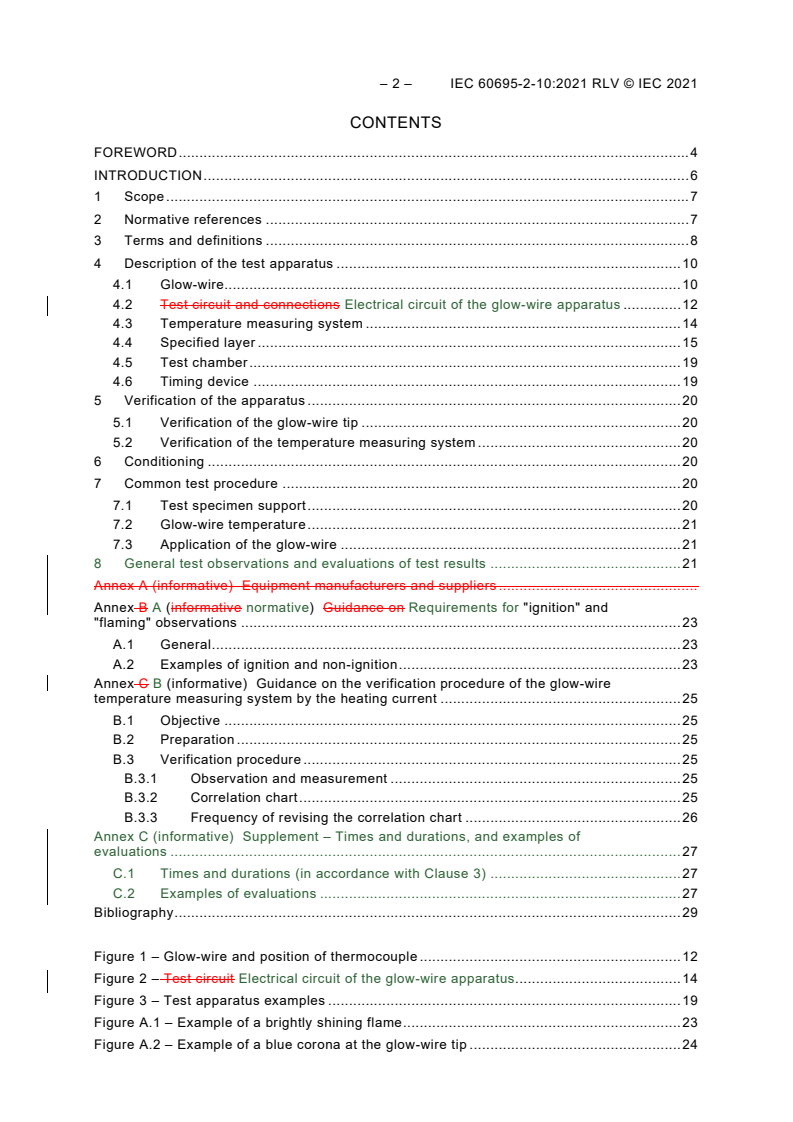
CONTENTS
FOREWORD . 4
INTRODUCTION . 6
1 Scope . 7
2 Normative references . 7
3 Terms and definitions . 8
4 Description of the test apparatus . 10
4.1 Glow-wire. 10
4.2 Test circuit and connections Electrical circuit of the glow-wire apparatus . 12
4.3 Temperature measuring system . 14
4.4 Specified layer . 15
4.5 Test chamber . 19
4.6 Timing device . 19
5 Verification of the apparatus . 20
5.1 Verification of the glow-wire tip . 20
5.2 Verification of the temperature measuring system . 20
6 Conditioning . 20
7 Common test procedure . 20
7.1 Test specimen support . 20
7.2 Glow-wire temperature . 21
7.3 Application of the glow-wire . 21
8 General test observations and evaluations of test results . 21
Annex A (informative) Equipment manufacturers and suppliers .
Annex B A (informative normative) Guidance on Requirements for "ignition" and
"flaming" observations . 23
A.1 General . 23
A.2 Examples of ignition and non-ignition . 23
Annex C B (informative) Guidance on the verification procedure of the glow-wire
temperature measuring system by the heating current . 25
B.1 Objective . 25
B.2 Preparation . 25
B.3 Verification procedure . 25
B.3.1 Observation and measurement . 25
B.3.2 Correlation chart . 25
B.3.3 Frequency of revising the correlation chart . 26
Annex C (informative) Supplement – Times and durations, and examples of
evaluations . 27
C.1 Times and durations (in accordance with Clause 3) . 27
C.2 Examples of evaluations . 27
Bibliography . 29
Figure 1 – Glow-wire and position of thermocouple . 12
Figure 2 – Test circuit Electrical circuit of the glow-wire apparatus. 14
Figure 3 – Test apparatus examples . 19
Figure A.1 – Example of a brightly shining flame . 23
Figure A.2 – Example of a blue corona at the glow-wire tip . 24
Figure A.3 – Example of ionized gases in the form of a blue corona tail near the glow
wire tip . 24
Figure B.1 – Correlation curve between the heating current and the glow-wire
temperature (example) . 26
Figure C.1 – Times and durations (in accordance with Clause 3) . 27
Figure C.2 – Evaluation scheme with examples . 28
– 4 – IEC 60695-2-10:2021 RLV © IEC 2021
INTERNATIONAL ELECTROTECHNICAL COMMISSION
____________
FIRE HAZARD TESTING –
Part 2-10: Glowing/hot-wire based test methods –
Glow-wire apparatus and common test procedure
FOREWORD
1) The International Electrotechnical Commission (IEC) is a worldwide organization for standardization comprising
all national electrotechnical committees (IEC National Committees). The object of IEC is to promote international
co-operation on all questions concerning standardization in the electrical and electronic fields. To this end and
in addition to other activities, IEC publishes International Standards, Technical Specifications, Technical Reports,
Publicly Available Specifications (PAS) and Guides (hereafter referred to as "IEC Publication(s)"). Their
preparation is entrusted to technical committees; any IEC National Committee interested in the subject dealt with
may participate in this preparatory work. International, governmental and non-governmental organizations liaising
with the IEC also participate in this preparation. IEC collaborates closely with the International Organization for
Standardization (ISO) in accordance with conditions determined by agreement between the two organizations.
2) The formal decisions or agreements of IEC on technical matters express, as nearly as possible, an international
consensus of opinion on the relevant subjects since each technical committee has representation from all
interested IEC National Committees.
3) IEC Publications have the form of recommendations for international use and are accepted by IEC National
Committees in that sense. While all reasonable efforts are made to ensure that the technical content of IEC
Publications is accurate, IEC cannot be held responsible for the way in which they are used or for any
misinterpretation by any end user.
4) In order to promote international uniformity, IEC National Committees undertake to apply IEC Publications
transparently to the maximum extent possible in their national and regional publications. Any divergence between
any IEC Publication and the corresponding national or regional publication shall be clearly indicated in the latter.
5) IEC itself does not provide any attestation of conformity. Independent certification bodies provide conformity
assessment services and, in some areas, access to IEC marks of conformity. IEC is not responsible for any
services carried out by independent certification bodies.
6) All users should ensure that they have the latest edition of this publication.
7) No liability shall attach to IEC or its directors, employees, servants or agents including individual experts and
members of its technical committees and IEC National Committees for any personal injury, property damage or
other damage of any nature whatsoever, whether direct or indirect, or for costs (including legal fees) and
expenses arising out of the publication, use of, or reliance upon, this IEC Publication or any other IEC
Publications.
8) Attention is drawn to the Normative references cited in this publication. Use of the referenced publications is
indispensable for the correct application of this publication.
9) Attention is drawn to the possibility that some of the elements of this IEC Publication may be the subject of patent
rights. IEC shall not be held responsible for identifying any or all such patent rights.
This redline version of the official IEC Standard allows the user to identify the changes
made to the previous edition IEC 60603-7:2013. A vertical bar appears in the margin
wherever a change has been made. Additions are in green text, deletions are in
strikethrough red text.
IEC 60695-2-10 has been prepared by IEC technical committee 89: Fire hazard testing. It is an
International Standard.
This third edition cancels and replaces the second edition published in 2013. This edition
constitutes a technical revision.
This edition includes the following significant technical changes with respect to the previous
edition:
a) New terms and definitions with regards to times and durations have been added to Clause 3.
b) Previous Annex A of Equipment manufacturers and suppliers has been deleted.
c) Annex A (previous Annex B) for ignition and flaming observations has been changed from
informative to normative.
d) New Annex C has been added, which visualizes times and durations, and gives examples
for the behaviour of specimens, and how to evaluate them.
The text of this International Standard is based on the following documents:
FDIS Report on voting
89/1535/FDIS 89/1547/RVD
Full information on the voting for its approval can be found in the report on voting indicated in
the above table.
The language used for the development of this International Standard is English.
This document was drafted in accordance with ISO/IEC Directives, Part 2, and developed in
accordance with ISO/IEC Directives, Part 1 and ISO/IEC Directives, IEC Supplement, available
at www.iec.ch/members_experts/refdocs. The main document types developed by IEC are
described in greater detail at www.iec.ch/standardsdev/publications.
It has the status of a basic safety publication in accordance with IEC Guide 104.
This standard is to be used in conjunction with IEC 60695-2-11, IEC 60695-2-12, and
IEC 60695-2-13.
A list of all parts in the IEC 60695 series, published under the general title Fire hazard testing,
can be found on the IEC website.
The committee has decided that the contents of this document will remain unchanged until the
stability date indicated on the IEC website under webstore.iec.ch in the data related to the
specific document. At this date, the document will be
• reconfirmed,
• withdrawn,
• replaced by a revised edition, or
• amended.
IMPORTANT – The 'colour inside' logo on the cover page of this publication indicates
that it contains colours which are considered to be useful for the correct understanding
of its contents. Users should therefore print this document using a colour printer.
The contents of the corrigendum 1 (2024-01) have been included in this copy.
– 6 – IEC 60695-2-10:2021 RLV © IEC 2021
INTRODUCTION
In the design of any electrotechnical product, the risk of fire and the potential hazards
associated with fire need to be considered. In this respect the objective of component, circuit,
and product design, as well as the choice of materials, is to reduce to acceptable levels the
potential risks of fire during normal operating conditions, reasonably foreseeable abnormal use,
malfunction, and/or failure. IEC 60695-1-10 [1] was developed, together with its companion,
IEC 60695-1-11 [2], to provide guidance on how this is to be accomplished.
The primary aims of IEC 60695-1-10 and IEC 60695-1-11 are to provide guidance on how:
a) to prevent ignition caused by an electrically energized component part; and
b) to confine any resulting fire within the bounds of the enclosure of the electrotechnical
product in the event of ignition.
Secondary aims of these documents include the minimization of any flame spread beyond the
product’s enclosure and the minimization of harmful effects of fire effluents such as heat,
smoke, toxicity and/or corrosivity.
Fires involving electrotechnical products can also be initiated from external non-electrical
sources. Considerations of this nature should be dealt with in the overall fire risk assessment.
In electrotechnical equipment, overheated metal parts can act as ignition sources. In glow-wire
tests, a glowing wire is used to simulate such an ignition source.
This part of IEC 60695 gives recommendations with regard to the glow-wire test apparatus and
describes a common test procedure for tests applicable to end products and materials to be
used with IEC 60695-2-11 which describes a glow-wire flammability test for end products
(GWEPT), IEC 60695-2-12 which describes a glow-wire flammability index test for materials
(GWFI), and IEC 60695-2-13 which describes a glow-wire ignition temperature test method for
materials (GWIT).
__________
Numbers in square brackets refer to the Bibliography.
FIRE HAZARD TESTING –
Part 2-10: Glowing/hot-wire based test methods –
Glow-wire apparatus and common test procedure
1 Scope
This part of IEC 60695 specifies the glow-wire apparatus and common test procedure to
simulate the effects of thermal stresses which may be produced by heat sources such as
glowing elements or overloaded resistors, for short periods, in order to assess the fire hazard
by a simulation technique.
The test procedure described in this document is a common test procedure intended for the
small-scale tests in which a standardized electrically heated wire is used as a source of ignition.
It is a common part of the test procedures applied to end products and to solid electrical
insulating materials or other solid combustible materials.
A detailed description of each particular test procedure is given in IEC 60695-2-11,
IEC 60695-2-12 and IEC 60695-2-13.
This basic safety publication focusing on safety test method(s) is primarily intended for use by
technical committees in the preparation of standards safety publications in accordance with the
principles laid down in IEC Guide 104 and ISO/IEC Guide 51.
One of the responsibilities of a technical committee is, wherever applicable, to make use of
basic safety publications in the preparation of its publications. The requirements, test methods
or test conditions of this basic safety publication will not apply unless specifically referred to or
included in the relevant publications.
2 Normative references
The following documents are referred to in the text in such a way that some or all of their content
constitutes requirements of this document. For dated references, only the edition cited applies.
For undated references, the latest edition of the referenced document (including any
amendments) applies.
IEC 60584-1, Thermocouples – Part 1: Reference tables
IEC 60584-2, Thermocouples – Part 2: Tolerances
IEC 60584-1, Thermocouples – Part 1: EMF specifications and tolerances
IEC 60695-2-11, Fire hazard testing – Part 2-11: Glowing/hot-wire based test methods –
Glow-wire flammability test method for end-products (GWEPT)
IEC 60695-2-12, Fire hazard testing – Part 2-12: Glowing/hot-wire based test methods –
Glow-wire flammability index (GWFI) test method for materials
IEC 60695-2-13, Fire hazard testing – Part 2-13: Glowing/hot-wire based test methods –
Glow-wire ignition temperature (GWIT) test method for materials
– 8 – IEC 60695-2-10:2021 RLV © IEC 2021
IEC Guide 104:2010, The preparation of safety publications and the use of basic safety
publications and group safety publications
ISO/IEC Guide 51:1999, Safety aspects – Guidelines for their inclusion in standards
ISO 4046-4:20022016, Paper, board, pulps and related terms – Vocabulary – Part 4: Paper and
board grades and converted products
ISO 13943:20082017, Fire safety – Vocabulary
3 Terms and definitions
For the purposes of this document, the terms and definitions given in ISO 13943:20082017,
some of which are reproduced below for the user's convenience, and the following apply.
ISO and IEC maintain terminological databases for use in standardization at the following
addresses:
• IEC Electropedia: available at http://www.electropedia.org/
• ISO Online browsing platform: available at http://www.iso.org/obp
3.1
combustible, adjective
capable of being ignited and burned
[SOURCE: ISO 13943:2008, definition 4.43 ISO 13943:2017, 3.52]
3.2
draught-free environment
space in which the results of experiments are not significantly affected by the local air speed
Note 1 to entry: A qualitative example is a space in which a wax candle flame remains essentially undisturbed.
−1 −1
Quantitative examples are small-scale fire tests in which a maximum air speed of 0,1 m·s or 0,2 m·s is sometimes
specified.
[SOURCE: ISO 13943:2008, definition 4.70 ISO 13943:2017, 3.83]
3.3
fire hazard
potential for harm associated with fire
Note 1 to entry: Alternatively, fire hazard can be a physical object or condition with a potential for an undesirable
consequence from fire.
[SOURCE: ISO 13943:2008, definition 4.112 ISO 13943:2017, 3.131]
3.4
fire test
test that measures fire behaviour of a fire or exposes an item to the effects of a fire
Note 1 to entry: The results of a fire test can be used to quantify fire severity or determine the fire resistance or
reaction to fire of the test specimen.
[SOURCE: ISO 13943:2008, definition 4.132 ISO 13943:2017, 3.157]
3.5
flame, noun
rapid, self-sustaining, sub-sonic propagation of combustion in a gaseous medium, usually with
emission of light
[SOURCE: ISO 13943:2008, definition 4.133 ISO 13943:2017, 3.159]
3.6
flame event
sustained flaming and/or glowing combustion
3.7
flammability
ability of a material or product to burn with a flame under specified conditions
[SOURCE: ISO 13943:2008, definition 4.151 ISO 13943:2017, 3.178]
3.8
ignition
DEPRECATED: sustained ignition
initiation of combustion
[SOURCE: ISO 13943:2008, definition 4.187 ISO 13943:2017, 3.217]
3.9
test temperature
temperature to which the tip of the glow-wire is heated and stabilized prior to any contact with
the test specimen
3.10
time of application
t
APP
application time of the glow-wire
Note 1 to entry: Time of application constitutes the first 30 s of the test.
Note 2 to entry: t was originally designated as t in Editions 1 and 2 of IEC 60695-2.
APP A
Note 3 to entry: See Annex C.
3.11
time of observation
t
OBS
observation time of the specimen and/or specified layer, starting immediately after t
APP
Note 1 to entry: Time of observation constitutes the second 30 s of the test.
Note 2 to entry: See Annex C.
3.12
time of ignition
t
I
time (to the nearest 0,5 s), from the start of test, at which the longest persisting flame event
starts
Note 1 to entry: This is a measured value.
Note 2 to entry: See Annex C.
– 10 – IEC 60695-2-10:2021 RLV © IEC 2021
3.13
time of extinguishing
t
E
time (to the nearest 0,5 s), from the start of the test, at which the longest persisting flame event
ends
Note 1 to entry: This is a measured value.
Note 2 to entry: See Annex C.
3.14
total flame event time
t
T
duration of the longest persisting flame event
t = t − t
T E I
Note 1 to entry: This is a calculated value.
Note 2 to entry: See Annex C.
3.15
flame time after removal
t
R
time elapsed after the removal of the glow-wire tip from the test specimen to the end of the
longest persisting flame event
= t − 30 s
t
R E
Note 1 to entry: If t is less than 30 s then t is zero.
E R
Note 2 to entry: This is a calculated value.
Note 3 to entry: See Annex C.
3.16
flame time during application
t
B
duration of the longest persisting flame event whilst the glow-wire tip is in contact with the test
specimen
t = t − t
B T R
Note 1 to entry: This is a calculated value.
Note 2 to entry: See Annex C.
4 Description of the test apparatus
4.1 Glow-wire
The glow-wire is formed from nickel/chromium (> 77 % Ni/20 ± 1 % Cr) wire, having an overall
diameter of 4,00 mm ± 0,07 mm (before bending). The dimensions of the glow-wire loop are as
detailed in Figure 1. When forming the glow-wire, ensure that fine cracking at the tip is avoided.
NOTE Annealing is a suitable process for prevention of fine cracking at the tip.
Z
12 ± 4
R26 ± 5
0,6 ± 0,2
R20 ± 5
Detail Z
50 ± 10
+ 2
IEC 632/13
Dimensions in millimetres
Glow-wire material: Nickel/Chromium (>77 %Ni/20 ± 1 %Cr)
Diameter: 4,0 mm ± 0,07 mm (before bending)
Dimension A: (after bending) see 5.1
When forming the glow-wire, care shall be taken to avoid fine cracking at the tip.
NOTE Annealing is a suitable process for prevention of fine cracking at the tip.
Key
1 Glow-wire
2 Thermocouple
3 Stud
–1
32 ± 2
A
– 12 – IEC 60695-2-10:2021 RLV © IEC 2021
Dimensions in millimetres
Key
1 Glow-wire
2 Thermocouple
3 Stud
Dimension A (after bending): see 5.1.
Figure 1 – Glow-wire and position of thermocouple
A new glow-wire shall be annealed for a total of at least 10 h by being subjected to a current of
at least 120 A before being used for a test run. The total annealing time may be achieved
cumulatively. To avoid damage, the thermocouple shall not be installed during annealing. At
the end of annealing, the depth of the thermocouple pocket hole shall be verified.
NOTE 1 The temperature of a new glow-wire which has not been annealed gradually lowers during the first few
hours when subjected to a flow of current. After a period of time the temperature then reaches equilibrium.
The test apparatus shall be designed so that the glow-wire is kept in a horizontal plane and
applies a force of 0,95 N ± 0,10 N to the test specimen during the application of the glow-wire.
The force shall be maintained at this value when the glow-wire or the test specimen is moved
horizontally one towards the other. The penetration of the tip of the glow-wire into and through
the test specimen shall be limited to 7 mm ± 0,5 mm.
The test apparatus shall be designed in such a way that burning or glowing particles falling from
the test specimen are able to fall without obstruction onto the layer as specified in 4.4.
Two typical examples of the test apparatus are shown in Figure 3a) and Figure 3b).
NOTE 2 The apparatus shown in Figure 3b) has been found useful when testing heavy and/or awkwardly shaped
test specimens.
4.2 Test circuit and connections Electrical circuit of the glow-wire apparatus
The glow-wire is heated by a simple electric circuit as shown in Figure 2. There shall be no
feedback mechanism or circuit to maintain the temperature. The power supply for the glow-wire
test apparatus shall be a stabilized voltage source (± 2 % rms). The test circuit shall contain a
current measuring device which indicates a true rms value with a maximum error of 1,0 %.
The glow-wire shall be heated by an electric circuit as shown in Figure 2. There shall be no
feedback mechanism or circuit to maintain the temperature. The input voltage supplying the
glow-wire test apparatus shall be stable (±2 %) during the test.
NOTE 1 The stable voltage can be supplied using an appropriate stabilized voltage source. As an alternative, it has
been found useful to monitor the input voltage supplied to the glow-wire test apparatus during the test.
The circuit shall contain a current measuring device which indicates a true RMS value having
an accuracy of ±2,5 % or more accurate.
Due to the high currents involved, it is essential that all electrical connections for the glow-wire
are capable of carrying the current without affecting the performance or long-term stability of
the circuit. For the glow-wire to stud connection, a sufficient contact area (typically at least
60 mm at each end) is necessary for the stable and loss-less current necessary for the test.
The glow-wire to stud connection shall be tightly screwed, soldered, or brazed between the
glow-wire and studs.
NOTE 2 The typical current necessary for heating the tip to a temperature of 960 °C is between 120 A and 150 A.
– 14 – IEC 60695-2-10:2021 RLV © IEC 2021
Mains
A
Variable Step down separating Glow-wire
auto-transformer transformer
IEC 633/13
Key
1 Mains input voltage supply
2 Stabilized voltage source (alternative to Key 3)
3 Input voltage measuring device (alternative to Key 2)
4 Variable auto-transformer
5 Step down separating transformer
6 Current measuring device
Figure 2 – Test circuit Electrical circuit of the glow-wire apparatus
4.3 Temperature measuring system
The temperature of the tip of the glow-wire shall be measured by a class 1 (see IEC 60584-2
IEC 60584-1) mineral-insulated metal-sheathed fine-wire thermocouple with an insulated
junction. It shall have an overall nominal diameter of 1,0 mm. The thermocouple wires shall be
suitable for continuous operation at temperatures up to 960 °C (e.g. chromel/alumel (Type K)
or NiCrSi/NiSi (Type N) – see IEC 60584-1). The welded point shall be located inside the sheath
as close to the tip as practicable. The sheath shall consist of a metal resistant to continuous
operation at a temperature of at least 1 050 °C.
NOTE A sheath made from a nickel-based heat-resistant alloy satisfies the above requirements.
The glow-wire, with the thermocouple inserted, is shown in Figure 1, Detail Z.
The thermocouple is arranged in a pocket hole, drilled in behind the tip of the glow-wire, and
maintained as a close fit as shown in Detail Z of Figure 1. The pocket hole shall be the smallest
diameter that can accommodate the inserted thermocouple in order to reduce the occurrence
of contamination during testing. The thermal contact between the tip of the thermocouple and
the end of the drilled hole shall be maintained. Care shall be taken to Ensure that the
thermocouple is able to follow the dimensional changes of the tip of the glow-wire caused by
heating.
The instrument for measuring the thermocouple voltages may consist of any commercial digital
thermometer with a built-in reference junction.
Other temperature measuring instrumentation may be used, but, in case of dispute, the
thermocouple method must be used.
4.4 Specified layer
To evaluate the possible spread of fire, for example by burning or glowing particles falling from
the test specimen, a specified layer is placed underneath the test specimen.
Unless otherwise specified, a single layer of wrapping tissue resting on, and in close contact
with the upper surface of a piece of wooden board (flat and smooth and having a minimum
thickness of 10 mm) is positioned at a distance of 200 mm ± 5 mm below the place where the
glow-wire is applied to the test specimen. See Figure 3a) and Figure 3b). Wrapping tissue (as
specified defined in ISO 4046-4:20022016, 4.215) is a soft and strong lightweight wrapping
2 2
tissue paper with a mass per unit area of between 12 g/m and 30 g/m .
– 16 – IEC 60695-2-10:2021 RLV © IEC 2021
6 10 8
IEC 634/13
Key
1 Test specimen support (see Figure 4) 8 Penetration adjustment
2 Carriage 9 Glow-wire
3 Tensioning cord 10 Cut-out in base plate for falling particles
4 Base plate 11 Glow-wire mounting stud
5 Weight 12 Low-friction rollers
6 Adjustable stop 13 Specified layer
7 Scale to measure height of flame
a) Test apparatus– static glow-wire, moving test specimen (example)
11 3
IEC 635/13
Key
1 Test specimen support (see Figure 4) 8 Penetration adjustment
2 Height adjustment screw 9 Glow-wire
3 Tensioning cord 10 Restraining pin
4 Base plate 11 Glow-wire mounting stud
5 Weight 12 Low-friction rollers
6 Adjustable stop 13 Specified layer
7 Scale to measure height of flame
b) Test apparatus – moving glow-wire, static test specimen (example)
– 18 – IEC 60695-2-10:2021 RLV © IEC 2021
Key
1 Test specimen support 8 Penetration adjustment
2 Carriage 9 Glow-wire
3 Tensioning cord 10 Cut-out in base plate for falling particles
4 Base plate 11 Glow-wire mounting stud
5 Weight 12 Low-friction rollers
6 Adjustable stop 13 Specified layer
7 Scale to measure height of flame
3a) Test apparatus – static glow-wire, moving test specimen (example)
Key
1 Test specimen support 8 Penetration adjustment
2 Height adjustment screw 9 Glow-wire
3 Tensioning cord 10 Restraining pin
4 Base plate 11 Glow-wire mounting stud
5 Weight 12 Low-friction rollers
6 Adjustable stop 13 Specified layer
7 Scale to measure height of flame
3b) Test apparatus – moving glow-wire, static test specimen (example)
Figure 3 – Test apparatus examples
4.5 Test chamber
The apparatus shall be operated in a draught-free environment having sufficient volume such
that
a) oxygen depletion during the test does not significantly affect the result, and
b) the test specimen can be mounted at least 100 mm from any surface.
NOTE 1 A chamber having a volume of at least 0,5 m is considered to have sufficient volume for the test.
Within the test location, the ambient light falling on the test specimen, not counting that from
the glow-wire, shall not exceed 20 lx. This is shall be measured with a lux meter positioned in
place of the test specimen facing towards the rear part of the location.
NOTE 2 Use of a dark background material will usually help in achieving the 20 lx limit.
After each test, the test location shall be vented to replace any depleted oxygen.
4.6 Timing device
The timing device shall have a resolution of 0,2 0,1 s or less.
– 20 – IEC 60695-2-10:2021 RLV © IEC 2021
5 Verification of the apparatus
5.1 Verification of the glow-wire tip
Before each series of tests, it is necessary to inspect the glow-wire tip shall be inspected by
measuring and recording dimension "A" as shown in Detail Z of Figure 1. The glow-wire shall
be replaced once this measurement is reduced to 97,5 % or less of the measurement taken
before its initial use.
On completion of each test, clean the tip, if necessary, to remove any residue of previously
tested material, for example by means of a wire brush (no copper or brass brush), and then
inspect the tip of the glow-wire for any cracks. If it is not possible to clean the tip without
damaging it (for example when there is molten glass fibre residue), then the glow-wire shall be
replaced.
5.2 Verification of the temperature measuring system
The temperature measuring system described in 4.3 shall be verified periodically using the
procedure described below.
A one-point verification of the temperature of the glow-wire can shall be performed using a foil
of silver with a purity of at least 99,8 %, approximately 2 mm in area and approximately
0,06 mm thick, placed upon the upper surface of the tip of the glow-wire. The glow-wire shall
be initially set at a temperature slightly lower than the melting point of the foil and allowed to
stabilize. The glow-wire temperature is then increased at a slow heating rate so that the melting
point may be accurately observed. When the silver starts to melt the thermometer shall indicate
960 °C ± 10 °C. The glow-wire, while still hot, shall be cleared of all traces of silver immediately
after this verification process to reduce the probability of alloying. In case of dispute, this
verification method using a silver foil shall be used.
NOTE Annex B provides guidance to complement the one-point verification procedure of the glow-wire temperature
measuring system by defining the relationship between the heating current and the glow-wire temperature. In order
to assist in setting test temperatures, it has been found useful to develop a reference chart immediately after
verification installing a new glow-wire and thermocouple indicating the current for each temperature. This reference
chart can be referred to on each use to verify that the current-temperature relationship remains consistent. A variation
to this relationship of more than 2 % would suggest that something in the apparatus has changed. In this situation,
a verification and recalibration of the test apparatus is indicated.
6 Conditioning
Before testing, the wooden board and wrapping tissue shall be stored for a minimum of 24 h in
an atmosphere having a temperature between 15 °C and 35 °C and a relative humidity between
45 % and 75 %.
7 Common test procedure
7.1 Test specimen support
The test specimen shall be mounted or clamped so that:
a) the heat losses due to the supporting or fixing means are insignificant (see Figure 4);
b) the planar area of the surface is vertical;
c) the tip of the glow-wire is applied to the centre of the planar area of the surface;
d) any dripping particles can flow freely without interference from the support.
Prior to each set of tests, the glow-wire application force shall be checked with a suitable device.
In addition, the free movement of the carriage along the full path shall be checked.
7.2 Glow-wire temperature
CAUTION – Precautions shall be taken to safeguard the health of personnel conducting tests
against:
– the risks of explosion, burning or fire;
– the risk of burns and electric shock;
– the inhalation of smoke and/or toxic products; and
– the risks of toxic residues.
Before heating the glow-wire to the specified temperature, there shall be no contamination in
the thermocouple hole drilled in the glow-wire and that there is appropriate thermocouple to
glow-wire contact. Appropriate contact shall be accomplished by gently pushing the
thermocouple into the full depth of the drilled hole.
The glow-wire is heated to the specified temperature which is measured by means of the
calibrated temperature measurement system. Before bringing the tip of the glow-wire into
contact with the test specimen, care shall be taken to ensure that:
a) this temperature is constant within 5 K for a period of at least 60 s;
b) there is no contamination in the thermocouple hole drilled in the glow-wire and there is
appropriate thermocouple to glow-wire contact. Appropriate contact shall be accomplished
by gently pushing the thermocouple into the full depth of the drilled hole;
b) heat radiation does not influence the test specimen during this period by providing an
adequate distance between the specimen and glow-wire, i.e. 5,0 cm minimum, or by using
an appropriate screen; and
c) no further adjustment to the heating current is to be made until after the test is completed.
7.3 Application of the glow-wire
The tip of the glow-wire is then brought smoothly into contact with the test specimen for a
duration of 30 s ± 1 s. An approximate rate of approach and withdrawal of 10 mm/s to 25 mm/s
has been found to be satisfactory. However, the rate of approach shall be reduced to near zero
upon contact to avoid impact forces exceeding 1,05 N. In those cases where the material melts
away from the glow-wire, the glow-wire shall not be kept in contact with the test specimen.
Following the application time, the glow-wire and the test specimen are slowly separated,
avoiding any further heating of the test specimen and any movement of air which might affect
the result of the test. The penetration of the tip of the glow-wire into and through the test
specimen shall be limited to 7 mm ± 0,5 mm.
NOTE During the tests conducted in accordance with IEC 60695-2-11, IEC 60695-2-12 and IEC 60695-2-13,
guidance on the observation of ignition and flaming can be found in Annex B.
8 General test observations and evaluations of test results
During the time of application of the glow-wire (t ), and during the time of observation (t ),
APP OBS
the test specimen, and the parts surrounding the test specimen (for GWEPT), or the specified
layer (for GWFI) placed below it, shall be observed, and t , t , t , t and t shall be recorded, if
I E B R T
applicable (see Annex C for times, durations, and examples of evaluations).
Details of observation and evaluation shall follow the sub-part of IEC 60695-2-11 for the end
product test and the sub-parts of IEC 60695-2-12 and IEC 60695-2-13 for the material tests.
During the tests conducted in accordance with IEC 60695-2-11, IEC 60695-2-12 and
IEC 60695-2-13, requirements for the observation of ignition and flaming are to be found in
Annex A.
– 22 – IEC 60695-2-10:2021 RLV © IEC 2021
Annex A
(informative)
Equipment manufacturers and suppliers
Equipment manufacturers and suppliers may be found by searching on the internet.
Annex B A
(informative normative)
Guidance on Requirements for "ignition" and "flaming" observations
A.1 General
During the tests conducted in accordance with IEC 60695-2-11, IEC 60695-2-12 and
IEC 60695-2-13, the following determination shall apply for "ignition" and flaming" observations.
a) A flame observed directly at the test specimen (see Figure A.1) shall be judged as a clear
indication of ignition.
NOTE Some materials show a pale flame instead of bright shiny flame.
b) Sometimes a circular corona can be observed around the tip of the glow-wire (see
Figure A.2). This corona consists of ionized gas, predominantly blue in colour and is located
in the immediate vicinity of the glow-wire. This phenomenon shall not be judged to be
ignition of the test specimen, as long as it does not lead to an ignition of the test specimen
according to a).
c) Ionized gases can sometimes be noticed along the glow-wire (see Figure A.3). This
phenomenon shall not be judged to be ignition of the test specimen, as long as it does not
lead to an ignition of the test specimen according to a).
A.2 Examples of ignition and non-ignition
Figure A.1 – Example of a brightly shining flame
This indicates that ignition has occurred.
– 24 – IEC 60695-2-10:2021 RLV © IEC 2021
Figure A.2 – Example of a blue corona at the glow-wire tip
This does not indicate that ignition has occurred.
Figure A.3 – Example of ionized gases in the form of a blue corona tail near
the glow wire tip
This does not indicate that ignition has occurred.
Annex C B
(informative)
Guidance on the verification procedure of the glow-wire
temperature measuring system by the heating current
B.1 Objective
The verification of the glow-wire temperature measuring system described in this document
(see 5.2) uses a one-point measurement based on the melting temperature of silver foil.
However, it assumes that this result covers verification at all other relevant test temperatures.
Annex B provides guidanc
...
IEC 60695-2-10 ®
Edition 3.0 2021-10
INTERNATIONAL
STANDARD
NORME
INTERNATIONALE
colour
inside
HORIZONTAL PUBLICATION
PUBLICATION HORIZONTALE
Fire hazard testing –
Part 2-10: Glowing/hot-wire based test methods – Glow-wire apparatus and
common test procedure
Essais relatifs aux risques du feu –
Partie 2-10: Essais au fil incandescent/chauffant – Appareillage et méthode
commune d’essai
All rights reserved. Unless otherwise specified, no part of this publication may be reproduced or utilized in any form
or by any means, electronic or mechanical, including photocopying and microfilm, without permission in writing from
either IEC or IEC's member National Committee in the country of the requester. If you have any questions about IEC
copyright or have an enquiry about obtaining additional rights to this publication, please contact the address below or
your local IEC member National Committee for further information.
Droits de reproduction réservés. Sauf indication contraire, aucune partie de cette publication ne peut être reproduite
ni utilisée sous quelque forme que ce soit et par aucun procédé, électronique ou mécanique, y compris la photocopie
et les microfilms, sans l'accord écrit de l'IEC ou du Comité national de l'IEC du pays du demandeur. Si vous avez des
questions sur le copyright de l'IEC ou si vous désirez obtenir des droits supplémentaires sur cette publication, utilisez
les coordonnées ci-après ou contactez le Comité national de l'IEC de votre pays de résidence.
IEC Central Office Tel.: +41 22 919 02 11
3, rue de Varembé info@iec.ch
CH-1211 Geneva 20 www.iec.ch
Switzerland
About the IEC
The International Electrotechnical Commission (IEC) is the leading global organization that prepares and publishes
International Standards for all electrical, electronic and related technologies.
About IEC publications
The technical content of IEC publications is kept under constant review by the IEC. Please make sure that you have the
latest edition, a corrigendum or an amendment might have been published.
IEC publications search - webstore.iec.ch/advsearchform IEC online collection - oc.iec.ch
The advanced search enables to find IEC publications by a Discover our powerful search engine and read freely all the
variety of criteria (reference number, text, technical publications previews. With a subscription you will always
committee, …). It also gives information on projects, replaced have access to up to date content tailored to your needs.
and withdrawn publications.
Electropedia - www.electropedia.org
IEC Just Published - webstore.iec.ch/justpublished
The world's leading online dictionary on electrotechnology,
Stay up to date on all new IEC publications. Just Published
containing more than 22 000 terminological entries in English
details all new publications released. Available online and
and French, with equivalent terms in 18 additional languages.
once a month by email.
Also known as the International Electrotechnical Vocabulary
(IEV) online.
IEC Customer Service Centre - webstore.iec.ch/csc
If you wish to give us your feedback on this publication or
need further assistance, please contact the Customer Service
Centre: sales@iec.ch.
A propos de l'IEC
La Commission Electrotechnique Internationale (IEC) est la première organisation mondiale qui élabore et publie des
Normes internationales pour tout ce qui a trait à l'électricité, à l'électronique et aux technologies apparentées.
A propos des publications IEC
Le contenu technique des publications IEC est constamment revu. Veuillez vous assurer que vous possédez l’édition la
plus récente, un corrigendum ou amendement peut avoir été publié.
Recherche de publications IEC - IEC online collection - oc.iec.ch
webstore.iec.ch/advsearchform Découvrez notre puissant moteur de recherche et consultez
La recherche avancée permet de trouver des publications IEC gratuitement tous les aperçus des publications. Avec un
en utilisant différents critères (numéro de référence, texte, abonnement, vous aurez toujours accès à un contenu à jour
comité d’études, …). Elle donne aussi des informations sur adapté à vos besoins.
les projets et les publications remplacées ou retirées.
Electropedia - www.electropedia.org
IEC Just Published - webstore.iec.ch/justpublished
Le premier dictionnaire d'électrotechnologie en ligne au
Restez informé sur les nouvelles publications IEC. Just
monde, avec plus de 22 000 articles terminologiques en
Published détaille les nouvelles publications parues.
anglais et en français, ainsi que les termes équivalents dans
Disponible en ligne et une fois par mois par email.
16 langues additionnelles. Egalement appelé Vocabulaire
Electrotechnique International (IEV) en ligne.
Service Clients - webstore.iec.ch/csc
Si vous désirez nous donner des commentaires sur cette
publication ou si vous avez des questions contactez-nous:
sales@iec.ch.
IEC 60695-2-10 ®
Edition 3.0 2021-10
INTERNATIONAL
STANDARD
NORME
INTERNATIONALE
colour
inside
HORIZONTAL PUBLICATION
PUBLICATION HORIZONTALE
Fire hazard testing –
Part 2-10: Glowing/hot-wire based test methods – Glow-wire apparatus and
common test procedure
Essais relatifs aux risques du feu –
Partie 2-10: Essais au fil incandescent/chauffant – Appareillage et méthode
commune d’essai
INTERNATIONAL
ELECTROTECHNICAL
COMMISSION
COMMISSION
ELECTROTECHNIQUE
INTERNATIONALE
ICS 13.220.40; 29.020 ISBN 978-2-8322-1010-9
– 2 – IEC 60695-2-10:2021 © IEC 2021
CONTENTS
FOREWORD . 4
INTRODUCTION . 6
1 Scope . 7
2 Normative references . 7
3 Terms and definitions . 8
4 Description of the test apparatus . 10
4.1 Glow-wire. 10
4.2 Electrical circuit of the glow-wire apparatus . 11
4.3 Temperature measuring system . 12
4.4 Specified layer . 13
4.5 Test chamber . 14
4.6 Timing device . 14
5 Verification of the apparatus . 15
5.1 Verification of the glow-wire tip . 15
5.2 Verification of the temperature measuring system . 15
6 Conditioning . 15
7 Common test procedure . 15
7.1 Test specimen support . 15
7.2 Glow-wire temperature . 16
7.3 Application of the glow-wire . 16
8 General test observations and evaluations of test results . 16
Annex A (normative) Requirements for "ignition" and "flaming" observations . 17
A.1 General . 17
A.2 Examples of ignition and non-ignition . 17
Annex B (informative) Guidance on the verification procedure of the glow-wire
temperature measuring system by the heating current . 19
B.1 Objective . 19
B.2 Preparation . 19
B.3 Verification procedure . 19
B.3.1 Observation and measurement . 19
B.3.2 Correlation chart . 19
B.3.3 Frequency of revising the correlation chart . 20
Annex C (informative) Supplement – Times and durations, and examples of
evaluations . 21
C.1 Times and durations (in accordance with Clause 3) . 21
C.2 Examples of evaluations . 21
Bibliography . 23
Figure 1 – Glow-wire and position of thermocouple . 11
Figure 2 – Electrical circuit of the glow-wire apparatus . 12
Figure 3 – Test apparatus examples . 14
Figure A.1 – Example of a brightly shining flame . 17
Figure A.2 – Example of a blue corona at the glow-wire tip . 18
Figure A.3 – Example of ionized gases in the form of a tail near the glow wire tip . 18
Figure B.1 – Correlation curve between the heating current and the glow-wire
temperature (example) . 20
Figure C.1 – Times and durations (Example: ignition occurs at 5 s and extinguishing
occurs at 50 s) . 21
Figure C.2 – Evaluation scheme with examples . 22
– 4 – IEC 60695-2-10:2021 © IEC 2021
INTERNATIONAL ELECTROTECHNICAL COMMISSION
____________
FIRE HAZARD TESTING –
Part 2-10: Glowing/hot-wire based test methods –
Glow-wire apparatus and common test procedure
FOREWORD
1) The International Electrotechnical Commission (IEC) is a worldwide organization for standardization comprising
all national electrotechnical committees (IEC National Committees). The object of IEC is to promote international
co-operation on all questions concerning standardization in the electrical and electronic fields. To this end and
in addition to other activities, IEC publishes International Standards, Technical Specifications, Technical Reports,
Publicly Available Specifications (PAS) and Guides (hereafter referred to as "IEC Publication(s)"). Their
preparation is entrusted to technical committees; any IEC National Committee interested in the subject dealt with
may participate in this preparatory work. International, governmental and non-governmental organizations liaising
with the IEC also participate in this preparation. IEC collaborates closely with the International Organization for
Standardization (ISO) in accordance with conditions determined by agreement between the two organizations.
2) The formal decisions or agreements of IEC on technical matters express, as nearly as possible, an international
consensus of opinion on the relevant subjects since each technical committee has representation from all
interested IEC National Committees.
3) IEC Publications have the form of recommendations for international use and are accepted by IEC National
Committees in that sense. While all reasonable efforts are made to ensure that the technical content of IEC
Publications is accurate, IEC cannot be held responsible for the way in which they are used or for any
misinterpretation by any end user.
4) In order to promote international uniformity, IEC National Committees undertake to apply IEC Publications
transparently to the maximum extent possible in their national and regional publications. Any divergence between
any IEC Publication and the corresponding national or regional publication shall be clearly indicated in the latter.
5) IEC itself does not provide any attestation of conformity. Independent certification bodies provide conformity
assessment services and, in some areas, access to IEC marks of conformity. IEC is not responsible for any
services carried out by independent certification bodies.
6) All users should ensure that they have the latest edition of this publication.
7) No liability shall attach to IEC or its directors, employees, servants or agents including individual experts and
members of its technical committees and IEC National Committees for any personal injury, property damage or
other damage of any nature whatsoever, whether direct or indirect, or for costs (including legal fees) and
expenses arising out of the publication, use of, or reliance upon, this IEC Publication or any other IEC
Publications.
8) Attention is drawn to the Normative references cited in this publication. Use of the referenced publications is
indispensable for the correct application of this publication.
9) Attention is drawn to the possibility that some of the elements of this IEC Publication may be the subject of patent
rights. IEC shall not be held responsible for identifying any or all such patent rights.
IEC 60695-2-10 has been prepared by IEC technical committee 89: Fire hazard testing. It is an
International Standard.
This third edition cancels and replaces the second edition published in 2013. This edition
constitutes a technical revision.
This edition includes the following significant technical changes with respect to the previous
edition:
a) New terms and definitions with regards to times and durations have been added to Clause 3.
b) Previous Annex A of Equipment manufacturers and suppliers has been deleted.
c) Annex A (previous Annex B) for ignition and flaming observations has been changed from
informative to normative.
d) New Annex C has been added, which visualizes times and durations, and gives examples
for the behaviour of specimens, and how to evaluate them.
The text of this International Standard is based on the following documents:
FDIS Report on voting
89/1535/FDIS 89/1547/RVD
Full information on the voting for its approval can be found in the report on voting indicated in
the above table.
The language used for the development of this International Standard is English.
This document was drafted in accordance with ISO/IEC Directives, Part 2, and developed in
accordance with ISO/IEC Directives, Part 1 and ISO/IEC Directives, IEC Supplement, available
at www.iec.ch/members_experts/refdocs. The main document types developed by IEC are
described in greater detail at www.iec.ch/standardsdev/publications.
It has the status of a basic safety publication in accordance with IEC Guide 104.
This standard is to be used in conjunction with IEC 60695-2-11, IEC 60695-2-12, and
IEC 60695-2-13.
A list of all parts in the IEC 60695 series, published under the general title Fire hazard testing,
can be found on the IEC website.
The committee has decided that the contents of this document will remain unchanged until the
stability date indicated on the IEC website under webstore.iec.ch in the data related to the
specific document. At this date, the document will be
• reconfirmed,
• withdrawn,
• replaced by a revised edition, or
• amended.
IMPORTANT – The 'colour inside' logo on the cover page of this publication indicates
that it contains colours which are considered to be useful for the correct understanding
of its contents. Users should therefore print this document using a colour printer.
– 6 – IEC 60695-2-10:2021 © IEC 2021
INTRODUCTION
In the design of any electrotechnical product, the risk of fire and the potential hazards
associated with fire need to be considered. In this respect the objective of component, circuit,
and product design, as well as the choice of materials, is to reduce to acceptable levels the
potential risks of fire during normal operating conditions, reasonably foreseeable abnormal use,
malfunction, and/or failure. IEC 60695-1-10 [1] was developed, together with its companion,
IEC 60695-1-11 [2], to provide guidance on how this is to be accomplished.
The primary aims of IEC 60695-1-10 and IEC 60695-1-11 are to provide guidance on how:
a) to prevent ignition caused by an electrically energized component part; and
b) to confine any resulting fire within the bounds of the enclosure of the electrotechnical
product in the event of ignition.
Secondary aims of these documents include the minimization of any flame spread beyond the
product’s enclosure and the minimization of harmful effects of fire effluents such as heat,
smoke, toxicity and/or corrosivity.
Fires involving electrotechnical products can also be initiated from external non-electrical
sources. Considerations of this nature should be dealt with in the overall fire risk assessment.
In electrotechnical equipment, overheated metal parts can act as ignition sources. In glow-wire
tests, a glowing wire is used to simulate such an ignition source.
This part of IEC 60695 gives recommendations with regard to the glow-wire test apparatus and
describes a common test procedure for tests applicable to end products and materials to be
used with IEC 60695-2-11 which describes a glow-wire flammability test for end products
(GWEPT), IEC 60695-2-12 which describes a glow-wire flammability index test for materials
(GWFI), and IEC 60695-2-13 which describes a glow-wire ignition temperature test method for
materials (GWIT).
__________
Numbers in square brackets refer to the Bibliography.
FIRE HAZARD TESTING –
Part 2-10: Glowing/hot-wire based test methods –
Glow-wire apparatus and common test procedure
1 Scope
This part of IEC 60695 specifies the glow-wire apparatus and common test procedure to
simulate the effects of thermal stresses which may be produced by heat sources such as
glowing elements or overloaded resistors, for short periods, in order to assess the fire hazard
by a simulation technique.
The test procedure described in this document is a common test procedure intended for the
small-scale tests in which a standardized electrically heated wire is used as a source of ignition.
It is a common part of the test procedures applied to end products and to solid electrical
insulating materials or other solid combustible materials.
A detailed description of each particular test procedure is given in IEC 60695-2-11,
IEC 60695-2-12 and IEC 60695-2-13.
This basic safety publication focusing on safety test method(s) is primarily intended for use by
technical committees in the preparation of safety publications in accordance with the principles
laid down in IEC Guide 104 and ISO/IEC Guide 51.
One of the responsibilities of a technical committee is, wherever applicable, to make use of
basic safety publications in the preparation of its publications.
2 Normative references
The following documents are referred to in the text in such a way that some or all of their content
constitutes requirements of this document. For dated references, only the edition cited applies.
For undated references, the latest edition of the referenced document (including any
amendments) applies.
IEC 60584-1, Thermocouples – Part 1: EMF specifications and tolerances
IEC 60695-2-11, Fire hazard testing – Part 2-11: Glowing/hot-wire based test methods –
Glow-wire flammability test method for end-products (GWEPT)
IEC 60695-2-12, Fire hazard testing – Part 2-12: Glowing/hot-wire based test methods –
Glow-wire flammability index (GWFI) test method for materials
IEC 60695-2-13, Fire hazard testing – Part 2-13: Glowing/hot-wire based test methods –
Glow-wire ignition temperature (GWIT) test method for materials
ISO 4046-4:2016, Paper, board, pulps and related terms – Vocabulary – Part 4: Paper and
board grades and converted products
ISO 13943:2017, Fire safety – Vocabulary
– 8 – IEC 60695-2-10:2021 © IEC 2021
3 Terms and definitions
For the purposes of this document, the terms and definitions given in ISO 13943:2017, some of
which are reproduced below for the user's convenience, and the following apply.
ISO and IEC maintain terminological databases for use in standardization at the following
addresses:
• IEC Electropedia: available at http://www.electropedia.org/
• ISO Online browsing platform: available at http://www.iso.org/obp
3.1
combustible, adjective
capable of being ignited and burned
[SOURCE: ISO 13943:2017, 3.52]
3.2
draught-free environment
space in which the results of experiments are not significantly affected by the local air speed
Note 1 to entry: A qualitative example is a space in which a wax candle flame remains essentially undisturbed.
−1 −1
Quantitative examples are small-scale fire tests in which a maximum air speed of 0,1 m·s or 0,2 m·s is sometimes
specified.
[SOURCE: ISO 13943:2017, 3.83]
3.3
fire hazard
potential for harm associated with fire
Note 1 to entry: Alternatively, fire hazard can be a physical object or condition with a potential for an undesirable
consequence from fire.
[SOURCE: ISO 13943:2017, 3.131]
3.4
fire test
test that measures fire behaviour or exposes an item to the effects of a fire
Note 1 to entry: The results of a fire test can be used to quantify fire severity or determine the fire resistance or
reaction to fire of the test specimen.
[SOURCE: ISO 13943:2017, 3.157]
3.5
flame, noun
rapid, self-sustaining, sub-sonic propagation of combustion in a gaseous medium, usually with
emission of light
[SOURCE: ISO 13943:2017, 3.159]
3.6
flame event
sustained flaming and/or glowing combustion
3.7
flammability
ability of a material or product to burn with a flame under specified conditions
[SOURCE: ISO 13943:2017, 3.178]
3.8
ignition
DEPRECATED: sustained ignition
initiation of combustion
[SOURCE: ISO 13943:2017, 3.217]
3.9
test temperature
temperature to which the tip of the glow-wire is heated and stabilized prior to any contact with
the test specimen
3.10
time of application
t
APP
application time of the glow-wire
Note 1 to entry: Time of application constitutes the first 30 s of the test.
Note 2 to entry: t was originally designated as t in Editions 1 and 2 of IEC 60695-2.
APP A
Note 3 to entry: See Annex C.
3.11
time of observation
t
OBS
observation time of the specimen and/or specified layer, starting immediately after t
APP
Note 1 to entry: Time of observation constitutes the second 30 s of the test.
Note 2 to entry: See Annex C.
3.12
time of ignition
t
I
time (to the nearest 0,5 s), from the start of test, at which the longest persisting flame event
starts
Note 1 to entry: This is a measured value.
Note 2 to entry: See Annex C.
3.13
time of extinguishing
t
E
time (to the nearest 0,5 s), from the start of the test, at which the longest persisting flame event
ends
Note 1 to entry: This is a measured value.
Note 2 to entry: See Annex C.
– 10 – IEC 60695-2-10:2021 © IEC 2021
3.14
total flame event time
t
T
duration of the longest persisting flame event
t = t − t
T E I
Note 1 to entry: This is a calculated value.
Note 2 to entry: See Annex C.
3.15
flame time after removal
t
R
time elapsed after the removal of the glow-wire tip from the test specimen to the end of the
longest persisting flame event
t = t − 30 s
R E
Note 1 to entry: If t is less than 30 s then t is zero.
E R
Note 2 to entry: This is a calculated value.
Note 3 to entry: See Annex C.
3.16
flame time during application
t
B
duration of the longest persisting flame event whilst the glow-wire tip is in contact with the test
specimen
t = t − t
B T R
Note 1 to entry: This is a calculated value.
Note 2 to entry: See Annex C.
4 Description of the test apparatus
4.1 Glow-wire
The glow-wire is formed from nickel/chromium (> 77 % Ni/20 ± 1 % Cr) wire, having an overall
diameter of 4,00 mm ± 0,07 mm (before bending). The dimensions of the glow-wire loop are as
detailed in Figure 1. When forming the glow-wire, ensure that fine cracking at the tip is avoided.
NOTE Annealing is a suitable process for prevention of fine cracking at the tip.
Dimensions in millimetres
Key
1 Glow-wire
2 Thermocouple
3 Stud
Dimension A (after bending): see 5.1.
Figure 1 – Glow-wire and position of thermocouple
A new glow-wire shall be annealed for a total of at least 10 h by being subjected to a current of
at least 120 A before being used for a test run. The total annealing time may be achieved
cumulatively. To avoid damage, the thermocouple shall not be installed during annealing. At
the end of annealing, the depth of the thermocouple pocket hole shall be verified.
NOTE 1 The temperature of a new glow-wire which has not been annealed gradually lowers during the first few
hours when subjected to a flow of current. After a period of time the temperature then reaches equilibrium.
The test apparatus shall be designed so that the glow-wire is kept in a horizontal plane and
applies a force of 0,95 N ± 0,10 N to the test specimen during the application of the glow-wire.
The force shall be maintained at this value when the glow-wire or the test specimen is moved
horizontally one towards the other. The penetration of the tip of the glow-wire into and through
the test specimen shall be limited to 7 mm ± 0,5 mm.
The test apparatus shall be designed in such a way that burning or glowing particles falling from
the test specimen are able to fall without obstruction onto the layer as specified in 4.4.
Two typical examples of the test apparatus are shown in Figure 3a) and Figure 3b).
NOTE 2 The apparatus shown in Figure 3b) has been found useful when testing heavy and/or awkwardly shaped
test specimens.
4.2 Electrical circuit of the glow-wire apparatus
The glow-wire shall be heated by an electric circuit as shown in Figure 2. There shall be no
feedback mechanism or circuit to maintain the temperature. The input voltage supplying the
glow-wire test apparatus shall be stable (±2 %) during the test.
NOTE 1 The stable voltage can be supplied using an appropriate stabilized voltage source. As an alternative, it has
been found useful to monitor the input voltage supplied to the glow-wire test apparatus during the test.
– 12 – IEC 60695-2-10:2021 © IEC 2021
The circuit shall contain a current measuring device which indicates a true RMS value having
an accuracy of ±2,5 % or more accurate.
Due to the high currents involved, it is essential that all electrical connections for the glow-wire
are capable of carrying the current without affecting the performance or long-term stability of
the circuit. For the glow-wire to stud connection, a sufficient contact area (typically at least
at each end) is necessary for the stable and loss-less current necessary for the test.
60 mm
The glow-wire to stud connection shall be tightly screwed, soldered, or brazed between the
glow-wire and studs.
NOTE 2 The typical current necessary for heating the tip to a temperature of 960 °C is between 120 A and 150 A.
Key
1 Mains input voltage supply
2 Stabilized voltage source (alternative to Key 3)
3 Input voltage measuring device (alternative to Key 2)
4 Variable auto-transformer
5 Step down separating transformer
6 Current measuring device
Figure 2 – Electrical circuit of the glow-wire apparatus
4.3 Temperature measuring system
The temperature of the tip of the glow-wire shall be measured by a class 1 (see IEC 60584-1)
mineral-insulated metal-sheathed fine-wire thermocouple with an insulated junction. It shall
have an overall nominal diameter of 1,0 mm. The thermocouple wires shall be suitable for
continuous operation at temperatures up to 960 °C (e.g. chromel/alumel (Type K) or NiCrSi/NiSi
(Type N) – see IEC 60584-1). The welded point shall be located inside the sheath as close to
the tip as practicable. The sheath shall consist of a metal resistant to continuous operation at
a temperature of at least 1 050 °C.
NOTE A sheath made from a nickel-based heat-resistant alloy satisfies the above requirements.
The glow-wire, with the thermocouple inserted, is shown in Figure 1, Detail Z.
The thermocouple is arranged in a pocket hole, drilled in behind the tip of the glow-wire, and
maintained as a close fit as shown in Detail Z of Figure 1. The pocket hole shall be the smallest
diameter that can accommodate the inserted thermocouple in order to reduce the occurrence
of contamination during testing. The thermal contact between the tip of the thermocouple and
the end of the drilled hole shall be maintained. Ensure that the thermocouple is able to follow
the dimensional changes of the tip of the glow-wire caused by heating.
The instrument for measuring the thermocouple voltages may consist of any commercial digital
thermometer with a built-in reference junction.
4.4 Specified layer
To evaluate the possible spread of fire, for example by burning or glowing particles falling from
the test specimen, a specified layer is placed underneath the test specimen.
Unless otherwise specified, a single layer of wrapping tissue resting on, and in close contact
with the upper surface of a piece of wooden board (flat and smooth and having a minimum
thickness of 10 mm) is positioned at a distance of 200 mm ± 5 mm below the place where the
glow-wire is applied to the test specimen. See Figure 3a) and Figure 3b). Wrapping tissue (as
defined in ISO 4046-4:2016, 4.215) is a soft and strong lightweight wrapping paper with a mass
2 2
per unit area of between 12 g/m and 30 g/m .
Key
1 Test specimen support 8 Penetration adjustment
2 Carriage 9 Glow-wire
3 Tensioning cord 10 Cut-out in base plate for falling particles
4 Base plate 11 Glow-wire mounting stud
5 Weight 12 Low-friction rollers
6 Adjustable stop 13 Specified layer
7 Scale to measure height of flame
3a) Test apparatus – static glow-wire, moving test specimen (example)
– 14 – IEC 60695-2-10:2021 © IEC 2021
Key
1 Test specimen support 8 Penetration adjustment
2 Height adjustment screw 9 Glow-wire
3 Tensioning cord 10 Restraining pin
4 Base plate 11 Glow-wire mounting stud
5 Weight 12 Low-friction rollers
6 Adjustable stop 13 Specified layer
7 Scale to measure height of flame
3b) Test apparatus – moving glow-wire, static test specimen (example)
Figure 3 – Test apparatus examples
4.5 Test chamber
The apparatus shall be operated in a draught-free environment having sufficient volume such
that
a) oxygen depletion during the test does not significantly affect the result, and
b) the test specimen can be mounted at least 100 mm from any surface.
NOTE 1 A chamber having a volume of at least 0,5 m is considered to have sufficient volume for the test.
Within the test location, the ambient light falling on the test specimen, not counting that from
the glow-wire, shall not exceed 20 lx. This shall be measured with a lux meter positioned in
place of the test specimen facing towards the rear part of the location.
NOTE 2 Use of a dark background material will usually help in achieving the 20 lx limit.
After each test, the test location shall be vented to replace any depleted oxygen.
4.6 Timing device
The timing device shall have a resolution of 0,1 s or less.
5 Verification of the apparatus
5.1 Verification of the glow-wire tip
Before each series of tests, the glow-wire tip shall be inspected by measuring and recording
dimension "A" as shown in Detail Z of Figure 1. The glow-wire shall be replaced once this
measurement is reduced to 97,5 % or less of the measurement taken before its initial use.
On completion of each test, clean the tip, if necessary, to remove any residue of previously
tested material, for example by means of a wire brush (no copper or brass brush), and then
inspect the tip of the glow-wire for any cracks. If it is not possible to clean the tip without
damaging it (for example when there is molten glass fibre residue), then the glow-wire shall be
replaced.
5.2 Verification of the temperature measuring system
The temperature measuring system described in 4.3 shall be verified periodically using the
procedure described below.
A one-point verification of the temperature of the glow-wire shall be performed using a foil of
silver with a purity of at least 99,8 %, approximately 2 mm in area and approximately 0,06 mm
thick, placed upon the upper surface of the tip of the glow-wire. The glow-wire shall be initially
set at a temperature slightly lower than the melting point of the foil and allowed to stabilize. The
glow-wire temperature is then increased at a slow heating rate so that the melting point may be
accurately observed. When the silver starts to melt the thermometer shall indicate
960 °C ± 10 °C. The glow-wire, while still hot, shall be cleared of all traces of silver immediately
after this verification process to reduce the probability of alloying.
NOTE Annex B provides guidance to complement the one-point verification procedure of the glow-wire temperature
measuring system by defining the relationship between the heating current and the glow-wire temperature. In order
to assist in setting test temperatures, it has been found useful to develop a reference chart immediately after installing
a new glow-wire and thermocouple indicating the current for each temperature. This reference chart can be referred
to on each use to verify that the current-temperature relationship remains consistent. A variation to this relationship
of more than 2 % would suggest that something in the apparatus has changed. In this situation, a verification and
recalibration of the test apparatus is indicated.
6 Conditioning
Before testing, the wooden board and wrapping tissue shall be stored for a minimum of 24 h in
an atmosphere having a temperature between 15 °C and 35 °C and a relative humidity between
45 % and 75 %.
7 Common test procedure
7.1 Test specimen support
The test specimen shall be mounted or clamped so that:
a) the heat losses due to the supporting or fixing means are insignificant;
b) the planar area of the surface is vertical;
c) the tip of the glow-wire is applied to the centre of the planar area of the surface;
d) any dripping particles can flow freely without interference from the support.
Prior to each set of tests, the glow-wire application force shall be checked with a suitable device.
In addition, the free movement of the carriage along the full path shall be checked.
– 16 – IEC 60695-2-10:2021 © IEC 2021
7.2 Glow-wire temperature
CAUTION – Precautions shall be taken to safeguard the health of personnel conducting tests
against:
– the risks of explosion, burning or fire;
– the risk of burns and electric shock;
– the inhalation of smoke and/or toxic products; and
– the risks of toxic residues.
Before heating the glow-wire to the specified temperature, there shall be no contamination in
the thermocouple hole drilled in the glow-wire and that there is appropriate thermocouple to
glow-wire contact. Appropriate contact shall be accomplished by gently pushing the
thermocouple into the full depth of the drilled hole.
The glow-wire is heated to the specified temperature which is measured by means of the
calibrated temperature measurement system. Before bringing the tip of the glow-wire into
contact with the test specimen, ensure that:
a) this temperature is constant within 5 K for a period of at least 60 s;
b) heat radiation does not influence the test specimen during this period by providing an
adequate distance between the specimen and glow-wire, i.e. 5,0 cm minimum, or by using
an appropriate screen; and
c) no further adjustment to the heating current is to be made until after the test is completed.
7.3 Application of the glow-wire
The tip of the glow-wire is then brought smoothly into contact with the test specimen for a
duration of 30 s ± 1 s. An approximate rate of approach and withdrawal of 10 mm/s to 25 mm/s
has been found to be satisfactory. However, the rate of approach shall be reduced to near zero
upon contact to avoid impact forces exceeding 1,05 N. In those cases where the material melts
away from the glow-wire, the glow-wire shall not be kept in contact with the test specimen.
Following the application time, the glow-wire and the test specimen are slowly separated,
avoiding any further heating of the test specimen and any movement of air which might affect
the result of the test. The penetration of the tip of the glow-wire into and through the test
specimen shall be limited to 7 mm ± 0,5 mm.
8 General test observations and evaluations of test results
During the time of application of the glow-wire (t ), and during the time of observation (t ),
APP OBS
the test specimen, and the parts surrounding the test specimen (for GWEPT), or the specified
layer (for GWFI) placed below it, shall be observed, and t , t , t , t and t shall be recorded, if
I E B R T
applicable (see Annex C for times, durations, and examples of evaluations).
Details of observation and evaluation shall follow the sub-part of IEC 60695-2-11 for the end
product test and the sub-parts of IEC 60695-2-12 and IEC 60695-2-13 for the material tests.
During the tests conducted in accordance with IEC 60695-2-11, IEC 60695-2-12 and
IEC 60695-2-13, requirements for the observation of ignition and flaming are to be found in
Annex A.
Annex A
(normative)
Requirements for "ignition" and "flaming" observations
A.1 General
During the tests conducted in accordance with IEC 60695-2-11, IEC 60695-2-12 and
IEC 60695-2-13, the following determination shall apply for "ignition" and flaming" observations.
a) A flame observed directly at the test specimen (see Figure A.1) shall be judged as a clear
indication of ignition.
NOTE Some materials show a pale flame instead of bright shiny flame.
b) Sometimes a circular corona can be observed around the tip of the glow-wire (see
Figure A.2). This corona consists of ionized gas, predominantly blue in colour and is located
in the immediate vicinity of the glow-wire. This phenomenon shall not be judged to be
ignition of the test specimen, as long as it does not lead to an ignition of the test specimen
according to a).
c) Ionized gases can sometimes be noticed along the glow-wire (see Figure A.3). This
phenomenon shall not be judged to be ignition of the test specimen, as long as it does not
lead to an ignition of the test specimen according to a).
A.2 Examples of ignition and non-ignition
Figure A.1 – Example of a brightly shining flame
This indicates that ignition has occurred.
– 18 – IEC 60695-2-10:2021 © IEC 2021
Figure A.2 – Example of a blue corona at the glow-wire tip
This does not indicate that ignition has occurred.
Figure A.3 – Example of ionized gases in the form of a tail near the glow wire tip
This does not indicate that ignition has occurred.
Annex B
(informative)
Guidance on the verification procedure of the glow-wire
temperature measuring system by the heating current
B.1 Objective
The verification of the glow-wire temperature measuring system described in this document
(see 5.2) uses a one-point measurement based on the melting temperature of silver foil.
However, it assumes that this result covers verification at all other relevant test temperatures.
Annex B provides guidance to complement the one-point verification procedure of the glow-wire
temperature measuring system by defining the relationship between the heating current and the
glow-wire temperature. It provides a practical verification procedure across the entire range of
test temperatures intended for use in IEC 60695-2-11, IEC 60695-2-12 and IEC 60695-2-13.
B.2 Preparation
The following actions should be taken before establishing the relationship between heating
current and glow-wire temperature measurement:
a) anneal the glow-wire (see 4.1);
b) ensure that the input voltage supplying the glow-wire is stable as defined in 4.2;
c) confirm that the glow-wire to stud electrical connection is sufficient to ensure no electrical
loss or temperature rise at the connection which may adversely affect the performance or
long-term stability of the circuit (see 4.2);
d) confirm that there is proper contact between the thermocouple and the glow-wire, taking
into account any dimensional change that may occur upon the heating of the glow-wire (see
4.3);
e) inspect the glow-wire for any damage and, if necessary, clean all contamination from the
glow-wire tip (including the thermocouple pocket hole) (see 5.1); and
f) confirm the dimensions of the glow-wire (see 5.1).
B.3 Verification procedure
B.3.1 Observation and measurement
Immediately after completion of the one-point temperature measurement verification (see 5.2),
the glow-wire is heated to 960 °C. After the temperature has stabilized (±5 °C) for at least 60 s,
the heating current and the indicated temperature are recorded. This process is repeated at
intervals of 50 K (60 K above 900 °C) down to 500 °C (i.e. 960 °C, 900 °C, 850 °C, …, 550 °C,
500 °C).
NOTE Dimensional changes to the tip of the glow-wire caused by heating can affect the thermocouple to glow-wire
contact. As stated in Clause B.2, item d), it has been found useful to verify this cont
...