


IEC 61747-10-1:2013
(Main)Liquid crystal display devices - Part 10-1: Environmental, endurance and mechanical test methods - Mechanical
General Information
- Abstract
IEC 61747-10-1:2013 lists test methods applicable to liquid crystal display devices. It takes into account, wherever possible, the mechanical robustness test methods as outlined in IEC 60068. The object of this standard is to establish uniform preferred test methods with preferred values for stress levels for judging the mechanical properties of liquid crystal display devices. This first edition of IEC 61747-10-1 cancels and replaces Clauses 1 and 2 of the first edition of IEC 61747-5 published in 1998. This edition constitutes a technical revision.
- Status
- Published
- Publication Date
- 09-Jul-2013
- Technical Committee
- TC 110 - Electronic displays
- Drafting Committee
- WG 2 - TC 110/WG 2
- Current Stage
- PPUB - Publication issued
- Start Date
- 10-Jul-2013
- Completion Date
- 30-Sep-2013
Overview
IEC 61747-10-1:2013 is an international standard developed by the International Electrotechnical Commission (IEC) for liquid crystal display (LCD) devices. This standard, part of the broader IEC 61747 series, specifies mechanical test methods to evaluate the reliability, durability, and mechanical robustness of LCD devices, including both cells and modules. By referencing proven methodologies such as those from IEC 60068, it promotes uniformity and consistency in assessing LCD mechanical performance globally.
Key Topics
The standard addresses critical aspects of the mechanical testing of LCD devices, including:
- Mechanical Robustness: Guidance on assessing the durability of LCD terminations, such as wire terminations, pins, connectors, and flexible cables.
- Soldering Tests: Application of standardized tests to evaluate solderability and resistance to soldering heat for devices with leads.
- Vibration Testing: Methods for sinusoidal vibration testing to determine an LCD’s ability to withstand mechanical vibrations during operation or transport.
- Shock and Acceleration: Procedures to test resistance to mechanical shock and steady-state acceleration, ensuring LCDs remain operational after exposure to abrupt forces.
- Bond Strength: Test methods for determining the strength and reliability of bonds, especially in devices using flexible flat cable technology.
- Uniform Test Conditions: Establishes preferred values for temperature, humidity, air pressure, and endurance durations to ensure reliable and repeatable results.
Applications
IEC 61747-10-1:2013 delivers practical value for:
- Manufacturers of LCD devices: Ensures that products meet universally recognized levels of mechanical robustness, supporting international market access.
- Quality Assurance and Reliability Engineering: Enables consistent application of mechanical endurance tests during R&D, production, and pre-shipment stages.
- Component Selection and Procurement: Assists purchasers in specifying LCDs with proven mechanical durability, reducing risk in end applications.
- Certification and Regulatory Compliance: Offers the framework for certifying LCD products in line with global standards, simplifying conformity assessments and audits.
- Product Development: Facilitates comparative evaluation of design improvements, material choices, and assembly techniques related to mechanical integrity.
Related Standards
IEC 61747-10-1:2013 harmonizes with several other key international standards to ensure comprehensive LCD device assessment:
- IEC 60068 Series: Reference environmental and mechanical test methods, including:
- IEC 60068-2-6: Vibration (sinusoidal)
- IEC 60068-2-7: Steady-state acceleration
- IEC 60068-2-20: Solderability and resistance to soldering heat
- IEC 60068-2-21: Robustness of terminations
- IEC 60068-2-27: Shock testing
- IEC 60747 and IEC 60748 Series: Standards for semiconductor devices, integral to display electronics.
- IEC 60749-14: Specifics on lead integrity and robustness.
- IEC 61747-1: The generic specification for liquid crystal and solid-state display devices.
- IEC 61747-5-3: Related methods for testing glass strength and reliability in LCDs.
Practical Value
Organizations applying IEC 61747-10-1:2013 benefit from:
- Global uniformity in mechanical test requirements and procedures for LCD devices.
- Reliable product comparison and benchmarking thanks to standardized stress levels and preferred values.
- Reduced risk of failures due to defined methodologies for assessing soldering, vibration, shock, bond strength, and acceleration endurance.
- Streamlined communication and specification across manufacturers, suppliers, and clients, facilitated by clear, internationally recognized test criteria.
Implementing IEC 61747-10-1 supports the production and selection of mechanically robust, high-quality LCD devices suited for diverse applications, including consumer electronics, industrial displays, automotive systems, and more.
Relations
- Effective Date
- 05-Sep-2023
Frequently Asked Questions
IEC 61747-10-1:2013 is a standard published by the International Electrotechnical Commission (IEC). Its full title is "Liquid crystal display devices - Part 10-1: Environmental, endurance and mechanical test methods - Mechanical". This standard covers: IEC 61747-10-1:2013 lists test methods applicable to liquid crystal display devices. It takes into account, wherever possible, the mechanical robustness test methods as outlined in IEC 60068. The object of this standard is to establish uniform preferred test methods with preferred values for stress levels for judging the mechanical properties of liquid crystal display devices. This first edition of IEC 61747-10-1 cancels and replaces Clauses 1 and 2 of the first edition of IEC 61747-5 published in 1998. This edition constitutes a technical revision.
IEC 61747-10-1:2013 lists test methods applicable to liquid crystal display devices. It takes into account, wherever possible, the mechanical robustness test methods as outlined in IEC 60068. The object of this standard is to establish uniform preferred test methods with preferred values for stress levels for judging the mechanical properties of liquid crystal display devices. This first edition of IEC 61747-10-1 cancels and replaces Clauses 1 and 2 of the first edition of IEC 61747-5 published in 1998. This edition constitutes a technical revision.
IEC 61747-10-1:2013 is classified under the following ICS (International Classification for Standards) categories: 31.120 - Electronic display devices. The ICS classification helps identify the subject area and facilitates finding related standards.
IEC 61747-10-1:2013 has the following relationships with other standards: It is inter standard links to IEC 61747-5:1998. Understanding these relationships helps ensure you are using the most current and applicable version of the standard.
IEC 61747-10-1:2013 is available in PDF format for immediate download after purchase. The document can be added to your cart and obtained through the secure checkout process. Digital delivery ensures instant access to the complete standard document.
Standards Content (Sample)
IEC 61747-10-1 ®
Edition 1.0 2013-07
INTERNATIONAL
STANDARD
NORME
INTERNATIONALE
Liquid crystal display devices –
Part 10-1: Environmental, endurance and mechanical test methods – Mechanical
Dispositifs d'affichage à cristaux liquides –
Partie 10-1: Méthodes d’essais d’environnement, d’endurance et mécaniques –
Essais mécaniques
All rights reserved. Unless otherwise specified, no part of this publication may be reproduced or utilized in any form
or by any means, electronic or mechanical, including photocopying and microfilm, without permission in writing from
either IEC or IEC's member National Committee in the country of the requester.
If you have any questions about IEC copyright or have an enquiry about obtaining additional rights to this publication,
please contact the address below or your local IEC member National Committee for further information.
Droits de reproduction réservés. Sauf indication contraire, aucune partie de cette publication ne peut être reproduite ni
utilisée sous quelque forme que ce soit et par aucun procédé, électronique ou mécanique, y compris la photocopie et les
microfilms, sans l'accord écrit de la CEI ou du Comité national de la CEI du pays du demandeur.
Si vous avez des questions sur le copyright de la CEI ou si vous désirez obtenir des droits supplémentaires sur cette
publication, utilisez les coordonnées ci-après ou contactez le Comité national de la CEI de votre pays de résidence.
IEC Central Office Tel.: +41 22 919 02 11
3, rue de Varembé Fax: +41 22 919 03 00
CH-1211 Geneva 20 info@iec.ch
Switzerland www.iec.ch
About the IEC
The International Electrotechnical Commission (IEC) is the leading global organization that prepares and publishes
International Standards for all electrical, electronic and related technologies.
About IEC publications
The technical content of IEC publications is kept under constant review by the IEC. Please make sure that you have the
latest edition, a corrigenda or an amendment might have been published.
Useful links:
IEC publications search - www.iec.ch/searchpub Electropedia - www.electropedia.org
The advanced search enables you to find IEC publications The world's leading online dictionary of electronic and
by a variety of criteria (reference number, text, technical electrical terms containing more than 30 000 terms and
committee,…). definitions in English and French, with equivalent terms in
It also gives information on projects, replaced and additional languages. Also known as the International
withdrawn publications. Electrotechnical Vocabulary (IEV) on-line.
IEC Just Published - webstore.iec.ch/justpublished Customer Service Centre - webstore.iec.ch/csc
Stay up to date on all new IEC publications. Just Published If you wish to give us your feedback on this publication
details all new publications released. Available on-line and or need further assistance, please contact the
also once a month by email. Customer Service Centre: csc@iec.ch.
A propos de la CEI
La Commission Electrotechnique Internationale (CEI) est la première organisation mondiale qui élabore et publie des
Normes internationales pour tout ce qui a trait à l'électricité, à l'électronique et aux technologies apparentées.
A propos des publications CEI
Le contenu technique des publications de la CEI est constamment revu. Veuillez vous assurer que vous possédez
l’édition la plus récente, un corrigendum ou amendement peut avoir été publié.
Liens utiles:
Recherche de publications CEI - www.iec.ch/searchpub Electropedia - www.electropedia.org
La recherche avancée vous permet de trouver des Le premier dictionnaire en ligne au monde de termes
publications CEI en utilisant différents critères (numéro de électroniques et électriques. Il contient plus de 30 000
référence, texte, comité d’études,…). termes et définitions en anglais et en français, ainsi que
Elle donne aussi des informations sur les projets et les les termes équivalents dans les langues additionnelles.
publications remplacées ou retirées. Egalement appelé Vocabulaire Electrotechnique
International (VEI) en ligne.
Just Published CEI - webstore.iec.ch/justpublished
Service Clients - webstore.iec.ch/csc
Restez informé sur les nouvelles publications de la CEI.
Just Published détaille les nouvelles publications parues. Si vous désirez nous donner des commentaires sur
Disponible en ligne et aussi une fois par mois par email. cette publication ou si vous avez des questions
contactez-nous: csc@iec.ch.
IEC 61747-10-1 ®
Edition 1.0 2013-07
INTERNATIONAL
STANDARD
NORME
INTERNATIONALE
Liquid crystal display devices –
Part 10-1: Environmental, endurance and mechanical test methods – Mechanical
Dispositifs d'affichage à cristaux liquides –
Partie 10-1: Méthodes d’essais d’environnement, d’endurance et mécaniques –
Essais mécaniques
INTERNATIONAL
ELECTROTECHNICAL
COMMISSION
COMMISSION
ELECTROTECHNIQUE
PRICE CODE
INTERNATIONALE
CODE PRIX M
ICS 31.120 ISBN 978-2-8322-0893-9
– 2 – 61747-10-1 © IEC:2013
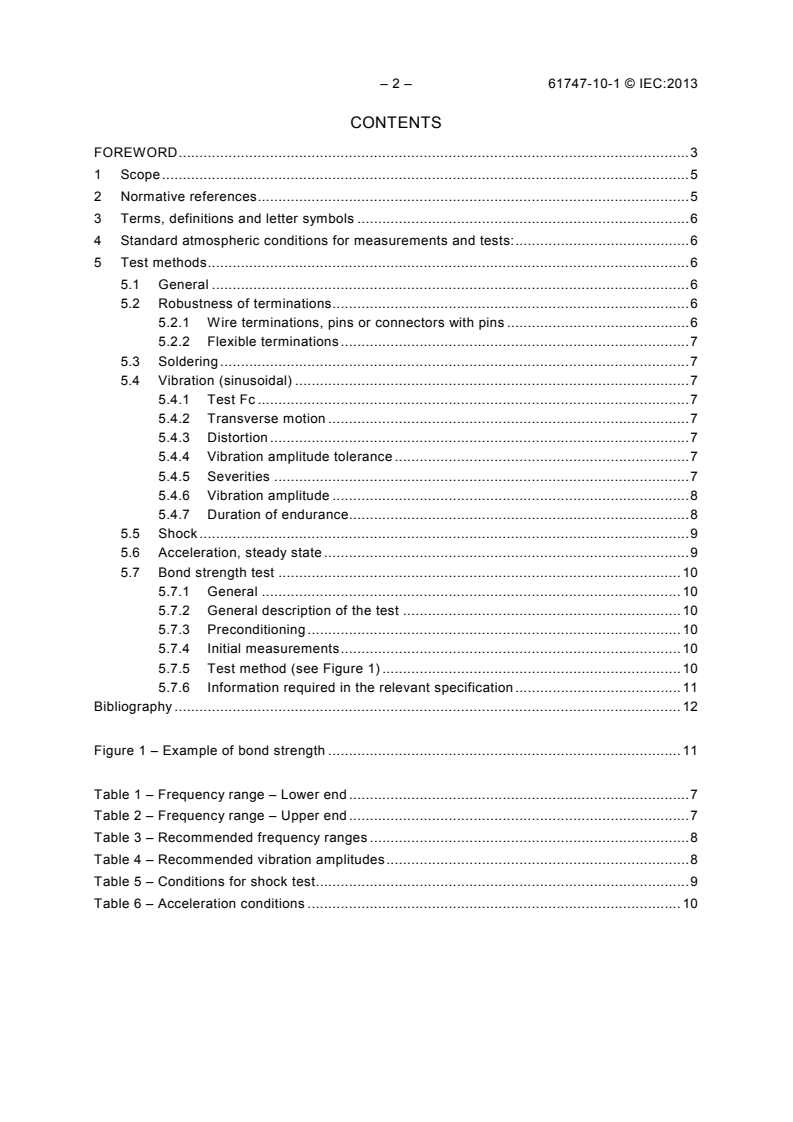
CONTENTS
FOREWORD . 3
1 Scope . 5
2 Normative references . 5
3 Terms, definitions and letter symbols . 6
4 Standard atmospheric conditions for measurements and tests: . 6
5 Test methods . 6
5.1 General . 6
5.2 Robustness of terminations . 6
5.2.1 Wire terminations, pins or connectors with pins . 6
5.2.2 Flexible terminations . 7
5.3 Soldering . 7
5.4 Vibration (sinusoidal) . 7
5.4.1 Test Fc . 7
5.4.2 Transverse motion . 7
5.4.3 Distortion . 7
5.4.4 Vibration amplitude tolerance . 7
5.4.5 Severities . 7
5.4.6 Vibration amplitude . 8
5.4.7 Duration of endurance . 8
5.5 Shock . 9
5.6 Acceleration, steady state . 9
5.7 Bond strength test . 10
5.7.1 General . 10
5.7.2 General description of the test . 10
5.7.3 Preconditioning . 10
5.7.4 Initial measurements . 10
5.7.5 Test method (see Figure 1) . 10
5.7.6 Information required in the relevant specification . 11
Bibliography . 12
Figure 1 – Example of bond strength . 11
Table 1 – Frequency range – Lower end . 7
Table 2 – Frequency range – Upper end . 7
Table 3 – Recommended frequency ranges . 8
Table 4 – Recommended vibration amplitudes . 8
Table 5 – Conditions for shock test . 9
Table 6 – Acceleration conditions . 10
61747-10-1 © IEC:2013 – 3 –
INTERNATIONAL ELECTROTECHNICAL COMMISSION
____________
LIQUID CRYSTAL DISPLAY DEVICES –
Part 10-1: Environmental, endurance and
mechanical test methods – Mechanical
FOREWORD
1) The International Electrotechnical Commission (IEC) is a worldwide organization for standardization comprising
all national electrotechnical committees (IEC National Committees). The object of IEC is to promote
international co-operation on all questions concerning standardization in the electrical and electronic fields. To
this end and in addition to other activities, IEC publishes International Standards, Technical Specifications,
Technical Reports, Publicly Available Specifications (PAS) and Guides (hereafter referred to as “IEC
Publication(s)”). Their preparation is entrusted to technical committees; any IEC National Committee interested
in the subject dealt with may participate in this preparatory work. International, governmental and non-
governmental organizations liaising with the IEC also participate in this preparation. IEC collaborates closely
with the International Organization for Standardization (ISO) in accordance with conditions determined by
agreement between the two organizations.
2) The formal decisions or agreements of IEC on technical matters express, as nearly as possible, an international
consensus of opinion on the relevant subjects since each technical committee has representation from all
interested IEC National Committees.
3) IEC Publications have the form of recommendations for international use and are accepted by IEC National
Committees in that sense. While all reasonable efforts are made to ensure that the technical content of IEC
Publications is accurate, IEC cannot be held responsible for the way in which they are used or for any
misinterpretation by any end user.
4) In order to promote international uniformity, IEC National Committees undertake to apply IEC Publications
transparently to the maximum extent possible in their national and regional publications. Any divergence
between any IEC Publication and the corresponding national or regional publication shall be clearly indicated in
the latter.
5) IEC itself does not provide any attestation of conformity. Independent certification bodies provide conformity
assessment services and, in some areas, access to IEC marks of conformity. IEC is not responsible for any
services carried out by independent certification bodies.
6) All users should ensure that they have the latest edition of this publication.
7) No liability shall attach to IEC or its directors, employees, servants or agents including individual experts and
members of its technical committees and IEC National Committees for any personal injury, property damage or
other damage of any nature whatsoever, whether direct or indirect, or for costs (including legal fees) and
expenses arising out of the publication, use of, or reliance upon, this IEC Publication or any other IEC
Publications.
8) Attention is drawn to the Normative references cited in this publication. Use of the referenced publications is
indispensable for the correct application of this publication.
9) Attention is drawn to the possibility that some of the elements of this IEC Publication may be the subject of
patent rights. IEC shall not be held responsible for identifying any or all such patent rights.
International Standard IEC 61747-10-1 has been prepared by IEC technical committee 110:
Electronic display devices.
This first edition of IEC 61747-10-1 cancels and replaces Clauses 1 and 2 of the first edition of
IEC 61747-5 published in 1998. This edition constitutes a technical revision.
NOTE It is intended that the other clauses of IEC 61747-5:1998 will be replaced by new parts in the IEC 61747
series. The details of the intended changes are given in Annex D of IEC 61747-30-1:2012.
– 4 – 61747-10-1 © IEC:2013
The text of this standard is based on the following documents:
CDV Report on voting
110/395/CDV 110/454/RVC
Full information on the voting for the approval of this standard can be found in the report on
voting indicated in the above table.
This publication has been drafted in accordance with the ISO/IEC Directives, Part 2.
A list of all parts in the IEC 61747 series, published under the general title Liquid crystal
display devices can be found on the IEC website.
Future standards in this series will carry the new general title as cited above. Titles of existing
standards in this series will be updated at the time of the next edition.
The committee has decided that the contents of this publication will remain unchanged until the
stability date indicated on the IEC web site under "http://webstore.iec.ch" in the data related to
the specific publication. At this date, the publication will be
• reconfirmed,
• withdrawn,
• replaced by a revised edition, or
• amended.
61747-10-1 © IEC:2013 – 5 –
LIQUID CRYSTAL DISPLAY DEVICES –
Part 10-1: Environmental, endurance and
mechanical test methods – Mechanical
1 Scope
This part of IEC 61747 lists test methods applicable to liquid crystal display devices. It takes
into account, wherever possible, the mechanical robustness test methods as outlined in
IEC 60068.
NOTE Devices include cells and modules.
The object of this standard is to establish uniform preferred test methods with preferred values
for stress levels for judging the mechanical properties of liquid crystal display devices.
In case of contradiction between this standard and a relevant specification, it is the latter that
should govern.
2 Normative references
The following documents, in whole or in part, are normatively referenced in this document and
are indispensable for its application. For dated references, only the edition cited applies. For
undated references, the latest edition of the referenced document (including any amendments)
applies.
IEC 60068 (all parts), Environmental testing
IEC 60068-2-6, Environmental testing – Part 2-6: Tests – Test Fc: Vibration (sinusoidal)
IEC 60068-2-7, Basic environmental testing procedures – Part 2-7: Tests – Test Ga and
guidance: Acceleration, steady state
IEC 60068-2-20, Environmental testing – Part 2-20: Tests – Test T: Test methods for
solderability and resistance to soldering heat of devices with leads
IEC 60068-2-21, Environmental testing – Part 2-21: Tests – Test U: Robustness of terminations
and integral mounting devices
IEC 60068-2-27, Environmental testing – Part 2-27: Tests – Test Ea and guidance: Shock
IEC 60747 (all parts), Semiconductor devices
IEC 60748 (all parts), Semiconductor devices – Integrated circuits
IEC 60749-14, Semiconductor devices – Mechanical and climatic test methods – Part 14:
Robustness of terminations (lead integrity)
IEC 61747-1, Liquid crystal and solid-state display devices − Part 1: Generic specification
– 6 – 61747-10-1 © IEC:2013
3 Terms, definitions and letter symbols
For the purposes of this document, the terms, definitions and letter symbols given in IEC 60068,
IEC 60747, IEC 60748 and IEC 61747-1 apply.
4 Standard atmospheric conditions for measurements and tests:
Unless otherwise specified, all tests and measurements shall be carried out under standard
atmospheric conditions for testing:
Temperature: 15 °C to 35 °C
Relative humidity: 25 % to 85 % RH, where appropriate
Air pressure: 86 kPa to 106 kPa (860 mbar to 1 060 mbar)
The absolute humidity of the atmosphere shall not exceed 22 g/m .
5 Test methods
5.1 General
Choice of the appropriate tests depends on the type of devices. The relevant specification shall
state which tests are applicable.
5.2 Robustness of terminations
5.2.1 Wire terminations, pins or connectors with pins
5.2.1.1 Test U
Test U, specified in IEC 60068-2-21, is applicable.
5.2.1.2 Tensile
This test shall be in accordance with test Ua1 of IEC 60068-2-21, with the following specific
requirements.
After the test, examine under 3× to 10× magnification.
The device shall be rejected if there is breakage, loosening or relative motion between the lead
or termination and the device body.
5.2.1.3 Bending
This test shall be in accordance with test Ub of IEC 60068-2-21.
5.2.1.4 Torsion
See IEC 60749-14.
Applied only for cells with pin.
5.2.1.5 Torque
See IEC 60749-14.
Applied only for cells with pin.
61747-10-1 © IEC:2013 – 7 –
5.2.2 Flexible terminations
Under consideration.
5.3 Soldering
Test T, specified in IEC 60068-2-20, is applicable.
This test shall be in accordance with test Ta (methods 1, 2) (only methods 1 and 2 are
referenced, these methods are solder bath and soldering iron).
5.4 Vibration (sinusoidal)
5.4.1 Test Fc
Test Fc, specified in IEC 60068-2-6, is applicable, with the following specific requirements.
5.4.2 Transverse motion
The maximum vibration amplitude at the check points in any perpendicular to the specified axis
shall not exceed 25 %.
5.4.3 Distortion
Not exceeding 25 %.
5.4.4 Vibration amplitude tolerance
Reference point: ±15 %
Check point: ±25 %
5.4.5 Severities
The frequency range shall be given in the relevant specification by selecting a lower frequency
from Table 1 and an upper frequency from Table 2.
Table 1 – Frequency range – Lower end
Lower frequency f
Hz
Table 2 – Frequency range – Upper end
Upper frequency f
Hz
– 8 – 61747-10-1 © IEC:2013
The recommended ranges are shown in Table 3.
Table 3 – Recommended frequency ranges
Recommended frequency ranges, from f to f
1 2
Hz
1 to 55
10 to 55
10 to 300
10 to 500
55 to 500
5.4.6 Vibration amplitude
The recommended vibration amplitudes with cross-over frequency are shown in Table 4.
Table 4 – Recommended vibration amplitudes
Displacement amplitude below Acceleration amplitude above
the cross-over frequency the cross-over frequency
mm m/s g
n
0,035 4,9 0,5
0,075 9,8 1,0
0,15 19,6 2,0
0,35 49,0 5,0
0,75 98,0 10,0
NOTE The values listed apply in Table 4 for cross-over frequencies between 57 Hz and 62 Hz.
5.4.7 Duration of endurance
5.4.7.1 Endurance by sweeping
The duration of the endurance in each axis shall be given as a number of sweep cycles given
preference by the relevant specification from the list given below:
1, 2, 5, 10, 20.
5.4.7.2 Endurance at critical frequencies
The duration of the endurance in each appropriate axis at each critical frequency found during
the vibration response investigation shall be given preference in the relevant specification from
the list given below:
10 min ± 0,5 min
30 min ± 1 min
90 min ± 1 min
10 h ± 5 min
The body of the device shall be securely clamped during the test. If the device has a specified
method of installation, it shall be used to clamp the device.
61747-10-1 © IEC:2013 – 9 –
5.5 Shock
Test Ea, specified in IEC 60068-2-27, is applicable, with the following specific requirements.
The conditions shall be selected from Table 5, taking into consideration the mass of the device
and its internal construction.
Table 5 – Conditions for shock test
Peak amplitude A Corresponding duration D Corresponding
of the nominal pulse velocity change ∆V
Half-sine Final-peak
saw-tooth
ms m/s m/s
m/s (g )
n
50 (5) 30 1,0 –
150 (15) 11 1,0 0,8
150 (15) 6 0,6 0,4
300 (30) 18 3,4 2,6
300 (30) 11 2,1 1,6
300 (30) 6 1,1 0,9
500 (50) 20 6,2 4,9
500 (50) 11 3,4 2,7
500 (50) 3 0,9 0,7
700 (70) 11 4,8 3,8
1 000 (100) 11 6,9 5,4
1 000 (100) 6 3,7 2,9
2 000 (200) 6 7,5 5,9
2 000 (200) 3 3,7 2,9
NOTE The preferred values are underlined.
The relevant specification shall state the wave form utilized.
The device shall be subjected to three successive shocks, in both directions of three mutually-
perpendicular axes chosen so that faults are most likely to be revealed, i.e. a total of 18 shocks
(see IEC 60068-2-27.) The preferred combinations are underlined.
The body of the device shall be securely clamped during the test. If the device has a specified
method of installation, it shall be used to clamp the device.
5.6 Acceleration, steady state
Test Ga, specified in IEC 60068-2-7, is applicable, with the following specific requirements.
The acceleration conditions shall be selected from Table 6.
– 10 – 61747-10-1 © IEC:2013
Table 6 – Acceleration conditions
Acceleration
m/s
1 000
2 000
Procedure:
The acceleration shall be applied for at least 1 min, in both directions of the three major axes,
unless otherwise specified.
The body of the device shall be securely clamped during the test. If the device has a specified
method of installation, it shall be used to clamp the device.
5.7 Bond strength test
5.7.1 General
The purpose of this test is to measure bond strength or to determine compliance with specified
bond strength requirements. This test is intended to show the bond strength on devices of
flexible flat cables.
5.7.2 General description of the test
The flexible flat cable is pulled as shown in Figure 1, with
...