

IEC 62977-2-8:2025
(Main)Electronic displays - Part 2-8: Measurements of optical characteristics - Reflective displays
General Information
- Abstract
IEC 62977-2-8:2025 specifies standard measurement conditions and methods for determining the optical characteristics of reflective direct view displays that render real 2D images on a flat panel. This document applies to flat panel displays operated in a reflective mode with any integrated light sources turned off during measurement. The input signal is unbounded and encodes either monochrome or colour images.
- Status
- Published
- Publication Date
- 17-Jun-2025
- Technical Committee
- TC 110 - Electronic displays
- Drafting Committee
- WG 13 - TC 110/WG 13
- Current Stage
- PPUB - Publication issued
- Start Date
- 18-Jun-2025
- Completion Date
- 06-Jun-2025

Overview - IEC 62977-2-8:2025 for reflective displays
IEC 62977-2-8:2025 is an international standard that defines standard measurement conditions and methods for determining the optical characteristics of reflective direct‑view flat panel displays. It applies to flat panel displays operated in a reflective mode (with integrated light sources turned off) and covers input signals that represent monochrome or colour 2D images. The standard establishes how to measure reflectance, contrast, colour, and directional behaviour of reflective displays under defined illumination and viewing geometries.
Key topics and technical requirements
This part of IEC 62977 focuses on optical measurement methodology and includes:
- Illumination specifications: defined standard illumination spectra and configurations (directional, conical, ring/annulus, hemispherical diffuse and specular illumination).
- Light measuring devices (LMDs): requirements and recommended conditions for measurement instruments, including receiver inclination effects and measuring spot geometry.
- Measurement arrangements: coordinate systems and geometry for DUT (device under test), source and LMD positioning.
- Reflection and reflectance metrics:
- Reflectance factor under hemispherical diffuse illumination
- Off‑specular reflectance under directional illumination
- Specular reflectance using annulus and variable aperture sources
- Haze reflectance factor
- Contrast and colour measurements:
- Contrast ratio under specified illumination (diffuse, off‑specular, ambient)
- Colour measurement methods under defined illumination, including use of CIELAB and calculation of CIELAB colour gamut volume
- Viewing direction variation: methods to quantify viewing direction range and conditions for grey‑level inversion.
- Test methods and artefacts: standard test patterns, measurement fields, working standards (diffuse and specular reflectance standards), and temporal stability requirements.
- Informative annexes on illumination, BRDF considerations, and substitution methods for spectral irradiance/reflectance.
Practical applications and users
IEC 62977-2-8 is valuable for professionals involved in design, testing and certification of reflective displays, such as:
- Display manufacturers (e‑paper, transflective LCDs, microdisplay designers)
- Test laboratories and metrology facilities performing optical characterization
- R&D teams developing outdoor/low‑power display technologies
- Quality assurance and compliance engineers
- System integrators and OEMs specifying display performance for outdoor signage, wearable devices, instrument panels, and e‑readers
Using the standard ensures consistent, repeatable optical measurements that support product specification, competitive benchmarking, regulatory compliance and interoperability between suppliers and test labs.
Related standards
- IEC 62977 series (other parts covering emissive/transmissive measurements and test methods)
- References to colourimetry conventions (CIELAB) and BRDF measurement principles are used within the standard; users should align with relevant CIE/ISO guidance where appropriate.
Keywords: IEC 62977-2-8, reflective displays, optical measurements, reflectance, contrast ratio, CIELAB, light measuring device (LMD), illumination, BRDF.
Frequently Asked Questions
IEC 62977-2-8:2025 is a standard published by the International Electrotechnical Commission (IEC). Its full title is "Electronic displays - Part 2-8: Measurements of optical characteristics - Reflective displays". This standard covers: IEC 62977-2-8:2025 specifies standard measurement conditions and methods for determining the optical characteristics of reflective direct view displays that render real 2D images on a flat panel. This document applies to flat panel displays operated in a reflective mode with any integrated light sources turned off during measurement. The input signal is unbounded and encodes either monochrome or colour images.
IEC 62977-2-8:2025 specifies standard measurement conditions and methods for determining the optical characteristics of reflective direct view displays that render real 2D images on a flat panel. This document applies to flat panel displays operated in a reflective mode with any integrated light sources turned off during measurement. The input signal is unbounded and encodes either monochrome or colour images.
IEC 62977-2-8:2025 is classified under the following ICS (International Classification for Standards) categories: 31.120 - Electronic display devices; 31.260 - Optoelectronics. Laser equipment. The ICS classification helps identify the subject area and facilitates finding related standards.
IEC 62977-2-8:2025 is available in PDF format for immediate download after purchase. The document can be added to your cart and obtained through the secure checkout process. Digital delivery ensures instant access to the complete standard document.
Standards Content (Sample)
IEC 62977-2-8 ®
Edition 1.0 2025-06
INTERNATIONAL
STANDARD
Electronic displays –
Part 2-8: Measurements of optical characteristics – Reflective displays
ICS 31.120; 31.260 ISBN 978-2-8327-0416-5
All rights reserved. Unless otherwise specified, no part of this publication may be reproduced or utilized in any form or
by any means, electronic or mechanical, including photocopying and microfilm, without permission in writing from either
IEC or IEC's member National Committee in the country of the requester. If you have any questions about IEC copyright
or have an enquiry about obtaining additional rights to this publication, please contact the address below or your local
IEC member National Committee for further information.
IEC Secretariat Tel.: +41 22 919 02 11
3, rue de Varembé info@iec.ch
CH-1211 Geneva 20 www.iec.ch
Switzerland
About the IEC
The International Electrotechnical Commission (IEC) is the leading global organization that prepares and publishes
International Standards for all electrical, electronic and related technologies.
About IEC publications
The technical content of IEC publications is kept under constant review by the IEC. Please make sure that you have the
latest edition, a corrigendum or an amendment might have been published.
IEC publications search - IEC Products & Services Portal - products.iec.ch
webstore.iec.ch/advsearchform Discover our powerful search engine and read freely all the
The advanced search enables to find IEC publications by a
publications previews, graphical symbols and the glossary.
variety of criteria (reference number, text, technical With a subscription you will always have access to up to date
committee, …). It also gives information on projects, content tailored to your needs.
replaced and withdrawn publications.
Electropedia - www.electropedia.org
IEC Just Published - webstore.iec.ch/justpublished The world's leading online dictionary on electrotechnology,
Stay up to date on all new IEC publications. Just Published containing more than 22 500 terminological entries in English
details all new publications released. Available online and and French, with equivalent terms in 25 additional languages.
once a month by email. Also known as the International Electrotechnical Vocabulary
(IEV) online.
IEC Customer Service Centre - webstore.iec.ch/csc
If you wish to give us your feedback on this publication or
need further assistance, please contact the Customer
Service Centre: sales@iec.ch.
– 2 – IEC 62977-2-8:2025 © IEC 2025
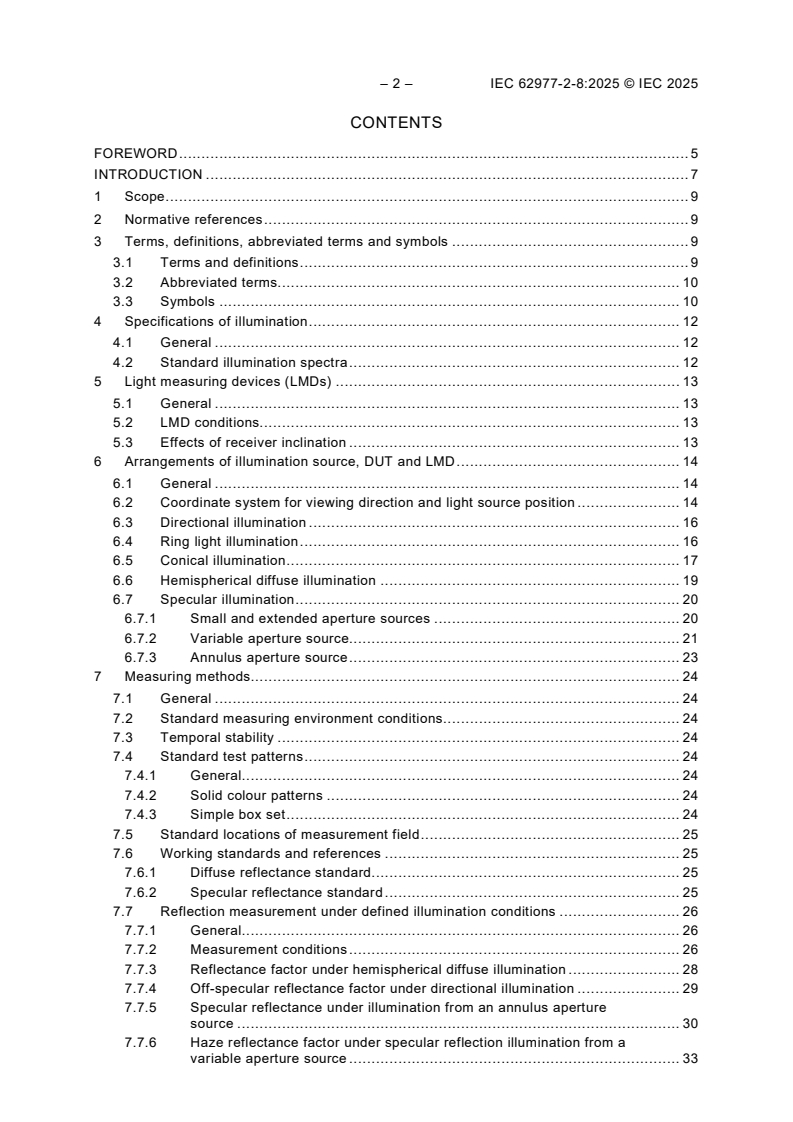
CONTENTS
FOREWORD . 5
INTRODUCTION . 7
1 Scope . 9
2 Normative references . 9
3 Terms, definitions, abbreviated terms and symbols . 9
3.1 Terms and definitions . 9
3.2 Abbreviated terms. 10
3.3 Symbols . 10
4 Specifications of illumination . 12
4.1 General . 12
4.2 Standard illumination spectra . 12
5 Light measuring devices (LMDs) . 13
5.1 General . 13
5.2 LMD conditions. 13
5.3 Effects of receiver inclination . 13
6 Arrangements of illumination source, DUT and LMD . 14
6.1 General . 14
6.2 Coordinate system for viewing direction and light source position . 14
6.3 Directional illumination . 16
6.4 Ring light illumination . 16
6.5 Conical illumination . 17
6.6 Hemispherical diffuse illumination . 19
6.7 Specular illumination . 20
6.7.1 Small and extended aperture sources . 20
6.7.2 Variable aperture source. 21
6.7.3 Annulus aperture source . 23
7 Measuring methods. 24
7.1 General . 24
7.2 Standard measuring environment conditions . 24
7.3 Temporal stability . 24
7.4 Standard test patterns . 24
7.4.1 General. 24
7.4.2 Solid colour patterns . 24
7.4.3 Simple box set . 24
7.5 Standard locations of measurement field . 25
7.6 Working standards and references . 25
7.6.1 Diffuse reflectance standard . 25
7.6.2 Specular reflectance standard . 25
7.7 Reflection measurement under defined illumination conditions . 26
7.7.1 General. 26
7.7.2 Measurement conditions . 26
7.7.3 Reflectance factor under hemispherical diffuse illumination . 28
7.7.4 Off-specular reflectance factor under directional illumination . 29
7.7.5 Specular reflectance under illumination from an annulus aperture
source . 30
7.7.6 Haze reflectance factor under specular reflection illumination from a
variable aperture source . 33
7.8 Contrast ratio under specified illumination . 34
7.8.1 General. 34
7.8.2 Contrast ratio under hemispherical diffuse illumination . 34
7.8.3 Contrast ratio under off-specular directional illumination . 35
7.8.4 Contrast ratio under ambient illumination . 36
7.9 Colour under specified illumination . 38
7.9.1 General. 38
7.9.2 Display colour under hemispherical diffuse illumination . 39
7.9.3 Display colour under off-specular directional illumination . 41
7.9.4 Display colour under ambient illumination . 42
7.9.5 CIELAB colour gamut volume . 44
8 Variations of viewing direction . 47
8.1 Purpose . 47
8.2 Viewing direction range . 48
8.2.1 Measuring method . 48
8.2.2 Determination methods . 48
8.2.3 Specified conditions . 48
8.3 Viewing direction range without grey-level inversion . 49
8.3.1 Calculation method . 49
8.3.2 Determination methods . 49
8.3.3 Specified conditions . 49
Annex A (informative) General remarks on illumination and measurement conditions. 50
A.1 General . 50
A.2 Illumination and measurement conditions . 50
A.3 Front-surface reflections of the DUT . 51
Annex B (informative) Measurement field on a slanted DUT . 52
Annex C (informative) Light source . 55
C.1 General . 55
C.2 Off-specular (diffuse) reflectance factor under directional illumination (7.7.4) . 55
C.3 Reflectance factor under hemispherical diffuse illumination (7.7.3) . 55
C.4 Specular characteristics . 55
Annex D (informative) Optical characteristic of hemispherical diffuse illumination . 56
Annex E (informative) Components of specular illumination . 58
Annex F (informative) Substitution method for determining the spectral irradiance and
the spectral reflectance factor at the measurement plane . 61
Annex G (informative) Chromaticity gamut area in CIE 1931 xy chromaticity diagram . 63
Bibliography . 64
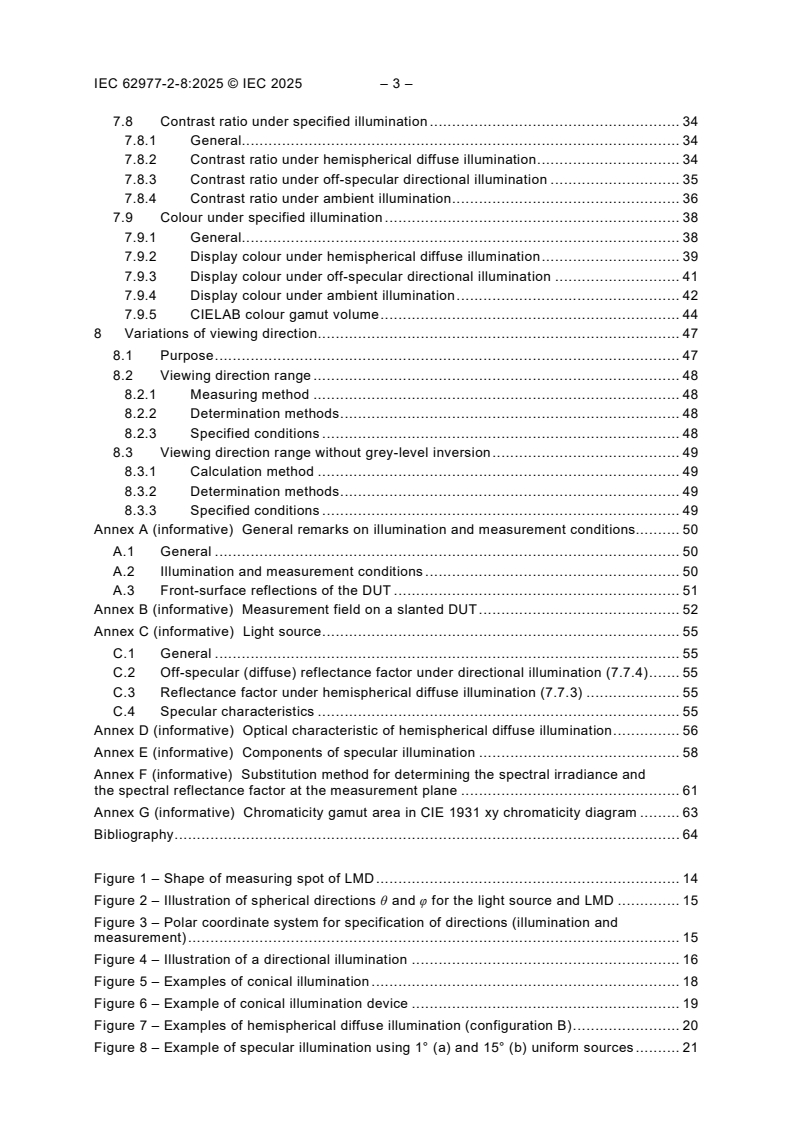
Figure 1 – Shape of measuring spot of LMD . 14
Figure 2 – Illustration of spherical directions θ and φ for the light source and LMD . 15
Figure 3 – Polar coordinate system for specification of directions (illumination and
measurement) . 15
Figure 4 – Illustration of a directional illumination . 16
Figure 5 – Examples of conical illumination . 18
Figure 6 – Example of conical illumination device . 19
Figure 7 – Examples of hemispherical diffuse illumination (configuration B) . 20
Figure 8 – Example of specular illumination using 1° (a) and 15° (b) uniform sources . 21
– 4 – IEC 62977-2-8:2025 © IEC 2025
Figure 9 – VAS in specular (a) and off-specular (b) reflection configurations. 22
Figure 10 – Illustration showing the use of the annulus light source for measuring
reflections in the specular direction (a) and the idealized luminance profile (b) . 23
Figure 11 – Measurement points of the annulus source with opaque centre for spectral
radiance . 31
Figure 12 – Input RGB colour cube and corresponding CIELAB gamut volume. . 45
Figure 13 – Tetrahedral tessellation of the RGB colour cube with 5 × 5 samples on
each face (from IEC 62977-2-2, Annex B.4) . 47
Figure A.1 – Arrangement of illumination of the reflective display under measurement
(DUT) and the light measuring device (LMD) . 50
Figure A.2 – Illustration of reflection rays from the first surface and the modulated
reflection . 51
Figure B.1 – Schematic diagram of DUT measurement using a LMD and the shape of
the measurement fields on DUT . 53
Figure B.2 – Centre shift of the measurement field on the DUT for the data given in
Table B.1 . 54
Figure C.1 – Schematic diagram of an example of the opaque centre aperture stop . 55
Figure D.1 – Example hemispherical diffuse illumination with gloss trap (GT) opposite
to LMD inclination . 56
Figure D.2 – Normalized illuminance at the location of the measuring spot . 56
Figure D.3 – Contour plot drawn with lines of equal colour difference ∆E* . 57
ab
Figure E.1 – Example of a BRDF obtained for a display surface that shows light
scattering components: specular, haze and Lambertian . 58
Figure E.2 – One-dimensional simulation of the reflectance distribution from 1° (a) and
0,25° to 15° (b) subtense light sources using the BRDF from Figure E.1 . 59
Table 1 – Measurement structure from optical quantities, to evaluations and to results
(top down) . 8
Table 2 – Summary of symbols . 11
Table 3 – Reference illuminant conditions . 12
Table 4 – Colour code . 24
Table 5 – The reference parameters for calculating ambient contrast ratio. 37
Table 6 – Number of sample colours and corresponding image levels (in 8 bit code
space) when subdividing each face of the RGB colour cube into n divisions. 46
Table 7 – Definitions and examples of viewing direction ranges. 48
Table B.1 – Numerical values for the measurement field on a plane and slanted DUT. 54
INTERNATIONAL ELECTROTECHNICAL COMMISSION
____________
ELECTRONIC DISPLAYS –
Part-2-8: Measurements of optical characteristics –
Reflective displays
FOREWORD
1) The International Electrotechnical Commission (IEC) is a worldwide organization for standardization comprising
all national electrotechnical committees (IEC National Committees). The object of IEC is to promote international
co-operation on all questions concerning standardization in the electrical and electronic fields. To this end and
in addition to other activities, IEC publishes International Standards, Technical Specifications, Technical Reports,
Publicly Available Specifications (PAS) and Guides (hereafter referred to as “IEC Publication(s)”). Their
preparation is entrusted to technical committees; any IEC National Committee interested in the subject dealt with
may participate in this preparatory work. International, governmental and non-governmental organizations liaising
with the IEC also participate in this preparation. IEC collaborates closely with the International Organization for
Standardization (ISO) in accordance with conditions determined by agreement between the two organizations.
2) The formal decisions or agreements of IEC on technical matters express, as nearly as possible, an international
consensus of opinion on the relevant subjects since each technical committee has representation from all
interested IEC National Committees.
3) IEC Publications have the form of recommendations for international use and are accepted by IEC National
Committees in that sense. While all reasonable efforts are made to ensure that the technical content of IEC
Publications is accurate, IEC cannot be held responsible for the way in which they are used or for any
misinterpretation by any end user.
4) In order to promote international uniformity, IEC National Committees undertake to apply IEC Publications
transparently to the maximum extent possible in their national and regional publications. Any divergence between
any IEC Publication and the corresponding national or regional publication shall be clearly indicated in the latter.
5) IEC itself does not provide any attestation of conformity. Independent certification bodies provide conformity
assessment services and, in some areas, access to IEC marks of conformity. IEC is not responsible for any
services carried out by independent certification bodies.
6) All users should ensure that they have the latest edition of this publication.
7) No liability shall attach to IEC or its directors, employees, servants or agents including individual experts and
members of its technical committees and IEC National Committees for any personal injury, property damage or
other damage of any nature whatsoever, whether direct or indirect, or for costs (including legal fees) and
expenses arising out of the publication, use of, or reliance upon, this IEC Publication or any other IEC
Publications.
8) Attention is drawn to the Normative references cited in this publication. Use of the referenced publications is
indispensable for the correct application of this publication.
9) IEC draws attention to the possibility that the implementation of this document may involve the use of (a)
patent(s). IEC takes no position concerning the evidence, validity or applicability of any claimed patent rights in
respect thereof. As of the date of publication of this document, IEC had not received notice of (a) patent(s), which
may be required to implement this document. However, implementers are cautioned that this may not represent
the latest information, which may be obtained from the patent database available at https://patents.iec.ch. IEC
shall not be held responsible for identifying any or all such patent rights.
IEC 62977-2-8 has been prepared by IEC technical committee 110: Electronic displays. It is an
International Standard.
The text of this International Standard is based on the following documents:
Draft Report on voting
110/1745/FDIS 110/1764/RVD
Full information on the voting for its approval can be found in the report on voting indicated in
the above table.
The language used for the development of this International Standard is English.
– 6 – IEC 62977-2-8:2025 © IEC 2025
This document was drafted in accordance with ISO/IEC Directives, Part 2, and developed in
accordance with ISO/IEC Directives, Part 1 and ISO/IEC Directives, IEC Supplement, available
at www.iec.ch/members_experts/refdocs. The main document types developed by IEC are
described in greater detail at www.iec.ch/publications.
A list of all parts in the IEC 62977 series, published under the general title Electronic displays,
can be found on the IEC website.
The committee has decided that the contents of this document will remain unchanged until the
stability date indicated on the IEC website under webstore.iec.ch in the data related to the
specific document. At this date, the document will be
• reconfirmed,
• withdrawn, or
• revised.
INTRODUCTION
All documents published by IEC TC 110 that are written on the measurement for electronic
displays refer to a set of methods and procedures that are similar to one another. These
measurement methods are sometimes identical. This document is written for reflective displays
by referring to IEC 62977-2-2 and is intended to identify these methods and to describe them
together with suitable precautions and diagnostics. Therefore, this document can be a reference
for forthcoming standards to make the work of the involved experts more efficient and to avoid
reduplication of efforts.
Introduction of the common optical measurement methods (COMM) is also related to a structure
where each kind of optical measurement finds its unambiguous position for identification of
similarities to other methods or for clarification of distinctions. This structural classification
together with a general taxonomy is supposed to make the process of standards production
easier, faster and thus more effective.
This document describes the common optical measurement methods applicable to the reflective
displays. However, the contents overlap with some parts of the existing standards which are
developed in TC 110 (IEC 61747-6-2:2011 and IEC 62679-3-1:2014), in which the documents
describe the optical measurement methods of the individual display technologies, such as LCD
and E-paper. This document is intended to be used as common optical measurement methods
for the reflective direct view type and a reference document for future standards. In addition,
the present document can be used in the revisions of the existing standards
(IEC 61747-6-2:2011 and IEC 62679-3-1:2014) in their maintenance time by referring to this
document to the largest extent possible.
The characteristics and the measurement methods of electronic displays in the IEC 62977
series are summarized in Table 1.
– 8 – IEC 62977-2-8:2025 © IEC 2025
Table 1 – Measurement structure from optical quantities,
to evaluations and to results (top down)
Test pattern,
Location Direction
electrical Illumination Temperature,
Variables Time
driving, input conditions humidity
(x, y) (θ, φ)
signal
Data
a a
sampling Fast Slow Slow
Slow Slow
condition
a a
transitions temporal uniformity darkroom standard
uniformity static pattern
from one stability environmental
a
characteristic
indoor a
optical state (uniformity)
conditions
function
to another
a
outdoor
(electro-optic
state
transfer
Results function,
EOTF)
characteristic
values (e.g.
threshold,
saturation),
turn-on, luminance
turn-off,
a
reflectance
delay
(latency)
a
contrast
time
Evaluations
periods, a
chromaticity
st
1 order temporal
modulations threshold,
saturation
values,
steepness of
transitions, etc.
flicker EOTF from
prediction, which the
exponent
moving
gamma is
picture
evaluated
response
Evaluations
nd
time, etc. chromaticity
2 order
and colour
a
gamut area
colour gamut
a
volume
a
Indicates the characteristics and measurement methods which are written in this document
ELECTRONIC DISPLAYS –
Part-2-8: Measurements of optical characteristics –
Reflective displays
1 Scope
This part of IEC 62977 specifies standard measurement conditions and methods for
determining the optical characteristics of reflective direct view displays that render real
2D images on a flat panel. This document applies to flat panel displays operated in a reflective
mode with any integrated light sources turned off during measurement. The input signal is
unbounded and encodes either monochrome or colour images.
2 Normative references
The following documents are referred to in the text in such a way that some or all of their content
constitutes requirements of this document. For dated references, only the edition cited applies.
For undated references, the latest edition of the referenced document (including any
amendments) applies.
IEC 62977-2-1:2021, Electronic displays – Part 2-1: Measurement of optical characteristics –
Fundamental measurements
IEC 62977-2-2:2020, Electronic displays – Part 2-2: Measurement of optical characteristics –
Ambient performance
ISO/CIE 11664-1, Colorimetry – Part 1: CIE standard colorimetric observers
ISO/CIE 11664-2, Colorimetry – Part 2: CIE standard illuminants
ISO/CIE 11664-4, Colorimetry – Part 4: CIE 1976 L*a*b* Colour space
ISO/CIE 23539, Photometry – The CIE system of physical photometry
CIE 015, Colorimetry
3 Terms, definitions, abbreviated terms and symbols
3.1 Terms and definitions
For the purposes of this document, the following terms and definitions apply.
ISO and IEC maintain terminology databases for use in standardization at the following
addresses:
• IEC Electropedia: available at https://www.electropedia.org/
• ISO Online browsing platform: available at https://www.iso.org/obp
– 10 – IEC 62977-2-8:2025 © IEC 2025
3.1.1
reflective display
electronic display device that modulates the illumination incident from an external source and
reflects it back as spatially and spectrally modulated light
Note 1 to entry: Any reflective display consists of at least two basic optical elements. (a) reflector and (b) reflection
modulator. The reflector element reflects back the incident ambient light so that the observer can see spatially
modulated light. The reflection modulator changes the reflectance either equally for all wavelengths for an achromatic
display or in a spectrally selective manner for a colour one.
Note 2 to entry: Ambient illumination is necessary for the recognition of the visual information on a reflective display.
3.1.2
ambient contrast ratio
contrast ratio under ambient illumination
contrast ratio of a display with both hemispherical diffuse and directional illumination incident
onto its surface used to simulate real lighting environments
[SOURCE: IEC 62679-1-1:2014, 3.2.1, modified – the admitted term “contrast ratio under
ambient illumination” has been added.]
3.1.3
ambient display colour
display colour under ambient illumination
colour of a display with both hemispherical diffuse and directional illumination incident onto its
surface at a defined geometry, spectra, and illumination levels that simulate a realistic lighting
environment
[SOURCE: IEC 62679-1-1:2014, 3.2.2, modified – the preferred term “daylight display colour”
has been replaced with “ambient display colour” and the admitted term “display colour under
ambient illumination” has been added.]
3.1.4
viewing direction range
angular span within which a viewer can perceive the visual content displayed on a screen for
its intended application
Note 1 to entry: The angle is described with unidirectional angle or bidirectional angle, for example, left and right
in horizontal, or up and down in vertical around the display's central axis, i.e. surface normal. See also 8.2.
Note 2 to entry: Viewing direction-dependent performance is often reported as “viewing angle” or “viewing direction
range” in the electronic display market, especially when the left/right and up/down characteristics are symmetrical.
3.2 Abbreviated terms
BRDF bidirectional reflectance distribution function
CIE Commission Internationale de l’Eclairage (International Commission on
Illumination)
CIELAB CIE 1976 L*a*b*
DUT device (display) under test
LMD light measuring device
SID Society for Information Display
VAS variable aperture source
3.3 Symbols
A list of symbols used in this document is given in Table 2. The other symbols and units used
in this document are coherent with IEC 62977-2-2.
Table 2 – Summary of symbols
Symbol Units Definition
Angle of inclination of light source (relative to the surface normal of
θ
degree
S
the DUT)
θ
degree Angle of inclination of LMD (relative to the surface normal of the DUT)
R
Azimuth angle of light source which is defined by the rotation around
φ
degree
S
the surface normal of the DUT
Azimuth angle of the LMD which is defined by the rotation around the
φ
degree
R
surface normal of the DUT
Distance from the centre of a measurement field on the DUT to the
d
mm
S
centre of the exit port of a light source
Distance from the centre of a measurement field on the DUT to the
d
mm
R
centre of the acceptance aperture of LMD or the front lens of LMD
Radius of exit port of an integrating sphere light source
r mm
Radius of the exit aperture of the light source
Angle subtended by the exit aperture of the light source to the DUT
Ψ degree
(Source subtense angle)
Angle subtended by the acceptance aperture of LMD to the DUT
ψ
degree
accept
(Angular aperture of LMD)
Angle subtended by the measurement field of LMD to the DUT
α
degree
meas
(Measurement field angle)
E lx Illuminance
-2 -1
E(λ) Spectral irradiance
W m nm
-2
L Luminance
cd m
-2 -1 -1
L(λ) Spectral radiance
W m sr nm
L* - CIELAB (CIE 1976 L*a*b*) lightness
CIELAB (CIE 1976 L*a*b*) colour difference is the Euclidean distance
∆E*
-
ab
between two colour coordinates
R % Luminous reflectance factor in off-specular directional illumination
R(λ) % Spectral reflectance factor in off-specular directional illumination
Luminous haze reflectance factor in a specular reflection geometry,
R
%
h
representing the maximum value of haze component of the DUT
ρ % Luminous reflectance factor in hemispherical diffuse illumination
ρ(λ) % Spectral reflectance factor in hemispherical diffuse illumination
Luminous specular (regular) reflectance in a specular reflection
ρ
% geometry, representing the specular (regular) reflection contribution
r
of the DUT
Luminous specular (regular) reflectance as a function of the source
ρ (ψ)
%
r
subtense angle
Specular (regular) spectral reflectance in a specular reflection
ρ (λ)
% geometry, representing the specular (regular) reflection contribution
r
of the DUT
Luminous diffuse (Lambertian) reflectance in a specular reflection
ρ
% geometry, representing the diffuse (Lambertian) scatter contribution
L
of the DUT
P
- Measurement position i of 9 points location (i = 0 to 8)
i
CR - Contrast ratio
S(λ) - Relative spectrum of CIE Illuminant
X, Y, Z - Tristimulus values of CIE 1931 standard colorimetric system
x, y - Chromaticity values of CIE 1931 chromaticity coordinates system
– 12 – IEC 62977-2-8:2025 © IEC 2025
Symbol Units Definition
Chromaticity gamut area of CIE 1931 chromaticity coordinates system
A
%
xy
The percentage of area in relation to the entire area encompassed by
the monochromatic spectrum locus
VDR_H degree Horizontal viewing direction range
VDR_V degree Vertical viewing direction range
4 Specifications of illumination
4.1 General
Standard lighting conditions shall comply with IEC 62977-2-2:2020, 4.3.
4.2 Standard illumination spectra
For spectral measurement of reflective displays, a spectrally smooth broadband illumination
(e.g. a spectrum range exceeding 380 nm to 780 nm) shall be used. Such illumination can be
provided by incandescent lamps, for example, or combinations of LEDs and so on. When using
a photometer, such as a luminance meter, to measure reflective display, the spectrum of
illumination shall be specified. The absence of fluorescence should be checked by illuminating
the display with blue light at a 45° inclination angle and determining if a glow from the
illumination area can be observed.
The measured reflection coefficients shall be used to predict the performance of reflective
displays when viewed under CIE Standard Illuminants such as Illuminant A, D50, D65, and CIE
Illuminant D75. One of the following reference illumination conditions shall be used to simulate
indoor and outdoor viewing environments. The CIE Illuminants given in Table 3 shall be used
for indoor and outdoor illumination conditions. The optical characteristics of a display under
indoor and outdoor illumination conditions are determined using the reflection coefficients from
Clause 7. When using a photometer, the illumination spectra should approximate CIE Standard
Illuminant A, D50 or D65 and the relative spectral distribution used shall be reported.
NOTE 1 The recommended type of illuminants are referred to in IEC 62977-2-2:2020, 4.3.3.
NOTE 2 CIE Standard Illuminant A is realized by an incandescent lamp. D50 and D65 can be approximated by an
incandescent or a halogen lamp with a colour temperature conversion filter such as a light balancing (LB) filter.
However, it is difficult to realize D75.
Table 3 – Reference illuminant conditions
Indoor, room illumination Outdoor, daylight illumination
CIE
Hemispherical Off-specular Hemispherical Off-specular
Illuminant
Specular Specular
diffuse directional diffuse directional
✓ ✓ ✓
A
D50 ✓ ✓ ✓ ✓ ✓
D65 ✓ ✓ ✓ ✓ ✓ ✓
D75 ✓
NOTE Relative spectral power distribution of the CIE Standard Illuminant A, D50 and D65 are described in
ISO/CIE 11664-2 and for the CIE Illuminant D75 in CIE 015.
5 Light measuring devices (LMDs)
5.1 General
For measurement and characterization of reflective displays, spectroradiometers shall be used.
When the spectrum of illumination used is specified, luminance meters can be used (see 7.7.1).
The employed LMD shall be checked for the following criteria and specified accordingly:
• sensitivity of the measured quantity to polarization of light,
• errors caused by veiling glare and lens flare (i.e. stray-light in optical system),
• timing of data-acquisition, low-pass filtering over time and temporal aliasing-effects,
• linearity of LMD,
• general V(λ) mismatch index (f ʹ) [1] is 6 % or less (for luminance meter).
5.2 LMD conditions
LMD conditions shall comply with IEC 62977-2-2:2020, 4.4.4. The following parameters should
be specified:
1) The distance between the LMD and the measurement spot on the DUT,
2) The measurement field area (angle) on the DUT shall be 2° or less,
3) The angular aperture (i.e. acceptance angle and entrance pupil area) of the LMD (refer to
Figure A.1).
When measuring matrix displays the LMD should be set to the measurement field that includes
more than 500 pixels on the display under normal observation (the standard measurement
direction). The angular aperture of the LMD, ψ , shall be 5° or less (refer to Annex A). When
accept
the number of pixels in the field of measurement is lower than 500, then it should be confirmed
and reported that the measurement yields equivalent results. In case of measuring segmented
displays, the field of measurement should be set within a single segment only.
5.3 Effects of receiver inclination
The measurement field of most LMDs is circular at the normal measurement direction. With
increasing LMD inclination the shape of the measurement area becomes an elongated ellipse
with the short axis of the ellipse being perpendicular to the inclination plane of the LMD and the
centre of that shape shifted relative to the LMD optical axis (refer to Annex B). In order to avoid
measurement errors, it shall be assured that the measurement field remains unchanged with a
constant optical state (uniform luminance on the measurement area) for all angles of inclination,
as shown in Figure 1. In the case of reflective displays, the display area at and around the
measurement field shall be uniformly illuminated. The uniformly illuminated area of the DUT
should be at least twice as large (in both horizontal and vertical directions) than the
measurement field at the largest used inclination of the LMD. Dimensions and location of the
measurement field shall be specified in the measurement report.
___________
Numbers in square brackets refer to the Bibliography.
Note that the official definition of a pixel can include a multitude of constituent dots.
– 14 – IEC 62977-2-8:2025 © IEC 2025
Key
1 Uniform field on the DUT
2 Circular measurement field at normal direction
3 Measurement field at an angle of inclination with respect to minor diameter of the ellipse
Figure 1 – Shape of measuring spot of LMD
6 Arrangements of illumination source, DUT and LMD
6.1 General
Reflective displays make use of the ambient illumination to visualize information. To achieve
the required precision and reproducibility of the measurement results, the cross-coupling
between the illumination apparatus and the LMD should be avoided. The geometry of the
measurement set should be well defined, in order to avoid trilateral coupling between
illumination, DUT and LMD ([2] to [21]).
Clause 6 describes a selection of different geometries suitable for measuring and characterizing
reflective displays as a function of the direction of observation (i.e. viewing direction or direction
of measurement). A set of parameters provides detailed specification of the conditions that are
used for measurement of the electro-optical characteristics indicated in the following paragraph.
At least one of four types of illumination geometries (see 6.3, 6.4, 6.5 and 6.6) shall be used
for determining the performance of the display. Additional illumination geometries can also be
used. For specular reflection measurement, the specular illumination geometry specified in 6.7
shall be used. The details of the illumination geometry used for a given measurement shall be
reported. Further guidance on the proper implementation of these illumination geometries is
given in the Society for Information Display (SID) Information Display Measurements Standard
[22]. The standard illumination geometry shall comply with IEC 62977-2-2:2020, 4.2.
NOTE 1 The range of geometries for illumination of the DUT and detection of the light reflected from the DUT is not
limited to the examples presented here.
NOTE 2 The purposes of the illumination geometries are described in Annex C.
6.2 Coordinate system for viewing direction and light source position
The viewing direction, which is represented by the optical axis of the LMD, and the light source
alignment are specified by angle of inclination, θ , measured relative to surface normal, and the
azimuth angle, φ (angle of rotation around the DUT’s surface normal, that is, measured with
respect to a reference direction) in a spherical coordinate system as illustrated in Figure 2. The
angles θ and φ shall be used to specify the direction of light incidence (θ , φ ) and the
S S
measurement direction (θ , φ ).
R R
Key
θ Inclination angle of LMD
R
φ Azimuth angle of LMD
R
θ Inclination angle of light source
S
φ Azimuth angle of light source
S
Figure 2 – Illustration of spherical directions θ and φ for the light source and LMD
The optical axis of the light source that crosses the centre of the light source's aperture shall
be fixed to the centre of the measurement field area on the DUT surface, that is any direction
(θ , φ ). Then, the LMD’s optical axis shall be fixed to the centre of the illumination spot (θ , φ ).
S S R R
Finally, the LMD can take any measurement direction (refer to Annex A).
Figure 3 – Polar coordinate system for specification of directions
(illumination and measurement)
Each direction specified by the spherical coordinates according to Figure 2 can be represented
and illustrated in a polar coordinate system as shown in Figure 3. The angle of inclination, θ, is
represented by the length of the radius vector. The azimuth angle (angle of rotation), φ, counted
from a reference direction (here the x-axis), corresponds to the directions on a clock (e.g.
φ = 90° corresponds to twelve o’clock).
– 16 – IEC 62977-2-8:2025 © IEC 2025
Variations of scalar quantities (e.g. luminance, contrast, etc.) with viewing direction or direction
of illumination can be represented in polar coordinate systems by lines of constant value
(iso-lines). Ranges of directions that meet certain minimum requirements (e.g. contrast is less
than 10) can be shown as regions in a polar coordinate system (e.g. refer to Annex D).
6.3 Directional illumination
Directional illumination means illumination of the measurement field from essentially one single
specified direction (i.e. unidirectional). It is provided by a lamp bulb or a source device with a
small aperture with uniform illumination which is subtending a small angle (5° or less which
complies with IEC 62977-2-2:2020, 4.3.4.2) from the centre of the measurement field. The
source subtense angle (ψ) from the measurement field and the direction of the cone-axis
(θ , φ ) shall be specified.
S S
Key
a Measurement field
b Area of unform illumination
NOTE The types of illumination are classified according to the angle subtended from the measurement field (a). An
area of uniform luminance (b) is subtending the angle ψ at the measurement field, illumination is provided within the
cone specified by the cone axis (θ, φ) and the source subtense angle, ψ. In the case ψ = 180º and the cone axis at
the normal direction, the illumination is provided from within the complete hemisphere (i.e. hemispherical diffuse
illumination).
Figure 4 – Illustration of a directional illumination
All conditions comply with IEC 62977-2-2:2020, 4.3.4.2, except the following conditions. The
standard conditions are (a) θ = 30° and θ = 0°, (b) θ = 45° and θ = 0° or (c) θ = 0° and
S R S R S
θ = 30°. Alignment accuracy should be within ±0,4°.
R
NOTE 1 The definition of directional illumination used here is different from the definition of a directional light source
according to CIE TN 010:2019 [23].
NOTE 2 The value of reflectance characteristics generally depends on the angular extent of the incident flux at the
field of measurement and the LMD acceptance cone (see CIE 038:1977 [24]).
6.4 Ring light illumination
A ring light provides directional illumination of the field of measurement with a constant angle
of inclination, θ, for all azimuth angles, φ (between 0° and 360° azimuth).
All conditions comply with IEC 62977-2-2:2020, 4.3.4.3. The standard conditions are θ = 0°
R
and θ ± ∆ = 45° ±3°. T
...