

IEC 62977-3-5:2023
(Main)Electronic displays - Part 3-5: Evaluation of optical performance - Colour capabilities
General Information
- Abstract
IEC 62977-3-5:2023 specifies standard evaluation methods for determining the colour capabilities of electronic display modules and systems with respect to colour accuracy, colour gamut volume, and their intersection with a reference colour space. Also included is evaluation with respect to the chromaticity gamut area. These methods apply to emissive and transmissive direct view displays that render real 2D images on a flat panel or on a curved panel with a local radius of curvature larger than 1 500 mm. This document evaluates the optical characteristics of these displays under darkroom conditions. This document applies to the testing of display performance in response to standard analogue or digital input signals that are not absolute luminance encoded. The input signal is relative RGB without metadata information that codes for real luminance, colour space or colour coordinates. These methods are limited to input signals with typical opto-electronic transfer functions (OETFs) such as defined in IEC 61966‑2‑1, Recommendation ITU-R BT.601 [18][1], Recommendation ITU-R BT.709, and Recommendation ITU-R BT.2020. The tests in this document are not suitable for use with HDR input signals.
This document contains attached files in the form of Microsoft Excel spreadsheet and App installer. These files are intended to be used as a complement and do not form an integral part of the standard.
The content of the corrigendum 1 (2024-10) has been included in this copy.
- Status
- Published
- Publication Date
- 25-Sep-2023
- Technical Committee
- TC 110 - Electronic displays
- Drafting Committee
- WG 13 - TC 110/WG 13
- Current Stage
- PPUB - Publication issued
- Start Date
- 26-Sep-2023
- Completion Date
- 20-Oct-2023
Overview
IEC 62977-3-5:2023 is an international standard published by the International Electrotechnical Commission (IEC) that specifies standardized evaluation methods for determining the colour capabilities of electronic display modules and systems. This document focuses on the objective measurement of colour accuracy, colour gamut volume, chromaticity gamut area, and the intersection of a display's colour capabilities with reference colour spaces. It applies to both emissive and transmissive direct view displays, including flat panels and curved panels with a local radius of curvature greater than 1,500 mm. Evaluations are carried out under darkroom conditions to ensure precise assessments of colour performance.
This standard is especially valuable for R&D engineers, quality control experts, and third-party reviewers engaged in electronic display development, verification, and testing. It helps to prevent miscommunication and to standardize the assessment procedures across the industry.
Key Topics
- Colour Accuracy: Methods for quantifying how faithfully an electronic display renders intended colours, facilitating comparison between the display output and reference standards.
- Colour Gamut Volume: Techniques for assessing the three-dimensional capability of a display to reproduce a broad range of colours, including in different viewing directions.
- Chromaticity Gamut Area: Analysis of a display’s ability to render colours within a specified two-dimensional reference colour space, often mapped against industry standards such as ITU-R BT.709.
- Intersection with Reference Colour Spaces: Evaluation methods to determine where and how much a display’s colour capabilities overlap with reference standards, such as sRGB or DCI-P3.
- Standard Measurement Conditions: Requirement for consistent test environments, including the use of darkroom conditions, carefully calibrated equipment, and standardized warm-up sequences for displays prior to testing.
- Applicable Input Signals: The standard applies only to typical opto-electronic transfer functions (OETFs) such as those defined in IEC 61966-2-1 (sRGB), ITU-R BT.601, ITU-R BT.709, and ITU-R BT.2020, using relative RGB input signals without absolute luminance encoding.
- Reporting Requirements: Clear guidelines on how to document, record, and report measurement results for repeatable and transparent performance evaluation.
Applications
The practical applications of IEC 62977-3-5:2023 span various facets of the electronic display industry:
- Display Development: Offers R&D teams consistent metrics to design, benchmark, and enhance display colour performance during prototyping.
- Product Testing and Verification: Enables manufacturers and independent laboratories to evaluate and certify displays, ensuring compliance with industry standards for colour representation and chromaticity.
- Quality Assurance: Facilitates sample and batch testing in pre-production environments to detect colour inconsistencies or deviations before mass manufacturing.
- Comparative Performance Analysis: Supports side-by-side evaluations of display modules and systems from different manufacturers using harmonized criteria, benefiting purchasing departments and technical reviewers.
- Consumer Electronics: Applies to televisions, monitors, digital signage, and professional displays where accurate colour rendering is critical for user experience, content creation, or broadcasting.
Related Standards
The methods and requirements outlined in IEC 62977-3-5:2023 interface closely with several other international standards, including:
- IEC 62977-2-1: Measurements of optical characteristics – guidelines for fundamental display measurements.
- IEC TS 62977-3-1: Evaluation of optical performance – methods for assessing colour difference based on viewing direction dependence.
- IEC 61966-2-1: Colour management in multimedia systems – defines sRGB colour space.
- Recommendation ITU-R BT.709 / BT.2020: Internationally recognized standards for HD and UHD television colourimetry.
- CIE 015:2018: Core document on colorimetry principles.
- CIE 168:2005: Criteria for evaluating extended-gamut colour encodings.
Summary
Implementing IEC 62977-3-5:2023 ensures that display colour capabilities are measured and communicated using internationally recognized, repeatable methods. By focusing on key performance indicators such as colour accuracy, gamut volume, and chromaticity, this standard supports the evolving need for high-quality colour reproduction in today’s electronic displays. Its alignment with other foundational standards maximizes interoperability and industry confidence in display evaluation outcomes, making it an essential reference for stakeholders in display technology.
Relations
- Effective Date
- 27-Sep-2024
Frequently Asked Questions
IEC 62977-3-5:2023 is a standard published by the International Electrotechnical Commission (IEC). Its full title is "Electronic displays - Part 3-5: Evaluation of optical performance - Colour capabilities". This standard covers: IEC 62977-3-5:2023 specifies standard evaluation methods for determining the colour capabilities of electronic display modules and systems with respect to colour accuracy, colour gamut volume, and their intersection with a reference colour space. Also included is evaluation with respect to the chromaticity gamut area. These methods apply to emissive and transmissive direct view displays that render real 2D images on a flat panel or on a curved panel with a local radius of curvature larger than 1 500 mm. This document evaluates the optical characteristics of these displays under darkroom conditions. This document applies to the testing of display performance in response to standard analogue or digital input signals that are not absolute luminance encoded. The input signal is relative RGB without metadata information that codes for real luminance, colour space or colour coordinates. These methods are limited to input signals with typical opto-electronic transfer functions (OETFs) such as defined in IEC 61966‑2‑1, Recommendation ITU-R BT.601 [18][1], Recommendation ITU-R BT.709, and Recommendation ITU-R BT.2020. The tests in this document are not suitable for use with HDR input signals. This document contains attached files in the form of Microsoft Excel spreadsheet and App installer. These files are intended to be used as a complement and do not form an integral part of the standard. The content of the corrigendum 1 (2024-10) has been included in this copy.
IEC 62977-3-5:2023 specifies standard evaluation methods for determining the colour capabilities of electronic display modules and systems with respect to colour accuracy, colour gamut volume, and their intersection with a reference colour space. Also included is evaluation with respect to the chromaticity gamut area. These methods apply to emissive and transmissive direct view displays that render real 2D images on a flat panel or on a curved panel with a local radius of curvature larger than 1 500 mm. This document evaluates the optical characteristics of these displays under darkroom conditions. This document applies to the testing of display performance in response to standard analogue or digital input signals that are not absolute luminance encoded. The input signal is relative RGB without metadata information that codes for real luminance, colour space or colour coordinates. These methods are limited to input signals with typical opto-electronic transfer functions (OETFs) such as defined in IEC 61966‑2‑1, Recommendation ITU-R BT.601 [18][1], Recommendation ITU-R BT.709, and Recommendation ITU-R BT.2020. The tests in this document are not suitable for use with HDR input signals. This document contains attached files in the form of Microsoft Excel spreadsheet and App installer. These files are intended to be used as a complement and do not form an integral part of the standard. The content of the corrigendum 1 (2024-10) has been included in this copy.
IEC 62977-3-5:2023 is classified under the following ICS (International Classification for Standards) categories: 31.120 - Electronic display devices; 31.260 - Optoelectronics. Laser equipment. The ICS classification helps identify the subject area and facilitates finding related standards.
IEC 62977-3-5:2023 has the following relationships with other standards: It is inter standard links to IEC 62977-3-5:2023/COR1:2024. Understanding these relationships helps ensure you are using the most current and applicable version of the standard.
IEC 62977-3-5:2023 is available in PDF format for immediate download after purchase. The document can be added to your cart and obtained through the secure checkout process. Digital delivery ensures instant access to the complete standard document.
Standards Content (Sample)
IEC 62977-3-5 ®
Edition 1.0 2023-09
INTERNATIONAL
STANDARD
NORME
INTERNATIONALE
colour
inside
Electronic displays –
Part 3-5: Evaluation of optical performance – Colour capabilities
All rights reserved. Unless otherwise specified, no part of this publication may be reproduced or utilized in any form
or by any means, electronic or mechanical, including photocopying and microfilm, without permission in writing from
either IEC or IEC's member National Committee in the country of the requester. If you have any questions about IEC
copyright or have an enquiry about obtaining additional rights to this publication, please contact the address below or
your local IEC member National Committee for further information.
Droits de reproduction réservés. Sauf indication contraire, aucune partie de cette publication ne peut être reproduite ni
utilisée sous quelque forme que ce soit et par aucun procédé, électronique ou mécanique, y compris la photocopie et
les microfilms, sans l'accord écrit de l'IEC ou du Comité national de l'IEC du pays du demandeur. Si vous avez des
questions sur le copyright de l'IEC ou si vous désirez obtenir des droits supplémentaires sur cette publication, utilisez
les coordonnées ci-après ou contactez le Comité national de l'IEC de votre pays de résidence.
IEC Secretariat Tel.: +41 22 919 02 11
3, rue de Varembé info@iec.ch
CH-1211 Geneva 20 www.iec.ch
Switzerland
About the IEC
The International Electrotechnical Commission (IEC) is the leading global organization that prepares and publishes
International Standards for all electrical, electronic and related technologies.
About IEC publications
The technical content of IEC publications is kept under constant review by the IEC. Please make sure that you have the
latest edition, a corrigendum or an amendment might have been published.
IEC publications search - webstore.iec.ch/advsearchform IEC Products & Services Portal - products.iec.ch
The advanced search enables to find IEC publications by a Discover our powerful search engine and read freely all the
variety of criteria (reference number, text, technical publications previews. With a subscription you will always have
committee, …). It also gives information on projects, replaced access to up to date content tailored to your needs.
and withdrawn publications.
Electropedia - www.electropedia.org
IEC Just Published - webstore.iec.ch/justpublished
The world's leading online dictionary on electrotechnology,
Stay up to date on all new IEC publications. Just Published
containing more than 22 300 terminological entries in English
details all new publications released. Available online and once
and French, with equivalent terms in 19 additional languages.
a month by email.
Also known as the International Electrotechnical Vocabulary
(IEV) online.
IEC Customer Service Centre - webstore.iec.ch/csc
If you wish to give us your feedback on this publication or need
further assistance, please contact the Customer Service
Centre: sales@iec.ch.
A propos de l'IEC
La Commission Electrotechnique Internationale (IEC) est la première organisation mondiale qui élabore et publie des
Normes internationales pour tout ce qui a trait à l'électricité, à l'électronique et aux technologies apparentées.
A propos des publications IEC
Le contenu technique des publications IEC est constamment revu. Veuillez vous assurer que vous possédez l’édition la
plus récente, un corrigendum ou amendement peut avoir été publié.
Recherche de publications IEC - IEC Products & Services Portal - products.iec.ch
webstore.iec.ch/advsearchform Découvrez notre puissant moteur de recherche et consultez
La recherche avancée permet de trouver des publications IEC gratuitement tous les aperçus des publications. Avec un
en utilisant différents critères (numéro de référence, texte, abonnement, vous aurez toujours accès à un contenu à jour
comité d’études, …). Elle donne aussi des informations sur les adapté à vos besoins.
projets et les publications remplacées ou retirées.
Electropedia - www.electropedia.org
IEC Just Published - webstore.iec.ch/justpublished
Le premier dictionnaire d'électrotechnologie en ligne au monde,
Restez informé sur les nouvelles publications IEC. Just
avec plus de 22 300 articles terminologiques en anglais et en
Published détaille les nouvelles publications parues.
français, ainsi que les termes équivalents dans 19 langues
Disponible en ligne et une fois par mois par email.
additionnelles. Egalement appelé Vocabulaire
Electrotechnique International (IEV) en ligne.
Service Clients - webstore.iec.ch/csc
Si vous désirez nous donner des commentaires sur cette
publication ou si vous avez des questions contactez-nous:
sales@iec.ch.
IEC 62977-3-5 ®
Edition 1.0 2023-09
INTERNATIONAL
STANDARD
NORME
INTERNATIONALE
colour
inside
Electronic displays –
Part 3-5: Evaluation of optical performance – Colour capabilities
INTERNATIONAL
ELECTROTECHNICAL
COMMISSION
COMMISSION
ELECTROTECHNIQUE
INTERNATIONALE
ICS 31.120, 31.260 ISBN 978-2-8322-7551-1
– 2 – IEC 62977-3-5:2023 © IEC 2023
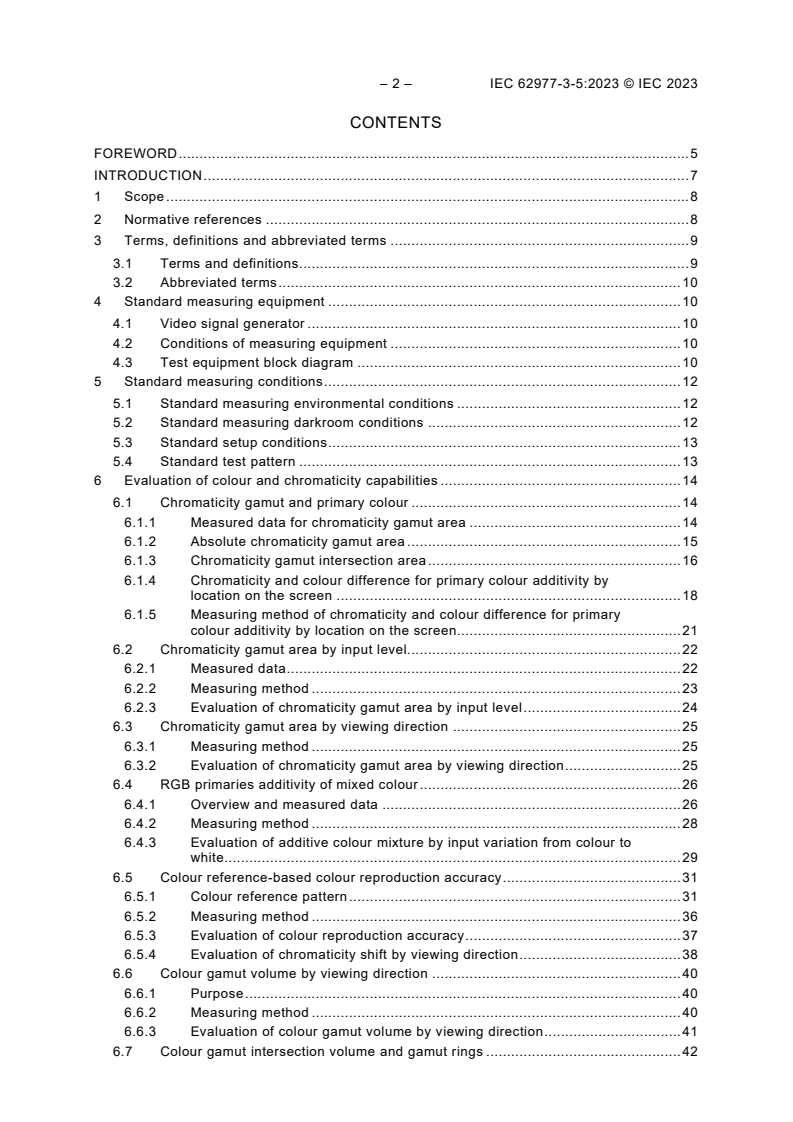
CONTENTS
FOREWORD . 5
INTRODUCTION . 7
1 Scope . 8
2 Normative references . 8
3 Terms, definitions and abbreviated terms . 9
3.1 Terms and definitions . 9
3.2 Abbreviated terms . 10
4 Standard measuring equipment . 10
4.1 Video signal generator . 10
4.2 Conditions of measuring equipment . 10
4.3 Test equipment block diagram . 10
5 Standard measuring conditions . 12
5.1 Standard measuring environmental conditions . 12
5.2 Standard measuring darkroom conditions . 12
5.3 Standard setup conditions . 13
5.4 Standard test pattern . 13
6 Evaluation of colour and chromaticity capabilities . 14
6.1 Chromaticity gamut and primary colour . 14
6.1.1 Measured data for chromaticity gamut area . 14
6.1.2 Absolute chromaticity gamut area . 15
6.1.3 Chromaticity gamut intersection area . 16
6.1.4 Chromaticity and colour difference for primary colour additivity by
location on the screen . 18
6.1.5 Measuring method of chromaticity and colour difference for primary
colour additivity by location on the screen. 21
6.2 Chromaticity gamut area by input level. 22
6.2.1 Measured data . 22
6.2.2 Measuring method . 23
6.2.3 Evaluation of chromaticity gamut area by input level . 24
6.3 Chromaticity gamut area by viewing direction . 25
6.3.1 Measuring method . 25
6.3.2 Evaluation of chromaticity gamut area by viewing direction . 25
6.4 RGB primaries additivity of mixed colour . 26
6.4.1 Overview and measured data . 26
6.4.2 Measuring method . 28
6.4.3 Evaluation of additive colour mixture by input variation from colour to
white. 29
6.5 Colour reference-based colour reproduction accuracy . 31
6.5.1 Colour reference pattern . 31
6.5.2 Measuring method . 36
6.5.3 Evaluation of colour reproduction accuracy . 37
6.5.4 Evaluation of chromaticity shift by viewing direction . 38
6.6 Colour gamut volume by viewing direction . 40
6.6.1 Purpose . 40
6.6.2 Measuring method . 40
6.6.3 Evaluation of colour gamut volume by viewing direction . 41
6.7 Colour gamut intersection volume and gamut rings . 42
6.7.1 Purpose of colour gamut intersection volume . 42
6.7.2 Evaluation of colour gamut intersection volume . 42
6.7.3 Evaluation using Gamut Rings . 42
7 Reporting. 42
7.1 Reporting information requirements . 42
7.2 Measurement results requirements . 43
Annex A (informative) Alternative colour gamut volume evaluation . 45
A.1 General . 45
A.2 Measuring method for colour gamut volume at various viewing directions . 45
A.3 Interpolation of colour coordinates . 46
A.4 Alternative method for colour gamut intersection volume . 49
A.5 Spreadsheets for colour gamut related evaluation . 51
Annex B (normative) Tool for colour gamut calculation and visualization . 54
B.1 General . 54 ®
B.2 Installation and launching (Windows ) . 54
B.3 Reading input files . 54
B.4 Graph selection. 55
B.5 Graph layout . 55
B.6 CIE 1976 L*a*b* and CIE 1931 xyY plots . 56
B.7 CIE 1931 xy chromaticity diagram . 57
B.8 Gamut rings . 58
B.9 Exporting graphs . 60
B.10 Support . 61
Bibliography . 62
Figure 1 – Measuring layout for a telescopic LMD . 11
Figure 2 – Measuring layout for a close-up type LMD . 11
Figure 3 – Setup for viewing directional measurements. 12
Figure 4 – Standard multi-colour pattern for centre box measurement . 14
Figure 5 – Example of chromaticity gamut area measurements . 16
Figure 6 – Example of gamut area intersection in Recommendation ITU-R BT.709 . 18
Figure 7 – Example of absolute chromaticity gamut area dependence on input level
normalized to the value at maximum input level (255) . 25
Figure 8 – CIE u’v’ chromaticity diagram for Table 10 . 31
Figure 9 –CIE u’v’ chromaticity diagram for Table 15 . 38
Figure 10 – Average Δu’v’ graph for Table 16 . 39
Figure 11 – Average Δu’v’ graph for Table 17 . 40
Figure 12 – Example of colour gamut volume at the H and V directions . 41
Figure 13 – Example of colour gamut volume at the azimuth directions . 41
Figure A.1 – RGB input values for 602-point interpolation . 46
Figure A.2 – Sub-gamut number for 602-point interpolation . 47
Figure A.3 – Example of mapping of an outer point to the boundary of a standard
gamut . 51
Figure A.4 – User interface and graphics of colour gamut related calculation
spreadsheets . 53
Figure B.1 – User interface for reading measurement input data . 55
– 4 – IEC 62977-3-5:2023 © IEC 2023
Figure B.2 – Screenshot of the Gamut Rings Viewer tool with the mouse hovering on a
file name showing a pop-up tip of the full path to the data file . 56
Figure B.3 – CIELAB plot of the same data as in Figure B.2 with the 3D rotation
showing the axes toolbar . 57
Figure B.4 – CIE xyY plot of the same data as in Figure B.2 . 57
Figure B.5 – CIE 1931 xy chromaticity diagram of the same data as in Figure B.2 . 58
Figure B.6 – Same plot as Figure B.2 in dark mode . 58
Figure B.7 – Schematic of the gamut ring transform . 59
Figure B.8 – Gamut rings in outline mode with the plot mode pop-up menu . 60
Figure B.9 – Total gamut of the test display (grey areas indicate DUT colours that lie
outside the reference gamut) . 60
Table 1 – Application comparison with the related documents . 7
Table 2 – RGB input values for the chromaticity gamut boundaries (8-bit example) . 15
Table 3 – Example of chromaticity gamut area intersection . 17
Table 4 – Cross-points of Table 3 . 17
Table 5 – Example of primary colour by location for each RGB input. 20
Table 6 –Example of measured and additively calculated white by location . 20
Table 7 – RGB input levels for determining the chromaticity gamut area dependence
on the input level . 23
Table 8 – Example of absolute and intersecting chromaticity gamut area dependence
on the input level . 24
Table 9 – RGB mixed colour inputs for colour to white . 27
Table 10 – Example of evaluation for input variation from colour to white . 29
Table 11 – Device characterization matrices for some standard chromaticities . 32
Table 12 – RGB input code values for colour reference pattern in Recommendation
ITU-R BT.709. 33
Table 13 – RGB input code values for colour reference pattern in Recommendation
ITU-R BT.2020 . 34
Table 14 – RGB input code values for colour reference pattern in DCI‑P3 . 35
Table 15 – Example of evaluation for colour reference pattern . 37
Table 16 –Example of average chromaticity difference Δu’v’ for colour reference
pattern at the H and V directions . 39
Table 17 – Example of average chromaticity difference Δu’v’ for colour reference
pattern at the azimuthal directions . 39
Table 18 – Letter symbols of the tristimulus values in 6.1, 6.4 and 6.5 . 43
Table A.1 – Example of sub-gamut assignment for RGB inputs . 48
Table A.2 – Example of sub-gamut primary in Recommendation ITU-R BT.709 . 48
INTERNATIONAL ELECTROTECHNICAL COMMISSION
____________
ELECTRONIC DISPLAYS –
Part 3-5: Evaluation of optical performance –
Colour capabilities
FOREWORD
1) The International Electrotechnical Commission (IEC) is a worldwide organization for standardization comprising
all national electrotechnical committees (IEC National Committees). The object of IEC is to promote international
co-operation on all questions concerning standardization in the electrical and electronic fields. To this end and
in addition to other activities, IEC publishes International Standards, Technical Specifications, Technical Reports,
Publicly Available Specifications (PAS) and Guides (hereafter referred to as “IEC Publication(s)”). Their
preparation is entrusted to technical committees; any IEC National Committee interested in the subject dealt with
may participate in this preparatory work. International, governmental and non-governmental organizations liaising
with the IEC also participate in this preparation. IEC collaborates closely with the International Organization for
Standardization (ISO) in accordance with conditions determined by agreement between the two organizations.
2) The formal decisions or agreements of IEC on technical matters express, as nearly as possible, an international
consensus of opinion on the relevant subjects since each technical committee has representation from all
interested IEC National Committees.
3) IEC Publications have the form of recommendations for international use and are accepted by IEC National
Committees in that sense. While all reasonable efforts are made to ensure that the technical content of IEC
Publications is accurate, IEC cannot be held responsible for the way in which they are used or for any
misinterpretation by any end user.
4) In order to promote international uniformity, IEC National Committees undertake to apply IEC Publications
transparently to the maximum extent possible in their national and regional publications. Any divergence between
any IEC Publication and the corresponding national or regional publication shall be clearly indicated in the latter.
5) IEC itself does not provide any attestation of conformity. Independent certification bodies provide conformity
assessment services and, in some areas, access to IEC marks of conformity. IEC is not responsible for any
services carried out by independent certification bodies.
6) All users should ensure that they have the latest edition of this publication.
7) No liability shall attach to IEC or its directors, employees, servants or agents including individual experts and
members of its technical committees and IEC National Committees for any personal injury, property damage or
other damage of any nature whatsoever, whether direct or indirect, or for costs (including legal fees) and
expenses arising out of the publication, use of, or reliance upon, this IEC Publication or any other IEC
Publications.
8) Attention is drawn to the Normative references cited in this publication. Use of the referenced publications is
indispensable for the correct application of this publication.
9) IEC draws attention to the possibility that the implementation of this document may involve the use of (a)
patent(s). IEC takes no position concerning the evidence, validity or applicability of any claimed patent rights in
respect thereof. As of the date of publication of this document, IEC had not received notice of (a) patent(s), which
may be required to implement this document. However, implementers are cautioned that this may not represent
the latest information, which may be obtained from the patent database available at https://patents.iec.ch. IEC
shall not be held responsible for identifying any or all such patent rights.
IEC 62977-3-5 has been prepared by IEC technical committee 110: Electronic displays. It is an
International Standard.
The text of this International Standard is based on the following documents:
Draft Report on voting
110/1547/FDIS 110/1563/RVD
Full information on the voting for its approval can be found in the report on voting indicated in
the above table.
The language used for the development of this International Standard is English.
– 6 – IEC 62977-3-5:2023 © IEC 2023
This document was drafted in accordance with ISO/IEC Directives, Part 2, and developed in
accordance with ISO/IEC Directives, Part 1 and ISO/IEC Directives, IEC Supplement, available
at www.iec.ch/members_experts/refdocs. The main document types developed by IEC are
described in greater detail at www.iec.ch/publications.
A list of all parts in the IEC 62977 series, published under the general title Electronic displays,
can be found on the IEC website.
This document contains attached files in the form of Microsoft Excel spreadsheet and App
installer. These files are intended to be used as a complement and do not form an integral part
of the standard.
The committee has decided that the contents of this document will remain unchanged until the
stability date indicated on the IEC website under webstore.iec.ch in the data related to the
specific document. At this date, the document will be
• reconfirmed,
• withdrawn, or
• revised.
IMPORTANT – The "colour inside" logo on the cover page of this document indicates
that it contains colours which are considered to be useful for the correct understanding
of its contents. Users should therefore print this document using a colour printer.
INTRODUCTION
The standards in IEC TC 110 that have been mainly concerned with the measurement and
evaluation of electronic displays refer to a set of methods and procedures that are similarly
performed at the condition of the display system complying with the standard requirement.
This document is intended to describe colour and chromaticity capabilities at the system
condition set to the required usage, together with suitable precautions and diagnostics, as a
reference for R&D engineers, third party experts and reviewers to avoid miscommunication and
duplication of efforts among them.
In this document, the methods are available for the verification or test purpose of the display
product development or evaluation by the users. The aim of this document is to evaluate the
available range of chromaticity and colour.
Introduction of the optical measurements of electronic displays (OPTs) is also related to a
structure where each kind of optical measurement finds its unambiguous position for
identification of similarities to other methods or for clarification of distinctions. This structural
classification together with a general taxonomy is supposed to make the process of standards
production easier, faster and thus more effective.
The basic application comparison with the related documents is summarized in Table 1. The
display system means an integrated product with device hardware, firmware or application
software, or both. The display system characteristics addressed in this part of IEC 62977 are
normally evaluated at the R&D stage or product sample test purpose rather than for quality
assurance in mass-production.
Table 1 – Application comparison with the related documents
IEC 62977-2-1 IEC TS 62977-3-1 IEC 62977-3-5
Display device module and Display device module and Display device module and
Application
display system display system display system
Fundamental optical Viewing directional colour Colour and chromaticity
capabilities of displays with deviation of displays with capabilities of displays with
Purpose
unbounded input signals unbounded input signals unbounded input signals
Mass-production and
Usage Sample test Sample test
sample test
ΔE between the normal and
Absolute chromaticity
a viewing direction based
difference by Δu’v’ between
on relative deviation from
the normal and a viewing
Colour and chromaticity Measures luminance and
the reference white at the
direction
dependence on viewing chromaticity variation with
viewing direction
direction viewing direction
ΔE calculated based on the Δu’v’ not influenced by the
reference white at each white of each viewing
viewing direction direction
60 points connecting the
RGB primaries
The three primary colours
(RGB) measured at the Primary colour mixture by
Chromaticity gamut area -
screen centre and parallel location
to the display normal
Intersection and directional
gamut area
Normal direction and
Colour reproduction
- -
accuracy
viewing directional variation
Directional volume
Total volume in normal
Colour gamut volume -
direction
Intersection volume
– 8 – IEC 62977-3-5:2023 © IEC 2023
ELECTRONIC DISPLAYS –
Part 3-5: Evaluation of optical performance –
Colour capabilities
1 Scope
This part of IEC 62977 specifies standard evaluation methods for determining the colour
capabilities of electronic display modules and systems with respect to colour accuracy, colour
gamut volume, and their intersection with a reference colour space. Also included is evaluation
with respect to the chromaticity gamut area. These methods apply to emissive and transmissive
direct view displays that render real 2D images on a flat panel or on a curved panel with a local
radius of curvature larger than 1 500 mm. This document evaluates the optical characteristics
of these displays under darkroom conditions. This document applies to the testing of display
performance in response to standard analogue or digital input signals that are not absolute
luminance encoded. The input signal is relative RGB without metadata information that codes
for real luminance, colour space or colour coordinates. These methods are limited to input
signals with typical opto-electronic transfer functions (OETFs) such as defined in IEC 61966-2-1,
Recommendation ITU-R BT.601 [18] , Recommendation ITU-R BT.709, and Recommendation
ITU-R BT.2020. The tests in this document are not suitable for use with HDR input signals.
NOTE A flat panel or flat panel display is a display with a planar surface that emits light from the surface. The
display can consist of light valves modulating a backlight or be self-luminous. Emissive, transmissive, or reflective
hybrid displays can be non-planar panel, non-planar panel displays, curved (design) panel, or curved (design) panel
displays.
2 Normative references
The following documents are referred to in the text in such a way that some or all of their content
constitutes requirements of this document. For dated references, only the edition cited applies.
For undated references, the latest edition of the referenced document (including any
amendments) applies.
IEC 61966-2-1, Multimedia systems and equipment – Colour measurement and management –
Part 2-1: Colour management – Default RGB colour space – sRGB
IEC 62977-2-1:2021, Electronic displays – Part 2-1: Measurements of optical characteristics –
Fundamental measurements
IEC TS 62977-3-1:2019, Electronic displays – Part 3-1: Evaluation of optical performances –
Colour difference based viewing direction dependence
IEC 61747-30-4, Liquid crystal display devices – Part 30-4: Measuring methods for liquid crystal
display modules – Dynamic backlight units
IEC 62341-6-3:2017, Organic light emitting diode (OLED) displays – Part 6-3: Measuring
methods of image quality
CIE 015:2018, Colorimetry
CIE 168:2005, Criteria for the evaluation of extended-gamut colour encodings
___________
Numbers in square brackets refer to the Bibliography.
Recommendation ITU-R BT.709, Parameter values for the HDTV standards for production and
international programme exchange
Recommendation ITU-R BT.2020, Parameter values for ultra-high definition television systems
for production and international programme exchange
SMPTE ST 431-1:2006, D-Cinema Quality – Screen Luminance Level, Chromaticity and
Uniformity
3 Terms, definitions and abbreviated terms
3.1 Terms and definitions
For the purposes of this document, the following terms and definitions apply.
ISO and IEC maintain terminological databases for use in standardization at the following
addresses:
• IEC Electropedia: available at http://www.electropedia.org/
• ISO Online browsing platform: available at http://www.iso.org/obp
3.1.1
chromaticity gamut intersection area
area defined by the intersection between the chromaticity gamuts of the display and a standard
colour space such as Recommendation ITU-R BT.709
Note 1 to entry: Colour and colour gamut are described and calculated three-dimensionally. The chromaticity area
was used in lieu of colour gamut for legacy displays that were additive. However, modern displays are not necessarily
additive so a distinction between chromaticity and colour is necessary [24].
3.1.2
colour gamut intersection volume
volume defined by the intersection between the colour gamuts of the display and a standard
colour space such as Recommendation ITU-R BT.709
Note 1 to entry: The colour gamut intersection can be represented by the ratio of the intersecting volume to the
volume of a reference colour space such as Recommendation ITU-R BT.709 (see CIE 168).
3.1.3
white balance
DUT mode or condition that attempts to adjust the incoming white signal (R = G = B = maximum
code value) so that a pre-defined white point is achieved
Note 1 to entry: The pre-defined white point can be expressed in terms of standard CIE illuminants, for example D50,
D65, or D93 [22].
3.1.4
ΔE
00,D50
colour difference calculated based on adaptation to D50 using CIE 1931 colour-matching
functions (CMFs)
Note 1 to entry: ΔE calculation used in this document uses a 2° observer, and is different from CIE ΔE .
00,D50 00
Note 2 to entry: For the formula of CIE ΔE , see CIE 015 or ISO/CIE 11664-6 [31].
– 10 – IEC 62977-3-5:2023 © IEC 2023
3.2 Abbreviated terms
ABC automatic brightness control
NOTE “Brightness” is a popular term describing DUT luminance control, not brightness adjustment by changing the
tone curve (gain control).
ALC automatic light control
ALS ambient light sensor
APL average picture level
CAT chromatic adaptation transform
* * *
CIELAB CIE 1976 L a b
CMF colour-matching function
DUT device under test
EOTF electro-optical transfer function
LMD light measurement device
LUT look-up table
OETF opto-electronic transfer function
OLED organic light emitting diode
OPT optical measurement of electronic displays
RGB red, green and blue
RGBCMY red, green, blue, cyan, magenta and yellow
SLET stray light elimination tube
sRGB standard RGB colour space defined in IEC 61966-2-1 (sRGB has the same
colour gamut as the gamut of Recommendation ITU-R BT.709)
WCG wide colour gamut
4 Standard measuring equipment
4.1 Video signal generator
A digital video signal generator with unbounded RGB output is used and the colour depth should
be at least 8 bits per colour, but it can also be smaller for devices under test (DUTs) that do not
support 8-bit input.
4.2 Conditions of measuring equipment
Refer to IEC 62977-2-1:2021, 5.3.4.
4.3 Test equipment block diagram
The setup of a telescopic LMD is shown in Figure 1. The optical axis of the LMD shall be centred
on the screen and parallel to the display screen normal. The general conditions of the measuring
equipment such as angular aperture are specified in IEC 62977-2-1. The block diagram of the
close-up type LMD is shown in Figure 2. The close-up type light measurement device (LMD)
can be used in order to save room space. The measurement distance is in accordance with the
distance specified by the manufacturer. The input optics shall meet the requirements as
indicated in 4.2. A close-up type LMD shall never touch the DUT surface, and the accuracy of
the close-up type LMD shall be verified by a telescopic spectroradiometer.
The measuring layout for the directional viewing measurement shall be applied by the
movement of the LMD or rotation of the display in the horizontal viewing direction as shown in
Figure 3a) and b), where the vertical arrangement for the vertical viewing direction is also
possible. Otherwise, the spherical coordinate system as shown in Figure 3c) shall be applied
(refer to IEC TS 62977-3-1:2019, 6.1, and IEC 62977-2-1:2021, 5.6 and 6.10).
Figure 1 – Measuring layout for a telescopic LMD
Figure 2 – Measuring layout for a close-up type LMD
– 12 – IEC 62977-3-5:2023 © IEC 2023
a) Measurement by moving LMD (top view) b) Measurement by rotating DUT (top view)
c) Measurement in spherical coordinate system
Figure 3 – Setup for viewing directional measurements
5 Standard measuring conditions
5.1 Standard measuring environmental conditions
The measurements should be carried out under the standard environmental conditions:
– temperature: 25 °C ± 3 °C
– relative humidity: 25 % RH to 85 % RH
– atmospheric pressure: 86 kPa to 106 kPa
When different environmental conditions are used, they should be noted in the report.
5.2 Standard measuring darkroom conditions
Refer to IEC 62977-2-1:2021, 5.2.
5.3 Standard setup conditions
The display system shall be warmed up prior to taking measurements. Measurements shall be
started after the display and measuring instruments achieve stability. The DUT shall be turned
on first and operated for at least 30 min prior to the measurement. Some display technologies
will possibly require a loop of colour patterns rendered on the screen during the warm-up period.
If the manufacturer specifies a warm-up sequence and duration, apply that prior to displaying
the test pattern. Sufficient warm-up time has been achieved when the luminance of the test
feature to be measured varies by less than ±3 % over the entire measurement period for a given
display image.
The standard operating status of the display system shall be adjusted by the following sequence.
a) Initialized status
The display system shall be set to the factory (default) setting condition. If the DUT does
not have default factory setting conditions, the DUT shall be set to a standard condition or
the corresponding mode. Once the mode is selected, the DUT shall remain in that same
mode for all measurements. The DUT setup condition, including the selected mode setting,
shall be recorded and reported.
b) Adjustment of ambient light control
Turn off the ABC (or ALC) by using the ALS of the DUT. If it cannot be turned off, set a light
source with at least 300 lx on the DUT ALS so a measurement can be done with minimal
variation of the DUT luminance, and this light source configuration shall be recorded and
reported. The light source used to disable the ABC shall be shielded from the DUT
measurement area so that it does not influence the LMD measurement of the DUT under
the darkroom condition.
c) Setting of energy saving and image retention protection function
Disable the image retention and energy saving functions of the display module via the
internal controls. If the display module resets, stop the measurement, disable the image
retention and energy saving functions, and retrieve the measurement condition so that the
measurement result is not affected by the functions.
d) Adjustment of aspect ratio
The aspect ratio of the input signal shall be adjusted so that it coincides with the physical
aspect ratio of the DUT in full screen mode. The display should be operated in a mode that
does not have over-scan.
Other conditions are specified in IEC 62977-2-1:2021, 5.3.
5.4 Standard test pattern
Standard test patterns for the measurement shall be the multi-colour test pattern of Figure 4
(example of RGBCMY, Bk, and W input, see IEC 62977-2-1 and [19]) where the average picture
level (APL) of the pattern is kept constant at 24,7 % throughout all measured colours. The RGB
values of the complementary blocks (indicated by stripes), V' , are complementary to the RGB
Q
values of the centre test patch:
N
VV' 21−−
(1)
Q ( Q)
where
Q {R, G, B},
N is the bit depth;
V are the RGB values of the centre test patch. To achieve an APL of 24,7 %, the width of
Q
each block shall be 2/9 of the screen width.
NOTE APL in this document refers to the pre-gamma average picture level (see IEC 62977-2-1).
=
– 14 – IEC 62977-3-5:2023 © IEC 2023
When a bright background near the measurement area produces stray light errors, a frustum or
SLET shall be used (see [1], section 15.1.5).
Figure 4 – Standard multi-colour pattern for centre box measurement
Additionally, it shall first be confirmed that the display does not have any power-saving or
protective mechanism, or both, that could affect the result. Display the pattern in Figure 4 for a
period corresponding to the duration of the measurement session and measure the luminance
of a centre white box. If the luminance changes by more than 2 % during that period, then a full
black screen shall be inserted between test pattern measurements in order to restore the DUT
luminance variation to within 2 %. Also, APL- and power-constancy can be ensured by using
the test pattern with complementary blocks shown in Figure 4. An APL lower than 24,7 % can
additionally be used when the display exhibits luminance loading. Luminance loading can, for
example, be detected by using the multi-colour pattern described in Figure 4 with a white centre
at 24,7 % APL) and white (L
patch and by forcing the complimentary colour to be black (L
BkC WC
at 29,6 % APL). If the luminance variation between the two measurements is greater than 2 %,
the current pattern most likely results in luminance loading. The additional test pattern and
associated fixed APL shall be reported.
When the inputs from IEC 62977-2-1:2021, Clause A.3, are applied for the measurement of this
document, the measured data of the 602 points could be used as is.
6 Evaluation of colour and chromaticity capabilities
6.1 Chromaticity gamut and primary colour
6.1.1 Measured data for chromaticity gamut area
The display is measured at the centre of the screen using the method described in
IEC 62977-2-1:2021, 7.8. RGB primary and CMY secondary data are available for the gamut
area measured in IEC 62977-2-1:2021, 7.8. Based on the measured data in
IEC 62977-2-1:2021, 7.8, this document extends the gamut area measurement by using
60 input values along the gamut edges as shown in Table 2, because some gamut mappings
can change the gamut area shape from a triangle to a polygon. It is recommended to use the
xy chromaticity area only since it is approximately proportional to the CIELAB colour gamut
volume for additive displays. For accurate measurement of colour gamut, use the colour gamut
volume measurement of IEC 62977-2-1.
Table 2 – RGB input values for the chromaticity
gamut boundaries (8-bit example)
Boundary from R to G Boundary from G to B Boundary from B to R
R’ G’ B’ R’ G’ B’ R' G' B’
1 (primary) 255 0 0 0 255 0 0 0 255
2 255 25 0 0 255 25 25 0 255
3 255 51 0 0 255 51 51 0 255
4 255 76 0 0 255 76 76 0 255
5 255 102 0 0 255 102 102 0 255
6 255 127 0 0 255 127 127 0 255
7 255 153 0 0 255 153 153 0 255
8 255 178 0 0 255 178 178 0 255
9 255 204 0 0 255 204 204 0 255
10 255 229 0 0 255 229 229 0 255
11 (secondary) 255 255 0 0 255 255 255 0 255
12 229 255 0 0 229 255 255 0 229
13 204 255 0 0 204 255 255 0 204
14 178 255 0 0 178 255 255 0 178
15 153 255 0 0 153 255 255 0 153
16 127 255 0 0 127 255 255 0 127
17 102 255 0 0 102 255 255 0 102
18 76 255 0 0 76 255 25
...