

IEC 62977-2-7:2024
(Main)Electronic displays - Part 2-7 : Measurements of optical characteristics - Tiled displays
General Information
- Abstract
IEC 62977-2-7:2024 specifies standard measuring conditions and measurement methods for determining the optical characteristics of tiled displays which consist of multiple display modules in order to form one screen. These methods apply to emissive and transmissive direct view flat displays that render real 2D images with all modules lying in the same plane. The methods are applicable in environments where the measuring conditions can be controlled, such as laboratory and production testing.
NOTE The measurement results are not specific values for the products. They can vary according to the measurement method and light measuring device (LMD) used in the calibration.
- Status
- Published
- Publication Date
- 21-Mar-2024
- Technical Committee
- TC 110 - Electronic displays
- Drafting Committee
- WG 13 - TC 110/WG 13
- Current Stage
- PPUB - Publication issued
- Start Date
- 22-Mar-2024
- Completion Date
- 19-Apr-2024
Overview
IEC 62977-2-7:2024 defines standardized measuring conditions and methods for determining the optical characteristics of tiled displays - systems made by assembling multiple display modules (tiles) to form a single, flat, direct‑view screen. The standard applies to both emissive and transmissive direct‑view flat displays that render real 2D images with all modules in the same plane, and is intended for controlled environments such as laboratory and production testing. Note: measurement results depend on the measurement method and the light measuring device (LMD) calibration and are not absolute product specifications.
Key Topics
- Standard measuring equipment
- Use of calibrated Light Measuring Devices (LMDs) and defined viewing‑direction coordinate systems for repeatable optical measurement.
- Measuring conditions
- Specified environmental conditions, darkroom setup, warm‑up times and standard set‑up for consistent test results.
- Alignment measurements
- Procedures for evaluating tile-to-tile alignment including seam width and depth, X–Y alignment, Z‑axis alignment and tilt.
- Visual uniformity
- Methods for quantifying luminance uniformity, chromaticity non‑uniformity, contrast‑ratio uniformity and reflectance non‑uniformity across the tiled screen.
- Viewing direction dependence
- Measurement of luminance and chromaticity changes as a function of viewing angle (inclination and azimuth) to assess performance across observer positions.
- Measurement locations and patterns
- Defined measurement grids and test patterns (e.g., full grey, grille patterns) to locate and evaluate non‑uniformities and seams.
Applications
IEC 62977-2-7 is practical for organizations involved in designing, assembling, testing and procuring tiled display systems:
- Display manufacturers and module integrators - for production QA, module-to-module validation and assembly verification.
- Test laboratories and calibration labs - to provide repeatable optical characterization and conformance testing.
- System integrators and AV contractors - to verify visual uniformity and alignment before installation.
- R&D teams - for comparative evaluations during product development and for assessing tiling technologies (overlap, invisible seams).
- Procurement and acceptance testing - to define measurable acceptance criteria during factory acceptance tests (FAT) and incoming inspection.
Keywords: IEC 62977-2-7, tiled displays, optical measurements, luminance uniformity, seam width, light measuring device, direct‑view flat displays, measurement methods, production testing
Related standards
- IEC 62977-2-1:2021 - Fundamental measurements for electronic displays
- IEC 62977-2-2:2020 - Ambient performance measurements
- IEC 62341-6-2:2015 - OLED displays: visual quality and ambient performance
This standard complements existing TC 110 methods and provides structured, repeatable procedures for evaluating the optical behavior of tiled display systems in controlled test environments.
Frequently Asked Questions
IEC 62977-2-7:2024 is a standard published by the International Electrotechnical Commission (IEC). Its full title is "Electronic displays - Part 2-7 : Measurements of optical characteristics - Tiled displays". This standard covers: IEC 62977-2-7:2024 specifies standard measuring conditions and measurement methods for determining the optical characteristics of tiled displays which consist of multiple display modules in order to form one screen. These methods apply to emissive and transmissive direct view flat displays that render real 2D images with all modules lying in the same plane. The methods are applicable in environments where the measuring conditions can be controlled, such as laboratory and production testing. NOTE The measurement results are not specific values for the products. They can vary according to the measurement method and light measuring device (LMD) used in the calibration.
IEC 62977-2-7:2024 specifies standard measuring conditions and measurement methods for determining the optical characteristics of tiled displays which consist of multiple display modules in order to form one screen. These methods apply to emissive and transmissive direct view flat displays that render real 2D images with all modules lying in the same plane. The methods are applicable in environments where the measuring conditions can be controlled, such as laboratory and production testing. NOTE The measurement results are not specific values for the products. They can vary according to the measurement method and light measuring device (LMD) used in the calibration.
IEC 62977-2-7:2024 is classified under the following ICS (International Classification for Standards) categories: 31.120 - Electronic display devices; 31.260 - Optoelectronics. Laser equipment. The ICS classification helps identify the subject area and facilitates finding related standards.
IEC 62977-2-7:2024 is available in PDF format for immediate download after purchase. The document can be added to your cart and obtained through the secure checkout process. Digital delivery ensures instant access to the complete standard document.
Standards Content (Sample)
IEC 62977-2-7 ®
Edition 1.0 2024-03
INTERNATIONAL
STANDARD
Electronic displays –
Part 2-7 : Measurements of optical characteristics – Tiled displays
All rights reserved. Unless otherwise specified, no part of this publication may be reproduced or utilized in any form
or by any means, electronic or mechanical, including photocopying and microfilm, without permission in writing from
either IEC or IEC's member National Committee in the country of the requester. If you have any questions about IEC
copyright or have an enquiry about obtaining additional rights to this publication, please contact the address below or
your local IEC member National Committee for further information.
IEC Secretariat Tel.: +41 22 919 02 11
3, rue de Varembé info@iec.ch
CH-1211 Geneva 20 www.iec.ch
Switzerland
About the IEC
The International Electrotechnical Commission (IEC) is the leading global organization that prepares and publishes
International Standards for all electrical, electronic and related technologies.
About IEC publications
The technical content of IEC publications is kept under constant review by the IEC. Please make sure that you have the
latest edition, a corrigendum or an amendment might have been published.
IEC publications search - webstore.iec.ch/advsearchform IEC Products & Services Portal - products.iec.ch
The advanced search enables to find IEC publications by a Discover our powerful search engine and read freely all the
variety of criteria (reference number, text, technical publications previews, graphical symbols and the glossary.
committee, …). It also gives information on projects, replaced With a subscription you will always have access to up to date
and withdrawn publications. content tailored to your needs.
IEC Just Published - webstore.iec.ch/justpublished
Electropedia - www.electropedia.org
Stay up to date on all new IEC publications. Just Published
The world's leading online dictionary on electrotechnology,
details all new publications released. Available online and once
containing more than 22 500 terminological entries in English
a month by email.
and French, with equivalent terms in 25 additional languages.
Also known as the International Electrotechnical Vocabulary
IEC Customer Service Centre - webstore.iec.ch/csc
(IEV) online.
If you wish to give us your feedback on this publication or need
further assistance, please contact the Customer Service
Centre: sales@iec.ch.
IEC 62977-2-7 ®
Edition 1.0 2024-03
INTERNATIONAL
STANDARD
Electronic displays –
Part 2-7 : Measurements of optical characteristics – Tiled displays
INTERNATIONAL
ELECTROTECHNICAL
COMMISSION
ICS 31.120; 31.260 ISBN 978-2-8322-8568-8
– 2 – IEC 62977-2-7:2024 © IEC 2024
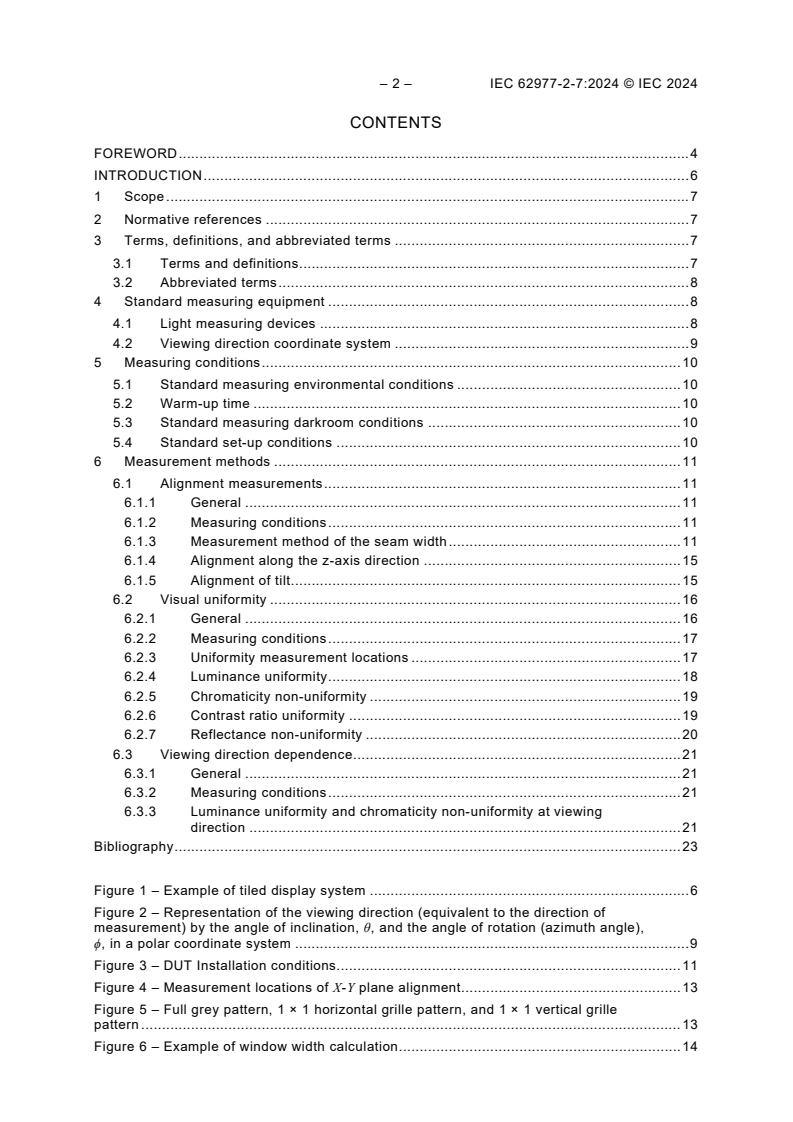
CONTENTS
FOREWORD . 4
INTRODUCTION . 6
1 Scope . 7
2 Normative references . 7
3 Terms, definitions, and abbreviated terms . 7
3.1 Terms and definitions . 7
3.2 Abbreviated terms . 8
4 Standard measuring equipment . 8
4.1 Light measuring devices . 8
4.2 Viewing direction coordinate system . 9
5 Measuring conditions . 10
5.1 Standard measuring environmental conditions . 10
5.2 Warm-up time . 10
5.3 Standard measuring darkroom conditions . 10
5.4 Standard set-up conditions . 10
6 Measurement methods . 11
6.1 Alignment measurements . 11
6.1.1 General . 11
6.1.2 Measuring conditions . 11
6.1.3 Measurement method of the seam width . 11
6.1.4 Alignment along the z-axis direction . 15
6.1.5 Alignment of tilt . 15
6.2 Visual uniformity . 16
6.2.1 General . 16
6.2.2 Measuring conditions . 17
6.2.3 Uniformity measurement locations . 17
6.2.4 Luminance uniformity . 18
6.2.5 Chromaticity non-uniformity . 19
6.2.6 Contrast ratio uniformity . 19
6.2.7 Reflectance non-uniformity . 20
6.3 Viewing direction dependence . 21
6.3.1 General . 21
6.3.2 Measuring conditions . 21
6.3.3 Luminance uniformity and chromaticity non-uniformity at viewing
direction . 21
Bibliography . 23
Figure 1 – Example of tiled display system . 6
Figure 2 – Representation of the viewing direction (equivalent to the direction of
measurement) by the angle of inclination, θ, and the angle of rotation (azimuth angle),
ϕ, in a polar coordinate system . 9
Figure 3 – DUT Installation conditions. 11
Figure 4 – Measurement locations of X-Y plane alignment. 13
Figure 5 – Full grey pattern, 1 × 1 horizontal grille pattern, and 1 × 1 vertical grille
pattern . 13
Figure 6 – Example of window width calculation . 14
Figure 7 – Luminance profile before and after WMA . 14
Figure 8 – Example of seam width and depth calculation . 14
Figure 9 – Measurement location of z-axis alignment . 15
Figure 10 – Measurement locations of alignment of tilt . 16
Figure 11 – Example measurement locations of 1 × 2 tiled display elements . 17
Figure 12 – Example measurement locations of 2 × 2 tiled display elements . 18
Figure 13 – Example of luminance uniformity at viewing direction . 22
– 4 – IEC 62977-2-7:2024 © IEC 2024
INTERNATIONAL ELECTROTECHNICAL COMMISSION
____________
ELECTRONIC DISPLAYS –
Part 2-7: Measurements of optical characteristics – Tiled displays
FOREWORD
1) The International Electrotechnical Commission (IEC) is a worldwide organization for standardization comprising
all national electrotechnical committees (IEC National Committees). The object of IEC is to promote international
co-operation on all questions concerning standardization in the electrical and electronic fields. To this end and
in addition to other activities, IEC publishes International Standards, Technical Specifications, Technical Reports,
Publicly Available Specifications (PAS) and Guides (hereafter referred to as “IEC Publication(s)”). Their
preparation is entrusted to technical committees; any IEC National Committee interested in the subject dealt with
may participate in this preparatory work. International, governmental and non-governmental organizations liaising
with the IEC also participate in this preparation. IEC collaborates closely with the International Organization for
Standardization (ISO) in accordance with conditions determined by agreement between the two organizations.
2) The formal decisions or agreements of IEC on technical matters express, as nearly as possible, an international
consensus of opinion on the relevant subjects since each technical committee has representation from all
interested IEC National Committees.
3) IEC Publications have the form of recommendations for international use and are accepted by IEC National
Committees in that sense. While all reasonable efforts are made to ensure that the technical content of IEC
Publications is accurate, IEC cannot be held responsible for the way in which they are used or for any
misinterpretation by any end user.
4) In order to promote international uniformity, IEC National Committees undertake to apply IEC Publications
transparently to the maximum extent possible in their national and regional publications. Any divergence between
any IEC Publication and the corresponding national or regional publication shall be clearly indicated in the latter.
5) IEC itself does not provide any attestation of conformity. Independent certification bodies provide conformity
assessment services and, in some areas, access to IEC marks of conformity. IEC is not responsible for any
services carried out by independent certification bodies.
6) All users should ensure that they have the latest edition of this publication.
7) No liability shall attach to IEC or its directors, employees, servants or agents including individual experts and
members of its technical committees and IEC National Committees for any personal injury, property damage or
other damage of any nature whatsoever, whether direct or indirect, or for costs (including legal fees) and
expenses arising out of the publication, use of, or reliance upon, this IEC Publication or any other IEC
Publications.
8) Attention is drawn to the Normative references cited in this publication. Use of the referenced publications is
indispensable for the correct application of this publication.
9) IEC draws attention to the possibility that the implementation of this document may involve the use of (a)
patent(s). IEC takes no position concerning the evidence, validity or applicability of any claimed patent rights in
respect thereof. As of the date of publication of this document, IEC had not received notice of (a) patent(s), which
may be required to implement this document. However, implementers are cautioned that this may not represent
the latest information, which may be obtained from the patent database available at https://patents.iec.ch. IEC
shall not be held responsible for identifying any or all such patent rights.
IEC 62977-2-7 has been prepared by IEC technical committee 110: Electronic displays. It is an
International Standard.
The text of this International Standard is based on the following documents:
Draft Report on voting
110/1614/FDIS 110/1631/RVD
Full information on the voting for its approval can be found in the report on voting indicated in
the above table.
The language used for the development of this International Standard is English.
This document was drafted in accordance with ISO/IEC Directives, Part 2, and developed in
accordance with ISO/IEC Directives, Part 1 and ISO/IEC Directives, IEC Supplement, available
at www.iec.ch/members_experts/refdocs. The main document types developed by IEC are
described in greater detail at www.iec.ch/publications.
A list of all parts in the IEC 62977 series, published under the general title Electronic displays,
can be found on the IEC website.
The committee has decided that the contents of this document will remain unchanged until the
stability date indicated on the IEC website under webstore.iec.ch in the data related to the
specific document. At this date, the document will be
• reconfirmed,
• withdrawn, or
• revised.
IMPORTANT – The "colour inside" logo on the cover page of this document indicates
that it contains colours which are considered to be useful for the correct understanding
of its contents. Users should therefore print this document using a colour printer.
– 6 – IEC 62977-2-7:2024 © IEC 2024
INTRODUCTION
Tiled displays are widely used in a variety of places and in a variety of forms. Demand for tiled
displays is expected to increase in the future. IEC TC 110 has already standardized various
measurement methods to evaluate performance of electronic displays. However, in order to
evaluate the performance of a tiled display, additional definitions of terms and new evaluation
methods will be developed.
The tiled display has repeatable elements that exist at various levels whose subsystems enable
a highly configurable display system. In terms used in LED industries, for example the display
system (first level of assembly) includes all subcomponents. It can come in any shape or size,
curved, disconnected, etc. The cabinet (second level of assembly) typically includes a
mechanical support structure with mechanical interconnects. The cabinet is also called a panel,
chassis, or shell. The module (third level of assembly) typically includes optical elements
(lowest level of assembly) with electrical interconnects, but will probably not have
module-to-module mechanical interconnects. The module is also called a tile. As described
above, the tiled display consists of a combination of subsystems of each level as illustrated in
Figure 1. In this combination process, problems that did not appear on a single panel display
can occur. Therefore, the optical properties caused by this problem will be checked at each
level.
Figure 1 – Example of tiled display system
Depending on the final installation location, the methods presented in this document will
probably not be applicable, and the result can vary depending on the calibration process
reflecting the final installation environment.
This document deals with a tiled display performance evaluation method based on the existing
TC 110 measurement method.
ELECTRONIC DISPLAYS –
Part 2-7: Measurements of optical characteristics – Tiled displays
1 Scope
This part of IEC 62977 specifies standard measuring conditions and measurement methods for
determining the optical characteristics of tiled displays which consist of multiple display modules
in order to form one screen. These methods apply to emissive and transmissive direct view flat
displays that render real 2D images with all modules lying in the same plane. The methods are
applicable in environments where the measuring conditions can be controlled, such as
laboratory and production testing.
NOTE The measurement results are not specific values for the products. They can vary according to the
measurement method and light measuring device (LMD) used in the calibration.
2 Normative references
The following documents are referred to in the text in such a way that some or all of their content
constitutes requirements of this document. For dated references, only the edition cited applies.
For undated references, the latest edition of the referenced document (including any
amendments) applies.
IEC 62977-2-1:2021, Electronic displays – Part 2-1: Measurements of optical characteristics –
Fundamental measurements
IEC 62977-2-2:2020, Electronic displays – Part 2-2: Measurements of optical characteristics –
Ambient performance
IEC 62341-6-2:2015, Organic light emitting diode (OLED) displays – Part 6-2: Measuring
methods of visual quality and ambient performance
3 Terms, definitions, and abbreviated terms
3.1 Terms and definitions
For the purposes of this document, the following terms and definitions apply.
ISO and IEC maintain terminology databases for use in standardization at the following
addresses:
• IEC Electropedia: available at https://www.electropedia.org/
• ISO Online browsing platform: available at https://www.iso.org/obp
3.1.1
tiled display
display which consists of multiple display modules in order to form one screen
– 8 – IEC 62977-2-7:2024 © IEC 2024
3.1.2
seam
space or gap between the adjacent display device modules
Note 1 to entry: Seam can result from the gaps between adjacent pixels on adjacent devices, and from any
components (e.g., interconnects, adhesives, seals, mechanical alignment components, etc.) of a frame outside the
device, making the display image discontinuous.
Note 2 to entry: In the case of some tiled display products, additional lens, narrow pitch, and overlapping technologies
are used to produce a seamless display with a seam that is not perceptible to the user. Such a seam is called an
invisible seam.
3.1.3
tiled display element
single device element of the tiled display that can be driven independently and capable of
providing an independent visual representation
Note 1 to entry: Among the assembly levels exemplified in the introduction, cabinets and modules would belong to
tiled display elements. However, the case of the module, which cannot be operated independently, is excluded.
3.1.4
pixel ratio
number of pixels of the output image of the LMD per pixel interval of the image of the display
input, when the display screen is captured by the LMD at a specific magnification
3.2 Abbreviated terms
CIE Commission Internationale de l’Eclairage (International Commission on Illumination)
CPX camera pixel
DUT device under test
ILMD imaging light measuring device
LMD light measuring device
MWA moving-window average
4 Standard measuring equipment
4.1 Light measuring devices
For the requirements of light measuring devices, refer to those specified in IEC 62977-2-1. The
system configurations, operating conditions, or both, of the measuring equipment shall comply
with the structure specified in each item. In particular, 6.2 and 6.3 shall follow the conditions of
IEC 62977-2-1:2021, 5.3.4.
For 2D ILMDs which are not covered by 62977-2-1, the following requirements apply to the light
measuring equipment, as follows.
2D ILMD: The ILMD shall capture a displayed image at a certain exposure time. The ILMD shall
be used within its linear range for the incoming light. If a 2D ILMD is used, the effect of moiré,
LMD field of view, flat field correction, background subtraction, etc., shall be taken into account.
The measurement method in this document only measures a small area of the display, not the
entire display, so moiré is not likely to occur, but should be checked before measurement. One
display pixel should be covered by 30 or more camera pixels to avoid it. Refer to [1] , Chapter 7,
Appendix A9, for more information.
___________
Numbers in square brackets refer to the Bibliography.
If the light level of the display is temporally modulated, then the ILMD integration time shall be
synchronized with the vertical frame synchronization signal. If the ILMD is not capable of
synchronizing, then the ILMD integration time shall be at least 200 cycles (refer to [1],
Appendix A4.2.2).
The ILMD should be set perpendicularly to the DUT screen. The results can be different when
measuring at a viewing direction (vantage point direction).
4.2 Viewing direction coordinate system
The viewing direction is the direction under which the observer looks at the spot of interest on
the DUT. During the measurement, the LMD is replacing the observer, looking from the same
direction at a specified spot (i.e., measuring spot, measurement field) on the DUT. The viewing
direction is conveniently defined by two angles: the angle of inclination θ (related to the surface
normal of the DUT) and the angle of rotation ϕ (also called azimuth angle) as illustrated in
Figure 2. The azimuth angle is related to the directions on a watch-dial as follows: ϕ = 0° is
referred to as the 3-o'clock direction ("right"), ϕ = 90° as the 12-o'clock direction ("up"), ϕ = 180°
as the 9-o'clock direction ("left") and ϕ = 270° as the 6-o'clock direction ("down").
NOTE
3 o’clock: right edge of the screen as seen from the user
6 o’clock: bottom edge of the screen as seen from the user
9 o’clock: left edge of the screen as seen from the user
12 o’clock: top edge of the screen as seen from the user
Figure 2 – Representation of the viewing direction
(equivalent to the direction of measurement) by the angle of inclination, θ,
and the angle of rotation (azimuth angle), ϕ, in a polar coordinate system
– 10 – IEC 62977-2-7:2024 © IEC 2024
5 Measuring conditions
5.1 Standard measuring environmental conditions
Measurements should be carried out under standard environmental conditions:
– temperature: 25 °C ± 3 °C,
– relative humidity: 25 % RH to 85 % RH,
– atmospheric pressure: 86 kPa to 106 kPa.
When different environmental conditions are used, they shall be noted in the measurement
report.
5.2 Warm-up time
Measurements shall be carried out after sufficient warm-up. Warm-up time is defined as the
time elapsed from when the supply source is switched on, and a 100 % grey level of input signal
is applied to the DUT, until repeated measurements of the display show a variation in luminance
of no more than 2 %/min.
5.3 Standard measuring darkroom conditions
The luminance contribution from the background illumination reflected off the test display shall
be < 0,01 cd/m in any direction. If these conditions are not satisfied, then background
subtraction is required, and it shall be noted in th
...