

IEC TR 63340-3:2025
(Main)Electronic displays for special applications - Part 3: Gaming and e-sports
General Information
- Abstract
IEC TR 63340-3:2025, which is a Technical Report, provides general information for the standardization of electronic displays for gaming and e-sports. This document includes an overview of market relevance, related technologies, and standardization strategies.
- Status
- Published
- Publication Date
- 01-Jul-2025
- Technical Committee
- TC 110 - Electronic displays
- Drafting Committee
- PT 63340 - TC 110/PT 63340


Overview
IEC TR 63340-3:2025 - Electronic displays for special applications, Part 3: Gaming and e‑sports - is a Technical Report from IEC TC 110 that provides general information to guide standardization of gaming displays and e‑sports displays. Rather than normative requirements, this TR summarizes market relevance, related technologies, performance characteristics, and a strategy for future standardization work. Its purpose is to collect technical knowledge and clarify where future standards or measurement methods are needed.
Key Topics
- Market trends and application types
- Overview of the gaming market, distinctions between casual gaming, competitive gaming and e‑sports, and types of games (FPS, MOBA, RAC, RTS, RPG).
- Display technologies
- Panel types and technologies (LCD variants such as TN, IPS, VA; OLED), connectors (e.g., HDMI), and auxiliary systems used in gaming displays.
- Temporal and optical performance characteristics
- Candidate characteristics to be considered for measurement and specification: GtG response time, MPRT (moving picture response time), ClearMR, refresh rate and VRR (variable refresh rate), frame skipping, motion artefacts (ghosting/overlap), stroboscopic effects, input latency, screen tearing and stuttering.
- Function and experience optimization
- Synchronization technologies, overdrive (OD), MEMC, ergonomics, curved displays and other UX-oriented functions.
- Standardization strategy
- Identification of stakeholders, gaps in current market labelling of “gaming” displays, candidate standardization maps for display modules and systems, and points for future work (definitions, scenario-dependent specs, measurement methods, relation to e‑sports regulations).
Applications and Who Uses It
IEC TR 63340-3:2025 is useful for:
- Display manufacturers and R&D teams designing panels and systems for gaming and e‑sports.
- Test laboratories and certification bodies planning measurement methods for gaming‑specific characteristics.
- Product managers and marketers who need to align product claims (e.g., “gaming monitor”) with objective performance factors.
- E‑sports organizers, tournament operators and regulators who require guidance on what display attributes matter in competitive play.
- Standards committees and policymakers shaping future normative standards for gaming displays.
Related Standards
- Part of the IEC 63340 series (Electronic displays for special applications) and developed by IEC TC 110 (Electronic displays).
- References to commonly used interfaces and technologies are included (e.g., HDMI, panel technologies, VRR), and the TR points to the need to align future normative standards with existing measurement practice.
Keywords: IEC TR 63340-3:2025, gaming displays, e‑sports displays, display standards, refresh rate, VRR, input latency, GtG, MPRT, OLED, LCD, measurement methods.
Frequently Asked Questions
IEC TR 63340-3:2025 is a technical report published by the International Electrotechnical Commission (IEC). Its full title is "Electronic displays for special applications - Part 3: Gaming and e-sports". This standard covers: IEC TR 63340-3:2025, which is a Technical Report, provides general information for the standardization of electronic displays for gaming and e-sports. This document includes an overview of market relevance, related technologies, and standardization strategies.
IEC TR 63340-3:2025, which is a Technical Report, provides general information for the standardization of electronic displays for gaming and e-sports. This document includes an overview of market relevance, related technologies, and standardization strategies.
IEC TR 63340-3:2025 is classified under the following ICS (International Classification for Standards) categories: 31.120 - Electronic display devices. The ICS classification helps identify the subject area and facilitates finding related standards.
IEC TR 63340-3:2025 is available in PDF format for immediate download after purchase. The document can be added to your cart and obtained through the secure checkout process. Digital delivery ensures instant access to the complete standard document.
Standards Content (Sample)
IEC TR 63340-3 ®
Edition 1.0 2025-07
TECHNICAL
REPORT
Electronic displays for special applications –
Part 3: Gaming and e-sports
ICS 31.120 ISBN 978-2-8327-0542-1
All rights reserved. Unless otherwise specified, no part of this publication may be reproduced or utilized in any form or
by any means, electronic or mechanical, including photocopying and microfilm, without permission in writing from either
IEC or IEC's member National Committee in the country of the requester. If you have any questions about IEC copyright
or have an enquiry about obtaining additional rights to this publication, please contact the address below or your local
IEC member National Committee for further information.
IEC Secretariat Tel.: +41 22 919 02 11
3, rue de Varembé info@iec.ch
CH-1211 Geneva 20 www.iec.ch
Switzerland
About the IEC
The International Electrotechnical Commission (IEC) is the leading global organization that prepares and publishes
International Standards for all electrical, electronic and related technologies.
About IEC publications
The technical content of IEC publications is kept under constant review by the IEC. Please make sure that you have the
latest edition, a corrigendum or an amendment might have been published.
IEC publications search - IEC Products & Services Portal - products.iec.ch
webstore.iec.ch/advsearchform Discover our powerful search engine and read freely all the
The advanced search enables to find IEC publications by a
publications previews, graphical symbols and the glossary.
variety of criteria (reference number, text, technical With a subscription you will always have access to up to date
committee, …). It also gives information on projects, content tailored to your needs.
replaced and withdrawn publications.
Electropedia - www.electropedia.org
IEC Just Published - webstore.iec.ch/justpublished The world's leading online dictionary on electrotechnology,
Stay up to date on all new IEC publications. Just Published containing more than 22 500 terminological entries in English
details all new publications released. Available online and and French, with equivalent terms in 25 additional languages.
once a month by email. Also known as the International Electrotechnical Vocabulary
(IEV) online.
IEC Customer Service Centre - webstore.iec.ch/csc
If you wish to give us your feedback on this publication or
need further assistance, please contact the Customer
Service Centre: sales@iec.ch.
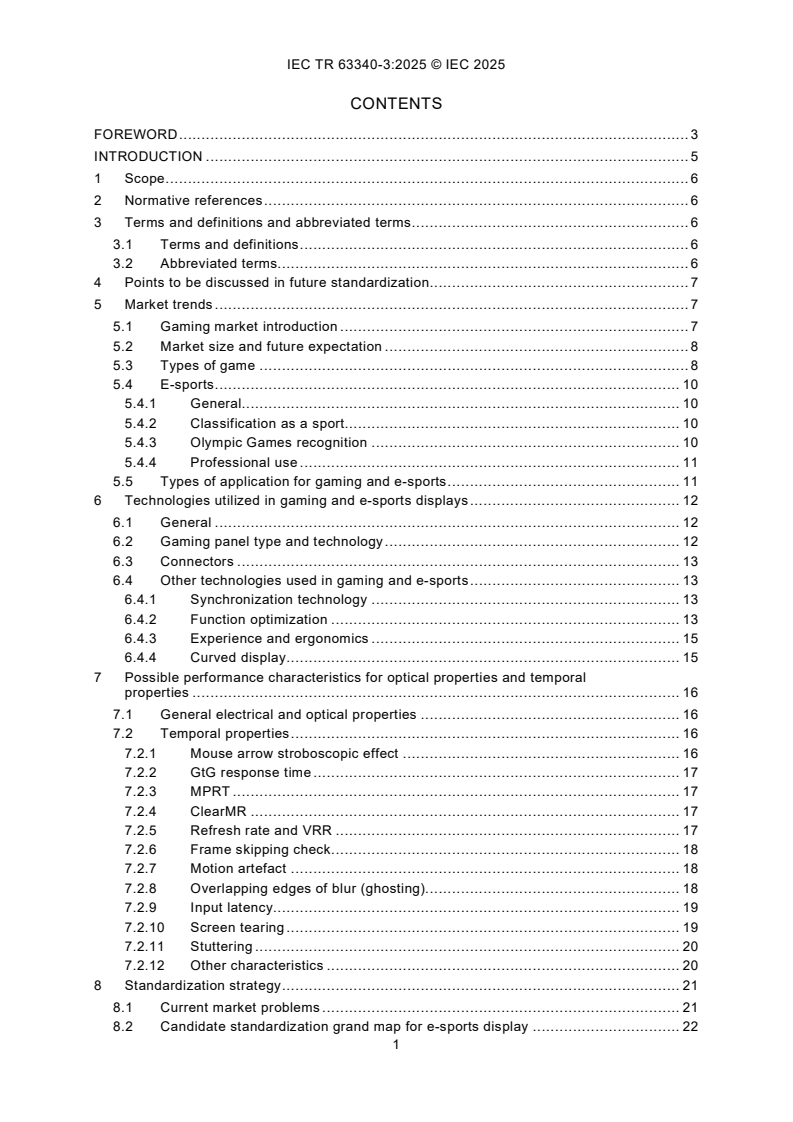
CONTENTS
FOREWORD . 3
INTRODUCTION . 5
1 Scope . 6
2 Normative references . 6
3 Terms and definitions and abbreviated terms . 6
3.1 Terms and definitions . 6
3.2 Abbreviated terms. 6
4 Points to be discussed in future standardization . 7
5 Market trends . 7
5.1 Gaming market introduction . 7
5.2 Market size and future expectation . 8
5.3 Types of game . 8
5.4 E-sports . 10
5.4.1 General. 10
5.4.2 Classification as a sport. 10
5.4.3 Olympic Games recognition . 10
5.4.4 Professional use . 11
5.5 Types of application for gaming and e-sports . 11
6 Technologies utilized in gaming and e-sports displays . 12
6.1 General . 12
6.2 Gaming panel type and technology . 12
6.3 Connectors . 13
6.4 Other technologies used in gaming and e-sports . 13
6.4.1 Synchronization technology . 13
6.4.2 Function optimization . 13
6.4.3 Experience and ergonomics . 15
6.4.4 Curved display . 15
7 Possible performance characteristics for optical properties and temporal
properties . 16
7.1 General electrical and optical properties . 16
7.2 Temporal properties . 16
7.2.1 Mouse arrow stroboscopic effect . 16
7.2.2 GtG response time . 17
7.2.3 MPRT . 17
7.2.4 ClearMR . 17
7.2.5 Refresh rate and VRR . 17
7.2.6 Frame skipping check . 18
7.2.7 Motion artefact . 18
7.2.8 Overlapping edges of blur (ghosting). 18
7.2.9 Input latency. 19
7.2.10 Screen tearing . 19
7.2.11 Stuttering . 20
7.2.12 Other characteristics . 20
8 Standardization strategy . 21
8.1 Current market problems . 21
8.2 Candidate standardization grand map for e-sports display . 22
8.2.1 General. 22
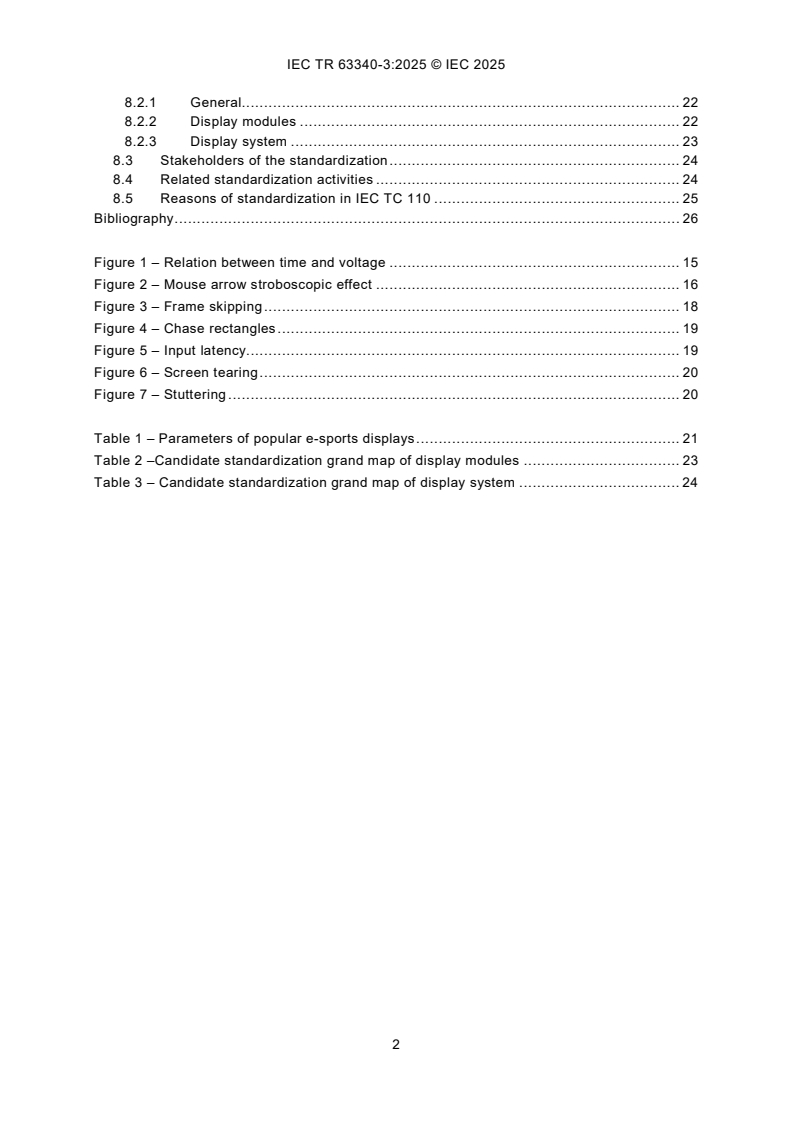
8.2.2 Display modules . 22
8.2.3 Display system . 23
8.3 Stakeholders of the standardization . 24
8.4 Related standardization activities . 24
8.5 Reasons of standardization in IEC TC 110 . 25
Bibliography . 26
Figure 1 – Relation between time and voltage . 15
Figure 2 – Mouse arrow stroboscopic effect . 16
Figure 3 – Frame skipping . 18
Figure 4 – Chase rectangles . 19
Figure 5 – Input latency. 19
Figure 6 – Screen tearing . 20
Figure 7 – Stuttering . 20
Table 1 – Parameters of popular e-sports displays . 21
Table 2 –Candidate standardization grand map of display modules . 23
Table 3 – Candidate standardization grand map of display system . 24
INTERNATIONAL ELECTROTECHNICAL COMMISSION
____________
Electronic displays for special applications -
Part 3: Gaming and e-sports
FOREWORD
1) The International Electrotechnical Commission (IEC) is a worldwide organization for standardization comprising
all national electrotechnical committees (IEC National Committees). The object of IEC is to promote international
co-operation on all questions concerning standardization in the electrical and electronic fields. To this end and
in addition to other activities, IEC publishes International Standards, Technical Specifications, Technical Reports,
Publicly Available Specifications (PAS) and Guides (hereafter referred to as "IEC Publication(s)"). Their
preparation is entrusted to technical committees; any IEC National Committee interested in the subject dealt with
may participate in this preparatory work. International, governmental and non-governmental organizations liaising
with the IEC also participate in this preparation. IEC collaborates closely with the International Organization for
Standardization (ISO) in accordance with conditions determined by agreement between the two organizations.
2) The formal decisions or agreements of IEC on technical matters express, as nearly as possible, an international
consensus of opinion on the relevant subjects since each technical committee has representation from all
interested IEC National Committees.
3) IEC Publications have the form of recommendations for international use and are accepted by IEC National
Committees in that sense. While all reasonable efforts are made to ensure that the technical content of IEC
Publications is accurate, IEC cannot be held responsible for the way in which they are used or for any
misinterpretation by any end user.
4) In order to promote international uniformity, IEC National Committees undertake to apply IEC Publications
transparently to the maximum extent possible in their national and regional publications. Any divergence between
any IEC Publication and the corresponding national or regional publication shall be clearly indicated in the latter.
5) IEC itself does not provide any attestation of conformity. Independent certification bodies provide conformity
assessment services and, in some areas, access to IEC marks of conformity. IEC is not responsible for any
services carried out by independent certification bodies.
6) All users should ensure that they have the latest edition of this publication.
7) No liability shall attach to IEC or its directors, employees, servants or agents including individual experts and
members of its technical committees and IEC National Committees for any personal injury, property damage or
other damage of any nature whatsoever, whether direct or indirect, or for costs (including legal fees) and
expenses arising out of the publication, use of, or reliance upon, this IEC Publication or any other IEC
Publications.
8) Attention is drawn to the Normative references cited in this publication. Use of the referenced publications is
indispensable for the correct application of this publication.
9) IEC draws attention to the possibility that the implementation of this document may involve the use of (a)
patent(s). IEC takes no position concerning the evidence, validity or applicability of any claimed patent rights in
respect thereof. As of the date of publication of this document, IEC had not received notice of (a) patent(s), which
may be required to implement this document. However, implementers are cautioned that this may not represent
the latest information, which may be obtained from the patent database available at https://patents.iec.ch. IEC
shall not be held responsible for identifying any or all such patent rights.
IEC TR 63340-3 has been prepared by IEC technical committee 110: Electronic displays. It is
a Technical Report.
The text of this Technical Report is based on the following documents:
Draft Report on voting
110/1753/DTR 110/1779/RVDTR
Full information on the voting for its approval can be found in the report on voting indicated in
the above table.
The language used for the development of this Technical Report is English.
This document was drafted in accordance with ISO/IEC Directives, Part 2, and developed in
accordance with ISO/IEC Directives, Part 1 and ISO/IEC Directives, IEC Supplement, available
at www.iec.ch/members_experts/refdocs. The main document types developed by IEC are
described in greater detail at www.iec.ch/publications.
A list of all parts in the IEC 63340 series, published under the general title Electronic displays
for special applications, can be found on the IEC website.
The committee has decided that the contents of this document will remain unchanged until the
stability date indicated on the IEC website under webstore.iec.ch in the data related to the
specific document. At this date, the document will be
– reconfirmed,
– withdrawn, or
– revised.
INTRODUCTION
This Technical Report is intended to gather technical information of electronic displays for
special applications in gaming and e-sports, and to clarify the relationship to normative aspects
of the standardization. The intent of this document is to provide guidance for the development
of future standards.
1 Scope
This part of IEC 63340, which is a Technical Report, provides general information for the
standardization of electronic displays for gaming and e-sports. This document includes an
overview of market relevance, related technologies, and standardization strategies.
2 Normative references
There are no normative references in this document.
3 Terms and definitions and abbreviated terms
3.1 Terms and definitions
No terms and definitions are listed in this document.
ISO and IEC maintain terminology databases for use in standardization at the following
addresses:
– IEC Electropedia: available at https://www.electropedia.org/
– ISO Online browsing platform: available at https://www.iso.org/obp
3.2 Abbreviated terms
ADSDS advanced super dimension switch
FDMI flat display mounting interface
FIFA international federation of association football
FPSG first person shooting game
GPU graphics processing unit
GtG grey to grey
HDMI high definition multimedia interface
HDR high dynamic range imaging
IOC international Olympic committee
IPS in-plane switching
LCD liquid crystal display
MEMC motion estimate and motion compensation
MIS mounting interface standard
MOBA multiplayer online battle arena
MPRT moving picture response time
OD overdrive
OLED organic light emitting diode
PC personal computer
RAC racing game
RPG role playing game
RTS real-time strategy
TC technical committee
TN twisted nematic
VA vertical alignment
VRR variable refresh rate
4 Points to be discussed in future standardization
For the standardization of electronic displays for gaming and e-sports, the following points can
be discussed:
– definition and specifications (requirements) for gaming and e-sports displays;
– specification dependence on game types and application scenarios for casual gaming,
competitive gaming and e-sports;
– measurement and evaluation methods specific to gaming and e-sports displays;
– relation with e-sports regulations.
Currently, there are many "gaming displays" in the market, but the specifications (requirements)
for labelling "gaming" are not clear. Basically, the required specifications depend on game types
(i.e. some games require for high-speed performance). However, the target audience and
requirements for casual gaming and e-sports monitors are different. In general, measurement
methods for electronic displays can be applied to gaming and e-sports displays, but some
specific methods can be required. When displays are applied to causal gaming and e-sports,
specifications (requirements) are different and the relation with the regulations can be defined.
Casual gaming is a type of entertainment game for which it takes a significantly less amount of
time to play and win. Typical displays with a normal performance level can meet their
requirements.
E-sports and competitive gaming are games at a professional level or in an organized format
(a tournament or league) with a specific goal (i.e. winning a champion title or prize money) and
a clear distinction between players and teams that are competing against each other.
Competitive gaming and e-sports displays require high-level performance for competition. So,
it is crucial that some items in the blank detailed specification of displays for competitive gaming
and e-sports meet the thresholds.
5 Market trends
5.1 Gaming market introduction
Electronic game is a form of game that runs on computer and with its outstanding computing
power, players can enjoy higher running speed and interaction speed. The long game
development process that was carried out by hand and props in the past can now be completed
quickly by the computers. Popular electronic games, mobile games, arcade games and many
other similar games fall under the category of electronic games.
The global electronic game market is expected to boom as more consumers turn to the
interactive digital gaming world as a source of entertainment. The increasing use of games on
TV and PCs is expected to help expand the market. The growing number of electronic games
will drive market growth over the forecast period. The growing number of adults playing
electronic games as a source of entertainment, is further expected to fuel market expansion.
The development of user interfaces for smartphones, laptops, and PCs is expected to benefit
the market in the coming years.
The growth of touch-screen devices such as smartphones and tablets, as well as the ease of
use of electronic games on different devices such as PCs, tablets, laptops, and smartphones
are expected to drive the growth of the electronic game market. The growing number of online
or social game players will further expand the market. The reduction in network costs and the
accessibility of games will drive demand in the electronic game market. The increasing
compatibility and hardware capacity of PCs, laptops, tablets, and smartphones will further
stimulate the market.
Electronic games market is segmented on the basis of devices such as tablet, PC, and other
gaming tools. Electronic games consist of online games, arcade games, social games, and
console games.
Electronic games such as strategy games, racing games, pursuit games, mission games, mind
games, social games, and team games have made important contributions to the expansion of
the market. Social networking sites have been crucial in promoting electronic games over the
Internet. The increasing disposable income and the improvement of living standards of
consumers are also enhancing the electronic game market. Further, electronic games are
increasingly proving effective in developing various qualities such as strategic planning and
team building. Current trends in the electronic games market include developing strategies to
increasing comparability mechanics with existing popular games so as to reduce the risk of
competition.
5.2 Market size and future expectation
The increasing proliferation of mobile phones and easy availability of games on the internet
along with innovations in both hardware and software are expected to have a positive impact
on the growth of the global gaming market. In addition, the growing adoption of mobile and
browser games which offer free-to-play business models is another trend that is gaining traction
in the gaming market. Furthermore, with the rising popularity of e-sports, multiplayer electronic
game competition between professional and amateur players, the gaming market is witnessing
an accelerated growth worldwide. Some of the other factors propelling the gaming market are
empowering nature of games, availability of different genres, such as strategy, action,
simulation, etc., and a shift from physical games to online games. According to the updated
"Global games market report", released by Newzoo, a market research institution in the game
industry, in January 2024, the global game market size reached 182,9 billion US dollars in 2022.
Game users are highly engaged. The demand of players continues to exist, and the increase in
the number of players will drive the steady growth of the game market size. It is predicted that
the global electronic game users will reach 3,68 billion in 2026, and the global electronic game
market revenue will reach $205,4 billion.
In terms of market segments, mobile games and console games are the main growth points.
Mobile games dominated the market with $89,9 billion in 2023. The console games market was
worth $52,4 billion in 2023, up 1,9 % year over year. Future trends suggest that the electronic
game market will continue to expand.
5.3 Types of game
There are many different types of electronic games, which can typically be categorized by the
characteristics or underlying objectives. Game categories or genres, then, can also have
subgenres, and many games fit into multiple genres. By breaking down the game mechanics,
gaming types can be divided into the following categories.
– Action
Action games emphasize physical challenges that require hand-eye coordination and motor
skill to overcome. They are player-centric because the player controls most of the action.
Most of the earliest electronic games were considered action games, today, it is still a vast
genre covering all game titles that involve physical challenges.
Action games are classified by many subgenres. Platform games and fighting games are
among the best-known subgenres, while shooting games have become and continue to be
one of the dominant genres in electronic games since 1990s. Action games usually involve
elements of twitch gameplay.
– Action-adventure
Action-adventure games combine the elements of two genres: they typically feature long-
term obstacles that are overcome using a tool or item (which was collected earlier) as you
would do in an action game, as well as many smaller obstacles that are almost constantly
getting in the way and require elements of action games to overcome. Action-adventure
games tend to focus on exploration and usually involve item-gathering, simple puzzle-
solving, and combat. "Action-adventure" has become a category which is for games that do
not fit neatly into another well-known genre. Because of their prevalence on electronic game
consoles and the absence of typical adventure games, action-adventure games are often
called "adventure games" by modern gamers.
– Adventure
Adventure games are a type of games that focus on exploration, puzzle solving, and
narrative. It offers players a unique form of entertainment through a rich narrative and
interactive experience. Players typically take on the role of one or more characters,
completing tasks by interacting with the environment, solving puzzles, collecting items, and
driving the story. Adventure games focus on story and player experience, often with little
emphasis on action or combat.
– Role-playing
Role-playing electronic games are a type of games with role-playing characteristics as the
core, in the sense that most of these games cast the player in the role of one or more
"adventurers" who specialize in specific skill sets (such as melee combat or ranged magic
spells) while progressing through a predetermined storyline. Many involve manoeuvring
these character(s) through an overworld, usually populated with monsters, that allows
access to more important game locations, such as towns, dungeons, and castles. Since the
emergence of affordable home computers coincided with the popularity of paper and pencil
role-playing games, this genre was one of the first in electronic games and continues to be
popular today. Gameplay elements strongly associated with RPG, such as statistical
character development through the acquisition of experience points, have been widely
adapted to other genres such as action-adventure games. Though nearly all of the early
entries in the genre were turn-based games, many modern role-playing games progress in
real-time. Thus, the genre has followed the strategy game's trend of moving from turn-based
to real-time combat.
– Simulation
Simulation electronic games describe a diverse super-category of electronic games,
generally designed to closely simulate real world activities. A simulation game attempts to
copy various activities from real life in the form of a game for various purposes such as
training, analysis, or prediction. Usually there are no strictly defined goals in the game, with
the player instead allowed to control a character or environment freely. Well-known
examples are war games, business games, and role play simulation.
– Strategy
Strategy electronic games focus on gameplay requiring careful and skilful thinking and
planning in order to achieve victory. The action scales from squad-based tactics to world
domination. In most strategy electronic games, the player is given a bird's eye view of the
game world and directly controlling the units under command. Rollings also notes that the
origin of strategy games is rooted in their close cousins, board games. Strategy electronic
games generally take one of four archetypal forms, depending on whether the game is turn-
based or real-time and whether the game's focus is upon strategy or tactics.
– Sports
Sports games emulate the playing of traditional physical sports. Some emphasize actually
playing the sport, while others emphasize the strategy behind the sport. Others satirize the
sport for comic effect. This genre emerged early in the history of electronic games and
remains popular.
– Others
Puzzle or logic games usually take place on a single screen or playfield and require the
player to solve a problem to advance the action. As technology continues to push the
confines of what's possible in electronic gaming – and as players and developers push the
confines of game genres – new genres are created all the time.
5.4 E-sports
5.4.1 General
E-sports are the sports projects that are based on electronic games, computer equipment as a
carrier, and carried in virtual situations. The forms of e-sports emphasize the confrontation
between competitors under the same rules, challenging quick response, operational skills and
teamwork. E-sports have successfully turned screen into the carrier of a sport, digitalized
competition process, realized the competition function of digital entertainment and promote
certain entertainment function, business value and culture meaning during the whole process.
In 2019, e-sports occupied an important position in the history of the global e-sports market.
The total revenue was mainly from brand investment (media copyright, advertising and
sponsorship) in e-sports related and non-relevant fields, consumer spending on goods and
tickets, and game publishers through cooperation agreements with event organizers.
5.4.2 Classification as a sport
In the 2015 World Championship hosted by the International E-sports Federation, an e-sports
panel was hosted with guests from international sports society to discuss the future recognition
of e-sports as a recognized, legitimate sporting activity worldwide. In 2013, Canadian League
of Legends player Danny "Shiphtur" Le became the first professional gamer to receive an
American P-1A visa, a category designated for "Internationally Recognized Athletes". In 2014,
Turkey's Ministry of Youth and Sports started issuing e-Sports Player licenses to players
certified as professionals. In 2016, the French government started working on a project to
regulate and recognize e-sports. The Games and Amusements Board of the Philippines started
issuing athletic license to Filipino e-sports players who were vouched by a professional e-sports
team in July 2017.
To help promote e-sports as a legitimate sport, several e-sports events have been run alongside
more traditional international sport competitions. The 2007 Asian Indoor Games was the first
notable multi-sport competition including e-sports as an official medal-winning event alongside
other traditional sports, and the later editions of the Asian Indoor Games and its successor the
Asian Indoor and Martial Arts Games have always included e-sports as an official medal event
or an exhibition event up to now. Moreover, the Asian Games, which is the Asian top-level multi-
sport competition, also included e-sports as a medal event at the 2022 edition; e-sports around
games such as Hearthstone, Starcraft II, and League of Legends were presented as an
exhibition event at the 2018 Asian Games as a lead-in to the 2022 games. The 2022 Asian
Games had featured eight e-sports events, including King of Glory, Hearthstone and League of
Legends.
5.4.3 Olympic Games recognition
The Olympic Games are also seen as a potential method to legitimize e-sports. A summit held
by the IOC in October 2017 acknowledged the growing popularity of e-sports, concluding that
"Competitive 'e-sports' could be considered as a sporting activity, and the players involved
prepare and train with an intensity which will be comparable to athletes in traditional sports".
During July 2018, the IOC and the Global Association of International Sports Federations held
a symposium and invited major figures in e-sports. The IOC had tested the potential for e-sports
through exhibition games. With support of the IOC, Intel sponsored exhibition e-Sports events
for StarCraft II and Steep prior to the 2018 Winter Olympics in Pyeongchang, and five South
Korean e-Sports players were part of the Olympic Torch relay. A similar exhibition showcase,
the eGames, was held alongside the 2016 Summer Olympics in Rio de Janeiro, though this was
not supported by the IOC.
At the suggestion of the Tokyo Olympic Games Committee for the 2020 Summer Olympics, four
e-sports organizations had worked with Japan's leading consumer organization. The Tokyo
Olympic Committee had also planned to arrange a number of e-sports events to lead up into
the 2020 games. The organization committee for the 2024 Summer Olympics in Paris were in
discussions with the IOC and the various professional e-Sports organizations to consider
e-sports for the event, citing the need to include these elements to keep the Olympics relevant
to younger generations. The organization committee determined e-sports were premature to
bring to the 2024 Games as medal events but had not ruled out other activities related to
e-sports during the Games.
5.4.4 Professional use
– Players and teams
Professional gamers, or "pro gamers", are often associated with gaming teams or broader
gaming associations. Teams consist of several professionals. These teams often cover
multiple e-sports games within tournaments and leagues, with various team makeups for
each game. They also represent single players for one-on-one e-sports, such as fighting
games within the Evolution Championship Series, or Hearthstone tournaments. In addition
to prize money from tournament wins, players in these teams and associations are also paid
a separate team salary. Team sponsorship covers tournament travel expenses or gaming
hardware. Prominent e-sports sponsors include companies such as Logitech and Razer.
Teams feature these sponsors on their website, team jerseys and on their social media, in
2016 the biggest teams have social media followings of over a million. Associations include
the International e-Sports Federation, the World e-sports Association, etc.
– Leagues and tournaments
In most team-based e-sports, organized play is centred around the use of promotion and
relegation to move sponsored teams between leagues within the competition's organization
based on how the team fared in matches; this follows patterns of professional sports in
European and Asian countries. Teams play a number of games across a season as to vie
for top positioning in the league by the end of that season. Those who do well, in addition
to prize money, will be promoted into a higher-level league, while those who perform not
well will be regulated downward. For example, until 2018, Riot Games ran several League
of Legends series, with the League of Legends Championship Series being the top-tier
series. Teams that did not do well were relegated to the League of Legends Challenger
Series, replaced by the better performing teams from that series.
E-sports are also frequently played in tournaments, where potential players and teams vie
to be placed through qualification matches before entering the tournament. From there, the
tournament formats can vary from single or double elimination, sometimes hybridized with
group stage. E-sports tournaments are almost always physical events in which occur in front
of a live audience, with referees or officials to monitor for cheating. The tournament is part
of a larger gathering, such as DreamHack, or the competition is the entirety of the event,
like the World Cyber Games or the Fortnite World Cup. E-Sports competitions have also
become a popular feature at gaming and multi-genre conventions.
5.5 Types of application for gaming and e-sports
According to the size of the screen and the application scenario, the gaming display can be
classified as follows:
– mobile gaming display;
– tablet gaming display;
– laptop gaming display;
– PC gaming monitor display;
– console and TV gaming display.
In addition, if classified by display technology, OLED and LCD are also included; if classified
according to structural form, flat display and curved display are included.
6 Technologies utilized in gaming and e-sports displays
6.1 General
Electronic gaming is a form of competition using electronic games. Display performance is an
important factor to the superior gaming experience. Other technologies such as synchronization
technology, function optimization and ergonomics also have a big impact on gaming experience.
6.2 Gaming panel type and technology
Mainstream gaming displays have four main panel types. Each type of panel has its own
advantages and disadvantages, such as contrast ratio, viewing angle, etc.
– TN panels
TN panels have become the most widely used entry-level LCD panels due to their low
production costs, and are widely used in mainstream low-end LCD displays on the market.
The advantage of TN panel is that due to the small number of output grey levels, the liquid
crystal molecule deflection speed is fast, and the response time is easy to improve. The
general response time of the TN screen is 1 ms, which is very suitable for the e-sports
gamers who will compete for milliseconds. In addition, the TN screen adopts fog screen
design, which is non-reflective and not easy to hurt eyes, making the game picture clearer
and not easy to fatigue. However, the viewing angle of the TN screen is relatively small.
Due to its excellent response time and features suitable for e-sports, the TN panel is well
suitable for gaming and e-sports scenarios.
– VA panels
The VA panel can be subdivided into multi-domain vertical alignment (MVA) and patterned
vertical alignment (PVA). It is now a panel type with more high-end liquid crystal
applications, which belongs to a wide angle panel. Its advantage is that the viewing angle
is large, convenient for many people to watch the screen at the same time. In addition, it
also has a relatively high contrast ratio, and its text display is particularly clear, which is
mostly used in high-end commercial LCD. The disadvantage of the VA panel is that in the
dynamic picture, the colour connection is not good, it is easier to produce dragging
phenomenon when displaying high-speed pictures, so it is important that users who love to
play intense FPSG carefully choose the display of the VA panel.
– IPS or ADSDS panels
These two types of panels are developed to deliver good performance in viewing angle and
colour reproduction, and compared to TN panels, these panels have better contrast ratio,
better viewing angles, and better colour accuracies. Although these all come at the cost of
slightly slower response times, and lower refresh rates. These two types of panels strike
the perfect balance between gorgeous picture reproduction and acceptable response time
or refresh rate functionality – both the response time and the refresh rate have gotten better
and better in recent years, to the point that a typical gamer can accept.
NOTE There are diverse performance variations even for the same panel type LCD. The advantage and
disadvantage for product can be different from the description of the document.
– OLED panels
OLED panels are capable of delivering extremely high contrast and true black with extremely
high colour accuracy. With extremely fast pixel response time, it can achieve smooth
animation and fast motion display effect. It has a wide viewing angle to provide users with
an immersive viewing experience. These make OLED panels ideal for gaming and e-sports.
Because there is no need for backlight, OLED displays are more stylish and compact in
appearance and easier to carry. These make OLED panels ideal for watching games, movies
and sports content. At present, there are some disadvantages for OLED panels, such as
being susceptible to image retention and screen burning, and higher cost.
6.3 Connectors
The following are connectors for electrical interfaces:
– DisplayPort 1.4
The connector for video and audio transfer on PC.
– HDMI 1.4/2.0/2.1
HDMI 1.4 or HDMI 2.0 does not support refresh rates as high in higher resolutions as
DisplayPort but just as viable for mid-range solutions, also transfers both video and audio.
HDMI 2.1 supports scenes with ultra-high resolution (2K and above).
– 5 mm Audio Out
Designed as a more convenient means of connecting headphones or speakers directly to
the monitor instead to your motherboard's back panel or the case's front panel.
Apart from those, a monitor will also have a 3,5 mm audio input and one or several USB
ports of varying types.
There are other types of connectors. Video and audio compatibility is not issued since most
graphics cards come with at least one or multiple DisplayPort or HDMI ports, and they can both
transfer sound.
6.4 Other technologies used in gaming and e-sports
6.4.1 Synchronization technology
Synchronization technology is also a parameter that cannot be ignored, because in the actual
game experience, the frame rate of the graphics card and the display are not synchronized,
which is also an important reason for the stuttering, frame dropping, and screen tearing. For
the matching problem between the graphics card and the display, the major hardware
manufacturers have proposed solutions, such as G-Sync and FreeSync technology, the
graphics rendering can be consistent with the display output frame rate, making the electronic
game have a high frame rate and a smooth gaming experience.
6.4.2 Function optimization
The continuous development of gaming displays is not only aimed at professional gamers, but
also focuses more broadly on the needs of ordinary gamers. Therefore, in addition to hardware
optimization, manufacturers are also starting to compete in the electronic gaming, by adding a
lot of optimisations of software features to enhance the player's experience.
– Dark detail enhancement
In different types of games, especially FPSGs, there exist black areas in the display, which
makes gamers unable to find competitors clearly in time. So, some advanced monitors have
the function called "dark detail enhancement". The principle of this function is increasing
the brightness of the black area in the display without changing the overall brightness. Some
of the e-sports display manufacturers have integrated this technology into their display
products. It can be a point to judge whether the device is suitable for competitive gaming
and e-sports.
– Colour enhancement
As explained in the dark detail enhancement paragraph, colour enhancement applies similar
concept to coloured areas. When the costumes of the competitors and the background have
similar colour, it is difficult for gamers to make the distinction. By applying colour
enhancement techniques, the costumes and the background can be distinguished easily.
This feature is usually game-title dependent. This technology helps players better identify
key elements and improve game performance by optimizing visual effects in esports games.
When using it, please pay attention to appropriate adjustment and compliance with the
competition rules.
– Crosshair enhancement
Crosshair in FPSGs indicates where the player is shooting, and sometimes can be confused
with the background, therefore players have difficulties to see where they are shooting. By
enhancing the crosshair, the player can visualize the crosshair more easily and take better
aim. The principle of crosshair enhancement is boosting the saturation and shifting hue of
the crosshair. When using crosshairs enhancement, it is crucial to adjust the parameters
according to personal habits and game needs. Some esports competitions restrict the use
of crosshairs, and it is crucial to understand the competition rules in advance.
– Background separation
As mentioned in the colour enhancement paragraph, the costumes of the competitors and
the background can be blended. A more advanced approach
...