

IEC 63211-2-21:2025
(Main)Durability test methods for electronic displays - Part 2-21: Environmental tests - Test methods for heat and humidity
General Information
- Abstract
IEC 63211-2-21:2025 provides test methods of the environmental tests for resistance to heat and humidity. This part of IEC 63211 is used to evaluate the ability of electronic displays to resist environmental damage. This document applies to electronic displays.
- Status
- Published
- Publication Date
- 04-Jun-2025
- Technical Committee
- TC 110 - Electronic displays
- Drafting Committee
- WG 14 - TC 110/WG 14
- Current Stage
- PPUB - Publication issued
- Start Date
- 05-Jun-2025
- Completion Date
- 23-May-2025
Overview
IEC 63211-2-21:2025 - Durability test methods for electronic displays - Part 2-21: Environmental tests – Test methods for heat and humidity - is an international standard from the International Electrotechnical Commission (IEC) designed to evaluate the durability of electronic displays under environmental stresses, specifically heat and humidity. This standard applies to all types of electronic displays and provides robust, repeatable methods for assessing their ability to resist environmental damage, supporting manufacturers, developers, and quality assurance professionals in meeting global reliability expectations.
Key Topics
Scope of Testing
The standard outlines test methods to assess resistance to environmental conditions such as heat and humidity for all types of electronic displays.Standardized Test Conditions
Specifies reference atmospheres, temperature and humidity ranges, and recovery conditions to ensure consistent and comparable test results.Testing Procedures
Detailed methods are provided for:- High temperature storage and operation
- Low temperature storage and operation
- Damp heat in steady-state (both storage and operation)
- Damp heat cyclic and composite temperature-humidity cycles
- Specified and rapid temperature change testing
Test Equipment and Specimen Handling
Requirements for test chambers, specimen mounting, and environmental controls are specified to minimize test variability and prevent condensation, ensuring tests reflect real-world conditions.Reporting and Documentation
Emphasizes the importance of recording all relevant environmental parameters and any deviations, supporting traceability and reproducibility.
Applications
IEC 63211-2-21:2025 is valuable across a wide range of sectors where reliable electronic displays are critical, including:
Consumer Electronics
Evaluation of LCD, OLED, and other displays for smartphones, tablets, TVs, and monitors to ensure operational stability in diverse climates.Automotive and Transportation
Qualification of dash displays and control panels exposed to varying temperatures and humidity levels in vehicles.Industrial and Medical Equipment
Testing of displays used in environments with harsh temperature cycles and humidity, such as manufacturing floors or medical diagnostics devices.Outdoor and Public-Use Displays
Validates performance of digital signage, ATMs, and interactive kiosks exposed to uncontrolled or challenging weather conditions.Quality Assurance, Certification, and Product Development
Provides a common reference for design validation, supplier assessment, regulatory submission, and benchmark comparisons during product development and lifecycle testing.
Related Standards
For comprehensive environmental and durability assessment of electronic displays, consider the following related IEC standards:
- IEC 60068 series: General standards for environmental testing, serving as a foundation for display-specific adaptations.
- IEC 62715-6-2: Standards for flexible display devices (FDD).
- IEC 62679-4-2: Standards for electronic paper displays (EPD).
- IEC 62341-5: Standards for organic light emitting diode (OLED) displays.
- IEC 62908-13-10: Standards for touch and interactive displays.
- IEC 61747-10-2: Liquid crystal displays (LCD) environment test methods.
These standards are complementary and often referenced together to create a holistic testing and durability assessment protocol for electronic displays across various technologies and use cases.
Applying IEC 63211-2-21:2025 helps ensure that electronic displays maintain reliable function and visual performance when exposed to heat and humidity, thereby supporting international compliance, brand reputation, user satisfaction, and market access. For up-to-date information or the latest revisions, consult the IEC standards database.
Frequently Asked Questions
IEC 63211-2-21:2025 is a standard published by the International Electrotechnical Commission (IEC). Its full title is "Durability test methods for electronic displays - Part 2-21: Environmental tests - Test methods for heat and humidity". This standard covers: IEC 63211-2-21:2025 provides test methods of the environmental tests for resistance to heat and humidity. This part of IEC 63211 is used to evaluate the ability of electronic displays to resist environmental damage. This document applies to electronic displays.
IEC 63211-2-21:2025 provides test methods of the environmental tests for resistance to heat and humidity. This part of IEC 63211 is used to evaluate the ability of electronic displays to resist environmental damage. This document applies to electronic displays.
IEC 63211-2-21:2025 is classified under the following ICS (International Classification for Standards) categories: 31.120 - Electronic display devices. The ICS classification helps identify the subject area and facilitates finding related standards.
IEC 63211-2-21:2025 is available in PDF format for immediate download after purchase. The document can be added to your cart and obtained through the secure checkout process. Digital delivery ensures instant access to the complete standard document.
Standards Content (Sample)
IEC 63211-2-21 ®
Edition 1.0 2025-06
INTERNATIONAL
STANDARD
Durability test methods for electronic displays –
Part 2-21: Environmental tests – Test methods for heat and humidity
ICS 31.120 ISBN 978-2-8327-0394-6
All rights reserved. Unless otherwise specified, no part of this publication may be reproduced or utilized in any form or
by any means, electronic or mechanical, including photocopying and microfilm, without permission in writing from either
IEC or IEC's member National Committee in the country of the requester. If you have any questions about IEC copyright
or have an enquiry about obtaining additional rights to this publication, please contact the address below or your local
IEC member National Committee for further information.
IEC Secretariat Tel.: +41 22 919 02 11
3, rue de Varembé info@iec.ch
CH-1211 Geneva 20 www.iec.ch
Switzerland
About the IEC
The International Electrotechnical Commission (IEC) is the leading global organization that prepares and publishes
International Standards for all electrical, electronic and related technologies.
About IEC publications
The technical content of IEC publications is kept under constant review by the IEC. Please make sure that you have the
latest edition, a corrigendum or an amendment might have been published.
IEC publications search - IEC Products & Services Portal - products.iec.ch
webstore.iec.ch/advsearchform Discover our powerful search engine and read freely all the
publications previews, graphical symbols and the glossary.
The advanced search enables to find IEC publications by a
variety of criteria (reference number, text, technical With a subscription you will always have access to up to date
committee, …). It also gives information on projects, content tailored to your needs.
replaced and withdrawn publications.
Electropedia - www.electropedia.org
The world's leading online dictionary on electrotechnology,
IEC Just Published - webstore.iec.ch/justpublished
Stay up to date on all new IEC publications. Just Published containing more than 22 500 terminological entries in English
details all new publications released. Available online and and French, with equivalent terms in 25 additional languages.
once a month by email. Also known as the International Electrotechnical Vocabulary
(IEV) online.
IEC Customer Service Centre - webstore.iec.ch/csc
If you wish to give us your feedback on this publication or
need further assistance, please contact the Customer
Service Centre: sales@iec.ch.
– 2 – IEC 63211-2-21:2025 © IEC 2025
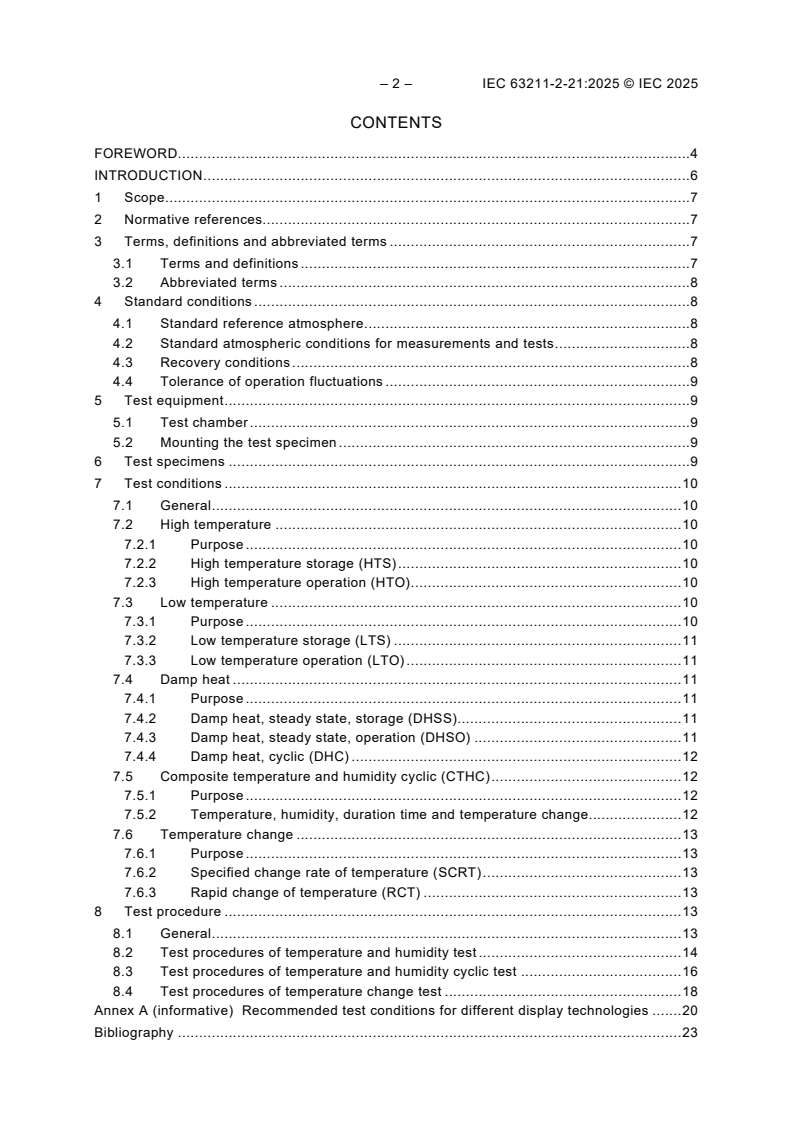
CONTENTS
FOREWORD . 4
INTRODUCTION . 6
1 Scope . 7
2 Normative references. 7
3 Terms, definitions and abbreviated terms . 7
3.1 Terms and definitions . 7
3.2 Abbreviated terms . 8
4 Standard conditions . 8
4.1 Standard reference atmosphere . 8
4.2 Standard atmospheric conditions for measurements and tests . 8
4.3 Recovery conditions . 8
4.4 Tolerance of operation fluctuations . 9
5 Test equipment . 9
5.1 Test chamber . 9
5.2 Mounting the test specimen . 9
6 Test specimens . 9
7 Test conditions . 10
7.1 General . 10
7.2 High temperature . 10
7.2.1 Purpose . 10
7.2.2 High temperature storage (HTS) . 10
7.2.3 High temperature operation (HTO) . 10
7.3 Low temperature . 10
7.3.1 Purpose . 10
7.3.2 Low temperature storage (LTS) . 11
7.3.3 Low temperature operation (LTO) . 11
7.4 Damp heat . 11
7.4.1 Purpose . 11
7.4.2 Damp heat, steady state, storage (DHSS) . 11
7.4.3 Damp heat, steady state, operation (DHSO) . 11
7.4.4 Damp heat, cyclic (DHC) . 12
7.5 Composite temperature and humidity cyclic (CTHC) . 12
7.5.1 Purpose . 12
7.5.2 Temperature, humidity, duration time and temperature change . 12
7.6 Temperature change . 13
7.6.1 Purpose . 13
7.6.2 Specified change rate of temperature (SCRT) . 13
7.6.3 Rapid change of temperature (RCT) . 13
8 Test procedure . 13
8.1 General . 13
8.2 Test procedures of temperature and humidity test . 14
8.3 Test procedures of temperature and humidity cyclic test . 16
8.4 Test procedures of temperature change test . 18
Annex A (informative) Recommended test conditions for different display technologies . 20
Bibliography . 23
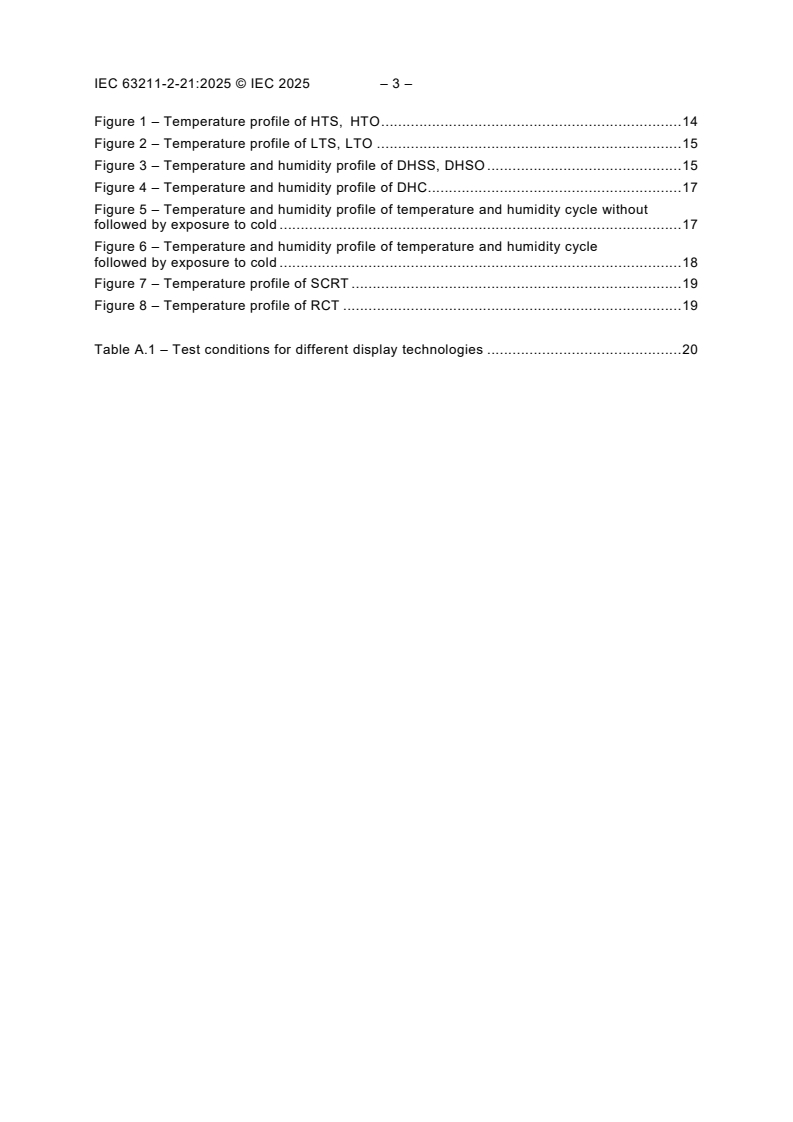
Figure 1 – Temperature profile of HTS, HTO . 14
Figure 2 – Temperature profile of LTS, LTO . 15
Figure 3 – Temperature and humidity profile of DHSS, DHSO . 15
Figure 4 – Temperature and humidity profile of DHC . 17
Figure 5 – Temperature and humidity profile of temperature and humidity cycle without
followed by exposure to cold . 17
Figure 6 – Temperature and humidity profile of temperature and humidity cycle
followed by exposure to cold . 18
Figure 7 – Temperature profile of SCRT . 19
Figure 8 – Temperature profile of RCT . 19
Table A.1 – Test conditions for different display technologies . 20
– 4 – IEC 63211-2-21:2025 © IEC 2025
INTERNATIONAL ELECTROTECHNICAL COMMISSION
____________
DURABILITY TEST METHODS FOR ELECTRONIC DISPLAYS –
Part 2-21: Environmental tests –
Test methods for heat and humidity
FOREWORD
1) The International Electrotechnical Commission (IEC) is a worldwide organization for standardization comprising
all national electrotechnical committees (IEC National Committees). The object of IEC is to promote international
co-operation on all questions concerning standardization in the electrical and electronic fields. To this end and
in addition to other activities, IEC publishes International Standards, Technical Specifications, Technical Reports,
Publicly Available Specifications (PAS) and Guides (hereafter referred to as “IEC Publication(s)”). Their
preparation is entrusted to technical committees; any IEC National Committee interested in the subject dealt with
may participate in this preparatory work. International, governmental and non-governmental organizations liaising
with the IEC also participate in this preparation. IEC collaborates closely with the International Organization for
Standardization (ISO) in accordance with conditions determined by agreement between the two organizations.
2) The formal decisions or agreements of IEC on technical matters express, as nearly as possible, an international
consensus of opinion on the relevant subjects since each technical committee has representation from all
interested IEC National Committees.
3) IEC Publications have the form of recommendations for international use and are accepted by IEC National
Committees in that sense. While all reasonable efforts are made to ensure that the technical content of IEC
Publications is accurate, IEC cannot be held responsible for the way in which they are used or for any
misinterpretation by any end user.
4) In order to promote international uniformity, IEC National Committees undertake to apply IEC Publications
transparently to the maximum extent possible in their national and regional publications. Any divergence between
any IEC Publication and the corresponding national or regional publication shall be clearly indicated in the latter.
5) IEC itself does not provide any attestation of conformity. Independent certification bodies provide conformity
assessment services and, in some areas, access to IEC marks of conformity. IEC is not responsible for any
services carried out by independent certification bodies.
6) All users should ensure that they have the latest edition of this publication.
7) No liability shall attach to IEC or its directors, employees, servants or agents including individual experts and
members of its technical committees and IEC National Committees for any personal injury, property damage or
other damage of any nature whatsoever, whether direct or indirect, or for costs (including legal fees) and
expenses arising out of the publication, use of, or reliance upon, this IEC Publication or any other IEC
Publications.
8) Attention is drawn to the Normative references cited in this publication. Use of the referenced publications is
indispensable for the correct application of this publication.
9) IEC draws attention to the possibility that the implementation of this document may involve the use of (a)
patent(s). IEC takes no position concerning the evidence, validity or applicability of any claimed patent rights in
respect thereof. As of the date of publication of this document, IEC had not received notice of (a) patent(s), which
may be required to implement this document. However, implementers are cautioned that this may not represent
the latest information, which may be obtained from the patent database available at https://patents.iec.ch. IEC
shall not be held responsible for identifying any or all such patent rights.
IEC 63211-2-21 has been prepared by IEC technical committee 110: Electronic displays. It is
an International Standard.
The text of this International Standard is based on the following documents:
Draft Report on voting
110/1742/FDIS 110/1760/RVD
Full information on the voting for its approval can be found in the report on voting indicated in
the above table.
The language used for the development of this International Standard is English.
This document was drafted in accordance with ISO/IEC Directives, Part 2, and developed in
accordance with ISO/IEC Directives, Part 1 and ISO/IEC Directives, IEC Supplement, available
at www.iec.ch/members_experts/refdocs. The main document types developed by IEC are
described in greater detail at www.iec.ch/publications.
A list of all parts in the IEC 63211 series, published under the general title Durability test
methods for electronic displays, can be found on the IEC website.
The committee has decided that the contents of this document will remain unchanged until the
stability date indicated on the IEC website under webstore.iec.ch in the data related to the
specific document. At this date, the document will be
• reconfirmed,
• withdrawn, or
• revised.
– 6 – IEC 63211-2-21:2025 © IEC 2025
INTRODUCTION
All documents developed in IEC TC 110 that are concerned with the durability of electronic
displays refer to a set of methods and procedures that are similar to each other, or sometimes
even identical. This document is intended to identify these methods and to describe them as a
reference for forthcoming standards to make the work of the involved experts more efficient and
to avoid duplication of efforts.
Environmental tests for different display technologies are covered in specific standards,
including IEC 62715-6-2, IEC 62679-4-2, IEC 62341-5, IEC 62908-13-10, and IEC 61747-10-2.
They were originally created using the IEC 60068 series as a reference, in which some
modifications were introduced to be suitable for electronic displays. However, the relevance of
environmental test largely depends on the application and intended use of the display, rather
than the technology utilized. Therefore, the creation of a comprehensive, technology-agnostic
IEC standard for environmental test of electronic displays is proposed. Such a standard would
facilitate more application-centric and use-case focused test protocols, resulting in a more
thorough assessment of electronic displays under various environmental conditions.
This document has been prepared for the following objectives:
a) to avoid unnecessary deviations;
b) to avoid inefficient discussions and documents in multiple working groups;
c) to follow ISO/IEC Directives Part 2:2021, 5.7 (Avoidance of duplication and unnecessary
deviations).
This document relates to the common durability test methods applicable in the field of electronic
displays, which can overlap with some of the parts of existing TC 110 documents that describe
the durability test methods of individual technologies, such as LCD, OLED, PDP and others.
This document is intended to be used as the reference document in future standards and in
revisions of existing ones. The existing standards will be revised in their maintenance time to
refer to this document to the largest extent possible.
DURABILITY TEST METHODS FOR ELECTRONIC DISPLAYS –
Part 2-21: Environmental tests –
Test methods for heat and humidity
1 Scope
This part of IEC 63211 provides test methods of the environmental tests for resistance to heat
and humidity. This part of IEC 63211 is used to evaluate the ability of electronic displays to
resist environmental damage. This document applies to electronic displays.
2 Normative references
The following documents are referred to in the text in such a way that some or all of their content
constitutes requirements of this document. For dated references, only the edition cited applies.
For undated references, the latest edition of the referenced document (including any
amendments) applies.
IEC 60068-1, Environmental testing – Part 1: General and guidance
3 Terms, definitions and abbreviated terms
3.1 Terms and definitions
For the purposes of this document, the terms and definitions given in IEC 60068-1 and the
following apply.
ISO and IEC maintain terminology databases for use in standardization at the following
addresses:
• IEC Electropedia: available at https://www.electropedia.org/
• ISO Online browsing platform: available at https://www.iso.org/obp
3.1.1
operation control point
set point for equilibrium conditions measured at sensor location(s) in an exposure device
3.1.2
operation fluctuations
positive and negative deviations from the setting of the sensor at the operation control set point
during equilibrium conditions in a laboratory-accelerated weathering device
– 8 – IEC 63211-2-21:2025 © IEC 2025
3.2 Abbreviated terms
CTHC composite temperature and humidity cyclic
DHC damp heat, cyclic
DHSO damp heat, steady state, operation
DHSS damp heat, steady state, storage
EPD electronic paper display
FDD flexible display device
HTO high temperature operation
HTS high temperature storage
LCD liquid crystal display
LTO low temperature operation
LTS low temperature storage
OLED organic light emitting diode
RCT rapid change of temperature
SCRT specified change rate of temperature
TID touch and interactive display
4 Standard conditions
4.1 Standard reference atmosphere
The following conditions are applied:
– temperature: 25 °C
– relative humidity: 50 % RH
– air pressure: 101,3 kPa
When different environmental conditions are used, they shall be noted in the report.
4.2 Standard atmospheric conditions for measurements and tests
All tests and measurements shall be carried out under standard atmospheric conditions.
– temperature: 15 °C to 35 °C
– relative humidity: 25 % RH to 85 % RH, where appropriate
– air pressure: 86 kPa to 106 kPa
4.3 Recovery conditions
The recovery conditions shall be in accordance with standard atmospheric conditions in 4.2.
The electronic displays shall remain the same under standard atmospheric conditions for
recovery for a period adequate for the attainment of temperature stability, with a minimum of
1 h.
If required by the relevant specification, the specimen shall be switched on or loaded during the
recovery period, in order to measure the properties of specimen after test.
If the standard conditions given above are not appropriate for the device to be tested, the
relevant specification may call for other recovery conditions.
During the recovery process, there shall be no condensation on the specimen surface.
4.4 Tolerance of operation fluctuations
For temperature control, the 24 h average of the operation fluctuations shall be within ±1,0 °C
of aim, and the operation fluctuations shall be within ±3,0 °C of aim.
For relative humidity control, the 24 h average of the operation fluctuations shall be within
±2,0 % RH of aim, and the operation fluctuations shall be within ±6,0 % RH of aim.
The transition time shall not be accounted in the aforementioned tolerance, and it shall not be
more than 1 h after count started.
5 Test equipment
5.1 Test chamber
Test chamber conditions are as follows.
a) Sensing devices shall be located in the working space to monitor the temperature and
humidity.
b) The low temperature, the high temperature, the relative humidity and the change rate
required for test shall be maintained.
c) The working space in the chambers shall be under uniform test conditions.
d) Condensed water shall be continuously drained from the chamber and not used again unless
it has been required. No condensed water from the walls and roof of the test chamber shall
fall on the specimens.
e) For rapid changes of temperature, the chamber either shall have the ability to rapidly change
between low and high temperature or it shall be possible to move test specimens between
two chambers with minimal exposure time.
5.2 Mounting the test specimen
Unless otherwise specified in the relevant specification, the thermal conduction of the mounting
shall be low, in such a way that for practical purposes the specimen is thermally isolated. When
testing several specimens simultaneously, they shall be placed so that free circulation is
provided between the specimens, circulation is provided between the specimens and chamber
surface.
6 Test specimens
The specimens shall be introduced to the chamber at standard atmospheric conditions and in
the unpacked, switched-off, ready-for-use state. For composite temperature and humidity cyclic
(CTHC), the specimens shall be subjected to the “assisted drying” conditions specified in
IEC 60068-1 (55 °C with a relative humidity not exceeding 20 %) for a period of 24 h prior to
the first cycle of damp heat test. For damp heat, cyclic (DHC), the specimens shall be stabilized
at a temperature of 25 °C and the relative humidity shall be increased to not less than 95 % RH.
Take precautions to ensure condensation does not impair the functionality of the specimens.
– 10 – IEC 63211-2-21:2025 © IEC 2025
7 Test conditions
7.1 General
The environmental test method is often used as one of several endurance test methods. When
the test method defined in this document is used as one of these endurance test methods,
revi
...