


IEC 60502-2:2005
(Main)Power cables with extruded insulation and their accessories for rated voltages from 1 kV (Um = 1,2 kV) up to 30 kV (Um = 36 kV) - Part 2: Cables for rated voltages from 6 kV (Um = 7,2 kV) up to 30 kV (Um = 36 kV)
General Information
- Abstract
Specifies the construction, dimensions and test requirements of power cables with extruded solid insulation from 6 kV up to 30 kV for fixed installations such as distribution networks or industrial installations. When determining applications, it is recommended that the possible risk of radial water ingress is considered. Cable designs with barriers claimed to prevent longitudinal water penetration and an associated test are included in this part of IEC 60502. Cables for special installation and service conditions are not included, for example cables for overhead networks, the mining industry, nuclear power plants (in and around the containment area) nor for submarine use or shipboard application. Significant technical changes with respect to the first edition have been made. The changes relate to possible water ingress, large conductor sizes, partial discharge requirements, insulation and oversheath thickness requirements, range of type approval, electrical tests after installation and tabulated current ratings.
- Status
- Published
- Publication Date
- 07-Mar-2005
- Technical Committee
- TC 20 - Electric cables
- Drafting Committee
- WG 16 - TC 20/WG 16
- Current Stage
- DELPUB - Deleted Publication
- Start Date
- 20-Feb-2014
- Completion Date
- 28-Aug-2026
Buy Documents
IEC 60502-2:2005 - Power cables with extruded insulation and their accessories for rated voltages from 1 kV (Um = 1,2 kV) up to 30 kV (Um = 36 kV) - Part 2: Cables for rated voltages from 6 kV (Um = 7,2 kV) up to 30 kV (Um = 36 kV) Released:3/8/2005
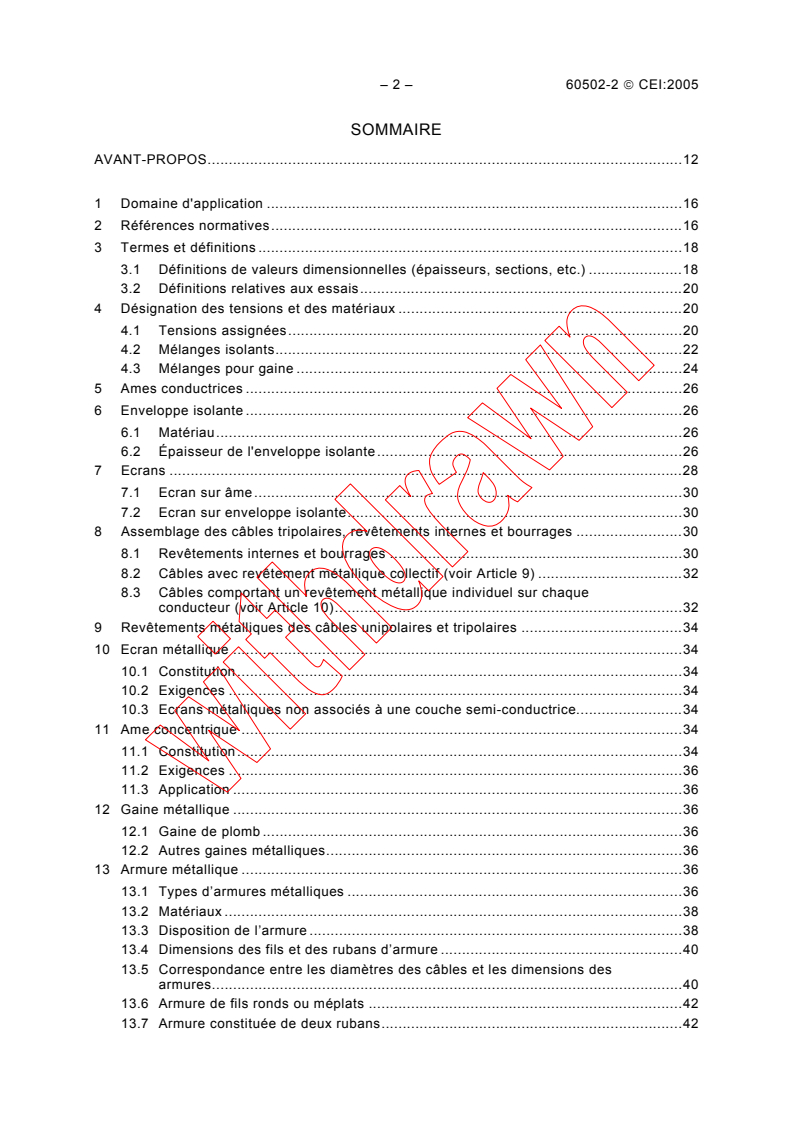
IEC 60502-2:2005 - Câbles d'énergie a isolant extrudé et leurs accessoires pour des tensions assignées de 1 kV (Um = 1,2 kV) a 30 kV (Um = 36 kV) - Partie 2: Câbles de tensions assignées de 6 kV (Um = 7,2 kV) a 30 kV (Um = 36 kV) Released:3/8/2005
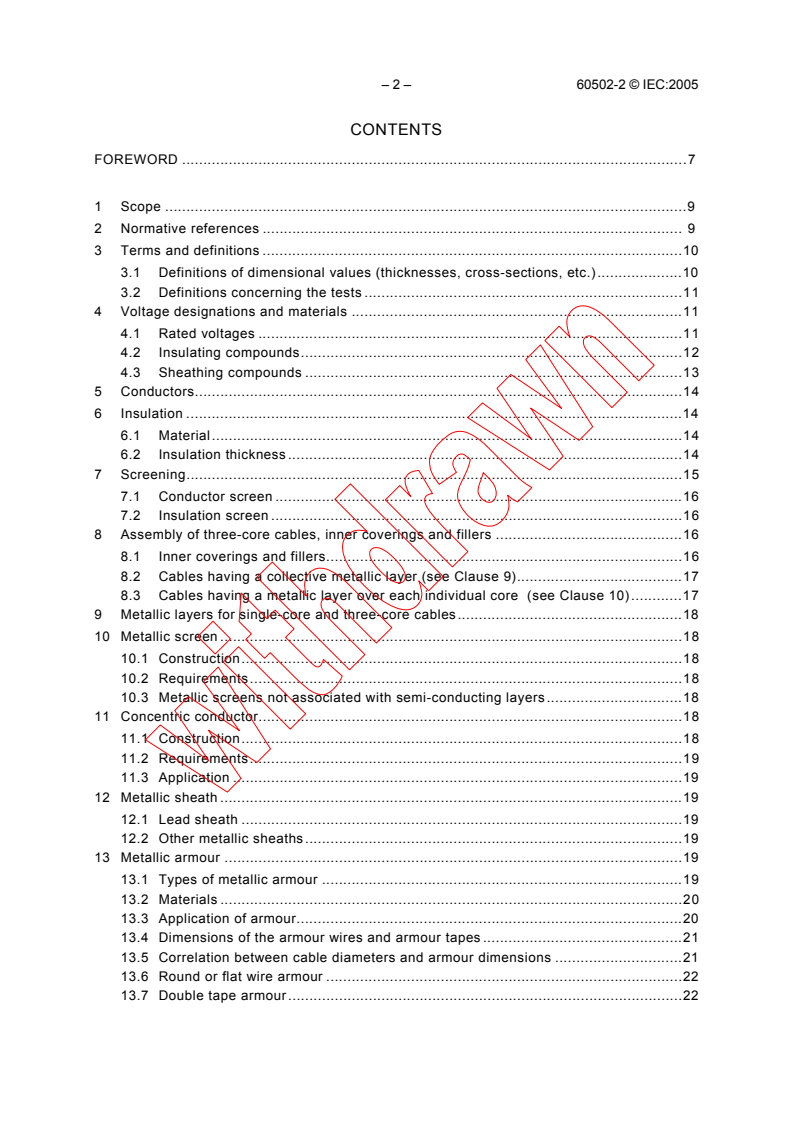
IEC 60502-2:2005 - Power cables with extruded insulation and their accessories for rated voltages from 1 kV (Um = 1,2 kV) up to 30 kV (Um = 36 kV) - Part 2: Cables for rated voltages from 6 kV (Um = 7,2 kV) up to 30 kV (Um = 36 kV) Released:3/8/2005
Overview
IEC 60502-2:2005 is an internationally recognized standard issued by the International Electrotechnical Commission (IEC) that specifies the construction, dimensions, and testing requirements for power cables with extruded solid insulation for rated voltages from 6 kV up to 30 kV. This standard is critical for ensuring the safety, performance, and reliability of medium-voltage power cables used in fixed installations such as distribution networks or industrial facilities. The standard also addresses considerations related to water ingress and includes tests for cable designs incorporating barriers against longitudinal water penetration. Special applications like mining, nuclear containment, overhead, submarine, and shipboard cables are outside the scope of this standard.
Key Topics
Cable Construction and Materials
- Requirements for conductor sizes, insulation, screening, metallic layers, armour, and oversheaths.
- Specifications for extruded insulation types and thicknesses.
- Guidance on materials for insulation and sheathing, aligned with performance and safety needs.
Voltage Ratings
- Addresses cables with rated voltages from 6 kV (Um = 7.2 kV) up to 30 kV (Um = 36 kV).
- Clarifies voltage designations and proper selection for different operating conditions.
Testing Requirements
- Details on routine, sample, type, and electrical tests performed after installation.
- Inclusion of tests for water penetration resistance, partial discharge, and mechanical properties.
Water Ingress Protection
- Recommendations for assessing the risk of radial water ingress.
- Guidance for longitudinal water penetration barriers and associated tests.
Current Ratings and Derating Factors
- References tables and factors to determine current-carrying capacities under different installation and environmental conditions.
Applications
- Distribution Networks: Used for underground and fixed installations in public and private utility networks.
- Industrial Installations: Suitable for factories, processing plants, and energy facilities requiring reliable medium voltage power transmission.
- Infrastructure Projects: Applicable in airports, ports, railway systems, and large infrastructure developments where safety and compliance are essential.
Implementing IEC 60502-2 ensures that:
- Medium-voltage cables meet internationally accepted safety and quality standards.
- Long-term operational reliability by addressing water ingress and environmental factors.
- Proper compatibility with accessories and installation in varied site conditions.
The standard is frequently referenced by engineers, designers, cable manufacturers, and procurement professionals for product selection, project specification, and compliance assessment.
Related Standards
- IEC 60502-1: Power cables with extruded insulation for rated voltages of 1 kV (Um = 1.2 kV) and 3 kV (Um = 3.6 kV).
- IEC 60502-4: Test requirements for accessories for cables with rated voltages from 6 kV up to 30 kV.
- IEC 60228: Conductors of insulated cables - Defines conductor classes and requirements.
- IEC 60229: Tests on cable oversheaths with special protective functions.
- IEC 60183: Guide to the selection of high-voltage cables.
- IEC 60332-1-2: Tests on cables under fire conditions, vertical flame propagation.
Conclusion
Adherence to IEC 60502-2 is essential for ensuring safe and high-performance installation of medium-voltage extruded insulated power cables and their accessories. The standard provides comprehensive requirements for cable manufacturing, testing, and installation, promoting consistency, reliability, and international harmonization in power cable applications for voltages ranging from 6 kV to 30 kV. Choosing compliant cables helps mitigate risks and supports efficient, long-term operation across a wide range of industrial and utility settings.
Relations
- Effective Date
- 03-Jun-2026
- Effective Date
- 10-Feb-2026
- Effective Date
- 10-Feb-2026
- Effective Date
- 10-Feb-2026
- Effective Date
- 10-Feb-2026
- Effective Date
- 05-Sep-2023
- Effective Date
- 05-Sep-2023
- Effective Date
- 05-Sep-2023
- Effective Date
- 05-Sep-2023
Buy Documents
IEC 60502-2:2005 - Power cables with extruded insulation and their accessories for rated voltages from 1 kV (Um = 1,2 kV) up to 30 kV (Um = 36 kV) - Part 2: Cables for rated voltages from 6 kV (Um = 7,2 kV) up to 30 kV (Um = 36 kV) Released:3/8/2005
IEC 60502-2:2005 - Câbles d'énergie a isolant extrudé et leurs accessoires pour des tensions assignées de 1 kV (Um = 1,2 kV) a 30 kV (Um = 36 kV) - Partie 2: Câbles de tensions assignées de 6 kV (Um = 7,2 kV) a 30 kV (Um = 36 kV) Released:3/8/2005
IEC 60502-2:2005 - Power cables with extruded insulation and their accessories for rated voltages from 1 kV (Um = 1,2 kV) up to 30 kV (Um = 36 kV) - Part 2: Cables for rated voltages from 6 kV (Um = 7,2 kV) up to 30 kV (Um = 36 kV) Released:3/8/2005
Get Certified
Connect with accredited certification bodies for this standard

IMQ S.p.A. (Certification)
Italian electrical product certification.

SLG Prüf- und Zertifizierungs GmbH
German testing and certification body.

UL Solutions
Global safety science company with testing, inspection and certification.
Sponsored listings
Frequently Asked Questions
IEC 60502-2:2005 is a standard published by the International Electrotechnical Commission (IEC). Its full title is "Power cables with extruded insulation and their accessories for rated voltages from 1 kV (Um = 1,2 kV) up to 30 kV (Um = 36 kV) - Part 2: Cables for rated voltages from 6 kV (Um = 7,2 kV) up to 30 kV (Um = 36 kV)". This standard covers: Specifies the construction, dimensions and test requirements of power cables with extruded solid insulation from 6 kV up to 30 kV for fixed installations such as distribution networks or industrial installations. When determining applications, it is recommended that the possible risk of radial water ingress is considered. Cable designs with barriers claimed to prevent longitudinal water penetration and an associated test are included in this part of IEC 60502. Cables for special installation and service conditions are not included, for example cables for overhead networks, the mining industry, nuclear power plants (in and around the containment area) nor for submarine use or shipboard application. Significant technical changes with respect to the first edition have been made. The changes relate to possible water ingress, large conductor sizes, partial discharge requirements, insulation and oversheath thickness requirements, range of type approval, electrical tests after installation and tabulated current ratings.
Specifies the construction, dimensions and test requirements of power cables with extruded solid insulation from 6 kV up to 30 kV for fixed installations such as distribution networks or industrial installations. When determining applications, it is recommended that the possible risk of radial water ingress is considered. Cable designs with barriers claimed to prevent longitudinal water penetration and an associated test are included in this part of IEC 60502. Cables for special installation and service conditions are not included, for example cables for overhead networks, the mining industry, nuclear power plants (in and around the containment area) nor for submarine use or shipboard application. Significant technical changes with respect to the first edition have been made. The changes relate to possible water ingress, large conductor sizes, partial discharge requirements, insulation and oversheath thickness requirements, range of type approval, electrical tests after installation and tabulated current ratings.
IEC 60502-2:2005 is classified under the following ICS (International Classification for Standards) categories: 29.060.20 - Cables. The ICS classification helps identify the subject area and facilitates finding related standards.
IEC 60502-2:2005 has the following relationships with other standards: It is inter standard links to EN ISO 13628-5:2009, EN 61442:2005, HD 605 S2:2008, HD 620 S1:1996/A3:2007, EN 50397-1:2020, IEC 60502-2:1997/AMD1:1998, IEC 60502-2:1997/COR1:1999, IEC 60502-2:1997, IEC 60502-2:2014. Understanding these relationships helps ensure you are using the most current and applicable version of the standard.
IEC 60502-2:2005 is available in PDF format for immediate download after purchase. The document can be added to your cart and obtained through the secure checkout process. Digital delivery ensures instant access to the complete standard document.
Standards Content (Sample)
INTERNATIONAL IEC
STANDARD 60502-2
Second edition
2005-03
Power cables with extruded insulation and their
accessories for rated voltages
from 1 kV (U = 1,2 kV) up to 30 kV (U = 36 kV) –
m m
Part 2:
Cables for rated voltages from 6 kV (U = 7,2 kV)
m
up to 30 kV (U = 36 kV)
m
This English-language version is derived from the original
bilingual publication by leaving out all French-language
pages. Missing page numbers correspond to the French-
language pages.
Reference number
Publication numbering
As from 1 January 1997 all IEC publications are issued with a designation in the
60000 series. For example, IEC 34-1 is now referred to as IEC 60034-1.
Consolidated editions
The IEC is now publishing consolidated versions of its publications. For example,
edition numbers 1.0, 1.1 and 1.2 refer, respectively, to the base publication, the
base publication incorporating amendment 1 and the base publication incorporating
amendments 1 and 2.
Further information on IEC publications
The technical content of IEC publications is kept under constant review by the IEC,
thus ensuring that the content reflects current technology. Information relating to
this publication, including its validity, is available in the IEC Catalogue of
publications (see below) in addition to new editions, amendments and corrigenda.
Information on the subjects under consideration and work in progress undertaken
by the technical committee which has prepared this publication, as well as the list
of publications issued, is also available from the following:
• IEC Web Site (www.iec.ch)
• Catalogue of IEC publications
The on-line catalogue on the IEC web site (www.iec.ch/searchpub) enables you to
search by a variety of criteria including text searches, technical committees
and date of publication. On-line information is also available on recently issued
publications, withdrawn and replaced publications, as well as corrigenda.
• IEC Just Published
This summary of recently issued publications (www.iec.ch/online_news/ justpub)
is also available by email. Please contact the Customer Service Centre (see
below) for further information.
• Customer Service Centre
If you have any questions regarding this publication or need further assistance,
please contact the Customer Service Centre:
Email: custserv@iec.ch
Tel: +41 22 919 02 11
Fax: +41 22 919 03 00
INTERNATIONAL IEC
STANDARD 60502-2
Second edition
2005-03
Power cables with extruded insulation and their
accessories for rated voltages
from 1 kV (U = 1,2 kV) up to 30 kV (U = 36 kV) –
m m
Part 2:
Cables for rated voltages from 6 kV (U = 7,2 kV)
m
up to 30 kV (U = 36 kV)
m
IEC 2005 Copyright - all rights reserved
No part of this publication may be reproduced or utilized in any form or by any means, electronic or mechanical,
including photocopying and microfilm, without permission in writing from the publisher.
International Electrotechnical Commission, 3, rue de Varembé, PO Box 131, CH-1211 Geneva 20, Switzerland
Telephone: +41 22 919 02 11 Telefax: +41 22 919 03 00 E-mail: inmail@iec.ch Web: www.iec.ch
PRICE CODE
Commission Electrotechnique Internationale XC
International Electrotechnical Commission
Международная Электротехническая Комиссия
For price, see current catalogue
60502-2 IEC:2005 – 3 –
CONTENTS
FOREWORD .13
1 Scope .17
2 Normative references .17
3 Terms and definitions .19
3.1 Definitions of dimensional values (thicknesses, cross-sections, etc.).19
3.2 Definitions concerning the tests .21
4 Voltage designations and materials .21
4.1 Rated voltages .21
4.2 Insulating compounds.23
4.3 Sheathing compounds .25
5 Conductors.27
6 Insulation .27
6.1 Material.27
6.2 Insulation thickness .27
7 Screening.29
7.1 Conductor screen .31
7.2 Insulation screen .31
8 Assembly of three-core cables, inner coverings and fillers .31
8.1 Inner coverings and fillers.31
8.2 Cables having a collective metallic layer (see Clause 9).33
8.3 Cables having a metallic layer over each individual core (see Clause 10).33
9 Metallic layers for single-core and three-core cables.35
10 Metallic screen .35
10.1 Construction.35
10.2 Requirements.35
10.3 Metallic screens not associated with semi-conducting layers.35
11 Concentric conductor.35
11.1 Construction.35
11.2 Requirements.37
11.3 Application .37
12 Metallic sheath .37
12.1 Lead sheath .37
12.2 Other metallic sheaths.37
13 Metallic armour .37
13.1 Types of metallic armour .37
13.2 Materials .39
13.3 Application of armour.39
13.4 Dimensions of the armour wires and armour tapes .41
13.5 Correlation between cable diameters and armour dimensions .41
13.6 Round or flat wire armour .43
13.7 Double tape armour.43
60502-2 IEC:2005 – 5 –
14 Oversheath .43
14.1 General .43
14.2 Material.45
14.3 Thickness.45
15 Test conditions.45
15.1 Ambient temperature .45
15.2 Frequency and waveform of power frequency test voltages .45
15.3 Waveform of impulse test voltages.45
16 Routine tests .47
16.1 General .47
16.2 Electrical resistance of conductors.47
16.3 Partial discharge test.47
16.4 Voltage test.47
17 Sample tests .49
17.1 General .49
17.2 Frequency of sample tests.51
17.3 Repetition of tests .51
17.4 Conductor examination.51
17.5 Measurement of thickness of insulation and of non-metallic sheaths
(including extruded separation sheaths, but excluding inner extruded
coverings) .51
17.6 Measurement of thickness of lead sheath .53
17.7 Measurement of armour wires and tapes.55
17.8 Measurement of external diameter.55
17.9 Voltage test for 4 h .55
17.10 Hot set test for EPR, HEPR and XLPE insulations and elastomeric sheaths.57
18 Type tests, electrical .57
18.1 Cables having conductor screens and insulation screens .57
18.2 Cables of rated voltage 3,6/6 (7,2) kV having unscreened insulation .65
19 Type tests, non-electrical.69
19.1 Measurement of thickness of insulation.69
19.2 Measurement of thickness of non-metallic sheaths (including extruded
separation sheaths, but excluding inner coverings) .69
19.3 Tests for determining the mechanical properties of insulation before and
after ageing.69
19.4 Tests for determining the mechanical properties of non-metallic sheaths
before and after ageing .71
19.5 Additional ageing test on pieces of completed cables.71
19.6 Loss of mass test on PVC sheaths of type ST .73
19.7 Pressure test at high temperature on insulations and non-metallic sheaths.73
19.8 Test on PVC insulation and sheaths at low temperatures .73
19.9 Test for resistance of PVC insulation and sheaths to cracking (heat shock
test) .73
19.10 Ozone resistance test for EPR and HEPR insulations.75
19.11 Hot set test for EPR, HEPR and XLPE insulations and elastomeric sheaths.75
19.12 Oil immersion test for elastomeric sheaths.75
19.13 Water absorption test on insulation .75
60502-2 IEC:2005 – 7 –
19.14 Flame spread test on single cables.75
19.15 Measurement of carbon black content of black PE oversheaths.75
19.16 Shrinkage test for XLPE insulation.77
19.17 Thermal stability test for PVC insulation.77
19.18 Determination of hardness of HEPR insulation .77
19.19 Determination of the elastic modulus of HEPR insulation.77
19.20 Shrinkage test for PE oversheaths .77
19.21 Strippability test for insulation screen .79
19.22 Water penetration test .79
20 Electrical tests after installation .81
20.1 D.C. voltage test of the oversheath .81
20.2 Insulation test.81
Annex A (normative) Fictitious calculation method for determination of dimensions of
protective coverings.93
Annex B (informative) Tabulated continuous current ratings for cables having
extruded insulation and a rated voltage from 3,6/6 kV up to 18/30 kV .103
Annex C (normative) Rounding of numbers .143
Annex D (normative) Method of measuring resistivity of semi-conducting screens .145
Annex E (normative) Determination of hardness of HEPR insulations .149
Annex F (normative) Water penetration test .153
Bibliography .157
Figure B.1 – Single-core cables in air.105
Figure B.2 – Single-core cables buried direct .107
Figure B.3 – Single-core cables in earthenware ducts .107
Figure B.4 – Three-core cables.109
Figure D.1a – Measurement of the volume resistivity of the conductor screen.147
Figure D.1b – Measurement of the volume resistivity of the insulation screen .147
Figure D.1 – Preparation of samples for measurement of resistivity of conductor and
insulation screens.147
Figure E.1 – Test on surfaces of large radius of curvature.151
Figure E.2 – Test on surfaces of small radius of curvature.151
Figure F.1 – Schematic diagram of apparatus for water penetration test .155
Table 1 – Recommended rated voltages U .23
Table 2 – Insulating compounds.25
Table 3 – Maximum conductor temperatures for different types of insulating compound .25
Table 4 – Maximum conductor temperatures for different types of sheathing
compound .27
Table 5 – Nominal thickness of PVC/B insulation .27
Table 6 – Nominal thickness of cross-linked polyethylene (XLPE) insulation.29
60502-2 IEC:2005 – 9 –
Table 7 – Nominal thickness of ethylene propylene rubber (EPR) and hard ethylene
propylene rubber (HEPR) insulation .29
Table 8 – Thickness of extruded inner covering.33
Table 9 – Nominal diameter of round armour wires.41
Table 10 – Nominal thickness of armour tapes .43
Table 11 – Routine test voltages.49
Table 12 – Number of samples for sample tests .51
Table 13 – Sample test voltages .57
Table 14 – Impulse voltages .63
Table 15 – Electrical type test requirements for insulating compounds.81
Table 16 – Non-electrical type tests (see Tables 17 to 23) .83
Table 17 – Test requirements for mechanical characteristics of insulating compounds
(before and after ageing) .85
Table 18 – Test requirements for particular characteristics for PVC insulating
compound .85
Table 19 – Test requirements for particular characteristics of various thermosetting
insulating compounds .87
Table 20 – Test requirements for mechanical characteristics of sheathing compounds
(before and after ageing) .87
Table 21 – Test requirements for particular characteristics for PVC sheathing
compounds.89
Table 22 – Test requirements for particular characteristics of PE (thermoplastic
polyethylene) sheathing compounds .89
Table 23 – Test requirements for particular characteristics of elastomeric sheathing
compound .91
Table A.1 – Fictitious diameter of conductor.95
Table A.2 – Increase of diameter for concentric conductors and metallic screens .97
Table A.3 – Increase of diameter for additional bedding .101
Table B.1 – Nominal screen cross-sectional areas .103
Table B.2 – Current ratings for single-core cables with XLPE insulation Rated voltage
3,6/6 kV to 18/30 kV * Copper conductor.111
Table B.3 – Current ratings for single-core cables with XLPE insulation Rated voltage
3,6/6 kV to 18/30 kV * Aluminium conductor .113
Table B.4 – Current ratings for single-core cables with EPR insulation Rated voltage
3,6/6 kV to 18/30 kV * Copper conductor.115
Table B.5 – Current ratings for single-core cables with EPR insulation Rated voltage
3,6/6 kV to 18/30 kV * Aluminium conductor .117
Table B.6 – Current rating for three-core XLPE insulated cables Rated voltage 3,6/6
kV to 18/30 kV * Copper conductor Armoured and unarmoured .119
Table B.7 – Current rating for three-core XLPE insulated cables Rated voltage 3,6/6
kV to 18/30 kV * Aluminium conductor Armoured and unarmoured.121
Table B.8 – Current rating for three-core EPR insulated cables Rated voltage 3,6/6 kV
to 18/30 kV * Copper conductor Armoured and unarmoured .123
60502-2 IEC:2005 – 11 –
Table B.9 – Current rating for three-core EPR insulated cables Rated voltage 3,6/6 kV
to 18/30 kV * Aluminium conductor Armoured and unarmoured.125
Table B.10 – Correction factors for ambient air temperatures other than 30 °C .127
Table B.11 – Correction factors for ambient ground temperatures other than 20 °C .127
Table B.12 – Correction factors for depths of laying other than 0,8 m for direct buried
cables .127
Table B.13 – Correction factors for depths of laying other than 0,8 m for cables in
ducts .129
Table B.14 – Correction factors for soil thermal resistivities other than 1,5 K•m/W for
direct buried single-core cables .129
Table B.15 – Correction factors for soil thermal resistivities other than 1,5 K•m/W
single-core cables in buried ducts .131
Table B.16 – Correction factors for soil thermal resistivities other than 1,5 K•m/W for
direct buried three-core cables .131
Table B.17 – Correction factors for soil thermal resistivities other than 1,5 K•m/W for
three-core cables in ducts.133
Table B.18 – Correction factors for groups of 3-core cables in horizontal formation
laid direct in the ground .133
Table B.19 – Correction factors for groups of 3-phase circuits of single-core cables
laid direct in the ground .135
Table B.20 – Correction factors for groups of 3-core cables in single way ducts in
horizontal formation .135
Table B.21 – Correction factors for groups of 3-phase circuits of single-core cables in
single-way ducts.137
Table B.22 – Reduction factors for groups of more than one multi-core cable in air To
be applied to the current-carrying capacity for one multi-core cable in free air .139
Table B.23 – Reduction factors for groups of more than one circuit of single-core
cables (Note 2) To be applied to the current-carrying capacity for one circuit of single-
core cables in free air .141
60502-2 IEC:2005 – 13 –
INTERNATIONAL ELECTROTECHNICAL COMMISSION
___________
POWER CABLES WITH EXTRUDED INSULATION AND THEIR ACCESSORIES
FOR RATED VOLTAGES FROM 1 kV (U = 1,2 kV) UP TO 30 kV (U = 36 kV) –
m m
Part 2: Cables for rated voltages from 6 kV
(U = 7,2 kV) up to 30 kV (U = 36 kV)
m m
FOREWORD
1) The International Electrotechnical Commission (IEC) is a worldwide organization for standardization comprising
all national electrotechnical committees (IEC National Committees). The object of IEC is to promote
international co-operation on all questions concerning standardization in the electrical and electronic fields. To
this end and in addition to other activities, IEC publishes International Standards, Technical Specifications,
Technical Reports, Publicly Available Specifications (PAS) and Guides (hereafter referred to as “IEC
Publication(s)”). Their preparation is entrusted to technical committees; any IEC National Committee interested
in the subject dealt with may participate in this preparatory work. International, governmental and non-
governmental organizations liaising with the IEC also participate in this preparation. IEC collaborates closely
with the International Organization for Standardization (ISO) in accordance with conditions determined by
agreement between the two organizations.
2) The formal decisions or agreements of IEC on technical matters express, as nearly as possible, an
international consensus of opinion on the relevant subjects since each technical committee has representation
from all interested IEC National Committees.
3) IEC Publications have the form of recommendations for international use and are accepted by IEC National
Committees in that sense. While all reasonable efforts are made to ensure that the technical content of IEC
Publications is accurate, IEC cannot be held responsible for the way in which they are used or for any
misinterpretation by any end user.
4) In order to promote international uniformity, IEC National Committees undertake to apply IEC Publications
transparently to the maximum extent possible in their national and regional publications. Any divergence
between any IEC Publication and the corresponding national or regional publication shall be clearly indicated in
the latter.
5) IEC provides no marking procedure to indicate its approval and cannot be rendered responsible for any
equipment declared to be in conformity with an IEC Publication.
6) All users should ensure that they have the latest edition of this publication.
7) No liability shall attach to IEC or its directors, employees, servants or agents including individual experts and
members of its technical committees and IEC National Committees for any personal injury, property damage or
other damage of any nature whatsoever, whether direct or indirect, or for costs (including legal fees) and
expenses arising out of the publication, use of, or reliance upon, this IEC Publication or any other IEC
Publications.
8) Attention is drawn to the Normative references cited in this publication. Use of the referenced publications is
indispensable for the correct application of this publication.
9) Attention is drawn to the possibility that some of the elements of this IEC Publication may be the subject of
patent rights. IEC shall not be held responsible for identifying any or all such patent rights.
International Standard IEC 60502-2 has been prepared by IEC technical committee 20:
Electric cables.
This second edition cancels and replaces the first edition published in 1997, its amendment 1
(1998) and its corrigendum 1 (1999) and constitutes a technical revision.
Significant technical changes with respect to the first edition have been made. The changes
relate to possible water ingress, large conductor sizes, partial discharge requirements,
insulation and oversheath thickness requirements, range of type approval, electrical tests
after installation and tabulated current ratings.
60502-2 IEC:2005 – 15 –
IEC 60502 consists of the following parts, under the general title Power cables with extruded
insulation and their accessories for rated voltages from 1 kV (U = 1,2 kV) up to 30 kV
m
(U = 36 kV):
m
Part 1: Cables for rated voltages of 1 kV (U = 1,2 kV) and 3 kV (U = 3,6 kV);
m m
Part 2: Cables for rated voltages from 6 kV (U = 7,2 kV) up to 30 kV (U = 36 kV);
m m
Part 3: Reserved;
Part 4: Test requirements on accessories for cables with rated voltages from 6 kV
(U = 7,2 kV) up to 30 kV (U = 36 kV).
m m
The text of this standard is based on the following documents:
FDIS Report on voting
20/749/FDIS 20/763/RVD
Full information on the voting for the approval of this standard can be found in the report on
voting indicated in the above table.
This publication has been drafted in accordance with the ISO/IEC Directives, Part 2.
The committee has decided that the contents of this publication will remain unchanged until
the maintenance result date indicated on the IEC web site under "http://webstore.iec.ch" in
the data related to the specific publication. At this date, the publication will be
• reconfirmed;
• withdrawn;
• replaced by a revised edition, or
• amended.
60502-2 IEC:2005 – 17 –
POWER CABLES WITH EXTRUDED INSULATION
AND THEIR ACCESSORIES FOR RATED VOLTAGES
FROM 1 kV (U = 1,2 kV) UP TO 30 kV (U = 36 kV) –
m m
Part 2: Cables for rated voltages from 6 kV
(U = 7,2 kV) up to 30 kV (U = 36 kV)
m m
1 Scope
This part of IEC 60502 specifies the construction, dimensions and test requirements of power
cables with extruded solid insulation from 6 kV up to 30 kV for fixed installations such as
distribution networks or industrial installations.
When determining applications, it is recommended that the possible risk of radial water
ingress is considered. Cable designs with barriers claimed to prevent longitudinal water
penetration and an associated test are included in this part of IEC 60502.
Cables for special installation and service conditions are not included, for example cables for
overhead networks, the mining industry, nuclear power plants (in and around the containment
area) nor for submarine use or shipboard application.
2 Normative references
The following referenced documents are indispensable for the application of this document.
For dated references, only the edition cited applies. For undated references, the latest edition
of the referenced document (including any amendments) applies.
IEC 60038, IEC standard voltages
IEC 60060-1, High-voltage test techniques – Part 1: General definitions and test
requirements
IEC 60183, Guide to the selection of high-voltage cables
IEC 60228, Conductors of insulated cables
IEC 60229, Tests on cable oversheaths which have a special protective function and are
applied by extrusion
IEC 60230, Impulse tests on cables and their accessories
IEC 60332-1-2, Tests on electric and optical fibre cables under fire conditions – Part 1-2: Test
for vertical flame propagation for a single insulated wire or cable – Procedure for 1 kW pre-
mixed flame
IEC 60811-1-1, Common test methods for insulating and sheathing materials of electric cables
and optical cables – Part 1-1: Methods for general application – Measurement of thickness
and overall dimensions – Tests for determining the mechanical properties
60502-2 IEC:2005 – 19 –
IEC 60811-1-2, Common test methods for insulating and sheathing materials of electric
cables – Part 1: Methods for general application – Section 2: Thermal ageing methods
IEC 60811-1-3, Common test methods for insulating and sheathing materials of electric and
optical cables – Part 1-3: General application – Methods for determining the density – Water
absorption tests – Shrinkage test
IEC 60811-1-4, Common test methods for insulating and sheathing materials of electric
cables – Part 1: Methods for general application – Section 4: Test at low temperature
IEC 60811-2-1, Common test methods for insulating and sheathing materials of electric and
optical cables – Part 2-1: Methods specific to elastomeric compounds – Ozone resistance, hot set
and mineral oil immersion tests
IEC 60811-3-1, Common test methods for insulating and sheathing materials of electric
cables – Part 3: Methods specific to PVC compounds – Section 1: Pressure test at high
temperature – Tests for resistance to cracking
IEC 60811-3-2, Common test methods for insulating and sheathing materials of electric
cables – Part 3: Methods specific to PVC compounds – Section 2: Loss of mass test –
Thermal stability test
IEC 60811-4-1, Insulating and sheathing materials of electric and optical cables – Common
test methods – Part 4-1: Methods specific to polyethylene and polypropylene compounds –
Resistance to environmental stress cracking – Measurement of the melt flow index – Carbon
black and/or mineral filler content measurement in polyethylene by direct combustion –
Measurement of carbon black content by thermogravimetric analysis (TGA) – Assessment of
carbon black dispersion in polyethylene using a microscope
IEC 60885-3, Electrical test methods for electric cables – Part 3: Test methods for partial
discharge measurements on lengths of extruded power cables
IEC 60986, Short-circuit temperature limits of electric cables with rated voltages from 6 kV
(U 7,2 kV) up to 30 kV (U =36 kV)
m m
ISO 48, Rubber, vulcanized or thermoplastic – Determination of hardness (hardness between
10 IRHD and 100 IRHD)
3 Terms and definitions
For the purpose of this document, the following terms and definitions apply.
3.1 Definitions of dimensional values (thicknesses, cross-sections, etc.)
3.1.1
nominal value
value by which a quantity is designated and which is often used in tables
NOTE Usually, in this standard, nominal values give rise to values to be checked by measurements taking into
account specified tolerances.
3.1.2
approximate value
value which is neither guaranteed nor checked; it is used, for example, for the calculation of
other dimensional values
60502-2 IEC:2005 – 21 –
3.1.3
median value
when several test results have been obtained and ordered in an increasing (or decreasing)
succession, the median value is the middle value if the number of available values is odd,
and the mean of the two middle values if the number is even
3.1.4
fictitious value
value calculated according to the "fictitious method'' described in Annex A
3.2 Definitions concerning the tests
3.2.1
routine tests
tests made by the manufacturer on each manufactured length of cable to check that each
length meets the specified requirements
3.2.2
sample tests
tests made by the manufacturer on samples of completed cable or components taken from a
completed cable, at a specified frequency, so as to verify that the finished product meets the
specified requirements
3.2.3
type tests
tests made before supplying, on a general commercial basis, a type of cable covered by this
standard, in order to demonstrate satisfactory performance characteristics to meet the
intended application
NOTE These tests are of such a nature that, after they have been made, they need not be repeated, unless
changes are made in the cable materials or design or manufacturing process which might change the performance
characteristics.
3.2.4
electrical tests after installation
tests made to demonstrate the integrity of the cable and its accessories as installed
4 Voltage designations and materials
4.1 Rated voltages
The rated voltages U /U(U ) of the cables considered in this standard are as follows:
0 m
U /U(U ) = 3,6/6 (7,2) – 6/10 (12) – 8,7/15 (17,5) – 12/20 (24) – 18/30 (36) kV.
0 m
NOTE 1 The voltages given above are the correct designations although in some countries other designations
are used, e.g. 3,5/6 – 5,8/10 – 11,5/20 – 17,3/30 kV.
In the voltage designation of cables U /U(U ):
0 m
U is the rated power frequency voltage between conductor and earth or metallic screen
for which the cable is designed;
U is the rated power frequency voltage between conductors for which the cable is
designed;
U is the maximum value of the "highest system voltage'' for which the equipment may be
m
used (see IEC 60038).
60502-2 IEC:2005 – 23 –
The rated voltage of the cable for a given application shall be suitable for the operating
conditions in the system in which the cable is used. To facilitate the selection of the cable,
systems are divided into three categories:
– category A: this category comprises those systems in which any phase conductor that
comes in contact with earth or an earth conductor is disconnected from the
system within 1 min;
– category B: this category comprises those systems which, under fault conditions, are
operated for a short time with one phase earthed. This period, according to
IEC 60183, should not exceed 1 h. For cables covered by this standard, a
longer period, not exceeding 8 h on any occasion, can be tolerated. The
total duration of earth faults in any year should not exceed 125 h;
– category C: this category comprises all systems which do not fall into category A or B.
NOTE 2 It should be realized that in a system where an earth fault is not automatically and promptly isolated, the
extra stresses on the insulation of cables during the earth fault reduce the life of the cables to a certain degree. If
the system is expected to be operated fairly often with a permanent earth fault, it may be advisable to classify the
system in category C.
The values of U recommended for cables to be used in three-phase systems are listed in
Table 1.
Table 1 – Recommended rated voltages U
Highest system voltage Rated voltage (U )
(U ) kV
m
kV Categories A and B Category C
7,2 3,6 6,0
12,0 6,0 8,7
17,5 8,7 12,0
24,0 12,0 18,0
36,0 18,0 –
4.2 Insulating compounds
The types of insulating compound covered by this standard are listed in Table 2, together
with their abbreviated designations.
60502-2 IEC:2005 – 25 –
Table 2 – Insulating compounds
Abbreviated
Insulating compound
designation
a) Thermoplastic
polyvinyl chloride intended for cables with rated voltages U /U = 3,6/6 kV PVC/B*
b) Thermosetting:
ethylene propylene rubber or similar (EPM or EPDM) EPR
high modulus or hard grade ethylene propylene rubber HEPR
cross-linked polyethylene XLPE
* Insulating compound based on polyvinyl chloride intended for cables with rated voltages
U /U ≤ 1,8/3 kV is designated PVC/A in IEC 60502-1.
The maximum conductor temperatures for different types of insulating compound covered by
this standard are given in Table 3.
Table 3 – Maximum conductor temperatures for different types of insulating compound
Maximum conductor temperature
°C
Insulating compound
Normal operation Short-circuit
(5 s maximum duration)
Polyvinyl chloride (PVC/B)
70 160
Conductor cross-section ≤300 mm
Conductor cross-section >300 mm 70 140
Cross-linked polyethylene (XLPE) 90 250
Ethylene propylene rubber (EPR and HEPR) 90 250
The temperatures in Table 3 are based on the intrinsic properties of the insulating materials.
It is important to take into account other factors when using these values for the calculation
of current ratings.
For example, in normal operation, if a cable directly buried in the ground is operated under
continuous load (100 % load factor) at the maximum conductor temperature shown in the
table, the thermal resistivity of the soil surrounding the cable may, in the course of time,
increase from its original value as a result of drying-out processes. As a consequence, the
conductor temperature may greatly exceed the maximum value. If such operating conditions
are foreseen, adequate provisions shall be made.
For guidance on continuous current ratings, reference should be made to Annex B.
For guidance on the short-circuit temperatures, reference should be made to IEC 60986.
4.3 Sheathing compounds
The maximum conductor temperatures for the different types of sheathing compound covered
by this standard are given in Table 4.
60502-2 IEC:2005 – 27 –
Table 4 – Maximum conductor temperatures for different types
of sheathing compound
Maximum conductor
Abbreviated temperature in
Sheathing compound
designation normal operation
°C
a) Thermoplastic:
polyvinyl chloride (PVC) ST 80
ST 90
polyethylene ST 80
ST 90
b) Elastomeric:
polychloroprene, chlorosulfonated polyethylene SE 85
or similar polymers
5 Conductors
The conductors shall be either of class 1 or class 2 of plain or metal-coated annealed copper
or of plain aluminium or aluminium alloy in accordance with IEC 60228. For class 2
conductors measures may be taken to achieve longitudinal watertightness.
6 Insulation
6.1 Material
Insulation shall be extruded dielectric of one of the types listed in Table 2.
6.2 Insulation thickness
The nominal insulation thicknesses are specified in Tables 5 to 7.
The thickness of any separator or semi-conducting screen on the conductor or over the
insulation shall not be included in the thickness of the insulation.
Table 5 – Nominal thickness of PVC/B insulation
Nominal cross-sectional Nominal thickness of insulation at rated voltage
area of conductor 3,6/6 (7,2) kV
mm mm
10 to 1 600 3,4
NOTE 1 Any smaller conductor cross-section than those given in this table is not recommended. However, if a
smaller cross-section is needed, either the diameter of the conductor may be increased by a conductor screen
(see 7.1), or the insulation thickness may be increased in order to limit, at the values calculated with the smallest
conductor size given in this table, the maximum electrical stresses applied to the insulation under test voltage.
NOTE 2 For conductor c
...
NORME CEI
INTERNATIONALE 60502-2
Deuxième édition
2005-03
Câbles d'énergie à isolant extrudé et leurs
accessoires pour des tensions assignées
de 1 kV (U = 1,2 kV) à 30 kV (U = 36 kV) –
m m
Partie 2:
Câbles de tensions assignées de 6 kV
(U = 7,2 kV) et 30 kV (U = 36 kV)
m m
Cette version française découle de la publication d’origine
bilingue dont les pages anglaises ont été supprimées.
Les numéros de page manquants sont ceux des pages
supprimées.
Numéro de référence
CEI 60502-2:2005(F)
Numérotation des publications
Depuis le 1er janvier 1997, les publications de la CEI sont numérotées à partir de
60000. Ainsi, la CEI 34-1 devient la CEI 60034-1.
Editions consolidées
Les versions consolidées de certaines publications de la CEI incorporant les
amendements sont disponibles. Par exemple, les numéros d’édition 1.0, 1.1 et 1.2
indiquent respectivement la publication de base, la publication de base incorporant
l’amendement 1, et la publication de base incorporant les amendements 1 et 2
Informations supplémentaires sur les publications de la CEI
Le contenu technique des publications de la CEI est constamment revu par la CEI
afin qu'il reflète l'état actuel de la technique. Des renseignements relatifs à cette
publication, y compris sa validité, sont disponibles dans le Catalogue des
publications de la CEI (voir ci-dessous) en plus des nouvelles éditions, amende-
ments et corrigenda. Des informations sur les sujets à l’étude et l’avancement des
travaux entrepris par le comité d’études qui a élaboré cette publication, ainsi que la
liste des publications parues, sont également disponibles par l’intermédiaire de:
• Site web de la CEI (www.iec.ch)
• Catalogue des publications de la CEI
Le catalogue en ligne sur le site web de la CEI (www.iec.ch/searchpub) vous permet
de faire des recherches en utilisant de nombreux critères, comprenant des
recherches textuelles, par comité d’études ou date de publication. Des informations
en ligne sont également disponibles sur les nouvelles publications, les publications
remplacées ou retirées, ainsi que sur les corrigenda.
• IEC Just Published
Ce résumé des dernières publications parues (www.iec.ch/online_news/justpub)
est aussi disponible par courrier électronique. Veuillez prendre contact avec le
Service client (voir ci-dessous) pour plus d’informations.
• Service clients
Si vous avez des questions au sujet de cette publication ou avez besoin de
renseignements supplémentaires, prenez contact avec le Service clients:
Email: custserv@iec.ch
Tél: +41 22 919 02 11
Fax: +41 22 919 03 00
NORME CEI
INTERNATIONALE 60502-2
Deuxième édition
2005-03
Câbles d'énergie à isolant extrudé et leurs
accessoires pour des tensions assignées
de 1 kV (U = 1,2 kV) à 30 kV (U = 36 kV) –
m m
Partie 2:
Câbles de tensions assignées de 6 kV
(U = 7,2 kV) et 30 kV (U = 36 kV)
m m
IEC 2005 Droits de reproduction réservés
Aucune partie de cette publication ne peut être reproduite ni utilisée sous quelque forme que ce soit et par aucun
procédé, électronique ou mécanique, y compris la photocopie et les microfilms, sans l'accord écrit de l'éditeur.
International Electrotechnical Commission, 3, rue de Varembé, PO Box 131, CH-1211 Geneva 20, Switzerland
Telephone: +41 22 919 02 11 Telefax: +41 22 919 03 00 E-mail: inmail@iec.ch Web: www.iec.ch
CODE PRIX
Commission Electrotechnique Internationale XC
International Electrotechnical Commission
Международная Электротехническая Комиссия
Pour prix, voir catalogue en vigueur
– 2 – 60502-2 CEI:2005
SOMMAIRE
AVANT-PROPOS.12
1 Domaine d'application .16
2 Références normatives.16
3 Termes et définitions .18
3.1 Définitions de valeurs dimensionnelles (épaisseurs, sections, etc.) .18
3.2 Définitions relatives aux essais.20
4 Désignation des tensions et des matériaux .20
4.1 Tensions assignées.20
4.2 Mélanges isolants.22
4.3 Mélanges pour gaine .24
5 Ames conductrices .26
6 Enveloppe isolante .26
6.1 Matériau.26
6.2 Épaisseur de l'enveloppe isolante.26
7 Ecrans .28
7.1 Ecran sur âme.30
7.2 Ecran sur enveloppe isolante.30
8 Assemblage des câbles tripolaires, revêtements internes et bourrages .30
8.1 Revêtements internes et bourrages .30
8.2 Câbles avec revêtement métallique collectif (voir Article 9) .32
8.3 Câbles comportant un revêtement métallique individuel sur chaque
conducteur (voir Article 10).32
9 Revêtements métalliques des câbles unipolaires et tripolaires .34
10 Ecran métallique .34
10.1 Constitution.34
10.2 Exigences .34
10.3 Ecrans métalliques non associés à une couche semi-conductrice.34
11 Ame concentrique .34
11.1 Constitution.34
11.2 Exigences .36
11.3 Application .36
12 Gaine métallique .36
12.1 Gaine de plomb .36
12.2 Autres gaines métalliques.36
13 Armure métallique .36
13.1 Types d’armures métalliques .36
13.2 Matériaux .38
13.3 Disposition de l’armure .38
13.4 Dimensions des fils et des rubans d’armure .40
13.5 Correspondance entre les diamètres des câbles et les dimensions des
armures.40
13.6 Armure de fils ronds ou méplats .42
13.7 Armure constituée de deux rubans.42
– 4 – 60502-2 CEI:2005
14 Gaine extérieure.42
14.1 Généralités .42
14.2 Matériau.44
14.3 Epaisseur.44
15 Conditions d’essais .44
15.1 Température ambiante.44
15.2 Fréquence et forme d’onde des tensions d’essai à fréquence industrielle .44
15.3 Forme d’onde des tensions d’essai de choc .44
16 Essais individuels.46
16.1 Généralités .46
16.2 Résistance électrique des âmes .46
16.3 Essai de décharges partielles .46
16.4 Essai de tension.46
17 Essais sur prélèvements.48
17.1 Généralités .48
17.2 Fréquence des essais sur prélèvements .50
17.3 Répétition des essais .50
17.4 Examen de l'âme.50
17.5 Mesure de l'épaisseur des enveloppes isolantes et des gaines non
métalliques (y compris les gaines de séparation extrudées, mais à
l'exclusion des revêtements internes extrudés) .50
17.6 Mesure de l’épaisseur de la gaine de plomb.52
17.7 Mesure sur les fils et rubans d’armure .54
17.8 Mesure du diamètre extérieur .54
17.9 Essai de tension pendant 4 h.54
17.10 Essai d’allongement à chaud des enveloppes isolantes en EPR, HEPR et
PR et des gaines en matériau élastomérique .56
18 Essais de type électriques .56
18.1 Câbles comportant des écrans sur âme et sur enveloppe isolante .56
18.2 Câbles de tension assignée 3,6/6 (7,2) kV sans écran sur enveloppe isolante.64
19 Essais de type non électriques .68
19.1 Mesure de l’épaisseur de l’enveloppe isolante .68
19.2 Mesure de l'épaisseur des gaines non métalliques (y compris les gaines de
séparation extrudées, mais à l'exclusion des revêtements internes) .68
19.3 Essais de détermination des propriétés mécaniques des enveloppes
isolantes avant et après vieillissement .68
19.4 Détermination des propriétés mécaniques des gaines non métalliques avant
et après vieillissement .70
19.5 Essai additionnel de vieillissement sur tronçons de câbles complets .70
19.6 Essai de perte de masse des gaines en PVC du type ST .72
19.7 Essai de pression à température élevée des enveloppes isolantes et des
gaines non métalliques .72
19.8 Essai à basse température de l’enveloppe isolante en PVC et des gaines en PVC.72
19.9 Essai de résistance à la fissuration de l’enveloppe isolante en PVC et des
gaines en PVC (essai de choc thermique).72
19.10 Essai de résistance à l’ozone des enveloppes isolantes en EPR et en HEPR .74
19.11Essai d'allongement à chaud des enveloppes isolantes en EPR, HEPR et PR
et des gaines en matériau élastomérique .74
19.12 Essai de résistance à l'huile minérale des gaines en matériau élastomérique .74
19.13 Essai d’absorption d’eau des enveloppes isolantes .74
– 6 – 60502-2 CEI:2005
19.14 Essai de résistance à la propagation de la flamme .74
19.15 Mesure du taux de noir de carbone des gaines en PE de couleur noire.74
19.16 Essai de rétraction des enveloppes isolantes en PR.76
19.17 Essai de stabilité thermique de l'enveloppe isolante en PVC.76
19.18 Détermination de la dureté de l’enveloppe isolante en HEPR.76
19.19 Détermination du module d’élasticité de l’enveloppe isolante en HEPR.76
19.20 Essai de rétraction des gaines extérieures en PE .76
19.21 Essai de pelabilité de l'écran sur enveloppe isolante .78
19.22 Essai de pénétration d'eau.78
20 Essais électriques après pose .80
20.1 Essai sous tension continue de la gaine extérieure .80
20.2 Essai de l’enveloppe isolante.80
Annexe A (normative) Méthode du calcul fictif pour déterminer les dimensions des
revêtements de protection .92
Annexe B (informative) Tableaux des courants admissibles en régime permanent
pour des câbles ayant une enveloppe isolante extrudée et une tension assignée de
3,6/6 kV à 18/30 kV .102
Annexe C (normative) Arrondissement des nombres .142
Annexe D (normative) Méthode de mesure de la résistivité des écrans semi-conducteurs .144
Annexe E (normative) Détermination de la dureté des enveloppes isolantes en HEPR .148
Annexe F (normative) Essai de pénétration d'eau.152
Bibliographie .156
Figure B.1 – Câbles unipolaires dans l’air .104
Figure B.2 – Câbles unipolaires directement enterrés.106
Figure B.3 – Câbles unipolaires en conduits en terre cuite .106
Figure B.4 – Câbles tripolaires.108
Figure D.1a – Mesure de la résistivité volumique de l'écran sur âme .146
Figure D.1b – Mesure de la résistivité volumique de l'écran sur enveloppe isolante .146
Figure D.1 – Préparation des échantillons pour la mesure de la résistivité des écrans
sur âme et sur enveloppe isolante.146
Figure E.1 – Essai des surfaces de grand rayon de courbure .150
Figure E.2 – Essai des surfaces de petit rayon de courbure .150
Figure F.1 – Schéma de principe de l’appareillage pour l’essai de pénétration d’eau .154
Tableau 1 – Tensions assignées recommandées U .22
Tableau 2 – Mélanges isolants.24
Tableau 3 – Températures maximales de l’âme pour les différents types de mélanges
isolants .24
Tableau 4 – Températures maximales de l'âme pour les différents types de mélanges
pour gaine .26
Tableau 5 – Epaisseur nominale de l’enveloppe isolante en PVC/B .26
Tableau 6 – Epaisseur nominale de l’enveloppe isolante en polyéthylène réticulé (PR).28
– 8 – 60502-2 CEI:2005
Tableau 7 – Epaisseur nominale de l’enveloppe isolante en caoutchouc d’éthylène
propylène (EPR) et caoutchouc d’éthylène propylène dur (HEPR) .28
Tableau 8 – Epaisseur du revêtement interne extrudé .32
Tableau 9 – Diamètre nominal des fils d’armure ronds .40
Tableau 10 – Epaisseur nominale des rubans d’armure.42
Tableau 11 – Tension des essais individuels.48
Tableau 12 – Nombre d’échantillons pour essais sur prélèvements .50
Tableau 13 – Tension des essais sur prélèvements.56
Tableau 14 – Tensions d'essai aux ondes de choc .62
Tableau 15 – Exigences pour les essais de type électriques pour les mélanges isolants .80
Tableau 16 – Essais de type non électriques.82
Tableau 17 – Exigences d'essai pour les propriétés mécaniques des mélanges pour
enveloppes isolantes (avant et après vieillissement) .84
Tableau 18 – Exigences d’essai pour les propriétés particulières des mélanges à base
de PVC pour enveloppes isolantes.84
Tableau 19 – Exigences d'essai pour les propriétés particulières des divers mélanges
réticulés pour enveloppes isolantes .86
Tableau 20 – Exigences d’essai pour les propriétés mécaniques des mélanges pour
gaines (avant et après vieillissement) .86
Tableau 21 – Exigences d'essai pour les propriétés particulières des mélanges à base
de PVC pour gaines.88
Tableau 22 – Exigences d’essai pour les propriétés particulières des mélanges à
base de PE (polyéthylène thermoplastique) pour gaines.88
Tableau 23 – Exigences d'essai pour les propriétés particulières de mélanges
élastomériques pour gaines .90
Tableau A.1 – Diamètre fictif des âmes .94
Tableau A.2 – Augmentation de diamètre pour les âmes concentriques et les écrans
métalliques.96
Tableau A.3 – Augmentation de diamètre pour le matelas supplémentaire.100
Tableau B.1 – Sections nominales d’écran .102
Tableau B.2 – Courants admissibles pour des câbles unipolaires avec une enveloppe
isolante en PR – Tensions assignées de 3,6/6 kV à 18/30 kV * – Âme en cuivre.110
Tableau B.3 – Courants admissibles pour des câbles unipolaires avec une enveloppe
isolante en PR – Tensions assignées de 3,6/6 kV à 18/30 kV * – Ame en aluminium.112
Tableau B.4 – Courants admissibles pour des câbles unipolaires avec une enveloppe
isolante en EPR – Tensions assignées de 3,6/6 kV à 18/30 kV * – Âme en cuivre.114
Tableau B.5 – Courants admissibles pour des câbles unipolaires avec une enveloppe
isolante en EPR – Tensions assignées de 3,6/6 kV à 18/30 kV * – Âme en aluminium .116
Tableau B.6 – Courants admissibles pour des câbles tripolaires avec une enveloppe
isolante en PR – Tensions assignées de 3,6/6 kV à 18/30 kV * – Âme en cuivre, câble
armé et non armé .118
Tableau B.7 – Courants admissibles pour des câbles tripolaires avec une enveloppe
isolante en PR – Tensions assignées de 3,6/6 kV à 18/30 kV * – Âme en aluminium,
câble armé et non armé .120
Tableau B.8 – Courants admissibles pour des câbles tripolaires avec une enveloppe
isolante en EPR – Tensions assignées de 3,6/6 kV à 18/30 kV * – Âme en cuivre,
câble armé et non armé .122
– 10 – 60502-2 CEI:2005
Tableau B.9 – Courants admissibles pour des câbles tripolaires avec une enveloppe
isolante en EPR – Tensions assignées de 3,6/6 kV à 18/30 kV * – Âme en aluminium,
câble armé et non armé .124
Tableau B.10 – Facteurs de correction pour des températures de l’air ambiant autres
que 30 °C .126
Tableau B.11 – Facteurs de correction pour des températures du sol ambiant autres
que 20 °C .126
Tableau B.12 – Facteurs de correction pour des profondeurs de pose autres que
0,8 m pour des câbles directement enterrés.126
Tableau B.13 – Facteurs de correction pour des profondeurs de pose autres que
0,8 m pour des câbles en conduits.128
Tableau B.14 – Facteurs de correction pour des résistivités thermiques de sol autres
.
que 1,5 K m/W pour des câbles unipolaires directement enterrés .128
Tableau B.15 – Facteurs de correction pour des résistivités thermiques de sol autres
.
que 1,5 K m/W pour des câbles unipolaires en conduits enterrés .130
Tableau B.16 – Facteurs de correction pour des résistivités thermiques de sol autres
.
que 1,5 K m/W pour des câbles tripolaires directement enterrés.130
Tableau B.17 – Facteurs de correction pour des résistivités thermiques de sol autres
.
que 1,5 K m/W pour des câbles tripolaires en conduits enterrés .132
Tableau B.18 – Facteurs de correction pour des groupes de câbles tripolaires en
nappe directement enterrés .132
Tableau B.19 – Facteurs de correction pour des groupes de circuits composés de
câbles unipolaires directement enterrés .134
Tableau B.20 – Facteurs de correction pour des groupes de câbles tripolaires en
conduits à passage simple en nappe.134
Tableau B.21 – Facteurs de correction pour des groupes de circuits triphasés de
câbles unipolaires en conduits à passage simple .136
Tableau B.22 – Facteurs de réduction pour des groupes de plus d’un câble
multipolaire dans l’air – À appliquer à la capacité de charge d’un câble multipolaire
dans l’air libre.138
Tableau B.23 – Facteurs de réduction pour des groupes de plus d’un circuit de câbles
unipolaires (Note 2) – À appliquer à la capacité de charge d’un circuit de câbles
unipolaires dans l’air libre .140
– 12 – 60502-2 CEI:2005
COMMISSION ÉLECTROTECHNIQUE INTERNATIONALE
___________
CÂBLES D'ÉNERGIE À ISOLANT EXTRUDÉ
ET LEURS ACCESSOIRES POUR DES TENSIONS ASSIGNÉES
DE 1 kV (U = 1,2 kV) À 30 kV (U = 36 kV) –
m m
Partie 2: Câbles de tensions assignées de 6 kV
(U = 7,2 kV) à 30 kV (U = 36 kV)
m m
AVANT-PROPOS
1) La Commission Electrotechnique Internationale (CEI) est une organisation mondiale de normalisation
composée de l'ensemble des comités électrotechniques nationaux (Comités nationaux de la CEI). La CEI a
pour objet de favoriser la coopération internationale pour toutes les questions de normalisation dans les
domaines de l'électricité et de l'électronique. A cet effet, la CEI – entre autres activités – publie des Normes
internationales, des Spécifications techniques, des Rapports techniques, des Spécifications accessibles au
public (PAS) et des Guides (ci-après dénommés "Publication(s) de la CEI"). Leur élaboration est confiée à des
comités d'études, aux travaux desquels tout Comité national intéressé par le sujet traité peut participer. Les
organisations internationales, gouvernementales et non gouvernementales, en liaison avec la CEI, participent
également aux travaux. La CEI collabore étroitement avec l'Organisation Internationale de Normalisation (ISO),
selon des conditions fixées par accord entre les deux organisations.
2) Les décisions ou accords officiels de la CEI concernant les questions techniques représentent, dans la mesure
du possible, un accord international sur les sujets étudiés, étant donné que les Comités nationaux de la
CEI intéressés sont représentés dans chaque comité d’études.
3) Les Publications de la CEI se présentent sous la forme de recommandations internationales et sont agréées
comme telles par les Comités nationaux de la CEI. Tous les efforts raisonnables sont entrepris afin que la
CEI s'assure de l'exactitude du contenu technique de ses publications; la CEI ne peut pas être tenue
responsable de l'éventuelle mauvaise utilisation ou interprétation qui en est faite par un quelconque utilisateur
final.
4) Dans le but d'encourager l'uniformité internationale, les Comités nationaux de la CEI s'engagent, dans toute la
mesure possible, à appliquer de façon transparente les Publications de la CEI dans leurs publications
nationales et régionales. Toutes divergences entre toutes Publications de la CEI et toutes publications
nationales ou régionales correspondantes doivent être indiquées en termes clairs dans ces dernières.
5) La CEI n’a prévu aucune procédure de marquage valant indication d’approbation et n'engage pas sa
responsabilité pour les équipements déclarés conformes à une de ses Publications.
6) Tous les utilisateurs doivent s'assurer qu'ils sont en possession de la dernière édition de cette publication.
7) Aucune responsabilité ne doit être imputée à la CEI, à ses administrateurs, employés, auxiliaires ou
mandataires, y compris ses experts particuliers et les membres de ses comités d'études et des Comités
nationaux de la CEI, pour tout préjudice causé en cas de dommages corporels et matériels, ou de tout autre
dommage de quelque nature que ce soit, directe ou indirecte, ou pour supporter les coûts (y compris les frais
de justice) et les dépenses découlant de la publication ou de l'utilisation de cette Publication de la CEI ou de
toute autre Publication de la CEI, ou au crédit qui lui est accordé.
8) L'attention est attirée sur les références normatives citées dans cette publication. L'utilisation de publications
référencées est obligatoire pour une application correcte de la présente publication.
9) L’attention est attirée sur le fait que certains des éléments de la présente Publication de la CEI peuvent faire
l’objet de droits de propriété intellectuelle ou de droits analogues. La CEI ne saurait être tenue pour
responsable de ne pas avoir identifié de tels droits de propriété et de ne pas avoir signalé leur existence.
La Norme internationale CEI 60502-2 a été établie par le comité d'études 20 de la CEI:
Câbles électriques.
Cette deuxième édition annule et remplace la première édition publiée en 1997, son amende-
ment 1 (1998) et son corrigendum 1 (1999) et constitue une révision technique.
Des changements techniques significatifs ont été apportés par rapport à la première édition.
Les changements concernent les essais en cas d’entrée possible d’eau dans les câbles,
les conducteurs de grosse section, les exigences concernant les décharges partielles, les
exigences concernant les épaisseurs des enveloppes isolantes et des gaines de protections
extérieures, l’étendue de l’acceptation de type, les essais après pose et les tableaux des
courants admissibles.
– 14 – 60502-2 CEI:2005
La CEI 60502 comprend les parties suivantes, présentées sous le titre général Câbles
d'énergie à isolant extrudé et leurs accessoires pour des tensions assignées de 1 kV
(U = 1,2 kV) à 30 kV (U = 36 kV):
m m
Partie 1: Câbles de tensions assignées de 1 kV (U = 1,2 kV) et 3 kV (U = 3,6 kV);
m m
Partie 2: Câbles de tensions assignées de 6 kV (U = 7,2 kV) à 30 kV (U = 36 kV);
m m
Partie 3: Réservée;
Partie 4: Exigences d'essai pour les accessoires de câbles de tensions assignées de 6 kV
(U = 7,2 kV) à 30 kV (U = 36 kV).
m m
Le texte de cette norme est issu des documents suivants:
FDIS Rapport de vote
20/749/FDIS 20/763/RVD
Le rapport de vote indiqué dans le tableau ci-dessus donne toute information sur le vote
ayant abouti à l'approbation de cette norme.
Cette publication a été rédigée selon les Directives ISO/CEI, Partie 2.
Le comité a décidé que le contenu de cette publication ne sera pas modifié avant la date de
maintenance indiquée sur le site web de la CEI sous «http://webstore.iec.ch» dans les
données relatives à la publication recherchée. A cette date, la publication sera
• reconduite;
• supprimée;
• remplacée par une édition révisée, ou
• amendée.
– 16 – 60502-2 CEI:2005
CÂBLES D'ÉNERGIE À ISOLANT EXTRUDÉ
ET LEURS ACCESSOIRES POUR DES TENSIONS ASSIGNÉES
DE 1 kV (U = 1,2 kV) À 30 kV (U = 36 kV) –
m m
Partie 2: Câbles de tensions assignées de 6 kV
(U = 7,2 kV) à 30 kV (U = 36 kV)
m m
1 Domaine d'application
La présente partie de la CEI 60502 spécifie la constitution, les dimensions et les exigences
d'essais des câbles d’énergie à isolation extrudée par diélectriques massifs, de tensions
assignées de 6 kV à 30 kV, pour installations fixes telles que les réseaux de distribution ou
les installations industrielles.
Pour la conception des câbles, il est recommandé de tenir compte du risque possible d’une
entrée d’eau radiale. Les câbles dont la conception est déclarée comporter une barrière
d’étanchéité longitudinale à l’eau et les essais qui y correspondent sont inclus dans cette
partie de la CEI 60502.
Les câbles destinés à des conditions particulières d'installations et de service ne sont pas
inclus, par exemple, les câbles pour réseaux aériens, pour l’industrie minière, pour les
centrales nucléaires (à l’intérieur et à l’extérieur de l’enceinte de confinement), les câbles
sous-marins ou les câbles de bord des navires.
2 Références normatives
Les documents de référence suivants sont indispensables pour l'application du présent
document. Pour les références datées, seule l'édition citée s'applique. Pour les références
non datées, la dernière édition du document de référence s'applique (y compris les éventuels
amendements).
CEI 60038, Tensions normales de la CEI
CEI 60060-1, Techniques des essais à haute tension – Première partie: Définitions et
prescriptions générales relatives aux essais
CEI 60183, Guide pour le choix des câbles à haute tension
CEI 60228, Ames des câbles isolés
CEI 60229, Essais sur les gaines extérieures des câbles, qui ont une fonction spéciale de
protection et sont appliquées par extrusion
CEI 60230, Essais de choc des câbles et de leurs accessoires
CEI 60332-1-2, Essais des câbles électriques soumis au feu – Partie 1-2: Essai de
propagation verticale de la flamme sur conducteur ou câble isolé – Procédure pour flamme à
prémélange de 1 kW
CEI 60811-1-1, Méthodes d’essais communes pour les matériaux d’isolation et de gainage
des câbles électriques et des câbles optiques – Partie 1-1: Méthodes d'application générale –
Mesure des épaisseurs et des dimensions extérieures – Détermination des propriétés
mécaniques
– 18 – 60502-2 CEI:2005
CEI 60811-1-2, Méthodes d’essais communes pour les matériaux d’isolation et de gainage
des câbles électriques – Première partie: Méthodes d'application générale – Section deux:
Méthodes de vieillissement thermique
CEI 60811-1-3, Méthodes d’essais communes pour les matériaux d’isolation et de gainage
des câbles électriques et optiques – Partie 1-3: Application générale –Méthodes de
détermination de la masse volumique – Essais d'absorption d'eau – Essai de rétraction
CEI 60811-1-4, Méthodes d'essai communes pour les matériaux d'isolation et de gainage des
câbles électriques – Partie 1: Méthodes d'application générale – Section 4: Essais à basse
température
CEI 60811-2-1, Méthodes d’essais communes pour matériaux d’isolation et de gainage des
câbles électriques et optiques – Partie 2-1: Méthodes spécifiques pour les mélanges
élastomères – Essais relatifs à la résistance à l'ozone à l’allongement à chaudet à la
résistance à l'huile
CEI 60811-3-1, Méthodes d’essais communes pour les matériaux d’isolation et de gainage
des câbles électriques – Partie 3: Méthodes spécifiques pour les mélanges PVC – Section 1:
Essai de pression à température élevée – Essais de résistance à la fissuration
CEI 60811-3-2, Méthodes d’essais communes pour les matériaux d’isolation et de gainage
des câbles électriques – Partie 3: Méthodes spécifiques pour les mélanges PVC – Section 2:
Essai de perte de masse – Essai de stabilité thermique
CEI 60811-4-1, Matériaux d'isolation et de gainage des câbles électriques et optiques –
Méthodes d'essais communes – Partie 4-1: Méthodes spécifiques pour les mélanges
polyéthylène et polypropylène – Résistance aux craquelures sous contraintes dues à
l'environnement – Mesure de l'indice de fluidité à chaud - Mesure dans le polyéthylène du
taux de noir de carbone et/ou des charges minérales par méthode de combustion directe –
Mesure du taux de noir de carbone par analyse thermogravimétrique – Évaluation de la
dispersion du noir de carbone dans le polyéthylène au moyen d'un microscope
CEI 60885-3, Méthodes d’essais électriques pour les câbles électriques – Partie 3: Méthodes
d’essais pour mesures de décharges partielles sur longueurs de câbles de puissance
extrudés
CEI 60986, Limites de température de court-circuit des câbles électriques de tensions
assignées de 6 kV (U 7,2 kV) à 30 kV (U =36 kV)
m m
ISO 48, Caoutchouc vulcanisé ou thermoplastique – Détermination de la dureté (dureté
comprise entre 10 DIDC et 100 DIDC)
3 Termes et définitions
Pour les besoins du présent document, les termes et définitions suivants s'appliquent.
3.1 Définitions de valeurs dimensionnelles (épaisseurs, sections, etc.)
3.1.1
valeur nominale
valeur par laquelle une grandeur est dénommée et qui est souvent utilisée dans les tableaux
NOTE Régulièrement, dans cette norme, les valeurs nominales correspondent à des valeurs qui sont vérifiées
par des mesures, compte tenu des tolérances spécifiées.
3.1.2
valeur approximative
valeur qui n'est ni garantie ni vérifiée; elle est utilisée, par exemple, pour le calcul d'autres
dimensions
– 20 – 60502-2 CEI:2005
3.1.3
valeur médiane
quand plusieurs résultats d'essais sont obtenus et classés par ordre de valeurs croissantes
(ou décroissantes), la valeur médiane est la valeur du milieu de la série si le nombre de
valeurs disponibles est impair, et la moyenne arithmétique des deux valeurs centrales de la
série si le nombre est pair
3.1.4
valeur fictive
valeur calculée suivant la «méthode du calcul fictif» définie à l’Annexe A
3.2 Définitions relatives aux essais
3.2.1
essais individuels
essais effectués par le fabricant sur chacune des longueurs de câble produit afin de vérifier
que chaque longueur répond aux caractéristiques spécifiées
3.2.2
essais sur prélèvements
essais effectués par le fabricant sur des échantillons de câble complet ou sur des
constituants prélevés sur câble complet, à une fréquence spécifiée, afin de vérifier que le
produit fini répond aux caractéristiques spécifiées
3.2.3
essais de type
essais effectués avant la livraison sur une base commerciale générale d'un type de câble
concerné par cette norme, afin de démontrer que ses caractéristiques répondent aux applica-
tions prévues
NOTE Ces essais sont de telle nature qu'après avoir été effectués, il n'est pas nécessaire de les répéter, à
moins que des modifications n'aient été introduites dans les matériaux, dans la conception du câble ou dans le
procédé de fabrication, susceptibles d’en modifier les caractéristiques.
3.2.4
essais électriques après pose
essais effectués pour vérifier l’intégrité du câble et de ses accessoires après la pose
4 Désignation des tensions et des matériaux
4.1 Tensions assignées
Les tensions assignées U /U (U ) des câbles concernés par cette norme sont les suivantes:
0 m
U /U (U ) = 3,6/6 (7,2) – 6/10 (12) – 8,7/15 (17,5) – 12/20 (24) – 18/30 (36) kV.
m
NOTE 1 Les tensions indiquées ci-dessus constituent les désignations correctes, bien que d'autres désignations
soient utilisées dans certains pays, par exemple 3,5/6 – 5,8/10 – 11,5/20 – 17,3/30 kV.
Dans la désignation des tensions des câbles U /U (U ):
0 m
U est la tension assignée à fréquence industrielle entre chacun des conducteurs et la
terre, ou l'écran métallique, pour laquelle le câble est conçu;
U est la tension assignée à fréquence industrielle entre conducteurs, pour laquelle le
câble est conçu;
U est la valeur maximale de la «tension la plus élevée du réseau» pour laquelle le
m
matériel peut être utilisé (voir CEI 60038).
– 22 – 60502-2 CEI:2005
Pour une application donnée, la tension assignée d'un câble doit être adaptée aux conditions
d'exploitation du réseau dans lequel il est utilisé. Pour faciliter le choix du câble, les réseaux
sont divisés en trois catégories:
– catégorie A: cette catégorie comprend les réseaux dans lesquels tout conducteur de
phase qui entre en contact avec la terre ou avec un conducteur de terre est
déconnecté du réseau en moins de 1 min;
– catégorie B: cette catégorie comprend les réseaux qui, en régime de défaut, continuent
à être exploités pendant un temps limité avec une phase à la terre. Selon la
CEI 60183, il convient que cette durée ne dépasse pas 1 h. Pour les câbles
concernés par cette norme, une durée plus longue peut être tolérée, ne
dépassant cependant 8 h en aucun cas. Il convient que la durée cumulée
des défauts à la terre sur une année quelconque ne dépasse pas 125 h;
– catégorie C: cette catégorie comprend tous les réseaux qui n'entrent pas dans l'une des
catégories A ou B.
NOTE 2 Il convient d'avoir à l'esprit que, dans un réseau où un défaut à la terre n'est pas éliminé
automatiquement et rapidement, les contraintes supplémentaires supportées par l'isolation des câbles pendant la
durée du défaut réduisent la vie de ceux-ci dans une certaine proportion. S’il est prévu que le réseau fonctionne
assez souvent avec un défaut permanent à la terre, il peut être prudent de classer le réseau dans la catégorie C.
Les valeurs recommandées de U pour les câbles utilisés dans les réseaux triphasés sont
indiquées au Tableau 1.
Tableau 1 – Tensions assignées recommandées U
Tension la plus élevée Tension assignée (U )
du réseau (U ) kV
m
kV
Catégories A et B Catégorie C
7,2 3,6 6,0
12,0 6,0 8,7
17,5 8,7 12,0
24,0 12,0 18,0
36,0 18,0 –
4.2 Mélanges isolants
Les types de mélanges isolants concernés par cette norme sont énumérés dans le Tableau
2, ainsi que leurs désignations abrégées.
– 24 – 60502-2 CEI:2005
Tableau 2 – Mélanges isolants
Désignation
Mélange isolant
abrégée
a) Thermoplastique:
polychlorure de vinyle pour les câbles de tension assignée U /U = 3,6/6 kV PVC/B *
b) Réticulé:
caoutchouc d’éthylène propylène ou matériau similaire (EPM ou EPDM) EPR
caoutchouc d’éthylène propylène dur ou à module élevé HEPR
polyéthylène réticulé PR
* Le mélange isolant à base de polychlorure de vinyle destiné aux câbles de tension assignée
U /U ≤ 1,8/3 kV est désigné PVC/A dans la CEI 60502-1.
Pour les différents types de mélanges isolants concernés par cette norme, les températures
maximales de l'âme sont données dans le Tableau 3.
Tableau 3 – Températures maximales de l’âme
pour les différents types de mélanges isolants
Température maximale de l'âme
°C
Mélange isolant
Court-circuit
Service normal
(durée maximale 5 s)
Polychlorure de vinyle (PVC/B)
Section d'âme ≤300 mm 70 160
70 140
Section d'âme >300 mm
Polyéthylène réticulé (PR) 90 250
Caoutchouc d’éthylène pro
...
IEC 60502-2
Edition 2.0 2005-03
INTERNATIONAL
STANDARD
NORME
INTERNATIONALE
Power cables with extruded insulation and their accessories for rated voltages
from 1 kV (U = 1,2 kV) up to 30 kV (U = 36 kV) –
m m
Part 2: Cables for rated voltages from 6 kV (U = 7,2 kV) up to 30 kV (U = 36 kV)
m m
Câbles d'énergie à isolant extrudé et leurs accessoires pour des tensions
assignées de 1 kV (U = 1,2 kV) à 30 kV (U = 36 kV) –
m m
Partie 2: Câbles de tensions assignées de 6 kV (U = 7,2 kV) à 30 kV
m
(U = 36 kV)
m
All rights reserved. Unless otherwise specified, no part of this publication may be reproduced or utilized in any form or by
any means, electronic or mechanical, including photocopying and microfilm, without permission in writing from either IEC or
IEC's member National Committee in the country of the requester.
If you have any questions about IEC copyright or have an enquiry about obtaining additional rights to this publication,
please contact the address below or your local IEC member National Committee for further information.
Droits de reproduction réservés. Sauf indication contraire, aucune partie de cette publication ne peut être reproduite
ni utilisée sous quelque forme que ce soit et par aucun procédé, électronique ou mécanique, y compris la photocopie
et les microfilms, sans l'accord écrit de la CEI ou du Comité national de la CEI du pays du demandeur.
Si vous avez des questions sur le copyright de la CEI ou si vous désirez obtenir des droits supplémentaires sur cette
publication, utilisez les coordonnées ci-après ou contactez le Comité national de la CEI de votre pays de résidence.
IEC Central Office
3, rue de Varembé
CH-1211 Geneva 20
Switzerland
Email: inmail@iec.ch
Web: www.iec.ch
About the IEC
The International Electrotechnical Commission (IEC) is the leading global organization that prepares and publishes
International Standards for all electrical, electronic and related technologies.
About IEC publications
The technical content of IEC publications is kept under constant review by the IEC. Please make sure that you have the
latest edition, a corrigenda or an amendment might have been published.
ƒ Catalogue of IEC publications: www.iec.ch/searchpub
The IEC on-line Catalogue enables you to search by a variety of criteria (reference number, text, technical committee,…).
It also gives information on projects, withdrawn and replaced publications.
ƒ IEC Just Published: www.iec.ch/online_news/justpub
Stay up to date on all new IEC publications. Just Published details twice a month all new publications released. Available
on-line and also by email.
ƒ Electropedia: www.electropedia.org
The world's leading online dictionary of electronic and electrical terms containing more than 20 000 terms and definitions
in English and French, with equivalent terms in additional languages. Also known as the International Electrotechnical
Vocabulary online.
ƒ Customer Service Centre: www.iec.ch/webstore/custserv
If you wish to give us your feedback on this publication or need further assistance, please visit the Customer Service
Centre FAQ or contact us:
Email: csc@iec.ch
Tel.: +41 22 919 02 11
Fax: +41 22 919 03 00
A propos de la CEI
La Commission Electrotechnique Internationale (CEI) est la première organisation mondiale qui élabore et publie des
normes internationales pour tout ce qui a trait à l'électricité, à l'électronique et aux technologies apparentées.
A propos des publications CEI
Le contenu technique des publications de la CEI est constamment revu. Veuillez vous assurer que vous possédez
l’édition la plus récente, un corrigendum ou amendement peut avoir été publié.
ƒ Catalogue des publications de la CEI: www.iec.ch/searchpub/cur_fut-f.htm
Le Catalogue en-ligne de la CEI vous permet d’effectuer des recherches en utilisant différents critères (numéro de référence,
texte, comité d’études,…). Il donne aussi des informations sur les projets et les publications retirées ou remplacées.
ƒ Just Published CEI: www.iec.ch/online_news/justpub
Restez informé sur les nouvelles publications de la CEI. Just Published détaille deux fois par mois les nouvelles
publications parues. Disponible en-ligne et aussi par email.
ƒ Electropedia: www.electropedia.org
Le premier dictionnaire en ligne au monde de termes électroniques et électriques. Il contient plus de 20 000 termes et
définitions en anglais et en français, ainsi que les termes équivalents dans les langues additionnelles. Egalement appelé
Vocabulaire Electrotechnique International en ligne.
ƒ Service Clients: www.iec.ch/webstore/custserv/custserv_entry-f.htm
Si vous désirez nous donner des commentaires sur cette publication ou si vous avez des questions, visitez le FAQ du
Service clients ou contactez-nous:
Email: csc@iec.ch
Tél.: +41 22 919 02 11
Fax: +41 22 919 03 00
IEC 60502-2
Edition 2.0 2005-03
INTERNATIONAL
STANDARD
NORME
INTERNATIONALE
Power cables with extruded insulation and their accessories for rated voltages
from 1 kV (U = 1,2 kV) up to 30 kV (U = 36 kV) –
m m
Part 2: Cables for rated voltages from 6 kV (U = 7,2 kV) up to 30 kV (U = 36 kV)
m m
Câbles d'énergie à isolant extrudé et leurs accessoires pour des tensions
assignées de 1 kV (U = 1,2 kV) à 30 kV (U = 36 kV) –
m m
Partie 2: Câbles de tensions assignées de 6 kV (U = 7,2 kV) à 30 kV
m
(U = 36 kV)
m
INTERNATIONAL
ELECTROTECHNICAL
COMMISSION
COMMISSION
ELECTROTECHNIQUE
PRICE CODE
INTERNATIONALE
XC
CODE PRIX
ICS 29.060.20 ISBN 2-8318-7901-9
60502-2 IEC:2005 – 3 – – 2 – 60502-2 © IEC:2005
CONTENTS
FOREWORD .7
1 Scope .9
2 Normative references . 9
3 Terms and definitions .10
3.1 Definitions of dimensional values (thicknesses, cross-sections, etc.).10
3.2 Definitions concerning the tests .11
4 Voltage designations and materials .11
4.1 Rated voltages .11
4.2 Insulating compounds.12
4.3 Sheathing compounds .13
5 Conductors.14
6 Insulation .14
6.1 Material.14
6.2 Insulation thickness .14
7 Screening.15
7.1 Conductor screen .16
7.2 Insulation screen .16
8 Assembly of three-core cables, inner coverings and fillers .16
8.1 Inner coverings and fillers.16
8.2 Cables having a collective metallic layer (see Clause 9).17
8.3 Cables having a metallic layer over each individual core (see Clause 10).17
9 Metallic layers for single-core and three-core cables.18
10 Metallic screen .18
10.1 Construction.18
10.2 Requirements.18
10.3 Metallic screens not associated with semi-conducting layers.18
11 Concentric conductor.18
11.1 Construction.18
11.2 Requirements.19
11.3 Application .19
12 Metallic sheath .19
12.1 Lead sheath .19
12.2 Other metallic sheaths.19
13 Metallic armour .19
13.1 Types of metallic armour .19
13.2 Materials .20
13.3 Application of armour.20
13.4 Dimensions of the armour wires and armour tapes .21
13.5 Correlation between cable diameters and armour dimensions .21
13.6 Round or flat wire armour .22
13.7 Double tape armour.22
60502-2 © IEC:200560502-2 IEC:2005 – 5 – – 3 –
14 Oversheath .22
14.1 General .22
14.2 Material.23
14.3 Thickness.23
15 Test conditions.23
15.1 Ambient temperature .23
15.2 Frequency and waveform of power frequency test voltages .23
15.3 Waveform of impulse test voltages.23
16 Routine tests .24
16.1 General .24
16.2 Electrical resistance of conductors.24
16.3 Partial discharge test.24
16.4 Voltage test.24
17 Sample tests .25
17.1 General .25
17.2 Frequency of sample tests.26
17.3 Repetition of tests .26
17.4 Conductor examination.26
17.5 Measurement of thickness of insulation and of non-metallic sheaths
(including extruded separation sheaths, but excluding inner extruded
coverings) .26
17.6 Measurement of thickness of lead sheath .27
17.7 Measurement of armour wires and tapes.28
17.8 Measurement of external diameter.28
17.9 Voltage test for 4 h .28
17.10 Hot set test for EPR, HEPR and XLPE insulations and elastomeric sheaths.29
18 Type tests, electrical .29
18.1 Cables having conductor screens and insulation screens .29
18.2 Cables of rated voltage 3,6/6 (7,2) kV having unscreened insulation .33
19 Type tests, non-electrical.35
19.1 Measurement of thickness of insulation.35
19.2 Measurement of thickness of non-metallic sheaths (including extruded
separation sheaths, but excluding inner coverings) .35
19.3 Tests for determining the mechanical properties of insulation before and
after ageing.35
19.4 Tests for determining the mechanical properties of non-metallic sheaths
before and after ageing .36
19.5 Additional ageing test on pieces of completed cables.36
19.6 Loss of mass test on PVC sheaths of type ST .37
19.7 Pressure test at high temperature on insulations and non-metallic sheaths.37
19.8 Test on PVC insulation and sheaths at low temperatures .37
19.9 Test for resistance of PVC insulation and sheaths to cracking (heat shock
test) .37
19.10 Ozone resistance test for EPR and HEPR insulations.38
19.11 Hot set test for EPR, HEPR and XLPE insulations and elastomeric sheaths.38
19.12 Oil immersion test for elastomeric sheaths.38
19.13 Water absorption test on insulation .38
60502-2 IEC:2005 – 7 – – 4 – 60502-2 © IEC:2005
19.14 Flame spread test on single cables.38
19.15 Measurement of carbon black content of black PE oversheaths.38
19.16 Shrinkage test for XLPE insulation.39
19.17 Thermal stability test for PVC insulation.39
19.18 Determination of hardness of HEPR insulation .39
19.19 Determination of the elastic modulus of HEPR insulation.39
19.20 Shrinkage test for PE oversheaths .39
19.21 Strippability test for insulation screen .40
19.22 Water penetration test .40
20 Electrical tests after installation .41
20.1 D.C. voltage test of the oversheath .41
20.2 Insulation test.41
Annex A (normative) Fictitious calculation method for determination of dimensions of
protective coverings.47
Annex B (informative) Tabulated continuous current ratings for cables having
extruded insulation and a rated voltage from 3,6/6 kV up to 18/30 kV . 52
Annex C (normative) Rounding of numbers . 72
Annex D (normative) Method of measuring resistivity of semi-conducting screens . 73
Annex E (normative) Determination of hardness of HEPR insulations . 75
Annex F (normative) Water penetration test . 77
Bibliography . 79
Figure B.1 – Single-core cables in air. 53
Figure B.2 – Single-core cables buried direct . 54
Figure B.3 – Single-core cables in earthenware ducts . 54
Figure B.4 – Three-core cables. 55
Figure D.1a – Measurement of the volume resistivity of the conductor screen. 74
Figure D.1b – Measurement of the volume resistivity of the insulation screen . 74
Figure D.1 – Preparation of samples for measurement of resistivity of conductor and
insulation screens. 74
Figure E.1 – Test on surfaces of large radius of curvature. 76
Figure E.2 – Test on surfaces of small radius of curvature. 76
Figure F.1 – Schematic diagram of apparatus for water penetration test . 78
Table 1 – Recommended rated voltages U .12
Table 2 – Insulating compounds.13
Table 3 – Maximum conductor temperatures for different types of insulating compound .13
Table 4 – Maximum conductor temperatures for different types of sheathing
compound .14
Table 5 – Nominal thickness of PVC/B insulation .14
Table 6 – Nominal thickness of cross-linked polyethylene (XLPE) insulation.15
60502-2 © IEC:200560502-2 IEC:2005 – 9 – – 5 –
Table 7 – Nominal thickness of ethylene propylene rubber (EPR) and hard ethylene
propylene rubber (HEPR) insulation .15
Table 8 – Thickness of extruded inner covering.17
Table 9 – Nominal diameter of round armour wires.21
Table 10 – Nominal thickness of armour tapes .22
Table 11 – Routine test voltages.25
Table 12 – Number of samples for sample tests .26
Table 13 – Sample test voltages .29
Table 14 – Impulse voltages .32
Table 15 – Electrical type test requirements for insulating compounds.41
Table 16 – Non-electrical type tests (see Tables 17 to 23) .42
Table 17 – Test requirements for mechanical characteristics of insulating compounds
(before and after ageing) .43
Table 18 – Test requirements for particular characteristics for PVC insulating
compound .43
Table 19 – Test requirements for particular characteristics of various thermosetting
insulating compounds .44
Table 20 – Test requirements for mechanical characteristics of sheathing compounds
(before and after ageing) .44
Table 21 – Test requirements for particular characteristics for PVC sheathing
compounds.45
Table 22 – Test requirements for particular characteristics of PE (thermoplastic
polyethylene) sheathing compounds .45
Table 23 – Test requirements for particular characteristics of elastomeric sheathing
compound .46
Table A.1 – Fictitious diameter of conductor.48
Table A.2 – Increase of diameter for concentric conductors and metallic screens .49
Table A.3 – Increase of diameter for additional bedding . 51
Table B.1 – Nominal screen cross-sectional areas . 52
Table B.2 – Current ratings for single-core cables with XLPE insulation Rated voltage
3,6/6 kV to 18/30 kV * Copper conductor. 56
Table B.3 – Current ratings for single-core cables with XLPE insulation Rated voltage
3,6/6 kV to 18/30 kV * Aluminium conductor . 57
Table B.4 – Current ratings for single-core cables with EPR insulation Rated voltage
3,6/6 kV to 18/30 kV * Copper conductor. 58
Table B.5 – Current ratings for single-core cables with EPR insulation Rated voltage
3,6/6 kV to 18/30 kV * Aluminium conductor . 59
Table B.6 – Current rating for three-core XLPE insulated cables Rated voltage 3,6/6
kV to 18/30 kV * Copper conductor Armoured and unarmoured . 60
Table B.7 – Current rating for three-core XLPE insulated cables Rated voltage 3,6/6
kV to 18/30 kV * Aluminium conductor Armoured and unarmoured. 61
Table B.8 – Current rating for three-core EPR insulated cables Rated voltage 3,6/6 kV
to 18/30 kV * Copper conductor Armoured and unarmoured . 62
60502-2 IEC:2005 – 11 – – 6 – 60502-2 © IEC:2005
Table B.9 – Current rating for three-core EPR insulated cables Rated voltage 3,6/6 kV
to 18/30 kV * Aluminium conductor Armoured and unarmoured.63
Table B.10 – Correction factors for ambient air temperatures other than 30 °C .64
Table B.11 – Correction factors for ambient ground temperatures other than 20 °C .64
Table B.12 – Correction factors for depths of laying other than 0,8 m for direct buried
cables .64
Table B.13 – Correction factors for depths of laying other than 0,8 m for cables in
ducts .65
Table B.14 – Correction factors for soil thermal resistivities other than 1,5 K•m/W for
direct buried single-core cables .65
Table B.15 – Correction factors for soil thermal resistivities other than 1,5 K•m/W
single-core cables in buried ducts .66
Table B.16 – Correction factors for soil thermal resistivities other than 1,5 K•m/W for
direct buried three-core cables .66
Table B.17 – Correction factors for soil thermal resistivities other than 1,5 K•m/W for
three-core cables in ducts.67
Table B.18 – Correction factors for groups of 3-core cables in horizontal formation
laid direct in the ground .67
Table B.19 – Correction factors for groups of 3-phase circuits of single-core cables
laid direct in the ground .68
Table B.20 – Correction factors for groups of 3-core cables in single way ducts in
horizontal formation .68
Table B.21 – Correction factors for groups of 3-phase circuits of single-core cables in
single-way ducts.69
Table B.22 – Reduction factors for groups of more than one multi-core cable in air To
be applied to the current-carrying capacity for one multi-core cable in free air .70
Table B.23 – Reduction factors for groups of more than one circuit of single-core
cables (Note 2) To be applied to the current-carrying capacity for one circuit of single-
core cables in free air .71
60502-2 © IEC:200560502-2 IEC:2005 – 13 – – 7 –
INTERNATIONAL ELECTROTECHNICAL COMMISSION
___________
POWER CABLES WITH EXTRUDED INSULATION AND THEIR ACCESSORIES
FOR RATED VOLTAGES FROM 1 kV (U = 1,2 kV) UP TO 30 kV (U = 36 kV) –
m m
Part 2: Cables for rated voltages from 6 kV
(U = 7,2 kV) up to 30 kV (U = 36 kV)
m m
FOREWORD
1) The International Electrotechnical Commission (IEC) is a worldwide organization for standardization comprising
all national electrotechnical committees (IEC National Committees). The object of IEC is to promote
international co-operation on all questions concerning standardization in the electrical and electronic fields. To
this end and in addition to other activities, IEC publishes International Standards, Technical Specifications,
Technical Reports, Publicly Available Specifications (PAS) and Guides (hereafter referred to as “IEC
Publication(s)”). Their preparation is entrusted to technical committees; any IEC National Committee interested
in the subject dealt with may participate in this preparatory work. International, governmental and non-
governmental organizations liaising with the IEC also participate in this preparation. IEC collaborates closely
with the International Organization for Standardization (ISO) in accordance with conditions determined by
agreement between the two organizations.
2) The formal decisions or agreements of IEC on technical matters express, as nearly as possible, an
international consensus of opinion on the relevant subjects since each technical committee has representation
from all interested IEC National Committees.
3) IEC Publications have the form of recommendations for international use and are accepted by IEC National
Committees in that sense. While all reasonable efforts are made to ensure that the technical content of IEC
Publications is accurate, IEC cannot be held responsible for the way in which they are used or for any
misinterpretation by any end user.
4) In order to promote international uniformity, IEC National Committees undertake to apply IEC Publications
transparently to the maximum extent possible in their national and regional publications. Any divergence
between any IEC Publication and the corresponding national or regional publication shall be clearly indicated in
the latter.
5) IEC provides no marking procedure to indicate its approval and cannot be rendered responsible for any
equipment declared to be in conformity with an IEC Publication.
6) All users should ensure that they have the latest edition of this publication.
7) No liability shall attach to IEC or its directors, employees, servants or agents including individual experts and
members of its technical committees and IEC National Committees for any personal injury, property damage or
other damage of any nature whatsoever, whether direct or indirect, or for costs (including legal fees) and
expenses arising out of the publication, use of, or reliance upon, this IEC Publication or any other IEC
Publications.
8) Attention is drawn to the Normative references cited in this publication. Use of the referenced publications is
indispensable for the correct application of this publication.
9) Attention is drawn to the possibility that some of the elements of this IEC Publication may be the subject of
patent rights. IEC shall not be held responsible for identifying any or all such patent rights.
International Standard IEC 60502-2 has been prepared by IEC technical committee 20:
Electric cables.
This second edition cancels and replaces the first edition published in 1997, its amendment 1
(1998) and its corrigendum 1 (1999) and constitutes a technical revision.
Significant technical changes with respect to the first edition have been made. The changes
relate to possible water ingress, large conductor sizes, partial discharge requirements,
insulation and oversheath thickness requirements, range of type approval, electrical tests
after installation and tabulated current ratings.
60502-2 IEC:2005 – 15 – – 8 – 60502-2 © IEC:2005
IEC 60502 consists of the following parts, under the general title Power cables with extruded
insulation and their accessories for rated voltages from 1 kV (U = 1,2 kV) up to 30 kV
m
(U = 36 kV):
m
Part 1: Cables for rated voltages of 1 kV (U = 1,2 kV) and 3 kV (U = 3,6 kV);
m m
Part 2: Cables for rated voltages from 6 kV (U = 7,2 kV) up to 30 kV (U = 36 kV);
m m
Part 3: Reserved;
Part 4: Test requirements on accessories for cables with rated voltages from 6 kV
(U = 7,2 kV) up to 30 kV (U = 36 kV).
m m
The text of this standard is based on the following documents:
FDIS Report on voting
20/749/FDIS 20/763/RVD
Full information on the voting for the approval of this standard can be found in the report on
voting indicated in the above table.
This publication has been drafted in accordance with the ISO/IEC Directives, Part 2.
The committee has decided that the contents of this publication will remain unchanged until
the maintenance result date indicated on the IEC web site under "http://webstore.iec.ch" in
the data related to the specific publication. At this date, the publication will be
• reconfirmed;
• withdrawn;
• replaced by a revised edition, or
• amended.
60502-2 © IEC:200560502-2 IEC:2005 – 17 – – 9 –
POWER CABLES WITH EXTRUDED INSULATION
AND THEIR ACCESSORIES FOR RATED VOLTAGES
FROM 1 kV (U = 1,2 kV) UP TO 30 kV (U = 36 kV) –
m m
Part 2: Cables for rated voltages from 6 kV
(U = 7,2 kV) up to 30 kV (U = 36 kV)
m m
1 Scope
This part of IEC 60502 specifies the construction, dimensions and test requirements of power
cables with extruded solid insulation from 6 kV up to 30 kV for fixed installations such as
distribution networks or industrial installations.
When determining applications, it is recommended that the possible risk of radial water
ingress is considered. Cable designs with barriers claimed to prevent longitudinal water
penetration and an associated test are included in this part of IEC 60502.
Cables for special installation and service conditions are not included, for example cables for
overhead networks, the mining industry, nuclear power plants (in and around the containment
area) nor for submarine use or shipboard application.
2 Normative references
The following referenced documents are indispensable for the application of this document.
For dated references, only the edition cited applies. For undated references, the latest edition
of the referenced document (including any amendments) applies.
IEC 60038, IEC standard voltages
IEC 60060-1, High-voltage test techniques – Part 1: General definitions and test
requirements
IEC 60183, Guide to the selection of high-voltage cables
IEC 60228, Conductors of insulated cables
IEC 60229, Tests on cable oversheaths which have a special protective function and are
applied by extrusion
IEC 60230, Impulse tests on cables and their accessories
IEC 60332-1-2, Tests on electric and optical fibre cables under fire conditions – Part 1-2: Test
for vertical flame propagation for a single insulated wire or cable – Procedure for 1 kW pre-
mixed flame
IEC 60811-1-1, Common test methods for insulating and sheathing materials of electric cables
and optical cables – Part 1-1: Methods for general application – Measurement of thickness
and overall dimensions – Tests for determining the mechanical properties
60502-2 IEC:2005 – 19 – – 10 – 60502-2 © IEC:2005
IEC 60811-1-2, Common test methods for insulating and sheathing materials of electric
cables – Part 1: Methods for general application – Section 2: Thermal ageing methods
IEC 60811-1-3, Common test methods for insulating and sheathing materials of electric and
optical cables – Part 1-3: General application – Methods for determining the density – Water
absorption tests – Shrinkage test
IEC 60811-1-4, Common test methods for insulating and sheathing materials of electric
cables – Part 1: Methods for general application – Section 4: Test at low temperature
IEC 60811-2-1, Common test methods for insulating and sheathing materials of electric and
optical cables – Part 2-1: Methods specific to elastomeric compounds – Ozone resistance, hot set
and mineral oil immersion tests
IEC 60811-3-1, Common test methods for insulating and sheathing materials of electric
cables – Part 3: Methods specific to PVC compounds – Section 1: Pressure test at high
temperature – Tests for resistance to cracking
IEC 60811-3-2, Common test methods for insulating and sheathing materials of electric
cables – Part 3: Methods specific to PVC compounds – Section 2: Loss of mass test –
Thermal stability test
IEC 60811-4-1, Insulating and sheathing materials of electric and optical cables – Common
test methods – Part 4-1: Methods specific to polyethylene and polypropylene compounds –
Resistance to environmental stress cracking – Measurement of the melt flow index – Carbon
black and/or mineral filler content measurement in polyethylene by direct combustion –
Measurement of carbon black content by thermogravimetric analysis (TGA) – Assessment of
carbon black dispersion in polyethylene using a microscope
IEC 60885-3, Electrical test methods for electric cables – Part 3: Test methods for partial
discharge measurements on lengths of extruded power cables
IEC 60986, Short-circuit temperature limits of electric cables with rated voltages from 6 kV
(U 7,2 kV) up to 30 kV (U =36 kV)
m m
ISO 48, Rubber, vulcanized or thermoplastic – Determination of hardness (hardness between
10 IRHD and 100 IRHD)
3 Terms and definitions
For the purpose of this document, the following terms and definitions apply.
3.1 Definitions of dimensional values (thicknesses, cross-sections, etc.)
3.1.1
nominal value
value by which a quantity is designated and which is often used in tables
NOTE Usually, in this standard, nominal values give rise to values to be checked by measurements taking into
account specified tolerances.
3.1.2
approximate value
value which is neither guaranteed nor checked; it is used, for example, for the calculation of
other dimensional values
60502-2 © IEC:200560502-2 IEC:2005 – 21 – – 11 –
3.1.3
median value
when several test results have been obtained and ordered in an increasing (or decreasing)
succession, the median value is the middle value if the number of available values is odd,
and the mean of the two middle values if the number is even
3.1.4
fictitious value
value calculated according to the "fictitious method'' described in Annex A
3.2 Definitions concerning the tests
3.2.1
routine tests
tests made by the manufacturer on each manufactured length of cable to check that each
length meets the specified requirements
3.2.2
sample tests
tests made by the manufacturer on samples of completed cable or components taken from a
completed cable, at a specified frequency, so as to verify that the finished product meets the
specified requirements
3.2.3
type tests
tests made before supplying, on a general commercial basis, a type of cable covered by this
standard, in order to demonstrate satisfactory performance characteristics to meet the
intended application
NOTE These tests are of such a nature that, after they have been made, they need not be repeated, unless
changes are made in the cable materials or design or manufacturing process which might change the performance
characteristics.
3.2.4
electrical tests after installation
tests made to demonstrate the integrity of the cable and its accessories as installed
4 Voltage designations and materials
4.1 Rated voltages
The rated voltages U /U(U ) of the cables considered in this standard are as follows:
0 m
U /U(U ) = 3,6/6 (7,2) – 6/10 (12) – 8,7/15 (17,5) – 12/20 (24) – 18/30 (36) kV.
0 m
NOTE 1 The voltages given above are the correct designations although in some countries other designations
are used, e.g. 3,5/6 – 5,8/10 – 11,5/20 – 17,3/30 kV.
In the voltage designation of cables U /U(U ):
0 m
U is the rated power frequency voltage between conductor and earth or metallic screen
for which the cable is designed;
U is the rated power frequency voltage between conductors for which the cable is
designed;
U is the maximum value of the "highest system voltage'' for which the equipment may be
m
used (see IEC 60038).
60502-2 IEC:2005 – 23 – – 12 – 60502-2 © IEC:2005
The rated voltage of the cable for a given application shall be suitable for the operating
conditions in the system in which the cable is used. To facilitate the selection of the cable,
systems are divided into three categories:
– category A: this category comprises those systems in which any phase conductor that
comes in contact with earth or an earth conductor is disconnected from the
system within 1 min;
– category B: this category comprises those systems which, under fault conditions, are
operated for a short time with one phase earthed. This period, according to
IEC 60183, should not exceed 1 h. For cables covered by this standard, a
longer period, not exceeding 8 h on any occasion, can be tolerated. The
total duration of earth faults in any year should not exceed 125 h;
– category C: this category comprises all systems which do not fall into category A or B.
NOTE 2 It should be realized that in a system where an earth fault is not automatically and promptly isolated, the
extra stresses on the insulation of cables during the earth fault reduce the life of the cables to a certain degree. If
the system is expected to be operated fairly often with a permanent earth fault, it may be advisable to classify the
system in category C.
The values of U recommended for cables to be used in three-phase systems are listed in
Table 1.
Table 1 – Recommended rated voltages U
Highest system voltage Rated voltage (U )
(U ) kV
m
kV Categories A and B Category C
7,2 3,6 6,0
12,0 6,0 8,7
17,5 8,7 12,0
24,0 12,0 18,0
36,0 18,0 –
4.2 Insulating compounds
The types of insulating compound covered by this standard are listed in Table 2, together
with their abbreviated designations.
60502-2 © IEC:200560502-2 IEC:2005 – 25 – – 13 –
Table 2 – Insulating compounds
Abbreviated
Insulating compound
designation
a) Thermoplastic
polyvinyl chloride intended for cables with rated voltages U /U = 3,6/6 kV PVC/B*
b) Thermosetting:
ethylene propylene rubber or similar (EPM or EPDM) EPR
high modulus or hard grade ethylene propylene rubber HEPR
cross-linked polyethylene XLPE
* Insulating compound based on polyvinyl chloride intended for cables with rated voltages
U /U ≤ 1,8/3 kV is designated PVC/A in IEC 60502-1.
The maximum conductor temperatures for different types of insulating compound covered by
this standard are given in Table 3.
Table 3 – Maximum conductor temperatures for different types of insulating compound
Maximum conductor temperature
°C
Insulating compound
Normal operation Short-circuit
(5 s maximum duration)
Polyvinyl chloride (PVC/B)
70 160
Conductor cross-section ≤300 mm
Conductor cross-section >300 mm 70 140
Cross-linked polyethylene (XLPE) 90 250
Ethylene propylene rubber (EPR and HEPR) 90 250
The temperatures in Table 3 are based on the intrinsic properties of the insulating materials.
It is important to take into account other factors when using these values for the calculation
of current ratings.
For example, in normal operation, if a cable directly buried in the ground is operated under
continuous load (100 % load factor) at the maximum conductor temperature shown in the
table, the thermal resistivity of the soil surr
...