


IEC 60405:2003
(Main)Nuclear instrumentation - Constructional requirements and classification of radiometric gauges
General Information
- Abstract
Specifies constructional requirements for the design of instruments and the radiation protection to be provided in the case of radiometric gauges. Special attention is drawn to the stability of the source housing in the event of fire.
- Status
- Replaced
- Publication Date
- 28-Apr-2003
- Technical Committee
- TC 45 - Nuclear instrumentation
- Drafting Committee
- WG 6 - TC 45/WG 6
- Current Stage
- DELPUB - Deleted Publication
- Start Date
- 30-Mar-2011
- Completion Date
- 28-Aug-2026
Buy Documents
IEC 60405:2003 - Nuclear instrumentation - Constructional requirements and classification of radiometric gauges Released:4/29/2003
IEC 60405:2003 - Nuclear instrumentation - Constructional requirements and classification of radiometric gauges Released:4/29/2003
Relations
- Effective Date
- 05-Sep-2023
- Effective Date
- 25-Aug-2026
- Effective Date
- 25-Aug-2026
Buy Documents
IEC 60405:2003 - Nuclear instrumentation - Constructional requirements and classification of radiometric gauges Released:4/29/2003
IEC 60405:2003 - Nuclear instrumentation - Constructional requirements and classification of radiometric gauges Released:4/29/2003
Get Certified
Connect with accredited certification bodies for this standard

DNV
DNV is an independent assurance and risk management provider.

Lloyd's Register
Lloyd's Register is a global professional services organisation specialising in engineering and technology.
DNV Energy Systems
Energy and renewable energy certification.
Sponsored listings
Frequently Asked Questions
IEC 60405:2003 is a standard published by the International Electrotechnical Commission (IEC). Its full title is "Nuclear instrumentation - Constructional requirements and classification of radiometric gauges". This standard covers: Specifies constructional requirements for the design of instruments and the radiation protection to be provided in the case of radiometric gauges. Special attention is drawn to the stability of the source housing in the event of fire.
Specifies constructional requirements for the design of instruments and the radiation protection to be provided in the case of radiometric gauges. Special attention is drawn to the stability of the source housing in the event of fire.
IEC 60405:2003 is classified under the following ICS (International Classification for Standards) categories: 27.120.01 - Nuclear energy in general. The ICS classification helps identify the subject area and facilitates finding related standards.
IEC 60405:2003 has the following relationships with other standards: It is inter standard links to IEC 62598:2011, EN 14753:2007, EN 746-1:1997+A1:2009. Understanding these relationships helps ensure you are using the most current and applicable version of the standard.
IEC 60405:2003 is available in PDF format for immediate download after purchase. The document can be added to your cart and obtained through the secure checkout process. Digital delivery ensures instant access to the complete standard document.
Standards Content (Sample)
INTERNATIONAL ���
STANDARD �����
Second edition
2003-04
�������������������������
�������������������������������
������������������������������������
Reference number
Publication numbering
As from 1 January 1997 all IEC publications are issued with a designation in the
60000 series. For example, IEC 34-1 is now referred to as IEC 60034-1.
Consolidated editions
The IEC is now publishing consolidated versions of its publications. For example,
edition numbers 1.0, 1.1 and 1.2 refer, respectively, to the base publication, the
base publication incorporating amendment 1 and the base publication incorporating
amendments 1 and 2.
Further information on IEC publications
The technical content of IEC publications is kept under constant review by the IEC,
thus ensuring that the content reflects current technology. Information relating to
this publication, including its validity, is available in the IEC Catalogue of
publications (see below) in addition to new editions, amendments and corrigenda.
Information on the subjects under consideration and work in progress undertaken
by the technical committee which has prepared this publication, as well as the list
of publications issued, is also available from the following:
• IEC Web Site (www.iec.ch)
• Catalogue of IEC publications
The on-line catalogue on the IEC web site (http://www.iec.ch/searchpub/cur_fut.htm)
enables you to search by a variety of criteria including text searches, technical
committees and date of publication. On-line information is also available on
recently issued publications, withdrawn and replaced publications, as well as
corrigenda.
• IEC Just Published
This summary of recently issued publications (http://www.iec.ch/online_news/
justpub/jp_entry.htm) is also available by email. Please contact the Customer
Service Centre (see below) for further information.
• Customer Service Centre
If you have any questions regarding this publication or need further assistance,
please contact the Customer Service Centre:
Email: custserv@iec.ch
Tel: +41 22 919 02 11
Fax: +41 22 919 03 00
INTERNATIONAL ���
STANDARD �����
Second edition
2003-04
�������������������������
�������������������������������
������������������������������������
� IEC 2003 � Copyright - all rights reserved
No part of this publication may be reproduced or utilized in any form or by any means, electronic or
mechanical, including photocopying and microfilm, without permission in writing from the publisher.
International Electrotechnical Commission, 3, rue de Varembé, PO Box 131, CH-1211 Geneva 20, Switzerland
Telephone: +41 22 919 02 11 Telefax: +41 22 919 03 00 E-mail: inmail@iec.ch Web: www.iec.ch
PRICE CODE
Commission Electrotechnique Internationale Q
International Electrotechnical Commission
)RU�SULFH��VHH�FXUUHQW�FDWDORJXH
– 2 – 60405 � IEC:2003(E)
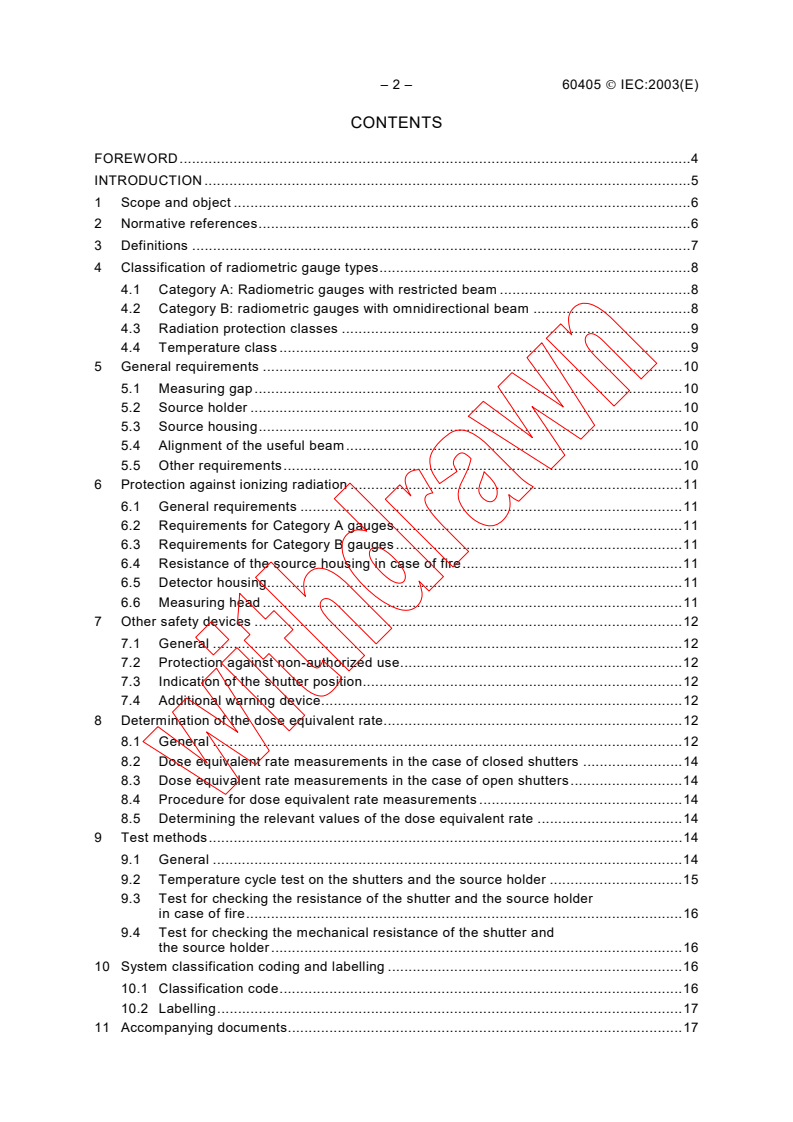
CONTENTS
FOREWORD.4
INTRODUCTION .5
1 Scope and object .6
2 Normative references.6
3 Definitions .7
4 Classification of radiometric gauge types.8
4.1 Category A: Radiometric gauges with restricted beam .8
4.2 Category B: radiometric gauges with omnidirectional beam .8
4.3 Radiation protection classes .9
4.4 Temperature class .9
5 General requirements .10
5.1 Measuring gap.10
5.2 Source holder .10
5.3 Source housing.10
5.4 Alignment of the useful beam.10
5.5 Other requirements.10
6 Protection against ionizing radiation .11
6.1 General requirements .11
6.2 Requirements for Category A gauges .11
6.3 Requirements for Category B gauges .11
6.4 Resistance of the source housing in case of fire.11
6.5 Detector housing.11
6.6 Measuring head .11
7 Other safety devices .12
7.1 General .12
7.2 Protection against non-authorized use.12
7.3 Indication of the shutter position.12
7.4 Additional warning device.12
8 Determination of the dose equivalent rate.12
8.1 General .12
8.2 Dose equivalent rate measurements in the case of closed shutters .14
8.3 Dose equivalent rate measurements in the case of open shutters.14
8.4 Procedure for dose equivalent rate measurements .14
8.5 Determining the relevant values of the dose equivalent rate .14
9 Test methods.14
9.1 General .14
9.2 Temperature cycle test on the shutters and the source holder .15
9.3 Test for checking the resistance of the shutter and the source holder
in case of fire.16
9.4 Test for checking the mechanical resistance of the shutter and
the source holder.16
10 System classification coding and labelling .16
10.1 Classification code.16
10.2 Labelling.17
11 Accompanying documents.17
60405 � IEC:2003(E) – 3 –
Figure 1 – Schematic arrangement of Category A gauges .8
Figure 2 – Schematic arrangement of Category B gauges .9
Figure 3 – Schematic representation of isodistance gauging faces in the case of
thickness gauges .13
Figure 4 – Schematic representation of isodistance gauging faces in the case of level
and density gauges and back-scatter gauges.13
Table 1 – Radiation protection classes .9
Table 2 – Temperature classes .9
– 4 – 60405 � IEC:2003(E)
INTERNATIONAL ELECTROTECHNICAL COMMISSION
____________
�������������������������
����������������������������������������������
���������������������
FOREWORD
1) The IEC (International Electrotechnical Commission) is a worldwide organization for standardization comprising
all national electrotechnical committees (IEC National Committees). The object of the IEC is to promote
international co-operation on all questions concerning standardization in the electrical and electronic fields. To
this end and in addition to other activities, the IEC publishes International Standards. Their preparation is
entrusted to technical committees; any IEC National Committee interested in the subject dealt with may
participate in this preparatory work. International, governmental and non-governmental organizations liaising
with the IEC also participate in this preparation. The IEC collaborates closely with the International Organization
for Standardization (ISO) in accordance with conditions determined by agreement between the two
organizations.
2) The formal decisions or agreements of the IEC on technical matters express, as nearly as possible, an
international consensus of opinion on the relevant subjects since each technical committee has representation
from all interested National Committees.
3) The documents produced have the form of recommendations for international use and are published in the form
of standards, technical specifications, technical reports or guides and they are accepted by the National
Committees in that sense.
4) In order to promote international unification, IEC National Committees undertake to apply IEC International
Standards transparently to the maximum extent possible in their national and regional standards. Any
divergence between the IEC Standard and the corresponding national or regional standard shall be clearly
indicated in the latter.
5) The IEC provides no marking procedure to indicate its approval and cannot be rendered responsible for any
equipment declared to be in conformity with one of its standards.
6) Attention is drawn to the possibility that some of the elements of this International Standard may be the subject
of patent rights. The IEC shall not be held responsible for identifying any or all such patent rights.
International Standard IEC 60405 has been prepared by IEC technical committee 45: Nuclear
instrumentation.
This second edition cancels and replaces the first edition published in 1972. This edition
constitutes a technical revision.
The text of this standard is based on the following documents:
FDIS Report on voting
45/519/FDIS 45/525/RVD
Full information on the voting for the approval of this standard can be found in the report on
voting indicated in the above table.
This publication has been drafted in accordance with the ISO/IEC Directives, Part 2.
The committee has decided that the contents of this publication will remain unchanged until 2006.
At this date, the publication will be
reconfirmed;
withdrawn;
replaced by a revised edition, or
amended.
A bilingual edition of this standard may be issued at a later date.
60405 � IEC:2003(E) – 5 –
INTRODUCTION
This International Standard is based on ISO 7205 which was published in 1986. It includes
excerpts of the requirements specified in ISO 7205 and modifies or supplements them with
additional provisions, where required by current needs.
Compared to the first edition of IEC 60405 published in 1972, the following major alterations
have been made:
a) the original classification of gauges in accordance with the activity of the radioactive source
has been replaced by a system-oriented and application-oriented classification in accord-
ance with the alignment of the useful beam, the dose equivalent rate (radiation protection
classes) and the permissible operating temperature (temperature classes);
b) safety-relevant requirements and appropriate test methods on the basis of ISO 7205 have
been introduced and worded more precisely;
c) a gauge classification system has been introduced (in line with ISO 7205) with a view to
reaching compatibility with international provisions.
– 6 – 60405 � IEC:2003(E)
�������������������������
����������������������������������������������
���������������������
�� ����������������
This standard applies to the manufacture and installation of electrical measuring systems and
instruments utilizing radioactive sources (radiometric gauges, hereinafter called gauges).
It does not apply to portable gauges which, because of their construction and purposes for use,
are intended to be operated as mobile equipment and it does not apply to gauges operated with
X-ray tubes, but it can be analogously applicable to these gauges.
The purpose of this standard is to specify constructional requirements for the design of
instruments and the radiation protection to be provided in the case of radiometric gauges.
In this context, special attention is attached to the stability of the source housing in the event
of fire.
�� ��� ��!"����#������$
The following referenced documents are indispensable for the application of this document. For
dated references, only the edition cited applies. For undated references, the latest edition of
the referenced document (including any amendments) applies.
IEC 61010-1:2001, �������������������������������������������������������������������������
���������������������������������������������
IEC 60476:1993, �������� ���������������� �� ����������� ���������� �������� ���� �����������
������������������������������������������������������
IEC 60692:1999, �������� ��������������� � �������� ������� ���������� ��������� ���������� �
������������������������ ���
IEC 60982:1989, !�"��� ���������� �������� ���������� ��������� ���������� #�� � ����������� ��
�#��� ����������
IEC 61326:2002, ��������������������������������������������������������������������$%
������������
IEC 61336:1996, ��������������������������& ��’�������������������������������������������
������������������������������������ ���
ISO 361:1975, (������������������������������
ISO 921:1997, �����������������)���������
ISO 2919:1999, *��������������������������������������"��������������������������������
������������������
ISO 7205:1986, *���������������������������������������������������������������
60405 � IEC:2003(E) – 7 –
%� ��#!�!�!��$
For the purposes of this document, the definitions as specified in ISO 921 and IEC 60476 and
the following apply.
%&��
���!� ���!��’�(’�
control and measuring assembly consisting of at least one radioactive source, at least one
detector and the mechanical devices required for non-destructive measurement of a process
quantity
%&��
��� �����)*�!�$��))������!� ���!��’�(’�
radiometric gauge that is permanently installed at the measuring location
NOTE The measuring location may also be situated on mobile equipment (e.g. on a ship or a vehicle). The
detector housing and the source housing may be installed both rigidly fixed and movable. The mobility of
the system is limited and determined by the purpose for which it was designed.
%&%�
$��)���$�(���
radioactive source that is sealed in a solid and inert capsule or is permanently incorporated in
solid and inert materials so that dispersion of radioactive substances under normal conditions
of use is substantially prevented; one dimension shall be at least 0,2 cm
%&+�
$�(����,�)���
device used to support and contain the radioactive source
%&-�
��$(�!�’�,���
subassembly comprising one or several radioactive sources and detectors along with
compensation sensors, if necessary, and devices that can be used to measure and correct the
effects of undesirable influences
NOTE The measuring head may consist of separate source-housing and detector-housing subassemblies and
it may include electronic devices for signal processing.
%&.�
$�(����,�($!�’
that portion of the measuring head which includes the radioactive source, its holder and
primary shielding device and shutter mechanism, if any
%&/�
���������,�($!�’
that portion of the measuring head that includes the detector
NOTE This assembly may be incorporated with the source housing, especially in the case of a back-scatter
measurement system.
%&0�
($�#()����!��!��1�($�#()����
portion of radiation that is emitted by the radioactive source and used for measurement
%&2�
��))! ��!�����"!��
device for restricting the useful radiation in one or more directions
– 8 – 60405 � IEC:2003(E)
+� �)�$$!#!���!����#����!� ���!��’�(’���*��$
+&�� ����’��*��3����!� ���!��’�(’�$�4!�,���$��!��������
Category A comprises gauges equipped with a device for collimation of the radiation, thereby
restricting the useful beam.
The gauge shall be designed in such a way that the radiation, except for the useful beam, is
attenuated in conformity with the requirements of this standard.
S D D
S
S
D
Fixed level or density gauge Tracking level gauge Level or density gauge
with the radioactive source
inside the material container
D
D S
D
S
S
Fixed thickness gauge Moveable thickness gauge Back-scatter measuring system
,(&����������
.H\
D detector housing
S source housing
�!’(���������,� ��!�������’� �����#�����’��*���’�(’�$
+&�� ����’��*�53����!� ���!��’�(’�$�4!�,�� �!�!����!���)����
Category B comprises gauges without a device for collimation of the radiation in one or more
directions of the useful beam or where the alignment does not comply with the requirements of
Category A gauges.
60405 � IEC:2003(E) – 9 –
S
S D
S D
D
Gauge with the radioactive source Gauge with the radioactive source Tracking level gauge with the
inside the material container and the detector inside the radioactive source inside
material container the material container
,(&����������
.H\
D detector housing
S source housing
�!’(���������,� ��!�������’� �����#�����’��*�5�’�(’�$
+&%� ���!��!����������!����)�$$�$
In conformity with the values of the dose equivalent rate in accordance with Clause 8, the
gauges shall be classified into the radiation protection classes as specified in Table 1.
NOTE The classification of the gauges into radiation protection classes simplifies the approval procedure and
facilitates the use in practice.
���)���������!��!����������!����)�$$�$
5DGLDWLRQ�SURWHFWLRQ�FODVV
�� � � � � �
Maximum dose
>0,5 mSv/h >0,05 mSv/h
>7,5 PSv/h
equivalent rate at a No test >1 mSv/h <7,5 PSv/h Special
<1 mSv/h <0,5 mSv/h <0,05 mSv/h
distance of 5 cm
Maximum dose
>25 PSv/h >7,5 PSv/h >2,5 PSv/h
equivalent rate at a No test >0,1 mSv/h <2,5 PSv/h Special
<0,1 mSv/h
<25 PSv/h <7,5 PSv/h
distance of 100 cm
+&+� �� �����(����)�$$
In conformity with the maximum and minimum operating temperature values on which the
design is based the gauges shall be classified into temperature classes as specified in Table 2.
NOTE The gauges are classified into separate temperature classes for both the maximum operating temperature
and the minimum operating temperature (see 10.1)
���)�������� �����(����)�$$�$
7HPSHUDWXUH�FODVV
�� � � � � �
Maximum operating
No test 50 °C 70 °C 100 °C 200 °C 400 °C Special
temperature
Minimum operating
No test 10 °C0 °C –10 °C –20 °C –40 °C Special
temperature
– 10 – 60405 � IEC:2003(E)
-� ������)���6(!�� ���$
-&�� ���$(�!�’�’��
In order to prevent persons placing their hands or any other part of their body in the useful
beam, the gauges shall be constructed in such a way that the measuring gap is kept to a
practical minimum. This also includes any other points where access to the useful beam is
likely to occur. If necessary, the user shall install additional protective devices.
-&�� ��(����,�)���
The source holder shall be designed and constructed in such a way that:
a) an easy installation of the radioactive source is feasible under radiologically safe conditions;
b) a reliable positioning of the source is feasible under radiologically safe conditions.
-&%� ��(����,�($!�’
The source housing shall be designed and constructed in such a way that:
a) the radioactive source is protected under normal operating conditions against impacts
which could damage it if no other means are provided in the gauge for such protection;
b) dismantling of the radioactive source by non-authorized persons is prevented (e.g.: by pro-
viding a safety lock, special tools which are necessary to open the housing, or by security
sealing procedures);
c) it withstands the adverse physical and chemical influences expected in accordance with the
user's information (e.g. by means of installing an additional protective hood or any other
installation-related measures);
d) the radioactive source is secured in a manner to prevent the radioactive source from falling
out even in the event of mechanical damage to the housing or in case of fire;
e) it is possible to carry out source leakage tests under radiologically safe conditions.
-&+� �)!’� �����#��,��($�#()����
The source and detector heads shall be aligned so that the collimation device of Category A
gauges restricts the useful beam so that it does not extend beyond the det
...
IEC 60405
Edition 2.0 2003-04
INTERNATIONAL
STANDARD
NORME
INTERNATIONALE
Nuclear instrumentation – Constructional requirements and classification of
radiometric guages
Instrumentation nucléaire – Prescriptions de construction et classification pour
les jauges de mesure des rayonnements ionisants
All rights reserved. Unless otherwise specified, no part of this publication may be reproduced or utilized in any form or by
any means, electronic or mechanical, including photocopying and microfilm, without permission in writing from either IEC or
IEC's member National Committee in the country of the requester.
If you have any questions about IEC copyright or have an enquiry about obtaining additional rights to this publication,
please contact the address below or your local IEC member National Committee for further information.
Droits de reproduction réservés. Sauf indication contraire, aucune partie de cette publication ne peut être reproduite
ni utilisée sous quelque forme que ce soit et par aucun procédé, électronique ou mécanique, y compris la photocopie
et les microfilms, sans l'accord écrit de la CEI ou du Comité national de la CEI du pays du demandeur.
Si vous avez des questions sur le copyright de la CEI ou si vous désirez obtenir des droits supplémentaires sur cette
publication, utilisez les coordonnées ci-après ou contactez le Comité national de la CEI de votre pays de résidence.
IEC Central Office
3, rue de Varembé
CH-1211 Geneva 20
Switzerland
Email: inmail@iec.ch
Web: www.iec.ch
About the IEC
The International Electrotechnical Commission (IEC) is the leading global organization that prepares and publishes
International Standards for all electrical, electronic and related technologies.
About IEC publications
The technical content of IEC publications is kept under constant review by the IEC. Please make sure that you have the
latest edition, a corrigenda or an amendment might have been published.
ƒ Catalogue of IEC publications: www.iec.ch/searchpub
The IEC on-line Catalogue enables you to search by a variety of criteria (reference number, text, technical committee,…).
It also gives information on projects, withdrawn and replaced publications.
ƒ IEC Just Published: www.iec.ch/online_news/justpub
Stay up to date on all new IEC publications. Just Published details twice a month all new publications released. Available
on-line and also by email.
ƒ Electropedia: www.electropedia.org
The world's leading online dictionary of electronic and electrical terms containing more than 20 000 terms and definitions
in English and French, with equivalent terms in additional languages. Also known as the International Electrotechnical
Vocabulary online.
ƒ Customer Service Centre: www.iec.ch/webstore/custserv
If you wish to give us your feedback on this publication or need further assistance, please visit the Customer Service
Centre FAQ or contact us:
Email: csc@iec.ch
Tel.: +41 22 919 02 11
Fax: +41 22 919 03 00
A propos de la CEI
La Commission Electrotechnique Internationale (CEI) est la première organisation mondiale qui élabore et publie des
normes internationales pour tout ce qui a trait à l'électricité, à l'électronique et aux technologies apparentées.
A propos des publications CEI
Le contenu technique des publications de la CEI est constamment revu. Veuillez vous assurer que vous possédez
l’édition la plus récente, un corrigendum ou amendement peut avoir été publié.
ƒ Catalogue des publications de la CEI: www.iec.ch/searchpub/cur_fut-f.htm
Le Catalogue en-ligne de la CEI vous permet d’effectuer des recherches en utilisant différents critères (numéro de référence,
texte, comité d’études,…). Il donne aussi des informations sur les projets et les publications retirées ou remplacées.
ƒ Just Published CEI: www.iec.ch/online_news/justpub
Restez informé sur les nouvelles publications de la CEI. Just Published détaille deux fois par mois les nouvelles
publications parues. Disponible en-ligne et aussi par email.
ƒ Electropedia: www.electropedia.org
Le premier dictionnaire en ligne au monde de termes électroniques et électriques. Il contient plus de 20 000 termes et
définitions en anglais et en français, ainsi que les termes équivalents dans les langues additionnelles. Egalement appelé
Vocabulaire Electrotechnique International en ligne.
ƒ Service Clients: www.iec.ch/webstore/custserv/custserv_entry-f.htm
Si vous désirez nous donner des commentaires sur cette publication ou si vous avez des questions, visitez le FAQ du
Service clients ou contactez-nous:
Email: csc@iec.ch
Tél.: +41 22 919 02 11
Fax: +41 22 919 03 00
IEC 60405
Edition 2.0 2003-04
INTERNATIONAL
STANDARD
NORME
INTERNATIONALE
Nuclear instrumentation – Constructional requirements and classification of
radiometric guages
Instrumentation nucléaire – Prescriptions de construction et classification pour
les jauges de mesure des rayonnements ionisants
INTERNATIONAL
ELECTROTECHNICAL
COMMISSION
COMMISSION
ELECTROTECHNIQUE
PRICE CODE
INTERNATIONALE
R
CODE PRIX
ICS 27.120 ISBN 2-8318-7232-4
– 2 – 60405 CEI:2003
SOMMAIRE
AVANT-PROPOS . 6
INTRODUCTION .10
1 Domaine d'application.12
2 Références normatives .12
3 Définitions .14
4 Classification des types de jauges radiométriques .16
4.1 Catégorie A: Jauges radiométriques avec faisceau collimaté .16
4.2 Catégorie B: Jauges radiométriques avec faisceau omnidirectionnel .18
4.3 Classification de la protection contre le rayonnement .18
4.4 Classification des températures .18
5 Prescriptions générales .20
5.1 Espace de mesure.20
5.2 Support de source .20
5.3 Boîtier de la source .20
5.4 Alignement du faisceau utile .20
5.5 Autres prescriptions.22
6 Protection contre les rayonnements ionisants .22
6.1 Prescriptions générales .22
6.2 Prescriptions pour les jauges de Catégorie A.22
6.3 Prescriptions pour les jauges de Catégorie B.22
6.4 Résistance du boîtier de la source en cas d'incendie .24
6.5 Boîtier du détecteur .24
6.6 Tête de mesure .24
7 Autres appareils de sécurité .24
7.1 Généralités.24
7.2 Protection contre une utilisation non autorisée.24
7.3 Indication sur la position de l'obturateur.24
7.4 Dispositif d’avertissement additionnel .24
8 Détermination du débit d’équivalent de dose.26
8.1 Généralités.26
8.2 Mesure du débit d’équivalent de dose dans le cas d'obturateurs fermés .28
8.3 Mesure du débit d’équivalent de dose dans le cas d'obturateurs ouverts .28
8.4 Procédure pour les mesures du débit d’équivalent de dose.28
8.5 Détermination des valeurs pertinentes du débit d’équivalent de dose.30
9 Méthodes d'essai.30
9.1 Généralités.30
9.2 Essai de cycle de température sur les obturateurs et le support de source .30
9.3 Essai de résistance de l'obturateur et du support de source en cas
d'incendie .32
9.4 Essai de résistance mécanique de l'obturateur et du support de source.34
10 Code de classification et étiquetage.34
10.1 Code de classification.34
10.2 Etiquetage .36
11 Documents d'accompagnement .36
60405 IEC:2003 – 3 –
CONTENTS
FOREWORD . 7
INTRODUCTION .11
1 Scope and object .13
2 Normative references.13
3 Definitions.15
4 Classification of radiometric gauge types.17
4.1 Category A: Radiometric gauges with restricted beam .17
4.2 Category B: radiometric gauges with omnidirectional beam.19
4.3 Radiation protection classes.19
4.4 Temperature class .19
5 General requirements.21
5.1 Measuring gap .21
5.2 Source holder .21
5.3 Source housing.21
5.4 Alignment of the useful beam .21
5.5 Other requirements .23
6 Protection against ionizing radiation .23
6.1 General requirements .23
6.2 Requirements for Category A gauges .23
6.3 Requirements for Category B gauges .23
6.4 Resistance of the source housing in case of fire .25
6.5 Detector housing.25
6.6 Measuring head .25
7 Other safety devices .25
7.1 General .25
7.2 Protection against non-authorized use.25
7.3 Indication of the shutter position.25
7.4 Additional warning device.25
8 Determination of the dose equivalent rate.27
8.1 General .27
8.2 Dose equivalent rate measurements in the case of closed shutters.29
8.3 Dose equivalent rate measurements in the case of open shutters .29
8.4 Procedure for dose equivalent rate measurements .29
8.5 Determining the relevant values of the dose equivalent rate.31
9 Test methods .31
9.1 General .31
9.2 Temperature cycle test on the shutters and the source holder .31
9.3 Test for checking the resistance of the shutter and the source holder
in case of fire.33
9.4 Test for checking the mechanical resistance of the shutter and
the source holder .35
10 System classification coding and labelling .35
10.1 Classification code.35
10.2 Labelling.37
11 Accompanying documents.37
– 4 – 60405 CEI:2003
Figure 1 – Disposition schématique des jauges de Catégorie A.16
Figure 2 – Disposition schématique des jauges de Catégorie B.18
Figure 3 – Représentation schématique des faces de mesure à iso-distance dans le
cas de jauges de mesure d’épaisseur.26
Figure 4 – Représentation schématique des faces de mesure à iso-distance dans le
cas de jauges de mesure de niveau et de densité et de jauges à rétrodiffusion .28
Tableau 1 – Classification de la protection contre le rayonnement.18
Tableau 2 – Classification des températures .20
60405 IEC:2003 – 5 –
Figure 1 – Schematic arrangement of Category A gauges .17
Figure 2 – Schematic arrangement of Category B gauges .19
Figure 3 – Schematic representation of isodistance gauging faces in the case of
thickness gauges.27
Figure 4 – Schematic representation of isodistance gauging faces in the case of level
and density gauges and back-scatter gauges.29
Table 1 – Radiation protection classes.19
Table 2 – Temperature classes.21
– 6 – 60405 © CEI:2003
COMMISSION ÉLECTROTECHNIQUE INTERNATIONALE
____________
INSTRUMENTATION NUCLÉAIRE –
PRESCRIPTIONS DE CONSTRUCTION ET CLASSIFICATION POUR
LES JAUGES DE MESURE DES RAYONNEMENTS IONISANTS
AVANT-PROPOS
1) La Commission Electrotechnique Internationale (CEI) est une organisation mondiale de normalisation
composée de l'ensemble des comités électrotechniques nationaux (Comités nationaux de la CEI). La CEI a
pour objet de favoriser la coopération internationale pour toutes les questions de normalisation dans les
domaines de l'électricité et de l'électronique. A cet effet, la CEI – entre autres activités – publie des Normes
internationales, des Spécifications techniques, des Rapports techniques, des Spécifications accessibles au
public (PAS) et des Guides (ci-après dénommés "Publication(s) de la CEI"). Leur élaboration est confiée à des
comités d'études, aux travaux desquels tout Comité national intéressé par le sujet traité peut participer. Les
organisations internationales, gouvernementales et non gouvernementales, en liaison avec la CEI, participent
également aux travaux. La CEI collabore étroitement avec l'Organisation Internationale de Normalisation (ISO),
selon des conditions fixées par accord entre les deux organisations.
2) Les décisions ou accords officiels de la CEI concernant les questions techniques représentent, dans la mesure
du possible, un accord international sur les sujets étudiés, étant donné que les Comités nationaux de la CEI
intéressés sont représentés dans chaque comité d’études.
3) Les Publications de la CEI se présentent sous la forme de recommandations internationales et sont agréées
comme telles par les Comités nationaux de la CEI. Tous les efforts raisonnables sont entrepris afin que la CEI
s'assure de l'exactitude du contenu technique de ses publications; la CEI ne peut pas être tenue responsable
de l'éventuelle mauvaise utilisation ou interprétation qui en est faite par un quelconque utilisateur final.
4) Dans le but d'encourager l'uniformité internationale, les Comités nationaux de la CEI s'engagent, dans toute la
mesure possible, à appliquer de façon transparente les Publications de la CEI dans leurs publications
nationales et régionales. Toutes divergences entre toutes Publications de la CEI et toutes publications
nationales ou régionales correspondantes doivent être indiquées en termes clairs dans ces dernières.
5) La CEI n’a prévu aucune procédure de marquage valant indication d’approbation et n'engage pas sa
responsabilité pour les équipements déclarés conformes à une de ses Publications.
6) Tous les utilisateurs doivent s'assurer qu'ils sont en possession de la dernière édition de cette publication.
7) Aucune responsabilité ne doit être imputée à la CEI, à ses administrateurs, employés, auxiliaires ou
mandataires, y compris ses experts particuliers et les membres de ses comités d'études et des Comités
nationaux de la CEI, pour tout préjudice causé en cas de dommages corporels et matériels, ou de tout autre
dommage de quelque nature que ce soit, directe ou indirecte, ou pour supporter les coûts (y compris les frais
de justice) et les dépenses découlant de la publication ou de l'utilisation de cette Publication de la CEI ou de
toute autre Publication de la CEI, ou au crédit qui lui est accordé.
8) L'attention est attirée sur les références normatives citées dans cette publication. L'utilisation de publications
référencées est obligatoire pour une application correcte de la présente publication.
9) L’attention est attirée sur le fait que certains des éléments de la présente Publication de la CEI peuvent faire
l’objet de droits de propriété intellectuelle ou de droits analogues. La CEI ne saurait être tenue pour
responsable de ne pas avoir identifié de tels droits de propriété et de ne pas avoir signalé leur existence.
La Norme internationale CEI 60405 a été établie par le comité d'études 45 de la CEI:
Instrumentation nucléaire.
Cette deuxième édition annule et remplace la première édition, publiée en 1972, dont elle
constitue une révision technique.
La présente version bilingue, publiée en 2003-10, correspond à la version anglaise.
Le texte anglais de cette norme est issu des documents 45/519/FDIS et 45/525/RVD.
Le rapport de vote 45/525/RVD donne toute information sur le vote ayant abouti à
l'approbation de cette norme.
La version française de cette norme n’a pas été soumise au vote.
60405 © IEC:2003 – 7 –
INTERNATIONAL ELECTROTECHNICAL COMMISSION
____________
NUCLEAR INSTRUMENTATION –
CONSTRUCTIONAL REQUIREMENTS AND CLASSIFICATION
OF RADIOMETRIC GAUGES
FOREWORD
1) The International Electrotechnical Commission (IEC) is a worldwide organization for standardization comprising
all national electrotechnical committees (IEC National Committees). The object of IEC is to promote
international co-operation on all questions concerning standardization in the electrical and electronic fields. To
this end and in addition to other activities, IEC publishes International Standards, Technical Specifications,
Technical Reports, Publicly Available Specifications (PAS) and Guides (hereafter referred to as “IEC
Publication(s)”). Their preparation is entrusted to technical committees; any IEC National Committee interested
in the subject dealt with may participate in this preparatory work. International, governmental and non-
governmental organizations liaising with the IEC also participate in this preparation. IEC collaborates closely
with the International Organization for Standardization (ISO) in accordance with conditions determined by
agreement between the two organizations.
2) The formal decisions or agreements of IEC on technical matters express, as nearly as possible, an international
consensus of opinion on the relevant subjects since each technical committee has representation from all
interested IEC National Committees.
3) IEC Publications have the form of recommendations for international use and are accepted by IEC National
Committees in that sense. While all reasonable efforts are made to ensure that the technical content of IEC
Publications is accurate, IEC cannot be held responsible for the way in which they are used or for any
misinterpretation by any end user.
4) In order to promote international uniformity, IEC National Committees undertake to apply IEC Publications
transparently to the maximum extent possible in their national and regional publications. Any divergence
between any IEC Publication and the corresponding national or regional publication shall be clearly indicated in
the latter.
5) IEC provides no marking procedure to indicate its approval and cannot be rendered responsible for any
equipment declared to be in conformity with an IEC Publication.
6) All users should ensure that they have the latest edition of this publication.
7) No liability shall attach to IEC or its directors, employees, servants or agents including individual experts and
members of its technical committees and IEC National Committees for any personal injury, property damage or
other damage of any nature whatsoever, whether direct or indirect, or for costs (including legal fees) and
expenses arising out of the publication, use of, or reliance upon, this IEC Publication or any other IEC
Publications.
8) Attention is drawn to the Normative references cited in this publication. Use of the referenced publications is
indispensable for the correct application of this publication.
9) Attention is drawn to the possibility that some of the elements of this IEC Publication may be the subject of
patent rights. IEC shall not be held responsible for identifying any or all such patent rights.
International Standard IEC 60405 has been prepared by IEC technical committee 45: Nuclear
instrumentation.
This second edition cancels and replaces the first edition published in 1972. This edition
constitutes a technical revision.
This bilingual version, published in 2003-10, correspond to the English version.
The text of this standard is based on the following documents:
FDIS Report on voting
45/519/FDIS 45/525/RVD
Full information on the voting for the approval of this standard can be found in the report on
voting indicated in the above table.
The French version of this standard has not been voted upon.
– 8 – 60405 CEI:2003
Cette publication a été rédigée selon les Directives ISO/CEI, Partie 2.
Le comité a décidé que le contenu de cette publication ne sera pas modifié avant 2006.
A cette date, la publication sera
• reconduite;
• supprimée;
• remplacée par une édition révisée, ou
• amendée.
60405 IEC:2003 – 9 –
This publication has been drafted in accordance with the ISO/IEC Directives, Part 2.
The committee has decided that the contents of this publication will remain unchanged until
2006. At this date, the publication will be
• reconfirmed;
• withdrawn;
• replaced by a revised edition, or
• amended.
– 10 – 60405 CEI:2003
INTRODUCTION
Cette Norme internationale est basée sur l'ISO 7205, publiée en 1986. Elle inclut des extraits
des prescriptions stipulées dans l’ISO 7205 et leur apporte des modifications ou des
compléments avec des informations additionnelles quand le besoin s'en fait sentir.
Comparé à la première édition de la CEI 60405, publiée en 1972, les principaux changements
suivants ont été faits:
a) la classification initiale des jauges selon l'activité de la source radioactive a été remplacée
par une classification orientée système et orientée application selon l'alignement du
faisceau utile, le débit équivalent de dose (classes de radioprotection) et les températures
de fontionnement admises (classes de températures);
b) des prescriptions concernant la sécurité et les méthodes d'essai appropriées selon
l’ISO 7205 ont été introduites et explicitées;
c) un système de classification des jauges a été introduit (conformément à l’ISO 7205) dans
le but d'être compatible avec les dispositions internationales.
60405 IEC:2003 – 11 –
INTRODUCTION
This International Standard is based on ISO 7205 which was published in 1986. It includes
excerpts of the requirements specified in ISO 7205 and modifies or supplements them with
additional provisions, where required by current needs.
Compared to the first edition of IEC 60405 published in 1972, the following major alterations
have been made:
a) the original classification of gauges in accordance with the activity of the radioactive source
has been replaced by a system-oriented and application-oriented classification in accord-
ance with the alignment of the useful beam, the dose equivalent rate (radiation protection
classes) and the permissible operating temperature (temperature classes);
b) safety-relevant requirements and appropriate test methods on the basis of ISO 7205 have
been introduced and worded more precisely;
c) a gauge classification system has been introduced (in line with ISO 7205) with a view to
reaching compatibility with international provisions.
– 12 – 60405 CEI:2003
INSTRUMENTATION NUCLÉAIRE –
PRESCRIPTIONS DE CONSTRUCTION ET CLASSIFICATION POUR
LES JAUGES DE MESURE DES RAYONNEMENTS IONISANTS
1 Domaine d'application
Cette Norme internationale s'applique à la fabrication et à l'installation des systèmes et
appareils de mesure électriques utilisant des sources radioactives (jauges radiométriques, ci-
après désignées par jauges, en abrégé).
Elle ne s'applique pas aux jauges portables qui, en raison de leur construction et de leur
utilisation, sont censées être utilisées comme des appareils mobiles ni aux jauges mises en
œuvre par des tubes à rayons X, mais elle peut être appliquée par analogie à ces jauges.
Le but de cette norme est de spécifier les prescriptions de construction concernant la
conception de l’instrument et la radioprotection à mettre en œuvre dans le cas de jauges
radiométriques. Dans ce contexte, une attention spéciale est portée à la stabilité du boîtier de
la source en cas d’incendie.
2 Références normatives
Les documents de référence suivants sont indispensables pour l'application du présent
document. Pour les références datées, seule l'édition citée s'applique. Pour les références
non datées, la dernière édition du document de référence s'applique (y compris les éventuels
amendements).
CEI 60476:1993, Instrumentation nucléaire – Appareils et systèmes électriques de mesure
utilisant des rayonnements ionisants – aspects généraux
CEI 60692:1999, Instrumentation nucléaire – Densimètres à rayonnements ionisants –
Définitions et méthodes d’essais
CEI 60982:1989, Systèmes de mesure de niveau utilisant les rayonnements ionisants avec
signal de sortie continu ou en mode tout-ou-rien
CEI 61010-1:2001, Règles de sécurité pour appareils électriques de mesurage, de régulation
et de laboratoire – Partie 1: Prescriptions générales
CEI 61326:2002, Matériels électriques de mesure, de commande et de laboratoire –
Prescriptions relatives à la CEM
CEI 61336:1996, Instrumentation nucléaire – Systèmes de mesure d’épaisseur par rayon-
nement ionisant – Définitions et méthodes d’essai
ISO 361:1975, Symboles de base pour les rayonnements ionisants
ISO 921:1997, Energie nucléaire – Vocabulaire
ISO 2919:1999, Radioprotection – Sources radioactives scellées – Prescriptions générales et
classification
ISO 7205:1986, Jauges à radioéléments – Appareils destinés à être installés à poste fixe
60405 IEC:2003 – 13 –
NUCLEAR INSTRUMENTATION –
CONSTRUCTIONAL REQUIREMENTS AND CLASSIFICATION
OF RADIOMETRIC GAUGES
1 Scope and object
This International Standard applies to the manufacture and installation of electrical measuring
systems and instruments utilizing radioactive sources (radiometric gauges, hereinafter called
gauges).
It does not apply to portable gauges which, because of their construction and purposes for use,
are intended to be operated as mobile equipment and it does not apply to gauges operated with
X-ray tubes, but it can be analogously applicable to these gauges.
The purpose of this standard is to specify constructional requirements for the design of
instruments and the radiation protection to be provided in the case of radiometric gauges.
In this context, special attention is attached to the stability of the source housing in the event
of fire.
2 Normative references
The following referenced documents are indispensable for the application of this document. For
dated references, only the edition cited applies. For undated references, the latest edition of
the referenced document (including any amendments) applies.
IEC 60476:1993, Nuclear instrumentation – Electrical measuring systems and instruments
utilizing ionizing radiation sources – General aspects
IEC 60692:1999, Nuclear intrumentation – Density gauges utilizing ionizing radiation –
Definitions and test methods
IEC 60982:1989, Level measuring systems utilizing ionizing radiation with continuous or
switching output
IEC 61010-1:2001, Safety requirements for electrical equipment for measurement, control and
laboratory use – Part 1: General requirements
IEC 61326:2002, Electrical equipment for measurement, control and laboratory use – EMC
requirements
IEC 61336:1996, Nuclear instrumentation – Thickness measurement systems utilizing ionizing
radiation – Definitions and test methods
ISO 361:1975, Basic ionizing radiation symbol
ISO 921:1997, Nuclear energy – Vocabulary
ISO 2919:1999, Radiation protection – Sealed radioactive sources – General requirements
and classification
ISO 7205:1986, Radionuclide gauges – Gauges designed for permanent installation
– 14 – 60405 CEI:2003
3 Termes et définitions
Pour les besoins du présent document, les termes et définitions de l’ISO 921 et de la
CEI 60476 s’appliquent, ainsi que les suivants.
3.1
jauge radiométrique
ensemble de contrôle et de mesure constitué d'au moins une source radioactive, d'un
détecteur et des appareils mécaniques nécessaires pour la mesure non destructive d'une
grandeur de processus
3.2
jauge radiométrique installée de façon permanente
jauge radiométrique installée de façon permanente sur le lieu de la mesure
NOTE Le lieu de la mesure peut être mobile (par exemple sur un bateau ou un véhicule). Le boîtier du détecteur
et le boîtier de la source peuvent être installés aussi bien de façon fixe que mobile. La mobilité du système est
limitée et déterminée par le but pour lequel il a été conçu.
3.3
source scellée
source radioactive scellée dans une capsule solide et inerte ou incorporée de façon
permanente dans des matériaux solides et inertes de sorte que la dispersion de substances
radioactives dans des conditions normales d'utilisation soit impossible; l’une des dimensions
doit être au moins de 0,2 cm
3.4
support de source
appareil destiné à soutenir et contenir la source radioactive
3.5
tête de mesure
sous-ensemble comprenant une ou plusieurs sources radioactives et des détecteurs, y
compris des capteurs de compensation si nécessaire, et des dispositifs qui peuvent être
utilisés pour mesurer et corriger les effets d'influences indésirables
NOTE La tête de mesure peut être constituée de sous-ensembles distincts pour le boîtier de la source et le
boîtier du détecteur et elle peut inclure des appareils électroniques pour le traitement des signaux.
3.6
boîtier de la source
partie de la tête de mesure qui inclut la source radioactive, son support, le dispositif d'écran
primaire et le mécanisme d'obturation, s’il y en a un
3.7
boîtier du détecteur
partie de la tête de mesure qui inclut le détecteur
NOTE Cet ensemble peut être incorporé dans le boîtier de la source, spécialement dans le cas d'un système de
mesure par rétro diffusion.
3.8
rayonnement utile; faisceau utile
partie du rayonnement émis par la source radioactive qui est utilisée pour la mesure
3.9
collimateur
dispositif permettant d’orienter le rayonnement utile dans une ou plusieurs directions
60405 IEC:2003 – 15 –
3 Terms and definitions
For the purposes of this document, the terms and definitions as specified in ISO 921 and
IEC 60476 and the following apply.
3.1
radiometric gauge
control and measuring assembly consisting of at least one radioactive source, at least one
detector and the mechanical devices required for non-destructive measurement of a process
quantity
3.2
permanently installed radiometric gauge
radiometric gauge that is permanently installed at the measuring location
NOTE The measuring location may also be situated on mobile equipment (e.g. on a ship or a vehicle). The
detector housing and the source housing may be installed both rigidly fixed and movable. The mobility of
the system is limited and determined by the purpose for which it was designed.
3.3
sealed source
radioactive source that is sealed in a solid and inert capsule or is permanently incorporated in
solid and inert materials so that dispersion of radioactive substances under normal conditions
of use is substantially prevented; one dimension shall be at least 0,2 cm
3.4
source holder
device used to support and contain the radioactive source
3.5
measuring head
subassembly comprising one or several radioactive sources and detectors along with
compensation sensors, if necessary, and devices that can be used to measure and correct the
effects of undesirable influences
NOTE The measuring head may consist of separate source-housing and detector-housing subassemblies and
it may include electronic devices for signal processing.
3.6
source housing
that portion of the measuring head which includes the radioactive source, its holder and
primary shielding device and shutter mechanism, if any
3.7
detector housing
that portion of the measuring head that includes the detector
NOTE This assembly may be incorporated with the source housing, especially in the case of a back-scatter
measurement system.
3.8
useful radiation; useful beam
portion of radiation that is emitted by the radioactive source and used for measurement
3.9
collimation device
device for restricting the useful radiation in one or more directions
– 16 – 60405 CEI:2003
4 Classification des types de jauges radiométriques
4.1 Catégorie A: Jauges radiométriques avec faisceau collimaté
La Catégorie A comprend les jauges équipées d'un collimateur du rayonnement, réduisant
ainsi le faisceau utile.
La jauge doit être conçue de telle façon que le rayonnement, excepté pour le faisceau utile,
soit atténué en conformité avec les prescriptions de cette norme.
S D S D
S
D
Jauge de niveau ou de densité,
Niveau fixe ou jauge de densité Jauge de suivi de niveau avec la source radioactive
dans le récipient du matériau
D
D
S
D
S
S
Jauge fixe d’épaisseur Jauge mobile d’épaisseur Système de mesure par rétrodiffusion
Légende
IEC 1278/03
D boîtier du détecteur
S boîtier de la source
Figure 1 – Disposition schématique des jauges de Catégorie A
60405 IEC:2003 – 17 –
4 Classification of radiometric gauge types
4.1 Category A: Radiometric gauges with restricted beam
Category A comprises gauges equipped with a device for collimation of the radiation, thereby
restricting the useful beam.
The gauge shall be designed in such a way that the radiation, except for the useful beam, is
attenuated in conformity with the requirements of this standard.
S D S D
S
D
Fixed level or density gauge Tracking level gauge Level or density gauge
with the radioactive source
inside the material container
D
D S
D
S
S
Fixed thickness gauge Moveable thickness gauge Back-scatter measuring system
IEC 1278/03
Key
D detector housing
S source housing
Figure 1 – Schematic arrangement of Category A gauges
– 18 – 60405 CEI:2003
4.2 Catégorie B: Jauges radiométriques avec faisceau omnidirectionnel
La Catégorie B comprend les jauges pour lesquelles dans une ou plusieurs directions du
faisceau utile le rayonnement n’est pas collimaté, ou les jauges qui ne satisfont pas aux
exigences de la Catégorie A.
S
S D
S D
D
Jauge dont la source radioactive Jauge dont la source radioactive Jauge de suivi de niveau dont la
se trouve à l’intérieur du récipient et le détecteur se trouvent à source radioactive se trouve à
du matériau l’intérieur du récipient du matériau l’intérieur du récipient du matériau
Légende IEC 1279/03
D: boîtier du détecteur
S: boîtier de la source
Figure 2 – Disposition schématique des jauges de Catégorie B
4.3 Classification de la protection contre le rayonnement
Conformément aux valeurs du débit d’équivalent de dose de l'Article 8, les jauges doivent être
classées en fonction de la classification de protection contre le rayonnement spécifiée au
Tableau 1.
NOTE Le classement des jauges en fonction de la classification de protection contre le rayonnement simplifie la
procédure d'acceptation et en facilite l'utilisation pratique.
Tableau 1 – Classification de la protection contre le rayonnement
Classification de la protection contre le rayonnement
1 2 345 6 7
Débit d’équivalent
de dose maximal à Pas >0,5 mSv/h >0,05 mSv/h >7,5 µSv/h
>1 mSv/h ≤7,5 µSv/h Spécifique
une distance de d'essai
≤1 mSv/h ≤0,5 mSv/h ≤0,05 mSv/h
5 cm
Débit d’équivalent
>25 µSv/h >7,5 µSv/h >2,5 µSv/h
de dose maximal à Pas
>0,1 mSv/h ≤2,5 µSv/h Spécifique
une distance de d'essai ≤0,1 mSv/h ≤25 µSv/h ≤7,5 µSv/h
100 cm
4.4 Classification des températures
Conformément aux valeurs maximales et minimales des températures en exploitation qui
servent de base à la conception, les jauges doivent être classées en fonction de la
classification des températures telle que spécifiée au Tableau 2.
NOTE Les jauges sont classées en fonction de classifications de température différentes pour la température
d'exploitation maximale et pour la température d'exploitation minimale (voir 10.1).
60405 IEC:2003 – 19 –
4.2 Category B: radiometric gauges with omnidirectional beam
Category B comprises gauges without a device for collimation of the radiation in one or more
directions of the useful beam or where the alignment does not comply with the requirements of
Category A gauges.
S
S D
D
S
D
Gauge with the radioactive source Gauge with the radioactive source Tracking level gauge with the
radioactive source inside
inside the material container and the detector inside the
material container the material container
IEC 1279/03
Key
D detector housing
S source housing
Figure 2 – Schematic arrangement of Category B gauges
4.3 Radiation protection classes
In conformity with the values of the dose equivalent rate in accordance with Clause 8, the
gauges shall be classified into the radiation protection classes as specified in Table 1.
NOTE The classification of the gauges into radiation protection classes simplifies the approval procedure and
facilitates the use in practice.
Table 1 – Radiation protection classes
Radiation protection class
12 3 4 5 6 7
Maximum dose
>0,5 mSv/h >0,05 mSv/h >7,5 μSv/h
equivalent rate at a No test >1 mSv/h Special
<7,5 μSv/h
<1 mSv/h <0,5 mSv/h <0,05 mSv/h
distance of 5 cm
Maximum dose
>25 μSv/h >7,5 μSv/h >2,5 μSv/h
equivalent rate at a No test >0,1 mSv/h <2,5 μSv/h Special
<0,1 mSv/h <25 μSv/h <7,5 μSv/h
distance of 100 cm
4.4 Temperature class
In conformity with the maximum and minimum operating temperature values on which the
design is based the gauges shall be classified into temperature classes as specified in Table 2.
NOTE The gauges are classified into separate temperature classes for both the maximum operating temperature
and the minimum operating temperature (see 10.1).
– 20 – 60405 CEI:2003
Tableau 2 – Classification des températures
Classification des températures
123 4 567
Température
Pas d'essai 50 °C 70 °C 100 °C 200 °C 400 °C Spécifique
d'exploitation
maximale
Température
d'exploitation Pas d'essai 10 °C 0 °C –10 °C –20 °C –40 °C Spécifique
minimale
5 Prescriptions générales
5.1 Espace de mesure
De façon à empêcher les personnes de mettre leurs mains ou toute autre partie du corps
dans le faisceau utile, les jauges doivent être construites de telle sorte que l'espace de
mesure soit réduit au minimum possible. Cette prescription s’applique également à tout autre
point où l'accès au faisceau utile pourrait avoir lieu. Si nécessaire, l'utilisateur doit installer
des appareils de protection supplémentaires.
5.2 Support de source
Le support de source doit être conçu et construit de telle sort
...