

IEC 62598:2011
(Main)Nuclear instrumentation - Constructional requirements and classification of radiometric gauges
General Information
- Abstract
IEC 62598:2011 applies to the manufacture and installation of electrical measuring systems and instruments utilizing radioactive sources (radiometric gauges, hereinafter called gauges). It also applies to source housings intended for use in the aforementioned measuring systems. This standard applies to equipment, which is not related to power production or to the fuel cycle. It specifies constructional requirements for the design of instruments utilizing radioactive sources in regard of radiation protection. This standards cancels and replaces IEC 60405.
- Status
- Published
- Publication Date
- 29-Mar-2011
- Technical Committee
- TC 45 - Nuclear instrumentation
- Current Stage
- PPUB - Publication issued
- Start Date
- 30-Mar-2011
- Completion Date
- 15-Apr-2011
Buy Documents
IEC 62598:2011 - Nuclear instrumentation - Constructional requirements and classification of radiometric gauges Released:3/30/2011
IEC 62598:2011 - Nuclear instrumentation - Constructional requirements and classification of radiometric gauges Released:3/30/2011
Overview
IEC 62598:2011 - "Nuclear instrumentation - Constructional requirements and classification of radiometric gauges" - specifies safety and classification requirements for electrical measuring systems and instruments that use radioactive sources (radiometric gauges) and for associated source housings. The standard focuses on radiation protection and constructional requirements for fixed gauges (not related to power production or the fuel cycle). It cancels and replaces IEC 60405 and introduces updated classification, testing and labelling provisions.
Key Topics and Requirements
- Scope & exclusions: Applies to fixed radiometric gauges and stand‑alone source housings; excludes portable gauges and X‑ray tube systems (though principles may be applied analogously).
- Gauge classification: Defines three categories:
- Category A - gauges with restricted (collimated) beams.
- Category B - gauges with omnidirectional beams.
- Category C - stand‑alone source housings for fixed gauges (new in this edition).
- Dose rate classes and temperature classes: Introduces standardized dose rate classes (replacing former “radiation protection class”) and temperature classes for environmental suitability.
- Fire resistance: Adds fire resistance classes and related test requirements for source housings and shutters.
- Constructional requirements: Specifies requirements for measuring gaps, source holders, source housings, beam alignment, detector housings and measuring heads to ensure safe containment and operation.
- Radiation protection measures: Prescribes shielding, shutter design, and protection against unauthorized use, including indication of shutter position and optional warning devices.
- Testing and measurement: Details procedures for dose equivalent rate measurements (closed and open shutter conditions), temperature cycle tests, mechanical and fire resistance tests.
- System coding and labelling: Defines a system classification code (including revision and fire-test digits) and labelling requirements; includes documentation and installation guidance (Annex A).
Keywords: IEC 62598, radiometric gauges, constructional requirements, source housings, dose rate classes, radiation protection, fire resistance, testing.
Practical Applications and Users
Who uses IEC 62598:
- Manufacturers and designers of fixed radiometric gauges and source housings - to design compliant products.
- Installation and maintenance engineers - for correct installation and verification of shielding, alignment and safety devices.
- Radiation protection officers and safety managers - to assess dose rates, signage and emergency measures.
- Certification and conformity bodies - to perform tests and label systems according to the classification code. Practical applications include level, density and thickness gauges in industrial process control where sealed radioactive sources are used.
Related Standards
Relevant normative references cited in IEC 62598 include:
- IEC 60476, IEC 60692, IEC 60846‑1/2, IEC 60982, IEC 61005, IEC 61010‑1, IEC 61326, IEC 61336
- ISO 921, ISO 2919
- IEC 60050‑394 (terminology) Consult these documents for detector/test methods, dose meters, and source classification details.
Relations
- Effective Date
- 05-Sep-2023
Buy Documents
IEC 62598:2011 - Nuclear instrumentation - Constructional requirements and classification of radiometric gauges Released:3/30/2011
IEC 62598:2011 - Nuclear instrumentation - Constructional requirements and classification of radiometric gauges Released:3/30/2011
Get Certified
Connect with accredited certification bodies for this standard

DNV
DNV is an independent assurance and risk management provider.

Lloyd's Register
Lloyd's Register is a global professional services organisation specialising in engineering and technology.
DNV Energy Systems
Energy and renewable energy certification.
Sponsored listings
Frequently Asked Questions
IEC 62598:2011 is a standard published by the International Electrotechnical Commission (IEC). Its full title is "Nuclear instrumentation - Constructional requirements and classification of radiometric gauges". This standard covers: IEC 62598:2011 applies to the manufacture and installation of electrical measuring systems and instruments utilizing radioactive sources (radiometric gauges, hereinafter called gauges). It also applies to source housings intended for use in the aforementioned measuring systems. This standard applies to equipment, which is not related to power production or to the fuel cycle. It specifies constructional requirements for the design of instruments utilizing radioactive sources in regard of radiation protection. This standards cancels and replaces IEC 60405.
IEC 62598:2011 applies to the manufacture and installation of electrical measuring systems and instruments utilizing radioactive sources (radiometric gauges, hereinafter called gauges). It also applies to source housings intended for use in the aforementioned measuring systems. This standard applies to equipment, which is not related to power production or to the fuel cycle. It specifies constructional requirements for the design of instruments utilizing radioactive sources in regard of radiation protection. This standards cancels and replaces IEC 60405.
IEC 62598:2011 is classified under the following ICS (International Classification for Standards) categories: 27.120.01 - Nuclear energy in general. The ICS classification helps identify the subject area and facilitates finding related standards.
IEC 62598:2011 has the following relationships with other standards: It is inter standard links to IEC 60405:2003. Understanding these relationships helps ensure you are using the most current and applicable version of the standard.
IEC 62598:2011 is available in PDF format for immediate download after purchase. The document can be added to your cart and obtained through the secure checkout process. Digital delivery ensures instant access to the complete standard document.
Standards Content (Sample)
IEC 62598 ®
Edition 1.0 2011-03
INTERNATIONAL
STANDARD
Nuclear instrumentation – Constructional requirements and classification of
radiometric gauges
All rights reserved. Unless otherwise specified, no part of this publication may be reproduced or utilized in any form
or by any means, electronic or mechanical, including photocopying and microfilm, without permission in writing from
either IEC or IEC's member National Committee in the country of the requester.
If you have any questions about IEC copyright or have an enquiry about obtaining additional rights to this publication,
please contact the address below or your local IEC member National Committee for further information.
IEC Central Office
3, rue de Varembé
CH-1211 Geneva 20
Switzerland
Email: inmail@iec.ch
Web: www.iec.ch
About the IEC
The International Electrotechnical Commission (IEC) is the leading global organization that prepares and publishes
International Standards for all electrical, electronic and related technologies.
About IEC publications
The technical content of IEC publications is kept under constant review by the IEC. Please make sure that you have the
latest edition, a corrigenda or an amendment might have been published.
Catalogue of IEC publications: www.iec.ch/searchpub
The IEC on-line Catalogue enables you to search by a variety of criteria (reference number, text, technical committee,…).
It also gives information on projects, withdrawn and replaced publications.
IEC Just Published: www.iec.ch/online_news/justpub
Stay up to date on all new IEC publications. Just Published details twice a month all new publications released. Available
on-line and also by email.
Electropedia: www.electropedia.org
The world's leading online dictionary of electronic and electrical terms containing more than 20 000 terms and definitions
in English and French, with equivalent terms in additional languages. Also known as the International Electrotechnical
Vocabulary online.
Customer Service Centre: www.iec.ch/webstore/custserv
If you wish to give us your feedback on this publication or need further assistance, please visit the Customer Service
Centre FAQ or contact us:
Email: csc@iec.ch
Tel.: +41 22 919 02 11
Fax: +41 22 919 03 00
IEC 62598 ®
Edition 1.0 2011-03
INTERNATIONAL
STANDARD
Nuclear instrumentation – Constructional requirements and classification of
radiometric gauges
INTERNATIONAL
ELECTROTECHNICAL
COMMISSION
PRICE CODE
T
ICS 27.120 ISBN 978-2-88912-421-3
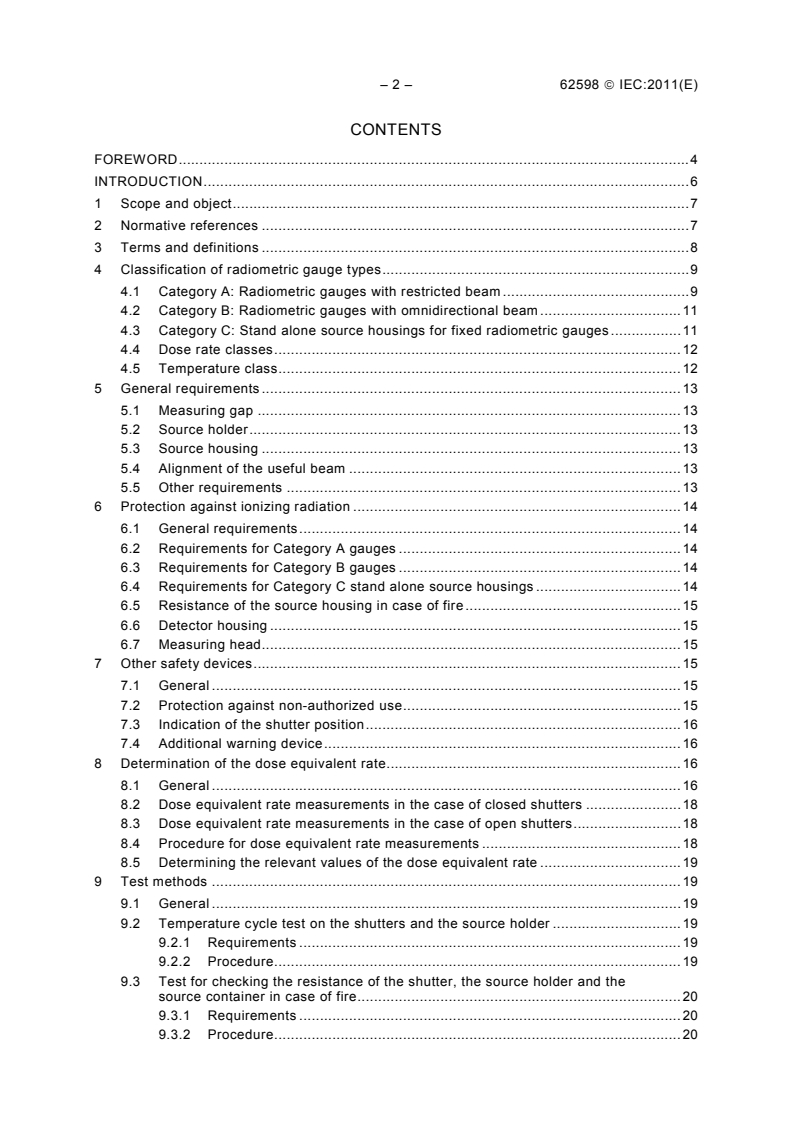
– 2 – 62598 IEC:2011(E)
CONTENTS
FOREWORD . 4
INTRODUCTION . 6
1 Scope and object . 7
2 Normative references . 7
3 Terms and definitions . 8
4 Classification of radiometric gauge types . 9
4.1 Category A: Radiometric gauges with restricted beam . 9
4.2 Category B: Radiometric gauges with omnidirectional beam . 11
4.3 Category C: Stand alone source housings for fixed radiometric gauges . 11
4.4 Dose rate classes . 12
4.5 Temperature class . 12
5 General requirements . 13
5.1 Measuring gap . 13
5.2 Source holder . 13
5.3 Source housing . 13
5.4 Alignment of the useful beam . 13
5.5 Other requirements . 13
6 Protection against ionizing radiation . 14
6.1 General requirements . 14
6.2 Requirements for Category A gauges . 14
6.3 Requirements for Category B gauges . 14
6.4 Requirements for Category C stand alone source housings . 14
6.5 Resistance of the source housing in case of fire . 15
6.6 Detector housing . 15
6.7 Measuring head . 15
7 Other safety devices . 15
7.1 General . 15
7.2 Protection against non-authorized use . 15
7.3 Indication of the shutter position . 16
7.4 Additional warning device . 16
8 Determination of the dose equivalent rate . 16
8.1 General . 16
8.2 Dose equivalent rate measurements in the case of closed shutters . 18
8.3 Dose equivalent rate measurements in the case of open shutters . 18
8.4 Procedure for dose equivalent rate measurements . 18
8.5 Determining the relevant values of the dose equivalent rate . 19
9 Test methods . 19
9.1 General . 19
9.2 Temperature cycle test on the shutters and the source holder . 19
9.2.1 Requirements . 19
9.2.2 Procedure . 19
9.3 Test for checking the resistance of the shutter, the source holder and the
source container in case of fire . 20
9.3.1 Requirements . 20
9.3.2 Procedure . 20
62598 IEC:2011(E) – 3 –
9.4 Test for checking the mechanical resistance of the shutter and the source
holder . 20
9.4.1 Requirements . 20
9.4.2 Procedure . 21
10 System classification coding and labelling . 21
10.1 Classification code . 21
10.2 Labelling . 22
11 Accompanying documents . 22
Annex A (informative) Guidelines for the installation of radiometric gauges . 23
Figure 1 – Schematic arrangement of Category A gauges . 10
Figure 2 – Schematic arrangement of Category B gauges . 11
Figure 3 – Category C stand alone source housing for fixed level or density gauges . 11
Figure 4 – Schematic representation of isodistance gauging faces in the case of
thickness gauges . 17
Figure 5 – Schematic representation of isodistance gauging faces in the case of level
and density gauges and back-scatter gauges . 17
Figure 6 – Schematic representation of isodistance gauging faces in the case of stand
alone source housings . 18
Figure A.1 – Examples of protection methods and principles . 24
Table 1 – Dose rate classes . 12
Table 2 – Temperature classes . 12
Table 3 – Fire resistance classes . 15
– 4 – 62598 IEC:2011(E)
INTERNATIONAL ELECTROTECHNICAL COMMISSION
____________
NUCLEAR INSTRUMENTATION –
CONSTRUCTIONAL REQUIREMENTS
AND CLASSIFICATION OF RADIOMETRIC GAUGES
FOREWORD
1) The International Electrotechnical Commission (IEC) is a worldwide organization for standardization comprising
all national electrotechnical committees (IEC National Committees). The object of IEC is to promote
international co-operation on all questions concerning standardization in the electrical and electronic fields. To
this end and in addition to other activities, IEC publishes International Standards, Technical Specifications,
Technical Reports, Publicly Available Specifications (PAS) and Guides (hereafter referred to as “IEC
Publication(s)”). Their preparation is entrusted to technical committees; any IEC National Committee interested
in the subject dealt with may participate in this preparatory work. International, governmental and non-
governmental organizations liaising with the IEC also participate in this preparation. IEC collaborates closely
with the International Organization for Standardization (ISO) in accordance with conditions determined by
agreement between the two organizations.
2) The formal decisions or agreements of IEC on technical matters express, as nearly as possible, an international
consensus of opinion on the relevant subjects since each technical committee has representation from all
interested IEC National Committees.
3) IEC Publications have the form of recommendations for international use and are accepted by IEC National
Committees in that sense. While all reasonable efforts are made to ensure that the technical content of IEC
Publications is accurate, IEC cannot be held responsible for the way in which they are used or for any
misinterpretation by any end user.
4) In order to promote international uniformity, IEC National Committees undertake to apply IEC Publications
transparently to the maximum extent possible in their national and regional publications. Any divergence
between any IEC Publication and the corresponding national or regional publication shall be clearly indicated in
the latter.
5) IEC itself does not provide any attestation of conformity. Independent certification bodies provide conformity
assessment services and, in some areas, access to IEC marks of conformity. IEC is not responsible for any
services carried out by independent certification bodies.
6) All users should ensure that they have the latest edition of this publication.
7) No liability shall attach to IEC or its directors, employees, servants or agents including individual experts and
members of its technical committees and IEC National Committees for any personal injury, property damage or
other damage of any nature whatsoever, whether direct or indirect, or for costs (including legal fees) and
expenses arising out of the publication, use of, or reliance upon, this IEC Publication or any other IEC
Publications.
8) Attention is drawn to the Normative references cited in this publication. Use of the referenced publications is
indispensable for the correct application of this publication.
9) Attention is drawn to the possibility that some of the elements of this IEC Publication may be the subject of
patent rights. IEC shall not be held responsible for identifying any or all such patent rights.
International Standard IEC 62598 has been prepared by IEC technical committee 45: Nuclear
instrumentation.
This standard cancels and replaces the second edition of IEC 60405, issued in 2003. It
constitutes a technical revision (see Introduction).
The text of this standard is based on the following documents:
FDIS Report on voting
45/718/FDIS 45/721/RVD
Full information on the voting for the approval of this standard can be found in the report on
voting indicated in the above table.
This publication has been drafted in accordance with the ISO/IEC Directives, Part 2.
62598 IEC:2011(E) – 5 –
The committee has decided that the contents of this publication will remain unchanged until
the stability date indicated on the IEC web site under "http://webstore.iec.ch" in the data
related to the specific publication. At this date, the publication will be
• reconfirmed,
• withdrawn,
• replaced by a revised edition, or
• amended.
A bilingual version of this publication may be issued at a later date.
– 6 – 62598 IEC:2011(E)
INTRODUCTION
This International Standard is based on the second edition of IEC 60405 which was published
in 2003. It modifies or supplements it with additional provisions, where required by current
needs.
Compared to the second edition of IEC 60405, the following major changes have been made:
– Introduction of Category C for stand alone source housings intended for fixed radiometric
gauges and associated test procedures.
– The system classification code has been amended by one digit indicating the applied
revision of IEC 62598 and by a second digit indicating the fire test conditions.
– The term dose rate class shall be used instead of radiation protection class.
Class 7, or alternatively E, represents the current ICRP regulations.
– Introduction of fire resistance classes.
– Revision of the procedure for dose equivalent measurements.
– Addition of Annex A (informative) "Guidelines for the installation of radiometric gauges".
62598 IEC:2011(E) – 7 –
NUCLEAR INSTRUMENTATION –
CONSTRUCTIONAL REQUIREMENTS
AND CLASSIFICATION OF RADIOMETRIC GAUGES
1 Scope and object
This International Standard applies to the manufacture and installation of electrical measuring
systems and instruments utilizing radioactive sources (radiometric gauges, hereinafter called
gauges). It also applies to source housings intended for use in the aforementioned measuring
systems. This standard applies to equipment, which is not related to power production or to
the fuel cycle.
It does not apply to portable gauges which, because of their construction and purposes for
use, are intended to be operated as mobile equipment and it does not apply to gauges
operated with X-ray tubes, but it can be analogously applicable to these gauges.
The object of this standard is to specify constructional requirements for the design of
instruments utilizing radioactive sources in regard of radiation protection. This standard does
not take into account mechanical or electrical hazards.
2 Normative references
The following referenced documents are indispensable for the application of this document.
For dated references, only the edition cited applies. For undated references, the latest edition
of the referenced document (including any amendments) applies.
IEC 60050-394:2007, International Electrotechnical Vocabulary (IEV) – Part 394: Nuclear
instrumentation – Instruments, systems, equipment and detectors
IEC 60476:1993, Nuclear instrumentation – Electrical measuring systems and instruments
utilizing ionizing radiation sources – General aspects
IEC 60692:1999, Nuclear instrumentation – Density gauges utilizing ionizing radiation –
Definitions and test methods
IEC 60846-1:2009, Radiation protection instrumentation – Ambient and/or directional dose
equivalent (rate) meters and/or monitors for beta, X and gamma radiation – Part 1: Portable
workplace and environmental meters and monitors
IEC 60846-2:2007, Radiation protection instrumentation – Ambient and/or directional dose
equivalent (rate) meters and/or monitors for beta, X and gamma radiation – Part 2: High range
beta and photon dose and dose rate portable instruments for emergency radiation protection
purposes
IEC 60982:1989, Level measuring systems utilizing ionizing radiation with continuous or
switching output
IEC 61005:2003, Radiation protection instrumentation – Neutron ambient dose equivalent
(rate) meters
IEC 61010-1:2010, Safety requirements for electrical equipment for measurement, control and
laboratory use – Part 1: General requirements
– 8 – 62598 IEC:2011(E)
IEC 61326 (all parts), Electrical equipment for measurement, control and laboratory use –
EMC requirements
IEC 61336:1996, Nuclear instrumentation – Thickness measurement systems utilizing ionizing
radiation – Definitions and test methods
ISO 361:1975, Basic ionizing radiation symbol
ISO 921:1997, Nuclear energy – Vocabulary
ISO 2919:1999, Radiation protection – Sealed radioactive sources – General requirements
and classification
3 Terms and definitions
For the purposes of this document, the terms and definitions as specified in ISO 921,
IEC 60050-394 and IEC 60476, as well as the following apply.
3.1
collimation device
device for restricting the radiation in one or more directions
3.2
detector housing
that portion of the measuring head that includes the detector
NOTE This assembly may be incorporated with the source housing, especially in the case of a back-scatter
measurement system.
3.3
measuring head
subassembly comprising one or several radioactive sources and detectors along with
compensation sensors, if necessary, and devices that can be used to measure and correct the
effects of undesirable influences
NOTE The measuring head may consist of separate source-housing and detector-housing subassemblies and
it may include electronic devices for signal processing.
3.4
permanently installed radiometric gauge
radiometric gauge that is permanently installed at the measuring location
NOTE The measuring location may also be situated on mobile equipment (e.g., on a ship or a vehicle). The
detector housing and the source housing may be installed both rigidly fixed and movable. The mobility of
the system is limited and determined by the purpose for which it was designed.
3.5
radiometric gauge
control and measuring assembly consisting of at least one radioactive source, at least one
detector and the mechanical devices required for non-destructive measurement of a process
quantity
3.6
sealed source
radioactive source that is sealed in a solid and inert capsule or is permanently incorporated in
solid and inert materials so that dispersion of radioactive substances under normal conditions
of use is substantially prevented; at least one dimension shall be ≥ 0,2 cm
62598 IEC:2011(E) – 9 –
3.7
source holder
device used to support and fix the radioactive source
NOTE In the context of this standard the term source holder means the part of the device which supports or holds
the source, e,g., the shutter or a part of the housing.
3.8
source housing
that portion of the measuring head which includes the radioactive source, its holder and
primary shielding device and shutter mechanism, if any
NOTE If the source housing is not part of a measuring head the term stand alone source housing is used
(see 3.9).
3.9
stand alone source housing
device which includes the radioactive source, its holder, primary shielding, collimator and
optional shutter mechanism
3.10
useful radiation; useful beam
portion of radiation that is emitted by the radioactive source and used for measurement
4 Classification of radiometric gauge types
4.1 Category A: Radiometric gauges with restricted beam
Category A comprises gauges equipped with a device for collimation of the radiation, thereby
restricting the useful beam.
The gauge shall be designed in such a way that the radiation, except for the useful beam, is
attenuated in conformity with the requirements of this standard (see Figure 1).
– 10 – 62598 IEC:2011(E)
Fixed level or density gauge Tracking level gauge Level or density gauge
with the radioactive source
inside the material container
Fixed thickness gauge Moveable thickness gauge Back-scatter measuring system
IEC 533/11
Key
D detector housing
S source housing
Figure 1 – Schematic arrangement of Category A gauges
62598 IEC:2011(E) – 11 –
4.2 Category B: Radiometric gauges with omnidirectional beam
Category B comprises gauges without a device for collimation of the radiation in one or more
directions of the useful beam or where the alignment does not comply with the requirements
of Category A gauges (see Figure 2).
Gauge with the radioactive source Gauge with the radioactive source Tracking level gauge with the
inside the material container and the detector inside the radioactive source inside
material container the material container
IEC 534/11
Key
D detector housing
S source housing
Figure 2 – Schematic arrangement of Category B gauges
4.3 Category C: Stand alone source housings for fixed radiometric gauges
Category C comprises stand alone source housings for radiometric gauges equipped with
shielding and properties for collimation of the useful beam. The source housing shall be
designed in such a way that the radiation, except for the useful beam, is attenuated in
conformity with the requirements of this standard (see Figure 3).
NOTE Such source housings are used in fixed level or density gauging systems in which the source housing and
the detector are independent units and the useful beam is not restricted by the detector but by additional radiation
protection measures.
S
IEC 535/11
Figure 3 – Category C stand alone source housing for fixed level or density gauges
– 12 – 62598 IEC:2011(E)
4.4 Dose rate classes
The gauges shall be classified into the dose rate classes as specified in Table 1, when the
dose equivalent rate is measured according to Clause 8.
NOTE The classification of the gauges into dose rate classes simplifies the approval procedure and facilitates the
use in practice.
Table 1 – Dose rate classes
Dose rate class
1 2 3 4 5 6 7 or E
Maximum dose
equivalent rate Not in > 1 mSv/h > 0,5 mSv/h > 0,05 mSv/h > 7,5 µSv/h > 3,0 µSv/h
≤ 3,0 µSv/h
at a distance of compliance
≤ 5 mSvh ≤ 1 mSv/h ≤ 0,5 mSv/h ≤ 0,05 mSv/h ≤ 7,5 µSv/h
5 cm
Maximum dose
equivalent rate Not in > 0,1 mSv/h > 25 µSv/h > 7,5 µSv/h > 2,5 µSv/h > 1,0 µSv/h
≤ 1,0 µSv/h
at a distance of compliance ≤ 0,5 mSv/h ≤ 0,1 mSv/h ≤ 25 µSv/h ≤ 7,5 µSv/h ≤ 2,5 µSv/h
100 cm
NOTE 1 The numbering of the classes starts from 2 for reasons of backward compatibility with IEC 60405
Edition 2, now withdrawn. Class 1 of the first and second editions of IEC 60405 are no longer applicable.
NOTE 2 Class 7 or E : This class relates to current ICRP regulations. Classes 7 and E are equivalent.
NOTE 3 Referring to 10.1 to each gauge four shielding classes are assigned. Two for "shutter closed" at 5 cm and
100 cm respectively and two for "shutter open" at 5 cm and 100 cm respectively.
*
NOTE 4 The dose equivalent rate can be measured in terms of and/or , see 8.4.
H (10) H ' (0,07)
4.5 Temperature class
In conformity with the maximum and minimum operating temperature values on which the
design is based the gauges shall be classified into temperature classes as specified
in Table 2.
NOTE The gauges are classified into separate temperature classes for both the maximum operating temperature
and the minimum operating temperature (see 10.1).
Table 2 – Temperature classes
Temperature class
1 2 3 4 5 6 7
Maximum
No test
operating 50 °C 70 °C 100 °C 200 °C 400 °C Other value
conducted
temperature
Minimum
No test
operating
10 °C 0 °C – 10 °C – 20 °C – 40 °C Other value
conducted
temperature
If the temperature class corresponding to the testing range of an incorporated source (e.g.,
according to ISO 2919) is lower than that of the source housing the temperature class of the
source only shall be used.
62598 IEC:2011(E) – 13 –
5 General requirements
5.1 Measuring gap
In order to prevent persons placing their hands
...
IEC 62598 ®
Edition 1.0 2011-03
INTERNATIONAL
STANDARD
NORME
INTERNATIONALE
Nuclear instrumentation – Constructional requirements and classification of
radiometric gauges
Instrumentation nucléaire – Exigences de construction et classification pour
les jauges radiométriques
All rights reserved. Unless otherwise specified, no part of this publication may be reproduced or utilized in any form or by
any means, electronic or mechanical, including photocopying and microfilm, without permission in writing from either IEC or
IEC's member National Committee in the country of the requester.
If you have any questions about IEC copyright or have an enquiry about obtaining additional rights to this publication,
please contact the address below or your local IEC member National Committee for further information.
Droits de reproduction réservés. Sauf indication contraire, aucune partie de cette publication ne peut être reproduite
ni utilisée sous quelque forme que ce soit et par aucun procédé, électronique ou mécanique, y compris la photocopie
et les microfilms, sans l'accord écrit de la CEI ou du Comité national de la CEI du pays du demandeur.
Si vous avez des questions sur le copyright de la CEI ou si vous désirez obtenir des droits supplémentaires sur cette
publication, utilisez les coordonnées ci-après ou contactez le Comité national de la CEI de votre pays de résidence.
IEC Central Office
3, rue de Varembé
CH-1211 Geneva 20
Switzerland
Email: inmail@iec.ch
Web: www.iec.ch
About the IEC
The International Electrotechnical Commission (IEC) is the leading global organization that prepares and publishes
International Standards for all electrical, electronic and related technologies.
About IEC publications
The technical content of IEC publications is kept under constant review by the IEC. Please make sure that you have the
latest edition, a corrigenda or an amendment might have been published.
Catalogue of IEC publications: www.iec.ch/searchpub
The IEC on-line Catalogue enables you to search by a variety of criteria (reference number, text, technical committee,…).
It also gives information on projects, withdrawn and replaced publications.
IEC Just Published: www.iec.ch/online_news/justpub
Stay up to date on all new IEC publications. Just Published details twice a month all new publications released. Available
on-line and also by email.
Electropedia: www.electropedia.org
The world's leading online dictionary of electronic and electrical terms containing more than 20 000 terms and definitions
in English and French, with equivalent terms in additional languages. Also known as the International Electrotechnical
Vocabulary online.
Customer Service Centre: www.iec.ch/webstore/custserv
If you wish to give us your feedback on this publication or need further assistance, please visit the Customer Service
Centre FAQ or contact us:
Email: csc@iec.ch
Tel.: +41 22 919 02 11
Fax: +41 22 919 03 00
A propos de la CEI
La Commission Electrotechnique Internationale (CEI) est la première organisation mondiale qui élabore et publie des
normes internationales pour tout ce qui a trait à l'électricité, à l'électronique et aux technologies apparentées.
A propos des publications CEI
Le contenu technique des publications de la CEI est constamment revu. Veuillez vous assurer que vous possédez
l’édition la plus récente, un corrigendum ou amendement peut avoir été publié.
Catalogue des publications de la CEI: www.iec.ch/searchpub/cur_fut-f.htm
Le Catalogue en-ligne de la CEI vous permet d’effectuer des recherches en utilisant différents critères (numéro de référence,
texte, comité d’études,…). Il donne aussi des informations sur les projets et les publications retirées ou remplacées.
Just Published CEI: www.iec.ch/online_news/justpub
Restez informé sur les nouvelles publications de la CEI. Just Published détaille deux fois par mois les nouvelles
publications parues. Disponible en-ligne et aussi par email.
Electropedia: www.electropedia.org
Le premier dictionnaire en ligne au monde de termes électroniques et électriques. Il contient plus de 20 000 termes et
définitions en anglais et en français, ainsi que les termes équivalents dans les langues additionnelles. Egalement appelé
Vocabulaire Electrotechnique International en ligne.
Service Clients: www.iec.ch/webstore/custserv/custserv_entry-f.htm
Si vous désirez nous donner des commentaires sur cette publication ou si vous avez des questions, visitez le FAQ du
Service clients ou contactez-nous:
Email: csc@iec.ch
Tél.: +41 22 919 02 11
Fax: +41 22 919 03 00
IEC 62598 ®
Edition 1.0 2011-03
INTERNATIONAL
STANDARD
NORME
INTERNATIONALE
Nuclear instrumentation – Constructional requirements and classification of
radiometric gauges
Instrumentation nucléaire – Exigences de construction et classification pour
les jauges radiométriques
INTERNATIONAL
ELECTROTECHNICAL
COMMISSION
COMMISSION
ELECTROTECHNIQUE
PRICE CODE
INTERNATIONALE
CODE PRIX T
ICS 27.120 ISBN 978-2-88912-422-0
– 2 – 62598 IEC:2011
CONTENTS
FOREWORD . 4
INTRODUCTION . 6
1 Scope and object . 7
2 Normative references . 7
3 Terms and definitions . 8
4 Classification of radiometric gauge types . 9
4.1 Category A: Radiometric gauges with restricted beam . 9
4.2 Category B: Radiometric gauges with omnidirectional beam . 11
4.3 Category C: Stand alone source housings for fixed radiometric gauges . 11
4.4 Dose rate classes . 12
4.5 Temperature class . 12
5 General requirements . 13
5.1 Measuring gap . 13
5.2 Source holder . 13
5.3 Source housing . 13
5.4 Alignment of the useful beam . 13
5.5 Other requirements . 13
6 Protection against ionizing radiation . 14
6.1 General requirements . 14
6.2 Requirements for Category A gauges . 14
6.3 Requirements for Category B gauges . 14
6.4 Requirements for Category C stand alone source housings . 14
6.5 Resistance of the source housing in case of fire . 15
6.6 Detector housing . 15
6.7 Measuring head . 15
7 Other safety devices . 15
7.1 General . 15
7.2 Protection against non-authorized use . 15
7.3 Indication of the shutter position . 16
7.4 Additional warning device . 16
8 Determination of the dose equivalent rate . 16
8.1 General . 16
8.2 Dose equivalent rate measurements in the case of closed shutters . 18
8.3 Dose equivalent rate measurements in the case of open shutters . 18
8.4 Procedure for dose equivalent rate measurements . 18
8.5 Determining the relevant values of the dose equivalent rate . 19
9 Test methods . 19
9.1 General . 19
9.2 Temperature cycle test on the shutters and the source holder . 19
9.2.1 Requirements . 19
9.2.2 Procedure . 19
9.3 Test for checking the resistance of the shutter, the source holder and the
source container in case of fire . 20
9.3.1 Requirements . 20
9.3.2 Procedure . 20
62598 IEC:2011 – 3 –
9.4 Test for checking the mechanical resistance of the shutter and the source
holder . 20
9.4.1 Requirements . 20
9.4.2 Procedure . 21
10 System classification coding and labelling . 21
10.1 Classification code . 21
10.2 Labelling . 22
11 Accompanying documents . 22
Annex A (informative) Guidelines for the installation of radiometric gauges . 23
Figure 1 – Schematic arrangement of Category A gauges . 10
Figure 2 – Schematic arrangement of Category B gauges . 11
Figure 3 – Category C stand alone source housing for fixed level or density gauges . 11
Figure 4 – Schematic representation of isodistance gauging faces in the case of
thickness gauges . 17
Figure 5 – Schematic representation of isodistance gauging faces in the case of level
and density gauges and back-scatter gauges . 17
Figure 6 – Schematic representation of isodistance gauging faces in the case of stand
alone source housings . 18
Figure A.1 – Examples of protection methods and principles . 24
Table 1 – Dose rate classes . 12
Table 2 – Temperature classes . 12
Table 3 – Fire resistance classes . 15
– 4 – 62598 IEC:2011
INTERNATIONAL ELECTROTECHNICAL COMMISSION
____________
NUCLEAR INSTRUMENTATION –
CONSTRUCTIONAL REQUIREMENTS
AND CLASSIFICATION OF RADIOMETRIC GAUGES
FOREWORD
1) The International Electrotechnical Commission (IEC) is a worldwide organization for standardization comprising
all national electrotechnical committees (IEC National Committees). The object of IEC is to promote
international co-operation on all questions concerning standardization in the electrical and electronic fields. To
this end and in addition to other activities, IEC publishes International Standards, Technical Specifications,
Technical Reports, Publicly Available Specifications (PAS) and Guides (hereafter referred to as “IEC
Publication(s)”). Their preparation is entrusted to technical committees; any IEC National Committee interested
in the subject dealt with may participate in this preparatory work. International, governmental and non-
governmental organizations liaising with the IEC also participate in this preparation. IEC collaborates closely
with the International Organization for Standardization (ISO) in accordance with conditions determined by
agreement between the two organizations.
2) The formal decisions or agreements of IEC on technical matters express, as nearly as possible, an international
consensus of opinion on the relevant subjects since each technical committee has representation from all
interested IEC National Committees.
3) IEC Publications have the form of recommendations for international use and are accepted by IEC National
Committees in that sense. While all reasonable efforts are made to ensure that the technical content of IEC
Publications is accurate, IEC cannot be held responsible for the way in which they are used or for any
misinterpretation by any end user.
4) In order to promote international uniformity, IEC National Committees undertake to apply IEC Publications
transparently to the maximum extent possible in their national and regional publications. Any divergence
between any IEC Publication and the corresponding national or regional publication shall be clearly indicated in
the latter.
5) IEC itself does not provide any attestation of conformity. Independent certification bodies provide conformity
assessment services and, in some areas, access to IEC marks of conformity. IEC is not responsible for any
services carried out by independent certification bodies.
6) All users should ensure that they have the latest edition of this publication.
7) No liability shall attach to IEC or its directors, employees, servants or agents including individual experts and
members of its technical committees and IEC National Committees for any personal injury, property damage or
other damage of any nature whatsoever, whether direct or indirect, or for costs (including legal fees) and
expenses arising out of the publication, use of, or reliance upon, this IEC Publication or any other IEC
Publications.
8) Attention is drawn to the Normative references cited in this publication. Use of the referenced publications is
indispensable for the correct application of this publication.
9) Attention is drawn to the possibility that some of the elements of this IEC Publication may be the subject of
patent rights. IEC shall not be held responsible for identifying any or all such patent rights.
International Standard IEC 62598 has been prepared by IEC technical committee 45: Nuclear
instrumentation.
This standard cancels and replaces the second edition of IEC 60405, issued in 2003. It
constitutes a technical revision (see Introduction).
This bilingual version, published in 2011-05, corresponds to the English version.
The text of this standard is based on the following documents:
FDIS Report on voting
45/718/FDIS 45/721/RVD
Full information on the voting for the approval of this standard can be found in the report on
voting indicated in the above table.
62598 IEC:2011 – 5 –
The French version of this standard has not been voted upon.
This publication has been drafted in accordance with the ISO/IEC Directives, Part 2.
The committee has decided that the contents of this publication will remain unchanged until
the stability date indicated on the IEC web site under "http://webstore.iec.ch" in the data
related to the specific publication. At this date, the publication will be
• reconfirmed,
• withdrawn,
• replaced by a revised edition, or
• amended.
– 6 – 62598 IEC:2011
INTRODUCTION
This International Standard is based on the second edition of IEC 60405 which was published
in 2003. It modifies or supplements it with additional provisions, where required by current
needs.
Compared to the second edition of IEC 60405, the following major changes have been made:
– Introduction of Category C for stand alone source housings intended for fixed radiometric
gauges and associated test procedures.
– The system classification code has been amended by one digit indicating the applied
revision of IEC 62598 and by a second digit indicating the fire test conditions.
– The term dose rate class shall be used instead of radiation protection class.
Class 7, or alternatively E, represents the current ICRP regulations.
– Introduction of fire resistance classes.
– Revision of the procedure for dose equivalent measurements.
– Addition of Annex A (informative) "Guidelines for the installation of radiometric gauges".
62598 IEC:2011 – 7 –
NUCLEAR INSTRUMENTATION –
CONSTRUCTIONAL REQUIREMENTS
AND CLASSIFICATION OF RADIOMETRIC GAUGES
1 Scope and object
This International Standard applies to the manufacture and installation of electrical measuring
systems and instruments utilizing radioactive sources (radiometric gauges, hereinafter called
gauges). It also applies to source housings intended for use in the aforementioned measuring
systems. This standard applies to equipment, which is not related to power production or to
the fuel cycle.
It does not apply to portable gauges which, because of their construction and purposes for
use, are intended to be operated as mobile equipment and it does not apply to gauges
operated with X-ray tubes, but it can be analogously applicable to these gauges.
The object of this standard is to specify constructional requirements for the design of
instruments utilizing radioactive sources in regard of radiation protection. This standard does
not take into account mechanical or electrical hazards.
2 Normative references
The following referenced documents are indispensable for the application of this document.
For dated references, only the edition cited applies. For undated references, the latest edition
of the referenced document (including any amendments) applies.
IEC 60050-394:2007, International Electrotechnical Vocabulary (IEV) – Part 394: Nuclear
instrumentation – Instruments, systems, equipment and detectors
IEC 60476:1993, Nuclear instrumentation – Electrical measuring systems and instruments
utilizing ionizing radiation sources – General aspects
IEC 60692:1999, Nuclear instrumentation – Density gauges utilizing ionizing radiation –
Definitions and test methods
IEC 60846-1:2009, Radiation protection instrumentation – Ambient and/or directional dose
equivalent (rate) meters and/or monitors for beta, X and gamma radiation – Part 1: Portable
workplace and environmental meters and monitors
IEC 60846-2:2007, Radiation protection instrumentation – Ambient and/or directional dose
equivalent (rate) meters and/or monitors for beta, X and gamma radiation – Part 2: High range
beta and photon dose and dose rate portable instruments for emergency radiation protection
purposes
IEC 60982:1989, Level measuring systems utilizing ionizing radiation with continuous or
switching output
IEC 61005:2003, Radiation protection instrumentation – Neutron ambient dose equivalent
(rate) meters
IEC 61010-1:2010, Safety requirements for electrical equipment for measurement, control and
laboratory use – Part 1: General requirements
– 8 – 62598 IEC:2011
IEC 61326 (all parts), Electrical equipment for measurement, control and laboratory use –
EMC requirements
IEC 61336:1996, Nuclear instrumentation – Thickness measurement systems utilizing ionizing
radiation – Definitions and test methods
ISO 361:1975, Basic ionizing radiation symbol
ISO 921:1997, Nuclear energy – Vocabulary
ISO 2919:1999, Radiation protection – Sealed radioactive sources – General requirements
and classification
3 Terms and definitions
For the purposes of this document, the terms and definitions as specified in ISO 921,
IEC 60050-394 and IEC 60476, as well as the following apply.
3.1
collimation device
device for restricting the radiation in one or more directions
3.2
detector housing
that portion of the measuring head that includes the detector
NOTE This assembly may be incorporated with the source housing, especially in the case of a back-scatter
measurement system.
3.3
measuring head
subassembly comprising one or several radioactive sources and detectors along with
compensation sensors, if necessary, and devices that can be used to measure and correct the
effects of undesirable influences
NOTE The measuring head may consist of separate source-housing and detector-housing subassemblies and
it may include electronic devices for signal processing.
3.4
permanently installed radiometric gauge
radiometric gauge that is permanently installed at the measuring location
NOTE The measuring location may also be situated on mobile equipment (e.g., on a ship or a vehicle). The
detector housing and the source housing may be installed both rigidly fixed and movable. The mobility of
the system is limited and determined by the purpose for which it was designed.
3.5
radiometric gauge
control and measuring assembly consisting of at least one radioactive source, at least one
detector and the mechanical devices required for non-destructive measurement of a process
quantity
3.6
sealed source
radioactive source that is sealed in a solid and inert capsule or is permanently incorporated in
solid and inert materials so that dispersion of radioactive substances under normal conditions
of use is substantially prevented; at least one dimension shall be ≥ 0,2 cm
62598 IEC:2011 – 9 –
3.7
source holder
device used to support and fix the radioactive source
NOTE In the context of this standard the term source holder means the part of the device which supports or holds
the source, e,g., the shutter or a part of the housing.
3.8
source housing
that portion of the measuring head which includes the radioactive source, its holder and
primary shielding device and shutter mechanism, if any
NOTE If the source housing is not part of a measuring head the term stand alone source housing is used
(see 3.9).
3.9
stand alone source housing
device which includes the radioactive source, its holder, primary shielding, collimator and
optional shutter mechanism
3.10
useful radiation; useful beam
portion of radiation that is emitted by the radioactive source and used for measurement
4 Classification of radiometric gauge types
4.1 Category A: Radiometric gauges with restricted beam
Category A comprises gauges equipped with a device for collimation of the radiation, thereby
restricting the useful beam.
The gauge shall be designed in such a way that the radiation, except for the useful beam, is
attenuated in conformity with the requirements of this standard (see Figure 1).
– 10 – 62598 IEC:2011
Fixed level or density gauge Tracking level gauge Level or density gauge
with the radioactive source
inside the material container
Fixed thickness gauge Moveable thickness gauge Back-scatter measuring system
IEC 533/11
Key
D detector housing
S source housing
Figure 1 – Schematic arrangement of Category A gauges
62598 IEC:2011 – 11 –
4.2 Category B: Radiometric gauges with omnidirectional beam
Category B comprises gauges without a device for collimation of the radiation in one or more
directions of the useful beam or where the alignment does not comply with the requirements
of Category A gauges (see Figure 2).
Gauge with the radioactive source Gauge with the radioactive source Tracking level gauge with the
inside the material container and the detector inside the radioactive source inside
material container the material container
IEC 534/11
Key
D detector housing
S source housing
Figure 2 – Schematic arrangement of Category B gauges
4.3 Category C: Stand alone source housings for fixed radiometric gauges
Category C comprises stand alone source housings for radiometric gauges equipped with
shielding and properties for collimation of the useful beam. The source housing shall be
designed in such a way that the radiation, except for the useful beam, is attenuated in
conformity with the requirements of this standard (see Figure 3).
NOTE Such source housings are used in fixed level or density gauging systems in which the source housing and
the detector are independent units and the useful beam is not restricted by the detector but by additional radiation
protection measures.
S
IEC 535/11
Figure 3 – Category C stand alone source housing for fixed level or density gauges
– 12 – 62598 IEC:2011
4.4 Dose rate classes
The gauges shall be classified into the dose rate classes as specified in Table 1, when the
dose equivalent rate is measured according to Clause 8.
NOTE The classification of the gauges into dose rate classes simplifies the approval procedure and facilitates the
use in practice.
Table 1 – Dose rate classes
Dose rate class
1 2 3 4 5 6 7 or E
Maximum dose
equivalent rate Not in > 1 mSv/h > 0,5 mSv/h > 0,05 mSv/h > 7,5 µSv/h > 3,0 µSv/h
≤ 3,0 µSv/h
at a distance of compliance
≤ 5 mSv/h ≤ 1 mSv/h ≤ 0,5 mSv/h ≤ 0,05 mSv/h ≤ 7,5 µSv/h
5 cm
Maximum dose
equivalent rate Not in > 0,1 mSv/h > 25 µSv/h > 7,5 µSv/h > 2,5 µSv/h > 1,0 µSv/h
≤ 1,0 µSv/h
at a distance of compliance ≤ 0,5 mSv/h ≤ 0,1 mSv/h ≤ 25 µSv/h ≤ 7,5 µSv/h ≤ 2,5 µSv/h
100 cm
NOTE 1 The numbering of the classes starts from 2 for reasons of backward compatibility with IEC 60405
Edition 2, now withdrawn. Class 1 of the first and second editions of IEC 60405 are no longer applicable.
NOTE 2 Class 7 or E : This class relates to current ICRP regulations. Classes 7 and E are equivalent.
NOTE 3 Referring to 10.1 to each gauge four shielding classes are assigned. Two for "shutter closed" at 5 cm and
100 cm respectively and two for "shutter open" at 5 cm and 100 cm respectively.
*
NOTE 4 The dose equivalent rate can be measured in terms of and/or , see 8.4.
H (10) H ' (0,07)
4.5 Temperature class
In conformity with the maximum and minimum operating temperature values on which the
design is based the gauges shall be classified into temperature classes as specified
in Table 2.
NOTE The gauges are classified into separate temperature classes for both the maximum operating temperature
and the minimum operating temperature (see 10.1).
Table 2 – Temperature classes
Temperature class
1 2 3 4 5 6 7
Maximum
No test
operating 50 °C 70 °C 100 °C 200 °C 400 °C Other value
conducted
temperature
Minimum
No test
operating
10 °C 0 °C – 10 °C – 20 °C – 40 °C Other value
conducted
temperature
If the temperature class corresponding to the testing range of an incorporated source (e.g.,
according to ISO 2919) is lower than that of the source housing the temperature class of the
source only shall be used.
62598 IEC:2011 – 13 –
5 General requirements
5.1 Measuring gap
In order to prevent persons placing their hands or any other part of their body in the useful
beam, the gauges shall be constructed in such a way that the measuring gap is kept to a
practical minimum. This also includes any other points where access to the useful beam is
likely to occur. Where there is potential to expose body parts the user shall install additional
protective devices.
5.2 Source holder
The source holder shall be designed and constructed in such a way that:
a) an easy installation and de-installation of the radioactive source is feasible under
radiologically safe conditions;
b) a reliable positioning of the source is feasible under radiologically safe conditions.
5.3 Source housing
The source housing shall be designed and constructed in such a way that:
a) the radioactive source is protected under normal operating conditions against impacts
which could damage it if no other means are provided in the gauge for such protection;
b) dismantling of the radioactive source by non-authorized persons is prevented (e.g., by
providing a safety lock, special tools which are necessary to open the housing, or by
security sealing procedures);
c) it withstands the adverse physical and chemical influences expected in accordance with
the user's information (e.g., by means of installing an additional protective hood or any
other installation-related measures);
d) the radioactive source is secured in a manner to prevent the radioactive source from
falling out even in the event of mechanical damage to the housing or in case of fire;
e) it is possible to carry out source leakage tests under radiologically safe conditions.
5.4 Alignment of the useful beam
The source and detector heads shall be aligned so that the collimating properties of Category
A gauges restrict the useful beam so that it does not extend beyond the detector or its shields
with no measured material in the measuring gap, provided this is necessary to conform to
permissible limit values in accordance with 6.1. For Category B and C gauges, the stand
alone source housing or the source housing should reduce the dose equivalent rate outside
the useful beam to levels as low as practical.
5.5 Other requirements
In addition to the specified constructional requirements, the gauges shall comply with the
provisions as laid down in the respective valid version of the appropriate national regulations
currently in force.
Additional non-safety relevant information on instruments and systems for which this standard
is applicable is given in IEC 60692, IEC 60982 and IEC 61336. General constructional
requirements for electrical measuring, control and laboratory instruments are given in
IEC 61010-1. Electromagnetic compatibility (EMC) requirements are given e.g., in the
IEC 61326 series. Safety requirements and tests for classification of the sealed sources used
in the gauges are given in ISO 2919.
– 14 – 62598 IEC:2011
6 Protection against ionizing radiation
6.1 General requirements
The shielding of the gauge shall be so designed, or the gauge shall be installed, in such a
way that the dose equivalent rate at the points which are accessible for non-occupationally
exposed persons does not exceed the values specified in appropriate national regulations
pertaining to continuously occupied working places.
The accompanying documents shall include information that it is the responsibility of the user
to observe the radiation labelling and shielding or barriers and to ensure that the actual limit
values, specified in appropriate national regulations, are not exceeded.
The dose rates with the “shutter closed” should be as low as reasonably achievable, e.g.,
Class 7.
Radiation profiles of gauges could be influenced by the individual application on site and shall
require additional measurement after installation (see Annex A).
6.2 Requirements for Category A gauges
The source housing shall ensure that the dose equivalent rate for the respective dose rate
class is adhered to in accordance with 4.4.
The source housing shall be equipped with shutters for interrupting the useful beam.
If the shutter of the device is remote-controlled or servo-controlled the shutter shall
automatically close if any failure of the control circuits occurs (e.g., failure of power supply).
After elimination of the fault, the shutter shall not automatically open until the system is
intentionally returned to its normal operating mode.
6.3 Requirements for Category B gauges
For Category B gauges, an additional shielded housing shall be provided for storing the
source holder/radioactive source when not in use, unless the radioactive source is
incorporated in a source housing with a shutter.
The shielding housing shall ensure that the dose equivalent rate for the respective dose rate
class is adhered to in accordance with 4.4 and this class shall be used for "shutter closed"
indication in the classification according to 10.1.
The shielding housing shall form a rigid assembly with the gauge if the dose equivalent rate
exceeds national regulatory limits for a non-shielded source.
The shielding housing shall include a safety lock in order to prevent unauthorized access to
the source holder/source.
6.4 Requirements for Category C stand alone source housings
The stand alone source housing shall ensure that the dose equivalent rate for the respective
dose rate class is adhered to in accordance with 4.4.
The source housing shall be equipped with a shutter for interrupting the useful beam.
If the shutter of the device is remote-controlled or servo-controlled the shutter shall
automatically close if any failure of the control circuits occurs (e.g., failure of power supply).
62598 IEC:2011 – 15 –
After elimination of the fault, the shutter shall not open until the system is intentionally
returned to its normal operating mode.
The shielding housing shall include a safety lock in order to prevent unauthorized access to
the source.
6.5 Resistance of the source housing in case of fire
A source housing and its shielding device, if any, intended to withstand a case of fire shall be
constructed in such a way that the dose equivalent rate does not exceed the values of
national regulatory limits or 10 mSv/h at a distance of 1 m, whichever is lower, for a fire of a
specified time-temperature condition according to Table 3. The radioactive source shall
remain shielded.
If the requirements of 9.3 are met, the gauge shall be classified into a fire resistance class
according to Table 3. The fire resistance class shall be indicated within the classification code
of 10.1.
If the fire test conditions are not met or no test is performed, "N" shall be stated for the fire
test condition.
Table 3 – Fire resistance classes
Time Temperature Fire resistance
class
(min) (°C)
No test conducted N
5 538 K
30 800 F
60 945 D
120 1 050 A
6.6 Detector housing
The detector housing shall be designed in conformity with the dose rate class to which the
gauge is assigned so that the dose equivalent rate that applies to the relevant class is
adhered to in accordance with 4.4.
6.7 Measuring head
In the case of integrated instruments in which the source and the detector are accommodated
in one housing, the housing shall comply with the requirements for both the source housing
and the detector housing.
7 Other safety devices
7.1 General
In addition to the requirements of Clauses 5 and 6, the gauges shall be fitted with safety
devices as specified in 7.2 to 7.4.
7.2 Protection against non-authorized use
The gauges shall include a safety function (lock-out) in order to prevent use by non-
authorized persons (e.g., opening the shutter or moving of the source).
– 16 – 62598 IEC:2011
7.3 Indication of the shutter position
A special indicating device shall be provided on, or in the immediate vicinity of source
housings equipped with shutters. It shall clearly indicate whether the shutters are in the open
position or completely closed. The indication shall be done by providing unambiguous
information on the condition of the shutter.
Colour may be additionally used in combination with the aforementioned marking. A not
closed shutter shall be indicated by red or orange and a closed shutter shall be indicated by
green or white colour.
The gauge shall be designed so that upon a technical or mechanical failure the shutter
indicator does not provide a false indication of ”safe condition” if the failure of the indicator
cannot be otherwise indentified.
An additional shielding housing of a Category B gauge shall provide a means which indicates
whether the source is in the shielded or in the unshielded position.
7.4 Additional warning device
Radiometric gauges with remote-controlled shutters, where routine activities are required to
be manually performed in the immediate vicinity of the gauge (e.g., insertion of the material to
be measured), shall also be fitted with warning lights providing fail safe operation of the
shutter position.
A red or orange warning light shall be used for the shutter position “not closed” and a green or
white warning light for the position “fully closed”, unless national regulations specify other
system-related requirements.
These additional warning lamps shall be mounted next to the gauge so that they are easily
visible.
8 Determination of the dose equivalent rate
8.1 General
Dose equivalent rates in the vicinity of the radiometric gauge shall be measured at the
distances as specified below or extrapolated from values that are measured at other
distances.
The maximum dose equivalent rate shall be determined for each service condition mentioned
below at distances of 5 cm and 100 cm from the nearest accessible surface of the combined
source/detector housing (see Figures 4 and 5) or of the stand alone source housing (see
Figure 6). In addition, the maximum distances from the gauge shall be given for any dose
equivalent rates specified in appropriate national regulations. The average values may be
typically determined over an area of 100 cm .
62598 IEC:2011 – 17 –
Dimensions in centimetres
a) Shutter in closed position. b) Shutter in closed position. c) Shutter in open position
Distance between housings Distance between housings
> 10 cm
≤ 10 cm
IEC 536/11
Key
D detector housing
S source housing
NOTE No measurements are made within the shaded area.
Figure 4 – Schematic representation of isodistance gauging faces
in the case of thickness gauges
Dimensions in centimetres
a) Level and density gauges b) Back-scatter measuring system
IEC 537/11
Key
D detector housing
S source housing
S/D combined source/detector housing
NOTE The container depicted in Figure 5 a) may also be another appliance for storing or carrying medium, for
example a conveyor belt in case of a bulk flow measurement.
Figure 5 – Schematic representation of isodistance gauging faces
in the case of level and density gauges and back-scatter gauges
– 18 – 62598 IEC:2011
Dimensions in centimetres
S S
a) Shutter in closed position. b) Shutter in open position
IEC 538/11
Key
S source housing
NOTE The dimensions of the shaded area should be taken from the data sheet or other technical specification of
the gauge. No measurements are made within this area.
Figure 6 – Schematic representation of isodistance
gauging faces in the case of stand alone source housings
The local dose equivalent rates shall be determined under the following operating conditions:
a) shutter (if any) in closed position, gauge out of operation (working beam shielded, source
in the protected position);
b) shutter (if any) in the open position, gauge in operation – for a transmission gauge:
without the material to be measured, for a back-scatter gauge: in the simulator position.
8.2 Dose equivalent rate measurements in the case of closed shutters
Where the distance between the source housing and the detector housing is ≤ 10 cm,
radiation measurements shall be performed as indicated in Figure 4b).
8.3 Dose equivalent rate measurements in the case of open shutters
The dose equivalent rate shall be measured as shown in Figure 4c) and Figure 6.
Radiation measurement may be made in the useful beam for information.
8.4 Procedure for dose equivalent rate measurements
Appropriate measuring instruments according to IEC 60846-1 and IEC 60846-2 (photon and
beta radiation) or IEC 61005 (neutron radiation) shall be used for measuring the dose
equivalent rate.
*
a) In every case the measuring quantity shall be the ambient dose equivalent .
H (10)
b) In the case of sources having a photon energy below 20 keV, additional measurement with
the measuring quantity directional dose equivalent H ' (0,07) shall be undertaken.
For neutron dose rate measurements at a distance of 5 cm, calculation from measurements at
1 m is permitted.
62598 IEC:2011 – 19 –
8.5 Determining the relevant values of the dose equivalent rate
For calculation of the dose equivalent rates for dose rate classification according to Table 1,
*
values in terms of for penetrating radiation are to be used. Values in terms of H ' (0,07)
H (10)
shall be divided by ten before applying Table 1 for classification.
*
Where both and H ' (0,07) are relevant, the lowest class of the different measuring
H (10)
quantities shall be used for classification of the entire gauge.
9 Test methods
9.1 General
Where proof of the properties required cannot be verified by the prototype tests specified in
9.2 through 9.4 this proof shall be determined by other means (e.g., calculations and
evaluation of the material characteristics).
The reasons that test results cannot be obtained shall be given in the type test report as well
as the calculation and evaluation results.
Certified properties are to be regarded as verified in accordance with the certificate.
Unless otherwise stated, these tests shall be carried out by the manufacturer on prototypes or
on parts with comparable constructional characteristics and the results shall be recorded in a
test report.
9.2 Temperature cycle test on the shutters and the source holder
9.2.1 Requirements
It shall be verified by these tests that the proper functioning of the safety devices (shutter,
source holder) is ensured within the operating temperature range specified. In particular
cases, the temperature cycle test may be confined to certain functions of the safety related
gauge parts.
The temperature cycle test shall be carried out in a climatic chamber at maximum and
minimum temperatures in accordance with Table 2.
The proper functioning of the safety device of the source housing shall be verified during t
...