

IEC 62372:2021
(Main)Nuclear instrumentation - Housed scintillators - Test methods of light output and intrinsic resolution
General Information
- Abstract
IEC 62372:2021 is applicable to housed scintillators for registration and spectrometry of alpha-, beta-, gamma-, X-ray and neutron radiation. This document specifies the requirements for the testing equipment and test methods of the basic parameters, of housed scintillators, such as:
- the direct method is applicable to measure the light output of housed scintillators based on scintillation material. The housed scintillators certified by this method can be used as working standard of housed scintillators (hereinafter: working standard) when performing measurements by a relative method of comparison.
- the relative method of comparison with the working standard is applicable to housed scintillators based on the same scintillation material as the working standard.
This second edition cancels and replaces the first edition published in 2006. This edition includes the following significant technical changes with respect to the previous edition:
- Title has been modified.
- To review the existing requirements and to update the terminology, definitions and normative references.
- Status
- Published
- Publication Date
- 02-Feb-2021
- Technical Committee
- TC 45 - Nuclear instrumentation
- Drafting Committee
- WG 9 - TC 45/WG 9
- Current Stage
- PPUB - Publication issued
- Start Date
- 03-Feb-2021
- Completion Date
- 26-Feb-2021
Buy Documents
IEC 62372:2021 - Nuclear instrumentation - Housed scintillators - Test methods of light output and intrinsic resolution Released:2/3/2021
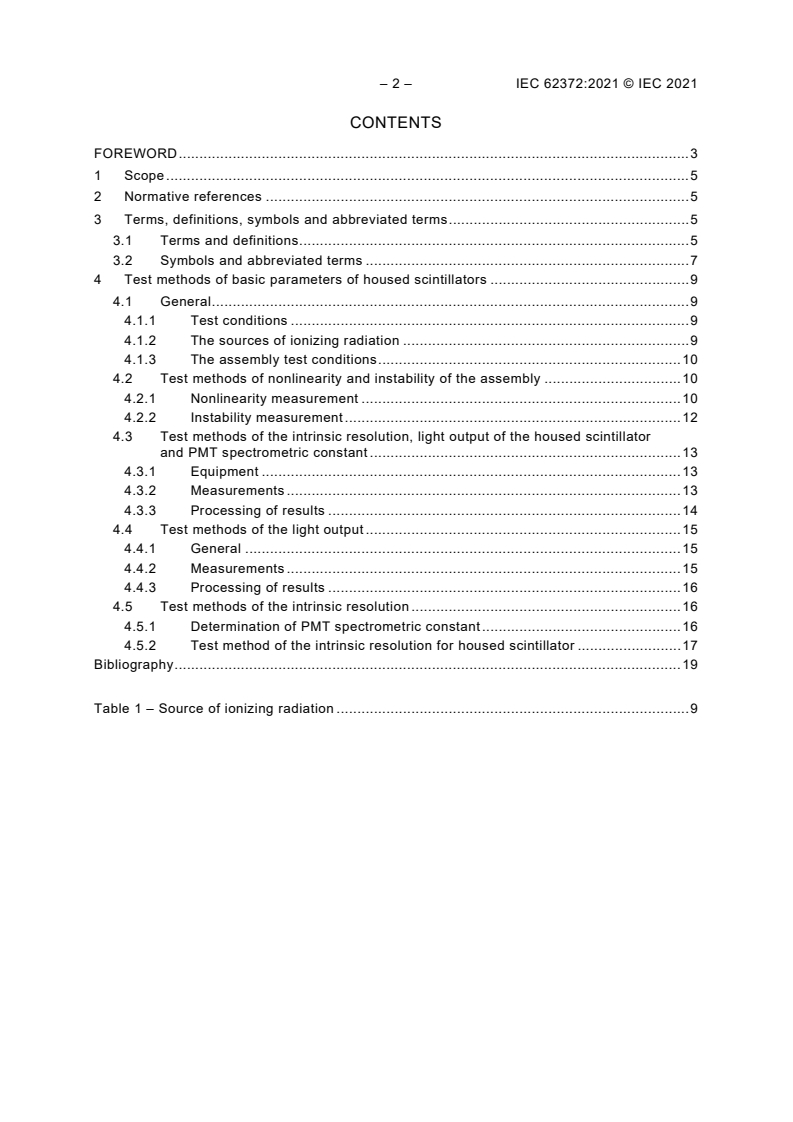
IEC 62372:2021 - Nuclear instrumentation - Housed scintillators - Test methods of light output and intrinsic resolution Released:2/3/2021
Overview - IEC 62372:2021 (Housed scintillators, light output & intrinsic resolution)
IEC 62372:2021 is an international standard for nuclear instrumentation that defines test methods and equipment requirements for housed scintillators used in registration and spectrometry of alpha-, beta-, gamma-, X‑ray and neutron radiation. This second edition (2021) cancels and replaces the 2006 edition and updates terminology, definitions and references. It applies to solid/liquid‑free housed scintillators (not gas or liquid scintillators, and not counting/current-mode detectors).
Key topics and technical requirements
- Scope of measurement: Establishes procedures to determine the basic parameters of housed scintillators - primarily light output and intrinsic resolution - under defined test conditions.
- Test methods:
- Direct method for absolute measurement of light output of scintillation materials; results can certify a housed scintillator as a working standard.
- Relative method of comparison using a working standard to measure other housed scintillators of the same scintillation material.
- Assembly and equipment: Defines requirements for the test assembly (housed scintillator, photomultiplier tube (PMT), PMT divider, shielding and optical coupling) and for radiation sources used during testing.
- Performance parameters and calculations: Covers determination of PMT spectrometric constant, full width at half maximum (FWHM) for total absorption peaks, nonlinearity, instability, and procedures for processing results and reporting expanded uncertainty and relative expanded uncertainty.
- Measurement practice: Includes guidance on measurement conditions, spectral matching, pulse‑height analysis, and extracting intrinsic resolution from detector energy resolution and PMT contributions.
Practical applications
- Calibration laboratories and manufacturers use IEC 62372:2021 to certify or compare housed scintillators intended for spectroscopy and radiation monitoring.
- Quality assurance teams use the standard to verify light output, energy resolution and stability of detector assemblies before deployment in environmental monitoring, nuclear industry, medical imaging adjuncts, emergency response, and research instrumentation.
- Metrology institutes use the direct method to produce working standards for intercomparisons and traceable measurements.
Who should use this standard
- Detector manufacturers and designers
- Calibration and testing laboratories
- Nuclear instrumentation engineers and metrologists
- Regulatory bodies and procurement specialists specifying performance criteria for scintillation detectors
Related standards and references
- Terminology referenced from IEC Electropedia and IEC 60050 series (e.g., IEC 60050-395).
- Users should consult other IEC/ISO guides on measurement uncertainty and radiological instrumentation where applicable.
Keywords: IEC 62372:2021, housed scintillators, light output, intrinsic resolution, nuclear instrumentation, test methods, photomultiplier, working standard, direct method, relative comparison.
Relations
- Effective Date
- 05-Sep-2023
Buy Documents
IEC 62372:2021 - Nuclear instrumentation - Housed scintillators - Test methods of light output and intrinsic resolution Released:2/3/2021
IEC 62372:2021 - Nuclear instrumentation - Housed scintillators - Test methods of light output and intrinsic resolution Released:2/3/2021
Get Certified
Connect with accredited certification bodies for this standard

DNV
DNV is an independent assurance and risk management provider.

Lloyd's Register
Lloyd's Register is a global professional services organisation specialising in engineering and technology.
DNV Energy Systems
Energy and renewable energy certification.
Sponsored listings
Frequently Asked Questions
IEC 62372:2021 is a standard published by the International Electrotechnical Commission (IEC). Its full title is "Nuclear instrumentation - Housed scintillators - Test methods of light output and intrinsic resolution". This standard covers: IEC 62372:2021 is applicable to housed scintillators for registration and spectrometry of alpha-, beta-, gamma-, X-ray and neutron radiation. This document specifies the requirements for the testing equipment and test methods of the basic parameters, of housed scintillators, such as: - the direct method is applicable to measure the light output of housed scintillators based on scintillation material. The housed scintillators certified by this method can be used as working standard of housed scintillators (hereinafter: working standard) when performing measurements by a relative method of comparison. - the relative method of comparison with the working standard is applicable to housed scintillators based on the same scintillation material as the working standard. This second edition cancels and replaces the first edition published in 2006. This edition includes the following significant technical changes with respect to the previous edition: - Title has been modified. - To review the existing requirements and to update the terminology, definitions and normative references.
IEC 62372:2021 is applicable to housed scintillators for registration and spectrometry of alpha-, beta-, gamma-, X-ray and neutron radiation. This document specifies the requirements for the testing equipment and test methods of the basic parameters, of housed scintillators, such as: - the direct method is applicable to measure the light output of housed scintillators based on scintillation material. The housed scintillators certified by this method can be used as working standard of housed scintillators (hereinafter: working standard) when performing measurements by a relative method of comparison. - the relative method of comparison with the working standard is applicable to housed scintillators based on the same scintillation material as the working standard. This second edition cancels and replaces the first edition published in 2006. This edition includes the following significant technical changes with respect to the previous edition: - Title has been modified. - To review the existing requirements and to update the terminology, definitions and normative references.
IEC 62372:2021 is classified under the following ICS (International Classification for Standards) categories: 27.120.01 - Nuclear energy in general. The ICS classification helps identify the subject area and facilitates finding related standards.
IEC 62372:2021 has the following relationships with other standards: It is inter standard links to IEC 62372:2006. Understanding these relationships helps ensure you are using the most current and applicable version of the standard.
IEC 62372:2021 is available in PDF format for immediate download after purchase. The document can be added to your cart and obtained through the secure checkout process. Digital delivery ensures instant access to the complete standard document.
Standards Content (Sample)
IEC 62372 ®
Edition 2.0 2021-02
INTERNATIONAL
STANDARD
Nuclear instrumentation – Housed scintillators – Test methods of light output
and intrinsic resolution
All rights reserved. Unless otherwise specified, no part of this publication may be reproduced or utilized in any form
or by any means, electronic or mechanical, including photocopying and microfilm, without permission in writing from
either IEC or IEC's member National Committee in the country of the requester. If you have any questions about IEC
copyright or have an enquiry about obtaining additional rights to this publication, please contact the address below or
your local IEC member National Committee for further information.
IEC Central Office Tel.: +41 22 919 02 11
3, rue de Varembé info@iec.ch
CH-1211 Geneva 20 www.iec.ch
Switzerland
About the IEC
The International Electrotechnical Commission (IEC) is the leading global organization that prepares and publishes
International Standards for all electrical, electronic and related technologies.
About IEC publications
The technical content of IEC publications is kept under constant review by the IEC. Please make sure that you have the
latest edition, a corrigendum or an amendment might have been published.
IEC publications search - webstore.iec.ch/advsearchform IEC online collection - oc.iec.ch
The advanced search enables to find IEC publications by a Discover our powerful search engine and read freely all the
variety of criteria (reference number, text, technical publications previews. With a subscription you will always
committee, …). It also gives information on projects, replaced have access to up to date content tailored to your needs.
and withdrawn publications.
Electropedia - www.electropedia.org
IEC Just Published - webstore.iec.ch/justpublished
The world's leading online dictionary on electrotechnology,
Stay up to date on all new IEC publications. Just Published
containing more than 22 000 terminological entries in English
details all new publications released. Available online and
and French, with equivalent terms in 18 additional languages.
once a month by email.
Also known as the International Electrotechnical Vocabulary
(IEV) online.
IEC Customer Service Centre - webstore.iec.ch/csc
If you wish to give us your feedback on this publication or
need further assistance, please contact the Customer Service
Centre: sales@iec.ch.
IEC 62372 ®
Edition 2.0 2021-02
INTERNATIONAL
STANDARD
Nuclear instrumentation – Housed scintillators – Test methods of light output
and intrinsic resolution
INTERNATIONAL
ELECTROTECHNICAL
COMMISSION
ICS 27.120.01 ISBN 978-2-8322-9322-5
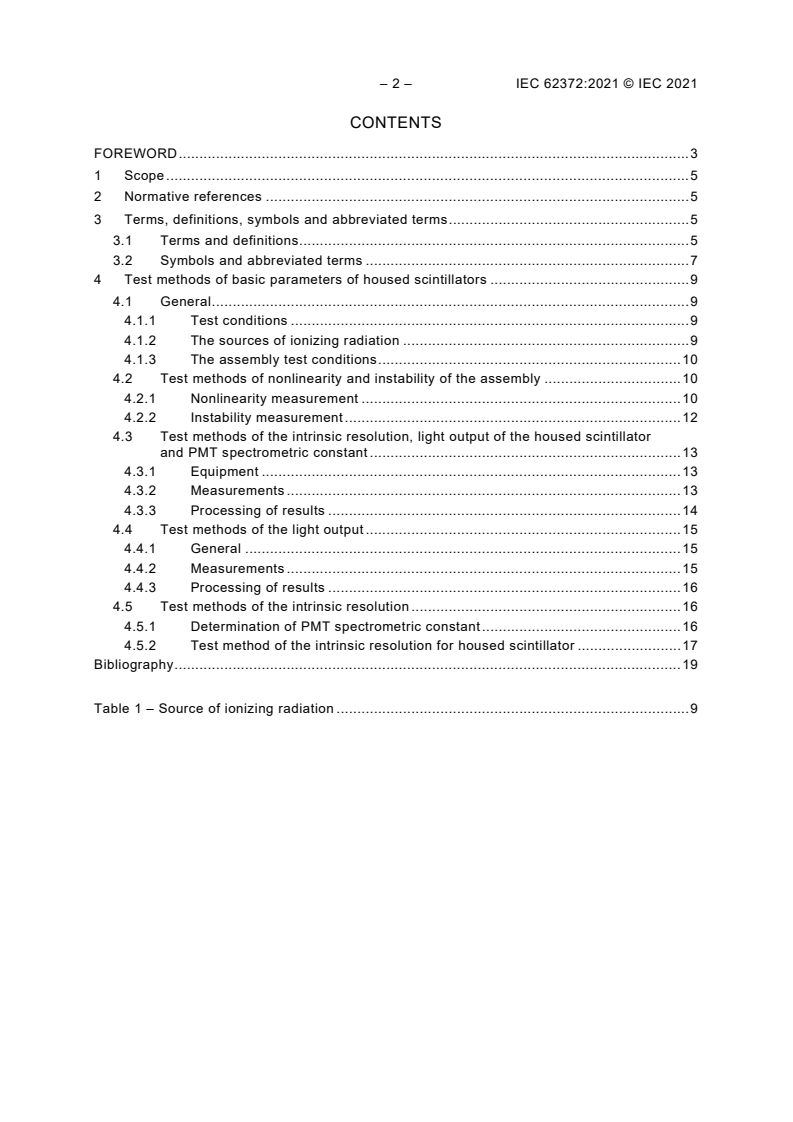
– 2 – IEC 62372:2021 © IEC 2021
CONTENTS
FOREWORD . 3
1 Scope . 5
2 Normative references . 5
3 Terms, definitions, symbols and abbreviated terms . 5
3.1 Terms and definitions . 5
3.2 Symbols and abbreviated terms . 7
4 Test methods of basic parameters of housed scintillators . 9
4.1 General . 9
4.1.1 Test conditions . 9
4.1.2 The sources of ionizing radiation . 9
4.1.3 The assembly test conditions . 10
4.2 Test methods of nonlinearity and instability of the assembly . 10
4.2.1 Nonlinearity measurement . 10
4.2.2 Instability measurement . 12
4.3 Test methods of the intrinsic resolution, light output of the housed scintillator
and PMT spectrometric constant . 13
4.3.1 Equipment . 13
4.3.2 Measurements . 13
4.3.3 Processing of results . 14
4.4 Test methods of the light output . 15
4.4.1 General . 15
4.4.2 Measurements . 15
4.4.3 Processing of results . 16
4.5 Test methods of the intrinsic resolution . 16
4.5.1 Determination of PMT spectrometric constant . 16
4.5.2 Test method of the intrinsic resolution for housed scintillator . 17
Bibliography . 19
Table 1 – Source of ionizing radiation . 9
INTERNATIONAL ELECTROTECHNICAL COMMISSION
____________
NUCLEAR INSTRUMENTATION – HOUSED SCINTILLATORS –
TEST METHODS OF LIGHT OUTPUT AND INTRINSIC RESOLUTION
FOREWORD
1) The International Electrotechnical Commission (IEC) is a worldwide organization for standardization comprising
all national electrotechnical committees (IEC National Committees). The object of IEC is to promote
international co-operation on all questions concerning standardization in the electrical and electronic fields. To
this end and in addition to other activities, IEC publishes International Standards, Technical Specifications,
Technical Reports, Publicly Available Specifications (PAS) and Guides (hereafter referred to as “IEC
Publication(s)”). Their preparation is entrusted to technical committees; any IEC National Committee interested
in the subject dealt with may participate in this preparatory work. International, governmental and non-
governmental organizations liaising with the IEC also participate in this preparation. IEC collaborates closely
with the International Organization for Standardization (ISO) in accordance with conditions determined by
agreement between the two organizations.
2) The formal decisions or agreements of IEC on technical matters express, as nearly as possible, an international
consensus of opinion on the relevant subjects since each technical committee has representation from all
interested IEC National Committees.
3) IEC Publications have the form of recommendations for international use and are accepted by IEC National
Committees in that sense. While all reasonable efforts are made to ensure that the technical content of IEC
Publications is accurate, IEC cannot be held responsible for the way in which they are used or for any
misinterpretation by any end user.
4) In order to promote international uniformity, IEC National Committees undertake to apply IEC Publications
transparently to the maximum extent possible in their national and regional publications. Any divergence
between any IEC Publication and the corresponding national or regional publication shall be clearly indicated in
the latter.
5) IEC itself does not provide any attestation of conformity. Independent certification bodies provide conformity
assessment services and, in some areas, access to IEC marks of conformity. IEC is not responsible for any
services carried out by independent certification bodies.
6) All users should ensure that they have the latest edition of this publication.
7) No liability shall attach to IEC or its directors, employees, servants or agents including individual experts and
members of its technical committees and IEC National Committees for any personal injury, property damage or
other damage of any nature whatsoever, whether direct or indirect, or for costs (including legal fees) and
expenses arising out of the publication, use of, or reliance upon, this IEC Publication or any other IEC
Publications.
8) Attention is drawn to the Normative references cited in this publication. Use of the referenced publications is
indispensable for the correct application of this publication.
9) Attention is drawn to the possibility that some of the elements of this IEC Publication may be the subject of
patent rights. IEC shall not be held responsible for identifying any or all such patent rights.
International Standard IEC 62372 has been prepared by IEC technical committee 45: Nuclear
instrumentation.
This second edition cancels and replaces the first edition published in 2006. This edition
constitutes a technical revision.
This edition includes the following significant technical changes with respect to the previous
edition:
• Title has been modified.
• To review the existing requirements and to update the terminology, definitions and
normative references.
– 4 – IEC 62372:2021 © IEC 2021
The text of this International Standard is based on the following documents:
FDIS Report on voting
45/913/FDIS 45/915/RVD
Full information on the voting for the approval of this International Standard can be found in
the report on voting indicated in the above table.
This document has been drafted in accordance with the ISO/IEC Directives, Part 2.
The committee has decided that the contents of this document will remain unchanged until the
stability date indicated on the IEC website under "http://webstore.iec.ch" in the data related to
the specific document. At this date, the document will be
• reconfirmed,
• withdrawn,
• replaced by a revised edition, or
• amended.
NUCLEAR INSTRUMENTATION – HOUSED SCINTILLATORS –
TEST METHODS OF LIGHT OUTPUT AND INTRINSIC RESOLUTION
1 Scope
This document is applicable to housed scintillators for registration and spectrometry of alpha-,
beta-, gamma-, X-ray and neutron radiation.
The main parameters, such as a light output and intrinsic resolution are established. This
document specifies the requirements for the testing equipment and test methods of the basic
parameters of housed scintillators, such as:
• the direct method is applicable to measure the light output of housed scintillators based on
scintillation material. The housed scintillators certified by this method can be used as
working standard of housed scintillators (hereinafter: working standard) when performing
measurements by a relative method of comparison.
• the relative method of comparison with the working standard is applicable to housed
scintillators based on the same scintillation material as the working standard.
This document does not apply to gas or liquid scintillators and scintillators for counting and
current modes.
The numerical values of the parameters are set to the specific type of scintillators in the
specifications.
2 Normative references
There are no normative references in this document.
3 Terms, definitions, symbols and abbreviated terms
3.1 Terms and definitions
For the purposes of this document, the following terms and definitions apply.
ISO and IEC maintain terminological databases for use in standardization at the following
addresses:
• IEC Electropedia: available at http://www.electropedia.org/
• ISO Online browsing platform: available at http://www.iso.org/obp
3.1.1
scintillator
luminescent material, usually liquid or solid, showing radioluminescence with a short afterglow
[SOURCE: IEC 60050-845:1987, 845-04-37]
3.1.2
housed scintillator
scintillator, housed in a container with a reflector and optical window
– 6 – IEC 62372:2021 © IEC 2021
3.1.3
scintillation detector
radiation detector consisting of a scintillator that is usually optically coupled to a
photosensitive device, directly or through light guides
Note 1 to entry: The scintillator consists of a scintillating material in which the ionizing particle produces a burst
of luminescence radiation along its path. A common scintillator is NaI(Tl).
[SOURCE: IEC 60050-395:2014, 395-03-01]
3.1.4
assembly
light protective chamber containing a housed scintillator, photomultiplier (PMT), PMT voltage
divider
Note 1 to entry: Assembly is used for testing of the housed scintillator.
3.1.5
light yield
η
ratio of scintillation photons summed energy (E ) to energy (E) lost by ionizing particles in the
p
scintillator
E
p
η=
E
Note 1 to entry: Value of η depends on type and energy of ionizing particle.
3.1.6
light output
C
ratio of total energy (L ) of scintillation photons, which pass through the output window of the
ph
housed scintillator of ionizing radiation, to energy (E), lost by ionizing particles in the
scintillator
L
ph
C=
E
3.1.7
intrinsic resolution of housed scintillator of ionizing radiation
R
d
component, given by housed scintillator of ionizing radiation to energy resolution of the
scintillation detector
Note 1 to entry: The intrinsic resolution R is defined from the relation:
d
2 2
R = R − R ,
d a pm
where
R is the energy resolution of the scintillation detector;
a
R is PMT intrinsic resolution.
pm
3.1.8
total absorption peak
portion of the spectral response curve corresponding to the total absorption of photon energy
in a radiation detector
Note 1 to entry: This peak represents the total absorption of photon energy from all interactive processes,
namely, a) photoelectric absorption, b) Compton effect, and c) pair production.
[SOURCE: IEC 60050-395:2014, 395-03-94]
3.1.9
photomultiplier tube spectrometric constant
A
parameter, characterizing properties of the photomultiplier tube
Note 1 to entry: Defined by the following formula:
2 2
A= (R − R )× C
a d ph
where C is light output, photons/MeV.
ph
3.1.10
working standard
working standard of housed scintillator that is used to check the measuring system and to
measure the light output by a method of comparison
3.1.11
full width at half maximum
FWHM
in a distribution curve comprising a single peak, the distance between the abscissa of two
points on the curve whose ordinates are half of the maximum ordinate of the peak
Note 1 to entry: If the curve considered comprises several peaks, a full width at half maximum exists for each
peak.
3.1.12
expanded uncertainty
expanded uncertainty quantity defining an interval about the result of a measurement that may
be expected to encompass a large fraction of the distribution of values that could reasonably
be attributed to the measurand
Note 1 to entry: The fraction may be viewed as the coverage probability or level of confidence of the interval.
Note 2 to entry: To associate a specific level of confidence with the interval defined by the expanded uncertainty
requires explicit or implicit assumptions regarding the probability distribution characterized by the measurement
result and its combined standard uncertainty. The level of confidence that may be attributed to this interval can be
known only to the extent to which such assumptions may be justified.
[SOURCE: JCGM 100:2008, 2.35]
3.1.13
relative expanded uncertainty
ratio of the expanded uncertainty of a measurement to average value of quantity. It expresses
the relative size of the uncertainty of a measurement (its precision)
3.2 Symbols and abbreviated terms
A the photomultiplier tube spectrometric constant;
a the assembly conversion factor with the housed scintillator;
a the value of conversion response, measured at energy value of E ;
i i
a the maximal value of a;
max
a the minimal value of a;
min
∆a the value of nonlinearity;
C the light output, in relative units;
– 8 – IEC 62372:2021 © IEC 2021
C the light output, photons/MeV;
ph
C the light output of the working standard, photons/MeV;
pho
FWHM the full width at half maximum of peak;
E energy lost by ionizing particle in the scintillator;
E the maximum gamma radiation energy;
max
E summed energy of scintillation photons, which have arisen in scintillator;
p
eps the initial point of housed scintillator conversion response, in energy units;
k the coverage factor;
k the assembly conversion factor;
a
L total energy of scintillation photons;
ph
m coefficient of spectral matching;
n the number of energy values used;
N the average value of conversion factor;
PMT a photomultiplier tube;
Q the PMT photocathode quantum sensitivity;
S(λ) the PMT photocathode spectral characteristic;
R the energy resolution of the scintillation detector;
a
R the energy resolution of scintillation detector with working standard;
ao
R the intrinsic resolution of the measured housed scintillator;
d
R the intrinsic resolution of the working standard;
et
R the PMT intrinsic resolution;
pm
U the expanded uncertainty;
p
u the combined standard uncertainty;
c
V the value of pulse height corresponding to total absorption peak maximum of the
measured housed scintillator;
V the initial point of housed scintillator conversion response;
d
V the value of pulse height corresponding to total absorption peak maximum of the
et
working standard;
V the value of pulse height corresponding to total absorption peak maximum for single
i
measurement;
V pulse height at the input of the assembly, the number of channels;
in
V the value of pulse height which corresponds to E , the number of channels;
max max
V the initial point of assembly conversion response;
o
V the initial point of assembly conversion response with the housed scintillator;
od
V pulse height at the output of the assembly, the number of channels;
out
∆V the value of FWHM;
y the average value of the controlled parameter at the beginning of the measurement;
y the average value of controlled parameter at the end of the measurement;
λ) the scintillator spectral characteristic;
y(
∆y the instability value;
η light yield.
4 Test methods of basic parameters of housed scintillators
4.1 General
4.1.1 Test conditions
Measurements shall be made under normal conditions, unless otherwise specified in the
specifications of the manufacturer of housed scintillators.
Measurements should start at least 0,5 h after the last device has been switched on, unless
otherwise specified by the manufacture
...
IEC 62372 ®
Edition 2.0 2021-02
INTERNATIONAL
STANDARD
NORME
INTERNATIONALE
Nuclear instrumentation – Housed scintillators – Test methods of light output
and intrinsic resolution
Instrumentation nucléaire – Scintillateurs montés – Méthodes d'essai de lumière
sortante et de résolution intrinsèque
All rights reserved. Unless otherwise specified, no part of this publication may be reproduced or utilized in any form
or by any means, electronic or mechanical, including photocopying and microfilm, without permission in writing from
either IEC or IEC's member National Committee in the country of the requester. If you have any questions about IEC
copyright or have an enquiry about obtaining additional rights to this publication, please contact the address below or
your local IEC member National Committee for further information.
Droits de reproduction réservés. Sauf indication contraire, aucune partie de cette publication ne peut être reproduite ni
utilisée sous quelque forme que ce soit et par aucun procédé, électronique ou mécanique, y compris la photocopie et
les microfilms, sans l'accord écrit de l'IEC ou du Comité national de l'IEC du pays du demandeur. Si vous avez des
questions sur le copyright de l'IEC ou si vous désirez obtenir des droits supplémentaires sur cette publication, utilisez
les coordonnées ci-après ou contactez le Comité national de l'IEC de votre pays de résidence.
IEC Secretariat Tel.: +41 22 919 02 11
3, rue de Varembé info@iec.ch
CH-1211 Geneva 20 www.iec.ch
Switzerland
About the IEC
The International Electrotechnical Commission (IEC) is the leading global organization that prepares and publishes
International Standards for all electrical, electronic and related technologies.
About IEC publications
The technical content of IEC publications is kept under constant review by the IEC. Please make sure that you have the
latest edition, a corrigendum or an amendment might have been published.
IEC publications search - webstore.iec.ch/advsearchform IEC Products & Services Portal - products.iec.ch
The advanced search enables to find IEC publications by a Discover our powerful search engine and read freely all the
variety of criteria (reference number, text, technical publications previews. With a subscription you will always have
committee, …). It also gives information on projects, replaced access to up to date content tailored to your needs.
and withdrawn publications.
Electropedia - www.electropedia.org
IEC Just Published - webstore.iec.ch/justpublished
The world's leading online dictionary on electrotechnology,
Stay up to date on all new IEC publications. Just Published
containing more than 22 300 terminological entries in English
details all new publications released. Available online and once
and French, with equivalent terms in 19 additional languages.
a month by email.
Also known as the International Electrotechnical Vocabulary
(IEV) online.
IEC Customer Service Centre - webstore.iec.ch/csc
If you wish to give us your feedback on this publication or need
further assistance, please contact the Customer Service
Centre: sales@iec.ch.
A propos de l'IEC
La Commission Electrotechnique Internationale (IEC) est la première organisation mondiale qui élabore et publie des
Normes internationales pour tout ce qui a trait à l'électricité, à l'électronique et aux technologies apparentées.
A propos des publications IEC
Le contenu technique des publications IEC est constamment revu. Veuillez vous assurer que vous possédez l’édition la
plus récente, un corrigendum ou amendement peut avoir été publié.
Recherche de publications IEC - IEC Products & Services Portal - products.iec.ch
webstore.iec.ch/advsearchform Découvrez notre puissant moteur de recherche et consultez
La recherche avancée permet de trouver des publications IEC gratuitement tous les aperçus des publications. Avec un
en utilisant différents critères (numéro de référence, texte, abonnement, vous aurez toujours accès à un contenu à jour
comité d’études, …). Elle donne aussi des informations sur les adapté à vos besoins.
projets et les publications remplacées ou retirées.
Electropedia - www.electropedia.org
IEC Just Published - webstore.iec.ch/justpublished
Le premier dictionnaire d'électrotechnologie en ligne au monde,
Restez informé sur les nouvelles publications IEC. Just
avec plus de 22 300 articles terminologiques en anglais et en
Published détaille les nouvelles publications parues.
français, ainsi que les termes équivalents dans 19 langues
Disponible en ligne et une fois par mois par email.
additionnelles. Egalement appelé Vocabulaire
Electrotechnique International (IEV) en ligne.
Service Clients - webstore.iec.ch/csc
Si vous désirez nous donner des commentaires sur cette
publication ou si vous avez des questions contactez-nous:
sales@iec.ch.
IEC 62372 ®
Edition 2.0 2021-02
INTERNATIONAL
STANDARD
NORME
INTERNATIONALE
Nuclear instrumentation – Housed scintillators – Test methods of light output
and intrinsic resolution
Instrumentation nucléaire – Scintillateurs montés – Méthodes d'essai de lumière
sortante et de résolution intrinsèque
INTERNATIONAL
ELECTROTECHNICAL
COMMISSION
COMMISSION
ELECTROTECHNIQUE
INTERNATIONALE
ICS 27.120.01 ISBN 978-2-8322-7267-1
– 2 – IEC 62372:2021 © IEC 2021
CONTENTS
FOREWORD . 3
1 Scope . 5
2 Normative references . 5
3 Terms, definitions, symbols and abbreviated terms . 5
3.1 Terms and definitions . 5
3.2 Symbols and abbreviated terms . 7
4 Test methods of basic parameters of housed scintillators . 9
4.1 General . 9
4.1.1 Test conditions . 9
4.1.2 The sources of ionizing radiation . 9
4.1.3 The assembly test conditions . 10
4.2 Test methods of nonlinearity and instability of the assembly . 10
4.2.1 Nonlinearity measurement . 10
4.2.2 Instability measurement . 12
4.3 Test methods of the intrinsic resolution, light output of the housed scintillator
and PMT spectrometric constant . 13
4.3.1 Equipment . 13
4.3.2 Measurements . 13
4.3.3 Processing of results . 14
4.4 Test methods of the light output . 15
4.4.1 General . 15
4.4.2 Measurements . 15
4.4.3 Processing of results . 16
4.5 Test methods of the intrinsic resolution . 16
4.5.1 Determination of PMT spectrometric constant . 16
4.5.2 Test method of the intrinsic resolution for housed scintillator . 17
Bibliography . 19
Table 1 – Source of ionizing radiation . 9
INTERNATIONAL ELECTROTECHNICAL COMMISSION
____________
NUCLEAR INSTRUMENTATION – HOUSED SCINTILLATORS –
TEST METHODS OF LIGHT OUTPUT AND INTRINSIC RESOLUTION
FOREWORD
1) The International Electrotechnical Commission (IEC) is a worldwide organization for standardization comprising
all national electrotechnical committees (IEC National Committees). The object of IEC is to promote
international co-operation on all questions concerning standardization in the electrical and electronic fields. To
this end and in addition to other activities, IEC publishes International Standards, Technical Specifications,
Technical Reports, Publicly Available Specifications (PAS) and Guides (hereafter referred to as “IEC
Publication(s)”). Their preparation is entrusted to technical committees; any IEC National Committee interested
in the subject dealt with may participate in this preparatory work. International, governmental and non-
governmental organizations liaising with the IEC also participate in this preparation. IEC collaborates closely
with the International Organization for Standardization (ISO) in accordance with conditions determined by
agreement between the two organizations.
2) The formal decisions or agreements of IEC on technical matters express, as nearly as possible, an international
consensus of opinion on the relevant subjects since each technical committee has representation from all
interested IEC National Committees.
3) IEC Publications have the form of recommendations for international use and are accepted by IEC National
Committees in that sense. While all reasonable efforts are made to ensure that the technical content of IEC
Publications is accurate, IEC cannot be held responsible for the way in which they are used or for any
misinterpretation by any end user.
4) In order to promote international uniformity, IEC National Committees undertake to apply IEC Publications
transparently to the maximum extent possible in their national and regional publications. Any divergence
between any IEC Publication and the corresponding national or regional publication shall be clearly indicated in
the latter.
5) IEC itself does not provide any attestation of conformity. Independent certification bodies provide conformity
assessment services and, in some areas, access to IEC marks of conformity. IEC is not responsible for any
services carried out by independent certification bodies.
6) All users should ensure that they have the latest edition of this publication.
7) No liability shall attach to IEC or its directors, employees, servants or agents including individual experts and
members of its technical committees and IEC National Committees for any personal injury, property damage or
other damage of any nature whatsoever, whether direct or indirect, or for costs (including legal fees) and
expenses arising out of the publication, use of, or reliance upon, this IEC Publication or any other IEC
Publications.
8) Attention is drawn to the Normative references cited in this publication. Use of the referenced publications is
indispensable for the correct application of this publication.
9) Attention is drawn to the possibility that some of the elements of this IEC Publication may be the subject of
patent rights. IEC shall not be held responsible for identifying any or all such patent rights.
International Standard IEC 62372 has been prepared by IEC technical committee 45: Nuclear
instrumentation.
This second edition cancels and replaces the first edition published in 2006. This edition
constitutes a technical revision.
This edition includes the following significant technical changes with respect to the previous
edition:
• Title has been modified.
• To review the existing requirements and to update the terminology, definitions and
normative references.
– 4 – IEC 62372:2021 © IEC 2021
The text of this International Standard is based on the following documents:
FDIS Report on voting
45/913/FDIS 45/915/RVD
Full information on the voting for the approval of this International Standard can be found in
the report on voting indicated in the above table.
This document has been drafted in accordance with the ISO/IEC Directives, Part 2.
The committee has decided that the contents of this document will remain unchanged until the
stability date indicated on the IEC website under "http://webstore.iec.ch" in the data related to
the specific document. At this date, the document will be
• reconfirmed,
• withdrawn,
• replaced by a revised edition, or
• amended.
NUCLEAR INSTRUMENTATION – HOUSED SCINTILLATORS –
TEST METHODS OF LIGHT OUTPUT AND INTRINSIC RESOLUTION
1 Scope
This document is applicable to housed scintillators for registration and spectrometry of alpha-,
beta-, gamma-, X-ray and neutron radiation.
The main parameters, such as a light output and intrinsic resolution are established. This
document specifies the requirements for the testing equipment and test methods of the basic
parameters of housed scintillators, such as:
• the direct method is applicable to measure the light output of housed scintillators based on
scintillation material. The housed scintillators certified by this method can be used as
working standard of housed scintillators (hereinafter: working standard) when performing
measurements by a relative method of comparison.
• the relative method of comparison with the working standard is applicable to housed
scintillators based on the same scintillation material as the working standard.
This document does not apply to gas or liquid scintillators and scintillators for counting and
current modes.
The numerical values of the parameters are set to the specific type of scintillators in the
specifications.
2 Normative references
There are no normative references in this document.
3 Terms, definitions, symbols and abbreviated terms
3.1 Terms and definitions
For the purposes of this document, the following terms and definitions apply.
ISO and IEC maintain terminological databases for use in standardization at the following
addresses:
• IEC Electropedia: available at http://www.electropedia.org/
• ISO Online browsing platform: available at http://www.iso.org/obp
3.1.1
scintillator
luminescent material, usually liquid or solid, showing radioluminescence with a short afterglow
[SOURCE: IEC 60050-845:1987, 845-04-37]
3.1.2
housed scintillator
scintillator, housed in a container with a reflector and optical window
– 6 – IEC 62372:2021 © IEC 2021
3.1.3
scintillation detector
radiation detector consisting of a scintillator that is usually optically coupled to a
photosensitive device, directly or through light guides
Note 1 to entry: The scintillator consists of a scintillating material in which the ionizing particle produces a burst
of luminescence radiation along its path. A common scintillator is NaI(Tl).
[SOURCE: IEC 60050-395:2014, 395-03-01]
3.1.4
assembly
light protective chamber containing a housed scintillator, photomultiplier (PMT), PMT voltage
divider
Note 1 to entry: Assembly is used for testing of the housed scintillator.
3.1.5
light yield
η
ratio of scintillation photons summed energy (E ) to energy (E) lost by ionizing particles in the
p
scintillator
E
p
η=
E
Note 1 to entry: Value of η depends on type and energy of ionizing particle.
3.1.6
light output
C
ratio of total energy (L ) of scintillation photons, which pass through the output window of the
ph
housed scintillator of ionizing radiation, to energy (E), lost by ionizing particles in the
scintillator
L
ph
C=
E
3.1.7
intrinsic resolution of housed scintillator of ionizing radiation
R
d
component, given by housed scintillator of ionizing radiation to energy resolution of the
scintillation detector
Note 1 to entry: The intrinsic resolution R is defined from the relation:
d
2 2
R = R − R ,
d a pm
where
R is the energy resolution of the scintillation detector;
a
R is PMT intrinsic resolution.
pm
3.1.8
total absorption peak
portion of the spectral response curve corresponding to the total absorption of photon energy
in a radiation detector
Note 1 to entry: This peak represents the total absorption of photon energy from all interactive processes,
namely, a) photoelectric absorption, b) Compton effect, and c) pair production.
[SOURCE: IEC 60050-395:2014, 395-03-94]
3.1.9
photomultiplier tube spectrometric constant
A
parameter, characterizing properties of the photomultiplier tube
Note 1 to entry: Defined by the following formula:
2 2
A= (R − R )× C
a d ph
where C is light output, photons/MeV.
ph
3.1.10
working standard
working standard of housed scintillator that is used to check the measuring system and to
measure the light output by a method of comparison
3.1.11
full width at half maximum
FWHM
in a distribution curve comprising a single peak, the distance between the abscissa of two
points on the curve whose ordinates are half of the maximum ordinate of the peak
Note 1 to entry: If the curve considered comprises several peaks, a full width at half maximum exists for each
peak.
3.1.12
expanded uncertainty
expanded uncertainty quantity defining an interval about the result of a measurement that may
be expected to encompass a large fraction of the distribution of values that could reasonably
be attributed to the measurand
Note 1 to entry: The fraction may be viewed as the coverage probability or level of confidence of the interval.
Note 2 to entry: To associate a specific level of confidence with the interval defined by the expanded uncertainty
requires explicit or implicit assumptions regarding the probability distribution characterized by the measurement
result and its combined standard uncertainty. The level of confidence that may be attributed to this interval can be
known only to the extent to which such assumptions may be justified.
[SOURCE: JCGM 100:2008, 2.3.5]
3.1.13
relative expanded uncertainty
ratio of the expanded uncertainty of a measurement to average value of quantity. It expresses
the relative size of the uncertainty of a measurement (its precision)
3.2 Symbols and abbreviated terms
A the photomultiplier tube spectrometric constant;
a the assembly conversion factor with the housed scintillator;
a the value of conversion response, measured at energy value of E ;
i i
a the maximal value of a;
max
a the minimal value of a;
min
∆a the value of nonlinearity;
C the light output, in relative units;
– 8 – IEC 62372:2021 © IEC 2021
C the light output, photons/MeV;
ph
C the light output of the working standard, photons/MeV;
pho
FWHM the full width at half maximum of peak;
E energy lost by ionizing particle in the scintillator;
E the maximum gamma radiation energy;
max
E summed energy of scintillation photons, which have arisen in scintillator;
p
eps the initial point of housed scintillator conversion response, in energy units;
k the coverage factor;
k the assembly conversion factor;
a
L total energy of scintillation photons;
ph
m coefficient of spectral matching;
n the number of energy values used;
N the average value of conversion factor;
PMT a photomultiplier tube;
Q the PMT photocathode quantum sensitivity;
S(λ) the PMT photocathode spectral characteristic;
R the energy resolution of the scintillation detector;
a
R the energy resolution of scintillation detector with working standard;
ao
R the intrinsic resolution of the measured housed scintillator;
d
R the intrinsic resolution of the working standard;
et
R the PMT intrinsic resolution;
pm
U the expanded uncertainty;
p
u the combined standard uncertainty;
c
V the value of pulse height corresponding to total absorption peak maximum of the
measured housed scintillator;
V the initial point of housed scintillator conversion response;
d
V the value of pulse height corresponding to total absorption peak maximum of the
et
working standard;
V the value of pulse height corresponding to total absorption peak maximum for single
i
measurement;
V pulse height at the input of the assembly, the number of channels;
in
V the value of pulse height which corresponds to E , the number of channels;
max max
V the initial point of assembly conversion response;
o
V the initial point of assembly conversion response with the housed scintillator;
od
V pulse height at the output of the assembly, the number of channels;
out
∆V the value of FWHM;
y the average value of the controlled parameter at the beginning of the measurement;
y the average value of controlled parameter at the end of the measurement;
λ) the scintillator spectral characteristic;
y(
∆y the instability value;
η light yield.
4 Test methods of basic parameters of housed scintillators
4.1 General
4.1.1 Test conditions
Measurements shall be made under normal conditions, unless otherwise specified in the
specifications of the manufacturer of housed scintillators.
Measurements should start at least 0,5 h after the last device has been switched on, unless
otherwise specified by the manufacturer specifications.
Before measuring, the housed scintillator and the PMT are kept under high voltage for the
time necessary for getting to the operation condition. Before measuring, the PMT is kept
under high voltage for the time necessary for getting to the operation condition.
All parameters are measured during the complete blackout of the housed scintillator and PMT.
Optical contact between the housed scintillator and the PMT is provided by the material
specified in the manufacturer specifications of the housed scintillator.
For the measuring, the following condition of choosing PMT should be reached: the working
part of the photocathode shall overlap the output window of the scintillator.
It is allowed to apply a light guide or an assembly of several PMT, if technical characteristics
and use conditions of light guide or assembly are specified in the specifications.
The measured housed scintillator is mounted on the PMT photocathode by optical contact,
unless otherwise is specified in the manufacturer's specifications.
It is allowed to place a source of ionizing radiation inside the light protective chamber.
PMT voltage should correspond to its attached data for operation conditions.
The spectrum of pulse height should be measured to define operation conditions of the
assembly.
4.1.2 The sources of ionizing radiation
Enclosed radioactive sources of alpha-, beta-, gamma-, X- and neutron radiation with known
energies should be used. The source of radiation shall be selected depending on the
application of measured housed scintillator according to Table 1.
Table 1 – Source of ionizing radiation
The application of housed scintillator Source of radiation according to application
239 241 244 237
Alpha-radiation of radionuclides Pu, Am, Cm or Np
137 207
Beta- radiation Cs or Bi
Gamma-radiation of radionuclide Cs
55 109 241 57
Low gamma- and X-radiation Fe, Cd, Am and Co
239 241 252
Neutron radiation Pu+Be, Am+Be or Cf
For measurements with the gamma- or X-radiation sources, they should be placed along the
scintillator axis at minimum distance of not less than two diameters or a diagonal of the
scintillator.
– 10 – IEC 62372:2021 © IEC 2021
For measurements with the alpha- or beta-radiation sources, they should be placed directly on
the entrance window of the housed scintillator.
For measurements with the alpha- or beta- sources, it is allowed to use a single-hole or multi-
hole collimator with a hole diameter less than the thickness of the collimator.
4.1.3 The assembly test conditions
The current of the divider should exceed the PMT average anode current more than 10 times.
PMT power supplies shall provide high voltage stability better than 0,05 % and divider current
more than 0,5 mA.
At low-resistance inputs of subsequent stages of the measurement section the measurements
may be performed without matching stage.
For a recording device providing a pulse heights spectrum suitable for further processing
multi-channel pulse analyzers, which have an output recording device of any type that
registers and allows to give the pulse height spectrum in form convenient for processing,
should be used.
4.2 Test methods of nonlinearity and instability of the assembly
4.2.1 Nonlinearity measurement
4.2.1.1 General
(V ) at the output of the assembly on the signal (V ) at
The dependence of the pulse height
out in
the input of the assembly (assembly conversion response) is defined according to formula:
V = k ×V +V ,
out a in o
where
k is the assembly conversion factor;
a
V is the initial point of assembly conversion response.
o
If conversion response of the housed scintillator is linear, the assembly conversion response
with the housed scintillator is also linear:
V = a× E+V
out od
Then
V = V +V = V + a× eps, (1)
od o d o
where
E is energy lost by ionizing particle in the scintillator;
a is the assembly conversion factor with the housed scintillator;
V is the initial point of assembly conversion response with the housed scintillator;
od
V is the initial point of housed scintillator conversion response;
d
eps is the initial point of housed scintillator conversion response, in energy units.
Nonlinearity (∆a) is determined by the deviation of measured points from assembly conversion
response, in percentage, and calculated according to the formula:
(a − a )
max min
∆a= ×100, (2)
(a + a )
max min
where
a is maximal value of a;
max
a is minimal value of a.
min
V value is defined as the cutoff of the assembly conversion response with the housed
od
scintillator on the coordinate axis. V value should be calculated according to formula (1).
o
For each value of energy, the position of a maximum of a peak of full absorption is defined.
The values of the nonlinearity and the initial point of assembly conversion response shall be
defined using a housed scintillator based on thallium-activated sodium iodide single crystal
during irradiation by gamma-radiation.
Pulse height spectra are measured using monoenergetic gamma radiation with at least five
energy values in the range from 300 keV to 1 500 keV.
For each energy value the total absorption peak maximum position should be defined.
The light output of a housed scintillator may be used to determine the nonlinearity and the
initial point of assembly conversion response in cases where it is necessary to measure the
parameters of housed scintillators with low light output. For that, light flux from housed
scintillator is attenuated by a neutral light filter. The pulse heights obtained after attenuation
should correspond to the working range of pulse heights of the tested scintillator.
Neutral light absorbers are added after the PMT power supply is turned off and the light
protection chamber is opened. After setting the light absorber, the chamber is closed, the
PMT power supply is turned on and measurements are taken after not less than half an hour’s
irradiation.
The values of nonlinearity and V are measured at the same gain factor which is used for
o
measuring the parameters of tested housed scintillator. The nonlinearity and V should be
o
measured once per month or more frequently, after PMT replacement or assembly repair.
4.2.1.2 Measurements
The test conditions and the order of measurements are in accordance with 4.1.
The value of pulse heights (V) corresponding to total absorption peak maximum is
determined. The measurements are repeated three times and the average value V is
calculated.
All above-mentioned procedures are repeated for each value of energy (E ).
i
The pulse height spectra may be accumulated simultaneously from all the gamma-emitting
sources during irradiation of the housed scintillator.
– 12 – IEC 62372:2021 © IEC 2021
4.2.1.3 Processing of results
The values of the assembly conversion factor with the housed scintillator (a ) for each energy
i
range (E ) are calculated according to the formula:
i
(V −V )
max i
a = ,
i
(E − E )
max i
where
E is the maximum gamma radiation energy;
max
V is the pulse height, corresponding to the E , the number of channels.
max max
The minimal (a ) and maximal (a ) values from the set of values (a ) should be selected.
min max i
The assembly nonlinearity (in percentage) is calculated in accordance with formula (2).
The average value of conversion factor (N) is calculated according to the formula:
n−1
N = a ,
∑ i
n−1
i=1
where
n is the number of energy values used;
a is the value of conversion response, measured at the energy value of E .
i i
The value of the initial point of assembly conversion response with the housed scintillator (the
number of channels) is calculated according to the formula:
n n
1
V = V− N E
∑ ∑
od i i
n
i=1 i=1
The value of the initial point of assembly conversion response is calculated in accordance
with the formula:
V = V + N× eps,
o od
Expanded uncertainty of assembly nonlinearity should not exceed ±0,03 with a level of
confidence of 0,95 (k = 1,96).
Expanded uncertainty of the initial point measurement of assembly conversion response
should not exceed two channels with a level of confidence of 0,95 (k = 1,96).
4.2.2 Instability measurement
4.2.2.1 General
The instability of the assembly should be calculated by the change in time of the determined
parameter or an intermediate parameter which is used to calculate the defined parameter.
During measurement of the light output of the housed scintillators, the instability is determined
by the change of pulse height over time.
During measurement of the intrinsic resolution of the housed scintillators, the instability is
determined by the change of pulse height and energy resolution of the scintillation detector
over time.
The instability of the assembly may be determined by using a housed scintillator based on the
same scintillator material type and during irradiation by the same radiation type as for the
tested housed scintillator.
The test conditions and the order of measurements are in accordance with 4.1.
Three measurements should be carried out before the start and at the end of the
measurement.
4.2.2.2 Processing of results
The value of instability (∆y), in percentage, is calculated by the formula:
(y − y )
1 2
∆y= ×100,
(y + y )
1 2
where
y is the average value of the controlled parameter at the beginning of the measurement;
y is the average value of the controlled parameter at the end of the measurement.
The instability of the pulse height should not exceed 2 %. The instability of the energy
resolution should not exceed 3 %.
4.3 Test methods of the intrinsic resolution, light output of the housed scintillator
and PMT spectrometric constant
4.3.1 Equipment
The test conditions and the order of measurements are in accordance with 4.1.
A PMT with the known spectral characteristic S(λ) and quantum sensitivity Q is used.
The nonlinearity and the initial point of assembly conversion response is measured as
specified in 4.2.1.
The assembly is qualified for making measurements if its nonlinearity does not exceed 3 %.
The instability of the assembly is assessed as specified in 4.2.2. The assembly is qualified for
making measurements if its instability does not exceed 2 %.
4.3.2 Measurements
The tested housed scintillator is mounted on the PMT photocathode by optical contact and the
pulse height spectrum is measured as specified in 4.1.1.
The number of channels (V) corresponding to total absorption peak maximum is determined
taking into account the initial point of assembly conversion response.
– 14 – IEC 62372:2021 © IEC 2021
The value of FWHM (∆V) is determined.
The measurements are carried out, as described above, each time installing neutral light
filters of different optical density between the housed scintillator output window and PMT
photocathode and obtaining the values of V and ∆V.
4.3.3 Processing of results
The value of the energy resolution of the scintillation detector (R ) for each of n
a
measurements (n is the number of filters for different optical density, at least 5) is calculated
according to the formula:
∆V
R = (3)
a
V
Based on the results of n measurements, a characteristic curve R = f is plotted. A
a
V
straight line is fitted through the experimental points, which can be approximated by the
dependence:
A
R = R + ,
a d
V
where the value R is the value which the curve cuts off on the y-axis that corresponds to the
d
intrinsic resolution of the measured housed scintillator (R ).
d
The PMT intrinsic resolution is calculated by the formula:
2 2
R = (R − R )
pm a d
Light output, photons/MeV, is defined using the formula:
2,36
C = ,
ph
R ×Q× m× E
pm
where
Q is the PMT photocathode quantum sensitivity;
m is the coefficient of spectral matching which is calculated according to the formula:
S(λ)× y(λ)dλ
∫
m= ,
y(λ)dλ
∫
where
S(λ) is the PMT photocathode’s spectral characteristic;
y(λ) is the housed scintillator spectral characteristic.
The scintillators certified using this method can be considered a working standard of housed
scintillators when performing measurements by the relative method of comparison.
4.4 Test methods of the light output
4.4.1 General
The relative method of comparison with the working standard may be applied if the tested
housed scintillator and working standard are made of the same scintillation material.
The test conditions and the order of measurements are in accordance with 4.1.
The nonlinearity and the initial point of assembly conversion response is measured as
specified in 4.2.1.
The assembly is qualified for making measurements if its nonlinearity does not exceed 3 %.
The instability of the assembly is calculated as specified in 4.2.2. The assembly is qualified
for making measurements if its instability does not exceed 2 %.
The difference between the diameters of the working standard and tested housed scintillators
should not exceed 25 %. Also, the sensitivity non-uniformity of PMT photocathode for the
larger housed scintillator should not exceed 20 %.
NOTE Sensitivity non-uniformity of PMT photocathode is measured using the housed scintillator with 10 mm
diameter as the light source.
The working standard is calibrated according to 4.3.
The working standard and tested housed scintillator are irradiated by ionizing radiation of the
same type and energy.
The type of ionizing radiation source is selected according to 4.1.2 or as specified in the
manufacturer’s specifications.
4.4.2 Measurements
At first the working standard is tested.
The order of measurements is in accordance with 4.1.
The PMT operative voltage and the gain of data processing unit are selected in such a way
that the maximum of distribution curve for the used source should be within the last quarter of
the pulse analyzer scale.
The value of pulse height (V ) corresponding to total absorption peak maximum is obtained.
et
NOTE For organic scintillators the pulse height corresponding to Compton absorption edge at half-height of the
distribution edge is determined.
The measurements are carried out three times and the average value V is calculated for the
et
working standard.
All above-mentioned procedures are repeated for the tested housed scintillator and the
average value of pulse height V corresponding to total absorption peak maximum or Compton
distribution edge is calculated.
– 16 – IEC 62372:2021 © IEC 2021
4.4.3 Processing of results
For the tested housed scintillator, the value of light output (C ), photons/MeV, is calculated
ph
by the formula:
C × (V −V )
pho a o
C = ,
ph
(V −V )
et o
where C is the value of the light output of the working standard (photons/MeV).
pho
∆C
ph
Relative expanded uncertainty ( ) of light output measurement, in percentage, at level of
C
ph
confidence of 0,95 should not exceed the value calculated by the following formula:
∆C ∆C
ph pho
= 1,1× + 4,
C C
ph pho
∆C
pho
where is the relative expanded uncertainty, in percentage, for light output measurement
C
pho
of the working standard.
Relative expanded uncertainty, in percentage, for light output measurement with a level of
confidence of 0,95 should not exceed ± 2 % (k = 1,96).
4.5 Test methods of the intrinsic resolution
4.5.1 Determination of PMT spectrometric constant
4.5.1.1 General
The test conditions and the order of measurements are in accordance with 4.1.
The nonlinearity and the initial point of assembly conversion response is measured as
specified in 4.2.1.
The assembly is qualified for making measurements if its nonlinearity does not exceed 3 %.
The instability of the assembly is assessed as specified in 4.2.2. The assembly is qualified for
making measurements if its instability does not exceed 2 %.
4.5.1.2 Measurements
The measurements are carried out three times according to 4.3.2.
The spectrometric constant (A) is obtained from the energy resolution of the scintillation
detector with the working standard (R ) and the intrinsic resolution of housed scintillator (R )
a0 et
according to the formula:
2 2
A= (R − R )× C (4)
aO et pho
The energy resolution of the scintillation detector with the working standard, intrinsic
resolution and light output of the working standard are determined for radiation of the same
type and energy.
4.5.1.3 Processing of results
The energy resolution (R ) value of the scintillation detector with working standard is
ao
calculated by the formula:
∆V
R =
ao
V
The average value of the three measurement results is obtained. The value of PMT
spectrometric constant is calculated according to formula (4).
The values of intrinsic resolution and light output of working standard are used for
calculations.
Relative expanded uncertainty, in percentage, of spectrometric constant with a level of
confidence of 0,95 should not exceed ±10 % (k = 1,96).
4.5.2 Test method of the intrinsic resolution for housed scintillator
4.5.2.1 General
The test conditions and the order of measurements are in accordance with 4.1.
The nonlinearity and the initial point of assembly conversion response is measured as
specified in 4.2.1.
The assembly is qualified for making measurements if its nonlinearity does not exceed 3 %.
The instability of the assembly is assessed as specified in 4.2.2. The assembly is qualified for
making measurements if its instability does not exceed 2 %.
Sources should be selected according to 4.1.2.
4.5.2.2 Measurements
The light output (C ) of tested housed scintillator shall be measured in accordance with 4.4.
ph
The PMT spectrometric constant (A) shall be measured according to 4.5.1.
For measurement of energy resolution of the scintillation detector (R ), the tested housed
a
scintillator is placed on the PMT photocathode by optical coupling, the pulse height spectrum
measurements are carried three times according to 4.3.2.
The energy resolution of the scintillation detector and the housed scintillator light output are
measured for radiation of the same type and energy as for the housed scintillator intrinsic
resolution.
– 18 – IEC 62372:2021 © IEC 2021
4.5.2.3 Processing of results
The energy resolution of the scintillation detector (R ) is calculated according to formula (3).
a
The energy resolution of the scintillation detector is estimated as the average value of three
measurements.
The housed scintillator intrinsic resolution (R ) is calculated in accordance with the following
d
formula:
A
R = R −
d a
C
ph
Relative expanded uncertainty, in percentage, of the housed scintillator intrinsic resolution with
a level of confidence of 0,95 should not exceed ±10 % (k = 1,96).
Bibliography
IEC 60050-395:2014, International Electrotechnical Vocabulary (IEV) – Part 395: Nuclear
instrumentation – Physical phenomena, basic concepts, instruments, systems, equipment and
detectors
IEC 60050-845:1987, International Electrotechnical Vocabulary (IEV) – Part 845: Lighting
IEC 60050-845:1987/AMD1:2016
IEC 60050-845:1987/AMD2:2019
IEC 60050-845:1987/AMD3:2020
JCGM 100:2008, Evaluation of measurement data – Guide to the expression of uncertainty in
measurement
____________
– 20 – IEC 62372:2021 © IEC 2021
SOMMAIRE
AVANT-PROPOS . 21
1 Domaine d'application . 23
2 Références normatives . 23
3 Termes, définitions, symboles et abréviations . 23
3.1 Termes et définitions . 23
3.2 Symboles et abréviations . 25
4 Méthodes de détermination des paramètres de base des scintillateurs montés . 27
4.1 Généralités . 27
4.1.1 Conditions d'essai . 27
4.1.2 Sources de rayonnement ionisant . 27
4.1.3 Conditions d'essai de l'assemblage . 28
4.2 Méthodes d'essai de non-linéarité et d'instabilité de l'assemblage . 28
4.2.1 Mesurage de la non-linéarité . 28
4.2.2 Mesurage de l'instabilité . 31
4.3 Méthodes d'essai de la résolution intrinsèque, de la lumière sortante du
scintill
...