


IEC 62495:2011
(Main)Nuclear instrumentation - Portable X-ray fluorescence analysis equipment utilizing a miniature X-ray tube
Nuclear instrumentation - Portable X-ray fluorescence analysis equipment utilizing a miniature X-ray tube
IEC 62495:2011(E) is applicable to the radiological safety of portable handheld X-ray fluorescence (XRF) analysis equipment utilizing a miniature X-ray tube as the source of ionizing radiation for industrial applications. Establishes performance specifications for general radiation, electrical, safety and environmental characteristics of the design and operation, and test methods in relation to radiological safety for portable XRF analysis equipment utilizing a miniature X-ray tube. The proposed performance specifications are aimed at minimizing and avoiding the health risk associated with the use of these devices.
General Information
- Status
- Published
- Publication Date
- 06-Apr-2011
- Technical Committee
- TC 45 - Nuclear instrumentation
- Current Stage
- PPUB - Publication issued
- Start Date
- 07-Apr-2011
- Completion Date
- 30-Apr-2011
Overview
IEC 62495:2011 sets out critical requirements for the radiological safety of portable handheld X-ray fluorescence (XRF) analysis equipment using a miniature X-ray tube. Published by the International Electrotechnical Commission (IEC), this standard is specifically intended for industrial use and targets devices that leverage a small X-ray tube as the source of ionizing radiation. By establishing performance specifications related to radiation, electrical, safety, and environmental aspects of design and operation, IEC 62495:2011 aims to minimize health risks to operators and the public when these devices are in use.
Key Topics
Scope and Applicability
- Covers portable handheld XRF analysis systems employing a miniature X-ray tube for industrial, not medical or veterinary, purposes.
- Excludes devices using radioactive sources or those found in fixed installations.
System Classification
- Defines two categories: closed beam and open beam portable XRF systems, each with different safety and shielding requirements.
Safety Requirements
- Sets clear limitations on accessible dose equivalent rates to protect users and bystanders.
- Specifies fail-safe safety circuits, key locks, warning lights, and operator interlocks as mandatory safety features.
Design and Operational Guidelines
- Emphasizes the need for thorough system descriptions, including safety features, beam paths, and shielding.
- Requires comprehensive training for operators and inclusion of safety documentation with each device.
Test Methods
- Describes standardized testing for radiological safety, robustness to temperature and electromagnetic interference, and integrity of warning labels and indicators.
Applications
Portable X-ray fluorescence analysis equipment is widely used across various industries for non-destructive elemental analysis and surface composition studies. Practical applications include:
- Alloy and material identification in manufacturing and quality control processes.
- Detection of hazardous elements in soils and paints, significant in environmental monitoring and safety compliance.
- Field-based geochemical analysis for mining, archaeology, and exploration.
- Industrial screening for hazardous materials in recycling, metal sorting, and consumer goods testing.
By following IEC 62495:2011, manufacturers and end-users ensure that portable XRF analyzers are not only effective but also safe, meeting robust standards for radiation protection and operational integrity.
Related Standards
Compliance with IEC 62495:2011 often requires consideration of related international standards, particularly for overlapping instrumentation and testing concerns:
- IEC 61010-1: Safety requirements for electrical equipment for measurement, control, and laboratory use.
- IEC 60692: Density gauges utilizing ionizing radiation - Definitions and test methods.
- IEC 60982: Level measuring systems using ionizing radiation.
- IEC 61326: EMC requirements for measurement, control, and laboratory equipment.
- IEC 61336: Thickness measurement systems using ionizing radiation.
These related standards address broader aspects of nuclear instrumentation, electrical safety, electromagnetic compatibility, and test protocols.
By adhering to IEC 62495:2011 and its associated recommendations, manufacturers and users of portable XRF analyzers can ensure radiological safety, regulatory compliance, and robust operational performance, supporting both workplace safety and effective material analysis across industrial sectors.
Get Certified
Connect with accredited certification bodies for this standard

DNV
DNV is an independent assurance and risk management provider.

Lloyd's Register
Lloyd's Register is a global professional services organisation specialising in engineering and technology.
DNV Energy Systems
Energy and renewable energy certification.
Sponsored listings
Frequently Asked Questions
IEC 62495:2011 is a standard published by the International Electrotechnical Commission (IEC). Its full title is "Nuclear instrumentation - Portable X-ray fluorescence analysis equipment utilizing a miniature X-ray tube". This standard covers: IEC 62495:2011(E) is applicable to the radiological safety of portable handheld X-ray fluorescence (XRF) analysis equipment utilizing a miniature X-ray tube as the source of ionizing radiation for industrial applications. Establishes performance specifications for general radiation, electrical, safety and environmental characteristics of the design and operation, and test methods in relation to radiological safety for portable XRF analysis equipment utilizing a miniature X-ray tube. The proposed performance specifications are aimed at minimizing and avoiding the health risk associated with the use of these devices.
IEC 62495:2011(E) is applicable to the radiological safety of portable handheld X-ray fluorescence (XRF) analysis equipment utilizing a miniature X-ray tube as the source of ionizing radiation for industrial applications. Establishes performance specifications for general radiation, electrical, safety and environmental characteristics of the design and operation, and test methods in relation to radiological safety for portable XRF analysis equipment utilizing a miniature X-ray tube. The proposed performance specifications are aimed at minimizing and avoiding the health risk associated with the use of these devices.
IEC 62495:2011 is classified under the following ICS (International Classification for Standards) categories: 27.120.01 - Nuclear energy in general. The ICS classification helps identify the subject area and facilitates finding related standards.
IEC 62495:2011 is available in PDF format for immediate download after purchase. The document can be added to your cart and obtained through the secure checkout process. Digital delivery ensures instant access to the complete standard document.
Standards Content (Sample)
IEC 62495 ®
Edition 1.0 2011-04
INTERNATIONAL
STANDARD
Nuclear instrumentation – Portable X-ray fluorescence analysis equipment
utilizing a miniature X-ray tube
All rights reserved. Unless otherwise specified, no part of this publication may be reproduced or utilized in any form
or by any means, electronic or mechanical, including photocopying and microfilm, without permission in writing from
either IEC or IEC's member National Committee in the country of the requester.
If you have any questions about IEC copyright or have an enquiry about obtaining additional rights to this publication,
please contact the address below or your local IEC member National Committee for further information.
IEC Central Office
3, rue de Varembé
CH-1211 Geneva 20
Switzerland
Email: inmail@iec.ch
Web: www.iec.ch
About the IEC
The International Electrotechnical Commission (IEC) is the leading global organization that prepares and publishes
International Standards for all electrical, electronic and related technologies.
About IEC publications
The technical content of IEC publications is kept under constant review by the IEC. Please make sure that you have the
latest edition, a corrigenda or an amendment might have been published.
Catalogue of IEC publications: www.iec.ch/searchpub
The IEC on-line Catalogue enables you to search by a variety of criteria (reference number, text, technical committee,…).
It also gives information on projects, withdrawn and replaced publications.
IEC Just Published: www.iec.ch/online_news/justpub
Stay up to date on all new IEC publications. Just Published details twice a month all new publications released. Available
on-line and also by email.
Electropedia: www.electropedia.org
The world's leading online dictionary of electronic and electrical terms containing more than 20 000 terms and definitions
in English and French, with equivalent terms in additional languages. Also known as the International Electrotechnical
Vocabulary online.
Customer Service Centre: www.iec.ch/webstore/custserv
If you wish to give us your feedback on this publication or need further assistance, please visit the Customer Service
Centre FAQ or contact us:
Email: csc@iec.ch
Tel.: +41 22 919 02 11
Fax: +41 22 919 03 00
IEC 62495 ®
Edition 1.0 2011-04
INTERNATIONAL
STANDARD
Nuclear instrumentation – Portable X-ray fluorescence analysis equipment
utilizing a miniature X-ray tube
INTERNATIONAL
ELECTROTECHNICAL
COMMISSION
PRICE CODE
R
ICS 27.120 ISBN 978-2-88912-441-1
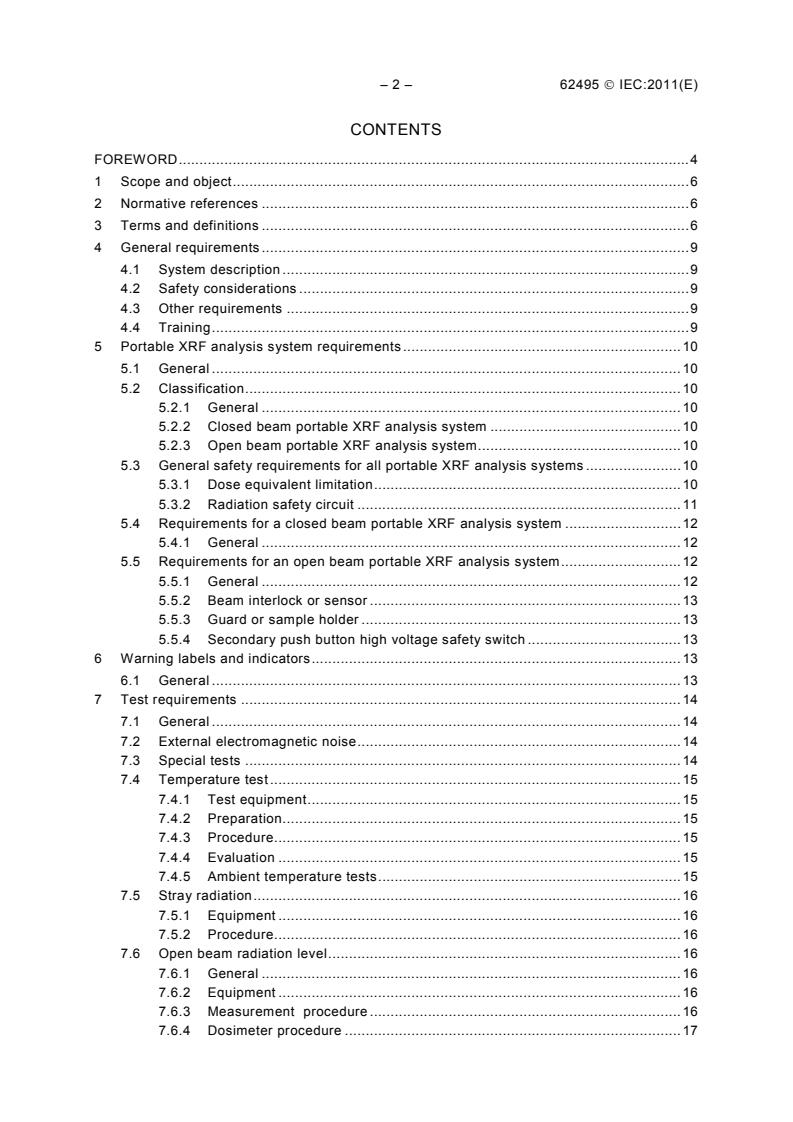
– 2 – 62495 IEC:2011(E)
CONTENTS
FOREWORD . 4
1 Scope and object . 6
2 Normative references . 6
3 Terms and definitions . 6
4 General requirements . 9
4.1 System description . 9
4.2 Safety considerations . 9
4.3 Other requirements . 9
4.4 Training . 9
5 Portable XRF analysis system requirements . 10
5.1 General . 10
5.2 Classification . 10
5.2.1 General . 10
5.2.2 Closed beam portable XRF analysis system . 10
5.2.3 Open beam portable XRF analysis system . 10
5.3 General safety requirements for all portable XRF analysis systems . 10
5.3.1 Dose equivalent limitation . 10
5.3.2 Radiation safety circuit . 11
5.4 Requirements for a closed beam portable XRF analysis system . 12
5.4.1 General . 12
5.5 Requirements for an open beam portable XRF analysis system . 12
5.5.1 General . 12
5.5.2 Beam interlock or sensor . 13
5.5.3 Guard or sample holder . 13
5.5.4 Secondary push button high voltage safety switch . 13
6 Warning labels and indicators . 13
6.1 General . 13
7 Test requirements . 14
7.1 General . 14
7.2 External electromagnetic noise . 14
7.3 Special tests . 14
7.4 Temperature test . 15
7.4.1 Test equipment . 15
7.4.2 Preparation. 15
7.4.3 Procedure . 15
7.4.4 Evaluation . 15
7.4.5 Ambient temperature tests . 15
7.5 Stray radiation . 16
7.5.1 Equipment . 16
7.5.2 Procedure . 16
7.6 Open beam radiation level . 16
7.6.1 General . 16
7.6.2 Equipment . 16
7.6.3 Measurement procedure . 16
7.6.4 Dosimeter procedure . 17
62495 IEC:2011(E) – 3 –
Annex A (normative) Recommended standard values and ranges of influence
quantities . 18
Bibliography . 19
– 4 – 62495 IEC:2011(E)
INTERNATIONAL ELECTROTECHNICAL COMMISSION
____________
NUCLEAR INSTRUMENTATION –
PORTABLE X-RAY FLUORESCENCE ANALYSIS
EQUIPMENT UTILIZING A MINIATURE X-RAY TUBE
FOREWORD
1) The International Electrotechnical Commission (IEC) is a worldwide organization for standardization comprising
all national electrotechnical committees (IEC National Committees). The object of IEC is to promote
international co-operation on all questions concerning standardization in the electrical and electronic fields. To
this end and in addition to other activities, IEC publishes International Standards, Technical Specifications,
Technical Reports, Publicly Available Specifications (PAS) and Guides (hereafter referred to as “IEC
Publication(s)”). Their preparation is entrusted to technical committees; any IEC National Committee interested
in the subject dealt with may participate in this preparatory work. International, governmental and non-
governmental organizations liaising with the IEC also participate in this preparation. IEC collaborates closely
with the International Organization for Standardization (ISO) in accordance with conditions determined by
agreement between the two organizations.
2) The formal decisions or agreements of IEC on technical matters express, as nearly as possible, an international
consensus of opinion on the relevant subjects since each technical committee has representation from all
interested IEC National Committees.
3) IEC Publications have the form of recommendations for international use and are accepted by IEC National
Committees in that sense. While all reasonable efforts are made to ensure that the technical content of IEC
Publications is accurate, IEC cannot be held responsible for the way in which they are used or for any
misinterpretation by any end user.
4) In order to promote international uniformity, IEC National Committees undertake to apply IEC Publications
transparently to the maximum extent possible in their national and regional publications. Any divergence
between any IEC Publication and the corresponding national or regional publication shall be clearly indicated in
the latter.
5) IEC itself does not provide any attestation of conformity. Independent certification bodies provide conformity
assessment services and, in some areas, access to IEC marks of conformity. IEC is not responsible for any
services carried out by independent certification bodies.
6) All users should ensure that they have the latest edition of this publication.
7) No liability shall attach to IEC or its directors, employees, servants or agents including individual experts and
members of its technical committees and IEC National Committees for any personal injury, property damage or
other damage of any nature whatsoever, whether direct or indirect, or for costs (including legal fees) and
expenses arising out of the publication, use of, or reliance upon, this IEC Publication or any other IEC
Publications.
8) Attention is drawn to the Normative references cited in this publication. Use of the referenced publications is
indispensable for the correct application of this publication.
9) Attention is drawn to the possibility that some of the elements of this IEC Publication may be the subject of
patent rights. IEC shall not be held responsible for identifying any or all such patent rights.
International Standard IEC 62495 has been prepared by committee 45: Nuclear
instrumentation.
The text of this standard is based on the following documents:
FDIS Report on voting
45/717/FDIS 45/731/RVD
Full information on the voting for the approval of this standard can be found in the report on
voting indicated in the above table.
This publication has been drafted in accordance with the ISO/IEC Directives, Part 2.
62495 IEC:2011(E) – 5 –
The committee has decided that the contents of this amendment and the base publication will
remain unchanged until the stability date indicated on the IEC web site under
"http://webstore.iec.ch" in the data related to the specific publication. At this date, the
publication will be
• reconfirmed,
• withdrawn,
• replaced by a revised edition, or
• amended.
A bilingual version of this publication may be issued at a later date.
– 6 – 62495 IEC:2011(E)
NUCLEAR INSTRUMENTATION –
PORTABLE X-RAY FLUORESCENCE ANALYSIS
EQUIPMENT UTILIZING A MINIATURE X-RAY TUBE
1 Scope and object
This International Standard is applicable to the radiological safety of portable handheld X-ray
fluorescence (XRF) analysis equipment utilizing a miniature X-ray tube as the source of
ionizing radiation for industrial applications.
The following are beyond the scope of this standard:
a) portable XRF analysis equipment utilizing a radioactive source(s);
b) large fixed installation XRF analysis equipment utilizing an X-ray tube;
c) veterinary and medical applications for portable XRF analysis.
The object of this standard is to establish performance specifications for general radiation,
electrical, safety and environmental characteristics of the design and operation, and test
methods in relation to radiological safety for portable XRF analysis equipment utilizing a
miniature X-ray tube. The proposed performance specifications are aimed at minimizing and
avoiding the health risk associated with the use of these devices. Analytical performance
specifications are beyond the scope of this standard.
Portable XRF analyzers utilizing low power, miniature X-ray tubes as sources of ionizing
radiation represent a new class of industrial equipment. The miniature X-ray tube replaces the
small radioisotope sources (e.g., Fe-55, Co-57, Cd-109, Am-241 and Cm-244) that have been
used in portable analyzers for applications such as analysis of lead in paint, alloy
identification, and soil screening for hazardous materials.
2 Normative references
The following referenced documents are indispensable for the application of this document.
For dated references, only the edition cited applies. For undated references, the latest edition
of the referenced document (including any amendments) applies.
IEC 60692:1999, Nuclear Instrumentation – Density gauges utilizing ionizing radiation –
Definitions and test methods
IEC 60982:1989, Level measuring systems utilizing ionizing radiation with continuous or
switching output
IEC 61010-1:2010, Safety requirements for electrical equipment for measurement, control and
laboratory use – Part 1: General requirements
IEC 61326 (all parts): Electrical equipment for measurement, control and laboratory use –
EMC requirements
IEC 61336:1996, Nuclear Instrumentation – Thickness measurement systems utilizing ionizing
radiation – Definitions and test methods
3 Terms and definitions
For the purposes of this document, the following terms and definitions apply:
62495 IEC:2011(E) – 7 –
3.1
closed beam X-ray system
a closed beam X-ray system is one in which the beam path cannot be entered by any part of
the body during normal operation
3.2
collimation device
device for restricting the useful radiation in one or more directions
3.3
detector housing; detector assembly
that portion of the measuring head which includes the radiation detector. This assembly may
be incorporated with the X-ray beam generator housing
3.4
electronic measuring assembly
assembly that supplies the equipment power, processes the signals delivered by the
measuring head, and delivers the output signals for the XRF analyzer
3.5
fail safe design
when no single failure or foreseeable combination of failures can place a system into an
unsafe configuration or mode
3.6
handheld instrument
a portable instrument that is designed to operate when held in the hand
3.7
interlock
a device or engineered system that precludes access to an area of radiation hazard either by
preventing entry or by automatically removing the hazard
3.8
isodose contour
an imaginary surface extending around the instrument where there is a specified dose
equivalent rate
3.9
leakage radiation
all radiation coming from within the source housing, except the useful beam
3.10
measuring head; measuring assembly
assembly comprising one or more X-ray generators and radiation detectors along with any
compensation sensors
3.11
normal conditions
operation under conditions suitable for collecting data as recommended by a manufacturer of
the portable X-ray fluorescence analysis equipment
3.12
open beam X-ray system
an open beam X-ray system is one in which the beam path could be entered by any part of
the body at any time
– 8 – 62495 IEC:2011(E)
3.13
portable instrument
an instrument that must be able to operate with complete functionality, continuously on
batteries
3.14
primary beam
ionizing radiation from an X-ray anode or secondary target which is allowed to pass by a
direct path through an aperture in the tube housing for use in conducting X-ray measurements
3.15
radiation generating machine
an assembly consisting of a least one X-ray generator used in an X-ray fluorescence analysis
system
3.16
safety circuit
safety circuit is designed to provide assurance that personnel are safe from accidental
exposure to radiation from the X-ray tube (e.g.,if a light indicating "X-RAY ON" fails, the
production of X-rays will be prevented, or if a shutter status indicator fails, the shutter shall
close)
3.17
safety features
properties of a device designed to preclude unintended exposure to sources of radiation.
Safety features may include, but are not limited to, radiation containment, shutters, radiation
beam collimation, shielding, beam ON-OFF indicators, key-locked power ON-OFF switches,
and safety interlocks
3.18
scattered radiation
radiation that has been deviated in direction and/or energy by passing through matter
3.19
stray radiation
the sum of leakage and scattered radiation
3.20
system barrier
that portion of an X-ray fluorescence analyzer which clearly defines the transition from the
primary beam to the outside of the device and provides such shielding as may be required to
limit the dose equivalent rate to the outside of the device during normal operation (e.g., a
shielded enclosure immediately around the X-ray tube)
3.21
useful beam
radiation that passes through the window, aperture, cone or other collimation device and is
used for making measurements
3.22
warning device
a visible or audible signal that warns personnel of a potential radiation hazard
3.23
X-ray accessory apparatus
any portion of an X-ray device that is external to the radiation source housing and into which
an X-ray beam is directed for making X-ray measurements or for other uses
62495 IEC:2011(E) – 9 –
3.24
X-ray fluorescence measurement system
radiation gauge that utilizes X-ray fluorescence to analyze a material
[IEC 60050-394:2007, 394-37-05]
3.25
X-ray generator
that portion of an X-ray system that provides the X-ray tube, the accelerating (high) voltage
and current for the X-ray tube
3.26
X-ray system
assemblage of components for the controlled generation and use of ionizing radiation,
including all X-ray accessory apparatus
4 General requirements
4.1 System description
The manufacturer shall provide a description of the analysis system. This shall include:
a) principle of measurement;
b) field of application – intended uses;
c) X-ray tube and radiation characteristics – type, number, maximum operational voltage,
current and wattage and physical and electrical characteristics;
d) stray radiation profiles; and
e) primary beam dose measurements.
4.2 Safety considerations
The manufacturer shall provide a description of the radiation safety circuit and features that
are designed to prevent accidental exposure to the operator and public during normal
operation of the portable instrument. The description shall indicate the fail-safe features of the
radiation safety circuit and provide instructions for testing these features.
The manufacturer shall indicate if the portable analyzer meets closed beam requirements (see
5.2.2) or meets open beam requirements (see 5.2.3).
4.3 Other requirements
In addition to the requirements specified in this standard, the devices may be required to
comply with the relevant national, regional, state or local regulations where applicable.
Additional non-safety information on instruments and systems that is relevant to this standard
is given in IEC 60692, IEC 60982 and IEC 61336. General constructional requirements for
electrical measuring, control and laboratory instruments are given in IEC 61010-1.
Electromagnetic compatibility (EMC) requirements are given in IEC 61326.
4.4 Training
Manufacturer or their agent shall provide adequate training material with each instrument on
the use and safety aspects of instrument operation. The documentation accompanying each
instrument shall include information to provide training to potential operators. It is the
responsibility of the owner of the device user to provide sufficient training to operators of the
device.
– 10 – 62495 IEC:2011(E)
5 Portable XRF analysis system requirements
5.1 General
The device shall be designed or controlled in such a way that the shielding limits the dose
when used in accordance with manufacturer’s
equivalent rates at all accessible points,
instructions. The maximum dose rate at any accessible point shall be less than the applicable
internationally specified limits for non-occupationally exposed persons. It shall be the
responsibility of the owner to verify that this maximum dose rate is less than that specified in
appropriate local or national regulations pertaining to continuously occupied working places
where these are more restrictive.
The accompanying documents should include information that it is the responsibility of the
user to observe all necessary radiation protection procedures including maintaining the
labeling, shielding and safety circuits and to ensure that the actual limit values, specified in
appropriate national regulations, are not exceeded.
5.2 Classification
5.2.1 General
For the purpose of this standard two classes of X-ray systems are recognized. They are
closed beam X-ray analysis and open beam X-ray analysis system. For a fully enclosed X-ray
beam XRF analysis device, the X-ray analysis system shall be designed to restrict or prohibit
operation if the X-ray beam is not contained within a closed measuring chamber.
Portable XRF analysis systems covered by this standard should be designed so that all
possible X-ray beam paths are fully enclosed. However, operational requirements such as the
following may make the use of a fully closed beam system during normal
...
Questions, Comments and Discussion
Ask us and Technical Secretary will try to provide an answer. You can facilitate discussion about the standard in here.
Loading comments...