


IEC PAS 61162-102:2003
(Main)Maritime navigation and radiocommunication equipment and systems - Digital interfaces - Part 102: Single talker and multiple listeners - Extra requirements to IEC 61162-1 for the Voyage Data Recorder
General Information
- Abstract
Is a PAS (Publicly Available Specification) providing information on sentences necessary to interface shipborne alarm systems with the voyage data recorder (VDR). Is to be used in conjunction with IEC 61162-1 and IEC 61162-2. The VDR is required to acquire data on engine, cargo and deck monitoring status in addition to the navigation and radiocommunications.
- Status
- Replaced
- Publication Date
- 03-Dec-2003
- Technical Committee
- TC 80 - Maritime navigation and radiocommunication equipment and systems
- Drafting Committee
- WG 6 - TC 80/WG 6
- Current Stage
- DELPUB - Deleted Publication
- Start Date
- 08-Jul-2008
- Completion Date
- 28-Aug-2026
Buy Documents
IEC PAS 61162-102:2003 - Maritime navigation and radiocommunication equipment and systems - Digital interfaces - Part 102: Single talker and multiple listeners - Extra requirements to IEC 61162-1 for the Voyage Data Recorder Released:12/4/2003
Relations
- Effective Date
- 05-Sep-2023
Buy Documents
IEC PAS 61162-102:2003 - Maritime navigation and radiocommunication equipment and systems - Digital interfaces - Part 102: Single talker and multiple listeners - Extra requirements to IEC 61162-1 for the Voyage Data Recorder Released:12/4/2003
Get Certified
Connect with accredited certification bodies for this standard

DNV
DNV is an independent assurance and risk management provider.

Lloyd's Register
Lloyd's Register is a global professional services organisation specialising in engineering and technology.

FSC International
Forest Stewardship Council certification.
Sponsored listings
Frequently Asked Questions
IEC PAS 61162-102:2003 is a technical specification published by the International Electrotechnical Commission (IEC). Its full title is "Maritime navigation and radiocommunication equipment and systems - Digital interfaces - Part 102: Single talker and multiple listeners - Extra requirements to IEC 61162-1 for the Voyage Data Recorder". This standard covers: Is a PAS (Publicly Available Specification) providing information on sentences necessary to interface shipborne alarm systems with the voyage data recorder (VDR). Is to be used in conjunction with IEC 61162-1 and IEC 61162-2. The VDR is required to acquire data on engine, cargo and deck monitoring status in addition to the navigation and radiocommunications.
Is a PAS (Publicly Available Specification) providing information on sentences necessary to interface shipborne alarm systems with the voyage data recorder (VDR). Is to be used in conjunction with IEC 61162-1 and IEC 61162-2. The VDR is required to acquire data on engine, cargo and deck monitoring status in addition to the navigation and radiocommunications.
IEC PAS 61162-102:2003 is classified under the following ICS (International Classification for Standards) categories: 47.020.70 - Navigation and control equipment. The ICS classification helps identify the subject area and facilitates finding related standards.
IEC PAS 61162-102:2003 has the following relationships with other standards: It is inter standard links to IEC 61162-1:2007. Understanding these relationships helps ensure you are using the most current and applicable version of the standard.
IEC PAS 61162-102:2003 is available in PDF format for immediate download after purchase. The document can be added to your cart and obtained through the secure checkout process. Digital delivery ensures instant access to the complete standard document.
Standards Content (Sample)
PUBLICLY
IEC
AVAILABLE
PAS 61162-102
SPECIFICATION
First edition
Pre-Standard
2003-12
Maritime navigation and
radiocommunication equipment
and systems –
Digital interfaces –
Part 102:
Single talker and multiple listeners –
Extra requirements to IEC 61162-1
for the Voyage Data Recorder
Reference number
IEC/PAS 61162-102:2003(E)
Publication numbering
As from 1 January 1997 all IEC publications are issued with a designation in the
60000 series. For example, IEC 34-1 is now referred to as IEC 60034-1.
Consolidated editions
The IEC is now publishing consolidated versions of its publications. For example,
edition numbers 1.0, 1.1 and 1.2 refer, respectively, to the base publication, the
base publication incorporating amendment 1 and the base publication incorporating
amendments 1 and 2.
Further information on IEC publications
The technical content of IEC publications is kept under constant review by the IEC,
thus ensuring that the content reflects current technology. Information relating to
this publication, including its validity, is available in the IEC Catalogue of
publications (see below) in addition to new editions, amendments and corrigenda.
Information on the subjects under consideration and work in progress undertaken
by the technical committee which has prepared this publication, as well as the list
of publications issued, is also available from the following:
• IEC Web Site (www.iec.ch)
• Catalogue of IEC publications
The on-line catalogue on the IEC web site (www.iec.ch/searchpub) enables you to
search by a variety of criteria including text searches, technical committees
and date of publication. On-line information is also available on recently issued
publications, withdrawn and replaced publications, as well as corrigenda.
• IEC Just Published
This summary of recently issued publications (www.iec.ch/online_news/ justpub)
is also available by email. Please contact the Customer Service Centre (see
below) for further information.
• Customer Service Centre
If you have any questions regarding this publication or need further assistance,
please contact the Customer Service Centre:
Email: custserv@iec.ch
Tel: +41 22 919 02 11
Fax: +41 22 919 03 00
PUBLICLY
IEC
AVAILABLE
PAS 61162-102
SPECIFICATION
First edition
Pre-Standard
2003-12
Maritime navigation and
radiocommunication equipment
and systems –
Digital interfaces –
Part 102:
Single talker and multiple listeners –
Extra requirements to IEC 61162-1
for the Voyage Data Recorder
© IEC 2003 ⎯ Copyright - all rights reserved
No part of this publication may be reproduced or utilized in any form or by any means, electronic or
mechanical, including photocopying and microfilm, without permission in writing from the publisher.
International Electrotechnical Commission, 3, rue de Varembé, PO Box 131, CH-1211 Geneva 20, Switzerland
Telephone: +41 22 919 02 11 Telefax: +41 22 919 03 00 E-mail: inmail@iec.ch Web: www.iec.ch
PRICE CODE
Commission Electrotechnique Internationale V
International Electrotechnical Commission
МеждународнаяЭлектротехническаяКомиссия
For price, see current catalogue
– 2 – PAS 61162-102 © IEC:2003 (E)
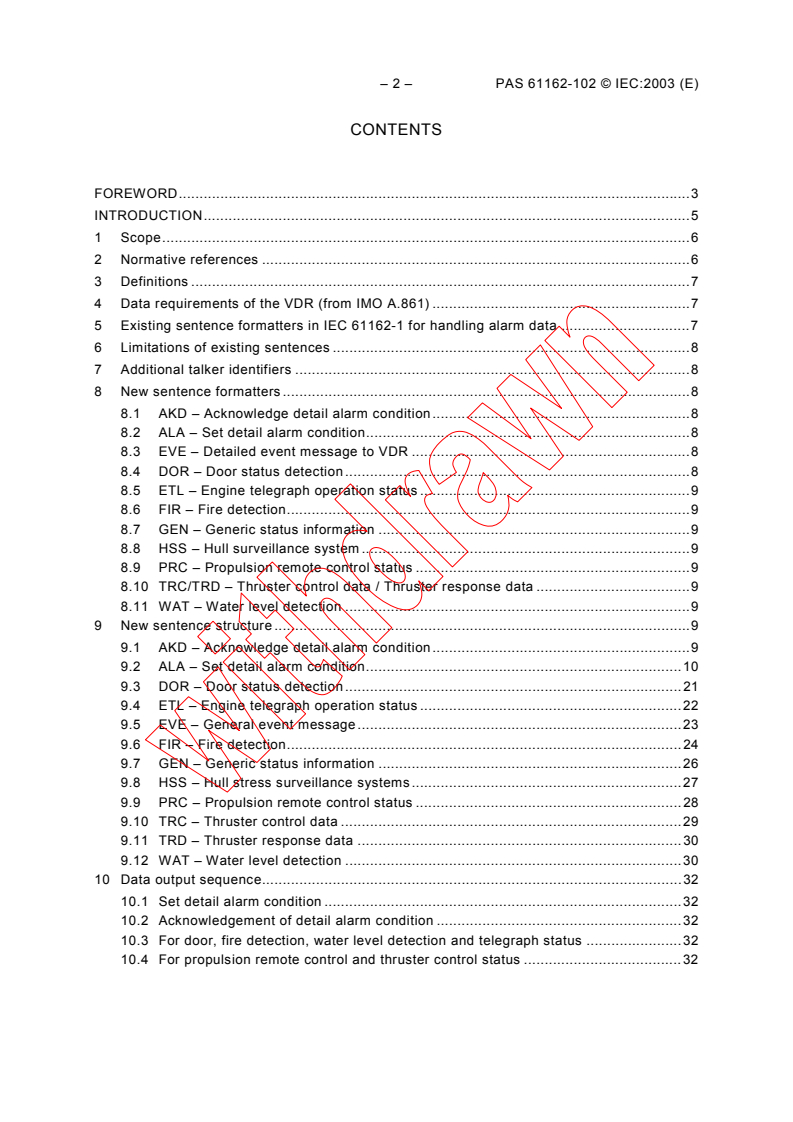
CONTENTS
FOREWORD.3
INTRODUCTION.5
1 Scope.6
2 Normative references .6
3 Definitions .7
4 Data requirements of the VDR (from IMO A.861) .7
5 Existing sentence formatters in IEC 61162-1 for handling alarm data .7
6 Limitations of existing sentences .8
7 Additional talker identifiers .8
8 New sentence formatters .8
8.1 AKD – Acknowledge detail alarm condition.8
8.2 ALA – Set detail alarm condition.8
8.3 EVE – Detailed event message to VDR .8
8.4 DOR – Door status detection.8
8.5 ETL – Engine telegraph operation status .9
8.6 FIR – Fire detection.9
8.7 GEN – Generic status information .9
8.8 HSS – Hull surveillance system .9
8.9 PRC – Propulsion remote control status .9
8.10 TRC/TRD – Thruster control data / Thruster response data .9
8.11 WAT – Water level detection .9
9 New sentence structure .9
9.1 AKD – Acknowledge detail alarm condition.9
9.2 ALA – Set detail alarm condition.10
9.3 DOR – Door status detection.21
9.4 ETL – Engine telegraph operation status .22
9.5 EVE – General event message.23
9.6 FIR – Fire detection.24
9.7 GEN – Generic status information .26
9.8 HSS – Hull stress surveillance systems.27
9.9 PRC – Propulsion remote control status .28
9.10 TRC – Thruster control data .29
9.11 TRD – Thruster response data .30
9.12 WAT – Water level detection .30
10 Data output sequence.32
10.1 Set detail alarm condition .32
10.2 Acknowledgement of detail alarm condition .32
10.3 For door, fire detection, water level detection and telegraph status .32
10.4 For propulsion remote control and thruster control status .32
PAS 61162-102 © IEC:2003 (E) – 3 –
INTERNATIONAL ELECTROTECHNICAL COMMISSION
____________
MARITIME NAVIGATION AND RADIOCOMMUNICATION EQUIPMENT
AND SYSTEMS – DIGITAL INTERFACES –
Part 102: Single talker and multiple listeners –
Extra requirements to IEC 61162-1 for the Voyage Data Recorder
FOREWORD
1) The International Electrotechnical Commission (IEC) is a worldwide organization for standardization comprising
all national electrotechnical committees (IEC National Committees). The object of IEC is to promote
international co-operation on all questions concerning standardization in the electrical and electronic fields. To
this end and in addition to other activities, IEC publishes International Standards, Technical Specifications,
Technical Reports, Publicly Available Specifications (PAS) and Guides (hereafter referred to as “IEC
Publication(s)”). Their preparation is entrusted to technical committees; any IEC National Committee interested
in the subject dealt with may participate in this preparatory work. International, governmental and non-
governmental organizations liaising with the IEC also participate in this preparation. IEC collaborates closely
with the International Organization for Standardization (ISO) in accordance with conditions determined by
agreement between the two organizations.
2) The formal decisions or agreements of IEC on technical matters express, as nearly as possible, an international
consensus of opinion on the relevant subjects since each technical committee has representation from all
interested IEC National Committees.
3) IEC Publications have the form of recommendations for international use and are accepted by IEC National
Committees in that sense. While all reasonable efforts are made to ensure that the technical content of IEC
Publications is accurate, IEC cannot be held responsible for the way in which they are used or for any
misinterpretation by any end user.
4) In order to promote international uniformity, IEC National Committees undertake to apply IEC Publications
transparently to the maximum extent possible in their national and regional publications. Any divergence
between any IEC Publication and the corresponding national or regional publication shall be clearly indicated in
the latter.
5) IEC provides no marking procedure to indicate its approval and cannot be rendered responsible for any
equipment declared to be in conformity with an IEC Publication.
6) All users should ensure that they have the latest edition of this publication.
7) No liability shall attach to IEC or its directors, employees, servants or agents including individual experts and
members of its technical committees and IEC National Committees for any personal injury, property damage or
other damage of any nature whatsoever, whether direct or indirect, or for costs (including legal fees) and
expenses arising out of the publication, use of, or reliance upon, this IEC Publication or any other IEC
Publications.
8) Attention is drawn to the Normative references cited in this publication. Use of the referenced publications is
indispensable for the correct application of this publication.
9) Attention is drawn to the possibility that some of the elements of this IEC Publication may be the subject of
patent rights. IEC shall not be held responsible for identifying any or all such patent rights.
A PAS is a technical specification not fulfilling the requirements for a standard, but made
available to the public.
IEC-PAS 61162-102 has been processed by IEC technical committee 80: Maritime navigation
and radiocommunication equipment and systems.
The text of this PAS is based on the This PAS was approved for
following document: publication by the P-members of the
committee concerned as indicated in
the following document
Draft PAS Report on voting
80/364/PAS 80/384/RVD
Following publication of this PAS, the technical committee or subcommittee concerned will
investigate the possibility of transforming the PAS into an International Standard.
– 4 – PAS 61162-102 © IEC:2003 (E)
This PAS document relates to International Standards of the IEC 61162 series. The document
has been co-ordinated with the NMEA Standards Committee.
This PAS shall remain valid for an initial maximum period of 3 years starting from 2003-09.
The validity may be extended for a single 3-year period, following which it shall be revised to
become another type of normative document, or shall be withdrawn.
PAS 61162-102 © IEC:2003 (E) – 5 –
INTRODUCTION
This document is issued as an IEC Publicly Available Specification according to the IEC/PAS
approval process. This agreed process allows the new information needed to implement the
Voyage Data Recorder (VDR) to be placed in the public domain in a shorter time-scale than
revising the appropriate international standards.
This document provides information on sentences necessary to interface shipborne alarm
systems with the VDR. The introduction of the VDR has highlighted the limitations of the
existing alarm sentences in the IEC Standards 61162-1 and 2. The VDR is required to acquire
data on engine, cargo and deck monitoring status in addition to the navigation and
radiocommunications.
In particular, the data sources have to be identified, in a system possibly comprising several
thousand sensors.
This PAS has been developed in conjunction with the NMEA.
This PAS will be replaced at a future date by, or be included within, a revision of the
international standard IEC 61162-1.
– 6 – PAS 61162-102 © IEC:2003 (E)
MARITIME NAVIGATION AND RADIOCOMMUNICATION EQUIPMENT
AND SYSTEMS – DIGITAL INTERFACES –
Part 102: Single talker and multiple listeners –
Extra requirements to IEC 61162-1 for the Voyage Data Recorder
1 Scope
The IEC 61162-1 standard includes 4 sentence formatters for handling alarm and transducer
status data. These were originally developed to handle the data required by navigation and
radiocommunications equipment and multiple alarm systems were not envisaged.
The introduction of the Voyage Data Recorder (VDR) has necessitated the interfacing to
engine, cargo and deck monitoring systems. In particular the interface to multi-point fire alarm
systems presents problems due to the large number of sensors and the need to identify
specific sources of incoming messages.
The IEC 61162-102 is the specified interface to the VDR and to permit identification of data a
series of specific sentences has been developed.
Whilst the facilities included in the IEC 61162-4 series may be utilised to handle the most
complex systems, these are not in general use, and probably unlikely on smaller vessels. The
VDR has to be applied with immediate effect to a range of vessels and there does not appear
to be any alternative standard available to meet the requirement.
NOTE This document defines sentences and parameters useful for the VDR and associated systems. The
sentences and parameters extend in some cases beyond the minimum requirement for the VDR.
2 Normative references
The following referenced documents are indispensable for the application of this document.
For dated references, only the edition cited applies. For undated references, the latest edition
of the referenced document (including any amendments) applies.
The references contained in IEC 61162-1 apply to this PAS. In addition the following apply :
IEC 61996:2000(E) Maritime navigation and radiocommunication equipment and systems –
Shipborne voyage data recorders (VDR) – Performance requirements – Methods of testing
and required test results
IMO A.830(19) Code on Alarms and Indicators, 1995
IMO SOLAS Convention, Chapter V, (2002)
IMO HSC Code, Chapter 13.
IMO A.861 (20):1997, Performance standards for shipborne voyage data recorders (VDRs)
PAS 61162-102 © IEC:2003 (E) – 7 –
3 Definitions
3.1
alarm
denotes a condition that has to be recognised, or acted upon immediately, e.g. depth
minimum limit exceeded, anchor deep
3.2
diagnostic
usually denotes a failure, or warning of deterioration in a system, e.g. engine sensor
malfunction
3.3
event
is used to log a condition that has occurred and /or [track the operation of some condition].
Events are [normally] defined, e.g. transfer of control to the bridge
3.4
fault
is a technical problem in one of the system components that will reduce the availability, or
future availability, of some or all functions
3.5
warning
is similar to ALARM but need not be acted upon immediately
4 Data requirements of the VDR (from IMO A.861)
Date and time
Ship’s position
Speed
Heading
Bridge Audio
Communications audio
Radar data, post-display selection
Echo-sounder
Main alarms
Rudder order and response
Engine order and response
Hull openings status
Watertight and fire door status
Accelerations and hull stresses
Wind speed and direction
5 Existing sentence formatters in IEC 61162-1 for handling alarm data
ALR – Set alarm status –possibly relevant to the VDR but not for machinery, fire or related
alarms.
AAM – Waypoint arrival alarm –possibly relevant to the VDR but not for machinery, fire or
related alarms.
– 8 – PAS 61162-102 © IEC:2003 (E)
ACK – Acknowledge alarm – developed for single items of equipment and has limitations for
the VDR. Lacks definition of source.
XDR – Transducer measurements – has limited use where multiple devices are in use e.g.
cabin fire alarm status.
6 Limitations of existing sentences
The data source is not readily identified in a multi-sensor system.
No differentiation between two or more devices transmitting the same sentence.
The definition of the alarm is inadequate, i.e. no distinction between a malfunction and
abnormal condition.
The VDR requires additional talker identifiers not presently covered by IEC 61162-1.
7 Additional talker identifiers
FD Fire door controller / monitoring panel
FR Fire detection system
HD Hull door controller / monitoring panel
HS Hull stress monitoring system
RC Propulsion machinery including remote control system
SG Steering gear / steering engine
WD Watertight door controller / monitoring panel
WL Water level detection system
NOTE Talker identifiers FE (Fire extinguisher system – halon, CO2 or similar), FS (Sprinkler, watermist or similar
system) and BI (Bilge system) may be added in a later edition.
8 New sentence formatters
NOTE An additional dedicated sentence for rudder order and response will be considered in a later edition
of 61162.
8.1 AKD – Acknowledge detail alarm condition
This sentence provides for acknowledgement of the detail alarm condition received from the
alarm source. The sentence is designed to clarify the source of the response.
8.2 ALA – Set detail alarm condition
This sentence permits the alarm condition of a system to be set. The data source is identified
and the alarm category is defined and avoids any conflict between alarms and devices.
8.3 EVE – Detailed event message to VDR
This is a voluntary sentence that is used to inform the VDR about details in system status that
are not contained in the mandatory sentences.
8.4 DOR – Door status detection
This sentence indicates the status of watertight doors, fire doors and other hull openings /
doors. Malfunction alarms of the watertight door, fire door and hull opening/door controller
should be included in the “ALA” sentence.
PAS 61162-102 © IEC:2003 (E) – 9 –
8.5 ETL – Engine telegraph operation status
This sentence indicates engine telegraph position including operating location and sub-
telegraph indicator.
8.6 FIR – Fire detection
This sentence indicates fire detection status with data on the specific location. Malfunction
alarm of the fire detection system should be included in the “ALA” sentence.
8.7 GEN – Generic status information
This sentence provides a means of transmitting multi-sensor information from any source, in a
format that can be stored by the VDR.
8.8 HSS – Hull surveillance system
This sentence indicates the hull surveillance system (HSS) measurement data required to be
logged by the VDR, if a HSS is fitted on the ship.
8.9 PRC – Propulsion remote control status
This sentence indicates the engine control status (engine order) on a M/E remote control
system. This provides the detail data not available from the engine telegraph.
8.10 TRC/TRD – Thruster control data / Thruster response data
This sentence provides the control and response data for thruster devices.
8.11 WAT – Water level detection
This sentence provides detection status of water leakage and bilge water level, with
monitoring location data. Malfunction alarm of the water level detector should be included in
the “ALA” sentences
9 New sentence structure
The sentence format is presented in tabular form in this PAS to facilitate understanding and
discussion.
9.1 AKD – Acknowledge detail alarm condition
This sentence provides for acknowledgement of the detail alarm condition received from the
alarm source. The sentence is designed to clarify the source of the response. AKD is used to
acknowledge an alarm reported through ALA.
$--AKD, hhmmss.ss, aa, aa, xx, xxx, aa, aa, xx *hh
0 1 2 3 4 5 6 7 8 9
Field Data form Field name Definition
No
0 $--AKD Header
1 hhmmss.ss Event time (optional) Event time of alarm condition change or
acknowledgement – if required or available.
– 10 – PAS 61162-102 © IEC:2003 (E)
Field Data form Field name Definition
No
If not necessary, this shall be a null field.
2 aa System indicator of original Indicator characters as upper system of original
alarm source (destination for alarm source. (Destination for Acknowledgement)
Acknowledgement)
This field is two fixed characters.
3 aa Sub-system/equipment/ Indicator characters as lower system of original
item indicator of original alarm alarm source. (Destination for Acknowledgement)
source (Destination for
This field is two fixed characters.
Acknowledgement)
If no sub-system, this shall be a null field.
4 xx Number of equipment / units / Numeric character indicating number of equipment,
items units or items.
This field is two fixed numeric characters.
5 xxx Number of original alarm Numeric character indicating original alarm
contents.
This field is three fixed numeric characters.
6 aa System indicator of source for Indicator characters as upper system of source for
Acknowledgement Acknowledgement
This field is two fixed characters.
7 aa Sub-system/equipment/ item Indicator characters as lower system of source for
indicator of source for Acknowledgement
Acknowledgement
This field is two fixed characters.
If no sub-system, this shall be a null field.
8 xx Number of equipment / units / Numeric character indicating number of equipment,
items units or items.
This field is two fixed numeric characters.
9 *hh Check-sum
NOTE System indicator (field 2), Sub-system indicator ( field 3) and number of original alarm (field 5) described in
above tabulation are shown in Table 1, below the ALA tabulation.
NOTE The mechanism specified in AKD and ALA is for general alarm handling and exceeds the minimum
requirement for the VDR.
9.2 ALA – Set detail alarm condition
This sentence permits the alarm condition of a system to be set. The data source is identified
and the alarm category is defined and avoids any conflict between alarms and devices.
$--ALA, hhmmss.ss, aa, aa, xx, xxx, a, a, c--c *hh
0 1 2 3 4 5 6 7 8 9
Field Data form Field name Definition
No
0 $--ALA Header
1 hhmmss.ss Event time (Optional) Event time of alarm condition change or
acknowledgement – if required or available.
If not necessary, this shall be a null field.
2 aa System indicator of alarm source Indicator characters as upper system of alarm source.
This field is two fixed characters.
PAS 61162-102 © IEC:2003 (E) – 11 –
Field Data form Field name Definition
No
3 aa Sub-system/equipment/ Indicator characters as lower system of alarm source.
item indicator of alarm
This field is two fixed characters.
source
For group alarms or if no sub-system can be
identified, this shall be a null field.
4 xx Number of equipment / units / Numeric character indicating number of equipment,
items units or items.
This field is two fixed numeric characters.
5 xxx Number of alarm source Numeric character indicating alarm identity.
This field is three fixed numeric characters as defined
in table 1. Codes 900-999 are user definable. If this
sentence is used to indicate a group alarm, or if no
alarm source can be identified, this shall be a null
field.
6 a Alarm condition This field is a single character specified by the
following :
N = normal state
H = alarm state (threshold exceeded)
J = alarm state (extreme threshold exceeded)
L = alarm state (Low threshold exceeded i.e. not
reached)
K = alarm state (extreme low threshold exceeded i.e.
not reached)
X = other
7 a Alarm’s acknowledge This field is a single character specified by the
state following:
A = acknowledged
V = not acknowledged
B = Broadcast (acknowledgement not applicable)
H = harbour mode
O = Override
8 c--c Alarm’s description text Additional and optional descriptive text/ alarm detail
condition tag.
Maximum number of characters will be limited by
maximum sentence length and length of other fields.
9 *hh Check-sum
NOTE System indicator (field 2),sub-system indicator (field 3) and number of alarm source (field 5) described in
the above tabulation are shown in table 1 below.
Table 1
NOTE The following table shows typical system alarm fields. The mandatory alarms required by a VDR are
indicated in annex B to IEC 61996.
NOTE Alarms from more systems may be added in a later edition of 61162.
Sub-system/equipment
System indicator (field 2) Number of alarm source (field 5)
indicator (field 3)
ID System category ID Sub system/Equipment No Alarm contents
SG Steering gear PU Power unit 001 Stop
002 Power fail
003 Overload
004 Phase fail
005 Hydraulic fluid level low
010 Run
– 12 – PAS 61162-102 © IEC:2003 (E)
Sub-system/equipment
System indicator (field 2) Number of alarm source (field 5)
indicator (field 3)
ID System category ID Sub system/Equipment No Alarm contents
CL Control system (actuator 001 Power fail
or drive unit for steering
signal)
PC Propulsion control PC Propulsion control Inhibition of starting of propulsion
engine
002 Automatic shutdown
003 Automatic slowdown
004 Safety system override
005 Operating in barred speed range
System power supply main and
emergency feeders – failure
CPP hydraulic oil pressure – low &
high
CPP hydraulic oil temperature –
high & low
Control, alarm or safety system,
power supply failure
RC Remote control system 001 Power fail
002 System abnormal
003 Governor control abnormal
004 Propeller pitch control abnormal
MN Monitoring system
001 Normal power source – fail
Individual power supply to control,
002 monitoring and Safety systems –
fail
Integrated computerized system:
data highway abnormal
Integrated computerized system:
duplicated data link – failure
AL Group alarm system 001 Power fail
002 Personnel alarm
003 Dead man alarm
004 Request backup OOW
SP System power source 001 Main feeder – fail
002 Emergency feeder – fail
OT Others 900
Others (if necessary, it is possible
|
to define by user.)
AM Auxiliary Machinery EP Electric power generator
001 Voltage – low & high
plant
002 Current – high
003 Frequency – high & low
004 Failure of online generator
005 Bearing lub. oil inlet pressure – low
Generator cooling inlet pump or fan
motor – fail
PAS 61162-102 © IEC:2003 (E) – 13 –
Sub-system/equipment
System indicator (field 2) Number of alarm source (field 5)
indicator (field 3)
ID System category ID Sub system/Equipment No Alarm contents
Generator cooling medium
temperature – high
RM High voltage rotating Stationary windings temperature –
machine high
FO Fuel oil system Settling and service tank level –
high & low
Overflow tank and drain tank level –
high
ST Stern tube lub. Oil 001 Tank level – low
BL Boiler
001 Automatic shutdown
MS Propulsion machinery
001 Bilge level – high
space
002 Air condition system – fail
003 Fire detected
OT Others 900
Others (if necessary, it is possible
|
to define by user.)
DE Diesel plant FO Fuel oil Fuel oil tank heating control and
temp. display and alarm – high
002 Fuel oil engine inlet pressure – low
Fuel oil before injunction pump
temp – high & low
004 Leakage from high pressure pipe
LO Lubricating oil Lub. oil to main bearing pressure –
low
Lub. oil to thrust bearing pressure –
low
Lub. oil to crosshead bearing
pressure – low
004 Lub. oil to camshaft pressure – low
005 Lub oil to camshaft temp – high
006 Lub oil inlet temp – high
Thrust bearing pads temp temp –
high
Main, crank, crosshead bearing oil
outlet temp – high
009 Cylinder lubricator, flow rate – low
010 Lub oil tanks, level – low
TC Turbo-charger
001 Lub oil inlet, pressure – low
002 Lub oil outlet, temp – high
PS Piston cooling
001 Coolant inlet, pressure – low
002 Coolant outlet, temp. – high
003 Coolant outlet, flow – low
004 Coolant expansion tank, level – low
– 14 – PAS 61162-102 © IEC:2003 (E)
Sub-system/equipment
System indicator (field 2) Number of alarm source (field 5)
indicator (field 3)
ID System category ID Sub system/Equipment No Alarm contents
SC Seawater cooling
001 Seawater cooling pressure – low
FW Cylinder fresh water
001 Water inlet pressure – low
cooling
Water outlet from cylinder, temp –
high
Oily contamination of engine
cooling water system – fail
Cooling water expansion tank, level
– low
CA Compressed air Starting air before main shut-off
valve, pressure – low
002 Control air, pressure – low
003 Safety air, pressure – low
SA Scavenge air
001 Scavenge air box, temp – high
Scavenge air receiver water, level –
high
EH Exhaust gas
001 Exhaust gas, temp – high
Exhaust gas deviation from
average, temp – high
Exhaust gas before tarbo-charger,
temp – high
Exhaust gas after tarbo-charger,
temp – high
FV Fuel valve coolant 001 Coolant, pressure low
002 Coolant, temp – high
003 Coolant expansion tank, level – low
EG Engine
001 Rotation – wrong way
002 Engine, overspeed
OT Others Reduction gear lub oil inlet,
pressure – low
Others (if necessary, it is possible
|
to define by user.)
ST Steam turbines plant LO Lubrication oil Pressure at bearing inlet - high &
low
002 Temp at bearing outlet – high
003 Filter differential pressure – high
004 Gravity tank level – low
LC Lubricating oil cooling
001 Pressure – low
system
002 Temp at outlet – high
003 Expansion tank level – low
SW Seawater
001 Pressure – low
SM Steam
001 Pressure at throttle – low
PAS 61162-102 © IEC:2003 (E) – 15 –
Sub-system/equipment
System indicator (field 2) Number of alarm source (field 5)
indicator (field 3)
ID System category ID Sub system/Equipment No Alarm contents
002 Gland seal exhaust fan – failure
003 Astern guardian valve – fail to open
CD Condensate
001 Condenser level – high & low
002 Condensate pump pressure – low
003 Condenser vacuum – low
004 Salinity – high
RT Rotor
001 Vibration level – high
002 Axial displacement – large
003 Overspeed
Shaft stopped – excess of set
period
PW Power Throttle control system power
failure
OT Others 900
Others (if necessary, it is possible
|
to define by user.)
GT Gas turbine plant FO Fuel oil
001 Pressu
...