

IEC 60335-2-24:2000
(Main)Safety of household and similar electrical appliances - Part 2-24: Particular requirements for refrigerating appliances, ice-cream appliances and ice-makers
General Information
- Abstract
Applies to: Refrigerating appliances for household use; Ice-makers incorporating a motor-compressor, and ice-makers in frozen food storage compartments; Refrigerating appliances and ice-makers for camping, caravans and boats; Ice-cream appliances for household use; Compression-type appliances using flammable refrigerants. These appliances may be operated from the mains and/or from a separate battery. For motor-compressors, see IEC 60335-2-34. For commercial dispensing appliances and vending machines, see IEC 60335-2-75.
- Status
- Published
- Publication Date
- 30-Jul-2000
- Technical Committee
- SC 61C - Safety of refrigeration appliances for household and commercial use
- Current Stage
- DELPUB - Deleted Publication
- Start Date
- 29-Oct-2002
- Completion Date
- 28-Aug-2026
Buy Documents
IEC 60335-2-24:2000 - Safety of household and similar electrical appliances - Part 2-24: Particular requirements for refrigerating appliances, ice-cream appliances and ice-makers Released:7/31/2000
Overview
IEC 60335-2-24:2000 is the IEC safety standard for household and similar refrigerating appliances, ice-cream appliances and ice-makers. It is Part 2-24 of the IEC 60335 series and is to be used together with the general safety requirements of IEC 60335-1. The standard covers appliances intended for household use (including camping, caravans and boats), appliances operating from mains or separate batteries, and compression-type units that use flammable refrigerants. Rated voltages covered include up to 250 V for single-phase, 480 V for other appliances, and 24 V d.c. for battery operation.
Key Topics
The standard supplements and modifies IEC 60335-1 with particular requirements specific to refrigeration equipment. Major technical topics and requirements include:
- Scope and definitions specific to refrigerating appliances, ice-makers, incorporated ice-makers and ice-cream appliances.
- Electrical safety tests: leakage current, electric strength at operating temperature, and insulation clearances.
- Heating and temperature limits for components and motor-compressors (see annexed tables).
- Moisture resistance and endurance tests for operation in typical household environments.
- Protection against access to live parts and safe starting of motor-operated appliances.
- Construction and mechanical safety: stability, mechanical strength, prevention of entrapment (free space), spillage tests and hazards from moving parts.
- Components and internal wiring requirements, including terminals, external flexible cords and provision for earthing.
- Requirements for appliances using flammable refrigerants, including additional safety and construction measures.
- Marking and instructions: user instructions, safety markings and refrigeration-specific information.
Applications and Users
IEC 60335-2-24 is essential for:
- Manufacturers and product designers of household refrigerators, freezers, ice-makers and domestic ice-cream machines.
- Compliance engineers and testing laboratories performing type testing and certification.
- Regulatory authorities and conformity assessment bodies verifying safety for household refrigeration appliances.
- OEMs designing refrigeration units for caravans, boats or battery operation.
- Safety teams addressing appliances that use flammable refrigerants or non-standard power sources.
Related Standards
- IEC 60335-1 (general safety requirements for household appliances)
- IEC 60335-2-34 (motor-compressors)
- IEC 60335-2-75 (commercial dispensing and vending machines)
- IEC 60050, IEC 60027, IEC 60417 (terminology and symbols)
- ISO 5149 (refrigerant flammability classification)
This standard (5th edition, 2000) includes Annex AA (integral) and informative Annex BB and is part of the IEC 60000-series safety framework for household electrical appliances.
Relations
- Effective Date
- 05-Sep-2023
- Effective Date
- 05-Sep-2023
- Effective Date
- 05-Sep-2023
- Effective Date
- 05-Sep-2023
- Effective Date
- 05-Sep-2023
Buy Documents
IEC 60335-2-24:2000 - Safety of household and similar electrical appliances - Part 2-24: Particular requirements for refrigerating appliances, ice-cream appliances and ice-makers Released:7/31/2000
Frequently Asked Questions
IEC 60335-2-24:2000 is a standard published by the International Electrotechnical Commission (IEC). Its full title is "Safety of household and similar electrical appliances - Part 2-24: Particular requirements for refrigerating appliances, ice-cream appliances and ice-makers". This standard covers: Applies to: Refrigerating appliances for household use; Ice-makers incorporating a motor-compressor, and ice-makers in frozen food storage compartments; Refrigerating appliances and ice-makers for camping, caravans and boats; Ice-cream appliances for household use; Compression-type appliances using flammable refrigerants. These appliances may be operated from the mains and/or from a separate battery. For motor-compressors, see IEC 60335-2-34. For commercial dispensing appliances and vending machines, see IEC 60335-2-75.
Applies to: Refrigerating appliances for household use; Ice-makers incorporating a motor-compressor, and ice-makers in frozen food storage compartments; Refrigerating appliances and ice-makers for camping, caravans and boats; Ice-cream appliances for household use; Compression-type appliances using flammable refrigerants. These appliances may be operated from the mains and/or from a separate battery. For motor-compressors, see IEC 60335-2-34. For commercial dispensing appliances and vending machines, see IEC 60335-2-75.
IEC 60335-2-24:2000 is classified under the following ICS (International Classification for Standards) categories: 97.040.30 - Domestic refrigerating appliances. The ICS classification helps identify the subject area and facilitates finding related standards.
IEC 60335-2-24:2000 has the following relationships with other standards: It is inter standard links to IEC 60335-2-24:2000/COR1:2001, IEC 60335-2-24:2002, IEC 60335-2-24:1997/AMD2:1999, IEC 60335-2-24:1997, IEC 60335-2-24:1997/AMD1:1998. Understanding these relationships helps ensure you are using the most current and applicable version of the standard.
IEC 60335-2-24:2000 is available in PDF format for immediate download after purchase. The document can be added to your cart and obtained through the secure checkout process. Digital delivery ensures instant access to the complete standard document.
Standards Content (Sample)
INTERNATIONAL IEC
STANDARD
60335-2-24
Fifth edition
2000-07
Safety of household and similar
electrical appliances –
Part 2-24:
Particular requirements for refrigerating
appliances, ice-cream appliances and ice-makers
Sécurité des appareils électrodomestiques et analogues –
Partie 2-24:
Règles particulières pour les appareils de réfrigération,
les appareils de glaces à la crème et les fabriques de glace
Reference number
Numbering
As from 1 January 1997 all IEC publications are issued with a designation in the
60000 series.
Consolidated publications
Consolidated versions of some IEC publications including amendments are
available. For example, edition numbers 1.0, 1.1 and 1.2 refer, respectively, to the
base publication, the base publication incorporating amendment 1 and the base
publication incorporating amendments 1 and 2.
Validity of this publication
The technical content of IEC publications is kept under constant review by the IEC,
thus ensuring that the content reflects current technology.
Information relating to the date of the reconfirmation of the publication is available
in the IEC catalogue.
Information on the subjects under consideration and work in progress undertaken
by the technical committee which has prepared this publication, as well as the list
of publications issued, is to be found at the following IEC sources:
• IEC web site*
• Catalogue of IEC publications
Published yearly with regular updates
(On-line catalogue)*
• IEC Bulletin
Available both at the IEC web site* and as a printed periodical
Terminology, graphical and letter symbols
For general terminology, readers are referred to IEC 60050: International
Electrotechnical Vocabulary (IEV).
For graphical symbols, and letter symbols and signs approved by the IEC for
general use, readers are referred to publications IEC 60027: Letter symbols to be
used in electrical technology, IEC 60417: Graphical symbols for use on equipment.
Index, survey and compilation of the single sheets and IEC 60617: Graphical symbols
for diagrams.
* See web site address on title page.
INTERNATIONAL IEC
STANDARD
60335-2-24
Fifth edition
2000-07
Safety of household and similar
electrical appliances –
Part 2-24:
Particular requirements for refrigerating
appliances, ice-cream appliances and ice-makers
Sécurité des appareils électrodomestiques et analogues –
Partie 2-24:
Règles particulières pour les appareils de réfrigération,
les appareils de glaces à la crème et les fabriques de glace
IEC 2000 Copyright - all rights reserved
No part of this publication may be reproduced or utilized in any form or by any means, electronic or
mechanical, including photocopying and microfilm, without permission in writing from the publisher.
International Electrotechnical Commission 3, rue de Varembé Geneva, Switzerland
Telefax: +41 22 919 0300 e-mail: inmail@iec.ch IEC web site http://www.iec.ch
Commission Electrotechnique Internationale
PRICE CODE
X
International Electrotechnical Commission
For price, see current catalogue
– 2 – 60335-2-24 © IEC:2000(E)
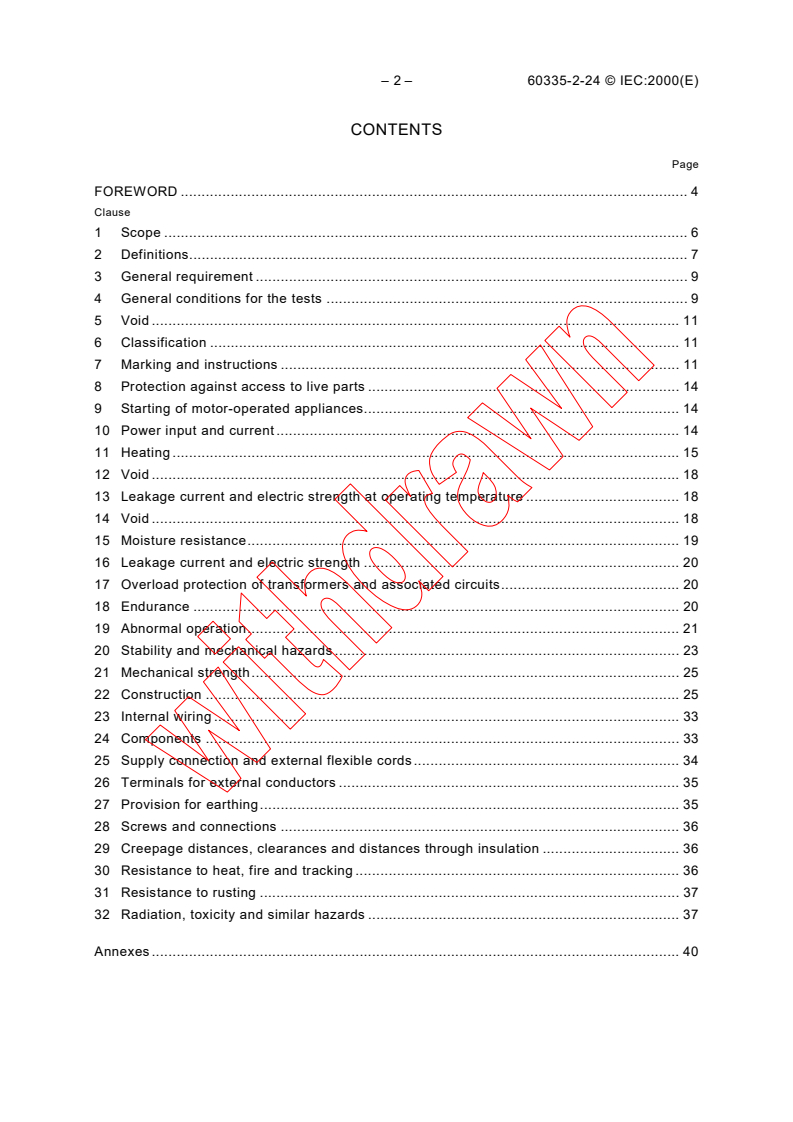
CONTENTS
Page
FOREWORD . 4
Clause
1 Scope . 6
2 Definitions. 7
3 General requirement . 9
4 General conditions for the tests . 9
5 Void . 11
6 Classification .11
7 Marking and instructions . 11
8 Protection against access to live parts . 14
9 Starting of motor-operated appliances. 14
10 Power input and current . 14
11 Heating . 15
12 Void . 18
13 Leakage current and electric strength at operating temperature . 18
14 Void . 18
15 Moisture resistance. 19
16 Leakage current and electric strength . 20
17 Overload protection of transformers and associated circuits. 20
18 Endurance .20
19 Abnormal operation. 21
20 Stability and mechanical hazards . 23
21 Mechanical strength. 25
22 Construction .25
23 Internal wiring . 33
24 Components . 33
25 Supply connection and external flexible cords. 34
26 Terminals for external conductors . 35
27 Provision for earthing. 35
28 Screws and connections . 36
29 Creepage distances, clearances and distances through insulation . 36
30 Resistance to heat, fire and tracking . 36
31 Resistance to rusting . 37
32 Radiation, toxicity and similar hazards . 37
Annexes . 40
60335-2-24 © IEC:2000(E) – 3 –
Figure 101 – Apparatus for spillage test . 38
Figure 102 – Detail of scratching tool tip . 39
Figure AA.1 – Supply circuit for locked-rotor test of a single-phase fan motor. 42
Figure BB.1 – Diagram of apparatus for water evaporation for accumulation of frost . 44
Figure BB.2 – Apparatus for water evaporation and for accumulation of frost . 45
Table 101 – Maximum temperatures for motor-compressors. 17
Table 102 – Refrigerant flammability parameters. 31
– 4 – 60335-2-24 © IEC:2000(E)
INTERNATIONAL ELECTROTECHNICAL COMMISSION
–––––––––––
SAFETY OF HOUSEHOLD AND SIMILAR ELECTRICAL APPLIANCES –
Part 2-24: Particular requirements for refrigerating appliances,
ice-cream appliances and ice-makers
FOREWORD
1) The IEC (International Electrotechnical Commission) is a worldwide organization for standardization comprising
all national electrotechnical committees (IEC National Committees). The object of the IEC is to promote
international co-operation on all questions concerning standardization in the electrical and electronic fields. To
this end and in addition to other activities, the IEC publishes International Standards. Their preparation is
entrusted to technical committees; any IEC National Committee interested in the subject dealt with may
participate in this preparatory work. International, governmental and non-governmental organizations liaising
with the IEC also participate in this preparation. The IEC collaborates closely with the International
Organization for Standardization (ISO) in accordance with conditions determined by agreement between the
two organizations.
2) The formal decisions or agreements of the IEC on technical matters express, as nearly as possible, an
international consensus of opinion on the relevant subjects since each technical committee has representation
from all interested National Committees.
3) The documents produced have the form of recommendations for international use and are published in the form
of standards, technical specifications, technical reports or guides and they are accepted by the National
Committees in that sense.
4) In order to promote international unification, IEC National Committees undertake to apply IEC International
Standards transparently to the maximum extent possible in their national and regional standards. Any
divergence between the IEC Standard and the corresponding national or regional standard shall be clearly
indicated in the latter.
5) The IEC provides no marking procedure to indicate its approval and cannot be rendered responsible for any
equipment declared to be in conformity with one of its standards.
6) Attention is drawn to the possibility that some of the elements of this International Standard may be the subject
of patent rights. The IEC shall not be held responsible for identifying any or all such patent rights.
International Standard IEC 60335-2-24 has been prepared by subcommittee 61C: Household
appliances for refrigeration, of IEC technical committee 61: Safety of household and similar
electrical appliances.
It forms the fifth edition of IEC 60335-2-24 and replaces the fourth edition published in 1997,
its amendment 1 (1998) and amendment 2 (1999).
The text of this standard is based on the fourth edition, amendments 1 and 2 and the following
documents:
FDIS Report on voting
61C/176/FDIS 61C/183/RVD
Full information on the voting for the approval of this standard can be found in the report on
voting indicated in the above table.
Annex AA forms an integral part of this standard.
Annex BB is for information only.
The contents of the corrigendum of March 2001 have been included in this copy.
60335-2-24 © IEC:2000(E) – 5 –
This part 2-24 is to be used in conjunction with the latest edition of IEC 60335-1 and its
amendments. It was established on the basis of the third edition (1991) of that standard.
This part 2-24 supplements or modifies the corresponding clauses in IEC 60335-1, so as to
convert that publication into the IEC standard: Safety requirements for refrigerating
appliances, ice-cream appliances and ice-makers.
Where a particular subclause of part 1 is not mentioned in this part 2, that subclause applies
as far as is reasonable. Where this standard states "addition", "modification# or
"replacement", the relevant text in part 1 is to be adapted accordingly.
NOTE 1 In this standard, the following print types are used:
– requirements: in roman type;
– test specifications: in italic type;
– notes: in smaller roman type.
Words in bold in the text are defined in clause 2. When a definition of part 1 concerns an adjective, the adjective
and the associated noun are also in bold.
NOTE 2 Subclauses, notes, tables and figures which are additional to those in part 1 are numbered starting from
101, annexes which are additional to those in part 1 are lettered AA, BB, etc.
The following additional differences exist in some countries:
– 6.101: Only appliances of tropical class T are allowed (Australia, Israel, New Zealand).
A bilingual version of this standard may be issued at a later date.
– 6 – 60335-2-24 © IEC:2000(E)
SAFETY OF HOUSEHOLD AND SIMILAR ELECTRICAL APPLIANCES –
Part 2-24: Particular requirements for refrigerating appliances,
ice-cream appliances and ice-makers
1 Scope
This clause of part 1 is replaced by:
This standard deals with the safety of the following appliances, their rated voltage being not
more than 250 V for single-phase appliances, 480 V for other appliances and 24 V d.c. for
appliances when battery operated.
– refrigerating appliances for household and similar use;
– ice-makers incorporating a motor-compressor and ice-makers intended to be
incorporated in frozen food storage compartments;
– refrigerating appliances and ice-makers for use in camping, touring caravans and boats
for leisure purposes.
These appliances may be operated from the mains, from a separate battery or operated either
from the mains or from a separate battery.
This standard also deals with the safety of ice-cream appliances intended for household use,
their rated voltage being not more than 250 V for single-phase appliances and 480 V for
other appliances.
It also deals with compression-type appliances for household and similar use, which use
flammable refrigerants.
This standard does not cover features of the construction and operation of those
refrigerating appliances which are dealt with in ISO standards.
Appliances not intended for normal household use but which nevertheless may be a source of
danger to the public, such as appliances intended to be used by laymen in shops, in light
industry and on farms, are within the scope of this standard.
As far as is practicable, this standard deals with the common hazards presented by
appliances which are encountered by all persons in and around the home.
This standard does not in general take into account
– the use of appliances by young children or infirm persons without supervision;
– playing with the appliance by young children.
NOTE 1 Attention is drawn to the fact that
– for appliances intended to be used in vehicles or on board ships or aircraft, additional requirements may be
necessary;
– in many countries additional requirements are specified by national health authorities, the national authorities
responsible for the protection of labour and the national authorities responsible for transportation.
60335-2-24 © IEC:2000(E) – 7 –
NOTE 2 This standard does not apply to
– appliances intended to be used in the open air;
– appliances designed exclusively for industrial purposes;
– appliances intended to be used in locations where special conditions prevail, such as the presence of a
corrosive or explosive atmosphere (dust, vapour or gas);
– appliances incorporating a battery intended as a power supply for the refrigerating function;
– appliances assembled on site by the installer;
– appliances with remote motor-compressors;
– motor-compressors (IEC 60335-2-34);
– commercial dispensing appliances and vending appliances (IEC 60335-2-75);
– commercial ice-cream appliances.
2 Definitions
This clause of part 1 is applicable except as follows:
2.2.9 Replacement:
normal operation
operation of the appliance under the following conditions:
2.2.9.1
normal operation of a refrigerating appliance
operation at an ambient temperature according to 4.7, empty, with the doors and lids closed.
User-adjustable temperature control devices which control the operation of the motor-
compressor in compression-type appliances, are short-circuited or otherwise rendered
inoperative
2.2.9.2
normal operation of an ice-maker
operation at an ambient temperature according to 4.7, with the supply water at a temperature
of 15 °C ± 2 °C
2.2.9.3
normal operation of an incorporated ice-maker
operation at the normal temperature of the frozen food storage compartment, with the supply
water at a temperature of 15 °C ± 2 °C
2.2.9.4
normal operation of an ice-cream appliance
operation of the appliance using the maximum quantity of the mixture of ingredients indicated
in the instructions; the mixture used being that which gives the most unfavourable results, the
mixture being at an initial temperature of 23 °C ± 2 °C
2.101
refrigerating appliance
enclosed thermally insulated appliance of suitable volume for household use, cooled by an
incorporated device and having one or more compartments intended for the preservation of
foodstuffs
2.102
compression-type appliance
appliance in which refrigeration is effected by the vaporization at low pressure in a heat
exchanger (evaporator) of a liquid refrigerant, the vapour thus formed being restored to the
liquid state by mechanical compression at a higher pressure and subsequent cooling in
another heat exchanger (condenser)
– 8 – 60335-2-24 © IEC:2000(E)
2.103
ice-maker
appliance in which ice is made by freezing water by a device consuming electrical energy and
having a compartment for storing the ice
2.104
incorporated ice-maker
ice-maker specially designed to be incorporated into a frozen food storage compartment and
without independent means for freezing water
2.105
heating system
heating element with associated components such as timers, switches, thermostats and
other controls
2.106
absorption-type appliance
appliance in which refrigeration is effected by the evaporation in a heat exchanger
(evaporator) of a liquid refrigerant, in the liquid state, the resulting vapour being then
absorbed by an absorbent medium from which it is subsequently expelled at a higher partial
vapour pressure by heating and liquefied by cooling in another heat exchanger (condenser)
2.107
condenser
heat exchanger in which, after compression, vaporized refrigerant is liquefied by losing heat
to an external cooling medium
2.108
evaporator
heat exchanger in which, after pressure reduction, the liquid refrigerant is vaporized by
absorbing heat from the medium to be refrigerated
2.109
flammable refrigerant
refrigerant with a flammability classification of group 2 or 3 according to ISO 5149
NOTE For refrigerant blends which have more than one flammability classification, the most unfavourable
classification is taken for the purposes of this definition.
2.110
ice-cream appliance
compression-type appliance which is used to make ice-cream
2.111
free space
space with a volume exceeding 60 l where a child can be entrapped and which is accessible
after opening any door, lid or drawer and removing any detachable internal part, including
shelves, containers or removable drawers which are themselves only accessible after opening
any door or lid. In calculating the volume, a space with any single dimension not exceeding
150 mm or any two orthogonal dimensions, each of which do not exceed 200 mm, is ignored
60335-2-24 © IEC:2000(E) – 9 –
3 General requirement
This clause of part 1 is applicable except as follows:
Addition:
NOTE 101 The use of flammable refrigerants involves additional hazards which are not associated with
appliances using non-flammable refrigerants.
This standard addresses the hazards due to ignition of leaked flammable refrigerant by potential ignition sources
associated with the appliance.
The hazard due to ignition of leaked flammable refrigerant by an external potential ignition source associated with
the environment in which the appliance is installed is compensated by the low probability of ignition.
4 General conditions for the tests
This clause of part 1 is applicable except as follows:
4.2 Addition:
At least one additional specially prepared sample is required for the tests of 22.107.
NOTE 1 Separate samples of the motor compressors may be needed for the tests of 19.1.
NOTE 2 The test of 22.7 may be carried out on separate samples.
NOTE 3 Due to the potentially hazardous nature of the tests of 22.107, 22.108 and 22.109, special precautions
may need to be taken when carrying out the tests.
Addition:
4.3
Before starting the tests
– ice-cream appliances are operated empty at rated voltage for 1 h or the maximum
setting of an incorporated timer, whichever is shorter;
– other compression-type appliances shall be operated at rated voltage for at least 24 h,
then switched off and left to stand for at least 12 h.
The test of 11.102 is carried out immediately after the tests of clause 13.
The test of 15.105 is carried out immediately after the test of 11.102.
The tests of 15.102, 15.103 and 15.104 are carried out immediately after the test of 15.2.
4.4 Replacement:
Tests are carried out using each source of energy (electricity, gas or other fuel) in turn. Gas
appliances are supplied at the appropriate rated pressure.
Tests are additionally carried out with all combinations of energy sources supplied
simultaneously unless this is prevented by interlocking devices.
4.7 Addition:
For ice-cream appliances, tests specified in clauses 10, 11 and 13 are carried out at an
ambient temperature of 23 °C ± 2 °C.
– 10 – 60335-2-24 © IEC:2000(E)
For other appliances, tests specified in clauses 10, 11, 13 and subclause 19.103 are carried
out at an ambient temperature of
32 °C ± 1 °C on appliances of extended temperate (SN) and temperate (N) classes;
38 °C ± 1 °C on appliances of subtropical (ST) class;
43 °C ± 1 °C on appliances of tropical (T) class.
Before starting these tests, the appliance with the doors or lids open is brought to within 2 K
of the ambient temperature specified.
Appliances classified for several climatic classes are tested at the ambient temperature
relevant to the highest climatic class.
Other tests are carried out at an ambient temperature of 20 °C ± 5 °C.
NOTE Steady conditions are considered to be established when three successive readings of the temperature,
taken at approximately 60 min intervals, at the same point of any operating cycle, do not differ by more than 1 K.
4.8.1 Addition:
Appliances which can be battery operated are tested at the more unfavourable polarity when
the supply terminals or terminations for the connection of the battery have no indication for
polarity.
4.9 Addition:
Appliances incorporating an ice-maker are tested with the ice-maker operating to give the
most unfavourable results.
4.10 Addition
For the tests of 22.107, 22.108 and 22.109, the appliance is empty and installed as outlined
below:
Built-in appliances are installed in accordance with the instructions for installation.
Other appliances are placed in a test enclosure, the walls enclosing the appliance as near to
all its sides and the top of the appliance as possible, unless the manufacturer indicates in the
instructions for installation that a free distance shall be observed from the walls or the ceiling,
in which case this distance is observed during the test.
NOTE Commonly available fixing hardware, such as screws and bolts, need not be delivered with a fixed
appliance.
4.101 Appliances which are constructed so that an ice-maker may be incorporated are
tested with the intended ice-maker.
4.102 Compression-type appliances with heating systems and Peltier-type appliances
are tested as combined appliances.
4.103 Compression-type appliances which use flammable refrigerants and which,
according to the instructions, may be used with other electrical appliances inside a food
storage compartment are tested with such recommended appliances incorporated and being
operated as in normal use.
NOTE Examples of such electrical appliances are ice-cream makers and deodorizers.
60335-2-24 © IEC:2000(E) – 11 –
5 Void
6 Classification
This clause of part 1 is applicable except as follows:
6.101 Appliances, other than ice-cream appliances, shall be of one or more of the following
climatic classes:
– appliances of extended temperate class (SN);
– appliances of temperate class (N);
– appliances of subtropical class (ST);
– appliances of tropical class (T).
Compliance is checked by inspection.
NOTE The climatic classes are specified in ISO standards.
7 Marking and instructions
This clause of part 1 is applicable except as follows:
7.1 Addition:
Appliances shall also be marked with
– the power input, in watts, of heating systems, if greater than 100 W;
– the defrosting input, in watts, if greater than the input corresponding to the rated power
input;
– rated power input in watts or rated current in amperes, except that compression-type
appliances, other than ice-cream appliances, shall be marked only with the rated
current in amperes;
– the letters SN, N, ST or T indicating the climatic class of the appliance;
– the maximum rated wattage of lamps, in watts;
– the total mass of the refrigerant;
NOTE 101 For absorption-type appliances using ammonia, the total mass of the refrigerant is considered to be
the mass of ammonia used.
– for a single component refrigerant, at least one of the following:
• the chemical name,
• the chemical formula,
• the refrigerant number;
– for a blended refrigerant, at least one of the following:
• the chemical name and nominal proportion of each of the components,
• the chemical formula and nominal proportion of each of the components,
• the refrigerant number and nominal proportion of each of the components,
• the refrigerant number of the refrigerant blend.
– 12 – 60335-2-24 © IEC:2000(E)
– the chemical name or refrigerant number of the principal component of the insulation
blowing gas.
NOTE 102 Refrigerant numbers are given in ISO 817.
For compression-type appliances, the defrosting power input in watts shall be marked
separately if the current corresponding to the defrosting power input is greater than the rated
current of the appliance.
Appliances which can be mains and battery operated shall be marked with the battery voltage.
Appliances which can be battery operated shall be marked with the type of battery,
distinguishing between rechargeable and non-rechargeable batteries, if necessary, unless the
type is irrelevant for the operation of the appliance.
The means provided for connection of any additional electrical supply shall be marked with
the voltage and nature of the supply.
Appliances designed for incorporating an ice-maker shall be marked with the maximum power
input for an incorporated ice-maker, if greater than 100 W.
Ice-makers without automatic water level control shall be marked with the maximum
permissible water level.
Appliances shall be marked with details of the source of supply other than electrical, if any.
For compression-type refrigerating systems, the appliance shall also be marked with the
mass of the refrigerant for each separate refrigerant circuit.
Compression-type appliances which use flammable refrigerants shall be marked with
warning sign B.3.2 from ISO 3864.
7.6 Addition:
The perpendicular height of the triangle containing the warning sign B.3.2 from ISO 3864 shall
be at least 15 mm.
7.10 Addition:
NOTE 101 As an alternative, temperature values in degrees Celsius may be indicated on a control scale.
7.12 Addition:
The instructions for refrigerating appliances and ice-makers for camping or similar use shall
include the substance of the following:
– suitable for camping use;
– the appliance may be connected to more than one source of energy;
NOTE 101 This item is not applicable to appliances which are intended to be supplied by electricity only.
– the appliance shall not be exposed to rain
NOTE 102 This item is not applicable to appliances with a degree of protection against harmful ingress of water of
at least IPX4.
60335-2-24 © IEC:2000(E) – 13 –
The instructions for ice-makers not intended to be connected to the water supply shall state
the substance of the following warning:
WARNING – fill with potable water only.
For compression-type appliances which use flammable refrigerants, the instructions shall
include information pertaining to the installation, handling, servicing and disposal of the
appliance.
The instructions shall also include the substance of the warnings listed below:
WARNING – keep ventilation openings, in the appliance enclosure or
in the built-in structure, clear of obstruction.
WARNING – do not use mechanical devices or other means to accelerate
the defrosting process, other than those recommended by the manufacturer.
WARNING – do not damage the refrigerant circuit.
NOTE 103 This warning is only applicable to appliances with refrigerating circuits which are accessible to the
user.
WARNING – do not use electrical appliances inside the food storage compartments
of the appliance, unless they are of the type recommended by the manufacturer.
For appliances which use flammable insulation blowing gases, the instructions shall include
information regarding disposal of the appliance.
The instructions for ice-cream appliances shall include the ingredients and maximum
quantity of mixtures that can be used in the appliance.
7.12.1 Addition:
Instructions shall include the method for replacing illuminating lamps.
For appliances designed for incorporating ice-makers, the instructions shall include the types
of ice-makers which can be incorporated.
The instructions shall include information on the installation of incorporated ice-makers
which are available as optional accessories and intended to be installed by the user. If it is
intended that incorporated ice-makers are to be installed only by the manufacturer or its
service agent, this shall be stated.
The instructions for ice-makers intended to be connected to the water supply shall state
– the maximum permissible inlet water pressure, in pascals or bars;
– the minimum permissible inlet water pressure, in pascals or bars, if this is necessary for
the correct operation of the appliance;
– the substance of the following warning:
WARNING – connect to potable water supply only.
The instructions for fixed appliances shall include the substance of the following warning:
WARNING – to avoid a hazard due to instability of the appliance,
it must be fixed according to the instructions.
– 14 – 60335-2-24 © IEC:2000(E)
7.12.4 Modification:
This subclause is also applicable to fixed appliances.
7.15 Addition:
The marking of the maximum rated wattage of illuminating lamps shall be easily discernible
while the lamp is being replaced.
For compression-type appliances the marking of the type of flammable refrigerant and of
the flammable insulation blowing gas, as well as the warning sign B.3.2 from ISO 3864, shall
be visible when gaining access to the motor-compressors.
For other appliances the marking of the type of flammable insulation blowing gas shall be on
the external enclosure.
7.101 For appliances which can be battery operated the supply terminals or terminations for
connections to the battery shall be clearly indicated by the symbol "+" or the colour red for the
positive polarity, and by the symbol "–" or the colour black for the negative polarity, unless the
polarity is irrelevant.
Compliance is checked by inspection.
8 Protection against access to live parts
This clause of part 1 is applicable except as follows:
8.1.1 Modification:
Replace the second paragraph of the test specification by the following:
Lamps are not removed, provided that the appliance can be isolated from the supply by
means of a plug or an all-pole switch. However, during the insertion or removal of lamps,
protection against contact with live parts of the lamp cap shall be ensured.
9 Starting of motor-operated appliances
This clause of part 1 is not applicable.
10 Power input and current
This clause of part 1 is applicable except as follows:
10.1 Modification:
Replace the third dashed item of the first paragraph of the test specification by the following:
– the appliance being operated under normal operation except that user adjustable
temperature controls are set to give the lowest temperature.
Addition:
The power input is considered to be stabilized when steady conditions are established or
when any incorporated timer operates, whichever occurs first.
60335-2-24 © IEC:2000(E) – 15 –
A representative period is one between the making and the breaking of the temperature
control, or between the highest and lowest values of power input measured, excluding starting
power input but including the power input of the incorporated ice-maker, if any.
NOTE 101 The power input of a defrosting system which is separately marked on the appliance is not taken into
consideration during the test.
10.2 Modification:
Replace the third dashed item of the first paragraph of the test specification by the following:
– the appliance being operated under normal operation except that user adjustable
temperature controls are set to give the lowest temperature.
Addition:
The appliance is operated for a period of 1 h or the maximum setting of an incorporated timer
whichever is shorter. Excluding starting current, the maximum value of the current averaged
over any 5 min period is obtained. The interval between current measurements shall not
exceed 30 s.
NOTE 101 Starting current is considered to be excluded if the first current measurement is made approximately
1 min after starting.
10.101 The power input of the defrosting system shall not deviate from the defrosting power
input marked on the appliance by more than the deviation shown in table 1.
Compliance is checked by operating the appliance at rated voltage and measuring the power
input of the defrosting system after the power input has stabilized.
10.102 The power input of any heating system shall not deviate from the power input of
these systems marked on the appliance by more than the deviation shown in table 1.
Compliance is checked by operating the appliance at rated voltage and measuring the power
input of the heating system after the power input has stabilized.
11 Heating
This clause of part 1 is applicable except as follows:
11.1 Modification:
Compliance is checked by determining the temperature rise of the various parts under the
conditions specified in 11.2 to 11.7.
If the winding temperatures of motor-compressors exceed the values given in table 101,
compliance is checked by the test of 11.101.
The winding temperatures of motor-compressors complying with IEC 60335-2-34 including its
annex AA are not measured.
11.2 Replacement:
Built-in appliances are installed in accordance with the instructions for installation.
Ice-cream appliances are placed as near to the walls of the test corner as possible, unless
the manufacturer indicates in the instructions for use that a free distance shall be observed
from the walls, in which case, this distance is observed during the test. If means of ventilation
are supplied by the manufacturer, they are mounted as intended.
– 16 – 60335-2-24 © IEC:2000(E)
Other appliances are placed in a test enclosure. The walls enclose the appliance as near to
all its sides and above as possible, unless the manufacturer indicates in the instructions for
installation that a free distance shall be observed from the walls or the ceiling, in which case
this distance is observed during the test.
Dull black painted plywood approximately 20 mm thick is used for the test corner, supports
and installation of built-in appliances and for the test enclosure for other appliances.
11.7 Replacement:
The appliance is operated until steady conditions are established.
11.8 Modification:
Replace the text above table 3 by the following:
During the test, protective devices other than self-resetting thermal motor-protectors for
motor-compressors shall not operate. When steady conditions are established, self-resetting
thermal motor-protectors for motor-compressors shall not operate.
During the test, sealing compound, if any, shall not flow out.
During the test, temperature rises are monitored continuously.
For appliances of extended temperate (SN) or temperate (N) class, the temperature rises
shall not exceed the values given in table 3.
For appliances of subtropical (ST) or tropical (T) class, the temperature rises shall not exceed
the values given in table 3 reduced by 7 K.
Addition:
The entry in table 3 relating to the temperature rise of the external enclosure of motor-
operated appliances is applicable to all appliances covered by this standard. However it is
not applicable to those parts of the external enclosure which are:
– for built-in appliances, not accessible parts after installation in accordance with the
instructions for installation;
– for other appliances, on that part of the appliance which according to the instructions for
installation, is intended to be placed against a wall with a free distance not exceeding
75 mm.
Temperatures of
– enclosures of motor-compressors other than those with an enclosure for which the
temperature rise is specified in table 3;
– windings of motor-compressors;
shall not exceed the values given in table 101.
For motor-compressors complying with IEC 60335-2-34 including its annex AA, the
temperatures of their
– enclosures, other than those with an enclosure for which the temperature rise is specified
in table 3;
– windings and other parts;
are not measured.
60335-2-24 © IEC:2000(E) – 17 –
Table 101 – Maximum temperatures for motor-compressors
Part of the motor-compressor Temperature
(C
Windings with
– synthetic insulation 140
– cellulose insulation or the like 130
External enclosure 150
11.101 If the temperatures of the windings of motor-compressors other than those complying
with IEC 60335-2-34 including its annex AA are higher than the temperature limits given in
table 101, the test is carried out again, the thermostat or similar control device being set at
the lowest temperature, and the short circuit of the user-adjustable temperature control device
removed.
The winding temperatures are measured at the end of a running cycle.
The temperatures shall be not higher than the temperature limits given in table 101.
11.102 Any defrosting system shall not give rise to excessive temperatures.
Compliance is checked by the following test:
The appliance is supplied at the most unfavourable voltage between 0,94 and 1,06 times the
rated voltage:
– in the case of appliances where defrosting is manually controlled, until the evaporator is
coated with a layer of frost;
– in the case of appliances where defrosting is automatically or semi-automatically
controlled, until the evaporator is coated with a layer of frost; however, this layer shall be
not thicker than that which occurs in normal use during the intervals between the
successive automatic defrosting operations or, for the semi-automatic defrosting, during
the intervals between the defrosting operations recommended by the manufacturer, if any.
NOTE 1 One method of accumulation of frost for refrigerating appliances is given in annex BB.
With the defrosting system operating:
– for absorption-type appliances and for compression-type appliances in which the
defrosting system can be energized with the rest of the appliance unenergized, the supply
voltage is as specified in 11.4;
– for other compression-type appliances, the supply voltage is as specified in 11.6.
NOTE 2 The defrosting system is regarded as being able to be energized separately if this can be done without
the use of a tool.
If the defrosting time is controlled by an adjustable device, the device is set to the time
recommended by the manufacturer. If a control device is used which stops the defrosting at a
given temperature or pressure, the defrosting period is automatically terminated when the
control operates.
For manually controlled defrosting, the test is continued until steady conditions are
established, otherwise the test is continued until the defrosting period is automatically
terminated by a control device.
– 18 – 60335-2-24 © IEC:2000(E)
The temperatures of combustible materials and of electrical components liable to be affected
by the defrosting operation are measured with thermocouples.
The temperatures and temperature rises shall not exceed the values given in 11.8.
NOTE 3 During the recovery period after defrosting, the thermal overload protector of the motor compressor may
operate.
11.103 Heating systems, other than defrosting systems, incorporated in an appliance shall
not give rise to excessive temperatures.
Compliance is checked by the following test:
Heating systems other than defrosting systems are energized as follows:
– for absorption-type appliances and for compression-type appliances in which the
heating system can be energized with the rest of the appliance unenergized, the supply
voltage is as specified in 11.4;
– for other compression-type appliances the supply voltage is as specified in 11.6.
NOTE The defrosting system is regarded as being able to be energized separately, if this can be done without the
use of a tool.
The test is continued until steady conditions are established.
Temperature rises are measured by means of thermocouples fixed on the outside surface of
the insulation of the heating systems.
Temperature rises shall not exceed the values given in 11.8.
12 Void
13 Leakage current and electric strength at operating temperature
This clause of part 1 is applicable except as follows:
13.1 Addition:
The test of 13.2 does not apply to battery circuits.
13.2 Modification:
Instead of the values specified for class 0I appliances and the various types of class I
appliances, the following values apply:
– for class 0I appliances 0,75 mA
– for class I appliances 1,5 mA
14 Void
60335-2-24 © IEC:2000(E) – 19 –
15 Moisture resistance
This clause of part 1 is applicable except as follows:
15.2 Addition:
Lamp covers are not removed.
15.101 Appliances subject to spillage of liquid from containers onto the inside walls of the
cabinet or compartment, or onto the top of the cabinet shall be constructed so that such
spillage does not affect their electrical insulation.
Compliance is checked by the relevant tests of 15.102, 15.103 and 15.104.
15.102 The apparatus shown in figure 101 is filled with water containing approximately 1 %
NaCl to the level of the lip and the displacement block is supported just above the water by
means of any suitable release mechanism and bridge support.
All shelves and containers which can be removed without the use of a tool are removed and
the appliance is disconnected from the supply. Lamp covers are not removed.
The apparatus is supported with its base horizontal and so positioned and at such a height
that when the release mechanism is operated, the water is discharged over the back and side
interior walls of the cabinet or compartment including any electrical components mounted
thereon, in the most unfavourable manner. The test is made only once with the apparatus in
any one position, but the test may be rep
...