

IEC 60335-2-24:2010/AMD2:2017
(Amendment)Amendment 2 - Household and similar electrical appliances - Safety - Part 2-24: Particular requirements for refrigerating appliances, ice-cream appliances and ice makers
General Information
- Abstract
The contents of the Interpretation sheet of April 2018 and March 2020 have been included in this copy.
- Status
- Published
- Publication Date
- 18-Apr-2017
- Technical Committee
- SC 61C - Safety of refrigeration appliances for household and commercial use
- Current Stage
- DELPUB - Deleted Publication
- Start Date
- 16-Sep-2020
- Completion Date
- 28-Aug-2026
Buy Documents
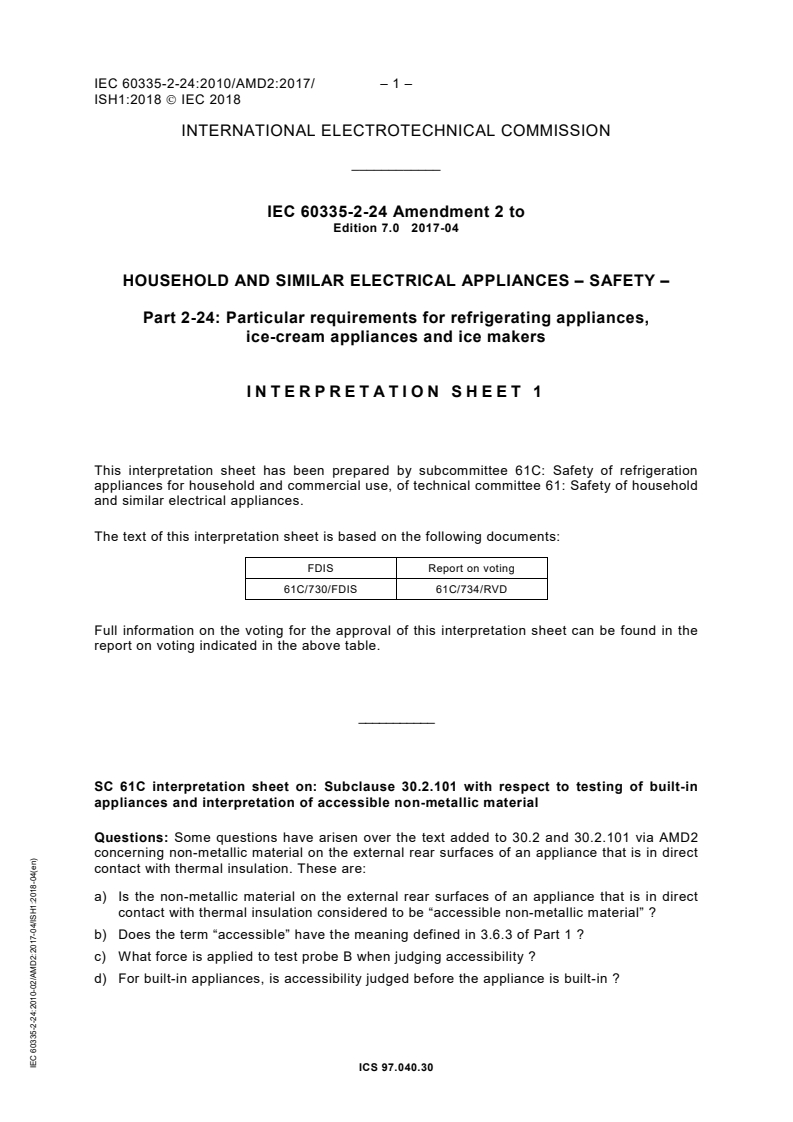
IEC 60335-2-24:2010/AMD2:2017 - Amendment 2 - Household and similar electrical appliances - Safety - Part 2-24: Particular requirements for refrigerating appliances, ice-cream appliances and ice makers Released:4/19/2017
Overview
IEC 60335-2-24:2010/AMD2:2017 is Amendment 2 to the international standard IEC 60335-2-24, which details the particular safety requirements for household and similar electrical appliances, specifically refrigerating appliances, ice-cream appliances, and ice makers. Issued by the International Electrotechnical Commission (IEC), this amendment incorporates the essential guidance from Interpretation Sheets issued in April 2018 and March 2020, clarifying and updating testing methods and safety criteria. The amendment provides crucial updates for manufacturers and testing bodies, enhancing product safety and compliance in the global marketplace.
Key Topics
- Scope: The amendment addresses design and construction details concerning accessible thermal insulation and non-metallic materials, especially focusing on fire resistance and moisture protection on key surfaces of appliances.
- Flammability and Fire Resistance: It clarifies that materials on external rear surfaces in direct contact with thermal insulation and with a surface area exceeding 75 cm² must comply with specific flammability tests, such as the needle-flame test or classifications according to IEC 60695-11-10 (V-0, V-1).
- Testing Procedures: Updates to test methods for assessing moisture resistance, mechanical strength, and the performance of glass panels and internal wiring in refrigerating appliances.
- Marking and Instructions: Requires the use of the ISO 7010 W021 “Caution: risk of fire” symbol and ensures its meaning is clearly explained in user manuals. Updates also detail mandatory warnings about cord damage and socket placement.
- Normative References: Updates references to standards concerning refrigerants, safety classification, and related test methods, ensuring alignment with the latest ISO and IEC publications.
- Interpretation Clarifications: Clearly defines what constitutes “accessible” thermal insulation or non-metallic material, specifies the force to be used in testing, and outlines when and how testing is conducted on built-in appliances.
Applications
The practical value of IEC 60335-2-24:2010/AMD2:2017 lies in its application to:
- Appliance Manufacturers: Ensure compliance with international safety regulations for refrigerating appliances, ice-makers, and ice-cream appliances by applying updated methods for fire resistance, moisture protection, and mechanical durability.
- Testing Laboratories: Conduct standardized evaluations of appliances by following the clarified test procedures for materials, moisture ingress, electrical safety, and mechanical impacts as stipulated in the amendment.
- Product Safety Assessors: Use the amendment’s requirements in conformity assessments, helping to verify that home and similar appliances pose minimal risk under normal use and foreseeable misuse.
- Certification Bodies: Reference the latest safety and labelling requirements to issue or renew the certifications needed for global appliance sales.
Related Standards
To ensure comprehensive appliance safety testing and certification, the following related standards should also be considered:
- IEC 60335-1: General requirements for the safety of electrical appliances.
- IEC 60695-11-10: Fire hazard testing, including needle-flame methods for flammability classification.
- IEC 60079-20-1: Test methods and data for explosive atmosphere classification, relevant for refrigerant testing.
- ISO 817: Refrigerants - Designation and safety classification.
- ISO 5149-1: Safety and environmental requirements for refrigerating systems and heat pumps.
Conclusion
IEC 60335-2-24:2010/AMD2:2017 significantly updates fire, moisture, construction, and marking requirements for household refrigerating appliances and similar products. By adopting this amendment, manufacturers and conformity bodies can better ensure product safety, regulatory compliance, and market acceptance worldwide. Proper implementation not only reduces risk for end-users but also facilitates smoother certification and global trade in electrical appliances.
Relations
- Effective Date
- 05-Sep-2023
- Effective Date
- 05-Sep-2023
Buy Documents
IEC 60335-2-24:2010/AMD2:2017 - Amendment 2 - Household and similar electrical appliances - Safety - Part 2-24: Particular requirements for refrigerating appliances, ice-cream appliances and ice makers Released:4/19/2017
Frequently Asked Questions
IEC 60335-2-24:2010/AMD2:2017 is a standard published by the International Electrotechnical Commission (IEC). Its full title is "Amendment 2 - Household and similar electrical appliances - Safety - Part 2-24: Particular requirements for refrigerating appliances, ice-cream appliances and ice makers". This standard covers: The contents of the Interpretation sheet of April 2018 and March 2020 have been included in this copy.
The contents of the Interpretation sheet of April 2018 and March 2020 have been included in this copy.
IEC 60335-2-24:2010/AMD2:2017 is classified under the following ICS (International Classification for Standards) categories: 97.040.30 - Domestic refrigerating appliances. The ICS classification helps identify the subject area and facilitates finding related standards.
IEC 60335-2-24:2010/AMD2:2017 has the following relationships with other standards: It is inter standard links to IEC 60335-2-24:2010, IEC 60335-2-24:2020. Understanding these relationships helps ensure you are using the most current and applicable version of the standard.
IEC 60335-2-24:2010/AMD2:2017 is available in PDF format for immediate download after purchase. The document can be added to your cart and obtained through the secure checkout process. Digital delivery ensures instant access to the complete standard document.
Standards Content (Sample)
IEC 60335-2-24 ®
Edition 7.0 2017-04
INTERNATIONAL
STANDARD
NORME
INTERNATIONALE
A MENDMENT 2
AM ENDEMENT 2
Household and similar electrical appliances – Safety –
Part 2-24: Particular requirements for refrigerating appliances, ice-cream
appliances and ice-makers
Appareils électrodomestiques et analogues – Sécurité –
Partie 2-24: Règles particulières pour les appareils de réfrigération, les
sorbetières et les fabriques de glace
IEC 60335-2-24:2010-02/AMD2:2017-04(en-fr)
All rights reserved. Unless otherwise specified, no part of this publication may be reproduced or utilized in any form
or by any means, electronic or mechanical, including photocopying and microfilm, without permission in writing from
either IEC or IEC's member National Committee in the country of the requester. If you have any questions about IEC
copyright or have an enquiry about obtaining additional rights to this publication, please contact the address below or
your local IEC member National Committee for further information.
Droits de reproduction réservés. Sauf indication contraire, aucune partie de cette publication ne peut être reproduite
ni utilisée sous quelque forme que ce soit et par aucun procédé, électronique ou mécanique, y compris la photocopie
et les microfilms, sans l'accord écrit de l'IEC ou du Comité national de l'IEC du pays du demandeur. Si vous avez des
questions sur le copyright de l'IEC ou si vous désirez obtenir des droits supplémentaires sur cette publication, utilisez
les coordonnées ci-après ou contactez le Comité national de l'IEC de votre pays de résidence.
IEC Central Office Tel.: +41 22 919 02 11
3, rue de Varembé Fax: +41 22 919 03 00
CH-1211 Geneva 20 info@iec.ch
Switzerland www.iec.ch
About the IEC
The International Electrotechnical Commission (IEC) is the leading global organization that prepares and publishes
International Standards for all electrical, electronic and related technologies.
About IEC publications
The technical content of IEC publications is kept under constant review by the IEC. Please make sure that you have the
latest edition, a corrigenda or an amendment might have been published.
IEC Catalogue - webstore.iec.ch/catalogue Electropedia - www.electropedia.org
The stand-alone application for consulting the entire The world's leading online dictionary of electronic and
bibliographical information on IEC International Standards, electrical terms containing 20 000 terms and definitions in
Technical Specifications, Technical Reports and other English and French, with equivalent terms in 16 additional
documents. Available for PC, Mac OS, Android Tablets and languages. Also known as the International Electrotechnical
iPad. Vocabulary (IEV) online.
IEC publications search - www.iec.ch/searchpub IEC Glossary - std.iec.ch/glossary
The advanced search enables to find IEC publications by a 65 000 electrotechnical terminology entries in English and
variety of criteria (reference number, text, technical French extracted from the Terms and Definitions clause of
committee,…). It also gives information on projects, replaced IEC publications issued since 2002. Some entries have been
and withdrawn publications. collected from earlier publications of IEC TC 37, 77, 86 and
CISPR.
IEC Just Published - webstore.iec.ch/justpublished
Stay up to date on all new IEC publications. Just Published IEC Customer Service Centre - webstore.iec.ch/csc
details all new publications released. Available online and If you wish to give us your feedback on this publication or
also once a month by email. need further assistance, please contact the Customer Service
Centre: csc@iec.ch.
A propos de l'IEC
La Commission Electrotechnique Internationale (IEC) est la première organisation mondiale qui élabore et publie des
Normes internationales pour tout ce qui a trait à l'électricité, à l'électronique et aux technologies apparentées.
A propos des publications IEC
Le contenu technique des publications IEC est constamment revu. Veuillez vous assurer que vous possédez l’édition la
plus récente, un corrigendum ou amendement peut avoir été publié.
Catalogue IEC - webstore.iec.ch/catalogue Electropedia - www.electropedia.org
Application autonome pour consulter tous les renseignements Le premier dictionnaire en ligne de termes électroniques et
bibliographiques sur les Normes internationales, électriques. Il contient 20 000 termes et définitions en anglais
Spécifications techniques, Rapports techniques et autres et en français, ainsi que les termes équivalents dans 16
documents de l'IEC. Disponible pour PC, Mac OS, tablettes langues additionnelles. Egalement appelé Vocabulaire
Android et iPad. Electrotechnique International (IEV) en ligne.
Recherche de publications IEC - www.iec.ch/searchpub Glossaire IEC - std.iec.ch/glossary
La recherche avancée permet de trouver des publications IEC 65 000 entrées terminologiques électrotechniques, en anglais
en utilisant différents critères (numéro de référence, texte, et en français, extraites des articles Termes et Définitions des
comité d’études,…). Elle donne aussi des informations sur les publications IEC parues depuis 2002. Plus certaines entrées
projets et les publications remplacées ou retirées. antérieures extraites des publications des CE 37, 77, 86 et
CISPR de l'IEC.
IEC Just Published - webstore.iec.ch/justpublished
Restez informé sur les nouvelles publications IEC. Just Service Clients - webstore.iec.ch/csc
Published détaille les nouvelles publications parues. Si vous désirez nous donner des commentaires sur cette
Disponible en ligne et aussi une fois par mois par email. publication ou si vous avez des questions contactez-nous:
csc@iec.ch.
IEC 60335-2-24 ®
Edition 7.0 2017-04
INTERNATIONAL
STANDARD
NORME
INTERNATIONALE
A MENDMENT 2
AM ENDEMENT 2
Household and similar electrical appliances – Safety –
Part 2-24: Particular requirements for refrigerating appliances, ice-cream
appliances and ice-makers
Appareils électrodomestiques et analogues – Sécurité –
Partie 2-24: Règles particulières pour les appareils de réfrigération, les
sorbetières et les fabriques de glace
INTERNATIONAL
ELECTROTECHNICAL
COMMISSION
COMMISSION
ELECTROTECHNIQUE
INTERNATIONALE
ICS 97.040.30 ISBN 978-2-8322-4159-2
ISH1:2018 IEC 2018
INTERNATIONAL ELECTROTECHNICAL COMMISSION
____________
IEC 60335-2-24 Amendment 2 to
Edition 7.0 2017-04
HOUSEHOLD AND SIMILAR ELECTRICAL APPLIANCES – SAFETY –
Part 2-24: Particular requirements for refrigerating appliances,
ice-cream appliances and ice makers
INTERPRETATION SHEET 1
This interpretation sheet has been prepared by subcommittee 61C: Safety of refrigeration
appliances for household and commercial use, of technical committee 61: Safety of household
and similar electrical appliances.
The text of this interpretation sheet is based on the following documents:
FDIS Report on voting
61C/730/FDIS 61C/734/RVD
Full information on the voting for the approval of this interpretation sheet can be found in the
report on voting indicated in the above table.
___________
SC 61C interpretation sheet on: Subclause 30.2.101 with respect to testing of built-in
appliances and interpretation of accessible non-metallic material
Questions: Some questions have arisen over the text added to 30.2 and 30.2.101 via AMD2
concerning non-metallic material on the external rear surfaces of an appliance that is in direct
contact with thermal insulation. These are:
a) Is the non-metallic material on the external rear surfaces of an appliance that is in direct
contact with thermal insulation considered to be “accessible non-metallic material” ?
b) Does the term “accessible” have the meaning defined in 3.6.3 of Part 1 ?
c) What force is applied to test probe B when judging accessibility ?
d) For built-in appliances, is accessibility judged before the appliance is built-in ?
ICS 97.040.30
IEC 60335-2-24:2010-02/AMD2:2017-04/ISH1:2018-04(en)
– 2 – IEC 60335-2-24:2010/AMD2:2017/
ISH1:2018 IEC 2018
Relevant text from IEC 60335-2-24 AMD2
The addition to 30.2 states:
For accessible thermal insulation and non-metallic material on the external rear surfaces of an
appliance having an area exceeding 75 cm that is in direct contact with the thermal
insulation, compliance is checked by the test of 30.2.101.
Subclause 30.2.101 states:
30.2.101 Accessible thermal insulation and non-metallic material on the external rear
surfaces of an appliance that is in direct contact with thermal insulation
− is subject to the needle-flame test (NFT) of Annex E; or
− shall comprise material classified as V-0 or V-1 according to IEC 60695-11-10 provided
that the test sample used for the classification was no thicker than the relevant part of the
appliance.
Non-metallic material
− that is within 150 mm from the top surface of the appliance;
− that is on the left side or right side of the motor-compressor compartment;
− that has an area not exceeding 75 cm that is in direct contact with the thermal insulation
is not tested.
ANSWERS
a) Yes
b) Yes
c) The test probe is applied with a force not exceeding 1 N
d) Yes. This is irrespective of the last paragraph of 5.10 of Part 1
ISH2:2020 IEC 2020
INTERNATIONAL ELECTROTECHNICAL COMMISSION
____________
IEC 60335-2-24
Edition 7.0 2010-02
Amendment 2: 2017-04
HOUSEHOLD AND SIMILAR ELECTRICAL APPLIANCES –
SAFETY –
Part 2-24: Particular requirements for refrigerating appliances,
ice-cream appliances and ice makers
INTERPRETATION SHEET 2
This interpretation sheet has been prepared by subcommittee 61C: Safety of refrigeration
appliances for household and commercial use, of technical committee 61: Safety of household
and similar electrical appliances.
The text of this interpretation sheet is based on the following documents:
DISH Report on voting
61C/839/DISH 61C/853/RVDISH
Full information on the voting for the approval of this interpretation sheet can be found in the
report on voting indicated in the above table.
___________
SC 61C interpretation sheet on: Subclause 30.2 of IEC 60335-2-24:2010/AMD2:2017
Subclause 30.2 states:
"Add the following to the addition:
For accessible thermal insulation and non-metallic material on the external rear surfaces of an
appliance having an area exceeding 75 cm that is in direct contact with the thermal
insulation, compliance is checked by the test of 30.2.101."
ICS 97.040.30
IEC 60335-2-24:2010-02/AMD2:2017-04/ISH2:2020-03(en-fr)
– 2 – IEC 60335-2-24:2010/AMD2:2017/
ISH2:2020 IEC 2020
Question 1: Has this subclause to be interpreted as:
"Add the following to the addition:
For accessible thermal insulation and non-metallic material on the external rear surfaces of an
appliance having a total area exceeding 75 cm that is in direct contact with the thermal
insulation, compliance is checked by the test of 30.2.101."
Subclause 30.2.101, final bullet point states:
• "that has an area not exceeding 75 cm that is in direct contact with the thermal
insulation is not tested. "
Question 2: Has this bullet point to be interpreted as:
• "that has a total area not exceeding 75 cm that is in direct contact with the thermal
insulation is not tested. "
Answers:
Question 1 –
From Subclause 30.2 addition, the following materials shall be tested:
1) Accessible thermal insulation
2) Non-metallic material on the rear surface of the appliance having an area exceeding
that is in direct contact with the thermal insulation
75 cm
Small holes (< 3 mm ) in the outer case were not intended to be considered as “accessible
thermal insulation”. These small < 3 mm holes are much smaller than the test probe B, so
therefore the thermal insulation of 3 mm holes is automatically not considered as accessible
thermal insulation without additional evaluation.
When testing accessible thermal insulation, the test is intended to be performed by applying
the flame to the accessible thermal insulation on the end product.
Question 2 – See question 1.
– 2 – IEC 60335-2-24:2010/AMD2:2017
© IEC 2017
FOREWORD
This amendment has been prepared by sub-committee 61C: Safety of refrigeration appliances
for household and commercial use, of IEC technical committee 61: Safety of household and
similar electrical appliances.
The text of this amendment is based on the following documents:
FDIS Report on voting
61C/694/FDIS 61C/700/RVD
Full information on the voting for the approval of this amendment can be found in the report
on voting indicated in the above table.
The committee has decided that the contents of this amendment and the base publication will
remain unchanged until the stability date indicated on the IEC website under
"http://webstore.iec.ch" in the data related to the specific publication. At this date, the
publication will be
• reconfirmed,
• withdrawn,
• replaced by a revised edition, or
• amended.
NOTE The attention of National Committees is drawn to the fact that equipment manufacturers and testing
organizations may need a transitional period following publication of a new, amended or revised IEC publication in
which to make products in accordance with the new requirements and to equip themselves for conducting new or
revised tests.
It is the recommendation of the committee that the content of this publication be adopted for implementation
nationally not earlier than 12 months or later than 36 months from the date of publication.
The contents of the interpretation sheet 1 of April 2018 and interpretation sheet 2 of March
2020 have been included in this copy.
_____________
2 Normative references
Delete references IEC 60079-4A and IEC/TR 60079-20 from the existing list.
Add the following new reference:
IEC 60079-20-1, Explosive atmospheres – Part 20-1: Material characteristics for gas and
vapour classification – Test methods and data
Replace the reference to ISO 817 by the following new reference:
ISO 817, Refrigerants – Designation and safety classification
Replace the reference to ISO 5149 by the following new reference:
ISO 5149-1, Refrigerating systems and heat pumps – Safety and environmental requirements
– Part 1: Definitions, classification and selection criteria
© IEC 2017
3 Terms and definitions
3.109 Replace the term definition by the following:
refrigerant with a flammability classification of A2L, A2 or A3 in accordance with ISO 817
5 General conditions for the tests
5.3 Replace the last paragraph of the addition by the following:
The tests of 15.101.1, 15.101.2, 15.103 and 15.104 are carried out immediately after the test
of 15.2.
7 Marking and instructions
7.1 In the first paragraph, third dashed item, delete “only”.
In the first paragraph, fifth dashed item, add “or its service agent” after “manufacturer”.
In the eleventh paragraph, replace “the symbol “Caution: risk of fire” with “the symbol
ISO 7010 W021”.
7.6 In the note, replace “the symbol “Caution: risk of fire” with “the symbol ISO 7010 W021”.
7.12 Add the following:
If symbol ISO 7010 W021 is used, its meaning shall be explained.
The instructions for refrigerating appliances and ice-makers shall include the substance of
the following:
WARNING: When positioning the appliance, ensure the supply cord is not trapped or
damaged.
WARNING: Do not locate multiple portable socket-outlets or portable power supplies at the
rear of the appliance.
7.14 In the first paragraph, replace “the symbol “Caution: risk of fire” with “the symbol
ISO 7010 W021”.
7.15 In the second paragraph, replace “the symbol “Caution: risk of fire” with “the symbol
ISO 7010 W021”.
15 Moisture resistance
Replace Subclauses 15.101, 15.102 and 15.103 by the following:
15.101 Appliances subject to spillage of liquid from containers onto the inside walls of the
cabinet or compartment shall be constructed so that such spillage does not affect their
electrical insulation.
Compliance is checked by the relevant tests of 15.101.1 and 15.101.2 using the spillage
solution specified in 15.2.
– 4 – IEC 60335-2-24:2010/AMD2:2017
© IEC 2017
15.101.1 The apparatus shown in Figure 101 is filled with the spillage solution to the level of
the lip, and the displacement block is supported just above the solution by means of any
suitable release mechanism and bridge support.
All shelves and containers which can be removed without the use of a tool are removed and
the appliance is disconnected from the supply. Lamp covers are not removed.
The apparatus is supported with its base horizontal and so positioned and at such a height
that when the release mechanism is operated, the solution is discharged over the back and
side interior walls of the cabinet or compartment including any electrical components mounted
thereon, in the most unfavourable manner. The test is made only once with the apparatus in
any one position, but the test may be repeated as many times as necessary in different
positions, provided that there is no residual solution on parts wetted by a previous test.
Immediately after the test, the appliance shall withstand the electric strength test of 16.3 and
inspection shall show that there is no trace of the solution on insulation which could result in a
reduction of clearances and creepage distances below the values specified in Clause 29.
Furthermore, if the inspection shows that the solution is in contact with the defrost heating
element or its insulation, then the complete heating element shall withstand the test of
22.102.
15.101.2 A rectangular container having dimensions of 200 mm x 110 mm and a height of
50 mm is filled with 0,5 l of the spillage solution.
The container is positioned, with its longest side parallel to the wall to be tested, on the
highest shelf on which it will fit, the shelf shall have a clearance to the ceiling of the
compartment of at least 130 mm. All other shelves and containers which can be removed
without the use of a tool are removed. Lamp covers are not removed.
The appliance is disconnected from the supply and the solution in the vessel is discharged
over the back and side interior walls of the cabinet or compartment including any electrical
components mounted thereon, in the most unfavourable manner within a period of 2 s. The
test is made only once with the container in any one position, but the test may be repeated as
many times as necessary in different positions, provided that there is no residual solution on
parts wetted by a previous test.
Immediately after the test, the appliance shall withstand the electric strength test of 16.3 and
inspection shall show that there is no trace of the solution on insulation which could result in a
reduction of clearances and creepage distances below the values specified in Clause 29.
Furthermore, if the inspection shows that the solution is in contact with the defrost heating
element or its insulation, then the complete heating element shall withstand the test of
22.102.
15.102 Appliances subject to spillage of liquid onto the top of the cabinet shall be
constructed so that such spillage does not affect their electrical insulation.
Compliance is checked by the relevant tests of 15.103 and 15.104. The spillage solution
specified in 15.2 is used for the test of 15.103.
15.103 Appliances, other than built-in appliances, ice-makers and ice-cream appliances
are tilted at an angle of up to 2° in relation to the position of normal use in the direction which
is likely to be the most unfavourable for this test. One half-litre of the spillage solution is
poured uniformly over the top of the appliance in approximately 60 s at the most unfavourable
place from a height of approximately 50 mm with the controls in the on position and the
appliance disconnected from the supply.
© IEC 2017
Immediately after the test, the appliance shall withstand the electric strength test of 16.3 and
inspection shall show that there is no trace of the solution on insulation which could result in a
reduction of clearances and creepage distances below the values specified in Clause 29.
20 Stability and mechanical hazards
20.101 In the last paragraph of the test specification, replace “tip” by “tilt by more than 2°
from the horizontal position”.
Delete Note 2 and replace “NOTE 1” by “NOTE”.
20.104 Replace the second paragraph by the following:
Each sliding drawer accessible without opening a door is loaded with a uniformly distributed
load/unit storage volume of the compartments of 0,5 kg/l.
21 Mechanical strength
Add the following new subclause:
21.1 Addition:
For accessible glass panels, the impact energy is 1,00 J ± 0,05 J.
22 Construction
22.109 Add the following to the end of fourth paragraph of the test specification:
"using a capillary tube having a diameter of 0,7 mm ± 0,05 mm."
Add the following before the existing penultimate paragraph of the test specification:
If the electrical component under consideration is situated within a separate enclosure and if
the refrigerant can stagnate within that enclosure, then the direction of refrigerant injection
shall be from the pipework joint under consideration towards any opening (such as ventilation
slots or cable entry ducts) in the separate enclosure.
22.110 In the requirement, replace “ignition” by “auto-ignition”.
Replace Table 102 by the following:
– 6 – IEC 60335-2-24:2010/AMD2:2017
© IEC 2017
Table 102 – Refrigerant flammability parameters
Refrigerant number Refrigerant name Refrigerant Refrigerant auto- Refrigerant lower
b, c, d,
formula ignition temperature explosive limit
a, c e,
°C % V/V
R-50 Methane CH 600 4,4
R-290 Propane CH CH CH 450 1,7
3 2 3
R-600 n-Butane CH CH CH CH 372 1,4
3 2 2 3
R-600a Isobutane (CH ) CHCH 460 1,3
3 2 3
a
Values for other flammable refrigerants can be obtained from IEC 60079-20-1 and ISO 5149-1.
b
Values for other flammable refrigerants can be obtained from IEC 60079-20-1 and ISO 817.
c
IEC 60079-20-1 is the reference standard. ISO 5149-1 and ISO 817 may be used if the required data is not
contained in IEC 60079-20-1.
d
Concentration of refrigerant in dry air.
e
In some standards, the term “flammability limit” is used for “explosive limit”.
22.116 Replace the existing text by the following:
Accessible glass panels with an area having any two orthogonal dimensions exceeding
75 mm shall be made from
• glass that breaks into small pieces when it fractures; or
• glass that is not released or dropped from its normal position when broken.
This requirement does not apply to accessible glass panels with an area having any two
orthogonal dimensions exceeding 75 mm inside the appliance made from glass that has
enhanced mechanical strength.
a) For glass that breaks into small pieces when it fractures, compliance is checked by the
following test which is performed on two samples.
Frames or other parts attached to the glass panel to be tested are removed and the glass
is placed on a rigid horizontal flat surface.
NOTE 1 The edges of the sample to be tested are contained within a frame of adhesive tape in such a
manner that the broken pieces remain in place after breakage but without hindering expansion of the sample.
The sample under test is broken by means of a test punch having a head with a mass of
75 g ± 5 g and a conical tungsten carbide tip with an angle of 60° ± 2°. The punch shall be
positioned approximately 13 mm in from the longest edge of the glass at the midpoint of
that edge. The punch is then hit by a hammer so that the glass breaks.
A transparent mask of 50 mm × 50 mm is placed on the fractured glass except within a
peripheral margin of 25 mm from the edge of the sample.
The assessment shall be undertaken on at least two areas of the sample, and the areas
chosen shall contain the largest particles.
The number of crack free particles within the mask is counted and for each assessment
shall not be less than 40. The particle count shall be made within 5 minutes of the
fracture. Each particle wholly contained within the area of the mask shall be counted as
one particle and each particle that is partially within the mask shall be counted as a half
particle.
NOTE 2 In the case of curved glass, plane
...