

IEC SRD 63456:2023
(Main)Navigation tools for smart manufacturing
General Information
- Abstract
IEC SRD 63456:2023 This document proposes external requirements for IT tools dedicated to smart manufacturing, to assist the development of manufacturing systems with international standards through linking reference models, use cases, architecture, and standards.
- Status
- Published
- Publication Date
- 05-Oct-2023
- Technical Committee
- SyC SM - Smart Manufacturing
- Drafting Committee
- WG 3 - SyC SM/WG 3
- Current Stage
- PPUB - Publication issued
- Start Date
- 06-Oct-2023
- Completion Date
- 08-Sep-2023
Overview
IEC SRD 63456:2023 - "Navigation tools for smart manufacturing" (Edition 1.0, 2023‑10) is a Systems Reference Deliverable published by the IEC Systems Committee SM: Smart Manufacturing. The document proposes external requirements for IT navigation tools that support the development of smart manufacturing systems by linking reference models, use cases, architectures and international standards. Its aim is to help stakeholders navigate standards-related artifacts and accelerate digital transformation in manufacturing through mapping and platform-enabled services.
Key topics and requirements
- Purpose and scope: Defines the objective, definition and expected value of navigation tools designed for smart manufacturing ecosystems.
- Functional and non‑functional requirements: The SRD identifies required tool capabilities and quality attributes (referenced as tables in the document), covering navigation, mapping, visualization, interoperability and performance expectations.
- Interfaces and relationships: Describes how navigation tools relate to IEC internal IT resources and domain‑neutral platform functionalities, including expectations for integration points with mapping platforms and other services.
- Categorization of functionalities: Provides a framework for grouping navigation features (search, map, traceability, linkage to standards) to support standards development and system design activities.
- Supplementary models and methodologies (Annexes A–E):
- Annex A: Unified Reference Model – Map and Methodology (URM‑MM) - methodology for mapping reference models, use cases and standards.
- Annex B–C: Examples such as Smart Grid Standards Map and maps created with the Mapping Platform (e.g., IEC 61850).
- Annex D: Practical development scheme and project guidance for implementing IT tools within IEC.
- Annex E: Investigation of platform requirements and recommended responsibilities for development phases.
Practical applications and users
IEC SRD 63456 is intended for:
- Standards developers and IEC technical committees who need to align standards, use cases and architectures.
- Tool and platform developers building mapping or navigation applications for manufacturing standards (e.g., Mapping Platform integrators).
- System architects and digital transformation leads in industry seeking to identify applicable standards, trace requirements and design interoperable manufacturing systems.
- Manufacturers, integrators and consultants who require traceable links between reference models, use cases and normative documents to speed implementation and compliance.
Practical uses include standards mapping, visualizing relationships between standards and system functions, supporting conformity assessment planning, and enabling collaborative development workflows across IEC and industrial stakeholders.
Related standards and resources
- Examples in the SRD reference IEC 61850 mappings and a Smart Grid Standards Map to illustrate the approach.
- The document was drafted in accordance with ISO/IEC Directives and connects to IEC’s Mapping Platform initiatives and other IEC digital‑support services.
Keywords: IEC SRD 63456:2023, navigation tools, smart manufacturing, mapping platform, reference models, use cases, standards mapping, IEC, manufacturing systems, digital transformation.
Get Certified
Connect with accredited certification bodies for this standard

DVS-ZERT GmbH
German welding certification society.
CARES (UK Certification Authority for Reinforcing Steels)
UK certification for reinforcing steels and construction.
EWF/IIW (European/International Welding Federation)
International welding personnel certification.
Sponsored listings
Frequently Asked Questions
IEC SRD 63456:2023 is a standardization document published by the International Electrotechnical Commission (IEC). Its full title is "Navigation tools for smart manufacturing". This standard covers: IEC SRD 63456:2023 This document proposes external requirements for IT tools dedicated to smart manufacturing, to assist the development of manufacturing systems with international standards through linking reference models, use cases, architecture, and standards.
IEC SRD 63456:2023 This document proposes external requirements for IT tools dedicated to smart manufacturing, to assist the development of manufacturing systems with international standards through linking reference models, use cases, architecture, and standards.
IEC SRD 63456:2023 is classified under the following ICS (International Classification for Standards) categories: 25.040.01 - Industrial automation systems in general. The ICS classification helps identify the subject area and facilitates finding related standards.
IEC SRD 63456:2023 is available in PDF format for immediate download after purchase. The document can be added to your cart and obtained through the secure checkout process. Digital delivery ensures instant access to the complete standard document.
Standards Content (Sample)
IEC SRD 63456 ®
Edition 1.0 2023-10
SYSTEMS REFERENCE
DELIVERABLE
colour
inside
Navigation tools for smart manufacturing
All rights reserved. Unless otherwise specified, no part of this publication may be reproduced or utilized in any form
or by any means, electronic or mechanical, including photocopying and microfilm, without permission in writing from
either IEC or IEC's member National Committee in the country of the requester. If you have any questions about IEC
copyright or have an enquiry about obtaining additional rights to this publication, please contact the address below or
your local IEC member National Committee for further information.
IEC Secretariat Tel.: +41 22 919 02 11
3, rue de Varembé info@iec.ch
CH-1211 Geneva 20 www.iec.ch
Switzerland
About the IEC
The International Electrotechnical Commission (IEC) is the leading global organization that prepares and publishes
International Standards for all electrical, electronic and related technologies.
About IEC publications
The technical content of IEC publications is kept under constant review by the IEC. Please make sure that you have the
latest edition, a corrigendum or an amendment might have been published.
IEC publications search - webstore.iec.ch/advsearchform IEC Products & Services Portal - products.iec.ch
The advanced search enables to find IEC publications by a Discover our powerful search engine and read freely all the
variety of criteria (reference number, text, technical publications previews. With a subscription you will always have
committee, …). It also gives information on projects, replaced access to up to date content tailored to your needs.
and withdrawn publications.
Electropedia - www.electropedia.org
IEC Just Published - webstore.iec.ch/justpublished
The world's leading online dictionary on electrotechnology,
Stay up to date on all new IEC publications. Just Published
containing more than 22 300 terminological entries in English
details all new publications released. Available online and once
and French, with equivalent terms in 19 additional languages.
a month by email.
Also known as the International Electrotechnical Vocabulary
(IEV) online.
IEC Customer Service Centre - webstore.iec.ch/csc
If you wish to give us your feedback on this publication or need
further assistance, please contact the Customer Service
Centre: sales@iec.ch.
IEC SRD 63456 ®
Edition 1.0 2023-10
SYTEMS REFERENCE
DELIVERABLE
colour
inside
Navigation tools for smart manufacturing
INTERNATIONAL
ELECTROTECHNICAL
COMMISSION
ICS 25.040.01 ISBN 978-2-8322-7618-1
– 2 – IEC SRD 63456:2023 © IEC 2023
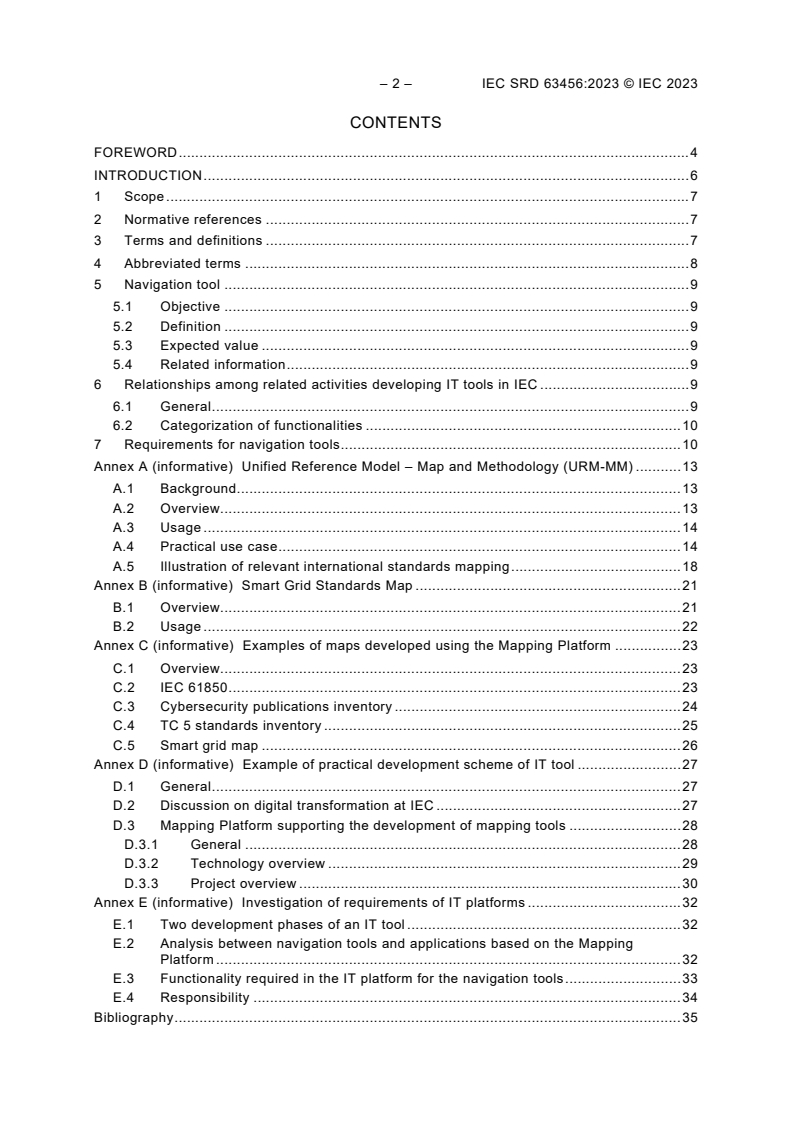
CONTENTS
FOREWORD . 4
INTRODUCTION . 6
1 Scope . 7
2 Normative references . 7
3 Terms and definitions . 7
4 Abbreviated terms . 8
5 Navigation tool . 9
5.1 Objective . 9
5.2 Definition . 9
5.3 Expected value . 9
5.4 Related information . 9
6 Relationships among related activities developing IT tools in IEC . 9
6.1 General . 9
6.2 Categorization of functionalities . 10
7 Requirements for navigation tools . 10
Annex A (informative) Unified Reference Model – Map and Methodology (URM-MM) . 13
A.1 Background. 13
A.2 Overview. 13
A.3 Usage . 14
A.4 Practical use case . 14
A.5 Illustration of relevant international standards mapping . 18
Annex B (informative) Smart Grid Standards Map . 21
B.1 Overview. 21
B.2 Usage . 22
Annex C (informative) Examples of maps developed using the Mapping Platform . 23
C.1 Overview. 23
C.2 IEC 61850 . 23
C.3 Cybersecurity publications inventory . 24
C.4 TC 5 standards inventory . 25
C.5 Smart grid map . 26
Annex D (informative) Example of practical development scheme of IT tool . 27
D.1 General . 27
D.2 Discussion on digital transformation at IEC . 27
D.3 Mapping Platform supporting the development of mapping tools . 28
D.3.1 General . 28
D.3.2 Technology overview . 29
D.3.3 Project overview . 30
Annex E (informative) Investigation of requirements of IT platforms . 32
E.1 Two development phases of an IT tool . 32
E.2 Analysis between navigation tools and applications based on the Mapping
Platform . 32
E.3 Functionality required in the IT platform for the navigation tools . 33
E.4 Responsibility . 34
Bibliography . 35
Figure 1 – Example of an assumed IEC service system configuration . 10
Figure A.1 – Unified Reference Model – Map and Methodology (URM-MM) . 13
Figure A.2 – Diagram of Canvas of an example production system with dynamic
optimization . 15
Figure A.3 – Diagram of Use-case of an example production system with dynamic
optimization . 15
Figure A.4 – Diagram of Function of an example production system with dynamic
optimization . 16
Figure A.5 – Diagram of Data of an example production system with dynamic
optimization (first half) . 17
Figure A.6 – Diagram of Data of an example production system with dynamic
optimization (second half) . 18
Figure A.7 – Example of "Canvas" mapping of relevant International Standards . 19
Figure A.8 – Example of "Data" mapping of relevant International Standards . 20
Figure B.1 – Architecture view of Smart Grid Standards Map . 22
Figure C.1 – Collection of released maps as developed using the Mapping Platform . 23
Figure C.2 – Draft IEC 61850 map . 24
Figure C.3 – Draft ACSEC map . 25
Figure C.4 – Draft TC 5 standards inventory . 26
Figure C.5 – Smart grid map . 26
Figure D.1 – The SMB Ad-Hoc Groups (as of 2020-10-21) . 27
Figure D.2 – Organization of SG 12 recommended by ahG 86 [2] . 28
Figure D.3 – Examples of visual representations of objects . 29
Figure D.4 – Example of use of objects and links . 30
Figure D.5 – Example of the use of a tab and its elements . 30
Figure D.6 – Management structure of masterplan implementation plans . 31
Figure E.1 – Hypothesis of relationship between the Mapping Platform and activities in
SyCs . 33
Table 1 – Functional requirements of navigation tools . 11
Table 2 – Non-functional requirements of navigation tools . 11
Table 3 – Expectations for interfaces between navigation tools and domain-neutral
functionalities . 12
Table D.1 – Timetable of the Mapping Platform project . 31
Table E.1 – A comparison result between navigation tools [NT] and applications based
on the Mapping Platform [MP] . 32
Table E.2 – Mapping Platform analysis results for navigation tool implementation. 33
Table E.3 – Analysis of responsible committees for software components during four
phases . 34
– 4 – IEC SRD 63456:2023 © IEC 2023
INTERNATIONAL ELECTROTECHNICAL COMMISSION
____________
NAVIGATION TOOLS FOR SMART MANUFACTURING
FOREWORD
1) The International Electrotechnical Commission (IEC) is a worldwide organization for standardization comprising
all national electrotechnical committees (IEC National Committees). The object of IEC is to promote international
co-operation on all questions concerning standardization in the electrical and electronic fields. To this end and
in addition to other activities, IEC publishes International Standards, Technical Specifications, Technical Reports,
Publicly Available Specifications (PAS) and Guides (hereafter referred to as "IEC Publication(s)"). Their
preparation is entrusted to technical committees; any IEC National Committee interested in the subject dealt with
may participate in this preparatory work. International, governmental and non-governmental organizations liaising
with the IEC also participate in this preparation. IEC collaborates closely with the International Organization for
Standardization (ISO) in accordance with conditions determined by agreement between the two organizations.
2) The formal decisions or agreements of IEC on technical matters express, as nearly as possible, an international
consensus of opinion on the relevant subjects since each technical committee has representation from all
interested IEC National Committees.
3) IEC Publications have the form of recommendations for international use and are accepted by IEC National
Committees in that sense. While all reasonable efforts are made to ensure that the technical content of IEC
Publications is accurate, IEC cannot be held responsible for the way in which they are used or for any
misinterpretation by any end user.
4) In order to promote international uniformity, IEC National Committees undertake to apply IEC Publications
transparently to the maximum extent possible in their national and regional publications. Any divergence between
any IEC Publication and the corresponding national or regional publication shall be clearly indicated in the latter.
5) IEC itself does not provide any attestation of conformity. Independent certification bodies provide conformity
assessment services and, in some areas, access to IEC marks of conformity. IEC is not responsible for any
services carried out by independent certification bodies.
6) All users should ensure that they have the latest edition of this publication.
7) No liability shall attach to IEC or its directors, employees, servants or agents including individual experts and
members of its technical committees and IEC National Committees for any personal injury, property damage or
other damage of any nature whatsoever, whether direct or indirect, or for costs (including legal fees) and
expenses arising out of the publication, use of, or reliance upon, this IEC Publication or any other IEC
Publications.
8) Attention is drawn to the Normative references cited in this publication. Use of the referenced publications is
indispensable for the correct application of this publication.
9) IEC draws attention to the possibility that the implementation of this document may involve the use of (a)
patent(s). IEC takes no position concerning the evidence, validity or applicability of any claimed patent rights in
respect thereof. As of the date of publication of this document, IEC had not received notice of (a) patent(s), which
may be required to implement this document. However, implementers are cautioned that this may not represent
the latest information, which may be obtained from the patent database available at https://patents.iec.ch. IEC
shall not be held responsible for identifying any or all such patent rights.
IEC SRD 63456 has been prepared by IEC systems committee SM: Smart Manufacturing. It is
a Systems Reference Deliverable.
The text of this Systems Reference Deliverable is based on the following documents:
Draft Report on voting
SyCSM/81/DTS SyCSM/89/RVDTS
Full information on the voting for its approval can be found in the report on voting indicated in
the above table.
The language used for the development of this Systems Reference Deliverable is English.
This document was drafted in accordance with ISO/IEC Directives, Part 2, and developed in
accordance with ISO/IEC Directives, Part 1 and ISO/IEC Directives, IEC Supplement, available
at www.iec.ch/members_experts/refdocs. The main document types developed by IEC are
described in greater detail at www.iec.ch/standardsdev/publications.
The committee has decided that the contents of this document will remain unchanged until the
stability date indicated on the IEC website under webstore.iec.ch in the data related to the
specific document. At this date, the document will be
• reconfirmed,
• withdrawn,
• replaced by a revised edition, or
• amended.
IMPORTANT – The "colour inside" logo on the cover page of this document indicates
that it contains colours which are considered to be useful for the correct understanding
of its contents. Users should therefore print this document using a colour printer.
– 6 – IEC SRD 63456:2023 © IEC 2023
INTRODUCTION
This document aims to describe external requirements in terms of navigation tools for smart
manufacturing to assist the development of manufacturing systems and international standards
through linking reference models, use cases, architecture, and standards. Some of the
requirements mentioned in this document (including annexes) refers to additional IEC internal
IT support.
With this motivation, this document contains the following clauses; Clause 5 describes an
outline of the navigation tool for smart manufacturing. Clause 6 presents a view of relationships
between the navigation tool and related IT resources in IEC. And Clause 7 defines external
requirements. Besides, annexes show a practical example of an IT tool having similar
characteristics to the navigation tool, prior works as IT tools developed in IEC, an example of a
practical development scheme of IT tool in IEC, and an outline of a potential development
scheme for the navigation tool through a comparative analysis with the Mapping Platform.
NAVIGATION TOOLS FOR SMART MANUFACTURING
1 Scope
This document describes requirements in terms of navigation tools for smart manufacturing.
2 Normative references
There are no normative references in this document.
3 Terms and definitions
For the purposes of this document, the following terms and definitions apply.
ISO and IEC maintain terminology databases for use in standardization at the following
addresses:
• IEC Electropedia: available at https://www.electropedia.org/
• ISO Online browsing platform: available at https://www.iso.org/obp
3.1
aspect
labelled designation for a collection of concepts in a particular context
[SOURCE: IEC 63339:–, 3.1.1, modified – The example and notes to entry have been omitted.]
3.2
business
series of processes, each having a clearly understood purpose, involving more than one person,
realised through the exchange of information and directed towards some mutually agreed upon
goal, extending over a period of time
[SOURCE: ISO/IEC 15944-20:2015, 2.2]
3.3
concern
matter of relevance or importance to a stakeholder (3.10) regarding a manufacturing system or
element thereof
[SOURCE: ISO/IEC/IEEE 42010:2022, 3.10, modified – In the definition, "regarding a
manufacturing system element thereof" has been added.]
3.4
dimension
coherent collection of aspects (3.1) relevant to a manufacturing domain (3.7)
[SOURCE: IEC 63339:–, 3.1.7, modified – Note 1 to entry has been omitted.]
– 8 – IEC SRD 63456:2023 © IEC 2023
3.5
facet
framework composed of one or more dimensions (3.4)
[SOURCE: IEC 63339:–, 3.1.9]
3.6
manufacture
any or all of the activities in the design, procurement, construction, commissioning, deployment,
screening, testing, production, storage, labelling, packaging or distribution of products and
production systems
[SOURCE: IEC 63339:–, 3.1.12]
3.7
manufacturing domain
portion of a business (3.2) dealing with the manufacture (3.6) of products
[SOURCE: IEC 63339:–, 3.1.13]
3.8
reference model
framework for understanding significant relationships among the entities of some environment,
and for the development of consistent standards or specifications supporting that environment
[SOURCE: ISO 19165-1:2018, 3.30]
3.9
use case
technique for capturing potential functional requirements
[SOURCE: IEC TS 62443-1-1:2009, 3.2.132]
3.10
stakeholder
role, position, individual, organization or classes thereof, having an interest, right, share, or
claim, in an entity of interest
[SOURCE: ISO/IEC/IEEE 42010:2022, 3.17]
4 Abbreviated terms
ahG ad hoc Group
GUI graphical user interface
IEC International Electrotechnical Commission
IEV International Electrotechnical Vocabulary
IS International Standard
ISO International Organization for Standardization
JWG Joint Working Group
MP Mapping Platform
MPIP Master Plan Implementation Plan
NT navigation tool
OF1 Open Forum 1
OSS open source software
SDK software development kit
SDO standards development organization
SEG Systems Evaluation Group
SM2TF Smart Manufacturing Standard Map Task Force
SM smart manufacturing
SMB Standardization Management Board
SMRM Smart Manufacturing Reference Model
SRG Systems Resource Group
SyC systems committee
TC technical committee
UCMR use case management repository
URM-MM Unified Reference Model – Map and Methodology
URMSM Unified Reference Model for Smart Manufacturing
5 Navigation tool
5.1 Objective
Navigation tools aim to assist in the configuring of smart manufacturing systems by utilizing
relevant ISs and existing products/solutions, including open source software, and the smart
manufacturing example described in use cases.
5.2 Definition
In order to clarify the external requirements of navigation tools, a navigation tool is defined as
follows:
"A set of software functions to navigate the development of smart manufacturing systems
through exploiting information related to reference models, use cases, architecture and
standards, which are stored in the accessible repositories."
5.3 Expected value
Navigation tools provide access to related reference models, use cases, architecture and
standards based on the needs of standard developers and smart manufacturing system
developers in the development and implementation of smart manufacturing systems.
5.4 Related information
There are some prior studies and activities related to navigation tools, such as Unified
Reference Model – Map and Methodology (URM-MM) (see Annex A), Smart Grid Standards
Map (see Annex B), and Mapping Platform (see Annex C).
6 Relationships among related activities developing IT tools in IEC
6.1 General
Subclause 6.1 describes the relationships among individual IT resources involving related
committees within IEC. Figure 1 shows an example of an assumed IEC service system
configuration, which allows IEC to deliver services to end users through its own platform. A
navigation tool provides a functionality as a domain-specific function by exploiting
functionalities provided as domain-neutral functions and repositories.
– 10 – IEC SRD 63456:2023 © IEC 2023
Figure 1 – Example of an assumed IEC service system configuration
6.2 Categorization of functionalities
Subclause 6.2 describes the categorization of functionalities provided through the IEC service
system. According to the assumed configuration depicted in Figure 1, a typical system
configuration is composed of two parts: a silo part composed of individual domain-specific
functions, and a common part composed of domain-neutral functions and repositories. The
common part will be utilized from multiple domain-specific functions at the silo part. As domain-
neutral functions, the common part also provides a software development kit (SDK) for
developing domain-neutral functions and for domain-specific functions, respectively. Domain-
neutral repositories are to be provided by relevant groups not only in the IEC but also by those
external to the IEC. Moreover, the common part allows the IEC to provide domain-specific
functions such as a navigation tool, which may utilize multiple domain-neutral functions and/or
refer to related repositories of the common part, as necessary, to end users via the Internet. To
understand how IEC proceeds with IT tool development, Annex D provides a case of practical
IT tool development in IEC. Besides, to consider practical implementation approaches for
navigation tools, Annex E describes similarities and differences between the case of Mapping
Platform and the case of a navigation tool.
7 Requirements for navigation tools
Clause 7 describes the functional requirements and non-functional requirements from a user’s
point of view. Moreover, it also describes the expectations for interfaces between navigation
tools and domain-neutral functionalities. Table 1 shows the list of functional requirements of
navigation tools.
Table 1 – Functional requirements of navigation tools
# Usage purpose In Process Out
[General]
1 Find relevant use case(s) Keyword(s) for use cases Search use cases in a Relevant use case(s)
repository
2 Find relevant IS(s) Keyword(s) for IS(s) Search IS(s) in a Relevant IS(s)
repository
3 Protect privacy of usage Data input by a user Authenticate users to Output generated from
data access data and prohibit the data of the user
the access of data for
other users
[User interface]
4 Create contents Name as a character Create new contents in The contents created in
string for identifying the the file system the file system
contents stored in file
system
5 Manage contents created Name as a character Manage the contents in The contents saved or
using the navigation tool string for identifying the the file system retrieved through the file
contents stored in a file system
system
6 Edit contents created GUI manipulation Edit design contents of Corresponding
using the navigation tool the navigation tool operations such as Undo,
intuitively Redo, Cut, Copy, and
Paste
7 Search a keyword Keyword Identify the location of Highlight the keyword on
the keyword in design the navigation tool
contents
[Navigation functionality]
8 Identify relevant Relevant keywords (e.g. Derive model-contents List of relevant
international standards CDD) from URMSM specified international standards
in ISO/TC 184 –
IEC TC 65 Joint Working
Group 21
Table 2 shows the list of non-functional requirements of navigation tools.
Table 2 – Non-functional requirements of navigation tools
# Usage purpose In Process Out
[Usability]
Access universally Interactions through a Recognize features of Appropriate
from any terminal terminal the terminal and adjust presentation of
presentation of contents contents
2 Access universally Interactions through a Recognize features of Appropriate
from any region terminal in any region the region (such as presentation of
language) and adjust contents
presentation of contents
3 Interact intuitively Key input and/or GUI Follow conventional GUI Visual contents and
manipulation manners feedback
[Security]
4 Protec
...