


IEC 61097-2:2008
(Main)Global maritime distress and safety system (GMDSS) - Part 2: COSPAS-SARSAT EPIRB - Satellite emergency position indicating radio beacon operating on 406 MHz - Operational and performance requirements, methods of testing and required test results
General Information
- Abstract
Specifies the minimum performance requirements, technical characteristics and type-testing requirements of the satellite emergency position-indicating radio beacon used in the COSPAS-SARSAT satellite system (satellite EPIRB), as required by the International Convention for Safety of Life at Sea (SOLAS). Is associated with IEC 60945 and incorporates the performance standards of the relevant IMO Resolutions and ITU Regulations. Significant changes in this third edition include revised characteristics for the low duty cycle light, together with a revised test to allow the use of white LEDs. Other requirements have been clarified or revised as well.
- Status
- Published
- Publication Date
- 21-Jan-2008
- Technical Committee
- TC 80 - Maritime navigation and radiocommunication equipment and systems
- Drafting Committee
- MT 2 - TC 80/MT 2
- Current Stage
- DELPUB - Deleted Publication
- Start Date
- 24-Jun-2021
- Completion Date
- 30-Jun-2020
Buy Documents
IEC 61097-2:2008 - Global maritime distress and safety system (GMDSS) - Part 2: COSPAS-SARSAT EPIRB - Satellite emergency position indicating radio beacon operating on 406 MHz - Operational and performance requirements, methods of testing and required test results Released:1/22/2008
Overview
IEC 61097-2:2008 defines the operational and performance requirements, test methods, and required test results for COSPAS‑SARSAT satellite emergency position‑indicating radio beacons (EPIRBs) operating on 406 MHz. Part of the Global Maritime Distress and Safety System (GMDSS) family, this standard supports SOLAS compliance by specifying minimum technical characteristics and type‑testing needed for satellite EPIRB type approval and safe maritime distress signalling.
Key topics and technical requirements
- Scope and compliance: Minimum performance requirements and type‑testing for 406 MHz satellite EPIRBs used with COSPAS‑SARSAT; intended for SOLAS applications and regulatory type approval.
- Distress signalling: Requirements for the 406 MHz distress message format, beacon identification codes and distress message memory.
- Homing signal: Specification and test requirements for the 121.5 MHz homing transmitter (referenced technical standard in Annex D).
- Operational features: Controls and ergonomics (prevention of inadvertent activation, activation, self‑test, indication of previous activation, colour/retro‑reflective materials, lanyard).
- Float‑free arrangements: Design, release mechanisms, manual and automatic release checks and tests for float‑free EPIRBs.
- Power and battery: Battery life, expiry date marking and low‑temperature performance tests; reverse polarity protection.
- Antenna and emissions: Antenna characteristics, spurious emissions and homing signal masks.
- Environment and ruggedness testing: Temperature, icing, shock, vibration, immersion, solar radiation, oil resistance and corrosion - many tests align with IEC 60945 environmental tests.
- Electromagnetic compatibility (EMC): Requirements to limit interference and conducted emissions.
- Testing methodology: Detailed test sequences, preparation for COSPAS‑SARSAT type approval, and pass/fail criteria (annexed test sequences and procedural details).
- Updates in Edition 3: Revised low‑duty‑cycle light characteristics and updated tests to allow use of white LEDs; other clarifications and revisions throughout.
Applications and who uses this standard
IEC 61097-2 is used by:
- EPIRB manufacturers for product design, development and pre‑compliance testing.
- Certification bodies and test laboratories performing COSPAS‑SARSAT type approval and SOLAS certification.
- Shipbuilders, ship operators and procurement teams specifying compliant emergency beacons for vessels.
- Maritime safety authorities, flag states and classification societies enforcing regulatory compliance.
- Maritime equipment integrators and maintenance providers for installation, servicing and lifecycle checks.
Practical uses include design verification, type approval testing, installation guidance, maintenance schedules and regulatory compliance documentation.
Related standards
- IEC 60945 - Environmental and performance tests for shipborne equipment (referenced for many environmental tests).
- SOLAS (IMO) - Regulatory requirement tying EPIRB performance to maritime safety law.
- Relevant IMO Resolutions and ITU Regulations - Incorporated for signal formats, frequencies and international radio rules.
Keywords: IEC 61097-2, GMDSS, COSPAS‑SARSAT, EPIRB 406 MHz, SOLAS compliance, EPIRB type approval, maritime distress beacon testing.
Relations
- Effective Date
- 10-Feb-2026
- Effective Date
- 10-Feb-2026
- Effective Date
- 10-Feb-2026
- Effective Date
- 05-Sep-2023
- Effective Date
- 05-Sep-2023
Buy Documents
IEC 61097-2:2008 - Global maritime distress and safety system (GMDSS) - Part 2: COSPAS-SARSAT EPIRB - Satellite emergency position indicating radio beacon operating on 406 MHz - Operational and performance requirements, methods of testing and required test results Released:1/22/2008
Get Certified
Connect with accredited certification bodies for this standard

DNV
DNV is an independent assurance and risk management provider.

Lloyd's Register
Lloyd's Register is a global professional services organisation specialising in engineering and technology.

FSC International
Forest Stewardship Council certification.
Sponsored listings
Frequently Asked Questions
IEC 61097-2:2008 is a standard published by the International Electrotechnical Commission (IEC). Its full title is "Global maritime distress and safety system (GMDSS) - Part 2: COSPAS-SARSAT EPIRB - Satellite emergency position indicating radio beacon operating on 406 MHz - Operational and performance requirements, methods of testing and required test results". This standard covers: Specifies the minimum performance requirements, technical characteristics and type-testing requirements of the satellite emergency position-indicating radio beacon used in the COSPAS-SARSAT satellite system (satellite EPIRB), as required by the International Convention for Safety of Life at Sea (SOLAS). Is associated with IEC 60945 and incorporates the performance standards of the relevant IMO Resolutions and ITU Regulations. Significant changes in this third edition include revised characteristics for the low duty cycle light, together with a revised test to allow the use of white LEDs. Other requirements have been clarified or revised as well.
Specifies the minimum performance requirements, technical characteristics and type-testing requirements of the satellite emergency position-indicating radio beacon used in the COSPAS-SARSAT satellite system (satellite EPIRB), as required by the International Convention for Safety of Life at Sea (SOLAS). Is associated with IEC 60945 and incorporates the performance standards of the relevant IMO Resolutions and ITU Regulations. Significant changes in this third edition include revised characteristics for the low duty cycle light, together with a revised test to allow the use of white LEDs. Other requirements have been clarified or revised as well.
IEC 61097-2:2008 is classified under the following ICS (International Classification for Standards) categories: 47.020.70 - Navigation and control equipment. The ICS classification helps identify the subject area and facilitates finding related standards.
IEC 61097-2:2008 has the following relationships with other standards: It is inter standard links to EN 61996-1:2008, EN 61996-1:2013, EN 61996-2:2008, IEC 61097-2:2002, IEC 61097-2:2021. Understanding these relationships helps ensure you are using the most current and applicable version of the standard.
IEC 61097-2:2008 is available in PDF format for immediate download after purchase. The document can be added to your cart and obtained through the secure checkout process. Digital delivery ensures instant access to the complete standard document.
Standards Content (Sample)
IEC 61097-2
Edition 3.0 2008-01
INTERNATIONAL
STANDARD
Global maritime distress and safety system (GMDSS) –
Part 2: COSPAS-SARSAT EPIRB – Satellite emergency position indicating radio
beacon operating on 406 MHz – Operational and performance requirements,
methods of testing and required test results
All rights reserved. Unless otherwise specified, no part of this publication may be reproduced or utilized in any form
or by any means, electronic or mechanical, including photocopying and microfilm, without permission in writing from
either IEC or IEC's member National Committee in the country of the requester.
If you have any questions about IEC copyright or have an enquiry about obtaining additional rights to this publication,
please contact the address below or your local IEC member National Committee for further information.
IEC Central Office
3, rue de Varembé
CH-1211 Geneva 20
Switzerland
Email: inmail@iec.ch
Web: www.iec.ch
About the IEC
The International Electrotechnical Commission (IEC) is the leading global organization that prepares and publishes
International Standards for all electrical, electronic and related technologies.
About IEC publications
The technical content of IEC publications is kept under constant review by the IEC. Please make sure that you have the
latest edition, a corrigenda or an amendment might have been published.
ƒ Catalogue of IEC publications: www.iec.ch/searchpub
The IEC on-line Catalogue enables you to search by a variety of criteria (reference number, text, technical committee,…).
It also gives information on projects, withdrawn and replaced publications.
ƒ IEC Just Published: www.iec.ch/online_news/justpub
Stay up to date on all new IEC publications. Just Published details twice a month all new publications released. Available
on-line and also by email.
ƒ Electropedia: www.electropedia.org
The world's leading online dictionary of electronic and electrical terms containing more than 20 000 terms and definitions
in English and French, with equivalent terms in additional languages. Also known as the International Electrotechnical
Vocabulary online.
ƒ Customer Service Centre: www.iec.ch/webstore/custserv
If you wish to give us your feedback on this publication or need further assistance, please visit the Customer Service
Centre FAQ or contact us:
Email: csc@iec.ch
Tel.: +41 22 919 02 11
Fax: +41 22 919 03 00
IEC 61097-2
Edition 3.0 2008-01
INTERNATIONAL
STANDARD
Global maritime distress and safety system (GMDSS) –
Part 2: COSPAS-SARSAT EPIRB – Satellite emergency position indicating radio
beacon operating on 406 MHz – Operational and performance requirements,
methods of testing and required test results
INTERNATIONAL
ELECTROTECHNICAL
COMMISSION
PRICE CODE
X
ICS 47.020.70 ISBN 2-8318-9549-9
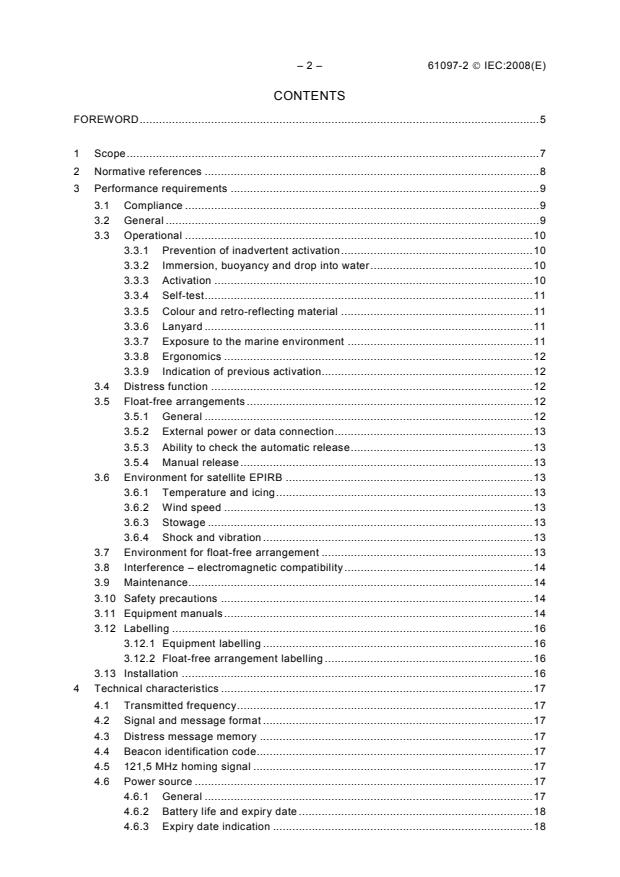
– 2 – 61097-2 © IEC:2008(E)
CONTENTS
FOREWORD.5
1 Scope.7
2 Normative references .8
3 Performance requirements .9
3.1 Compliance .9
3.2 General .9
3.3 Operational .10
3.3.1 Prevention of inadvertent activation.10
3.3.2 Immersion, buoyancy and drop into water.10
3.3.3 Activation .10
3.3.4 Self-test.11
3.3.5 Colour and retro-reflecting material .11
3.3.6 Lanyard .11
3.3.7 Exposure to the marine environment .11
3.3.8 Ergonomics .12
3.3.9 Indication of previous activation.12
3.4 Distress function .12
3.5 Float-free arrangements .12
3.5.1 General .12
3.5.2 External power or data connection.13
3.5.3 Ability to check the automatic release.13
3.5.4 Manual release.13
3.6 Environment for satellite EPIRB .13
3.6.1 Temperature and icing.13
3.6.2 Wind speed .13
3.6.3 Stowage .13
3.6.4 Shock and vibration .13
3.7 Environment for float-free arrangement .13
3.8 Interference – electromagnetic compatibility.14
3.9 Maintenance.14
3.10 Safety precautions .14
3.11 Equipment manuals.14
3.12 Labelling .16
3.12.1 Equipment labelling .16
3.12.2 Float-free arrangement labelling .16
3.13 Installation .16
4 Technical characteristics .17
4.1 Transmitted frequency.17
4.2 Signal and message format .17
4.3 Distress message memory .17
4.4 Beacon identification code.17
4.5 121,5 MHz homing signal .17
4.6 Power source .17
4.6.1 General .17
4.6.2 Battery life and expiry date .18
4.6.3 Expiry date indication .18
61097-2 © IEC:2008(E) – 3 –
4.6.4 Reverse polarity protection .18
4.7 Antenna characteristics .18
5 Methods of testing and required test results .18
5.1 General .18
5.1.1 COSPAS-SARSAT type approval.18
5.1.2 Power supply.19
5.1.3 Warm-up period.19
5.1.4 Instructions.19
5.1.5 Additional facilities .19
5.1.6 Audible and visual indications.19
5.1.7 Preparation of satellite EPIRB for type-approval testing.19
5.1.8 Test conditions .20
5.1.9 Test sequence.20
5.1.10 Performance check.20
5.1.11 Performance test .20
5.2 General tests.21
5.2.1 Tests for float-free arrangements.21
5.3 Operational tests .22
5.3.1 Prevention of inadvertent activation.22
5.3.2 Immersion, buoyancy and drop into water.22
5.3.3 Activation .22
5.3.4 Self-test.24
5.3.5 Colour and retro-reflecting material .24
5.3.6 Lanyard .24
5.3.7 Exposure to marine environment .24
5.3.8 Ergonomics .25
5.3.9 Indication of previous activation.25
5.4 Distress function .25
5.5 Float-free arrangements .25
5.5.1 General .25
5.5.2 External power or data connection.26
5.5.3 Ability to check the automatic release.26
5.5.4 Manual release.26
5.6 Environment .26
5.6.1 Temperature.26
5.6.2 Icing .26
5.6.3 Wind speed .26
5.6.4 Stowage .26
5.6.5 Shock and vibration .26
5.7 Environment for float-free arrangement .26
5.8 Interference – Electromagnetic compatibility .26
5.9 Maintenance.27
5.10 Safety precautions .27
5.11 Equipment manuals.27
5.12 Labelling .27
5.12.1 Equipment labelling .27
5.12.2 Float-free arrangement labelling .27
5.13 Installation .27
5.14 Technical characteristics .27
– 4 – 61097-2 © IEC:2008(E)
5.15 Power source .27
5.15.1 Battery capacity and low-temperature test .27
5.15.2 Expiry date indication .28
5.15.3 Reverse polarity protection .28
5.16 Antenna characteristics .28
5.17 Environment .28
5.17.1 Dry heat cycle, of IEC 60945.29
5.17.2 Damp heat cycle, of IEC 60945 .29
5.17.3 Low-temperature cycle .29
5.17.4 Thermal shock test, of IEC 60945.29
5.17.5 Drop test for portable equipment, of IEC 60945 .29
5.17.6 Vibration test, of IEC 60945 .29
5.17.7 Ruggedness test .30
5.17.8 Immersion test, of IEC 60945 .30
5.17.9 Solar radiation test, of IEC 60945.30
5.17.10 Oil resistance test, of IEC 60945 .30
5.17.11 Corrosion test, of IEC 60945 .30
5.18 Interference testing .31
5.19 Spurious emissions .31
5.20 Compass safe distance .31
5.21 Conducted interference .31
Annex A (normative) Sequence of tests .32
Annex B (normative) Internal and external navigation devices .34
Annex C (normative) Standard for a satellite EPIRB without a float-free mechanism .36
Annex D (normative) Technical standard for 121,5 MHz homing device .38
Annex E (informative) User experience of COSPAS-SARSAT satellite EPIRB
operation .44
Figure D.1 – Spurious emission mask for 121,5 MHz signal .42
Figure D.2 – Typical modulation waveforms.43
Table 1 – EPIRB control functions .9
Table 2 – Effective luminous intensity .24
61097-2 © IEC:2008(E) – 5 –
INTERNATIONAL ELECTROTECHNICAL COMMISSION
____________
GLOBAL MARITIME DISTRESS AND SAFETY SYSTEM (GMDSS) –
Part 2: COSPAS-SARSAT EPIRB – Satellite emergency position
indicating radio beacon operating on 406 MHz –
Operational and performance requirements,
methods of testing and required test results
FOREWORD
1) The International Electrotechnical Commission (IEC) is a worldwide organization for standardization comprising
all national electrotechnical committees (IEC National Committees). The object of IEC is to promote
international co-operation on all questions concerning standardization in the electrical and electronic fields. To
this end and in addition to other activities, IEC publishes International Standards, Technical Specifications,
Technical Reports, Publicly Available Specifications (PAS) and Guides (hereafter referred to as “IEC
Publication(s)”). Their preparation is entrusted to technical committees; any IEC National Committee interested
in the subject dealt with may participate in this preparatory work. International, governmental and non-
governmental organizations liaising with the IEC also participate in this preparation. IEC collaborates closely
with the International Organization for Standardization (ISO) in accordance with conditions determined by
agreement between the two organizations.
2) The formal decisions or agreements of IEC on technical matters express, as nearly as possible, an international
consensus of opinion on the relevant subjects since each technical committee has representation from all
interested IEC National Committees.
3) IEC Publications have the form of recommendations for international use and are accepted by IEC National
Committees in that sense. While all reasonable efforts are made to ensure that the technical content of IEC
Publications is accurate, IEC cannot be held responsible for the way in which they are used or for any
misinterpretation by any end user.
4) In order to promote international uniformity, IEC National Committees undertake to apply IEC Publications
transparently to the maximum extent possible in their national and regional publications. Any divergence
between any IEC Publication and the corresponding national or regional publication shall be clearly indicated in
the latter.
5) IEC provides no marking procedure to indicate its approval and cannot be rendered responsible for any
equipment declared to be in conformity with an IEC Publication.
6) All users should ensure that they have the latest edition of this publication.
7) No liability shall attach to IEC or its directors, employees, servants or agents including individual experts and
members of its technical committees and IEC National Committees for any personal injury, property damage or
other damage of any nature whatsoever, whether direct or indirect, or for costs (including legal fees) and
expenses arising out of the publication, use of, or reliance upon, this IEC Publication or any other IEC
Publications.
8) Attention is drawn to the Normative references cited in this publication. Use of the referenced publications is
indispensable for the correct application of this publication.
9) Attention is drawn to the possibility that some of the elements of this IEC Publication may be the subject of
patent rights. IEC shall not be held responsible for identifying any or all such patent rights.
International Standard IEC 61097-2 has been prepared by IEC technical committee 80:
Maritime navigation and radiocommunication equipment and systems.
This third edition cancels and replaces the second edition, published in 2002, of which it
constitutes a technical revision.
The significant changes in this edition include revised characteristics for the low duty cycle
light in 3.3.3 c), together with a revised test in 5.3.3.3, to allow the use of white LEDs.
Requirements for retro-reflecting material and the lanyard have been clarified in 3.3 noting the
ever decreasing size of EPIRBs, and requirements for equipment manuals and labelling
clarified in 3.11 and 3.12. Battery life requirements have been clarified in 4.6.2.
The test methods have been generally revised to align with the latest editions of COSPAS-
SARSAT T.001 and T.007 and IEC 60945. An extra test requirement for a drop onto a hard
– 6 – 61097-2 © IEC:2008(E)
surface has been added, together with further frequency bands for the measurement of
spurious emissions to protect aeronautical communications.
Annex B, which reproduced some COSPAS-SARSAT material has been deleted and replaced
with a new annex giving requirements for EPIRBs associated with navigation devices.
Annex C, concerning EPIRBs without a float free mechanism, has been expanded and Annex
D, concerning the homing device, includes a new radiated power test “off ground plane” and
clarification to the measurement of spurious emissions.
The text of this standard is based on the following documents:
CDV Report on voting
80/480/CDV 80/514/RVC
Full information on the voting for the approval of this standard can be found in the report on
voting indicated in the above table.
This publication has been drafted in accordance with the ISO/IEC Directives, Part 2.
A list of all parts of the IEC 61097 series, under the general title Global maritime distress and
safety system (GMDSS), can be found on the IEC website.
The committee has decided that the contents of this publication will remain unchanged until
the maintenance result date indicated on the IEC web site under "http://webstore.iec.ch" in
the data related to the specific publication. At this date, the publication will be
• reconfirmed,
• withdrawn,
• replaced by a revised edition, or
• amended.
A bilingual version of this publication may be issued at a later date.
61097-2 © IEC:2008(E) – 7 –
GLOBAL MARITIME DISTRESS AND SAFETY SYSTEM (GMDSS) –
Part 2: COSPAS-SARSAT EPIRB – Satellite emergency position
indicating radio beacon operating on 406 MHz –
Operational and performance requirements,
methods of testing and required test results
1 Scope
This part of IEC 61097 specifies the minimum performance requirements, technical charac-
teristics and type-testing requirements of the satellite emergency position-indicating radio
beacon used in the COSPAS-SARSAT satellite system (satellite EPIRB), as required by
Regulation IV/7.1.6 of the 1988 amendments to the 1974 International Convention for Safety
of Life at Sea (SOLAS), and which is associated with IEC 60945. When a requirement in this
standard is different from IEC 60945, the requirement in this standard takes precedence.
This standard incorporates the performance standards of IMO Resolution A.810(19), the
International Telecommunication Union (ITU) Radio Regulations as well as the technical
characteristics for such transmitters contained in Recommendation ITU-R M.633, and takes
account of the general requirements contained in IMO Resolution A.694(17). This standard
further takes account of IMO Resolution A.696(17) concerning the type approval of satellite
EPIRBs.
This standard also includes minimum performance standards for a non-float-free satellite
EPIRB without float-free release mechanism (see Annex C).
NOTE 1 Although a number of the requirements and tests may be similar this standard is not intended to be used
with 406 MHz Ship Security Alert System (SSAS) Beacons.
All texts of this standard, whose wording is identical to that in the IMO SOLAS Convention
1974 as amended and Resolutions A.662(16), A.694(17), A.702(17) and A.810(19) and
Recommendation ITU-R M.633 will be printed in italics and the Resolution/Recommendation
and paragraph number indicated between brackets.
NOTE 2 Classes of satellite EPIRB's considered in this document are:
– Class 1: Float-free (–40 °C to +55 °C). The float-free release mechanism (A.662(16)) should be
capable of operating throughout the temperature range of –30 °C to +65 °C.
This class is not required by IMO Resolutions but may be applied at the discretion of each
Administration.
– Class 2: Float-free (–20 °C to +55 °C). The float-free release mechanism (A.662(16)) should be
capable of operating throughout the temperature range of –30 °C to +65 °C.
NOTE 3 Non float-free, satellite EPIRB's in both classes are considered in Annex C.
NOTE 4 All classes include a 121,5 MHz homing device, described in Annex D.
NOTE 5 All classes may include beacon position data, obtained from a navigation device internal or external to
the satellite EPIRB as described in Annex B.
NOTE 6 User experience of COSPAS-SARSAT satellite EPIRB operation leading to some clarification of IMO
performance standards, and providing some useful information for satellite EPIRB users is included in
Annex E.
– 8 – 61097-2 © IEC:2008(E)
2 Normative references
The following referenced documents are indispensable for the application of this document.
For dated references, only the edition cited applies. For undated references, the latest edition
of the referenced document (including any amendments) applies.
IEC 60945, Marine navigation and radiocommunication equipment and systems – General
Requirements – Methods of testing and required test results
IEC 61108-1, Maritime navigation and radiocommunication equipment and systems – Global
Navigation Satellite Systems (GNSS) – Part 1: Global Positioning System (GPS) – Receiver
equipment – Performance standards, methods of testing and required test results
ISO 15734:2001, Ships and marine technology – Hydrostatic release units
IMO Resolution A.658(16):1989, Use and fitting of retro-reflective materials on life-saving
appliances
IMO Resolution A.662(16):1989, Performance standards for float-free release and activation
arrangements for emergency radio equipment
IMO Resolution A.694(17):1991, General requirements for shipborne radio equipment forming
part of the global maritime distress and safety system (GMDSS) and for electronic
navigational aids
IMO Resolution A.696(17):1991, Type approval of satellite emergency position-indicating
radio beacons (EPIRBs) operating in the COSPAS-SARSAT system
IMO Resolution A.702(17):1991, Radio maintenance guidelines for the global maritime
distress and safety system (GMDSS) related to sea areas A3 and A4
IMO Resolution A.810(19):1995, Performance standards for float-free satellite emergency
position-indicating radio beacons (EPIRBs) operating on 406 MHz, as amended by IMO
Resolution MSC.56(66) and IMO Resolution MSC.120(74)
IMO Resolution MSC.48(66):1996, International life-saving appliance code
IMO Resolution MSC.81(70):1998, Revised recommendation on testing of life-saving
appliances, as amended by IMO Resolution MSC.200(80)
ITU-R Recommendation M.585, Assignment and use of maritime mobile service identities
ITU-R Recommendation M.633, Transmission characteristics of a satellite emergency
position-indicating radio beacon (satellite EPIRB) system operating through a satellite system
in the 406 MHz band
ITU-R Recommendation M.690, Technical characteristics of emergency position indicating
radio beacons (EPIRBs) operating on the carrier frequencies of 121,5 MHz and 243 MHz
COSPAS-SARSAT
C/S T.001, Specification for COSPAS-SARSAT 406 MHz Distress Beacons
C/S T.007, COSPAS-SARSAT 406 MHz Distress Beacon Type Approval Standard (as
applicable to satellite EPIRBs)
C/S T.012, as amended, COSPAS-SARSAT 406 MHz Frequency Management Plan
IMO Safety of Life at Sea (SOLAS) Convention 1974, as amended.
61097-2 © IEC:2008(E) – 9 –
United Nations Recommendations on the Transport of Dangerous Goods, Manual of Tests
and Criteria, Fourth Revised Edition, PART III, Section 38.3 (ST/SG/AC.10/11/Rev.4).
3 Performance requirements
3.1 Compliance
(A.810(19)/A.1) The satellite emergency position-indicating radio beacon (EPIRB) shall,
in addition to meeting the requirements of the Radio Regulations, the relevant ITU-R
Recommendations and the general requirements set out in resolution A.694(17) comply with
the following performance Standard.
In addition to this performance Standard, the satellite EPIRB shall comply with the
requirements of COSPAS-SARSAT documents C/S T.001, C/S T.007 and C/S T.012.
The radio frequency of operation of the equipment shall at all times be within the limits
defined by the Radio Regulations.
3.2 General
The following are general requirements for the satellite EPIRB.
a) The satellite EPIRB shall be (IV/7.1.6.3) ready to be manually released and capable to be
carried by one person into a survival craft.
b) (A.810(19)/A.2.1) The satellite EPIRB shall be capable of transmitting a distress alert to
the satellites comprising the COSPAS-SARSAT system operating in the 406 MHz band.
c) The satellite EPIRB shall be designed to operate according to this standard when floating
in the sea and shall also be capable of operating on board a ship and on a survival craft.
d) (A.810(19)/A.2.2) The satellite EPIRB shall be of an automatic float-free type.
The equipment, mounting and releasing arrangements shall be reliable and operate
satisfactorily under the most extreme conditions likely to be met with at sea.
e) (A.662(16)/1) Float-free release and activation arrangements shall enable the automatic
release of the satellite EPIRB from a sinking ship and its automatic activation. Table 1
shows the correct combination of control functions to prevent or enable activation.
Table 1 – EPIRB control functions
EPIRB-mount or release
Control position EPIRB condition Transmitter status
mechanism status
ON READY WET* DRY OUT IN ON OFF
X X X X
X X X X
X X X X
X X X X
X X X X
X X X X
X X X X
X X X X
* Floating or immersed in water.
f) (A.694(17)/1.2) Where a unit of equipment provides a facility which is additional to the
minimum requirements of this standard, such as an internal navigation device (Global
Navigation Satellite System (GNSS) receiver) or the possibility of connecting external
– 10 – 61097-2 © IEC:2008(E)
navigation data, the operation, and as far as is reasonably practicable, the malfunction of
such additional facility shall not degrade the performance of the equipment below those
minimum standards. The additional facility shall, as a minimum, meet the appropriate
requirements of IEC 60945, as applicable. Where such an additional facility exists, it
shall not prevent the satellite EPIRB fully conforming to the requirements of this
standard during normal combined operation. Any internal or external navigation device
connected to, or forming part of, the satellite EPIRB shall comply with the requirements
of Annex B.
g) The satellite EPIRB shall be a single integral unit. No part of it shall be detachable without
the use of tools.
3.3 Operational
3.3.1 Prevention of inadvertent activation
The satellite EPIRB shall:
a) (A.810(19)/A.2.3.1) be fitted with adequate means to prevent inadvertent activation and
deactivation;
b) not automatically activate when water washes over it while in its release mechanism. See
Table 1;
c) be designed to limit any inadvertent continuous 406 MHz transmission to a maximum of 45 s.
3.3.2 Immersion, buoyancy and drop into water
The satellite EPIRB shall:
a) (A.810(19)/A.2.3.2) be so designed that the electrical portions are watertight at a depth
of 10 m for at least 5 min. Consideration shall be given to a temperature variation of 45 °C
during transitions from the mounted position to immersion. The harmful effects of a marine
environment, condensation and water leakage shall not affect the performance of the
beacon;
b) (A.810(19)/A.2.3.6) be capable of floating upright in calm water and have positive
stability and sufficient buoyancy in all sea conditions;
c) (A.810(19)/A.2.3.7) be capable of being dropped into the water without damage from a
height of 20 m.
3.3.3 Activation
The following describes the activation of the satellite EPIRB.
a) The satellite EPIRB shall (A.810(19)/A.2.3.3) be automatically activated after floating free
or when floating in the water, irrespective of the settings of any control. See Table 1.
b) The satellite EPIRB shall (A.810(19)/A.2.3.4) be capable of repetitive manual activation
and manual deactivation.
Manual deactivation shall not prevent automatic activation of the satellite EPIRB when
automatically released from its release mechanism or when floating in the water.
c) The satellite EPIRB shall (A.810(19)/A.2.3.11) be provided with a low-duty cycle white
light (of at least effective 0,75 cd) active during darkness and all other lighting conditions,
–6
and flashing at a rate of 20 to 30 times per minute, with a flash duration of between 10 s
–1
and 10 s to indicate its position for the nearby survivors and rescue units.
The light shall be mounted so that it produces effective 0,75 cd or greater over as great a
portion of the upper hemisphere as is practical. The arithmetic mean of the light output
over the entire upper hemisphere shall not be less than effective 0,50 cd.
61097-2 © IEC:2008(E) – 11 –
NOTE Note that there can be areas of lower intensity at spots around the satellite EPIRB and as the
elevation increases to allow for mounting bushes, controls and the antenna etc and for the fact that at higher
elevation angles the range to rescue units is reduced.
d) When the satellite EPIRB is manually activated, the low-duty cycle light (see 3.3.3 c))
shall begin flashing within 2 s, in any lighting condition, and no distress signal shall be
emitted until at least 47 s and at most 5 min after the satellite EPIRB has been manually
activated.
e) After start of transmission of the distress signal, the operation of the low-duty cycle light
should be in accordance with 3.3.3 c).
f) The satellite EPIRB shall (A.810(19)/A.2.3.5) be provided with means to indicate that
signals are being emitted. The low-duty cycle light operating in accordance with 3.3.3 c),
is an acceptable indication.
g) The satellite EPIRB shall (A.810(19)/A.2.3.14) be provided with a 121,5 MHz beacon
primarily for homing by aircraft.
3.3.4 Self-test
The satellite EPIRB shall (A.810(19)/A.2.3.8) be capable of being tested, without using the
satellite system, to determine that the satellite EPIRB is capable of operating properly.
When the self-test mode (see C/S T.001) is activated, the satellite EPIRB shall emit a single
modulated burst which shall always provide the beacon 15 Hex ID. The frame synchronization
pattern shall be "011010000" (i.e. the last eight bits are complemented so that this test burst
will not be processed by the satellite equipment and the burst duration shall be 440 ms or
520 ms).
For location protocol beacons, the content of the encoded position data field of the self-test
message should be the default values specified in C/S T.001. Successful completion of the
test shall be indicated. Activation of the test facility shall reset automatically. The 121,5 MHz
auxiliary radio-locating device signal shall also be transmitted during the self-test, but it shall
not exceed 3 audio sweeps or 1 s, whichever is greater. The self-test function shall perform
an internal check and indicate that RF power is being emitted at 406 MHz and at 121,5 MHz.
3.3.5 Colour and retro-reflecting material
The satellite EPIRB shall (A.810(19)/A.2.3.9) be of highly visible yellow/orange colour and be
fitted with retro-reflecting material.
The minimum area of retro-reflective material visible above the water-line of the satellite
EPIRB shall be at least 25 cm . This shall be achieved by retro-reflective material, at least
25 mm wide, with at least 5 cm viewable from every angle on the horizon.
The retro-reflective material shall also meet the performance requirements of IMO Resolution
A.658(16) Annex 2.
3.3.6 Lanyard
The satellite EPIRB shall (A.810(19)/A.2.3.10) be equipped with a buoyant lanyard, firmly
attached to it, suitable for use as a tether for survivors or from a survival craft in the water. It
shall be so arranged as to prevent its being trapped in the ship's structure when floating free.
The buoyant lanyard shall have a length of 5 m to 8 m. The breaking strength of the lanyard
and its attachment to the satellite EPIRB shall be at least 25 kg.
3.3.7 Exposure to the marine environment
The satellite EPIRB shall not (A.810(19)/A.2.3.12), including the labelling, be unduly affected
by sea water or oil or both; and (A.810(19)/A.2.3.13) be resistant to deterioration in prolonged
exposure to sunlight.
– 12 – 61097-2 © IEC:2008(E)
3.3.8 Ergonomics
The satellite EPIRB shall have all controls of sufficient size for simple and satisfactory
operation and also be capable of being operated by a person wearing an immersion suit as
defined in the IMO Lifesaving Appliance Code (Resolution MSC.48(66), section 2.3). This
shall include removing the EPIRB from its bracket, manual activation and deactivation of the
control function and deployment of th lanyard.
3.3.9 Indication of previous activation
The satellite EPIRB shall be provided with means to indicate that the satellite EPIRB has
been previously activated, to advise the users of a possible reduction of the required battery
capacity. These means shall not be capable of reset by the user.
For example, manual activation of the satellite EPIRB requires the breaking of a seal, which
shall not be replaceable by the user.
This indication of operation shall not be activated when using the self-test facility.
3.4 Distress function
(A.810(19)/A.3.1) When the satellite EPIRB is manually operated a distress alert shall be
initiated only by means of a dedicated distress alert activator (see Table 1).
The dedicated activator shall:
a) (A.810(19)/A.3.2.1) be clearly identified; and
b) (A.810(19)/A.3.2.2) be protected against inadvertent operation.
(A.810(19)/A.3.3) Manual distress alert initiation shall require at least two independent actions
neither of which on its own shall activate the satellite EPIRB.
The following actions shall not be counted as one of the two independent actions required to
activate the satellite EPIRB
– breaking a seal or other means provided to comply with 3.3.9;
– manual removal from the bracket; or
– inversion.
(A.810(19)/A.3.4) The satellite EPIRB shall not be automatically activated after being
manually removed from the release mechanism (dry EPIRB condition).
3.5 Float-free arrangements
3.5.1 General
The float-free arrangement shall:
a) (A.662(16)/2.1) be designed so that the release mechanism shall operate before reaching
a water depth of 4 m in any orientation. Any hydrostatic release unit used in the float-free
release mechanism shall comply with IMO Lifesaving Appliance Code (IMO Resolution
MSC.48(66)) paragraph 4.1.6.3 and ISO 15734.
b) (A.662(16)/2.4) be constructed to prevent release when seas wash over the unit.
c) have its release mechanism fitted with adequate means to prevent its inadvertent
activation (see Table 1).
d) (A.662(16)/2.3) be constructed of non-corrosive compatible materials, so as to prevent
deterioration which may cause any malfunction of the unit. Galvanizing or other forms of
metallic coating on parts of the float-free release mechanism shall not be accepted.
61097-2 © IEC:2008(E) – 13 –
e) (A.662(16)/2.5) including the labelling, not be unduly affected by seawater or oil or
prolonged exposure to sunlight.
3.5.2 External power or data connection
(A.662(16)/3) For the satellite EPIRB requiring external power or data connection, or both, the
means of connection shall not inhibit the release from the release mechanism or activation of
the satellite EPIRB.
3.5.3 Ability to check the automatic release
(A.662(16)/4) With the exception of disposable hydrostatic release units, it shall be possible
to assess the proper functioning of the automatic release mechanism by a simple method
without activation of the satellite EPIRB.
3.5.4 Manual release
(A.662(16)/5) It shall be possible to release the satellite EPIRB manually from the float-free
mechanism, without tools.
3.6 Environment for satellite EPIRB
(A.810(19)/A.2.5) The satellite EPIRB shall be so designed as to operate under any of the
following environmental conditions:
3.6.1 Temperature and icing
a) Ambient temperatures of –40 °C to +55 °C for class 1.
b) Ambient temperatures of –20 °C to +55 °C for class 2.
c) Icing.
3.6.2 Wind speed
(A.810(19)/A.2.5.3) Relative wind speeds up to 100 knots (52 m/s).
3.6.3 Stowage
After stowage at temperatures between –40 °C and +70 °C for class 1 and between –30 °C
and +70 °C for class 2.
NOTE In this standard the term “Stowage” is generally used when referring to non-operational equipment
temperature ranges. However, in some standards such as IEC 60945 the alternative term “Storage” is used. These
terms are to be considered interchangeable in the context of their use in this standard.
3.6.4 Shock and vibration
(A.810(19)/A.2.6.2) Be capable, while mounted on board, of operating properly over the
ranges of shock and vibration and other environmental conditions normally encountered
above deck on sea-going vessels.
3.7 Environment for float-free arrangement
The float-free arrangement shall:
a) (A.662(16)/2.2) be capable of operating throughout the temperature range of –30 °C to
+65 °C for all classes of satellite EPIRB.
b) (A.662(16)/2.6) be capable of operating properly after exposure to shock and vibration
and other severe environmental conditions encountered above deck on seagoing vessels.
– 14 – 61097-2 © IEC:2008(E)
c) (A.662(16)/2.7) if the ship navigates in areas where icing may be expected, be so
designed as to minimize the formation of ice and prevent its effects from hindering the
release of the satellite EPIRB as far as practicable.
d) not be damaged in stowage throughout the temperature range of –30 °C to +65 °C for all
classes of satellite EPIRB.
NOTE It should be noted that the Stowage and Operating temperature ranges for the satellite EPIRB are different
to those of the float-free arrangement.
3.8 Interference – electromagnetic compatibility
(A.694/6.1) All reasonable and practicable steps shall be taken to ensure electromagnetic
compatibility between the equipment concerned and other radiocommunication and
navigational equipment carried on board in compliance with the releva
...