

IEC 62321-1:2013
(Main)Determination of certain substances in electrotechnical products - Part 1: Introduction and overview
General Information
- Abstract
IEC 62321-1:2013 refers to the sample as the object to be processed and measured. The nature of the sample and the manner in which it is acquired is defined by the entity carrying out the tests and not by this standard. It provides guidance on the disassembly procedure employed for obtaining a sample. This first edition of IEC 62321-1 is a partial replacement of IEC 62321, forming a structural revision and replacing Clauses 1 to 4.
IEC 62321-1:2013 has the status of a horizontal standard in accordance with IEC Guide 108.
- Status
- Published
- Publication Date
- 16-May-2013
- Technical Committee
- TC 111 - Environmental standardization for electrical and electronic products and systems
- Drafting Committee
- WG 3 - TC 111/WG 3
- Current Stage
- PPUB - Publication issued
- Start Date
- 17-May-2013
- Completion Date
- 15-Jun-2013
Overview
IEC 62321-1:2013 is an international standard issued by the International Electrotechnical Commission (IEC) that provides an introduction and comprehensive overview for determining certain substances in electrotechnical products. This standard serves as the foundational part of the IEC 62321 series, which addresses the environmental impact and regulatory compliance concerns related to hazardous substances in electrical and electronic equipment.
IEC 62321-1:2013 outlines guidance on sampling procedures and tests for identifying hazardous substances such as lead (Pb), cadmium (Cd), and certain brominated flame retardants commonly found in electrotechnical products. It is a horizontal standard, meaning it applies broadly across different test methods and products. The document replaces Clauses 1 to 4 of the 2008 IEC 62321 edition as part of a structural revision that modularizes the testing framework for easier implementation and updates.
Key Topics
- Scope and Purpose
IEC 62321-1 covers the processes from sample selection to measurement, emphasizing the role of the testing entity in defining sampling methods. It provides guidelines on disassembly procedures to obtain representative samples without prescribing exact conformity or unit definitions. - Sample Definition and Preparation
The standard acknowledges that the nature of the sample-its composition, homogeneity, and state-affects the test results and interpretation. It offers recommendations on mechanical disassembly and sample extraction which are essential for accuracy and repeatability. - Testing Methods Overview
IEC 62321-1 includes a flow chart and structured approach for screening and verification testing procedures. It addresses factors such as quality assurance, detection limits, matrix adjustment, and blank solutions, helping laboratories adapt to different substances and materials. - Terms and Definitions
The standard sets out precise definitions for terms like analyte, matrix, field replaceable unit, and performance-based measurement system, ensuring global consistency in the communication and execution of tests. - Quality and Detection Criteria
Guidance on determining limits of detection (LOD) and quantification (LOQ) is included, crucial for ensuring test sensitivity meets legislative and safety requirements.
Applications
- Regulatory Compliance
IEC 62321-1 supports manufacturers, testing laboratories, and regulatory bodies in evaluating electrotechnical products for restricted hazardous substances, aligning with international regulations such as RoHS (Restriction of Hazardous Substances). - Environmental Impact Assessment
The standard facilitates measurement of environmentally concerning substances in electrical and electronic equipment, enabling efforts to reduce hazardous waste and pollution. - Product Safety and Quality Control
By standardizing sample preparation and testing protocols, IEC 62321-1 helps maintain consistent product quality and safety standards worldwide. - Industrial Testing Protocols
Laboratories use this standard for establishing test procedures, integrating quality control, and reporting results reliably for electrotechnical components and assemblies.
Related Standards
- IEC 62321 Series
This standard is the first part of a modular series that includes:- Part 2: Disassembly, disjointment, and mechanical sample preparation
- Subsequent parts focusing on specific analytical test methods for individual substances.
- IEC/TR 62476
Provides further guidance on conformity assessment procedures related to material composition and hazardous substance evaluation. - ISO/IEC 17025
Defines general requirements for testing and calibration laboratories ensuring competence and consistent application of test methods outlined in IEC 62321-1. - ISO 78-2
Specifies layouts for standards related to chemical analysis, complementing the methodology provided in IEC 62321-1.
Keywords: IEC 62321-1, electrotechnical products, hazardous substances testing, sample preparation, environmental compliance, IEC standard, electrical equipment, RoHS, lead testing, cadmium testing, brominated flame retardants, LOD, LOQ, quality assurance in testing.
Get Certified
Connect with accredited certification bodies for this standard

TÜV Rheinland
TÜV Rheinland is a leading international provider of technical services.

TÜV SÜD
TÜV SÜD is a trusted partner of choice for safety, security and sustainability solutions.

BSI Group
BSI (British Standards Institution) is the business standards company that helps organizations make excellence a habit.
Sponsored listings
Frequently Asked Questions
IEC 62321-1:2013 is a standard published by the International Electrotechnical Commission (IEC). Its full title is "Determination of certain substances in electrotechnical products - Part 1: Introduction and overview". This standard covers: IEC 62321-1:2013 refers to the sample as the object to be processed and measured. The nature of the sample and the manner in which it is acquired is defined by the entity carrying out the tests and not by this standard. It provides guidance on the disassembly procedure employed for obtaining a sample. This first edition of IEC 62321-1 is a partial replacement of IEC 62321, forming a structural revision and replacing Clauses 1 to 4. IEC 62321-1:2013 has the status of a horizontal standard in accordance with IEC Guide 108.
IEC 62321-1:2013 refers to the sample as the object to be processed and measured. The nature of the sample and the manner in which it is acquired is defined by the entity carrying out the tests and not by this standard. It provides guidance on the disassembly procedure employed for obtaining a sample. This first edition of IEC 62321-1 is a partial replacement of IEC 62321, forming a structural revision and replacing Clauses 1 to 4. IEC 62321-1:2013 has the status of a horizontal standard in accordance with IEC Guide 108.
IEC 62321-1:2013 is classified under the following ICS (International Classification for Standards) categories: 13.020.01 - Environment and environmental protection in general; 43.040.10 - Electrical and electronic equipment. The ICS classification helps identify the subject area and facilitates finding related standards.
IEC 62321-1:2013 is available in PDF format for immediate download after purchase. The document can be added to your cart and obtained through the secure checkout process. Digital delivery ensures instant access to the complete standard document.
Standards Content (Sample)
IEC 62321-1 ®
Edition 1.0 2013-05
INTERNATIONAL
STANDARD
NORME
INTERNATIONALE
colour
inside
HORIZONTAL STANDARD
NORME HORIZONTALE
Determination of certain substances in electrotechnical products –
Part 1: Introduction and overview
Détermination de certaines substances dans les produits électrotechniques –
Partie 1: Introduction et présentation
All rights reserved. Unless otherwise specified, no part of this publication may be reproduced or utilized in any form
or by any means, electronic or mechanical, including photocopying and microfilm, without permission in writing from
either IEC or IEC's member National Committee in the country of the requester.
If you have any questions about IEC copyright or have an enquiry about obtaining additional rights to this publication,
please contact the address below or your local IEC member National Committee for further information.
Droits de reproduction réservés. Sauf indication contraire, aucune partie de cette publication ne peut être reproduite ni
utilisée sous quelque forme que ce soit et par aucun procédé, électronique ou mécanique, y compris la photocopie et les
microfilms, sans l'accord écrit de la CEI ou du Comité national de la CEI du pays du demandeur.
Si vous avez des questions sur le copyright de la CEI ou si vous désirez obtenir des droits supplémentaires sur cette
publication, utilisez les coordonnées ci-après ou contactez le Comité national de la CEI de votre pays de résidence.
IEC Central Office Tel.: +41 22 919 02 11
3, rue de Varembé Fax: +41 22 919 03 00
CH-1211 Geneva 20 info@iec.ch
Switzerland www.iec.ch
About the IEC
The International Electrotechnical Commission (IEC) is the leading global organization that prepares and publishes
International Standards for all electrical, electronic and related technologies.
About IEC publications
The technical content of IEC publications is kept under constant review by the IEC. Please make sure that you have the
latest edition, a corrigenda or an amendment might have been published.
Useful links:
IEC publications search - www.iec.ch/searchpub Electropedia - www.electropedia.org
The advanced search enables you to find IEC publications The world's leading online dictionary of electronic and
by a variety of criteria (reference number, text, technical electrical terms containing more than 30 000 terms and
committee,…). definitions in English and French, with equivalent terms in
It also gives information on projects, replaced and additional languages. Also known as the International
withdrawn publications. Electrotechnical Vocabulary (IEV) on-line.
IEC Just Published - webstore.iec.ch/justpublished Customer Service Centre - webstore.iec.ch/csc
Stay up to date on all new IEC publications. Just Published If you wish to give us your feedback on this publication
details all new publications released. Available on-line and or need further assistance, please contact the
also once a month by email. Customer Service Centre: csc@iec.ch.
A propos de la CEI
La Commission Electrotechnique Internationale (CEI) est la première organisation mondiale qui élabore et publie des
Normes internationales pour tout ce qui a trait à l'électricité, à l'électronique et aux technologies apparentées.
A propos des publications CEI
Le contenu technique des publications de la CEI est constamment revu. Veuillez vous assurer que vous possédez
l’édition la plus récente, un corrigendum ou amendement peut avoir été publié.
Liens utiles:
Recherche de publications CEI - www.iec.ch/searchpub Electropedia - www.electropedia.org
La recherche avancée vous permet de trouver des Le premier dictionnaire en ligne au monde de termes
publications CEI en utilisant différents critères (numéro de électroniques et électriques. Il contient plus de 30 000
référence, texte, comité d’études,…). termes et définitions en anglais et en français, ainsi que
Elle donne aussi des informations sur les projets et les les termes équivalents dans les langues additionnelles.
publications remplacées ou retirées. Egalement appelé Vocabulaire Electrotechnique
International (VEI) en ligne.
Just Published CEI - webstore.iec.ch/justpublished
Service Clients - webstore.iec.ch/csc
Restez informé sur les nouvelles publications de la CEI.
Just Published détaille les nouvelles publications parues. Si vous désirez nous donner des commentaires sur
Disponible en ligne et aussi une fois par mois par email. cette publication ou si vous avez des questions
contactez-nous: csc@iec.ch.
IEC 62321-1 ®
Edition 1.0 2013-05
INTERNATIONAL
STANDARD
NORME
INTERNATIONALE
colour
inside
HORIZONTAL STANDARD
NORME HORIZONTALE
Determination of certain substances in electrotechnical products –
Part 1: Introduction and overview
Détermination de certaines substances dans les produits électrotechniques –
Partie 1: Introduction et présentation
INTERNATIONAL
ELECTROTECHNICAL
COMMISSION
COMMISSION
ELECTROTECHNIQUE
INTERNATIONALE
ICS 13.020; 43.040.10 ISBN 978-2-83220-815-1
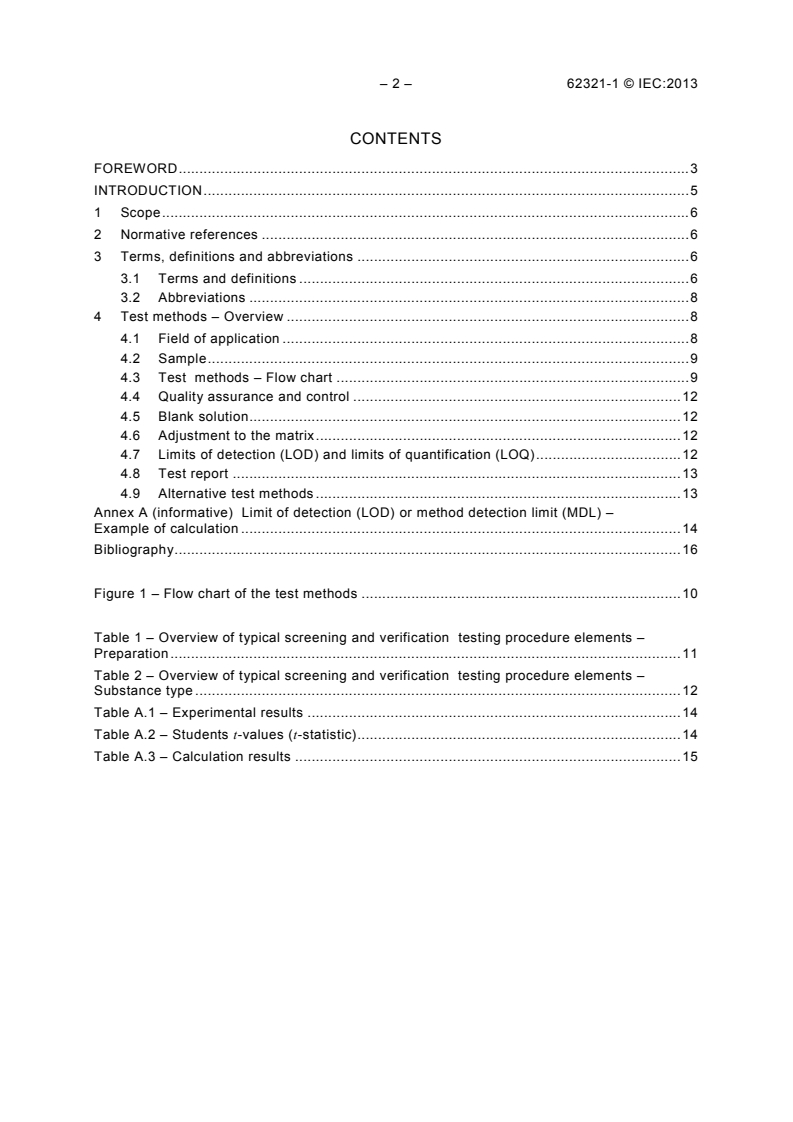
– 2 – 62321-1 © IEC:2013
CONTENTS
FOREWORD . 3
INTRODUCTION . 5
1 Scope . 6
2 Normative references . 6
3 Terms, definitions and abbreviations . 6
3.1 Terms and definitions . 6
3.2 Abbreviations . 8
4 Test methods – Overview . 8
4.1 Field of application . 8
4.2 Sample . 9
4.3 Test methods – Flow chart . 9
4.4 Quality assurance and control . 12
4.5 Blank solution . 12
4.6 Adjustment to the matrix . 12
4.7 Limits of detection (LOD) and limits of quantification (LOQ) . 12
4.8 Test report . 13
4.9 Alternative test methods . 13
Annex A (informative) Limit of detection (LOD) or method detection limit (MDL) –
Example of calculation . 14
Bibliography . 16
Figure 1 – Flow chart of the test methods . 10
Table 1 – Overview of typical screening and verification testing procedure elements –
Preparation . 11
Table 2 – Overview of typical screening and verification testing procedure elements –
Substance type . 12
Table A.1 – Experimental results . 14
Table A.2 – Students t-values (t-statistic) . 14
Table A.3 – Calculation results . 15
62321-1 © IEC:2013 – 3 –
INTERNATIONAL ELECTROTECHNICAL COMMISSION
____________
DETERMINATION OF CERTAIN SUBSTANCES
IN ELECTROTECHNICAL PRODUCTS –
Part 1: Introduction and overview
FOREWORD
1) The International Electrotechnical Commission (IEC) is a worldwide organization for standardization comprising
all national electrotechnical committees (IEC National Committees). The object of IEC is to promote
international co-operation on all questions concerning standardization in the electrical and electronic fields. To
this end and in addition to other activities, IEC publishes International Standards, Technical Specifications,
Technical Reports, Publicly Available Specifications (PAS) and Guides (hereafter referred to as “IEC
Publication(s)”). Their preparation is entrusted to technical committees; any IEC National Committee interested
in the subject dealt with may participate in this preparatory work. International, governmental and non-
governmental organizations liaising with the IEC also participate in this preparation. IEC collaborates closely
with the International Organization for Standardization (ISO) in accordance with conditions determined by
agreement between the two organizations.
2) The formal decisions or agreements of IEC on technical matters express, as nearly as possible, an international
consensus of opinion on the relevant subjects since each technical committee has representation from all
interested IEC National Committees.
3) IEC Publications have the form of recommendations for international use and are accepted by IEC National
Committees in that sense. While all reasonable efforts are made to ensure that the technical content of IEC
Publications is accurate, IEC cannot be held responsible for the way in which they are used or for any
misinterpretation by any end user.
4) In order to promote international uniformity, IEC National Committees undertake to apply IEC Publications
transparently to the maximum extent possible in their national and regional publications. Any divergence
between any IEC Publication and the corresponding national or regional publication shall be clearly indicated in
the latter.
5) IEC itself does not provide any attestation of conformity. Independent certification bodies provide conformity
assessment services and, in some areas, access to IEC marks of conformity. IEC is not responsible for any
services carried out by independent certification bodies.
6) All users should ensure that they have the latest edition of this publication.
7) No liability shall attach to IEC or its directors, employees, servants or agents including individual experts and
members of its technical committees and IEC National Committees for any personal injury, property damage or
other damage of any nature whatsoever, whether direct or indirect, or for costs (including legal fees) and
expenses arising out of the publication, use of, or reliance upon, this IEC Publication or any other IEC
Publications.
8) Attention is drawn to the Normative references cited in this publication. Use of the referenced publications is
indispensable for the correct application of this publication.
9) Attention is drawn to the possibility that some of the elements of this IEC Publication may be the subject of
patent rights. IEC shall not be held responsible for identifying any or all such patent rights.
International Standard IEC 62321-1 has been prepared by IEC technical committee 111:
Environmental standardization for electrical and electronic products and systems.
It has the status of a horizontal standard in accordance with IEC Guide 108.
The first edition of IEC 62321:2008 was a 'stand-alone' standard that included an introduction,
an overview of test methods, a mechanical sample preparation as well as various test method
clauses.
This first edition of IEC 62321-1 is a partial replacement of IEC 62321, forming a structural
revision and replacing Clauses 1 to 4.
Future parts in the IEC 62321 series will gradually replace the corresponding clauses from
IEC 62321:2008. Until such time as all parts are published, however, IEC 62321:2008 remains
valid for those clauses not yet re-published as a separate part.
– 4 – 62321-1 © IEC:2013
The text of this standard is based on the following documents:
FDIS Report on voting
111/295/FDIS 111/306/RVD
Full information on the voting for the approval of this standard can be found in the report on
voting indicated in the above table.
This publication has been drafted in accordance with the ISO/IEC Directives, Part 2.
A list of all parts in the IEC 62321 series can be found on the IEC website under the general
title: Determination of certain substances in electrotechnical products.
The committee has decided that the contents of this publication will remain unchanged until
the stability date indicated on the IEC web site under "http://webstore.iec.ch" in the data
related to the specific publication. At this date, the publication will be
• reconfirmed,
• withdrawn,
• replaced by a revised edition, or
• amended.
IMPORTANT – The 'colour inside' logo on the cover page of this publication indicates
that it contains colours which are considered to be useful for the correct
understanding of its contents. Users should therefore print this document using a
colour printer.
62321-1 © IEC:2013 – 5 –
INTRODUCTION
The widespread use of electrotechnical products has drawn increased attention to their impact
on the environment. In many countries this has resulted in the adoption of regulations
affecting wastes, substances and energy use of electrotechnical products.
The use of certain substances (e.g. lead (Pb), cadmium (Cd) and polybrominated diphenyl
ethers (PBDEs)) in electrotechnical products, is a source of concern in current and proposed
regional legislation.
The purpose of the IEC 62321 series is therefore to provide test methods that will allow the
electrotechnical industry to determine the levels of certain substances of concern in
electrotechnical products on a consistent global basis.
The first edition of IEC 62321:2008 was a single 'stand-alone' standard that included an
introduction, an overview of test methods, a mechanical sample preparation as well as various
test method clauses.
The structure of the new multi-part IEC 62321 series comprises:
– Determination of certain substances in electrotechnical products – Part 1: Introduction and
overview.
– Determination of certain substances in electrotechnical products – Part 2: Disassembly,
disjointment and mechanical sample preparation.
The remaining parts specify screening and verification test methods for the determination of
certain substances, each part representing a given substance.
WARNING – Persons using this International Standard should be familiar with normal
laboratory practice. This standard does not purport to address all of the safety
problems, if any, associated with its use. It is the responsibility of the user to establish
appropriate safety and health practices and to ensure compliance with any national
regulatory conditions.
– 6 – 62321-1 © IEC:2013
DETERMINATION OF CERTAIN SUBSTANCES
IN ELECTROTECHNICAL PRODUCTS –
Part 1: Introduction and overview
1 Scope
This part of IEC 62321 refers to the sample as the object to be processed and measured. The
nature of the sample and the manner in which it is acquired is defined by the entity carrying
out the tests and not by this standard.
It is noted that the selection of the sample may affect the interpretation of the test results.
While this standard provides guidance on the disassembly procedure employed for obtaining
a sample, it does not determine or specify:
• the level of the disassembly procedure required for obtaining a sample;
• the definition of a “unit” or “homogenous material” as the sample;
• conformity assessment procedures.
NOTE Further guidance on assessment procedures may be found in IEC/TR 62476 [2].
2 Normative references
The following documents, in whole or in part, are normatively referenced in this document and
are indispensable for its application. For dated references, only the edition cited applies. For
undated references, the latest edition of the referenced document (including any
amendments) applies.
ISO 78-2:1999, Chemistry – Layouts for standards – Part 2: Methods of chemical analysis
ISO/IEC 17025, General requirements for the competence of testing and calibration
laboratories
3 Terms, definitions and abbreviations
3.1 Terms and definitions
For the purposes of this document, the following terms and definitions apply.
3.1.1
analyte
substance to be measured
3.1.2
electronics
material used in electrical or electronic equipment that is not metal or plastic (e.g. ceramic) or
not uniform in composition throughout and cannot be practically disassembled to individual
discrete materials
EXAMPLE Resistors, capacitors, diodes, integrated circuits, hybrids, application-specific integrated circuits,
wound components, relays and their materials.
62321-1 © IEC:2013 – 7 –
3.1.3
field replaceable unit
part, component or subassembly that is easily removed (mechanically disjointed) using
ordinary tools
Note 1 to entry: “Easily removed” means using ordinary tools to perform such functions as screwing or
disconnecting, and only without irreversibly destroying the unit.
[SOURCE: IEC Guide 114:2005, definition 3.7] [3]
3.1.4
matrix
substance or mixture and its form or state in which analyte is embedded or to which analyte is
attached
3.1.5
performance-based measurement system
set of processes wherein the data needs, mandates or limitations of a program or project are
specified, serving as criteria for selecting appropriate methods to meet those needs in a cost-
effective manner
Note 1 to entry: The criteria may be published in regulations, technical guidance documents, permits, work plans
or enforcement orders.
3.1.6
precision
closeness of agreement between independent test results obtained under stipulated
conditions
3.1.7
reference material
material, sufficiently homogeneous and stable with reference to specified properties, which
has been established to be fit for its intended use in measurement or in examination of
nominal properties
3.1.8
repeatability
precision under repeatability conditions
[SOURCE: ISO 5725-1:1994, definition 3.13] [4]
3.1.9
reproducibility
precision under reproducibility conditions
[SOURCE: ISO 5725-1:1994, definition 3.17]
3.1.10
screening
analytical procedure to determine the presence or absence of substances in the
representative part or section of a product, relative to the value or values chosen as the
criterion for presence, absence or further testing
Note 1 to entry: If the screening method produces values that are not conclusive, then additional analysis or other
follow-up actions may be necessary to make a final presence/absence decision.
– 8 – 62321-1 © IEC:2013
3.2 Abbreviations
AAS Atomic Absorption Spectrometry
C-IC Combustion – Ion chromatography
CV-AAS Cold Vapour Atomic Absorption Spectrometry
CV-AFS Cold Vapour Atomic Fluorescence Spectroscopy
EPA Environmental Protection Agency
FRU Field replaceable unit
GC-MS Gas chromatography – mass spectrometry
GLP Good laboratory practice
HPLC-UV High-performance liquid chromatography – ultraviolet
IC Ion Chromatography
IAMS Ion attached mass spectrometry
ICP-MS Inductively coupled plasma mass spectrometry
ICP-OES Inductively coupled plasma optical emission spectrometry
IS Internal standard
IUPAC International Union of Pure and Applied Chemistry
LOD Limit of detection
LOQ Limit of quantification
MDL Method detection limit
PBB Polybrominated biphenyl
PBDE Polybrominated diphenyl ether
PBMS Performance-based measurement system
PWB Printed wiring board
QC Quality control
UV-VIS Ultraviolet–visible Spectroscopy
XRF X-ray fluorescence
4 Test methods – Overview
4.1 Field of application
The contents of the test methods to determine the levels of certain substances are grouped in
two important steps:
a) analytical test methods;
b) laboratory implementation.
Analytical test methods were developed and validated to ensure their suitability to the task.
The structure of each of the test methods are generally aligned in accordance with ISO 78-2
where applicable, i.e.:
– Foreword
– Introduction
– Title
– Warnings
– Scope
– Normative references
– Definitions
62321-1 © IEC:2013 – 9 –
– Principle
– Reactions
– Reagents and materials
– Apparatus
– Sampling
– Procedure
– Calculation
– Precision
– Quality assurance and control protocols
– Special cases
– Test report
– Annexes
– Bibliography
Laboratory implementation is not covered in this standard, as laboratories are able to
implement test methods described using test methods and standards addressed in other
sources. The implementation step includes suitable quality assurance measures and a
validation protocol that documents the performance of the analytical method using the
instruments in the laboratory. Quality assurance systems such as good laboratory practice
(GLP) and/or accreditation to similar international or national systems (e.g. ISO 17025) are
strongly encouraged.
4.2 Sample
This standard refers to the sample as the object to be processed and measured according to
the test methods to determine the levels of certain substances. A sample can either be a
polymer, a metal or electronics.
The entity carrying out the test methods shall define the sample and how to produce it with
respect to applicable normative documents.
NOTE The entity can either be the organization commissioning the work or the organization carrying out the work.
In practice, the requestor and the analyst will agree on the sample to be taken.
The entity may decide to prepare a sample from homogenous material. For this kind of
sample, the test methods applicable to metals or polymers are especially suitable.
The entity may also decide to prepare a sample from an electronic component, an electronic
assembly or a FRU. For this kind of sample, the test methods applicable to electronics are
especially suitable.
4.3 Test methods – Flow chart
Figure 1 gives a flow chart of the test methods to determine the levels of certain substances
in electrotechnical products.
– 10 – 62321-1 © IEC:2013
Non-destructive
Yes
sample
preparation
Entity based
Pass
Screening Meets
Sample
conforming
procedure limits?
uniform?
sample
Mechanical
sample
Fail
No
preparation
Samples
Yes
Entity based
Yes No
Further
Metallic
non conforming
testing?
materials,
sample
polymer
Screening?
materials
Entity based
Electronics
Pass
(PWB/ No conforming
component)
sample
Verification test
Mechanical
Meets
sample procedure –
limits?
preparation Various methods
Entity based
Fail
non conforming
sample
Decision criteria will
Decision
be entity based
IEC 2244/08
Figure 1 – Flow chart of the test methods
After obtaining the sample, a decision is taken as to whether the screening procedure or the
verification procedure using a variety of test methods will be used.
The use of the term “screening” for the evaluation of certain substances (e.g. lead, cadmium,
hexavalent chromium, etc.) in electrical and electronic equipment is widely used in reference
to analytical testing methods. Screening methods provide the analyst a convenient approach
to evaluate for the presence or quantity of certain substance(s) in samples. Screening may
employ qualitative or semi-quantitative methods. In some cases, a quantitative method may
be used for screening purposes if the actual targeted substance(s) are difficult to analyse
directly (e.g. hexavalent Cr).
Depending on the screening results however, additional analysis methods may need to be
employed to definitively verify the presence or quantity of certain substances. These definitive
analysis methods are referred to as verification methods.
While X-ray fluorescence spectrometry (XRF) is the tool most commonly associated with the
screening approach, it is not limited to this analytical measurement technique. Users of this
family of standards will understand that multiple measurement techniques can be employed
for the purpose of “screening”.
Screening for hexavalent chromium (Cr VI) for example, can be accomplished by a total
chromium measurement using a non-destructive XRF analysis method. Similarly, total
chromium analysis could be performed by a destructive analysis using an inductively coupled
plasma measurement method. Either measurement can be effectively employed to evaluate
for the presence or quantity of hexavalent chromium since the concentration of the hexavalent
species can be no greater than the total chromium concentration value.
Likewise, a total bromine measurement using a non-destructive XRF analysis method or C-IC
method can be used in the same fashion. Either measurement can be effectively employed to
evaluate for the presence or quantity (PBBs) or (PBDEs) in a sample when relating the total
bromine content to the composition of these compounds.
In both examples however, the detection of elevated total element levels requires additional
verification method analysis (e.g. UV-VIS or GC-MS techniques) to confirm the potential
presence or quantity of hexavalent chromium (Cr +IV) or PBB/PBDE compound species.
62321-1 © IEC:2013 – 11 –
It can therefore be seen that the prudent analyst can effectively employ different screening
procedures to achieve the same result.
The screening procedure may be carried out either by directly measuring the sample (non-
destructive sample preparation) or by destroying the sample to make it uniform (mechanical
sample preparation). This decision shall be made by judging the uniformity of the sample. A
screening of representative samples of many uniform materials (such as polymers, alloys,
glass) may be carried out non-destructively, while for other more complex samples (such as a
FRU), mechanical sample preparation may be an appropriate solution. Mechanical sample
preparation is the same for both the screening and the verification test procedure.
Verification test procedures are often employed to confirm the presence or quantity of certain
substances of concern after a screening procedure has been performed (e.g. to determine if
the source of “screened” bromine is from a bromine compound of concern). Alternatively,
verification test procedures can be performed independent of a screening procedure.
Verification procedures are typically performed after mechanical and chemical sample
preparation using a variety of test methods tailored to the substances of concern and the
sample, which can be a polymer, a metal or electronics.
Tables 1 and 2 give an overview of typical screening/verification test methods, which are
described in detail in the individual substance test method parts of this standard.
Table 1 – Overview of typical screening and verification
testing procedure elements – Preparation
Electronics
Procedure Sample preparation Polymers Metals
(PWBs/components)
Non destructive No preparation No preparation No preparation
Mechanical sample
Grinding or milling Grinding or milling Grinding or milling
preparation
• Aqueous/alkaline • Aqueous/alkaline
extraction extraction
• Acid digestion • Acid digestion
Sample
• Dry ashing • Organic solvent/
Preparation
extraction
Chemical sample • Organic solvent
Acid digestion
extraction • Combustion/extract
preparation
ion
• Combustion/
extraction
• Thermal gold-
amalgamation
– 12 – 62321-1 © IEC:2013
Table 2 – Overview of typical screening and verification
testing procedure elements – Substance type
Electronics
Procedure Substance type Polymers Metals
(PWBs/components)
• GC-MS • GC-MS
Organic compounds
• IAMS • IAMS
NA
(e.g. PBDEs)
• HPLC-UV • HPLC-UV
• XRF • XRF
Elemental bromine NA
• IC • IC
Analytical
measurement
Ionic species
Colorimetry/UV-VIS Colorimetry/UV-VIS Colorimetry
(e.g. Cr +VI
Elemental (metals)
analysis
XRF, AAS, CV-AAS, CV-AFS, ICP-OES and ICP-MS
(e.g. Pb, Cd)
After the verification procedure has been carried out, it shall be decided whether the sample
meets the limits based on the entity’s criteria for certain substances.
4.4 Quality assurance and control
Where applicable, the quality assurance and control clauses of the individual test method
standards shall include control sample requirements regarding testing frequency and
acceptance criteria. These clauses shall also include method specific quality control concerns
regarding the determination of limits of detection (LOD) and limits of quantification
(LOQ). Where applicable, the LOD and LOQ section shall be consistent with the descriptions
in 4.7. Examples of other method-specific quality control concerns include requirements
regarding method blanks, calibration check standards, spike or surrogate samples, internal
standard responses and the like.
4.5 Blank solution
Where applicable, the precision clause of the individual test method standards shall include
repeatability and reproducibility statements (see Annex B of ISO 78-2:1999) supported by
statistical data derived from interlaboratory study or the equivalent.
4.6 Adjustment to the matrix
Test methods for certain substances that are present at relatively low levels amongst other
chemical elements or compounds at relatively high concentrations, or those that represent the
major constituent of the sample, are very often material or matrix dependent. Therefore, the
test methods shall be adjusted to the materials to be tested, either by introducing the
appropriate blanks and matrix-adjusted calibration samples, or by a preparation step that
separates the analyte from the adherent materials or the main matrix. The main material types
(or matrices) in electronic equipment are polymers (mostly technical polymers containing
additives and sometimes having coated surfaces), metals or alloys (they may also be coated)
and electronics. Matrix adjustment may be difficult for electronic products.
4.7 Limits of detection (LOD) and limits of quantification (LOQ)
In its simplest form, a limit of detection (LOD) or method detection limit (MDL) is typically
described as the lowest amount or concentration of analyte in a test sample that can be
reliably differentiated from zero for a given measurement system.
Instrument detection limits represent an instrument’s ability to differentiate low concentrations
of analytes from “zero” in a blank or standard solution, and are commonly used by
manufacturers to demonstrate the measurement capability of a system (e.g. atomic absorption
62321-1 © IEC:2013 – 13 –
spectrometer). Whilst instrument detection limits are useful, they are often considerably lower
than a limit of detection representing a complete analytical measurement process.
Complete analytical method detection limits are most appropriately determined experimentally
by performing replicate, independent measurements on low-level or fortified sample matrices
(e.g. plastic) carried out through the entire test procedure, including sample digestion or
extraction. A minimum of six replicates and analyte concentrations of 3 to 5 times the
estimated method detection limit have been suggested as suitable for this analysis. The
complete method detection limit for an entire test procedure is determined by multiplying the
standard deviation of the replicates by an appropriate factor. IUPAC recommends a factor of
3 for a minimum of six replicates, whilst EPA utilizes a one-sided confidence interval with the
multiplier equal to Student’s t value chosen for the number of replicates and the level of
confidence (e.g. t = 3,36 for six replicates for 99 % confidence).
NOTE An illustrative calculation example is given in Annex A.
The limit of quantification (LOQ) or estimated quantitation limit for a given measurement
system is typically described as the lowest concentration that can be reliably determined
within specified or acceptable limits of precision during routine laboratory operating conditions.
The acceptable precision limit is often defined as 10 % relative standard deviation or simply
expressed as a fixed multiple (2 to 10) of the method detection limit.
4.8 Test report
The work carried out by the testing laboratory shall be covered by a report that accurately,
clearly and unambiguously presents the test results and other relevant information. Each test
report shall include at least the following information:
a) name, address and location of any laboratory involved in the analysis and name of the
operator;
b) date of receipt of sample and date(s) of performance of test(s);
c) unique identification of report (such as a serial number) and of each page and total
number of pages of the report;
d) description and identification of the sample, including a description of any product
disassembly performed to acquire the test sample;
e) a reference to this standard, the method used or performance-based equivalent (including
digestion method(s) and equipment);
f) the limit of detection (LOD) or limit of quantification (LOQ);
g) the results of the test expressed as milligram/kilogram (mg/kg) in samples tested;
h) any details not specified in this standard which are optional, and any other factors that
may have affected the results. Any deviation, by agreement or otherwise, from the test
procedure specified here.
The results of all quality control (QC) tests (e.g. results from method blanks, matrix spikes,
etc.) and a list of reference materials used and their origin shall be available upon request.
Corrections or additions to a test report after issue shall be made only in a further document
suitably marked, e.g. “Amendment/Addendum to test report serial number XXX” (or as
otherwise identified), and shall meet the relevant requirements of 4.2 to 4.6).
4.9 Alternative test methods
Alternative test methods, digestion methods or analytical techniques may be utilized once the
performance effectiveness has been validated according to PBMS criteria, referenced in the
quality control clauses of the test methods. Any deviation from the described test methods
shall be evaluated and documented in the test report.
– 14 – 62321-1 © IEC:2013
Annex A
(informative)
Limit of detection (LOD) or method detection limit (MDL) –
Example of calculation
A sample containing an amount (~9,5 mg/kg) of cadmium approximately 3 to 5 times the
estimated method detection limit (~2 mg/kg) underwent nine (9) separate digestions and
quantitative measurements. The results are shown in Table A.1.
Table A.1 – Experimental results
Measured cadmium content
Replicate (digestion) number
mg/kg
1 9,49
2 10,20
3 9,79
4 9,44
5 9,42
6 9,80
7 9,94
8 8,89
9 10,20
The limit of detection (LOD) or method detection limit (MDL) was determined using the
appropriate student's t-value (t-statistic) and formula shown in Table A.2 and Formula (A.1).
Table A.2 – Students t-values (t-statistic)
No. of samples
t-statistic (n-1, α = 0,99)
3 6,96
4 4,54
5 3,75
6 3,36
7 3,14
8 3,00
9 2,90
10 2,82
LOD or MDL = t-statistic × standard deviation (s ) (A.1)
n-1
The limit of quantification (LOQ) or estimated quantitation limit is expressed as a fixed multiple
(5) of the limit of detection (LOD) or method detection limit (MDL) as shown in Table A.3.
62321-1 © IEC:2013 – 15 –
Table A.3 – Calculation results
Mean 9,69 mg/kg
t-statistic (n-1, α = 0,99) 2,90
Standard deviation (s ) 0,42 mg/kg
n-1
LOD or MDL 1,22 mg/kg
LOQ @ 5x MDL 6,09 mg/kg
Based on the results of the calculations, it is appropriate to quote the estimated LOD as
1,2 mg/kg and the estimated LOQ as 6.0 mg/kg.
– 16 – 62321-1 © IEC:2013
Bibliography
[1] IEC/TR 62476:2010, Guidance for evaluation of products with respect to substance-
use restrictions in electrical and electronic products
[2] IEC Guide 114:2005, Environmentally conscious design – Integrating environmental
aspects into design and development of electrotechnical products
(withdrawn)
[3] ISO 5725-1:1994, Accuracy (trueness and precision) of measurement methods and
results — Part 1: General principles and definitions
Additional non-cited references
ISO 5725 (all parts), Accuracy (trueness and precision) of measurement methods and
results
IEC 60730-1:2010, Automatic electrical controls for household and similar use – Part 1:
General requirements
IEC/TS 62239:2008, Process management for avionics – Preparation of an electronic
components management plan
ISO 6206, Chemical products for industrial use – Sampling – Vocabulary
ISO/IEC Guide 98-3, Uncertainty of measurement – Part 3: Guide to the expression of
uncertainty in measurement (GUM:1995)
ISO/IEC Guide 99, International vocabulary of metrology – Basic and general concepts
and associated terms (VIM)
ISO Guide 30, Terms and definitions used in connection with reference materials
ISO Guide 32, Calibration in analytical chemistry and use of certified reference
materials
BECKER, D., Use of NIST Standard Reference Materials for Decisions on Performance
of Analytical Chemical Methods and Laboratories, National Institute of Standards and
Technology (NIST) Special Publication 829, 1992
International Union of Pure and Applied Chemistry, Harmonized Guidelines for Single
Laboratory Validation of Methods of Analysis (IUPAC Technical Report), Pure Appl.
Chem., 2002, vol. 74, no. 5, p. 835–855
International Union of Pure and Applied Chemistry, Nomenclature in Evaluation of
Analytical Methods Including Detection and Quantification Limits, Pure Appl. Chem.,
1995, vol. 67, no. 10, p.1699-1723,
United States Environmental Protection Agency (EPA), EPA SW-846, Chapter 1,
Quality Control
_____________
– 18 – 62321-1 © CEI:2013
SOMMAIRE
AVANT-PROPOS . 19
INTRODUCTION . 21
1 Domaine d'application . 22
2 Références normatives . 22
3 Termes, définitions et abréviations . 22
3.1 Termes et définitions . 22
3.2 Abréviations . 24
4 Méthodes d'essai – Présentation . 25
4.1 Domaine d’application . 25
4.2 Échantillon . 26
4.3 Méthodes d'essai − Logigramme . 26
4.4 Assurance qualité et contrôle de la qualité . 29
4.5 Solution témoin . 30
4.6 Adaptation à la matrice . 30
4.7 Limites de détection (LOD) et limites de quantification (LOQ) . 30
4.8 Rapport d’essai . 31
4.9 Autres méthodes d'essai . 31
Annexe A (informative) Limite de détection (LOD) ou limite de détection de la méthode
(MDL) – Exemple de calcul . 32
Bibliographie . 34
Figure 1 – Logigramme des méthodes d'essai. 27
Tableau 1 – Présentation des éléments d'une procédure type d'essai de détection et
de vérification – Préparation . 29
Tableau 2 – Présentation des éléments d'une procédure type d'essai de détection et
de vérification – Type de substance . 29
Tableau A.1 – Résultats expérimentaux . 32
Tableau A.2 – Valeurs t de Student (statistique t) . 32
Tableau A.3 – Résultats de calcul . 33
62321-1 © CEI:2013 – 19 –
COMMISSION ÉLECTROTECHNIQUE INTERNATIONALE
____________
DETERMINATION DE CERTAINES SUBSTANCES
DANS LES PRODUITS ELECTROTECHNIQUES –
Partie 1: Introduction et présentation
AVANT-PROPOS
1) La Commission Electrotechnique Internationale (CEI) est une organisation mondiale de normalisation
composée de l'ensemble des comités électrotechniques nationaux (Comités nationaux de la CEI). La CEI a
pour objet de favoriser la coopération internationale pour toutes les questions de normalisation dans les
domaines de l'électricité et de l'électronique. A cet effet, la CEI – entre autres activités – publie des Normes
internationales, des Spécifications techniques, des Rapports techniques, des Spécifications accessibles au
public (PAS) et des Guides (ci-après dénommés "Publication(s) de la CEI"). Leur élaboration est confiée à des
comités d'études, aux travaux desquels tout Comité national intéressé par le sujet traité peut participer. Les
organisations internationales, gouvernementales et non gouvernementales, en liaison avec la CEI, participent
également aux travaux. La CEI collabore étroitement avec l'Organisation Internationale de Normalisation (ISO),
selon des conditions fix
...