

IEC 62321-4:2013
(Main)Determination of certain substances in electrotechnical products - Part 4: Mercury in polymers, metals and electronics by CV-AAS, CV-AFS, ICP-OES and ICP-MS
General Information
- Abstract
IEC 62321-4:2013 describes the use of four test methods for mercury in polymers, metals and electronics, namely CV-AAS (cold vapour atomic absorption spectrometry), CV-AFS (cold vapour atomic fluorescence spectrometry) ICP-OES (inductively coupled plasma optical emission spectrometry), and ICP-MS (inductively coupled plasma mass spectrometry) as well as several procedures for preparing the sample solution from which the most appropriate method of analysis can be selected by experts.
It has the status of a horizontal standard in accordance with IEC Guide 108.
- Status
- Published
- Publication Date
- 12-Jul-2017
- Technical Committee
- TC 111 - Environmental standardization for electrical and electronic products and systems
- Drafting Committee
- WG 3 - TC 111/WG 3
- Current Stage
- PPUB - Publication issued
- Start Date
- 19-Jun-2013
- Completion Date
- 30-Jun-2013
Buy Documents
IEC 62321-4:2013 - Determination of certain substances in electrotechnical products - Part 4: Mercury in polymers, metals and electronics by CV-AAS, CV-AFS, ICP-OES and ICP-MS Released:6/19/2013

IEC 62321-4:2013+AMD1:2017 CSV - Determination of certain substances in electrotechnical products - Part 4: Mercury in polymers, metals and electronics by CV-AAS, CV-AFS, ICP-OES and ICP-MS Released:7/13/2017
Overview
IEC 62321-4:2013 is an international horizontal standard published by the International Electrotechnical Commission (IEC) that focuses on the determination of mercury content in electrotechnical products. This standard addresses mercury in polymers, metals, and electronic components, outlining test methods based on advanced spectrometric and analytical techniques. It forms part 4 of the IEC 62321 series, which deals with the analysis of certain substances in electrical and electronic equipment to support regulatory compliance and environmental protection.
The standard specifies four analytical methods for mercury detection:
- CV-AAS (Cold Vapour Atomic Absorption Spectrometry)
- CV-AFS (Cold Vapour Atomic Fluorescence Spectrometry)
- ICP-OES (Inductively Coupled Plasma Optical Emission Spectrometry)
- ICP-MS (Inductively Coupled Plasma Mass Spectrometry)
In addition, IEC 62321-4:2013 provides detailed sample preparation procedures, ensuring robust and accurate mercury quantification across different material matrices including polymers and metals commonly found in electronic products.
Key Topics
- Scope and Purpose: Defines mercury determination in polymers, metals, and electronic components to ensure compliance with international regulations restricting hazardous substances.
- Test Methods: Detailed procedures for CV-AAS, CV-AFS, ICP-OES, and ICP-MS, enabling selection of the most appropriate analytical technique depending on the sample type and measurement requirements.
- Sample Preparation: Includes wet digestion, microwave digestion, and thermal decomposition-gold amalgamation methods to prepare samples for precise mercury analysis.
- Calibration and Quality Control: Guidelines on calibration curve development, reagent blanks, method detection limits (LOD), and quantification limits (LOQ) to maintain analytical integrity.
- Precision and Accuracy: Statistical data on repeatability and reproducibility to validate method consistency.
- Environmental and Regulatory Relevance: Supports manufacturers and test labs in addressing mercury restrictions in electronic products in line with global directives such as RoHS (Restriction of Hazardous Substances).
Applications
IEC 62321-4:2013 is essential for:
- Manufacturers of electrical and electronic products aiming to monitor and control mercury content in their materials to ensure regulatory compliance and environmental safety.
- Testing laboratories conducting standardized mercury analysis using recognized spectrometric methods, enhancing the reliability of their test results.
- Environmental and regulatory authorities ensuring that electrotechnical products entering the market meet hazardous substance limits to minimize environmental and human health risks.
- Quality assurance teams within electronics industries implementing mercury testing within supplier audits and product inspection processes.
- Research and development units focusing on material safety assessment and innovation in low-mercury or mercury-free electronics.
By following IEC 62321-4, stakeholders can achieve consistent, comparable, and internationally accepted results that facilitate market access and reduce environmental impact.
Related Standards
IEC 62321-4:2013 is part of the broader IEC 62321 series that covers determination methods for certain hazardous substances in electronics, including:
- IEC 62321-1: Introduction and overview of test methods for various restricted substances.
- IEC 62321-5: Cadmium determination by various methods.
- IEC 62321-6: Determination of phthalates.
- IEC 62321-7: Methods for polybrominated biphenyls (PBB) and polybrominated diphenyl ethers (PBDE).
- IEC 62321-8: Determination of hexavalent chromium.
Together, these standards provide a comprehensive framework for hazardous substance assessment in electrotechnical products, complementing regulations such as RoHS, WEEE, and REACH. Compliance with IEC 62321-4 supports environmental stewardship and fosters global harmonization in chemical safety controls for the electronics industry.
Keywords: IEC 62321-4, mercury determination, polymers, metals, electronics, electrotechnical products, CV-AAS, CV-AFS, ICP-OES, ICP-MS, mercury testing, hazardous substances, electrical and electronic equipment, standardized analysis, environmental compliance, RoHS, Hg content analysis
Relations
- Effective Date
- 05-Sep-2023
Buy Documents
IEC 62321-4:2013 - Determination of certain substances in electrotechnical products - Part 4: Mercury in polymers, metals and electronics by CV-AAS, CV-AFS, ICP-OES and ICP-MS Released:6/19/2013
IEC 62321-4:2013+AMD1:2017 CSV - Determination of certain substances in electrotechnical products - Part 4: Mercury in polymers, metals and electronics by CV-AAS, CV-AFS, ICP-OES and ICP-MS Released:7/13/2017
Get Certified
Connect with accredited certification bodies for this standard

TÜV Rheinland
TÜV Rheinland is a leading international provider of technical services.

TÜV SÜD
TÜV SÜD is a trusted partner of choice for safety, security and sustainability solutions.

BSI Group
BSI (British Standards Institution) is the business standards company that helps organizations make excellence a habit.
Sponsored listings
Frequently Asked Questions
IEC 62321-4:2013 is a standard published by the International Electrotechnical Commission (IEC). Its full title is "Determination of certain substances in electrotechnical products - Part 4: Mercury in polymers, metals and electronics by CV-AAS, CV-AFS, ICP-OES and ICP-MS". This standard covers: IEC 62321-4:2013 describes the use of four test methods for mercury in polymers, metals and electronics, namely CV-AAS (cold vapour atomic absorption spectrometry), CV-AFS (cold vapour atomic fluorescence spectrometry) ICP-OES (inductively coupled plasma optical emission spectrometry), and ICP-MS (inductively coupled plasma mass spectrometry) as well as several procedures for preparing the sample solution from which the most appropriate method of analysis can be selected by experts. It has the status of a horizontal standard in accordance with IEC Guide 108.
IEC 62321-4:2013 describes the use of four test methods for mercury in polymers, metals and electronics, namely CV-AAS (cold vapour atomic absorption spectrometry), CV-AFS (cold vapour atomic fluorescence spectrometry) ICP-OES (inductively coupled plasma optical emission spectrometry), and ICP-MS (inductively coupled plasma mass spectrometry) as well as several procedures for preparing the sample solution from which the most appropriate method of analysis can be selected by experts. It has the status of a horizontal standard in accordance with IEC Guide 108.
IEC 62321-4:2013 is classified under the following ICS (International Classification for Standards) categories: 13.020.01 - Environment and environmental protection in general; 43.040.10 - Electrical and electronic equipment. The ICS classification helps identify the subject area and facilitates finding related standards.
IEC 62321-4:2013 has the following relationships with other standards: It is inter standard links to IEC 62321-4:2013/AMD1:2017. Understanding these relationships helps ensure you are using the most current and applicable version of the standard.
IEC 62321-4:2013 is available in PDF format for immediate download after purchase. The document can be added to your cart and obtained through the secure checkout process. Digital delivery ensures instant access to the complete standard document.
Standards Content (Sample)
IEC 62321-4 ®
Edition 1.0 2013-06
INTERNATIONAL
STANDARD
NORME
INTERNATIONALE
HORIZONTAL STANDARD
NORME HORIZONTALE
Determination of certain substances in electrotechnical products –
Part 4: Mercury in polymers, metals and electronics by CV-AAS, CV-AFS,
ICP-OES and ICP-MS
Détermination de certaines substances dans les produits électrotechniques –
Partie 4: Mercure dans les polymères, métaux et produits électroniques par
CV-AAS, CV-AFS, ICP-OES et ICP-MS
All rights reserved. Unless otherwise specified, no part of this publication may be reproduced or utilized in any form
or by any means, electronic or mechanical, including photocopying and microfilm, without permission in writing from
either IEC or IEC's member National Committee in the country of the requester.
If you have any questions about IEC copyright or have an enquiry about obtaining additional rights to this publication,
please contact the address below or your local IEC member National Committee for further information.
Droits de reproduction réservés. Sauf indication contraire, aucune partie de cette publication ne peut être reproduite ni
utilisée sous quelque forme que ce soit et par aucun procédé, électronique ou mécanique, y compris la photocopie et les
microfilms, sans l'accord écrit de la CEI ou du Comité national de la CEI du pays du demandeur.
Si vous avez des questions sur le copyright de la CEI ou si vous désirez obtenir des droits supplémentaires sur cette
publication, utilisez les coordonnées ci-après ou contactez le Comité national de la CEI de votre pays de résidence.
IEC Central Office Tel.: +41 22 919 02 11
3, rue de Varembé Fax: +41 22 919 03 00
CH-1211 Geneva 20 info@iec.ch
Switzerland www.iec.ch
About the IEC
The International Electrotechnical Commission (IEC) is the leading global organization that prepares and publishes
International Standards for all electrical, electronic and related technologies.
About IEC publications
The technical content of IEC publications is kept under constant review by the IEC. Please make sure that you have the
latest edition, a corrigenda or an amendment might have been published.
Useful links:
IEC publications search - www.iec.ch/searchpub Electropedia - www.electropedia.org
The advanced search enables you to find IEC publications The world's leading online dictionary of electronic and
by a variety of criteria (reference number, text, technical electrical terms containing more than 30 000 terms and
committee,…). definitions in English and French, with equivalent terms in
It also gives information on projects, replaced and additional languages. Also known as the International
withdrawn publications. Electrotechnical Vocabulary (IEV) on-line.
IEC Just Published - webstore.iec.ch/justpublished Customer Service Centre - webstore.iec.ch/csc
Stay up to date on all new IEC publications. Just Published If you wish to give us your feedback on this publication
details all new publications released. Available on-line and or need further assistance, please contact the
also once a month by email. Customer Service Centre: csc@iec.ch.
A propos de la CEI
La Commission Electrotechnique Internationale (CEI) est la première organisation mondiale qui élabore et publie des
Normes internationales pour tout ce qui a trait à l'électricité, à l'électronique et aux technologies apparentées.
A propos des publications CEI
Le contenu technique des publications de la CEI est constamment revu. Veuillez vous assurer que vous possédez
l’édition la plus récente, un corrigendum ou amendement peut avoir été publié.
Liens utiles:
Recherche de publications CEI - www.iec.ch/searchpub Electropedia - www.electropedia.org
La recherche avancée vous permet de trouver des Le premier dictionnaire en ligne au monde de termes
publications CEI en utilisant différents critères (numéro de électroniques et électriques. Il contient plus de 30 000
référence, texte, comité d’études,…). termes et définitions en anglais et en français, ainsi que
Elle donne aussi des informations sur les projets et les les termes équivalents dans les langues additionnelles.
publications remplacées ou retirées. Egalement appelé Vocabulaire Electrotechnique
International (VEI) en ligne.
Just Published CEI - webstore.iec.ch/justpublished
Service Clients - webstore.iec.ch/csc
Restez informé sur les nouvelles publications de la CEI.
Just Published détaille les nouvelles publications parues. Si vous désirez nous donner des commentaires sur
Disponible en ligne et aussi une fois par mois par email. cette publication ou si vous avez des questions
contactez-nous: csc@iec.ch.
IEC 62321-4 ®
Edition 1.0 2013-06
INTERNATIONAL
STANDARD
NORME
INTERNATIONALE
HORIZONTAL STANDARD
NORME HORIZONTALE
Determination of certain substances in electrotechnical products –
Part 4: Mercury in polymers, metals and electronics by CV-AAS, CV-AFS,
ICP-OES and ICP-MS
Détermination de certaines substances dans les produits électrotechniques –
Partie 4: Mercure dans les polymères, métaux et produits électroniques par
CV-AAS, CV-AFS, ICP-OES et ICP-MS
INTERNATIONAL
ELECTROTECHNICAL
COMMISSION
COMMISSION
ELECTROTECHNIQUE
INTERNATIONALE
ICS 13.020; 43.040.10 ISBN 978-2-83220-841-0
– 2 – 62321-4 © IEC:2013
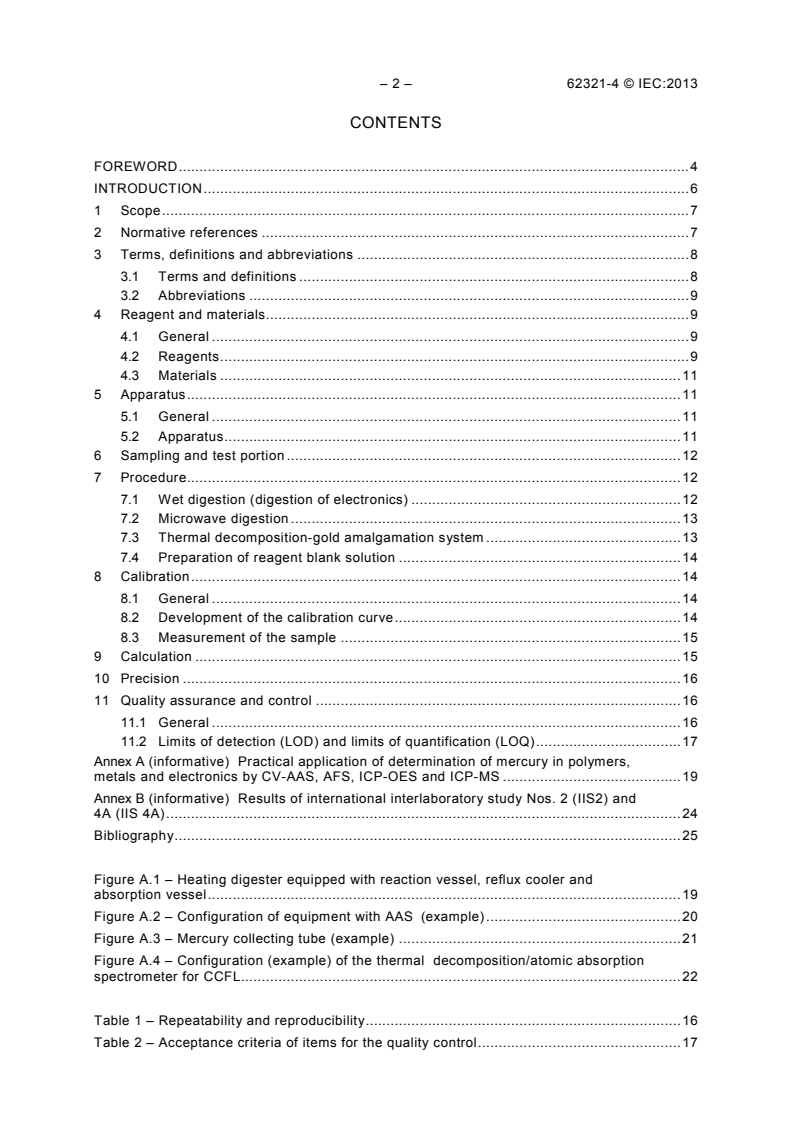
CONTENTS
FOREWORD . 4
INTRODUCTION . 6
1 Scope . 7
2 Normative references . 7
3 Terms, definitions and abbreviations . 8
3.1 Terms and definitions . 8
3.2 Abbreviations . 9
4 Reagent and materials. 9
4.1 General . 9
4.2 Reagents . 9
4.3 Materials . 11
5 Apparatus . 11
5.1 General . 11
5.2 Apparatus . 11
6 Sampling and test portion . 12
7 Procedure. 12
7.1 Wet digestion (digestion of electronics) . 12
7.2 Microwave digestion . 13
7.3 Thermal decomposition-gold amalgamation system . 13
7.4 Preparation of reagent blank solution . 14
8 Calibration . 14
8.1 General . 14
8.2 Development of the calibration curve . 14
8.3 Measurement of the sample . 15
9 Calculation . 15
10 Precision . 16
11 Quality assurance and control . 16
11.1 General . 16
11.2 Limits of detection (LOD) and limits of quantification (LOQ) . 17
Annex A (informative) Practical application of determination of mercury in polymers,
metals and electronics by CV-AAS, AFS, ICP-OES and ICP-MS . 19
Annex B (informative) Results of international interlaboratory study Nos. 2 (IIS2) and
4A (IIS 4A) . 24
Bibliography . 25
Figure A.1 – Heating digester equipped with reaction vessel, reflux cooler and
absorption vessel . 19
Figure A.2 – Configuration of equipment with AAS (example) . 20
Figure A.3 – Mercury collecting tube (example) . 21
Figure A.4 – Configuration (example) of the thermal decomposition/atomic absorption
spectrometer for CCFL. 22
Table 1 – Repeatability and reproducibility . 16
Table 2 – Acceptance criteria of items for the quality control . 17
62321-4 © IEC:2013 – 3 –
Table 3 – Method detection limit = t × s . 18
n–1
Table A.1 – Program for microwave digestion (example) of samples (power output for
five vessels). 20
Table B.1 – Statistical data for TD(G)-AAS . 24
Table B.2 – Statistical data for CV-AAS . 24
Table B.3 – Statistical data for CV-AFS . 24
Table B.4 – Statistical data for ICP-OES . 24
– 4 – 62321-4 © IEC:2013
INTERNATIONAL ELECTROTECHNICAL COMMISSION
____________
DETERMINATION OF CERTAIN SUBSTANCES
IN ELECTROTECHNICAL PRODUCTS –
Part 4: Mercury in polymers, metals and electronics
by CV-AAS, CV-AFS, ICP-OES and ICP-MS
FOREWORD
1) The International Electrotechnical Commission (IEC) is a worldwide organization for standardization comprising
all national electrotechnical committees (IEC National Committees). The object of IEC is to promote
international co-operation on all questions concerning standardization in the electrical and electronic fields. To
this end and in addition to other activities, IEC publishes International Standards, Technical Specifications,
Technical Reports, Publicly Available Specifications (PAS) and Guides (hereafter referred to as “IEC
Publication(s)”). Their preparation is entrusted to technical committees; any IEC National Committee interested
in the subject dealt with may participate in this preparatory work. International, governmental and non-
governmental organizations liaising with the IEC also participate in this preparation. IEC collaborates closely
with the International Organization for Standardization (ISO) in accordance with conditions determined by
agreement between the two organizations.
2) The formal decisions or agreements of IEC on technical matters express, as nearly as possible, an international
consensus of opinion on the relevant subjects since each technical committee has representation from all
interested IEC National Committees.
3) IEC Publications have the form of recommendations for international use and are accepted by IEC National
Committees in that sense. While all reasonable efforts are made to ensure that the technical content of IEC
Publications is accurate, IEC cannot be held responsible for the way in which they are used or for any
misinterpretation by any end user.
4) In order to promote international uniformity, IEC National Committees undertake to apply IEC Publications
transparently to the maximum extent possible in their national and regional publications. Any divergence
between any IEC Publication and the corresponding national or regional publication shall be clearly indicated in
the latter.
5) IEC itself does not provide any attestation of conformity. Independent certification bodies provide conformity
assessment services and, in some areas, access to IEC marks of conformity. IEC is not responsible for any
services carried out by independent certification bodies.
6) All users should ensure that they have the latest edition of this publication.
7) No liability shall attach to IEC or its directors, employees, servants or agents including individual experts and
members of its technical committees and IEC National Committees for any personal injury, property damage or
other damage of any nature whatsoever, whether direct or indirect, or for costs (including legal fees) and
expenses arising out of the publication, use of, or reliance upon, this IEC Publication or any other IEC
Publications.
8) Attention is drawn to the Normative references cited in this publication. Use of the referenced publications is
indispensable for the correct application of this publication.
9) Attention is drawn to the possibility that some of the elements of this IEC Publication may be the subject of
patent rights. IEC shall not be held responsible for identifying any or all such patent rights.
International Standard IEC 62321-4 has been prepared by IEC technical committee 111:
Environmental standardization for electrical and electronic products and systems.
It has the status of a horizontal standard in accordance with IEC Guide 108.
The first edition of IEC 62321:2008 was a 'stand alone' standard that included an Introduction,
an overview of test methods, a mechanical sample preparation as well as various test method
clauses.
This first edition of IEC 62321-4 is a partial replacement of IEC 62321, forming a structural
revision and replacing Clause 7 and Annex E.
Future parts in the IEC 62321 series will gradually replace the corresponding clauses in
IEC 62321:2008. Until such time as all parts are published, however, IEC 62321:2008 remains
valid for those clauses not yet re-published as a separate part.
62321-4 © IEC:2013 – 5 –
The text of this standard is based on the following documents:
FDIS Report on voting
111/299/FDIS 111/309/RVD
Full information on the voting for the approval of this standard can be found in the report on
voting indicated in the above table.
This publication has been drafted in accordance with the ISO/IEC Directives, Part 2.
A list of all parts in the IEC 62321 series can be found on the IEC website under the general
title: Determination of certain substances in electrotechnical products
The committee has decided that the contents of this publication will remain unchanged until
the stability date indicated on the IEC web site under "http://webstore.iec.ch" in the data
related to the specific publication. At this date, the publication will be
• reconfirmed,
• withdrawn,
• replaced by a revised edition, or
• amended.
– 6 – 62321-4 © IEC:2013
INTRODUCTION
The widespread use of electrotechnical products has drawn increased attention to their impact
on the environment. In many countries this has resulted in the adaptation of regulations
affecting wastes, substances and energy use of electrotechnical products.
The use of certain substances (e.g. lead (Pb), cadmium (Cd) and polybrominated diphenyl
ethers (PBDEs)) in electrotechnical products, is a source of concern in current and proposed
regional legislation.
The purpose of the IEC 62321 series is therefore to provide test methods that will allow the
electrotechnical industry to determine the levels of certain substances of concern in
electrotechnical products on a consistent global basis.
WARNING – Persons using this International Standard should be familiar with normal
laboratory practice. This standard does not purport to address all of the safety
problems, if any, associated with its use. It is the responsibility of the user to establish
appropriate safety and health practices and to ensure compliance with any national
regulatory conditions.
62321-4 © IEC:2013 – 7 –
DETERMINATION OF CERTAIN SUBSTANCES
IN ELECTROTECHNICAL PRODUCTS –
Part 4: Mercury in polymers, metals and electronics
by CV-AAS, CV-AFS, ICP-OES and ICP-MS
1 Scope
This part of IEC 62321 describes test methods for mercury in polymers, metals and
electronics by CV-AAS, CV-AFS, ICP-OES and ICP-MS.
This standard specifies the determination of the levels of mercury (Hg) contained in
electrotechnical products. These materials are polymers, metals and electronics (e.g. printed
wiring boards, cold cathode fluorescent lamps, mercury switches). Batteries containing Hg
should be handled as described in [1] . The interlaboratory study has only evaluated these
test methods for plastics, other matrices were not covered.
This standard refers to the sample as the object to be processed and measured. What the
sample is or how to get to the sample is defined by the entity carrying out the tests. Further
guidance on obtaining representative samples from finished electronic products to be tested
for levels of regulated substances may be found in IEC 62321-2. It is noted that the selection
and/or determination of the sample may affect the interpretation of the test results.
This standard describes the use of four methods, namely CV-AAS (cold vapour atomic
absorption spectrometry), CV-AFS (cold vapour atomic fluorescence spectrometry) ICP-OES
(inductively coupled plasma optical emission spectrometry), and ICP-MS (inductively coupled
plasma mass spectrometry) as well as several procedures for preparing the sample solution
from which the most appropriate method of analysis can be selected by experts.
Analysis by CV-AAS, CV-AFS, ICP-OES and ICP-MS allows the determination of the target
element, mercury, with high precision (uncertainty in the low per cent range) and/or high
sensitivity (down to the µg/kg level). The test procedures described in this standard are
intended to provide the highest level of accuracy and precision for concentrations of mercury
in the range from 4 mg/kg to 1 000 mg/kg. The procedures are not limited for higher
concentrations.
For direct analysis, using thermal decomposition-gold amalgamation in conjunction with
CV-AAS (TD(G)-AAS) can be also applied for mercury analysis without sample digestion,
although the detection limits are higher than other methods due to the reduced sample size.
2 Normative references
The following documents, in whole or in part, are normatively referenced in this document and
are indispensable for its application. For dated references, only the edition cited applies. For
undated references, the latest edition of the referenced document (including any
amendments) applies.
IEC 62321-1, Determination of levels of certain substances in electrotechnical products –
Part 1: Introduction and overview
______________
Figures in square brackets refer to the bibliography.
– 8 – 62321-4 © IEC:2013
IEC 62321-2, Determination of levels of certain substances in electrotechnical products –
Part 2: Disassembly, disjointment and mechanical sample preparation
IEC 62321-3-1, Determination of certain substances in electrotechnical products – Part 3-1:
Screening – Lead, mercury, cadmium, total chromium and total bromine by X-ray fluorescence
spectrometry
IEC 62554, Sample preparation for measurement of mercury level in fluorescent lamps
ISO 3696, Water for analytical laboratory use – Specification and test methods
3 Terms, definitions and abbreviations
3.1 Terms and definitions
For the purposes of this document, the terms and definitions given in IEC 62321-1 as well as
the following, apply.
3.1.1
accuracy
closeness of agreement between a test result and an accepted reference value
3.1.2
blank calibration solution
calibration solution without analyte
3.1.3
calibration standard
substance in solid or liquid form with known and stable concentration(s) of the analyte(s) of
interest used to establish instrument response (calibration curve) with respect to analyte(s)
concentration(s)
3.1.4
calibration solution
solution used to calibrate the instrument prepared either from (a) stock solution(s) or from a
(certified) reference material
3.1.5
certified reference material
reference material, accompanied by documentation issued by an authoritative body and
providing one or more specified property values with associated uncertainties and
traceabilities using valid precedures
3.1.6
laboratory control sample
known matrix spiked with compound(s) representative of the target analytes, used to
document laboratory performance
[SOURCE: US EPA SW-846] [2]
3.1.7
reagent blank solution
prepared by adding to the solvent the same amounts of reagents as those added to the test
sample solution (same final volume)
______________
To be published.
62321-4 © IEC:2013 – 9 –
3.1.8
stock solution
solution with accurately known analyte concentartion(s), prepared from “pure chemicals”
3.1.9
test portion
quantity of material drawn from the test sample (or from the laboratory sample if both are the
same) and on which the test or observation is actually carried out
[SOURCE ISO 6206:1979] [3]
3.1.10
test sample solution
solution prepared with the test portion of the test sample according to the appropriate
specifications such that it can be used for the envisaged measurement
3.2 Abbreviations
CRM Certified reference material
CCFL Cold cathode fluorescent lamp
CCV Continuing calibration verification
CV-AAS Cold vapour atomic absorption spectrometry
CV-AFS Cold vapour atomic fluorescence spectrometry
LCS Laboratory control sample
LOD Limits of detection
LOQ Limits of quantification
MDL Method detection limit
TD(G)-AAS Thermal decomposition – Gold amalgamation – Atomic absorption spectrometry
NOTE TD(G)-AAS is commonly referred to as a direct mercury analysis or DMA technique.
4 Reagent and materials
4.1 General
For the determination of elements at trace level, the reagents shall be of adequate purity.
Contamination can be a major source of error when working in the 1 ng range with the
instruments. Cautious handling of the apparatus and careful technique will minimize this
problem. Therefore, only grade 1 water (4.2 a) shall be used. Care shall be taken that all
materials in contact with the water are Hg-free.
Chemicals used for sample preparation can be a major source of contamination. Only
reagents that are mercury-free shall be used. It is therefore highly recommended that the
blank values of the reducing agents and the other chemicals be measured before using them
for sample preparation.
4.2 Reagents
The following reagents are used:
a) Water: Grade 1, as defined in ISO 3696, shall be used for preparation and dilution of all
sample solutions.
b) Nitric acid (concentrated nitric acid): ρ(HNO ) = 1,4 g/ml , a mass fraction of 65 %, trace
metal grade.
c) Nitric acid, a mass fraction of 50 %, trace metal grade.
d) Nitric acid, 0,5 mol/l, trace metal grade.
– 10 – 62321-4 © IEC:2013
e) Nitric acid, a mass fraction of 1 %, trace metal grade.
f) Nitric acid, a mass fraction of 1,5 %, trace metal grade.
g) Nitric acid, a mass fraction of 5 % , trace metal grade.
h) Fluoroboric acid: HBF a mass fraction of 50 %, trace metal grade (for microwave
4,
digestion).
i) Hydrogen peroxide: H O a mass fraction of 30 %, trace metal grade (for microwave
2 2,
digestion).
j) Stock solution with 1 000 mg/L of mercury, trace metal grade.
k) Potassium tetrahydridoborate (potassium borohyride): KBH , trace metal grade.
l) Potassium permanganate: KMnO , a mass fraction of 5 % solution, trace metal grade.
Dissolve 5 g of potassium permanganate in 100 ml of water (4.2 a).
m) Sodium tetrahydridoborate (sodium borohydride), NaBH , trace metal grade.
n) Sodium hydroxide, NaOH trace metal grade.
o) Hydrogen tetrachloroaurate (Ⅲ) tetra hydrate, HAuCl ・ 4H2O trace metal grade.
p) Internal standard stock solution, trace metal grade:
– Internal standard elements that do not interfere with the target element are used for
ICP-OES and ICP-MS. Also, the presence of these internal standard elements in the
sample solution shall be at negligible levels. Sc, In, Tb, Lu, Re, Rh, Bi and Y may be
used as internal standard elements.
– For use with ICP-OES, Sc or Y is recommended. The recommended concentration is
1 000 mg/L.
– For use with ICP-MS, Rh is recommended. The recommended concentration is
1 000 µg/l.
q) Reducing agent for CV-AAS: a mass fraction of 3 % NaBH in a mass fraction of 1 %
NaOH.
Dissolve 10,0 g sodium hydroxide (4.2 n) into approximately 700 ml of water (4.2 a) in a
beaker and stir until dissolved. Add 30,0 g of sodium tetrahydridoborate powder (4.2 m)
into the beaker and stir until dissolved. Finally transfer to a 1 l volumetric flask and fill up
to the mark with water (4.2 a) and filter. Prepare daily.
Reductant solution containing sodium tetrahydridoborate in a sodium hydroxide solution is
recommended. If the available mercury hydride system is incompatible with this reductant,
tin (II) chloride or stannous sulfate can be used instead. The instructions given in the
operator’s manual for the instrument should be followed.
r) Reducing agent for CV-AFS: a mass fraction of 1 % (m/v) KBH in a mass fraction of
0,05 % NaOH.
Dissolve 0,50 g sodium hydroxide (4.2 n) into approximately 700 ml of water (4.2 a) in a
beaker and stir until dissolved. Add 10,0 g of potassium tetrahydridoborate (4.2 k) into the
beaker and stir until dissolved. Finally transfer to a 1 l volumetric flask and fill up to the
mark with water (4.2 a) and filter. Prepare daily.
Reductant solution containing potassium tetrahydridoborate in a sodium hydroxide solution
is recommended. If the available mercury hydride system is incompatible with this
reductant, tin (II) chloride or stannous sulfate can be used instead. The instructions given
in the operator’s manual for the instrument should be followed.
s) Gold preservation stock solution for mercury (1 ml = 100 µg): it is recommended
purchasing as high purity prepared solution of AuCl in dilute hydrochloric acid matrix.
t) Diatomaceous earth
Analytical grade reagents may be used as an alternative except when utilizing ICP-MS
methods.
62321-4 © IEC:2013 – 11 –
4.3 Materials
Materials include:
a) Mercury collector for thermal–decomposition-gold amalgamation system
A solution of 1 g of hydrogen tetrachloroaurate(Ⅲ) tetra hydrate (4.2 o) in 20 ml to 30 ml
of water (4.2 a) is added to 3 g of 420 µm to 590 µm diatomaceous earth, which is then
mixed until homogeneous. After being dried at approximately 80 °C, the collector is loaded
into a tube furnace and heated for 30 min at around 800 °C in flowing air.
5 Apparatus
5.1 General
In general, the collection and storage of glassware are a critical part of mercury analysis,
regardless of the type of sample to be analysed. Because of the sensitivity of the mercury
analysis techniques described, each individual sampling step shall be carried out with great
care.
Beakers, pipettes, volumetric flasks, etc. are all major sources of metal contamination. It is
essential to use mercury-free plastic or quartz glassware for sample handling.
All sampling, storage and manipulation apparatus shall be mercury free. Soak all glassware in
50 % nitric acid (4.2 c) for 24 h at room temperature, and then rinse thoroughly with water
(4.2 a).
For measurements by ICP-OES and ICP-MS, the memory effect occurs in cases where high
concentrations of mercury are introduced. Dilution of the sample solution is required for high
levels of mercury. If the memory effect is not decreased by dilution, thorough washing of the
equipment is required.
5.2 Apparatus
The following apparatus shall be used:
a) Analytical balance capable of measuring accurately to 0,000 1 g.
For wet digestion as described in 7.1:
b) Heating digester equipped with reaction vessels, reflux coolers and absorption vessels
(for the digestion of metals and electronics).
c) Glass fibre filter 0,45 µm.
For microwave digestion as described in 7.2:
d) Microwave sample preparation system equipped with a sample holder and high-pressure
polytetrafluoroethylene/tetrafluoroethylene modified (PTFE/TFM) or perfluoro alkoxyl
alkane resin /tetrafluoroethylene modified (PFA/TFM) or other vessels based on
fluorocarbon materials (for the digestion of metals containing significant amounts of silicon
(Si), zirconium (Zr), hafnium (Hf), titanium (Ti), tantalum (Ta), niobium (Nb) or tungsten
(W), and for plastics).
e) Glass microfibre filter (borosilicate glass), pore size: 0,45 µm and a suitable filter cup.
f) Volumetric flasks such as 25 ml, 250 ml , etc. (PTFE-PFA equipment or glassware).
Where appropriate, other types of volumetric equipment with acceptable precision and
accuracy can be used as alternatives to volumetric flasks.
g) Pipettes such as 1 ml, 2 ml, 5 ml, 10 ml, etc. (PTFE-PFA equipment or glassware).
h) Micropipettes such as 200 µl, 500 µl, 1 000 µl, etc.
i) Plastic containers for standards and digestion solutions. (PTFE-PFA equipment).
j) Cold vapour atomic absorption spectrometer (CV-AAS).
– 12 – 62321-4 © IEC:2013
k) Cold vapour atomic fluorescence spectrometer (CV-AFS).
l) Inductively coupled plasma optical emission spectrometer (ICP-OES).
m) Inductively coupled plasma mass spectrometer (ICP-MS).
n) Argon gas with a purity of at least 99,99 %.
o) Thermal decomposition-gold amalgamation system.
6 Sampling and test portion
The different test methods, which can be used as alternatives according to this standard,
need different amounts of sample to obtain the required quality of results.
In the case of electronics, the sample shall first be destroyed mechanically by appropriate
means (e.g. grinding, milling, mill cutting with LN -cooling due to volatility of mercury) before
chemical dissolution of the powder can start. To ensure representative sample taking at this
stage, a certain particle size as a function of the starting amount of sample is required (see
IEC 62321-2).
For the determination of mercury in fluorescent self ballasted lamps, single capped compact
florescent multi lamps and linear fluorescent lamps, follow the instructions given in IEC 62554.
If using a thermal decomposition-gold amalgamation system, samples should be milled in a
ball mill and homogenized in advance. Difficult samples, like metals, to be ground as finely as
possible. Put 50 mg to 200 mg of the sample into a sample boat. If using an additive, spread
0,5 g in a thin layer over the surface of the sample boat, evenly spread the sample over the
additive, and then cover the sample with 2 g of additive.
It is recommended to analyse aqueous sample solutions containing mercury preferably
directly after sample preparation. If this is not possible, it is highly recommended stabilizing
the solutions in an adequate way, and to store the solutions no longer than 28 days at
ambient temperature.
7 Procedure
7.1 Wet digestion (digestion of electronics)
Wet digestion is recommended for the digestion of metals and electronics, with the exception
of metals containing significant amounts of Si, Zr, Hf, Ti, Ta, Nb or W. For these materials and
for polymers, microwave digestion, as described in 7.2, is recommended.
a) Weigh 1 g of a sample to the nearest 0,1 mg into the reaction vessel and 30 ml
concentrated nitric acid (4.2 b) is added. (When the available sample amount is 500 mg or
less, refer to the instructions given in 7.2 a).
The vessel is equipped with a reflux cooler and an absorption vessel (on top of the reflux
cooler – see Figure A.1) containing 10 ml 0,5 mol/l nitric acid (4.2 d). A temperature
program is then started to digest the samples for 1 h at room temperature and for 2 h at
90 °C.
After cooling to room temperature, the contents of the absorption tube are placed in the
reaction vessel and the solution obtained is transferred to a 250 ml volumetric flask (5.2 f)
and filled with 5 % nitric acid (4.2 g) to the mark (if the sample is digested completely).
b) For ICP-OES and ICP-MS measurements, the sample solution obtained may be diluted
with water (4.2 a) to the appropriate concentration levels for measurements. Add 250 µl of
internal standard (4.2 p) for a volume of 250 ml before filling to the mark.
c) If the sample is not completely digested (e.g. printed wiring boards), the sample is filtered
with a filter (5.2 e) and the solid residue is washed four times with 15 ml 5 % nitric acid
62321-4 © IEC:2013 – 13 –
(4.2 g). The solution obtained is transferred to a 250 ml volumetric flask (5.2 f) and filled
with 5 % nitric acid (4.2 g) to the mark.
d) Any sample residues shall be separated by a centrifuge or a filter. The residues shall be
tested by appropriate measurements (e.g. XRF, alkali fusion method, other acid digestion
methods, etc.) to confirm the absence of target elements. The instruction for XRF is given
in IEC 62321-3-1.
7.2 Microwave digestion
Microwave digestion is recommended for the following materials:
– metals containing significant amounts of Si, Zr, Hf, Ti, Ta, Nb or W,
– polymers,
in cases where the available sample amount is smaller than 500 mg.
It is highly recommended that the same sample amounts and the same type of samples be
weighed in one digestion run.
NOTE 1 Mercury can be determined in the same solution with Pb and Cd obtained in a closed system for acid
decomposition, as described in IEC 62321-5 [4].
a) Weigh, 0,1 g of a sample to the nearest 0,1 mg into a PTFE-TFM or PFA-TFM vessel. Add
5 ml of concentrated nitric acid (4.2 b), 1,5 ml 50 % HBF solution (4.2 h), 1,5 ml 30 %
H O (4.2 i) and 1 ml water (4.2 a). Close the vessel and digest the sample in the
2 2
microwave oven following a digestion program specified in advance. An example of a
suitable microwave program is given in Annex A.
NOTE 2 If HBF is not available in sufficient purity, HF may be used as an alternative.
Hydrogen peroxide should only be added when the reactive components of the sample are
known. Hydrogen peroxide may react rapidly and violently with easily oxidizable materials
and should not be added if the sample contains large quantities of easily oxidizable
organic constituents.
b) Cool the vessel to room temperature (approximately 1 h). Open the vessel, filter the
solution with filter (5.2 e) into a 25 ml flask (5.2 f), wash with water (4.2 a) and fill to mark
with water (4.2 a).
c) Any sample residues shall be separated by a centrifuge or filter. The residues shall be
checked by appropriate measurements (e.g. XRF, alkali fusion method, other acid
digestion methods, etc.) to confirm the absence of target elements. The instruction for
XRF is given in IEC 62321-3-1.
The resulting concentrated solutions may be measured directly by ICP-OES and ICP-MS, i.e.
the digestion solution may be analysed without any further sample preparation. When using
CV-AAS and CV-AFS, the mercury is reduced to its elemental state before it is analysed.
7.3 Thermal decomposition-gold amalgamation system
The procedure should be performed as follows, but also follow the instruction manual of the
relevant instruments for details on their operation:
a) Place the sample vessel charged with a sample in position in the automatic sample
changer.
b) Set the predetermined temperature ramp program and raise the temperature of the
sample heating furnace.
c) The mercury, mercury compounds and combustion product gases generated from the
sample will be decomposed in the decomposition furnace containing the catalyst and then
scrubbed and dehumidified in the gas washing bottle and the dehumidifier bottle.
– 14 – 62321-4 © IEC:2013
d) The mercury and other gases are introduced into the mercury collecting tube, where only
mercury is trapped in the form of amalgam, and any other gases discharged through the
switching valve.
e) The mercury collecting tube is heated at a constant temperature of 350 °C to 600 °C, and
the generated mercury introduced into the absorption cell or the fluorescence cell. The
height or area of the absorption peak or the fluorescence intensity is then measured at a
wavelength of 253,7 nm.
7.4 Preparation of reagent blank solution
The procedure is identical to that of sample preparation and is carried out concurrently but
without the sample.
8 Calibration
8.1 General
All analyses require that a calibration curve shall be prepared to cover the appropriate
concentration range. Calibration solutions are prepared by diluting the stock solution (4.2 j)
with 1,5 % nitric acid (4.2 f). When internal standard methods (ICP-OES and ICP-MS) are
used, the appropriate amounts of solution for the internal standard stock solutions (4.2 p) are
added.
Prepare a reagent blank solution of 1,5 % nitric acid (4.2 f) and at least three calibration
solutions in graduated amounts in the appropriate range of the linear part of the calibration
curve.
Calibration solutions shall be stored in mercury-free plastic containers. The stock solution (4.2
j) is usually stable for at least a year, whereas calibration solutions shall be prepared daily.
The stability of mercury calibration solutions can be severely affected by adsorption on the
walls of the storage vessel. Therefore, it is recommended that mercury calibration solutions
be stabilized by the addition of a few drops of 5 % KMnO (4.2 l) solution.
NOTE A 1 % gold (Au) solution can also be used instead of potassium permanganate.
8.2 Development of the calibration curve
The spectrometers are prepared for quantification with a reagent blank solution and a
minimum of three calibration solutions.
a) CV-AAS
1) The readings for the absorbance of the target element mercury are determined. The
calibration curve obtained shows the relationship between the absorbance of mercury
and its concentration.
2) The recommended wavelength and examples of workable instrument parameters are
listed in Clause A.3.
b) CV-AFS
1) The readings for the fluorescence intensity of the target element mercury are
determined. The calibration curve obtained shows the relationship between the
fluorescence intensity of mercury and its concentration.
2) The recommended wavelength and examples of workable instrument parameters are
listed in Clause A.3.
c) ICP-OES
The readings for the emission intensity of the target element mercury and those of the
internal standard are determined. The calibration curve obtained shows the relationship
62321-4 © IEC:2013 – 15 –
between the ratio of emission intensities of mercury and those of the internal standard to
the concentration of mercury.
The recommended wavelength for mercury and examples of workable instrument
parameters are listed in Clause A.3.
d) ICP-MS
The readings for the mass/charge (m/z) intensity of the target element mercury and those
of the internal standard are determined. The calibration curve obtained shows the
relationship between the intensity ratio of the m/z of mercury and that of the internal
standard to the concentration of mercury.
The recommended m/z ratios for mercury and examples of workable instrument
parameters are listed in Clause A.3.
e) TD(G)-AAS
Four or five calibration solutions, including a blank calibration solution, are placed directly
into the sample boats using a micro pipette while changing the amount but ensuring it is
within the working measurement range, and measured in the same manner as samples. A
calibration curve is then derived from the relationship between the amounts of mercury
and indicated values. For example, in the case of a sample’s mercury concentration being
around 10 mg/kg, use 50 µl, 100 µl, 150 µl and 200 µl of 100 µg/ml stock solution for
measurement and develop a calibration curve from the results obtained.
8.3 Measurement of the sample
After development of the calibration curve, the reagent blank solution and the test sample
solutions are measured. If the sample concentration is above the range of the concentration
curve, the solution shall be diluted with 1 % nitric acid (4.2 e) to the range of the calibration
curve and measured again.
Measurement precision and baseline drift shall be checked with a standard substance,
calibration solution, etc. and a blank calibration solution at regular intervals (such as every 10
samples) and after the last sample.
If the sample is diluted to the range of calibration, it should be ensured that the internal
standard concentration in the diluted sample solution is adjusted to the standard solution.
9 Calculation
The concentration measured in 8.3 is the concentration of mercury in the sample solution. The
concentration of mercury in the sample is calculated from the following formula:
(A − A )
1 2
c = ×V (2)
m
where
c is the concentration of mercury in the sample in µg/g;
A is the concentration of mercury in the sample solution in mg/l;
A is the concentration of mercury in the reagent blank solution in mg/l;
V is the total volume for the sample solution in ml which depends on
– the type of digestion carried out (250 ml for wet digestion, 25 ml for microwave
digestion),
– the type of the particular series of dilutions used;
m is the measured quantity of the sample in g.
– 16 – 62321-4 © IEC:2013
10 Precision
When the values of two independent single test results, obtained using the same method on
identical test material in the same laboratory by the same operator using the same equipment
within a short interval of time, lie within the range of the mean val
...
IEC 62321-4 ®
Edition 1.1 2017-07
CONSOLIDATED
VERSION
VERSION
CONSOLIDÉE
colour
inside
NORME HORIZONTALE
HORIZONTAL STANDARD
Determination of certain substances in electrotechnical products –
Part 4: Mercury in polymers, metals and electronics by CV-AAS, CV-AFS,
ICP-OES and ICP-MS
Détermination de certaines substances dans les produits électrotechniques –
Partie 4: Mercure dans les polymères, métaux et produits électroniques par
CV-AAS, CV-AFS, ICP-OES et ICP-MS
All rights reserved. Unless otherwise specified, no part of this publication may be reproduced or utilized in any form
or by any means, electronic or mechanical, including photocopying and microfilm, without permission in writing from
either IEC or IEC's member National Committee in the country of the requester. If you have any questions about IEC
copyright or have an enquiry about obtaining additional rights to this publication, please contact the address below or
your local IEC member National Committee for further information.
Droits de reproduction réservés. Sauf indication contraire, aucune partie de cette publication ne peut être reproduite
ni utilisée sous quelque forme que ce soit et par aucun procédé, électronique ou mécanique, y compris la photocopie
et les microfilms, sans l'accord écrit de l'IEC ou du Comité national de l'IEC du pays du demandeur. Si vous avez des
questions sur le copyright de l'IEC ou si vous désirez obtenir des droits supplémentaires sur cette publication, utilisez
les coordonnées ci-après ou contactez le Comité national de l'IEC de votre pays de résidence.
IEC Central Office Tel.: +41 22 919 02 11
3, rue de Varembé info@iec.ch
CH-1211 Geneva 20 www.iec.ch
Switzerland
About the IEC
The International Electrotechnical Commission (IEC) is the leading global organization that prepares and publishes
International Standards for all electrical, electronic and related technologies.
About IEC publications
The technical content of IEC publications is kept under constant review by the IEC. Please make sure that you have the
latest edition, a corrigendum or an amendment might have been published.
IEC publications search - webstore.iec.ch/advsearchform Electropedia - www.electropedia.org
The advanced search enables to find IEC publications by a The world's leading online dictionary on electrotechnology,
variety of criteria (reference number, text, technical containing more than 22 000 terminological entries in English
committee,…). It also gives information on projects, replaced and French, with equivalent terms in 16 additional languages.
and withdrawn publications. Also known as the International Electrotechnical Vocabulary
(IEV) online.
IEC Just Published - webstore.iec.ch/justpublished
Stay up to date on all new IEC publications. Just Published IEC Glossary - std.iec.ch/glossary
details all new publications released. Available online and 67 000 electrotechnical terminology entries in English and
once a month by email. French extracted from the Terms and definitions clause of
IEC publications issued between 2002 and 2015. Some
IEC Customer Service Centre - webstore.iec.ch/csc entries have been collected from earlier publications of IEC
If you wish to give us your feedback on this publication or TC 37, 77, 86 and CISPR.
need further assistance, please contact the Customer Service
Centre: sales@iec.ch.
A propos de l'IEC
La Commission Electrotechnique Internationale (IEC) est la première organisation mondiale qui élabore et publie des
Normes internationales pour tout ce qui a trait à l'électricité, à l'électronique et aux technologies apparentées.
A propos des publications IEC
Le contenu technique des publications IEC est constamment revu. Veuillez vous assurer que vous possédez l’édition la
plus récente, un corrigendum ou amendement peut avoir été publié.
Recherche de publications IEC - Electropedia - www.electropedia.org
webstore.iec.ch/advsearchform Le premier dictionnaire d'électrotechnologie en ligne au
La recherche avancée permet de trouver des publications IEC monde, avec plus de 22 000 articles terminologiques en
en utilisant différents critères (numéro de référence, texte, anglais et en français, ainsi que les termes équivalents dans
comité d’études,…). Elle donne aussi des informations sur les 16 langues additionnelles. Egalement appelé Vocabulaire
projets et les publications remplacées ou retirées. Electrotechnique International (IEV) en ligne.
IEC Just Published - webstore.iec.ch/justpublished Glossaire IEC - std.iec.ch/glossary
Restez informé sur les nouvelles publications IEC. Just 67 000 entrées terminologiques électrotechniques, en anglais
Published détaille les nouvelles publications parues. et en français, extraites des articles Termes et définitions des
Disponible en ligne et une fois par mois par email. publications IEC parues entre 2002 et 2015. Plus certaines
entrées antérieures extraites des publications des CE 37, 77,
Service Clients - webstore.iec.ch/csc 86 et CISPR de l'IEC.
Si vous désirez nous donner des commentaires sur cette
publication ou si vous avez des questions contactez-nous:
sales@iec.ch.
IEC 62321-4 ®
Edition 1.1 2017-07
CONSOLIDATED
VERSION
VERSION
CONSOLIDÉE
colour
inside
HORIZONTAL STANDARD
NORME HORIZONTALE
Determination of certain substances in electrotechnical products –
Part 4: Mercury in polymers, metals and electronics by CV-AAS, CV-AFS,
ICP-OES and ICP-MS
Détermination de certaines substances dans les produits électrotechniques –
Partie 4: Mercure dans les polymères, métaux et produits électroniques par
CV-AAS, CV-AFS, ICP-OES et ICP-MS
INTERNATIONAL
ELECTROTECHNICAL
COMMISSION
COMMISSION
ELECTROTECHNIQUE
INTERNATIONALE
ICS 13.020; 43.040.10 ISBN 978-2-8322-4601-6
IEC 62321-4 ®
Edition 1.1 2017-07
REDLINE VERSION
VERSION REDLINE
colour
inside
HORIZONTAL STANDARD
NORME HORIZONTALE
Determination of certain substances in electrotechnical products –
Part 4: Mercury in polymers, metals and electronics by CV-AAS, CV-AFS,
ICP-OES and ICP-MS
Détermination de certaines substances dans les produits électrotechniques –
Partie 4: Mercure dans les polymères, métaux et produits électroniques par
CV-AAS, CV-AFS, ICP-OES et ICP-MS
– 2 – IEC 62321-4:2013+AMD1:2017 CSV
© IEC 2017
CONTENTS
FOREWORD . 4
INTRODUCTION . 6
1 Scope . 7
2 Normative references . 7
3 Terms, definitions and abbreviations . 8
3.1 Terms and definitions . 8
3.2 Abbreviations . 9
4 Reagent and materials. 9
4.1 General . 9
4.2 Reagents . 9
4.3 Materials . 11
5 Apparatus . 11
5.1 General . 11
5.2 Apparatus . 11
6 Sampling and test portion . 12
7 Procedure. 12
7.1 Wet digestion (digestion of electronics) . 12
7.2 Microwave digestion . 13
7.3 Thermal decomposition-gold amalgamation system . 13
7.4 Preparation of reagent blank solution . 14
8 Calibration . 14
8.1 General . 14
8.2 Development of the calibration curve . 14
8.3 Measurement of the sample . 15
9 Calculation . 15
10 Precision . 16
11 Quality assurance and control . 17
11.1 General . 17
11.2 Limits of detection (LOD) and limits of quantification (LOQ) . 18
Annex A (informative) Practical application of determination of mercury in polymers,
metals and electronics by CV-AAS, AFS, ICP-OES and ICP-MS . 20
Annex B (informative) Results of international interlaboratory study Nos. 2 (IIS2)
and 4A (IIS 4A) . 25
Bibliography . 26
Figure A.1 – Heating digester equipped with reaction vessel, reflux cooler and
absorption vessel . 20
Figure A.2 – Configuration of equipment with AAS (example) . 21
Figure A.3 – Mercury collecting tube (example) . 22
Figure A.4 – Configuration (example) of the thermal decomposition/atomic absorption
spectrometer for CCFL. 23
Table 1 – Repeatability and reproducibility . 17
Table 2 – Acceptance criteria of items for the quality control . 18
© IEC 2017
Table 3 – Method detection limit = t × s . 19
n–1
Table A.1 – Program for microwave digestion (example) of samples (power output
for five vessels) . 21
Table B.1 – Statistical data for TD(G)-AAS . 25
Table B.2 – Statistical data for CV-AAS . 25
Table B.3 – Statistical data for CV-AFS . 25
Table B.4 – Statistical data for ICP-OES . 25
– 4 – IEC 62321-4:2013+AMD1:2017 CSV
© IEC 2017
INTERNATIONAL ELECTROTECHNICAL COMMISSION
____________
DETERMINATION OF CERTAIN SUBSTANCES
IN ELECTROTECHNICAL PRODUCTS –
Part 4: Mercury in polymers, metals and electronics
by CV-AAS, CV-AFS, ICP-OES and ICP-MS
FOREWORD
1) The International Electrotechnical Commission (IEC) is a worldwide organization for standardization comprising
all national electrotechnical committees (IEC National Committees). The object of IEC is to promote
international co-operation on all questions concerning standardization in the electrical and electronic fields. To
this end and in addition to other activities, IEC publishes International Standards, Technical Specifications,
Technical Reports, Publicly Available Specifications (PAS) and Guides (hereafter referred to as “IEC
Publication(s)”). Their preparation is entrusted to technical committees; any IEC National Committee interested
in the subject dealt with may participate in this preparatory work. International, governmental and non-
governmental organizations liaising with the IEC also participate in this preparation. IEC collaborates closely
with the International Organization for Standardization (ISO) in accordance with conditions determined by
agreement between the two organizations.
2) The formal decisions or agreements of IEC on technical matters express, as nearly as possible, an international
consensus of opinion on the relevant subjects since each technical committee has representation from all
interested IEC National Committees.
3) IEC Publications have the form of recommendations for international use and are accepted by IEC National
Committees in that sense. While all reasonable efforts are made to ensure that the technical content of IEC
Publications is accurate, IEC cannot be held responsible for the way in which they are used or for any
misinterpretation by any end user.
4) In order to promote international uniformity, IEC National Committees undertake to apply IEC Publications
transparently to the maximum extent possible in their national and regional publications. Any divergence
between any IEC Publication and the corresponding national or regional publication shall be clearly indicated in
the latter.
5) IEC itself does not provide any attestation of conformity. Independent certification bodies provide conformity
assessment services and, in some areas, access to IEC marks of conformity. IEC is not responsible for any
services carried out by independent certification bodies.
6) All users should ensure that they have the latest edition of this publication.
7) No liability shall attach to IEC or its directors, employees, servants or agents including individual experts and
members of its technical committees and IEC National Committees for any personal injury, property damage or
other damage of any nature whatsoever, whether direct or indirect, or for costs (including legal fees) and
expenses arising out of the publication, use of, or reliance upon, this IEC Publication or any other IEC
Publications.
8) Attention is drawn to the Normative references cited in this publication. Use of the referenced publications is
indispensable for the correct application of this publication.
9) Attention is drawn to the possibility that some of the elements of this IEC Publication may be the subject of
patent rights. IEC shall not be held responsible for identifying any or all such patent rights.
This consolidated version of the official IEC Standard and its amendment has been prepared
for user convenience.
IEC 62321-4 edition 1.1 contains the first edition (2013-06) [documents 111/299/FDIS and
111/309/RVD] and its amendment 1 (2017-07) [documents 111/414/CDV and 111/431/RVC].
In this Redline version, a vertical line in the margin shows where the technical content is
modified by amendment 1. Additions are in green text, deletions are in strikethrough red text. A
separate Final version with all changes accepted is available in this publication.
© IEC 2017
International Standard IEC 62321-4 has been prepared by IEC technical committee 111:
Environmental standardization for electrical and electronic products and systems.
It has the status of a horizontal standard in accordance with IEC Guide 108.
The first edition of IEC 62321:2008 was a 'stand alone' standard that included an Introduction, an
overview of test methods, a mechanical sample preparation as well as various test method clauses.
This first edition of IEC 62321-4 is a partial replacement of IEC 62321, forming a structural
revision and replacing Clause 7 and Annex E.
Future parts in the IEC 62321 series will gradually replace the corresponding clauses in IEC
62321:2008. Until such time as all parts are published, however, IEC 62321:2008 remains valid for
those clauses not yet re-published as a separate part.
This publication has been drafted in accordance with the ISO/IEC Directives, Part 2.
A list of all parts in the IEC 62321 series can be found on the IEC website under the general title:
Determination of certain substances in electrotechnical products
The committee has decided that the contents of the base publication and its amendment will
remain unchanged until the stability date indicated on the IEC web site under
"http://webstore.iec.ch" in the data related to the specific publication. At this date, the
publication will be
reconfirmed,
withdrawn,
replaced by a revised edition, or
amended.
IMPORTANT – The 'colour inside' logo on the cover page of this publication indicates
that it contains colours which are considered to be useful for the correct
understanding of its contents. Users should therefore print this document using a
colour printer.
– 6 – IEC 62321-4:2013+AMD1:2017 CSV
© IEC 2017
INTRODUCTION
The widespread use of electrotechnical products has drawn increased attention to their impact
on the environment. In many countries this has resulted in the adaptation of regulations
affecting wastes, substances and energy use of electrotechnical products.
The use of certain substances (e.g. lead (Pb), cadmium (Cd) and polybrominated diphenyl
ethers (PBDEs)) in electrotechnical products, is a source of concern in current and proposed
regional legislation.
The purpose of the IEC 62321 series is therefore to provide test methods that will allow the
electrotechnical industry to determine the levels of certain substances of concern in
electrotechnical products on a consistent global basis.
WARNING – Persons using this International Standard should be familiar with normal
laboratory practice. This standard does not purport to address all of the safety
problems, if any, associated with its use. It is the responsibility of the user to establish
appropriate safety and health practices and to ensure compliance with any national
regulatory conditions.
© IEC 2017
DETERMINATION OF CERTAIN SUBSTANCES
IN ELECTROTECHNICAL PRODUCTS –
Part 4: Mercury in polymers, metals and electronics
by CV-AAS, CV-AFS, ICP-OES and ICP-MS
1 Scope
This part of IEC 62321 describes test methods for mercury in polymers, metals and
electronics by CV-AAS, CV-AFS, ICP-OES and ICP-MS.
This standard specifies the determination of the levels of mercury (Hg) contained in
electrotechnical products. These materials are polymers, metals and electronics (e.g. printed
wiring boards, cold cathode fluorescent lamps, mercury switches). Batteries containing Hg
should be handled as described in [1] . The interlaboratory study has only evaluated these
test methods for plastics, other matrices were not covered.
This standard refers to the sample as the object to be processed and measured. What the
sample is or how to get to the sample is defined by the entity carrying out the tests. Further
guidance on obtaining representative samples from finished electronic products to be tested
for levels of regulated substances may be found in IEC 62321-2. It is noted that the selection
and/or determination of the sample may affect the interpretation of the test results.
This standard describes the use of four methods, namely CV-AAS (cold vapour atomic
absorption spectrometry), CV-AFS (cold vapour atomic fluorescence spectrometry) ICP-OES
(inductively coupled plasma optical emission spectrometry), and ICP-MS (inductively coupled
plasma mass spectrometry) as well as several procedures for preparing the sample solution
from which the most appropriate method of analysis can be selected by experts.
Analysis by CV-AAS, CV-AFS, ICP-OES and ICP-MS allows the determination of the target
element, mercury, with high precision (uncertainty in the low per cent range) and/or high
sensitivity (down to the µg/kg level). The test procedures described in this standard are
intended to provide the highest level of accuracy and precision for concentrations of mercury
in the range from 4 mg/kg to 1 000 mg/kg. The procedures are not limited for higher
concentrations.
For direct analysis, using thermal decomposition-gold amalgamation in conjunction with
CV-AAS (TD(G)-AAS) can be also applied for mercury analysis without sample digestion,
although the detection limits are higher than other methods due to the reduced sample size.
2 Normative references
The following documents, in whole or in part, are normatively referenced in this document and
are indispensable for its application. For dated references, only the edition cited applies. For
undated references, the latest edition of the referenced document (including any
amendments) applies.
IEC 62321-1, Determination of levels of certain substances in electrotechnical products –
Part 1: Introduction and overview
______________
Figures in square brackets refer to the bibliography.
– 8 – IEC 62321-4:2013+AMD1:2017 CSV
© IEC 2017
IEC 62321-2, Determination of levels of certain substances in electrotechnical products –
Part 2: Disassembly, disjointment and mechanical sample preparation
IEC 62321-3-1, Determination of certain substances in electrotechnical products – Part 3-1:
Screening – Lead, mercury, cadmium, total chromium and total bromine by X-ray fluorescence
spectrometry
IEC 62554, Sample preparation for measurement of mercury level in fluorescent lamps
ISO 3696, Water for analytical laboratory use – Specification and test methods
3 Terms, definitions and abbreviations
3.1 Terms and definitions
For the purposes of this document, the terms and definitions given in IEC 62321-1 as well as
the following, apply.
3.1.1
accuracy
closeness of agreement between a test result and an accepted reference value
3.1.2
blank calibration solution
calibration solution without analyte
3.1.3
calibration standard
substance in solid or liquid form with known and stable concentration(s) of the analyte(s) of
interest used to establish instrument response (calibration curve) with respect to analyte(s)
concentration(s)
3.1.4
calibration solution
solution used to calibrate the instrument prepared either from (a) stock solution(s) or from a
(certified) reference material
3.1.5
certified reference material
reference material, accompanied by documentation issued by an authoritative body and
providing one or more specified property values with associated uncertainties and
traceabilities using valid precedures
3.1.6
laboratory control sample
known matrix spiked with compound(s) representative of the target analytes, used to
document laboratory performance
[SOURCE: US EPA SW-846] [2]
3.1.7
reagent blank solution
prepared by adding to the solvent the same amounts of reagents as those added to the test
sample solution (same final volume)
______________
To be published.
© IEC 2017
3.1.8
stock solution
solution with accurately known analyte concentartion(s), prepared from “pure chemicals”
3.1.9
test portion
quantity of material drawn from the test sample (or from the laboratory sample if both are the
same) and on which the test or observation is actually carried out
[SOURCE ISO 6206:1979] [3]
3.1.10
test sample solution
solution prepared with the test portion of the test sample according to the appropriate
specifications such that it can be used for the envisaged measurement
3.2 Abbreviations
CRM Certified reference material
CCFL Cold cathode fluorescent lamp
CCV Continuing calibration verification
CV-AAS Cold vapour atomic absorption spectrometry
CV-AFS Cold vapour atomic fluorescence spectrometry
LCS Laboratory control sample
LOD Limits of detection
LOQ Limits of quantification
MDL Method detection limit
TD(G)-AAS Thermal decomposition – Gold amalgamation – Atomic absorption spectrometry
NOTE TD(G)-AAS is commonly referred to as a direct mercury analysis or DMA technique.
4 Reagent and materials
4.1 General
For the determination of elements at trace level, the reagents shall be of adequate purity.
Contamination can be a major source of error when working in the 1 ng range with the
instruments. Cautious handling of the apparatus and careful technique will minimize this
problem. Therefore, only grade 1 water (4.2 a) shall be used. Care shall be taken that all
materials in contact with the water are Hg-free.
Chemicals used for sample preparation can be a major source of contamination. Only
reagents that are mercury-free shall be used. It is therefore highly recommended that the
blank values of the reducing agents and the other chemicals be measured before using them
for sample preparation.
4.2 Reagents
The following reagents are used:
a) Water: Grade 1, as defined in ISO 3696, shall be used for preparation and dilution of all
sample solutions.
b) Nitric acid (concentrated nitric acid): ρ(HNO ) = 1,4 g/ml , a mass fraction of 65 %, trace
metal grade.
c) Nitric acid, a mass fraction of 50 %, trace metal grade.
d) Nitric acid, 0,5 mol/l, trace metal grade.
– 10 – IEC 62321-4:2013+AMD1:2017 CSV
© IEC 2017
e) Nitric acid, a mass fraction of 1 %, trace metal grade.
f) Nitric acid, a mass fraction of 1,5 %, trace metal grade.
g) Nitric acid, a mass fraction of 5 % , trace metal grade.
h) Fluoroboric acid: HBF a mass fraction of 50 %, trace metal grade (for microwave
4,
digestion).
i) Hydrogen peroxide: H O a mass fraction of 30 %, trace metal grade (for microwave
2 2,
digestion).
j) Stock solution with 1 000 mg/L of mercury, trace metal grade.
k) Potassium tetrahydridoborate (potassium borohyride): KBH , trace metal grade.
l) Potassium permanganate: KMnO , a mass fraction of 5 % solution, trace metal grade.
Dissolve 5 g of potassium permanganate in 100 ml of water (4.2 a).
m) Sodium tetrahydridoborate (sodium borohydride), NaBH , trace metal grade.
n) Sodium hydroxide, NaOH trace metal grade.
o) Hydrogen tetrachloroaurate (Ⅲ) tetra hydrate, HAuCl ・ 4H2O trace metal grade.
p) Internal standard stock solution, trace metal grade:
– Internal standard elements that do not interfere with the target element are used for
ICP-OES and ICP-MS. Also, the presence of these internal standard elements in the
sample solution shall be at negligible levels. Sc, In, Tb, Lu, Re, Rh, Bi and Y may be
used as internal standard elements.
– For use with ICP-OES, Sc or Y is recommended. The recommended concentration is
1 000 mg/L.
– For use with ICP-MS, Rh is recommended. The recommended concentration is
1 000 µg/l.
q) Reducing agent for CV-AAS: a mass fraction of 3 % NaBH in a mass fraction of 1 %
NaOH.
Dissolve 10,0 g sodium hydroxide (4.2 n) into approximately 700 ml of water (4.2 a) in a
beaker and stir until dissolved. Add 30,0 g of sodium tetrahydridoborate powder (4.2 m)
into the beaker and stir until dissolved. Finally transfer to a 1 l volumetric flask and fill up
to the mark with water (4.2 a) and filter. Prepare daily.
Reductant solution containing sodium tetrahydridoborate in a sodium hydroxide solution is
recommended. If the available mercury hydride system is incompatible with this reductant,
tin (II) chloride or stannous sulfate can be used instead. The instructions given in the
operator’s manual for the instrument should be followed.
r) Reducing agent for CV-AFS: a mass fraction of 1 % (m/v) KBH in a mass fraction of
0,05 % NaOH.
Dissolve 0,50 g sodium hydroxide (4.2 n) into approximately 700 ml of water (4.2 a) in a
beaker and stir until dissolved. Add 10,0 g of potassium tetrahydridoborate (4.2 k) into the
beaker and stir until dissolved. Finally transfer to a 1 l volumetric flask and fill up to the
mark with water (4.2 a) and filter. Prepare daily.
Reductant solution containing potassium tetrahydridoborate in a sodium hydroxide solution
is recommended. If the available mercury hydride system is incompatible with this
reductant, tin (II) chloride or stannous sulfate can be used instead. The instructions given
in the operator’s manual for the instrument should be followed.
s) Gold preservation stock solution for mercury (1 ml = 100 µg): it is recommended
purchasing as high purity prepared solution of AuCl in dilute hydrochloric acid matrix.
t) Diatomaceous earth
Analytical grade reagents may be used as an alternative except when utilizing ICP-MS
methods.
© IEC 2017
4.3 Materials
Materials include:
a) Mercury collector for thermal–decomposition-gold amalgamation system
A solution of 1 g of hydrogen tetrachloroaurate(Ⅲ) tetra hydrate (4.2 o) in 20 ml to 30 ml
of water (4.2 a) is added to 3 g of 420 µm to 590 µm diatomaceous earth, which is then
mixed until homogeneous. After being dried at approximately 80 °C, the collector is loaded
into a tube furnace and heated for 30 min at around 800 °C in flowing air.
5 Apparatus
5.1 General
In general, the collection and storage of glassware are a critical part of mercury analysis,
regardless of the type of sample to be analysed. Because of the sensitivity of the mercury
analysis techniques described, each individual sampling step shall be carried out with great
care.
Beakers, pipettes, volumetric flasks, etc. are all major sources of metal contamination. It is
essential to use mercury-free plastic or quartz glassware for sample handling.
All sampling, storage and manipulation apparatus shall be mercury free. Soak all glassware in
50 % nitric acid (4.2 c) for 24 h at room temperature, and then rinse thoroughly with water
(4.2 a).
For measurements by ICP-OES and ICP-MS, the memory effect occurs in cases where high
concentrations of mercury are introduced. Dilution of the sample solution is required for high
levels of mercury. If the memory effect is not decreased by dilution, thorough washing of the
equipment is required.
Warning: Analytical experts need to investigate the matrix effect or possible
interferences of the phosphor to choose the appropriate conditions.
5.2 Apparatus
The following apparatus shall be used:
a) Analytical balance capable of measuring accurately to 0,000 1 g.
For wet digestion as described in 7.1:
b) Heating digester equipped with reaction vessels, reflux coolers and absorption vessels
(for the digestion of metals and electronics).
c) Glass fibre filter 0,45 µm.
For microwave digestion as described in 7.2:
d) Microwave sample preparation system equipped with a sample holder and high-pressure
polytetrafluoroethylene/tetrafluoroethylene modified (PTFE/TFM) or perfluoro alkoxyl
alkane resin /tetrafluoroethylene modified (PFA/TFM) or other vessels based on
fluorocarbon materials (for the digestion of metals containing significant amounts of silicon
(Si), zirconium (Zr), hafnium (Hf), titanium (Ti), tantalum (Ta), niobium (Nb) or tungsten
(W), and for plastics).
e) Glass microfibre filter (borosilicate glass), pore size: 0,45 µm and a suitable filter cup.
f) Volumetric flasks such as 25 ml, 250 ml , etc. (PTFE-PFA equipment or glassware).
Where appropriate, other types of volumetric equipment with acceptable precision and
accuracy can be used as alternatives to volumetric flasks.
g) Pipettes such as 1 ml, 2 ml, 5 ml, 10 ml, etc. (PTFE-PFA equipment or glassware).
– 12 – IEC 62321-4:2013+AMD1:2017 CSV
© IEC 2017
h) Micropipettes such as 200 µl, 500 µl, 1 000 µl, etc.
i) Plastic containers for standards and digestion solutions. (PTFE-PFA equipment).
j) Cold vapour atomic absorption spectrometer (CV-AAS).
k) Cold vapour atomic fluorescence spectrometer (CV-AFS).
l) Inductively coupled plasma optical emission spectrometer (ICP-OES).
m) Inductively coupled plasma mass spectrometer (ICP-MS).
n) Argon gas with a purity of at least 99,99 %.
o) Thermal decomposition-gold amalgamation system.
6 Sampling and test portion
The different test methods, which can be used as alternatives according to this standard,
need different amounts of sample to obtain the required quality of results.
In the case of electronics, the sample shall first be destroyed mechanically by appropriate
means (e.g. grinding, milling, mill cutting with LN -cooling due to volatility of mercury) before
chemical dissolution of the powder can start. To ensure representative sample taking at this
stage, a certain particle size as a function of the starting amount of sample is required (see
IEC 62321-2).
For the determination sample preparation of mercury in fluorescent self ballasted lamps,
single capped compact florescent multi lamps and linear fluorescent lamps, follow the
instructions given in IEC 62554.
If using a thermal decomposition-gold amalgamation system, samples should be milled in a
ball mill and homogenized in advance. Difficult samples, like metals, to be ground as finely as
possible. Put 50 mg to 200 mg of the sample into a sample boat. If using an additive, spread
0,5 g in a thin layer over the surface of the sample boat, evenly spread the sample over the
additive, and then cover the sample with 2 g of additive.
It is recommended to analyse aqueous sample solutions containing mercury preferably
directly after sample preparation. If this is not possible, it is highly recommended stabilizing
the solutions in an adequate way, and to store the solutions no longer than 28 days at
ambient temperature.
7 Procedure
7.1 Wet digestion (digestion of electronics)
Wet digestion is recommended for the digestion of metals and electronics, with the exception
of metals containing significant amounts of Si, Zr, Hf, Ti, Ta, Nb or W. For these materials and
for polymers, microwave digestion, as described in 7.2, is recommended.
a) Weigh 1 g of a sample to the nearest 0,1 mg into the reaction vessel and 30 ml
concentrated nitric acid (4.2 b) is added. (When the available sample amount is 500 mg or
less, refer to the instructions given in 7.2 a).
The vessel is equipped with a reflux cooler and an absorption vessel (on top of the reflux
cooler – see Figure A.1) containing 10 ml 0,5 mol/l nitric acid (4.2 d). A temperature
program is then started to digest the samples for 1 h at room temperature and for 2 h at
90 °C.
After cooling to room temperature, the contents of the absorption tube are placed in the
reaction vessel and the solution obtained is transferred to a 250 ml volumetric flask (5.2 f)
and filled with 5 % nitric acid (4.2 g) to the mark (if the sample is digested completely).
© IEC 2017
b) For ICP-OES and ICP-MS measurements, the sample solution obtained may be diluted
with water (4.2 a) to the appropriate concentration levels for measurements. Add 250 µl of
internal standard (4.2 p) for a volume of 250 ml before filling to the mark.
c) If the sample is not completely digested (e.g. printed wiring boards), the sample is filtered
with a filter (5.2 e) and the solid residue is washed four times with 15 ml 5 % nitric acid
(4.2 g). The solution obtained is transferred to a 250 ml volumetric flask (5.2 f) and filled
with 5 % nitric acid (4.2 g) to the mark.
d) Any sample residues shall be separated by a centrifuge or a filter. The residues shall be
tested by appropriate measurements (e.g. XRF, alkali fusion method, other acid digestion
methods, etc.) to confirm the absence of target elements. The instruction for XRF is given
in IEC 62321-3-1.
7.2 Microwave digestion
Microwave digestion is recommended for the following materials:
– metals containing significant amounts of Si, Zr, Hf, Ti, Ta, Nb or W,
– polymers,
in cases where the available sample amount is smaller than 500 mg.
It is highly recommended that the same sample amounts and the same type of samples be
weighed in one digestion run.
NOTE 1 Mercury can be determined in the same solution with Pb and Cd obtained in a closed system for acid
decomposition, as described in IEC 62321-5 [4].
a) Weigh, 0,1 g of a sample to the nearest 0,1 mg into a PTFE-TFM or PFA-TFM vessel. Add
5 ml of concentrated nitric acid (4.2 b), 1,5 ml 50 % HBF solution (4.2 h), 1,5 ml 30 %
H O (4.2 i) and 1 ml water (4.2 a). Close the vessel and digest the sample in the
2 2
microwave oven following a digestion program specified in advance. An example of a
suitable microwave program is given in Annex A.
NOTE 2 If HBF is not available in sufficient purity, HF may be used as an alternative.
Hydrogen peroxide should only be added when the reactive components of the sample are
known. Hydrogen peroxide may react rapidly and violently with easily oxidizable materials
and should not be added if the sample contains large quantities of easily oxidizable
organic constituents.
b) Cool the vessel to room temperature (approximately 1 h). Open the vessel, filter the
solution with filter (5.2 e) into a 25 ml flask (5.2 f), wash with water (4.2 a) and fill to mark
with water (4.2 a).
c) Any sample residues shall be separated by a centrifuge or filter. The residues shall be
checked by appropriate measurements (e.g. XRF, alkali fusion method, other acid
digestion methods, etc.) to confirm the absence of target elements. The instruction for
XRF is given in IEC 62321-3-1.
The resulting concentrated solutions may be measured directly by ICP-OES and ICP-MS, i.e.
the digestion solution may be analysed without any further sample preparation. When using
CV-AAS and CV-AFS, the mercury is reduced to its elemental state before it is analysed.
7.3 Thermal decomposition-gold amalgamation system
The procedure should be performed as follows, but also follow the instruction manual of the
relevant instruments for details on their operation:
a) Place the sample vessel charged with a sample in position in the automatic sample
changer.
b) Set the predetermined temperature ramp program and raise the temperature of the
sample heating furnace.
– 14 – IEC 62321-4:2013+AMD1:2017 CSV
© IEC 2017
c) The mercury, mercury compounds and combustion product gases generated from the
sample will be decomposed in the decomposition furnace containing the catalyst and then
scrubbed and dehumidified in the gas washing bottle and the dehumidifier bottle.
d) The mercury and other gases are introduced into the mercury collecting tube, where only
mercury is trapped in the form of amalgam, and any other gases discharged through the
switching valve.
e) The mercury collecting tube is heated at a constant temperature of 350 °C to 600 °C, and
the generated mercury introduced into the absorption cell or the fluorescence cell. The
height or area of the absorption peak or the fluorescence intensity is then measured at a
wavelength of 253,7 nm.
7.4 Preparation of reagent blank solution
The procedure is identical to that of sample preparation and is carried out concurrently but
without the sample.
8 Calibration
8.1 General
All analyses require that a calibration curve shall be prepared to cover the appropriate
concentration range. Calibration solutions are prepared by diluting the stock solution (4.2 j)
with 1,5 % nitric acid (4.2 f). When internal standard methods (ICP-OES and ICP-MS) are
used, the appropriate amounts of solution for the internal standard stock solutions (4.2 p) are
added.
Prepare a reagent blank solution of 1,5 % nitric acid (4.2 f) and at least three calibration
solutions in graduated amounts in the appropriate range of the linear part of the calibration
curve.
Calibration solutions shall be stored in mercury-free plastic containers. The stock solution (4.2
j) is usually stable for at least a year, whereas calibration solutions shall be prepared daily.
The stability of mercury calibration solutions can be severely affected by adsorption on the
walls of the storage vessel. Therefore, it is recommended that mercury calibration solutions
be stabilized by the addition of a few drops of 5 % KMnO (4.2 l) solution.
"CV-AAS" is the preferred method due to its sensitivity and ease of use for fluorescent lamps.
NOTE A 1 % gold (Au) solution can also be used instead of potassium permanganate.
8.2 Development of the calibration curve
The spectrometers are prepared for quantification with a reagent blank solution and a
minimum of three calibration solutions.
a) CV-AAS
1) The readings for the absorbance of the target element mercury are determined. The
calibration curve obtained shows the relationship between the absorbance of mercury
and its concentration.
2) The recommended wavelength and examples of workable instrument parameters are
listed in Clause A.3.
b) CV-AFS
1) The readings for the fluorescence intensity of the target element mercury are
determined. The calibration curve obtained shows the relationship between the
fluorescence intensity of mercury and its concentration.
© IEC 2017
2) The recommended wavelength and examples of workable instrument parameters are
listed in Clause A.3.
c) ICP-OES
The readings for the emission intensity of the target element mercury and those of the
internal standard are determined. The calibration curve obtained shows the relationship
between the ratio of emission intensities of mercury and those of the internal standard to
the concentration of mercury.
The recommended wavelength for mercury and examples of workable instrument
parameters are listed in Clause A.3.
d) ICP-MS
The readings for the mass/charge (m/z) intensity of the target element mercury and those
of the internal standard are determined. The calibration curve obtained shows the
relationship between the intensity ratio of the m/z of mercury and that of the internal
standard to the concentration of mercury.
The recommended m/z ratios for mercury and examples of workable instrument
parameters are listed in Clause A.3.
e) TD(G)-AAS
Four or five calibration solutions, including a blank calibration solution, are placed directly
into the sample boats using a micro
...