

IEC TS 62332-1:2011
(Main)Electrical insulation systems (EIS) - Thermal evaluation of combined liquid and solid components - Part 1: General requirements
General Information
- Abstract
IEC/TS 62332-1:2011(E) is applicable to EIS containing solid and liquid components where the thermal stress is the dominant ageing factor, without restriction to voltage class. This part specifies a dual-temperature test procedure for the thermal evaluation and qualification of electrical insulation systems (EIS). The following significant technical changes with respect to the previous edition have been made - Modifications have been made based on an extensive test series conducted using this methodology given in the first edition. This included updating expected times and tempertatures to use in order to obtain useful results, as well as making the range of equipment covered broader. The method can now cover electrotechnical devices using different sealing systems, as well as devices using enamel covered wires.
- Status
- Published
- Publication Date
- 13-Mar-2011
- Technical Committee
- TC 112 - Evaluation and qualification of electrical insulating materials and systems
- Drafting Committee
- WG 6 - TC 112/WG 6


Overview
IEC TS 62332-1:2011 establishes general requirements for the thermal evaluation of electrical insulation systems (EIS) that include both liquid and solid components. Published by the International Electrotechnical Commission (IEC), this technical specification outlines a comprehensive, dual-temperature test procedure to determine the thermal performance and ageing characteristics of EIS used in a wide range of electrotechnical devices - regardless of voltage class. The focus is on scenarios where thermal stress is the primary ageing factor, enabling the effective qualification and comparison of different insulation system configurations under accelerated thermal conditions.
Significantly revised from its initial edition, this document integrates improvements based on extensive testing, introduces updated temperature and time parameters, and broadens the range of applicable equipment, including products with varied sealing systems and enamel-covered wires.
Key Topics
Dual-Temperature Test Method: IEC TS 62332-1 specifies a unique test procedure where solid and liquid insulation components are aged at independently controlled temperatures. This simulates real-world operating conditions more accurately, as solid insulation near active parts often endures higher temperatures than the surrounding liquid.
Test Apparatus Requirements: The standard details construction and operation of ageing cells, including requirements for monitoring, heating, gas blanketing (e.g., nitrogen or desiccated air systems), and safety features like pressure relief and over-temperature protection.
Test Object Construction: Emphasis is placed on modeling the volume ratios of insulation system components accurately to reflect actual electrotechnical products. Guidelines cover the preparation and pre-testing of both solid (e.g., cellulose, enamel) and liquid (e.g., mineral oil, synthetic fluids) insulating materials.
Diagnostic Testing and Analysis: IEC TS 62332-1 outlines diagnostic tests for both solid and liquid insulation, assessing properties such as dielectric strength, tensile properties, moisture content, breakdown voltage, acidity, and presence of dissolved gases. Data from these tests inform end-of-life criteria for the evaluated system.
Broader Applicability: Updates allow the methodology to cover diverse electrotechnical equipment, including devices using a variety of sealing techniques and different types of insulated conductors.
Applications
Power Transformers and Switchgear: The standard is particularly relevant for manufacturers and testers of oil-immersed transformers and switchgear, facilitating reliable thermal endurance qualification for combined insulation systems.
Electrotechnical Device Development: OEMs and product designers can use the IEC TS 62332-1 approach to model, evaluate, and qualify new insulation systems under accelerated ageing conditions, supporting innovation and compliance with industry best practices.
Quality Assurance and Comparative Testing: The dual-temperature test method enables direct comparison between reference and candidate EIS, supporting due diligence for safety, longevity, and regulatory or contractual requirements.
Enamel-Coated Wire Equipment: The revised scope accommodates systems utilizing enamel-coated conductors, ensuring comprehensive evaluation for modern winding techniques found in motors, generators, and related products.
Related Standards
To effectively apply IEC TS 62332-1:2011 for thermal evaluation of electrical insulation systems, users should be familiar with several complementary standards:
- IEC 60085: Electrical insulation – Thermal evaluation and designation
- IEC 60216 Series: Thermal endurance properties of insulating materials
- IEC 60156: Insulating liquids – Breakdown voltage determination
- IEC 60243-1: Electrical strength of insulating materials – Test methods
- IEC 60505: Evaluation and qualification of electrical insulation systems
- IEC 60250, IEC 60247, IEC 62021-1: Property measurements for dielectric and liquid insulation
- IEC 60296, IEC 60422, IEC 60450: Requirements for mineral insulating oils and cellulosic insulation
For the most up-to-date guidance and alignment with IEC terminology, users should also consult the IEC Electropedia for standardized definitions.
Keywords: electrical insulation systems, EIS, IEC TS 62332-1, thermal evaluation, insulation ageing, liquid and solid insulation, dual-temperature test, transformer insulation, IEC standards, dielectric testing.
Relations
- Effective Date
- 08-Mar-2024
- Effective Date
- 05-Sep-2023
Get Certified
Connect with accredited certification bodies for this standard

IMQ S.p.A. (Certification)
Italian electrical product certification.

SLG Prüf- und Zertifizierungs GmbH
German testing and certification body.

UL Solutions
Global safety science company with testing, inspection and certification.
Sponsored listings
Frequently Asked Questions
IEC TS 62332-1:2011 is a technical specification published by the International Electrotechnical Commission (IEC). Its full title is "Electrical insulation systems (EIS) - Thermal evaluation of combined liquid and solid components - Part 1: General requirements". This standard covers: IEC/TS 62332-1:2011(E) is applicable to EIS containing solid and liquid components where the thermal stress is the dominant ageing factor, without restriction to voltage class. This part specifies a dual-temperature test procedure for the thermal evaluation and qualification of electrical insulation systems (EIS). The following significant technical changes with respect to the previous edition have been made - Modifications have been made based on an extensive test series conducted using this methodology given in the first edition. This included updating expected times and tempertatures to use in order to obtain useful results, as well as making the range of equipment covered broader. The method can now cover electrotechnical devices using different sealing systems, as well as devices using enamel covered wires.
IEC/TS 62332-1:2011(E) is applicable to EIS containing solid and liquid components where the thermal stress is the dominant ageing factor, without restriction to voltage class. This part specifies a dual-temperature test procedure for the thermal evaluation and qualification of electrical insulation systems (EIS). The following significant technical changes with respect to the previous edition have been made - Modifications have been made based on an extensive test series conducted using this methodology given in the first edition. This included updating expected times and tempertatures to use in order to obtain useful results, as well as making the range of equipment covered broader. The method can now cover electrotechnical devices using different sealing systems, as well as devices using enamel covered wires.
IEC TS 62332-1:2011 is classified under the following ICS (International Classification for Standards) categories: 29.080.30 - Insulation systems. The ICS classification helps identify the subject area and facilitates finding related standards.
IEC TS 62332-1:2011 has the following relationships with other standards: It is inter standard links to IEC TS 62332-1:2026, IEC TS 62332-1:2005. Understanding these relationships helps ensure you are using the most current and applicable version of the standard.
IEC TS 62332-1:2011 is available in PDF format for immediate download after purchase. The document can be added to your cart and obtained through the secure checkout process. Digital delivery ensures instant access to the complete standard document.
Standards Content (Sample)
IEC/TS 62332-1 ®
Edition 2.0 2011-03
TECHNICAL
SPECIFICATION
Electrical insulation systems (EIS) – Thermal evaluation of combined liquid and
solid components –
Part 1: General requirements
IEC/TS 62332-1:2011(E)
All rights reserved. Unless otherwise specified, no part of this publication may be reproduced or utilized in any form or by
any means, electronic or mechanical, including photocopying and microfilm, without permission in writing from either IEC or
IEC's member National Committee in the country of the requester.
If you have any questions about IEC copyright or have an enquiry about obtaining additional rights to this publication,
please contact the address below or your local IEC member National Committee for further information.
Droits de reproduction réservés. Sauf indication contraire, aucune partie de cette publication ne peut être reproduite
ni utilisée sous quelque forme que ce soit et par aucun procédé, électronique ou mécanique, y compris la photocopie
et les microfilms, sans l'accord écrit de la CEI ou du Comité national de la CEI du pays du demandeur.
Si vous avez des questions sur le copyright de la CEI ou si vous désirez obtenir des droits supplémentaires sur cette
publication, utilisez les coordonnées ci-après ou contactez le Comité national de la CEI de votre pays de résidence.
IEC Central Office
3, rue de Varembé
CH-1211 Geneva 20
Switzerland
Email: inmail@iec.ch
Web: www.iec.ch
About IEC publications
The technical content of IEC publications is kept under constant review by the IEC. Please make sure that you have the
latest edition, a corrigenda or an amendment might have been published.
Catalogue of IEC publications: www.iec.ch/searchpub
The IEC on-line Catalogue enables you to search by a variety of criteria (reference number, text, technical committee,…).
It also gives information on projects, withdrawn and replaced publications.
IEC Just Published: www.iec.ch/online_news/justpub
Stay up to date on all new IEC publications. Just Published details twice a month all new publications released. Available
on-line and also by email.
Electropedia: www.electropedia.org
The world's leading online dictionary of electronic and electrical terms containing more than 20 000 terms and definitions
in English and French, with equivalent terms in additional languages. Also known as the International Electrotechnical
Vocabulary online.
Customer Service Centre: www.iec.ch/webstore/custserv
If you wish to give us your feedback on this publication or need further assistance, please visit the Customer Service
Centre FAQ or contact us:
Email: csc@iec.ch
Tel.: +41 22 919 02 11
Fax: +41 22 919 03 00
IEC/TS 62332-1 ®
Edition 2.0 2011-03
TECHNICAL
SPECIFICATION
Electrical insulation systems (EIS) – Thermal evaluation of combined liquid and
solid components –
Part 1: General requirements
INTERNATIONAL
ELECTROTECHNICAL
COMMISSION
PRICE CODE
R
ICS 29.080.30 ISBN 978-2-88912-404-6
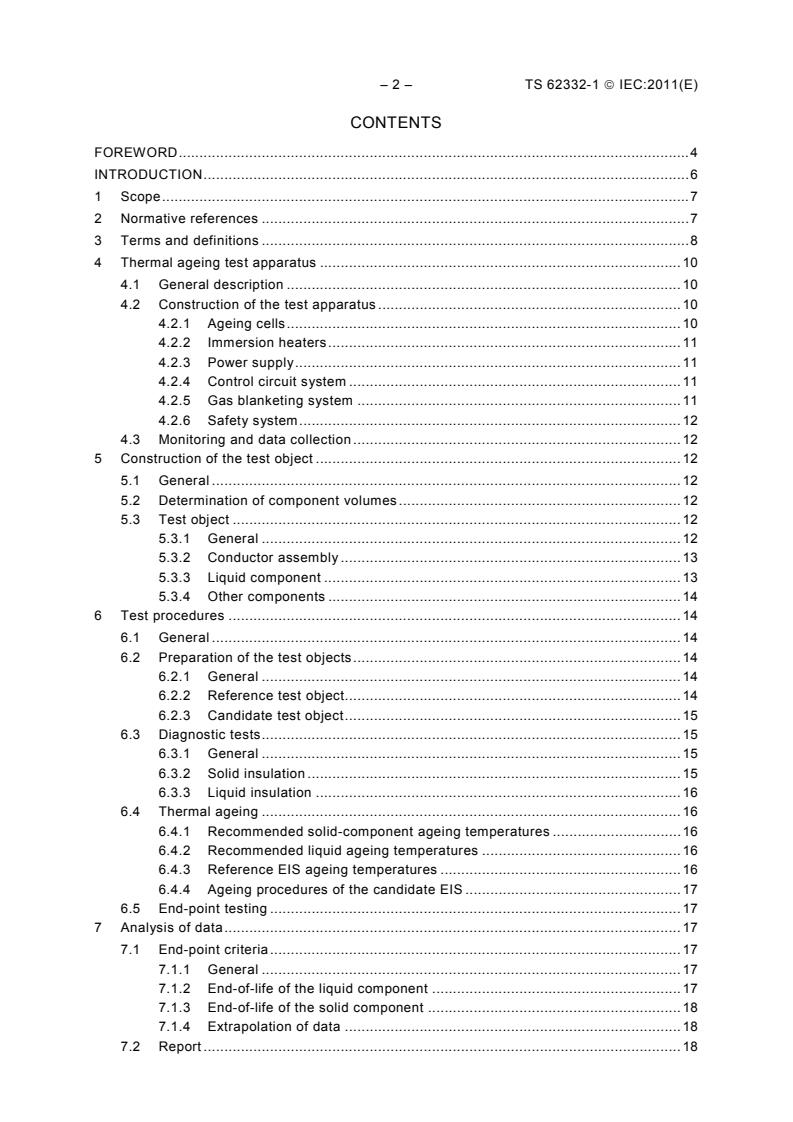
– 2 – TS 62332-1 IEC:2011(E)
CONTENTS
FOREWORD . 4
INTRODUCTION . 6
1 Scope . 7
2 Normative references . 7
3 Terms and definitions . 8
4 Thermal ageing test apparatus . 10
4.1 General description . 10
4.2 Construction of the test apparatus . 10
4.2.1 Ageing cells . 10
4.2.2 Immersion heaters . 11
4.2.3 Power supply . 11
4.2.4 Control circuit system . 11
4.2.5 Gas blanketing system . 11
4.2.6 Safety system . 12
4.3 Monitoring and data collection . 12
5 Construction of the test object . 12
5.1 General . 12
5.2 Determination of component volumes . 12
5.3 Test object . 12
5.3.1 General . 12
5.3.2 Conductor assembly . 13
5.3.3 Liquid component . 13
5.3.4 Other components . 14
6 Test procedures . 14
6.1 General . 14
6.2 Preparation of the test objects . 14
6.2.1 General . 14
6.2.2 Reference test object. 14
6.2.3 Candidate test object . 15
6.3 Diagnostic tests . 15
6.3.1 General . 15
6.3.2 Solid insulation . 15
6.3.3 Liquid insulation . 16
6.4 Thermal ageing . 16
6.4.1 Recommended solid-component ageing temperatures . 16
6.4.2 Recommended liquid ageing temperatures . 16
6.4.3 Reference EIS ageing temperatures . 16
6.4.4 Ageing procedures of the candidate EIS . 17
6.5 End-point testing . 17
7 Analysis of data . 17
7.1 End-point criteria . 17
7.1.1 General . 17
7.1.2 End-of-life of the liquid component . 17
7.1.3 End-of-life of the solid component . 18
7.1.4 Extrapolation of data . 18
7.2 Report . 18
TS 62332-1 IEC:2011(E) – 3 –
Annex A (informative) Component volume ratio spreadsheet example . 19
Bibliography . 20
Figure 1 – Ageing cell cross-section . 11
Figure 2 – Example of an insulation package for a transformer winding . 13
Table 1 – Recommended ageing temperatures and periods for expected thermal class . 16
Table A.1 – Examples of component volume ratio calculations . 19
– 4 – TS 62332-1 IEC:2011(E)
INTERNATIONAL ELECTROTECHNICAL COMMISSION
___________
ELECTRICAL INSULATION SYSTEMS (EIS) –
THERMAL EVALUATION OF COMBINED LIQUID
AND SOLID COMPONENTS –
Part 1: General requirements
FOREWORD
1) The International Electrotechnical Commission (IEC) is a worldwide organization for standardization comprising
all national electrotechnical committees (IEC National Committees). The object of IEC is to promote
international co-operation on all questions concerning standardization in the electrical and electronic fields. To
this end and in addition to other activities, IEC publishes International Standards, Technical Specifications,
Technical Reports, Publicly Available Specifications (PAS) and Guides (hereafter referred to as “IEC
Publication(s)”). Their preparation is entrusted to technical committees; any IEC National Committee interested
in the subject dealt with may participate in this preparatory work. International, governmental and non-
governmental organizations liaising with the IEC also participate in this preparation. IEC collaborates closely
with the International Organization for Standardization (ISO) in accordance with conditions determined by
agreement between the two organizations.
2) The formal decisions or agreements of IEC on technical matters express, as nearly as possible, an international
consensus of opinion on the relevant subjects since each technical committee has representation from all
interested IEC National Committees.
3) IEC Publications have the form of recommendations for international use and are accepted by IEC National
Committees in that sense. While all reasonable efforts are made to ensure that the technical content of IEC
Publications is accurate, IEC cannot be held responsible for the way in which they are used or for any
misinterpretation by any end user.
4) In order to promote international uniformity, IEC National Committees undertake to apply IEC Publications
transparently to the maximum extent possible in their national and regional publications. Any divergence
between any IEC Publication and the corresponding national or regional publication shall be clearly indicated in
the latter.
5) IEC itself does not provide any attestation of conformity. Independent certification bodies provide conformity
assessment services and, in some areas, access to IEC marks of conformity. IEC is not responsible for any
services carried out by independent certification bodies.
6) All users should ensure that they have the latest edition of this publication.
7) No liability shall attach to IEC or its directors, employees, servants or agents including individual experts and
members of its technical committees and IEC National Committees for any personal injury, property damage or
other damage of any nature whatsoever, whether direct or indirect, or for costs (including legal fees) and
expenses arising out of the publication, use of, or reliance upon, this IEC Publication or any other IEC
Publications.
8) Attention is drawn to the Normative references cited in this publication. Use of the referenced publications is
indispensable for the correct application of this publication.
9) Attention is drawn to the possibility that some of the elements of this IEC Publication may be the subject of
patent rights. IEC shall not be held responsible for identifying any or all such patent rights.
The main task of IEC technical committees is to prepare International Standards. In
exceptional circumstances, a technical committee may propose the publication of a technical
specification when
• the required support cannot be obtained for the publication of an International Standard,
despite repeated efforts, or
• the subject is still under technical development or where, for any other reason, there is the
future but no immediate possibility of an agreement on an International Standard.
Technical specifications are subject to review within three years of publication to decide
whether they can be transformed into International Standards.
IEC/TS 62332-1, which is a technical specification, has been prepared by IEC technical
committee 112: Evaluation and qualification of electrical insulating materials and systems.
TS 62332-1 IEC:2011(E) – 5 –
This second edition cancels and replaces the first edition, published in 2005, and constitutes
editorial and technical revisions.
The following significant technical changes with respect to the previous edition have been
made:
Modifications have been made to the technical specification based on an extensive test series
conducted using this methodology based on the first edition. This included updating expected
times and temperatures to use in order to get useful results, as well as making the range of
equipment covered more broad. The method can now cover electrotechnical devices using
different sealing systems, as well as devices using enamel covered wires
The text of this technical specification is based on the following documents:
Enquiry draft Report on voting
112/160/DTS 112/168/RVC
Full information on the voting for the approval of this technical specification can be found in
the report on voting indicated in the above table.
This publication has been drafted in accordance with the ISO/IEC Directives, Part 2.
The committee has decided that the contents of this publication will remain unchanged until
the stability date indicated on the IEC web site under "http://webstore.iec.ch" in the data
related to the specific publication. At this date, the publication will be
• transformed into an International standard,
• reconfirmed,
• withdrawn,
• replaced by a revised edition, or
• amended.
A bilingual version of this publication may be issued at a later date.
– 6 – TS 62332-1 IEC:2011(E)
INTRODUCTION
This technical specification describes a method for the thermal evaluation of electrical
insulation systems (EIS) for electrotechnical products with combined liquid and solid
components. Part 1 covers general test requirements. Subsequent parts should cover specific
product test requirements.
Prior to this technical specification, the procedure for determining the thermal endurance of
insulation systems for liquid-immersed products involved one of two processes: firstly, sealed-
tube ageing and, secondly, ageing of full-scale models.
The ageing of full-scale models is impractical, especially for larger products, such as power
transformers. Similarly, the use of sealed-tube ageing is not practical when testing
components having drastically different thermal capabilities. For example, testing of a system
with a solid material with an RTI of 200 °C with a liquid having a 130 °C thermal capability
cannot be performed efficiently. Accelerated ageing temperatures, which fairly age the liquid,
will result in extremely long ageing times for the solid. Accelerated ageing temperatures,
which fairly age the solid, will result in extreme, or even hazardous, ageing of the liquid.
This technical specification describes an accelerated thermal ageing procedure and model
that allows for the solid materials to be aged at temperatures separate from the liquid ageing
temperatures, all in the same apparatus. The model acts more in the true-life ageing mode of
insulation systems, where solid insulation near the active parts is exposed to much higher
temperatures than the major volume of liquid in the equipment. The model contains all the
primary EIS elements, and in relative component ratios which compare with actual
electrotechnical products.
The model has a dual temperature capability that allows independent control of the
temperatures of the solid and liquid components by the use of separate circuits. A detailed
bibliography is provided.
This technical specification has been prepared in conjunction with TC 14, Power transformers.
Any comments or suggestions from other technical committees to make this technical
specification more general are welcome.
TS 62332-1 IEC:2011(E) – 7 –
ELECTRICAL INSULATION SYSTEMS (EIS) –
THERMAL EVALUATION OF COMBINED LIQUID
AND SOLID COMPONENTS –
Part 1: General requirements
1 Scope
This part of IEC/TS 62332 is applicable to EIS containing solid and liquid components where
the thermal stress is the dominant ageing factor, without restriction to voltage class.
This part specifies a dual-temperature test procedure for the thermal evaluation and
qualification of electrical insulation systems (EIS).
2 Normative references
The following referenced documents are indispensable for the application of this document.
For dated references, only the edition cited applies. For undated references, the latest edition
of the referenced document (including any amendments) applies.
IEC 60085:2007, Electrical insulation – Thermal evaluation and designation
IEC 60156, Insulating liquids – Determination of the breakdown voltage at power frequency –
Test method
IEC 60216-2:2005, Electrical insulating materials – Thermal endurance properties – Part 2:
Determination of thermal endurance properties of electrical insulating materials – Choice of
test criteria IEC 60216-3, Electrical insulating materials – Thermal endurance properties –
Part 3: Instructions for calculating thermal endurance characteristics
IEC 60216-5, Electrical insulating materials – Thermal endurance properties – Part 5:
Determination of relative thermal endurance index (RTE) of an insulating material
IEC 60243-1, Electrical strength of insulating materials – Test methods – Part 1: Tests at
power frequencies
IEC 60247, Insulating liquids – Measurement of relative permittivity, dielectric dissipation
factor (tan δ) and d.c. resistivity
IEC 60250, Recommended methods for the determination of the permittivity and dielectric
dissipation factor of electrical insulating materials at power, audio and radio frequencies
including metre wavelengths
IEC 60296, Fluids for electrotechnical applications – Unused mineral insulating oils for
transformers and switchgear
IEC 60422, Mineral insulating oils in electrical equipment – Supervision and maintenance
guidance
IEC 60450, Measurement of the average viscometric degree of polymerization of new and
aged cellulosic electrically insulating materials
– 8 – TS 62332-1 IEC:2011(E)
IEC 60505:2004, Evaluation and qualification of electrical insulation systems
IEC 60554-2, Cellulosic papers for electrical purposes – Part 2: Methods of test
IEC 60567, Oil-filled electrical equipment – Sampling of gases and of oil for analysis of free
and dissolved gases – Guidance
IEC 60599, Mineral oil-impregnated electrical equipment in service – Guide to the
interpretation of dissolved and free gases analysis
IEC 60763-2, Specification for laminated pressboard – Part 2: Methods of test
IEC 60814, Insulating liquids – Oil-impregnated paper and pressboard – Determination of
water by automatic coulometric Karl Fischer titration
IEC 61198, Mineral insulating oils– Methods for the determination of 2-furfural and related
compounds
IEC 61620, Insulating liquids – Determination of dielectric dissipation factor by measurement
of the conductance and capacitance – Test method
IEC 61857-1:2008, Electrical insulation systems– Procedures for thermal evaluation – Part 1:
General requirements – Low voltage
IEC 62021-1, Insulating liquids – Determination of acidity – Part 1: Automatic potentiometric
titration
ISO 287, Paper and board – Determination of moisture content of a lot – Oven-drying method
ISO 1924 (all parts), Paper and board – Determination of tensile properties
ISO 2049, Petroleum products – Determination of colour (ASTM scale)
ASTM D971-99a, Standard test method for interfacial tension of oil against water by the ring
method
3 Terms and definitions
For the purposes of this document, the following terms and definitions apply, some of which
are taken from IEC 60505.
3.1
electrical insulation system
EIS
insulating structure containing one or more electrical insulating materials (EIM) together with
associated conducting parts employed in an electrotechnical device
[IEC 60505:2004, definition 3.1.1]
NOTE EIMs with different temperature indices (ATE RTE according to IEC 60216-5) may be combined to form an
EIS, which has a thermal class that may be higher or lower than that of any of the individual components according
to IEC 60505.
—————————
A fourth edition of IEC 60505 is currently in preparation.
TS 62332-1 IEC:2011(E) – 9 –
3.2
candidate EIS
EIS under evaluation to determine its service capability (thermal)
3.3
reference EIS
evaluated and established EIS with either a known service experience record or a known
comparative functional evaluation as a basis
3.4
thermal class
designation of an EIS that is equal to the numerical value of the maximum temperature in
degrees Celsius for which the EIS is appropriate according to Table 1 of IEC 60085:2007
NOTE An EIS may be subjected to operating temperatures exceeding its thermal class, which can result in
shorter expected life.
3.5
EIS assessed thermal endurance index
EIS ATE
numerical value of the temperature in degrees Celsius for the reference EIS as derived from
known service experience or a known comparative functional evaluation
3.6
EIS relative thermal endurance index
EIS RTE
numerical value of the temperature in degrees Celsius for the candidate EIS which is relative
to the known EIS ATE of a reference EIS, when both EIS are subjected to the same ageing
and diagnostic procedures in a comparative test
3.7
test object
piece of original equipment, a representation (model) of equipment, a component of or part of
equipment, including the EIS, intended for use in a functional test
3.8
thermal ageing factor
thermal stress that causes irreversible changes in the EIS
3.9
diagnostic test
periodic application of a specified level of a diagnostic factor to a test object to determine
whether the end-point criterion has been reached
3.10
end-point criterion
selected value of either a property or a change of property that defines the end of a
component’s life
[IEC 61857-1:2008, definition 3.11, modified]
3.11
end-of-life
end of a test object’s life, as determined by any selected component meeting its end-point
criterion
– 10 – TS 62332-1 IEC:2011(E)
3.12
ageing cell
sealed container partially filled with the liquid EIM and in which are mounted the test object,
liquid immersion heaters and thermocouples for control and monitoring
4 Thermal ageing test apparatus
4.1 General description
The thermal ageing test
...