

IEC TS 62332-3:2016
(Main)Electrical insulation systems (EIS) - Thermal evaluation of combined liquid and solid components - Part 3: Hermetic motor-compressors
General Information
- Abstract
IEC TS 62332-3:2016 is applicable to EIM and EIS containing solid and liquid components where the refrigerant, oil and thermal stresses are the dominant ageing factor, without restriction to voltage class.
- Status
- Published
- Publication Date
- 20-Jul-2016
- Technical Committee
- TC 112 - Evaluation and qualification of electrical insulating materials and systems
- Drafting Committee
- WG 6 - TC 112/WG 6
- Current Stage
- PPUB - Publication issued
- Start Date
- 21-Jul-2016
- Completion Date
- 30-Sep-2016
Buy Documents
IEC TS 62332-3:2016 - Electrical insulation systems (EIS) - Thermal evaluation of combined liquid and solid components - Part 3: Hermetic motor-compressors Released:7/21/2016
Overview
IEC TS 62332-3:2016 is a Technical Specification developed by the International Electrotechnical Commission (IEC) for the thermal evaluation of electrical insulation systems (EIS) with both liquid and solid components-specifically in hermetic motor-compressors. This standard provides guidance on test methods to assess the combined effects of refrigerant, oil, and thermal stresses as dominant aging factors in EIM (electrical insulation material) and EIS, regardless of voltage class. It ensures that motor-compressor reliability and performance meet safety and operational requirements in applications such as refrigerators and air conditioning systems.
Key Topics
- Thermal Aging of Insulation Systems: Methods for evaluating material endurance against heat, refrigerant, and oil exposure under elevated pressure and temperature.
- Component Compatibility: Testing the chemical, mechanical, and thermal interactions between liquid and solid insulation materials.
- Test Procedures: Step-by-step approaches for preparing, conditioning, and analyzing insulation system specimens using sealed autoclaves and ovens.
- Diagnostic Testing: Procedures for evaluating the deterioration of insulation properties, including breakdown voltage, permittivity, tensile strength, elongation, and surface contamination.
- Reference and Candidate Material Comparisons: Ensuring new or modified EIMs perform at least as well as established reference materials in similar motor-compressor environments.
Applications
IEC TS 62332-3:2016 is highly relevant for industries involved in:
- Manufacture and Testing of Hermetic Motor-Compressors: Used in household and commercial refrigeration and HVAC (heating, ventilation, air conditioning) products.
- Quality Assurance in Electrical Insulation: Providing consistent and repeatable test methods to verify that insulation systems can endure real-world operating conditions, preventing unexpected failures.
- Supplier Qualification & Product Development: Assisting manufacturers and suppliers in evaluating new materials or product modifications before widespread implementation.
- Maintenance, Reliability, and Product Safety: Supporting preventive maintenance programs and compliance with international safety standards for electrical insulation performance.
Typical users of this standard include product engineers, materials scientists, test laboratories, and quality assurance teams responsible for ensuring the long-term stability of motor-compressor insulation systems.
Related Standards
To ensure robust evaluation and thermal endurance of electrical insulation systems, IEC TS 62332-3:2016 references and complements several other international standards, including:
- IEC 60216 Series: Electrical insulating materials – Thermal endurance properties; procedures, ovens, and statistical analysis.
- IEC 60317-0-1 and IEC 60851-5: Specifications and test methods for winding wires.
- IEC 60505: Evaluation and qualification of electrical insulation systems.
- IEC 60674-2 and IEC 60684-2: Test methods for plastic films and flexible insulating sleeving.
- IEC 60247 and IEC 60250: Measurements of dielectric properties for insulating liquids and solids.
- IEC 61857 Series: Procedures for thermal evaluation of insulation systems.
These related standards facilitate comprehensive and harmonized approaches for the evaluation of electrical insulation, supporting ongoing innovation and international market access for compliant products.
By adhering to IEC TS 62332-3:2016, manufacturers and testing organizations can ensure that hermetic motor-compressors operate safely and reliably, even in the demanding conditions imposed by modern refrigeration and air conditioning systems. This document maximizes practical value by providing clear methodologies for insulation system testing and validation according to global best practices.
Buy Documents
IEC TS 62332-3:2016 - Electrical insulation systems (EIS) - Thermal evaluation of combined liquid and solid components - Part 3: Hermetic motor-compressors Released:7/21/2016
Get Certified
Connect with accredited certification bodies for this standard

IMQ S.p.A. (Certification)
Italian electrical product certification.

SLG Prüf- und Zertifizierungs GmbH
German testing and certification body.

UL Solutions
Global safety science company with testing, inspection and certification.
Sponsored listings
Frequently Asked Questions
IEC TS 62332-3:2016 is a technical specification published by the International Electrotechnical Commission (IEC). Its full title is "Electrical insulation systems (EIS) - Thermal evaluation of combined liquid and solid components - Part 3: Hermetic motor-compressors". This standard covers: IEC TS 62332-3:2016 is applicable to EIM and EIS containing solid and liquid components where the refrigerant, oil and thermal stresses are the dominant ageing factor, without restriction to voltage class.
IEC TS 62332-3:2016 is applicable to EIM and EIS containing solid and liquid components where the refrigerant, oil and thermal stresses are the dominant ageing factor, without restriction to voltage class.
IEC TS 62332-3:2016 is classified under the following ICS (International Classification for Standards) categories: 29.080.30 - Insulation systems. The ICS classification helps identify the subject area and facilitates finding related standards.
IEC TS 62332-3:2016 is available in PDF format for immediate download after purchase. The document can be added to your cart and obtained through the secure checkout process. Digital delivery ensures instant access to the complete standard document.
Standards Content (Sample)
IEC TS 62332-3 ®
Edition 1.0 2016-07
TECHNICAL
SPECIFICATION
SPECIFICATION
TECHNIQUE
colour
inside
Electrical insulation systems (EIS) – Thermal evaluation of combined liquid and
solid components –
Part 3: Hermetic motor-compressors
Systèmes d'isolation électrique (SIE) – Évaluation thermique de composants
liquides et solides combinés –
Partie 3: Motocompresseurs hermétiques
All rights reserved. Unless otherwise specified, no part of this publication may be reproduced or utilized in any form
or by any means, electronic or mechanical, including photocopying and microfilm, without permission in writing from
either IEC or IEC's member National Committee in the country of the requester. If you have any questions about IEC
copyright or have an enquiry about obtaining additional rights to this publication, please contact the address below or
your local IEC member National Committee for further information.
Droits de reproduction réservés. Sauf indication contraire, aucune partie de cette publication ne peut être reproduite
ni utilisée sous quelque forme que ce soit et par aucun procédé, électronique ou mécanique, y compris la photocopie
et les microfilms, sans l'accord écrit de l'IEC ou du Comité national de l'IEC du pays du demandeur. Si vous avez des
questions sur le copyright de l'IEC ou si vous désirez obtenir des droits supplémentaires sur cette publication, utilisez
les coordonnées ci-après ou contactez le Comité national de l'IEC de votre pays de résidence.
IEC Central Office Tel.: +41 22 919 02 11
3, rue de Varembé Fax: +41 22 919 03 00
CH-1211 Geneva 20 info@iec.ch
Switzerland www.iec.ch
About the IEC
The International Electrotechnical Commission (IEC) is the leading global organization that prepares and publishes
International Standards for all electrical, electronic and related technologies.
About IEC publications
The technical content of IEC publications is kept under constant review by the IEC. Please make sure that you have the
latest edition, a corrigenda or an amendment might have been published.
IEC Catalogue - webstore.iec.ch/catalogue Electropedia - www.electropedia.org
The stand-alone application for consulting the entire The world's leading online dictionary of electronic and
bibliographical information on IEC International Standards, electrical terms containing 20 000 terms and definitions in
Technical Specifications, Technical Reports and other English and French, with equivalent terms in 15 additional
documents. Available for PC, Mac OS, Android Tablets and languages. Also known as the International Electrotechnical
iPad. Vocabulary (IEV) online.
IEC publications search - www.iec.ch/searchpub IEC Glossary - std.iec.ch/glossary
The advanced search enables to find IEC publications by a 65 000 electrotechnical terminology entries in English and
variety of criteria (reference number, text, technical French extracted from the Terms and Definitions clause of
committee,…). It also gives information on projects, replaced IEC publications issued since 2002. Some entries have been
and withdrawn publications. collected from earlier publications of IEC TC 37, 77, 86 and
CISPR.
IEC Just Published - webstore.iec.ch/justpublished
Stay up to date on all new IEC publications. Just Published IEC Customer Service Centre - webstore.iec.ch/csc
details all new publications released. Available online and If you wish to give us your feedback on this publication or
also once a month by email. need further assistance, please contact the Customer Service
Centre: csc@iec.ch.
A propos de l'IEC
La Commission Electrotechnique Internationale (IEC) est la première organisation mondiale qui élabore et publie des
Normes internationales pour tout ce qui a trait à l'électricité, à l'électronique et aux technologies apparentées.
A propos des publications IEC
Le contenu technique des publications IEC est constamment revu. Veuillez vous assurer que vous possédez l’édition la
plus récente, un corrigendum ou amendement peut avoir été publié.
Catalogue IEC - webstore.iec.ch/catalogue Electropedia - www.electropedia.org
Application autonome pour consulter tous les renseignements
Le premier dictionnaire en ligne de termes électroniques et
bibliographiques sur les Normes internationales,
électriques. Il contient 20 000 termes et définitions en anglais
Spécifications techniques, Rapports techniques et autres
et en français, ainsi que les termes équivalents dans 15
documents de l'IEC. Disponible pour PC, Mac OS, tablettes
langues additionnelles. Egalement appelé Vocabulaire
Android et iPad.
Electrotechnique International (IEV) en ligne.
Recherche de publications IEC - www.iec.ch/searchpub
Glossaire IEC - std.iec.ch/glossary
La recherche avancée permet de trouver des publications IEC 65 000 entrées terminologiques électrotechniques, en anglais
en utilisant différents critères (numéro de référence, texte, et en français, extraites des articles Termes et Définitions des
comité d’études,…). Elle donne aussi des informations sur les publications IEC parues depuis 2002. Plus certaines entrées
projets et les publications remplacées ou retirées. antérieures extraites des publications des CE 37, 77, 86 et
CISPR de l'IEC.
IEC Just Published - webstore.iec.ch/justpublished
Service Clients - webstore.iec.ch/csc
Restez informé sur les nouvelles publications IEC. Just
Published détaille les nouvelles publications parues. Si vous désirez nous donner des commentaires sur cette
Disponible en ligne et aussi une fois par mois par email. publication ou si vous avez des questions contactez-nous:
csc@iec.ch.
IEC TS 62332-3 ®
Edition 1.0 2016-07
TECHNICAL
SPECIFICATION
SPECIFICATION
TECHNIQUE
colour
inside
Electrical insulation systems (EIS) – Thermal evaluation of combined liquid and
solid components –
Part 3: Hermetic motor-compressors
Systèmes d'isolation électrique (SIE) – Évaluation thermique de composants
liquides et solides combinés –
Partie 3: Motocompresseurs hermétiques
INTERNATIONAL
ELECTROTECHNICAL
COMMISSION
COMMISSION
ELECTROTECHNIQUE
INTERNATIONALE
ICS 29.080.30 ISBN 978-2-8322-3527-0
– 2 – IEC TS 62332-3:2016 © IEC 2016
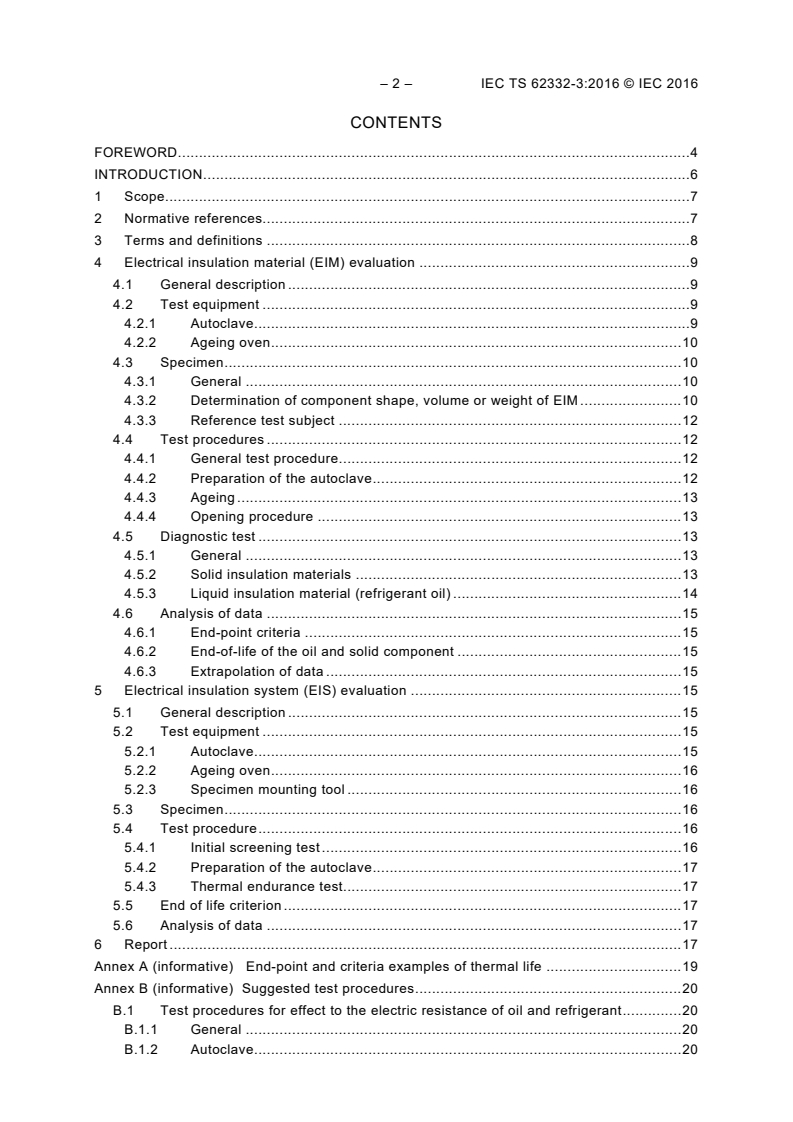
CONTENTS
FOREWORD . 4
INTRODUCTION . 6
1 Scope . 7
2 Normative references. 7
3 Terms and definitions . 8
4 Electrical insulation material (EIM) evaluation . 9
4.1 General description . 9
4.2 Test equipment . 9
4.2.1 Autoclave . 9
4.2.2 Ageing oven . 10
4.3 Specimen . 10
4.3.1 General . 10
4.3.2 Determination of component shape, volume or weight of EIM . 10
4.3.3 Reference test subject . 12
4.4 Test procedures . 12
4.4.1 General test procedure . 12
4.4.2 Preparation of the autoclave . 12
4.4.3 Ageing . 13
4.4.4 Opening procedure . 13
4.5 Diagnostic test . 13
4.5.1 General . 13
4.5.2 Solid insulation materials . 13
4.5.3 Liquid insulation material (refrigerant oil) . 14
4.6 Analysis of data . 15
4.6.1 End-point criteria . 15
4.6.2 End-of-life of the oil and solid component . 15
4.6.3 Extrapolation of data . 15
5 Electrical insulation system (EIS) evaluation . 15
5.1 General description . 15
5.2 Test equipment . 15
5.2.1 Autoclave . 15
5.2.2 Ageing oven . 16
5.2.3 Specimen mounting tool . 16
5.3 Specimen . 16
5.4 Test procedure . 16
5.4.1 Initial screening test . 16
5.4.2 Preparation of the autoclave . 17
5.4.3 Thermal endurance test. 17
5.5 End of life criterion . 17
5.6 Analysis of data . 17
6 Report . 17
Annex A (informative) End-point and criteria examples of thermal life . 19
Annex B (informative) Suggested test procedures . 20
B.1 Test procedures for effect to the electric resistance of oil and refrigerant . 20
B.1.1 General . 20
B.1.2 Autoclave . 20
B.1.3 Test subject . 20
B.1.4 Test process . 20
B.2 Blister test of winding wire . 20
B.2.1 Overview . 20
B.2.2 General . 20
B.2.3 Autoclave . 20
B.2.4 Test subject . 21
B.2.5 Test process . 21
B.2.6 Test result . 21
B.3 Refrigerant extract test for solid insulating materials . 21
B.3.1 General . 21
B.3.2 Autoclave . 21
B.3.3 Test subject . 21
B.3.4 Test process . 22
B.3.5 Test result . 22
B.4 Metal surface contamination test . 22
B.4.1 General . 22
B.4.2 Test procedure . 22
Bibliography . 23
Figure 1 – Autoclave example for ageing test of EIM . 9
Figure 2 – Examples of the autoclave for EIS ageing . 16
Figure 3 – Mounting tool . 16
Figure 4 – Example of GPM mounting . 16
Table 1 – Hermetic motor-compressor EIM and diagnostic test items . 10
Table 2 – Diagnostic test and its method for solid insulation . 14
Table 3 – Diagnostic test and its method for liquid insulation . 14
Table A.1 – End-point and criteria example of thermal life . 19
– 4 – IEC TS 62332-3:2016 © IEC 2016
INTERNATIONAL ELECTROTECHNICAL COMMISSION
____________
ELECTRICAL INSULATION SYSTEMS (EIS) –
THERMAL EVALUATION OF COMBINED LIQUID
AND SOLID COMPONENTS –
Part 3: Hermetic motor-compressors
FOREWORD
1) The International Electrotechnical Commission (IEC) is a worldwide organization for standardization comprising
all national electrotechnical committees (IEC National Committees). The object of IEC is to promote
international co-operation on all questions concerning standardization in the electrical and electronic fields. To
this end and in addition to other activities, IEC publishes International Standards, Technical Specifications,
Technical Reports, Publicly Available Specifications (PAS) and Guides (hereafter referred to as “IEC
Publication(s)”). Their preparation is entrusted to technical committees; any IEC National Committee interested
in the subject dealt with may participate in this preparatory work. International, governmental and non-
governmental organizations liaising with the IEC also participate in this preparation. IEC collaborates closely
with the International Organization for Standardization (ISO) in accordance with conditions determined by
agreement between the two organizations.
2) The formal decisions or agreements of IEC on technical matters express, as nearly as possible, an international
consensus of opinion on the relevant subjects since each technical committee has representation from all
interested IEC National Committees.
3) IEC Publications have the form of recommendations for international use and are accepted by IEC National
Committees in that sense. While all reasonable efforts are made to ensure that the technical content of IEC
Publications is accurate, IEC cannot be held responsible for the way in which they are used or for any
misinterpretation by any end user.
4) In order to promote international uniformity, IEC National Committees undertake to apply IEC Publications
transparently to the maximum extent possible in their national and regional publications. Any divergence
between any IEC Publication and the corresponding national or regional publication shall be clearly indicated in
the latter.
5) IEC itself does not provide any attestation of conformity. Independent certification bodies provide conformity
assessment services and, in some areas, access to IEC marks of conformity. IEC is not responsible for any
services carried out by independent certification bodies.
6) All users should ensure that they have the latest edition of this publication.
7) No liability shall attach to IEC or its directors, employees, servants or agents including individual experts and
members of its technical committees and IEC National Committees for any personal injury, property damage or
other damage of any nature whatsoever, whether direct or indirect, or for costs (including legal fees) and
expenses arising out of the publication, use of, or reliance upon, this IEC Publication or any other IEC
Publications.
8) Attention is drawn to the Normative references cited in this publication. Use of the referenced publications is
indispensable for the correct application of this publication.
9) Attention is drawn to the possibility that some of the elements of this IEC Publication may be the subject of
patent rights. IEC shall not be held responsible for identifying any or all such patent rights.
The main task of IEC technical committees is to prepare International Standards. In
exceptional circumstances, a technical committee may propose the publication of a Technical
Specification when
• the required support cannot be obtained for the publication of an International Standard,
despite repeated efforts, or
• the subject is still under technical development or where, for any other reason, there is the
future but no immediate possibility of an agreement on an International Standard.
Technical Specifications are subject to review within three years of publication to decide
whether they can be transformed into International Standards.
IEC TS 62332-3, which is a Technical Specification, has been prepared by IEC technical
committee 112: Evaluation and qualification of electrical insulating materials and systems.
The text of this Technical Specification is based on the following documents:
Enquiry draft Report on voting
112/353/DTS 112/362/RVC
Full information on the voting for the approval of this Technical Specification can be found in
the report on voting indicated in the above table.
This publication has been drafted in accordance with the ISO/IEC Directives, Part 2.
A list of all parts in the IEC 62332 series, published under the general title Electrical insulation
systems (EIS) – Thermal evaluation of combined liquid and solid components, can be found
on the IEC website.
The committee has decided that the contents of this publication will remain unchanged until
the stability date indicated on the IEC website under "http://webstore.iec.ch" in the data
related to the specific publication. At this date, the publication will be
• transformed into an International Standard,
• reconfirmed,
• withdrawn,
• replaced by a revised edition, or
• amended.
IMPORTANT – The 'colour inside' logo on the cover page of this publication indicates
that it contains colours which are considered to be useful for the correct
understanding of its contents. Users should therefore print this document using a
colour printer.
– 6 – IEC TS 62332-3:2016 © IEC 2016
INTRODUCTION
This part of IEC 62332, which is a Technical Specification, describes a method for the thermal
evaluation of electrical insulation systems (EIS) for electrotechnical products with combined
liquid and solid components. IEC TS 62332-1 covers general test requirements.
IEC TS 62332-2 covers a simplified test method which can be used as a screening test prior
to conducting IEC TS 62332-1 testing or can be used as a quality control test to evaluate
minor product changes. This part of IEC 62332 covers the evaluation and qualification of
electrical insulation materials (EIM) and EIS which are applied to motor-compressors for the
refrigerator or air conditioner. This document contains the evaluation items which are
important to maintain the equipment performances in the refrigerator oil and refrigerant at
high temperature and high pressure.
This document has been prepared in conjunction with IEC 60335-2-34.
IEC TS 62332-3 is applicable to EIM and EIS evaluation for hermetic motor-compressors
which are applied to the refrigerator and the air conditioner. The main procedures consist in
the evaluation of EIM and EIS endurance for refigerator and oil at high temperature and high
pressure. It describes how to evaluate the mechanical, thermal and chemical degradation of
the performances of EIM which have deep relation to keep the sound condition of the
equipment.
This simplified Technical Specification provides a test method for sealed tube testing. The
sealed tube should contain all the primary EIM elements in relative component ratios which
compare with the actual electrotechnical device.
ELECTRICAL INSULATION SYSTEMS (EIS) –
THERMAL EVALUATION OF COMBINED LIQUID
AND SOLID COMPONENTS –
Part 3: Hermetic motor-compressors
1 Scope
This part of IEC 62332, which is a Technical Specification, is applicable to EIM and EIS
containing solid and liquid components where the refrigerant, oil and thermal stresses are the
dominant ageing factor, without restriction to voltage class.
2 Normative references
The following documents are referred to in the text in such a way that some or all of their
content constitutes requirements of this document. For dated references, only the edition
cited applies. For undated references, the latest edition of the referenced document (including
any amendments) applies.
IEC 60216-1, Electrical insulating materials – Thermal endurance properties – Part 1: Ageing
procedures and evaluation of test results
IEC 60216-3, Electrical insulating materials – Thermal endurance properties – Part 3:
Instructions for calculating thermal endurance characteristics
IEC 60216-4-1:2006, Electrical insulating materials – Thermal endurance properties – Part 4-1:
Ageing ovens – Single-chamber ovens
IEC 60216-5, Electrical insulating materials – Thermal endurance properties – Part 5:
Determination of relative thermal endurance index (RTE) of an insulating material
IEC 60247, Insulating liquids – Measurement of relative permittivity, dielectric dissipation
factor (tan δ) and d.c. resistivity
IEC 60250, Recommended methods for the determination of the permittivity and dielectric
dissipation factor of electrical insulating materials at power, audio and radio frequencies
including metre wavelengths
IEC 60317-0-1, Specifications for particular types of winding wires – Part 0-1: General
requirements – Enamelled round copper wire
IEC 60505, Evaluation and qualification of electrical insulation systems
IEC 60674-2, Specification for plastic films for electrical purposes. Part 2: Methods of test
IEC 60684-2, Flexible insulating sleeving – Part 2: Methods of test
IEC 60851-5, Winding wires – Test methods – Part 5: Electrical properties
IEC 61857-1:2008, Electrical insulation systems– Procedures for thermal evaluation – Part 1:
General requirements – Low voltage
– 8 – IEC TS 62332-3:2016 © IEC 2016
IEC 61857-21:2009, Electrical insulation systems – Procedures for thermal evaluation –
Part 21: Specific requirements for general-purpose models – Wire-wound applications
IEC 62021 (all parts), Insulating liquids – Determination of acidity
ISO 178, Plastics – Determination of flexural properties
ASTM D4603, Standard Test Method for Determining Inherent Viscosity of Poly(Ethylene
Terephthalate) (PET) by Glass Capillary Viscometer
3 Terms and definitions
For the purposes of this document, the terms and definitions given in IEC 60505, as well as
the following apply.
ISO and IEC maintain terminological databases for use in standardization at the following
addresses:
• IEC Electropedia: available at http://www.electropedia.org/
• ISO Online browsing platform: available at http://www.iso.org/obp
3.1
acidity
quantity of base, expressed in milligrams of potassium hydroxide per gram of sample,
required to titrate potentiometrically or colourimetrically a test portion in a specified solvent to
the end point
[SOURCE: IEC 62021-3: 2014, 3.1]
3.2
breakdown voltage
voltage at which a specimen suffers destructive discharges under the prescribed test
conditions
Note 1 to entry: It is used in tests with continuously rising voltage.
3.3
extract
substance or resource obtained from a given element by a special method
3.4
thermal ageing factor
thermal stress that causes irreversible changes in the EIS
3.5
interfacial tension
adhesive forces between the liquid phase of one substance and either a solid, liquid or gas
phase of another substance
3.6
autoclave
sealed tube
sealed container partially filled with the liquid EIM and which includes the solid EIM in relative
component ratios which compare with the actual electrotechnical device
3.7
blister
small foam which is produced in the inner enamel layer of a winding wire
4 Electrical insulation material (EIM) evaluation
4.1 General description
This test procedure is useful for evaluating the chemical compatibility of insulation material
(EIM) with the liquid (oil) and refrigerant at high temperature and high pressure.
The reference and candidate EIM shall be exposed to test periods at selected elevated
temperatures and pressures. These test periods consist of a specific time exposure at the
selected temperature and pressure followed by diagnostic tests.
A specific material is sealed in a stainless steel autoclave, subjected to a specified thermal
ageing cycle and then subjected to each test. Candidate autoclave test results are then
compared to the reference autoclave test results for qualification of the acceptability of the
candidate EIM.
The test system consists of the following elements:
• autoclaves;
• ageing ovens;
• test objects.
4.2 Test equipment
4.2.1 Autoclave
Each autoclave is a container constructed of stainless steel. The size or the volume shall be
determined by the size or the volume of the test objects, oil and refrigerant, excluding the
3 3
electric resistance test and extract test. In general, 300 cm to 500 cm volume of autoclave
is convenient and enough for each EIM test.
Either one or both ends of the cell shall be fitted with removable, sealable bolt-on covers.
The autoclave parts shall be provided for the pressure gage, pressure relief system, needle
valve and gas sealing packing.
For specific details, see Figure 1.
IEC
Figure 1 – Autoclave example for ageing test of EIM
– 10 – IEC TS 62332-3:2016 © IEC 2016
4.2.2 Ageing oven
An air circulating oven or oil bath can be used.
In case of an air circulating oven, the ovens used shall meet the requirements of
IEC 60216-4-1:2006, 5.2 to 5.4 (temperature difference, fluctuation on variation).
In case of an oil bath, the oil level shall be maintained at a level high enough to provide
appropriate heat transfer during the test. The oil shall have enough thermal endurance for the
ageing test in this case.
4.3 Specimen
4.3.1 General
The following EIMs and components are applied as test subjects and evaluated by each
diagnostic test as shown in Table 1.
Table 1 – Hermetic motor-compressor EIM and diagnostic test items
Winding Varnish Film Molding Tube Tie cord Oil Refriger Process
a
wire part ant oil
Breakdown voltage
〇 〇 〇 〇
Dielectric constant (ε)
〇
Electric resistivity
〇 〇
Effect to electric
〇
resistivity of oil
Effect to electric
〇
resistivity of refrigerant
Tensile strength
〇 〇
Flexual strength
〇
Elongation
〇
Blister
〇
Molecular weight
〇
change
Extract
〇 〇 〇 〇 〇 〇
Acidity
〇
Metal Surface
〇
contamination
Key:
〇 = EIM that is applied to the qualification test.
a
For example: winding wire winding lubricant, iron punching oil, die casting oil.
4.3.2 Determination of component shape, volume or weight of EIM
Excluding the resistance test and the extract test, the specimen shall be prepared as follows:
a) Winding wire:
• breakdown voltage: specimen shall be prepared in accordance with IEC 60851-5,
• relative permittivity (ε ) and dielectric loss (tanδ): in accordance with IEC 60250,
r
• blister test: 100 mm in length,
• extract test: see 4.4.2.
b) Varnish:
• breakdown voltage: if included in the EIS, the impregnating varnish shall be applied to
the winding wire samples as twisted pair and cured in accordance with the
manufacturer’s specifications,
• extract test: see 4.4.2.
c) Film:
• breakdown voltage: size 250 mm × 250 mm,
• relative permittivity (ε ): size 100 mm × 100 mm,
r
• tensile strength and elongation: width = 10 mm to 25 mm, length = 100 mm,
• molecular weight; about 1,0 g,
• extract test: see Clause B.3
d) Molding part:
• bending strength: apply the practical part which is used in the compressor,
• extract test: see Clause B.3.
e) Tube:
• breakdown voltage: enough length that it does not cause flashover when the surface
test pole length is 100 mm,
• extract test: see Article B.3.
f) Tie cord:
• tensile strength and elongation: enough length to chuck when the elongation
measurement is 25 mm long,
• effect on the electric resistance of oil: the same ratio of the weight to the oil in the
compressor is applied,
• effect on the electric resistance of refrigerant: the same ratio of the weight to the
refrigerant in the compressor is applied,
• extract test: see Clause B.3.
g) Metallic part:
• surface contamination test: capillary tube longer than 100 mm ,
• see Clause B.4.
h) Oil:
• half the volume of the autoclave container shall be supplied for each ageing test,
• after the ageing, the test subject shall be removed from the autoclave and the oil shall
be supplied to each diagnostic test.
i) Refrigerant:
• the refrigerant weight which is supplied to the autoclave shall be decided by the ageing
pressure at the ageing temperature. The relation between the temperature and the
pressure depends on the quality of each refrigerant.
NOTE The amount of the refrigerant ratio to the oil is different according to the ageing test temperatures for
keeping the settled autoclave inner pressure.
– 12 – IEC TS 62332-3:2016 © IEC 2016
4.3.3 Reference test subject
The reference test subject shall be composed of EIMs that have an established performance
in combination with the same compressor component, oil and refrigerant.
4.4 Test procedures
4.4.1 General test procedure
The general test procedure shall be applied to the evaluation tests, excluding the electrical
resistance of refrigerant test and extract test.
A three-temperature ageing test shall be completed to establish the thermal rating of the new
EIM. A reference EIM shall be used to validate the testing of the candidate EIM.
A simplified single-point ageing can also be conducted for the purpose of quality control,
minor product changes or for screening prior to a full three-point evaluation. The setup would
be similar to that described for the three-point ageing.
While a complete thermal index may not be determined based on such a single-point test, this
test could be used to understand the expected capability of a proposed candidate EIS without
the time and effort of completing a full evaluation.
4.4.2 Preparation of the autoclave
The preparation of the autoclave assembly is as follows.
a) Cleaning of the autoclave: it shall be filled with an effective solvent, such as acetone, for
24 h or longer, scrubbed well with a detergent brush, rinsed thoroughly with tap water and
then with distilled water, and finally dried.
b) Drying of the autoclave: the taps, nuts, and bolts shall be conditioned for at least 1 h in an
oven maintained at 105 °C ± 2 K, and shall then be removed from the oven and the
samples immediately inserted.
c) Setting of the specimen: the twisted pairs of wire shall be prepared in accordance with
IEC 60851-5 before insertion in the autoclave. The other materials shall then be
positioned inside the autoclave, avoiding contact with each other, if possible, so that there
is no sticking during the ageing period.
d) The twisted pair shall be set up in the autoclave so that half of the twisted part is
immersed into the oil. In case there are other EIMs, it is better to separate into two groups.
One of the group (about half the amount of the specimen) shall be kept in oil, and the
effect of oil checked.
e) Drying of the specimen: after the EIMs are set in the autoclave, the tube, gaskets, taps,
nuts and bolts shall be dried for at least 1 h in an oven maintained at 105 °C ± 2 K.
Certain materials may require additional conditioning to remove all moisture, if agreed
upon by interested parties. Higher temperatures and times may be used to condition these
materials prior to insertion in the autoclave.
f) Supplying of the oil: the oil is supplied into the autoclave. Oil volume is at about half the
volume of the autoclave's inner volume. In this case, the water content of the oil shall be
controlled.
g) Assembly of the autoclave: immediately after the supplying of the oil, the autoclave shall
be closed, to prevent the oil from absorbing water.
h) Supplying of the refrigerant: in the autoclave a vacuum of 1 000 Pa to 2 000 Pa is
generated and the pre-fixed amount of refrigerant is supplied.
i) Pressure control: the autoclave is inserted into the oven or the oil bath and the
temperature is maintained at a settled temperature. After the autoclave temperature has
settled, the autoclave pressure is set to the settled pressure by controlling the refrigerant
amount using the needle valve of the autoclave. Inspection of the autoclave sealing could
be done by checking the pressure gauge.
4.4.3 Ageing
The autoclave shall be placed in the pre-heated thermal conditioning oven. The thermal
conditioning oven shall not be opened during the conditioning cycle as this can affect the
thermal ageing of the EIS under evaluation.
The ageing temperature and time shall be in accordance with IEC 60216-1.
The ageing temperature shall be selected at the temperature where the refrigerant oil or
refrigerant is stable.
4.4.4 Opening procedure
After thermal conditioning of the autoclave, the oven shall be turned off and allowed to cool to
room temperature before the autoclave is removed.
The autoclave shall be kept sealed, prior to evaluation, which is not to be delayed for more
than three days. The autoclave shall then be opened and the EIMs components carefully
removed and separated so as to reduce mechanical damage.
4.5 Diagnostic test
4.5.1 General
Samples of both the solid insulation and the liquid insulation shall be tested prior to start-up.
After the ageing, each property of the solid insulation and the liquid shall be measured.
Changes between the initial and final states shall be used to determine the amount of
degradation occurring during the testing cycle. The results of the initial moisture content
measurements shall be used to determine whether or not the materials are adequately dried
prior to start-up.
4.5.2 Solid insulation materials
At start-up, the solid insulation samples shall be tested using one or more diagnostic tests to
be chosen by the equipment technical committee to determine the end of life. Additional tests
may be used for monitoring purposes. Evaluation tests and their method are shown in Table 2.
– 14 – IEC TS 62332-3:2016 © IEC 2016
Table 2 – Diagnostic test and its method for solid insulation
Evaluation test Test EIM Test method
Electric property Breakdown voltage Winding wire IEC 60317-0-1
Varnish IEC 60317-0-1
Film IEC 60674-2
Tube IEC 60684-2
Relative permittivity (ε ) Film IEC 60250
r
Effect on oil electric Tie cord Clause B.1
resistivity
Effect on refrigerant
electric resistivity
Mechanical property Tensile strength Film IEC 60674-2
Tie cord IEC 60684-2
Elongation Film IEC 60674-2
a
Flexural strength Molding part ISO 178
Blister Winding wire Clause B.2
Chemical property Extract Winding wire Clause B.3
Varnish
Film
Molding part
Tie cord
Molecular weight Film ASTM D4603
Metal surface EIMs and process oil Clause B.4
contamination
NOTE For solid insulation which includes enamel coated wires, most of the above test methods are not
appropriate. In such cases, the key characteristic to monitor for the enamel coated wires is the dielectric
strength retention. There has only been limited experience using such coated wires with this test method.
a
The support span shall be decided by the examiner.
4.5.3 Liquid insulation material (refrigerant oil)
At start-up, the liquid insulation pre-conditioned according to 4.4.2 shall be tested using one
or more diagnostic tests to be chosen by the equipment technical committee to determine the
end of life. Additional tests may be used for monitoring purposes. Examples of typical
diagnostic test for liquids are as follows (see Table 3):
Table 3 – Diagnostic test and its method for liquid insulation
Evaluation test Test EIM Test method
Electric resistivity Oil IEC 60247
Refrigerant IEC 60247
Acidity Oil IEC 62021 (all parts)
4.6 Analysis of data
4.6.1 End-point criteria
The criteria by which a test object is considered to have failed shall be fully defined prior to
the start of the test. An adequate test shall be included in the test period to detect when a
failure occurs, denoting the end of life for each test object. The use of more than one end-
point criterion will tend to make interpretation of the test results more difficult. It is
recommended that only one end-point criterion be used for each component in the test object
(solid/liquid). The equipment technical committee for the EIS being modelled shall define the
specific end-point criterion.
4.6.2 End-of-life of the oil and solid component
The preferred end-point criterion for the solid or oil insulation shall be the degradation of the
original value of the selected mechanical, electrical and chemical properties.
Other choices for the end-point criterion are described in IEC 60216-2:2005, Table 1. The end
of life value for the candidate EIS (such as 50 % tensile strength retention) shall be
determined based on the test of the same component in the reference EIS.
The end point and criteria examples of thermal life are shown in Table A.1.
The total number of hours to end of life shall be recorded for the solid component in the test
object at each ageing temperature. The life (in hours) at each ageing temperature shall be
calculated according to IEC 60216-3.
4.6.3 Extrapolation of data
Linear regression analysis on the solid component data shall be carried out in accordance
with IEC 60216-5.
5 Electrical insulation system (EIS) evaluation
5.1 General description
EIS evaluation uses the same method in accordance with IEC 61857-1 and IEC 61857-21
except the ageing environment which is applied to the refrigerant and refrigerant oil in the
autoclave.
5.2 Test equipment
5.2.1 Autoclave
Each autoclave is a container constructed of stainless steel. The size or the volume shall be
determined by the size or the volume of the test objects. Either one or both ends of the cell
shall be fitted with removable, sealable bolt-on covers.
The autoclave parts shall be provided for pressure gauge, pressure relief system, needle
valve and gas sealing packing.
Two examples of the autoclave for EIS ageing are shown in Figure 2.
– 16 – IEC TS 62332-3:2016 © IEC 2016
IEC
Source: ELTEK International Laboratories
Figure 2 – Examples of the autoclave for EIS ageing
5.2.2 Ageing oven
The air circulating oven shall be used and meet the requirements of IEC 60216-4-1:2006, 5.2
through 5.4 (temperature difference, fluctuation on variation).
5.2.3 Specimen mounting tool
The GPM (general purpose model) specimen is mounted in the autoclave by using an
adequate tool for keeping the oil immersion length and avoiding contact with each other.
Examples of mounting tool for EIS and of GPM mounting are shown in Figure 3, and Figure 4
IEC
IEC
Source: ELTEK International Laboratories. Source: ELTEK International Laboratories.
Figure 3 – Mounting tool Figure 4 – Example of GPM mounting
5.3 Specimen
For the evaluation of EIS, the GPM shall be applied in accordance with IEC 61857-21.
The minimum number of test objects in a group for each ageing temperature shall be 5.
5.4 Test procedure
5.4.1 Initial screening test
Prior to the ageing test, all test objects shall be subjected to the initial screening test in
accordance with IEC 61857-21:2009, 6.2.2.
5.4.2 Preparation of the autoclave
The preparation of the autoclave shall be done in accordance with 4.4.2.
In this case, the volume of the oil is controlled to about half of the autoclave volume so that
the GPM shall be capable of being immersed to half of its length.
5.4.3 Thermal endurance test
5.4.3.1 General
Following the mounting of the GPM in the autoclave, the autoclave shall be placed in the pre-
heated thermal conditioning oven. All test objects shall be subjected to repeated thermal
endurance test cycles consisting of sub-cycle in the following order:
a) thermal ageing by exposure to refrigerant and refrigerant oil;
b) mechanical stress;
c) thermal shock;
d) dielectric diagnostic test.
5.4.3.2 Thermal ageing by exposure to refrigerant and refrigerant oil (5.4.3.1 a))
The thermal conditioning oven shall not be opened during the conditioning cycle as this can
affect the thermal ageing of the EIS under evaluation. The agei
...