

IEC TS 61934:2024
(Main)Electrical insulating materials and systems - Electrical measurement of partial discharges (PD) under short rise time and repetitive voltage impulses
General Information
- Abstract
IEC TS 61934:2024 is applicable to the off-line electrical measurement of partial discharges (PDs) that occur in electrical insulation systems (EISs) when stressed by repetitive voltage impulses generated from power electronics devices.
Typical applications are EISs belonging to apparatus driven by power electronics, such as motors, inductive reactors, wind turbine generators and the power electronics modules themselves.
NOTE Use of this document with specific products can require the application of additional procedures.
Excluded from the scope of this document are:
- methods based on optical or ultrasonic PD detection,
- fields of application for PD measurements when stressed by non-repetitive impulse voltages such as lightning impulse or switching impulses from switchgear.
This edition includes the following significant technical changes with respect to the previous edition:
a) background information on the progress being made in the field of power electronics including the introduction of wide band gap semiconductor devices has been added to the Introduction;
b) voltage impulse generators; the parameter values of the voltage impulse waveform have been modified to reflect application of wide band gap semiconductor devices.
c) PD detection methods; charge-based measurements are not described in this third edition nor are source-controlled gating techniques to suppress external noise.
d) Since the previous edition in 2011, there have been significant technical advances in this field as evidenced by several hundreds of publications. Consequently, the Bibliography in the 2011 edition has been deleted in this third edition.
- Status
- Published
- Publication Date
- 25-Jan-2024
- Technical Committee
- TC 112 - Evaluation and qualification of electrical insulating materials and systems
- Drafting Committee
- WG 3 - TC 112/WG 3
- Current Stage
- PPUB - Publication issued
- Start Date
- 26-Jan-2024
- Completion Date
- 14-Aug-2023
Buy Documents
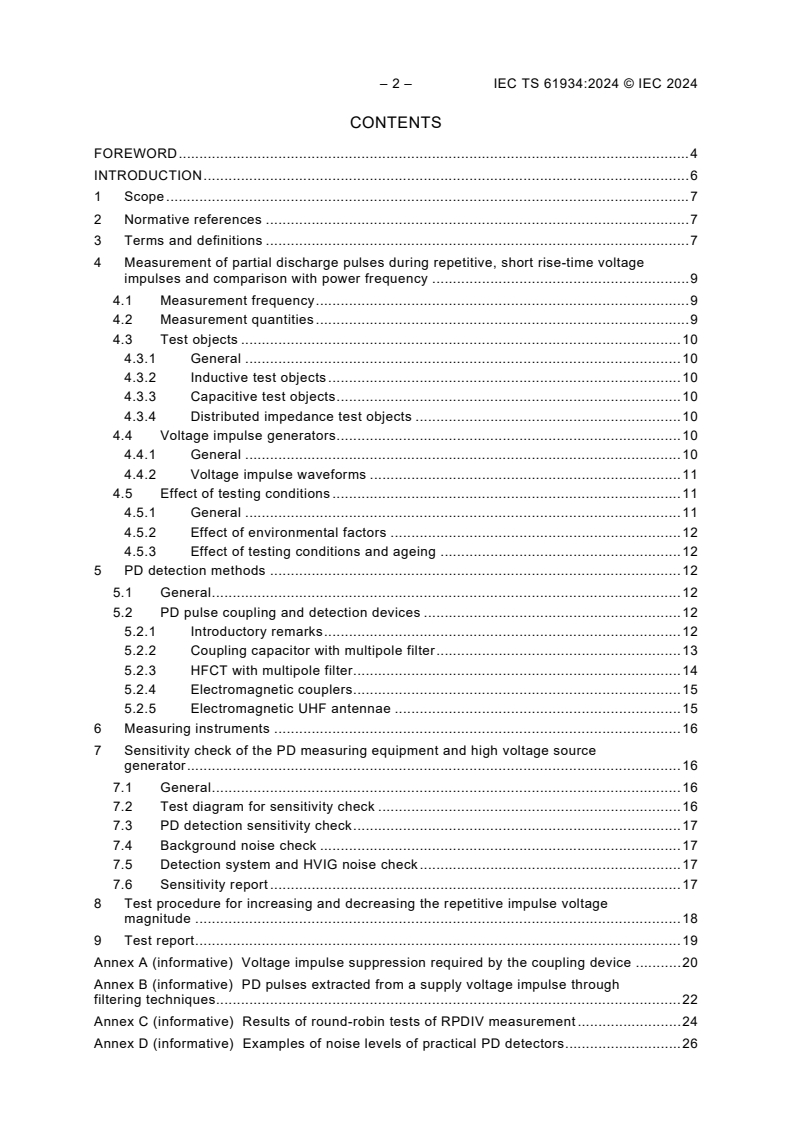
IEC TS 61934:2024 - Electrical insulating materials and systems - Electrical measurement of partial discharges (PD) under short rise time and repetitive voltage impulses Released:1/26/2024
IEC TS 61934:2024 RLV - Electrical insulating materials and systems - Electrical measurement of partial discharges (PD) under short rise time and repetitive voltage impulses Released:1/26/2024
Overview - IEC TS 61934:2024 (Partial Discharge Measurement for Short Rise-Time, Repetitive Impulses)
IEC TS 61934:2024 provides guidance for off-line electrical measurement of partial discharges (PD) that occur in electrical insulation systems (EISs) when stressed by short rise-time, repetitive voltage impulses typical of power‑electronics-driven equipment. It addresses PD phenomena generated by modern switching devices - including wide band gap semiconductors - and defines measurement approaches, test objects, and reporting practices for impulse-induced PD in apparatus such as motors, inductive reactors, wind‑turbine generators and power‑electronics modules.
Key topics and technical requirements
- Scope & exclusions
- Applicable to off-line PD measurement under repetitive short rise‑time impulses from power electronics.
- Excludes optical/ultrasonic PD detection methods and PDs from non‑repetitive impulses (e.g., lightning or switchgear switching impulses).
- Voltage impulse generators and waveforms
- Updated guidance on impulse generator parameter values to reflect fast switching and wide band gap device behavior (see Table 1 in the TS for example parameter sets).
- PD detection methods
- Electrical detection techniques described include coupling capacitors with multipole filters, HFCT (high-frequency current transformers) with filters, and electromagnetic couplers / UHF antennas.
- Note: charge‑based measurements and source‑controlled gating for noise suppression are not covered in this edition.
- Test objects
- Guidance for different test object types: inductive, capacitive, and distributed‑impedance EIS configurations.
- Measurement quality & procedures
- Measurement quantities, frequency considerations, sensitivity checks, background noise assessment, and stepwise voltage increase/decrease procedures are specified.
- Requirements for test reports and sensitivity documentation to ensure reproducibility and comparability.
- Environmental and ageing effects
- Consideration of environmental factors (e.g., humidity) and ageing on PD responses and repeatability.
Applications - practical use and benefits
- Design validation of insulation systems for motors, inverters, wind turbine generators and power‑electronics modules subjected to PWM and fast switching transients.
- Type testing and R&D to characterize PD inception under realistic repetitive impulse stress from power electronics.
- Quality assurance and condition assessment to detect insulation vulnerabilities caused by fast, repetitive transients.
- Laboratory testing to compare PD behavior under impulse stress with power‑frequency PD performance.
Who should use this TS
- Test laboratories and certification bodies performing PD measurements for product qualification.
- Manufacturers of motors, generators, drives, inverters and power‑electronics modules.
- R&D and reliability engineers assessing insulation design against fast repetitive impulse stress.
- OEMs and utilities concerned with insulation degradation due to power‑electronics switching.
Related standards
- Use IEC TS 61934:2024 alongside other IEC standards covering electrical insulation testing, safety and product‑specific type tests. Product‑specific procedures may be required in addition to this Technical Specification.
Keywords: IEC TS 61934:2024, partial discharge measurement, PD under short rise time, repetitive voltage impulses, power electronics, wide band gap semiconductors, HFCT, coupling capacitor, UHF antenna, electrical insulating materials.
Relations
- Effective Date
- 05-Sep-2023
Buy Documents
IEC TS 61934:2024 - Electrical insulating materials and systems - Electrical measurement of partial discharges (PD) under short rise time and repetitive voltage impulses Released:1/26/2024
IEC TS 61934:2024 RLV - Electrical insulating materials and systems - Electrical measurement of partial discharges (PD) under short rise time and repetitive voltage impulses Released:1/26/2024
Get Certified
Connect with accredited certification bodies for this standard

IMQ S.p.A. (Certification)
Italian electrical product certification.

SLG Prüf- und Zertifizierungs GmbH
German testing and certification body.

UL Solutions
Global safety science company with testing, inspection and certification.
Sponsored listings
Frequently Asked Questions
IEC TS 61934:2024 is a technical specification published by the International Electrotechnical Commission (IEC). Its full title is "Electrical insulating materials and systems - Electrical measurement of partial discharges (PD) under short rise time and repetitive voltage impulses". This standard covers: IEC TS 61934:2024 is applicable to the off-line electrical measurement of partial discharges (PDs) that occur in electrical insulation systems (EISs) when stressed by repetitive voltage impulses generated from power electronics devices. Typical applications are EISs belonging to apparatus driven by power electronics, such as motors, inductive reactors, wind turbine generators and the power electronics modules themselves. NOTE Use of this document with specific products can require the application of additional procedures. Excluded from the scope of this document are: - methods based on optical or ultrasonic PD detection, - fields of application for PD measurements when stressed by non-repetitive impulse voltages such as lightning impulse or switching impulses from switchgear. This edition includes the following significant technical changes with respect to the previous edition: a) background information on the progress being made in the field of power electronics including the introduction of wide band gap semiconductor devices has been added to the Introduction; b) voltage impulse generators; the parameter values of the voltage impulse waveform have been modified to reflect application of wide band gap semiconductor devices. c) PD detection methods; charge-based measurements are not described in this third edition nor are source-controlled gating techniques to suppress external noise. d) Since the previous edition in 2011, there have been significant technical advances in this field as evidenced by several hundreds of publications. Consequently, the Bibliography in the 2011 edition has been deleted in this third edition.
IEC TS 61934:2024 is applicable to the off-line electrical measurement of partial discharges (PDs) that occur in electrical insulation systems (EISs) when stressed by repetitive voltage impulses generated from power electronics devices. Typical applications are EISs belonging to apparatus driven by power electronics, such as motors, inductive reactors, wind turbine generators and the power electronics modules themselves. NOTE Use of this document with specific products can require the application of additional procedures. Excluded from the scope of this document are: - methods based on optical or ultrasonic PD detection, - fields of application for PD measurements when stressed by non-repetitive impulse voltages such as lightning impulse or switching impulses from switchgear. This edition includes the following significant technical changes with respect to the previous edition: a) background information on the progress being made in the field of power electronics including the introduction of wide band gap semiconductor devices has been added to the Introduction; b) voltage impulse generators; the parameter values of the voltage impulse waveform have been modified to reflect application of wide band gap semiconductor devices. c) PD detection methods; charge-based measurements are not described in this third edition nor are source-controlled gating techniques to suppress external noise. d) Since the previous edition in 2011, there have been significant technical advances in this field as evidenced by several hundreds of publications. Consequently, the Bibliography in the 2011 edition has been deleted in this third edition.
IEC TS 61934:2024 is classified under the following ICS (International Classification for Standards) categories: 17.220.99 - Other standards related to electricity and magnetism; 29.035.01 - Insulating materials in general; 29.080.30 - Insulation systems. The ICS classification helps identify the subject area and facilitates finding related standards.
IEC TS 61934:2024 has the following relationships with other standards: It is inter standard links to IEC TS 61934:2011. Understanding these relationships helps ensure you are using the most current and applicable version of the standard.
IEC TS 61934:2024 is available in PDF format for immediate download after purchase. The document can be added to your cart and obtained through the secure checkout process. Digital delivery ensures instant access to the complete standard document.
Standards Content (Sample)
IEC TS 61934 ®
Edition 3.0 2024-01
TECHNICAL
SPECIFICATION
colour
inside
Electrical insulating materials and systems – Electrical measurement of partial
discharges (PD) under short rise time and repetitive voltage impulses
All rights reserved. Unless otherwise specified, no part of this publication may be reproduced or utilized in any form
or by any means, electronic or mechanical, including photocopying and microfilm, without permission in writing from
either IEC or IEC's member National Committee in the country of the requester. If you have any questions about IEC
copyright or have an enquiry about obtaining additional rights to this publication, please contact the address below or
your local IEC member National Committee for further information.
IEC Secretariat Tel.: +41 22 919 02 11
3, rue de Varembé info@iec.ch
CH-1211 Geneva 20 www.iec.ch
Switzerland
About the IEC
The International Electrotechnical Commission (IEC) is the leading global organization that prepares and publishes
International Standards for all electrical, electronic and related technologies.
About IEC publications
The technical content of IEC publications is kept under constant review by the IEC. Please make sure that you have the
latest edition, a corrigendum or an amendment might have been published.
IEC publications search - webstore.iec.ch/advsearchform IEC Products & Services Portal - products.iec.ch
The advanced search enables to find IEC publications by a Discover our powerful search engine and read freely all the
variety of criteria (reference number, text, technical publications previews, graphical symbols and the glossary.
committee, …). It also gives information on projects, replaced With a subscription you will always have access to up to date
and withdrawn publications. content tailored to your needs.
IEC Just Published - webstore.iec.ch/justpublished
Electropedia - www.electropedia.org
Stay up to date on all new IEC publications. Just Published
The world's leading online dictionary on electrotechnology,
details all new publications released. Available online and once
containing more than 22 500 terminological entries in English
a month by email.
and French, with equivalent terms in 25 additional languages.
Also known as the International Electrotechnical Vocabulary
IEC Customer Service Centre - webstore.iec.ch/csc
(IEV) online.
If you wish to give us your feedback on this publication or need
further assistance, please contact the Customer Service
Centre: sales@iec.ch.
IEC TS 61934 ®
Edition 3.0 2024-01
TECHNICAL
SPECIFICATION
colour
inside
Electrical insulating materials and systems – Electrical measurement of partial
discharges (PD) under short rise time and repetitive voltage impulses
INTERNATIONAL
ELECTROTECHNICAL
COMMISSION
ICS 17.220.99; 29.035.01; 29.080.30 ISBN 978-2-8322-8116-1
– 2 – IEC TS 61934:2024 © IEC 2024
CONTENTS
FOREWORD . 4
INTRODUCTION . 6
1 Scope . 7
2 Normative references . 7
3 Terms and definitions . 7
4 Measurement of partial discharge pulses during repetitive, short rise-time voltage
impulses and comparison with power frequency . 9
4.1 Measurement frequency . 9
4.2 Measurement quantities . 9
4.3 Test objects . 10
4.3.1 General . 10
4.3.2 Inductive test objects . 10
4.3.3 Capacitive test objects . 10
4.3.4 Distributed impedance test objects . 10
4.4 Voltage impulse generators . 10
4.4.1 General . 10
4.4.2 Voltage impulse waveforms . 11
4.5 Effect of testing conditions . 11
4.5.1 General . 11
4.5.2 Effect of environmental factors . 12
4.5.3 Effect of testing conditions and ageing . 12
5 PD detection methods . 12
5.1 General . 12
5.2 PD pulse coupling and detection devices . 12
5.2.1 Introductory remarks . 12
5.2.2 Coupling capacitor with multipole filter . 13
5.2.3 HFCT with multipole filter. 14
5.2.4 Electromagnetic couplers . 15
5.2.5 Electromagnetic UHF antennae . 15
6 Measuring instruments . 16
7 Sensitivity check of the PD measuring equipment and high voltage source
generator . 16
7.1 General . 16
7.2 Test diagram for sensitivity check . 16
7.3 PD detection sensitivity check . 17
7.4 Background noise check . 17
7.5 Detection system and HVIG noise check . 17
7.6 Sensitivity report . 17
8 Test procedure for increasing and decreasing the repetitive impulse voltage
magnitude . 18
9 Test report . 19
Annex A (informative) Voltage impulse suppression required by the coupling device . 20
Annex B (informative) PD pulses extracted from a supply voltage impulse through
filtering techniques. 22
Annex C (informative) Results of round-robin tests of RPDIV measurement . 24
Annex D (informative) Examples of noise levels of practical PD detectors . 26
Bibliography . 27
Figure 1 – Coupling capacitor with multipole filter . 13
Figure 2 – Example of voltage impulse and ideal PD pulse frequency spectra before
and after filtering. 14
Figure 3 – HFCT between supply and test object with multipole filter . 14
Figure 4 – HFCT between test object and earth with multipole filter . 15
Figure 5 – Circuit using an electromagnetic coupler (e.g. an antenna) to suppress
impulses from the test supply . 15
Figure 6 – Circuit using an electromagnetic UHF antenna . 16
Figure 7 – Test diagram for sensitivity check . 17
Figure 8 – Example of relation between the outputs of LVPG and PD detector . 18
Figure 9 – Example of increasing and decreasing the impulse voltage magnitude . 19
Figure A.1 – Example of overlap between voltage impulse and PD pulse spectra
(dotted area) . 20
Figure A.2 – Example of voltage impulse and PD pulse spectra after filtering . 20
Figure A.3 – Example of impulse voltage damping as a function of impulse voltage
magnitude and rise time . 21
Figure B.1 – Power supply waveform and recorded signal using an antenna during
supply voltage commutation . 22
Figure B.2 – Signal detected by an antenna from the record of Figure B.1, using a
filtering technique (400 MHz high-pass filter) . 23
Figure B.3 – Characteristic of the filter used to pass from Figure B.1 to Figure B.2 . 23
Figure C.1 – Sequence of negative voltage impulses used for RRT . 24
Figure C.2 – PD pulses corresponding to voltage impulses . 25
Figure C.3 – Dependence of normalized RPDIV on 100 data (NRPDIV/100) on relative
humidity . 25
Table 1 – Example of parameter values of impulse voltage waveform without load . 11
Table D.1 – Examples of bandwidths and noise levels for practical PD sensors . 26
– 4 – IEC TS 61934:2024 © IEC 2024
INTERNATIONAL ELECTROTECHNICAL COMMISSION
____________
ELECTRICAL INSULATING MATERIALS AND SYSTEMS –
ELECTRICAL MEASUREMENT OF PARTIAL DISCHARGES (PD)
UNDER SHORT RISE TIME AND REPETITIVE VOLTAGE IMPULSES
FOREWORD
1) The International Electrotechnical Commission (IEC) is a worldwide organization for standardization comprising
all national electrotechnical committees (IEC National Committees). The object of IEC is to promote international
co-operation on all questions concerning standardization in the electrical and electronic fields. To this end and
in addition to other activities, IEC publishes International Standards, Technical Specifications, Technical Reports,
Publicly Available Specifications (PAS) and Guides (hereafter referred to as “IEC Publication(s)”). Their
preparation is entrusted to technical committees; any IEC National Committee interested in the subject dealt with
may participate in this preparatory work. International, governmental and non-governmental organizations liaising
with the IEC also participate in this preparation. IEC collaborates closely with the International Organization for
Standardization (ISO) in accordance with conditions determined by agreement between the two organizations.
2) The formal decisions or agreements of IEC on technical matters express, as nearly as possible, an international
consensus of opinion on the relevant subjects since each technical committee has representation from all
interested IEC National Committees.
3) IEC Publications have the form of recommendations for international use and are accepted by IEC National
Committees in that sense. While all reasonable efforts are made to ensure that the technical content of IEC
Publications is accurate, IEC cannot be held responsible for the way in which they are used or for any
misinterpretation by any end user.
4) In order to promote international uniformity, IEC National Committees undertake to apply IEC Publications
transparently to the maximum extent possible in their national and regional publications. Any divergence between
any IEC Publication and the corresponding national or regional publication shall be clearly indicated in the latter.
5) IEC itself does not provide any attestation of conformity. Independent certification bodies provide conformity
assessment services and, in some areas, access to IEC marks of conformity. IEC is not responsible for any
services carried out by independent certification bodies.
6) All users should ensure that they have the latest edition of this publication.
7) No liability shall attach to IEC or its directors, employees, servants or agents including individual experts and
members of its technical committees and IEC National Committees for any personal injury, property damage or
other damage of any nature whatsoever, whether direct or indirect, or for costs (including legal fees) and
expenses arising out of the publication, use of, or reliance upon, this IEC Publication or any other IEC
Publications.
8) Attention is drawn to the Normative references cited in this publication. Use of the referenced publications is
indispensable for the correct application of this publication.
9) Attention is drawn to the possibility that some of the elements of this IEC Publication may be the subject of patent
rights. IEC shall not be held responsible for identifying any or all such patent rights.
IEC TS 61934 has been prepared by IEC technical committee 112: Evaluation and qualification
of electrical insulating materials and systems. It is a Technical Specification.
This third edition cancels and replaces the second edition published in 2011. This edition
constitutes a technical revision.
This edition includes the following significant technical changes with respect to the previous
edition:
a) background information on the progress being made in the field of power electronics
including the introduction of wide band gap semiconductor devices has been added to the
Introduction;
b) voltage impulse generators; the parameter values of the voltage impulse waveform have
been modified to reflect application of wide band gap semiconductor devices.
c) PD detection methods; charge-based measurements are not described in this third edition
nor are source-controlled gating techniques to suppress external noise.
d) Since the previous edition in 2011, there have been significant technical advances in this
field as evidenced by several hundreds of publications. Consequently, the Bibliography in
the 2011 edition has been deleted in this third edition.
The text of this Technical Specification is based on the following documents:
Draft Report on voting
112/578/DTS 112/610/RVDTS
Full information on the voting for its approval can be found in the report on voting indicated in
the above table.
The language used for the development of this Technical Specification is English.
This document was drafted in accordance with ISO/IEC Directives, Part 2, and developed in
accordance with ISO/IEC Directives, Part 1 and ISO/IEC Directives, IEC Supplement, available
at www.iec.ch/members_experts/refdocs. The main document types developed by IEC are
described in greater detail at www.iec.ch/publications.
The committee has decided that the contents of this document will remain unchanged until the
stability date indicated on the IEC website under webstore.iec.ch in the data related to the
specific document. At this date, the document will be
• reconfirmed,
• withdrawn,
• replaced by a revised edition, or
• amended.
IMPORTANT – The “colour inside” logo on the cover page of this document indicates that it
contains colours which are considered to be useful for the correct understanding of its
contents. Users should therefore print this document using a colour printer.
– 6 – IEC TS 61934:2024 © IEC 2024
INTRODUCTION
Power electronics has been developed along with both control theory and semiconductor
technology. Switching is one of the essential features of power electronics control. For higher
efficiency and smoother operation, switching times of devices such as an insulated-gate bipolar
transistor (IGBT) tend to be shorter than microseconds. The introduction of wide band gap
devices, such as those based on silicon carbide, can result in transients with rise times of the
order of a few tens of nanoseconds. Such a short rise time can cause transient overvoltage
impulses or surges in systems. When the voltage impulses reach the breakdown strength of an
air gap, partial discharge (PD) can occur. In addition, the impulses are repetitive from power
electronics modulation such as pulse width modulation (PWM). Since PD can cause degradation
of electrical insulation parts in the system, it is one of the most important parameters to be
measured.
The first edition of IEC TS 61934 was issued in April 2006. Because of rapid development in
this field, the revision activity for the latest information was approved by TC 112 at their Berlin
meeting in September 2006. The second edition of IEC TS 61934 was published in 2011. Owing
to further advances in this area, a revision of the second edition was commenced formally in
2019 and has resulted in this third edition.
ELECTRICAL INSULATING MATERIALS AND SYSTEMS –
ELECTRICAL MEASUREMENT OF PARTIAL DISCHARGES (PD)
UNDER SHORT RISE TIME AND REPETITIVE VOLTAGE IMPULSES
1 Scope
This document is applicable to the off-line electrical measurement of partial discharges (PDs)
that occur in electrical insulation systems (EISs) when stressed by repetitive voltage impulses
generated from power electronics devices.
Typical applications are EISs belonging to apparatus driven by power electronics, such as
motors, inductive reactors, wind turbine generators and the power electronics modules
themselves.
NOTE Use of this document with specific products can require the application of additional procedures.
Excluded from the scope of this document are
– methods based on optical or ultrasonic PD detection,
– fields of application for PD measurements when stressed by non-repetitive impulse voltages
such as lightning impulse or switching impulses from switchgear.
2 Normative references
The following documents are referred to in the text in such a way that some or all of their content
constitutes requirements of this document. For dated references, only the edition cited applies.
For undated references, the latest edition of the referenced document (including any
amendments) applies.
IEC 60270, High-voltage test techniques – Partial discharge measurements
3 Terms and definitions
For the purposes of this document, the following terms and definitions apply.
ISO and IEC maintain terminology databases for use in standardization at the following
addresses:
• IEC Electropedia: available at https://www.electropedia.org/
• ISO Online browsing platform: available at https://www.iso.org/obp
3.1
repetitive voltage impulse
voltage impulse which is used as test voltage for the evaluation of switching surges from power
electronics devices with a carrier or driven frequency
3.2
partial discharge
PD
localized electric discharge that only partially bridges the insulation between conductors and
which can or cannot occur adjacent to a conductor
– 8 – IEC TS 61934:2024 © IEC 2024
3.3
partial discharge pulse
current pulse in an object under test that results from a partial discharge occurring within the
object under test
Note 1 to entry: The pulse is measured using suitable detector circuits, which have been introduced into the test
circuit for the purpose of the test.
Note 2 to entry: A detector in accordance with the provisions of this document produces a current or a voltage
signal at its output related to the PD pulse at its input.
[SOURCE: IEC 60270, 3.2, modified – “or voltage” has been deleted, the second part of the
definition has been included in Note 1 to entry and Note 2 to entry has been revised.]
3.4
RPDIV
repetitive partial discharge inception voltage
minimum peak-to-peak impulse voltage at which more than five PD pulses occur on ten voltage
impulses of the same polarity
Note 1 to entry: The RPDIV is a mean value for the specified test time and a test arrangement where the voltage
applied to the test object is gradually increased from a value at which no partial discharges can be detected. Further
explanation is mentioned in 8.
3.5
RPDEV
repetitive partial discharge extinction voltage
maximum peak-to-peak impulse voltage at which less than five PD pulses occur on ten voltage
impulses of the same polarity
Note 1 to entry: The RPDEV is a mean value for a specified test time and a test arrangement where the voltage
applied to the test object gradually decreases from a voltage at which PDs have been detected. Further explanation
is mentioned in Clause 8.
3.6
impulse voltage polarity
polarity of the applied impulse voltage with respect to earth
3.7
unipolar impulse
repetitive voltage impulse, the polarity of which is either positive or negative
[SOURCE: IEC 62068:2013, 3.11, modified – “repetitive” has been added.]
3.8
bipolar impulse
repetitive voltage impulse, the polarity of which changes from positive to negative or vice versa
3.9
impulse voltage repetition rate
inverse of the average time between successive impulses of the same polarity, whether unipolar
or bipolar
3.10
impulse rise time
time for the voltage to rise from 10 % to 90 %
3.11
impulse decay time
time interval between the instants at which the instantaneous value of an impulse decreases
from a specified upper value to a specified lower value
Note 1 to entry: Unless otherwise specified, the upper and lower values are fixed at 90 % and 10 % of the impulse
magnitude.
3.12
impulse width
interval of time between the first and last instants at which the instantaneous value of an impulse
reaches a specified fraction of impulse magnitude or a specified threshold
3.13
impulse duty cycle
ratio, for a given time interval, of the impulse width to the total time
3.14
peak partial discharge magnitude
largest magnitude of any quantity related to PD pulses observed in a test object at a specified
voltage following a specified conditioning and test
Note 1 to entry: For impulse voltage tests, the peak magnitude of the PD pulse is the largest repeatedly occurring
PD magnitude.
[SOURCE: IEC 60270, 3.4, modified – In the term “largest repeatedly occurring” has been
replaced with “peak”, the definition has been revised and the Note to entry has been added.]
4 Measurement of partial discharge pulses during repetitive, short rise-time
voltage impulses and comparison with power frequency
4.1 Measurement frequency
IEC 60270 describes the methods employed to measure the electrical pulses associated with
PD in test objects excited by DC and alternating voltages up to 400 Hz. The methods used to
measure PD pulses when the test object is subjected to supply voltage impulses shall be
modified from the standard narrow-band and wide-band frequency methods described in
IEC 60270.
To measure the PD during repetitive short rise time voltage impulses, it is necessary to avoid
the induced current of the impulse voltage. One technique is current or electromagnetic wave
measurement at ultra-high frequency, that is, higher than the frequency components associated
with the impulse. Ultra-wide band (UWB) detection is often used with a high-pass filter for the
suppression of the relatively lower frequency components of the impulse voltage. In principle,
narrow-band measurement in the ultra-high frequency (UHF: 300 MHz to 3 GHz) region is also
effective for the suppression of the impulse voltage. Partial discharge measurement methods
in this frequency range are described in IEC TS 62478.
NOTE Measurements in accordance with IEC TS 62478 cannot be calibrated in relation to apparent charge in pC,
so a direct value-based comparison to measurements in accordance with IEC 60270 is not possible.
4.2 Measurement quantities
Measured quantities concern the RPDIV, the RPDEV, the peak partial discharge magnitude and
partial discharge pulse repetition rate.
The RPDIV and RPDEV can depend on PD measurement sensitivity and measurement circuit
noise, therefore normalization, as indicated in Clause 7, is necessary. Moreover, they depend
on the test object and the pulse deformation from the discharge site to the measurement point.
In this document, and consistent with IEC TS 62478, PD readings are reported in units of mV.
In all cases, a sensitivity evaluation of the measuring system is necessary and shall be carried
out according to Clause 7.
– 10 – IEC TS 61934:2024 © IEC 2024
4.3 Test objects
4.3.1 General
Test objects behave predominantly as inductive, capacitive or distributed equivalent
impedances according to the voltage supply frequency content. For some test objects, whether
they are predominantly inductive, capacitive or distributed, impedances can depend on the PD
detection frequency range (not only on the voltage supply frequency). Test objects with
distributed behaviour have transmission line characteristics which can cause attenuation and
distortion of the PD pulses as the pulses propagate through the test object. The following
classification is effective only for low-frequency,
...
IEC TS 61934 ®
Edition 3.0 2024-01
REDLINE VERSION
TECHNICAL
SPECIFICATION
colour
inside
Electrical insulating materials and systems – Electrical measurement of partial
discharges (PD) under short rise time and repetitive voltage impulses
All rights reserved. Unless otherwise specified, no part of this publication may be reproduced or utilized in any form
or by any means, electronic or mechanical, including photocopying and microfilm, without permission in writing from
either IEC or IEC's member National Committee in the country of the requester. If you have any questions about IEC
copyright or have an enquiry about obtaining additional rights to this publication, please contact the address below or
your local IEC member National Committee for further information.
IEC Secretariat Tel.: +41 22 919 02 11
3, rue de Varembé info@iec.ch
CH-1211 Geneva 20 www.iec.ch
Switzerland
About the IEC
The International Electrotechnical Commission (IEC) is the leading global organization that prepares and publishes
International Standards for all electrical, electronic and related technologies.
About IEC publications
The technical content of IEC publications is kept under constant review by the IEC. Please make sure that you have the
latest edition, a corrigendum or an amendment might have been published.
IEC publications search - webstore.iec.ch/advsearchform IEC Products & Services Portal - products.iec.ch
The advanced search enables to find IEC publications by a Discover our powerful search engine and read freely all the
variety of criteria (reference number, text, technical publications previews, graphical symbols and the glossary.
committee, …). It also gives information on projects, replaced With a subscription you will always have access to up to date
and withdrawn publications. content tailored to your needs.
IEC Just Published - webstore.iec.ch/justpublished
Electropedia - www.electropedia.org
Stay up to date on all new IEC publications. Just Published
The world's leading online dictionary on electrotechnology,
details all new publications released. Available online and once
containing more than 22 500 terminological entries in English
a month by email.
and French, with equivalent terms in 25 additional languages.
Also known as the International Electrotechnical Vocabulary
IEC Customer Service Centre - webstore.iec.ch/csc
(IEV) online.
If you wish to give us your feedback on this publication or need
further assistance, please contact the Customer Service
Centre: sales@iec.ch.
IEC TS 61934 ®
Edition 3.0 2024-01
REDLINE VERSION
TECHNICAL
SPECIFICATION
colour
inside
Electrical insulating materials and systems – Electrical measurement of partial
discharges (PD) under short rise time and repetitive voltage impulses
INTERNATIONAL
ELECTROTECHNICAL
COMMISSION
ICS 17.220.99; 29.035.01; 29.080.30 ISBN 978-2-8322-8189-5
– 2 – IEC TS 61934:2024 RLV © IEC 2024
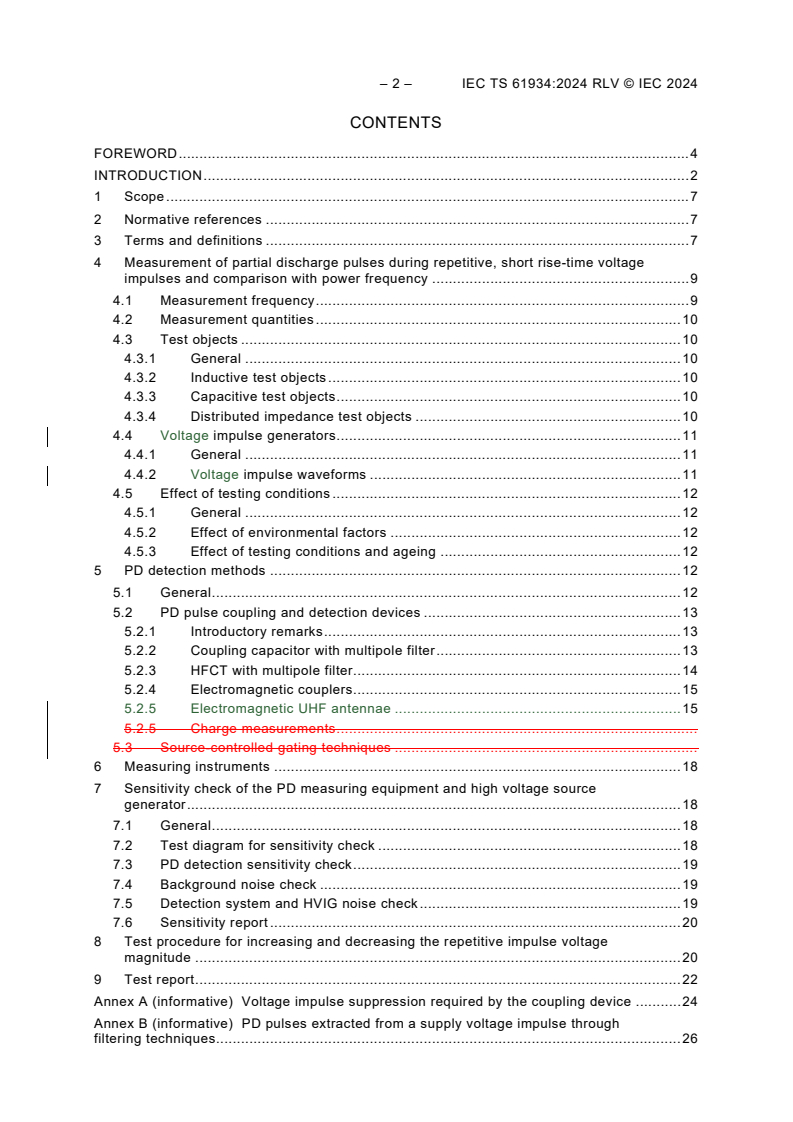
CONTENTS
FOREWORD . 4
INTRODUCTION . 2
1 Scope . 7
2 Normative references . 7
3 Terms and definitions . 7
4 Measurement of partial discharge pulses during repetitive, short rise-time voltage
impulses and comparison with power frequency . 9
4.1 Measurement frequency . 9
4.2 Measurement quantities . 10
4.3 Test objects . 10
4.3.1 General . 10
4.3.2 Inductive test objects . 10
4.3.3 Capacitive test objects . 10
4.3.4 Distributed impedance test objects . 10
4.4 Voltage impulse generators . 11
4.4.1 General . 11
4.4.2 Voltage impulse waveforms . 11
4.5 Effect of testing conditions . 12
4.5.1 General . 12
4.5.2 Effect of environmental factors . 12
4.5.3 Effect of testing conditions and ageing . 12
5 PD detection methods . 12
5.1 General . 12
5.2 PD pulse coupling and detection devices . 13
5.2.1 Introductory remarks . 13
5.2.2 Coupling capacitor with multipole filter . 13
5.2.3 HFCT with multipole filter. 14
5.2.4 Electromagnetic couplers . 15
5.2.5 Electromagnetic UHF antennae . 15
5.2.5 Charge measurements .
5.3 Source-controlled gating techniques .
6 Measuring instruments . 18
7 Sensitivity check of the PD measuring equipment and high voltage source
generator . 18
7.1 General . 18
7.2 Test diagram for sensitivity check . 18
7.3 PD detection sensitivity check . 19
7.4 Background noise check . 19
7.5 Detection system and HVIG noise check . 19
7.6 Sensitivity report . 20
8 Test procedure for increasing and decreasing the repetitive impulse voltage
magnitude . 20
9 Test report . 22
Annex A (informative) Voltage impulse suppression required by the coupling device . 24
Annex B (informative) PD pulses extracted from a supply voltage impulse through
filtering techniques. 26
Annex C (informative) Results of round-robin tests of RPDIV measurement . 28
Annex D (informative) Examples of noise levels of practical PD detectors . 30
Bibliography . 31
Figure 1 – Coupling capacitor with multipole filter . 13
Figure 2 – Example of voltage impulse and ideal PD pulse frequency spectra before
and after filtering. 14
Figure 3 – HFCT between supply and test object with multipole filter . 15
Figure 4 – HFCT between test object and earth with multipole filter . 15
Figure 5 – Circuit using an electromagnetic coupler (e.g. an antenna) to suppress
impulses from the test supply . 15
Figure 6 – Circuit using an electromagnetic UHF antenna . 16
Figure 7 – Example of waveforms of repetitive bipolar impulse voltage
and charge accumulation for a twisted-pair sample .
Figure 8 – Charge measurements .
Figure 9 – Example of PD detection using electronic source-controlled gating
(other PD coupling devices can be used) .
Figure 7 – Test diagram for sensitivity check . 19
Figure 8 – Example of relation between the outputs of LVPG and PD detector . 20
Figure 9 – Example of increasing and decreasing the impulse voltage magnitude . 22
Figure A.1 – Example of overlap between voltage impulse and PD pulse spectra
(dotted area) . 24
Figure A.2 – Example of voltage impulse and PD pulse spectra after filtering . 24
Figure A.3 – Example of impulse voltage damping as a function of impulse voltage
magnitude and rise time . 25
Figure B.1 – Power supply waveform and recorded signal using an antenna during
supply voltage commutation . 26
Figure B.2 – Signal detected by an antenna from the record of Figure B.1, using a
filtering technique (400 MHz high-pass filter) . 27
Figure B.3 – Characteristic of the filter used to pass from Figure B.1 to Figure B.2 . 27
Figure C.1 – Sequence of negative voltage impulses used for RRT . 28
Figure C.2 – PD pulses corresponding to voltage impulses . 29
Figure C.3 – Dependence of normalized RPDIV on 100 data (NRPDIV/100) on relative
humidity . 29
Table 1 – Example of parameter values of impulse voltage waveform without load . 11
Table D.1 – Examples of bandwidths and noise levels for practical PD sensors . 30
– 4 – IEC TS 61934:2024 RLV © IEC 2024
INTERNATIONAL ELECTROTECHNICAL COMMISSION
____________
ELECTRICAL INSULATING MATERIALS AND SYSTEMS –
ELECTRICAL MEASUREMENT OF PARTIAL DISCHARGES (PD)
UNDER SHORT RISE TIME AND REPETITIVE VOLTAGE IMPULSES
FOREWORD
1) The International Electrotechnical Commission (IEC) is a worldwide organization for standardization comprising
all national electrotechnical committees (IEC National Committees). The object of IEC is to promote international
co-operation on all questions concerning standardization in the electrical and electronic fields. To this end and
in addition to other activities, IEC publishes International Standards, Technical Specifications, Technical Reports,
Publicly Available Specifications (PAS) and Guides (hereafter referred to as “IEC Publication(s)”). Their
preparation is entrusted to technical committees; any IEC National Committee interested in the subject dealt with
may participate in this preparatory work. International, governmental and non-governmental organizations liaising
with the IEC also participate in this preparation. IEC collaborates closely with the International Organization for
Standardization (ISO) in accordance with conditions determined by agreement between the two organizations.
2) The formal decisions or agreements of IEC on technical matters express, as nearly as possible, an international
consensus of opinion on the relevant subjects since each technical committee has representation from all
interested IEC National Committees.
3) IEC Publications have the form of recommendations for international use and are accepted by IEC National
Committees in that sense. While all reasonable efforts are made to ensure that the technical content of IEC
Publications is accurate, IEC cannot be held responsible for the way in which they are used or for any
misinterpretation by any end user.
4) In order to promote international uniformity, IEC National Committees undertake to apply IEC Publications
transparently to the maximum extent possible in their national and regional publications. Any divergence between
any IEC Publication and the corresponding national or regional publication shall be clearly indicated in the latter.
5) IEC itself does not provide any attestation of conformity. Independent certification bodies provide conformity
assessment services and, in some areas, access to IEC marks of conformity. IEC is not responsible for any
services carried out by independent certification bodies.
6) All users should ensure that they have the latest edition of this publication.
7) No liability shall attach to IEC or its directors, employees, servants or agents including individual experts and
members of its technical committees and IEC National Committees for any personal injury, property damage or
other damage of any nature whatsoever, whether direct or indirect, or for costs (including legal fees) and
expenses arising out of the publication, use of, or reliance upon, this IEC Publication or any other IEC
Publications.
8) Attention is drawn to the Normative references cited in this publication. Use of the referenced publications is
indispensable for the correct application of this publication.
9) Attention is drawn to the possibility that some of the elements of this IEC Publication may be the subject of patent
rights. IEC shall not be held responsible for identifying any or all such patent rights.
This redline version of the official IEC Standard allows the user to identify the changes
made to the previous edition IEC TS 61934:2011. A vertical bar appears in the margin
wherever a change has been made. Additions are in green text, deletions are in
strikethrough red text.
IEC TS 61934 has been prepared by IEC technical committee 112: Evaluation and qualification
of electrical insulating materials and systems. It is a Technical Specification.
This third edition cancels and replaces the second edition published in 2011. This edition
constitutes a technical revision.
This edition includes the following significant technical changes with respect to the previous
edition:
a) background information on the progress being made in the field of power electronics
including the introduction of wide band gap semiconductor devices has been added to the
Introduction;
b) voltage impulse generators; the parameter values of the voltage impulse waveform have
been modified to reflect application of wide band gap semiconductor devices.
c) PD detection methods; charge-based measurements are not described in this third edition
nor are source-controlled gating techniques to suppress external noise.
d) Since the previous edition in 2011, there have been significant technical advances in this
field as evidenced by several hundreds of publications. Consequently, the Bibliography in
the 2011 edition has been deleted in this third edition.
The text of this Technical Specification is based on the following documents:
Draft Report on voting
112/578/DTS 112/610/RVDTS
Full information on the voting for its approval can be found in the report on voting indicated in
the above table.
The language used for the development of this Technical Specification is English.
This document was drafted in accordance with ISO/IEC Directives, Part 2, and developed in
accordance with ISO/IEC Directives, Part 1 and ISO/IEC Directives, IEC Supplement, available
at www.iec.ch/members_experts/refdocs. The main document types developed by IEC are
described in greater detail at www.iec.ch/publications.
The committee has decided that the contents of this document will remain unchanged until the
stability date indicated on the IEC website under webstore.iec.ch in the data related to the
specific document. At this date, the document will be
• reconfirmed,
• withdrawn,
• replaced by a revised edition, or
• amended.
IMPORTANT – The “colour inside” logo on the cover page of this document indicates that it
contains colours which are considered to be useful for the correct understanding of its
contents. Users should therefore print this document using a colour printer.
– 6 – IEC TS 61934:2024 RLV © IEC 2024
INTRODUCTION
Power electronics has been developed along with both control theory and semiconductor
technology. Switching is one of the essential features of power electronics control. For higher
efficiency and smoother operation, switching times of the latest devices such as an insulated-
gate bipolar transistor (IGBT) tend to be shorter than microseconds. The introduction of wide
band gap devices, such as those based on silicon carbide, can result in transients with rise
times of the order of a few tens of nanoseconds. Such a short rise time may can cause transient
overvoltage impulses or surges in systems. When the voltage impulses reach the breakdown
strength of an air gap, partial discharge (PD) may can occur. In addition, the impulses are
repetitive from power electronics modulation such as pulse width modulation (PWM). Since PD
may can cause degradation of electrical insulation parts in the system, it is one of the most
important parameters to be measured.
The first edition of IEC TS 61934 was issued in April 2006. Because of rapid development in
this field, the revision activity for the latest information was approved by TC 112 at their Berlin
meeting in September 2006. In addition to technical and editorial changes, practical experience
obtained through round-robin test (RRT) is also presented in Annex C. The second edition of
IEC TS 61934 was published in 2011. Owing to further advances in this area, a revision of the
second edition was commenced formally in 2019 and has resulted in this third edition.
ELECTRICAL INSULATING MATERIALS AND SYSTEMS –
ELECTRICAL MEASUREMENT OF PARTIAL DISCHARGES (PD)
UNDER SHORT RISE TIME AND REPETITIVE VOLTAGE IMPULSES
1 Scope
This document is applicable to the off-line electrical measurement of partial discharges (PDs)
that occur in electrical insulation systems (EISs) when stressed by repetitive voltage impulses
generated from electronic power electronics devices.
Typical applications are EISs belonging to apparatus driven by power electronics, such as
motors, inductive reactors and windmill, wind turbine generators and the power electronics
modules themselves.
NOTE 1 Use of this document with specific products may can require the application of additional procedures.
NOTE 2 The procedures described in this technical specification are emerging technologies. Experience and
caution, as well as certain preconditions, are needed to apply it.
Excluded from the scope of this document are
– methods based on optical or ultrasonic PD detection,
– fields of application for PD measurements when stressed by non-repetitive impulse voltages
such as lightning impulse or switching impulses from switchgear.
2 Normative references
The following documents are referred to in the text in such a way that some or all of their content
constitutes requirements of this document. For dated references, only the edition cited applies.
For undated references, the latest edition of the referenced document (including any
amendments) applies.
IEC 60034 (all parts), Rotating electrical machines
IEC 60270:2000, High-voltage test techniques – Partial discharge measurements
3 Terms and definitions
For the purposes of this document, the following terms and definitions apply.
ISO and IEC maintain terminology databases for use in standardization at the following
addresses:
• IEC Electropedia: available at https://www.electropedia.org/
• ISO Online browsing platform: available at https://www.iso.org/obp
3.1
repetitive voltage impulse
voltage impulse which is used as test voltage for the evaluation of switching surges from power
electronics devices with a carrier or driven frequency
– 8 – IEC TS 61934:2024 RLV © IEC 2024
3.2
partial discharge
PD
localized electric discharge that only partially bridges the insulation between conductors and
which can or cannot occur adjacent to a conductor
[IEC 60270:2000, 3.1, modified]
3.3
partial discharge pulse
current pulse in an object under test that results from a partial discharge occurring within the
object under test
Note 1 to entry: The pulse is measured using suitable detector circuits, which have been introduced into the test
circuit for the purpose of the test.
Note 2 to entry: A detector in accordance with the provisions of this document produces a current or a voltage
signal at its output related to the PD pulse at its input.
[SOURCE: IEC 60270:2000, 3.2, modified – “or voltage” has been deleted, the second part of
the definition has been included in Note 1 to entry and Note 2 to entry has been revised.]
3.4
RPDIV
repetitive partial discharge inception voltage
minimum peak-to-peak impulse voltage at which more than five PD pulses occur on ten voltage
impulses of the same polarity
Note 1 to entry: The RPDIV is a mean value for the specified test time and a test arrangement where the voltage
applied to the test object is gradually increased from a value at which no partial discharges can be detected. Further
explanation is mentioned in 8.
3.5
RPDEV
repetitive partial discharge extinction voltage
maximum peak-to-peak impulse voltage at which less than five PD pulses occur on ten voltage
impulses of the same polarity
Note 1 to entry: The RPDEV is a mean value for a specified test time and a test arrangement where the voltage
applied to the test object gradually decreases from a voltage at which PDs have been detected. Further explanation
is mentioned in Clause 8.
3.6
impulse voltage polarity
polarity of the applied impulse voltage with respect to earth
[IEC 62068-1:2003, 3.10]
3.7
unipolar impulse
repetitive voltage impulse, the polarity of which is either positive or negative
[IEC 62068-1:2003, 3.8, modified]
NOTE The magnitude of the oscillation of the opposite polarity has to be less than 20 %.
[SOURCE: IEC 62068:2013, 3.11, modified – “repetitive” has been added.]
3.8
bipolar impulse
repetitive voltage impulse, the polarity of which changes from positive to negative or vice versa
[IEC 62068-1:2003, 3.9, modified]
3.9
impulse voltage repetition rate
inverse of the average time between successive impulses of the same polarity, whether unipolar
or bipolar
[IEC 62068-1:2003, 3.11, modified]
3.10
impulse rise time
time for the voltage impulse to go to rise from 0 % to 100 % 10 % to 90 %
NOTE Unless otherwise stated, this is estimated as 1,25 times the time for the voltage to rise from 10 % to 90 %.
3.11
impulse decay time
time interval between the instants at which the instantaneous value of an impulse decreases
from a specified upper value to a specified lower value
Note 1 to entry: Unless otherwise specified, the upper and lower values are fixed at 90 % and 10 % of the impulse
magnitude.
3.12
impulse width
interval of time between the first and last instants at which the instantaneous value of an impulse
reaches a specified fraction of impulse magnitude or a specified threshold
3.13
impulse duty cycle
ratio, for a given time interval, of the impulse width to the total time
3.14
peak partial discharge magnitude
largest magnitude of any quantity related to PD pulses observed in a test object at a specified
voltage following a specified conditioning and test
Note 1 to entry: For impulse voltage tests, the peak magnitude of the PD pulse is the largest repeatedly occurring
PD magnitude.
[SOURCE: IEC 60270:2000, 3.4, modified – In the term “largest repeatedly occurring” has been
replaced with “peak”, the definition has been revised and the Note to entry has been added.]
4 Measurement of partial discharge pulses during repetitive, short rise-time
voltage impulses and comparison with power frequency
4.1 Measurement frequency
IEC 60270 describes the methods employed to measure the electrical pulses associated with
PD in test objects excited by DC and alternating voltages up to 400 Hz. The methods used to
measure PD pulses when the test object is subjected to supply voltage impulses have to shall
be modified from the standard narrow-band and wide-band frequency methods described in
IEC 60270.
To measure the PD during repetitive short rise time voltage impulses, it is necessary to avoid
the induced current of the excited impulse voltage. One technique is current or electromagnetic
wave measurement at ultra-high frequency, that is, higher than that of the frequency
components associated with the impulse. Ultra-wide band (UWB) detection is often used with a
high-pass filter for the suppression of the relatively lower frequency components of the impulse
voltage. In principle, narrow-band measurement in the ultra-high frequency (UHF: 300 MHz to
3 GHz) region is also effective for the suppression of the impulse voltage. The other method is
– 10 – IEC TS 61934:2024 RLV © IEC 2024
the integration of PD current at a very low frequency compared to that of the impulse voltage.
Partial discharge measurement methods in this frequency range are described in IEC TS 62478.
NOTE Measurements in accordance with IEC TS 62478 cannot be calibrated in relation to apparent charge in pC,
so a direct value-based comparison to measurements in accordance with IEC 60270 is not possible.
4.2 Measurement quantities
Measured quantities concern the RPDIV, the RPDEV, the peak partial discharge magnitude and
partial discharge pulse repetition rate.
The RPDIV and RPDEV may can depend on PD measurement sensitivity and measurement
circuit noise, therefore normalization, as indicated in Clause 7, is needed necessary. Moreover,
they depend on the test object and the pulse deformation from the discharge site to the
measurement point.
In this document, and consistent with IEC TS 62478, PD readings are reported in units of mV.
In all cases, a sensitivity evaluation of the measuring system is necessary and shall be carried
out according to Clause 7.
4.3 Test objects
4.3.1 General
Test objects behave predominantly as inductive, capacitive or distributed equivalent
impedances according to the voltage supply frequency content. For some test objects, whether
they are predominantly inductive, capacitive or distributed, impedances may can depend on the
PD detection frequency range (not only on the voltage supply frequency). Test objects with
distributed behaviour have transmission line characteristics which may can cause attenuation
and distortion of the PD pulses as the pulses propagate through the test object. The following
classification is effective only for low-frequency, narrow-band measurements.
4.3.2 Inductive test objects
Types of inductive test objects may can include:
– stator and rotor windings
– inductive reactors
– transformer windings
– motorettes and formettes: see the IEC 60034 series IEC 60034-18-1
4.3.3 Capacitive test objects
Types of capacitive test objects may can include:
– twisted pairs of winding wire
– capacitors
– packaging of switching devices
– power electronics modules and substrates
– isolated heat sinks
– main wall insulation models in stator coils and bars
– printed circuit boards
– optocouplers
4.3.4 Distributed impedance test objects
The following test objects may can have distributed equivalent impedance properties:
– cables
– busbars
– stator and rotor windings
– transformer windings
– turn insulation of stator and rotor windings
– bushings with capacitive voltage stress control.
4.4 Voltage impulse generators
4.4.1 General
Voltage impulse generators used in this document shall generate short rise time and repetitive
voltage impulses with a low noise level. For a short rise time of impulses, semiconductor devices
may can be used for switching in addition to conventional sphere electrode gaps. For repetitive
impulses, the main capacitor shall be charged from a DC power supply in a short period of time.
The ranges of rise time, repetition frequency and other parameters are described in 4.4.2.
The polarity of successive voltage impulses is important for PD behaviour. To simulate the turn-
to-turn voltage of a motor driven by a PWM phase voltage, a bipolar repetitive voltage impulse
voltage is preferable. When a bipolar generator is hard to obtain, a unipolar repetitive voltage
impulse generator may can be used.
For PD measurements, voltage impulse generators shall suppress noise emission by means of
sufficient electromagnetic shielding.
4.4.2 Voltage impulse waveforms
For the purpose of comparison between different insulating materials or design solutions, partial
discharge measurements can be performed using appropriate voltage supply waveforms. The
specification of the voltage impulse generator shall include amongst other factors:
– impulse voltage rise time
– impulse voltage polarity
– impulse voltage repetition rate
– impulse voltage width
– impulse duty cycle
Examples are given in Table 1. Rise times as short as 20 ns are exhibited by devices employing
wide band gap semiconductor materials, e.g. SiC or GaN.
Table 1 – Example of parameter values of impulse voltage waveform without load
Characteristic Range
Rise time 0,04 0,02 μs to 1 μs
Repetition rate 1 Hz to 10 000 Hz
Voltage impulse width 0,08 μs to 25 μs
Shape Square or triangular (preferred)
Polarity Unipolar or bipolar (preferred)
The voltage impulse waveform depends not only on the voltage impulse generator specification
but also on sample impedance. The voltage impulse waveform will change significantly with
load. The voltage impulse generator needs to shall be designed to deliver the required wave
shape to the load. As the capacitance of the sample increases, the rise time of the voltage
impulse increases in general. On the other hand, The inductive test object, or distributed
– 12 – IEC TS 61934:2024 RLV © IEC 2024
equivalent impedance mentioned in 4.3.4, can cause damped oscillation after the voltage
impulse waveform in addition to the change of rise time. Examples of these distortions to the
waveform, due to variations in sample impedance, can be found in IEC TS 60034-27-5:2021,
4.2.2. It is important to check and record the waveform of the impulse voltage across the tested
electrical insulation, at the test object itself. In this case, it is strongly recommended that
impulse and PD waveforms are observed with a wide band oscilloscope with at least 100 MHz
bandwidth. It is noted that PD can occur during the voltage oscillation following the first impulse.
4.5 Effect of testing conditions
4.5.1 General
In general, PD-associated quantities may can depend upon specific features of the impulse
waveform, for example the impulse rise time, the impulse decay time, the impulse repetition
rate, the polarity and the number of oscillations in the impulse.
4.5.2 Effect of environmental factors
In general, PD-associated quantities may can be affected by the following factors:
– temperature
– humidity
– atmospheric pressure
– type of environment gas
– degree of contamination of the test object
NOTE PD phenomena may can change with and exhibit longer rise times in the case of high altitude, i.e., lower
pressure.
4.5.3 Effect of testing conditions and ageing
PD-associated quantities may can be affected by
– voltage distribution
– position of PD occurrence
– previous voltage applications as well as the time between voltage applications
– operation time or time under stress of the test object
In addition, they may can vary as ageing of the electrical insulation occurs, that is, during
operation of the EIS.
5 PD detection methods
5.1 General
Any PD pulse detection system where the test object is excited by voltage impulses requires
strong suppression of the residual voltage impulse, measured by the PD detection circuit, and
negligible suppression of the PD pulse. The PD pulse shall have a magnitude after processing
by the detection system that is greater than the residual transmitted voltage impulse. The
amount of impulse voltage suppression required will be dependent on the test voltage and the
rise time of the impulse.
As the impulse voltage increases in amplitude, greater suppression is required in order to
ensure that important PD pulse magnitudes are higher than the residual transmitted voltage
impulse on the output of the detector. Similarly, as the rise time of the applied impulse voltage
becomes shorter, the suppression shall be greater, due to the increased overlap of frequency
spectra of supply impulse and PD pulse (see Annex A). PD pulse coupling devices shall be
designed to ensure that important PD pulse magnitudes are higher than the residual transmitted
voltage impulse on the output of the detector, or that the residual is clearly distinguishable from
the PD pulses.
Annex A provides indications of the voltage impulse suppression action required by the coupling
device. Suggestions for the amount of supply voltage impulse suppression needed necessary
as a function of impulse magnitude and rise time are given.
Examples of PD pulses extracted from a supply voltage impulse through filtering techniques are
reported in Annex B.
5.2 PD pulse coupling and detection devices
5.2.1 Introductory remarks
PD current or voltage pulses in a test object can be detected either by means of high-voltage
capacitors, high-frequency current transformers (HFCTs) or electromagnetic couplers (e.g.
antennae). The detectors, in conjunction with the rest of the measuring system, shall be able
to suppress the impulse voltage to a magnitude less than that expected from the PD pulse (e.g.
using appropriate filters).
Short low-inductance connections between the supply, the test object and the PD detector are
required, since the voltage impulses and PD pulses contain high-frequency components. The
impulse supply shall be as physically close to the test object as possible, in order to prevent
attenuation and dispersion of the applied impulse due to the equivalent transmission
parameters of the connecting leads. Since the PD is measured with a UWB detection system,
earthing of the test object shall be made directly to the impulse voltage supply, with leads as
short as possible and with low inductance. It is recommended that lead lengths should not
exceed 1 m.
The following circuits are applicable for PD pulse detection.
5.2.2 Coupling capacitor with multipole filter
A coupling capacitor with a voltage rating exceeding that of the expected applied impulse
voltage together with a filter that strongly attenuates the test voltage impulses can be used. The
filter shall have at least three poles and special measures to inhibit cross-coupling of the input
signal to the output. The filter can be designed using passive or active filtering technology. The
coupling capacitor is connected to the test object high-voltage terminal (Figure 1). Annex A
shows a schematic example of filter behaviour. Figure 2 reports an example of the ideal
th
frequency spectra of PD pulse and impulse voltage before and after filtering for an 8 order
filter. Note that real filters distort the PD pulse shape and can introduce extra frequency
components.
Figure 1 – Coupling capacitor with multipole filter
– 14 – IEC TS 61934:2024 RLV © IEC 2024
10 10
Voltage Impulse
Voltage Impulse
PD pulse PD pulse
5 5
0 0
–5 –5
–10
–10
–15
–15
–20
–20
–6 –4 –2 0 –6 –4 –2 0
10 10 10 10 10 10 10 10
Frequency (GHz)
IEC 832/11
IEC 833/11
Frequency (GHz)
Figure 2a – Example of voltage impulse and PD Figure 2b – Example of voltage impulse and PD
pulse frequency spectra before filtering pulse frequency spectra after filtering
a) Example of voltage impulse and ideal PD pulse b) Example of voltage impulse and ideal PD pulse
frequency spectra before filtering frequency spectra after filtering
th
NOTE The impulse voltage rise time is 50 ns, the PD pulse rise time is 2 ns, the 8 order filter with filter cut-off
frequency is equal to 500 MHz.
Figure 2 – Example of voltage impulse and ideal PD pulse frequency spectra
before and after filtering
5.2.3 HFCT with multipole filter
An HFCT, together with a filter, can be used to detect PD pulses while suppressing the impulse
voltage. Note that HFCTs may can have a very wide range of upper cut-off frequencies that
may can affect the performance of this method, especially with impulse voltage rise times
< 100 ns. The HFCT shall have a higher cut-off frequency than the voltage impulse frequency.
The filter shall have at least three poles and special measures to inhibit cross-coupling of the
input signal to the output. The filter can be implemented using passive or active filtering
technology. The HFCT can be placed over the high-voltage cable between the impulse supply
and the test object (Figure 3). In this case, the HFCT shall have sufficient electrical insulation
to ensure that breakdown between the cable and the HFCT does not occur. Alternatively, the
HFCT can be connected between the test object and earth (Figure 4). Only low-voltage
insulation is then required. The latter arrangement is effective, in general, only if the metallic
enclosure of the test object can be isolated from earth. Annex A shows a schematic example of
filter behaviour.
Spectrum (dB)
Spectrum (dB)
Figure 3 – HFCT between supply and test object with multipole filter
Figure 4 – HFCT between test object and earth with multipole filter
5.2.4 Electromagnetic couplers
Antenna-type couplers can be used to separate impulses from the supply from PD originating
in the test object (Figure 5).
Various antenna-type couplers can be used to detect an electromagnetic signal from the partial
discharge site in the test object. For the separation of the PD signal from the impulse voltage,
the couplers shall have suitable frequency characteristics.
An ultra-wide band (UWB) coupler can detect a PD signal with impulse noise. To suppress the
impulse voltage, an electromagnetic near-field coupler with a fixed coupling impedance to the
lead from the impulse supply to the test object can be effective (Figure 5).
Examples of noise levels of electromagnetic PD couplers are provided in Annex D.
Figure 5 – Circuit using an electromagnetic coupler (e.g. an antenna)
to suppress impulses from the test supply
5.2.5 Electromagnetic UHF antennae
Alternatively, an electromagnetic coupler UHF antenna can detect the radiated electromagnetic
signals propagating through free space from the PD site in the test object (Figure 6). If the
antenna has UWB characteristics including lower frequency component of voltage impulses, a
– 16 – IEC TS 61934:2024 RLV © IEC 2024
filtering function is necessary to suppress the residual signal inside the acquisition system.
Some double-ridged guide antennae (horn antennae) have a cut-off frequency above 0,5 GHz
which need no do not require filters. UHF antennae with narrow-band characteristics, the centre
frequency of which is higher than those of voltage impulse also do not need require a filter for
the same reason. Note that the coupling efficiency will depend on the distance between the PD
site and the antenna as well as the presence of any metallic shielding between the PD site and
the antenna.
Figure 6 – Circuit using an electromagnetic UHF antenna
5.2.5 Charge measurements
For simple, unearthed capacitive test objects, such as twisted pairs (with equivalent
capacitance C ), it is possible to measure PD charge using both a detection capacitor with a
s
capacitance C (C >>C ) in series with the test object and a voltage detector with high input
d d s
resistance R.
Charge builds up on the detecting capacitor through the charging current due to the impulse
voltage rise. When the impulse voltage decays to zero, the capacitor charge is cancelled out
by the opposite charge. Consequently, without PD, the voltage of the detecting capacitor shows
the same shape of the applied impulse voltage, with amplitude scaled by the ratio C /C . When
s d
PD occurs during the impulse voltage, the PD charge decays to zero with the time constant
RC , where R is the impedance of the measuring system. When the time constant is selected
d
to be long enough with respect to the impulse voltage duration, charge decay can be observed
after a single voltage impulse. Figure 7 shows an experimental example of impulse voltage and
accumulated charge for a twisted pair sample. The charge measurement is meaningful as a PD
detection tool only if the voltage impulses are bipolar and identical for both polarities. The
sensitivity of PD measurement depends on the background noise in the same way as for
conventional PD measurement. A schematic of the test circuit is shown in Figure 8.
–2
–20
–2 0 2 4
Time (ms)
IEC 838/11
NOTE Peak impulse voltage magnitude = 2,3 kV, impulse v
...