

IEC 60825-1:1993
(Main)Safety of laser products - Part 1: Equipment classification, requirements and user's guide
General Information
- Abstract
Deals with the safety of laser products. Covers laser radiation in the wavelength range 180 nm to 1 mm, indicates safe working levels of laser radiation and introduces a system of classification of lasers and laser products according to their degree of hazard. Replaces IEC 60825 (1984) and IEC 60820 (1986). Has the status of a group safety publication in accordance with IEC Guide 104.
- Status
- Published
- Publication Date
- 29-Aug-2001
- Technical Committee
- TC 76 - Optical radiation safety and laser equipment
- Drafting Committee
- WG 1 - TC 76/WG 1
- Current Stage
- DELPUB - Deleted Publication
- Start Date
- 02-Apr-2007
- Completion Date
- 28-Aug-2026
Buy Documents
IEC 60825-1:1993+AMD1:1997+AMD2:2001 CSV - Safety of laser products - Part 1: Equipment classification, requirements and user's guide Released:8/30/2001


IEC 60825-1:1993/COR1:1994 - Safety of laser products - Part 1: Equipment classification, requirements and user's guide Released:12/1/1994
IEC 60825-1:1993+AMD1:1997 CSV - Safety of laser products - Part 1: Equipment classification, requirements and user's guide Released:1/15/1998
Overview
IEC 60825-1:1993 (consolidated edition 1.2 - 1993 with amendments A1:1997 and A2:2001) is the International Electrotechnical Commission’s foundational laser safety standard for equipment classification, requirements and a user's guide. It addresses laser radiation from 180 nm to 1 mm, defines safe working levels, and establishes a system for classifying lasers and laser products by degree of hazard. IEC 60825-1 replaces earlier IEC 60825 (1984) and IEC 60820 (1986) and has the status of a group safety publication under IEC Guide 104.
Key Topics
- Laser product classification: Description and responsibilities for Classes 1, 2, 3R, 3B and 4, including Class 1M/2M variants for extended sources and viewing optics.
- Accessible Emission Limits (AELs) and Maximum Permissible Exposure (MPE) concepts for eye and skin protection across the covered wavelength range.
- Measurement and test methods: Measurement geometry, measurement apertures, and test procedures required to determine classification.
- Manufacturing requirements: Protective housings, access panels and interlocks, remote interlock connectors, key control, beam stops/attenuators, viewing optics and scanning safeguards.
- Labelling and information: Required warning labels, aperture labels, radiation output data, user instructions, purchasing and servicing information.
- User guidance: Operational safety measures, training, eye protection, hazard control procedures, demonstrations/displays, laboratory and outdoor installations.
- Informative annexes: Calculation examples, biophysical considerations, summary tables, high‑power laser considerations, LED information and bibliographic references.
Applications and Who Uses This Standard
IEC 60825-1 is essential for stakeholders involved in design, manufacture, testing, regulation and safe use of lasers:
- Laser manufacturers and OEMs - to classify products, set AELs, design safety interlocks and labels.
- Compliance and test laboratories - to perform measurements and certify product safety and classification.
- Laser Safety Officers (LSOs) and safety managers - to develop workplace controls, training and signage.
- Medical device manufacturers - for medical laser product requirements and user instructions.
- Regulators, purchasers and installers - to ensure products meet internationally recognized safety requirements for consumer, industrial, research and entertainment applications.
Related Standards
- Part of the IEC 60825 series - consult associated parts for medical, materials‑processing or system‑specific requirements.
- Annex F lists related IEC standards; Annex H gives an overview of associated IEC 60825 parts.
- Includes guidance on LED products (Annex G) where relevant.
Keywords: IEC 60825-1, laser safety standard, laser classification, AEL, MPE, laser product labelling, measurement geometry, laser safety officer, laser equipment requirements.
Relations
- Effective Date
- 25-Aug-2026
- Effective Date
- 25-Aug-2026
- Effective Date
- 03-Jun-2026
- Effective Date
- 05-Sep-2023
- Effective Date
- 05-Sep-2023
- Revised
IEC 60825-1:2007 - Safety of laser products - Part 1: Equipment classification and requirements - Effective Date
- 05-Sep-2023
Buy Documents
IEC 60825-1:1993+AMD1:1997+AMD2:2001 CSV - Safety of laser products - Part 1: Equipment classification, requirements and user's guide Released:8/30/2001
IEC 60825-1:1993/COR1:1994 - Safety of laser products - Part 1: Equipment classification, requirements and user's guide Released:12/1/1994
IEC 60825-1:1993+AMD1:1997 CSV - Safety of laser products - Part 1: Equipment classification, requirements and user's guide Released:1/15/1998
Frequently Asked Questions
IEC 60825-1:1993 is a standard published by the International Electrotechnical Commission (IEC). Its full title is "Safety of laser products - Part 1: Equipment classification, requirements and user's guide". This standard covers: Deals with the safety of laser products. Covers laser radiation in the wavelength range 180 nm to 1 mm, indicates safe working levels of laser radiation and introduces a system of classification of lasers and laser products according to their degree of hazard. Replaces IEC 60825 (1984) and IEC 60820 (1986). Has the status of a group safety publication in accordance with IEC Guide 104.
Deals with the safety of laser products. Covers laser radiation in the wavelength range 180 nm to 1 mm, indicates safe working levels of laser radiation and introduces a system of classification of lasers and laser products according to their degree of hazard. Replaces IEC 60825 (1984) and IEC 60820 (1986). Has the status of a group safety publication in accordance with IEC Guide 104.
IEC 60825-1:1993 is classified under the following ICS (International Classification for Standards) categories: 31.260 - Optoelectronics. Laser equipment. The ICS classification helps identify the subject area and facilitates finding related standards.
IEC 60825-1:1993 has the following relationships with other standards: It is inter standard links to EN ISO 22827-1:2005, EN ISO 16201:2006, EN ISO 15367-1:2003, IEC 60825-1:1993/AMD2:2001, IEC 60825-1:1993/AMD1:1997, IEC 60825-1:2007. Understanding these relationships helps ensure you are using the most current and applicable version of the standard.
IEC 60825-1:1993 is available in PDF format for immediate download after purchase. The document can be added to your cart and obtained through the secure checkout process. Digital delivery ensures instant access to the complete standard document.
Standards Content (Sample)
INTERNATIONAL IEC
STANDARD 60825-1
Edition 1.2
2001-08
Edition 1:1993 consolidated with amendments 1:1997 and 2:2001
GROUP SAFETY PUBLICATION
Safety of laser products –
Part 1:
Equipment classification, requirements
and user's guide
Sécurité des appareils à laser –
Partie 1:
Classification des matériels, prescriptions
et guide de l'utilisateur
Reference number
Publication numbering
As from 1 January 1997 all IEC publications are issued with a designation in the
60000 series. For example, IEC 34-1 is now referred to as IEC 60034-1.
Consolidated editions
The IEC is now publishing consolidated versions of its publications. For example,
edition numbers 1.0, 1.1 and 1.2 refer, respectively, to the base publication, the
base publication incorporating amendment 1 and the base publication incorporating
amendments 1 and 2.
Further information on IEC publications
The technical content of IEC publications is kept under constant review by the IEC,
thus ensuring that the content reflects current technology. Information relating to
this publication, including its validity, is available in the IEC Catalogue of
publications (see below) in addition to new editions, amendments and corrigenda.
Information on the subjects under consideration and work in progress undertaken
by the technical committee which has prepared this publication, as well as the list
of publications issued, is also available from the following:
• IEC Web Site (www.iec.ch)
• Catalogue of IEC publications
The on-line catalogue on the IEC web site (www.iec.ch/catlg-e.htm) enables
you to search by a variety of criteria including text searches, technical
committees and date of publication. On-line information is also available on
recently issued publications, withdrawn and replaced publications, as well as
corrigenda.
• IEC Just Published
This summary of recently issued publications (www.iec.ch/JP.htm) is also
available by email. Please contact the Customer Service Centre (see below) for
further information.
• Customer Service Centre
If you have any questions regarding this publication or need further assistance,
please contact the Customer Service Centre:
Email: custserv@iec.ch
Tel: +41 22 919 02 11
Fax: +41 22 919 03 00
.
INTERNATIONAL IEC
STANDARD 60825-1
Edition 1.2
2001-08
Edition 1:1993 consolidated with amendments 1:1997 and 2:2001
GROUP SAFETY PUBLICATION
Safety of laser products –
Part 1:
Equipment classification, requirements
and user's guide
Sécurité des appareils à laser –
Partie 1:
Classification des matériels, prescriptions
et guide de l'utilisateur
IEC 2001 – Copyright - all rights reserved
No part of this publication may be reproduced or utilized in any form or by any means, electronic or mechanical,
including photocopying and microfilm, without permission in writing from the publisher.
International Electrotechnical Commission 3, rue de Varembé Geneva, Switzerland
Telefax: +41 22 919 0300 e-mail: inmail@iec.ch IEC web site http://www.iec.ch
Commission Electrotechnique Internationale
PRICE CODE
XE
International Electrotechnical Commission
For price, see current catalogue
– 2 – 60825-1 © IEC:1993+A1:1997
+A2:2001(E)
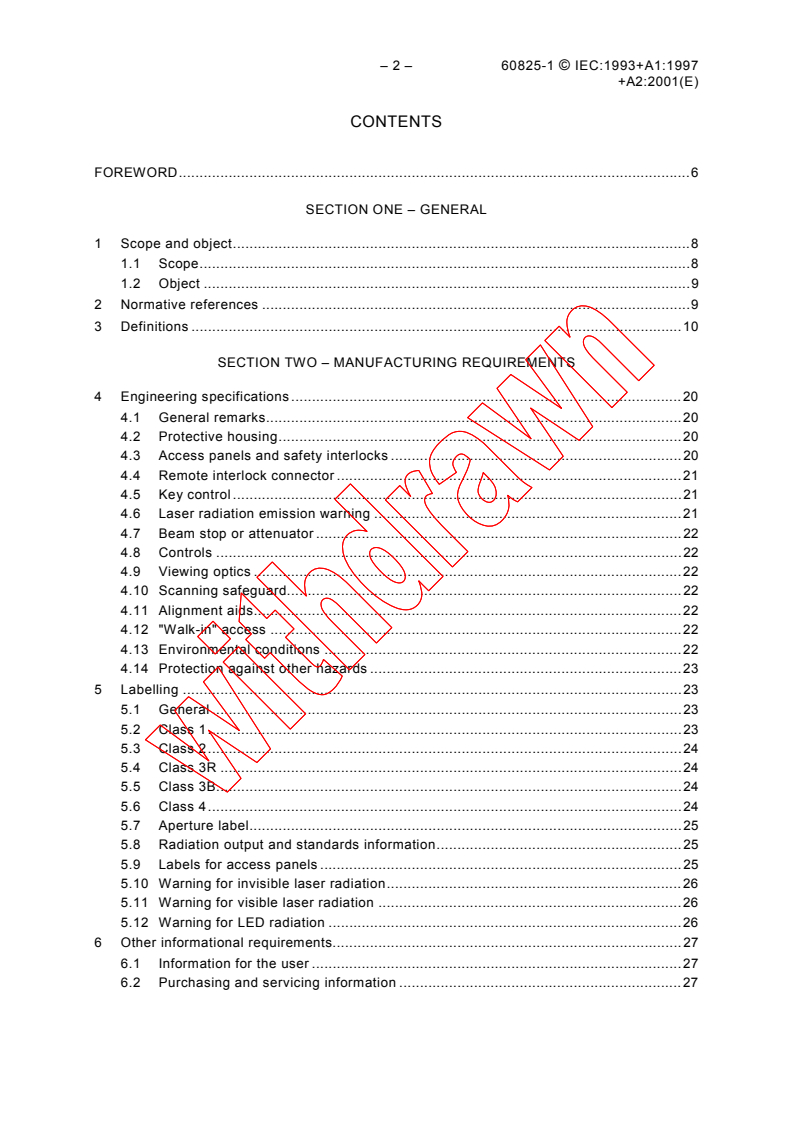
CONTENTS
FOREWORD.6
SECTION ONE – GENERAL
1 Scope and object.8
1.1 Scope.8
1.2 Object .9
2 Normative references .9
3 Definitions .10
SECTION TWO – MANUFACTURING REQUIREMENTS
4 Engineering specifications .20
4.1 General remarks.20
4.2 Protective housing.20
4.3 Access panels and safety interlocks .20
4.4 Remote interlock connector .21
4.5 Key control.21
4.6 Laser radiation emission warning .21
4.7 Beam stop or attenuator .22
4.8 Controls .22
4.9 Viewing optics .22
4.10 Scanning safeguard.22
4.11 Alignment aids.22
4.12 "Walk-in" access .22
4.13 Environmental conditions .22
4.14 Protection against other hazards .23
5 Labelling .23
5.1 General .23
5.2 Class 1.23
5.3 Class 2.24
5.4 Class 3R .24
5.5 Class 3B.24
5.6 Class 4.24
5.7 Aperture label.25
5.8 Radiation output and standards information.25
5.9 Labels for access panels .25
5.10 Warning for invisible laser radiation.26
5.11 Warning for visible laser radiation .26
5.12 Warning for LED radiation .26
6 Other informational requirements.27
6.1 Information for the user .27
6.2 Purchasing and servicing information .27
60825-1 © IEC:1993+A1:1997 – 3 –
+A2:2001(E)
7 Additional requirements for specific laser products .28
7.1 Medical laser products .28
7.2 Other parts of the standard series IEC 60825 .28
8 Classification.28
8.1 Introduction .28
8.2 Description of laser classes.28
8.3 Classification responsibilities.29
8.4 Classification rules .29
9 Measurements for classification.32
9.1 Tests.32
9.2 Measurement of laser radiation .33
9.3 Measurement geometry.34
SECTION THREE – USER'S GUIDE
10 Safety precautions.41
10.1 General .41
10.2 Use of remote interlock connector .41
10.3 Key control.41
10.4 Beam stop or attenuator .41
10.5 Warning signs .42
10.6 Beam paths .42
10.7 Specular reflections.42
10.8 Eye protection .42
10.9 Protective clothing.43
10.10 Training.44
10.11 Medical supervision.44
11 Hazards incidental to laser operation.44
11.1 Atmospheric contamination.44
11.2 Collateral radiation hazards.44
11.3 Electrical hazards.45
11.4 Cryogenic coolants.45
11.5 Materials processing .45
11.6 Other hazards .45
12 Procedures for hazard control.45
12.1 General .45
12.2 Hazard evaluation for lasers used outdoors.46
12.3 Personal protection .46
12.4 Laser demonstrations, displays and exhibitions .46
12.5 Laboratory and workshop laser installations .47
12.6 Outdoor and construction laser installations .48
13 Maximum permissible exposures .49
13.1 General remarks.49
13.2 Limiting apertures.50
13.3 Repetitively pulsed or modulated lasers .50
13.4 Measurement conditions.51
13.5 Extended source lasers .52
– 4 – 60825-1 © IEC:1993+A1:1997
+A2:2001(E)
Annex A (informative) Examples of calculations .68
Annex B (informative) Biophysical considerations .96
Annex C (informative) Bibliography.105
Annex D (informative) Summary tables .106
Annex E (informative) High power laser considerations particularly appropriate to
materials-processing laser products.109
Annex F (informative) Related IEC Standards .112
Annex G (informative) Information to be provided by manufacturers of LEDs .113
Annex H (informative) Overview of associated parts of IEC 60825 .116
–9
Figure 1 – Correction factor C for emission durations from 10 s to 10 s .55
Figure 2 – Breakpoint T for λ = 302,5 nm to 315 nm .55
Figure 3 – Correction factor C for λ = 302,5 nm to 315 nm .55
Figure 4 – Breakpoint T for source size α ranging from 0 mrad to more than 100 mrad .56
Figure 5 – Correction factor C for λ = 400 nm to 600 nm .57
Figure 6 – Correction factor C for λ = 700 nm to 1 400 nm .58
Figure 7 – Correction factor C shown for N (number of pulses) between 1 and 100 000 .59
Figure 8 – Correction factor C for λ = 1 050 nm to 1 400 nm .60
Figure 9a – MPE for direct ocular exposure to ultra-violet radiation at selected
–9 3
emission durations from 10 s to 10 s .61
Figure 9b – MPE for direct ocular exposure to ultra-violet radiation for exposure
–9 3
durations from 10 s to 10 s at selected wavelengths.61
Figure 10a – MPE for direct ocular exposure to protect against thermal injury
λ
( = 400 nm to 700 nm) for exposure durations greater than 0,1 s for selected source
sizes between 1,5 mrad and 100 mrad.62
Figure 10b – MPE for direct ocular exposure (C = 1) for exposure durations greater
than 1 s for selected wavelengths between 700 nm and 1 050 nm .62
Figure 11a – MPE for ocular exposure (λ = 400 nm to 700 nm) to a single exposure
at selected angular subtenses for the source .63
Figure 11b – MPE for ocular exposure at selected wavelengths from 400 nm
to 1 400 nm and C = 1.63
Figure 12a – AEL for Class 1 ultra-violet laser products for selected emission durations
–9 3
from 10 s to 10 s .64
Figure 12b – AEL for Class 1 ultra-violet laser products for emission durations
–9 3
from 10 s to 10 s at selected wavelengths .64
Figure 13 – AEL for Class 1 visible and selected infra-red laser products (case C = 1).65
Figure 14 – Warning label – Hazard symbol .66
Figure 15 – Explanatory label .67
Figure 16 – Measurement set-up to obtain a well-defined angle of acceptance – 16a:
by imaging the apparent source onto the plane of the field stop – 16b: by placing a
circular aperture or a mask (serving as field stop) close to the source .36
Figure A.1 – Laser diode array with two groupings.74
Figure B.1 – Anatomy of the eye.103
Figure B.2 – Diagram of laser-induced damage in biological systems .104
60825-1 © IEC:1993+A1:1997 – 5 –
+A2:2001(E)
Table 1 – Accessible emission limits for Class 1 and Class 1M laser products .37
Table 2 – Accessible emission limits for Class 2 and Class 2M laser products .38
Table 3 – Accessible emission limits for Class 3R laser products.39
Table 4 – Accessible emission limits for Class 3B laser products .40
Table 5 – Additivity of effects on eye (o) and skin (s) of radiation of different spectral regions.49
Table 6 – Maximum permissible exposure (MPE) at the cornea for direct exposure
to laser radiation.53
Table 7 – Aperture diameter applicable to measuring laser irradiance and radiant exposure. 54
Table 8 – Maximum permissible exposure (MPE) of skin to laser radiation .54
Table 9 – Times T below which pulse groups are summed up .32
i
Table 10 – Diameters of the measurement apertures and measurement distances.35
Table B.1 – Summary of pathological effects associated with excessive exposure to light.98
Table B.2 – Explanation of measurement apertures applied to the MPEs .102
Table D.1 – Summary of the physical quantities used in this part 1 .106
Table D.2 – Summary of manufacturer's requirements .107
Table D.3 – Summary of user precautions.108
Table H.1 – Overview of additional data in associated parts of IEC 60825 .115
– 6 – 60825-1 © IEC:1993+A1:1997
+A2:2001(E)
INTERNATIONAL ELECTROTECHNICAL COMMISSION
____________
SAFETY OF LASER PRODUCTS –
Part 1: Equipment classification, requirements and user's guide
FOREWORD
1) The IEC (International Electrotechnical Commission) is a worldwide organization for standardization comprising
all national electrotechnical committees (IEC National Committees). The object of the IEC is to promote
international co-operation on all questions concerning standardization in the electrical and electronic fields. To
this end and in addition to other activities, the IEC publishes International Standards. Their preparation is
entrusted to technical committees; any IEC National Committee interested in the subject dealt with may
participate in this preparatory work. International, governmental and non-governmental organizations liaising
with the IEC also participate in this preparation. The IEC collaborates closely with the International
Organization for Standardization (ISO) in accordance with conditions determined by agreement between the
two organizations.
2) The formal decisions or agreements of the IEC on technical matters express, as nearly as possible, an
international consensus of opinion on the relevant subjects since each technical committee has representation
from all interested National Committees.
3) The documents produced have the form of recommendations for international use and are published in the form
of standards, technical specifications, technical reports or guides and they are accepted by the National
Committees in that sense.
4) In order to promote international unification, IEC National Committees undertake to apply IEC International
Standards transparently to the maximum extent possible in their national and regional standards. Any
divergence between the IEC Standard and the corresponding national or regional standard shall be clearly
indicated in the latter.
5) The IEC provides no marking procedure to indicate its approval and cannot be rendered responsible for any
equipment declared to be in conformity with one of its standards.
6) Attention is drawn to the possibility that some of the elements of this International Standard may be the subject
of patent rights. The IEC shall not be held responsible for identifying any or all such patent rights.
International Standard IEC 60825-1 has been prepared by IEC technical committee 76: Laser
equipment.
This consolidated version of IEC 60825-1 is based on the first edition (1993), its amendment 1
(1997) [documents 76/157/FDIS and 76/165/RVD] and amendment 2 (2001) [documents
76/220/FDIS and 76/223/RVD].
It bears the edition number 1.2.
A vertical line in the margin shows where the base publication has been modified by
amendments 1 and 2.
This part of IEC 60825 has the status of a Group Safety Publication, in accordance with
*
IEC Guide 104 , for aspects of laser radiation pertaining to human safety.
It is also referred to as "part 1" in this publication.
Annexes A, B, C, D, E, F, G and H are given for information only.
________
*
IEC Guide 104:1984, Guide to the drafting of safety standards, and the role of Committees with safety pilot
functions and safety group functions.
It gives guidance to IEC technical committees and to writers of specifications concerning the manner in which
safety publications should be drafted.
This guide does not constitute a normative reference but reference to it is given for information only.
60825-1 © IEC:1993+A1:1997 – 7 –
+A2:2001(E)
The committee has decided that the contents of this publication will remain unchanged
until 2003. At this date, the publication will be
• reconfirmed;
• withdrawn;
• replaced by a revised edition, or
• amended.
The contents of the corrigendum of June 2002 have been included in this copy.
– 8 – 60825-1 © IEC:1993+A1:1997
+A2:2001(E)
SAFETY OF LASER PRODUCTS –
Part 1: Equipment classification, requirements and user's guide
Section One – General
1 Scope and object
1.1 Scope
IEC 60825-1 is applicable to safety of laser products. For convenience it is divided into three
separate sections: Section One (General) and the annexes; Section Two (Manufacturing
*
requirements); and Section Three (User's guide ).
A laser product may consist of a single laser with or without a separate power supply or may
incorporate one or more lasers in a complex optical, electrical, or mechanical system.
Typically, laser products are used for demonstration of physical and optical phenomena;
materials processing; data reading and storage; transmission and display of information; etc.
Such systems have found use in industry, business, entertainment, research, education and
medicine. However, laser products which are sold to other manufacturers for use as
components of any system for subsequent sale are not subject to IEC 60825-1, since the final
product will itself be subject to this standard.
Throughout this part 1 light emitting diodes (LED) are included whenever the word "laser" is used.
See also annex G which describes information which should be provided by manufacturers
of LEDs.
Any laser product or LED product is exempt from all further requirements of this part 1 if
– classification by the manufacturer according to clauses 3, 8 and 9 shows that the emission
level does not exceed the AEL of Class 1 under all conditions of operation, maintenance,
service and failure, and
– it does not contain an embedded laser or embedded LED.
In addition to the hazards resulting from laser radiation, laser equipment may also give rise to
other hazards such as fire and electric shock.
This part 1 describes the minimum requirements.
Where a laser system forms a part of equipment which is subject to another IEC product
safety standard (e.g. for medical equipment (IEC 60601-2-22) IT equipment (IEC 60950),
audio and video equipment (IEC 60065), equipment for use in hazardous atmospheres), this
**
part 1 will apply in accordance with the provisions of IEC Guide 104 , for hazards resulting
from laser radiation.
However, if the laser system is operable when removed from the equipment, all the
requirements of this part 1 will apply to the removed unit.
If no product safety standard is applicable, then IEC 61010-1 shall apply.
________
*
Some countries have requirements which differ from Section Three of this part 1. Therefore, contact the
appropriate national agency for these requirements.
**
IEC Guide 104:1984, Guide to the drafting of safety standards, and the role of Committees with safety pilot
functions and safety group functions.
It gives guidance to IEC technical committees and to writers of specifications concerning the manner in which
safety publications should be drafted.
This guide does not constitute a normative reference but reference to it is given for information only.
60825-1 © IEC:1993+A1:1997 – 9 –
+A2:2001(E)
The MPE (maximum permissible exposure) values of this part 1 were developed for laser
radiation and do not apply to collateral radiation.
However, if a concern exists that accessible collateral radiation might be hazardous, the laser
MPE values may be applied to conservatively evaluate this risk.
The MPE values shall not be applicable to patient exposure to laser radiation for the purpose
of medical treatment.
NOTE Annexes A to D have been included for purposes of general guidance and to illustrate many typical cases.
However, the annexes must not be regarded as definitive or exhaustive and reference should always be made to
the appropriate clause(s) in Sections One to Three.
1.2 Object
*
1.2.1 To protect persons from laser radiation in the wavelength range 180 nm to 1 mm by
indicating safe working levels of laser radiation and by introducing a system of classification
of lasers and laser products according to their degree of hazard.
1.2.2 To lay down requirements for both user and manufacturer to establish procedures and
supply information so that proper precautions can be adopted.
1.2.3 To ensure adequate warning to individuals of hazards associated with accessible
radiation from laser products through signs, labels and instructions.
1.2.4 To reduce the possibility of injury by minimizing unnecessary accessible radiation and
to give improved control of the laser radiation hazards through protective features and provide
safe usage of laser products by specifying user control measures.
1.2.5 To protect persons against other hazards resulting from the operation and use of laser
products.
2 Normative references
The following normative documents contain provisions which, through reference in this text,
constitute provisions of this part of IEC 60825. For dated references, subsequent amend-
ments to, or revisions of, any of these publications do not apply. However, parties to
agreements based on this part of IEC 60825 are encouraged to investigate the possibility of
applying the most recent editions of the normative documents indicated below. For undated
references, the latest edition of the normative document referred to applies. Members of IEC
and ISO maintain registers of currently valid International Standards.
IEC 60027-1:1992, Letter symbols to be used in electrical technology – Part 1: General
Amendment 1, 1997
IEC 60050(845):1987, International Electrotechnical Vocabulary (IEV) – Chapter 845: Lighting
IEC 60601-2-22:1995, Medical electrical equipment – Part 2: Particular requirements for the
safety of diagnostic and therapeutic laser equipment
IEC 60825-2:2000, Safety of laser products – Part 2: Safety of optical fibre communication
systems
IEC 61010-1:2001, Safety requirements for electrical equipment for measurement, control and
laboratory use – Part 1: General requirements
IEC 61040:1990, Power and energy measuring detectors, instruments and equipment for laser
radiation
ISO 1000:1992, SI units and recommendations for the use of their multiples and of certain
other units
________
*
In this part 1, the wavelength range λ to λ means λ ≤ λ < λ (e.g. 180 nm to 1 mm means 180 nm ≤ λ < 1 mm).
1 2 1 2
– 10 – 60825-1 © IEC:1993+A1:1997
+A2:2001(E)
*
3 Definitions
For the purposes of this part of IEC 60825, the following definitions apply.
3.1
access panel
a part of the protective housing or enclosure which provides access to laser radiation when
removed or displaced.
3.2
accessible emission limit (AEL)
the maximum accessible emission level permitted within a particular class
3.3
administrative control
safety measures of a non-engineering type such as: key supervision, safety training of
personnel, warning notices, count-down procedures, and range safety controls
3.4
alignment laser product
the laser product designed, manufactured, intended or promoted for one or more of the
following uses:
a) determining and delineating the form, extent or position of a point, body or area by taking
angular measurements;
b) positioning or adjusting parts in relation to one another;
c) defining a plane, level, elevation or straight line.
3.5
alpha min. (αααα )
min
see angular subtense (3.7)
3.6
angle of acceptance
plane angle within which a detector will respond to optical radiation, usually measured in
radians. This angle of acceptance may be controlled by apertures or optical elements in front
of the detector (see figure 16). The angle of acceptance is also sometimes referred to as the
field of view
Symbol: γ
NOTE Angle of acceptance for evaluating photochemical hazards. For evaluation of the photochemical hazard, a
limiting measurement angle of acceptance, γ , is specified. The angle γ is biologically related to eye movements
p p
and is not dependent upon the angular subtense of the source. If the angular subtense of the source is smaller
than the limiting angle of acceptance, the actual measurement angle of acceptance does not have to be limited. If
the angular subtense of the source is larger than the specified limiting angle of acceptance, the angle
of acceptance has to be limited and the source has to be scanned for hotspots. If the measurement angle of
acceptance is not limited to the specified level, the hazard may be over-estimated.
Symbol: γ
p
________
*
Arranged here for convenience in English alphabetical order. Departures from IEC 60050(845) are intentional
and are indicated. Reference is made to the definition number in Chapter 845 of IEC 60050.
60825-1 © IEC:1993+A1:1997 – 11 –
+A2:2001(E)
3.7
angular subtense (α)
angle subtended by an apparent source as viewed at a point in space. In this standard, for
classification, the angular subtense is determined at a point not less than 100 mm from the
apparent source (or at the exit window or lens of the product if the apparent source is located
at a distance greater than 100 mm within the window or lens). (See also 3.53 and 3.57.) For
an analysis of the maximum permissible exposure levels, the angular subtense shall be
determined at the viewing distance from the apparent source but not less than 100 mm. This
concept is also discussed in clause A.3 of annex A
NOTE 1 The angular subtense of an apparent source is applicable in this part 1 only in the wavelength range
from 400 nm to 1 400 nm, the retinal hazard region.
NOTE 2 The angular subtense of the source should not be confused with the divergence of the beam.
3.8
aperture, aperture stop
an aperture is any opening in the protective housing or other enclosure of a laser product
through which laser radiation is emitted, thereby allowing human access to such radiation
An aperture stop is an opening serving to define the area over which radiation is measured.
3.9
apparent source
the real or virtual object that forms the smallest possible retinal image
NOTE This definition is used to determine the location of the apparent origin of laser radiation in the wavelength
range of 400 nm to 1 400 nm, with the assumption of the apparent source being located in the eye's range of
accommodation (≥100 mm). In the limit of vanishing divergence, i.e. in the case of an ideally collimated beam, the
location of the apparent source goes to infinity.
The concept of an apparent source is used in the extended wavelength region 302,5 nm to 4 000 nm since focusing
by conventional lenses might be possible in that region.
3.10
beam
laser radiation that may be characterized by direction, divergence, diameter or scan speci-
fications. Scattered radiation from a non-specular reflection is not considered to be a beam
3.11
beam attenuator
a device which reduces the laser radiation to or below a specified level
3.12
beam diameter (beam width)
the beam diameter d at a point in space is the diameter of the smallest circle which contains
u
u % of the total laser power (or energy). For the purpose of this standard d is used
NOTE In the case of a Gaussian beam, d corresponds to the point where the irradiance (radiant exposure) falls
to 1/e of its central peak value.
3.13
beam divergence
the beam divergence is the far field plane angle of the cone defined by the beam diameter.
If the beam diameters (see 3.10) at two points separated by a distance r are d and d ′ the
63 63
divergence is given by:
'
d − d
63 63
ϕ = 2 arctan
2 r
SI unit: radian
– 12 – 60825-1 © IEC:1993+A1:1997
+A2:2001(E)
3.14
beam expander
a combination of optical elements which will increase the diameter of a laser beam
3.15
beam path component
an optical component which lies on a defined beam path (e.g. a beam steering mirror or a
focusing lens)
3.16
beam stop
a device which terminates a laser beam path
3.17
Class 1 laser product
any laser product which does not permit human access to laser radiation in excess of
the accessible emission limits of Class 1 for applicable wavelengths and emission durations
(see 8.2 and 8.4e))
3.18
Class 1M laser product
any laser product in the wavelength range from 302,5 nm to 4 000 nm which does not permit
human access to laser radiation in excess of the accessible emission limits of Class 1 for
applicable wavelengths and emission durations (see 8.4e)), where the level of radiation is
measured according to 9.2g), however, evaluated with smaller measurement apertures or at a
greater distance from the apparent source than those used for Class 1 laser products. The
output of a Class 1M product is therefore potentially hazardous when viewed using an optical
instrument (see 8.2)
3.19
Class 2 laser product
any laser product which does not permit human access to laser radiation in excess of the
accessible emission limits of Class 2 for applicable wavelengths and emission durations (see
8.2 and 8.4e))
3.20
Class 2M laser product
any laser product in the wavelength range from 400 nm to 700 nm which does not permit
human access to laser radiation in excess of the accessible emission limits of Class 2 for
applicable wavelengths and emission durations (see 8.4e)), where the level of radiation is
measured according to 9.2h), however, evaluated with smaller measurement apertures or at a
greater distance from the apparent source than those used for Class 2 laser products. The
output of a Class 2M product is therefore potentially hazardous when viewed using an optical
instrument
3.21
Class 3R and Class 3B laser products
any laser product which permits human access to laser radiation in excess of the accessible
emission limits of Class 1 and Class 2 as applicable, but which does not permit human access
to laser radiation in excess of the accessible emission limits of Classes 3R and 3B (respect-
ively) for any emission duration and wavelength (see 8.2)
3.22
Class 4 laser product
any laser product which permits human access to laser radiation in excess of the accessible
emission limits of Class 3B (see 8.2)
60825-1 © IEC:1993+A1:1997 – 13 –
+A2:2001(E)
3.23
collateral radiation
any electromagnetic radiation, within the wavelength range between 180 nm and 1 mm,
except laser radiation, emitted by a laser product as a result of, or physically necessary for,
the operation of a laser
3.24
collimated beam
a "parallel" beam of radiation with very small angular divergence or convergence
3.25
continuous wave (CW)
the output of a laser which is operated in a continuous rather than pulsed mode. In this part 1,
a laser operating with a continuous output for a period equal to or greater than 0,25 s is
regarded as a CW laser
3.26
defined beam path
an intended path of a laser beam within the laser product
3.27
demonstration laser product
any laser product designed, manufactured, intended or promoted for purposes of demon-
stration, entertainment, advertising, display or artistic composition. The term "demonstration
laser product" does not apply to laser products which are designed and intended for other
applications, although they may be used for demonstrating those applications
3.28
diffuse reflection
change of the spatial distribution of a beam of radiation by scattering in many directions by a
surface or medium. A perfect diffuser destroys all correlation between the directions of the
incident and emergent radiation
NOTE This definition is different from IEV 845-04-47.
3.29
embedded laser product
in this part 1 a laser product which, because of engineering features limiting the accessible
emissions, has been assigned a class number lower than the inherent capability of the laser
incorporated
NOTE The laser which is incorporated in the embedded laser product is called the embedded laser.
3.30
emission duration
the temporal duration of a pulse, of a train or series of pulses, or of continuous operation,
during which human access to laser radiation could occur as a result of operation,
maintenance or servicing of a laser product. For a train of pulses, this is the duration between
the first half-peak power point of the leading pulse and the last half-peak power point of the
trailing pulse
3.31
errant laser radiation
laser radiation which deviates from a defined beam path. Such radiation includes unwanted
secondary reflections from beam path components, deviant radiation from misaligned or
damaged components, and reflections from a workpiece
– 14 – 60825-1 © IEC:1993+A1:1997
+A2:2001(E)
3.32
exposure time
the duration of a pulse, or series, or train of pulses or of continuous emission of laser
radiation incident upon the human body. For a train of pulses, this is the duration between the
first half-peak power point of the leading pulse and the last half-peak power point of the
trailing pulse
3.33
extended source viewing
the viewing conditions whereby the apparent source at a distance of 100 mm or more
subtends an angle at the eye greater than the limiting angular subtense (α )
min
Two extended source conditions are considered in this standard when considering retinal
thermal injury hazards: intermediate source and large source, which are used to distinguish
sources with angular subtenses, α, between α and α (intermediate sources), and greater
min max
than α (large sources). (See also 3.79.)
max
Examples are viewing of some diffuse reflections and of some laser diode arrays
3.34
fail safe
the design consideration in which failure of a component does not increase the hazard. In the
failure mode the system is rendered inoperative or non-hazardous
3.35
fail safe safety interlock
an interlock which in the failure mode does not defeat the purpose of the interlock, for
example an interlock which is positively driven into the OFF position as soon as a hinged
cover begins to open, or before a detachable cover is removed, and which is positively held in
the OFF position until the hinged cover is closed or the detachable cover is locked in the
closed position
3.36
human access
a) Capability for a part of the human body to meet hazardous laser radiation either as
emitted from an aperture, or capability for a straight 12 mm diameter probe up to 80 mm
long to intercept laser radiation of Class 2, 2M or 3R, or
b) For levels of laser radiation within a housing that exceed the limits in a) the capability for
any part of the human body to meet hazardous laser radiation that can be reflected
directly by any single introduced flat surface from the interior of the product through any
opening in its protective housing
3.37
integrated radiance
the integral of the radiance over a given exposure time expressed as radiant energy per unit
–2 –1
area of a radiating surface per unit solid angle of emission (usually expressed in J⋅m ⋅sr )
3.38
intrabeam viewing
all viewing conditions whereby the eye is exposed to the direct or specularly reflected laser
beam in contrast to viewing of, for example, diffuse reflections
3.39
irradiance
quotient of the radiant flux dΦ incident on an element of a surface by the area dA of that
element
dΦ
Symbol: E E =
dA
–2
SI unit: watt per square metre (W⋅m )
60825-1 © IEC:1993+A1:1997 – 15 –
+A2:2001(E)
3.40
laser
any device which can be made to produce or amplify electromagnetic radiation in the
wavelength range from 180 nm to 1 mm primarily by the process of controlled stimulated
emission.
NOTE This definition is different from IEV 845-04-39.
3.41
laser controlled area
an area where the occupancy and activity of those within is subject to control and supervision
for the purpose of protection from radiation hazards
3.42
laser energy source
any device intended for use in conjunction with a laser to supply energy for the excitation of
electrons, ions or molecules. General energy sources such as electrical supply mains or
batteries shall not be considered to constitute laser energy sources
3.43
laser hazard area
see nominal ocular hazard area (3.59)
3.44
laser fibre optic t
...
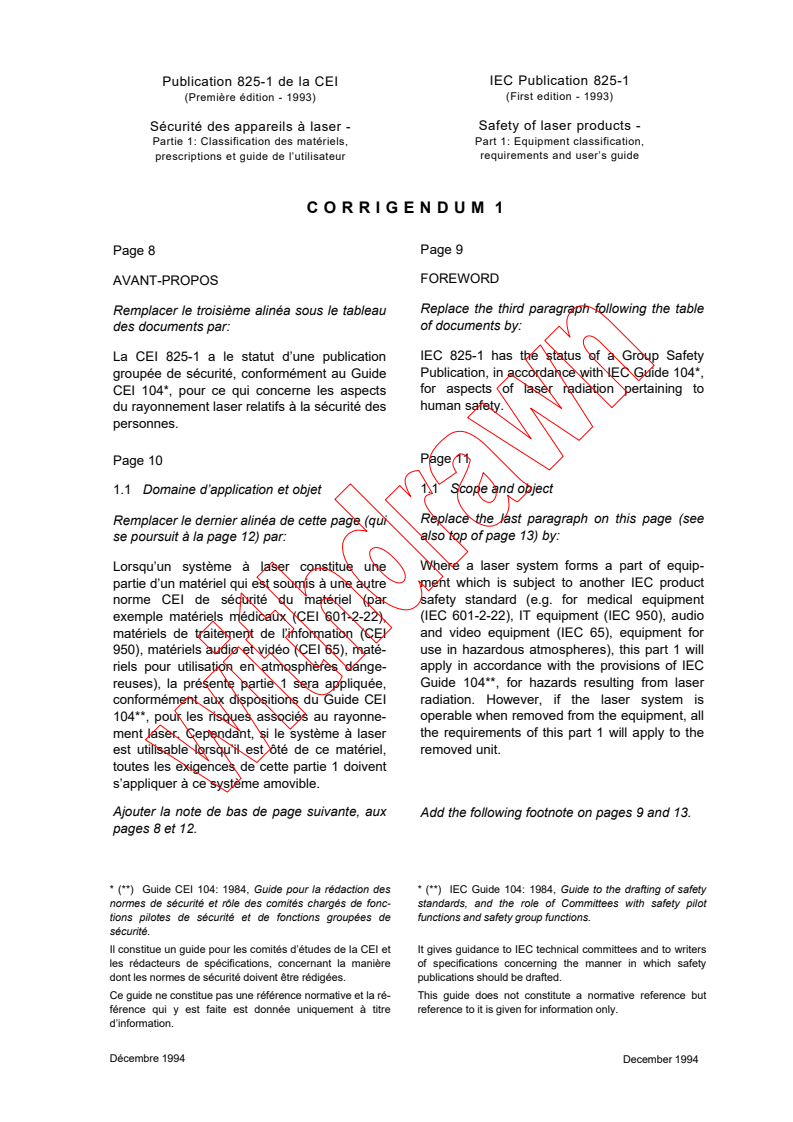
Publication 825-1 de la CEI IEC Publication 825-1
(Première édition - 1993) (First edition - 1993)
Safety of laser products -
Sécurité des appareils à laser -
Part 1: Equipment classification,
Partie 1: Classification des matériels,
prescriptions et guide de l’utilisateur requirements and user’s guide
C O R R I G E N D U M 1
Page 9
Page 8
FOREWORD
AVANT-PROPOS
Replace the third paragraph following the table
Remplacer le troisième alinéa sous le tableau
of documents by:
des documents par:
IEC 825-1 has the status of a Group Safety
La CEI 825-1 a le statut d’une publication
Publication, in accordance with IEC Guide 104*,
groupée de sécurité, conformément au Guide
for aspects of laser radiation pertaining to
CEI 104*, pour ce qui concerne les aspects
human safety.
du rayonnement laser relatifs à la sécurité des
personnes.
Page 11
Page 10
1.1 Scope and object
1.1 Domaine d’application et objet
Replace the last paragraph on this page (see
Remplacer le dernier alinéa de cette page (qui
also top of page 13) by:
se poursuit à la page 12) par:
Lorsqu’un système à laser constitue une Where a laser system forms a part of equip-
ment which is subject to another IEC product
partie d’un matériel qui est soumis à une autre
norme CEI de sécurité du matériel (par safety standard (e.g. for medical equipment
(IEC 601-2-22), IT equipment (IEC 950), audio
exemple matériels médicaux (CEI 601-2-22),
matériels de traitement de l’information (CEI and video equipment (IEC 65), equipment for
use in hazardous atmospheres), this part 1 will
950), matériels audio et vidéo (CEI 65), maté-
riels pour utilisation en atmo
...
NORME
CEI
INTERNATIONALE
IEC
60825-1
INTERNATIONAL
Edition 1.1
STANDARD
1998-01
Edition 1:1993 consolidée par l'amendement 1:1997
Edition 1:1993 consolidated with amendment 1:1997
PUBLICATION GROUPÉE DE SÉCURITÉ
GROUP SAFETY PUBLICATION
Sécurité des appareils à laser –
Partie 1:
Classification des matériels, prescriptions
et guide de l'utilisateur
Safety of laser products –
Part 1:
Equipment classification, requirements
and user's guide
Numéro de référence
Reference number
CEI/IEC 60825-1:1993+A1:1997
Numéros des publications Numbering
Depuis le 1er janvier 1997, les publications de la CEI As from 1 January 1997 all IEC publications are issued
sont numérotées à partir de 60000. with a designation in the 60000 series.
Publications consolidées Consolidated publications
Les versions consolidées de certaines publications de Consolidated versions of some IEC publications
la CEI incorporant les amendements sont disponibles. including amendments are available. For example,
Par exemple, les numéros d’édition 1.0, 1.1 et 1.2 edition numbers 1.0, 1.1 and 1.2 refer, respectively, to
indiquent respectivement la publication de base, la the base publication, the base publication incorporating
publication de base incorporant l’amendement 1, et la amendment 1 and the base publication incorporating
publication de base incorporant les amendements 1 amendments 1 and 2.
et 2.
Validité de la présente publication Validity of this publication
Le contenu technique des publications de la CEI est The technical content of IEC publications is kept under
constamment revu par la CEI afin qu'il reflète l'état constant review by the IEC, thus ensuring that the
actuel de la technique. content reflects current technology.
Des renseignements relatifs à la date de reconfirmation Information relating to the date of the reconfirmation of
de la publication sont disponibles dans le Catalogue de the publication is available in the IEC catalogue.
la CEI.
Les renseignements relatifs à ces révisions, à l'établis- Information on the revision work, the issue of revised
sement des éditions révisées et aux amendements editions and amendments may be obtained from
peuvent être obtenus auprès des Comités nationaux de la IEC National Committees and from the following
CEI et dans les documents ci-dessous: IEC sources:
• Bulletin de la CEI • IEC Bulletin
• Annuaire de la CEI • IEC Yearbook
Accès en ligne* On-line access*
• Catalogue des publications de la CEI • Catalogue of IEC publications
Publié annuellement et mis à jour régulièrement Published yearly with regular updates
(Accès en ligne)* (On-line access)*
Terminologie, symboles graphiques Terminology, graphical and letter
et littéraux symbols
En ce qui concerne la terminologie générale, le lecteur For general terminology, readers are referred to
se reportera à la CEI 60050: Vocabulaire Electro- IEC 60050: International Electrotechnical Vocabulary
technique International (VEI). (IEV).
Pour les symboles graphiques, les symboles littéraux et For graphical symbols, and letter symbols and signs
les signes d'usage général approuvés par la CEI, le approved by the IEC for general use, readers are
referred to publications IEC 60027: Letter symbols to
lecteur consultera la CEI 60027: Symboles littéraux à
utiliser en électrotechnique, la CEI 60417: Symboles be used in electrical technology, IEC 60417: Graphical
graphiques utilisables sur le matériel. Index, relevé et symbols for use on equipment. Index, survey and
compilation of the single sheets
compilation des feuilles individuelles, et la CEI 60617: and IEC 60617:
Symboles graphiques pour schémas. Graphical symbols for diagrams.
Publications de la CEI établies par IEC publications prepared by the same
le même comité d'études technical committee
L'attention du lecteur est attirée sur les listes figurant à The attention of readers is drawn to the end pages of
la fin de cette publication, qui énumèrent les this publication which list the IEC publications issued
publications de la CEI préparées par le comité d'études by the technical committee which has prepared the
qui a établi la présente publication. present publication.
* Voir adresse «site web» sur la page de titre. * See web site address on title page.
NORME
CEI
INTERNATIONALE
IEC
60825-1
INTERNATIONAL
Edition 1.1
STANDARD
1998-01
Edition 1:1993 consolidée par l'amendement 1:1997
Edition 1:1993 consolidated with amendment 1:1997
PUBLICATION GROUPÉE DE SÉCURITÉ
GROUP SAFETY PUBLICATION
Sécurité des appareils à laser –
Partie 1:
Classification des matériels, prescriptions
et guide de l'utilisateur
Safety of laser products –
Part 1:
Equipment classification, requirements
and user's guide
IEC 1998 Droits de reproduction réservés Copyright - all rights reserved
Aucune partie de cette publication ne peut être reproduite ni No part of this publication may be reproduced or utilized in
utilisée sous quelque forme que ce soit et par aucun any form or by any means, electronic or mechanical,
procédé, électronique ou mécanique, y compris la photo- including photocopying and microfilm, without permission in
copie et les microfilms, sans l'accord écrit de l'éditeur. writing from the publisher.
International Electrotechnical Commission 3, rue de Varembé Geneva, Switzerland
Telefax: +41 22 919 0300 e-mail: inmail@iec.ch IEC web site http: //www.iec.ch
CODE PRIX
Commission Electrotechnique Internationale
PRICE CODE XD
International Electrotechnical Commission
Pour prix, voir catalogue en vigueur
For price, see current catalogue
– 2 – 60825-1 © CEI:1993+A1:1997
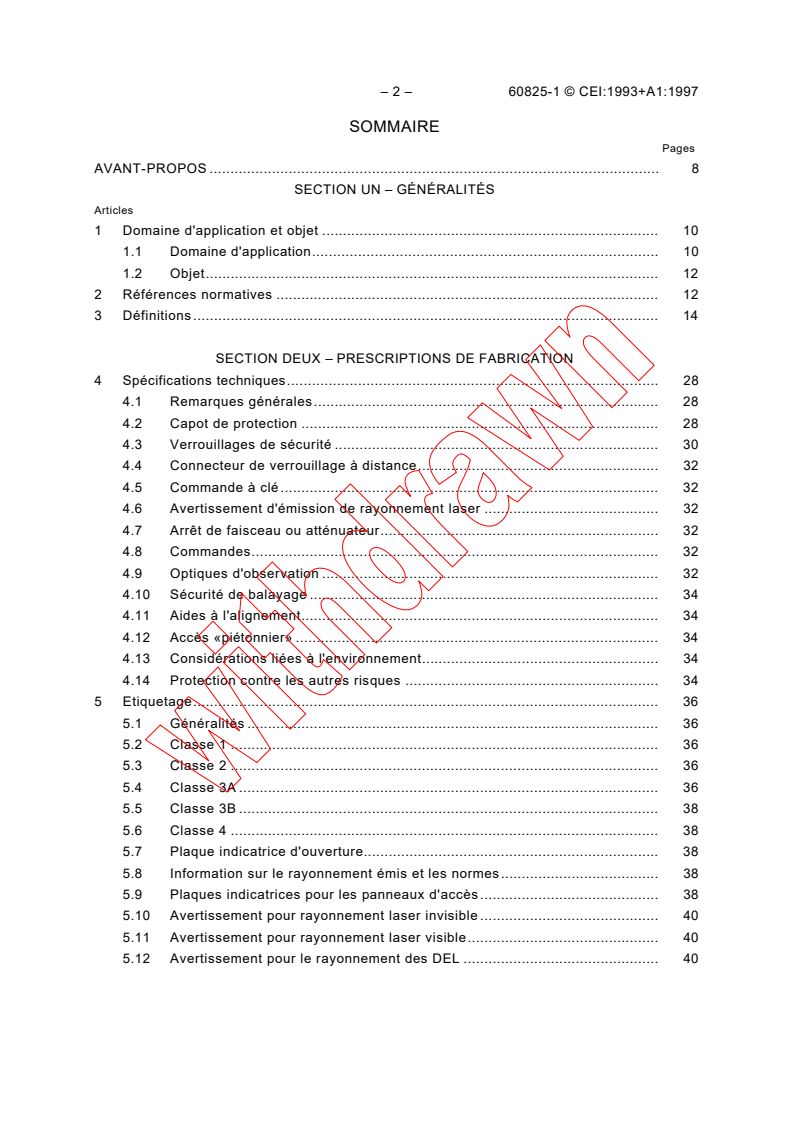
SOMMAIRE
Pages
AVANT-PROPOS . 8
SECTION UN – GÉNÉRALITÉS
Articles
1 Domaine d'application et objet . 10
1.1 Domaine d'application. 10
1.2 Objet. 12
2 Références normatives . 12
3 Définitions. 14
SECTION DEUX – PRESCRIPTIONS DE FABRICATION
4 Spécifications techniques. 28
4.1 Remarques générales. 28
4.2 Capot de protection . 28
4.3 Verrouillages de sécurité . 30
4.4 Connecteur de verrouillage à distance. 32
4.5 Commande à clé. 32
4.6 Avertissement d'émission de rayonnement laser . 32
4.7 Arrêt de faisceau ou atténuateur. 32
4.8 Commandes. 32
4.9 Optiques d'observation. 32
4.10 Sécurité de balayage . 34
4.11 Aides à l'alignement. 34
4.12 Accès «piétonnier». 34
4.13 Considérations liées à l'environnement. 34
4.14 Protection contre les autres risques . 34
5 Etiquetage. 36
5.1 Généralités. 36
5.2 Classe 1. 36
5.3 Classe 2. 36
5.4 Classe 3A. 36
5.5 Classe 3B. 38
5.6 Classe 4. 38
5.7 Plaque indicatrice d'ouverture. 38
5.8 Information sur le rayonnement émis et les normes. 38
5.9 Plaques indicatrices pour les panneaux d'accès . 38
5.10 Avertissement pour rayonnement laser invisible . 40
5.11 Avertissement pour rayonnement laser visible. 40
5.12 Avertissement pour le rayonnement des DEL . 40
60825-1 © IEC:1993+A1:1997 – 3 –
CONTENTS
Page
FOREWORD . 9
SECTION ONE – GENERAL
Clause
1 Scope and object . 11
1.1 Scope . 11
1.2 Object . 13
2 Normative references. 13
3 Definitions . 15
SECTION TWO – MANUFACTURING REQUIREMENTS
4 Engineering specifications . 29
4.1 General remarks . 29
4.2 Protective housing . 29
4.3 Access panels and safety interlocks . 31
4.4 Remote interlock connector . 33
4.5 Key control . 33
4.6 Laser radiation emission warning. 33
4.7 Beam stop or attenuator . 33
4.8 Controls . 33
4.9 Viewing optics. 33
4.10 Scanning safeguard . 35
4.11 Alignment aids . 35
4.12 "Walk-in" access . 35
4.13 Environmental conditions. 35
4.14 Protection against other hazards . 35
5 Labelling . 37
5.1 General. 37
5.2 Class 1 . 37
5.3 Class 2 . 37
5.4 Class 3A . 37
5.5 Class 3B . 39
5.6 Class 4 . 39
5.7 Aperture label . 39
5.8 Radiation output and standards information. 39
5.9 Labels for access panels . 39
5.10 Warning for invisible laser radiation. 41
5.11 Warning for visible laser radiation. 41
5.12 Warning for LED radiation. 41
– 4 – 60825-1 © CEI:1993+A1:1997
Articles Pages
6 Autres prescriptions relatives aux renseignements à fournir . 40
6.1 Renseignements pour l'utilisateur . 40
6.2 Renseignements pour l'achat et l'entretien . 42
7 Prescriptions additionnelles pour appareils à laser spécifiques. 42
7.1 Appareils à laser médicaux. 42
7.2 Système de transmission laser par fibre optique . 44
8 Essais.44
8.1 Généralités. 44
8.2 Mesure des niveaux de rayonnement laser en vue de déterminer la
classification. 44
9 Classification. 48
9.1 Introduction. 48
9.2 Définitions des classes laser . 48
9.3 Procédure de classification. 50
9.4 Lasers modulés ou à impulsions répétitives. 52
SECTION TROIS – GUIDE DE L'UTILISATEUR
10 Mesures de sécurité. 64
10.1 Généralités. 64
10.2 Emploi du connecteur de verrouillage à distance. 64
10.3 Commande à clé. 64
10.4 Arrêt de faisceau ou atténuateur. 66
10.5 Panneaux avertisseurs. 66
10.6 Trajet des faisceaux . 66
10.7 Réflexions spéculaires. 66
10.8 Protection des yeux . 66
10.9 Vêtements de protection . 70
10.10 Formation. 70
10.11 Surveillance médicale. 70
11 Risques pouvant résulter du fonctionnement des lasers . 70
11.1 Contamination de l'atmosphère. 70
11.2 Dangers du rayonnement connexe . 72
11.3 Risques électriques. 72
11.4 Agents cryogènes. 72
11.5 Traitement des matériaux . 72
11.6 Autres risques. 72
12 Procédures de contrôle des risques . 72
12.1 Généralités. 72
12.2 Evaluation du risque pour les lasers des classes 3B et 4 utilisés
à l'extérieur. 74
12.3 Protection individuelle. 74
12.4 Démonstrations, affichages et spectacles utilisant des lasers . 74
60825-1 © IEC:1993+A1:1997 – 5 –
Clause Page
6 Other informational requirements . 41
6.1 Information for the user . 41
6.2 Purchasing and servicing information . 43
7 Additional requirements for specific laser products . 43
7.1 Medical laser products. 43
7.2 Laser fibre optic transmission system. 45
8 Tests . 45
8.1 General. 45
8.2 Measurements of laser radiation for determining classification . 45
9 Classification. 49
9.1 Introduction. 49
9.2 Description of laser classes . 49
9.3 Classification procedures. 51
9.4 Repetitively pulsed or modulated lasers . 53
SECTION THREE – USER'S GUIDE
10 Safety precautions . 65
10.1 General. 65
10.2 Use of remote interlock connector . 65
10.3 Key control. 65
10.4 Beam stop or attenuator . 67
10.5 Warning signs. 67
10.6 Beam paths. 67
10.7 Specular reflections. 67
10.8 Eye protection . 67
10.9 Protective clothing. 71
10.10 Training . 71
10.11 Medical supervision. 71
11 Hazards incidental to laser operation . 71
11.1 Atmospheric contamination. 71
11.2 Collateral radiation hazards . 73
11.3 Electrical hazards. 73
11.4 Cryogenic coolants. 73
11.5 Materials processing. 73
11.6 Other hazards. 73
12 Procedures for hazard control . 73
12.1 General. 73
12.2 Hazard evaluation for Class 3B and Class 4 lasers used outdoors . 75
12.3 Personal protection. 75
12.4 Laser demonstrations, displays and exhibitions . 75
– 6 – 60825-1 © CEI:1993+A1:1997
Articles Pages
12.5 Installations des lasers de laboratoire et d'atelier . 76
12.6 Installations des lasers de chantier et de construction. 78
13 Expositions maximales permises. 80
13.1 Remarques générales. 80
13.2 Diaphragme limite. 82
13.3 Lasers modulés ou à impulsions répétitives. 82
13.4 Conditions de mesure . 84
13.5 Sources laser étendues . 84
Annexes
A Exemples de calculs . 118
B Considérations médicales. 180
C Bibliographie. 194
D Tableaux récapitulatifs . 196
E Laser de forte puissance, considérations particulières pour les installations
de traitement des matériaux par laser . 202
F Publications CEI complémentaires . 208
60825-1 © IEC:1993+A1:1997 – 7 –
Clause Page
12.5 Laboratory and workshop laser installations . 77
12.6 Outdoor and construction laser installations . 79
13 Maximum permissible exposures. 81
13.1 General remarks . 81
13.2 Limiting apertures . 83
13.3 Repetitively pulsed or modulated lasers . 83
13.4 Measurement conditions . 85
13.5 Extended source lasers . 85
Annexes
A Examples of calculations. 119
B Medical considerations . 181
C Bibliography. 195
D Summary tables. 197
E High power laser considerations particularly appropriate to materials
processing laser products . 203
F Related IEC standards . 209
– 8 – 60825-1 © CEI:1993+A1:1997
COMMISSION ÉLECTROTECHNIQUE INTERNATIONALE
__________
SÉCURITÉ DES APPAREILS À LASER –
Partie 1: Classification des matériels,
prescriptions et guide de l'utilisateur
AVANT-PROPOS
1) La CEI (Commission Electrotechnique Internationale) est une organisation mondiale de normalisation composée
de l'ensemble des comités électrotechniques nationaux (Comités nationaux de la CEI). La CEI a pour objet de
favoriser la coopération internationale pour toutes les questions de normalisation dans les domaines de
l'électricité et de l'électronique. A cet effet, la CEI, entre autres activités, publie des Normes Internationales.
Leur élaboration est confiée à des comités d'études, aux travaux desquels tout Comité national intéressé par le
sujet traité peut participer. Les organisations internationales, gouvernementales et non gouvernementales, en
liaison avec la CEI, participent également aux travaux. La CEI collabore étroitement avec l'Organisation
Internationale de Normalisation (ISO), selon des conditions fixées par accord entre les deux organisations.
2) Les décisions ou accords officiels de la CEI concernant les questions techniques, représentent, dans la mesure
du possible un accord international sur les sujets étudiés, étant donné que les Comités nationaux intéressés
sont représentés dans chaque comité d’études.
3) Les documents produits se présentent sous la forme de recommandations internationales. Ils sont publiés
comme normes, rapports techniques ou guides et agréés comme tels par les Comités nationaux.
4) Dans le but d'encourager l'unification internationale, les Comités nationaux de la CEI s'engagent à appliquer de
façon transparente, dans toute la mesure possible, les Normes internationales de la CEI dans leurs normes
nationales et régionales. Toute divergence entre la norme de la CEI et la norme nationale ou régionale
correspondante doit être indiquée en termes clairs dans cette dernière.
5) La CEI n’a fixé aucune procédure concernant le marquage comme indication d’approbation et sa responsabilité
n’est pas engagée quand un matériel est déclaré conforme à l’une de ses normes.
6) L’attention est attirée sur le fait que certains des éléments de la présente Norme internationale peuvent faire
l’objet de droits de propriété intellectuelle ou de droits analogues. La CEI ne saurait être tenue pour
responsable de ne pas avoir identifié de tels droits de propriété et de ne pas avoir signalé leur existence.
La Norme internationale CEI 60825-1 a été établie par le comité d'études 76 de la CEI:
Matériels laser.
La présente version consolidée de la CEI 60825-1 est issue de la première édition (1993) et de
son amendement 1 (1997) [documents 76/157/FDIS et 76/165/RVD].
Elle porte le numéro d'édition 1.1.
Une ligne verticale dans la marge indique où la publication de base a été modifiée par
l'amendement 1.
Cette première édition de la CEI 60825-1 annule et remplace la première édition de la
CEI 60825 publiée en 1984 et son amendement 1 dont elle constitue une révision technique.
Elle annule et remplace également la CEI 60820 publiée en 1986.
*
La CEI 60825-1 a le statut d'une publication groupée de sécurité, conformément au Guide 104
pour ce qui concerne les aspects du rayonnement laser relatifs à la sécurité des personnes.
La CEI 60825-1 est également appelée «partie 1» dans cette publication.
Les annexes A, B, C, D, E et F sont données à titre d'information.
___________
*
Guide CEI 104:1984, Guide pour la rédaction des normes de sécurité et rôle des comités chargés de fonctions
pilotes de sécurité et de fonctions groupées de sécurité.
Il constitue un guide pour les comités d'études de la CEI et les rédacteurs de spécifications, concernant la
manière dont les normes de sécurité doivent être rédigées.
Ce guide ne constitue pas une référence normative et la référence qui y est faite est donnée uniquement à titre
d'information.
60825-1 © IEC:1993+A1:1997 – 9 –
INTERNATIONAL ELECTROTECHNICAL COMMISSION
___________
SAFETY OF LASER PRODUCTS –
Part 1: Equipment classification, requirements
and user's guide
FOREWORD
1) The IEC (International Electrotechnical Commission) is a worldwide organization for standardization comprising
all national electrotechnical committees (IEC National Committees). The object of the IEC is to promote
international co-operation on all questions concerning standardization in the electrical and electronic fields. To
this end and in addition to other activities, the IEC publishes International Standards. Their preparation is
entrusted to technical committees; any IEC National Committee interested in the subject dealt with may
participate in this preparatory work. International, governmental and non-governmental organizations liaising
with the IEC also participate in this preparation. The IEC collaborates closely with the International Organization
for Standardization (ISO) in accordance with conditions determined by agreement between the two
organizations.
2) The formal decisions or agreements of the IEC on technical matters express, as nearly as possible, an
international consensus of opinion on the relevant subjects since each technical committee has representation
from all interested National Committees.
3) The documents produced have the form of recommendations for international use and are published in the form
of standards, technical reports or guides and they are accepted by the National Committees in that sense.
4) In order to promote international unification, IEC National Committees undertake to apply IEC International
Standards transparently to the maximum extent possible in their national and regional standards. Any
divergence between the IEC Standard and the corresponding national or regional standard shall be clearly
indicated in the latter.
5) The IEC provides no marking procedure to indicate its approval and cannot be rendered responsible for any
equipment declared to be in conformity with one of its standards.
6) Attention is drawn to the possibility that some of the elements of this International Standard may be the subject
of patent rights. The IEC shall not be held responsible for identifying any or all such patent rights.
International Standard IEC 60825-1 has been prepared by IEC technical committee 76: Laser
equipment.
This consolidated version of IEC 60825-1 is based on the first edition (1993) and its
amendment 1 (1997) [documents 76/157/FDIS and 76/165/RVD].
It bears the edition number 1.1.
A vertical line in the margin shows where the base publication has been modified by
amendment 1.
This first edition of IEC 60825-1 cancels and replaces the first edition of IEC 60825
published in 1984, and its amendment 1, of which it constitutes a technical revision. It also
cancels and replaces IEC 60820 published in 1986.
IEC 60825-1 has the status of a Group Safety Publication, in accordance with IEC Guide
*
104 , for aspects of laser radiation pertaining to human safety.
IEC 60825-1 is also referred to as "part 1" in this publication.
Annexes A, B, C, D, E and F are given for information only.
___________
*
IEC Guide 104:1984, Guide to the drafting of safety standards, and the role of Committees with safety pilot
functions and safety group functions.
It gives guidance to IEC technical committees and to writers of specifications concerning the manner in which
safety publications should be drafted.
This guide does not constitute a normative reference but reference to it is given for information only.
– 10 – 60825-1 © CEI:1993+A1:1997
SÉCURITÉ DES APPAREILS À LASER –
Partie 1: Classification des matériels,
prescriptions et guide de l'utilisateur
Section un – Généralités
1 Domaine d'application et objet
1.1 Domaine d'application
La CEI 60825-1 est relative à la sécurité des appareils à laser. Par commodité, elle est divisée
en trois sections séparées: section un (Généralités) et les annexes, section deux (Prescrip-
*
tions de fabrication) et section trois (Guide de l'utilisateur) .
Un appareil à laser peut se composer d'un seul laser avec ou sans dispositif d'alimentation
séparé, ou bien il peut comporter un ou plusieurs lasers dans un système complexe optique,
électrique ou mécanique. Des appareils à laser sont utilisés classiquement pour la
démonstration des phénomènes physiques et optiques, pour le travail des matériaux, pour la
lecture et le stockage des données, la transmission et la visualisation de l'information, etc. De
tels systèmes sont utilisés dans l'industrie, le commerce, le spectacle, la recherche,
l'enseignement et la médecine. Cependant, les appareils à laser qui sont vendus à d'autres
fabricants pour être utilisés en tant que composants d'un matériel quelconque destiné à une
vente ultérieure ne sont pas soumis à la CEI 60825-1, étant donné que l'appareil final sera, lui-
même, soumis à cette norme.
Tout au long de cette partie 1, les diodes électroluminescentes (DEL) sont incluses à chaque
fois que le mot «laser» est utilisé.
Tout appareil à laser ou appareil à DEL n'est pas soumis aux prescriptions de la présente
partie 1
– si la classification par le fabricant selon les articles 3, 8 et 9 indique que le niveau
d'émission n'excède pas la limite d'émission accessible (LEA) de la classe 1 dans toutes les
conditions de fonctionnement, d'entretien, de réglage ou de défaut, et
– s'il ne contient pas un laser ou une DEL incorporé.
En complément des risques associés au rayonnement laser, les appareils à laser peuvent
éventuellement présenter aussi d'autres risques tels que constituer un danger d'incendie ou
provoquer un choc électrique.
Cette norme donne les prescriptions minimales.
Lorsqu'un système à laser constitue une partie d'un matériel qui est soumis à une autre norme
CEI de sécurité du matériel (par exemple matériels médicaux (CEI 60601-2-22), matériels de
traitement de l'information (CEI 60950), matériels audio et vidéo (CEI 60065), matériels pour
utilisation en atmosphères dangereuses), la présente partie 1 sera appliquée, conformément
**
aux dispositions du Guide CEI 104 pour les risques associés au rayonnement laser.
___________
*
Certains pays ont des spécifications qui sont différentes de celles qui sont énoncées dans la section trois de
cette partie 1. En conséquence, l'agence nationale appropriée doit être contactée pour ces spécifications.
**
Guide CEI 104:1984, Guide pour la rédaction des normes de sécurité et rôle des comités chargés de fonctions
pilotes de sécurité et de fonctions groupées de sécurité.
Il constitue un guide pour les comités d'études de la CEI et les rédacteurs de spécifications, concernant la
manière dont les normes de sécurité doivent être rédigées.
Ce guide ne constitue pas une référence normative et la référence qui y est faite est donnée uniquement à titre
d'information.
60825-1 © IEC:1993+A1:1997 – 11 –
SAFETY OF LASER PRODUCTS –
Part 1: Equipment classification, requirements
and user's guide
Section One – General
1 Scope and object
1.1 Scope
IEC 60825-1 is applicable to safety of laser products. For convenience it is divided into three
separate sections: Section One (General) and the annexes; Section Two (Manufacturing
*
requirements); and Section Three (User's guide ).
A laser product may consist of a single laser with or without a separate power supply or may
incorporate one or more lasers in a complex optical, electrical, or mechanical system.
Typically, laser products are used for demonstration of physical and optical phenomena;
materials processing; data reading and storage; transmission and display of information; etc.
Such systems have found use in industry, business, entertainment, research, education and
medicine. However, laser products which are sold to other manufacturers for use as
components of any system for subsequent sale are not subject to IEC 60825-1, since the final
product will itself be subject to this standard.
Throughout this part 1 light emitting diodes (LED) are included whenever the word "laser" is used.
Any laser product or LED product is exempt from all further requirements of this part 1 if
– classification by the manufacturer according to clauses 3, 8 and 9 shows that the emission
level does not exceed the AEL of Class 1 under all conditions of operation, maintenance,
service and failure, and
– it does not contain an embedded laser or embedded LED.
In addition to the hazards resulting from laser radiation, laser equipment may also give rise to
other hazards such as fire and electric shock.
This part 1 describes the minimum requirements.
Where a laser system forms a part of equipment which is subject to another IEC product safety
standard (e.g. for medical equipment (IEC 60601-2-22) IT equipment (IEC 60950), audio and
video equipment (IEC 60065), equipment for use in hazardous atmospheres), this part 1 will
**
apply in accordance with the provisions of IEC Guide 104 , for hazards resulting from laser
radiation.
___________
*
Some countries have requirements which differ from Section Three of this part 1. Therefore, contact the
appropriate national agency for these requirements.
**
IEC Guide 104:1984, Guide to the drafting of safety standards, and the role of Committees with safety pilot
functions and safety group functions.
It gives guidance to IEC technical committees and to writers of specifications concerning the manner in which
safety publications should be drafted.
This guide does not constitute a normative reference but reference to it is given for information only.
– 12 – 60825-1 © CEI:1993+A1:1997
Cependant, si le système à laser est utilisable lorsqu'il est ôté de ce matériel, toutes les
exigences de cette partie 1 doivent s'appliquer à ce système amovible.
S'il n'y a pas de norme de sécurité du matériel directement applicable, alors la CEI 61010-1
doit s'appliquer.
Les valeurs des EMP (expositions maximales permises) de cette partie 1 ont été établies pour
le rayonnement laser et ne s'appliquent pas au rayonnement connexe.
Cependant, s'il demeure une inquiétude concernant le risque d'un rayonnement connexe, les
valeurs des EMP pour les lasers peuvent être appliquées pour minimiser ce risque.
Les valeurs des EMP ne sont pas applicables à l'exposition d'un patient au rayonnement laser
dans le but d'un traitement médical.
NOTE – Les annexes A à D ont été incluses afin de fournir un guide général et de donner plusieurs cas pratiques.
Cependant, les annexes ne doivent pas être considérées comme définitives ou exhaustives et il faudrait toujours
faire référence à l'article ou aux articles appropriés de la section un à la section trois.
1.2 Objet
1.2.1 Protéger les personnes contre le rayonnement laser dans la gamme de longueurs
*
d'onde allant de 180 nm à 1 mm en indiquant les niveaux d'utilisation en toute sécurité du
rayonnement laser et en introduisant un système de classification des lasers et des appareils à
laser compte tenu du degré de risque qu'ils présentent.
1.2.2 Etablir des prescriptions, tant pour l'utilisateur que pour le fabricant, en vue de
déterminer les procédures et de fournir les informations nécessaires pour que des précautions
adéquates puissent être prises.
1.2.3 Assurer aux personnes une mise en garde appropriée contre les risques associés au
rayonnement accessible des appareils à laser, par signalisation, étiquetage et instructions.
1.2.4 Diminuer la possibilité d'accident en réduisant au minimum le rayonnement accessible
non utile, procurer un meilleur contrôle des risques liés au rayonnement laser par des
procédures de protection et assurer une utilisation sans danger des appareils à laser en
spécifiant les mesures à prendre par l'utilisateur.
1.2.5 Protéger les personnes contre les autres risques résultant du fonctionnement et de
l'utilisation des appareils à laser.
2 Références normatives
Les documents normatifs suivants contiennent des dispositions qui, par suite de la référence
qui y est faite, constituent des dispositions valables pour la présente partie de la CEI 60825.
Au moment de la publication, les éditions indiquées étaient en vigueur. Tout document normatif
est sujet à révision et les parties prenantes aux accords fondés sur la présente partie de la
CEI 60825 sont invitées à rechercher la possibilité d'appliquer les éditions les plus récentes
des documents normatifs indiqués ci-après. Les membres de la CEI et de l'ISO possèdent le
registre des Normes internationales en vigueur.
CEI 60027-1:1992, Symboles littéraux à utiliser en électrotechnique – Partie 1: Généralités
CEI 60050(845):1987, Vocabulaire Electrotechnique International (VEI) – Chapitre 845:
Eclairage
___________
* Dans la présente partie 1, le domaine de longueurs d'onde λ à λ signifie λ ≤ λ < λ (par exemple 180 nm à
1 2 1 2
1 mm signifie 180 nm ≤ λ < 1 mm.
60825-1 © IEC:1993+A1:1997 – 13 –
However, if the laser system is operable when removed from the equipment, all the
requirements of this part 1 will apply to the removed unit.
If no product safety standard is applicable, then IEC 61010-1 shall apply.
The MPE (maximum permissible exposure) values of this part 1 were developed for laser
radiation and do not apply to collateral radiation.
However, if a concern exists that accessible collateral radiation might be hazardous, the laser
MPE values may be applied to conservatively evaluate this risk.
The MPE values shall not be applicable to patient exposure to laser radiation for the purpose of
medical treatment.
NOTE – Annexes A to D have been included for purposes of general guidance and to illustrate many typical cases.
However, the annexes must not be regarded as definitive or exhaustive and reference should always be made to the
appropriate clause(s) in Sections One to Three.
1.2 Object
*
1.2.1 To protect persons from laser radiation in the wavelength range 180 nm to 1 mm by
indicating safe working levels of laser radiation and by introducing a system of classification of
lasers and laser products according to their degree of h
...