

IEC 60825-1:1993/AMD2:2001
(Amendment)Amendment 2 - Safety of laser products - Part 1: Equipment classification, requirements and user's guide
General Information
- Abstract
- Status
- Published
- Publication Date
- 18-Jan-2001
- Technical Committee
- TC 76 - Optical radiation safety and laser equipment
- Drafting Committee
- WG 8 - TC 76/WG 8
- Current Stage
- DELPUB - Deleted Publication
- Start Date
- 02-Apr-2007
- Completion Date
- 28-Aug-2026
Overview
IEC 60825-1:1993/AMD2:2001 - Amendment 2 to Safety of laser products – Part 1: Equipment classification, requirements and user's guide - updates the international laser safety standard by clarifying definitions, classification rules and user/label requirements. Amendment 2 introduces new classes (for example Class 1M, Class 2M, Class 3R), new technical terms (angle of acceptance, angular subtense, beam, beam divergence), and revised requirements for interlocks, labels, controls and user information. The amendment is incorporated into a consolidated edition under preparation and includes corrigenda up to June 2002.
Key topics and requirements
- Laser product classification: Introduces and defines Class 1M, Class 2M and Class 3R, and refines Class 1, 2, 3B and 4 criteria. Classification is based on accessible emission limits (AEL) and angular subtense of the apparent source.
- New definitions and measurement concepts:
- Angle of acceptance (γ) and angular subtense (α) - used to evaluate photochemical and retinal hazards.
- Beam and beam divergence - clarified measurement methods.
- Access panels and interlocks:
- Rules for access-panel removal and the resulting accessible emission categories.
- Remote interlock connector mandatory for Class 3B and Class 4 systems; open-circuit must reduce emissions to Class 1M/2M as applicable.
- Key-operated master control required for Class 3B and Class 4.
- Warnings, labels and user information:
- New wording and label requirements for Class 1M, 2M, 2, 3R, 3B and 4 products, including specific text for invisible/visible radiation and interlocks defeated.
- Explanatory label requirements to include maximum output, pulse duration and emitted wavelengths; standard reference must be provided.
- Additional user warnings for 1M/2M products about hazards when viewed with optical instruments (magnifiers, binoculars, telescopes).
- Engineering controls:
- Mandatory permanently attached beam stop/attenuator for Class 3B/4 devices.
- Requirements for controls, viewing optics, and “walk-in” housings.
Applications and who uses it
- Laser manufacturers and product designers - classify products, design safety features, prepare labels and user manuals.
- Compliance and test laboratories - perform measurements (AEL/MPE evaluations), verify labeling and interlocks.
- Safety officers and procurement teams - assess product risk, specify requirements in procurement and service documentation.
- Medical device manufacturers - note cross-reference: Class 3B/4 medical lasers must also comply with IEC 60601‑2‑22.
Related standards
- IEC 60601-2-22 (medical laser product safety) - explicitly referenced for Class 3B/4 medical devices.
- Consolidated edition of IEC 60825-1 (1993 + AMD1 1997 + AMD2 2001) under preparation.
Keywords: IEC 60825-1, laser safety standard, laser product classification, Class 1M, Class 2M, Class 3R, accessible emission limits, AEL, MPE, beam divergence, laser labeling, interlocks.
Relations
- Effective Date
- 05-Sep-2023
- Effective Date
- 05-Sep-2023
- Revised
IEC 60825-1:2007 - Safety of laser products - Part 1: Equipment classification and requirements - Effective Date
- 05-Sep-2023
Get Certified
Connect with accredited certification bodies for this standard

CIS Institut d.o.o.
Personal Protective Equipment (PPE) certification body. Notified Body NB-2890 for EU Regulation 2016/425 PPE.

Kiwa BDA Testing
Building and construction product certification.
Kmetijski inštitut Slovenije
Agricultural Institute of Slovenia. Soil testing, plant health, agricultural product analysis.
Sponsored listings
Frequently Asked Questions
IEC 60825-1:1993/AMD2:2001 is a standard published by the International Electrotechnical Commission (IEC). Its full title is "Amendment 2 - Safety of laser products - Part 1: Equipment classification, requirements and user's guide". This standard covers: Amendment 2 - Safety of laser products - Part 1: Equipment classification, requirements and user's guide
Amendment 2 - Safety of laser products - Part 1: Equipment classification, requirements and user's guide
IEC 60825-1:1993/AMD2:2001 is classified under the following ICS (International Classification for Standards) categories: 13.110 - Safety of machinery; 31.260 - Optoelectronics. Laser equipment. The ICS classification helps identify the subject area and facilitates finding related standards.
IEC 60825-1:1993/AMD2:2001 has the following relationships with other standards: It is inter standard links to IEC 60825-1:1993, IEC 60825-1:1993/AMD2:2001/COR1:2002, IEC 60825-1:2007. Understanding these relationships helps ensure you are using the most current and applicable version of the standard.
IEC 60825-1:1993/AMD2:2001 is available in PDF format for immediate download after purchase. The document can be added to your cart and obtained through the secure checkout process. Digital delivery ensures instant access to the complete standard document.
Standards Content (Sample)
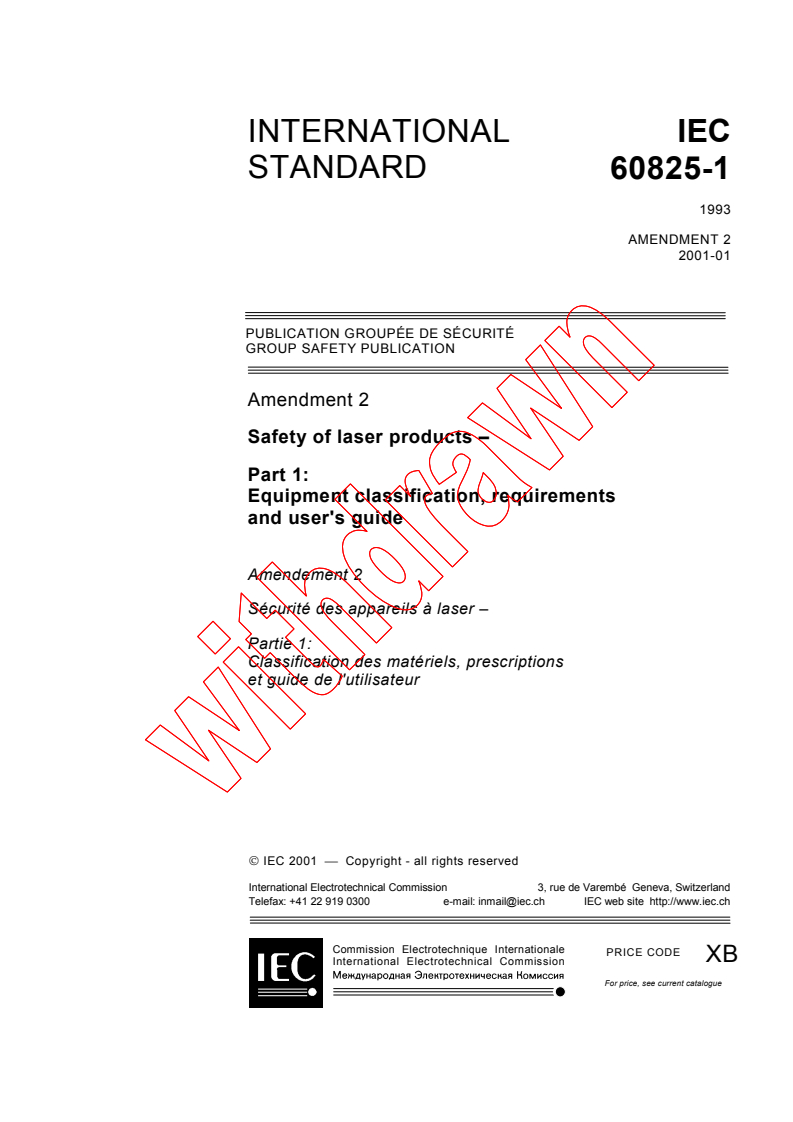
INTERNATIONAL IEC
STANDARD
60825-1
AMENDMENT 2
2001-01
PUBLICATION GROUPÉE DE SÉCURITÉ
GROUP SAFETY PUBLICATION
Amendment 2
Safety of laser products –
Part 1:
Equipment classification, requirements
and user's guide
Amendement 2
Sécurité des appareils à laser –
Partie 1:
Classification des matériels, prescriptions
et guide de l'utilisateur
IEC 2001 Copyright - all rights reserved
International Electrotechnical Commission 3, rue de Varembé Geneva, Switzerland
Telefax: +41 22 919 0300 e-mail: inmail@iec.ch IEC web site http://www.iec.ch
Commission Electrotechnique Internationale
PRICE CODE
XB
International Electrotechnical Commission
For price, see current catalogue
– 2 – 60825-1 Amend. 2 © IEC:2001(E)
FOREWORD
This amendment has been prepared by IEC technical committee 76: Optical radiation safety
and laser equipment.
The text of this amendment is based on the following documents:
FDIS Report on voting
76/220/FDIS 76/223/RVD
Full information on the voting for the approval of this amendment can be found in the report
on voting indicated in the above table.
The committee has decided that the contents of the base publication and its amendments will
remain unchanged until 2003. At this date, the publication will be
• reconfirmed;
• withdrawn;
• replaced by a revised edition; or
• amended.
A consolidated edition incorporating IEC 60825-1 (1993), amendment 1 (1997) and the
present amendment 2 (2001) is under preparation.
The contents of the corrigendum of June 2002 have been included in this copy.
––––––––––
Page 11
1 Scope and object
1.1 Scope
At the end of the third paragraph, add the following sentence:
See also annex G which describes information which should be provided by manufacturers of
LEDs.
Page 15
3 Definitions
Page 17
Replace, in definition 3.5, the reference in brackets by "3.7".
60825-1 Amend. 2 © IEC:2001(E) – 3 –
Add the following new definition:
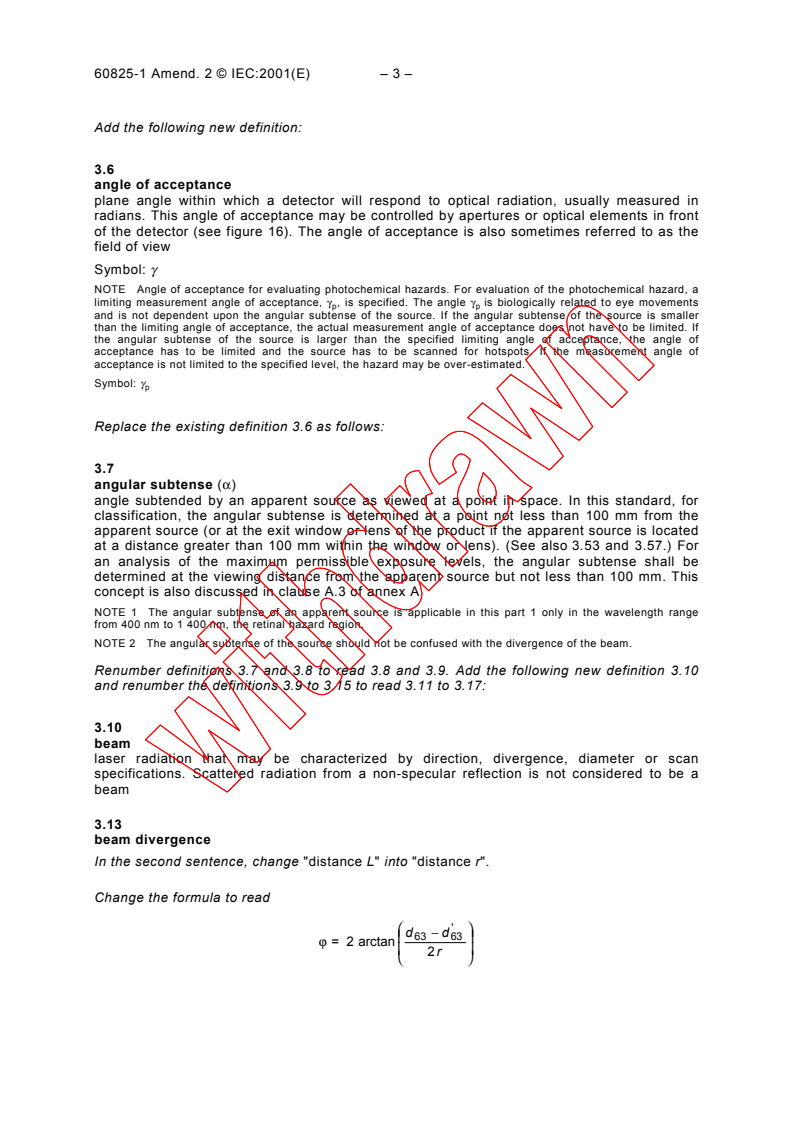
3.6
angle of acceptance
plane angle within which a detector will respond to optical radiation, usually measured in
radians. This angle of acceptance may be controlled by apertures or optical elements in front
of the detector (see figure 16). The angle of acceptance is also sometimes referred to as the
field of view
Symbol: γ
NOTE Angle of acceptance for evaluating photochemical hazards. For evaluation of the photochemical hazard, a
limiting measurement angle of acceptance, γ , is specified. The angle γ is biologically related to eye movements
p p
and is not dependent upon the angular subtense of the source. If the angular subtense of the source is smaller
than the limiting angle of acceptance, the actual measurement angle of acceptance does not have to be limited. If
the angular subtense of the source is larger than the specified limiting angle of acceptance, the angle of
acceptance has to be limited and the source has to be scanned for hotspots. If the measurement angle of
acceptance is not limited to the specified level, the hazard may be over-estimated.
Symbol: γ
p
Replace the existing definition 3.6 as follows:
3.7
angular subtense (α)
angle subtended by an apparent source as viewed at a point in space. In this standard, for
classification, the angular subtense is determined at a point not less than 100 mm from the
apparent source (or at the exit window or lens of the product if the apparent source is located
at a distance greater than 100 mm within the window or lens). (See also 3.53 and 3.57.) For
an analysis of the maximum permissible exposure levels, the angular subtense shall be
determined at the viewing distance from the apparent source but not less than 100 mm. This
concept is also discussed in clause A.3 of annex A
NOTE 1 The angular subtense of an apparent source is applicable in this part 1 only in the wavelength range
from 400 nm to 1 400 nm, the retinal hazard region.
NOTE 2 The angular subtense of the source should not be confused with the divergence of the beam.
Renumber definitions 3.7 and 3.8 to read 3.8 and 3.9. Add the following new definition 3.10
and renumber the definitions 3.9 to 3.15 to read 3.11 to 3.17:
3.10
beam
laser radiation that may be characterized by direction, divergence, diameter or scan
specifications. Scattered radiation from a non-specular reflection is not considered to be a
beam
3.13
beam divergence
In the second sentence, change "distance L" into "distance r".
Change the formula to read
'
d − d
63 63
ϕ = 2 arctan
2 r
– 4 – 60825-1 Amend. 2 © IEC:2001(E)
Page 19
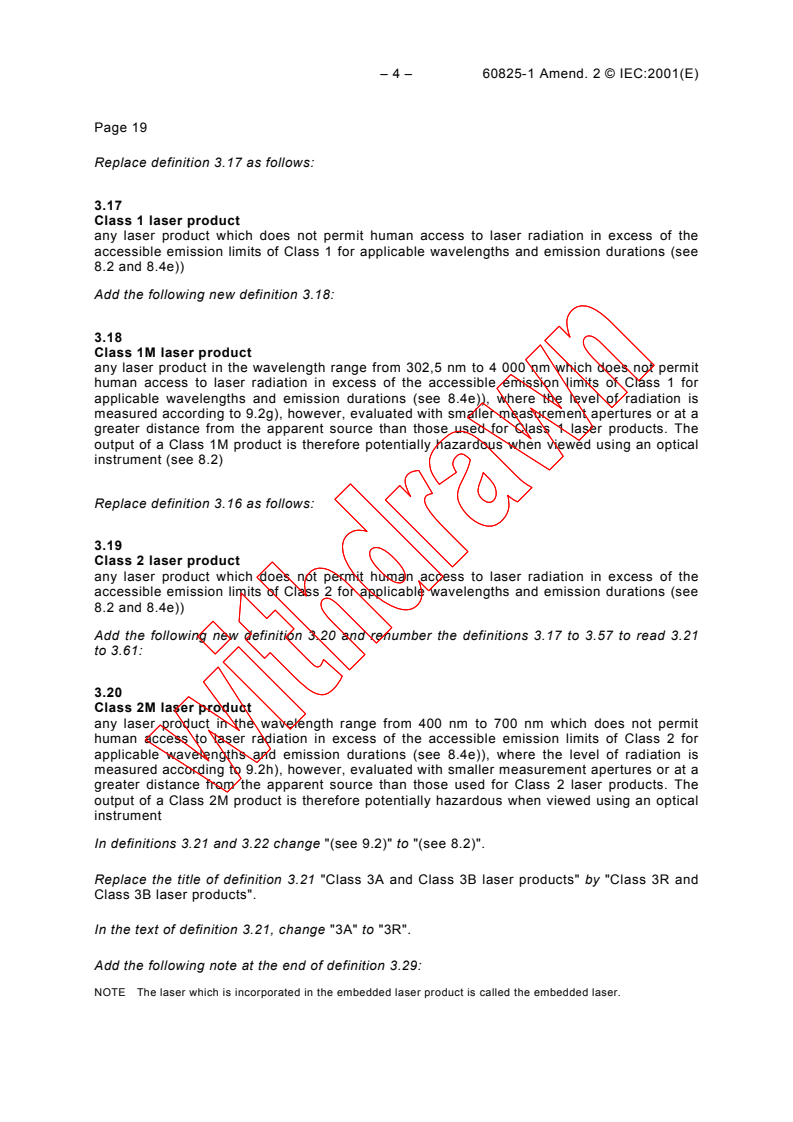
Replace definition 3.17 as follows:
3.17
Class 1 laser product
any laser product which does not permit human access to laser radiation in excess of the
accessible emission limits of Class 1 for applicable wavelengths and emission durations (see
8.2 and 8.4e))
Add the following new definition 3.18:
3.18
Class 1M laser product
any laser product in the wavelength range from 302,5 nm to 4 000 nm which does not permit
human access to laser radiation in excess of the accessible emission limits of Class 1 for
applicable wavelengths and emission durations (see 8.4e)), where the level of radiation is
measured according to 9.2g), however, evaluated with smaller measurement apertures or at a
greater distance from the apparent source than those used for Class 1 laser products. The
output of a Class 1M product is therefore potentially hazardous when viewed using an optical
instrument (see 8.2)
Replace definition 3.16 as follows:
3.19
Class 2 laser product
any laser product which does not permit human access to laser radiation in excess of the
accessible emission limits of Class 2 for applicable wavelengths and emission durations (see
8.2 and 8.4e))
Add the following new definition 3.20 and renumber the definitions 3.17 to 3.57 to read 3.21
to 3.61:
3.20
Class 2M laser product
any laser product in the wavelength range from 400 nm to 700 nm which does not permit
human access to laser radiation in excess of the accessible emission limits of Class 2 for
applicable wavelengths and emission durations (see 8.4e)), where the level of radiation is
measured according to 9.2h), however, evaluated with smaller measurement apertures or at a
greater distance from the apparent source than those used for Class 2 laser products. The
output of a Class 2M product is therefore potentially hazardous when viewed using an optical
instrument
In definitions 3.21 and 3.22 change "(see 9.2)" to "(see 8.2)".
Replace the title of definition 3.21 "Class 3A and Class 3B laser products" by "Class 3R and
Class 3B laser products".
In the text of definition 3.21, change "3A" to "3R".
Add the following note at the end of definition 3.29:
NOTE The laser which is incorporated in the embedded laser product is called the embedded laser.
60825-1 Amend. 2 © IEC:2001(E) – 5 –
Add to definitions 3.30 and, on page 21, 3.32 the following second sentence:
For a train of pulses, this is the duration between the first half-peak power point of the leading
pulse and the last half-peak power point of the trailing pulse
Add the following text at the end of definition 3.33:
Two extended source conditions are considered in this standard when considering retinal
thermal injury hazards: intermediate source and large source, which are used to distinguish
sources with angular subtenses, α, between α and α (intermediate sources), and greater
min max
than α (large sources). (See also 3.79.)
max
Replace, in definition 3.36a), third line, "Class 2, 3A or 3B of not more than 5 times the AEL of
Class 2 in the wavelength region from 400 nm to 700 nm" by "Class 2, 2M or 3R".
Replace definition 3.38 as follows:
3.38
intrabeam viewing
all viewing conditions whereby the eye is exposed to the direct or specularly reflected laser
beam in contrast to viewing of, for example, diffuse reflections
Page 25
Add the following new definition 3.62 after definition 3.61 and renumber definitions 3.58 to
3.73 to read 3.63 to 3.78:
3.62
photochemical hazard limit
either an MPE or AEL which was derived to protect persons against adverse photochemical
effects (for example, photoretinitis – a photochemical retinal injury from exposure to radiation
in the wavelength range from 400 nm to 600 nm)
Delete, in definition 3.69, at the end of the second line:
–2
(usually expressed in J·m )
Add the following new definition 3.79 after definition 3.78 and renumber definitions 3.74 to
read 3.80, and 3.75 to read 3.81:
3.79
small source
source with an angular subtense α less than, or equal to, the minimum angular subtense α
min
Add the following new definitions 3.82 and 3.83 after definition 3.81:
3.82
thermal hazard limit
either an MPE or AEL which was derived to protect persons against adverse thermal effects,
as opposed to photochemical injury
3.83
time base
emission duration to be considered for classification (see 8.4 e))
– 6 – 60825-1 Amend. 2 © IEC:2001(E)
Renumber definitions 3.76 to 3.80 to read 3.84 to 3.88
Page 33
4.3 Access panels and safety interlocks
Replace, in 4.3.1b) "the removal of the panel . Class 2" by "the removal of the panel gives
access to laser radiation levels designated by "X" in the table below."
Replace the table and the third paragraph by the following:
Accessible emission during or after removal of access panel
Product class
1, 1M 2, 2M 3R 3B 4
1, 1M – – X X X
2, 2M – – X X X
3R ––– X X
3B ––– X X
4 ––– X X
Removal of the panel shall not result in emission through the opening in excess of Class 1M
or Class 2M as applicable according to the wavelength.
Page 35
4.4 Remote interlock connector
Replace the text of this subclause as follows:
Each Class 3B and Class 4 laser system shall have a remote interlock connector. When the
terminals of the connector are open-circuited, the accessible radiation shall not exceed
Class 1M or Class 2M as applicable.
4.5 Key control
Replace the first sentence as follows:
Each Class 3B and Class 4 laser system shall incorporate a key-operated master control.
4.6 Laser radiation emission warning
Subclause 4.6.1
Replace the first sentence by the following new first sentence:
Each Class 3R laser system in the wavelength range below 400 nm and above 700 nm and
each Class 3B and Class 4 laser system shall give an audible or visible warning when it is
switched on or if capacitor banks of a pulsed laser are being charged or have not positively
discharged.
Replace, at the end of the last sentence, "in excess of the AEL for Class 1 and Class 2" by "in
excess of the AEL for Class 1M and 2M".
60825-1 Amend. 2 © IEC:2001(E) – 7 –
4.7 Beam stop or attenuator
Replace the existing text by the following new text:
Each Class 3B and Class 4 laser system shall incorporate one or more permanently attached
means of attenuation (beam stop or attenuator, other than a laser energy source switch,
mains connector or key control). The beam stop or attenuator shall be capable of preventing
human access to laser radiation in excess of Class 1M or Class 2M as applicable.
Page 37
4.8 Controls
Replace, at the end of the sentence, "do not require exposure to laser radiation in excess of
the AEL for Class 1 and Class 2" by "do not require exposure to laser radiation of Class 3R,
3B or Class 4".
4.9 Viewing optics
Replace, "in excess of the AEL for Class 1" by "in excess of the AEL for Class 1M" (three
times).
4.12 "Walk-in" access
Replace the existing texts in a) and b) by the following:
a) means shall be provided so that any person inside the housing can prevent activation of a
Class 3B or Class 4 laser hazard.
b) a warning device shall be situated so as to provide adequate warning of emission of
Class 3R laser radiation in the wavelength range below 400 nm and above 700 nm, or of
Class 3B or Class 4 laser radiation to any person who might be within the housing.
Page 39
5.2 Class 1
Replace the existing text by the following:
Except as permitted in 1.1, each Class 1 laser product shall have affixed an explanatory label
(figure 15) bearing the words:
CLASS 1 LASER PRODUCT
Each Class 1M laser product shall have affixed an explanatory label (figure 15) bearing the
words:
LASER RADIATION
DO NOT VIEW DIRECTLY WITH OPTICAL INSTRUMENTS
CLASS 1M LASER PRODUCT
The type of optical instrument which could result in an increased hazard may be added in
parenthesis after the word "instruments". The added wording could in particular be
"(BINOCULARS OR TELESCOPES)" for a laser product with a collimated, large-diameter
beam, which is classified 1M because it fails condition 1 of table 10, or "(MAGNIFIERS)" for a
laser product which is classified 1M because it fails condition 2 of table 10 (highly diverging
beam).
Instead of the above labels, at the discretion of the manufacturer, the same statements may
be included in the information for the user.
– 8 – 60825-1 Amend. 2 © IEC:2001(E)
Page 41
5.3 Class 2
Add the following text:
Each Class 2M laser product shall have affixed a warning label (figure 14) and an explanatory
label (figure 15) bearing the words:
LASER RADIATION
DO NOT STARE INTO THE BEAM OR VIEW
DIRECTLY WITH OPTICAL INSTRUMENTS
CLASS 2M LASER PRODUCT
The type of optical instrument which could result in an increased hazard may be added in
parenthesis after the word "instruments". The added wording could in particular be
"(BINOCULARS OR TELESCOPES)" for a laser product with a collimated, large-diameter
beam which is classified 2M because it fails condition 1 of table 10, or "(MAGNIFIERS)" for a
laser product which is classified 2M because it fails condition 2 of table 10 (highly diverging
beam).
5.4 Class 3A
Replace the title and text by the following:
5.4 Class 3R
Each Class 3R laser product in the wavelength range from 400 nm to 1 400 nm shall have
affixed a warning label (figure 14) and an explanatory label (figure 15) bearing the words:
LASER RADIATION
AVOID DIRECT EYE EXPOSURE
CLASS 3R LASER PRODUCT
For other wavelengths, each Class 3R laser product shall have affixed a warning label
(figure 14) and an explanatory label (figure 15) bearing the words:
LASER RADIATION
AVOID EXPOSURE TO BEAM
CLASS 3R LASER PRODUCT
5.7 Aperture label
Replace "Each Class 3B and Class 4…" by "Each Class 3R, Class 3B and Class 4…"
Page 43
5.8 Radiation output and standards information
Replace the existing text by the following:
Each laser product, except those of Class 1, shall be described on the explanatory label
(figure 15) by a statement of the maximum output of laser radiation, the pulse duration (if
appropriate) and the emitted wavelength(s). The name and publication date of the standard to
which the product was classified shall be included on the explanatory label or elsewhere in
close proximity on the product. For Class 1 and Class 1M, instead of the labels on the
product, the information may be contained in the information for the user.
60825-1 Amend. 2 © IEC:2001(E) – 9 –
5.9.1 Labels for panels
Replace, at the end of the first sentence of the first paragraph ". shall have affixed a label
bearing the words:" by ".shall have affixed labels bearing the words (for the case of an
embedded Class 1M laser, the statement instead may be included in the information for the
user):"
Replace the warnings in 5.9.1 as follows:
a)
CAUTION – CLASS 1M LASER RADIATION WHEN OPEN
DO NOT VIEW DIRECTLY WITH OPTICAL INSTRUMENTS
if the accessible radiation does not exceed the AEL for Class 1M where the level of radiation
is measured according to 9.2g) and 9.3;
b)
CAUTION – CLASS 2 LASER RADIATION WHEN OPEN
DO NOT STARE INTO THE BEAM
if the accessible radiation does not exceed the AEL for Class 2 where the level of radiation is
measured according to 9.2h) and 9.3;
c)
CAUTION – CLASS 2M LASER RADIATION WHEN OPEN
DO NOT STARE INTO THE BEAM OR VIEW
DIRECTLY WITH OPTICAL INSTRUMENTS
if the accessible radiation does not exceed the AEL for Class 2M where the level of radiation
is measured according to 9.2h) and 9.3;
d)
CAUTION – CLASS 3R LASER RADIATION WHEN OPEN
AVOID DIRECT EYE EXPOSURE
if the accessible radiation is in the wavelength range from 400 nm to 1 400 nm and does not
exceed the AEL for Class 3R;
e)
CAUTION – CLASS 3R LASER RADIATION WHEN OPEN
AVOID EXPOSURE TO THE BEAM
if the accessible radiation is outside the wavelength range from 400 nm to 1 400 nm and does
not exceed the AEL for Class 3R;
f)
CAUTION – CLASS 3B LASER RADIATION WHEN OPEN
AVOID EXPOSURE TO THE BEAM
if the accessible radiation does not exceed the AEL for Class 3B;
g)
CAUTION – CLASS 4 LASER RADIATION WHEN OPEN
AVOID EYE OR SKIN EXPOSURE TO
DIRECT OR SCATTERED RADIATION
if the accessible radiation exceeds the limits for Class 3B.
This information may be provided in more than one adjacent label on the product.
– 10 – 60825-1 Amend. 2 © IEC:2001(E)
5.9.2 Labels for safety interlocked panels
Modify the last sentence of the first paragraph and the warning as follows, and delete the
second paragraph:
Such labels shall be visible prior to and during interlock override and be in close proximity to
the opening created by the removal of the protective housing. This label shall bear the words
specified in items a) to g) of 5.9.1, with the introduction of an additional line, positioned after
the first line, with the following words:
AND INTERLOCKS DEFEATED
Page 45
5.10 Warning for invisible laser radiation
Replace, in the first sentence, ". for explanatory labels includes the phrase" by ". for labels
in clause 5 includes the phrase .".
Add at the end of this subclause:
If a product is classified on the basis of the level of visible laser radiation and also emits in
excess of the AEL of Class 1 at invisible wavelengths, the label shall include the words
"Visible and invisible laser radiation" in lieu of "Laser radiation".
5.11 Warning for visible laser radiation
Replace, in the first sentence, "The wording "laser radiation" on the explanatory labels may be
modified to read." by "The wording "laser radiation" for labels in Clause 5 may be modified to
read.".
6.1 Information for the user
Insert a new item at the end of 6.1a) and renumber subsequent original items to read 6.1c) to
g) inclusive:
b) For Class 1M and 2M laser products an additional warning is required. For diverging
beams, this warning shall state that viewing the laser output with certain optical
instruments (for example, eye loupes, magnifiers and microscopes) within a distance of
100 mm may pose an eye hazard. For collimated beams, this warning shall state that
viewing the laser output with certain optical instruments designed for use at a distance (for
example, telescopes and binoculars) may pose an eye hazard.
Page 47
6.2 Purchasing and servicing information
Replace the text of item a) by the following:
a) In all catalogues, specification sheets and descriptive brochures, the classification of each
laser product and any warnings required by 6.1b) shall be stated.
7.1 Medical laser products
Delete item b) and include item a) into the second sentence to read:
In addition, any Class 3B or Class 4 medical laser product shall comply with IEC 60601-2-22.
60825-1 Amend. 2 © IEC:2001(E) – 11 –
7.2 Laser fibre optic transmission system
Replace the title and text of this subclause as follows:
7.2 Other parts of the standard series IEC 60825
For specific applications, one or other of the following IEC 60825 series may be applicable
(see also annex H).
– IEC 60825-2 is additionally applicable to optical fibre communication systems.
– IEC 60825-4 is additionally applicable to laser guards.
– Further information on laser shows may be found in IEC/TR 60825-3.
– Further information regarding a manufacturer's checklist may be found in IEC/TR 60825-5.
– Further information regarding products exclusively used for visible information
transmission may be found in IEC/TS 60825-6.
– Further information regarding products exclusively used for non-visible information
transmission may be found in IEC/TS 60825-7.
– Guidelines for the safe use of medical laser equipment may be found in IEC/TR 60825-8.
– Further information regarding a review of MPEs for incoherent radiation may be found in
IEC/TR 60825-9.
Page 49
8 Tests
Replace the title and text of clause 8 by the following:
8 Classification
8.1 Introduction
Because of the wide ranges possible for the wavelength, energy content and pulse
characteristics of a laser beam, the hazards arising in its use vary widely. It is impossible to
regard lasers as a single group to which common safety limits can apply.
8.2 Description of laser classes
Class 1: Lasers that are safe under reasonably foreseeable conditions of operation, including
the use of optical instruments for intrabeam viewing.
Class 1M: Lasers emitting in the wavelength range from 302,5 nm to 4 000 nm which are safe
under reasonably foreseeable conditions of operation, but may be hazardous if the user
employs optics within the beam. Two conditions apply:
a) for diverging beams if the user places optical components within 100 mm from the source
to concentrate (collimate) the beam; or
b) for a collimated beam with a diameter larger than the diameter specified in table 10 for the
measurements of irradiance and radiant exposure.
Class 2: Lasers that emit visible radiation in the wavelength range from 400 nm to 700 nm
where eye protection is normally afforded by aversion responses, including the blink reflex.
This reaction may be expected to provide adequate protection under reasonably foreseeable
conditions of operation including the use of optical instruments for intrabeam viewing.
NOTE Outside the wavelength range from 400 nm to 700 nm, any additional emissions of Class 2 lasers are
required to be below the AEL of Class 1.
– 12 – 60825-1 Amend. 2 © IEC:2001(E)
Class 2M: Lasers that emit visible radiation in the wavelength range from 400 nm to 700 nm
where eye protection is normally afforded by aversion responses including the blink reflex.
However, viewing of the output may be more hazardous if the user employs optics within the
beam. Two conditions apply:
a) for diverging beams, if the user places optical components within 100 mm from the source
to concentrate (collimate) the beam, or
b) for a collimated beam with a diameter larger than the diameter specified in table 10 for the
measurements of irradiance and radiant exposure.
NOTE Outside the wavelength range from 400 nm to 700 nm, any additional emissions of Class 2M lasers are
required to be below the AEL of Class 1M.
Class 3R: Lasers that emit in the wavelength range from 302,5 nm to 10 nm where direct
intrabeam viewing is potentially hazardous but the risk is lower than for Class 3B lasers, and
fewer manufacturing requirements and control measures for the user apply than for Class 3B
lasers. The accessible emission limit is within five times the AEL of Class 2 in the wavelength
range from 400 nm to 700 nm and within five times the AEL of Class 1 for other wavelengths.
Class 3B: Lasers that are normally hazardous when direct intrabeam exposure occurs (i.e.
within the NOHD). Viewing diffuse reflections is normally safe (see also note to 12.5.2c)).
Class 4: Lasers that are also capable of producing hazardous diffuse reflections. They may
cause skin injuries and could also constitute a fire hazard. Their use requires extreme
caution.
8.3 Classification responsibilities
It is the responsibility of the manufacturer or his agent to provide correct classification of a
laser product. The product shall be classified on the basis of that combination of output
power(s) and wavelength(s) of the accessible laser radiation over the full range of capability
during operation at any time after manufacture which results in its allocation to the highest
appropriate class. The accessible emission limit (AELs) for Class 1 and 1M, Class 2 and 2M,
Class 3R and Class 3B (listed in order of increasing hazard) are given in tables 1, 2, 3 and 4
respectively.
The values of the correction factors used are given in the notes to tables 1 to 4 as functions of
wavelength, emission duration, number of pulses and angular subtense.
8.4 Classification rules
For the purpose of classification rules, the following ranking of the classes (in increasing
order of hazard) shall be used: Class 1, Class 1M, Class 2, Class 2M, Class 3R, Class 3B,
Class 4.
NOTE For classification of a laser product as Class 1M or 2M, the use of an aperture, specified in table 10 for
irradiance and radiant exposure at the distances in that table for these measurements, limits the amount of
radiation that is collected from large diameter or highly diverging beams. For example, when measured under the
applicable conditions, Class 1M and Class 2M products may have higher measured energy or power than the AEL
of Class 3R. For such laser products, a classification of 1M or 2M is appropriate.
a) Radiation of a single wavelength
A single wavelength laser product, with a spectral range of the emission line narrow
enough so that the AELs do not change, is assigned to a class when the accessible laser
radiation, measured under the conditions appropriate to that class, exceeds the AEL of all
lower classes but does not exceed that of the class assigned.
60825-1 Amend. 2 © IEC:2001(E) – 13 –
b) Radiation of multiple wavelengths
1) A laser product emitting two or more wavelengths in spectral regions shown as
additive in table 5 is assigned to a class when the sum of the ratios of the accessible
laser radiation, measured under the conditions appropriate to that class, to the AELs of
those wavelengths is greater than unity for all lower classes but does not exceed unity
for the class assigned.
2) A laser product emitting two or more wavelengths not shown as additive in table 5 is
assigned to a class when the accessible laser radiation, measured under the
conditions appropriate to that class, exceeds the AELs of all lower classes for at least
one wavelength but does not exceed the AEL for the class assigned for any
wavelength.
c) Radiation from extended sources
The ocular hazard from laser sources in the wavelength range from 400 nm to 1 400 nm is
dependent upon the angular subtense of the source. A source is considered an extended
source when the angular subtense of the source is greater than α , where α = 1,5 mrad.
min min
For retinal thermal hazard evaluation (400 nm to 1 400 nm), the AELs for extended sources
vary directly with the angular subtense of the source. For the retinal photochemical hazard
evaluation (400 nm to 600 nm), for exposures greater than 1 s, the AELs do not vary
directly with the angular subtense of the source, but, depending on the exposure duration
(see 9.3c) i), a limiting angle of acceptance γ of 11 mrad or more is used for measurement,
p
and the relation of the limiting acceptance angle γ to the angular subtense α of the source
p
can influence the measured value.
For sources subtending an angle less than or equal to α , the AEL and MPE are
min
independent of the angular subtense of the source α.
For an extended source, the power or energy measured must be below the permitted
power or energy for the AEL specified for the class as a function of the angular subtense
of the source α.
For classifying laser products where condition 1 applies (see table 10), the angular
subtense α of the apparent source shall be determined at the location of the 50 mm
measurement aperture. The 7× magnification of the angular subtense α of the
apparent source may be applied to determine C , i.e. C = 7 × α / α , provided that it
6 6 min
can be demonstrated that the smallest possible retinal spot diameter will not be less than
C × 25 μm when the radiation is viewed through an optical instrument of magnification 7.
The expression (7 × α) shall be limited to α prior to the calculation of C .
max 6
NOTE For the case that α < 1,5 mrad but 7 × α > 1,5 mrad, the limits for α > 1,5 mrad of table 1 and 3 apply,
provided that the 7× magnification of the retinal spot diameter can be demonstrated.
For classifying laser products where condition 2 applies (see table 10), the angular
subtense α of the apparent source shall be determined at the nearest point of human
access to the apparent source, but not less than 100 mm.
d) Non-circular and multiple sources
For laser radiation where the apparent source consists of multiple points or is a linear
source with an angular subtense greater than α and within the wavelength range
min
from 400 nm to 1 400 nm, measurements or evaluations shall be made for every single
point, or assembly of points, necessary to assure that the source does not exceed the AEL
for each possible angle α subtended by each partial area, where α ≤ α ≤ α .
min max
For the retinal photochemical hazard limits (400 nm to 600 nm), the limiting angle of
acceptance γ to be used to evaluate extended sources is specified in 9.3 c) i).
p
For the determination of the AEL retinal thermal hazard limits (400 nm to 1 400 nm), the
value of the angular subtense of a rectangular or linear source is determined by the
arithmetic mean of the two angular dimensions of the source. Any angular dimension that
is greater than α or less than α shall be limited to α or α respectively, prior to
max min max min
calculating the mean. The photochemical limits (400 nm to 600 nm) do not depend on the
angular subtense of the source, and the source is measured with the angle of acceptance
specified in 9.3 c).
– 14 – 60825-1 Amend. 2 © IEC:2001(E)
e) Time bases
The following time bases are used in this standard for classification:
i) 0,25 s for Class 2, Class 2M and Class 3R laser radiation in the wavelength range
from 400 nm to 700 nm.
ii) 100 s for laser radiation of all wavelengths greater than 400 nm except for the cases
listed in i) and iii).
iii) 30 000 s for laser radiation of all wavelengths less than or equal to 400 nm and for
laser radiation of wavelengths greater than 400 nm where intentional long-term viewing
is inherent in the design or function of the laser product.
NOTE Every possible emission duration within the time base must be considered when determining the
classification of a product. This means that the emission level of a single pulse must be compared to the AEL
applicable to the emission duration of the pulse, etc. It is not sufficient to merely average the emission level for
the duration of the classification time base.
f) Repetitively pulsed or modulated lasers
The following methods shall be used to determine the AEL to be applied to repetitive
pulsed emissions.
The AEL for wavelengths from 400 nm to 10 nm is determined by using the most
restrictive of requirements i), ii) and iii) as appropriate. For other wavelengths, the AEL is
determined by using the most restrictive of requirements i) and ii). Requirement iii) applies
only to the thermal limits, not to the photochemical limits.
i) The exposure from any single pulse within a pulse train shall not exceed the AEL for a
single pulse.
ii) The average power for a pulse train of emission duration T shall not exceed the power
corresponding to the AEL given in tables 1, 2, 3 and 4, respectively for a single pulse
of emission duration T.
iii) The average pulse energy from pulses within a pulse train shall not exceed the AEL for
a single pulse multiplied by the correction factor C . If pulses of variable amplitude are
used, the assessment is made for pulses of each amplitude separately, and for the
whole train of pulses.
AEL = AEL × C
train single 5
where
AEL is the AEL for any single pulse in the pulse train;
train
AEL is the AEL for a single pulse;
single
–0,25
C = N ;
N is the number of pulses in the pulse train during the duration according to the
following:
Wavelength Duration to determine N
400 nm to 1 400 nm T (see note 2 of the notes to tables 1 to 4) or the applicable time basis,
whichever is shorter
>1 400 nm 10 s
C is only applicable to individual pulse durations shorter than 0,25 s.
In some cases, the calculated value may fall below the AEL that would apply for continuous
operation at the same peak power using the same time base. Under these circumstances, the
AEL for continuous operation may be used.
If multiple pulses appear within the period of T (see table 9), they are counted as a single
i
pulse to determine N and the energies of the individual pulses are added to be compared to
–9
the AEL of T , provided that all individual pulse durations are greater than 10 s.
i
NOTE The energy from any group of pulses (or sub-group of pulses in a train) delivered in any given time should
not exceed the AEL for that time.
60825-1 Amend. 2 © IEC:2001(E) – 15 –
Table 9 – Times T below which pulse groups are summed up
i
Wavelength T
i
–6
400 nm ≤ λ < 1 050 nm 18 × 10 s
–6
1 050 nm ≤ λ < 1 400 nm 50 × 10 s
–3
1 400 nm ≤ λ < 1 500 nm 10 s
10 s
1 500 nm ≤ λ < 1 800 nm
–3
1 800 nm ≤ λ < 2 600 nm 10 s
–7
10 s
2 600 nm ≤ λ ≤ 10 nm
In cases of varying pulse widths or pulse intervals, the total-on-time-pulse (TOTP) method
may be used in place of requirement iii). In this case, the AEL is determined by the duration of
the TOTP, which is the sum of all pulse durations within the emission duration or T ,
whichever is smaller. Pulses with durations less than T , are assigned pulse durations of T . If
i i
two or more pulses occur within a duration of T, these pulse groups are assigned pulse
i
durations of T . For comparison with the AEL for the corresponding duration, all individual
i
pulse energies are added.
This method is equivalent to requirement iii) when the average energy of pulses is compared
to the AEL of a single pulse multiplied with C .
IEC/TR 60825-9 presents an alternative procedure that may be considered.
Page 53
9 Classification
Replace the title and text of clause 9 by the following:
9 Measurements for classification
9.1 Tests
Tests shall take into account all errors and statistical uncertainties in the measurement
process (see IEC 61040) and increases in emission and degradation in radiation safety with
age. Specific user requirements may impose additional tests.
Tests during operation shall be used to determine the classification of the product. Tests
during operation, maintenance and service shall also be used as appropriate to determine the
requirements for safety interlocks, labels and information for the user. The above tests shall
be made under each and every reasonably foreseeable single-fault condition; however, faults
which result in the emission of radiation in excess of the AEL for a limited period only, and for
which it is not reasonably foreseeable that human access to the radiation will occur before the
product is taken out of service, need not be considered.
NOTE For example, surface-emitting LEDs will be a product group where the single-fault condition need not be
considered. (Surface-emitting LEDs are conventional LEDs without gain where the emission is orthogonal to the
chip surface, and the chip surface can be viewed directly. It may have a built-in lens or reflector.)
Equivalent tests or procedures are acceptable.
Optical amplifiers shall be classified using the maximum accessible total output power or
energy, which may include maximum rated input power or energy.
NOTE In those cases where there is no clear output power or energy limit, the maximum power or energy added
by the amplifier plus the necessary input signal power or energy to achieve that condition should be used.
– 16 – 60825-1 Amend. 2 © IEC:2001(E)
9.2 Measurement of laser radiation
Measurement of laser radiation levels may be necessary to classify a laser product in
accordance with 9.1. Measurements are unnecessary when the physical characteristics and
limitations of the laser source place the laser product or laser installation clearly in a
particular class. Measurements shall be made under the following conditions.
a) Under those conditions and procedures which maximize the accessible emission levels,
including start-up, stabilized emission and shut-down of the laser product.
b) With all controls and settings listed in the operation, maintenance and service instructions
adjusted in combination to result in the maximum accessible level of radiation.
Measurements are also required with the use of accessories that may increase the
radiation hazard (for example, collimating optics) and that are supplied or offered by the
manufacturer for use with the product.
c) For a laser product other than a laser system, with the laser coupled to that type of laser
energy source which is specified as compatible by the laser product manufacturer and
which produces the maximum emission of accessible radiation from the product.
d) At points in space to which human access is possible during operation for measurement of
accessible emission levels (for example, if operation may require removal of portions of
the protective housing and defeat of safety interlocks, measurements shall be made at
points accessible in that product configuration).
e) With the measuring instrument detector so positioned and so oriented with respect to the
laser product as to result in the maximum detection of radiation by the instrument.
f) Appropriate provision shall be made to avoid or to eliminate the contribution of collateral
radiation to the measurement.
g) Class 1 and 1M
In the wavelength range of 302,5 nm to 4 000 nm, if the level of radiation, as determined
according to table 10, for condition 1 and condition 2 is less than, or equal to, the AEL of
Class 1, the laser product is assigned to Class 1.
If the level of radiation, as determined according to table 10, is larger than the AEL of
Class 1 for condition 1 or condition 2 and less than the AEL of Class 3B, but with an
aperture stop of diameter and at a distance from the apparent source as specified in
table 10 for irradiance or radiant exposure measurements is less than, or equal to, the
AEL of Class 1, the laser product is assigned to Class 1M.
NOTE To limit the maximum power passing through an optical instrument for Class 1M, the AELs of Class 3B
are also employed with the measurement of power or energy.
h) Class 2 and 2M
In the wavelength range of 400 nm to 700 nm, if the level of radiation, as determined
according to table 10, for condition 1 and condition 2 exceeds the AEL of Class 1 and is
less than or equal to the AEL of Class 2, the laser product is assigned to Class 2.
If the level of radiation as determined according to table 10 is larger than the AEL of
Class 2 for condition 1 or condition 2 and less than the AEL of Class 3B, but the level of
radiation measured with an aperture stop of diameter and at a distance as specified in
table 10 for irradiance or radiant exposure measurements is less than, or equal to, the
AEL of Class 2, the laser product is assigned to Class 2M.
NOTE To limit the maximum power passing through an optical instrument for Class 2M, the AELs of Class 3B
are also employed with measurements of power or energy.
9.3 Measurement geometry
Two measurement conditions as given in table 10 apply for wavelengths where optically aided
viewing may increase the hazard. The most restrictive condition shall be applied. If the
applicability of condition 1 or 2 is not obvious, both cases shall be evaluated. Condition 1
applies to collimated beams where telescopes and binoculars may increase the hazard, and
condition 2 applies to sources with a highly diverging output where the use of microscopes,
hand magnifiers and eye loupes may increase the hazard.
60825-1 Amend. 2 © IEC:2001(E) – 17 –
For power and energy measurement of scanned laser radiation, the measurement apertures
and distances as specified in table 10 for irradiance or radiant exposure shall be used.
a) Aperture diameters
The aperture diameters used for measurements of radiation for classification purposes
shall be as shown in table 10.
NOTE Irradiance and radiant exposure values should not be averaged over apertures smaller than the limiting
apertures given in table 10 for irradiance and radiant exposure.
b) Measurement distance
For condition 1, the measurement distance specified in table 10 refers to the distance
between the closest point of human access and the aperture stop; for condition 2 and
irradiance or radiant exposure measurements the measurement distance refers to the
distance between the apparent source and the aperture stop. Outside the wavelength
range of 302,5 nm and 4 000 nm, the differentiation into condition 1 and condition 2 does
not apply and the distance specified in table 10 refers to the distance between the closest
point of human access and the aperture stop.
For the purpose of this standard, the location of the beam waist shall be considered as the
location of the apparent source in determining the measurement distance as given in
table 10; however, the location and size of the beam waist should not be used to
geometrically determine the angular subtense of the apparent source. If a value of angular
subtense greater than α is to be used for classification, the dimensions of the apparent
min
source shall be determined. In the case of scanning beams, the appropriate measurement
location is the location where the combination of angular subtense and pulse duration
results in the most restrictive accessible emission limit (AEL).
NOTE For the measurement of power and energy for condition 2 and the measurement of irradiance or radiant
exposure in the wavelength range of 302,5 nm to 4 000 nm. In cases where the apparent source is not accessible
by virtue of engineering design (for example, recessed), the measurement distance should be at the closest point
of human access but not less than the specified distance.
If the source is not recessed, instead of a 7 mm diameter aperture stop placed at a distance r
as determined by the formula in a) of table 10 for thermal limits, an aperture stop with varying
diameter d can be placed at a distance of 100 mm from the apparent source. In this case, the
diameter of the aperture is determined by the formula:
α
max
d = (7 mm) If α < α , d = 50 mm. If α ≥ α , d = 7 mm
min max
α + 0,46 mrad
NOTE The measurement apertures and distances in table 10 describe the geometry of the measurement
conditions required to determine the radiation level to be used for classification. In some cases, it may be
appropriate, because of instrument or space limitations, to use an equivalent arrangement of apertures and
distances. For example, as an alternative to a 7 mm diameter aperture stop placed at a distance of 14 mm from the
apparent source, an aperture stop with a diameter of 50 mm can be placed at a distance of 100 mm from the
apparent source.
– 18 – 60825-1 Amend. 2 © IEC:2001(E)
Table 10 – Diameters of the measurement apertures and measurement distances
For values expressed in power W
2 b
Wavelength For irradiance W/m or
or energy J
2 b
nm radiant exposure J/m
Condition 1 Condition 2
For Class 1 Aperture Distance Aperture Distance Limiting aperture Distance
see also 9.2g) stop stop
For Class 2
mm mm mm mm mm mm
see also 9.2h)
< 302,5 nm – – 7 14 1 0
25 2 000 7 14 1 100
≥ 302,5 nm to 400 nm
a a
≥ 400 nm to 1 400 nm 50 2 000 7 r 7 100
25 2 000 7 14 100
≥ 1400 nm to 4 000 nm 1 for t ≤ 0,35 s
3/8
1,5 t for 0,35 s < t < 10 s
3,5 for t ≥ 10 s (t in s)
≥ 4 000 nm to 10 nm –– 7 14 1 for t ≤ 0,35 s 0
3/8
1,5 t for 0,35 s < t < 10 s
3,5 for t ≥ 10 s (t in s)
5 6
–– 7 14 11 0
≥ 10 nm to 10 n
...