

IEC 61000-4-8:1993
(Main)Electromagnetic compatibility (EMC) - Part 4: Testing and measurement techniques - Section 8: Power frequency magnetic field immunity test. Basic EMC Publication
General Information
- Abstract
Relates to the immunity requirements of equipment, only under operational conditions, to magnetic disturbances at power frequency related to: - residential and commercial locations - industrial installations and power plants - medium voltage and high voltage sub-stations.
- Status
- Published
- Publication Date
- 27-Mar-2001
- Technical Committee
- SC 77B - High frequency phenomena
- Current Stage
- DELPUB - Deleted Publication
- Start Date
- 03-Sep-2009
- Completion Date
- 28-Aug-2026
Buy Documents
IEC 61000-4-8:1993+AMD1:2000 CSV - Electromagnetic compatibility (EMC) - Part 4-8: Testing and measurement techniques - Power frequency magnetic field immunity test Released:3/28/2001
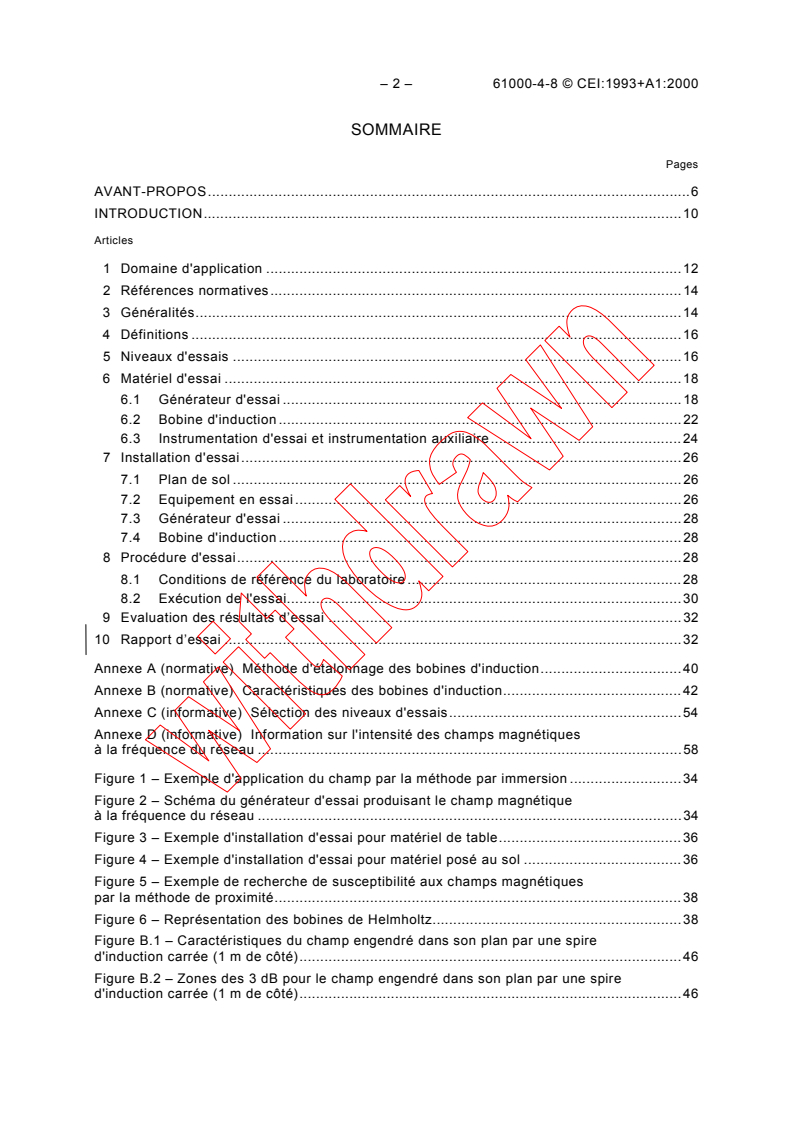
IEC 61000-4-8:1993+AMD1:2000 CSV - Compatibilité électromagnétique (CEM)- Partie 4-8: Techniques d'essai et de mesure - Essai d'immunité au champ magnétique a la fréquence du réseau Released:3/28/2001
IEC 61000-4-8:1993+AMD1:2000 CSV - Electromagnetic compatibility (EMC) - Part 4-8: Testing and measurement techniques - Power frequency magnetic field immunity test Released:3/28/2001
Overview
IEC 61000-4-8:1993 (consolidated with Amendment 1:2000, Edition 1.1) is a basic EMC publication from the IEC that defines a reproducible method for assessing power frequency magnetic field immunity of electrical and electronic equipment. The standard applies to equipment under normal operational conditions and covers magnetic disturbances at mains frequencies in residential and commercial locations, industrial installations and power plants, and medium- and high-voltage substations.
Key outcomes of the standard include recommended test levels, required test equipment and set-up, the test procedure, and guidance on evaluation and reporting of results.
Key topics and technical requirements
- Scope and applicability: Immunity tests for equipment exposed to power-frequency (50/60 Hz) magnetic fields in different environments - domestic, commercial, industrial and sub-station locations.
- Test types: Distinguishes between continuous (steady-state) magnetic fields and short-duration fields produced under fault conditions; short-duration tests use different test levels and durations.
- Test levels: The standard defines recommended levels for continuous and short-duration magnetic fields (tables provided in the document). Exact numeric values are in the standard itself.
- Test equipment:
- Test generator to drive field-producing coils.
- Induction coils (defined shape and dimensions) and the induction coil factor (field-to-current ratio) for field generation and calibration.
- Auxiliary instrumentation for monitoring and measurement.
- Test methods and set-up:
- Immersion method (EUT placed within coil-generated field) and proximity method for localized investigation.
- Use of ground (reference) plane, defined EUT placement (table-top vs floor-standing), and coil geometry (including Helmholtz arrangements).
- Calibration procedures (Annex A normative) and coil characteristics (Annex B normative).
- Procedure and reporting: Laboratory reference conditions, stepwise test execution, result evaluation criteria and mandatory test report content.
Practical applications
- Demonstrating product immunity to mains-frequency magnetic fields for compliance, design validation and risk mitigation.
- Pre-compliance and full compliance testing in EMC laboratories.
- Specifying procurement or acceptance criteria for equipment deployed near power distribution equipment (e.g., in substations, switchrooms or close to power converters).
- Informing mitigation design (shielding, equipment placement and wiring layout) where magnetic field exposure is expected.
Who uses this standard
- EMC engineers and test laboratories performing immunity testing.
- Product manufacturers of household, commercial and industrial electrical/electronic equipment.
- Utilities, power-plant operators and contractors specifying equipment for installation in high-exposure locations.
- Compliance officers and certification bodies referencing IEC 61000 series requirements.
Related standards
- IEC 61000 series (Part 4: Testing and measurement techniques) for complementary EMC test methods.
- IEC 60068-1 (referenced normative) for environmental testing guidance.
- Other IEC standards addressing conducted disturbances and different frequency ranges for magnetic fields (harmonics, DC or higher frequencies).
Relations
- Effective Date
- 25-Aug-2026
- Effective Date
- 10-Feb-2026
- Effective Date
- 10-Feb-2026
- Effective Date
- 05-Sep-2023
- Effective Date
- 05-Sep-2023
Buy Documents
IEC 61000-4-8:1993+AMD1:2000 CSV - Electromagnetic compatibility (EMC) - Part 4-8: Testing and measurement techniques - Power frequency magnetic field immunity test Released:3/28/2001
IEC 61000-4-8:1993+AMD1:2000 CSV - Compatibilité électromagnétique (CEM)- Partie 4-8: Techniques d'essai et de mesure - Essai d'immunité au champ magnétique a la fréquence du réseau Released:3/28/2001
IEC 61000-4-8:1993+AMD1:2000 CSV - Electromagnetic compatibility (EMC) - Part 4-8: Testing and measurement techniques - Power frequency magnetic field immunity test Released:3/28/2001
Get Certified
Connect with accredited certification bodies for this standard

ANCE
Mexican certification and testing association.

Intertek Slovenia
Intertek testing, inspection, and certification services in Slovenia.

LNE (Laboratoire National de Métrologie et d'Essais)
French national laboratory for metrology and testing.
Sponsored listings
Frequently Asked Questions
IEC 61000-4-8:1993 is a standard published by the International Electrotechnical Commission (IEC). Its full title is "Electromagnetic compatibility (EMC) - Part 4: Testing and measurement techniques - Section 8: Power frequency magnetic field immunity test. Basic EMC Publication". This standard covers: Relates to the immunity requirements of equipment, only under operational conditions, to magnetic disturbances at power frequency related to: - residential and commercial locations - industrial installations and power plants - medium voltage and high voltage sub-stations.
Relates to the immunity requirements of equipment, only under operational conditions, to magnetic disturbances at power frequency related to: - residential and commercial locations - industrial installations and power plants - medium voltage and high voltage sub-stations.
IEC 61000-4-8:1993 is classified under the following ICS (International Classification for Standards) categories: 33.100.20 - Immunity. The ICS classification helps identify the subject area and facilitates finding related standards.
IEC 61000-4-8:1993 has the following relationships with other standards: It is inter standard links to EN ISO 9241-6:1999, EN 50082-2:1995, EN 60601-2-4:2003, IEC 61000-4-8:1993/AMD1:2000, IEC 61000-4-8:2009. Understanding these relationships helps ensure you are using the most current and applicable version of the standard.
IEC 61000-4-8:1993 is available in PDF format for immediate download after purchase. The document can be added to your cart and obtained through the secure checkout process. Digital delivery ensures instant access to the complete standard document.
Standards Content (Sample)
INTERNATIONAL IEC
STANDARD
61000-4-8
Edition 1.1
2001-03
Edition 1:1993 consolidated with amendment 1:2000
BASIC EMC PUBLICATION
Electromagnetic compatibility (EMC) –
Part 4-8:
Testing and measurement techniques –
Power frequency magnetic field immunity test
This English-language version is derived from the original
bilingual publication by leaving out all French-language
pages. Missing page numbers correspond to the French-
language pages.
Reference number
Publication numbering
As from 1 January 1997 all IEC publications are issued with a designation in the
60000 series. For example, IEC 34-1 is now referred to as IEC 60034-1.
Consolidated editions
The IEC is now publishing consolidated versions of its publications. For example,
edition numbers 1.0, 1.1 and 1.2 refer, respectively, to the base publication, the base
publication incorporating amendment 1 and the base publication incorporating
amendments 1 and 2.
Further information on IEC publications
The technical content of IEC publications is kept under constant review by the IEC,
thus ensuring that the content reflects current technology. Information relating to this
publication, including its validity, is available in the IEC Catalogue of publications
(see below) in addition to new editions, amendments and corrigenda. Information on
the subjects under consideration and work in progress undertaken by the technical
committee which has prepared this publication, as well as the list of publications
issued, is also available from the following:
• IEC Web Site (www.iec.ch)
• Catalogue of IEC publications
The on-line catalogue on the IEC web site (www.iec.ch/searchpub) enables you to
search by a variety of criteria including text searches, technical committees and
date of publication. On-line information is also available on recently issued
publications, withdrawn and replaced publications, as well as corrigenda.
• IEC Just Published
This summary of recently issued publications (www.iec.ch/online_news/ justpub) is
also available by email. Please contact the Customer Service Centre (see below)
for further information.
• Customer Service Centre
If you have any questions regarding this publication or need further assistance,
please contact the Customer Service Centre:
Email: custserv@iec.ch
Tel: +41 22 919 02 11
Fax: +41 22 919 03 00
INTERNATIONAL IEC
STANDARD
61000-4-8
Edition1.1
2001-03
Edition 1:1993 consolidated with amendment 1:2000
BASIC EMC PUBLICATION
Electromagnetic compatibility (EMC) –
Part 4-8:
Testing and measurement techniques –
Power frequency magnetic field immunity test
IEC 2001 Copyright - all rights reserved
No part of this publication may be reproduced or utilized in any form or by any means, electronic or mechanical,
including photocopying and microfilm, without permission in writing from the publisher.
International Electrotechnical Commission, 3, rue de Varembé, PO Box 131, CH-1211 Geneva 20, Switzerland
Telephone: +41 22 919 02 11 Telefax: +41 22 919 03 00 E-mail: inmail@iec.ch Web: www.iec.ch
PRICE CODE
CK
Commission Electrotechnique Internationale
International Electrotechnical Commission
Международная Электротехническая Комиссия
For price, see current catalogue
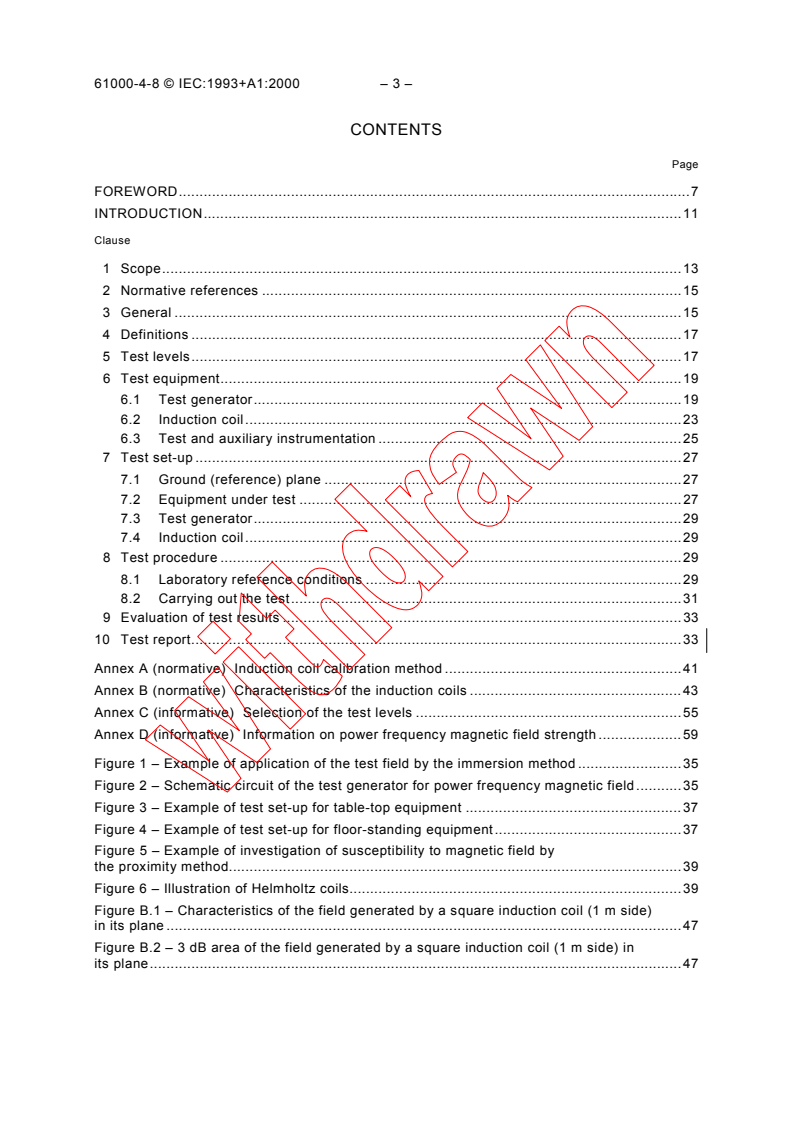
61000-4-8 © IEC:1993+A1:2000 – 3 –
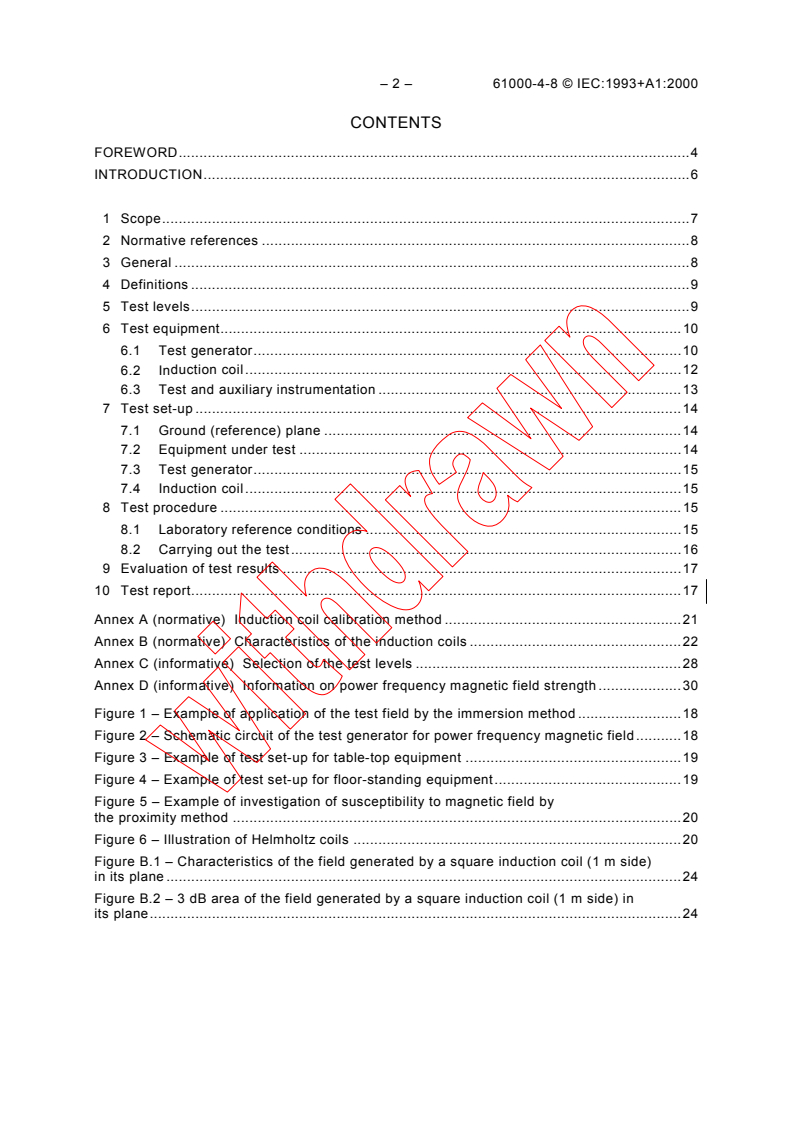
CONTENTS
Page
FOREWORD.7
INTRODUCTION.11
Clause
1 Scope.13
2 Normative references .15
3 General .15
4 Definitions .17
5 Test levels.17
6 Test equipment.19
6.1 Test generator.19
6.2 Induction coil.23
6.3 Test and auxiliary instrumentation .25
7 Test set-up .27
7.1 Ground (reference) plane .27
7.2 Equipment under test .27
7.3 Test generator.29
7.4 Induction coil.29
8 Test procedure .29
8.1 Laboratory reference conditions .29
8.2 Carrying out the test.31
9 Evaluation of test results .33
10 Test report.33
Annex A (normative) Induction coil calibration method .41
Annex B (normative) Characteristics of the induction coils .43
Annex C (informative) Selection of the test levels .55
Annex D (informative) Information on power frequency magnetic field strength .59
Figure 1 – Example of application of the test field by the immersion method .35
Figure 2 – Schematic circuit of the test generator for power frequency magnetic field.35
Figure 3 – Example of test set-up for table-top equipment .37
Figure 4 – Example of test set-up for floor-standing equipment.37
Figure 5 – Example of investigation of susceptibility to magnetic field by
the proximity method.39
Figure 6 – Illustration of Helmholtz coils.39
Figure B.1 – Characteristics of the field generated by a square induction coil (1 m side)
in its plane .47
Figure B.2 – 3 dB area of the field generated by a square induction coil (1 m side) in
its plane.47
61000-4-8 © IEC:1993+A1:2000 – 5 –
Page
Figure B.3 – 3 dB area of the field generated by a square induction coil (1 m side) in
the mean orthogonal plane (component orthogonal to the plane of the coil) .49
Figure B.4 – 3 dB area of the field generated by two square induction coils (1 m side)
0,6 m spaced, in the mean orthogonal plane (component orthogonal to the plane of the
coils).49
Figure B.5 – 3 dB area of the field generated by two square induction coils
(1 m side) 0,8 m spaced, in the mean orthogonal plane (component orthogonal
to the plane of the coils) .51
Figure B.6 – 3 dB area of the field generated by a rectangular induction coil
(1 m × 2,6 m) in its plane .51
Figure B.7 – 3 dB area of the field generated by a rectangular induction coil
(1 m × 2,6 m) in its plane (ground plane as a side of the induction coil).53
Figure B.8 – 3 dB area of the field generated by a rectangular induction coil
(1 m × 2,6 m) with ground plane, in the mean orthogonal plane (component orthogonal
to the plane of the coil) .53
Table 1 – Test levels for continuous field .19
Table 2 – Test levels for short duration: 1 s to 3 s.19
Table D.1 – Values of the maximum magnetic field produced by household appliances
(results of the measurements of 100 different devices of 25 basic types) .59
Table D.2 – Values of the magnetic field generated by a 400 kV line .59
Table D.3 – Values of the magnetic field in high voltage sub-station areas .61
Table D.4 – Values of the magnetic field in power plants .61
61000-4-8 © IEC:1993+A1:2000 – 7 –
INTERNATIONAL ELECTROTECHNICAL COMMISSION
____________
ELECTROMAGNETIC COMPATIBILITY (EMC) –
Part 4-8: Testing and measurement techniques –
Power frequency magnetic field immunity test
FOREWORD
1) The IEC (International Electrotechnical Commission) is a worldwide organization for standardization comprising
all national electrotechnical committees (IEC National Committees). The object of the IEC is to promote
international co-operation on all questions concerning standardization in the electrical and electronic fields. To
this end and in addition to other activities, the IEC publishes International Standards. Their preparation is
entrusted to technical committees; any IEC National Committee interested in the subject dealt with may
participate in this preparatory work. International, governmental and non-governmental organizations liaising
with the IEC also participate in this preparation. The IEC collaborates closely with the International
Organization for Standardization (ISO) in accordance with conditions determined by agreement between the
two organizations.
2) The formal decisions or agreements of the IEC on technical matters express, as nearly as possible, an
international consensus of opinion on the relevant subjects since each technical committee has representation
from all interested National Committees.
3) The documents produced have the form of recommendations for international use and are published in the form
of standards, technical specifications, technical reports or guides and they are accepted by the National
Committees in that sense.
4) In order to promote international unification, IEC National Committees undertake to apply IEC International
Standards transparently to the maximum extent possible in their national and regional standards. Any
divergence between the IEC Standard and the corresponding national or regional standard shall be clearly
indicated in the latter.
5) The IEC provides no marking procedure to indicate its approval and cannot be rendered responsible for any
equipment declared to be in conformity with one of its standards.
6) Attention is drawn to the possibility that some of the elements of this International Standard may be the subject
of patent rights. The IEC shall not be held responsible for identifying any or all such patent rights.
International Standard IEC 61000-4-8 has been prepared by subcommittee 77B: High
frequency phenomena, of IEC technical committee 77: Electromagnetic compatibility.
It forms section 8 of part 4 of IEC 61000. It has the status of a basic EMC publication in
accordance with IEC Guide 107.
This consolidated version of IEC 61000-4-8 consists of the first edition (1993) [documents
77B(CO)7 and 77B(CO)13] and its amendment 1 (2000) [documents 77B/291+293/FDIS and
77B/298+300/RVD].
The technical content is therefore identical to the base edition and its amendment and has
been prepared for user convenience.
It bears the edition number 1.1.
A vertical line in the margin shows where the base publication has been modified by
amendment 1.
Annexes A and B form an integral part of this standard.
Annexes C and D are for information only.
61000-4-8 © IEC:1993+A1:2000 – 9 –
The committee has decided that the contents of the base publication and its amendment will
remain unchanged until 2002. At this date, the publication will be
• reconfirmed;
• withdrawn;
• replaced by a revised edition, or
• amended.
61000-4-8 © IEC:1993+A1:2000 – 11 –
INTRODUCTION
This standard is part of the IEC 61000 series, according to the following structure:
Part 1: General
General considerations (introduction, fundamental principles)
Definitions, terminology
Part 2: Environment
Description of the environment
Classification of the environment
Compatibility levels
Part 3: Limits
Emission limits
Immunity limits (in so far as they do not fall under the responsibility of the product
committees)
Part 4: Testing and measurement techniques
Measurement techniques
Testing techniques
Part 5: Installation and mitigation guidelines
Installation guidelines
Mitigation methods and devices
Part 9: Miscellaneous
Each part is further subdivided into sections which are to be published either as international
standards or as technical reports.
These standards and reports will be published in chronological order and numbered
accordingly.
This part is an international standard which gives immunity requirements and test procedures
related to "power frequency magnetic field".
61000-4-8 © IEC:1993+A1:2000 – 13 –
ELECTROMAGNETIC COMPATIBILITY (EMC) –
Part 4-8: Testing and measurement techniques –
Power frequency magnetic field immunity test
1 Scope
This international standard relates to the immunity requirements of equipment, only under
operational conditions, to magnetic disturbances at power frequency related to:
– residential and commercial locations;
– industrial installations and power plants;
– medium voltage and high voltage sub-stations.
The applicability of this standard to equipment installed in different locations is determined by
the presence of the phenomenon, as specified in clause 3.
This standard does not consider disturbances due to capacitive or inductive coupling in cables
or other parts of the field installation.
Other IEC standards dealing with conducted disturbances cover these aspects.
The object of this standard is to establish a common and reproducible basis for evaluating the
performance of electrical and electronic equipment for household, commercial and industrial
applications when subjected to magnetic fields at power frequency (continuous and short
duration field).
The standard defines:
– recommended test levels;
– test equipment;
– test set-up;
– test procedure.
Other kinds of magnetic fields would be object of standardization:
– fields at other power frequencies (16 2/3 – 20 or 30 – 400 Hz);
– fields of harmonic currents (100 Hz to 2 000 Hz);
– fields of higher frequencies (up to 150 kHz, e.g. for mains signalling systems);
– D.C. fields.
61000-4-8 © IEC:1993+A1:2000 – 15 –
2 Normative references
The following normative documents contain provisions which, through reference in this text,
constitute provisions of this section of IEC 61000-4. At the time of publication, the editions
indicated were valid. All normative documents are subject to revision, and parties to
agreements based on this section of IEC 61000-4 are encouraged to investigate the
possibility of applying the most recent editions of the normative documents indicated below.
Members of IEC and ISO maintain registers of currently valid International Standards.
IEC 60068-1:1988, Environmental testing – Part 1: General and guidance
3 General
The magnetic fields to which equipment is subjected may influence the reliable operation of
equipment and systems.
The following tests are intended to demonstrate the immunity of equipment when subjected to
power frequency magnetic fields related to the specific location and installation condition of
the equipment (e.g. proximity of equipment to the disturbance source).
The power frequency magnetic field is generated by power frequency current in conductors
or, more seldom, from other devices (e.g. Ieakage of transformers) in the proximity of
equipment.
As for the influence of nearby conductors, one should differentiate between:
– the current under normal operating conditions, which produces a steady magnetic field,
with a comparatively small magnitude;
– the current under fault conditions which can produce comparatively high magnetic fields
but of short duration, until the protection devices operate (a few milliseconds with fuses, a
few seconds for protection relays).
The test with a steady magnetic field may apply to all types of equipment intended for public
or industrial low voltage distribution networks or for electrical plants.
The test with a short duration magnetic field related to fault conditions, requires test levels
that differ from those for steady-state conditions; the highest values apply mainly to
equipment to be installed in exposed places of electrical plants.
The test field waveform is that of power frequency.
In many cases (household areas, sub-stations and power plant under normal conditions), the
magnetic field produced by harmonics is negligible. However, in very special cases like heavy
industrial areas (large power convertors, etc.) they occur, and will be considered in a future
revision of this standard.
61000-4-8 © IEC:1993+A1:2000 – 17 –
4 Definitions
The following definitions and terms are used in this standard and apply to the restricted field
of magnetic disturbances; not all of them are included in IEC 60050(161) [IEV].
4.1
EUT
equipment under test
4.2
induction coil
conductor loop of defined shape and dimensions, in which flows a current, generating a
magnetic field of defined constancy in its plane and in the enclosed volume
4.3
induction coil factor
ratio between the magnetic field strength generated by an induction coil of given dimensions
and the corresponding current value; the field is that measured at the centre of the coil plane,
without the EUT
4.4
immersion method
method of application of the magnetic field to the EUT, which is placed in the centre of an
induction coil (figure 1)
4.5
proximity method
method of application of the magnetic field to the EUT, where a small induction coil is moved
along the side of the EUT in order to detect particularly sensitive areas
4.6
ground (reference) plane (GRP)
a flat conductive surface whose potential is used as a common reference for the magnetic
field generator and the auxiliary equipment (the ground plane can be used to close the loop of
the induction coil, as in figure 4)
[IEV 161-04-36, modified]
4.7
decoupling network, back filter
electrical circuit intended to avoid reciprocal influence with other equipment not submitted to
the magnetic field test
5 Test levels
The preferential range of test levels, respectively for continuous and short duration application
of the magnetic field, applicable to distribution networks at 50 Hz and 60 Hz, is given in table 1
and table 2.
The magnetic field strength is expressed in A/m; 1 A/m corresponds to a free space induction
of 1,26 μT.
61000-4-8 © IEC:1993+A1:2000 – 19 –
Table 1 – Test levels for continuous field
Level Magnetic field strength
A/m
5 100
1)
x special
NOTE 1 "x" is an open level. This level can be given
in the product specification.
Table 2 – Test levels for short duration: 1 s to 3 s
Level Magnetic field strength
A/m
2)
1 n.a.
2)
2 n.a.
2)
3 n.a.
4 300
51 000
1)
x special
NOTE 1 "x" is an open level. This level, as well the
duration of the test, can be given in the product
specification.
NOTE 2 "n.a." = not applicable.
Information on the selection of the test levels is given in annex C.
Information on actual levels is given in annex D.
6 Test equipment
The test magnetic field is obtained by a current flowing in an induction coil; the application of
the test field to the EUT is by the immersion method.
An example of application of the immersion method is given in figure 1.
The test equipment includes the current source (test generator), the induction coil and
auxiliary test instrumentation.
6.1 Test generator
The generator, with the output waveform corresponding to the test magnetic field, shall be
able to deliver the required current in the induction coils specified in 6.2.
The generator power capability shall therefore be dimensioned by taking into account the coil
impedance; the inductance may range from 2,5 μH for the 1 m standard coil, to several μH
(e.g. 6 μH) for a rectangular induction coil (1 m × 2,6 m, see 6.2).
61000-4-8 © IEC:1993+A1:2000 – 21 –
The specifications of the generator are:
– current capability, determined by the maximum selected test level and induction coil factor
–1
(see 6.2.2 and annex A), ranging from 0,87 m , (1 m standard coil for testing table-top or
–1
small equipment) to 0,66 m (rectangular induction coil, 1 m × 2,6 m, for testing floor-
standing or large equipment);
– operability in short-circuit condition;
– low output terminal connected to the earth terminal (for connection to the safety earth of
the laboratory);
– precautions to prevent the emission of large disturbances that may be injected in the
power supply network or may influence the test results.
The characteristics and performances of the current source or test generator for the different
fields considered in this standard are given in 6.1.1.
6.1.1 Characteristics and performances of the test generator
The current source typically consists of a voltage regulator (connected to the mains
distribution network), a current transformer and a circuit for the control of short duration
application. The generator shall be able to operate in continuous mode or short duration mode.
Specifications
Output current range for
continuous mode operation: 1 A to 100 A, divided by the coil factor
Output current range for
short duration mode operation: 300 A to 1000 A, divided by the coil factor
Total distortion factor of
the output current: less than 8 %
Set time for short duration
mode operation: 1 s to 3 s
NOTE The output current range for the standard coil is from 1,2 A to 120 A for continuous mode, and from
350 A to 1200 A for short duration mode.
The waveform of the output current is a sinusoid.
The schematic circuit of the generator is given in figure 2.
6.1.2 Verification of the characteristics of the test generator
In order to compare the results for different test generators, the essential characteristics of
the output current parameters shall be verified.
The output current shall be verified with the generator connected to the standard induction
coil specified in 6.2.1 a); the connection shall be realized by twisted conductors of up to 3 m
length and suitable cross-section.
The emission of disturbances by the generator shall be verified (see 6.1).
The characteristics to be verified are:
– output current value;
– total distortion factor.
The verifications shall be carried out with a current probe and measurement instrumentation
having ±2 % accuracy.
61000-4-8 © IEC:1993+A1:2000 – 23 –
6.2 Induction coil
6.2.1 Characteristics of the induction coil
The induction coil, connected to the test generator previously defined (see 6.1.1), shall
generate a field strength corresponding to the selected test level and the defined homo-
geneity.
The induction coil shall be made of copper, aluminium or any conductive non-magnetic
material, of such cross-section and mechanical arrangement as to facilitate its stable
positioning during the tests.
A same coil is suitable for the generation of the magnetic fields considered in this standard; it
may be a "single turn" coil and shall have a suitable current capability, as may be necessary
for the selected test level.
Multi-turn coils may be used in order to have a lower testing current.
The induction coil shall be adequately dimensioned to surround the EUT (three orthogonal
positions).
Depending on the size of the EUT, induction coils of different dimensions may be used.
The dimensions recommended below are suitable for the generation of magnetic fields over
the whole volume of the EUT's (table-top equipment or floor-standing equipment), with an
acceptable variation of ±3 dB.
The characteristics of induction coils in respect of the magnetic field distribution are given in
annex B.
a) Induction coil for table-top equipment
The induction coil of standard dimensions for testing small equipment (e.g. computer
monitors, watt-hour meters, transmitters for process control, etc.) has a square (or
circular) form with 1 m side (or diameter), made of a conductor of relatively small cross-
section.
The test volume of the standard square coil is 0,6 m × 0,6 m × 0,5 m (height).
A double coil of standard size (Helmholtz coil) could be used in order to obtain a field
homogeneity better than 3 dB or for testing larger EUT's.
The double coil (Helmholtz coil) shall be comprised of two or more series of turns, properly
spaced (see figure 6, figure B.4, figure B.5).
The test volume of a double standard size coil, 0,8 m spaced, for a 3 dB homogeneity is
0,6 m × 0,6 m × 1 m (height).
For example, the Helmholtz coils, for a 0,2 dB inhomogeneity, have dimensions and
separation distances as given in figure 6.
b) Induction coil for floor-standing equipment
Induction coils shall be made according to the dimensions of the EUT and the different
field polarizations.
The coil shall be able to envelop the EUT; the coil dimensions shall be such as to give a
minimum distance of coil conductors to EUT walls equal to 1/3 of the dimension of the
EUT considered.
61000-4-8 © IEC:1993+A1:2000 – 25 –
The coils shall be made of conductors of relatively small cross-section.
NOTE Due to the possible large dimensions of EUT's, the coils may be made of "C" or "T" sections in order to
have sufficient mechanical rigidity.
The test volume is determined by the testing area of the coil (60 % × 60 % of each side)
multiplied by a depth corresponding to 50 % of the shorter side of the coil.
6.2.2 Calibration of the inductio
...
NORME CEI
INTERNATIONALE
61000-4-8
Edition 1.1
2001-03
Edition 1:1993 consolidée par l’amendement 1:2000
PUBLICATION FONDAMENTALE EN CEM
Compatibilité électromagnétique (CEM) –
Partie 4-8:
Techniques d'essai et de mesure –
Essai d'immunité au champ magnétique
à la fréquence du réseau
Cette version française découle de la publication d’origine
bilingue dont les pages anglaises ont été supprimées.
Les numéros de page manquants sont ceux des pages
supprimées.
Numéro de référence
CEI 61000-4-8:1993+A1:2000(F)
Numérotation des publications
Depuis le 1er janvier 1997, les publications de la CEI sont numérotées à partir de
60000. Ainsi, la CEI 34-1 devient la CEI 60034-1.
Editions consolidées
Les versions consolidées de certaines publications de la CEI incorporant les
amendements sont disponibles. Par exemple, les numéros d’édition 1.0, 1.1 et 1.2
indiquent respectivement la publication de base, la publication de base incorporant
l’amendement 1, et la publication de base incorporant les amendements 1 et 2
Informations supplémentaires sur les publications de la CEI
Le contenu technique des publications de la CEI est constamment revu par la CEI
afin qu'il reflète l'état actuel de la technique. Des renseignements relatifs à cette
publication, y compris sa validité, sont disponibles dans le Catalogue des
publications de la CEI (voir ci-dessous) en plus des nouvelles éditions, amende-
ments et corrigenda. Des informations sur les sujets à l’étude et l’avancement des
travaux entrepris par le comité d’études qui a élaboré cette publication, ainsi que la
liste des publications parues, sont également disponibles par l’intermédiaire de:
• Site web de la CEI (www.iec.ch)
• Catalogue des publications de la CEI
Le catalogue en ligne sur le site web de la CEI (www.iec.ch/searchpub) vous permet
de faire des recherches en utilisant de nombreux critères, comprenant des
recherches textuelles, par comité d’études ou date de publication. Des informations
en ligne sont également disponibles sur les nouvelles publications, les publications
remplacées ou retirées, ainsi que sur les corrigenda.
• IEC Just Published
Ce résumé des dernières publications parues (www.iec.ch/online_news/justpub)
est aussi disponible par courrier électronique. Veuillez prendre contact avec le
Service client (voir ci-dessous) pour plus d’informations.
• Service clients
Si vous avez des questions au sujet de cette publication ou avez besoin de
renseignements supplémentaires, prenez contact avec le Service clients:
Email: custserv@iec.ch
Tél: +41 22 919 02 11
Fax: +41 22 919 03 00
NORME CEI
INTERNATIONALE
61000-4-8
Edition 1.1
2001-03
Edition 1:1993 consolidée par l’amendement 1:2000
PUBLICATION FONDAMENTALE EN CEM
Compatibilité électromagnétique (CEM) –
Partie 4-8:
Techniques d'essai et de mesure –
Essai d'immunité au champ magnétique
à la fréquence du réseau
IEC 2001 Droits de reproduction réservés
Aucune partie de cette publication ne peut être reproduite ni utilisée sous quelque forme que ce soit et par aucun
procédé, électronique ou mécanique, y compris la photocopie et les microfilms, sans l'accord écrit de l'éditeur.
International Electrotechnical Commission, 3, rue de Varembé, PO Box 131, CH-1211 Geneva 20, Switzerland
Telephone: +41 22 919 02 11 Telefax: +41 22 919 03 00 E-mail: inmail@iec.ch Web: www.iec.ch
CODE PRIX
CK
Commission Electrotechnique Internationale
International Electrotechnical Commission
Международная Электротехническая Комиссия
Pour prix, voir catalogue en vigueur
– 2 – 61000-4-8 © CEI:1993+A1:2000
SOMMAIRE
Pages
AVANT-PROPOS.6
INTRODUCTION.10
Articles
1 Domaine d'application .12
2 Références normatives.14
3 Généralités.14
4 Définitions .16
5 Niveaux d'essais .16
6 Matériel d'essai .18
6.1 Générateur d'essai .18
6.2 Bobine d'induction .22
6.3 Instrumentation d'essai et instrumentation auxiliaire.24
7 Installation d'essai.26
7.1 Plan de sol .26
7.2 Equipement en essai .26
7.3 Générateur d'essai .28
7.4 Bobine d'induction .28
8 Procédure d'essai.28
8.1 Conditions de référence du laboratoire .28
8.2 Exécution de l'essai.30
9 Evaluation des résultats d’essai .32
10 Rapport d’essai .32
Annexe A (normative) Méthode d'étalonnage des bobines d'induction.40
Annexe B (normative) Caractéristiques des bobines d'induction.42
Annexe C (informative) Sélection des niveaux d'essais.54
Annexe D (informative) Information sur l'intensité des champs magnétiques
à la fréquence du réseau .58
Figure 1 – Exemple d'application du champ par la méthode par immersion .34
Figure 2 – Schéma du générateur d'essai produisant le champ magnétique
à la fréquence du réseau .34
Figure 3 – Exemple d'installation d'essai pour matériel de table.36
Figure 4 – Exemple d'installation d'essai pour matériel posé au sol .36
Figure 5 – Exemple de recherche de susceptibilité aux champs magnétiques
par la méthode de proximité.38
Figure 6 – Représentation des bobines de Helmholtz.38
Figure B.1 – Caractéristiques du champ engendré dans son plan par une spire
d'induction carrée (1 m de côté).46
Figure B.2 – Zones des 3 dB pour le champ engendré dans son plan par une spire
d'induction carrée (1 m de côté).46
– 4 – 61000-4-8 © CEI:1993+A1:2000
Pages
Figure B.3 – Zones des 3 dB pour le champ engendré dans le plan orthogonal moyen
(composante orthogonale au plan de la spire) par une spire d'induction carrées
(1 m de côté) .48
Figure B.4 – Zones des 3 dB pour le champ engendré dans le plan orthogonal moyen
(composante orthogonale au plan des spires) par deux spires d'induction carrées
(1 m de côté) espacées de 0,6 m .48
Figure B.5 – Zones des 3 dB pour le champ engendré dans le plan orthogonal moyen
(composante orthogonale au plan des spires) par deux spires d'induction carrées
(1 m de côté) espacées de 0,8 m .50
Figure B.6 – Zones des 3 dB pour le champ engendré dans son plan par une spire
d'induction rectangulaire (1 m × 2,6 m) .50
Figure B.7 – Zones des 3 dB pour le champ engendré dans son plan par une spire
d'induction rectangulaire (1 m × 2,6 m), le plan de sol étant considéré comme un côté
de la bobine.52
Figure B.8 – Zones des 3 dB pour le champ engendré dans le plan orthogonal moyen
(composante orthogonale au plan de la spire) par une spire d'induction rectangulaire
(1 m × 2,6 m) .52
Tableau 1 – Niveaux d'essais pour champ permanent.18
Tableau 2 – Niveaux d'essais de courte durée: 1 s à 3 s.18
Tableau D.1 – Valeurs maximales du champ magnétique produit par les appareils
ménagers (résultats de mesures réalisées sur 100 appareils de 25 types différents).58
Tableau D.2 – Valeurs du champ magnétique sous les fils d'une ligne 400 kV .58
Tableau D.3 – Valeurs du champ magnétique dans les zones de postes électriques
haute tension.60
Tableau D.4 – Valeurs du champ magnétique dans les centrales électriques .60
– 6 – 61000-4-8 © CEI:1993+A1:2000
COMMISSION ÉLECTROTECHNIQUE INTERNATIONALE
____________
COMPATIBILITÉ ÉLECTROMAGNÉTIQUE (CEM) –
Partie 4-8: Techniques d'essai et de mesure –
Essai d'immunité au champ magnétique à la fréquence du réseau
AVANT-PROPOS
1) La CEI (Commission Électrotechnique Internationale) est une organisation mondiale de normalisation
composée de l'ensemble des comités électrotechniques nationaux (Comités nationaux de la CEI). La CEI a
pour objet de favoriser la coopération internationale pour toutes les questions de normalisation dans les
domaines de l'électricité et de l'électronique. A cet effet, la CEI, entre autres activités, publie des Normes
internationales. Leur élaboration est confiée à des comités d'études, aux travaux desquels tout Comité national
intéressé par le sujet traité peut participer. Les organisations internationales, gouvernementales et non
gouvernementales, en liaison avec la CEI, participent également aux travaux. La CEI collabore étroitement
avec l'Organisation Internationale de Normalisation (ISO), selon des conditions fixées par accord entre les
deux organisations.
2) Les décisions ou accords officiels de la CEI concernant les questions techniques représentent, dans la mesure
du possible, un accord international sur les sujets étudiés, étant donné que les Comités nationaux intéressés
sont représentés dans chaque comité d’études.
3) Les documents produits se présentent sous la forme de recommandations internationales. Ils sont publiés
comme normes, spécifications techniques, rapports techniques ou guides et agréés comme tels par les
Comités nationaux.
4) Dans le but d'encourager l'unification internationale, les Comités nationaux de la CEI s'engagent à appliquer de
façon transparente, dans toute la mesure possible, les Normes internationales de la CEI dans leurs normes
nationales et régionales. Toute divergence entre la norme de la CEI et la norme nationale ou régionale
correspondante doit être indiquée en termes clairs dans cette dernière.
5) La CEI n’a fixé aucune procédure concernant le marquage comme indication d’approbation et sa responsabilité
n’est pas engagée quand un matériel est déclaré conforme à l’une de ses normes.
6) L’attention est attirée sur le fait que certains des éléments de la présente Norme internationale peuvent faire
l’objet de droits de propriété intellectuelle ou de droits analogues. La CEI ne saurait être tenue pour
responsable de ne pas avoir identifié de tels droits de propriété et de ne pas avoir signalé leur existence
La Norme internationale CEI 61000-4-8 a été établie par le sous-comité 77B: Phénomènes
haute fréquence, du comité d'études 77 de la CEI: Compatibilité électromagnétique.
Elle constitue la section 8 de la partie 4 de la norme CEI 61000. Elle a le statut de
publication fondamentale en CEM en accord avec le Guide 107 de la CEI.
La présente version consolidée de la CEI 61000-4-8 comprend la première édition (1993)
[documents 77B(BC)7 et 77B(BC)13] et son amendement 1 (2000) [documents
77B/291+293/FDIS et 77B/298+300/RVD].
Le contenu technique de cette version consolidée est donc identique à celui de l'édition de
base et à son amendement; cette version a été préparée par commodité pour l'utilisateur.
Elle porte le numéro d'édition 1.1.
Une ligne verticale dans la marge indique où la publication de base a été modifiée par
l’amendement 1.
Les annexes A et B font partie intégrante de cette norme.
Les annexes C et D sont données uniquement à titre d'information.
– 8 – 61000-4-8 © CEI:1993+A1:2000
Le comité a décidé que le contenu de la publication de base et de son amendement ne sera
pas modifié avant 2002. A cette date, la publication sera
• reconduite;
• supprimée;
• remplacée par une édition révisée, ou
• amendée.
– 10 – 61000-4-8 © CEI:1993+A1:2000
INTRODUCTION
La présente norme fait partie de la série des normes 61000 de la CEI, selon la répartition
suivante:
Partie 1: Généralités
Considérations générales (introduction, principes fondamentaux)
Définitions, terminologie
Partie 2: Environnement
Description de l'environnement
Classification de l'environnement
Niveaux de compatibilité
Partie 3: Limites
Limites d'émission
Limites d'immunité (dans la mesure où elles ne relèvent pas des comités de produit)
Partie 4: Techniques d'essai et de mesure
Techniques de mesure
Techniques d'essai
Partie 5: Guide d'installation et d'atténuation
Guide d'installation
Méthodes et dispositifs d'atténuation
Partie 9: Divers
Chaque partie est à son tour subdivisée en sections qui seront publiées soit comme normes
internationales soit comme rapports techniques.
Ces normes et rapports seront publiés dans un ordre chronologique et numérotés en
conséquence.
La présente partie constitue une norme internationale qui traite des prescriptions en matière
d'immunité et des procédures d'essai qui s'appliquent au «Champ magnétique à la fréquence
du réseau».
– 12 – 61000-4-8 © CEI:1993+A1:2000
COMPATIBILITÉ ÉLECTROMAGNÉTIQUE (CEM) –
Partie 4-8: Techniques d'essai et de mesure –
Essai d'immunité au champ magnétique à la fréquence du réseau
1 Domaine d'application
La présente Norme internationale traite des exigences en matière d'immunité des matériels,
uniquement dans les conditions d'utilisation, contre les perturbations magnétiques dans les:
– locaux résidentiels et commerciaux;
– installations industrielles et les centrales électriques;
– postes moyenne et haute tension.
Les conditions d'application de la présente norme aux matériels installés dans les différents
secteurs sont déterminées par la présence du phénomène dans les conditions spécifiées
dans l'article 3.
La présente norme ne traite pas des perturbations engendrées par le couplage capacitif ou
inductif sur les câbles ou autres parties de l'installation.
D'autres normes CEI traitant des perturbations conduites couvrent ces aspects.
La présente norme a pour objet d'établir une base commune et reproductible pour évaluer la
performance des matériels électriques et électroniques à vocation domestique, commerciale
ou industrielle lorsqu'ils sont soumis à des champs magnétiques à la fréquence du réseau
(champs permanents et courte durée).
La présente norme a pour objet de définir les éléments suivants:
– les niveaux recommandés d'essai;
– le matériel d'essai;
– l'installation d'essai;
– la procédure d'essai.
D'autres types de champs magnétiques pourront faire l'objet d'essais normalisés:
– champs à d'autres fréquences (16 2/3 – 20 ou 30 – 400 Hz);
– champs de courants d'harmoniques (100 Hz à 2 000 Hz);
– champs de fréquences plus élevées (jusqu'à 150 kHz, par exemple, pour le télérelevé);
– champs continus.
– 14 – 61000-4-8 © CEI:1993+A1:2000
2 Références normatives
Les documents normatifs suivants contiennent des dispositions qui, par suite de la référence
qui y est faite, constituent des dispositions valables pour la présente section de la CEI 61000-4.
Au moment de la publication, les éditions indiquées étaient en vigueur. Tout document normatif
est sujet à révision et les parties prenantes aux accords fondés sur la présente section de la
CEI 61000-4 sont invitées à rechercher la possibilité d'appliquer les éditions les plus récentes
des documents normatifs indiqués ci-après. Les membres de la CEI et de l'ISO possèdent le
registre des Normes Internationales en vigueur.
CEI 60068-1:1988, Essais d'environnement – Première partie: Généralités et guide
3 Généralités
Le champ magnétique auquel est soumis le matériel peut influencer le bon fonctionnement de
celui-ci et des ensembles qui y sont reliés.
Les essais dont il est fait état dans ce document ont pour objet de démontrer l'immunité du
matériel lorsqu'il est soumis au champ magnétique, à la fréquence du réseau qui s'applique à
l'emplacement spécifique et aux conditions d'installation de l'équipement (par exemple,
matériel situé à proximité de la source de perturbation).
Le champ magnétique à la fréquence du réseau est engendré par un courant à la fréquence
du réseau dans des fils ou, plus rarement, par d'autres appareils (par exemple, fuites de
transformateurs) situés à proximité du matériel.
En ce qui concerne les fils proches, il convient de distinguer deux types de courant:
– le courant dans des conditions de fonctionnement normales qui produit un champ
magnétique stable d'une amplitude relativement faible;
– le courant dans des conditions de défaut qui peut produire des champs magnétiques
relativement élevés, mais de courte durée, jusqu'à ce que les dispositifs de protection
fonctionnent (quelques millisecondes pour des fusibles, quelques secondes pour des
relais de protection).
L'essai à champ magnétique constant peut s'appliquer à tous les types de matériels destinés
aux réseaux de distribution basse tension publics ou industriels ou aux centrales électriques.
L'essai à champ magnétique de faible durée provoqué par des défauts nécessite des niveaux
différents de ceux des essais avec un champ constant; les valeurs les plus élevées
s'appliquent principalement aux matériels installés dans les endroits particulièrement exposés
des centrales électriques.
La forme d'onde du champ est celle de la fréquence du réseau.
Dans la plupart des cas (zones résidentielles, postes et centrales électriques dans des
conditions de fonctionnement normales), les champs magnétiques engendrés par les harmo-
niques sont négligeables. En revanche, dans des cas très particuliers comme les zones
d'industrie lourde (grands convertisseurs de puissance, etc.), ils apparaissent et seront pris
en considération lors d'une future révision de cette norme.
– 16 – 61000-4-8 © CEI:1993+A1:2000
4 Définitions
Les définitions et termes suivants sont utilisés dans la présente norme; ils concernent
uniquement le domaine des perturbations magnétiques et ne sont pas tous répertoriés dans la
CEI 60050(161) [VEI].
4.1
EST
équipement en essai
4.2
bobine d'induction
boucle d'induction de forme et de dimensions définies dans laquelle un courant circule, en
engendrant un champ magnétique d'un niveau constant défini dans son plan et dans le
volume contenu
4.3
facteur de bobine d'induction
rapport entre l'intensité du champ magnétique engendré par une spire d'induction de
dimensions données et la valeur du courant correspondant; le champ est mesuré au centre du
plan de la spire, sans tenir compte de l'EST
4.4
méthode par immersion
méthode d'application du champ magnétique à l'EST, placé au centre de la spire d'induction
(figure 1)
4.5
méthode de proximité
méthode d'application du champ magnétique à l'EST, là où une bobine de faible induction est
déplacée le long du côté de l'EST de manière à détecter des zones particulièrement sensibles
4.6
plan de sol (PS)
surface conductrice plane dont le potentiel est pris comme référence pour le générateur de
champ magnétique et le matériel auxiliaire. (Le plan de sol peut être utilisé pour fermer la
boucle de la spire d'induction, voir figure 4)
[VEI 161-04-36, modifié]
4.7
réseau de découplage, filtre anti-retour
réseau électrique destiné à éviter toute interaction avec un autre matériel non soumis aux
essais de champ magnétique
5 Niveaux d'essais
La gamme préférentielle des niveaux d'essais, pour l'application des champs magnétiques
permanents et des champs magnétiques de courte durée, applicable aux réseaux de
distribution 50 Hz et 60 Hz est indiquée dans les tableaux 1 et 2.
L'intensité du champ magnétique est exprimée en A/m; 1 A/m correspond à une induction en
espace libre de 1,26 μT.
– 18 – 61000-4-8 © CEI:1993+A1:2000
Tableau 1 – Niveaux d'essais pour champ permanent
Niveau Intensité des champs
magnétiques
A/m
5 100
1)
x spécial
NOTE 1 Le niveau «x» n'est pas défini. Ce niveau
peut être donné dans la spécification produit.
Tableau 2 – Niveaux d'essais de courte durée: 1 s à 3 s
Niveau Intensité des champs
magnétiques
A/m
2)
1 n.a.
2)
2 n.a.
2)
3 n.a.
4 300
51 000
1)
x spécial
NOTE 1 Le niveau «x» n'est pas défini. Ce niveau,
ainsi que la durée d'essai du champ de courte durée,
peuvent être donnés dans la spécification produit.
NOTE 2 «n.a.» = non applicable.
Les informations concernant la sélection des niveaux d'essais sont données dans l'annexe C.
Les informations concernant l'intensité des champs magnétiques réels sont données dans
l'annexe D.
6 Matériel d'essai
Le champ magnétique est obtenu par la circulation d'un courant dans une bobine d'induction.
Le champ est appliqué à l'EST par la méthode par immersion.
Un exemple d'application de la méthode par immersion est donné à la figure 1.
Le matériel d'essai comprend la source de courant (générateur d'essai), la bobine d'induction
et l'instrumentation d'essai auxiliaire.
6.1 Générateur d'essai
Le générateur dont la forme d'onde de sortie correspond au champ magnétique d'essai doit
être capable d'appliquer le courant requis aux bobines d'induction spécifiées en 6.2.
C'est pourquoi la puissance du générateur doit être dimensionnée en tenant compte de
l'impédance des bobines; la gamme d'inductances peut varier de 2,5 μH pour une bobine
normalisée de 1 m, à plusieurs μH (par exemple 6 μH) pour une bobine d'induction
rectangulaire (1 m × 2,6 m, paragraphe 6.2).
– 20 – 61000-4-8 © CEI:1993+A1:2000
Les spécifications du générateur sont les suivantes:
– intensité déterminée par le niveau d'essai maximal choisi et le facteur de bobine
–1
d'induction maximal choisi (paragraphe 6.2.2 et annexe A), qui varie de 0,87 m (bobine
–1
normalisée de 1 m pour tester les matériels de table ou les petits équipements) à 0,66 m
(bobine d'induction rectangulaire de 1 m × 2,6 m pour tester les équipements posés au sol
ou les grands équipements);
– aptitude au fonctionnement en présence de courts-circuits;
– point froid connecté à la borne de terre (pour la liaison au câble de terre de sécurité du
laboratoire);
– précautions nécessaires pour éviter la production de perturbations importantes pouvant
être injectées sur le réseau d'alimentation ou susceptibles d'influencer les résultats des essais.
Les caractéristiques et les performances des sources de courant ou du générateur d'essai
pour les différents champs étudiés dans la présente norme sont indiquées en 6.1.1.
6.1.1 Caractéristiques et performances du générateur d'essai
La source de courant est généralement constituée d'un régulateur de tension (connecté au
réseau d'alimentation), d'un transformateur d'intensité et d'un circuit pour la commande des
applications de courte durée. Le générateur doit être capable de fonctionner en mode
permanent ou en mode de courte durée.
Caractéristiques:
Gamme d'intensité de sortie pour
le fonctionnement permanent: 1 A à 100 A divisés par le facteur de bobine
Gamme d'intensité de sortie pour
le fonctionnement de courte durée: 300 A à 1 000 A divisés par le facteur de bobine
Facteur total de distorsion de
l'intensité de sortie: Inférieur à 8 %
Temps programmable pour le
fonctionnement de courte durée: 1 s à 3 s
NOTE La gamme d'intensité de sortie pour la bobine normalisée doit être de 1,2 A à 120 A en mode permanent et
de 350 A à 1 200 A en mode de courte durée.
La forme d'onde de l'intensité de sortie est sinusoïdale.
Le schéma du générateur est donné à la figure 2.
6.1.2 Vérification des caractéristiques du générateur d'essai
Pour comparer les résultats obtenus avec les différents générateurs d'essai, il faut vérifier les
caractéristiques essentielles des paramètres du courant de sortie.
Le courant de sortie doit être vérifié avec le générateur connecté à la bobine d'induction
normalisée spécifiée en 6.2.1 a); la connexion doit être réalisée avec des fils torsadés d'une
longueur maximale de 3 m de section appropriée.
Il faut vérifier l'émission de perturbations du générateur (voir 6.1).
Les caractéristiques à vérifier sont les suivantes:
– valeur du courant de sortie;
– facteur total de distorsion.
Les vérifications doivent être effectuées avec une pince ampèremétrique et une instrumen-
tation de mesure d'une précision de ±2 %.
– 22 – 61000-4-8 © CEI:1993+A1:2000
6.2 Bobine d'induction
6.2.1 Caractéristiques de la bobine d'induction
La bobine d'induction connectée au générateur d'essai défini plus haut (voir 6.1.1) doit produire
un champ dont l'intensité correspond au niveau d'essai choisi et à la précision demandée.
Cette bobine doit être faite de cuivre, d'aluminium ou de tout autre matériau conducteur non
magnétique; sa section et sa conception doivent permettre de lui donner une position stable
pendant les essais.
Il est souhaitable de pouvoir produire les champs magnétiques considérés dans cette norme
avec la même bobine; dans ce cas, elle peut être de type «monospire» et doit pouvoir
supporter l'intensité qui peut être nécessaire pour le niveau d'essai choisi.
On peut utiliser une bobine multispire de manière à obtenir une intensité de courant d'essai
plus basse.
Les dimensions de la bobine d'induction doivent lui permettre d'envelopper l'EST (trois
positions orthogonales).
Des bobines d'induction de différentes dimensions peuvent être utilisées en fonction de la
taille de l'EST.
Les dimensions conseillées ci-dessous permettent de produire des champs magnétiques
d'essai dans tout le volume des EST (matériel de table ou équipement posé au sol) avec une
variation acceptable de ±3 dB.
Les caractéristiques des bobines d'induction en fonction de la distribution du champ
magnétique sont données dans l'annexe B.
a) Bobine d'induction pour matériel de table
La bobine d'induction de dimensions normalisées destinée aux essais des petits matériels
(terminaux, watt-heuremètres, transmetteurs pour commande de processus, etc.) est de
forme carrée (ou circulaire), de 1 m de côté (ou de diamètre) et constituée d'un fil d'une
section relativement faible.
Le volume d'essai d'une bobine carrée normalisée est de 0,6 m × 0,6 m × 0,5 m (hauteur).
On peut utiliser une bobine double de taille normalisée (bobine de Helmholtz) pour obtenir
un champ homogène à 3 dB ou pour tester des EST de plus grand volume.
La bobine double (bobine de Helmholtz) doit être composée de deux ou plusieurs séries
de spires, convenablement espacées (voir figure 6, figure B.4, figure B.5).
Le volume d'essai d'une bobine double normalisée à espacement de 0,8 m, pour une
homogénéité meilleure que 3 dB, est de 0,6 m × 0,6 m × 1 m (hauteur).
Par exemple, pour une non homogénéité de 0,2 dB, les bobines de Helmholtz ont les
dimensions et la distance de séparation indiquées à la figure 6.
b) Bobine d'induction pour équipement posé au sol
Il faut réaliser des bobines d'induction compatibles avec les dimensions de l'EST et les
différentes polarisations du champ.
Cette bobine doit être capable d'envelopper l'EST; ses dimensions doivent permettre de
conserver une distance minimale entre les fils de la bobine et les parois de l'EST égale
au 1/3 du côté de l'EST considéré.
– 24 – 61000-4-8 © CEI:1993+A1:2000
Les bobines doivent être constituées de fils de section relativement faible.
NOTE Les dimensions de l'EST pouvant être grandes, la bobine peut être constituée d'une section en «C» ou
en «T» pour assurer une rigidité mécanique suffisante.
Le volume d'essai est déterminé par la zone d'essai de la bobine (60 % × 60 % de chaque
côté) multipliée par une profondeur égale à 50 % du plus petit côté.
6.2.2 Etalonnage de la bobine d'induction, facteur de la bobine
Pour permettre la comparaison des résultats obtenus avec différents matériels d'essai, il faut
étalonner les bobines d'induction dans leurs condit
...
IEC 61000-4-8
Edition 1.1 2001-03
INTERNATIONAL
STANDARD
NORME
INTERNATIONALE
BASIC EMC PUBLICATION
PUBLICATION FONDAMENTALE EN CEM
Electromagnetic compatibility (EMC) –
Part 4-8: Testing and measurement techniques – Power frequency magnetic field
immunity test
Compatibilité électromagnétique (CEM) –
Partie 4-8: Techniques d'essai et de mesure – Essai d'immunité au champ
magnétique à la fréquence du réseau
All rights reserved. Unless otherwise specified, no part of this publication may be reproduced or utilized in any form or by
any means, electronic or mechanical, including photocopying and microfilm, without permission in writing from either IEC or
IEC's member National Committee in the country of the requester.
If you have any questions about IEC copyright or have an enquiry about obtaining additional rights to this publication,
please contact the address below or your local IEC member National Committee for further information.
Droits de reproduction réservés. Sauf indication contraire, aucune partie de cette publication ne peut être reproduite
ni utilisée sous quelque forme que ce soit et par aucun procédé, électronique ou mécanique, y compris la photocopie
et les microfilms, sans l'accord écrit de la CEI ou du Comité national de la CEI du pays du demandeur.
Si vous avez des questions sur le copyright de la CEI ou si vous désirez obtenir des droits supplémentaires sur cette
publication, utilisez les coordonnées ci-après ou contactez le Comité national de la CEI de votre pays de résidence.
IEC Central Office
3, rue de Varembé
CH-1211 Geneva 20
Switzerland
Email: inmail@iec.ch
Web: www.iec.ch
About the IEC
The International Electrotechnical Commission (IEC) is the leading global organization that prepares and publishes
International Standards for all electrical, electronic and related technologies.
About IEC publications
The technical content of IEC publications is kept under constant review by the IEC. Please make sure that you have the
latest edition, a corrigenda or an amendment might have been published.
ƒ Catalogue of IEC publications: www.iec.ch/searchpub
The IEC on-line Catalogue enables you to search by a variety of criteria (reference number, text, technical committee,…).
It also gives information on projects, withdrawn and replaced publications.
ƒ IEC Just Published: www.iec.ch/online_news/justpub
Stay up to date on all new IEC publications. Just Published details twice a month all new publications released. Available
on-line and also by email.
ƒ Electropedia: www.electropedia.org
The world's leading online dictionary of electronic and electrical terms containing more than 20 000 terms and definitions
in English and French, with equivalent terms in additional languages. Also known as the International Electrotechnical
Vocabulary online.
ƒ Customer Service Centre: www.iec.ch/webstore/custserv
If you wish to give us your feedback on this publication or need further assistance, please visit the Customer Service
Centre FAQ or contact us:
Email: csc@iec.ch
Tel.: +41 22 919 02 11
Fax: +41 22 919 03 00
A propos de la CEI
La Commission Electrotechnique Internationale (CEI) est la première organisation mondiale qui élabore et publie des
normes internationales pour tout ce qui a trait à l'électricité, à l'électronique et aux technologies apparentées.
A propos des publications CEI
Le contenu technique des publications de la CEI est constamment revu. Veuillez vous assurer que vous possédez
l’édition la plus récente, un corrigendum ou amendement peut avoir été publié.
ƒ Catalogue des publications de la CEI: www.iec.ch/searchpub/cur_fut-f.htm
Le Catalogue en-ligne de la CEI vous permet d’effectuer des recherches en utilisant différents critères (numéro de référence,
texte, comité d’études,…). Il donne aussi des informations sur les projets et les publications retirées ou remplacées.
ƒ Just Published CEI: www.iec.ch/online_news/justpub
Restez informé sur les nouvelles publications de la CEI. Just Published détaille deux fois par mois les nouvelles
publications parues. Disponible en-ligne et aussi par email.
ƒ Electropedia: www.electropedia.org
Le premier dictionnaire en ligne au monde de termes électroniques et électriques. Il contient plus de 20 000 termes et
définitions en anglais et en français, ainsi que les termes équivalents dans les langues additionnelles. Egalement appelé
Vocabulaire Electrotechnique International en ligne.
ƒ Service Clients: www.iec.ch/webstore/custserv/custserv_entry-f.htm
Si vous désirez nous donner des commentaires sur cette publication ou si vous avez des questions, visitez le FAQ du
Service clients ou contactez-nous:
Email: csc@iec.ch
Tél.: +41 22 919 02 11
Fax: +41 22 919 03 00
IEC 61000-4-8
Edition 1.1 2001-03
INTERNATIONAL
STANDARD
NORME
INTERNATIONALE
BASIC EMC PUBLICATION
PUBLICATION FONDAMENTALE EN CEM
Electromagnetic compatibility (EMC) –
Part 4-8: Testing and measurement techniques – Power frequency magnetic
field immunity test
Compatibilité électromagnétique (CEM) –
Partie 4-8: Techniques d'essai et de mesure – Essai d'immunité au champ
magnétique à la fréquence du réseau
INTERNATIONAL
ELECTROTECHNICAL
COMMISSION
COMMISSION
ELECTROTECHNIQUE
PRICE CODE
INTERNATIONALE
CK
CODE PRIX
ICS 33.100.20 ISBN 2-8318-5659-0
– 2 – 61000-4-8 © IEC:1993+A1:2000
CONTENTS
FOREWORD.4
INTRODUCTION.6
1 Scope.7
2 Normative references .8
3 General .8
4 Definitions .9
5 Test levels.9
6 Test equipment.10
6.1 Test generator.10
6.2 Induction coil.12
6.3 Test and auxiliary instrumentation .13
7 Test set-up .14
7.1 Ground (reference) plane .14
7.2 Equipment under test .14
7.3 Test generator.15
7.4 Induction coil.15
8 Test procedure .15
8.1 Laboratory reference conditions .15
8.2 Carrying out the test.16
9 Evaluation of test results .17
10 Test report.17
Annex A (normative) Induction coil calibration method .21
Annex B (normative) Characteristics of the induction coils .22
Annex C (informative) Selection of the test levels .28
Annex D (informative) Information on power frequency magnetic field strength .30
Figure 1 – Example of application of the test field by the immersion method .18
Figure 2 – Schematic circuit of the test generator for power frequency magnetic field.18
Figure 3 – Example of test set-up for table-top equipment .19
Figure 4 – Example of test set-up for floor-standing equipment.19
Figure 5 – Example of investigation of susceptibility to magnetic field by
the proximity method .20
Figure 6 – Illustration of Helmholtz coils .20
Figure B.1 – Characteristics of the field generated by a square induction coil (1 m side)
in its plane .24
Figure B.2 – 3 dB area of the field generated by a square induction coil (1 m side) in
its plane.24
61000-4-8 © IEC:1993+A1:2000 – 3 –
Figure B.3 – 3 dB area of the field generated by a square induction coil (1 m side) in
the mean orthogonal plane (component orthogonal to the plane of the coil) .25
Figure B.4 – 3 dB area of the field generated by two square induction coils (1 m side)
0,6 m spaced, in the mean orthogonal plane (component orthogonal to the plane of the
coils).25
Figure B.5 – 3 dB area of the field generated by two square induction coils
(1 m side) 0,8 m spaced, in the mean orthogonal plane (component orthogonal
to the plane of the coils) .26
Figure B.6 – 3 dB area of the field generated by a rectangular induction coil
(1 m × 2,6 m) in its plane .26
Figure B.7 – 3 dB area of the field generated by a rectangular induction coil
(1 m × 2,6 m) in its plane (ground plane as a side of the induction coil).27
Figure B.8 – 3 dB area of the field generated by a rectangular induction coil
(1 m × 2,6 m) with ground plane, in the mean orthogonal plane (component orthogonal
to the plane of the coil) .27
Table 1 – Test levels for continuous field .10
Table 2 – Test levels for short duration: 1 s to 3 s.10
Table D.1 – Values of the maximum magnetic field produced by household appliances
(results of the measurements of 100 different devices of 25 basic types) .30
Table D.2 – Values of the magnetic field generated by a 400 kV line .30
Table D.3 – Values of the magnetic field in high voltage sub-station areas .31
Table D.4 – Values of the magnetic field in power plants .31
– 4 – 61000-4-8 © IEC:1993+A1:2000
INTERNATIONAL ELECTROTECHNICAL COMMISSION
____________
ELECTROMAGNETIC COMPATIBILITY (EMC) –
Part 4-8: Testing and measurement techniques –
Power frequency magnetic field immunity test
FOREWORD
1) The IEC (International Electrotechnical Commission) is a worldwide organization for standardization comprising
all national electrotechnical committees (IEC National Committees). The object of the IEC is to promote
international co-operation on all questions concerning standardization in the electrical and electronic fields. To
this end and in addition to other activities, the IEC publishes International Standards. Their preparation is
entrusted to technical committees; any IEC National Committee interested in the subject dealt with may
participate in this preparatory work. International, governmental and non-governmental organizations liaising
with the IEC also participate in this preparation. The IEC collaborates closely with the International
Organization for Standardization (ISO) in accordance with conditions determined by agreement between the
two organizations.
2) The formal decisions or agreements of the IEC on technical matters express, as nearly as possible, an
international consensus of opinion on the relevant subjects since each technical committee has representation
from all interested National Committees.
3) The documents produced have the form of recommendations for international use and are published in the form
of standards, technical specifications, technical reports or guides and they are accepted by the National
Committees in that sense.
4) In order to promote international unification, IEC National Committees undertake to apply IEC International
Standards transparently to the maximum extent possible in their national and regional standards. Any
divergence between the IEC Standard and the corresponding national or regional standard shall be clearly
indicated in the latter.
5) The IEC provides no marking procedure to indicate its approval and cannot be rendered responsible for any
equipment declared to be in conformity with one of its standards.
6) Attention is drawn to the possibility that some of the elements of this International Standard may be the subject
of patent rights. The IEC shall not be held responsible for identifying any or all such patent rights.
International Standard IEC 61000-4-8 has been prepared by subcommittee 77B: High
frequency phenomena, of IEC technical committee 77: Electromagnetic compatibility.
It forms section 8 of part 4 of IEC 61000. It has the status of a basic EMC publication in
accordance with IEC Guide 107.
This consolidated version of IEC 61000-4-8 consists of the first edition (1993) [documents
77B(CO)7 and 77B(CO)13] and its amendment 1 (2000) [documents 77B/291+293/FDIS and
77B/298+300/RVD].
The technical content is therefore identical to the base edition and its amendment and has
been prepared for user convenience.
It bears the edition number 1.1.
A vertical line in the margin shows where the base publication has been modified by
amendment 1.
Annexes A and B form an integral part of this standard.
Annexes C and D are for information only.
61000-4-8 © IEC:1993+A1:2000 – 5 –
The committee has decided that the contents of the base publication and its amendment will
remain unchanged until 2002. At this date, the publication will be
• reconfirmed;
• withdrawn;
• replaced by a revised edition, or
• amended.
– 6 – 61000-4-8 © IEC:1993+A1:2000
INTRODUCTION
This standard is part of the IEC 61000 series, according to the following structure:
Part 1: General
General considerations (introduction, fundamental principles)
Definitions, terminology
Part 2: Environment
Description of the environment
Classification of the environment
Compatibility levels
Part 3: Limits
Emission limits
Immunity limits (in so far as they do not fall under the responsibility of the product
committees)
Part 4: Testing and measurement techniques
Measurement techniques
Testing techniques
Part 5: Installation and mitigation guidelines
Installation guidelines
Mitigation methods and devices
Part 9: Miscellaneous
Each part is further subdivided into sections which are to be published either as international
standards or as technical reports.
These standards and reports will be published in chronological order and numbered
accordingly.
This part is an international standard which gives immunity requirements and test procedures
related to "power frequency magnetic field".
61000-4-8 © IEC:1993+A1:2000 – 7 –
ELECTROMAGNETIC COMPATIBILITY (EMC) –
Part 4-8: Testing and measurement techniques –
Power frequency magnetic field immunity test
1 Scope
This international standard relates to the immunity requirements of equipment, only under
operational conditions, to magnetic disturbances at power frequency related to:
– residential and commercial locations;
– industrial installations and power plants;
– medium voltage and high voltage sub-stations.
The applicability of this standard to equipment installed in different locations is determined by
the presence of the phenomenon, as specified in clause 3.
This standard does not consider disturbances due to capacitive or inductive coupling in cables
or other parts of the field installation.
Other IEC standards dealing with conducted disturbances cover these aspects.
The object of this standard is to establish a common and reproducible basis for evaluating the
performance of electrical and electronic equipment for household, commercial and industrial
applications when subjected to magnetic fields at power frequency (continuous and short
duration field).
The standard defines:
– recommended test levels;
– test equipment;
– test set-up;
– test procedure.
Other kinds of magnetic fields would be object of standardization:
– fields at other power frequencies (16 2/3 – 20 or 30 – 400 Hz);
– fields of harmonic currents (100 Hz to 2 000 Hz);
– fields of higher frequencies (up to 150 kHz, e.g. for mains signalling systems);
– D.C. fields.
– 8 – 61000-4-8 © IEC:1993+A1:2000
2 Normative references
The following normative documents contain provisions which, through reference in this text,
constitute provisions of this section of IEC 61000-4. At the time of publication, the editions
indicated were valid. All normative documents are subject to revision, and parties to
agreements based on this section of IEC 61000-4 are encouraged to investigate the
possibility of applying the most recent editions of the normative documents indicated below.
Members of IEC and ISO maintain registers of currently valid International Standards.
IEC 60068-1:1988, Environmental testing – Part 1: General and guidance
3 General
The magnetic fields to which equipment is subjected may influence the reliable operation of
equipment and systems.
The following tests are intended to demonstrate the immunity of equipment when subjected to
power frequency magnetic fields related to the specific location and installation condition of
the equipment (e.g. proximity of equipment to the disturbance source).
The power frequency magnetic field is generated by power frequency current in conductors
or, more seldom, from other devices (e.g. Ieakage of transformers) in the proximity of
equipment.
As for the influence of nearby conductors, one should differentiate between:
– the current under normal operating conditions, which produces a steady magnetic field,
with a comparatively small magnitude;
– the current under fault conditions which can produce comparatively high magnetic fields
but of short duration, until the protection devices operate (a few milliseconds with fuses, a
few seconds for protection relays).
The test with a steady magnetic field may apply to all types of equipment intended for public
or industrial low voltage distribution networks or for electrical plants.
The test with a short duration magnetic field related to fault conditions, requires test levels
that differ from those for steady-state conditions; the highest values apply mainly to
equipment to be installed in exposed places of electrical plants.
The test field waveform is that of power frequency.
In many cases (household areas, sub-stations and power plant under normal conditions), the
magnetic field produced by harmonics is negligible. However, in very special cases like heavy
industrial areas (large power convertors, etc.) they occur, and will be considered in a future
revision of this standard.
61000-4-8 © IEC:1993+A1:2000 – 9 –
4 Definitions
The following definitions and terms are used in this standard and apply to the restricted field
of magnetic disturbances; not all of them are included in IEC 60050(161) [IEV].
4.1
EUT
equipment under test
4.2
induction coil
conductor loop of defined shape and dimensions, in which flows a current, generating a
magnetic field of defined constancy in its plane and in the enclosed volume
4.3
induction coil factor
ratio between the magnetic field strength generated by an induction coil of given dimensions
and the corresponding current value; the field is that measured at the centre of the coil plane,
without the EUT
4.4
immersion method
method of application of the magnetic field to the EUT, which is placed in the centre of an
induction coil (figure 1)
4.5
proximity method
method of application of the magnetic field to the EUT, where a small induction coil is moved
along the side of the EUT in order to detect particularly sensitive areas
4.6
ground (reference) plane (GRP)
a flat conductive surface whose potential is used as a common reference for the magnetic
field generator and the auxiliary equipment (the ground plane can be used to close the loop of
the induction coil, as in figure 4)
[IEV 161-04-36, modified]
4.7
decoupling network, back filter
electrical circuit intended to avoid reciprocal influence with other equipment not submitted to
the magnetic field test
5 Test levels
The preferential range of test levels, respectively for continuous and short duration application
of the magnetic field, applicable to distribution networks at 50 Hz and 60 Hz, is given in table 1
and table 2.
The magnetic field strength is expressed in A/m; 1 A/m corresponds to a free space induction
of 1,26 μT.
– 10 – 61000-4-8 © IEC:1993+A1:2000
Table 1 – Test levels for continuous field
Level Magnetic field strength
A/m
1 1
2 3
3 10
4 30
5 100
1)
x special
NOTE 1 "x" is an open level. This level can be given
in the product specification.
Table 2 – Test levels for short duration: 1 s to 3 s
Level Magnetic field strength
A/m
2)
1 n.a.
2)
2 n.a.
2)
3 n.a.
4 300
5 1 000
1)
x special
NOTE 1 "x" is an open level. This level, as well the
duration of the test, can be given in the product
specification.
NOTE 2 "n.a." = not applicable.
Information on the selection of the test levels is given in annex C.
Information on actual levels is given in annex D.
6 Test equipment
The test magnetic field is obtained by a current flowing in an induction coil; the application of
the test field to the EUT is by the immersion method.
An example of application of the immersion method is given in figure 1.
The test equipment includes the current source (test generator), the induction coil and
auxiliary test instrumentation.
6.1 Test generator
The generator, with the output waveform corresponding to the test magnetic field, shall be
able to deliver the required current in the induction coils specified in 6.2.
The generator power capability shall therefore be dimensioned by taking into account the coil
impedance; the inductance may range from 2,5 μH for the 1 m standard coil, to several μH
(e.g. 6 μH) for a rectangular induction coil (1 m × 2,6 m, see 6.2).
61000-4-8 © IEC:1993+A1:2000 – 11 –
The specifications of the generator are:
– current capability, determined by the maximum selected test level and induction coil factor
–1
(see 6.2.2 and annex A), ranging from 0,87 m , (1 m standard coil for testing table-top or
–1
small equipment) to 0,66 m (rectangular induction coil, 1 m × 2,6 m, for testing floor-
standing or large equipment);
– operability in short-circuit condition;
– low output terminal connected to the earth terminal (for connection to the safety earth of
the laboratory);
– precautions to prevent the emission of large disturbances that may be injected in the
power supply network or may influence the test results.
The characteristics and performances of the current source or test generator for the different
fields considered in this standard are given in 6.1.1.
6.1.1 Characteristics and performances of the test generator
The current source typically consists of a voltage regulator (connected to the mains
distribution network), a current transformer and a circuit for the control of short duration
application. The generator shall be able to operate in continuous mode or short duration mode.
Specifications
Output current range for
continuous mode operation: 1 A to 100 A, divided by the coil factor
Output current range for
short duration mode operation: 300 A to 1000 A, divided by the coil factor
Total distortion factor of
the output current: less than 8 %
Set time for short duration
mode operation: 1 s to 3 s
NOTE The output current range for the standard coil is from 1,2 A to 120 A for continuous mode, and from
350 A to 1200 A for short duration mode.
The waveform of the output current is a sinusoid.
The schematic circuit of the generator is given in figure 2.
6.1.2 Verification of the characteristics of the test generator
In order to compare the results for different test generators, the essential characteristics of
the output current parameters shall be verified.
The output current shall be verified with the generator connected to the standard induction
coil specified in 6.2.1 a); the connection shall be realized by twisted conductors of up to 3 m
length and suitable cross-section.
The emission of disturbances by the generator shall be verified (see 6.1).
The characteristics to be verified are:
– output current value;
– total distortion factor.
The verifications shall be carried out with a current probe and measurement instrumentation
having ±2 % accuracy.
– 12 – 61000-4-8 © IEC:1993+A1:2000
6.2 Induction coil
6.2.1 Characteristics of the induction coil
The induction coil, connected to the test generator previously defined (see 6.1.1), shall
generate a field strength corresponding to the selected test level and the defined homo-
geneity.
The induction coil shall be made of copper, aluminium or any conductive non-magnetic
material, of such cross-section and mechanical arrangement as to facilitate its stable
positioning during the tests.
A same coil is suitable for the generation of the magnetic fields considered in this standard; it
may be a "single turn" coil and shall have a suitable current capability, as may be necessary
for the selected test level.
Multi-turn coils may be used in order to have a lower testing current.
The induction coil shall be adequately dimensioned to surround the EUT (three orthogonal
positions).
Depending on the size of the EUT, induction coils of different dimensions may be used.
The dimensions recommended below are suitable for the generation of magnetic fields over
the whole volume of the EUT's (table-top equipment or floor-standing equipment), with an
acceptable variation of ±3 dB.
The characteristics of induction coils in respect of the magnetic field distribution are given in
annex B.
a) Induction coil for table-top equipment
The induction coil of standard dimensions for testing small equipment (e.g. computer
monitors, watt-hour meters, transmitters for process control, etc.) has a square (or
circular) form with 1 m side (or diameter), made of a conductor of relatively small cross-
section.
The test volume of the standard square coil is 0,6 m × 0,6 m × 0,5 m (height).
A double coil of standard size (Helmholtz coil) could be used in order to obtain a field
homogeneity better than 3 dB or for testing larger EUT's.
The double coil (Helmholtz coil) shall be comprised of two or more series of turns, properly
spaced (see figure 6, figure B.4, figure B.5).
The test volume of a double standard size coil, 0,8 m spaced, for a 3 dB homogeneity is
0,6 m × 0,6 m × 1 m (height).
For example, the Helmholtz coils, for a 0,2 dB inhomogeneity, have dimensions and
separation distances as given in figure 6.
b) Induction coil for floor-standing equipment
Induction coils shall be made according to the dimensions of the EUT and the different
field polarizations.
The coil shall be able to envelop the EUT; the coil dimensions shall be such as to give a
minimum distance of coil conductors to EUT walls equal to 1/3 of the dimension of the
EUT considered.
61000-4-8 © IEC:1993+A1:2000 – 13 –
The coils shall be made of conductors of relatively small cross-section.
NOTE Due to the possible large dimensions of EUT's, the coils may be made of "C" or "T" sections in order to
have sufficient mechanical rigidity.
The test volume is determined by the testing area of the coil (60 % × 60 % of each side)
multiplied by a depth corresponding to 50 % of the shorter side of the coil.
6.2.2 Calibration of the induction coil, coil factor
In order to make it possible to compare the test results from different test equipment, the
induction coils shall be calibrated in their operating condition, before conducting the test
(without the EUT, in free space condition).
An induction coil of the correct dimensions for the EUT dimensions, shall be positioned at
1 m minimum distance from the wall of the laboratory and any magnetic material, by using
insulating supports, and shall be connected to the test generator as prescribed in 6.1.2.
Appropriate magnetic field sensors shall be used to verify the magnetic field strength
generated by the induction coil.
The field sensor shall be positioned at the centre of the induction coil (without the EUT) and
with suitable orientation to detect the maximum value of the field.
The current in the induction coil shall be adjusted to obtain the field strength specified by the
test level.
The calibration shall be carried out at power frequency.
The calibration procedure shall be carried out with the test generator and induction coil.
The coil factor is determined (and verified) by the above procedure.
The coil factor gives the current value to be injected in the coil to obtain the required test
magnetic field (H/l).
Information on the measurement of the test magnetic field is given in annex A.
6.3 Test and auxiliary instrumentation
6.3.1 Test instrumentation
The test instrumentation includes the current measuring system (sensors and instrument) for
setting and measuring the current injected in the induction coil.
NOTE The termination networks, back filters, etc. on power supply, control and signal lines that is part of the test
set-up for other tests may be maintained.
The current measuring system is a calibrated current, measuring instrument, probe or shunt.
The accuracy of the measurement instrumentation shall be ±2 %.
6.3.2 Auxiliary instrumentation
The auxiliary instrumentation comprises a simulator and any other instrument necessary for
the operation and verification of the EUT functional specifications.
– 14 – 61000-4-8 © IEC:1993+A1:2000
7 Test set-up
The test set-up comprises the following components:
– ground (reference) plane (GRP);
– equipment under test (EUT);
– induction coil;
– test generator.
Precautions shall be taken if the test magnetic field may interfere with the test instrumentation
and other sensitive equipment in the vicinity of the test set-up.
Examples of test set-ups are given in the following figures:
Figure 3: Example of test set-up for table-top equipment
Figure 4: Example of test set-up for floor-standing equipment
7.1 Ground (reference) plane
The ground plane (GRP) shall be placed in the laboratory; the EUT and auxiliary test
equipment shall be placed on it and connected to it.
The ground plane shall be a non-magnetic metal sheet (copper or aluminium) of 0,25 mm
thickness; other metals may be used but in this case they shall have 0,65 mm minimum
thickness.
The minimum size of the ground plane is 1 m × 1 m.
The final size depends on the dimensions of the EUT.
The ground plane shall be connected to the safety earth system of the laboratory.
7.2 Equipment under test
The equipment is configured and connected to satisfy its functional requirements. It shall be
placed on the GRP with the interposition of a 0,1 m thickness insulating support (e.g. dry wood).
The equipment cabinets shall be connected to the safety earth directly on the GRP via the
earth terminal of the EUT.
The power supply, input and output circuits shall be connected to the sources of power
supply, control and signal.
The cables supplied or recommended by the equipment manufacturer shall be used. In
absence of any recommendation, unshielded cables shall be adopted, of a type appropriate
for the signals involved. All cables shall be exposed to the magnetic field for 1 m of their
length.
The back filters, if any, shall be inserted in the circuits at 1 m cable lengths from the EUT and
connected to the ground plane.
The communication lines (data lines) shall be connected to the EUT by the cables given in the
technical specification or standard for this application.
61000-4-8 © IEC:1993+A1:2000 – 15 –
7.3 Test generator
The test generator shall be placed at less than 3 m distance from the induction coil.
One terminal of the generator shall be connected to the ground plane as far as used.
7.4 Induction coil
The induction coil, of the type specified in 6.2.1, shall enclose the EUT placed at its centre.
Different induction coils may be selected for testing in the different orthogonal directions,
according to the general criteria specified in 6.2.1 a) and b).
Induction coils used in the vertical position (horizontal polarization of the field) can be bonded
(at the foot of one vertical conductor) directly to the ground plane, which represents the low
side of the coil, as a part of it. In this case, 0,1 m minimum distance from EUT to the ground
plane is sufficient.
The induction coil shall be connected to the test generator in the same way as for the
calibration procedure specified in 6.2.2.
The induction coil selected for the tests shall be specified in the test plan.
8 Test procedure
The test procedure shall include:
– verification of the laboratory reference conditions;
– preliminary verification of the correct operation of the equipment;
– carrying out the test;
– evaluation of the test results.
8.1 Laboratory reference conditions
In order to minimize the effect of environmental parameters on the test results, the test shall
be carried out in climatic and electromagnetic reference conditions as specified in 8.1.1
and 8.1.2.
8.1.1 Climatic conditions
Unless otherwise specified by the committee responsible for the generic or product standard,
the climatic conditions in the laboratory shall be within any limits specified for the operation of
the EUT and the test equipment by their respective manufacturers.
Tests shall not be performed if the relative humidity is so high as to cause condensation on
the EUT or the test equipment.
NOTE Where it is considered that there is sufficient evidence to demonstrate that the effects of the phenomenon
covered by this standard are influenced by climatic conditions, this should be brought to the attention of the
committee responsible for this standard.
– 16 – 61000-4-8 © IEC:1993+A1:2000
8.1.2 Electromagnetic conditions
The electromagnetic conditions of the laboratory shall be such as to guarantee the correct
operation of the EUT in order not to influence the test results; otherwise, the tests shall be
carried out in a Faraday cage.
In particular, the electromagnetic field value of the laboratory shall be at least 20 dB lower
than the selected test level.
8.2 Carrying out the test
The test shall be carried out on the basis of a test plan including verification of the
performances of the EUT as defined in the technical specification.
The power supply, signal and other functional electrical quantities shall be applied within their
rated range.
If the actual operating signals are not available, they may be simulated.
Preliminary verification of equipment performances shall be carried out prior to applying the
test magnetic field.
The test magnetic field shall be applied by the immersion method to the EUT, previously set
up as specified in 7.2.
The test level shall not exceed the product specification.
NOTE In order to detect the most susceptible side/positions of the EUT, mainly of a stationary type, the proximity
method may be used for investigation purposes. This method is not to be used for certification. An example of
application of the test field by proximity method is given in figure 5.
The test field strength and the duration of the test shall be as determined by the selected test
level, according to the different type of field (continuous or short duration field) established in
the test plan.
a) Table-top equipment
The equipment shall be subjected to the test magnetic field by using the induction coil of
standard dimensions (1 m × 1 m) specified in 6.2.1 a) and shown in figure 3.
The induction coil shall then be rotated by 90° in order to expose the EUT to the test field
with different orientations.
b) Floor-standing equipment
The equipment shall be subjected to the test magnetic field by using induction coils of
suitable dimensions as specified in 6.2.1 b); the test shall be repeated by moving and
shifting the induction coils, in order to test the whole volume of the EUT for each
orthogonal direction.
The test shall be repeated with the coil shifted to different positions along the side of the
EUT, in steps corresponding to 50 % of the shortest side of the coil.
NOTE The moving of the induction coil in steps corresponding to 50 % of the shortest side of the
coil gives overlapping test fields.
The induction coil shall then be rotated by 90° in order to expose the EUT to the test field
with different orientations and the same procedure.
61000-4-8 © IEC:1993+A1:2000 – 17 –
9 Evaluation of test results
The test results shall be classified in terms of the loss of function or degradation of
performance of the equipment under test, relative to a performance level defined by its
manufacturer or the requestor of the test, or agreed between the manufacturer and the
purchaser of the product. The recommended classification is as follows:
a) normal performance within limits specified by the manufacturer, requestor or purchaser;
b) temporary loss of function or degradation of performance which ceases after the
disturbance ceases, and from which the equipment under test recovers its normal
performance, without operator intervention;
c) temporary loss of function or degradation of performance, the correction of which requires
operator intervention;
d) loss of function or degradation of performance which is not recoverable, owing to damage
to hardware or software, or loss of data.
The manufacturer’s specification may define effects on the EUT which may be considered
insignificant, and therefore acceptable.
This classification may be used as a guide in formulating performance criteria, by committees
responsible for generic, product and product-family standards, or as a framework for the
agreement on performance criteria between the manufacturer and the purchaser, for example
where no suitable generic, product or product-family standard exists.
10 Test report
The test report shall contain all the information necessary to reproduce the test. In particular,
the following shall be recorded:
– the items specified in the test plan required by clause 8 of this standard;
– identification of the EUT and any associated equipment, for example, brand name,
product type, serial number;
– identification of the test equipment, for example, brand name, product type, serial
number;
– any special environmental conditions in which the test was performed, for example,
shielded enclosure;
– any specific conditions necessary to enable the test to be performed;
– performance level defined by the manufacturer, requestor or purchaser;
– performance criterion specified in the generic, product or product-family standard;
– any effects on the EUT observed during or after the application of the test disturbance,
and the duration for which these effects persist;
– the rationale for the pass/fail decision (based on the performance criterion specified in the
generic, product or product-family standard, or agreed between the manufacturer and
the purchaser);
– any specific conditions of use, for example cable length or type, shielding or grounding, or
EUT operating conditions, which are required to achieve compliance.
– 18 – 61000-4-8 © IEC:1993+A1:2000
Table-top equipment Floor-standing equipment
Figure 1 – Example of application of the test field
by the immersion method
Vr: Voltage regulator
C: Control circuit
Tc: Current transformer
Figure 2 – Schematic circuit of the test generator for
power frequency magnetic field
61000-4-8 © IEC:1993+A1:2000 – 19 –
Figure 3 – Example of test set-up for table-top equipment
Figure 4 – Example of test set-up for floor-standing equipment
References common to figure 3 and figure 4
GRP: Ground plane C1: Power supply circuit
A: Safety earth C2: Signal circuit
S: Insulating support L: Communication line
EUT: Equipment under test B: To power supply source
lc: Induction coil D: To signal source, simulator
E: Earth terminal G: To the test generator
– 20 – 61000-4-8 © IEC:1993+A1:2000
Figure 5 – Example of investigation of susceptibility to magnetic field
by the proximity method
n: Number of turns in each coil a: Separation of the coils
b: Side of the coils (m) l: Current value (A)
H: Magnetic field strength (A/m) H: 1,22 × n/b × l
(with a = b/2,5 the non-homogeneity of the magnetic field strength is ±0,2 dB)
Figure 6 – Illustration of Helmholtz coils
61000-4-8 © IEC:1993+A1:2000 – 21 –
Annex A
(normative)
Induction coil calibration method
A.1 Magnetic field measurement
The magnetic field test is related to free space condition, without the EUT and at 1 m
minimum distance from the laboratory walls and any magnetic material.
The measurement of the magnetic field may be done wit
...