


IEC 62481-1:2007
(Main)Digital living network alliance (DLNA) home networked device interoperability guidelines - Part 1: Architecture and protocols
Digital living network alliance (DLNA) home networked device interoperability guidelines - Part 1: Architecture and protocols
specifies the information needed to build interoperable networked platforms and devices for the digital home on audio, video and multimedia systems, including interoperable components for devices and software infrastructure, physical media, network transports, device discovery and control, media management and control, media formats, and media transport protocols. It also provides product developers with a long-term architectural view, plus specific guidance for IP-networked platforms, devices and applications in the home.
General Information
- Status
- Published
- Publication Date
- 29-Aug-2007
- Technical Committee
- TC 100 - Audio, video and multimedia systems and equipment
- Drafting Committee
- PT 62481 - TC 100/PT 62481
- Current Stage
- DELPUB - Deleted Publication
- Start Date
- 23-Oct-2013
- Completion Date
- 13-Feb-2026
Relations
- Effective Date
- 10-Feb-2026
- Effective Date
- 10-Feb-2026
- Effective Date
- 10-Feb-2026
- Effective Date
- 05-Sep-2023
Overview
IEC 62481-1:2007 - Digital Living Network Alliance (DLNA) home networked device interoperability guidelines, Part 1: Architecture and protocols - defines the architectural framework and protocol-level requirements for building interoperable audio, video and multimedia devices and platforms in the digital home. The standard gives product developers a long‑term architectural view plus specific guidance for IP‑networked platforms, covering device discovery, control, media management, media formats and media transport protocols.
Key topics and technical requirements
The standard addresses a broad set of technical areas essential to DLNA interoperability, including:
- DLNA home network architecture - functional components, networking and connectivity models, and QoS considerations for home media.
- Device model and roles - device categories, classes, capabilities, system usages (2‑box, 3‑box, upload/download, printing scenarios).
- Device discovery and control - UPnP‑based discovery, SSDP, device descriptions, HTTP/UPnP transaction rules, UUID usage and event/subscription handling.
- Media management and formats - content indexing, metadata, play/container models and guidance for audio, video and image handling.
- Media transport protocols - HTTP transport, RTP (and RTSP control), SDP parameters and adaptation of media format profiles for streaming.
- Networking and QoS - network connectivity modes, robustness, and performance expectations for reliable streaming and control.
- Content transformation and virtualization - virtual device implementations and media conversion strategies to enable cross‑device interoperability.
- Special topics and annexes - imaging/printing support, multi‑interface devices, Auto‑IP developer guidance, mobile connectivity and network infrastructure device recommendations.
These topics contain normative requirements and implementation guidance intended to ensure predictable cross‑vendor behavior in home networks.
Applications and who uses it
IEC 62481-1 is intended for:
- Product developers and firmware engineers building DLNA‑compliant TVs, set‑top boxes, media servers, NAS devices, smart speakers, printers and mobile clients.
- Software architects and platform teams designing IP‑networked media platforms and middleware.
- Interoperability test labs and QA teams validating device behavior against UPnP/DLNA protocol rules, QoS and media transport requirements.
- System integrators and OEMs implementing bridging, virtual devices or home gateway features that connect media hosts and renderers.
Practical applications include interoperable media streaming, remote playback control, media sharing between devices, image printing over home networks and cross‑format content delivery.
Related standards
- DLNA guidelines and UPnP (Universal Plug and Play) specifications (referenced throughout).
- Media format and transport standards (HTTP, RTP/RTSP, SDP) that the standard maps to DLNA interoperability requirements.
Keywords: IEC 62481-1, DLNA, home networked device interoperability, architecture and protocols, UPnP, media transport, RTP, HTTP, RTSP, QoS, device discovery.
Get Certified
Connect with accredited certification bodies for this standard

BSI Group
BSI (British Standards Institution) is the business standards company that helps organizations make excellence a habit.

TL 9000 QuEST Forum
Telecommunications quality management system.

NYCE
Mexican standards and certification body.
Sponsored listings
Frequently Asked Questions
IEC 62481-1:2007 is a standard published by the International Electrotechnical Commission (IEC). Its full title is "Digital living network alliance (DLNA) home networked device interoperability guidelines - Part 1: Architecture and protocols". This standard covers: specifies the information needed to build interoperable networked platforms and devices for the digital home on audio, video and multimedia systems, including interoperable components for devices and software infrastructure, physical media, network transports, device discovery and control, media management and control, media formats, and media transport protocols. It also provides product developers with a long-term architectural view, plus specific guidance for IP-networked platforms, devices and applications in the home.
specifies the information needed to build interoperable networked platforms and devices for the digital home on audio, video and multimedia systems, including interoperable components for devices and software infrastructure, physical media, network transports, device discovery and control, media management and control, media formats, and media transport protocols. It also provides product developers with a long-term architectural view, plus specific guidance for IP-networked platforms, devices and applications in the home.
IEC 62481-1:2007 is classified under the following ICS (International Classification for Standards) categories: 33.160.01 - Audio, video and audiovisual systems in general; 35.100.05 - Multilayer applications; 35.110 - Networking. The ICS classification helps identify the subject area and facilitates finding related standards.
IEC 62481-1:2007 has the following relationships with other standards: It is inter standard links to EN 62546:2009, EN 62514:2010, EN 62481-3:2011, IEC 62481-1:2013. Understanding these relationships helps ensure you are using the most current and applicable version of the standard.
IEC 62481-1:2007 is available in PDF format for immediate download after purchase. The document can be added to your cart and obtained through the secure checkout process. Digital delivery ensures instant access to the complete standard document.
Standards Content (Sample)
IEC 62481-1
Edition 1.0 2007-08
INTERNATIONAL
STANDARD
Digital living network alliance (DLNA) home networked device interoperability
guidelines –
Part 1: Architecture and protocols
All rights reserved. Unless otherwise specified, no part of this publication may be reproduced or utilized in any form
or by any means, electronic or mechanical, including photocopying and microfilm, without permission in writing from
either IEC or IEC's member National Committee in the country of the requester.
If you have any questions about IEC copyright or have an enquiry about obtaining additional rights to this publication,
please contact the address below or your local IEC member National Committee for further information.
IEC Central Office
3, rue de Varembé
CH-1211 Geneva 20
Switzerland
Email: inmail@iec.ch
Web: www.iec.ch
About the IEC
The International Electrotechnical Commission (IEC) is the leading global organization that prepares and publishes
International Standards for all electrical, electronic and related technologies.
About IEC publications
The technical content of IEC publications is kept under constant review by the IEC. Please make sure that you have the
latest edition, a corrigenda or an amendment might have been published.
ƒ Catalogue of IEC publications: www.iec.ch/searchpub
The IEC on-line Catalogue enables you to search by a variety of criteria (reference number, text, technical committee,…).
It also gives information on projects, withdrawn and replaced publications.
ƒ IEC Just Published: www.iec.ch/online_news/justpub
Stay up to date on all new IEC publications. Just Published details twice a month all new publications released. Available
on-line and also by email.
ƒ Electropedia: www.electropedia.org
The world's leading online dictionary of electronic and electrical terms containing more than 20 000 terms and definitions
in English and French, with equivalent terms in additional languages. Also known as the International Electrotechnical
Vocabulary online.
ƒ Customer Service Centre: www.iec.ch/webstore/custserv
If you wish to give us your feedback on this publication or need further assistance, please visit the Customer Service
Centre FAQ or contact us:
Email: csc@iec.ch
Tel.: +41 22 919 02 11
Fax: +41 22 919 03 00
IEC 62481-1
Edition 1.0 2007-08
INTERNATIONAL
STANDARD
Digital living network alliance (DLNA) home networked device interoperability
guidelines –
Part 1: Architecture and protocols
INTERNATIONAL
ELECTROTECHNICAL
COMMISSION
PRICE CODE
XH
ICS 33.160; 35.100.05; 35.110 ISBN 2-8318-9271-6
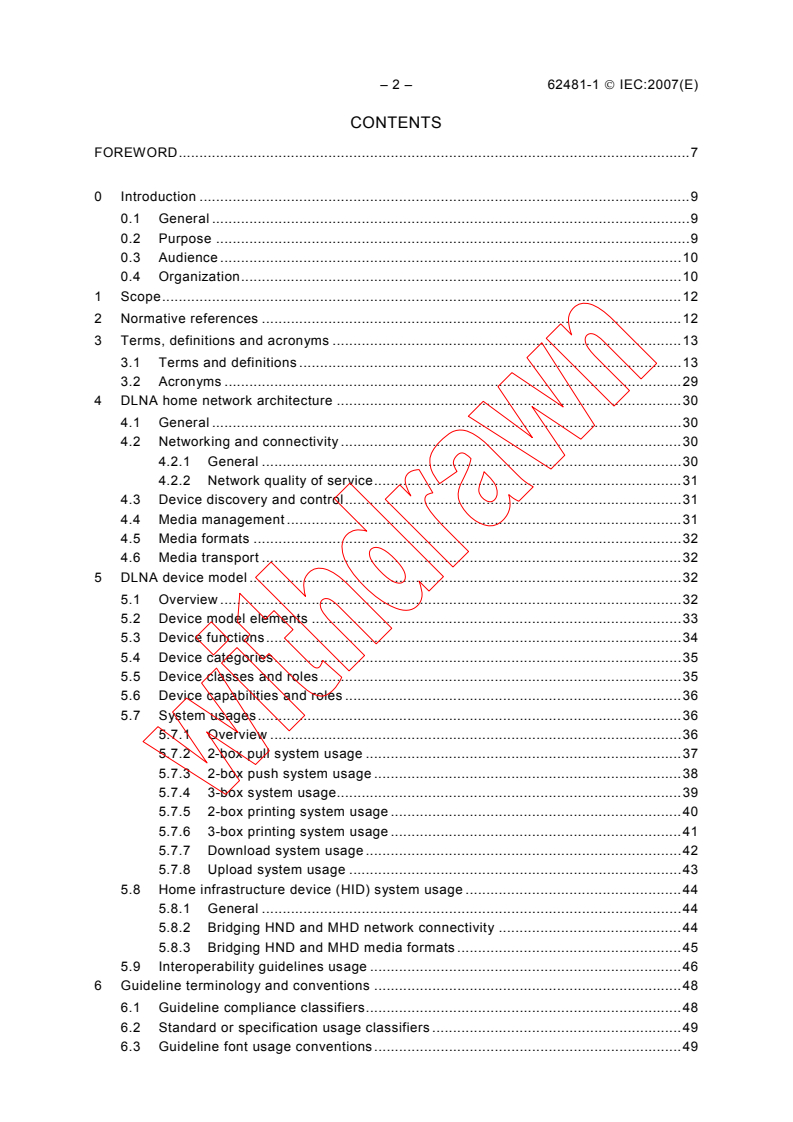
– 2 – 62481-1 © IEC:2007(E)
CONTENTS
FOREWORD.7
0 Introduction .9
0.1 General .9
0.2 Purpose .9
0.3 Audience .10
0.4 Organization.10
1 Scope.12
2 Normative references .12
3 Terms, definitions and acronyms .13
3.1 Terms and definitions .13
3.2 Acronyms .29
4 DLNA home network architecture .30
4.1 General .30
4.2 Networking and connectivity .30
4.2.1 General .30
4.2.2 Network quality of service.31
4.3 Device discovery and control.31
4.4 Media management .31
4.5 Media formats .32
4.6 Media transport .32
5 DLNA device model .32
5.1 Overview .32
5.2 Device model elements .33
5.3 Device functions.34
5.4 Device categories.35
5.5 Device classes and roles.35
5.6 Device capabilities and roles .36
5.7 System usages.36
5.7.1 Overview .36
5.7.2 2-box pull system usage .37
5.7.3 2-box push system usage .38
5.7.4 3-box system usage.39
5.7.5 2-box printing system usage .40
5.7.6 3-box printing system usage .41
5.7.7 Download system usage .42
5.7.8 Upload system usage .43
5.8 Home infrastructure device (HID) system usage .44
5.8.1 General .44
5.8.2 Bridging HND and MHD network connectivity .44
5.8.3 Bridging HND and MHD media formats .45
5.9 Interoperability guidelines usage .46
6 Guideline terminology and conventions .48
6.1 Guideline compliance classifiers.48
6.2 Standard or specification usage classifiers .49
6.3 Guideline font usage conventions.49
62481-1 © IEC:2007(E) – 3 –
6.4 Guideline syntax notation conventions.49
6.5 Guideline normative and informative text conventions .50
6.6 DLNA XML namespaces and schemas .50
7 Guideline requirements .50
7.1 General .50
7.2 Networking and connectivity .52
7.2.1 General .52
7.2.2 Normative definitions of NC-PS modes .53
7.2.3 Networking and connectivity – General capability requirements .53
7.2.4 Networking and connectivity – QoS requirements .62
7.2.5 Networking and connectivity – Device requirements .66
7.3 Device discovery and control.86
7.3.1 General .86
7.3.2 DDC UPnP device architecture .86
7.3.3 DDC UPnP Auto IP support .88
7.3.4 DDC UPnP SSDP default port .88
7.3.5 DDC UPnP discovery robustness.89
7.3.6 DDC UPnP HTTP support and general rules.92
7.3.7 DDC UPnP HTTP/1.0 rules .95
7.3.8 DDC UPnP HTTP/1.1 transaction rules.96
7.3.9 DDC UPnP HTTP persistent connections.97
7.3.10 DDC UPnP device responsiveness .98
7.3.11 DDC UPnP device description rules.99
7.3.12 DDC UPnP embedded device support .102
7.3.13 DDC UPnP service description rules.103
7.3.14 DDC UPnP XML namespace.104
7.3.15 DDC UPnP action argument encoding .104
7.3.16 DDC UPnP SOAP packet size .105
7.3.17 DDC UPnP error codes.105
7.3.18 DDC UPnP GENA packet size .106
7.3.19 DDC UPnP subscription handling .106
7.3.20 DDC UPnP UUID format .107
7.3.21 DDC UPnP UUID generation .107
7.3.22 DDC UPnP event subscription renewals .107
7.3.23 DDC UPnP event notification handling.108
7.3.24 DDC UPnP unknown header/tag/field robustness rule. 108
7.3.25 DDC URI rules.109
7.3.26 DDC UPnP device description usage .111
7.3.27 DDC UPnP UDN usage.112
7.3.28 DDC UPnP multi-homi§ng rules .113
7.3.29 DDC UPnP device icons .114
7.3.30 DDC UPnP UTF-8 support .115
7.3.31 DDC UPnP XML comments .115
7.3.32 DDC UPnP boolean types.115
7.3.33 DDC CP versioning.116
7.3.34 DDC absolute and relative URI requests.117
7.3.35 DDC maximum HTTP header size .117
7.3.36 DDC device capabilities.117
7.3.37 DDC DLNAQOS support .118
– 4 – 62481-1 © IEC:2007(E)
7.4 Media management .118
7.4.1 AV media management.118
7.4.2 Image printing media management .250
7.5 Media transport .255
7.5.1 General .255
7.5.2 Uniform client data availability model.258
7.5.3 Media operations.260
7.5.4 Media transport protocols .261
7.5.5 HTTP transport.274
7.5.6 RTP media transport.340
7.5.7 RTP media transport – Adaptation of media format profiles . 363
7.5.8 RTP media transport – RTSP for control of RTP streams. 386
7.6 Content transformation device virtualization . 421
7.6.1 Theory of operations.421
7.6.2 Virtual device implementation . 423
7.6.3 Virtual device, device discovery and control (DDC). 424
7.6.4 Virtual device media management (MM) .427
7.6.5 Virtual device media formats (MF) .438
7.6.6 Virtual device media transport (MT) .439
7.7 Media interoperability unit (MIU).439
7.7.1 General .439
7.7.2 Media interoperability unit media management guidelines . 440
Annex A (informative) Network infrastructure device (NID) recommendations . 443
Annex B (informative) Tuner representation .449
Annex C (informative) UPnP devices with multiple network interfaces. 453
Annex D (informative) Printer support .458
Annex E (informative) Example applications of the uniform client data availability
model (UCDAM).464
Annex F (informative) Auto-IP developer guidance.469
Annex G (informative) Mobile network connectivity and power-saving operation
principles .475
Annex H (informative) RTP protocol stack and SDP/RTSP/RTCP parameters . 479
Bibliography.481
Figure 1 – DLNA functional components .30
Figure 2 – DLNA device model terms hierarchy.34
Figure 3 – 2-box pull system usage interaction model .38
Figure 4 – 2-box push system usage interaction model .39
Figure 5 – 3-box system usage interaction model .40
Figure 6 – 2-box printing system usage interaction model .41
Figure 7 – 3-box printing system usage interaction model .42
Figure 8 – Download system usage interaction model.43
Figure 9 – Upload system usage interaction model .43
Figure 10 – 2-box pull system usage interaction model between device categories .44
62481-1 © IEC:2007(E) – 5 –
Figure 11 – M-NCF bridging the network connectivity gap between MHD and HND
device categpries.45
Figure 12 – Media interoperability between device categories.46
Figure 13 – Guideline layout and definitions .51
Figure 14 – Visual map of possible values for the attribute tables .52
Figure 15 – DLNA QoS visual organization .62
Figure 16 – UPnP discovery robustness.91
Figure 17 − Example of MM DLNA PlayContainer URI .192
Figure 18 – UCDAM summary.259
Figure 19 – Example of a valid and invalid pipelined POST transaction. 339
Figure 20 – Calculated line .353
Figure 21 – Wall clock time sample accuracy distribution.354
Figure 22 – Packet with wall clock time sample header extension . 356
Figure 23 – Example of packet with another header extension following wall clock time
sample.356
Figure 24 – BFR packet format .363
Figure 25 – Content transformation with a virtual media server . 422
Figure 26 – Content transformation with a virtual media renderer. 423
Figure C.1 – UPnP device representation .453
Figure C.2 – UPnP device on multiple networks.454
Figure C.3 – Representation at the CDS level.455
Figure C.4 – Content URIs over multiple networks . 456
Figure D.1 – Photo layout options .461
Figure D.2 – DMPr architecture components.461
Figure E.1 – Abstract representation of a stream . 464
Figure E.2 – Stored content stream.465
Figure E.3 – Stream with no random access support. 465
Figure E.4 – Stream with random access support . 465
Figure E.5 – Live stream with growing buffer and no random access . 466
Figure E.6 – Live stream with growing buffer and random access .466
Figure E.7 – Live stream with sliding buffer and random access support. 466
Figure E.8 – Time-delayed live stream with sliding buffer and random access support . 466
Figure F.1 – IP mixed network (Auto-IP and DHCP) .469
Figure F.2 – Communication in mixed IP network. 471
Figure F.3 – New routes in address transition flow.474
Figure G.1 – Illustration of the abstraction introduced by the NC-PS modes. 477
Figure G.2 – NC-PS mode transition diagram .478
Figure H.1 – Overview of the protocol stack for RTP transport .479
Figure H.2 – SDP and RTSP parameters .479
Figure H.3 – RTCP parameters.480
Table 1 – Interoperable components .10
Table 2 – DLNA device classes in the HND device category .46
Table 3 – DLNA device capabilities.47
– 6 – 62481-1 © IEC:2007(E)
Table 4 – DLNA device classes in the MHD device category.47
Table 5 – DLNA device classes in the HID device category.48
Table 6 – DLNA namespace values .50
Table 7 – Normative definitions of network connectivity power saving (NC-PS) modes .53
Table 8 – Normative priorities for DLNA traffic types.63
Table 9 – BT-802.11 DLNAQOS access category mapping .84
Table 10 – IEEE 802.1D user priority values .85
Table 11 – Colour depth of device icons .114
Table 12 – CDS and UPnP maximum byte length.123
Table 13 – Namespace prefixes.129
Table 14 – Recommended metadata properties .129
Table 15 – CDS: Search minimum support of operators . 175
Table 16 – UPnP: Class for searching all CDS objects.176
Table 17 – Capability ID syntax .185
Table 18 – Capability IDs for AnyContainer support .219
Table 19 – Required media class UPnP values .224
Table 20 – Required UPnP createClass elements .229
Table 21 – UPnP Printer dlna:X_DLNACAP element .252
Table 22 – DLNA media transfer modes.256
Table 23 – Permitted combinations of DLNAQOS_UP and transfer mode per media
class.257
Table 24 – DLNA streaming media operation definitions . 260
Table 25 – MT media class transfer modes .262
Table 26 – TTP prohibited operations references. 323
Table A.1 – NID functions .443
Table A.2 – WMM access category mapping .446
Table A.3 – WMM Access and IEEE 802.1D priority.447
Table D.1 – DMPr printer verses PC attached printer.459
Table D.2 – Printing controller (+PR1+, +PR2+) UI components . 460
Table D.3 – Printer status – Response.460
Table D.4 – UPnP PrintEnhanced:1 actions summary . 462
Table D.5 – Evented variables .463
Table F.1 – Auto-IP Route .470
Table F.2 – DHCP Route .471
Table F.3 – Windows routing table example for device w/DHCP address . 472
Table F.4 – Windows routing table example for device w/Auto-IP address . 473
Table F.5 – Linux routing table example for device w/DHCP address . 473
Table F.6 – Linux routing table example for device w/Auto-IP address . 474
Table G.1 – Dynamic behaviour of the M-NCF depending on the current NC-PS mode .478
62481-1 © IEC:2007(E) – 7 –
INTERNATIONAL ELECTROTECHNICAL COMMISSION
____________
DIGITAL LIVING NETWORK ALLIANCE (DLNA) HOME NETWORKED
DEVICE INTEROPERABILITY GUIDELINES –
Part 1: Architecture and protocols
FOREWORD
1) The International Electrotechnical Commission (IEC) is a worldwide organization for standardization comprising
all national electrotechnical committees (IEC National Committees). The object of IEC is to promote
international co-operation on all questions concerning standardization in the electrical and electronic fields. To
this end and in addition to other activities, IEC publishes International Standards, Technical Specifications,
Technical Reports, Publicly Available Specifications (PAS) and Guides (hereafter referred to as “IEC
Publication(s)”). Their preparation is entrusted to technical committees; any IEC National Committee interested
in the subject dealt with may participate in this preparatory work. International, governmental and non-
governmental organizations liaising with the IEC also participate in this preparation. IEC collaborates closely
with the International Organization for Standardization (ISO) in accordance with conditions determined by
agreement between the two organizations.
2) The formal decisions or agreements of IEC on technical matters express, as nearly as possible, an international
consensus of opinion on the relevant subjects since each technical committee has representation from all
interested IEC National Committees.
3) IEC Publications have the form of recommendations for international use and are accepted by IEC National
Committees in that sense. While all reasonable efforts are made to ensure that the technical content of IEC
Publications is accurate, IEC cannot be held responsible for the way in which they are used or for any
misinterpretation by any end user.
4) In order to promote international uniformity, IEC National Committees undertake to apply IEC Publications
transparently to the maximum extent possible in their national and regional publications. Any divergence
between any IEC Publication and the corresponding national or regional publication must be clearly indicated in
the latter.
5) IEC provides no marking procedure to indicate its approval and cannot be rendered responsible for any
equipment declared to be in conformity with an IEC Publication.
6) All users should ensure that they have the latest edition of this publication.
7) No liability must attach to IEC or its directors, employees, servants or agents including individual experts and
members of its technical committees and IEC National Committees for any personal injury, property damage or
other damage of any nature whatsoever, whether direct or indirect, or for costs (including legal fees) and
expenses arising out of the publication, use of, or reliance upon, this IEC Publication or any other IEC
Publications.
8) Attention is drawn to the Normative references cited in this publication. Use of the referenced publications is
indispensable for the correct application of this publication.
9) Attention is drawn to the possibility that some of the elements of this IEC Publication may be the subject of
patent rights. IEC must not be held responsible for identifying any or all such patent rights.
International Standard IEC 62481-1 has been prepared by IEC technical committee 100:
Audio, video and multimedia systems and equipment.
The text of this standard is based on the following documents:
CDV Report on voting
100/1127/CDV 100/1213/RVC
Full information on the voting for the approval of this standard can be found in the report on
voting indicated in the above table.
This publication has been drafted in accordance with the ISO/IEC Directives, Part 2.
A list of all parts of the IEC 62481 series, published under the general title Digital living
network alliance (DLNA) home networked device interoperability guidelines, can be found on
the IEC website.
– 8 – 62481-1 © IEC:2007(E)
The committee has decided that the contents of this publication will remain unchanged until
the maintenance result date indicated on the IEC web site under "http://webstore.iec.ch" in
the data related to the specific publication. At this date, the publication will be
• reconfirmed,
• withdrawn,
• replaced by a revised edition, or
• amended.
A bilingual version of this publication may be issued at a later date.
62481-1 © IEC:2007(E) – 9 –
0 Introduction
0.1 General
Consumers are acquiring, viewing, and managing an increasing amount of digital media
(photos, music, and video) on devices in the consumer electronics (CE), mobile device, and
personal computer (PC) domains. Consumers want to conveniently enjoy that content –
regardless of the source – across different devices and locations in their homes. The digital
home vision integrates the Internet, mobile, and broadcast networks through a seamless,
interoperable network, which will provide a unique opportunity for manufacturers and
consumers alike. In order to deliver on this vision, it was recognized that a common set of
industry design guidelines would be required to allow companies to participate in a growing
marketplace, leading to more innovation, simplicity, and value for consumers.
The digital living network alliance (DLNA) answered this challenge by taking the initiative to
develop a workable framework for interoperable product design. The DLNA home networked
device interoperability guidelines (hereinafter referred to as the interoperability guidelines)
has been created in a unique cross-industry effort that combined the efforts of over 100 CE,
PC-industry and mobile device companies from around the world who worked together with
the aim of achieving the world's first substantial platform for true interoperability between
personal computer and consumer electronic devices. The interoperability guidelines provide
product developers with a long-term architectural view, plus specific guidance for IP-
networked platforms, devices and applications in the home. The interoperability guidelines will
be introduced in phases over several years to accompany the market adoption of usages and
the availability of needed technology and standards.
The interoperability guidelines of this part of IEC 62481 include several informative annexes:
Annex A, Annex B, Annex C, Annex D, Annex E, Annex F and Annex G.
The media formats contain
a) ASF recommended procedures (informative);
b) IFO file format (normative).
0.2 Purpose
The interoperability guidelines consists of two volumes covering architecture and protocols
and media formats. It provides vendors with the information needed to build interoperable
networked platforms and devices for the digital home. The necessary standards and
technologies are available now to enable products to be built for networked entertainment
centric usages. However, standards and technologies need to be clarified and options limited
to ensure interoperability. The interoperability guidelines fulfil that role.
The interoperability guidelines are based on an architecture (see Clause 4) that defines
interoperable components for devices and software infrastructure. It covers physical media,
network transports, device discovery and control, media management and control, media
formats, and media transport protocols.
– 10 – 62481-1 © IEC:2007(E)
Table 1 – Interoperable components
Key technology ingredients
Functional components Technology ingredients
Connectivity Ethernet, IEEE 802.11 and Bluetooth
Networking IPv4 suite
Device discovery and control UPnP* Device Architecture v1.0
Media management and control UPnP AV v1 and UPnP Printer:1
Media formats Required and optional format profiles
Media transport HTTP (mandatory) and RTP (optional)
0.3 Audience
The interoperability guidelines are intended for the following audiences:
– marketing professionals who specify requirements for home networked media products;
– developers who design and build home networked media products;
– quality assurance personnel who test and validate home networked media products.
0.4 Organization
This part of the interoperability guidelines is organized as follows. All annexes are informative.
Clause 2 Normative references: Information on ISO, IEC and recognized normative
references contained in this standard. Other informative documents are listed in the
bibliography.
Clause 3 Terms and acronyms: Definitions of terms and acronyms used in this standard.
Clause 4 DLNA home network architecture: An overview of the DLNA home networking
architecture.
Clause 5 DLNA device model: An overview of the major device categpries used to group
guideline requirements.
Clause 6 Guideline terminology and conventions: Definitions for the compliance and usage
classifications used for guideline requirements.
Clause 7 Guideline requirements: Covers guideline requirements for DLNA devices
excluding media formats which are covered in another part of IEC 62481.
Annex A (informative) Network infrastructure device (NID) recommendations: Covers a
set of recommendations for home network infrastructure devices such as gateways, routers,
and hubs to ensure they work well with DLNA devices.
Annex B (informative) Tuner representation: Describes the way DLNA devices should
represent tuner-based content.
Annex C (informative) UPnP devices with multiple network interfaces: Describes how a
DLNA device can represent itself on multiple network interfaces. The annex also discusses
how a content source should expose content URI values for different network interfaces.
62481-1 © IEC:2007(E) – 11 –
Annex D (informative) Printer support: Introduces developers to the technical
considerations required to support printers and also discusses some of the usability aspects
of printing that are important for a good user experience.
Annex E (informative) Example applications of the uniform client data availability
model: Clarifies the general applicability of the uniform client data availability model
(UCDAM). It describes the data accessibility assumptions for both content sources and
content receivers. The UCDAM model strives for completeness by using examples derived
from stored, converted, and live content streams. The model also accounts for caching of data
by content receivers.
Annex F (informative) Auto-IP developer guidance: Provides guidance for developers on
extending Auto-IP support for IP stacks that have problems with full conformance to Auto-IP.
Annex G (informative) Mobile network connectivity and power saving operation
principles: Provides guidance on network connectivity for mobile devices, including Bluetooth
security and NC power-saving modes.
Annex H (informative) RTP protocol stack and SDP/RTSP/RTCP parameters: Provides
graphic layout of the protocol stack for the RTP transport and SDP/RTSP/RTCP parameters.
– 12 – 62481-1 © IEC:2007(E)
DIGITAL LIVING NETWORK ALLIANCE (DLNA) HOME NETWORKED
DEVICE INTEROPERABILITY GUIDELINES –
Part 1: Architecture and protocols
1 Scope
This part of IEC 62481 specifies the information needed to build interoperable networked
platforms and devices for the digital home on audio, video and multimedia systems, including
interoperable components for devices and software infrastructure, physical media, network
transports, device discovery and control, media management and control, media formats, and
media transport protocols. This standard also provides product developers with a long-term
architectural view, plus specific guidance for IP-networked platforms, devices and applications
in the home.
2 Normative references
The following referenced documents are indispensable for the application of this document.
For dated references, only the edition cited applies. For undated references, the latest edition
of the referenced document (including any amendments) applies.
IEC 62481-2, Digital living network alliance (DLNA) home networked device interoperability
guidelines – Part 2: Media formats
ISO/IEC 13818-1:2000, Information technology – Generic coding of moving pictures and
associated audio information: Systems
ISO/IEC 13818-9:1996, Information technology – Generic coding of moving pictures and
associated audio information – Part 9: Extension for real time interface for systems decoders
ISO 8601:2004, Data elements and interchange formats – Information interchange –
Representation of dates and times
ISO 10646:2003, Information technology – Universal Multiple-Octet Coded Character Set
(UCS)
IEEE 802.1D:2004, IEEE Standard for Information technology – Telecommunications and
information exchange between systems – IEEE standard for local and metropolitan area
networks – Common specifications – Media access control (MAC) Bridges
IEEE 802.1Q:2003, IEEE Standard for Information Technology – Telecommunications and
information exchange between systems – IEEE standard for local and metropolitan area
networks – Common specifications – Virtual Bridged Local Area Networks
IEEE 802.3:2002, IEEE Standard for information technology – Telecommunications and
information exchange between systems – Local and metropolitan area networks – Specific
requirements – Part 3: Carrier sense multiple access with collision detection (CSMA/CD)
access method and physical layer specification
IEEE 802, IEEE Standard for information technology – Telecommunications and information
exchange between systems – Local and metropolitan area networks – Specific requirements –
Part 11: Wireless LAN Medium Access Control (MAC) and Physical Layer (PHY)
specifications
62481-1 © IEC:2007(E) – 13 –
3 Terms, definitions and acronyms
For the purposes of this document, the following terms, definitions and acronyms apply.
3.1 Terms and definitions
3.1.1
AC 3
audio format standard for delivering up to 5.1 audio channels developed by Dolby
Laboratories popularly known as Dolby Digital
3.1.2
access point
AP
device specially configured as a network infrastructure device on a wireless local area
network (WLAN)
NOTE Access points act as a central transmitter and receiver of WLAN radio signals. APs used in home networks
are generally small, dedicated hardware devices featuring a built-in network adapter, antenna, and radio
transmitter. These APs support Wi-Fi wireless communication standards.
3.1.3
acknowledge
ACK
term typically used to describe an action following a network packet being successfully
received
3.1.4
address resolution protocol
ARP
protocol in the TCP/IP family that resolves an IP address to a hardware address, such as an
Ethernet address
3.1.5
advanced television systems committee
ATSC
one of the standard bodies for digital television broadcasting
3.1.6
application data unit
ADU
unit of data used for the RTP media transport
NOTE The definition of an ADU is different for each media stream. For audio media streams, an ADU is typically
an audio frame. For video media streams, an ADU is typically a "slice" (for example, an NAL unit) or, in some
cases, a complete video picture. Also, as a special case when MPEG-2 TS encapsulation is used, each TS packet
is an ADU.
3.1.7
audio/visual profile
AVP
profile used for the RTP media transport
3.1.8
authentication
process by which an entity verifies that another entity is who or what it claims to be (examples
of entities are: device, person, process.)
NOTE Authentication for Bluetooth is defined in Specification of the Bluetooth System (Volume 1 – Core,
Volume 2 – Profiles, Addendum, Errata), Specification of the Bluetooth System, version 1.1, Bluetooth SIG,
February 22, 2001, as the process of verifying which device is at the other end of the link. Authentication is
– 14 – 62481-1 © IEC:2007(E)
performed for devices based on their Bluetooth Address (BD_ADDR). In Bluetooth this is achieved by the
authentication procedure based on the mutually stored link key or by pairing.
3.1.9
authorization
process of access check to determine whether the authenticated entity has access to the
resource
NOTE Authorization for Bluetooth is defined in Specification of the Bluetooth System (Volume 1 – Core, Volume 2
– Profiles, Addendum, Errata), Specification of the Bluetooth System, version 1.1, Bluetooth SIG, February 22,
2001, as the process of deciding if a device is allowed to have access to a particular service. This is where the
concept of “trusted” exists. Trusted devices (authenticated and indicat
...
Questions, Comments and Discussion
Ask us and Technical Secretary will try to provide an answer. You can facilitate discussion about the standard in here.
Loading comments...