IEC 61954:2021/COR1:2024
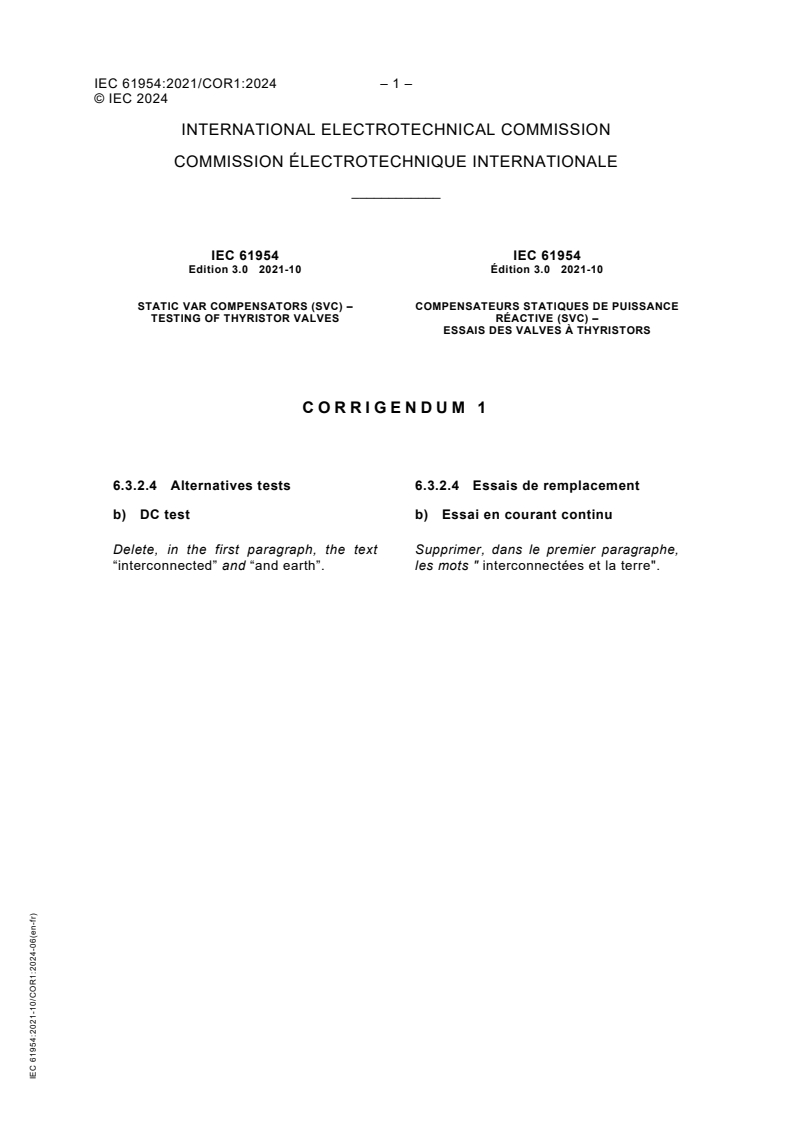
(Corrigendum)Corrigendum 1 - Static VAR compensators (SVC) - Testing of thyristor valves
Corrigendum 1 - Static VAR compensators (SVC) - Testing of thyristor valves
Corrigendum 1 - Compensateurs statiques de puissance réactive (SVC) - Essais des valves à thyristors
General Information
Relations
Standards Content (Sample)
© IEC 2024
INTERNATIONAL ELECTROTECHNICAL COMMISSION
COMMISSION ÉLECTROTECHNIQUE INTERNATIONALE
____________
IEC 61954 IEC 61954
Edition 3.0 2021-10 Édition 3.0 2021-10
STATIC VAR COMPENSATORS (SVC) – COMPENSATEURS STATIQUES DE PUISSANCE
TESTING OF THYRISTOR VALVES RÉACTIVE (SVC) –
ESSAIS DES VALVES À THYRISTORS
CO
...
This May Also Interest You
IEC 61954:2021 defines type, production and optional tests on thyristor valves used in thyristor controlled reactors (TCR), thyristor switched reactors (TSR) and thyristor switched capacitors (TSC) forming part of static VAR compensators (SVC) for power system applications. The requirements of the document apply both to single valve units (one phase) and to multiple valve units (several phases). Clauses 4 to 7 detail the type tests, i.e. tests which are carried out to verify that the valve design meets the requirements specified. Clause 8 covers the production tests, i.e. tests which are carried out to verify proper manufacturing. Clauses 9 and 10 detail optional tests, i.e. tests additional to the type and production tests. This edition includes the following significant technical changes with respect to the previous edition: important clarifications were made in 4.4.1.2, 5.1.2.2, 5.1.3.2, 5.2.3.2, 6.1.2.2, 6.1.2.4, 6.1.3.2, 6.2.2.2, 6.2.2.4, 6.3.2.2 and 9.3.2.
The contents of the corrigendum of June 2024 have been included in this copy.
- Standard138 pagesEnglish languagesale 15% off
- Standard88 pagesEnglish and French languagesale 15% off
- Standard8 pagesEnglish and French languagesale 15% off
- Standard5 pagesEnglish and French languagesale 15% off
IEC 61954:2011 defines type, production and optional tests on thyristor valves used in thyristor controlled reactors (TCR), thyristor switched reactors (TSR) and thyristor switched capacitors (TSC) forming part of static VAR compensators (SVC) for power system applications. The requirements of the standard apply both to single valve units (one phase) and to multiple valve units (several phases). This edition includes the following significant technical changes with respect to the previous edition:
a) Definitions of terms "thyristor level", "valve section", "valve base electronics" and "redundant thyristor levels" have been changed for clarification;
b) Conditions of testing thyristor valve sections instead of a complete thyristor valve have been defined;
c) The requirement has been added that if, following a type test, one thyristor level has become short-circuited, then the failed level shall be restored and this type test repeated;
d) The time period of increasing the initial test voltage from 50 % to 100 % during type a.c. dielectric tests on TSC, TCR or TSR valves has been set equal to approximately 10 s;
e) The duration of test voltage Uts2 during type a.c.-d.c. dielectric tests between TSC valve terminals and earth as well as the duration of test voltage Utvv2 during dielectric tests between TSC valves (for MVU only) has been changed from 30 min to 3 h;
f) The reference on the number of pulses per minute of the periodic partial discharge recorded during a.c.-d.c. dielectric tests on TSC valves and exceeding the permissible level has been deleted.
- Standard91 pagesEnglish and French languagesale 15% off
- Standard182 pagesEnglish and French languagesale 15% off
- Standard91 pagesEnglish and French languagesale 15% off
Defines type, production and optional test on thyristor valves used in thyristor controlled reactots (TCR), Thyristor switched reactor (TSR) and thyristor switched capacitors (TSC) forming part of static VAR compensators (SVC) for power system applications. the requirements of the standard apply both to single valve units (one phase) and to multiple valve units (several phases). Clauses 4 to 7 detail the type tests, clause 8 covers the production tests, clauses 9 and 7 detail optional tests.
- Standard85 pagesEnglish and French languagesale 15% off
- Standard10 pagesEnglish and French languagesale 15% off
IEC 62541-100:2025 defines the information model associated with Devices. This document describes three models which build upon each other as follows:
• The (base) Device Model is intended to provide a unified view of devices and their hardware and software parts irrespective of the underlying device protocols.
• The Device Communication Model adds Network and Connection information elements so that communication topologies can be created.
• The Device Integration Host Model finally adds additional elements and rules required for host systems to manage integration for a complete system. It enables reflecting the topology of the automation system with the devices as well as the connecting communication networks.
This document also defines AddIns that can be used for the models in this document but also for models in other information models. They are:
• Locking model – a generic AddIn to control concurrent access,
• Software update model – an AddIn to manage software in a Device.
This second edition cancels and replaces the first edition published in 2015. This edition constitutes a technical revision.
This edition includes the following significant technical changes with respect to the previous edition:
a a ComponentType that can be used to model any HW or SW element of a device has been defined and a SoftwareType has been added as subtype of ComponentType;
b the new OPC UA interface concept and defined interfaces for Nameplate, DeviceHealth, and SupportInfo has been added.
c) a new model for Software Update (Firmware Update) has been added;
d) a new entry point for documents where each document is represented by a FileType instance has been specified;
e) a model that provides information about the lifetime, related limits and semantic of the lifetime of things like tools, material or machines has been added.
- Standard152 pagesEnglish languagesale 15% off
- Standard158 pagesFrench languagesale 15% off
- Standard310 pagesEnglish and French languagesale 15% off
IEC TR 61169-1-8:2025 provides a test method for voltage standing wave ratio (VSWR, hereinafter) of single RF connector by double-connector method. This document is applicable to single RF cable connectors and single microstrip RF connectors as well as single adapters if an estimation of the VSWR of a single completely installed RF-connector is used and a time domain feature is not available on the vector network analyzer.
- Technical report18 pagesEnglish languagesale 15% off
IEC 62541-13:2025 is available as IEC 62541-13:2025 RLV which contains the International Standard and its Redline version, showing all changes of the technical content compared to the previous edition.IEC 62541-13:2025 defines the information model associated with Aggregates. Programmatically produced aggregate examples are listed in Annex A. This third edition cancels and replaces the second edition published in 2020. This edition constitutes a technical revision.
This edition includes the following technical changes with respect to the previous edition:
a) Multiple fixes for the computation of aggregates
• The Raw status bit is always set for non-bad StatusCodes for the Start and End aggregates.
• Entries in the Interpolative examples Tables A2.2 Historian1, Historian2, and Historian3 have been changed from Good to Good, Raw status codes when the timestamp matches with the timestamp of the data source.
• Missing tables have been added for DurationInStateZero and DurationInStateNonZero.
• The value of zero has been removed for results with a StatusCode of bad.
• Data Type was listed as "Status Code" when it is "Double" for both Standard Deviation and both Variance Aggregates.
• Rounding Error in TimeAverage and TimeAverage2 have been corrected.
• The status codes have been corrected for the last two intervals and the value has been corrected in the last interval.
• The wording has been changed to be more consistent with the certification testing tool.
• UsedSlopedExtrapolation set to true for Historian2 and all examples locations needed new values or status' are modified.
• Values affected by percent good and percent bad have been updated.
• PercentGood/PercentBad are now accounted for in the calculation.
• TimeAverage uses SlopedInterpolation but the Time aggregate is incorrectly allowed to used Stepped Interpolation.
• Partial bit is now correctly calculated.
• Unclear sentence was removed.
• Examples have been moved to a CSV.
• The value and status code for Historian 3 have been updated.
• TimeAverage2 Historian1 now takes uncertain regions into account when calculating StatusCodes.
• TimeAverage2 Historian2 now takes uncertain regions into account when calculating StatusCodes.
• Total2 Historian1 now takes uncertain regions into account when calculating StatusCodes
• Total2 Historian2 now takes uncertain regions into account when calculating StatusCodes
• Maximum2 Historian1 now takes uncertain regions into account when calculating StatusCodes
• MaximumActualTime2 Historian1 now takes uncertain regions into account when calculating StatusCodes
• Minimum2 Historian1 now takes uncertain regions into account when calculating StatusCodes
• MinimumActualTime2 Historian1 now has the StatusCodes calculated while using the TreatUncertainAsBad flag.
• Range2 Historian1 now looks at TreatUncertainAsBad in the calculation of the StatusCodes.
• Clarifications have been made to the text defining how PercentGood/PercentBad are used. The table values and StatusCodes of the TimeAverage2 and Total2 aggregates have been corrected.
- Standard64 pagesEnglish languagesale 15% off
- Standard64 pagesFrench languagesale 15% off
- Standard128 pagesEnglish and French languagesale 15% off
IEC 62541-7: 2025 specifies value and structure of Profiles in the OPC Unified Architecture.
OPC UA Profiles are used to segregate features with regard to testing of OPC UA products and the nature of the testing. The scope of this document includes defining functionality that can only be tested. The definition of actual TestCases is not within the scope of this document, but the general categories of TestCases are covered by this document.
Most OPC UA applications will conform to several, but not all of the Profiles.
This fourth edition cancels and replaces the third edition published in 2020. This edition constitutes a technical revision.
This edition includes the following significant technical changes with respect to the previous edition:
a) Profiles and ConformanceUnits are not part of this document, but are solely managed in a public database as described in Clause 1.
- Standard160 pagesEnglish languagesale 15% off
- Standard173 pagesFrench languagesale 15% off
- Standard333 pagesEnglish and French languagesale 15% off


Questions, Comments and Discussion
Ask us and Technical Secretary will try to provide an answer. You can facilitate discussion about the standard in here.
Loading comments...