

IEC 60404-8-7:2008
(Main)Magnetic materials - Part 8-7: Specifications for individual materials - Cold-rolled grain-oriented electrical steel strip and sheet delivered in the fully-processed state
General Information
- Abstract
IEC 60404-8-7:2008 defines the grades of cold-rolled grain-oriented electrical steel strip and sheet in nominal thicknesses of 0,23 mm, 0,27 mm, 0,30 mm and 0,35 mm. In particular, it gives general requirements, magnetic properties, geometric characteristics, tolerances and technological characteristics, as well as inspection procedures. This standard applies to Goss textured grain-oriented electrical steel strip and sheet supplied in the final annealed condition in sheets or coils, and intended for the construction of magnetic circuits. The grades are grouped into two classes:
- conventional grades;
- high permeability grades.
They correspond to Class C.22 of IEC 60404-1. This third edition cancels and replaces the second edition published in 1998 of which it constitutes a technical revision. This revision extends the range of electrical steels to include the improved grades.
- Status
- Published
- Publication Date
- 20-May-2008
- Technical Committee
- TC 68 - Magnetic alloys and steels
- Drafting Committee
- JWG 1 - TC 68/JWG 1
- Current Stage
- DELPUB - Deleted Publication
- Start Date
- 15-Sep-2017
- Completion Date
- 28-Aug-2026
Buy Documents
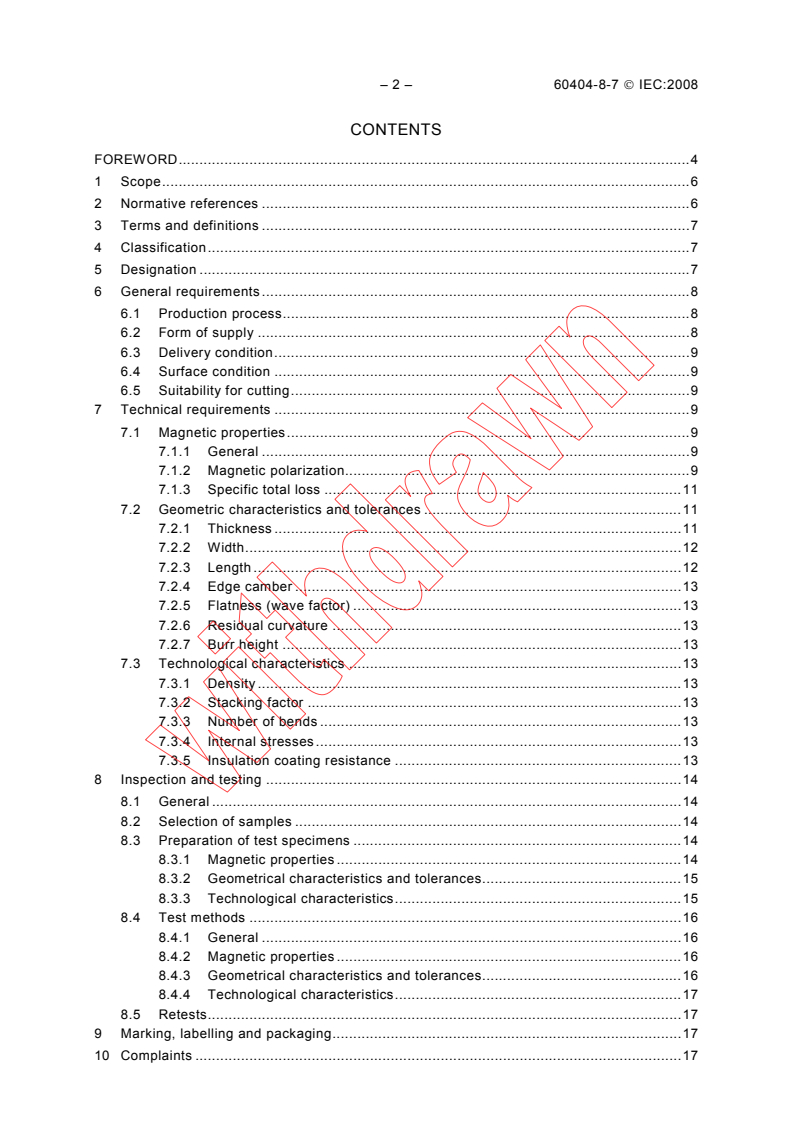
IEC 60404-8-7:2008 - Magnetic materials - Part 8-7: Specifications for individual materials - Cold-rolled grain-oriented electrical steel strip and sheet delivered in the fully-processed state Released:5/21/2008
Overview
IEC 60404-8-7:2008 is an international standard published by the International Electrotechnical Commission (IEC) detailing the specifications for cold-rolled grain-oriented electrical steel strip and sheet delivered in the fully-processed state. This standard defines grades of electrical steel in nominal thicknesses of 0.23 mm, 0.27 mm, 0.30 mm, and 0.35 mm, focusing on magnetic, geometric, technological, and inspection requirements. Intended for Goss textured grain-oriented steel supplied in final annealed condition, it is widely used in constructing magnetic circuits.
This third edition provides a technical revision that extends the range of electrical steels by including improved grades, reflecting advances since the second edition issued in 1998. The standard classifies material grades into two main classes: conventional grades and high permeability grades, aligned with Class C.22 from IEC 60404-1.
Key Topics
Material Grades and Classification
- Conventional grades
- High permeability grades
Both grades meet Class C.22 requirements of IEC 60404-1, ensuring uniformity in quality and performance across applications.
Magnetic Properties
- Magnetic polarization values
- Specific total loss measurements to evaluate efficiency and performance in magnetic circuits.
Precise magnetic property specifications ensure materials deliver optimal performance in electro-technical applications.
Geometric Characteristics and Tolerances
- Thickness accuracy
- Width and length dimensions
- Edge camber, flatness, residual curvature, and burr height tolerances.
These parameters guarantee reliable assembly and function in transformers and electrical machinery.
Technological Characteristics
- Density and stacking factor
- Number of bends and internal stresses
- Surface insulation coating resistance
Focus on material processability and durability, ensuring consistent manufacturing quality.
Inspection and Testing Procedures
- Sampling methods
- Test specimen preparation
- Standardized measurement of magnetic, geometric, and technological characteristics.
Thorough inspection protocols maintain compliance with specifications, enhancing end-product reliability.
Supply Conditions & Surface Quality
- Final annealed condition supply in sheets or coils
- Surface quality suitable for cutting and subsequent processing steps.
Applications
IEC 60404-8-7:2008 is critical for industries relying on high-quality electrical steel for magnetic circuit construction, including:
Transformer Manufacturing
Materials meeting this standard optimize transformer core losses and magnetic permeability, improving efficiency and energy savings.Electrical Motors and Generators
Grain-oriented steel strips and sheets ensure minimal magnetic losses and mechanical stability, enhancing machine performance.Magnetic Components
Used in inductors, chokes, and reactors that require specific magnetic characteristics and tight dimensional tolerances.Energy-Efficient Electrotechnical Equipment
Manufacturers utilize the specified grades to meet modern demands for energy-saving and low-loss electrical devices.
Related Standards
IEC 60404-1: Magnetic materials - Classification
Provides general classification framework referenced by IEC 60404-8-7 for defining steel grades.IEC 60404-2 & IEC 60404-3: Measurement Methods
Specify Epstein frame and single sheet tester methods applicable for measuring magnetic properties outlined in IEC 60404-8-7.IEC 60404-9: Geometrical Characteristics Determination
Supports the measurement of thickness, width, and flatness tolerances.IEC 60404-11: Surface Insulation Resistance Test
Details testing procedures for insulation coatings essential for technological characteristics compliance.ISO 404 & ISO 7799: Technical Delivery & Mechanical Tests
Address general steel product delivery requirements and strip bend tests reinforcing IEC-compliant steel quality.
Keywords: cold-rolled grain-oriented electrical steel, IEC 60404-8-7, magnetic materials standard, electrical steel sheet specifications, magnetic properties, geometric tolerances, high permeability grades, transformer core steel, electrical steel inspection, electrotechnical standards.
Relations
- Effective Date
- 10-Feb-2026
- Effective Date
- 10-Feb-2026
- Effective Date
- 10-Feb-2026
- Effective Date
- 05-Sep-2023
- Effective Date
- 05-Sep-2023
Buy Documents
IEC 60404-8-7:2008 - Magnetic materials - Part 8-7: Specifications for individual materials - Cold-rolled grain-oriented electrical steel strip and sheet delivered in the fully-processed state Released:5/21/2008
Get Certified
Connect with accredited certification bodies for this standard

IMQ S.p.A. (Certification)
Italian electrical product certification.

SLG Prüf- und Zertifizierungs GmbH
German testing and certification body.

UL Solutions
Global safety science company with testing, inspection and certification.
Sponsored listings
Frequently Asked Questions
IEC 60404-8-7:2008 is a standard published by the International Electrotechnical Commission (IEC). Its full title is "Magnetic materials - Part 8-7: Specifications for individual materials - Cold-rolled grain-oriented electrical steel strip and sheet delivered in the fully-processed state". This standard covers: IEC 60404-8-7:2008 defines the grades of cold-rolled grain-oriented electrical steel strip and sheet in nominal thicknesses of 0,23 mm, 0,27 mm, 0,30 mm and 0,35 mm. In particular, it gives general requirements, magnetic properties, geometric characteristics, tolerances and technological characteristics, as well as inspection procedures. This standard applies to Goss textured grain-oriented electrical steel strip and sheet supplied in the final annealed condition in sheets or coils, and intended for the construction of magnetic circuits. The grades are grouped into two classes: - conventional grades; - high permeability grades. They correspond to Class C.22 of IEC 60404-1. This third edition cancels and replaces the second edition published in 1998 of which it constitutes a technical revision. This revision extends the range of electrical steels to include the improved grades.
IEC 60404-8-7:2008 defines the grades of cold-rolled grain-oriented electrical steel strip and sheet in nominal thicknesses of 0,23 mm, 0,27 mm, 0,30 mm and 0,35 mm. In particular, it gives general requirements, magnetic properties, geometric characteristics, tolerances and technological characteristics, as well as inspection procedures. This standard applies to Goss textured grain-oriented electrical steel strip and sheet supplied in the final annealed condition in sheets or coils, and intended for the construction of magnetic circuits. The grades are grouped into two classes: - conventional grades; - high permeability grades. They correspond to Class C.22 of IEC 60404-1. This third edition cancels and replaces the second edition published in 1998 of which it constitutes a technical revision. This revision extends the range of electrical steels to include the improved grades.
IEC 60404-8-7:2008 is classified under the following ICS (International Classification for Standards) categories: 29.030 - Magnetic materials. The ICS classification helps identify the subject area and facilitates finding related standards.
IEC 60404-8-7:2008 has the following relationships with other standards: It is inter standard links to EN 60404-1:2017, EN 60404-8-6:2017, EN 60404-2:1998/A1:2008, IEC 60404-8-7:1998, IEC 60404-8-7:2017. Understanding these relationships helps ensure you are using the most current and applicable version of the standard.
IEC 60404-8-7:2008 is available in PDF format for immediate download after purchase. The document can be added to your cart and obtained through the secure checkout process. Digital delivery ensures instant access to the complete standard document.
Standards Content (Sample)
IEC 60404-8-7
Edition 3.0 2008-05
INTERNATIONAL
STANDARD
NORME
INTERNATIONALE
Magnetic materials –
Part 8-7: Specifications for individual materials – Cold-rolled grain-oriented
electrical steel strip and sheet delivered in the fully-processed state
Matériaux magnétiques –
Partie 8-7: Spécifications pour matériaux particuliers – Bandes et tôles
magnétiques en acier à grains orientés, laminées à froid et livrées à l'état fini
All rights reserved. Unless otherwise specified, no part of this publication may be reproduced or utilized in any form or by
any means, electronic or mechanical, including photocopying and microfilm, without permission in writing from either IEC or
IEC's member National Committee in the country of the requester.
If you have any questions about IEC copyright or have an enquiry about obtaining additional rights to this publication,
please contact the address below or your local IEC member National Committee for further information.
Droits de reproduction réservés. Sauf indication contraire, aucune partie de cette publication ne peut être reproduite
ni utilisée sous quelque forme que ce soit et par aucun procédé, électronique ou mécanique, y compris la photocopie
et les microfilms, sans l'accord écrit de la CEI ou du Comité national de la CEI du pays du demandeur.
Si vous avez des questions sur le copyright de la CEI ou si vous désirez obtenir des droits supplémentaires sur cette
publication, utilisez les coordonnées ci-après ou contactez le Comité national de la CEI de votre pays de résidence.
IEC Central Office
3, rue de Varembé
CH-1211 Geneva 20
Switzerland
Email: inmail@iec.ch
Web: www.iec.ch
About the IEC
The International Electrotechnical Commission (IEC) is the leading global organization that prepares and publishes
International Standards for all electrical, electronic and related technologies.
About IEC publications
The technical content of IEC publications is kept under constant review by the IEC. Please make sure that you have the
latest edition, a corrigenda or an amendment might have been published.
ƒ Catalogue of IEC publications: www.iec.ch/searchpub
The IEC on-line Catalogue enables you to search by a variety of criteria (reference number, text, technical committee,…).
It also gives information on projects, withdrawn and replaced publications.
ƒ IEC Just Published: www.iec.ch/online_news/justpub
Stay up to date on all new IEC publications. Just Published details twice a month all new publications released. Available
on-line and also by email.
ƒ Electropedia: www.electropedia.org
The world's leading online dictionary of electronic and electrical terms containing more than 20 000 terms and definitions
in English and French, with equivalent terms in additional languages. Also known as the International Electrotechnical
Vocabulary online.
ƒ Customer Service Centre: www.iec.ch/webstore/custserv
If you wish to give us your feedback on this publication or need further assistance, please visit the Customer Service
Centre FAQ or contact us:
Email: csc@iec.ch
Tel.: +41 22 919 02 11
Fax: +41 22 919 03 00
A propos de la CEI
La Commission Electrotechnique Internationale (CEI) est la première organisation mondiale qui élabore et publie des
normes internationales pour tout ce qui a trait à l'électricité, à l'électronique et aux technologies apparentées.
A propos des publications CEI
Le contenu technique des publications de la CEI est constamment revu. Veuillez vous assurer que vous possédez
l’édition la plus récente, un corrigendum ou amendement peut avoir été publié.
ƒ Catalogue des publications de la CEI: www.iec.ch/searchpub/cur_fut-f.htm
Le Catalogue en-ligne de la CEI vous permet d’effectuer des recherches en utilisant différents critères (numéro de référence,
texte, comité d’études,…). Il donne aussi des informations sur les projets et les publications retirées ou remplacées.
ƒ Just Published CEI: www.iec.ch/online_news/justpub
Restez informé sur les nouvelles publications de la CEI. Just Published détaille deux fois par mois les nouvelles
publications parues. Disponible en-ligne et aussi par email.
ƒ Electropedia: www.electropedia.org
Le premier dictionnaire en ligne au monde de termes électroniques et électriques. Il contient plus de 20 000 termes et
définitions en anglais et en français, ainsi que les termes équivalents dans les langues additionnelles. Egalement appelé
Vocabulaire Electrotechnique International en ligne.
ƒ Service Clients: www.iec.ch/webstore/custserv/custserv_entry-f.htm
Si vous désirez nous donner des commentaires sur cette publication ou si vous avez des questions, visitez le FAQ du
Service clients ou contactez-nous:
Email: csc@iec.ch
Tél.: +41 22 919 02 11
Fax: +41 22 919 03 00
IEC 60404-8-7
Edition 3.0 2008-05
INTERNATIONAL
STANDARD
NORME
INTERNATIONALE
Magnetic materials –
Part 8-7: Specifications for individual materials – Cold-rolled grain-oriented
electrical steel strip and sheet delivered in the fully-processed state
Matériaux magnétiques –
Partie 8-7: Spécifications pour matériaux particuliers – Bandes et tôles
magnétiques en acier à grains orientés, laminées à froid et livrées à l'état fini
INTERNATIONAL
ELECTROTECHNICAL
COMMISSION
COMMISSION
ELECTROTECHNIQUE
PRICE CODE
INTERNATIONALE
R
CODE PRIX
ICS 29.030 ISBN 2-8318-9793-9
– 2 – 60404-8-7 © IEC:2008
CONTENTS
FOREWORD.4
1 Scope.6
2 Normative references .6
3 Terms and definitions .7
4 Classification.7
5 Designation .7
6 General requirements .8
6.1 Production process.8
6.2 Form of supply .8
6.3 Delivery condition.9
6.4 Surface condition .9
6.5 Suitability for cutting.9
7 Technical requirements .9
7.1 Magnetic properties.9
7.1.1 General .9
7.1.2 Magnetic polarization.9
7.1.3 Specific total loss .11
7.2 Geometric characteristics and tolerances .11
7.2.1 Thickness .11
7.2.2 Width.12
7.2.3 Length .12
7.2.4 Edge camber .13
7.2.5 Flatness (wave factor) .13
7.2.6 Residual curvature .13
7.2.7 Burr height .13
7.3 Technological characteristics .13
7.3.1 Density .13
7.3.2 Stacking factor .13
7.3.3 Number of bends .13
7.3.4 Internal stresses.13
7.3.5 Insulation coating resistance .13
8 Inspection and testing .14
8.1 General .14
8.2 Selection of samples .14
8.3 Preparation of test specimens .14
8.3.1 Magnetic properties .14
8.3.2 Geometrical characteristics and tolerances.15
8.3.3 Technological characteristics.15
8.4 Test methods .16
8.4.1 General .16
8.4.2 Magnetic properties .16
8.4.3 Geometrical characteristics and tolerances.16
8.4.4 Technological characteristics.17
8.5 Retests.17
9 Marking, labelling and packaging.17
10 Complaints .17
60404-8-7 © IEC:2008 – 3 –
11 Information to be supplied by the purchaser .18
Annex A (informative) European steel designation .19
Table 1 – Technological and magnetic properties of the conventional grades of grain-
oriented material.10
Table 2 – Technological and magnetic properties of the high permeability grades of
grain-oriented material.11
Table 3 – Tolerances on nominal width .12
Table A.1 – European steel designation.19
– 4 – 60404-8-7 © IEC:2008
INTERNATIONAL ELECTROTECHNICAL COMMISSION
_____________
MAGNETIC MATERIALS –
Part 8-7: Specifications for individual materials –
Cold-rolled grain-oriented electrical steel strip and sheet
delivered in the fully-processed state
FOREWORD
1) The International Electrotechnical Commission (IEC) is a worldwide organization for standardization comprising
all national electrotechnical committees (IEC National Committees). The object of IEC is to promote
international co-operation on all questions concerning standardization in the electrical and electronic fields. To
this end and in addition to other activities, IEC publishes International Standards, Technical Specifications,
Technical Reports, Publicly Available Specifications (PAS) and Guides (hereafter referred to as “IEC
Publication(s)”). Their preparation is entrusted to technical committees; any IEC National Committee interested
in the subject dealt with may participate in this preparatory work. International, governmental and non-
governmental organizations liaising with the IEC also participate in this preparation. IEC collaborates closely
with the International Organization for Standardization (ISO) in accordance with conditions determined by
agreement between the two organizations.
2) The formal decisions or agreements of IEC on technical matters express, as nearly as possible, an international
consensus of opinion on the relevant subjects since each technical committee has representation from all
interested IEC National Committees.
3) IEC Publications have the form of recommendations for international use and are accepted by IEC National
Committees in that sense. While all reasonable efforts are made to ensure that the technical content of IEC
Publications is accurate, IEC cannot be held responsible for the way in which they are used or for any
misinterpretation by any end user.
4) In order to promote international uniformity, IEC National Committees undertake to apply IEC Publications
transparently to the maximum extent possible in their national and regional publications. Any divergence
between any IEC Publication and the corresponding national or regional publication shall be clearly indicated in
the latter.
5) IEC provides no marking procedure to indicate its approval and cannot be rendered responsible for any
equipment declared to be in conformity with an IEC Publication.
6) All users should ensure that they have the latest edition of this publication.
7) No liability shall attach to IEC or its directors, employees, servants or agents including individual experts and
members of its technical committees and IEC National Committees for any personal injury, property damage or
other damage of any nature whatsoever, whether direct or indirect, or for costs (including legal fees) and
expenses arising out of the publication, use of, or reliance upon, this IEC Publication or any other IEC
Publications.
8) Attention is drawn to the Normative references cited in this publication. Use of the referenced publications is
indispensable for the correct application of this publication.
9) Attention is drawn to the possibility that some of the elements of this IEC Publication may be the subject of
patent rights. IEC shall not be held responsible for identifying any or all such patent rights.
International Standard IEC 60404-8-7 has been prepared by IEC technical committee 68:
Magnetic alloys and steels.
This third edition cancels and replaces the second edition published in 1998 of which it
constitutes a technical revision. This revision extends the range of electrical steels to include
the improved grades.
The text of this standard is based on the following documents:
FDIS Report on voting
68/367/FDIS 68/370/RVD
Full information on the voting for the approval of this standard can be found in the report on
voting indicated in the above table.
60404-8-7 © IEC:2008 – 5 –
This publication has been drafted in accordance with the ISO/IEC Directives, Part 2.
A list of all the parts in the IEC 60404 series, under the general title Magnetic materials, can
be found on the IEC website.
The committee has decided that the contents of this publication will remain unchanged until
the maintenance result date indicated on the IEC web site under "http://webstore.iec.ch" in
the data related to the specific publication. At this date, the publication will be
• reconfirmed,
• withdrawn,
• replaced by a revised edition, or
• amended.
– 6 – 60404-8-7 © IEC:2008
MAGNETIC MATERIALS –
Part 8-7: Specifications for individual materials –
Cold-rolled grain-oriented electrical steel strip and sheet
delivered in the fully-processed state
1 Scope
This part of IEC 60404 defines the grades of cold-rolled grain-oriented electrical steel strip
and sheet in nominal thicknesses of 0,23 mm, 0,27 mm, 0,30 mm and 0,35 mm. In particular,
it gives general requirements, magnetic properties, geometric characteristics, tolerances and
technological characteristics, as well as inspection procedures.
This standard applies to Goss textured grain-oriented electrical steel strip and sheet supplied
in the final annealed condition in sheets or coils, and intended for the construction of
magnetic circuits.
The grades are grouped into two classes:
– conventional grades;
– high permeability grades.
They correspond to Class C.22 of IEC 60404-1.
2 Normative references
The following referenced documents are indispensable for the application of this document.
For dated references, only the edition cited applies. For undated references, the latest edition
of the referenced document (including any amendments) applies.
IEC 60050-121, International Electrotechnical Vocabulary – Part 121: Electromagnetism
IEC 60050-221, International Electrotechnical Vocabulary – Part 221: Magnetic materials and
components
IEC 60404-1, Magnetic materials – Part 1: Classification
IEC 60404-1-1, Magnetic materials – Part 1-1: Classification - Surface insulations of electrical
steel sheet, strip and laminations
IEC 60404-2, Magnetic materials – Part 2: Methods of measurement of the magnetic
properties of electrical steel sheet and strip by means of an Epstein frame
IEC 60404-3, Magnetic materials – Part 3: Methods of measurement of the magnetic
properties of magnetic sheet and strip by means of a single sheet tester
IEC 60404-9, Magnetic materials – Part 9: Methods of determination of the geometrical
characteristics of magnetic steel sheet and strip
IEC 60404-11, Magnetic materials – Part 11: Method of test for the determination of surface
insulation resistance of magnetic sheet and strip
60404-8-7 © IEC:2008 – 7 –
IEC 60404-13, Magnetic materials – Part 13: Methods of measurement of density, resistivity
and stacking factor of electrical steel sheet and strip
ISO 404, Steel and steel products – General technical delivery requirements
ISO 7799, Metallic materials – Sheet and strip 3 mm thick or less – Reverse bend test
ISO 10474, Steel and steel products – Inspection documents
3 Terms and definitions
For the purposes of this document, the definitions of the principal terms relating to magnetic
properties given in IEC 60050-121 and IEC 60050-221 apply, as well as the following
definitions:
3.1
edge camber
greatest distance between a longitudinal edge of the sheet and the line joining the two
extremities of the measured length of this edge
NOTE See IEC 60404-9.
3.2
flatness (wave factor)
the property of a sheet or of a length of strip which is characterized by the wave factor, i.e. by
the relation of the height of the wave to its length
NOTE See IEC 60404-9.
3.3
number of bends
number of alternate bends possible before the appearance of the first crack in the base metal
visible to the naked eye
NOTE It constitutes an indication of the ductility of the material.
3.4
internal stresses
stresses which are characterized by a deviation in relation to the line of cutting
4 Classification
The grades covered by this standard are classified according to the value of maximum
specific total loss in watts per kilogram and according to the nominal thickness of the
)
material (0,23 mm, 0,27 mm, 0,30 mm and 0,35 mm).
5 Designation
The steel name comprises the following in the order given:
1) the letter M for electrical steel;
2) one hundred times the specified value of maximum specific total loss at 1,7 T and 50 Hz,
in watts per kilogram and corresponding to the nominal product thickness;
___________
)
In the rest of the document, the word "material" is used to mean "sheet and strip".
– 8 – 60404-8-7 © IEC:2008
3) one hundred times the nominal thickness of the material, in millimetres;
4) the characteristic letter
– S for conventional grades;
– P for high permeability grades;
5) one tenth of the frequency 50 Hz, i.e. 5.
EXAMPLE M140-30S5 for cold-rolled grain-oriented electrical steel sheet or strip of conventional grade
with a maximum specific total loss at 1,7 T of 1,40 W/kg at 50 Hz and a nominal thickness of 0,30 mm,
supplied in the fully-processed state.
NOTE The corresponding steel numbers used in the relevant European Standard are given in Annex A.
6 General requirements
6.1 Production process
The production process of the steel and its chemical composition are left to the discretion of
the manufacturer.
6.2 Form of supply
The material is supplied in bundles in the case of sheets and in coils in the case of strip.
The mass of the bundles of sheets or coils shall be agreed at the time of ordering.
The recommended value for the internal diameter of coils is approximately 508 mm.
Sheets which make up each bundle shall be stacked so that the side faces are substantially
flat and approximately perpendicular to the top face.
Strip shall be of constant width and wound in such a manner that the edges are superimposed
in a regular manner and the side faces of the coil are substantially flat.
Coils shall be sufficiently tightly wound in order that they do not collapse under their own
weight.
Strip may exhibit welds or interleaves resulting from the removal of defective zones if agreed
at the time of enquiry and order. If necessary, the marking of welds or interleaves may be
agreed at the time of enquiry and order.
For coils containing repair welds or interleaves, each part of the strip shall be of the same
grade.
The edges of parts welded together shall not be so much out of alignment as to affect the
further processing of the material.
60404-8-7 © IEC:2008 – 9 –
6.3 Delivery condition
Cold-rolled grain-oriented steel material is usually supplied with an insulating coating on both
sides. This coating generally consists of an EC-5-G coating on an EC-2 coating in accordance
)
with IEC 60404-1-1 .
6.4 Surface condition
3)
The surfaces shall be smooth and clean, free from grease and rust . Dispersed defects such
as scratches, blisters, cracks, etc. are permitted if they are within the limits of the tolerances
on thickness and if they are not detrimental to the correct use of the supplied material.
The insulation coating present on the surface of the material shall be sufficiently adherent so
that it does not become detached during cutting operations or heat treatment under conditions
specified by the supplier.
NOTE If the product is to be immersed in a fluid, an agreement, initiated by the purchaser, should be reached to
ensure compatibility between the fluid and the coating.
6.5 Suitability for cutting
The material shall be suitable for cutting accurately into the usual shapes at any point when
appropriate cutting tools are used.
7 Technical requirements
7.1 Magnetic properties
7.1.1 General
The properties defined in 7.1.2 and 7.1.3 shall apply to materials in the delivery condition
defined in 6.3 and to the aged condition defined in 8.3.1.
The Epstein strips shall receive a stress relief heat treatment after cutting under conditions
specified by the manufacturer.
The single sheet test specimens shall not be heat treated.
7.1.2 Magnetic polarization
The specified minimum values of peak magnetic polarization for the peak magnetic field
strength of 800 A/m at 50 Hz or 60 Hz shall be as given in Tables 1 and 2.
___________
)
Other types of coating exist which are used only when particularly specified.
)
Not to be confused with some coloration of the insulating coating inherent to the manufacturing process.
– 10 – 60404-8-7 © IEC:2008
Table 1 – Technological and magnetic properties of the conventional
grades of grain-oriented material
Steel name Nominal Maximum specific total Maximum specific total Minimum Minimum
thickness loss at 1,5 T loss at 1,7 T magnetic stacking
polarization for factor
a
W/kg W/kg
H = 800 A/m
mm 50 Hz 60 Hz 50 Hz 60 Hz T
M110-23S5 0,23 0,73 0,96 1,10 1,45 1,78 0,945
M120-23S5 0,23 0,77 1,01 1,20 1,57 1,78 0,945
M120-27S5 0,27 0,80 1,07 1,20 1,58 1,78 0,950
M130-27S5 0,27 0,85 1,12 1,30 1,68 1,78 0,950
M130-30S5 0,30 0,85 1,15 1,30 1,71 1,78 0,955
M140-30S5 0,30 0,92 1,21 1,40 1,83 1,78 0,955
M145-35S5 0,35 1,03 1,36 1,45 1,91 1,78 0,960
M155-35S5 0,35 1,07 1,41 1,55 2,04 1,78 0,960
a
It has been common practice for many years to give values of magnetic flux density. In fact the Epstein frame is
used to determine magnetic polarization (intrinsic flux density) which is defined as
J = B - μ H
where
J is the magnetic polarization;
B is the magnetic flux density;
–7 –1
μ0 is the magnetic constant: 4 π x 10 H·m ;
H is the magnetic field strength.
NOTE The difference between B and J at 800 A/m is equal to 0,001 T.
60404-8-7 © IEC:2008 – 11 –
Table 2 – Technological and magnetic properties of the high permeability
grades of grain-oriented material
Steel name Nominal Maximum specific total loss Minimum Minimum
thickness at 1,7 T magnetic stacking
polarization for factor
a
W/kg
H = 800 A/m
mm 50 Hz 60 Hz T
b
0,23 0,85 1,12 1,85 0,945
M85-23P5
b
0,23 0,90 1,19 1,85 0,945
M90-23P5
M95-23P5 0,23 0,95 1,25 1,85 0,945
M100-23P5 0,23 1,00 1,32 1,85 0,945
b
0,27 0,90 1,19 1,85 0,950
M90-27P5
b
0,27 0,95 1,25 1,85 0,950
M95-27P5
M100-27P5 0,27 1,00 1,32 1,88 0,950
M110-27P5 0,27 1,10 1,45 1,88 0,950
M105-30P5 0,30 1,05 1,38 1,88 0,955
M110-30P5 0,30 1,10 1,46 1,88 0,955
M120-30P5 0,30 1,20 1,58 1,85 0,955
M115-35P5 0,35 1,15 1,51 1,88 0,960
M125-35P5 0,35 1,25 1,64 1,88 0,960
M135-35P5 0,35 1,35 1,77 1,88 0,960
a
It has been common practice for many years to give values of magnetic flux density. In fact the Epstein
frame is used to determine magnetic polarization (intrinsic flux density) which is defined as
J = B - μ H
where
J is the magnetic polarization;
B is the magnetic flux density;
–7 –1
μ is the magnetic constant: 4 π x 10 H·m ;
H is the magnetic field strength.
NOTE The difference between B and J at 800 A/m is equal to 0,001 T.
b
This grade may be delivered in the domain refined condition. The magnetic properties of some domain
refined material may deteriorate when the material is subjected to heat treatment.
7.1.3 Specific total loss
The specified values of maximum specific total loss at 50 Hz or 60 Hz shall be as given in
Tables 1 and 2.
7.2 Geometric characteristics and tolerances
7.2.1 Thickness
The nominal thicknesses of the material are 0,23 mm, 0,27 mm, 0,30 mm and 0,35 mm.
For thickness tolerance, a distinction is made between
– the allowable tolerance on the nominal thickness within the same acceptance unit;
– 12 – 60404-8-7 © IEC:2008
– the difference in thickness in a sheet or in a length of strip in a direction parallel to the
direction of rolling;
– the difference in thickness in a direction perpendicular to the direction of rolling. This
tolerance applies only to materials with a width greater than 150 mm.
At any point, the allowable tolerance on the nominal thickness within the same acceptance
unit shall not exceed ± 0,030 mm except for the 0,23 mm thickness for which this tolerance
shall not exceed ± 0,025 mm. The additional thickness due to welds with respect to the
measured thickness of the steel sheet or strip shall not exceed 0,050 mm.
The difference in thickness in a sheet or in a length of strip of 2 m in a direction parallel to the
direction of rolling shall not exceed 0,030 mm.
In addition, for material with a width greater than 150 mm, the difference in thickness in a
direction perpendicular to the direction of rolling shall not exceed 0,020 mm, the
measurements being made at least 40 mm from the edges (see 8.4.3.1). For narrow strips,
other agreements may be needed.
7.2.2 Width
The available nominal widths are less than or equal to 1 000 mm.
The material can be supplied either in a width chosen from the specific range of the
manufacturer or in the finally used width.
For width tolerances
– for material supplied in a width chosen from the specific range of the manufacturer, the
+ 2
tolerances permitted shall be mm;
– for material supplied in the finally used width, the tolerances of Table 3 shall apply.
Table 3 – Tolerances on nominal width
Tolerance
Nominal width l
mm mm
l ≤ 150
-0,2
150 < l ≤ 400
-0,3
400 < l ≤ 750
-0,5
l > 750
-0,6
NOTE By agreement at the time of enquiry and
order, the tolerances on the nominal width can be all
positive tolerances.
7.2.3 Length
+0,5
The tolerance on length of sheets in relation to the length ordered shall be %, but with a
maximum of 6 mm.
60404-8-7 © IEC:2008 – 13 –
7.2.4 Edge camber
The verification of edge camber does not apply to material of width less than or equal to
150 mm. The edge camber shall not exceed 0,9 mm for a measuring length of 2 m.
7.2.5 Flatness (wave factor)
The verification of the flatness does not apply to material of width less than or equal to
150 mm. The wave factor (see 8.4.3.4), expressed as a percentage, shall not exceed 1,5 %.
7.2.6 Residual curvature
A requirement concerning residual curvature may be specified by agreement when ordering
material of width greater than 150 mm.
In this case the distance between the bottom edge of the test piece and the supporting plate
shall not exceed 35 mm for sheets and shall be subject to agreement for coils.
7.2.7 Burr height
The determination of the burr height applies only to material delivered in the width in which it
will finally be used. The measured burr height shall not exceed 0,025 mm.
7.3 Technological characteristics
7.3.1 Density
The density of the material is not specified.
The conventional value of density used to calculate the magnetic properties and the stacking
factor shall be 7,65 kg/dm .
7.3.2 Stacking factor
The minimum values shall be as specified in Tables 1 and 2.
7.3.3 Number of bends
The specified minimum number of bends is 1. This value applies to test specimens cut parallel
to the direction of rolling.
7.3.4 Internal stresses
The material shall be, as far as possible, free from internal stresses.
The verification of internal stress is not applicable to material of width less than 500 mm (slit
material). The measured gap shall not exceed 1 mm (see 8.3.3.3).
7.3.5 Insulation coating resistance
A minimum value of the insulation coating resistance measured before or after the possible
application of a stress relief heat treatment shall be the subject of agreement between the
parties when ordering. The stress relief heat treatment, when applied, shall be carried out
under conditions specified by the manufacturer.
The insulation coating resistance expressed in Ω × mm represents the electrical resistance
offered to the passage of current through the coating.
– 14 – 60404-8-7 © IEC:2008
8 Inspection and testing
8.1 General
The materials defined by this standard can be ordered with or without specific inspection in
accordance with ISO 404. However, as a dispensation from ISO 404, in the case of an order
without inspection, the manufacturer shall supply a certificate giving the specific total loss of
the supplied material.
In the case of an order with specific inspection, the type of inspection document in
accordance with ISO 10474 shall be specified when ordering. In this case, the delivery is
divided into acceptance units.
Each acceptance unit shall comprise 3,0 t or the remaining fraction thereof of the same grade
and the same nominal thickness. Different acceptance units can be adopted by special
agreement.
For coils of more than 3,0 t, each coil shall constitute an acceptance unit.
Except by special agreement, the same rules apply to the inspection of internal stresses,
suitability for cutting, surface insulation resistance and tolerances of shape and dimensions.
When the products are delivered in the form of slit coils, the test results applying to the parent
unit of acceptance shall apply.
8.2 Selection of samples
Test samples shall be taken from each acceptance unit.
The first internal turn and last external turn of the coils shall be considered as wrapping and
not as representative of the quality of the rest of the coil. The selection shall be made from
the first internal or external turns, excluding the wrapping turn and outside any welding zones
or interleaves.
In the case of sheets, the selection shall be made preferably from the upper part of the
bundle.
By choosing a suitable order for the execution of the tests, the same sample shall serve to
check the various properties.
8.3 Preparation of test specimens
8.3.1 Magnetic properties
For the measurement of magnetic polarization and specific total loss using the 25 cm Epstein
frame, the test specimen shall consist of a minimum of 24 Epstein test strips having the
following dimensions:
– length 280 mm to 320 mm, the lengths being equal within a tolerance of ± 0,5 mm;
– width 30 mm ± 0,2 mm.
As far as possible, the selection of test strips shall be made uniformly across the width of the
material. The test strips shall be carefully cut without deformation. Cutting or punching shall
be carried out only with well sharpened tools.
60404-8-7 © IEC:2008 – 15 –
Before the measurements, the test strips shall be subjected to a stress relief heat treatment in
accordance with the manufacturer's specification.
In the case where the measurement of magnetic polarization and specific total loss shall be
made using the single sheet method specified in IEC 60404-3 (see 8.4.2), the test specimen
for the single sheet tester shall consist of one sheet having the following dimensions:
– length 500 mm to 530 mm;
NOTE The value of 500 mm is recommended.
– width 500 mm mm.
- 5
All the test specimens shall be cut parallel to the direction of rolling. The permitted tolerance
for the angle between the direction of rolling and the direction of cutting is ± 1°.
In the case of measurements of specific total loss on aged test pieces, these shall be aged by
heating at 225 °C ± 5 °C for a duration of 24 h and shall be cooled to ambient temperature.
8.3.2 Geometrical characteristics and tolerances
For the measurement of thickness, width, flatness and edge camber, the test specimen shall
consist of a sheet or a 2 m length of strip.
For the measurement of the residual curvature, the test specimen shall consist of a sample
+ 2,5
(500 ) mm in length and of width equal to the delivery width of the sheet or strip.
8.3.3 Technological characteristics
8.3.3.1 Stacking factor
The test specimen shall consist of at least 24 strips of the same size; in case of dispute, the
test shall be made with 100 strips. They shall have a width of at least 20 mm and a surface
area of at least 5 000 mm , their widths being equal within a tolerance of ± 0,1 mm as well as
their lengths. The test strips shall be carefully deburred before the test.
8.3.3.2 Number of bends
Five test specimens at least 20 mm wide shall be taken from outside the welding zones,
parallel to the direction of rolling, with a view to making the bend perpendicular to the
direction of rolling. The edge of the material shall not constitute one side of the test specimen.
The test specimens shall be carefully cut without deformation.
8.3.3.3 Internal stresses
The test specimen shall consist of a sheet or 1 m length of strip.
8.3.3.4 Insulation coating resistance
For sheet or strip with a width equal to or greater than 600 mm, four strips shall be selected
over the whole width of the material. The width of each strip depends on the method to be
used, e.g. 50 mm for the test method in accordance with IEC 60404-11.
– 16 – 60404-8-7 © IEC:2008
For sheet or strip less than 600 mm wide, the selection for inspection of insulation coating
resistance shall be subject to agreement when ordering.
Before the measurements, depending on the agreement (see 7.3.5), the test specimen may
need to be heat-treated in accordance with the specification of the manufacturer.
8.4 Test methods
8.4.1 General
For each specified property, one test shall be carried out per acceptance unit. Unless
otherwise specified, the tests shall be made at a temperature of (23 ± 5) °C.
8.4.2 Magnetic properties
The test shall be made using a 25 cm Epstein frame in accordance with IEC 60404-2.
NOTE As an alternative to the Epstein method, the single sheet tester (SST) described in IEC 60404-3 may be
used by agreement between the manufacturer and purchaser. In this case the specified values to be obtained with
the single sheet tester may also be subject to agreement. The relationships between the SST and Epstein test
results which are given in Annex C of IEC 60404-3 may be used as a guide.
In the case of some grades of domain-refined material (see Table 2, footnote b)), the test
shall be made using the single sheet method of IEC 60404-3, according to the instructions of
the manufacturer. The single sheet test specimen is not heat treated.
8.4.3 Geometrical characteristics and tolerances
8.4.3.1 Thickness
The measurement of thickness shall be made at any point located more than 40 mm from the
edges. For materials of a width less than 80 mm, the measurement of thickness shall be made
along the longitudinal axis of the sheet or strip. This measurement shall be made using a
micrometer with an accuracy of 0,001 mm.
8.4.3.2 Width
The width shall be measured perpendicular to the longitudinal axis of the sheet or strip.
8.4.3.3 Edge camber
The edge camber shall be determined in accordance with IEC 60404-9.
8.4.3.4 Flatness (wave factor)
The wave factor shall be determined in accordance with IEC 60404-9.
8.4.3.5 Residual curvature
The residual curvature in the longitudinal direction of the strip shall be determined in
accordance with IEC 60404-9.
8.4.3.6 Burr height
The burr height shall be determined in accordance with IEC 60404-9.
60404-8-7 © IEC:2008 – 17 –
8.4.4 Technological characteristics
8.4.4.1 Stacking factor
The stacking factor shall be measured in accordance with IEC 60404-13.
8.4.4.2 Number of bends
The test consists of bending the test specimen through 90° alternately to each side of its
initial position, following the method of bending defined by ISO 7799. The radius of bending
chosen shall be 5 mm.
A bend of 90° from the initial position with return to the initial position counts as one bend.
The test shall be stopped on the appearance in the base metal of the first crack visible to the
naked eye. The last bend shall not be counted.
8.4.4.3 Internal stresses
The internal stresses shall be determined in accordance with IEC 60404-9.
8.4.4.4 Insulation coating resistance
The test can be carried out by different methods, among which is the method in accordance
with IEC 60404-11 on both sides of the product.
8.5 Retests
When a test does not give the specified result, this test shall be repeated on double the
number of test specimens from other sheets of the acceptance unit or on other strips from the
coils. The delivery shall be considered to conform to the order if all results of additional tests
are in accordance with the requirements of this standard.
After re-treatment, the manufacturer has the right to present again for test acceptance units
which had not been found to comply with the order.
9 Marking, labelling and packaging
Marking, labelling and packaging of the products may be agreed at the time of ordering.
10 Complaints
Internal or external defects shall justify a complaint only if they are clearly prejudicial to the
method of working or the judicious use of the material.
The purchaser shall give to the manufacturer the opportunity of convincing himself of the
fairness of the claim by presenting the material in dispute and evidence for the complaint.
In all cases, the terms and conditions of complaints shall be in accordance with ISO 404.
– 18 – 60404-8-7 © IEC:2008
11 Information to be supplied by the purchaser
For material to comply adequately with the requirements of this standard, the purchaser shall
include the following information in his enquiry and order:
a) quantity;
b) type of product (sheet or strip);
c) number of this standard (IEC 60404-8-7);
d) the steel name or number (see Clause 5);
e) the dimensions of sheets or strips required (including any limitations on the external
diameter of a coil) (see 6.2 and 7.2.2);
f) any limitations on the mass of a bundle of sheets or of a coil (see 6.2);
g) any special requirement about residual curvature (see 7.2.6);
h) any special requirement about insulation coating resistance (see 7.3.5);
i) any special requirement regarding the thickness measurement and tolerance across the
width of narrow strip (see 7.2.1 and 8.4.3.1);
j) the inspection procedure required including the nature of the related documents (see 8.1);
k) any special requirement about single sheet testing (see 8.4.2).
60404-8-7 © IEC:2008 – 19 –
Annex A
(informative)
European steel designation
For the steel names specified in this standard, Table A.1 gives the steel numbers of
corresponding steel grades as allocated in the relevant European Standard.
Table A.1 – European steel designation
Steel name in this standard Steel number in the relevant
European Standard
M110-23S5 1.0863
M120-23S5 1.0864
M120-27S5 1.0868
M130-27S5 1.0866
M130-30S5 1.0859
M140-30S5 1.0862
M145-35S5 –
M155-35S5 –
M85-23P5 1.0822
M90-23P5 1.0835
M95-23P5 1.0836
M100-23P5 1.0879
M90-27P5 1.0838
M95-27P5 1.0839
M100-27P5 –
M110-27P5 –
M105-30P5 1.0886
a
M110-30P5
(1.0881)
M120-30P5 –
M115-35P5 –
M125-35P5 1.0854
M135-35P5 –
a
The grade M110-30P5 is similar but not fully equivalent to the
corresponding grade (steel name M111-30P) of the relevant European
Standard.
___________
– 20 – 60404-8-7 © CEI:2008
SOMMAIRE
AVANT-PROPOS.22
1 Domaine d'application .24
2 Références normatives.24
3 Termes et définitions .25
4 Classification.25
5 Désignation .25
6 Exigences générales .
...