

IEC 62908-12-10:2023
(Main)Touch and interactive displays - Part 12-10: Measurement methods of touch displays - Touch and electrical performance
General Information
- Abstract
IEC 62908-12-10:2023 specifies the standard measuring conditions and measurement methods for determining touch and hovering performance of a touch sensor module. This document is applicable to touch sensor modules, where the structural relationship between touch sensor, touch controller, touch sensor module, display panel, touch display panel, and touch display module is defined in IEC 62908-1-2. This second edition cancels and replaces the first edition published in 2017. This edition constitutes a technical revision. This edition includes the following significant technical changes with respect to the previous edition:
- added hovering performance measurement methods, especially in-plane characteristics at a constant distance from the touch sensor;
- added pen touch performance.
- Status
- Published
- Publication Date
- 29-Jan-2023
- Technical Committee
- TC 110 - Electronic displays
- Drafting Committee
- WG 9 - TC 110/WG 9
Buy Documents

IEC 62908-12-10:2023 - Touch and interactive displays - Part 12-10: Measurement methods of touch displays - Touch and electrical performance Released:1/30/2023

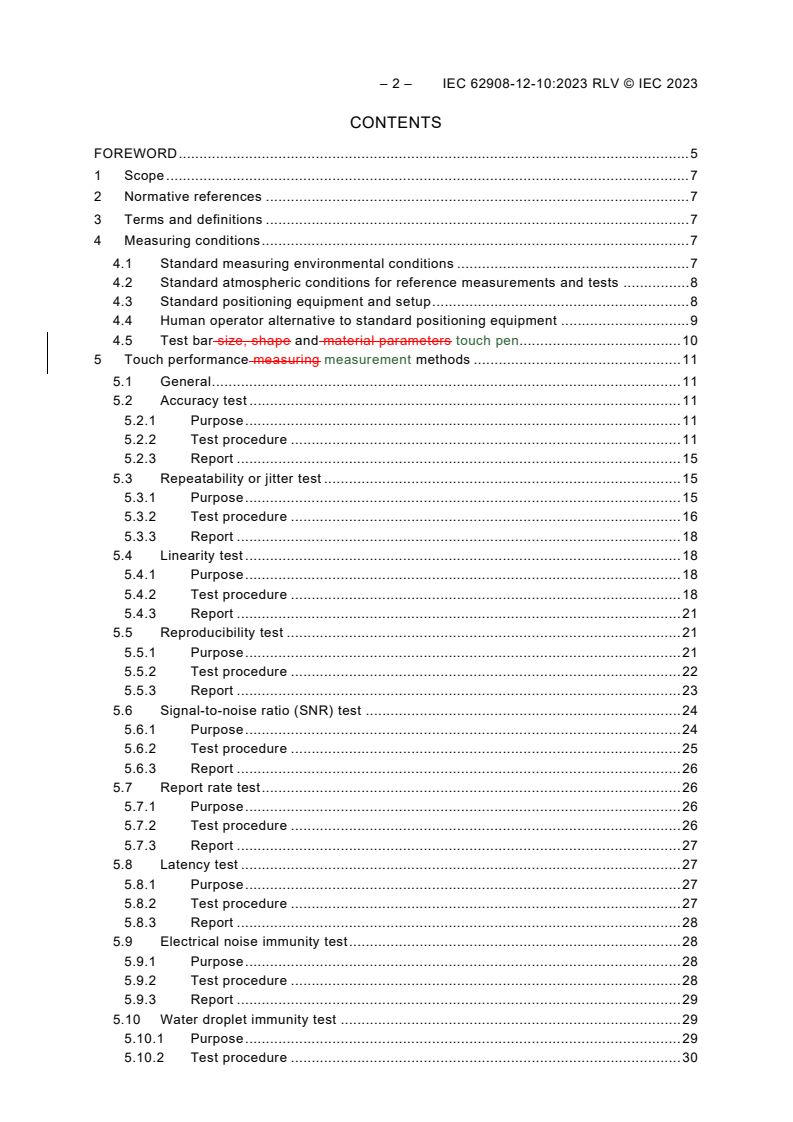
IEC 62908-12-10:2023 RLV - Touch and interactive displays - Part 12-10: Measurement methods of touch displays - Touch and electrical performance Released:1/30/2023
Overview
IEC 62908-12-10:2023 is the International Electrotechnical Commission standard that defines standard measuring conditions and measurement methods for touch and hovering performance of touch sensor modules. Applicable where the structural relationships between touch sensor, touch controller, display panel and modules are defined (see IEC 62908‑1‑2). This second edition (2023) replaces the 2017 edition and introduces significant technical updates, notably hovering performance measurement (in‑plane at constant distance) and pen touch performance.
Key topics and technical requirements
The standard prescribes test setups, procedures and reporting for a comprehensive set of touch and electrical performance measurements, including:
Measuring conditions and setup
- Standard environmental and atmospheric conditions
- Positioning equipment and a human‑operator alternative
- Test tools (test bars) and pen parameters
Touch performance measurement methods
- Accuracy (position error) and how to calculate/report results
- Repeatability / jitter
- Linearity (dragging/line tests)
- Reproducibility (including velocity dependence)
- Signal‑to‑noise ratio (SNR)
- Report rate and reporting time interval
- Latency (end‑to‑end response timing)
- Electrical noise immunity and external noise injection procedures
- Water droplet immunity and optical noise immunity
- Power consumption
- Perpendicular touch/hover distance (Z‑axis detection limits)
In‑plane hovering performance
- Specific procedures for measuring XY accuracy and repeatability when a pointer hovers at a constant distance
Electrical performance (Annex A)
- Procedures for resistance and trans‑capacitance measurement of touch sensors, measurement equipment specifications and reporting.
Practical applications and who uses it
IEC 62908‑12‑10 is intended for:
- Touch display manufacturers validating sensor performance during development and production
- Component and module suppliers (touch sensors, controllers)
- Test laboratories and QA/validation teams performing compliance and specification tests
- Systems integrators and OEMs assessing touch performance for product selection, troubleshooting or procurement
- R&D teams benchmarking hover and pen input performance for new interfaces
Using the standard helps ensure consistent, repeatable measurement data for design verification, quality control, customer specifications and conformance testing.
Related standards
- IEC 62908‑1‑2 (defines structural relationships for touch sensor modules) - directly referenced and required for applying IEC 62908‑12‑10.
- Other parts of the IEC 62908 series covering touch and interactive displays may be relevant for broader functionality and system-level requirements.
Keywords: IEC 62908‑12‑10, touch displays, measurement methods, hovering performance, pen touch, touch sensor module, touch performance testing, electrical performance, SNR, latency.
Relations
- Effective Date
- 23-Feb-2024
- Effective Date
- 05-Sep-2023
- Effective Date
- 05-Sep-2023
Buy Documents
IEC 62908-12-10:2023 - Touch and interactive displays - Part 12-10: Measurement methods of touch displays - Touch and electrical performance Released:1/30/2023
IEC 62908-12-10:2023 RLV - Touch and interactive displays - Part 12-10: Measurement methods of touch displays - Touch and electrical performance Released:1/30/2023
Frequently Asked Questions
IEC 62908-12-10:2023 is a standard published by the International Electrotechnical Commission (IEC). Its full title is "Touch and interactive displays - Part 12-10: Measurement methods of touch displays - Touch and electrical performance". This standard covers: IEC 62908-12-10:2023 specifies the standard measuring conditions and measurement methods for determining touch and hovering performance of a touch sensor module. This document is applicable to touch sensor modules, where the structural relationship between touch sensor, touch controller, touch sensor module, display panel, touch display panel, and touch display module is defined in IEC 62908-1-2. This second edition cancels and replaces the first edition published in 2017. This edition constitutes a technical revision. This edition includes the following significant technical changes with respect to the previous edition: - added hovering performance measurement methods, especially in-plane characteristics at a constant distance from the touch sensor; - added pen touch performance.
IEC 62908-12-10:2023 specifies the standard measuring conditions and measurement methods for determining touch and hovering performance of a touch sensor module. This document is applicable to touch sensor modules, where the structural relationship between touch sensor, touch controller, touch sensor module, display panel, touch display panel, and touch display module is defined in IEC 62908-1-2. This second edition cancels and replaces the first edition published in 2017. This edition constitutes a technical revision. This edition includes the following significant technical changes with respect to the previous edition: - added hovering performance measurement methods, especially in-plane characteristics at a constant distance from the touch sensor; - added pen touch performance.
IEC 62908-12-10:2023 is classified under the following ICS (International Classification for Standards) categories: 31.120 - Electronic display devices. The ICS classification helps identify the subject area and facilitates finding related standards.
IEC 62908-12-10:2023 has the following relationships with other standards: It is inter standard links to IEC 62908-12-10:2025, IEC 62908-12-10:2017, IEC 62908-12-10:2017/COR1:2018. Understanding these relationships helps ensure you are using the most current and applicable version of the standard.
IEC 62908-12-10:2023 is available in PDF format for immediate download after purchase. The document can be added to your cart and obtained through the secure checkout process. Digital delivery ensures instant access to the complete standard document.
Standards Content (Sample)
IEC 62908-12-10 ®
Edition 2.0 2023-01
INTERNATIONAL
STANDARD
colour
inside
Touch and interactive displays –
Part 12-10: Measurement methods of touch displays – Touch and electrical
performance
All rights reserved. Unless otherwise specified, no part of this publication may be reproduced or utilized in any form
or by any means, electronic or mechanical, including photocopying and microfilm, without permission in writing from
either IEC or IEC's member National Committee in the country of the requester. If you have any questions about IEC
copyright or have an enquiry about obtaining additional rights to this publication, please contact the address below or
your local IEC member National Committee for further information.
IEC Secretariat Tel.: +41 22 919 02 11
3, rue de Varembé info@iec.ch
CH-1211 Geneva 20 www.iec.ch
Switzerland
About the IEC
The International Electrotechnical Commission (IEC) is the leading global organization that prepares and publishes
International Standards for all electrical, electronic and related technologies.
About IEC publications
The technical content of IEC publications is kept under constant review by the IEC. Please make sure that you have the
latest edition, a corrigendum or an amendment might have been published.
IEC publications search - webstore.iec.ch/advsearchform IEC Products & Services Portal - products.iec.ch
The advanced search enables to find IEC publications by a Discover our powerful search engine and read freely all the
variety of criteria (reference number, text, technical publications previews. With a subscription you will always have
committee, …). It also gives information on projects, replaced access to up to date content tailored to your needs.
and withdrawn publications.
Electropedia - www.electropedia.org
IEC Just Published - webstore.iec.ch/justpublished
The world's leading online dictionary on electrotechnology,
Stay up to date on all new IEC publications. Just Published
containing more than 22 300 terminological entries in English
details all new publications released. Available online and once
and French, with equivalent terms in 19 additional languages.
a month by email.
Also known as the International Electrotechnical Vocabulary
(IEV) online.
IEC Customer Service Centre - webstore.iec.ch/csc
If you wish to give us your feedback on this publication or need
further assistance, please contact the Customer Service
Centre: sales@iec.ch.
IEC 62908-12-10 ®
Edition 2.0 2023-01
INTERNATIONAL
STANDARD
colour
inside
Touch and interactive displays –
Part 12-10: Measurement methods of touch displays – Touch and electrical
performance
INTERNATIONAL
ELECTROTECHNICAL
COMMISSION
ICS 31.120 ISBN 978-2-8322-6393-8
– 2 – IEC 62908-12-10:2023 © IEC 2023
CONTENTS
FOREWORD . 5
1 Scope . 7
2 Normative references . 7
3 Terms and definitions . 7
4 Measuring conditions . 7
4.1 Standard measuring environmental conditions . 7
4.2 Standard atmospheric conditions for reference measurements and tests . 8
4.3 Standard positioning equipment and setup . 8
4.4 Human operator alternative to standard positioning equipment . 9
4.5 Test bar and touch pen . 10
5 Touch performance measurement methods . 11
5.1 General . 11
5.2 Accuracy test . 11
5.2.1 Purpose . 11
5.2.2 Test procedure . 11
5.2.3 Report . 15
5.3 Repeatability or jitter test . 15
5.3.1 Purpose . 15
5.3.2 Test procedure . 16
5.3.3 Report . 18
5.4 Linearity test . 18
5.4.1 Purpose . 18
5.4.2 Test procedure . 18
5.4.3 Report . 21
5.5 Reproducibility test . 21
5.5.1 Purpose . 21
5.5.2 Test procedure . 22
5.5.3 Report . 23
5.6 Signal-to-noise ratio (SNR) test . 24
5.6.1 Purpose . 24
5.6.2 Test procedure . 25
5.6.3 Report . 26
5.7 Report rate test . 26
5.7.1 Purpose . 26
5.7.2 Test procedure . 26
5.7.3 Report . 27
5.8 Latency test . 27
5.8.1 Purpose . 27
5.8.2 Test procedure . 27
5.8.3 Report . 28
5.9 Electrical noise immunity test . 28
5.9.1 Purpose . 28
5.9.2 Test procedure . 28
5.9.3 Report . 29
5.10 Water droplet immunity test . 29
5.10.1 Purpose . 29
5.10.2 Test procedure . 30
5.10.3 Report . 30
5.11 Optical noise immunity test . 30
5.11.1 Purpose . 30
5.11.2 Test procedure . 31
5.11.3 Report . 31
5.12 Power consumption test . 31
5.12.1 Purpose . 31
5.12.2 Test procedure . 31
5.12.3 Report . 31
5.13 Perpendicular hover distance test . 31
5.13.1 Purpose . 31
5.13.2 Test procedure . 31
5.13.3 Report . 32
6 In-plane hovering performance measurement methods . 32
6.1 General . 32
6.2 Accuracy test . 32
6.2.1 Purpose . 32
6.2.2 Test procedure . 32
6.2.3 Report . 35
6.3 Repeatability or jitter test . 35
6.3.1 Purpose . 35
6.3.2 Test procedure . 35
6.3.3 Report . 38
6.4 Report rate test . 38
6.4.1 Purpose . 38
6.4.2 Test procedure . 38
6.4.3 Report . 40
Annex A (informative) Electrical performance measurement methods of touch sensors . 41
A.1 Resistance . 41
A.1.1 General . 41
A.1.2 Test samples . 41
A.1.3 Measurement equipment . 41
A.1.4 Procedures . 41
A.1.5 Data analysis . 42
A.1.6 Report . 42
A.2 Trans-capacitance . 42
A.2.1 General . 42
A.2.2 Test samples . 42
A.2.3 Measurement equipment . 42
A.2.4 Procedure . 42
A.2.5 Data analysis . 43
A.2.6 Report . 43
Bibliography . 44
Figure 1 – Composition of test equipment . 9
Figure 2 – Concept of performance measurement . 9
Figure 3 – Example of manual test tool (left), positioning without triggering a touch
event (middle) and recording a touch event (right) . 10
– 4 – IEC 62908-12-10:2023 © IEC 2023
Figure 4 – Examples of test bars . 11
Figure 5 – Location of edge area and centre area . 12
Figure 6 – Point grid . 12
Figure 7 – Accuracy definition . 13
Figure 8 – Example of measurement result and calculation of accuracy . 15
Figure 9 – Repeatability in the touch sensor module . 16
Figure 10 – Example of measurement result for repeatability . 18
Figure 11 – Dragging line for linearity test . 19
Figure 12 – Linearity definition . 19
Figure 13 – Example of measurement and calculation of linearity . 21
Figure 14 – Example of reproducibility test results . 22
Figure 15 – Reproducibility test procedure . 23
Figure 16 – Examples of measurements of reproducibility – Velocity dependence . 24
Figure 17 – SNR definition concept . 25
Figure 18 – Dragging direction for reporting time measurement . 26
Figure 19 – Reporting time interval measurement . 27
Figure 20 – Latency measurement . 27
Figure 21 – Example of the effect of external noise . 28
Figure 22 – External noise injection . 29
Figure 23 – Report of external noise immunity . 29
Figure 24 – Example of water drop effect . 30
Figure 25 – Water droplet test procedure . 30
Figure 26 – Perpendicular hover distance measurement . 32
Figure 27 – Point grid . 33
Figure 28 – Accuracy definition for in-plane of XY coordinates on the target projection
plane (l) of the active area . 33
Figure 29 – Accuracy definition for Z coordinate on the target projection plane (l) of the
active area . 34
Figure 30 – Repeatability for in-plane of XY coordinates on the target projection plane
(l) of the active area. 36
Figure 31 – Repeatability for Z coordinate on the target projection plane (l) of the
active area . 36
Figure 32 – Dragging direction of in-plane for reporting time measurement . 39
Figure 33 – Dragging direction of Z-axis for reporting time measurement . 39
Figure 34 – Reporting time interval measurement . 40
Figure A.1 – Diagrammatic representation of measurement of resistance . 42
Figure A.2 – Diagrammatic representation of measurement of capacitance . 43
Table 1 – Standard conditions for reference measurements and tests . 8
Table A.1 – Specification of LCR impedance meter . 41
INTERNATIONAL ELECTROTECHNICAL COMMISSION
____________
TOUCH AND INTERACTIVE DISPLAYS –
Part 12-10: Measurement methods of touch displays –
Touch and electrical performance
FOREWORD
1) The International Electrotechnical Commission (IEC) is a worldwide organization for standardization comprising
all national electrotechnical committees (IEC National Committees). The object of IEC is to promote international
co-operation on all questions concerning standardization in the electrical and electronic fields. To this end and
in addition to other activities, IEC publishes International Standards, Technical Specifications, Technical Reports,
Publicly Available Specifications (PAS) and Guides (hereafter referred to as "IEC Publication(s)"). Their
preparation is entrusted to technical committees; any IEC National Committee interested in the subject dealt with
may participate in this preparatory work. International, governmental and non-governmental organizations liaising
with the IEC also participate in this preparation. IEC collaborates closely with the International Organization for
Standardization (ISO) in accordance with conditions determined by agreement between the two organizations.
2) The formal decisions or agreements of IEC on technical matters express, as nearly as possible, an international
consensus of opinion on the relevant subjects since each technical committee has representation from all
interested IEC National Committees.
3) IEC Publications have the form of recommendations for international use and are accepted by IEC National
Committees in that sense. While all reasonable efforts are made to ensure that the technical content of IEC
Publications is accurate, IEC cannot be held responsible for the way in which they are used or for any
misinterpretation by any end user.
4) In order to promote international uniformity, IEC National Committees undertake to apply IEC Publications
transparently to the maximum extent possible in their national and regional publications. Any divergence between
any IEC Publication and the corresponding national or regional publication shall be clearly indicated in the latter.
5) IEC itself does not provide any attestation of conformity. Independent certification bodies provide conformity
assessment services and, in some areas, access to IEC marks of conformity. IEC is not responsible for any
services carried out by independent certification bodies.
6) All users should ensure that they have the latest edition of this publication.
7) No liability shall attach to IEC or its directors, employees, servants or agents including individual experts and
members of its technical committees and IEC National Committees for any personal injury, property damage or
other damage of any nature whatsoever, whether direct or indirect, or for costs (including legal fees) and
expenses arising out of the publication, use of, or reliance upon, this IEC Publication or any other IEC
Publications.
8) Attention is drawn to the Normative references cited in this publication. Use of the referenced publications is
indispensable for the correct application of this publication.
9) Attention is drawn to the possibility that some of the elements of this IEC Publication may be the subject of patent
rights. IEC shall not be held responsible for identifying any or all such patent rights.
IEC 62908-12-10 has been prepared by IEC technical committee 110: Electronic displays. It is
an International Standard.
This second edition cancels and replaces the first edition published in 2017. This edition
constitutes a technical revision.
This edition includes the following significant technical changes with respect to the previous
edition:
a) added hovering performance measurement methods, especially in-plane characteristics at
a constant distance from the touch sensor;
b) added pen touch performance.
– 6 – IEC 62908-12-10:2023 © IEC 2023
The text of this International Standard is based on the following documents:
Draft Report on voting
110/1434/CDV 110/1480A/RVC
Full information on the voting for its approval can be found in the report on voting indicated in
the above table.
The language used for the development of this International Standard is English.
This document was drafted in accordance with ISO/IEC Directives, Part 2, and developed in
accordance with ISO/IEC Directives, Part 1 and ISO/IEC Directives, IEC Supplement, available
at www.iec.ch/members_experts/refdocs. The main document types developed by IEC are
described in greater detail at www.iec.ch/publications.
A list of all parts in the IEC 62908 series, published under the general title Touch and interactive
displays, can be found on the IEC website.
The committee has decided that the contents of this document will remain unchanged until the
stability date indicated on the IEC website under webstore.iec.ch in the data related to the
specific document. At this date, the document will be
• reconfirmed,
• withdrawn,
• replaced by a revised edition, or
• amended.
IMPORTANT – The "colour inside" logo on the cover page of this document indicates that it
contains colours which are considered to be useful for the correct understanding of its
contents. Users should therefore print this document using a colour printer.
TOUCH AND INTERACTIVE DISPLAYS –
Part 12-10: Measurement methods of touch displays –
Touch and electrical performance
1 Scope
This part of IEC 62908 specifies the standard measuring conditions and measurement methods
for determining touch and hovering performance of a touch sensor module. This document is
applicable to touch sensor modules, where the structural relationship between touch sensor,
touch controller, touch sensor module, display panel, touch display panel, and touch display
module is defined in IEC 62908-1-2.
2 Normative references
The following documents are referred to in the text in such a way that some or all of their content
constitutes requirements of this document. For dated references, only the edition cited applies.
For undated references, the latest edition of the referenced document (including any
amendments) applies.
IEC 60068-1, Environmental testing – Part 1: General and guidance
IEC 62908-1-2, Touch and interactive displays – Part 1-2: Generic – Terminology and letter
symbols
3 Terms and definitions
For the purposes of this document, the terms and definitions given in IEC 60068-1 and
IEC 62908-1-2 apply.
ISO and IEC maintain terminology databases for use in standardization at the following
addresses:
• IEC Electropedia: available at https://www.electropedia.org/
• ISO Online browsing platform: available at https://www.iso.org/obp
4 Measuring conditions
4.1 Standard measuring environmental conditions
Measurements shall be carried out under the standard environmental conditions:
– temperature: 25 °C ± 3 °C,
– relative humidity: 25 % RH to 85 % RH,
– atmospheric pressure: 86 kPa to 106 kPa.
When different environmental conditions are used, they shall be noted in the measurement
report.
– 8 – IEC 62908-12-10:2023 © IEC 2023
4.2 Standard atmospheric conditions for reference measurements and tests
If the parameters to be measured depend on temperature, pressure and humidity, and their
dependence on temperature, pressure and humidity is unknown, the atmospheres to be
specified shall be selected from the following values, as shown in Table 1. The selected values
shall be noted in the relevant specifications.
Table 1 – Standard conditions for reference measurements and tests
a a, b a
Temperature Relative humidity Air pressure
°C % RH kPa
(20, 25, 30, and 35) ± 3 45 to 75 86 to 106
a
Including extreme values.
b 3
Absolute humidity ≤ 22 g/m .
4.3 Standard positioning equipment and setup
The standard positioning equipment for touch performance shall be the positioning machine
equipped with a test bar, a moving arm, and a stage onto which the touch sensor module is
placed, as shown in Figure 1. The positioning machine shall move its arm and stage to place
the test bar on or over the touch sensor module.
There are three types of positions associated with a given test: target, actual and reported
positions. The target position is a desired measurement location in physical space referenced
to a fixed datum on or over the touch sensor module surface. The actual position is the actual
location of contact or hovering during test, referenced to the same fixed datum, which can differ
from the target position due to test bar placement error. The reported position is the location
reported by the touch controller.
As shown in Figure 2, the reported positions from the touch controller are analysed to define
performance measures with respect to the target positions.
The touch sensor module and the stage shall be aligned correctly while setting up the
measurement equipment, because a misalignment between them can introduce coordinate
shifts or rotation between the actual touch positions and target positions; each positioning
machine has its inherent accuracy, which means that an actual touched position does not
coincide with its target position. The performance measurements based on the target positions
can include errors due to the accuracy of the positioning machine. The touch sensor module
under test shall be attached to the stage and connected to the electrical interface. The test bar
of the selected diameter shall be attached to the moving arm. In case of measurement of the
pen touch performance, instead of the test bar, a selected touch pen (stylus pen) shall be
attached to the moving arm.
Figure 1 – Composition of test equipment
Figure 2 – Concept of performance measurement
4.4 Human operator alternative to standard positioning equipment
Under certain circumstances, for example if the display under test is too large for suitable
positioning equipment to be available, a suitably designed test arm may be manually positioned
to enable completion of a subset of the tests described in this document. In this situation, the
test arm needs to be designed carefully to minimise the reasonable achievable error between
actual and target positions when conducting measurements. An example of such a test arm can
consist of a rod with a sliding tip (Figure 3, left), whose materials are chosen so that contact
between the rod and the display does not trigger a touch event (Figure 3, middle), whereas
contact between the sliding tip and the display does trigger a touch event (Figure 3, right). Such
a test arm can be placed accurately and reliably by the human operator with the sliding tip away
from the display, subsequent to which a measurement can be made by sliding the tip into
contact with the display.
The human operator alternative is not recommended for hovering performance measurements
because it is difficult to ensure the accuracy of positions, including the height.
– 10 – IEC 62908-12-10:2023 © IEC 2023
Figure 3 – Example of manual test tool (left), positioning without triggering
a touch event (middle) and recording a touch event (right)
4.5 Test bar and touch pen
The parameters of the test bar shall be size, shape, and material. Examples of suitable sizes
and shapes of the test bar are shown in Figure 4. The material parameters for the test bar shall
be appropriately chosen given the device category under test.
When the touch sensor module is a capacitive touch system, the test bar shall be electrically
conductive and shall additionally be grounded in order to avoid potential performance
degradation due to electrical noise, unless otherwise stated. A test bar may have an insulating
layer on the base to model the effect of a gloved finger.
For reflection-based optical systems, the reflectivity of the contact end of the test bar shall be
chosen to be spectrally representative of human skin.
In all cases, the appropriate properties (including size, shape and material) of the test bar shall
be reported.
In case of measurement of the pen touch performance, the selected touch pen shall be applied
instead of the test bar. The touch pen corresponding to the touch sensor module shall be
selected, because there are several types of touch pens (see IEC TR 62908-1-3). The
information of the selected touch pen and related properties (i.e., tilt angle of touch pen,
pressure of touch pen, etc.) shall be reported.
NOTE ø (test bar diameter) = 4 mm, 6 mm, 7 mm, 9 mm, or 12 mm.
Figure 4 – Examples of test bars
5 Touch performance measurement methods
5.1 General
Fundamental touch performance measurement methods are described in Clause 5. They shall
be applied during the characterization of a touch sensor module to provide a good user
experience. (See Annex A regarding electrical performance measurement methods of touch
sensors.)
5.2 Accuracy test
5.2.1 Purpose
The purpose of this test is to measure the ability of touch sensors and modules to indicate how
close touch positions are reported relative to their target positions.
5.2.2 Test procedure
5.2.2.1 General
For the accuracy measurement, one of the following two methods can be selected. The first
method is a straightforward method to evaluate the distance between each target point and its
corresponding reported point. The second method is an indirect method where target grid points
are estimated from reported points. This method can tolerate coordinate shifts which are caused
by a misalignment between the touch sensor module and the stage while setting up the
measurement equipment.
5.2.2.2 Method 1
The active area is defined as the area where touch is recognized. The centre area is defined
as the rest of the active area without the edge area as shown in Figure 5. The edge area is
defined as an area with the width of W from the edge of the active area. The origin and axis
direction shall be defined.
The touch sensor module under test shall be attached to the stage and connected to the
electrical interface. The test bar of the selected diameter size, shape and material shall be
attached to the moving arm. For a precise measurement of the accuracy, the test equipment
should be set up properly. The measurement points in the test grid are evenly spaced along
both X and Y axes, away from the origin and spanning the whole active area of the touch sensor
panel as shown in Figure 6.
– 12 – IEC 62908-12-10:2023 © IEC 2023
Figure 5 – Location of edge area and centre area
NOTE m, n: number of points in the X and Y direction.
Figure 6 – Point grid
At each target grid point (i, j), lift the test bar down and up, and collect the touch reports p times.
As shown in Figure 7, the accuracy is defined as the distance between the target coordinate
and the mean reported coordinate.
Figure 7 – Accuracy definition
In the centre area, calculate the accuracy, that is, the maximum of accuracy, the standard
deviation of accuracy and the average of accuracy, as shown in Formula (1) to Formula (5). In
the edge area, the accuracy is calculated in the same manner.
AA= max( )
ccmax cci, j (1)
nm
()AA−
∑∑
ccij, ccmean
ji11
(2)
A =
ccσ
q
nm
()A
∑∑
ccij,
ji11
(3)
A =
ccmean
q
A (xr− xt )(+ yr− yt ) (4)
ccij, ij, ij, ij,
ij,
pp
xr yr
∑ ij, ,k ∑ ij, ,k
k 11k
(5)
xr , yr
ij,
ij,
pp
where
p is the number of reports at a target point (1,2,…);
q is the number of measurement points = m x n;
i, j, k is the k-th data in number of reports (p) at a target point(i, j);
A is the distance between the target coordinate and the mean reported coordinate;
cci,j
A is the maximum of accuracy;
ccmax
A is the standard deviation of accuracy; and
ccσ
A is the average of accuracy.
ccmean
In case of measurement of the pen touch performance instead of the test bar, the selected
touch pen shall be applied.
==
==
=
==
==
– 14 – IEC 62908-12-10:2023 © IEC 2023
5.2.2.3 Method 2
The test bar shall be placed at m x n target grid points equally spaced by a distance d in both
horizontal and vertical directions. When the touch sensor module is a capacitive touch system,
d shall be smaller than or equal to one fourth of the sensor channel pitch, and m x d and n x d
are greater than or equal to the sensor channel pitch. At each target grid point (i, j), collect the
touch reports 50 times to 100 times in one of the following two ways:
1) lift the test bar down and up for each report at each target;
2) keep the test bar stationary at each target.
The data from 1) and 2) is used in the calculation of repeatability.
y
x
Calculate the mean point ( , ) of the reported points at (i, j).
i, j
i, j
Then find the best fitted grid
X ,Y = i−+1 d x , j−+1 d y i=1,,mj,=1, ,n
( ) ( ) (6)
( ) ( )
ij, ij, best best
which minimizes the mean square distance
{(X − x ) +−(Yy ) }
∑
i, j i, j i, j
i, j
(7)
i=1,2,.,m,
jn=1,2,.,
from
x , y i 1,,mj, 1, ,n
(8)
( )
i, j ij,
The shifts (x y ) for the best grid are obtained by equating the derivatives of the distance
best, best
by x and y to zero, and are calculated as
best best
xy
∑∑
i, j
i, j
i 1,2,.,m, i 1,2,.,m,
(n−−11)d (md)
jn1,2,., jn1,2,.,
xy,,=−−
( )
(9)
best best
mn 22mn
The accuracy at (i, j) is defined as the distance between the grid point (X ,Y ) and the mean
i,j i,j
x y
point ( , ).
i, j
i, j
(10)
A X− x +−Yy
( )
cci, j ( i, j ) i, j ij,
i, j
An example of a measurement result and the corresponding calculation of accuracy is shown
in Figure 8.
=
==
==
==
In case of measurement of the pen touch performance, instead of the test bar, the selected
touch pen shall be applied.
Figure 8 – Example of measurement result and calculation of accuracy
5.2.3 Report
The following items shall be reported:
– selected measurement method;
– selected size, shape and material of the test bar or the selected touch pen and properties
(tilt angle of touch pen and pressure of touch pen);
– width of edge area W;
– target position;
– number of measurements at each point;
– maximum of accuracy for all points in each area;
– average of accuracy for all points in each area; and
– standard deviation of accuracy for all points in each area.
5.3 Repeatability or jitter test
5.3.1 Purpose
The purpose of this test is to measure the ability of touch sensors and modules to indicate how
precisely touch positions are reported, given a sequence of touches in the same target position,
where "precise" means that the reported positions are "close to each other".
– 16 – IEC 62908-12-10:2023 © IEC 2023
5.3.2 Test procedure
5.3.2.1 General
For the repeatability or jitter measurement, one of the following two methods can be selected,
as in the case of accuracy measurement.
The repeatability is defined with the same reported data collected for accuracy measurement
at target grid point (i, j) by lifting the test bar down and up for each report. The jitter is defined
with the reported data collected by keeping the test bar stationary at target grid point (i, j). The
repeatability measurement is applicable to the jitter measurement.
5.3.2.2 Method 1
The touch sensor module under test shall be attached to the stage and connected to the
electrical interface. The test bar of the selected diameter shall be attached to the moving arm.
At each target grid point (i, j), lift the test bar down and up, and collect the touch reports p times,
As shown in Figure 9, the repeatability is defined as the distance between the reported
coordinate and the mean reported coordinate.
Repeatability/Jitter is standard
Target coordinate
R
(xt,yt) ti,j
i,j
Mean reported coordinate
(xr,yr)
i,j
Reported coordinate
(xr,yr)
i,j
IEC
Figure 9 – Repeatability in the touch sensor module
In the centre area, calculate the repeatability, that is, the maximum, standard deviation and the
average, as shown in Formula (11) to Formula (15). In the edge area, the repeatability is
calculated in the same manner.
RR= max( )
tmax ti, j (11)
nm
()RR−
∑∑ ti, j tmean
ji11
(12)
R =
tσ
q
nm
()R
∑∑ ti, j
ji11
(13)
R =
tmean
q
==
==
R (xr− xr )(+ yr− yr ) (14)
i, j
ti, j i, j i, j
i, j
p p
xr yr
∑∑i, j,k i, j,k
kk1 1
(15)
xr , yr
i, j
i, j
pp
where
p is the number of reports at a target point (1,2,…);
q is the number of measurement points = m × n;
i, j, k is the k-th data in number of reports (p) at a target point (i,j);
R is the distance between the target coordinate and the mean reported coordinate;
ti, j
R is the maximum of repeatability;
tmax
R is the standard deviation of repeatability; and
tσ
R is the average of repeatability.
tmean
In case of measurement of the pen touch performance instead of the test bar, the selected
touch pen shall be applied.
5.3.2.3 Method 2
The repeatability is defined with the same reported data collected for the accuracy
measurement at target grid point (i, j) by lifting the test bar down and up for each report.
Calculate the standard deviation σ as the root mean square distance between the reported
i, j
xy
,
points at target grid point (i, j) and their mean point .
( )
ij,
ij,
The repeatability is defined as
R = max σ
( )
t i, j (16)
ij,
An example of a measurement result for repeatability is shown in Figure 10.
In case of measurement of the pen touch performance instead of the test bar, the selected
touch pen shall be applied.
==
==
=
– 18 – IEC 62908-12-10:2023 © IEC 2023
Figure 10 – Example of measurement result for repeatability
5.3.3 Report
The following items shall be reported:
– selected measurement method;
– selected size, shape and material of the test bar or the selected touch pen and properties
(tilt angle of touch pen and pressure of touch pen);
– width of edge area W;
– target position;
– number of measurements at each point;
– maximum of repeatability or jitter for all points in each area; and
– average of repeatability or jitter for all points in each area.
5.4 Linearity test
5.4.1 Purpose
The purpose of this test is to measure the ability of touch sensors and modules to indicate how
precisely straight lines can be drawn.
5.4.2 Test procedure
5.4.2.1 General
For the linearity measurement, one of the following two methods can be selected as in the
previous cases.
5.4.2.2 Method 1
The touch sensor module under test shall be attached to the stage and connected to the
electrical interface. The test bar of the selected diameter shall be attached to the moving arm.
The test bar touches and drags from one edge of the panel to the opposite edge. The dragging
speed is in the range 5 mm/s to 50 mm/s. The path of the dragging operation is chosen to be
horizontal, vertical or diagonal across the panel (see Figure 11).
Figure 11 – Dragging line for linearity test
The centre of the distance between the reported point and straight line is calculated by the
formula in Figure 12. The edge measurement start point for the line is positioned in the same
way as shown in Figure 6.
Figure 12 – Linearity definition
The distance between the target line and the reported line is measured and determines the
linearity of the touch sensor module, and is calculated as follows:
ax ++by c
r r(i, j) r r(i, j) r
d =
(17)
r(i, j)
ab+
rr
ax ++by c
t r(i, j) t r(i, j) t
d =
(18)
t(i, j)
ab+
tt
Ld= max
( ) (19)
r r(i, j)
– 20 – IEC 62908-12-10:2023 © IEC 2023
Ld= max
( )
t t(i, j) (20)
In case of measurement of the pen touch performance instead of the test bar, the selected
touch pen shall be applied.
5.4.2.3 Method 2
Draw m parallel lines in a chosen direction (vertical, horizontal or diagonal) of equal spacing d
with a touch object at a speed S in the range 5 mm/s to 50 mm/s. When the touch sensor module
is a capacitive touch system, the length of each line shall be greater than or equal to three
times the sensor channel pitch, d is smaller than or equal to one four
...
IEC 62908-12-10 ®
Edition 2.0 2023-01
REDLINE VERSION
INTERNATIONAL
STANDARD
colour
inside
Touch and interactive displays –
Part 12-10: Measurement methods of touch displays – Touch and electrical
performance
All rights reserved. Unless otherwise specified, no part of this publication may be reproduced or utilized in any form
or by any means, electronic or mechanical, including photocopying and microfilm, without permission in writing from
either IEC or IEC's member National Committee in the country of the requester. If you have any questions about IEC
copyright or have an enquiry about obtaining additional rights to this publication, please contact the address below or
your local IEC member National Committee for further information.
IEC Secretariat Tel.: +41 22 919 02 11
3, rue de Varembé info@iec.ch
CH-1211 Geneva 20 www.iec.ch
Switzerland
About the IEC
The International Electrotechnical Commission (IEC) is the leading global organization that prepares and publishes
International Standards for all electrical, electronic and related technologies.
About IEC publications
The technical content of IEC publications is kept under constant review by the IEC. Please make sure that you have the
latest edition, a corrigendum or an amendment might have been published.
IEC publications search - webstore.iec.ch/advsearchform IEC Products & Services Portal - products.iec.ch
The advanced search enables to find IEC publications by a Discover our powerful search engine and read freely all the
variety of criteria (reference number, text, technical publications previews. With a subscription you will always have
committee, …). It also gives information on projects, replaced access to up to date content tailored to your needs.
and withdrawn publications.
Electropedia - www.electropedia.org
IEC Just Published - webstore.iec.ch/justpublished
The world's leading online dictionary on electrotechnology,
Stay up to date on all new IEC publications. Just Published
containing more than 22 300 terminological entries in English
details all new publications released. Available online and once
and French, with equivalent terms in 19 additional languages.
a month by email.
Also known as the International Electrotechnical Vocabulary
(IEV) online.
IEC Customer Service Centre - webstore.iec.ch/csc
If you wish to give us your feedback on this publication or need
further assistance, please contact the Customer Service
Centre: sales@iec.ch.
IEC 62908-12-10 ®
Edition 2.0 2023-01
REDLINE VERSION
INTERNATIONAL
STANDARD
colour
inside
Touch and interactive displays –
Part 12-10: Measurement methods of touch displays – Touch and electrical
performance
INTERNATIONAL
ELECTROTECHNICAL
COMMISSION
ICS 31.120 ISBN 978-2-8322-6440-9
– 2 – IEC 62908-12-10:2023 RLV © IEC 2023
CONTENTS
FOREWORD . 5
1 Scope . 7
2 Normative references . 7
3 Terms and definitions . 7
4 Measuring conditions . 7
4.1 Standard measuring environmental conditions . 7
4.2 Standard atmospheric conditions for reference measurements and tests . 8
4.3 Standard positioning equipment and setup . 8
4.4 Human operator alternative to standard positioning equipment . 9
4.5 Test bar size, shape and material parameters touch pen. 10
5 Touch performance measuring measurement methods . 11
5.1 General . 11
5.2 Accuracy test . 11
5.2.1 Purpose . 11
5.2.2 Test procedure . 11
5.2.3 Report . 15
5.3 Repeatability or jitter test . 15
5.3.1 Purpose . 15
5.3.2 Test procedure . 16
5.3.3 Report . 18
5.4 Linearity test . 18
5.4.1 Purpose . 18
5.4.2 Test procedure . 18
5.4.3 Report . 21
5.5 Reproducibility test . 21
5.5.1 Purpose . 21
5.5.2 Test procedure . 22
5.5.3 Report . 23
5.6 Signal-to-noise ratio (SNR) test . 24
5.6.1 Purpose . 24
5.6.2 Test procedure . 25
5.6.3 Report . 26
5.7 Report rate test . 26
5.7.1 Purpose . 26
5.7.2 Test procedure . 26
5.7.3 Report . 27
5.8 Latency test . 27
5.8.1 Purpose . 27
5.8.2 Test procedure . 27
5.8.3 Report . 28
5.9 Electrical noise immunity test . 28
5.9.1 Purpose . 28
5.9.2 Test procedure . 28
5.9.3 Report . 29
5.10 Water droplet immunity test . 29
5.10.1 Purpose . 29
5.10.2 Test procedure . 30
5.10.3 Report . 30
5.11 Optical noise immunity test . 30
5.11.1 Purpose . 30
5.11.2 Test procedure . 31
5.11.3 Report . 31
5.12 Power consumption test . 31
5.12.1 Purpose . 31
5.12.2 Test procedure . 31
5.12.3 Report . 31
5.13 Perpendicular touch/hover distance test . 31
5.13.1 Purpose . 31
5.13.2 Test procedure . 31
5.13.3 Report . 32
6 In-plane hovering performance measurement methods . 32
6.1 General . 32
6.2 Accuracy test . 32
6.2.1 Purpose . 32
6.2.2 Test procedure . 32
6.2.3 Report . 35
6.3 Repeatability or jitter test . 35
6.3.1 Purpose . 35
6.3.2 Test procedure . 35
6.3.3 Report . 38
6.4 Report rate test . 38
6.4.1 Purpose . 38
6.4.2 Test procedure . 38
6.4.3 Report . 40
Annex A (informative) Electrical performance measuring measurement of touch
sensors . 41
A.1 Resistance . 41
A.1.1 General . 41
A.1.2 Test samples . 41
A.1.3 Measurement equipment . 41
A.1.4 Procedures . 41
A.1.5 Data analysis . 42
A.1.6 Report . 42
A.2 Trans-capacitance . 42
A.2.1 General . 42
A.2.2 Test samples . 42
A.2.3 Measurement equipment . 42
A.2.4 Procedure . 42
A.2.5 Data analysis . 43
A.2.6 Report . 43
Bibliography . 44
Figure 1 – Composition of test equipment . 9
Figure 2 – Concept of performance measurement . 9
Figure 3 – Example of manual test tool (left), positioning without triggering a touch
event (middle) and recording a touch event (right) . 10
– 4 – IEC 62908-12-10:2023 RLV © IEC 2023
Figure 4 – Examples of test bars . 11
Figure 5 – Location of edge area and centre area . 12
Figure 6 – Point grid . 12
Figure 7 – Accuracy definition . 13
Figure 8 – Example of measurement result and calculation of accuracy . 15
Figure 9 – Repeatability in the touch sensor module . 16
Figure 10 – Example of measurement result for repeatability . 18
Figure 11 – Dragging line for linearity test . 19
Figure 12 – Linearity definition . 19
Figure 13 – Example of measurement and calculation of linearity . 21
Figure 14 – Example of reproducibility test results . 22
Figure 15 – Reproducibility test procedure . 23
Figure 16 – Examples of measurements of reproducibility – Velocity dependence . 24
Figure 17 – SNR definition concept . 25
Figure 18 – Dragging direction for reporting time measurement . 26
Figure 19 – Reporting time interval measurement . 27
Figure 20 – Latency measurement . 27
Figure 21 – Example of the effect of external noise . 28
Figure 22 – External noise injection . 29
Figure 23 – Report of external noise immunity . 29
Figure 24 – Example of water drop effect . 30
Figure 25 – Water droplet test procedure . 30
Figure 26 – Perpendicular touch/hover distance measurement . 32
Figure 27 – Point grid . 33
Figure 28 – Accuracy definition for in-plane of XY coordinates on the target projection
plane (l) of the active area . 33
Figure 29 – Accuracy definition for Z coordinate on the target projection plane (l) of the
active area . 34
Figure 30 – Repeatability for in-plane of XY coordinates on the target projection plane
(l) of the active area. 36
Figure 31 – Repeatability for Z coordinate on the target projection plane (l) of the
active area . 36
Figure 32 – Dragging direction of in-plane for reporting time measurement . 39
Figure 33 – Dragging direction of Z-axis for reporting time measurement . 39
Figure 34 – Reporting time interval measurement . 40
Figure A.1 – Diagrammatic representation of measurement of resistance . 42
Figure A.2 – Diagrammatic representation of measurement of capacitance . 43
Table 1 – Standard conditions for reference measurements and tests . 8
Table A.1 – Specification of LCR impedance meter . 41
INTERNATIONAL ELECTROTECHNICAL COMMISSION
____________
TOUCH AND INTERACTIVE DISPLAYS –
Part 12-10: Measurement methods of touch displays –
Touch and electrical performance
FOREWORD
1) The International Electrotechnical Commission (IEC) is a worldwide organization for standardization comprising
all national electrotechnical committees (IEC National Committees). The object of IEC is to promote international
co-operation on all questions concerning standardization in the electrical and electronic fields. To this end and
in addition to other activities, IEC publishes International Standards, Technical Specifications, Technical Reports,
Publicly Available Specifications (PAS) and Guides (hereafter referred to as "IEC Publication(s)"). Their
preparation is entrusted to technical committees; any IEC National Committee interested in the subject dealt with
may participate in this preparatory work. International, governmental and non-governmental organizations liaising
with the IEC also participate in this preparation. IEC collaborates closely with the International Organization for
Standardization (ISO) in accordance with conditions determined by agreement between the two organizations.
2) The formal decisions or agreements of IEC on technical matters express, as nearly as possible, an international
consensus of opinion on the relevant subjects since each technical committee has representation from all
interested IEC National Committees.
3) IEC Publications have the form of recommendations for international use and are accepted by IEC National
Committees in that sense. While all reasonable efforts are made to ensure that the technical content of IEC
Publications is accurate, IEC cannot be held responsible for the way in which they are used or for any
misinterpretation by any end user.
4) In order to promote international uniformity, IEC National Committees undertake to apply IEC Publications
transparently to the maximum extent possible in their national and regional publications. Any divergence between
any IEC Publication and the corresponding national or regional publication shall be clearly indicated in the latter.
5) IEC itself does not provide any attestation of conformity. Independent certification bodies provide conformity
assessment services and, in some areas, access to IEC marks of conformity. IEC is not responsible for any
services carried out by independent certification bodies.
6) All users should ensure that they have the latest edition of this publication.
7) No liability shall attach to IEC or its directors, employees, servants or agents including individual experts and
members of its technical committees and IEC National Committees for any personal injury, property damage or
other damage of any nature whatsoever, whether direct or indirect, or for costs (including legal fees) and
expenses arising out of the publication, use of, or reliance upon, this IEC Publication or any other IEC
Publications.
8) Attention is drawn to the Normative references cited in this publication. Use of the referenced publications is
indispensable for the correct application of this publication.
9) Attention is drawn to the possibility that some of the elements of this IEC Publication may be the subject of patent
rights. IEC shall not be held responsible for identifying any or all such patent rights.
This redline version of the official IEC Standard allows the user to identify the changes made to
the previous edition IEC 62908-12-10:2017. A vertical bar appears in the margin wherever a
change has been made. Additions are in green text, deletions are in strikethrough red text.
– 6 – IEC 62908-12-10:2023 RLV © IEC 2023
IEC 62908-12-10 has been prepared by IEC technical committee 110: Electronic displays. It is
an International Standard.
This second edition cancels and replaces the first edition published in 2017. This edition
constitutes a technical revision.
This edition includes the following significant technical changes with respect to the previous
edition:
a) added hovering performance measurement methods, especially in-plane characteristics at
a constant distance from the touch sensor;
b) added pen touch performance.
The text of this International Standard is based on the following documents:
Draft Report on voting
110/1434/CDV 110/1480A/RVC
Full information on the voting for its approval can be found in the report on voting indicated in
the above table.
The language used for the development of this International Standard is English.
This document was drafted in accordance with ISO/IEC Directives, Part 2, and developed in
accordance with ISO/IEC Directives, Part 1 and ISO/IEC Directives, IEC Supplement, available
at www.iec.ch/members_experts/refdocs. The main document types developed by IEC are
described in greater detail at www.iec.ch/publications.
A list of all parts in the IEC 62908 series, published under the general title Touch and interactive
displays, can be found on the IEC website.
The committee has decided that the contents of this document will remain unchanged until the
stability date indicated on the IEC website under webstore.iec.ch in the data related to the
specific document. At this date, the document will be
• reconfirmed,
• withdrawn,
• replaced by a revised edition, or
• amended.
IMPORTANT – The "colour inside" logo on the cover page of this document indicates that it
contains colours which are considered to be useful for the correct understanding of its
contents. Users should therefore print this document using a colour printer.
TOUCH AND INTERACTIVE DISPLAYS –
Part 12-10: Measurement methods of touch displays –
Touch and electrical performance
1 Scope
This part of IEC 62908 specifies the standard measuring conditions and measurement methods
for determining touch and hovering performance of a touch sensor module. This document is
applicable to touch sensor modules, where the structural relationship between touch sensor,
touch controller, touch sensor module, display panel, touch display panel, and touch display
module is defined in IEC 62908-1-2.
2 Normative references
The following documents are referred to in the text in such a way that some or all of their content
constitutes requirements of this document. For dated references, only the edition cited applies.
For undated references, the latest edition of the referenced document (including any
amendments) applies.
IEC 60068-1, Environmental testing – Part 1: General and guidance
IEC 62908-1-2 , Touch and interactive displays – Part 1-2: Generic – Terminology and letter
symbols
3 Terms and definitions
For the purposes of this document, the terms and definitions given in IEC 60068-1 and
IEC 62908-1-2 apply.
ISO and IEC maintain terminology databases for use in standardization at the following
addresses:
• IEC Electropedia: available at https://www.electropedia.org/
• ISO Online browsing platform: available at https://www.iso.org/obp
4 Measuring conditions
4.1 Standard measuring environmental conditions
Measurements shall be carried out under the standard environmental conditions:
– temperature: 25 °C ± 3 °C,
– relative humidity: 25 % RH to 85 % RH,
– atmospheric pressure: 86 kPa to 106 kPa.
When different environmental conditions are used, they shall be noted in the measurement
report.
___________
Under preparation. Stage at the time of publication: IEC/AFDIS 62908-1-2:2017.
– 8 – IEC 62908-12-10:2023 RLV © IEC 2023
4.2 Standard atmospheric conditions for reference measurements and tests
If the parameters to be measured depend on temperature, pressure and humidity, and their
dependence on temperature, pressure and humidity is unknown, the atmospheres to be
specified shall be selected from the following values, as shown in Table 1. The selected values
shall be noted in the relevant specifications.
Table 1 – Standard conditions for reference measurements and tests
a a, b a
Temperature Relative humidity Air pressure
°C % RH kPa
(20, 25, 30, and 35) ± 3 45 to 75 86 to 106
a
Including extreme values.
b 3
Absolute humidity ≤ 22 g/m .
4.3 Standard positioning equipment and setup
The standard positioning equipment for touch performance shall be the positioning machine
equipped with a test bar, a moving arm, and a stage onto which the touch sensor module is
placed, as shown in Figure 1. The positioning machine shall move its arm and stage to place
the test bar on or over the touch sensor module.
There are three types of positions associated with a given test: target, actual and reported
positions. The target position is a desired measurement location in physical space referenced
to a fixed datum on or over the touch sensor module surface. The actual position is the actual
location of contact or hovering during test, referenced to the same fixed datum, which may can
differ from the target position due to test bar placement error. The reported position is the
location reported by the touch controller.
As shown in Figure 2, the reported positions from the touch controller are analysed to define
performance measures with respect to the target positions.
The touch sensor module and the stage shall be aligned correctly while setting up the
measurement equipment, because a misalignment between them may can introduce coordinate
shifts or rotation between the actual touch positions and target positions; each positioning
machine has its inherent accuracy, which means that an actual touched position does not
coincide with its target position. The performance measurements based on the target positions
may can include errors due to the accuracy of the positioning machine. The touch sensor
module under test shall be attached to the stage and connected to the electrical interface. The
test bar of the selected diameter shall be attached to the moving arm. In case of measurement
of the pen touch performance, instead of the test bar, a selected touch pen (stylus pen) shall
be attached to the moving arm.
Figure 1 – Composition of test equipment
Figure 2 – Concept of performance measurement
4.4 Human operator alternative to standard positioning equipment
Under certain circumstances, for example if the display under test is too large for suitable
positioning equipment to be available, a suitably designed test arm may be manually positioned
to enable completion of a subset of the tests described in this document. In this situation, the
test arm needs to be designed carefully to minimise the reasonable achievable error between
actual and target positions when conducting measurements. An example of such a test arm
may can consist of a rod with a sliding tip (Figure 3, left), whose materials are chosen so that
contact between the rod and the display does not trigger a touch event (Figure 3, middle),
whereas contact between the sliding tip and the display does trigger a touch event (Figure 3,
right). Such a test arm may can be placed accurately and reliably by the human operator with
the sliding tip away from the display, subsequent to which a measurement may can be made
by sliding the tip into contact with the display.
The human operator alternative is not recommended for hovering performance measurements
because it is difficult to ensure the accuracy of positions, including the height.
– 10 – IEC 62908-12-10:2023 RLV © IEC 2023
Figure 3 – Example of manual test tool (left), positioning without triggering
a touch event (middle) and recording a touch event (right)
4.5 Test bar size, shape and material parameters touch pen
The parameters of the test bar shall be size, shape, and material. Examples of suitable sizes
and shapes of the test bar are shown in Figure 4. Care shall be taken to ensure that The material
parameters for the test bar are shall be appropriately chosen given the device category under
test.
When the touch sensor module is a capacitive touch system, the test bar shall be electrically
conductive and shall additionally be grounded in order to avoid potential performance
degradation due to electrical noise, unless otherwise stated. A test bar may have an insulating
layer on the base to model the effect of a gloved finger.
For reflection-based optical systems, the reflectivity of the contact end of the test bar shall be
chosen to be spectrally representative of human skin.
In all cases, the appropriate properties (including size, shape and material) of the test bar shall
be reported.
In case of measurement of the pen touch performance, the selected touch pen shall be applied
instead of the test bar. The touch pen corresponding to the touch sensor module shall be
selected, because there are several types of touch pens (see IEC TR 62908-1-3). The
information of the selected touch pen and related properties (i.e., tilt angle of touch pen,
pressure of touch pen, etc.) shall be reported.
NOTE ø (test bar diameter) = 4 mm, 6 mm, 7 mm, 9 mm, or 12 mm.
Figure 4 – Examples of test bars
5 Touch performance measuring measurement methods
5.1 General
Fundamental touch performance measuring measurement methods are described in Clause 5.
They shall be taken into account applied during the characterization of a touch sensor module
to realize provide a good user experience. (See Annex A regarding electrical performance
measurement methods of touch sensors.)
5.2 Accuracy test
5.2.1 Purpose
The purpose of this test is to measure the ability of touch sensors and modules to indicate how
close touch positions are reported relative to their target positions.
5.2.2 Test procedure
5.2.2.1 General
For the accuracy measurement, one of the following two methods can be selected. The first
method is a straightforward method to evaluate the distance between each target point and its
corresponding reported point. The second method is an indirect method where target grid points
are estimated from reported points. This method can tolerate coordinate shifts which are caused
by a misalignment between the touch sensor module and the stage while setting up the
measurement equipment.
5.2.2.2 Method 1
The active area is defined as the area where touch is recognized. The centre area is defined
as the rest of the active area without the edge area as shown in Figure 5. The edge area is
defined as an area with the width of W from the edge of the active area. The origin and axis
direction shall be defined.
The touch sensor module under test shall be attached to the stage and connected to the
electrical interface. The test bar of the selected diameter size, shape and material shall be
attached to the moving arm. For a precise measurement of the accuracy, the test equipment
should be set up properly. The measurement points in the test grid are evenly spaced along
both X and Y axes, away from the origin and spanning the whole active area of the touch sensor
panel as shown in Figure 6.
– 12 – IEC 62908-12-10:2023 RLV © IEC 2023
Figure 5 – Location of edge area and centre area
NOTE m, n: number of points in the X and Y direction.
Figure 6 – Point grid
At each target grid point (i, j), lift the test bar down and up, and collect the touch reports p times.
As shown in Figure 7, the accuracy is defined as the distance between the target coordinate
and the mean reported coordinate.
Figure 7 – Accuracy definition
In the centre area, calculate the accuracy, that is, the maximum of accuracy, the standard
deviation of accuracy and the average of accuracy, as shown in Formula (1) to Formula (5). In
the edge area, the accuracy is calculated in the same manner.
AA= max( )
ccmax cci, j
(1)
nm
()AA−
∑∑
ccij, ccmean
ji11
(2)
A =
ccσ
q
nm
()A
∑∑
ccij,
ji11
(3)
A =
ccmean
q
A (xr− xt )(+ yr− yt ) (4)
ccij, ij, ij, ij,
ij,
pp
xr yr
∑ ij, ,k ∑ ij, ,k
k 11k
(5)
xr , yr
ij,
ij,
pp
where
p is the number of reports at a target point (1,2,…);
q is the number of measurement points = m x n;
i, j, k is the k-th data in number of reports (p) at a target point(i, j);
A is the distance between the target coordinate and the mean reported coordinate;
cci,j
A is the maximum of accuracy;
ccmax
A is the standard deviation of accuracy; and
ccσ
A is the average of accuracy.
ccmean
In case of measurement of the pen touch performance instead of the test bar, the selected
touch pen shall be applied.
==
==
=
==
==
– 14 – IEC 62908-12-10:2023 RLV © IEC 2023
5.2.2.3 Method 2
The test bar shall be placed at m x n target grid points equally spaced by a distance d in both
horizontal and vertical directions. When the touch sensor module is a capacitive touch system,
d shall be smaller than or equal to one fourth of the sensor channel pitch, and m x d and n x d
are greater than or equal to the sensor channel pitch. At each target grid point (i, j), collect the
touch reports 50 times to 100 times in one of the following two ways:
1) lift the test bar down and up for each report at each target;
2) keep the test bar stationary at each target.
The data from 1) and 2) is used in the calculation of repeatability.
x y
Calculate the mean point ( , ) of the reported points at (i, j).
i, j
i, j
Then find the best fitted grid
X ,Y = i−+1 d x , j−+1 d y i=1,,mj,=1, ,n
( ) ( ) (6)
( ) ( )
ij, ij, best best
which minimizes the mean square distance
{(X − x ) +−(Yy ) }
∑ i, j i, j
i, j
i, j
(7)
i=1,2,.,m,
jn=1,2,.,
from
x , y i 1,,mj, 1, ,n
(8)
( )
i, j ij,
The shifts (x y ) for the best grid are obtained by equating the derivatives of the distance
best, best
by x and y to zero, and are calculated as
best best
xy
∑∑
i, j
i, j
i 1,2,.,m, i 1,2,.,m,
n −−11d md
( ) ( )
jn1,2,., jn1,2,.,
xy,,=−−
( ) (9)
best best
mn 22mn
The accuracy at (i, j) is defined as the distance between the grid point (X ,Y ) and the mean
i,j i,j
x y
point ( , ).
i, j
i, j
(10)
A X− x +−Yy
( ) ( )
cci, j i, j i, j ij,
i, j
An example of a measurement result and the corresponding calculation of accuracy is shown
in Figure 8.
=
==
==
==
In case of measurement of the pen touch performance, instead of the test bar, the selected
touch pen shall be applied.
Figure 8 – Example of measurement result and calculation of accuracy
5.2.3 Report
The following items shall be reported:
– selected measurement method;
– selected size, shape and material of the test bar or the selected touch pen and properties
(tilt angle of touch pen and pressure of touch pen);
– width of edge area W;
– target position;
– number of measurements at each point;
– maximum of accuracy for all points in each area;
– average of accuracy for all points in each area; and
– standard deviation of accuracy for all points in each area.
5.3 Repeatability/ or jitter test
5.3.1 Purpose
The purpose of this test is to measure the ability of touch sensors and modules to indicate how
precisely touch positions are reported, given a sequence of touches in the same target position,
where "precise" means that the reported positions are "close to each other".
– 16 – IEC 62908-12-10:2023 RLV © IEC 2023
5.3.2 Test procedure
5.3.2.1 General
For the repeatability/ or jitter measurement, one of the following two methods can be selected,
as in the case of accuracy measurement.
The repeatability is defined with the same reported data collected for accuracy measurement
at target grid point (i, j) by lifting the test bar down and up for each report. The jitter is defined
with the reported data collected by keeping the test bar stationary at target grid point (i, j). The
repeatability measurement is applicable to the jitter measurement.
5.3.2.2 Method 1
The touch sensor module under test shall be attached to the stage and connected to the
electrical interface. The test bar of the selected diameter shall be attached to the moving arm.
At each target grid point (i, j), lift the test bar down and up, and collect the touch reports p times,
As shown in Figure 9, the repeatability is defined as the distance between the target reported
coordinate and the mean reported coordinate.
Repeatability/Jitter is standard
Target coordinate
R
(xt,yt) ti,j
i,j
Mean reported coordinate
(xr,yr)
i,j
Reported coordinate
(xr,yr)
i,j
IEC
Figure 9 – Repeatability in the touch sensor module
In the centre area, calculate the repeatability, that is, the maximum, standard deviation and the
average, as shown in Formula (11) to Formula (15). In the edge area, the repeatability is
calculated in the same manner.
RR= max( )
tmax ti, j (11)
nm
()RR−
∑∑ ti, j tmean
ji11
(12)
R =
tσ
q
nm
()R
∑∑ ti, j
ji11
(13)
R =
tmean
q
==
==
R (xr− xr )(+ yr− yr ) (14)
i, j
ti, j i, j i, j
i, j
p p
xr yr
∑∑i, j,k i, j,k
kk1 1
(15)
xr , yr
i, j
i, j
pp
where
p is the number of reports at a target point (1,2,…);
q is the number of measurement points = m × n;
i, j, k is the k-th data in number of reports (p) at a target point (i,j);
R is the distance between the target coordinate and the mean reported coordinate;
ti, j
R is the maximum of repeatability;
tmax
R is the standard deviation of repeatability; and
tσ
R is the average of repeatability.
tmean
In case of measurement of the pen touch performance instead of the test bar, the selected
touch pen shall be applied.
5.3.2.3 Method 2
The repeatability is defined with the same reported data collected for the accuracy
measurement at target grid point (i, j) by lifting the test bar down and up for each report.
Calculate the standard deviation σ as the root mean square distance between the reported
i, j
xy
points at target grid point (i, j) and their mean point , .
( )
ij,
ij,
The repeatability is defined as
R = max σ
( )
t i, j (16)
ij,
An example of a measurement result for repeatability is shown in Figure 10.
In case of measurement of the pen touch performance instead of the test bar, the selected
touch pen shall be applied.
==
==
=
– 18 – IEC 62908-12-10:2023 RLV © IEC 2023
Figure 10 – Example of measurement result for repeatability
5.3.3 Report
The following items shall be reported:
– selected measurement method;
– selected size, shape and material of the test bar or the selected touch pen and properties
(tilt angle of touch pen and pressure of touch pen);
– width of edge area W;
– target position;
– number of measurements at each point;
– maximum of repeatability/ or jitter for all points in each area; and
– average of repeatability/ or jitter for all points in each area.
5.4 Linearity test
5.4.1 Purpose
The purpose of this test is to measure the ability of touch sensors and modules to indicate how
precisely straight lines can be drawn.
5.4.2 Test procedure
5.4.2.1 General
For the linearity measurement, one of the following two methods can be selected as in the
previous cases.
5.4.2.2 Method 1
The touch sensor module under test shall be attached to the stage and connected to the
electrical interface. The test bar of the selected diameter shall be attached to the moving arm.
The test bar touches and drags from one edge of the panel to the opposite edge. The dragging
speed is in the range 5 mm/s to 50 mm/s. The path of the dragging operation is chosen to be
horizontal, vertical or diagonal across the panel (see Figure 11).
Figure 11 – Dragging line for linearity test
The centre of the distance between the centre of the reported point and straight line is
calculated by the formula in Figure 12. The edge measurement start point for the line is
positioned in the same way as shown in Figure 6.
Figure 12 – Linearity definition
The distance between the target line and the reported line is measured and determines the
linearity of the touch sensor module, and is calculated as follows:
ax ++by c
r r(i, j) r r(i, j) r
d =
(17)
r(i, j)
ab+
rr
ax ++by c
t r(i, j) t r(i, j) t
d =
(18)
t(i, j)
ab+
tt
Ld= max
( )
r r(i, j) (19)
-----------------
...