


IEC 61000-4-22:2010
(Main)Electromagnetic compatibility (EMC) - Part 4-22: Testing and measurement techniques - Radiated emissions and immunity measurements in fully anechoic rooms (FARs)
Electromagnetic compatibility (EMC) - Part 4-22: Testing and measurement techniques - Radiated emissions and immunity measurements in fully anechoic rooms (FARs)
IEC 61000-4-22:2010 considers immunity tests and emission measurements for electric and/or electronic equipment. Only radiated phenomena are considered. It establishes the required test procedures for using fully anechoic rooms for performing radiated immunity testing and radiated emission measurements. IEC 61000-4-22:2010 establishes a common validation procedure, equipment under test (EUT) set-up requirements, and measurement methods for fully anechoic rooms (FARs) when both radiated electromagnetic emission measurements and radiated electromagnetic immunity tests will be performed in the same FAR. As a basic measurement standard, this part of IEC 61000 does not intend to specify the test levels or emission limits to be applied to particular apparatus or system(s). Its main goal is to provide general measurement procedures to all concerned product committees of IEC or CISPR. Specific product requirements and test conditions are defined by the responsible product committees. The methods described in this standard are appropriate for radiated emission measurements and immunity tests in the frequency range of 30 MHz to 18 GHz. IEC 61000-4-22:2010 has the status of a basic EMC publication in accordance with IEC Guide 107, Electromagnetic compatibility - Guide to the drafting of electromagnetic compatibility publications.
Compatibilité électromagnétique (CEM) - Partie 4-22: Techniques d'essai et de mesure - Mesures de l'immunité et des émissions rayonnées dans des enceintes complètement anéchoïques (FAR)
La CEI 61000-4-22:2010 couvre les essais d'immunité et les mesures d'émissions d'équipements électriques et/ou électroniques. Seuls les phénomènes rayonnés sont pris en compte. Elle définit les procédures d'essai requises pour l'utilisation d'enceintes complètement anéchoïques de mesure de l'immunité aux rayonnements et des émissions rayonnées. La CEI 61000-4-22:2010 établit une procédure de validation commune, les exigences de montage du matériel en essai (EUT) ainsi que les méthodes de mesure pour les enceintes complètement anéchoïques (FAR) lorsque les émissions électromagnétiques rayonnées et l'évaluation de l'immunité électromagnétique rayonnée sont mesurées dans la même enceinte FAR. En tant que norme de mesure de base, la présente partie de la CEI 61000 n'a pas pour but de spécifier les niveaux d'essai ou des limites d'émission à appliquer à un matériel ou système(s) particulier(s). Son principal objectif est de fournir des procédures de mesure d'ordre général à l'ensemble des comités de produits concernés de la CEI ou du CISPR. Les exigences et conditions d'essai applicables à un produit spécifique relèvent de la responsabilité des comités de produits concernés. Les méthodes décrites dans la présente norme permettent de mesurer les émissions rayonnées et l'immunité dans la gamme de fréquences de 30 MHz à 18 GHz. La CEI 61000-4-22:2010 a le statut de publication fondamentale en CEM conformément au Guide 107 de la CEI, Compatibilité électromagnétique - Guide pour les projets de publications en compatibilité électromagnétique.
General Information
- Status
- Published
- Publication Date
- 26-Oct-2010
- Technical Committee
- CIS/A - Radio-interference measurements and statistical methods
- Current Stage
- PPUB - Publication issued
- Start Date
- 27-Oct-2010
- Completion Date
- 30-Nov-2010
Overview
IEC 61000-4-22:2010 is an International Electrotechnical Commission (IEC) standard focusing on electromagnetic compatibility (EMC) testing and measurement techniques within fully anechoic rooms (FARs). This standard specifically addresses radiated emissions and immunity measurements for electrical and electronic equipment, covering frequencies from 30 MHz to 18 GHz. It defines common validation procedures, equipment setup requirements, and measurement methods when conducting radiated electromagnetic emission and immunity tests in the same FAR. As a foundational EMC publication, IEC 61000-4-22 does not set emission limits or test levels for specific products but provides general measurement procedures adaptable by relevant IEC or CISPR product committees.
Key Topics
Fully Anechoic Room (FAR) Applications
IEC 61000-4-22 establishes the framework for using FARs in EMC radiated immunity and emission measurements. It clarifies the measurands for both radiated immunity testing and radiated emission measurements, ensuring consistent evaluation environments.Validation and Calibration Procedures
The standard introduces a harmonized validation/calibration method for FARs, involving simultaneous verification of the room, test antennas, and cables as a complete measurement system. It defines various validation set-up types to assess the FAR’s compliance with measurement requirements.Test Facility Components
Essential elements detailed include the test volume, broadband antennas, antenna cables, test set-up tables, turntables for positioning the equipment under test (EUT), automated antenna polarization changers, and absorber configurations-all crucial for accurate radiated testing.Test Set-up and Measurement Methods
IEC 61000-4-22 provides guidelines for EUT set-up to accommodate tabletop and floor-standing equipment. It outlines procedures for radiated immunity tests and radiated emission measurements, emphasizing reproducibility and reliability over the wide frequency range specified.Measurement Uncertainty and Quality Assurance
The standard offers informative annexes covering measurement uncertainties and system transducer factors, promoting transparency and traceability in EMI/EMC measurement results obtained within FARs.
Applications
Electromagnetic Compatibility Testing
This standard plays an essential role for EMC laboratories utilizing fully anechoic chambers to evaluate electronic devices for radiated emissions and immunity, ensuring globally harmonized practices and repeatable test results.Product Compliance and Certification
While emission limits are product-specific, IEC 61000-4-22 provides manufacturers and compliance bodies with the fundamental measurement processes needed to perform radiated EMC tests that underpin certification in various industries including telecommunications, consumer electronics, automotive, and industrial equipment.Research and Development
Developers leverage IEC 61000-4-22 to validate EMC designs by simulating radiated environments accurately in fully anechoic rooms, facilitating improvements in immunity and reduction of unwanted emissions.Test Facility Design and Validation
The standard guides the construction, validation, and maintenance of FARs, supporting test facilities worldwide in establishing compliant environments that meet international measurement requirements.
Related Standards
IEC 61000 Series
- Part 1: General principles and definitions for EMC
- Part 2: Environment and classification of electromagnetic environments
- Part 3: Emission and immunity limits
- Part 5: Installation and mitigation guidelines
- Future related parts addressing specific EMC testing conditions and equipment types
CISPR 16 Series
Specification for radio disturbance and immunity measurement apparatus and methods, which closely complements IEC 61000-4-22 in test equipment and measurement procedure standards.IEC Guide 107
Guide to drafting electromagnetic compatibility publications, under which IEC 61000-4-22 holds the status of a basic EMC publication.
Keywords: IEC 61000-4-22, electromagnetic compatibility, EMC testing, fully anechoic room, FAR, radiated emissions, radiated immunity, EMC measurement, FAR validation, EMC standards, CISPR, EMC laboratory, radiated emission measurements, immunity testing, test facility validation.
Get Certified
Connect with accredited certification bodies for this standard

TL 9000 QuEST Forum
Telecommunications quality management system.

ANCE
Mexican certification and testing association.

Intertek Slovenia
Intertek testing, inspection, and certification services in Slovenia.
Sponsored listings
Frequently Asked Questions
IEC 61000-4-22:2010 is a standard published by the International Electrotechnical Commission (IEC). Its full title is "Electromagnetic compatibility (EMC) - Part 4-22: Testing and measurement techniques - Radiated emissions and immunity measurements in fully anechoic rooms (FARs)". This standard covers: IEC 61000-4-22:2010 considers immunity tests and emission measurements for electric and/or electronic equipment. Only radiated phenomena are considered. It establishes the required test procedures for using fully anechoic rooms for performing radiated immunity testing and radiated emission measurements. IEC 61000-4-22:2010 establishes a common validation procedure, equipment under test (EUT) set-up requirements, and measurement methods for fully anechoic rooms (FARs) when both radiated electromagnetic emission measurements and radiated electromagnetic immunity tests will be performed in the same FAR. As a basic measurement standard, this part of IEC 61000 does not intend to specify the test levels or emission limits to be applied to particular apparatus or system(s). Its main goal is to provide general measurement procedures to all concerned product committees of IEC or CISPR. Specific product requirements and test conditions are defined by the responsible product committees. The methods described in this standard are appropriate for radiated emission measurements and immunity tests in the frequency range of 30 MHz to 18 GHz. IEC 61000-4-22:2010 has the status of a basic EMC publication in accordance with IEC Guide 107, Electromagnetic compatibility - Guide to the drafting of electromagnetic compatibility publications.
IEC 61000-4-22:2010 considers immunity tests and emission measurements for electric and/or electronic equipment. Only radiated phenomena are considered. It establishes the required test procedures for using fully anechoic rooms for performing radiated immunity testing and radiated emission measurements. IEC 61000-4-22:2010 establishes a common validation procedure, equipment under test (EUT) set-up requirements, and measurement methods for fully anechoic rooms (FARs) when both radiated electromagnetic emission measurements and radiated electromagnetic immunity tests will be performed in the same FAR. As a basic measurement standard, this part of IEC 61000 does not intend to specify the test levels or emission limits to be applied to particular apparatus or system(s). Its main goal is to provide general measurement procedures to all concerned product committees of IEC or CISPR. Specific product requirements and test conditions are defined by the responsible product committees. The methods described in this standard are appropriate for radiated emission measurements and immunity tests in the frequency range of 30 MHz to 18 GHz. IEC 61000-4-22:2010 has the status of a basic EMC publication in accordance with IEC Guide 107, Electromagnetic compatibility - Guide to the drafting of electromagnetic compatibility publications.
IEC 61000-4-22:2010 is classified under the following ICS (International Classification for Standards) categories: 33.100.10 - Emission; 33.100.20 - Immunity. The ICS classification helps identify the subject area and facilitates finding related standards.
IEC 61000-4-22:2010 is available in PDF format for immediate download after purchase. The document can be added to your cart and obtained through the secure checkout process. Digital delivery ensures instant access to the complete standard document.
Standards Content (Sample)
IEC 61000-4-22 ®
Edition 1.0 2010-10
INTERNATIONAL
STANDARD
NORME
INTERNATIONALE
BASIC EMC PUBLICATION
PUBLICATION FONDAMENTALE EN CEM
Electromagnetic compatibility (EMC) –
Part 4-22: Testing and measurement techniques – Radiated emissions and
immunity measurements in fully anechoic rooms (FARs)
Compatibilité électromagnétique (CEM) –
Partie 4-22: Techniques d'essai et de mesure – Mesures de l'immunité et des
émissions rayonnées dans des enceintes complètement anéchoïques (FAR)
All rights reserved. Unless otherwise specified, no part of this publication may be reproduced or utilized in any form or by
any means, electronic or mechanical, including photocopying and microfilm, without permission in writing from either IEC or
IEC's member National Committee in the country of the requester.
If you have any questions about IEC copyright or have an enquiry about obtaining additional rights to this publication,
please contact the address below or your local IEC member National Committee for further information.
Droits de reproduction réservés. Sauf indication contraire, aucune partie de cette publication ne peut être reproduite
ni utilisée sous quelque forme que ce soit et par aucun procédé, électronique ou mécanique, y compris la photocopie
et les microfilms, sans l'accord écrit de la CEI ou du Comité national de la CEI du pays du demandeur.
Si vous avez des questions sur le copyright de la CEI ou si vous désirez obtenir des droits supplémentaires sur cette
publication, utilisez les coordonnées ci-après ou contactez le Comité national de la CEI de votre pays de résidence.
IEC Central Office
3, rue de Varembé
CH-1211 Geneva 20
Switzerland
Email: inmail@iec.ch
Web: www.iec.ch
About the IEC
The International Electrotechnical Commission (IEC) is the leading global organization that prepares and publishes
International Standards for all electrical, electronic and related technologies.
About IEC publications
The technical content of IEC publications is kept under constant review by the IEC. Please make sure that you have the
latest edition, a corrigenda or an amendment might have been published.
ƒ Catalogue of IEC publications: www.iec.ch/searchpub
The IEC on-line Catalogue enables you to search by a variety of criteria (reference number, text, technical committee,…).
It also gives information on projects, withdrawn and replaced publications.
ƒ IEC Just Published: www.iec.ch/online_news/justpub
Stay up to date on all new IEC publications. Just Published details twice a month all new publications released. Available
on-line and also by email.
ƒ Electropedia: www.electropedia.org
The world's leading online dictionary of electronic and electrical terms containing more than 20 000 terms and definitions
in English and French, with equivalent terms in additional languages. Also known as the International Electrotechnical
Vocabulary online.
ƒ Customer Service Centre: www.iec.ch/webstore/custserv
If you wish to give us your feedback on this publication or need further assistance, please visit the Customer Service
Centre FAQ or contact us:
Email: csc@iec.ch
Tel.: +41 22 919 02 11
Fax: +41 22 919 03 00
A propos de la CEI
La Commission Electrotechnique Internationale (CEI) est la première organisation mondiale qui élabore et publie des
normes internationales pour tout ce qui a trait à l'électricité, à l'électronique et aux technologies apparentées.
A propos des publications CEI
Le contenu technique des publications de la CEI est constamment revu. Veuillez vous assurer que vous possédez
l’édition la plus récente, un corrigendum ou amendement peut avoir été publié.
ƒ Catalogue des publications de la CEI: www.iec.ch/searchpub/cur_fut-f.htm
Le Catalogue en-ligne de la CEI vous permet d’effectuer des recherches en utilisant différents critères (numéro de référence,
texte, comité d’études,…). Il donne aussi des informations sur les projets et les publications retirées ou remplacées.
ƒ Just Published CEI: www.iec.ch/online_news/justpub
Restez informé sur les nouvelles publications de la CEI. Just Published détaille deux fois par mois les nouvelles
publications parues. Disponible en-ligne et aussi par email.
ƒ Electropedia: www.electropedia.org
Le premier dictionnaire en ligne au monde de termes électroniques et électriques. Il contient plus de 20 000 termes et
définitions en anglais et en français, ainsi que les termes équivalents dans les langues additionnelles. Egalement appelé
Vocabulaire Electrotechnique International en ligne.
ƒ Service Clients: www.iec.ch/webstore/custserv/custserv_entry-f.htm
Si vous désirez nous donner des commentaires sur cette publication ou si vous avez des questions, visitez le FAQ du
Service clients ou contactez-nous:
Email: csc@iec.ch
Tél.: +41 22 919 02 11
Fax: +41 22 919 03 00
IEC 61000-4-22 ®
Edition 1.0 2010-10
INTERNATIONAL
STANDARD
NORME
INTERNATIONALE
BASIC EMC PUBLICATION
PUBLICATION FONDAMENTALE EN CEM
Electromagnetic compatibility (EMC) –
Part 4-22: Testing and measurement techniques – Radiated emissions and
immunity measurements in fully anechoic rooms (FARs)
Compatibilité électromagnétique (CEM) –
Partie 4-22: Techniques d'essai et de mesure – Mesures de l'immunité et des
émissions rayonnées dans des enceintes complètement anéchoïques (FAR)
INTERNATIONAL
ELECTROTECHNICAL
COMMISSION
COMMISSION
ELECTROTECHNIQUE
PRICE CODE
INTERNATIONALE
XA
CODE PRIX
ICS 33.100.10; 33.100.20 ISBN 978-2-88912-229-5
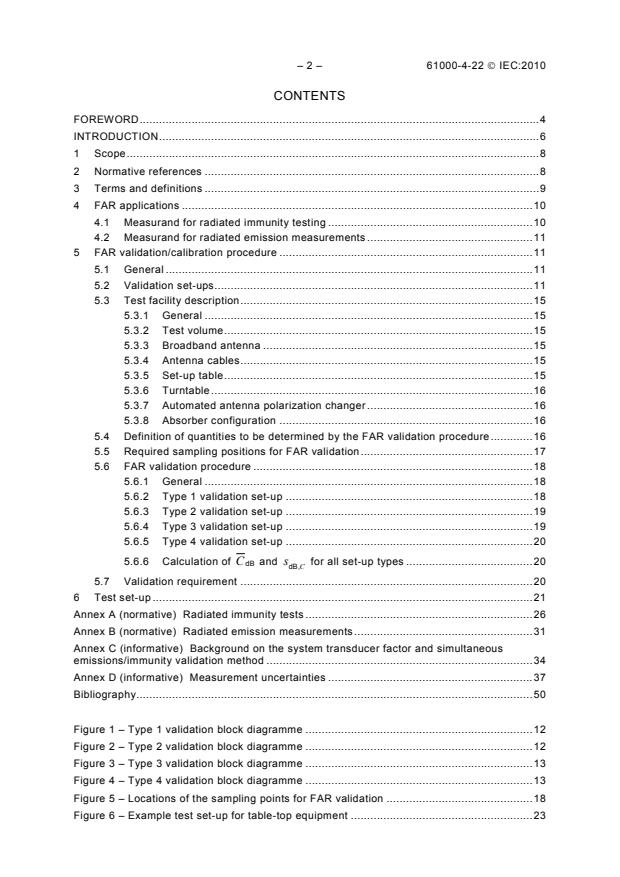
– 2 – 61000-4-22 © IEC:2010
CONTENTS
FOREWORD.4
INTRODUCTION.6
1 Scope.8
2 Normative references .8
3 Terms and definitions .9
4 FAR applications .10
4.1 Measurand for radiated immunity testing .10
4.2 Measurand for radiated emission measurements .11
5 FAR validation/calibration procedure .11
5.1 General .11
5.2 Validation set-ups.11
5.3 Test facility description.15
5.3.1 General .15
5.3.2 Test volume.15
5.3.3 Broadband antenna .15
5.3.4 Antenna cables.15
5.3.5 Set-up table.15
5.3.6 Turntable.16
5.3.7 Automated antenna polarization changer .16
5.3.8 Absorber configuration .16
5.4 Definition of quantities to be determined by the FAR validation procedure.16
5.5 Required sampling positions for FAR validation.17
5.6 FAR validation procedure .18
5.6.1 General .18
5.6.2 Type 1 validation set-up .18
5.6.3 Type 2 validation set-up .19
5.6.4 Type 3 validation set-up .19
5.6.5 Type 4 validation set-up .20
5.6.6 Calculation of C and s for all set-up types .20
dB
dB
,C
5.7 Validation requirement .20
6 Test set-up .21
Annex A (normative) Radiated immunity tests .26
Annex B (normative) Radiated emission measurements.31
Annex C (informative) Background on the system transducer factor and simultaneous
emissions/immunity validation method .34
Annex D (informative) Measurement uncertainties .37
Bibliography.50
Figure 1 – Type 1 validation block diagramme .12
Figure 2 – Type 2 validation block diagramme .12
Figure 3 – Type 3 validation block diagramme .13
Figure 4 – Type 4 validation block diagramme .13
Figure 5 – Locations of the sampling points for FAR validation .18
Figure 6 – Example test set-up for table-top equipment .23
61000-4-22 © IEC:2010 – 3 –
Figure 7 – Example test set-up for table-top equipment, top view.24
Figure 8 – Example test set-up for floor-standing equipment.24
Figure 9 – Example test set-up for floor-standing equipment, top view .25
Figure A.1 – Definition of d for immunity tests .28
measurement
Figure B.1 – Definition of d for emission measurements.32
measurement
Figure D.1 – Example of influence factors for emission measurements .37
Figure D.2 – Example of influences upon the immunity test method .44
Table 1 – Components required for the different validation set-up types .15
Table 2 – Validation criteria .21
Table D.1 – Measurement instrumentation uncertainty in a FAR for radiated emission
measurements in the frequency range 30 MHz to 1 000 MHz.38
Table D.2 – Measurement instrumentation uncertainty in a FAR for radiated emission
measurements in the frequency range 1 GHz to 18 GHz .39
Table D.3 – Measurement instrumentation uncertainty in a FAR for level setting for
immunity testing in the frequency range 30 MHz to 1 000 MHz .45
Table D.4 – Measurement instrumentation uncertainty in a FAR for level setting for
immunity testing in the frequency range 1 GHz to 18 GHz .46
– 4 – 61000-4-22 © IEC:2010
INTERNATIONAL ELECTROTECHNICAL COMMISSION
INTERNATIONAL SPECIAL COMMITTEE ON RADIO INTERFERENCE
____________
ELECTROMAGNETIC COMPATIBILITY (EMC) –
Part 4-22: Testing and measurement techniques –
Radiated emissions and immunity measurements
in fully anechoic rooms (FARs)
FOREWORD
1) The International Electrotechnical Commission (IEC) is a worldwide organization for standardization comprising
all national electrotechnical committees (IEC National Committees). The object of IEC is to promote
international co-operation on all questions concerning standardization in the electrical and electronic fields. To
this end and in addition to other activities, IEC publishes International Standards, Technical Specifications,
Technical Reports, Publicly Available Specifications (PAS) and Guides (hereafter referred to as “IEC
Publication(s)”). Their preparation is entrusted to technical committees; any IEC National Committee interested
in the subject dealt with may participate in this preparatory work. International, governmental and non-
governmental organizations liaising with the IEC also participate in this preparation. IEC collaborates closely
with the International Organization for Standardization (ISO) in accordance with conditions determined by
agreement between the two organizations.
2) The formal decisions or agreements of IEC on technical matters express, as nearly as possible, an international
consensus of opinion on the relevant subjects since each technical committee has representation from all
interested IEC National Committees.
3) IEC Publications have the form of recommendations for international use and are accepted by IEC National
Committees in that sense. While all reasonable efforts are made to ensure that the technical content of IEC
Publications is accurate, IEC cannot be held responsible for the way in which they are used or for any
misinterpretation by any end user.
4) In order to promote international uniformity, IEC National Committees undertake to apply IEC Publications
transparently to the maximum extent possible in their national and regional publications. Any divergence
between any IEC Publication and the corresponding national or regional publication shall be clearly indicated in
the latter.
5) IEC itself does not provide any attestation of conformity. Independent certification bodies provide conformity
assessment services and, in some areas, access to IEC marks of conformity. IEC is not responsible for any
services carried out by independent certification bodies.
6) All users should ensure that they have the latest edition of this publication.
7) No liability shall attach to IEC or its directors, employees, servants or agents including individual experts and
members of its technical committees and IEC National Committees for any personal injury, property damage or
other damage of any nature whatsoever, whether direct or indirect, or for costs (including legal fees) and
expenses arising out of the publication, use of, or reliance upon, this IEC Publication or any other IEC
Publications.
8) Attention is drawn to the Normative references cited in this publication. Use of the referenced publications is
indispensable for the correct application of this publication.
9) Attention is drawn to the possibility that some of the elements of this IEC Publication may be the subject of
patent rights. IEC shall not be held responsible for identifying any or all such patent rights.
International Standard IEC 61000-4-22 has been prepared by CISPR subcommittee A: Radio
interference measurements and statistical methods, in cooperation with subcommittee 77B:
High frequency phenomena, of IEC technical committee 77: Electromagnetic compatibility.
This standard has the status of a basic EMC publication in accordance with IEC Guide 107,
Electromagnetic compatibility – Guide to the drafting of electromagnetic compatibility
publications.
61000-4-22 © IEC:2010 – 5 –
The text of this standard is based on the following documents:
Enquiry draft Report on voting
CISPR/A/912/FDIS CISPR/A/923/RVD
Full information on the voting for the approval of this standard can be found in the report on
voting indicated in the above table.
This publication has been drafted in accordance with the ISO/IEC Directives, Part 2.
A list of all parts of the IEC 61000 series can be found on the IEC website under the general
title Electromagnetic compatibility (EMC), and of all parts of the CISPR 16 series under the
general title Specification for radio disturbance and immunity measuring apparatus and
methods.
The committee has decided that the contents of this publication will remain unchanged until
the stability date indicated on the IEC web site under "http://webstore.iec.ch" in the data
related to the specific publication. At this date, the publication will be
• reconfirmed,
• withdrawn,
• replaced by a revised edition, or
• amended.
– 6 – 61000-4-22 © IEC:2010
INTRODUCTION
This standard is part of the IEC 61000 series of standards, according to the following
structure:
Part 1: General
General considerations (introduction, fundamental principles)
Definitions, terminology
Part 2: Environment
Description of the environment
Classification of the environment
Compatibility levels
Part 3: Limits
Emission limits
Immunity limits (in so far as they do not fall under the responsibility of the product
committees)
Part 4: Testing and measurement techniques
Measurement techniques
Testing techniques
Part 5: Installation and mitigation guidelines
Installation guidelines
Mitigation methods and devices
Part 6: Test set-up
Part 9: Miscellaneous
Each part is further subdivided into several parts, published either as international standards,
as technical specifications or technical reports, some of which have already been published
as sections. Others will be published with the part number followed by a dash and a second
number identifying the subdivision (example: IEC 61000-6-1).
This part is an international standard that establishes the required test procedures for using
fully anechoic rooms for performing radiated immunity testing and radiated emission
measurements.
The main text of this standard provides all information that is common to both radiated
emission measurements and immunity tests in a FAR (fully anechoic room). This includes the
description of a FAR, a common set-up for equipment under test (EUT), and a harmonized
validation/calibration procedure. The test methods described in this standard are based on the
harmonized validation/calibration which verifies a FAR as a measurement system, including
the room, antenna and associated cables simultaneously. The validation procedure
determines a combined transducer factor for a FAR measurement system that is later applied
to both emission measurements and immunity tests. If different sets of antennas and/or
cables are used for emission measurements and immunity tests the validation/calibration
process is performed twice.
Annex A (normative) provides the measurement procedure and any special considerations for
performing radiated immunity tests.
Annex B (normative) provides the measurement procedure and any special considerations for
performing radiated emission measurements.
61000-4-22 © IEC:2010 – 7 –
Annex C (informative) provides background on the system transducer factor and simultaneous
emissions/immunity validation method.
Annex D (informative) provides guidance for calculation of the uncertainty of measurement
results obtained using a FAR and instrumentation in accordance with
)
ISO/IEC Guide 98-3 [4] .
___________
)
Numbers in square brackets refer to the Bibliography.
– 8 – 61000-4-22 © IEC:2010
ELECTROMAGNETIC COMPATIBILITY (EMC) –
Part 4-22: Testing and measurement techniques –
Radiated emissions and immunity measurements
in fully anechoic rooms (FARs)
1 Scope
This part of IEC 61000 considers immunity tests and emission measurements for electric
and/or electronic equipment. Only radiated phenomena are considered. It establishes the
required test procedures for using fully anechoic rooms for performing radiated immunity
testing and radiated emission measurements.
NOTE In accordance with IEC Guide 107 [1], IEC 61000-4-22 is a basic EMC publication for use by product
committees of the IEC. As stated in Guide 107, product committees are responsible for determining the
applicability of the EMC standards. TC 77 and CISPR and their sub-committees are prepared to cooperate with
product committees in the determination of the value of particular EMC tests for specific products.
This part establishes a common validation procedure, equipment under test (EUT) set-up
requirements, and measurement methods for fully anechoic rooms (FARs) when both radiated
electromagnetic emission measurements and radiated electromagnetic immunity tests will be
performed in the same FAR.
As a basic measurement standard, this part of IEC 61000 does not intend to specify the test
levels or emission limits to be applied to particular apparatus or system(s). Its main goal is to
provide general measurement procedures to all concerned product committees of IEC or
CISPR. Specific product requirements and test conditions are defined by the responsible
product committees.
The methods described in this standard are appropriate for radiated emission measurements
and immunity tests in the frequency range of 30 MHz to 18 GHz.
2 Normative references
The following referenced documents are indispensable for the application of this document.
For dated references, only the edition cited applies. For undated references, the latest edition
of the referenced document (including any amendments) applies.
CISPR 16-1-1:2010, Specification for radio disturbance and immunity measuring apparatus
and methods – Part 1-1: Radio disturbance and immunity measuring apparatus – Measuring
apparatus
CISPR 16-1-4:2010, Specification for radio disturbance and immunity measuring apparatus
and methods – Part 1-4: Radio disturbance and immunity measuring apparatus – Ancillary
equipment – Radiated disturbances
IEC 60050-161:1990, International Electrotechnical Vocabulary (IEV) – Part 161:
Electromagnetic compatibility
IEC 60050-394:2007, International Electrotechnical Vocabulary (IEV) – Part 394: Nuclear
instrumentation – Instruments, systems, equipment and detectors
61000-4-22 © IEC:2010 – 9 –
3 Terms and definitions
For the purposes of this document, the terms and definitions in IEC 60050-161, as well as the
following, apply.
3.1
ancillary equipment
transducers (e.g. current and voltage probes and artificial networks) connected to a
measuring receiver or (test) signal generator and used in the disturbance signal transfer
between the EUT and the measuring or test equipment
3.2
associated equipment
AE
apparatus that is not part of the system under test, but needed to help exercise the EUT
3.3
average system transducer factor
C
dB
factor that converts a voltage at the system source/receive termination point to field strength
induced or received; this parameter is calculated from the FAR validation data separately for
horizontal and vertical polarization
NOTE Average system transducer factor is expressed in dB(1/m).
3.4
calibration
set of operations that establish, under specified conditions, the relationship between values of
quantities indicated by a measuring instrument or measuring system, or values represented
by a material measure or a reference material, and the corresponding values realized by
standards
[IEC 60050-394, 394-40-43]
3.5
forward power
P
f,x
power to a FAR test system, recorded during the measurement of the field at a single
position, x, in the test volume
NOTE Forward power is expressed in watts (W).
3.6
fully anechoic room
FAR
shielded enclosure, the entire internal surface of which is lined with radio-frequency absorbing
material (RF-absorber), which absorbs electromagnetic energy in the frequency range of
interest
3.7
fully anechoic room test system
FAR test system
test system comprised of a FAR and a means to generate and/or measure electromagnetic
fields
NOTE Most typically this is comprised of a FAR, an antenna and other ancillary equipment and cabling.
– 10 – 61000-4-22 © IEC:2010
3.8
measurement distance
d
measurement
distance used for EUT measurement/testing and measured from the reference point of the
transmit/receive antenna to the periphery of the EUT at its closest point on the measurement
axis
NOTE Measurement distance is expressed in metres (m) and is illustrated in Figures A.1 and B.1.
3.9
normalized forward power
P
fn,x
forward power required to generate an electric field strength of 1 V/m at a position, x, in the
test volume
NOTE Normalized forward power is expressed in watts (W).
3.10
polarization
orientation of the electric field vector of a linearly polarized radiated field
3.11
reference distance
d
reference
distance at which a limit is specified
3.12
test volume
maximum volume in a FAR in which the EUT and its cabling may be positioned
NOTE See Clause 6 for additional details.
3.13
validation
process of confirming that a finalized instrumentation and control system (hardware and
software) complies with all of its functional, performance and interface requirements
[IEC 60050-394, 394-40-42]
3.14
validation distance
d
validation
distance used for validation/calibration measurements and measured from the reference point
of the transmit/receive antenna to the test volume at its closest point on the measurement
axis
4 FAR applications
4.1 Measurand for radiated immunity testing
Most electronic equipment is, in some manner, affected by electromagnetic radiation. This
radiation is frequently generated by such general-purpose sources as the small handheld
radio transceivers that are used by operating, maintenance and security personnel, fixed-
station radio and television transmitters, vehicle radio transmitters, and various industrial
electromagnetic sources.
In the frequency range covered by this standard, far-field conditions cannot be established in
all cases (e.g. at the lower frequencies), and therefore the disturbance quantity simulating the
real electromagnetic phenomenon is defined by the quantity “electrical field strength” in this
standard.
61000-4-22 © IEC:2010 – 11 –
The measurand to establish the desired disturbance quantity for immunity tests is the electric
field strength (carrier) established by using the average system transducer factor C at
dB
d . The measurand is obtained separately for the horizontal and vertical
measurement
polarizations.
4.2 Measurand for radiated emission measurements
The measurand in a FAR for radiated emission measurements is the field strength radiated by
the EUT and obtained at the measurement distance d by the use of a linearly-
measurement
polarized antenna and applying the average system transducer factor, C , to the maximum
dB
voltage measured at the receive termination point. The measurand is obtained separately for
the horizontal and vertical polarizations of the receiving antenna, and expressed as a result at
the reference distance, d , specified in product standards.
reference
5 FAR validation/calibration procedure
5.1 General
This clause provides the performance requirements and harmonized FAR validation
procedure for both radiated emission measurements and radiated immunity tests.
5.2 Validation set-ups
Figures 1 to 4 show block diagrams of set-ups that can be used alternatively for the validation
procedure. All set-up variants have a transducer reference point (p ) for which the average
TR
system transducer factor (see 5.4) is determined by the validation process.
The primary instrumentation required for each of these set-ups is summarized in the following
bulleted list, and described further in the subsequent lettered list.
• Type 1 (Figure 1): signal generator, spectrum analyzer or power meter, field probe
• Type 2 (Figure 2): signal generator, spectrum analyzer or power meter, reference
antenna
• Type 3 (Figure 3): network analyzer, reference antenna
• Type 4 (Figure 4): network analyzer, power amplifier, reference antenna
– 12 – 61000-4-22 © IEC:2010
FAR
A
DC p
TR
Signal Pow er Directional
Broadband
amplifier coupler
generator
antenna
A
F C1
DC
Spectrum analyzer or RF
pow er meter
Field
probe
F
FP
Field monitor
Computer
IEC 2420/10
Key:
A Attenuation of the cable between the directional coupler and the spectrum analyzer or power meter (dB)
C1
F Calibration factor of the field probe (in linear scale)
FP
A Attenuation of the directional coupler between power input and power output (dB)
DC
F Coupling loss of the directional coupler between power input and forward power output (dB)
DC
p Transducer reference point
TR
Figure 1 – Type 1 validation block diagramme
FAR
A
DC p
TR
Signal Pow er Directional
Broadband
amplifier coupler
generator
antenna
F A
DC C1
Spectrum analyzer or RF
pow er meter
Reference
antenna
F
RA
A
C2
Spectrum analyzer
Computer
IEC 2421/10
Key:
A Attenuation of the cable between the directional coupler and the spectrum analyzer or power meter (dB)
C1
A Attenuation of the cable between the reference antenna and the spectrum analyzer (dB)
C2
F Antenna factor of the reference antenna [dB(1/m)]
RA
A Attenuation of the directional coupler between power input and power output (dB)
DC
F Coupling loss of the directional coupler between power input and forward power output (dB)
DC
p Transducer reference point
TR
Figure 2 – Type 2 validation block diagramme
61000-4-22 © IEC:2010 – 13 –
FAR
p
TR
Vector network
Broadband
Port 1
analyzer or
antenna
Scalar network
Port 2
analyzer
A
C2
Reference
F
RA
antenna
p
RA
Computer
IEC 2422/10
Key:
F Antenna factor of the reference antenna [dB(1/m)]
RA
A Attenuation of the cable between the reference antenna and the spectrum analyzer (dB)
C2
p Reference point of the reference antenna
RA
p Transducer reference point
TR
NOTE Alternatively, the attenuation of the cable between the reference antenna and the network analyzer may be
determined by normalization of the network analyzer (p and p are connected for normalization).
TR RA
Figure 3 – Type 3 validation block diagramme
FAR
p
A
TR
DC
Directional Broadband
Vector network Pow er
R
antenna
analyzer or amplifier coupler
scalar network
A
analyzer
F
DC
A
C1
B
A Reference
C2
F
RA
antenna
p
RA
Computer
IEC 2423/10
Key:
A
Attenuation of the cable between the directional coupler and the spectrum analyzer or power meter (dB)
C1
A Attenuation of the cable between the reference antenna and the spectrum analyzer (dB)
C2
F Antenna factor of the reference antenna [dB(1/m)]
RA
A Attenuation of the directional coupler between power input and power output (dB)
DC
F Coupling loss of the directional coupler between power input and forward power output (dB)
DC
p
Transducer reference point
TR
p Reference point of the reference antenna
RA
R,A,B Network analyzer ports – output port R, input ports A and B
Figure 4 – Type 4 validation block diagramme
– 14 – 61000-4-22 © IEC:2010
The following components are part of a FAR validation set-up. A summary list of the
components required for the different set-up types is given in Table 1.
a) Fully anechoic room (FAR)
The test volume and the validation distance shall be previously specified according to
Figure 5 (see 5.5) and definitions 3.12, 3.14.
b) Broadband antenna
The position of the broadband antenna is fixed in the room.
NOTE 1 The antenna factor normally provided with the antenna is not required because it is determined as
part of the FAR test system transducer factor during this validation/calibration.
c) RF power meter, frequency selective voltmeter, or spectrum analyzer
d) Directional coupler
e) Isotropic field probe and monitor
f) Reference antenna
The reference antenna shall conform to the specifications in 5.4.2.3 of CISPR 16-1-4 for
the frequency range 30 MHz to 1 GHz and 8.3.3.1 of CISPR 16-1-4 for the frequency
range 1 GHz to 18 GHz.
g) Cable to broadband antenna
Routing to the broadband antenna shall be fixed in the installation.
NOTE 2 The loss of the cable to the broadband antenna is determined as part of the FAR system transducer
factor during this validation/calibration.
NOTE 3 The cable to the broadband antenna is typically recommended to be installed horizontally from the
antenna to the absorbers lined on the back wall, then installed vertically against the absorbers to the floor.
This is to minimize the influence of the cable.
h) Other RF cables
The characteristics of other RF cables shall be determined in previous calibration. Any
differences between the cables utilized for this calibration and subsequent testing may be
separately characterized.
i) Signal source
RF generator, able to produce a stable signal.
j) Power amplifier
The output power shall be monitored during this validation/calibration and during immunity
tests (see 5.2 c) and d)). Refer to Annex A for consideration of harmonics and
compression characteristics.
k) Scalar or vector network analyzer
Instrument for the measurement of the transfer function between two points (S ) or the
ratio of two signals (without bridge).
61000-4-22 © IEC:2010 – 15 –
Table 1 – Components required for the different validation set-up types
1) 2)
Component Validation set-up
Type 1 Type 2 Type 3 Type 4
a) Fully anechoic room (FAR) x x x x
b) Broadband antenna x x x x
c) RF power meter x x – –
d) Directional coupler x x – x
e) Isotropic field probe and monitor x – – –
f) Reference antenna – x x x
g) Cable to broadband antenna x x x x
h) Other RF cables x x x x
i) Signal source x x – –
j) Power amplifier x x – x
k) Scalar or network analyzer – – x x
1)
Letters preceding a component correspond with items detailed in 5.2.
2)
“x” indicates component is required; “–“ indicates component is not required.
5.3 Test facility description
5.3.1 General
For the purposes of FAR validation, the parameters of 5.3.2 through 5.3.8 shall be specified
and clearly documented using text descriptions and photographs in the validation report.
5.3.2 Test volume
The test volume is a cylinder that shall encompass the EUT maximum dimensions including
its associated cables, as described in Clause 6. The following parameters of the specified test
volume shall be clearly defined: diameter of volume, location of the centre of the volume
bottom surface, and height.
5.3.3 Broadband antenna
The broadband antenna shall be located at a fixed position outside the test volume within a
FAR. The antenna height is typically set to the height of the centre of the test volume. The
broadband antenna is used as the receiving antenna for emission measurements and as the
transmitting antenna for the validation/calibration tests and subsequent immunity tests. The
validation/calibration process shall be performed for each set of antennas (e.g. to cover
various frequency ranges) used for either immunity testing or emission measurements.
5.3.4 Antenna cables
Reflections from antenna cables can affect results obtained in FAR testing, so consideration
should be given to their design and placement. The lengths of antenna cables located within a
FAR and leading to the broadband antenna shall be laid out in the same manner during
validation of a FAR as they are during product tests in a FAR. Any ferrites placed on the
antenna cable shall be present for both validation testing and subsequent EUT testing.
5.3.5 Set-up table
Set-up tables made from nonconductive and low permittivity materials are recommended. A
set-up table that is designed for installation in the test volume and is removable does not
need to be in-place during the facility validation described in 5.6. A set-up table that is located
– 16 – 61000-4-22 © IEC:2010
outside of the test volume and always used for EUT tests shall be considered as part of a
FAR facility and shall be installed during the validation procedure of 5.6.
5.3.6 Turntable
The recommended minimum facility contains a remotely controlled turntable in the test
volume. Validation/calibration of the facility shall be performed with the turntable, power feed
and communication cabling in their typical locations, and as used for EUT testing.
5.3.7 Automated antenna polarization changer
A computer-controlled, automated antenna polarization changer is recommended, to reduce
test time.
5.3.8 Absorber configuration
The absorber configuration used for the validation test must be the same as will be used for
subsequent EUT testing.
5.4 Definition of quantities to be determined by the FAR validation procedure
The quantities to be determined for each sampling position from the FAR validation procedure
are as described in this subclause. The system transducer factor, C , in dB(1/m), for a
dB,x
single position denoted by x, is given by:
⎛ ⎞
d
x
⎜ ⎟
C = 20log( f ) −15 −10log
(1)
dB,x MHz
⎜ ⎟
P
fn,x
⎝ ⎠
where
f is the frequency in MHz;
MHz
d is the distance between the reference point of the broadband antenna and
x
the reference point of the field probe or reference antenna, in m (see 5.5 for
additional details);
P is the normalized forward power in W, given by:
fn,x
P
f,x
P =
fn,x
(2)
E
x
where
P is the forward power at the transducer reference point p in W;
f,x TR
E is the corresponding electric field strength at location x in V/m.
x
NOTE Annex C gives background and rationale about the relationships shown in Equations (1) and (2).
From the individual system transducer factors, C , the average system transducer
dB,x
factor, C , (as defined in 3.3) can be derived using Equation (3):
dB
n
C
dB,x
C =
dB (3)
∑
n
x=1
61000-4-22 © IEC:2010 – 17 –
where n is the number of sampling points, as determined according to the procedure of 5.5.
The standard deviation of the collected samples is calculated using Equation (4), and for each
antenna polarization separately. This quantity is used for comparison to the validation criteria
of 5.7.
n
1 2
s = ×()C − C (4)
dB, C ∑ dB,x dB
n −1
x=1
The standard deviation of the average system transducer factor, s , is calculated using
dB,C
Equation (5), for each antenna polarization. This quantity is important for the estimation of
uncertainty for subsequent EUT testing [i.e. see item 8 of D.1.3 and item 9 of D.2.4)].
s
dB, C
s =
(5)
dB,C
n
5.5 Required sampling positions for FAR validation
For the procedure described in this subclause, the characteristics of a FAR are to be
measured at multiple positions in a test volume, and the results expressed as an average
system transducer factor and a standard deviation (see 5.4), separately for each antenna
polarization (horizontal and vertical).
The FAR measurements and validation shall be performed for both horizontal and vertical
antenna polarizations at the following positions (see Figure 5):
a) At three heights of the test volume – bottom, middle and top:
1) bottom height h , located at 25 % of the height of the test volume from the bottom.
B
This height shall be a minimum of 20 cm when the test volume height is less than 80
cm, and shall be taken as 50 cm when the test volume height is more than 2 m;
2) top height h , located at 25 % of the height of the test volume from the top; this height
T
shall be a minimum of 20 cm when the test volume height is less than 80 cm, and shall
be taken as 50 cm when the test volume height is more than 2 m;
3) middle height, located at 50 % of the height of the test volume.
b) At five positions in all three horizontal planes – centre, left, right, front, and rear positions,
in each horizontal plane.
The position in height of the broadband antenna outside of the test volume shall be set and
remain fixed at the centre height of the test volume, as shown in Figure 5. The broadband
antenna shall not be tilted, i.e. the boresight axis of the broadband antenna shall remain
aligned along the primary measurement axis for all measurements. The field probe or
reference antenna located in the test volume shall be oriented or tilted to face the broadband
antenna. The position of the broadband antenna (including height) shall be the same as will
be used later for equipment testing.
The distance between the reference point of the broadband antenna and the front position of
the test volume is d . Any antenna masts and supporting floors or structures shall be in
validation
place during the validation procedure. Note that only the field probe or reference antenna is
moved throughout the test volume with this procedure—the broadband antenna is not moved
during the validation, therefore the actual separation distance between the broadband
antenna and each sampling position, d , will vary depending on the sampling position. Note
x
that the actual separation distance shall be recorded for each sampling position, and then
used for d in Equation (1).
x
– 18 – 61000-4-22 © IEC:2010
The sampling positions shall be located such that the phase centre of the reference antenna
or field probe shall always be a minimum of 20 cm inside the test volume.
Top view
Back
Centre Front
20 cm
d
validation
Side view
h
T
Top
Middle
Bottom
h
B
d
validation
IEC 2424/10
NOTE Parameters are described in 5.5. The cylinder formed by the solid lines represents the test volume.
Figure 5 – Locations of the sampling points for FAR validation
5.6 FAR validation procedure
5.6.1 General
Set up the measurement equipment as indicated in Figure 1, Figure 2, Figure 3 or Figure 4.
Place the probe or reference antenna at one of the positions illustrated in Figure 5, and set
the polarization of the broadband antenna to horizontal.
The specific steps used for each of the four set-up types of 5.2 are detailed in 5.6.2 to 5.6.5.
Calculations of the average system transducer factor and standard deviation are covered
in 5.6.6.
5.6.2 Type 1 validation set-up
The following steps shall be applied when using a Type 1 validation set-up.
a) Set the field probe to a single-axis mode, in order to measure the appropriate polarization.
b) Set the signal generator to the first frequency of interest.
c) Set the signal generator or amplifier output power to a fixed CW level that will provide a
suitable validation field strength E . The measurement results are independent of the
x
absolute field strength and/or power level.
61000-4-22 © IEC:2010 – 19 –
NOTE 1 The signal generator and/or amplifier shall be operated at a power level below its maximum output
level, to limit the possible influence of harmonics on the measurement results.
d) Record the following parameters:
• power indicated at the power meter measurement point, P , in dB
...
Questions, Comments and Discussion
Ask us and Technical Secretary will try to provide an answer. You can facilitate discussion about the standard in here.
Loading comments...