


IEC 60092-507:2014
(Main)Electrical installations in ships - Part 507: Small vessels
Electrical installations in ships - Part 507: Small vessels
IEC 60092-507:2014 specifies requirements for the design, construction and installation of electrical systems in small vessels, which have a length of up to 50 m, or which have a gross tonnage not exceeding 500 Gross Tonnes (GT), designed for use on inland waters or at sea. It is not intended to apply to:
a) small craft equipped only with a battery supplying circuits for engine starting and navigation lighting recharged from an inboard or outboard engine driven alternator.
b) recreational craft of less than 24 m hull length requiring to conform to the Recreational Craft Directive 94/25/EC Annex 1 Essential Requirements Part 5.3 Electrical systems, except for three-phase alternating current installations in such recreational craft which operate at a nominal voltage not exceeding AC 500 V. This third edition includes the following significant technical changes with respect to the previous edition:
a) The standard now clarifies its application for electrical installations in those recreational craft which require to conform to the Recreational Craft Directive.
b) The standard specifies requirements for methods of galvanic isolation for small vessels and recreational craft connecting to a low voltage AC shore supply.
c) The standard includes design guidance for electric propulsion systems suitable for small vessels and associated installation requirements.
Installations électriques à bord des navires - Partie 507: Petits navires
L'IEC 60092-507:2014 spécifie les exigences pour la conception, la construction et l'installation des réseaux électriques à bord des petits navires dont la longueur ne dépasse pas 50 m et le tonnage brut 500 GT (Gross Tonne) qui sont conçus pour être utilisés dans les eaux intérieures ou en mer. Elle n'est pas destinée à s'appliquer:
a) aux petits navires équipés seulement d'une batterie alimentant des circuits pour le démarrage d'un moteur et pour les feux de navigation rechargée par un alternateur entraîné par un moteur en-bord ou hors-bord;
b) les navires de plaisance d'une longueur de coque inférieure à 24 m exigeant la conformité à la Directive 94/25/CE sur les navires de plaisance, Annexe 1 Exigences Essentielles, Partie 5.3 Systèmes Électriques, à l'exception des installations à courant alternatif triphasé de tels navires de plaisance qui fonctionnent à une tension nominale ne dépassant pas 500 V en courant alternatif. Cette troisième édition inclut les modifications techniques majeures suivantes par rapport à l'édition précédente
a) La norme clarifie maintenant son application aux installations électriques dans les navires de plaisance qui exigent la conformité à la Directive sur les navires de plaisance.
b) La norme spécifie les exigences pour les méthodes d'isolation galvanique des petits navires et des navires de plaisance raccordés à une alimentation à courant alternatif basse tension par le quai.
c) La norme comprend des lignes directrices de conception pour les Systèmes à propulsion électrique adaptés aux petits navires et les exigences d'installation associées.
General Information
- Status
- Published
- Publication Date
- 24-Nov-2014
- Drafting Committee
- MT 22 - TC 18/MT 22
- Current Stage
- PPUB - Publication issued
- Start Date
- 25-Nov-2014
- Completion Date
- 31-Dec-2014
Relations
- Effective Date
- 05-Sep-2023
Overview
IEC 60092-507:2014 is an international standard published by the International Electrotechnical Commission (IEC) that sets forth requirements for the electrical installations in small vessels. This standard applies to vessels up to 50 meters in length or those with a gross tonnage not exceeding 500 GT, intended for operation on inland waters or at sea. It specifically addresses the design, construction, and installation of electrical systems, ensuring safety, functionality, and regulatory compliance for vessels within its scope. Notably, it excludes small craft equipped solely with battery-powered systems for engine starting and navigation lighting, as well as recreational craft under 24 meters conforming to the Recreational Craft Directive 94/25/EC, except for specific three-phase AC installations.
This third edition includes important technical updates such as clarified applicability for recreational craft, guidelines for galvanic isolation methods when connecting to shore supplies, and design guidance for electric propulsion systems tailored to small vessels.
Key Topics
The IEC 60092-507:2014 standard comprehensively covers multiple key aspects of small vessel electrical systems including:
Scope and Definitions
Clear delineation of vessel size and type, definitions related to DC and AC systems, protection mechanisms, batteries, and galvanic isolation.General Electrical Requirements
Ratings for components, temperature considerations, vessel inclinations, voltage and frequency variations, electrical power sources (batteries, DC and AC generators), and emergency power supplies.Equipment and Installation
Specifications for transformers, converters, motors, and electrical fittings, including enclosures, protection from water ingress, cable entry, electromagnetic compatibility, labelling, and segregation of DC and AC systems.Battery Systems
Installation arrangements, isolation techniques, ventilation, and operational switching for battery banks, along with protection against overcharging and reversal of charging current.Electric Propulsion System Design
Guidance on components, operator controls, alarms, and system safety for electric propulsion setups suitable for small vessels.Distribution System Requirements
Standards for DC and AC distribution systems, earthing methods, earth bonding conductors, load balancing in three-phase systems, and shore connection arrangements with galvanic isolation options.Safety and Protection
Protection against electric shock-covering direct contact prevention, automatic disconnection, and use of class II equipment; overcurrent and fault current protection for AC/DC systems; and protective device characteristics, including generator and motor safeguards.Additional Considerations
Provisions for electrical heating and cooking appliances, navigation light supplies, internal communication circuits, magnetic compasses, and installation in explosive gas atmospheres.
Applications
IEC 60092-507:2014 is essential for maritime engineers, shipbuilders, electrical contractors, and regulatory bodies involved in the:
- Design and installation of compliant electrical systems in small vessels under 50 meters or 500 GT.
- Development of safe, reliable electric propulsion systems and battery installations for inland and sea-going small vessels.
- Implementation of effective galvanic isolation solutions to prevent corrosion and electrical faults when connecting vessels to shore power supplies.
- Protection strategies addressing electric shock hazards, overcurrent faults, and equipment longevity to enhance onboard safety.
- Compliance with international maritime electrical standards to meet regulatory and operational requirements, especially on small commercial vessels and specialized craft.
Related Standards
For broader context and compliance alignment, IEC 60092-507:2014 works in conjunction with related standards such as:
- IEC 60092 Series – covers electrical installations in ships for various vessel sizes and types.
- Recreational Craft Directive 94/25/EC – applicable especially to recreational vessels under 24 m in length regarding electrical system requirements.
- IEC 60364 Series – pertains to electrical installations for buildings, offering complementary guidance on low-voltage electrical systems.
- IEC 60529 – defines degrees of protection provided by enclosures (IP code), relevant for protecting equipment on vessels.
- IEC 61892 – mobile and fixed offshore units electrical installations, which may overlap with certain marine system requirements.
Keywords: IEC 60092-507, electrical installations in ships, small vessels electrical systems, maritime electrical standards, galvanic isolation, electric propulsion systems, ship battery installation, AC DC marine electrical systems, marine electrical safety, vessel wiring requirements, shore power connection, small vessel electrical design.
Get Certified
Connect with accredited certification bodies for this standard

DNV
DNV is an independent assurance and risk management provider.

Lloyd's Register
Lloyd's Register is a global professional services organisation specialising in engineering and technology.

ABS Quality Evaluations Inc.
American Bureau of Shipping quality certification.
Sponsored listings
Frequently Asked Questions
IEC 60092-507:2014 is a standard published by the International Electrotechnical Commission (IEC). Its full title is "Electrical installations in ships - Part 507: Small vessels". This standard covers: IEC 60092-507:2014 specifies requirements for the design, construction and installation of electrical systems in small vessels, which have a length of up to 50 m, or which have a gross tonnage not exceeding 500 Gross Tonnes (GT), designed for use on inland waters or at sea. It is not intended to apply to: a) small craft equipped only with a battery supplying circuits for engine starting and navigation lighting recharged from an inboard or outboard engine driven alternator. b) recreational craft of less than 24 m hull length requiring to conform to the Recreational Craft Directive 94/25/EC Annex 1 Essential Requirements Part 5.3 Electrical systems, except for three-phase alternating current installations in such recreational craft which operate at a nominal voltage not exceeding AC 500 V. This third edition includes the following significant technical changes with respect to the previous edition: a) The standard now clarifies its application for electrical installations in those recreational craft which require to conform to the Recreational Craft Directive. b) The standard specifies requirements for methods of galvanic isolation for small vessels and recreational craft connecting to a low voltage AC shore supply. c) The standard includes design guidance for electric propulsion systems suitable for small vessels and associated installation requirements.
IEC 60092-507:2014 specifies requirements for the design, construction and installation of electrical systems in small vessels, which have a length of up to 50 m, or which have a gross tonnage not exceeding 500 Gross Tonnes (GT), designed for use on inland waters or at sea. It is not intended to apply to: a) small craft equipped only with a battery supplying circuits for engine starting and navigation lighting recharged from an inboard or outboard engine driven alternator. b) recreational craft of less than 24 m hull length requiring to conform to the Recreational Craft Directive 94/25/EC Annex 1 Essential Requirements Part 5.3 Electrical systems, except for three-phase alternating current installations in such recreational craft which operate at a nominal voltage not exceeding AC 500 V. This third edition includes the following significant technical changes with respect to the previous edition: a) The standard now clarifies its application for electrical installations in those recreational craft which require to conform to the Recreational Craft Directive. b) The standard specifies requirements for methods of galvanic isolation for small vessels and recreational craft connecting to a low voltage AC shore supply. c) The standard includes design guidance for electric propulsion systems suitable for small vessels and associated installation requirements.
IEC 60092-507:2014 is classified under the following ICS (International Classification for Standards) categories: 47.020.60 - Electrical equipment of ships and of marine structures. The ICS classification helps identify the subject area and facilitates finding related standards.
IEC 60092-507:2014 has the following relationships with other standards: It is inter standard links to IEC 60092-507:2008. Understanding these relationships helps ensure you are using the most current and applicable version of the standard.
IEC 60092-507:2014 is available in PDF format for immediate download after purchase. The document can be added to your cart and obtained through the secure checkout process. Digital delivery ensures instant access to the complete standard document.
Standards Content (Sample)
IEC 60092-507 ®
Edition 3.0 2014-11
INTERNATIONAL
STANDARD
NORME
INTERNATIONALE
Electrical installations in ships –
Part 507: Small vessels
Installations électriques à bord des navires –
Partie 507: Petits navires
All rights reserved. Unless otherwise specified, no part of this publication may be reproduced or utilized in any form
or by any means, electronic or mechanical, including photocopying and microfilm, without permission in writing from
either IEC or IEC's member National Committee in the country of the requester. If you have any questions about IEC
copyright or have an enquiry about obtaining additional rights to this publication, please contact the address below or
your local IEC member National Committee for further information.
Droits de reproduction réservés. Sauf indication contraire, aucune partie de cette publication ne peut être reproduite
ni utilisée sous quelque forme que ce soit et par aucun procédé, électronique ou mécanique, y compris la photocopie
et les microfilms, sans l'accord écrit de l'IEC ou du Comité national de l'IEC du pays du demandeur. Si vous avez des
questions sur le copyright de l'IEC ou si vous désirez obtenir des droits supplémentaires sur cette publication, utilisez
les coordonnées ci-après ou contactez le Comité national de l'IEC de votre pays de résidence.
IEC Central Office Tel.: +41 22 919 02 11
3, rue de Varembé Fax: +41 22 919 03 00
CH-1211 Geneva 20 info@iec.ch
Switzerland www.iec.ch
About the IEC
The International Electrotechnical Commission (IEC) is the leading global organization that prepares and publishes
International Standards for all electrical, electronic and related technologies.
About IEC publications
The technical content of IEC publications is kept under constant review by the IEC. Please make sure that you have the
latest edition, a corrigenda or an amendment might have been published.
IEC Catalogue - webstore.iec.ch/catalogue Electropedia - www.electropedia.org
The stand-alone application for consulting the entire The world's leading online dictionary of electronic and
bibliographical information on IEC International Standards, electrical terms containing more than 30 000 terms and
Technical Specifications, Technical Reports and other definitions in English and French, with equivalent terms in 14
documents. Available for PC, Mac OS, Android Tablets and additional languages. Also known as the International
iPad. Electrotechnical Vocabulary (IEV) online.
IEC publications search - www.iec.ch/searchpub IEC Glossary - std.iec.ch/glossary
The advanced search enables to find IEC publications by a More than 55 000 electrotechnical terminology entries in
variety of criteria (reference number, text, technical English and French extracted from the Terms and Definitions
committee,…). It also gives information on projects, replaced clause of IEC publications issued since 2002. Some entries
and withdrawn publications. have been collected from earlier publications of IEC TC 37,
77, 86 and CISPR.
IEC Just Published - webstore.iec.ch/justpublished
Stay up to date on all new IEC publications. Just Published IEC Customer Service Centre - webstore.iec.ch/csc
details all new publications released. Available online and If you wish to give us your feedback on this publication or
also once a month by email. need further assistance, please contact the Customer Service
Centre: csc@iec.ch.
A propos de l'IEC
La Commission Electrotechnique Internationale (IEC) est la première organisation mondiale qui élabore et publie des
Normes internationales pour tout ce qui a trait à l'électricité, à l'électronique et aux technologies apparentées.
A propos des publications IEC
Le contenu technique des publications IEC est constamment revu. Veuillez vous assurer que vous possédez l’édition la
plus récente, un corrigendum ou amendement peut avoir été publié.
Catalogue IEC - webstore.iec.ch/catalogue Electropedia - www.electropedia.org
Application autonome pour consulter tous les renseignements
Le premier dictionnaire en ligne de termes électroniques et
bibliographiques sur les Normes internationales,
électriques. Il contient plus de 30 000 termes et définitions en
Spécifications techniques, Rapports techniques et autres
anglais et en français, ainsi que les termes équivalents dans
documents de l'IEC. Disponible pour PC, Mac OS, tablettes
14 langues additionnelles. Egalement appelé Vocabulaire
Android et iPad.
Electrotechnique International (IEV) en ligne.
Recherche de publications IEC - www.iec.ch/searchpub
Glossaire IEC - std.iec.ch/glossary
Plus de 55 000 entrées terminologiques électrotechniques, en
La recherche avancée permet de trouver des publications IEC
en utilisant différents critères (numéro de référence, texte, anglais et en français, extraites des articles Termes et
comité d’études,…). Elle donne aussi des informations sur les Définitions des publications IEC parues depuis 2002. Plus
projets et les publications remplacées ou retirées. certaines entrées antérieures extraites des publications des
CE 37, 77, 86 et CISPR de l'IEC.
IEC Just Published - webstore.iec.ch/justpublished
Service Clients - webstore.iec.ch/csc
Restez informé sur les nouvelles publications IEC. Just
Published détaille les nouvelles publications parues. Si vous désirez nous donner des commentaires sur cette
Disponible en ligne et aussi une fois par mois par email. publication ou si vous avez des questions contactez-nous:
csc@iec.ch.
IEC 60092-507 ®
Edition 3.0 2014-11
INTERNATIONAL
STANDARD
NORME
INTERNATIONALE
Electrical installations in ships –
Part 507: Small vessels
Installations électriques à bord des navires –
Partie 507: Petits navires
INTERNATIONAL
ELECTROTECHNICAL
COMMISSION
COMMISSION
ELECTROTECHNIQUE
PRICE CODE
INTERNATIONALE
CODE PRIX XB
ICS 47.020.60 ISBN 978-2-8322-1933-1
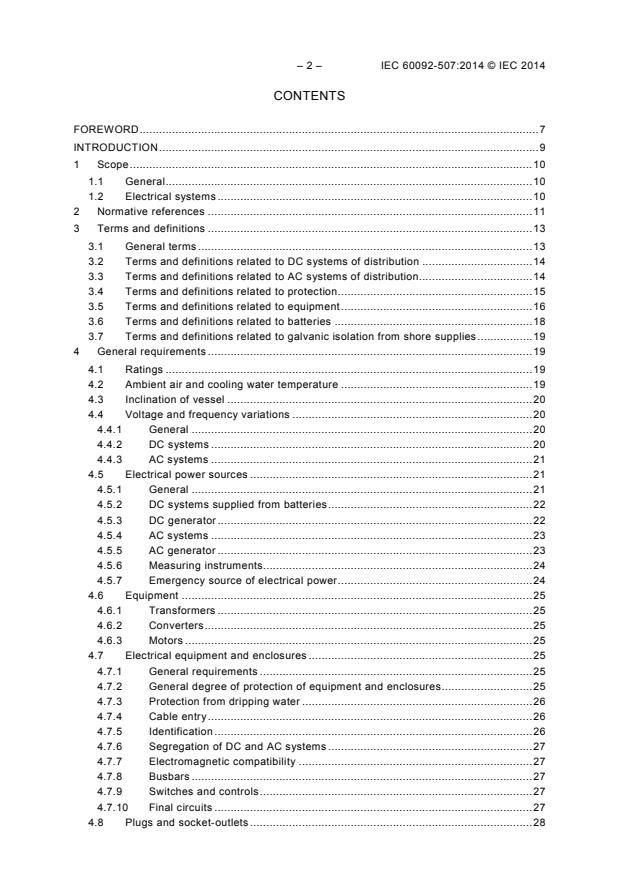
– 2 – IEC 60092-507:2014 © IEC 2014
CONTENTS
FOREWORD . 7
INTRODUCTION . 9
1 Scope . 10
1.1 General . 10
1.2 Electrical systems . 10
2 Normative references . 11
3 Terms and definitions . 13
3.1 General terms . 13
3.2 Terms and definitions related to DC systems of distribution . 14
3.3 Terms and definitions related to AC systems of distribution. 14
3.4 Terms and definitions related to protection. 15
3.5 Terms and definitions related to equipment . 16
3.6 Terms and definitions related to batteries . 18
3.7 Terms and definitions related to galvanic isolation from shore supplies . 19
4 General requirements . 19
4.1 Ratings . 19
4.2 Ambient air and cooling water temperature . 19
4.3 Inclination of vessel . 20
4.4 Voltage and frequency variations . 20
4.4.1 General . 20
4.4.2 DC systems . 20
4.4.3 AC systems . 21
4.5 Electrical power sources . 21
4.5.1 General . 21
4.5.2 DC systems supplied from batteries . 22
4.5.3 DC generator . 22
4.5.4 AC systems . 23
4.5.5 AC generator . 23
4.5.6 Measuring instruments. 24
4.5.7 Emergency source of electrical power . 24
4.6 Equipment . 25
4.6.1 Transformers . 25
4.6.2 Converters . 25
4.6.3 Motors . 25
4.7 Electrical equipment and enclosures . 25
4.7.1 General requirements . 25
4.7.2 General degree of protection of equipment and enclosures . 25
4.7.3 Protection from dripping water . 26
4.7.4 Cable entry . 26
4.7.5 Identification . 26
4.7.6 Segregation of DC and AC systems . 27
4.7.7 Electromagnetic compatibility . 27
4.7.8 Busbars . 27
4.7.9 Switches and controls . 27
4.7.10 Final circuits . 27
4.8 Plugs and socket-outlets . 28
4.8.1 AC system . 28
4.8.2 DC systems . 28
4.8.3 Installation in special locations . 28
4.9 Battery installation . 28
4.9.1 General arrangements . 28
4.9.2 Isolation of battery banks . 28
4.9.3 Operational switching of battery banks . 29
4.9.4 Permanently energised circuits . 29
4.9.5 Ventilation . 29
4.10 Electrical apparatus for explosive gas atmospheres . 30
4.11 Battery chargers . 30
4.11.1 Protection against overcharging and reversal of charging current . 30
4.11.2 Wind generator and photovoltaic devices . 31
4.12 Electric propulsion systems . 31
4.12.1 General . 31
4.12.2 Component parts of electric propulsion systems suitable for small
vessels. . 31
4.12.3 Operator controls, instruments, system and trip alarms . 33
4.13 Electrical fittings and cables attached to structures of another metal . 34
4.14 Internal communication circuits . 34
4.15 Navigation lights supply . 34
4.16 Luminaires . 34
4.17 Electrical heating and cooking appliances . 35
4.18 Magnetic compasses . 35
5 Distribution systems . 35
5.1 DC distribution systems . 35
5.2 Standard AC distribution systems . 35
5.2.1 Types of AC distribution system . 35
5.2.2 Earthing the neutral conductor in type TN AC systems . 35
5.2.3 Earthing of non-current-carrying parts. 36
5.2.4 Protective conductor in AC systems . 36
5.3 Earth bonding conductors . 36
5.4 Balance of loads in three-phase AC systems . 36
5.5 Shore connection arrangements . 37
5.5.1 General . 37
5.5.2 Vessel connections . 37
5.5.3 Information and connection instructions . 37
5.5.4 Galvanic isolation provided by an isolation transformer . 37
5.5.5 Galvanic isolation provided by a diode type galvanic isolator . 38
6 Protection against electric shock in AC and DC systems with voltage exceeding
safety voltage . 39
6.1 Protection against direct contact . 39
6.2 Automatic disconnection of supply to final circuit or equipment . 39
6.3 Earthed neutral AC system (TN system). 39
6.4 Non-neutral earthed AC system (IT-type system) . 39
6.5 Use of class II equipment . 40
7 Protection against over-current and fault-current in AC and DC systems . 40
7.1 General . 40
7.2 Characteristics of protective devices . 40
– 4 – IEC 60092-507:2014 © IEC 2014
7.3 DC battery source . 40
7.3.1 Overcurrent protection of main circuit from batteries . 40
7.3.2 Batteries without output overcurrent protection . 41
7.4 AC system . 41
7.4.1 Protective devices . 41
7.4.2 Final circuits . 41
7.5 Generators . 42
7.5.1 Small generators in DC systems . 42
7.5.2 Use of fuses . 42
7.5.3 Generator circuit-breaker . 42
7.6 Transformers . 42
7.7 Motor protection . 42
7.8 Electronic power converters . 42
8 Diversity (demand) factor . 42
8.1 Circuits other than final circuits . 42
8.2 Application of diversity (demand) factors . 43
8.3 Final circuits . 43
8.4 Motor power circuits . 43
9 Cables . 43
9.1 Selection of cables . 43
9.1.1 Cables for DC systems . 43
9.1.2 Cables for AC systems . 43
9.1.3 Conductors . 43
9.1.4 Protective coverings . 43
9.2 Determination of the cross-sectional areas of conductors . 44
9.2.1 General requirement . 44
9.2.2 DC system . 44
9.2.3 AC system . 44
9.2.4 Protective conductor in AC systems . 44
9.2.5 Current ratings for continuous service (AC and DC) . 45
9.2.6 Correction factors for different ambient air temperatures . 46
9.2.7 Correction factors for cable bunching. 47
9.2.8 Correction factors for non-continuous service . 47
9.2.9 Parallel connection of cables . 47
10 Cable installation, conductor terminations and identification . 48
10.1 Cable routes . 48
10.2 Cable support and protection . 48
10.3 Segregation of circuits . 48
10.4 DC and AC cabling segregation . 49
10.5 Instrument, control, navigation aids, data, and communications cables . 49
10.6 Conductor terminations . 50
10.7 Conductor identification . 50
10.7.1 General . 50
10.7.2 Bonding conductors . 51
10.7.3 Conductor insulation colours in DC systems . 51
11 Earthing . 51
11.1 Earthing arrangements on small vessels with non-metallic hull . 51
11.2 Earthing arrangements on small vessels with metallic hull . 51
11.3 Earthing plate for the main earth connection in a small vessel with non-
metallic hull . 51
11.4 Insulation from earth of control systems for internal combustion engine on
metallic hulled vessels . 51
11.5 Earthing of electrical equipment enclosures . 52
12 Lightning protection . 52
12.1 Lightning protection conductors . 52
12.2 Installation . 52
12.3 Earthing of lightning conductors . 52
13 Testing . 52
13.1 General . 52
13.2 Earthing . 53
13.3 Insulation resistance . 53
13.3.1 General . 53
13.3.2 Switchboards, panel boards and distribution boards . 53
13.3.3 Lighting and power circuits . 53
13.3.4 Generators and motors . 53
13.3.5 Transformers . 53
13.4 Switchgear and controlgear . 54
13.5 Voltage drop . 54
13.6 Internal communication circuits . 54
13.7 Lighting, heating and galley equipment . 54
14 Vessels over 24 m in length up to 50 m/500 GT . 54
14.1 General . 54
14.2 Essential services . 54
14.3 Capacity of the batteries . 54
14.4 Segregation of supplies for essential circuits . 55
14.5 SOLAS battery charger protection . 55
14.6 Protection against over current and fault current – safety equipment . 55
14.7 Earth faults in essential circuits . 55
14.7.1 Earthed neutral systems (TN-type systems) . 55
14.7.2 Non-earthed system (IT-type system) . 55
14.8 Navigation light supply . 55
14.9 Radio and navigation equipment . 55
14.10 Navigation, control, instrumentation and communication systems . 56
14.11 Electric and electrohydraulic steering gear . 56
Annex A (informative) Shore-side power supply arrangements . 57
A.1 Connection to a shore power supply . 57
A.1.1 General . 57
A.1.2 Instructions included in a vessel owner's manual (ISO 10240) . 57
A.1.3 Information and instructions for connecting an electrical shore supply to
a vessel . 57
A.2 Examples of general arrangements for an electrical supply to a vessel . 58
A.2.1 Direct connection to a single phase mains supply . 58
A.2.2 Direct connection to a single phase mains supply with an isolating
transformer on the vessel . 59
A.2.3 Direct connection to a three phase mains supply . 59
A.2.4 Direct connection to a three phase mains supply with an isolating
transformer on the vessel . 60
– 6 – IEC 60092-507:2014 © IEC 2014
A.2.5 Connection to a single phase supply through a shore-mounted isolating
transformer . 61
A.2.6 Direct connection to a single phase mains supply with a diode type
galvanic isolator in the PE circuit to shore. . 61
A.2.7 Direct connection to a three phase mains supply with a diode type
galvanic isolator in the PE circuit to shore. . 62
Annex B (informative) Diode type galvanic isolator . 63
B.1 General . 63
B.2 Testing . 64
Annex ZZ (informative) Relationship between this standard and the essential
requirements of EU directive 94/25/EC as amended by directive 2003/44/EC . 65
Bibliography . 66
Figure 1 – Diagram showing the use of shore power supply accessories . 18
Figure A.1 – Direct connection to a single phase mains supply . 59
Figure A.2 – Direct connection to a single phase mains supply with an isolating
transformer on the vessel . 59
Figure A.3 – Direct connection to a three phase mains supply . 60
Figure A.4 – Direct connection to a three phase mains supply with an isolating
transformer on the vessel . 60
Figure A.5 – Connection to a single phase supply through a shore-mounted isolating
transformer . 61
Figure A.6 – Direct connection to a single phase mains supply with a diode type
galvanic isolator in the protective earth circuit to shore . 62
Figure A.7 – Direct connection to a three phase mains supply with a diode type
galvanic isolator in the protective earth circuit to shore . 62
Table 1 – Design parameters – Temperature . 20
Table 2 – Angular deviation and motion . 20
Table 3 – AC voltages and frequencies for vessel's service systems of supply . 21
Table 4 – Required technical data for owner’s manual . 22
Table 5 – Degree of protection in accordance with IEC 60529. 26
Table 6 – Minimum clearances and creepage distances for bare busbars . 27
Table 7 – Reference currents for calculation of minimum ventilation . 30
Table 8 – Table of main component parts of an electric propulsion system and
associated clauses and sections in this standard . 32
Table 9 – Recommended maximum breaking times for protective devices . 41
Table 10 – Values of α used in the calculation of current ratings . 45
Table 11 – Recommended current ratings for single core cables in continuous service
(ambient temperature 45 °C) . 46
Table 12 – Correction factors for various ambient air temperatures . 47
Table 13 – Correction factors for half-hour and one-hour service . 47
Table ZZ.1 – Correspondence between this standard and directive 94/25/EC as
amended by directive 2003/44/EC . 65
INTERNATIONAL ELECTROTECHNICAL COMMISSION
____________
ELECTRICAL INSTALLATIONS IN SHIPS –
Part 507: Small vessels
FOREWORD
1) The International Electrotechnical Commission (IEC) is a worldwide organization for standardization comprising
all national electrotechnical committees (IEC National Committees). The object of IEC is to promote
international co-operation on all questions concerning standardization in the electrical and electronic fields. To
this end and in addition to other activities, IEC publishes International Standards, Technical Specifications,
Technical Reports, Publicly Available Specifications (PAS) and Guides (hereafter referred to as “IEC
Publication(s)”). Their preparation is entrusted to technical committees; any IEC National Committee interested
in the subject dealt with may participate in this preparatory work. International, governmental and non-
governmental organizations liaising with the IEC also participate in this preparation. IEC collaborates closely
with the International Organization for Standardization (ISO) in accordance with conditions determined by
agreement between the two organizations.
2) The formal decisions or agreements of IEC on technical matters express, as nearly as possible, an international
consensus of opinion on the relevant subjects since each technical committee has representation from all
interested IEC National Committees.
3) IEC Publications have the form of recommendations for international use and are accepted by IEC National
Committees in that sense. While all reasonable efforts are made to ensure that the technical content of IEC
Publications is accurate, IEC cannot be held responsible for the way in which they are used or for any
misinterpretation by any end user.
4) In order to promote international uniformity, IEC National Committees undertake to apply IEC Publications
transparently to the maximum extent possible in their national and regional publications. Any divergence
between any IEC Publication and the corresponding national or regional publication shall be clearly indicated in
the latter.
5) IEC itself does not provide any attestation of conformity. Independent certification bodies provide conformity
assessment services and, in some areas, access to IEC marks of conformity. IEC is not responsible for any
services carried out by independent certification bodies.
6) All users should ensure that they have the latest edition of this publication.
7) No liability shall attach to IEC or its directors, employees, servants or agents including individual experts and
members of its technical committees and IEC National Committees for any personal injury, property damage or
other damage of any nature whatsoever, whether direct or indirect, or for costs (including legal fees) and
expenses arising out of the publication, use of, or reliance upon, this IEC Publication or any other IEC
Publications.
8) Attention is drawn to the normative references cited in this publication. Use of the referenced publications is
indispensable for the correct application of this publication.
9) Attention is drawn to the possibility that some of the elements of this IEC Publication may be the subject of
patent rights. IEC shall not be held responsible for identifying any or all such patent rights.
International Standard IEC 60092-507 has been prepared by IEC technical committee 18:
Electrical installations of ships and of mobile and fixed offshore units.
This third edition cancels and replaces the second edition published in 2008 and constitutes a
technical revision.
This third edition includes the following significant technical changes with respect to the
previous edition.
a) The standard now clarifies its application for electrical installations in those recreational
craft which require to conform to the Recreational Craft Directive.
b) The standard specifies requirements for methods of galvanic isolation for small vessels
and recreational craft connecting to a low voltage AC shore supply.
c) The standard includes design guidance for electric propulsion systems suitable for small
vessels and associated installation requirements.
– 8 – IEC 60092-507:2014 © IEC 2014
The text of this standard is based on the following documents:
FDIS Report on voting
18/1426/FDIS 18/1443/RVD
Full information on the voting for the approval of this standard can be found in the report on
voting indicated in the above table.
This publication has been drafted in accordance with the ISO/IEC Directives, Part 2.
A list of all the parts of the IEC 60092 series, published under the general title Electrical
installations in ships, can be found on the IEC website.
The committee has decided that the contents of this publication will remain unchanged until
the stability date indicated on the IEC web site under "http://webstore.iec.ch" in the data
related to the specific publication. At this date, the publication will be
• reconfirmed,
• withdrawn,
• replaced by a revised edition, or
• amended.
INTRODUCTION
This International Standard incorporates and coordinates, as far as possible, the existing
requirements for electrical installations relevant to small vessels as published in other parts of
the IEC 60092 series and the IEC 60364 series.
– 10 – IEC 60092-507:2014 © IEC 2014
ELECTRICAL INSTALLATIONS IN SHIPS –
Part 507: Small vessels
1 Scope
1.1 General
This part of IEC 60092 specifies requirements for the design, construction and installation of
electrical systems in small vessels, which have a length of up to 50 m, or which have a gross
tonnage not exceeding 500 Gross Tonnes (GT), designed for use on inland waters or at sea.
It is not intended to apply to:
a) small craft equipped only with a battery supplying circuits for engine starting and
navigation lighting recharged from an inboard or outboard engine driven alternator.
b) recreational craft of less than 24 m hull length requiring to conform to the Recreational
Craft Directive 94/25/EC Annex 1 Essential Requirements Part 5.3 Electrical systems,
except for three-phase alternating current installations in such recreational craft which
operate at a nominal voltage not exceeding AC 500 V.
1.2 Electrical systems
This standard applies to the types of DC and AC electrical systems described below,
individually or in combination.
a) Direct current system which operates at a nominal voltage not exceeding DC 50 V. For
many small vessels, this will be the main electrical system supported by batteries for
engine starting, navigation lights, navigational aids and communications equipment,
lighting and other DC power consumer or converter equipment.
b) Single-phase alternating current system which operates at a nominal voltage not
exceeding AC 250 V. Such a system may be the principal electrical power system of a
vessel or a system which may only be energized when connected to a shore supply. AC
extra-low voltage, safety extra-low voltage, and other circuits may also comprise part of a
single-phase AC system. A vessel may also be equipped with DC system(s) for equipment
supplied from batteries as in 1.2 a) above.
c) Three-phase alternating current system which operates at a nominal voltage not
exceeding AC 500 V. The three-phase system is likely to be the principal electrical power
system of a vessel’s electrical installation. Such a vessel may also be equipped with
single-phase AC circuits(s) similar to 1.2 b) above and DC system(s) for equipment
supplied from batteries as in 1.2 a) above.
NOTE 1 Concerning recreational craft of less than 24 m hull length referenced in 1.1 b) above, the following
standards apply:
– for direct current installations which operate at a nominal voltage not exceeding DC 50 V: ISO 10133;
– for single-phase alternating current installations which operate at a nominal voltage not exceeding AC 250 V
single phase: ISO 13297.
NOTE 2 For alternating current systems having voltages exceeding AC 250 V single-phase or AC 500 V three-
phase, for direct current systems exceeding DC 50 V, and for vessels larger than 500 GT or with a length greater
than 50 m, other standards within the IEC 60092 series apply.
NOTE 3 Attention is drawn to regulations which govern specific requirements for navigation lights for small
vessels.
NOTE 4 Attention is drawn to the fact that, in some countries the EC Directives covering EMC (89/336/EEC), low
voltage (73/23/EEC) and general product safety (92/59/EEC) may be applied. In addition, Council Directive 97/70
applies to fishing vessels of 24 m in length and over, and Council Directive 98/18/EC applies to passenger ships.
For high speed crafts, attention is drawn to the International code of safety for high-speed craft (HSC Code).
2 Normative references
The following documents, in whole or in part, are normatively referenced in this document and
are indispensable for its application. For dated references, only the edition cited applies. For
undated references, the latest edition of the referenced document (including any
amendments) applies.
IEC 60034 (all parts), Rotating electrical machines
IEC 60079 (all parts), Explosive atmospheres
IEC 60092-101:1994, Electrical installations in ships – Part 101: Definitions and general
requirements
IEC 60092-202:1994, Electrical installations in ships – Part 202: System design – Protection
IEC 60092-202:1994/AMD 1:1996
IEC 60092-301:1980, Electrical installations in ships – Part 301: Equipment – Generators and
motors
IEC 60092-302, Electrical installations in ships – Part 302: Low-voltage switchgear and
controlgear assemblies
IEC 60092-303, Electrical installations in ships – Part 303: Equipment – Transformers for
power and lighting
IEC 60092-304, Electrical installations in ships – Part 304: Semiconductor convertors
IEC 60092-306, Electrical installations in ships – Part 306: Equipment – Luminaires and
accessories
IEC 60092-307, Electrical installations in ships – Part 307: Equipment – Heating and cooking
appliances
IEC 60092-350, Electrical installations in ships – Part 350: General construction and test
methods of power, control and instrumentation cables for shipboard and offshore applications
IEC 60092-352, Electrical installations in ships – Part 352: Choice and installation of electric
cables
IEC 60092-401:1980, Electrical installations in ships – Part 401: Installation and test of
completed installation
IEC 60092-501:2013, Electrical installations in ships – Part 501: Special features – Electric
propulsion plant
IEC 60146 (all parts), Semiconductor convertors
IEC 60245-4, Rubber insulated cables-rated voltages up to and including 450/750 V – Part 4:
Cords and flexible cables
IEC 60309-1, Plugs, socket
...
Questions, Comments and Discussion
Ask us and Technical Secretary will try to provide an answer. You can facilitate discussion about the standard in here.
Loading comments...