

IEC 60336:2005
(Main)Medical electrical equipment - X-ray tube assemblies for medical diagnosis - Characteristics of focal spots
General Information
- Abstract
Applies to focal spots in medical diagnostic X-ray tube assemblies or medical use, operating at X-ray tube voltages up to and including 200 kV. Describes the test methods for evaluating focal spot characteristics and the means for indicating compliance. The contents of the corrigendum of May 2006 have been included in this copy.
- Status
- Published
- Publication Date
- 19-Apr-2005
- Technical Committee
- SC 62B - Medical imaging equipment, software, and systems
- Drafting Committee
- MT 32 - TC 62/SC 62B/MT 32
- Current Stage
- DELPUB - Deleted Publication
- Start Date
- 17-Dec-2020
- Completion Date
- 19-Jan-2018
Overview
IEC 60336:2005 sets the international standard for evaluating the characteristics of focal spots in X-ray tube assemblies used for medical diagnosis, particularly at tube voltages up to and including 200 kV. Developed by the International Electrotechnical Commission (IEC), this standard outlines precise test methods for assessing focal spot properties and provides clear guidance on compliance verification. Focal spot characteristics are critical because they directly affect image resolution and diagnostic accuracy in medical radiography.
This standard, now in its fourth edition and including the corrigendum as of May 2006, is essential for manufacturers, quality assurance professionals, and regulatory bodies concerned with X-ray system performance and safety.
Key Topics
IEC 60336:2005 addresses several core topics crucial to standardizing and verifying focal spot characteristics in medical X-ray equipment:
Scope and Definitions
Covers focal spots in X-ray tube assemblies for medical use, operating up to 200 kV. Terms and definitions for focal spots and related concepts are specified, referencing IEC 60788.Test Methods
Details standardized procedures to measure focal spot size, including:- Radiogram (slit and pinhole) test arrangements
- Camera and optical system setup
- Measurement directions for focal spot length and width
Performance Parameters
- Determination of focal spot dimensions
- Line Spread Function (LSF)
- Modulation Transfer Function (MTF)
- Star pattern resolution limit
- Blooming value assessment
Compliance and Reporting
- Criteria and documentation for demonstrating compliance
- Marking requirements for indicating conformity
Measurement Uncertainty
The standard discusses approaches to assess and minimize uncertainty in measurement setups.Annexes and References
- Guidance for alignment procedures
- Application of digital X-ray detectors in focal spot evaluation
- Historical context for changes in focal spot standards
Applications
Practical implementation of IEC 60336:2005 delivers substantial value across the medical imaging field:
Equipment Manufacturers
Apply the standard to consistently verify and declare the focal spot characteristics of X-ray tubes, supporting product quality and regulatory approval.Quality Assurance
Medical physicists and hospital technicians rely on the standard’s test methods to perform acceptance testing, periodic quality checks, and maintenance inspections, ensuring continued image quality and diagnostic confidence.Regulatory Compliance
National and international regulators reference IEC 60336 to evaluate whether medical X-ray devices meet established safety and performance requirements.Research and Development
R&D teams use the guidelines for comparative analysis of different X-ray tube designs, focusing on innovations that enhance resolution and reduce radiation exposure.
Related Standards
Several IEC and ISO standards intersect with, or complement, IEC 60336:2005 in the field of medical X-ray imaging:
- IEC 60613 – Specifies electrical, thermal, and loading characteristics for rotating anode X-ray tubes.
- IEC 60788 – Provides a glossary of defined terms for medical electrical equipment.
- IEC 601-1 series / IEC 60601-1 – Fundamental requirements for safety and essential performance of medical electrical equipment.
Summary:
IEC 60336:2005 is foundational for ensuring high-quality, safe, and effective operation of medical X-ray imaging equipment by standardizing the evaluation of focal spot characteristics. Adherence to this standard contributes to improved diagnostic capabilities, patient safety, and international equipment compatibility.
Relations
- Effective Date
- 05-Sep-2023
- Effective Date
- 05-Sep-2023
Get Certified
Connect with accredited certification bodies for this standard

BSI Group
BSI (British Standards Institution) is the business standards company that helps organizations make excellence a habit.

TÜV Rheinland
TÜV Rheinland is a leading international provider of technical services.

TÜV SÜD
TÜV SÜD is a trusted partner of choice for safety, security and sustainability solutions.
Sponsored listings
Frequently Asked Questions
IEC 60336:2005 is a standard published by the International Electrotechnical Commission (IEC). Its full title is "Medical electrical equipment - X-ray tube assemblies for medical diagnosis - Characteristics of focal spots". This standard covers: Applies to focal spots in medical diagnostic X-ray tube assemblies or medical use, operating at X-ray tube voltages up to and including 200 kV. Describes the test methods for evaluating focal spot characteristics and the means for indicating compliance. The contents of the corrigendum of May 2006 have been included in this copy.
Applies to focal spots in medical diagnostic X-ray tube assemblies or medical use, operating at X-ray tube voltages up to and including 200 kV. Describes the test methods for evaluating focal spot characteristics and the means for indicating compliance. The contents of the corrigendum of May 2006 have been included in this copy.
IEC 60336:2005 is classified under the following ICS (International Classification for Standards) categories: 11.040.50 - Radiographic equipment. The ICS classification helps identify the subject area and facilitates finding related standards.
IEC 60336:2005 has the following relationships with other standards: It is inter standard links to IEC 60336:2005/COR1:2006, IEC 60336:2020. Understanding these relationships helps ensure you are using the most current and applicable version of the standard.
IEC 60336:2005 is available in PDF format for immediate download after purchase. The document can be added to your cart and obtained through the secure checkout process. Digital delivery ensures instant access to the complete standard document.
Standards Content (Sample)
NORME CEI
INTERNATIONALE
IEC
INTERNATIONAL
Quatrième édition
STANDARD
Fourth edition
2005-04
Appareils électromédicaux –
Gaines équipées pour diagnostic médical –
Caractéristiques des foyers
Medical electrical equipment –
X-ray tube assemblies for medical diagnosis –
Characteristics of focal spots
Numéro de référence
Reference number
CEI/IEC 60336:2005
Numérotation des publications Publication numbering
Depuis le 1er janvier 1997, les publications de la CEI As from 1 January 1997 all IEC publications are
sont numérotées à partir de 60000. Ainsi, la CEI 34-1 issued with a designation in the 60000 series. For
devient la CEI 60034-1. example, IEC 34-1 is now referred to as IEC 60034-1.
Editions consolidées Consolidated editions
Les versions consolidées de certaines publications de la The IEC is now publishing consolidated versions of its
CEI incorporant les amendements sont disponibles. Par publications. For example, edition numbers 1.0, 1.1
exemple, les numéros d’édition 1.0, 1.1 et 1.2 indiquent and 1.2 refer, respectively, to the base publication,
respectivement la publication de base, la publication de the base publication incorporating amendment 1 and
base incorporant l’amendement 1, et la publication de the base publication incorporating amendments 1
base incorporant les amendements 1 et 2. and 2.
Informations supplémentaires Further information on IEC publications
sur les publications de la CEI
Le contenu technique des publications de la CEI est The technical content of IEC publications is kept
constamment revu par la CEI afin qu'il reflète l'état under constant review by the IEC, thus ensuring that
actuel de la technique. Des renseignements relatifs à the content reflects current technology. Information
cette publication, y compris sa validité, sont dispo- relating to this publication, including its validity, is
nibles dans le Catalogue des publications de la CEI available in the IEC Catalogue of publications
(voir ci-dessous) en plus des nouvelles éditions, (see below) in addition to new editions, amendments
amendements et corrigenda. Des informations sur les and corrigenda. Information on the subjects under
sujets à l’étude et l’avancement des travaux entrepris consideration and work in progress undertaken by the
par le comité d’études qui a élaboré cette publication, technical committee which has prepared this
ainsi que la liste des publications parues, sont publication, as well as the list of publications issued,
également disponibles par l’intermédiaire de: is also available from the following:
• Site web de la CEI (www.iec.ch) • IEC Web Site (www.iec.ch)
• Catalogue des publications de la CEI • Catalogue of IEC publications
Le catalogue en ligne sur le site web de la CEI The on-line catalogue on the IEC web site
(www.iec.ch/searchpub) vous permet de faire des (www.iec.ch/searchpub) enables you to search by a
recherches en utilisant de nombreux critères, variety of criteria including text searches,
comprenant des recherches textuelles, par comité technical committees and date of publication. On-
d’études ou date de publication. Des informations en line information is also available on recently
ligne sont également disponibles sur les nouvelles issued publications, withdrawn and replaced
publications, les publications remplacées ou retirées, publications, as well as corrigenda.
ainsi que sur les corrigenda.
• IEC Just Published • IEC Just Published
Ce résumé des dernières publications parues This summary of recently issued publications
(www.iec.ch/online_news/justpub) est aussi dispo- (www.iec.ch/online_news/justpub) is also available
nible par courrier électronique. Veuillez prendre by email. Please contact the Customer Service
contact avec le Service client (voir ci-dessous) Centre (see below) for further information.
pour plus d’informations.
• Service clients • Customer Service Centre
Si vous avez des questions au sujet de cette If you have any questions regarding this
publication ou avez besoin de renseignements publication or need further assistance, please
supplémentaires, prenez contact avec le Service contact the Customer Service Centre:
clients:
Email: custserv@iec.ch Email: custserv@iec.ch
Tél: +41 22 919 02 11 Tel: +41 22 919 02 11
Fax: +41 22 919 03 00 Fax: +41 22 919 03 00
.
NORME CEI
INTERNATIONALE
IEC
INTERNATIONAL
Quatrième édition
STANDARD
Fourth edition
2005-04
Appareils électromédicaux –
Gaines équipées pour diagnostic médical –
Caractéristiques des foyers
Medical electrical equipment –
X-ray tube assemblies for medical diagnosis –
Characteristics of focal spots
IEC 2005 Droits de reproduction réservés Copyright - all rights reserved
Aucune partie de cette publication ne peut être reproduite ni No part of this publication may be reproduced or utilized in any
utilisée sous quelque forme que ce soit et par aucun procédé, form or by any means, electronic or mechanical, including
électronique ou mécanique, y compris la photocopie et les photocopying and microfilm, without permission in writing from
microfilms, sans l'accord écrit de l'éditeur. the publisher.
International Electrotechnical Commission, 3, rue de Varembé, PO Box 131, CH-1211 Geneva 20, Switzerland
Telephone: +41 22 919 02 11 Telefax: +41 22 919 03 00 E-mail: inmail@iec.ch Web: www.iec.ch
CODE PRIX
W
PRICE CODE
Commission Electrotechnique Internationale
International Electrotechnical Commission
МеждународнаяЭлектротехническаяКомиссия
Pour prix, voir catalogue en vigueur
For price, see current catalogue
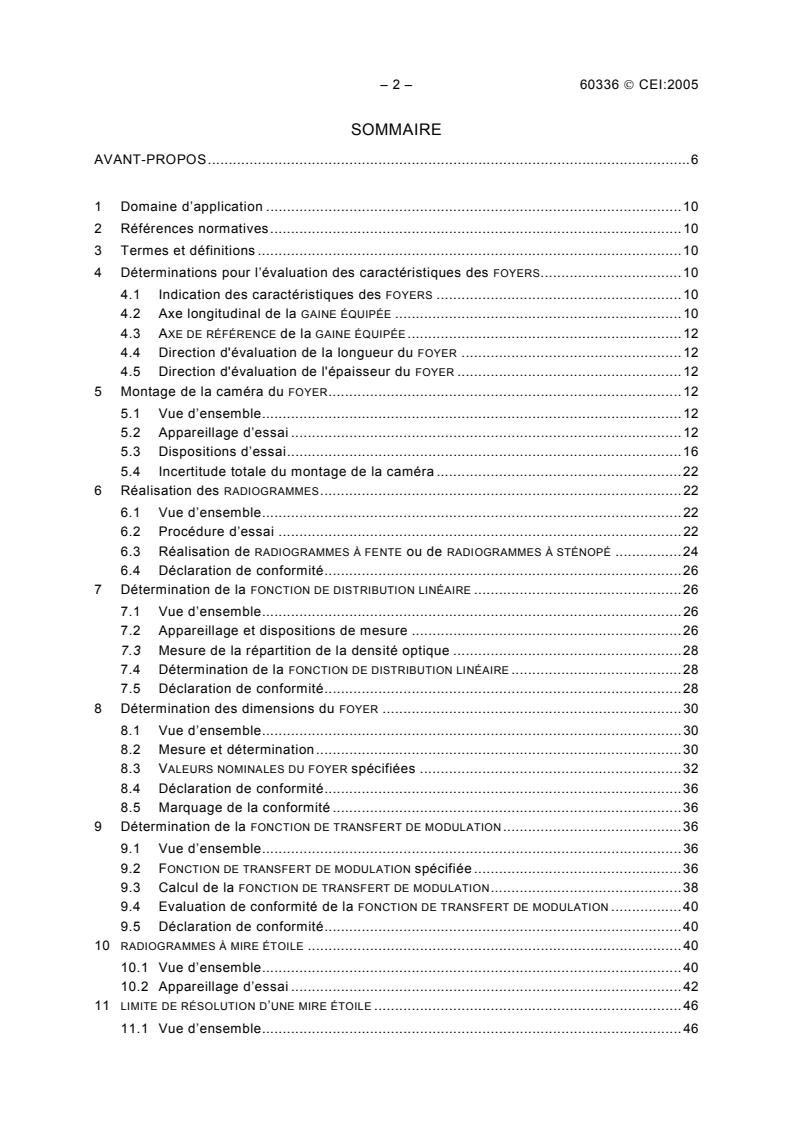
– 2 – 60336 CEI:2005
SOMMAIRE
AVANT-PROPOS.6
1 Domaine d’application .10
2 Références normatives.10
3 Termes et définitions .10
4 Déterminations pour l’évaluation des caractéristiques des FOYERS.10
4.1 Indication des caractéristiques des FOYERS .10
4.2 Axe longitudinal de la GAINE ÉQUIPÉE .10
4.3 AXE DE RÉFÉRENCE de la GAINE ÉQUIPÉE.12
4.4 Direction d'évaluation de la longueur du FOYER .12
4.5 Direction d'évaluation de l'épaisseur du FOYER .12
5 Montage de la caméra du FOYER.12
5.1 Vue d’ensemble.12
5.2 Appareillage d’essai .12
5.3 Dispositions d’essai.16
5.4 Incertitude totale du montage de la caméra .22
6 Réalisation des RADIOGRAMMES.22
6.1 Vue d’ensemble.22
6.2 Procédure d’essai .22
6.3 Réalisation de RADIOGRAMMES À FENTE ou de RADIOGRAMMES À STÉNOPÉ .24
6.4 Déclaration de conformité.26
7 Détermination de la FONCTION DE DISTRIBUTION LINÉAIRE .26
7.1 Vue d’ensemble.26
7.2 Appareillage et dispositions de mesure .26
7.3 Mesure de la répartition de la densité optique .28
7.4 Détermination de la FONCTION DE DISTRIBUTION LINÉAIRE .28
7.5 Déclaration de conformité.28
8 Détermination des dimensions du FOYER .30
8.1 Vue d’ensemble.30
8.2 Mesure et détermination.30
8.3 VALEURS NOMINALES DU FOYER spécifiées .32
8.4 Déclaration de conformité.36
8.5 Marquage de la conformité .36
9 Détermination de la FONCTION DE TRANSFERT DE MODULATION.36
9.1 Vue d’ensemble.36
9.2 FONCTION DE TRANSFERT DE MODULATION spécifiée .36
9.3 Calcul de la FONCTION DE TRANSFERT DE MODULATION.38
9.4 Evaluation de conformité de la FONCTION DE TRANSFERT DE MODULATION .40
9.5 Déclaration de conformité.40
10 RADIOGRAMMES À MIRE ÉTOILE .40
10.1 Vue d’ensemble.40
10.2 Appareillage d’essai .42
11 LIMITE DE RÉSOLUTION D’UNE MIRE ÉTOILE .46
11.1 Vue d’ensemble.46
60336 IEC:2005 – 3 –
CONTENTS
FOREWORD.7
1 Scope.11
2 Normative references .11
3 Terms and definitions .11
4 Determinations for the evaluation of the FOCAL SPOT characteristics.11
4.1 Statement of the FOCAL SPOT characteristics .11
4.2 Longitudinal axis of the X-RAY TUBE ASSEMBLY.11
4.3 REFERENCE AXIS of the X-RAY TUBE ASSEMBLY .13
4.4 Direction of evaluation for the FOCAL SPOT length.13
4.5 Direction of evaluation for the FOCAL SPOT width .13
5 FOCAL SPOT camera set-up .13
5.1 Overview .13
5.2 Test equipment .13
5.3 Test arrangement .17
5.4 Total uncertainty of the camera set-up .23
6 Production of RADIOGRAMS .23
6.1 Overview .23
6.2 Operating conditions .23
6.3 Production of FOCAL SPOT SLIT RADIOGRAMS or FOCAL SPOT PINHOLE
RADIOGRAMS.25
6.4 Statement of compliance .27
7 Determination of the LINE SPREAD FUNCTION.27
7.1 Overview .27
7.2 Measuring equipment and measuring arrangement.27
7.3 Measurement of the density distribution .29
7.4 Determination of the LINE SPREAD FUNCTION .29
7.5 Statement of compliance .29
8 Determination of FOCAL SPOT dimensions.31
8.1 Overview .31
8.2 Measurement and determination .31
8.3 Specified NOMINAL FOCAL SPOT VALUES .33
8.4 Statement of compliance .37
8.5 Marking of compliance.37
9 Determination of the MODULATION TRANSFER FUNCTION .37
9.1 Overview .37
9.2 Specified MODULATION TRANSFER FUNCTION.37
9.3 Calculation of the MODULATION TRANSFER FUNCTION .39
9.4 Evaluation of compliance of the MTF.41
9.5 Statement of compliance .41
10 FOCAL SPOT STAR RADIOGRAMS.41
10.1 Overview .41
10.2 Test equipment .43
11 STAR PATTERN RESOLUTION LIMIT .47
11.1 Overview .47
– 4 – 60336 CEI:2005
11.2 LIMITE DE RÉSOLUTION D’UNE MIRE ÉTOILE spécifiée.46
11.3 Mesure.48
11.4 Détermination de la LIMITE DE RÉSOLUTION D’UNE MIRE ÉTOILE.48
11.5 Evaluation et déclaration de conformité .50
12 VALEUR DE DISPERSION .52
12.1 Vue d’ensemble.52
12.2 Détermination de la VALEUR DE DISPERSION .52
12.3 Evaluation et déclaration de conformité .52
13 Méthodes alternatives de mesure .54
Annexe A (informative) Alignement par rapport à l’AXE DE RÉFÉRENCE .56
ANNEXE B (informative) Utilisation de capteurs numériques pour images radiologiques
dans la détermination des caractéristiques des FOYERS .60
Annexe C (informative) Contexte historique .62
Bibliographie.72
Index des termes définis .74
Figure 1 – Dimensions essentielles du diaphragme à fente .14
Figure 2 – Dimensions essentielles du diaphragme à sténopé .16
Figure 3 – Position du centre du diaphragme à fente ou à sténopé (marqué x sur la
figure) par rapport à l’AXE DE RÉFÉRENCE .18
Figure 4 – Dimensions et plans de référence .20
Figure 5 – Alignement de la fente du densitomètre optique .28
Figure 6 – FONCTION DE DISTRIBUTION LINÉAIRE .30
Figure 7 – Dimensions essentielles de la mire étoile .42
Figure 8 – Dimensions essentielles de la mire étoile .44
Figure 9 – Illustration des zones de modulation minimale .48
Figure A.1 – AXE de RÉFÉRENCE et directions d'évaluation .56
Figure A.2 – Projection du FOYER ÉLECTRONIQUE sur le PLAN DE RÉCEPTION DE L’IMAGE .58
Figure C.1 – LSFs pour un TUBE RADIOGÈNE type avec un petit FOYER (<0,3 mm) .64
Figure C.2 – LSFs pour un TUBE RADIOGÈNE type avec un grand FOYER (≥0,3 mm) .64
Figure C.3 – Les FTMs correspondantes pour les LSFs de la Figure C.2 .66
Tableau 1 – Agrandissement pour les RADIOGRAMMES des FOYERS .22
Tableau 2 – PARAMÈTRES DE CHARGE.24
Tableau 3 – Valeurs maximales admissibles des dimensions du FOYER pour les
VALEURS NOMINALES DU FOYER.34
Tableau 4 – Grandissements normalisés pour les FONCTIONS DE TRANSFERT DE
MODULATION .38
Tableau 5 – Grandissements normalisés pour la LIMITE DE RÉSOLUTION D’UNE MIRE ÉTOILE .50
Tableau 6 – PARAMÈTRES DE CHARGE pour la détermination de la VALEUR DE DISPERSION.52
Tableau C.1- Méthodes d’évaluation des caractéristiques spécifiques des FOYERS .70
60336 IEC:2005 – 5 –
11.2 Specified STAR PATTERN RESOLUTION LIMIT .47
11.3 Measurement .49
11.4 Determination of the STAR PATTERN RESOLUTION LIMIT .49
11.5 Evaluation and statement of compliance.51
12 BLOOMING VALUE.53
12.1 Overview .53
12.2 Determination of the BLOOMING VALUE .53
12.3 Evaluation and statement of compliance.53
13 Alternate measurement methods .55
Annex A (informative) Alignment to the REFERENCE AXIS.57
Annex B (informative) Application of digital X-ray image detectors for determination of
the FOCAL SPOT characteristics .61
Annex C (informative) Historical background.63
Bibliography.73
Index of defined terms .75
Figure 1 – Essential dimensions of the slit diaphragm.15
Figure 2 – Essential dimensions of the pinhole diaphragm .17
Figure 3 − Position of the centre of the slit or pinhole diaphragm (marked as x in the
figure) with respect to the REFERENCE AXIS .19
Figure 4 – Reference dimensions and planes.21
Figure 5 − Alignment of the optical densitometer slit .29
Figure 6 – LINE SPREAD FUNCTION.31
Figure 7 – Essential dimensions of the star test pattern .43
Figure 8 – Essential dimensions of the star test pattern .45
Figure 9 – Illustration of the zones of minimum modulation .49
Figure A.1 – The REFERENCE AXIS and directions of evaluation .57
Figure A.2 – Projection of the ACTUAL FOCAL SPOT on the IMAGE RECEPTION PLANE.59
Figure C.1 – The LSFs for a typical X-RAY TUBE with small FOCAL SPOT (< 0,3 mm) .65
Figure C.2 – The LSFs for a typical X-RAY TUBE with large FOCAL SPOT (≥0,3 mm).65
Figure C.3 – The corresponding MTFs for the LSFs in Figure C.2 .67
Table 1 – Enlargement for FOCAL SPOT RADIOGRAMs .23
Table 2 − LOADING FACTORS .25
Table 3 − Maximum permissible values of FOCAL SPOT dimensions for NOMINAL FOCAL
SPOT VALUES.35
Table 4 − Standard magnifications for MODULATION TRANSFER FUNCTIONS.39
Table 5 – Standard magnifications for STAR PATTERN RESOLUTION LIMIT.51
Table 6 – LOADING FACTORS for the determination of the BLOOMING VALUE.53
Table C.1 − Methods for evaluation of specific aspects characterising the FOCAL SPOT.71
– 6 – 60336 CEI:2005
COMMISSION ÉLECTROTECHNIQUE INTERNATIONALE
____________
APPAREILS ÉLECTROMÉDICAUX –
GAINES EQUIPÉES POUR DIAGNOSTIC MÉDICAL –
CARACTÉRISTIQUES DES FOYERS
AVANT-PROPOS
1) La Commission Electrotechnique Internationale (CEI) est une organisation mondiale de normalisation
composée de l'ensemble des comités électrotechniques nationaux (Comités nationaux de la CEI). La CEI a
pour objet de favoriser la coopération internationale pour toutes les questions de normalisation dans les
domaines de l'électricité et de l'électronique. A cet effet, la CEI – entre autres activités – publie des Normes
internationales, des Spécifications techniques, des Rapports techniques, des Spécifications accessibles au
public (PAS) et des Guides (ci-après dénommés «Publication(s) de la CEI»). Leur élaboration est confiée à des
comités d'études, aux travaux desquels tout Comité national intéressé par le sujet traité peut participer. Les
organisations internationales, gouvernementales et non gouvernementales, en liaison avec la CEI, participent
également aux travaux. La CEI collabore étroitement avec l'Organisation Internationale de Normalisation (ISO),
selon des conditions fixées par accord entre les deux organisations.
2) Les décisions ou accords officiels de la CEI concernant les questions techniques représentent, dans la mesure
du possible, un accord international sur les sujets étudiés, étant donné que les Comités nationaux de la CEI
intéressés sont représentés dans chaque comité d’études.
3) Les Publications de la CEI se présentent sous la forme de recommandations internationales et sont agréées
comme telles par les Comités nationaux de la CEI. Tous les efforts raisonnables sont entrepris afin que la CEI
s'assure de l'exactitude du contenu technique de ses publications; la CEI ne peut pas être tenue responsable
de l'éventuelle mauvaise utilisation ou interprétation qui en est faite par un quelconque utilisateur final.
4) Dans le but d'encourager l'uniformité internationale, les Comités nationaux de la CEI s'engagent, dans toute la
mesure possible, à appliquer de façon transparente les Publications de la CEI dans leurs publications
nationales et régionales. Toutes divergences entre toutes Publications de la CEI et toutes publications
nationales ou régionales correspondantes doivent être indiquées en termes clairs dans ces dernières.
5) La CEI n’a prévu aucune procédure de marquage valant indication d’approbation et n'engage pas sa
responsabilité pour les équipements déclarés conformes à une de ses Publications.
6) Tous les utilisateurs doivent s'assurer qu'ils sont en possession de la dernière édition de cette publication.
7) Aucune responsabilité ne doit être imputée à la CEI, à ses administrateurs, employés, auxiliaires ou
mandataires, y compris ses experts particuliers et les membres de ses comités d'études et des Comités
nationaux de la CEI, pour tout préjudice causé en cas de dommages corporels et matériels, ou de tout autre
dommage de quelque nature que ce soit, directe ou indirecte, ou pour supporter les coûts (y compris les frais
de justice) et les dépenses découlant de la publication ou de l'utilisation de cette Publication de la CEI ou de
toute autre Publication de la CEI, ou au crédit qui lui est accordé.
8) L'attention est attirée sur les références normatives citées dans cette publication. L'utilisation de publications
référencées est obligatoire pour une application correcte de la présente publication.
9) L’attention est attirée sur le fait que certains des éléments de la présente Publication de la CEI peuvent faire
l’objet de droits de propriété intellectuelle ou de droits analogues. La CEI ne saurait être tenue pour
responsable de ne pas avoir identifié de tels droits de propriété et de ne pas avoir signalé leur existence.
La Norme internationale CEI 60336 a été établie par le sous-comité 62B: Appareils d’imagerie
de diagnostic, du comité d'études 62 de la CEI: Equipements électriques dans la pratique
médicale.
Cette quatrième édition annule et remplace la troisième édition, publiée en 1993, et constitue
une révision technique. Les changements significatifs introduits par cette quatrième édition
sont indiqués de façon détaillée dans l’Annexe C (voir l’Article C.6).
Le texte de la présente norme est issu des documents suivants:
FDIS Rapport de vote
62B/554/FDIS 62B/569/RVD
Le rapport de vote indiqué dans le tableau ci-dessus donne toute information sur le vote ayant
abouti à l'approbation de cette norme.
60336 IEC:2005 – 7 –
INTERNATIONAL ELECTROTECHNICAL COMMISSION
____________
MEDICAL ELECTRICAL EQUIPMENT –
X-RAY TUBE ASSEMBLIES FOR MEDICAL DIAGNOSIS –
CHARACTERISTICS OF FOCAL SPOTS
FOREWORD
1) The International Electrotechnical Commission (IEC) is a worldwide organization for standardization comprising
all national electrotechnical committees (IEC National Committees). The object of IEC is to promote
international co-operation on all questions concerning standardization in the electrical and electronic fields. To
this end and in addition to other activities, IEC publishes International Standards, Technical Specifications,
Technical Reports, Publicly Available Specifications (PAS) and Guides (hereafter referred to as “IEC
Publication(s)”). Their preparation is entrusted to technical committees; any IEC National Committee interested
in the subject dealt with may participate in this preparatory work. International, governmental and non-
governmental organizations liaising with the IEC also participate in this preparation. IEC collaborates closely
with the International Organization for Standardization (ISO) in accordance with conditions determined by
agreement between the two organizations.
2) The formal decisions or agreements of IEC on technical matters express, as nearly as possible, an international
consensus of opinion on the relevant subjects since each technical committee has representation from all
interested IEC National Committees.
3) IEC Publications have the form of recommendations for international use and are accepted by IEC National
Committees in that sense. While all reasonable efforts are made to ensure that the technical content of IEC
Publications is accurate, IEC cannot be held responsible for the way in which they are used or for any
misinterpretation by any end user.
4) In order to promote international uniformity, IEC National Committees undertake to apply IEC Publications
transparently to the maximum extent possible in their national and regional publications. Any divergence
between any IEC Publication and the corresponding national or regional publication shall be clearly indicated in
the latter.
5) IEC provides no marking procedure to indicate its approval and cannot be rendered responsible for any
equipment declared to be in conformity with an IEC Publication.
6) All users should ensure that they have the latest edition of this publication.
7) No liability shall attach to IEC or its directors, employees, servants or agents including individual experts and
members of its technical committees and IEC National Committees for any personal injury, property damage or
other damage of any nature whatsoever, whether direct or indirect, or for costs (including legal fees) and
expenses arising out of the publication, use of, or reliance upon, this IEC Publication or any other IEC
Publications.
8) Attention is drawn to the Normative references cited in this publication. Use of the referenced publications is
indispensable for the correct application of this publication.
9) Attention is drawn to the possibility that some of the elements of this IEC Publication may be the subject of
patent rights. IEC shall not be held responsible for identifying any or all such patent rights.
International Standard IEC 60336 has been prepared by subcommittee 62B: Diagnostic
imaging equipment, of IEC technical committee 62: Electrical equipment in medical practice.
This fourth edition cancels and replaces the third edition published in 1993 and constitutes a
technical revision. The significant changes of this fourth edition are detailed in Annex C (see
Clause C.6).
The text of this standard is based on the following documents:
FDIS Report on voting
62B/554/FDIS 62B/569/RVD
Full information on the voting for the approval of this standard can be found in the report on
voting indicated in the above table.
– 8 – 60336 CEI:2005
Cette publication a été rédigée selon les Directives ISO/CEI, Partie 2.
Les conventions indiquées ci-dessous sont appliquées dans la présente norme.
a) Les termes imprimés en petites majuscules sont utilisés au sens de la définition qui en est
donnée dans la CEI 60788 et à l'Article 3 de la présente norme. Lorsqu’un terme défini est
utilisé comme qualificatif d’un autre terme défini ou non défini, il n'est pas imprimé en
petites majuscules, à moins que le concept ainsi qualifié ne soit défini ou reconnu comme
un “terme dérivé sans définition”.
b) Certains termes, indiqués ci-dessous, qui ne sont pas imprimés en petites capitales,
revêtent une signification particulière.
– Le terme «spécifique» est utilisé pour indiquer des informations définitives figurant
dans la présente norme ou auxquelles il est fait référence dans d’autres normes, et
concernant habituellement des conditions de fonctionnement particulières, des
dispositifs d'essai particuliers ou des valeurs particulières en relation avec la
conformité;
– Le terme «spécifié» est utilisé pour indiquer des informations définitives fournies par
le constructeur dans les documents d’accompagnement ou dans toute autre
documentation relative à l’appareil considéré, concernant habituellement la destination
prévue, ou les paramètres, ou bien les conditions associées à son utilisation ou aux
essais pour la détermination de la conformité.
NOTE L’attention est attirée sur le fait que, dans les cas où le concept concerné n’est pas précisément limité à la
définition donnée dans l’une des publications citées ci-dessus, un terme correspondant est imprimé en lettres
minuscules.
Le comité a décidé que le contenu de cette publication ne sera pas modifié avant la date de
maintenance indiquée sur le site web de la CEI sous «http://webstore.iec.ch» dans les
données relatives à la publication recherchée. A cette date, la publication sera
• reconduite;
• supprimée;
• remplacée par une édition révisée, ou
• amendée.
Le contenu du corrigendum de mai 2006 a été pris en considération dans cet exemplaire.
60336 IEC:2005 – 9 –
This publication has been drafted in accordance with the ISO/IEC Directives, Part 2.
In this standard, the following conventions apply.
a) Terms printed in small capitals are used as defined in IEC 60788 and in Clause 3 of this
standard. Where a defined term is used as a qualifier in another defined or undefined
term, it is not printed in small capitals, unless the concept thus qualified is defined or
recognized as a “derived term without definition”.
b) Certain terms that are not printed in small capitals have particular meanings, as follows
− "specific" is used to indicate definitive information stated in this standard or referenced
in other standards, usually concerning particular operating conditions, test
arrangements or values connected with compliance;
− "specified" is used to indicate definitive information stated by the MANUFACTURER in
ACCOMPANYING DOCUMENTS or in other documentation relating to the equipment under
consideration, usually concerning its intended purposes, or the parameters or
conditions associated with its use or with testing to determine compliance.
NOTE Attention is drawn to the fact that in cases where the concept addressed is not strongly confined to the
definition given in one of the publications listed above, a corresponding term is printed in lower-case letters.
The committee has decided that the contents of this publication will remain unchanged until
the maintenance result date indicated on the IEC web site under "http://webstore.iec.ch" in
the data related to the specific publication. At this date, the publication will be
• reconfirmed;
• withdrawn;
• replaced by a revised edition, or
• amended.
The contents of the corrigendum of May 2006 have been included in this copy.
– 10 – 60336 CEI:2005
APPAREILS ÉLECTROMÉDICAUX –
GAINES ÉQUIPÉES POUR DIAGNOSTIC MÉDICAL –
CARACTÉRISTIQUES DES FOYERS
1 Domaine d’application
La présente Norme internationale s’applique aux FOYERS des GAINES ÉQUIPÉES à usage
médical, pour diagnostic médical, fonctionnant à des POTENTIELS D'ACCÉLÉRATION DE TUBES
RADIOGÈNES inférieurs ou égaux à 200 kV.
La présente Norme internationale décrit les méthodes d’essai pour l’évaluation des
caractéristiques DES FOYERS et les moyens d’indiquer la conformité.
2 Références normatives
Les documents de référence suivants sont indispensables pour l'application du présent
document. Pour les références datées, seule l'édition citée s'applique. Pour les références
non datées, la dernière édition du document de référence s'applique (y compris les éventuels
amendements).
1)
CEI 60417-DB:2002, Symboles graphiques utilisables sur le matériel
CEI 60613, Caractéristiques électriques, thermiques et de charge des tubes radiogènes à
anode tournante pour diagnostic médical
CEI 60788:2004, Medical electrical equipment – Glossary of defined terms (Disponible en
anglais seulement)
3 Termes et définitions
Pour les besoins du présent document, les termes et définitions suivants s'appliquent, ainsi
que ceux donnés dans la CEI 60788.
3.1
LIMITE DE RÉSOLUTION D’UNE MIRE ÉTOILE
caractéristique d’un FOYER de TUBE RADIOGÈNE; fréquence spatiale la plus élevée qui peut être
résolue dans des conditions de mesure spécifiques
4 Déterminations pour l’évaluation des caractéristiques des FOYERS
4.1 Indication des caractéristiques des FOYERS
Les caractéristiques des FOYERS doivent être indiquées pour deux directions perpendiculaires
auxquelles il est fait référence pour l'évaluation de la longueur et pour l'évaluation de la
largeur. L'illustration de l'Article 4 peut être trouvée à l'Annexe A, Figure A.1.
4.2 Axe longitudinal de la GAINE ÉQUIPÉE
En général, l’axe longitudinal peut être identifié sans ambiguïté. Si la GAINE ÉQUIPÉE n’a pas
d’axe longitudinal identifiable ou s'il est spécifié autrement par le CONSTRUCTEUR, l’axe
longitudinal doit être spécifié ainsi que les caractéristiques des FOYERS.
———————
1)
«DB» se réfère à la base de données «on-line de la CEI.
60336 IEC:2005 – 11 –
MEDICAL ELECTRICAL EQUIPMENT –
X-RAY TUBE ASSEMBLIES FOR MEDICAL DIAGNOSIS –
CHARACTERISTICS OF FOCAL SPOTS
1 Scope
This International Standard applies to FOCAL SPOTs in medical diagnostic X-RAY TUBE
assemblies for medical use, operating at X-RAY TUBE VOLTAGEs up to and including 200 kV.
This International Standard describes the test methods for evaluating FOCAL SPOT character-
istics and the means for indicating compliance.
2 Normative references
The following referenced documents are indispensable for the application of this document.
For dated references, only the edition cited applies. For undated references, the latest edition
of the referenced document (including any amendments) applies.
1)
IEC 60417-DB:2002: Graphical symbols for use on equipment
IEC 60613, Electrical, thermal and loading characteristics of rotating anode X-ray tubes for
medical diagnosis
IEC 60788:2004, Medical electrical equipment – Glossary of defined terms
3 Terms and definitions
For the purposes of this document, the terms and definitions given in IEC 60788 together with
the following apply.
3.1
STAR PATTERN RESOLUTION LIMIT
characteristic of the FOCAL SPOT of an X-RAY TUBE; highest spatial frequency that can be
resolved under specific measuring conditions
4 Determinations for the evaluation of the FOCAL SPOT characteristics
4.1 Statement of the FOCAL SPOT characteristics
The FOCAL SPOT characteristics shall be stated for two normal directions of evaluation referred
to as the length direction and width direction. An illustration for this clause can be found in
Figure A.1.
4.2 Longitudinal axis of the X-RAY TUBE ASSEMBLY
Generally, the longitudinal axis can be identified unambiguously. If the X-RAY TUBE ASSEMBLY
does not have an identifiable longitudinal axis or if it is specified otherwise by the
MANUFACTURER, the longitudinal axis shall be specified together with the FOCAL SPOT
characteristics.
———————
1)
"DB" refers to the IEC on-line database.
– 12 – 60336 CEI:2005
4.3 AXE DE RÉFÉRENCE de la GAINE ÉQUIPÉE
Si non spécifié par ailleurs, l’AXE DE RÉFÉRENCE est perpendiculaire à l’axe longitudinal, passe
par le centre du FOYER ÉLECTRONIQUE et coupe l’axe longitudinal de la GAINE ÉQUIPÉE.
4.4 Direction d'évaluation de la longueur du FOYER
La direction d'évaluation de la longueur du FOYER est perpendiculaire à l'AXE DE RÉFÉRENCE
dans le plan donné par l'AXE DE RÉFÉRENCE et l'axe longitudinal de la GAINE ÉQUIPÉE.
4.5 Direction d'évaluation de l'épaisseur du FOYER
La direction d'évaluation de l'épaisseur du FOYER est perpendiculaire à l'axe longitudinal de la
GAINE ÉQUIPÉE et perpendiculaire à l'AXE DE RÉFÉRENCE.
5 Montage de la caméra du FOYER
5.1 Vue d’ensemble
Le présent article traite des exigences de conception d’une caméra pour la réalisation de
RADIOGRAMMES À FENTE destinés à la détermination des dimensions du FOYER conformément
à l'Article 8 et à la détermination de la fonction de transfert de modulation conformément à
l'Article 9.
Le présent article traite également des exigences de conception d’une caméra pour la
réalisation de RADIOGRAMMES À STÉNOPÉ.
5.2 Appareillage d’essai
5.2.1 CAMÉRA À FENTE
Le diaphragme de la CAMÉRA À FENTE doit être réalisé à partir de matériaux avec des
propriétés d’ATTÉNUATION élevées et doit avoir les dimensions données à la Figure 1.
Les matériaux appropriés sont, par exemple, les suivants:
– tungstène;
– tantale;
– alliage d’or et de 10 % de platine;
– alliage de tungstène et de 10 % de rhénium;
– alliage de platine et de 10 % d’iridium.
60336 IEC:2005 – 13 –
4.3 REFERENCE AXIS of the X-RAY TUBE ASSEMBLY
If not specified otherwise, the REFERENCE AXIS is normal to the longitudinal axis and intersects
both the centre of the ACTUAL FOCAL SPOT and the longitudinal axis of the X-RAY TUBE
ASSEMBLY.
4.4 Direction of evaluation for the FOCAL SPOT length
The direction of evaluation for the FOCAL SPOT length is normal to the REFERENCE AXIS in the
plane given by the REFERENCE AXIS and the longitudinal axis of the X-RAY TUBE ASSEMBLY.
4.5 Direction of evaluation for the FOCAL SPOT width
The direction of evaluation for the FOCAL SPOT width is normal to the longitudinal axis of the X-
RAY TUBE ASSEMBLY and normal to the REFERENCE AXIS.
5 FOCAL SPOT camera set-up
5.1 Overview
This clause deals with the design requirements of a camera for the production of FOCAL SPOT
SLIT RADIOGRAMs to be used for the determination of FOCAL SPOT dimensions in accordance
with Clause 8, and the determination of the modulation transfer function in accordance with
Clause 9.
This clause deals also with the design requirements of a camera for the production of FOCAL
SPOT PINHOLE RADIOGRAMs.
5.2 Test equipment
5.2.1 SLIT CAMERA
The diaphragm of the SLIT CAMERA shall be made from materials with high ATTENUATION
properties and shall have dimensions as given in Figure 1.
Suitable mate
...