

IEC 60077-3:2019
(Main)Railway applications - Electric equipment for rolling stock - Part 3: Electrotechnical components - Rules for DC circuit-breakers
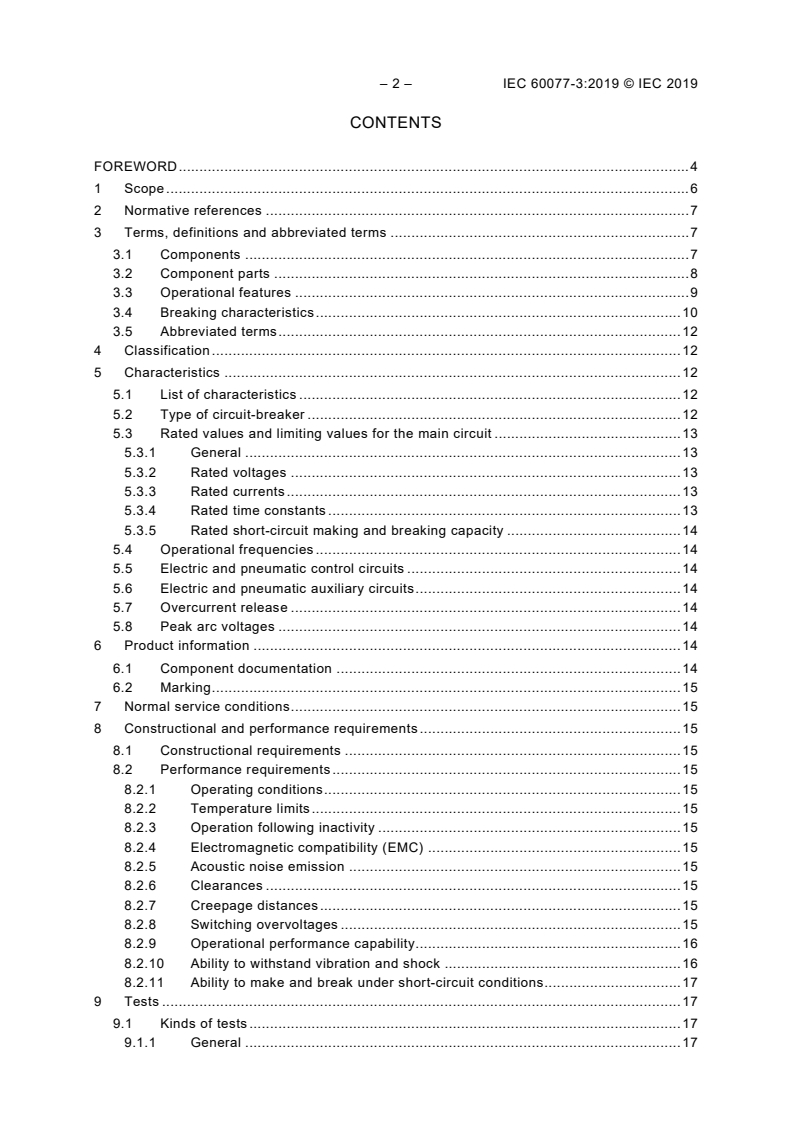
General Information
- Abstract
IEC 60077-3:2019 gives the rules for circuit-breakers, the main contacts of which are connected to DC power and/or auxiliary circuits. The nominal voltage of these circuits does not exceed 3 000 V DC according to IEC 60850. This part of IEC 60077, together with IEC 60077-2, states specifically:
a) the characteristics of the circuit-breakers;
b) the service conditions with which circuit-breakers complies with reference to:
- operation and behaviour in normal service;
- operation and behaviour in the case of short circuit
- dielectric properties;
c) the tests for confirming the compliance of the components with the characteristics under the service conditions and the methods to be adopted for these tests;
d) the information to be marked on, or given with, the circuit breaker.
This second edition cancels and replaces the first edition, issued in 2001. This edition includes the following main technical changes with regard to the previous edition:
- procedure of verification of temperature rise is changed;
- air-tightness test as type test, insulation resistance measurement are added.
- Status
- Published
- Publication Date
- 24-Oct-2019
- Technical Committee
- TC 9 - Electrical equipment and systems for railways
- Drafting Committee
- MT 60077 - TC 9/MT 60077
- Current Stage
- PPUB - Publication issued
- Start Date
- 25-Oct-2019
- Completion Date
- 08-Nov-2019
Buy Documents
IEC 60077-3:2019 RLV - Railway applications - Electric equipment for rolling stock - Part 3: Electrotechnical components - Rules for DC circuit-breakers Released:10/25/2019
IEC 60077-3:2019 - Railway applications - Electric equipment for rolling stock - Part 3: Electrotechnical components - Rules for DC circuit-breakers Released:10/25/2019
Overview
IEC 60077-3:2019 - Railway applications - Electric equipment for rolling stock - Part 3: Electrotechnical components - Rules for DC circuit-breakers - provides the electrotechnical rules, requirements and test methods for DC circuit‑breakers used on rolling stock. It applies to main contacts connected to DC power and auxiliary circuits with nominal voltages up to 3 000 V DC (per IEC 60850). This second edition (2019) replaces the 2001 edition and introduces key updates to temperature‑rise verification, adds an air‑tightness type test and includes insulation‑resistance measurement.
Key topics and technical requirements
- Scope and rated values
- Applicability to DC circuit‑breakers for railway rolling stock (main and auxiliary circuits up to 3 000 V DC).
- Definitions of rated voltages, rated currents and rated time constants.
- Service conditions
- Requirements for normal service operation, behaviour under short‑circuit conditions and dielectric performance.
- Constructional and performance requirements
- Mechanical and electrical construction rules, clearances and creepage distances, EMC and acoustic emission limits, vibration and shock resistance.
- Temperature‑rise limits and verification procedures.
- Requirements for switching overvoltages and peak arc voltages.
- Short‑circuit capability
- Rules for rated short‑circuit making and breaking capacities, including test circuits and verification methods (see Annexes A and B).
- Testing program
- Defined type tests, routine tests, and investigatory tests with test sequences (I–VI) to validate constructional and performance characteristics.
- New/updated tests in this edition: air‑tightness as a type test (for pneumatic circuit‑breakers) and insulation resistance measurement.
- Product information & marking
- Required documentation and marking information to accompany circuit‑breakers for safe selection, installation and maintenance.
Practical applications and users
Who uses IEC 60077-3:2019:
- Rolling stock OEMs and designers specifying DC circuit‑breakers for trains, trams and metros.
- Circuit‑breaker manufacturers designing components to meet railway safety, EMC and environmental criteria.
- Test laboratories and certification bodies performing type and routine testing and conformity assessment.
- Procurement and maintenance teams ensuring installed components meet interoperability, safety and serviceability requirements.
Practical uses:
- Specifying breaker performance (making/breaking capacity, temperature behavior).
- Validating designs against railway environmental and short‑circuit scenarios.
- Creating test plans for type approval and production quality control.
Related standards
- IEC 60077-1 and IEC 60077-2 (general requirements and specific component rules for rolling stock).
- IEC 60850 (reference for nominal DC voltages).
- The broader IEC 60077 series for railway electric equipment.
Keywords: IEC 60077-3:2019, DC circuit-breakers, railway applications, rolling stock, electrotechnical components, short-circuit testing, dielectric properties, temperature rise, air‑tightness, insulation resistance.
Relations
- Effective Date
- 05-Sep-2023
Buy Documents
IEC 60077-3:2019 RLV - Railway applications - Electric equipment for rolling stock - Part 3: Electrotechnical components - Rules for DC circuit-breakers Released:10/25/2019
IEC 60077-3:2019 - Railway applications - Electric equipment for rolling stock - Part 3: Electrotechnical components - Rules for DC circuit-breakers Released:10/25/2019
Get Certified
Connect with accredited certification bodies for this standard

IRIS Certification (UNIFE)
International Railway Industry Standard certification.

TÜV SÜD Rail GmbH
TÜV SÜD railway certification services.

Bureau Veritas Railway Certification
Railway and transportation certification.
Sponsored listings
Frequently Asked Questions
IEC 60077-3:2019 is a standard published by the International Electrotechnical Commission (IEC). Its full title is "Railway applications - Electric equipment for rolling stock - Part 3: Electrotechnical components - Rules for DC circuit-breakers". This standard covers: IEC 60077-3:2019 gives the rules for circuit-breakers, the main contacts of which are connected to DC power and/or auxiliary circuits. The nominal voltage of these circuits does not exceed 3 000 V DC according to IEC 60850. This part of IEC 60077, together with IEC 60077-2, states specifically: a) the characteristics of the circuit-breakers; b) the service conditions with which circuit-breakers complies with reference to: - operation and behaviour in normal service; - operation and behaviour in the case of short circuit - dielectric properties; c) the tests for confirming the compliance of the components with the characteristics under the service conditions and the methods to be adopted for these tests; d) the information to be marked on, or given with, the circuit breaker. This second edition cancels and replaces the first edition, issued in 2001. This edition includes the following main technical changes with regard to the previous edition: - procedure of verification of temperature rise is changed; - air-tightness test as type test, insulation resistance measurement are added.
IEC 60077-3:2019 gives the rules for circuit-breakers, the main contacts of which are connected to DC power and/or auxiliary circuits. The nominal voltage of these circuits does not exceed 3 000 V DC according to IEC 60850. This part of IEC 60077, together with IEC 60077-2, states specifically: a) the characteristics of the circuit-breakers; b) the service conditions with which circuit-breakers complies with reference to: - operation and behaviour in normal service; - operation and behaviour in the case of short circuit - dielectric properties; c) the tests for confirming the compliance of the components with the characteristics under the service conditions and the methods to be adopted for these tests; d) the information to be marked on, or given with, the circuit breaker. This second edition cancels and replaces the first edition, issued in 2001. This edition includes the following main technical changes with regard to the previous edition: - procedure of verification of temperature rise is changed; - air-tightness test as type test, insulation resistance measurement are added.
IEC 60077-3:2019 is classified under the following ICS (International Classification for Standards) categories: 45.060.01 - Railway rolling stock in general. The ICS classification helps identify the subject area and facilitates finding related standards.
IEC 60077-3:2019 has the following relationships with other standards: It is inter standard links to IEC 60077-3:2001. Understanding these relationships helps ensure you are using the most current and applicable version of the standard.
IEC 60077-3:2019 is available in PDF format for immediate download after purchase. The document can be added to your cart and obtained through the secure checkout process. Digital delivery ensures instant access to the complete standard document.
Standards Content (Sample)
IEC 60077-3 ®
Edition 2.0 2019-10
REDLINE VERSION
INTERNATIONAL
STANDARD
colour
inside
Railway Applications – Electric equipment for rolling stock –
Part 3: Electrotechnical components – Rules for DC circuit-breakers
All rights reserved. Unless otherwise specified, no part of this publication may be reproduced or utilized in any form
or by any means, electronic or mechanical, including photocopying and microfilm, without permission in writing from
either IEC or IEC's member National Committee in the country of the requester. If you have any questions about IEC
copyright or have an enquiry about obtaining additional rights to this publication, please contact the address below or
your local IEC member National Committee for further information.
IEC Central Office Tel.: +41 22 919 02 11
3, rue de Varembé info@iec.ch
CH-1211 Geneva 20 www.iec.ch
Switzerland
About the IEC
The International Electrotechnical Commission (IEC) is the leading global organization that prepares and publishes
International Standards for all electrical, electronic and related technologies.
About IEC publications
The technical content of IEC publications is kept under constant review by the IEC. Please make sure that you have the
latest edition, a corrigendum or an amendment might have been published.
IEC publications search - webstore.iec.ch/advsearchform Electropedia - www.electropedia.org
The advanced search enables to find IEC publications by a The world's leading online dictionary on electrotechnology,
variety of criteria (reference number, text, technical containing more than 22 000 terminological entries in English
committee,…). It also gives information on projects, replaced and French, with equivalent terms in 16 additional languages.
and withdrawn publications. Also known as the International Electrotechnical Vocabulary
(IEV) online.
IEC Just Published - webstore.iec.ch/justpublished
Stay up to date on all new IEC publications. Just Published IEC Glossary - std.iec.ch/glossary
details all new publications released. Available online and 67 000 electrotechnical terminology entries in English and
once a month by email. French extracted from the Terms and Definitions clause of
IEC publications issued since 2002. Some entries have been
IEC Customer Service Centre - webstore.iec.ch/csc collected from earlier publications of IEC TC 37, 77, 86 and
If you wish to give us your feedback on this publication or CISPR.
need further assistance, please contact the Customer Service
Centre: sales@iec.ch.
IEC 60077-3 ®
Edition 2.0 2019-10
REDLINE VERSION
INTERNATIONAL
STANDARD
colour
inside
Railway Applications – Electric equipment for rolling stock –
Part 3: Electrotechnical components – Rules for DC circuit-breakers
INTERNATIONAL
ELECTROTECHNICAL
COMMISSION
ICS 45.060.01 ISBN 978-2-8322-7565-8
– 2 – IEC 60077-3:2019 RLV © IEC 2019
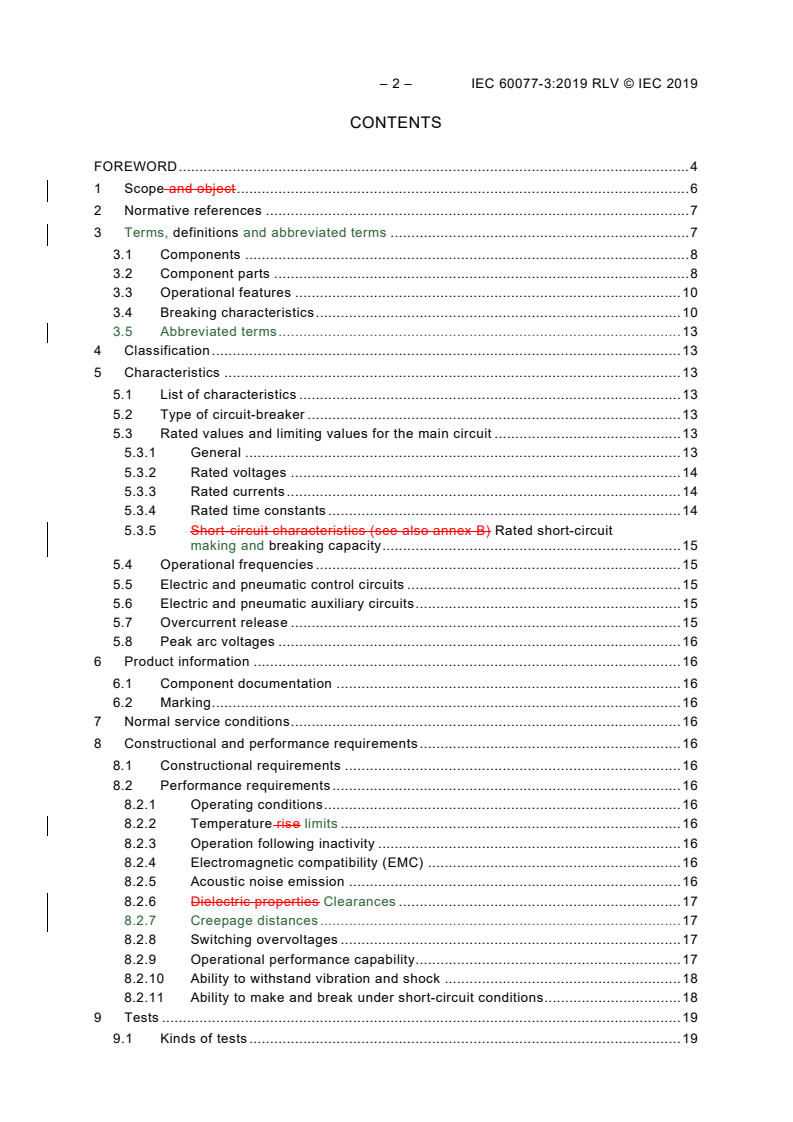
CONTENTS
FOREWORD . 4
1 Scope and object . 6
2 Normative references . 7
3 Terms, definitions and abbreviated terms . 7
3.1 Components . 8
3.2 Component parts . 8
3.3 Operational features . 10
3.4 Breaking characteristics . 10
3.5 Abbreviated terms . 13
4 Classification . 13
5 Characteristics . 13
5.1 List of characteristics . 13
5.2 Type of circuit-breaker . 13
5.3 Rated values and limiting values for the main circuit . 13
5.3.1 General . 13
5.3.2 Rated voltages . 14
5.3.3 Rated currents . 14
5.3.4 Rated time constants . 14
5.3.5 Short-circuit characteristics (see also annex B) Rated short-circuit
making and breaking capacity . 15
5.4 Operational frequencies . 15
5.5 Electric and pneumatic control circuits . 15
5.6 Electric and pneumatic auxiliary circuits . 15
5.7 Overcurrent release . 15
5.8 Peak arc voltages . 16
6 Product information . 16
6.1 Component documentation . 16
6.2 Marking . 16
7 Normal service conditions . 16
8 Constructional and performance requirements . 16
8.1 Constructional requirements . 16
8.2 Performance requirements . 16
8.2.1 Operating conditions . 16
8.2.2 Temperature rise limits . 16
8.2.3 Operation following inactivity . 16
8.2.4 Electromagnetic compatibility (EMC) . 16
8.2.5 Acoustic noise emission . 16
8.2.6 Dielectric properties Clearances . 17
8.2.7 Creepage distances . 17
8.2.8 Switching overvoltages . 17
8.2.9 Operational performance capability . 17
8.2.10 Ability to withstand vibration and shock . 18
8.2.11 Ability to make and break under short-circuit conditions . 18
9 Tests . 19
9.1 Kinds of tests . 19
9.1.1 General . 19
9.1.2 Type tests . 19
9.1.3 Routine tests . 19
9.1.4 Investigatory Investigation tests . 19
9.2 Verification of constructional requirements . 19
9.2.1 General . 19
9.2.2 Type tests . 19
9.2.3 Routine tests . 20
9.3 Type tests for verification of performance requirements . 20
9.3.1 Test sequences . 20
9.3.2 General test conditions . 21
9.3.3 Test sequence I: General performance characteristics . 22
9.3.4 Test sequence II: Rated short-circuit making and breaking capacities . 23
9.3.5 Test sequence III: capability Ability to withstand vibration and shock . 25
9.3.6 Test sequence IV: Searching for critical currents . 26
9.3.7 Test sequence V: Climatic conditions . 26
9.3.8 Test sequence VI: Other tests. 26
9.4 Routine tests for verification of performance requirements . 27
9.4.1 General . 27
9.4.2 Mechanical operation Functional test . 27
9.4.3 Measurement of resistance . 27
9.4.4 Calibration of releases . 27
9.4.5 Air-tightness (for pneumatic circuit-breaker) . 27
9.4.6 Dielectric withstand . 27
Annex A (normative) Test circuit to verify the making and breaking capacities . 28
Annex B (informative) Verification of short-circuit making and breaking capacities . 29
Bibliography . 31
Figure A.1 – Diagram of the test circuit . 28
Figure B.1 – Calibration of the circuit to obtain the prospective peak making current . 29
Figure B.2 – Oscillogram corresponding to a break after the current has passed its
maximum value . 30
Figure B.3 – Oscillogram corresponding to a break before the current has reached its
maximum value (current-limiting circuit-breaker) . 30
Table 1 – Rated time constants . 14
Table 2 – Operational performance capability . 18
Table 3 – List of type test sequences for performance requirements . 20
Table 4 – Tolerances on test values . 21
– 4 – IEC 60077-3:2019 RLV © IEC 2019
INTERNATIONAL ELECTROTECHNICAL COMMISSION
____________
RAILWAY APPLICATIONS –
ELECTRIC EQUIPMENT FOR ROLLING STOCK –
Part 3: Electrotechnical components –
Rules for DC circuit-breakers
FOREWORD
1) The International Electrotechnical Commission (IEC) is a worldwide organization for standardization comprising
all national electrotechnical committees (IEC National Committees). The object of IEC is to promote
international co-operation on all questions concerning standardization in the electrical and electronic fields. To
this end and in addition to other activities, IEC publishes International Standards, Technical Specifications,
Technical Reports, Publicly Available Specifications (PAS) and Guides (hereafter referred to as "IEC
Publication(s)"). Their preparation is entrusted to technical committees; any IEC National Committee interested
in the subject dealt with may participate in this preparatory work. International, governmental and non-
governmental organizations liaising with the IEC also participate in this preparation. IEC collaborates closely
with the International Organization for Standardization (ISO) in accordance with conditions determined by
agreement between the two organizations.
2) The formal decisions or agreements of IEC on technical matters express, as nearly as possible, an international
consensus of opinion on the relevant subjects since each technical committee has representation from all
interested IEC National Committees.
3) IEC Publications have the form of recommendations for international use and are accepted by IEC National
Committees in that sense. While all reasonable efforts are made to ensure that the technical content of IEC
Publications is accurate, IEC cannot be held responsible for the way in which they are used or for any
misinterpretation by any end user.
4) In order to promote international uniformity, IEC National Committees undertake to apply IEC Publications
transparently to the maximum extent possible in their national and regional publications. Any divergence
between any IEC Publication and the corresponding national or regional publication shall be clearly indicated in
the latter.
5) IEC itself does not provide any attestation of conformity. Independent certification bodies provide conformity
assessment services and, in some areas, access to IEC marks of conformity. IEC is not responsible for any
services carried out by independent certification bodies.
6) All users should ensure that they have the latest edition of this publication.
7) No liability shall attach to IEC or its directors, employees, servants or agents including individual experts and
members of its technical committees and IEC National Committees for any personal injury, property damage or
other damage of any nature whatsoever, whether direct or indirect, or for costs (including legal fees) and
expenses arising out of the publication, use of, or reliance upon, this IEC Publication or any other IEC
Publications.
8) Attention is drawn to the Normative references cited in this publication. Use of the referenced publications is
indispensable for the correct application of this publication.
9) Attention is drawn to the possibility that some of the elements of this IEC Publication may be the subject of
patent rights. IEC shall not be held responsible for identifying any or all such patent rights.
This redline version of the official IEC Standard allows the user to identify the changes
made to the previous edition. A vertical bar appears in the margin wherever a change
has been made. Additions are in green text, deletions are in strikethrough red text.
International Standard IEC 60077-3 has been prepared by IEC technical committee 9:
Electrical equipment and systems for railways.
This second edition cancels and replaces the first edition, issued in 2001. It constitutes a
technical revision.
This edition includes the following main technical changes with regard to the previous edition:
a) procedure of verification of temperature rise is changed;
b) air-tightness test as type test, insulation resistance measurement are added.
The text of this International Standard is based on the following documents:
FDIS Report on voting
9/2537/FDIS 9/2553/RVD
Full information on the voting for the approval of this International Standard can be found in
the report on voting indicated in the above table.
This document has been drafted in accordance with the ISO/IEC Directives, Part 2.
This document should be read in conjunction with IEC 60077-1 and IEC 60077-2.
A list of all parts in the IEC 60077 series, published under the general title Railway
applications – Electric equipment for rolling stock, can be found on the IEC website.
The committee has decided that the contents of this document will remain unchanged until the
stability date indicated on the IEC website under "http://webstore.iec.ch" in the data related to
the specific document. At this date, the document will be
• reconfirmed,
• withdrawn,
• replaced by a revised edition, or
• amended.
IMPORTANT – The 'colour inside' logo on the cover page of this publication indicates
that it contains colours which are considered to be useful for the correct
understanding of its contents. Users should therefore print this document using a
colour printer.
– 6 – IEC 60077-3:2019 RLV © IEC 2019
RAILWAY APPLICATIONS –
ELECTRIC EQUIPMENT FOR ROLLING STOCK –
Part 3: Electrotechnical components –
Rules for DC circuit-breakers
1 Scope and object
In addition to the general requirements of IEC 60077-2, this part of IEC 60077 gives the rules
for circuit-breakers, the main contacts of which are to be connected to DC power and/or
auxiliary circuits. The nominal voltage of these circuits does not exceed 3 000 V DC according
to IEC 60850.
This part of IEC 60077, together with IEC 60077-2, states specifically:
a) the characteristics of the circuit-breakers;
b) the service conditions with which circuit-breakers have to comply complies with reference
to:
– operation and behaviour in normal service;
– operation and behaviour in the case of short circuit;
– dielectric properties;
c) the tests for confirming the compliance of the components with the characteristics under
the service conditions and the methods to be adopted for these tests;
d) the information to be marked on, or given with, the circuit breaker.
NOTE 1 Circuit-breakers which are dealt with in this document may can be provided with devices for automatic
opening under predetermined conditions other than those of overcurrent, for example, under-voltage and reversal
of power current flow direction. This document does not deal with the verification of operation under such
predetermined conditions.
NOTE 2 The incorporation of electronic components or electronic sub-assemblies into electrotechnical components is
now common practice.
Although this document is not applicable to electronic equipment, the presence of electronic components does not
provide a reason to exclude such electrotechnical components from the scope.
Electronic sub-assemblies included in circuit-breakers should comply with the relevant document for electronics
(IEC 60571).
NOTE 3 Certain of these rules may, after agreement between the user and the manufacturer, be are used for
electrotechnical components installed on vehicles other than rail rolling stock such as mine locomotives,
trolleybuses, etc. In this case, particular additional requirements may can be necessary.
This document does not cover:
a) multi-connection of electro-technical components to achieve a particular duty;
b) industrial circuit-breakers which have to comply complies with IEC 60947-2;
c) DC circuit-breakers for fixed installations which have to comply complies with IEC 61992-2.
For b) and c), in order to ensure satisfactory operation, this document should be is used to
specify only the particular requirements for rolling stock. In such cases, a specific document
should state states the additional requirements with which the industrial or fixed installations
circuits breakers are to comply, for example:
– either to be adapted (for example, for control voltage, environmental conditions, etc.);
– or to be installed and used in such a way that they do not have to endure specific rolling
stock conditions;
– or to be additionally tested to prove that these components can withstand satisfactorily the
rolling stock conditions.
2 Normative references
The following documents are referred to in the text in such a way that some or all of their
content constitutes requirements of this document. For dated references, only the edition
cited applies. For undated references, the latest edition of the referenced document (including
any amendments) applies.
IEC 60050(441):1984, International Electrotechnical Vocabulary – Switchgear, controlgear
and fuses
IEC 60077-1:19992017, Railway applications – Electric equipment for rolling stock – Part 1:
General service conditions and general rules
IEC 60077-2:19992017; Railway applications – Electric equipment for rolling stock – Part 2:
Electrotechnical components – General rules
IEC 60529:1989, Degrees of protection provided by enclosures (IP Code)
IEC 60571:1998, Electronic equipment used on rail vehicles
IEC 60850:2000, Railway applications – Supply voltage of traction systems
IEC/TR3 60943:1998, Guidance concerning the permissible temperature rise for parts of
electrical equipment, in particular for terminals
IEC 60947-2:1989, Low-voltage switchgear and controlgear – Part 2: Circuit-breakers
IEC 61373:1999, Railway applications – Rolling stock equipment – Shock and vibration tests
IEC 61992-2:2001, Railway applications – Fixed installations – DC switchgear – Part 2:
Circuit-breakers
3 Terms, definitions and abbreviated terms
For the purpose of this part of IEC 60077, the definitions given in clauses 3 of IEC 60077-1
and IEC 60077-2 are applicable together with the following additional definitions.
For the purposes of this document, the terms and definitions given in Clause 3 of
IEC 60077-1:2017 and Clause 3 of IEC 60077-2:2017, and the following apply.
ISO and IEC maintain terminological databases for use in standardization at the following
addresses:
• IEC Electropedia: available at http://www.electropedia.org/
• ISO Online browsing platform: available at http://www.iso.org/obp
– 8 – IEC 60077-3:2019 RLV © IEC 2019
3.1 Components
3.1.1
polarized circuit-breaker
circuit-breaker for which the breaking characteristics are defined for only one prescribed
direction of current in the main circuit
3.1.2
bi-directional circuit-breaker
circuit-breaker for which the breaking characteristics are the same for both directions of
current in the main circuit
3.1.3
air circuit-breaker
circuit-breaker in which the contacts open and close in air at atmospheric pressure
[SOURCE: IEC 60050-441:1984/AMD1:2000, 441-14-27]
3.1.4
vacuum circuit-breaker
circuit-breaker in which the contacts open and close within a highly evacuated envelope
[SOURCE: IEC 60050-441:1984/AMD1:2000, 441-14-29]
3.1.5
semiconductor circuit-breaker
circuit-breaker designed to make and break the current in an electric circuit by means of the
controlled conductivity of a semiconductor
Note 1 to entry: There can be mechanical contacts associated with these semiconductor devices.
[SOURCE: IEC 60050-811:2017, 811-29-42]
3.1.6
hybrid circuit-breaker
circuit-breaker with mechanical contacts for isolation associated with a semiconductor for
switching
Note 1 to entry: Semiconductor circuit-breakers without mechanical isolation are not used on rolling stock.
3.2 Component parts
3.2.1
release,
device, mechanically connected to a mechanical switching device, which releases the holding
means and permits the opening or closing of the circuit-breaker
[IEV 441-15-17, modified]
Note 1 to entry: A circuit-breaker may have can be activated by several releases each becoming operational
according to specified conditions.
Note 2 to entry: A release may include mechanical, electromechanical or electronic parts. These releases can be
mechanically or electrically connected to the switching device.
[SOURCE: IEC 60050-811:2017, 811-29-44]
3.2.2
overcurrent (instantaneous) release
device which causes a tripping operation without any intentional time delay when the current
exceeds a specified value
[IEV 441-16-32, modified]
release which permits a mechanical switching device to open with or without time-delay when
the current in the release exceeds a predetermined value
Note 1 to entry: This value can in some cases depend upon the rate-of-rise of current.
[SOURCE: IEC 60050-441:1984/AMD1:2000, 441-16-33]
3.2.3
direct overcurrent release
overcurrent release directly energized by the current in the main circuit of the circuit-breaker a
mechanical switching device
[SOURCE: IEC 60050-441:1984/AMD1:2000, 441-16-36, modified]
3.2.4
indirect overcurrent release,
overcurrent release initiated by the current in the main circuit of a mechanical switching
device through a current sensor (shunt or current transducer)
[SOURCE: IEC 60050-441:1984/AMD1:2000, 441-16-37, modified – "energized" and "a
current transformer or a shunt" have been replaced with "initiated" and "a current sensor".]
3.2.5
anti-pumping device
device which prevents reclosing after a close-open operation as long as the device initiating
closing is maintained in the position for closing
Note 1 to entry: The opening operation may be either an opening command or a tripping operation.
[SOURCE: IEC 60050-441:1984/AMD1:2000, 441-16-48, modified – Note 1 to entry has been
added.]
3.2.6
enclosure,
part of an assembly providing a specified degree of protection of the circuit-breaker
equipment against external pollution influences and a specified degree of protection against
access approach to or contact with live parts and against contact with moving parts
Note 1 to entry: The enclosure may also provide a protection of adjacent parts against the influence of the circuit-
breaker (for example, arcing).
[SOURCE: IEC 60050-441:1984/AMD1:2000, 441-13-01, modified – Note 1 to entry has been
added.]
3.2.7
integral enclosure
enclosure forming an integral part of the circuit-breaker
– 10 – IEC 60077-3:2019 RLV © IEC 2019
3.3 Operational features
3.3.1
current-limiting circuit-breaker
circuit-breaker with a break-time short enough to prevent the short-circuit current reaching its
otherwise attainable peak value
[SOURCE: IEC 60050-441:1984/AMD1:2000, 441-14-21]
3.3.2
trip-free circuit-breaker
circuit-breaker in which the moving main contacts of which return to and remain in the open
position when the opening (i.e. tripping) operation is initiated after the initiation of the closing
operation, even if the closing command is maintained
[IEV 441-16-31, modified]
Note 1 to entry: To ensure proper breaking of the current which may have been established, it may be necessary
that the contacts momentarily reach the closed position.
[SOURCE: IEC 61992-1:2006/AMD1:2014, 3.4.11]
3.3.3
current setting,
value of the current in the main circuit to which the operating characteristics of the over-
current release are referred and for which the release is set
value of the operating current for which the release is adjusted and in accordance with which
its operating conditions are defined
Note 1 to entry: A release may have more than one current setting.
[SOURCE: IEC 60050-441:1984/AMD1:2000, 441-16-46, modified – Note 1 to entry has been
added.]
3.3.4
current setting range,
range between the minimum and maximum values over which the current setting of the over-
current release can be adjusted
[SOURCE: IEC 60050-441:1984/AMD1:2000, 441-16-47, modified]
3.3.5
tripping operation
opening operation of a circuit-breaker initiated by a release
3.4 Breaking characteristics
NOTE Some of the terms defined in this clause are used in the examples of annex B.
3.4.1
opening time,
interval of time between the specified instant of initiation of the opening operation and the
instant when the arcing contacts have separated in all poles
Note 1 to entry: The instant of initiation of the opening operation is specified by the manufacturer for all the
opening commands other than overcurrent.
Note 2 to entry: The opening time includes the operating time of any auxiliary equipment necessary to open the
circuit-breaker and forming an integral part of the circuit-breaker.
[SOURCE: IEC 60050-441:1984/AMD1:2000, 441-17-36, modified – Note 1 to entry has been
modified and Note 2 to entry has been added.]
3.4.2
overcurrent opening time
interval of time between the instant when the current in the main circuit reaches the current
setting value of the overcurrent release and the instant when the arcing contacts have
separated
3.4.3
prospective current,
current that would flow in the circuit if each pole of the circuit-breaker switching device or the
fuse were replaced by a conductor of negligible impedance
Note 1 to entry: This term is commonly associated with fault conditions.
[SOURCE: IEC 60050-441:1984/AMD1:2000, 441-17-01, modified – Note has been replaced.]
3.4.4
prospective peak current
peak value of a prospective current during the transient period following initiation
[SOURCE: IEC 60050-441:1984/AMD1:2000, 441-17-02, modified – Note has been deleted.]
3.4.5
prospective breaking current,
prospective current evaluated at a time corresponding to the instant of the initiation of the
breaking process
Note 1 to entry: The instant of initiation of the breaking process is usually defined as the beginning of the arc.
[SOURCE: IEC 60050-441:1984/AMD1:2000, 441-17-06, modified – Note 1 to entry has been
replaced.]
3.4.6
cut-off current
maximum instantaneous value of current attained during the breaking operation of a switching
device or a fuse
Note 1 to entry: This concept is of particular importance when the switching device or the fuse operates in such a
manner that the prospective peak current of the circuit is not reached.
[SOURCE: IEC 60050-441:1984/AMD1:2000, 441-17-12, modified – In note 1 to entry "is" has
been added between "concept" and "of particular".]
3.4.7
recovery voltage
voltage which appears across the terminals of each a pole of a circuit-breaker switching
device or a fuse after the breaking of the current
[SOURCE: IEC 60050-441:1984/AMD1:2000, 441-17-25, modified – Note has been deleted.]
3.4.8
arcing time,
interval of time between the instant of the initiation of the arc between the arcing contacts in a
pole or a fuse and the instant of final arc extinction in that pole or that fuse
[SOURCE: IEC 60050-441:1984/AMD1:2000, 441-17-37, modified]
– 12 – IEC 60077-3:2019 RLV © IEC 2019
3.4.9
break-time
interval of time between the beginning of the opening time of a circuit-breaker mechanical
switching device (or the pre-arcing time of a fuse) and the end of the arcing time
[SOURCE: IEC 60050-441:1984/AMD1:2000, 441-17-39, modified]
3.4.10
joule integral,
I t
integral of the square of the current in a circuit-breaker during a breaking process, over the
break-time
t
2 2
I t = i d t
∫
t
t = beginning of the opening time
t = end of the arcing time
t
2 2
I t = i dt
∫
t
t = beginning of the opening time
t = end of the arcing time
[SOURCE: IEC 60050-441:1984/AMD1:2000, 441-18-23, modified – "in a circuit-breaker
during a breaking process," has been added. "a given time interval" has been replaced with
"the break-time". Notes have been deleted, keys for t and t have been added.]
0 1
3.4.11
I t characteristic,
information (generally a curve) giving the value of I t as a function of the prospective peak
current for specified conditions such as the current setting of the release, the time constant of
the test circuit, etc.
[SOURCE: IEC 60050-441:1984/AMD1:2000, 441-18-24, modified – "information (generally a
curve) giving" has been added. "under prescribed conditions" has been deleted. "prospective
current and/or voltage" has been replaced with "the prospective peak current …". Note has
been deleted.]
3.4.12
break-time – current characteristic
curve giving the break-time as a function of the prospective peak current for specified
conditions such as the current setting of the release, the time constant of the test circuit, etc.
3.4.13
cut-off current characteristic,
curve giving the cut-off current as a function of the prospective peak current for specified
conditions such as the current setting of the release, the time constant of the test circuit, etc.
[SOURCE: IEC 60050-811:2017, 811-29-43, modified – "peak", "such" and ", etc." have been
added.]
3.4.14
initial current rate of rise
di/dt
rate of rise at the beginning of the current flow
[SOURCE: IEC 61992-1:2006/AMD1:2014, 3.2.27, modified – "current" has been added in the
term and symbol has been added.]
3.5 Abbreviated terms
DC Direct Current
EMC Electromagnetic Compatibility
4 Classification
This clause is intended to list the characteristics of a circuit-breaker on which information is
given by the manufacturer and which shall be verified by testing where relevant.
The circuit breakers are classified:
a) according to their operational frequency C1, C2 or C3. The characteristics of these
operational frequencies are given in 5.4;
b) according to the type of design:
– open construction;
– construction with an integral enclosure;
c) according to the degree of protection provided by the enclosure (see IEC 60529).
5 Characteristics
5.1 List of characteristics
The characteristics of a circuit-breaker shall be stated as applicable, among those of the
following:
– type of circuit-breaker (5.2);
– rated values and limiting values of for the main circuit (5.3);
– operational frequencies (5.4);
– electric and pneumatic control circuits (5.5);
– electric and pneumatic auxiliary circuits (5.6);
– overcurrent release (5.7);
– peak arc voltages (5.8).
5.2 Type of circuit-breaker
It is necessary to state:
– the kind of device (for example, air circuit-breaker, vacuum circuit-breaker, hybrid circuit-
breaker, bi-directional or polarized circuit-breaker);
– the type of design (see Clause 4);
– the degree of protection provided by the enclosure (see Clause 4);
– operational features (for example, current-limiting circuit-breaker, trip-free circuit-breaker).
5.3 Rated values and limiting values for the main circuit
5.3.1 General
Rated values are assigned by the manufacturer but it is not necessary to establish all the
ratings listed.
– 14 – IEC 60077-3:2019 RLV © IEC 2019
5.3.2 Rated voltages
The rated voltages for a circuit-breaker are the following:
A component is defined by the following rated voltages given in 5.2 of IEC 60077-1:2017:
– rated operational voltage (U U ) (see 5.1.2 of IEC 60077-1);
e
r
NOTE 1 Certain types of circuit-breakers may have several rated operational voltages or may have a rated
operational voltage range.
– rated insulation voltage (U U ) (see 5.1.3 of IEC 60077-1);
i
Nm
NOTE 2 When no rated insulation voltage has been assigned to a circuit-breaker, the rated insulation voltage is
considered to be equal to the highest value of the rated operational voltage.
– rated impulse withstand voltage (U U ) (see 5.1.5 of IEC 60077-1);
imp
Ni
– power-frequency test voltage (U ).
a
5.3.3 Rated currents
The rated currents for a circuit-breaker are the following:
A component is defined by the following rated currents given in 5.4 of IEC 60077-1:2017 and
5.3.3 of IEC 60077-2:2017:
– rated operational current (I I ) (see 5.3.1 of IEC 60077-1) at the rated time constant T2
e
r
(see 5.3.4);
NOTE Certain types of circuit-breakers may have several rated operational currents or may have a rated
operational current range.
– conventional free air thermal current (I ) (see 5.3.3 of IEC 60077-2);
th
– rated short-time withstand current (I ) (see 5.3.2 of IEC 60077-1).
cw
– conventional enclosed thermal current (I ).
the
5.3.4 Rated time constants
The time constants for the circuit-breaker are dependent on the electrical characteristics of
the substation, the line and the load.
The four time constants given in Table 1 shall be used by the manufacturer to determine the
short-circuit breaking and making capacities stated in 5.3.5.
If necessary the time constant values may be defined by agreement between the
manufacturer and the user.
Table 1 – Rated time constants
Rated operational voltage U
e
900 1 800 3 600
U V
r
Time constant T1 (minimum) ms 0 0 0
Time constant T2 ms 15 15 15
Time constant T3 ms 50 40 30
Time constant T4 ms 150 100 50
NOTE A time constant of 0 ms signifies that for the tests the load is made up of resistors without any
voluntary adding of inductance.
5.3.5 Short-circuit characteristics (see also annex B) Rated short-circuit making and
breaking capacity
5.3.5.1 Rated short-circuit making capacity
The rated short-circuit making capacity of a circuit-breaker is the value of the making current
corresponding to the rated operational voltage and is assigned by the manufacturer. The
circuit-breaker shall satisfy the rated short-circuit test conditions specified in 9.3.4 and shall
be capable of subsequent operation.
5.3.5.2 Rated short-circuit breaking capacity
The rated short-circuit making and breaking capacity capacities of a circuit-breaker is are the
values of the breaking prospective peak current corresponding to the rated operational
voltage for the rated time constants and is are assigned by the manufacturer. The circuit-
breaker shall satisfy the rated short-circuit test conditions specified in 9.3.4 and shall be
capable of subsequent operation.
NOTE See also Annex B.
5.4 Operational frequencies
The operational frequencies C1, C2 and C3 are defined as:
– C1: light operational frequency (for example, the circuit-breaker opens only when a short
circuit is detected);
– C2: medium operational frequency (for example, in addition to C1, the circuit-breaker
opens by a command produced by exceeding a predetermined limiting value for example,
due to over-voltage and overload conditions, etc.);
– C3: heavy operational frequency (for example, in addition to C2, the circuit-breaker opens
for other reasons, for example, at each gap section, each sectioning point, each terminal
station etc.).
The operational frequencies are used to characterize the performance capability as given in
Table 2.
5.5 Electric and pneumatic control circuits
The characteristics of the electric and pneumatic control circuits are given in 5.6 and 5.7
of IEC 60077-2:2017.
5.6 Electric and pneumatic auxiliary circuits
The characteristics of the auxiliary circuits are the number and nature of the contacts ("a"
contact, "b" contact, etc.) of each of these circuits and their rated characteristics. These
characteristics are given in 5.9 and 5.10 of IEC 60077-2:2017.
5.7 Overcurrent release
The following characteristics shall be declared by the manufacturer for each overcurrent
release:
– type of overcurrent release (for example, direct overcurrent release and/or indirect
overcurrent release, with or without an anti-pumping device);
– current setting (or setting range) for each direction of the current in the main circuit;
– characteristics of the opening time as a function of the quantities which influence the
release (for example, as a function of the rate of rise of current).
– 16 – IEC 60077-3:2019 RLV © IEC 2019
5.8 Peak arc voltages
The manufacturer shall specify the maximum value of the peak arc voltages caused by
operation of the circuit-breaker when it is tested in accordance with the provisions of the
making and breaking tests of sequences I, II and IV of Table 3.
6 Product information
6.1 Component documentation
This information shall be given in the manufacturer’s catalogue or manual.
6.1 of IEC 60077-2:2017 applies and is supplemented by the following:
– rated operational voltage of the control circuit of the indirect overcurrent release and/or
under-voltage release (or no voltage release) and its rated frequency, if applicable;
– current setting or current setting range of overcurrent releases;
– opening time, break-time – current characteristic;
– cut-off current characteristic;
– I t characteristic.
6.2 Marking
The data or identification shall be marked in accordance with 6.2 of IEC 60077-2:2017.
7 Normal service conditions
These conditions are given in Clause 7 of IEC 60077-1:2017.
8 Constructional and performance requirements
8.1 Constructional requirements
These requirements are given in 8.1 of IEC 60077-2:2017.
8.2 Performance requirements
8.2.1 Operating conditions
These requirements are given in 8.2.1 of IEC 60077-2:2017.
8.2.2 Temperature rise limits
These requirements are given in 8.2.2 of IEC 60077-2:2017.
8.2.3 Operation following inactivity
These requirements are given in 8.2.3 of IEC 60077-1:2017.
8.2.4 Electromagnetic compatibility (EMC)
These requirements are given in 8.2.4 of IEC 60077-1:2017.
8.2.5 Acoustic noise emission
These requirements are given in 8.2.5 of IEC 60077-1:2017.
8.2.6 Dielectric properties Clearances
These requirements are given in 8.2.6 of IEC 60077-1:2017.
8.2.7 Creepage distances
These requirements are given in 8.2.7 of IEC 60077-1:2017.
8.2.8 Switching overvoltages
8.2.8 of IEC 60077-1:2017 applies with the following additional requirement:
– the switching of DC circuit-breakers for which the rated insulation voltage (U U ) is
i
Nm
between 660 V and 4 800 V shall not generate peak arc voltages higher than 3 times U
i
U .
Nm
8.2.9 Operational performance capability
The circuit-breaker shall be capable of complying (as a function of the operational frequency)
with
...
IEC 60077-3 ®
Edition 2.0 2019-10
INTERNATIONAL
STANDARD
NORME
INTERNATIONALE
Railway Applications – Electric equipment for rolling stock –
Part 3: Electrotechnical components – Rules for DC circuit-breakers
Applications ferroviaires – Équipements électriques du matériel roulant –
Partie 3: Composants électrotechniques – Règles pour disjoncteurs
à courant continu
All rights reserved. Unless otherwise specified, no part of this publication may be reproduced or utilized in any form
or by any means, electronic or mechanical, including photocopying and microfilm, without permission in writing from
either IEC or IEC's member National Committee in the country of the requester. If you have any questions about IEC
copyright or have an enquiry about obtaining additional rights to this publication, please contact the address below or
your local IEC member National Committee for further information.
Droits de reproduction réservés. Sauf indication contraire, aucune partie de cette publication ne peut être reproduite
ni utilisée sous quelque forme que ce soit et par aucun procédé, électronique ou mécanique, y compris la photocopie
et les microfilms, sans l'accord écrit de l'IEC ou du Comité national de l'IEC du pays du demandeur. Si vous avez des
questions sur le copyright de l'IEC ou si vous désirez obtenir des droits supplémentaires sur cette publication, utilisez
les coordonnées ci-après ou contactez le Comité national de l'IEC de votre pays de résidence.
IEC Central Office Tel.: +41 22 919 02 11
3, rue de Varembé info@iec.ch
CH-1211 Geneva 20 www.iec.ch
Switzerland
About the IEC
The International Electrotechnical Commission (IEC) is the leading global organization that prepares and publishes
International Standards for all electrical, electronic and related technologies.
About IEC publications
The technical content of IEC publications is kept under constant review by the IEC. Please make sure that you have the
latest edition, a corrigendum or an amendment might have been published.
IEC publications search - webstore.iec.ch/advsearchform Electropedia - www.electropedia.org
The advanced search enables to find IEC publications by a The world's leading online dictionary on electrotechnology,
variety of criteria (reference number, text, technical containing more than 22 000 terminological entries in English
committee,…). It also gives information on projects, replaced and French, with equivalent terms in 16 additional languages.
and withdrawn publications. Also known as the International Electrotechnical Vocabulary
(IEV) online.
IEC Just Published - webstore.iec.ch/justpublished
Stay up to date on all new IEC publications. Just Published IEC Glossary - std.iec.ch/glossary
details all new publications released. Available online and 67 000 electrotechnical terminology entries in English and
once a month by email. French extracted from the Terms and Definitions clause of
IEC publications issued since 2002. Some entries have been
IEC Customer Service Centre - webstore.iec.ch/csc collected from earlier publications of IEC TC 37, 77, 86 and
If you wish to give us your feedback on this publication or CISPR.
need further assistance, please contact the Customer Service
Centre: sales@iec.ch.
A propos de l'IEC
La Commission Electrotechnique Internationale (IEC) est la première organisation mondiale qui élabore et publie des
Normes internationales pour tout ce qui a trait à l'électricité, à l'électronique et aux technologies apparentées.
A propos des publications IEC
Le contenu technique des publications IEC est constamment revu. Veuillez vous assurer que vous possédez l’édition la
plus récente, un corrigendum ou amendement peut avoir été publié.
Recherche de publications IEC - Electropedia - www.electropedia.org
webstore.iec.ch/advsearchform Le premier dictionnaire d'électrotechnologie en ligne au
La recherche avancée permet de trouver des publications IEC monde, avec plus de 22 000 articles terminologiques en
en utilisant différents critères (numéro de référence, texte, anglais et en français, ainsi que les termes équivalents dans
comité d’études,…). Elle donne aussi des informations sur les 16 langues additionnelles. Egalement appelé Vocabulaire
projets et les publications remplacées ou retirées. Electrotechnique International (IEV) en ligne.
IEC Just Published - webstore.iec.ch/justpublished Glossaire IEC - std.iec.ch/glossary
Restez informé sur les nouvelles publications IEC. Just 67 000 entrées terminologiques électrotechniques, en anglais
Published détaille les nouvelles publications parues. et en français, extraites des articles Termes et Définitions des
Disponible en ligne et une fois par mois par email. publications IEC parues depuis 2002. Plus certaines entrées
antérieures extraites des publications des CE 37, 77, 86 et
Service Clients - webstore.iec.ch/csc CISPR de l'IEC.
Si vous désirez nous donner des commentaires sur cette
publication ou si vous avez des questions contactez-nous:
sales@iec.ch.
IEC 60077-3 ®
Edition 2.0 2019-10
INTERNATIONAL
STANDARD
NORME
INTERNATIONALE
Railway Applications – Electric equipment for rolling stock –
Part 3: Electrotechnical components – Rules for DC circuit-breakers
Applications ferroviaires – Équipements électriques du matériel roulant –
Partie 3: Composants électrotechniques – Règles pour disjoncteurs
à courant continu
INTERNATIONAL
ELECTROTECHNICAL
COMMISSION
COMMISSION
ELECTROTECHNIQUE
INTERNATIONALE
ICS 45.060.01 ISBN 978-2-8322-7507-8
– 2 – IEC 60077-3:2019 © IEC 2019
CONTENTS
FOREWORD . 4
1 Scope . 6
2 Normative references . 7
3 Terms, definitions and abbreviated terms . 7
3.1 Components . 7
3.2 Component parts . 8
3.3 Operational features . 9
3.4 Breaking characteristics . 10
3.5 Abbreviated terms . 12
4 Classification . 12
5 Characteristics . 12
5.1 List of characteristics . 12
5.2 Type of circuit-breaker . 12
5.3 Rated values and limiting values for the main circuit . 13
5.3.1 General . 13
5.3.2 Rated voltages . 13
5.3.3 Rated currents . 13
5.3.4 Rated time constants . 13
5.3.5 Rated short-circuit making and breaking capacity . 14
5.4 Operational frequencies . 14
5.5 Electric and pneumatic control circuits . 14
5.6 Electric and pneumatic auxiliary circuits . 14
5.7 Overcurrent release . 14
5.8 Peak arc voltages . 14
6 Product information . 14
6.1 Component documentation . 14
6.2 Marking . 15
7 Normal service conditions . 15
8 Constructional and performance requirements . 15
8.1 Constructional requirements . 15
8.2 Performance requirements . 15
8.2.1 Operating conditions . 15
8.2.2 Temperature limits . 15
8.2.3 Operation following inactivity . 15
8.2.4 Electromagnetic compatibility (EMC) . 15
8.2.5 Acoustic noise emission . 15
8.2.6 Clearances . 15
8.2.7 Creepage distances . 15
8.2.8 Switching overvoltages . 15
8.2.9 Operational performance capability . 16
8.2.10 Ability to withstand vibration and shock . 16
8.2.11 Ability to make and break under short-circuit conditions . 17
9 Tests . 17
9.1 Kinds of tests . 17
9.1.1 General . 17
9.1.2 Type tests . 17
9.1.3 Routine tests . 17
9.1.4 Investigation tests . 17
9.2 Verification of constructional requirements . 18
9.2.1 General . 18
9.2.2 Type tests . 18
9.2.3 Routine tests . 18
9.3 Type tests for verification of performance requirements . 18
9.3.1 Test sequences . 18
9.3.2 General test conditions . 19
9.3.3 Test sequence I: General performance characteristics . 20
9.3.4 Test sequence II: Rated short-circuit making and breaking capacities . 21
9.3.5 Test sequence III: Ability to withstand vibration and shock . 23
9.3.6 Test sequence IV: Searching for critical currents . 24
9.3.7 Test sequence V: Climatic conditions . 24
9.3.8 Test sequence VI: Other tests. 24
9.4 Routine tests for verification of performance requirements . 25
9.4.1 General . 25
9.4.2 Functional test . 25
9.4.3 Measurement of resistance . 25
9.4.4 Calibration of releases . 25
9.4.5 Air-tightness (for pneumatic circuit-breaker) . 25
9.4.6 Dielectric withstand . 25
Annex A (normative) Test circuit to verify the making and breaking capacities . 26
Annex B (informative) Verification of short-circuit making and breaking capacities . 27
Bibliography . 29
Figure A.1 – Diagram of the test circuit . 26
Figure B.1 – Calibration of the circuit to obtain the prospective peak making current . 27
Figure B.2 – Oscillogram corresponding to a break after the current has passed its
maximum value . 28
Figure B.3 – Oscillogram corresponding to a break before the current has reached its
maximum value (current-limiting circuit-breaker) . 28
Table 1 – Rated time constants . 13
Table 2 – Operational performance capability . 16
Table 3 – List of type test sequences for performance requirements . 18
Table 4 – Tolerances on test values . 19
– 4 – IEC 60077-3:2019 © IEC 2019
INTERNATIONAL ELECTROTECHNICAL COMMISSION
____________
RAILWAY APPLICATIONS –
ELECTRIC EQUIPMENT FOR ROLLING STOCK –
Part 3: Electrotechnical components –
Rules for DC circuit-breakers
FOREWORD
1) The International Electrotechnical Commission (IEC) is a worldwide organization for standardization comprising
all national electrotechnical committees (IEC National Committees). The object of IEC is to promote
international co-operation on all questions concerning standardization in the electrical and electronic fields. To
this end and in addition to other activities, IEC publishes International Standards, Technical Specifications,
Technical Reports, Publicly Available Specifications (PAS) and Guides (hereafter referred to as "IEC
Publication(s)"). Their preparation is entrusted to technical committees; any IEC National Committee interested
in the subject dealt with may participate in this preparatory work. International, governmental and non-
governmental organizations liaising with the IEC also participate in this preparation. IEC collaborates closely
with the International Organization for Standardization (ISO) in accordance with conditions determined by
agreement between the two organizations.
2) The formal decisions or agreements of IEC on technical matters express, as nearly as possible, an international
consensus of opinion on the relevant subjects since each technical committee has representation from all
interested IEC National Committees.
3) IEC Publications have the form of recommendations for international use and are accepted by IEC National
Committees in that sense. While all reasonable efforts are made to ensure that the technical content of IEC
Publications is accurate, IEC cannot be held responsible for the way in which they are used or for any
misinterpretation by any end user.
4) In order to promote international uniformity, IEC National Committees undertake to apply IEC Publications
transparently to the maximum extent possible in their national and regional publications. Any divergence
between any IEC Publication and the corresponding national or regional publication shall be clearly indicated in
the latter.
5) IEC itself does not provide any attestation of conformity. Independent certification bodies provide conformity
assessment services and, in some areas, access to IEC marks of conformity. IEC is not responsible for any
services carried out by independent certification bodies.
6) All users should ensure that they have the latest edition of this publication.
7) No liability shall attach to IEC or its directors, employees, servants or agents including individual experts and
members of its technical committees and IEC National Committees for any personal injury, property damage or
other damage of any nature whatsoever, whether direct or indirect, or for costs (including legal fees) and
expenses arising out of the publication, use of, or reliance upon, this IEC Publication or any other IEC
Publications.
8) Attention is drawn to the Normative references cited in this publication. Use of the referenced publications is
indispensable for the correct application of this publication.
9) Attention is drawn to the possibility that some of the elements of this IEC Publication may be the subject of
patent rights. IEC shall not be held responsible for identifying any or all such patent rights.
International Standard IEC 60077-3 has been prepared by IEC technical committee 9:
Electrical equipment and systems for railways.
This second edition cancels and replaces the first edition, issued in 2001. It constitutes a
technical revision.
This edition includes the following main technical changes with regard to the previous edition:
a) procedure of verification of temperature rise is changed;
b) air-tightness test as type test, insulation resistance measurement are added.
The text of this International Standard is based on the following documents:
FDIS Report on voting
9/2537/FDIS 9/2553/RVD
Full information on the voting for the approval of this International Standard can be found in
the report on voting indicated in the above table.
This document has been drafted in accordance with the ISO/IEC Directives, Part 2.
This document should be read in conjunction with IEC 60077-1 and IEC 60077-2.
A list of all parts in the IEC 60077 series, published under the general title Railway
applications – Electric equipment for rolling stock, can be found on the IEC website.
The committee has decided that the contents of this document will remain unchanged until the
stability date indicated on the IEC website under "http://webstore.iec.ch" in the data related to
the specific document. At this date, the document will be
• reconfirmed,
• withdrawn,
• replaced by a revised edition, or
• amended.
– 6 – IEC 60077-3:2019 © IEC 2019
RAILWAY APPLICATIONS –
ELECTRIC EQUIPMENT FOR ROLLING STOCK –
Part 3: Electrotechnical components –
Rules for DC circuit-breakers
1 Scope
In addition to the general requirements of IEC 60077-2, this part of IEC 60077 gives the rules
for circuit-breakers, the main contacts of which are connected to DC power and/or auxiliary
circuits. The nominal voltage of these circuits does not exceed 3 000 V DC according to
IEC 60850.
This part of IEC 60077, together with IEC 60077-2, states specifically:
a) the characteristics of the circuit-breakers;
b) the service conditions with which circuit-breakers complies with reference to:
– operation and behaviour in normal service;
– operation and behaviour in the case of short circuit;
– dielectric properties;
c) the tests for confirming the compliance of the components with the characteristics under
the service conditions and the methods to be adopted for these tests;
d) the information to be marked on, or given with, the circuit breaker.
NOTE 1 Circuit-breakers which are dealt with in this document can be provided with devices for automatic
opening under predetermined conditions other than those of overcurrent, for example, under-voltage and reversal
of power flow direction. This document does not deal with the verification of operation under such predetermined
conditions.
NOTE 2 The incorporation of electronic components or electronic sub-assemblies into electrotechnical components is
now common practice.
Although this document is not applicable to electronic equipment, the presence of electronic components does not
provide a reason to exclude such electrotechnical components from the scope.
Electronic sub-assemblies included in circuit-breakers comply with the relevant document for electronics
(IEC 60571).
NOTE 3 Certain of these rules, after agreement between the user and the manufacturer, are used for electro-
technical components installed on vehicles other than rail rolling stock such as mine locomotives, trolleybuses, etc.
In this case, particular additional requirements can be necessary.
This document does not cover:
e) multi-connection of electro-technical components to achieve a particular duty;
f) industrial circuit-breakers which complies with IEC 60947-2;
g) DC circuit-breakers for fixed installations which complies with IEC 61992-2.
For f) and g), in order to ensure satisfactory operation, this document is used to specify only
the particular requirements for rolling stock. In such cases, a specific document states the
additional requirements with which the industrial or fixed installations circuits breakers comply,
for example:
– either to be adapted (for example, for control voltage, environmental conditions, etc.);
– or to be installed and used in such a way that they do not have to endure specific rolling
stock conditions;
– or to be additionally tested to prove that these components can withstand satisfactorily the
rolling stock conditions.
2 Normative references
The following documents are referred to in the text in such a way that some or all of their
content constitutes requirements of this document. For dated references, only the edition
cited applies. For undated references, the latest edition of the referenced document (including
any amendments) applies.
IEC 60077-1:2017, Railway applications – Electric equipment for rolling stock – Part 1:
General service conditions and general rules
IEC 60077-2:2017; Railway applications – Electric equipment for rolling stock – Part 2:
Electrotechnical components – General rules
IEC 60529, Degrees of protection provided by enclosures (IP Code)
IEC 61373, Railway applications – Rolling stock equipment – Shock and vibration tests
3 Terms, definitions and abbreviated terms
For the purposes of this document, the terms and definitions given in Clause 3 of
IEC 60077-1:2017 and Clause 3 of IEC 60077-2:2017, and the following apply.
ISO and IEC maintain terminological databases for use in standardization at the following
addresses:
• IEC Electropedia: available at http://www.electropedia.org/
• ISO Online browsing platform: available at http://www.iso.org/obp
3.1 Components
3.1.1
polarized circuit-breaker
circuit-breaker for which the breaking characteristics are defined for only one prescribed
direction of current in the main circuit
3.1.2
bi-directional circuit-breaker
circuit-breaker for which the breaking characteristics are the same for both directions of
current in the main circuit
3.1.3
air circuit-breaker
circuit-breaker in which the contacts open and close in air at atmospheric pressure
[SOURCE: IEC 60050-441:1984/AMD1:2000, 441-14-27]
3.1.4
vacuum circuit-breaker
circuit-breaker in which the contacts open and close within a highly evacuated envelope
[SOURCE: IEC 60050-441:1984/AMD1:2000, 441-14-29]
– 8 – IEC 60077-3:2019 © IEC 2019
3.1.5
semiconductor circuit-breaker
circuit-breaker designed to make and break the current in an electric circuit by means of the
controlled conductivity of a semiconductor
Note 1 to entry: There can be mechanical contacts associated with these semiconductor devices.
[SOURCE: IEC 60050-811:2017, 811-29-42]
3.1.6
hybrid circuit-breaker
circuit-breaker with mechanical contacts for isolation associated with a semiconductor for
switching
Note 1 to entry: Semiconductor circuit-breakers without mechanical isolation are not used on rolling stock.
3.2 Component parts
3.2.1
release,
device which releases the holding means and permits the opening or closing of the circuit-
breaker
Note 1 to entry: A circuit-breaker can be activated by several releases each becoming operational according to
specified conditions.
Note 2 to entry: These releases can be mechanically or electrically connected to the switching device.
[SOURCE: IEC 60050-811:2017, 811-29-44]
3.2.2
overcurrent release
release which permits a mechanical switching device to open with or without time-delay when
the current in the release exceeds a predetermined value
Note 1 to entry: This value can in some cases depend upon the rate-of-rise of current.
[SOURCE: IEC 60050-441:1984/AMD1:2000, 441-16-33]
3.2.3
direct overcurrent release
overcurrent release directly energized by the current in the main circuit of a mechanical
switching device
[SOURCE: IEC 60050-441:1984/AMD1:2000, 441-16-36]
3.2.4
indirect overcurrent release,
overcurrent release initiated by the current in the main circuit of a mechanical switching
device through a current sensor
[SOURCE: IEC 60050-441:1984/AMD1:2000, 441-16-37, modified – "energized" and "a
current transformer or a shunt" have been replaced with "initiated" and "a current sensor".]
3.2.5
anti-pumping device
device which prevents reclosing after a close-open operation as long as the device initiating
closing is maintained in the position for closing
Note 1 to entry: The opening operation may be either an opening command or a tripping operation.
[SOURCE: IEC 60050-441:1984/AMD1:2000, 441-16-48, modified – Note 1 to entry has been
added.]
3.2.6
enclosure,
part of an assembly providing a specified degree of protection of equipment against external
influences and a specified degree of protection against approach to or contact with live parts
and against contact with moving parts
Note 1 to entry: The enclosure may also provide a protection of adjacent parts against the influence of the circuit-
breaker (for example, arcing).
[SOURCE: IEC 60050-441:1984/AMD1:2000, 441-13-01, modified – Note 1 to entry has been
added.]
3.2.7
integral enclosure
enclosure forming an integral part of the circuit-breaker
3.3 Operational features
3.3.1
current-limiting circuit-breaker
circuit-breaker with a break-time short enough to prevent the short-circuit current reaching its
otherwise attainable peak value
[SOURCE: IEC 60050-441:1984/AMD1:2000, 441-14-21]
3.3.2
trip-free circuit-breaker
circuit-breaker in which the moving contacts return to and remain in the open position when
the tripping operation is initiated after the initiation of the closing operation, even if the closing
command is maintained
Note 1 to entry: To ensure proper breaking of the current which may have been established, it may be necessary
that the contacts momentarily reach the closed position.
[SOURCE: IEC 61992-1:2006/AMD1:2014, 3.4.11]
3.3.3
current setting,
value of the operating current for which the release is adjusted and in accordance with which
its operating conditions are defined
Note 1 to entry: A release may have more than one current setting.
[SOURCE: IEC 60050-441:1984/AMD1:2000, 441-16-46, modified – Note 1 to entry has been
added.]
3.3.4
current setting range,
range between the minimum and maximum values over which the current setting of the
release can be adjusted
[SOURCE: IEC 60050-441:1984/AMD1:2000, 441-16-47]
3.3.5
tripping operation
opening operation of a circuit-breaker initiated by a release
– 10 – IEC 60077-3:2019 © IEC 2019
3.4 Breaking characteristics
3.4.1
opening time,
interval of time between the specified instant of initiation of the opening operation and the
instant when the arcing contacts have separated in all poles
Note 1 to entry: The instant of initiation of the opening operation is specified by the manufacturer for all the
opening commands other than overcurrent.
Note 2 to entry: The opening time includes the operating time of any auxiliary equipment necessary to open the
circuit-breaker and forming an integral part of the circuit-breaker.
[SOURCE: IEC 60050-441:1984/AMD1:2000, 441-17-36, modified – Note 1 to entry has been
modified and Note 2 to entry has been added.]
3.4.2
overcurrent opening time
interval of time between the instant when the current in the main circuit reaches the current
setting value of the overcurrent release and the instant when the arcing contacts have
separated
3.4.3
prospective current,
current that would flow in the circuit if each pole of the switching device or the fuse were
replaced by a conductor of negligible impedance
Note 1 to entry: This term is commonly associated with fault conditions.
[SOURCE: IEC 60050-441:1984/AMD1:2000, 441-17-01, modified – Note has been replaced.]
3.4.4
prospective peak current
peak value of a prospective current during the transient period following initiation
[SOURCE: IEC 60050-441:1984/AMD1:2000, 441-17-02, modified – Note has been deleted.]
3.4.5
prospective breaking current,
prospective current evaluated at a time corresponding to the instant of the initiation of the
breaking process
Note 1 to entry: The instant of initiation of the breaking process is usually defined as the beginning of the arc.
[SOURCE: IEC 60050-441:1984/AMD1:2000, 441-17-06, modified – Note 1 to entry has been
replaced.]
3.4.6
cut-off current
maximum instantaneous value of current attained during the breaking operation of a switching
device or a fuse
Note 1 to entry: This concept is of particular importance when the switching device or the fuse operates in such a
manner that the prospective peak current of the circuit is not reached.
[SOURCE: IEC 60050-441:1984/AMD1:2000, 441-17-12, modified – In note 1 to entry "is" has
been added between "concept" and "of particular".]
3.4.7
recovery voltage
voltage which appears across the terminals of a pole of a switching device or a fuse after the
breaking of the current
[SOURCE: IEC 60050-441:1984/AMD1:2000, 441-17-25, modified – Note has been deleted.]
3.4.8
arcing time,
interval of time between the instant of the initiation of the arc in a pole or a fuse and the
instant of final arc extinction in that pole or that fuse
[SOURCE: IEC 60050-441:1984/AMD1:2000, 441-17-37]
3.4.9
break-time
interval of time between the beginning of the opening time of a mechanical switching device
(or the pre-arcing time of a fuse) and the end of the arcing time
[SOURCE: IEC 60050-441:1984/AMD1:2000, 441-17-39]
3.4.10
joule integral,
I t
integral of the square of the current in a circuit-breaker during a breaking process, over the
break-time
t
2 1 2
I t= i dt
∫
t
t = beginning of the opening time
t = end of the arcing time
[SOURCE: IEC 60050-441:1984/AMD1:2000, 441-18-23, modified – "in a circuit-breaker
during a breaking process," has been added. "a given time interval" has been replaced with
"the break-time". Notes have been deleted, keys for t and t have been added.]
0 1
3.4.11
I t characteristic,
information (generally a curve) giving the value of I t as a function of the prospective peak
current for specified conditions such as the current setting of the release, the time constant of
the test circuit, etc.
[SOURCE: IEC 60050-441:1984/AMD1:2000, 441-18-24, modified – "information (generally a
curve) giving" has been added. "under prescribed conditions" has been deleted. "prospective
current and/or voltage" has been replaced with "the prospective peak current …". Note has
been deleted.]
3.4.12
break-time – current characteristic
curve giving the break-time as a function of the prospective peak current for specified
conditions such as the current setting of the release, the time constant of the test circuit, etc.
3.4.13
cut-off current characteristic,
curve giving the cut-off current as a function of the prospective peak current for specified
conditions such as the current setting of the release, the time constant of the test circuit, etc.
– 12 – IEC 60077-3:2019 © IEC 2019
[SOURCE: IEC 60050-811:2017, 811-29-43, modified – "peak", "such" and ", etc." have been
added.]
3.4.14
initial current rate of rise
di/dt
rate of rise at the beginning of the current flow
[SOURCE: IEC 61992-1:2006/AMD1:2014, 3.2.27, modified – "current" has been added in the
term and symbol has been added.]
3.5 Abbreviated terms
DC Direct Current
EMC Electromagnetic Compatibility
4 Classification
This clause is intended to list the characteristics of a circuit-breaker on which information is
given by the manufacturer and which shall be verified by testing where relevant.
The circuit breakers are classified:
a) according to their operational frequency C1, C2 or C3. The characteristics of these
operational frequencies are given in 5.4;
b) according to the type of design:
– open construction;
– construction with an integral enclosure;
c) according to the degree of protection provided by the enclosure (see IEC 60529).
5 Characteristics
5.1 List of characteristics
The characteristics of a circuit-breaker shall be stated as applicable, among those of the
following:
– type of circuit-breaker (5.2);
– rated values and limiting values for the main circuit (5.3);
– operational frequencies (5.4);
– electric and pneumatic control circuits (5.5);
– electric and pneumatic auxiliary circuits (5.6);
– overcurrent release (5.7);
– peak arc voltages (5.8).
5.2 Type of circuit-breaker
It is necessary to state:
– the kind of device (for example, air circuit-breaker, vacuum circuit-breaker, hybrid circuit-
breaker, bi-directional or polarized circuit-breaker);
– the type of design (see Clause 4);
– the degree of protection provided by the enclosure (see Clause 4);
– operational features (for example, current-limiting circuit-breaker, trip-free circuit-breaker).
5.3 Rated values and limiting values for the main circuit
5.3.1 General
Rated values are assigned by the manufacturer but it is not necessary to establish all the
ratings listed.
5.3.2 Rated voltages
A component is defined by the following rated voltages given in 5.2 of IEC 60077-1:2017:
– rated operational voltage (U );
r
NOTE 1 Certain types of circuit-breakers have several rated operational voltages or have a rated operational
voltage range.
– rated insulation voltage (U );
Nm
NOTE 2 When no rated insulation voltage has been assigned to a circuit-breaker, the rated insulation voltage is
considered to be equal to the highest value of the rated operational voltage.
– rated impulse voltage (U );
Ni
– power-frequency test voltage (U ).
a
5.3.3 Rated currents
A component is defined by the following rated currents given in 5.4 of IEC 60077-1:2017 and
5.3.3 of IEC 60077-2:2017:
– rated operational current (I ) at the rated time constant T2 (see 5.3.4);
r
NOTE Certain types of circuit-breakers have several rated operational currents or have a rated operational
current range.
– conventional free air thermal current (I );
th
– conventional enclosed thermal current (I ).
the
5.3.4 Rated time constants
The time constants for the circuit-breaker are dependent on the electrical characteristics of
the substation, the line and the load.
The four time constants given in Table 1 shall be used by the manufacturer to determine the
short-circuit breaking and making capacities stated in 5.3.5.
If necessary the time constant values may be defined by agreement between the
manufacturer and the user.
Table 1 – Rated time constants
Rated operational voltage U V 900 1 800 3 600
r
Time constant T1 (minimum) ms 0 0 0
Time constant T2 ms 15 15 15
Time constant T3 ms 50 40 30
Time constant T4 ms 150 100 50
NOTE A time constant of 0 ms signifies that for the tests the load is made up of resistors without any
voluntary adding of inductance.
– 14 – IEC 60077-3:2019 © IEC 2019
5.3.5 Rated short-circuit making and breaking capacity
The rated short-circuit making and breaking capacities of a circuit-breaker are the values of
the prospective peak current corresponding to the rated operational voltage for the rated time
constants and are assigned by the manufacturer. The circuit-breaker shall satisfy the rated
short-circuit test conditions specified in 9.3.4 and shall be capable of subsequent operation.
NOTE See also Annex B.
5.4 Operational frequencies
The operational frequencies C1, C2 and C3 are defined as:
– C1: light operational frequency (for example, the circuit-breaker opens only when a short
circuit is detected);
– C2: medium operational frequency (for example, in addition to C1, the circuit-breaker
opens by a command produced by exceeding a predetermined limiting value for example,
due to over-voltage and overload conditions, etc.);
– C3: heavy operational frequency (for example, in addition to C2, the circuit-breaker opens
for other reasons, for example, at each gap section, each sectioning point, each terminal
station etc.).
The operational frequencies are used to characterize the performance capability as given in
Table 2.
5.5 Electric and pneumatic control circuits
The characteristics of the electric and pneumatic control circuits are given in 5.6 and 5.7
of IEC 60077-2:2017.
5.6 Electric and pneumatic auxiliary circuits
The characteristics of the auxiliary circuits are the number and nature of the contacts ("a"
contact, "b" contact, etc.) of each of these circuits and their rated characteristics. These
characteristics are given in 5.9 and 5.10 of IEC 60077-2:2017.
5.7 Overcurrent release
The following characteristics shall be declared by the manufacturer for each overcurrent
release:
– type of overcurrent release (for example, direct overcurrent release and/or indirect
overcurrent release, with or without an anti-pumping device);
– current setting (or setting range) for each direction of the current in the main circuit;
– characteristics of the opening time as a function of the quantities which influence the
release (for example, as a function of the rate of rise of current).
5.8 Peak arc voltages
The manufacturer shall specify the maximum value of the peak arc voltages caused by
operation of the circuit-breaker when it is tested in accordance with the provisions of the
making and breaking tests of sequences I, II and IV of Table 3.
6 Product information
6.1 Component documentation
This information shall be given in the manufacturer’s catalogue or manual.
6.1 of IEC 60077-2:2017 applies and is supplemented by the following:
– rated operational voltage of the control circuit of the indirect overcurrent release and/or
under-voltage release (or no voltage release) and its rated frequency, if applicable;
– current setting or current setting range of overcurrent releases;
– opening time, break-time – current characteristic;
– cut-off current characteristic;
– I t characteristic.
6.2 Marking
The data or identification shall be marked in accordance with 6.2 of IEC 60077-2:2017.
7 Normal service conditions
These conditions are given in Clause 7 of IEC 60077-1:2017.
8 Constructional and performance requirements
8.1 Constructional requirements
These requirements are given in 8.1 of IEC 60077-2:2017.
8.2 Performance requirements
8.2.1 Operating conditions
These requirements are given in 8.2.1 of IEC 60077-2:2017.
8.2.2 Temperature limits
These requirements are given in 8.2.2 of IEC 60077-2:2017.
8.2.3 Operation following inactivity
These requirements are given in 8.2.3 of IEC 60077-1:2017.
8.2.4 Electromagnetic compatibility (EMC)
These requirements are given in 8.2.4 of IEC 60077-1:2017.
8.2.5 Acoustic noise emission
These requirements are given in 8.2.5 of IEC 60077-1:2017.
8.2.6 Clearances
These requirements are given in 8.2.6 of IEC 60077-1:2017.
8.2.7 Creepage distances
These requirements are given in 8.2.7 of IEC 60077-1:2017.
8.2.8 Switching overvoltages
8.2.8 of IEC 60077-1:2017 applies with the following additional requirement:
– 16 – IEC 60077-3:2019 © IEC 2019
– the switching of DC circuit-breakers for which the rated insulation voltage (U ) is
Nm
between 660 V and 4 800 V shall not generate peak arc voltages higher than 3 times U .
Nm
8.2.9 Operational performance capability
The circuit-breaker shall be capable of complying (as a function of the operational frequency)
with the provisions of Table 2 under the test conditions stated in 9.3.3.6.
Each operating cycle shall consist either of a closing operation followed by an opening
operation (cycle without current), or a making operation followed by a breaking operation
(cycle with current).
Each sequence shall consist of performing a number of operating cycles without current,
specified in Table 2 column 3, followed by a number of operating cycles with current,
specified in Table 2 column 4.
Each sequence shall be repeated a number of times as specified in Table 2 column 2 to
obtain the total number of operating cycles
...