


IEC 61000-6-7:2014
(Main)Electromagnetic compatibility (EMC) - Part 6-7: Generic standards - Immunity requirements for equipment intended to perform functions in a safety-related system (functional safety) in industrial locations
Electromagnetic compatibility (EMC) - Part 6-7: Generic standards - Immunity requirements for equipment intended to perform functions in a safety-related system (functional safety) in industrial locations
IEC 61000-6-7:2014 is intended to be used by suppliers when making claims for the immunity of equipment intended for use in safety-related systems against electromagnetic disturbances. This standard should also be used by designers, integrators, installers, and assessors of safety-related systems to assess the claims made by suppliers. It provides guidance to product committees. This part of IEC 61000 applies to electrical and electronic equipment intended for use in safety-related systems and that is:
- intended to comply with the requirements of IEC 61508 and;or other sector-specific functional safety standards;
- and intended to be operated in industrial locations as described in 3.1.15. The object of this standard is to define immunity test requirements for equipment in relation to continuous and transient, conducted and radiated disturbances, including electrostatic discharge. These requirements apply only to functions intended for use in functional safety applications. Test requirements are specified for each port considered.
Compatibilité électromagnétique (CEM) - Partie 6-7: Normes génériques - Exigences d'immunité pour les équipements visant à exercer des fonctions dans un système lié à la sécurité (sécurité fonctionnelle) dans des sites industriels
L'IEC 61000-6-7:2014 est destinée à être utilisée par les fournisseurs lorsqu'ils font des déclarations concernant l'immunité d'équipements destinés à être utilisés dans des systèmes relatifs à la sécurité, contre les perturbations électromagnétiques. Il convient également que cette norme soit utilisée par les concepteurs, les intégrateurs, les installateurs et les vérificateurs des systèmes relatifs à la sécurité afin de vérifier les déclarations faites par les fournisseurs. Elle fournit des lignes directrices aux comités de produits. Cette partie de l'IEC 61000 s'applique aux équipements électriques et électroniques destinés à être utilisés dans les systèmes relatifs à la sécurité et qui sont:
- destinés à être conformes aux exigences de l'IEC 61508 et/ou à d'autres normes de sécurité fonctionnelle spécifiques à un secteur;
- et destinés à être exploités dans des sites industriels, comme cela est décrit en 3.1.15. L'objet de la présente norme est de définir les exigences d'essai d'immunité des équipements, en ce qui concerne les perturbations continues et transitoires, conduites et rayonnées, y compris les décharges électrostatiques. Ces exigences ne s'appliquent qu'aux fonctions destinées à être utilisées dans des applications de sécurité fonctionnelle. Les exigences d'essai sont spécifiées pour chaque accès considéré.
General Information
- Status
- Published
- Publication Date
- 08-Oct-2014
- Technical Committee
- TC 77 - Electromagnetic compatibility
- Drafting Committee
- MT 15 - TC 77/MT 15
- Current Stage
- PPUB - Publication issued
- Start Date
- 09-Oct-2014
- Completion Date
- 15-Nov-2014
Overview
IEC 61000-6-7:2014 is a crucial international standard published by the International Electrotechnical Commission (IEC) focusing on electromagnetic compatibility (EMC). Specifically, it addresses the immunity requirements for equipment intended to perform functions within safety-related systems (functional safety) in industrial environments. This standard ensures that electrical and electronic equipment, which complies with IEC 61508 or other sector-specific functional safety standards, is immune to electromagnetic disturbances such as continuous and transient, conducted and radiated interference, including electrostatic discharge.
Designed for manufacturers, designers, integrators, installers, and assessors, IEC 61000-6-7:2014 supports claims about immunity to electromagnetic interference, ensuring the reliable operation of safety-related functions in industrial locations. The standard provides detailed test methods, immunity thresholds, and performance criteria to assess the electromagnetic resilience of systems critical to safety.
Key Topics
- Functional Safety in Industrial Locations: Focus on equipment used in systems where failure could impact safety.
- Immunity Testing: Methods cover continuous and transient electromagnetic disturbances affecting power, signal, and control ports.
- Performance Criteria: Defines how equipment shall behave under electromagnetic stress, including the DS (degraded state) criterion.
- Test Configurations: Guidelines for equipment setup during testing, including cabling, earthing, and auxiliary devices.
- Port-Specific Requirements: Tailored immunity levels for enclosure, AC and DC power ports, I/O signal, and functional earth connections.
- Electromagnetic Disturbance Types: Covers radiated and conducted disturbances, electrostatic discharge, and interference from ISM and mobile transmitter frequency ranges.
- Compliance Assessment: Support for suppliers in immunity claim validation and aids assessors in system functional evaluation.
Applications
IEC 61000-6-7:2014 is highly applicable in industries where functional safety is paramount, including:
- Industrial Automation: Ensuring control equipment remains immune to electromagnetic disturbances to prevent safety hazards.
- Process Control Systems: Protecting instrumentation and control devices responsible for safety functions in chemical, oil & gas, and manufacturing plants.
- Safety-Related Electrical Equipment: Electrical devices fulfilling safety roles must meet immunity requirements to withstand electromagnetic interference without degradation.
- System Integration & Installation: Assisting engineers and installers in configuring and maintaining systems according to strict EMC immunity standards.
- Product Development: Providing product committees and manufacturers with detailed guidelines to design equipment that meets functional safety standards and immunity requirements.
Adhering to this standard reduces risks related to electromagnetic interference affecting safety-critical functions, helping organizations achieve regulatory compliance, promote industrial safety, and maintain high equipment availability in challenging electromagnetic environments.
Related Standards
- IEC 61508 – Functional Safety of Electrical/Electronic/Programmable Electronic Safety-Related Systems, providing the overarching framework for safety lifecycle requirements and risk management.
- IEC 61000 Series – The comprehensive electromagnetic compatibility standard collection, including:
- Part 1: General principles and terminology
- Part 2: Environment descriptions and compatibility levels
- Part 3: Emission and immunity limits
- Part 4: Testing and measurement techniques
- Part 5: Installation and mitigation guidelines
- Sector-Specific Functional Safety Standards – Such as IEC 61800 series for adjustable speed electrical power drive systems or IEC 62061 for machinery safety, which reference IEC 61000-6-7 for EMC immunity requirements.
- IEC/TS 61000-1-2 – Technical specification for EMC functional safety aspects, supporting compliance and implementation strategies.
Keywords: IEC 61000-6-7, electromagnetic compatibility, EMC immunity, functional safety, industrial equipment, safety-related systems, IEC 61508, electromagnetic disturbances, immunity testing, industrial locations, electrostatic discharge, EMC standards, safety-critical equipment.
IEC 61000-6-7:2014 - Electromagnetic compatibility (EMC) - Part 6-7: Generic standards - Immunity requirements for equipment intended to perform functions in a safety-related system (functional safety) in industrial locations
Get Certified
Connect with accredited certification bodies for this standard

TL 9000 QuEST Forum
Telecommunications quality management system.

ANCE
Mexican certification and testing association.

Intertek Slovenia
Intertek testing, inspection, and certification services in Slovenia.
Sponsored listings
Frequently Asked Questions
IEC 61000-6-7:2014 is a standard published by the International Electrotechnical Commission (IEC). Its full title is "Electromagnetic compatibility (EMC) - Part 6-7: Generic standards - Immunity requirements for equipment intended to perform functions in a safety-related system (functional safety) in industrial locations". This standard covers: IEC 61000-6-7:2014 is intended to be used by suppliers when making claims for the immunity of equipment intended for use in safety-related systems against electromagnetic disturbances. This standard should also be used by designers, integrators, installers, and assessors of safety-related systems to assess the claims made by suppliers. It provides guidance to product committees. This part of IEC 61000 applies to electrical and electronic equipment intended for use in safety-related systems and that is: - intended to comply with the requirements of IEC 61508 and;or other sector-specific functional safety standards; - and intended to be operated in industrial locations as described in 3.1.15. The object of this standard is to define immunity test requirements for equipment in relation to continuous and transient, conducted and radiated disturbances, including electrostatic discharge. These requirements apply only to functions intended for use in functional safety applications. Test requirements are specified for each port considered.
IEC 61000-6-7:2014 is intended to be used by suppliers when making claims for the immunity of equipment intended for use in safety-related systems against electromagnetic disturbances. This standard should also be used by designers, integrators, installers, and assessors of safety-related systems to assess the claims made by suppliers. It provides guidance to product committees. This part of IEC 61000 applies to electrical and electronic equipment intended for use in safety-related systems and that is: - intended to comply with the requirements of IEC 61508 and;or other sector-specific functional safety standards; - and intended to be operated in industrial locations as described in 3.1.15. The object of this standard is to define immunity test requirements for equipment in relation to continuous and transient, conducted and radiated disturbances, including electrostatic discharge. These requirements apply only to functions intended for use in functional safety applications. Test requirements are specified for each port considered.
IEC 61000-6-7:2014 is classified under the following ICS (International Classification for Standards) categories: 33.100.20 - Immunity. The ICS classification helps identify the subject area and facilitates finding related standards.
IEC 61000-6-7:2014 is available in PDF format for immediate download after purchase. The document can be added to your cart and obtained through the secure checkout process. Digital delivery ensures instant access to the complete standard document.
Standards Content (Sample)
IEC 61000-6-7 ®
Edition 1.0 2014-10
INTERNATIONAL
STANDARD
NORME
INTERNATIONALE
GENERIC EMC STANDARD
NORME GÉNÉRIQUE EN CEM
Electromagnetic compatibility (EMC) –
Part 6-7: Generic standards – Immunity requirements for equipment intended
to perform functions in a safety-related system (functional safety) in industrial
locations
Compatibilité électromagnétique (CEM) –
Partie 6-7: Normes génériques – Exigences d'immunité pour les équipements
visant à exercer des fonctions dans un système lié à la sécurité (sécurité
fonctionnelle) dans des sites industriels
All rights reserved. Unless otherwise specified, no part of this publication may be reproduced or utilized in any form
or by any means, electronic or mechanical, including photocopying and microfilm, without permission in writing from
either IEC or IEC's member National Committee in the country of the requester. If you have any questions about IEC
copyright or have an enquiry about obtaining additional rights to this publication, please contact the address below or
your local IEC member National Committee for further information.
Droits de reproduction réservés. Sauf indication contraire, aucune partie de cette publication ne peut être reproduite
ni utilisée sous quelque forme que ce soit et par aucun procédé, électronique ou mécanique, y compris la photocopie
et les microfilms, sans l'accord écrit de l'IEC ou du Comité national de l'IEC du pays du demandeur. Si vous avez des
questions sur le copyright de l'IEC ou si vous désirez obtenir des droits supplémentaires sur cette publication, utilisez
les coordonnées ci-après ou contactez le Comité national de l'IEC de votre pays de résidence.
IEC Central Office Tel.: +41 22 919 02 11
3, rue de Varembé Fax: +41 22 919 03 00
CH-1211 Geneva 20 info@iec.ch
Switzerland www.iec.ch
About the IEC
The International Electrotechnical Commission (IEC) is the leading global organization that prepares and publishes
International Standards for all electrical, electronic and related technologies.
About IEC publications
The technical content of IEC publications is kept under constant review by the IEC. Please make sure that you have the
latest edition, a corrigenda or an amendment might have been published.
IEC Catalogue - webstore.iec.ch/catalogue Electropedia - www.electropedia.org
The stand-alone application for consulting the entire The world's leading online dictionary of electronic and
bibliographical information on IEC International Standards, electrical terms containing more than 30 000 terms and
Technical Specifications, Technical Reports and other definitions in English and French, with equivalent terms in 14
documents. Available for PC, Mac OS, Android Tablets and additional languages. Also known as the International
iPad. Electrotechnical Vocabulary (IEV) online.
IEC publications search - www.iec.ch/searchpub IEC Glossary - std.iec.ch/glossary
The advanced search enables to find IEC publications by a More than 55 000 electrotechnical terminology entries in
variety of criteria (reference number, text, technical English and French extracted from the Terms and Definitions
committee,…). It also gives information on projects, replaced clause of IEC publications issued since 2002. Some entries
and withdrawn publications. have been collected from earlier publications of IEC TC 37,
77, 86 and CISPR.
IEC Just Published - webstore.iec.ch/justpublished
Stay up to date on all new IEC publications. Just Published IEC Customer Service Centre - webstore.iec.ch/csc
details all new publications released. Available online and If you wish to give us your feedback on this publication or
also once a month by email. need further assistance, please contact the Customer Service
Centre: csc@iec.ch.
A propos de l'IEC
La Commission Electrotechnique Internationale (IEC) est la première organisation mondiale qui élabore et publie des
Normes internationales pour tout ce qui a trait à l'électricité, à l'électronique et aux technologies apparentées.
A propos des publications IEC
Le contenu technique des publications IEC est constamment revu. Veuillez vous assurer que vous possédez l’édition la
plus récente, un corrigendum ou amendement peut avoir été publié.
Catalogue IEC - webstore.iec.ch/catalogue Electropedia - www.electropedia.org
Application autonome pour consulter tous les renseignements
Le premier dictionnaire en ligne de termes électroniques et
bibliographiques sur les Normes internationales,
électriques. Il contient plus de 30 000 termes et définitions en
Spécifications techniques, Rapports techniques et autres
anglais et en français, ainsi que les termes équivalents dans
documents de l'IEC. Disponible pour PC, Mac OS, tablettes
14 langues additionnelles. Egalement appelé Vocabulaire
Android et iPad.
Electrotechnique International (IEV) en ligne.
Recherche de publications IEC - www.iec.ch/searchpub
Glossaire IEC - std.iec.ch/glossary
Plus de 55 000 entrées terminologiques électrotechniques, en
La recherche avancée permet de trouver des publications IEC
en utilisant différents critères (numéro de référence, texte, anglais et en français, extraites des articles Termes et
comité d’études,…). Elle donne aussi des informations sur les Définitions des publications IEC parues depuis 2002. Plus
projets et les publications remplacées ou retirées. certaines entrées antérieures extraites des publications des
CE 37, 77, 86 et CISPR de l'IEC.
IEC Just Published - webstore.iec.ch/justpublished
Service Clients - webstore.iec.ch/csc
Restez informé sur les nouvelles publications IEC. Just
Published détaille les nouvelles publications parues. Si vous désirez nous donner des commentaires sur cette
Disponible en ligne et aussi une fois par mois par email. publication ou si vous avez des questions contactez-nous:
csc@iec.ch.
IEC 61000-6-7 ®
Edition 1.0 2014-10
INTERNATIONAL
STANDARD
NORME
INTERNATIONALE
GENERIC EMC STANDARD
NORME GÉNÉRIQUE EN CEM
Electromagnetic compatibility (EMC) –
Part 6-7: Generic standards – Immunity requirements for equipment intended
to perform functions in a safety-related system (functional safety) in industrial
locations
Compatibilité électromagnétique (CEM) –
Partie 6-7: Normes génériques – Exigences d'immunité pour les équipements
visant à exercer des fonctions dans un système lié à la sécurité (sécurité
fonctionnelle) dans des sites industriels
INTERNATIONAL
ELECTROTECHNICAL
COMMISSION
COMMISSION
ELECTROTECHNIQUE
PRICE CODE
INTERNATIONALE
CODE PRIX U
ICS 33.100.20 ISBN 978-2-8322-1880-8
– 2 – IEC 61000-6-7:2014 IEC 2014
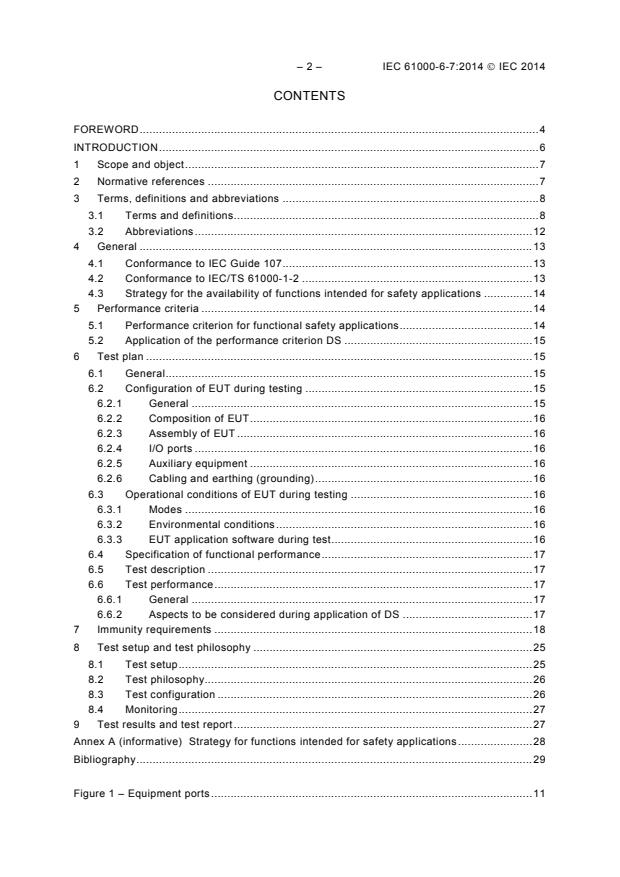
CONTENTS
FOREWORD . 4
INTRODUCTION . 6
1 Scope and object . 7
2 Normative references . 7
3 Terms, definitions and abbreviations . 8
3.1 Terms and definitions . 8
3.2 Abbreviations . 12
4 General . 13
4.1 Conformance to IEC Guide 107 . 13
4.2 Conformance to IEC/TS 61000-1-2 . 13
4.3 Strategy for the availability of functions intended for safety applications . 14
5 Performance criteria . 14
5.1 Performance criterion for functional safety applications . 14
5.2 Application of the performance criterion DS . 15
6 Test plan . 15
6.1 General . 15
6.2 Configuration of EUT during testing . 15
6.2.1 General . 15
6.2.2 Composition of EUT . 16
6.2.3 Assembly of EUT . 16
6.2.4 I/O ports . 16
6.2.5 Auxiliary equipment . 16
6.2.6 Cabling and earthing (grounding) . 16
6.3 Operational conditions of EUT during testing . 16
6.3.1 Modes . 16
6.3.2 Environmental conditions . 16
6.3.3 EUT application software during test . 16
6.4 Specification of functional performance . 17
6.5 Test description . 17
6.6 Test performance . 17
6.6.1 General . 17
6.6.2 Aspects to be considered during application of DS . 17
7 Immunity requirements . 18
8 Test setup and test philosophy . 25
8.1 Test setup . 25
8.2 Test philosophy. 26
8.3 Test configuration . 26
8.4 Monitoring . 27
9 Test results and test report . 27
Annex A (informative) Strategy for functions intended for safety applications . 28
Bibliography . 29
Figure 1 – Equipment ports . 11
Table 1 – Reaction of EUT during test . 18
Table 2 – Immunity test requirements for equipment – Enclosure port . 19
Table 3 – Immunity test requirements for equipment – Input and output AC power
ports . 20
Table 4 – Immunity test requirements for equipment –Input and output DC power ports . 21
Table 5 – Immunity test requirements for equipment – I/O signal/control ports . 22
Table 6 – Immunity test requirements for equipment – I/O signal/control ports
connected directly to AC power supply networks (including functional earth ports) . 23
Table 7 – General frequency ranges for mobile transmitters and ISM equipment for
radiated tests . 24
Table 8 – General frequency ranges for mobile transmitters and ISM for conducted
tests . 25
Table 9 – Applicable performance criteria and observed behaviour during test for
equipment within the scope that is intended for use in safety-related systems . 26
– 4 – IEC 61000-6-7:2014 IEC 2014
INTERNATIONAL ELECTROTECHNICAL COMMISSION
____________
ELECTROMAGNETIC COMPATIBILITY (EMC) –
Part 6-7: Generic standards – Immunity requirements
for equipment intended to perform functions in a safety-related
system (functional safety) in industrial locations
FOREWORD
1) The International Electrotechnical Commission (IEC) is a worldwide organization for standardization comprising
all national electrotechnical committees (IEC National Committees). The object of IEC is to promote
international co-operation on all questions concerning standardization in the electrical and electronic fields. To
this end and in addition to other activities, IEC publishes International Standards, Technical Specifications,
Technical Reports, Publicly Available Specifications (PAS) and Guides (hereafter referred to as “IEC
Publication(s)”). Their preparation is entrusted to technical committees; any IEC National Committee interested
in the subject dealt with may participate in this preparatory work. International, governmental and non-
governmental organizations liaising with the IEC also participate in this preparation. IEC collaborates closely
with the International Organization for Standardization (ISO) in accordance with conditions determined by
agreement between the two organizations.
2) The formal decisions or agreements of IEC on technical matters express, as nearly as possible, an international
consensus of opinion on the relevant subjects since each technical committee has representation from all
interested IEC National Committees.
3) IEC Publications have the form of recommendations for international use and are accepted by IEC National
Committees in that sense. While all reasonable efforts are made to ensure that the technical content of IEC
Publications is accurate, IEC cannot be held responsible for the way in which they are used or for any
misinterpretation by any end user.
4) In order to promote international uniformity, IEC National Committees undertake to apply IEC Publications
transparently to the maximum extent possible in their national and regional publications. Any divergence
between any IEC Publication and the corresponding national or regional publication shall be clearly indicated in
the latter.
5) IEC itself does not provide any attestation of conformity. Independent certification bodies provide conformity
assessment services and, in some areas, access to IEC marks of conformity. IEC is not responsible for any
services carried out by independent certification bodies.
6) All users should ensure that they have the latest edition of this publication.
7) No liability shall attach to IEC or its directors, employees, servants or agents including individual experts and
members of its technical committees and IEC National Committees for any personal injury, property damage or
other damage of any nature whatsoever, whether direct or indirect, or for costs (including legal fees) and
expenses arising out of the publication, use of, or reliance upon, this IEC Publication or any other IEC
Publications.
8) Attention is drawn to the Normative references cited in this publication. Use of the referenced publications is
indispensable for the correct application of this publication.
9) Attention is drawn to the possibility that some of the elements of this IEC Publication may be the subject of
patent rights. IEC shall not be held responsible for identifying any or all such patent rights.
International Standard IEC 61000-6-7 has been prepared by TC 77: Electromagnetic
compatibility.
The text of this standard is based on the following documents:
FDIS Report on voting
77/462/FDIS 77/468//RVD
Full information on the voting for the approval of this standard can be found in the report on
voting indicated in the above table.
This publication has been drafted in accordance with the ISO/IEC Directives, Part 2.
A list of all parts in the IEC 61000 series, published under the general title Electromagnetic
compatibility (EMC), can be found on the IEC website.
The committee has decided that the contents of this publication will remain unchanged until
the stability date indicated on the IEC web site under "http://webstore.iec.ch" in the data
related to the specific publication. At this date, the publication will be
• reconfirmed,
• withdrawn,
• replaced by a revised edition, or
• amended.
– 6 – IEC 61000-6-7:2014 IEC 2014
INTRODUCTION
IEC 61000 is published in separate parts according to the following structure:
Part 1: General
General considerations (introduction, fundamental principles)
Definitions, terminology
Part 2: Environment
Description of the environment
Classification of the environment
Compatibility levels
Part 3: Limits
Emission limits
Immunity limits (insofar as they do not fall under the responsibility of the product
committees)
Part 4: Testing and measurement techniques
Measurement techniques
Testing techniques
Part 5: Installation and mitigation guidelines
Installation guidelines
Mitigation methods and devices
Part 6: Generic standards
Part 9: Miscellaneous
Each part is further subdivided into several parts, published either as International Standards
or technical reports, some of which have already been published as sections. Others will be
published with the part number followed by a dash and completed by a second number
identifying the subdivision (example: IEC 61000-3-11).
ELECTROMAGNETIC COMPATIBILITY (EMC) –
Part 6-7: Generic standards – Immunity requirements
for equipment intended to perform functions in a safety-related
system (functional safety) in industrial locations
1 Scope and object
This part of IEC 61000 is intended to be used by suppliers when making claims for the
immunity of equipment intended for use in safety-related systems against electromagnetic
disturbances.
This standard should also be used by designers, integrators, installers, and assessors of
safety-related systems to assess the claims made by suppliers. It provides guidance to
product committees.
This part of IEC 61000 applies to electrical and electronic equipment intended for use in
safety-related systems and that is
• intended to comply with the requirements of IEC 61508 and/or other sector-specific
functional safety standards, and
• intended to be operated in industrial locations as described in 3.1.15.
NOTE 1 The final safety-related system is designed by a system integrator (or equivalent) that has the
responsibility to assess the adequacy of the equipment for the particular application. This process is described in
Annex D of IEC/TS 61000-1-2:2008.
The object of this standard is to define immunity test requirements for equipment in relation to
continuous and transient, conducted and radiated disturbances, including electrostatic
discharge. These requirements apply only to functions intended for use in functional safety
applications. Test requirements are specified for each port considered.
NOTE 2 The immunity requirements of this standard do not, however, cover extreme cases, which can occur at
any location, but with an extremely low probability of occurrence. In consequence, a designer of a safety-related
system checks whether the requirements of this standard cover the expected electromagnetic phenomena within
the intended application.
2 Normative references
The following documents, in whole or in part, are normatively referenced in this document and
are indispensable for its application. For dated references, only the edition cited applies. For
undated references, the latest edition of the referenced document (including any
amendments) applies.
IEC 60050 (all parts), International Electrotechnical Vocabulary (IEV) (available at
www.electropedia.org)
IEC/TS 61000-1-2:2008, Electromagnetic compatibility (EMC) – Part 1-2: General –
Methodology for the achievement of functional safety of electrical and electronic systems
including equipment with regard to electromagnetic phenomena
IEC 61000-1-6:2012, Electromagnetic compatibility (EMC) – Part 1-6: General – Guide to the
assessment of measurement uncertainty
– 8 – IEC 61000-6-7:2014 IEC 2014
IEC 61000-4-2, Electromagnetic compatibility (EMC) – Part 4-2: Testing and measurement
techniques – Electrostatic discharge immunity test
IEC 61000-4-3, Electromagnetic compatibility (EMC) – Part 4-3: Testing and measurement
techniques – Radiated, radio-frequency, electromagnetic field immunity test
IEC 61000-4-4, Electromagnetic compatibility (EMC) – Part 4-4: Testing and measurement
techniques – Electrical fast transient/burst immunity test
IEC 61000-4-5, Electromagnetic compatibility (EMC) – Part 4-5: Testing and measurement
techniques – Surge immunity test
IEC 61000-4-6, Electromagnetic compatibility (EMC) – Part 4-6: Testing and measurement
techniques – Immunity to conducted disturbances, induced by radio-frequency fields
IEC 61000-4-8, Electromagnetic compatibility (EMC) – Part 4-8: Testing and measurement
techniques – Power frequency magnetic field immunity test
IEC 61000-4-11, Electromagnetic compatibility (EMC) – Part 4-11: Testing and measurement
techniques – Voltage dips, short interruptions and voltage variations immunity tests
IEC 61000-4-16, Electromagnetic compatibility (EMC) – Part 4-16: Testing and measurement
techniques – Test for immunity to conducted, common mode disturbances in the frequency
range 0 Hz to 150 kHz
IEC 61000-4-29, Electromagnetic compatibility (EMC) – Part 4-29: Testing and measurement
techniques – Voltage dips, short interruptions and voltage variations on d.c. input power port
immunity tests
IEC 61000-4-34, Electromagnetic compatibility (EMC) – Part 4-34: Testing and measurement
techniques – Voltage dips, short interruptions and voltage variations immunity tests for
equipment with mains current more than 16 A per phase
IEC 61508 (all parts), Functional safety of electrical/electronic/programmable electronic
safety-related systems
IEC 61784-3, Industrial communication networks – Profiles – Part 3: Functional safety
fieldbuses – General rules and profile definitions
IEC Guide 107, Electromagnetic compatibility – Guide to the drafting of electromagnetic
compatibility publications
3 Terms, definitions and abbreviations
3.1 Terms and definitions
For the purposes of this document, the terms and definitions given in IEC 60050-161, as well
as the following apply.
NOTE Other definitions, not included in IEC 60050-161 and in this standard, but nevertheless necessary for the
application of the different tests, are given in the EMC basic publications of the IEC 61000 series.
3.1.1
auxiliary equipment
AE
equipment necessary to provide the equipment under test (EUT) with the signals required for
normal operation and equipment to verify the performance of the EUT
3.1.2
dangerous failure
failure of an element and/or subsystem and/or system that plays a part in implementing the
safety function that:
a) prevents a safety function from operating when required (demand mode) or causes a
safety function to fail (continuous mode) such that the EUC (equipment under control) is
put into a hazardous or potentially hazardous state; or
b) decreases the probability that the safety function operates correctly when required
[SOURCE: IEC 61508-4:2010, 3.6.7]
3.1.3
DC distribution network
local DC electricity supply network in the infrastructure of a certain site or building intended
for connection of any type of DC-powered equipment
Note 1 to entry: Connection to a local or remote battery/power supply/PELV/SELV/UPS is not regarded as a DC
distribution network if such a link comprises only the power source mentioned above for a single piece of
equipment. These lines are considered as signal lines.
3.1.4
electrical/electronic/programmable electronic
E/E/PE
based on electrical (E) and/or electronic (E) and/or programmable electronic (PE) technology
EXAMPLE Electrical/electronic/programmable electronic devices include
– electro-mechanical devices (electrical);
– solid-state non-programmable electronic devices (electronic);
– electronic devices based on computer technology (programmable electronic);
Note 1 to entry: The term is intended to cover any and all devices or systems operating on electrical principles.
[SOURCE: IEC 61508-4:2010, 3.2.13]
3.1.5
enclosure port
physical boundary of the apparatus through which electromagnetic fields may radiate or
impinge on
3.1.6
equipment
electrical and electronic subsystems, apparatus, modules, devices and other assemblies of
products intended to be used to construct safety-related systems, and which are
• intended to comply with the requirements of IEC 61508 and/or other sector-specific
functional safety standards, and
• intended to be operated in industrial locations as described in 3.1.15
3.1.7
equipment under control
EUC
equipment, machinery, apparatus or plant used for manufacturing, process, transportation,
medical or other activities
Note 1 to entry: The EUC control system is separate and distinct from the EUC.
Note 2 to entry: This note applies to the French language only.
– 10 – IEC 61000-6-7:2014 IEC 2014
[SOURCE: IEC 61508-4:2010, 3.2.1, modified – note 2 has been added.]
3.1.8
equipment under test
EUT
equipment (products, devices, appliances and systems) subjected to immunity tests
3.1.9
extra-low voltage
ELV
any voltage not exceeding the relevant voltage limit specified in IEC 61201
[SOURCE: IEC 61140:2009, 3.26]
3.1.10
functional earth port
cable port other than signal/control or power port, intended for connection to earth for
purposes other than electrical safety
3.1.11
functional safety
part of the overall safety relating to the EUC and the EUC control system that depends on the
correct functioning of the E/E/PE safety-related systems and other risk reduction measures
[SOURCE: IEC 61508-4:2010, 3.1.12]
3.1.12
functional safety application
system, equipment or product that is intended for use in a safety-related system but is not
itself a complete safety-related system
Note 1 to entry: This definition refers to aspects of the safety functions of the safety-related system within which it
will be used.
3.1.13
harm
physical injury or damage to the health of people, or damage to property or the environment
[SOURCE: IEC 60050-351:2013, 351-57-02]
3.1.14
hazard
potential source of harm
Note 1 to entry: The term includes dangers to persons arising within a short time scale (for example, fire and
explosion) and also those that have a long-term effect on a person’s health (for example, release of a toxic
substance).
[SOURCE: IEC 60050-351:2013, 351-57-01, modified – the note has been modified.]
3.1.15
industrial location
location characterized by a separate power network, supplied from a high- or medium-voltage
transformer, dedicated for the supply of the installation
Note 1 to entry: Industrial locations can generally be described by the existence of an installation with one or
more of the following characteristics:
– items of equipment installed and connected together and working simultaneously;
– significant amount of electrical power is generated, transmitted and/or consumed;
– frequent switching of heavy inductive or capacitive loads;
– high currents and associated magnetic fields;
– presence of industrial, scientific and medical (ISM) equipment (for example, welding machines)
The electromagnetic environment at an industrial location is predominantly produced by the equipment and
installation present at the location. There are types of industrial installations where some of the electromagnetic
phenomena appear in a more severe degree than in other installations.
Note 2 to entry: Examples of industrial locations are metalworking, pulp and paper, chemical plants, car
production.
3.1.16
PELV system
electric system in which the voltage cannot exceed the value of extra low voltage and is
connected to PE
– under normal conditions and
– under single fault conditions, except earth faults in other electric circuits
Note 1 to entry: PELV is the abbreviation for protective extra low voltage.
[SOURCE: IEC 60050-826:2004, 826-12-32]
3.1.17
port
particular interface of the equipment which couples this equipment with or is influenced by the
external electromagnetic environment
Note 1 to entry: Examples of ports of interest are shown in Figure 1. The enclosure port is the physical boundary
of the apparatus (e.g. enclosure). The enclosure port provides for radiated and electrostatic discharge (ESD)
energy transfer, whereas the other ports provide for conducted energy transfer.
Note 2 to entry: Though Figure 1 describes the situation for equipment, it applies to products and systems as
well.
IEC
Figure 1 – Equipment ports
3.1.18
power port
port at which a conductor or cable carrying the primary electrical power (AC or DC) needed
for the operation (functioning) of equipment or associated equipment is connected to the
equipment
Note 1 to entry: Different types and numbers of power ports are possible on one item of equipment.
3.1.19
product
item that is commercially available on the market, from manufacturers or their agents
3.1.20
safety function
function to be implemented by an E/E/PE safety-related system or other risk reduction
measures, that is intended to achieve or maintain a safe state for the EUC, in respect of a
specific hazardous event
– 12 – IEC 61000-6-7:2014 IEC 2014
[SOURCE: IEC 61508-4:2010, 3.5.1]
3.1.21
safety extra low voltage
SELV
AC voltage the r.m.s. value of which does not exceed 50 V or ripple-free DC voltage the value
of which does not exceed 120 V, between conductors, or between any conductor and
reference earth, in an electric circuit which has galvanic separation from the supplying electric
power system by such means as a separate-winding transformer
Note 1 to entry: Maximum voltage lower than 50 V AC or 120 V ripple-free DC may be specified in particular
requirements, especially when direct contact with live parts is allowed.
Note 2 to entry: The voltage limit should not be exceeded at any load between full load and no-load when the
source is a safety isolating transformer.
Note 3 to entry: Ripple-free qualifies conventionally an r.m.s. ripple voltage not more than 10 % of the DC
component; the maximum peak value does not exceed 140 V for a nominal 120 V ripple-free DC system and 70 V
for a nominal 60 V ripple-free DC system.
[SOURCE: IEC 60050-851:2008, 851-15-08]
3.1.22
safety integrity level
SIL
discrete level (one out of a possible four), corresponding to a range of safety integrity values,
where safety integrity level 4 has the highest level of safety integrity and safety integrity level
1 has the lowest
[SOURCE: IEC 61508-4:2010, 3.5.8]
3.1.23
signal/control port
port at which a conductor or cable intended to carry signals is connected to the equipment
Note 1 to entry: Examples are analog inputs, outputs and control lines; data buses; communication networks; etc.
3.1.24
system
combination of apparatus and/or active components constituting a single functional unit and
intended to be installed and operated to perform (a) specific task(s)
Note 1 to entry: "Safety-related systems" are specifically "designed" equipment that both
– implement the required safety functions necessary to achieve or maintain a safe state for controlled
equipment;
– are intended to achieve on their own or with other safety-related equipment or external risk reduction facilities,
the necessary safety integrity for the safety requirements.
3.1.25
type test
conformity test made on one or more items representative of the production
[SOURCE: IEC 60050-151:2001, 151-16-16]
3.2 Abbreviations
AE auxiliary equipment
DS (performance criterion) “defined state”, see 5.1
E/E/PE electrical/electronic/programmable electronic
ELV extra-low voltage
EUC equipment under control
EUT equipment under test
ISM Industrial, scientific and medical
PELV protective extra low voltage
SELV safety extra low voltage
SIL safety integrity level
SRS safety requirements specification
4 General
4.1 Conformance to IEC Guide 107
This generic standard is applicable in the absence of relevant dedicated product-family or
product standard(s) that address electromagnetic influences on functional safety. Since a
product family/product standard usually gives more specific requirements, it is generally
considered that it takes precedence over the corresponding generic standard. Where a
product family/product standard detailing electromagnetic influences on functional safety
specifies less stringent test values for a phenomenon or if a phenomenon is only partially
covered (e.g. the product family/product standard only covers a subset of the recommended
frequency range), a technical justification shall be given in that standard.
NOTE 1 IEC 61508 does not necessarily require that the proof of sufficient immunity is done by means of
immunity tests. There might be other approaches to demonstrate sufficient immunity, e.g. by means of design
and/or analysis.
NOTE 2 If fail-safe happens too often in real life operation it becomes a significant nuisance to the owner or
operator and might result in a higher level of risk.
4.2 Conformance to IEC/TS 61000-1-2
This part of IEC 61000 specifies immunity testing taking into account the principles of Clause
9 of IEC/TS 61000-1-2:2008. It is important to note that this standard and the process
described herein shall only be applied in accordance with the processes detailed in
IEC/TS 61000-1-2.
For clarity, this standard only applies in reference to the verification phase of the functional
safety process detailed in IEC/TS 61000-1-2. The achievement of tolerable functional safety
risks shall only be achieved by fully applying the requirements of IEC/TS 61000-1-2. These
requirements include: consideration of the safety lifecycle; the development of a safety
requirements specification (SRS) that includes safety function requirements and safety
integrity requirements; consideration of EMC specific steps that include more than EMC
immunity testing; and the management of EMC for functional safety.
In the same way that immunity testing is considered of great value during the verification
phase, additional immunity testing should be considered to take into account the effects of
aging. This type of testing could be performed on an accelerated lifetime basis.
Due to the wide variety of equipment that may be used and consequently the wide variety of
electromagnetic environments in industrial locations, the type of electromagnetic disturbances
and the associated immunity levels specified herein for functional safety might not adequately
represent the totality of the electromagnetic environment or significantly over prescribe the
same for certain applications. In either case, the applicable test requirements for functional
safety shall reflect the expected or specified electromagnetic environment for the equipment.
NOTE 1 The applicable test requirements for known applications are discussed and agreed with the end-user,
where at all possible (see Annex F of IEC/TS 61000-1-2:2008 for more details).
NOTE 2 Any practical amount of testing alone cannot demonstrate that equipment within the scope of this standard
is safe. However, increased confidence can be achieved if equipment within the scope of this standard fails to a
– 14 – IEC 61000-6-7:2014 IEC 2014
defined safe state during a test. This confidence is still limited by the possibility of various environmental
differences existing between testing and operation. Equipment within the scope of this standard operating normally
at any test level does not indicate anything about what will happen when it fails. Knowing this, no fixed set of
immunity tests can possibly demonstrate that a safety-related system will achieve a tolerable level of functional
safety when it is exposed to the electromagnetic disturbances that could be present over its lifetime.
4.3 Strategy for the availability of functions intended for safety applications
This part of IEC 61000 specifies functional safety requirements for equipment described in the
scope of this document. The requirements of this standard do not apply to functions other
than those intended for safety applications.
NOTE The overall design process and the necessary design features to achieve functional safety of electrical/
electronic/programmable electronic safety-related systems are defined in IEC 61508. This includes requirements
for design features that make the system tolerant (IEC 61508-2) to electromagnetic disturbances. Annex B of
IEC/TS 61000-1-2:2008 provides more detailed guidance on EMC design aspects. The methodology for the
achievement of functional safety of E/E/PE systems (including equipment) with respect to electromagnetic
phenomena is given in IEC/TS 61000-1-2.
The requirements of this part of IEC 61000 shall be applied in accordance with the safety
lifecycle requirements of IEC/TS 61000-1-2. As stated in IEC/TS 61000-1-2, several but not
all of the safety lifecycle phases presented in IEC 61508 are impacted by electromagnetic
considerations. The minimum requirements of Clause 6 of IEC/TS 61000-1-2:2008 for
equipment within the scope of this part of IEC 61000 are covered by complying with the
electromagnetic tests in this part of IEC 61000. Also, the design and implementation phases
(see Clause 7 of IEC/TS 61000-1-2:2008), and the verification and validation phases (see
Clause 8 of IEC/TS 61000-1-2:2008) of the overall safety lifecycle include electromagnetic
considerations. It is only by satisfying the relevant requirements of IEC/TS 61000-1-2 that
equipment can be declared to have a systematic capability with regard to electromagnetic
phenomena.
The specifications given in most EMC product/product family or generic standards do not
cover functional safety aspects with regard to electromagnetic phenomena but only “normal”
EMC tests or requirements. The immunity requirements in product/product family or generic
EMC standards are typically selected based upon technical/economic compromises
considered adequate for equipment used in non-safety-related systems. However, these may
not be suitable for safety-related systems.
5 Performance criteria
5.1 Performance criterion for functional safety applications
Performance criteria are used to describe and to assess the reaction of the EUT when
exposed to electromagnetic phenomena. With regard to safety applications for equipment
within the scope of this standard, a particular performance criterion DS is defined as follows:
a) The functions of the EUT intended for use in safety applications
1) are not affected outside their specification, or
2) may be affected temporarily or permanently (even by destruction of components), if the
EUT reacts to a disturbance in a way that a detectable and defined state (or states) of
the EUT is(are)
i) maintained, or
ii) achieved within a stated time.
b) The functions not intended for use in safety applications may be disturbed temporarily or
permanently.
NOTE 1 It is possible for the defined state to be outside normal operating limits.
NOTE 2 Generalized performance criteria A, B and C as defined in generic EMC standards and also more precise
performance criteria as defined in EMC product or product family standards were specifically not developed for use
in functional safety applications. However, performance criterion A is always acceptable.
NOTE 3 Other standards or projects in the area of EMC and functional safety use the term performance criterion
FS instead of performance criterion DS, however, the definitions may not be the same.
It is important to understand that the detectable and defined states specified shall be the
result of a specific design. Such defined states shall be specified in advance of the immunity
testing. It is not sufficient to merely observe the behaviour of the EUT during a test, observe a
failure mode, then interpret that as the defined state for that function of the EUT.
5.2 Application of the performance criterion DS
This performance criterion is only applicable for functions of the EUT intended for functional
safety applications. It shall be considered for all the electromagnetic phenomena. There is no
differentiation required between continuous and transient electromagnetic phenomena.
Equipment within the scope of this standard that performs or is intended to perform functions
intended for functional safety applications or parts of such functions shall behave in a
specified manner. The specified behaviour of a functional safety application is intended to
achieve or maintain safe conditions. To achieve this, the behaviour of the equipment shall be
known under all considered conditions.
NOTE 1 In the safety requirements specification of a safety-related system both the undisturbed function and the
required behaviour in case of failure or occurrence of a fault are specified by the safety-related system’s designer.
The safety requirements specification in some cases also specifies time constraints. The required functional
behaviour and the related time constraints can differ from the general specification for performance criteria A, B or
C as defined in EMC immunity standards not covering functional safety.
NOTE 2 See also 4.2 with reference to the approach given in IEC/TS 61000-1-2.
Where an item of equipment performs both functions intended for functional safety
applications and non-safety applications, the requirements for functional safety apply in
context wi
...
Questions, Comments and Discussion
Ask us and Technical Secretary will try to provide an answer. You can facilitate discussion about the standard in here.
Loading comments...