

IEC 61000-6-2:2016
(Main)Electromagnetic compatibility (EMC) - Part 6-2: Generic standards - Immunity standard for industrial environments
General Information
- Abstract
IEC 61000-6-2:2016 for EMC immunity requirements applies to electrical and electronic equipment intended for use in industrial locations, as described below. Immunity requirements in the frequency range 0 Hz to 400 GHz are covered. No tests need to be performed at frequencies where no requirements are specified. This generic EMC immunity standard is applicable if no relevant dedicated product or product-family EMC immunity standard exists. This third edition cancels and replaces the second edition published in 2005. This edition constitutes a technical revision.
- Status
- Published
- Publication Date
- 09-Aug-2016
- Technical Committee
- TC 77 - Electromagnetic compatibility
- Drafting Committee
- WG 13 - TC 77/WG 13
- Current Stage
- PPUB - Publication issued
- Start Date
- 10-Aug-2016
- Completion Date
- 30-Sep-2016
Buy Documents
IEC 61000-6-2:2016 RLV - Electromagnetic compatibility (EMC) - Part 6-2: Generic standards - Immunity standard for industrial environments Released:8/10/2016
IEC 61000-6-2:2016 - Electromagnetic compatibility (EMC) - Part 6-2: Generic standards - Immunity standard for industrial environments Released:8/10/2016
Overview
IEC 61000-6-2:2016 is the third-edition generic EMC immunity standard for industrial environments published by the IEC. It defines immunity requirements for electrical and electronic equipment intended for use in industrial locations (indoor and outdoor) and covers disturbances in the frequency range 0 Hz to 400 GHz. This generic standard applies when no dedicated product or product-family EMC immunity standard exists and replaces the 2005 second edition.
Key characteristics:
- Focus: Electromagnetic compatibility (EMC) - Immunity for industrial equipment
- Frequency coverage: 0 Hz to 400 GHz
- Applicability: equipment connected to industrial power supplies (AC or DC), battery-operated apparatus, and installations fed from medium/high-voltage transformers
- Environment: industrial sites with ISM equipment, frequent switching of heavy inductive/capacitive loads, and high currents
Key topics and technical requirements
IEC 61000-6-2 organizes practical immunity requirements by equipment ports and test types rather than specific products. Important technical topics include:
- Performance criteria and classification of acceptable behaviour during/after tests
- Ports covered: enclosure ports, signal/control ports, input/output DC and AC power ports
- Immunity phenomena and test methods (normatively referencing IEC 61000‑4 series), including:
- Electrostatic discharge (ESD) - IEC 61000‑4‑2
- Radiated RF field immunity - IEC 61000‑4‑3
- Electrical fast transients / bursts - IEC 61000‑4‑4
- Surge immunity - IEC 61000‑4‑5
- Conducted RF disturbances - IEC 61000‑4‑6
- Power frequency magnetic fields - IEC 61000‑4‑8
- Voltage dips, interruptions and variations (including IEC 61000‑4‑34 for >16 A)
- Reverberation chamber, TEM and anechoic room test methods (IEC 61000‑4‑20/21/22)
- Testing conditions, measurement uncertainty, product documentation and applicability rules
- Guidance for product committees (Annex A) to tailor tests/levels for specific product families
Practical applications and users
IEC 61000-6-2 is essential for:
- EMC engineers and product designers creating robust industrial controllers, drives, PLCs, sensors, power conversion equipment, instrumentation and battery/DC systems
- Test laboratories and conformity assessment bodies conducting immunity testing
- System integrators and OEMs specifying procurement and acceptance criteria for industrial equipment
- Compliance officers and risk managers assessing electromagnetic resilience in manufacturing plants, process control and heavy-industry installations
Use cases:
- Defining EMC test plans when no product-specific immunity standard exists
- Integrating immunity requirements into design-for-EMC and mitigation strategies
- Preparing documentation for certification and supplier contracts
Related standards
Normative references include the IEC 61000‑4 series (‑2, ‑3, ‑4, ‑5, ‑6, ‑8, ‑11, ‑20, ‑21, ‑22, ‑34), CISPR 22 and IEC 60050‑161. These are used together with IEC 61000‑6‑2 to design, test and demonstrate EMC immunity for industrial equipment.
Keywords: IEC 61000-6-2, EMC immunity, industrial environments, electromagnetic compatibility, ESD, surge, radiated immunity, conducted disturbances, IEC 61000-4, immunity testing.
Relations
- Effective Date
- 25-Aug-2026
- Effective Date
- 25-Aug-2026
- Effective Date
- 25-Aug-2026
- Effective Date
- 25-Aug-2026
- Effective Date
- 25-Aug-2026
- Effective Date
- 25-Aug-2026
- Effective Date
- 25-Aug-2026
- Effective Date
- 25-Aug-2026
- Referred By
EN ISO 16093:2017 - Machine tools - Safety - Sawing machines for cold metal (ISO 16093:2017) - Effective Date
- 25-Aug-2026
- Referred By
EN ISO 28881:2022 - Machine tools - Safety - Electrical discharge machines (ISO 28881:2022) - Effective Date
- 25-Aug-2026
- Effective Date
- 25-Aug-2026
- Effective Date
- 25-Aug-2026
- Effective Date
- 15-Jul-2026
- Referred By
EN ISO 3991:2025 - Agricultural machinery - Robotic feed systems - Safety (ISO 3991:2025) - Effective Date
- 04-Mar-2026
- Referred By
EN ISO 16089:2025 - Machine tools - Safety - Stationary grinding machines (ISO 16089:2025) - Effective Date
- 04-Mar-2026
Buy Documents
IEC 61000-6-2:2016 RLV - Electromagnetic compatibility (EMC) - Part 6-2: Generic standards - Immunity standard for industrial environments Released:8/10/2016
IEC 61000-6-2:2016 - Electromagnetic compatibility (EMC) - Part 6-2: Generic standards - Immunity standard for industrial environments Released:8/10/2016
Get Certified
Connect with accredited certification bodies for this standard

ANCE
Mexican certification and testing association.

Intertek Slovenia
Intertek testing, inspection, and certification services in Slovenia.

LNE (Laboratoire National de Métrologie et d'Essais)
French national laboratory for metrology and testing.
Sponsored listings
Frequently Asked Questions
IEC 61000-6-2:2016 is a standard published by the International Electrotechnical Commission (IEC). Its full title is "Electromagnetic compatibility (EMC) - Part 6-2: Generic standards - Immunity standard for industrial environments". This standard covers: IEC 61000-6-2:2016 for EMC immunity requirements applies to electrical and electronic equipment intended for use in industrial locations, as described below. Immunity requirements in the frequency range 0 Hz to 400 GHz are covered. No tests need to be performed at frequencies where no requirements are specified. This generic EMC immunity standard is applicable if no relevant dedicated product or product-family EMC immunity standard exists. This third edition cancels and replaces the second edition published in 2005. This edition constitutes a technical revision.
IEC 61000-6-2:2016 for EMC immunity requirements applies to electrical and electronic equipment intended for use in industrial locations, as described below. Immunity requirements in the frequency range 0 Hz to 400 GHz are covered. No tests need to be performed at frequencies where no requirements are specified. This generic EMC immunity standard is applicable if no relevant dedicated product or product-family EMC immunity standard exists. This third edition cancels and replaces the second edition published in 2005. This edition constitutes a technical revision.
IEC 61000-6-2:2016 is classified under the following ICS (International Classification for Standards) categories: 33.100.20 - Immunity. The ICS classification helps identify the subject area and facilitates finding related standards.
IEC 61000-6-2:2016 has the following relationships with other standards: It is inter standard links to EN ISO 7396-3:2025, EN ISO 28057:2018, EN ISO 22291:2022, EN ISO 8041-2:2021, EN ISO 10637:2018, EN ISO 22052:2020, EN ISO 4064-2:2025, EN ISO 21789:2022, EN ISO 16093:2017, EN ISO 28881:2022, EN ISO 16090-1:2018, EN ISO 23402-3:2024, EN ISO 16090-1:2022, EN ISO 3991:2025, EN ISO 16089:2025. Understanding these relationships helps ensure you are using the most current and applicable version of the standard.
IEC 61000-6-2:2016 is available in PDF format for immediate download after purchase. The document can be added to your cart and obtained through the secure checkout process. Digital delivery ensures instant access to the complete standard document.
Standards Content (Sample)
IEC 61000-6-2 ®
Edition 3.0 2016-08
REDLINE VERSION
INTERNATIONAL
STANDARD
colour
inside
Electromagnetic compatibility (EMC) –
Part 6-2: Generic standards – Immunity standard for industrial environments
All rights reserved. Unless otherwise specified, no part of this publication may be reproduced or utilized in any form
or by any means, electronic or mechanical, including photocopying and microfilm, without permission in writing from
either IEC or IEC's member National Committee in the country of the requester. If you have any questions about IEC
copyright or have an enquiry about obtaining additional rights to this publication, please contact the address below or
your local IEC member National Committee for further information.
IEC Central Office Tel.: +41 22 919 02 11
3, rue de Varembé Fax: +41 22 919 03 00
CH-1211 Geneva 20 info@iec.ch
Switzerland www.iec.ch
About the IEC
The International Electrotechnical Commission (IEC) is the leading global organization that prepares and publishes
International Standards for all electrical, electronic and related technologies.
About IEC publications
The technical content of IEC publications is kept under constant review by the IEC. Please make sure that you have the
latest edition, a corrigenda or an amendment might have been published.
IEC Catalogue - webstore.iec.ch/catalogue Electropedia - www.electropedia.org
The stand-alone application for consulting the entire The world's leading online dictionary of electronic and
bibliographical information on IEC International Standards, electrical terms containing 20 000 terms and definitions in
Technical Specifications, Technical Reports and other English and French, with equivalent terms in 15 additional
documents. Available for PC, Mac OS, Android Tablets and languages. Also known as the International Electrotechnical
iPad. Vocabulary (IEV) online.
IEC publications search - www.iec.ch/searchpub IEC Glossary - std.iec.ch/glossary
The advanced search enables to find IEC publications by a 65 000 electrotechnical terminology entries in English and
variety of criteria (reference number, text, technical French extracted from the Terms and Definitions clause of
committee,…). It also gives information on projects, replaced IEC publications issued since 2002. Some entries have been
and withdrawn publications. collected from earlier publications of IEC TC 37, 77, 86 and
CISPR.
IEC Just Published - webstore.iec.ch/justpublished
Stay up to date on all new IEC publications. Just Published IEC Customer Service Centre - webstore.iec.ch/csc
details all new publications released. Available online and If you wish to give us your feedback on this publication or
also once a month by email. need further assistance, please contact the Customer Service
Centre: csc@iec.ch.
IEC 61000-6-2 ®
Edition 3.0 2016-08
REDLINE VERSION
INTERNATIONAL
STANDARD
colour
inside
Electromagnetic compatibility (EMC) –
Part 6-2: Generic standards – Immunity standard for industrial environments
INTERNATIONAL
ELECTROTECHNICAL
COMMISSION
ICS 33.100.20 ISBN 978-2-8322-3579-9
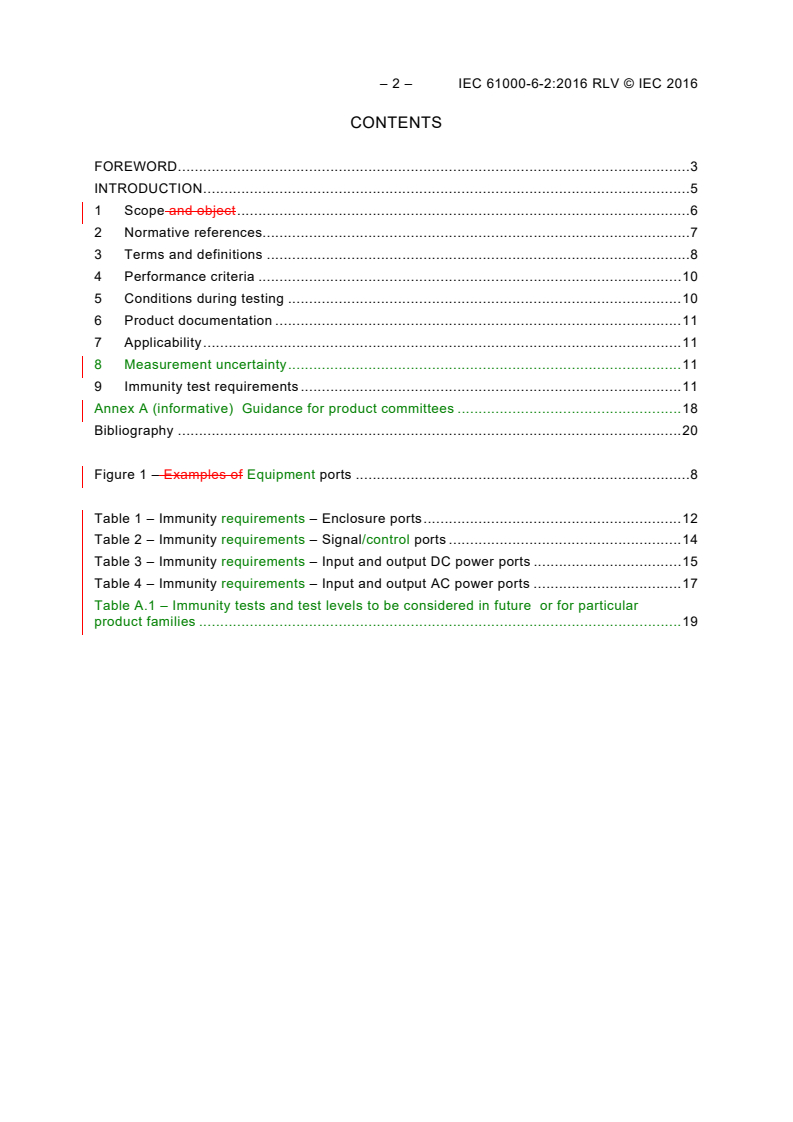
– 2 – IEC 61000-6-2:2016 RLV © IEC 2016
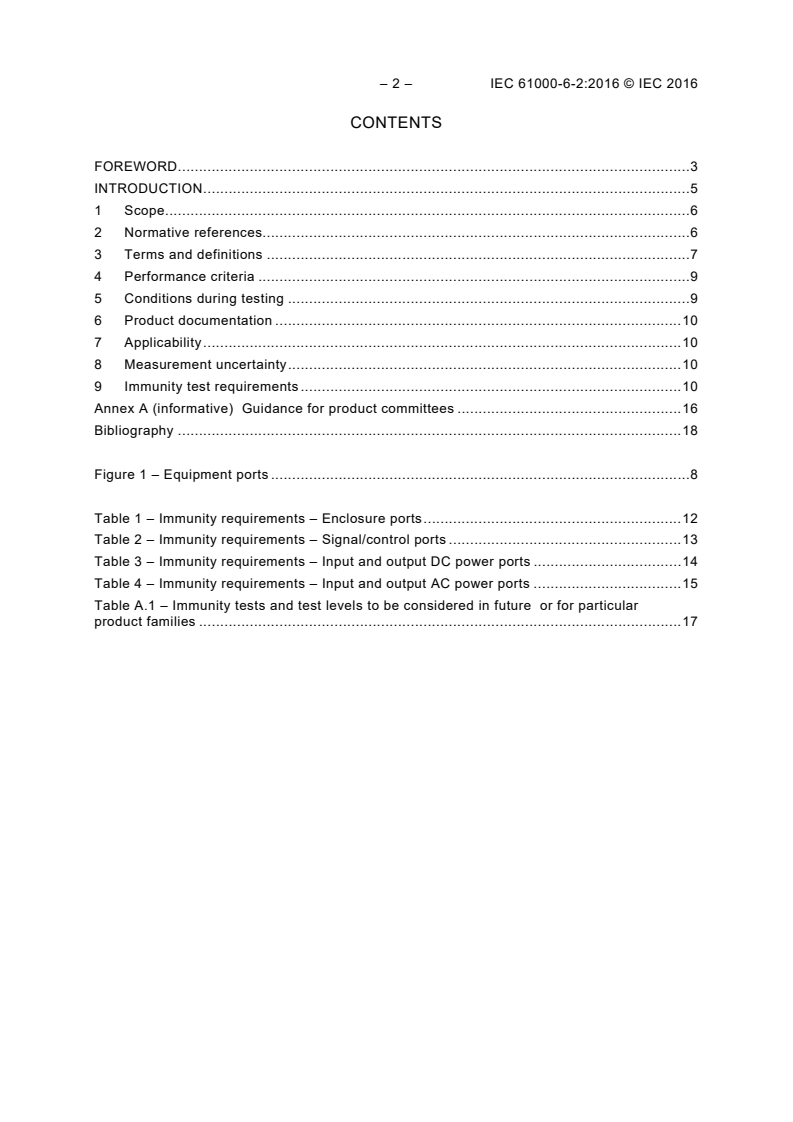
CONTENTS
FOREWORD . 3
INTRODUCTION . 5
1 Scope and object . 6
2 Normative references. 7
3 Terms and definitions . 8
4 Performance criteria . 10
5 Conditions during testing . 10
6 Product documentation . 11
7 Applicability . 11
8 Measurement uncertainty . 11
9 Immunity test requirements . 11
Annex A (informative) Guidance for product committees . 18
Bibliography . 20
Figure 1 – Examples of Equipment ports . 8
Table 1 – Immunity requirements – Enclosure ports . 12
Table 2 – Immunity requirements – Signal/control ports . 14
Table 3 – Immunity requirements – Input and output DC power ports . 15
Table 4 – Immunity requirements – Input and output AC power ports . 17
Table A.1 – Immunity tests and test levels to be considered in future or for particular
product families . 19
INTERNATIONAL ELECTROTECHNICAL COMMISSION
____________
ELECTROMAGNETIC COMPATIBILITY (EMC) –
Part 6-2: Generic standards –
Immunity standard for industrial environments
FOREWORD
1) The International Electrotechnical Commission (IEC) is a worldwide organization for standardization comprising
all national electrotechnical committees (IEC National Committees). The object of IEC is to promote
international co-operation on all questions concerning standardization in the electrical and electronic fields. To
this end and in addition to other activities, IEC publishes International Standards, Technical Specifications,
Technical Reports, Publicly Available Specifications (PAS) and Guides (hereafter referred to as “IEC
Publication(s)”). Their preparation is entrusted to technical committees; any IEC National Committee interested
in the subject dealt with may participate in this preparatory work. International, governmental and non-
governmental organizations liaising with the IEC also participate in this preparation. IEC collaborates closely
with the International Organization for Standardization (ISO) in accordance with conditions determined by
agreement between the two organizations.
2) The formal decisions or agreements of IEC on technical matters express, as nearly as possible, an international
consensus of opinion on the relevant subjects since each technical committee has representation from all
interested IEC National Committees.
3) IEC Publications have the form of recommendations for international use and are accepted by IEC National
Committees in that sense. While all reasonable efforts are made to ensure that the technical content of IEC
Publications is accurate, IEC cannot be held responsible for the way in which they are used or for any
misinterpretation by any end user.
4) In order to promote international uniformity, IEC National Committees undertake to apply IEC Publications
transparently to the maximum extent possible in their national and regional publications. Any divergence
between any IEC Publication and the corresponding national or regional publication shall be clearly indicated in
the latter.
5) IEC itself does not provide any attestation of conformity. Independent certification bodies provide conformity
assessment services and, in some areas, access to IEC marks of conformity. IEC is not responsible for any
services carried out by independent certification bodies.
6) All users should ensure that they have the latest edition of this publication.
7) No liability shall attach to IEC or its directors, employees, servants or agents including individual experts and
members of its technical committees and IEC National Committees for any personal injury, property damage or
other damage of any nature whatsoever, whether direct or indirect, or for costs (including legal fees) and
expenses arising out of the publication, use of, or reliance upon, this IEC Publication or any other IEC
Publications.
8) Attention is drawn to the Normative references cited in this publication. Use of the referenced publications is
indispensable for the correct application of this publication.
9) Attention is drawn to the possibility that some of the elements of this IEC Publication may be the subject of
patent rights. IEC shall not be held responsible for identifying any or all such patent rights.
This redline version of the official IEC Standard allows the user to identify the changes
made to the previous edition. A vertical bar appears in the margin wherever a change
has been made. Additions are in green text, deletions are in strikethrough red text.
– 4 – IEC 61000-6-2:2016 RLV © IEC 2016
International Standard IEC 61000-6-2 has been prepared by IEC technical committee 77:
Electromagnetic compatibility.
This third edition cancels and replaces the second edition published in 2005. This edition
constitutes a technical revision.
This edition includes the following significant technical changes with respect to the previous
edition:
a) improvement of the environmental description;
b) extension of the frequency range for the radio-frequency electromagnetic field test
according to IEC 61000-4-3;
c) amended test levels at particular frequencies for the radio-frequency electromagnetic field
test according to IEC 61000-4-3;
d) change of the repetition frequency for the fast transients immunity test according to
IEC 61000-4-4;
e) introduction of requirements according to IEC 61000-4-34;
f) revision of the test levels;
g) consideration of measurement uncertainty;
h) addition of Annex A.
The text of this standard is based on the following documents:
FDIS Report on voting
77/521/FDIS 77/523/RVD
Full information on the voting for the approval of this standard can be found in the report on
voting indicated in the above table.
This publication has been drafted in accordance with the ISO/IEC Directives, Part 2.
A list of all parts in the IEC 61000 series, published under the general title Electromagnetic
compatibility (EMC), can be found on the IEC website.
The committee has decided that the contents of this publication will remain unchanged until
the stability date indicated on the IEC website under "http://webstore.iec.ch" in the data
related to the specific publication. At this date, the publication will be
• reconfirmed,
• withdrawn,
• replaced by a revised edition, or
• amended.
IMPORTANT – The “colour inside” logo on the cover page of this publication indicates
that it contains colours which are considered to be useful for the correct understanding
of its contents. Users should therefore print this publication using a colour printer.
INTRODUCTION
IEC 61000 is published in separate parts according to the following structure:
Part 1: General
General considerations (introduction, fundamental principles)
Definitions, terminology
Part 2: Environment
Description of the environment
Classification of the environment
Compatibility levels
Part 3: Limits
Emission limits
Immunity limits (insofar as these limits do not fall under the responsibility of the product
committees)
Part 4: Testing and measurement techniques
Measurement techniques
Testing techniques
Part 5: Installation and mitigation guidelines
Installation guidelines
Mitigation methods and devices
Part 6: Generic standards
Part 9: Miscellaneous
Each part is further subdivided into several parts, published either as International Standards
or as Technical Specifications or Technical Reports, some of which have already been
published as sections. Others will be published with the part number followed by a dash and a
second number identifying the subdivision (example: IEC 61000-6-1).
– 6 – IEC 61000-6-2:2016 RLV © IEC 2016
ELECTROMAGNETIC COMPATIBILITY (EMC) –
Part 6-2: Generic standards –
Immunity standard for industrial environments
1 Scope and object
This part of IEC 61000 for EMC immunity requirements applies to electrical and electronic
apparatus equipment intended for use in industrial environments locations, as described
below. Immunity requirements in the frequency range 0 Hz to 400 GHz are covered. No tests
need to be performed at frequencies where no requirements are specified.
This generic EMC immunity standard is applicable if no relevant dedicated product or product-
family EMC immunity standard exists.
This standard applies to apparatus intended to be connected to a power network supplied
from a high or medium voltage transformer dedicated to the supply of an installation feeding
manufacturing or similar plant, and electrical and electronic equipment intended to be
operated in or in proximity to industrial locations, as described below defined in 3.7, both
indoor and outdoor.
This standard applies also to apparatus equipment intended to be directly connected to a DC
distribution network or which is battery operated, and intended to be used in industrial
locations.
The environments encompassed by this standard are industrial, both indoor and outdoor.
Industrial locations are in addition characterised by the existence of one or more of the
following:
– industrial, scientific and medical (ISM) apparatus (as defined in CISPR 11);
– heavy inductive or capacitive loads are frequently switched;
– currents and associated magnetic fields are high.
The object of This standard is to defines the immunity test requirements for apparatus
defined equipment specified in the scope in relation to continuous and transient, conducted
and radiated disturbances, including electrostatic discharges.
The immunity requirements have been selected to ensure an adequate level of immunity for
apparatus at equipment operating within industrial locations. The levels do not, however,
cover extreme cases, which may occur at any location, but with an extremely low probability
of occurrence. Not all disturbance phenomena have been included for testing purposes in this
standard, but only those considered as relevant for the equipment covered by this standard.
These test requirements represent essential electromagnetic compatibility immunity
requirements. They are specified for each port considered.
NOTE 1 Information on other disturbance phenomena is given in IEC TR 61000-4-1.
NOTE 2 Safety considerations are not covered by this standard.
NOTE 3 In special cases, situations will arise where the level of disturbances may exceed the levels specified in
this standard, for example where an apparatus equipment is installed in proximity to industrial, scientific and
medical equipment as defined in CISPR 11 or where a hand-held transmitter is used in close proximity to an
apparatus equipment. In these instances, special mitigation measures may have to be employed.
NOTE 4 The industrial environment may be changed by special mitigation measures. Where
such measures can be shown to produce an electromagnetic environment equivalent to the
residential, commercial or light-industrial environment, then the generic standard for this
environment, or the relevant product standard, should may be applied.
2 Normative references
The following documents, in whole or in part, are normatively referenced in this document and
are indispensable for its application. For dated references, only the edition cited applies. For
undated references, the latest edition of the referenced document (including any
amendments) applies.
IEC 60050-161, International Electrotechnical Vocabulary – Part 161: Electromagnetic
compatibility (available at: www.electropedia.org)
IEC 61000-4-2:2008, Electromagnetic compatibility (EMC) – Part 4-2: Testing and
measurement techniques – Electrostatic discharge immunity test
IEC 61000-4-3:2006, Electromagnetic compatibility (EMC) – Part 4-3: Testing and
measurement techniques – Radiated, radio-frequency, electromagnetic field immunity test
IEC 61000-4-3:2006/AMD1:2007
IEC 61000-4-3:2006/AMD2:2010
IEC 61000-4-4:2012, Electromagnetic compatibility (EMC) – Part 4-4: Testing and
measurement techniques – Electrical fast transient/burst immunity test
IEC 61000-4-5:2014, Electromagnetic compatibility (EMC) – Part 4-5: Testing and
measurement techniques – Surge immunity test
IEC 61000-4-6:2013, Electromagnetic compatibility (EMC) – Part 4-6: Testing and
measurement techniques – Immunity to conducted disturbances, induced by radio-frequency
fields
IEC 61000-4-8:2009, Electromagnetic compatibility (EMC) – Part 4-8: Testing and
measurement techniques – Power frequency magnetic field immunity test
IEC 61000-4-11:2004, Electromagnetic compatibility (EMC) – Part 4-11: Testing and
measurement techniques – Voltage dips, short interruptions and voltage variations immunity
tests
IEC 61000-4-20:2010, Electromagnetic compatibility (EMC) – Part 4-20: Testing and
measurement techniques – Emission and immunity testing in transverse electromagnetic
(TEM) waveguides
IEC 61000-4-21:2011, Electromagnetic compatibility (EMC) – Part 4-21: Testing and
measurement techniques – Reverberation chamber test methods
IEC 61000-4-22:2010, Electromagnetic compatibility (EMC) – Part 4-22: Testing and
measurement techniques – Radiated emissions and immunity measurements in fully anechoic
rooms (FARs)
IEC 61000-4-34:2005, Electromagnetic compatibility (EMC) – Part 4-34: Testing and
measurement techniques – Voltage dips, short interruptions and voltage variations immunity
tests for equipment with mains current more than 16 A per phase
IEC 61000-4-34:2005/AMD1:2009
– 8 – IEC 61000-6-2:2016 RLV © IEC 2016
CISPR 22, Information technology equipment – Radio disturbance characteristics – Limits and
methods of measurement
3 Terms and definitions
For the purposes of this document, the terms and definitions given in IEC 60050-161 as well
as the following apply.
NOTE Additional definitions related to EMC and to relevant phenomena are given in other IEC and CISPR
publications.
3.1
port
particular interface of the specified apparatus equipment which couples this equipment with or
is influenced by the external electromagnetic environment (see Figure 1)
Note 1 to entry: In some cases different ports may be combined. Examples of ports of interest are shown in
Figure 1. The enclosure port is the physical boundary of the equipment (e.g. enclosure). The enclosure port
provides for radiated and electrostatic discharge (ESD) energy transfer, whereas the other ports provide for
conducted energy transfer, either by direct injection or by induction.
Enclosure port
Signal port AC power port
Apparatus
DC power port
IEC 072/05
Enclosure port
Signal/control port
AC power port
EQUIPMENT
DC power port
IEC
Figure 1 – Example of Equipment ports
3.2
enclosure port
physical boundary of the apparatus equipment through which electromagnetic fields may
radiate through or on which they may impinge on
3.3
cable port
port at which a conductor or a cable is connected to the apparatus
NOTE Examples are signal and power ports.
3.3
signal/control port
port at which a conductor or cable intended to carry signals is connected to the apparatus
equipment
NOTE EXAMPLE Analog inputs, outputs and control lines; data buses; communication networks lines, etc.
3.4
power port
port at which a conductor or cable, carrying the primary electrical input/output power needed
for the operation (functioning) of an apparatus or associated apparatus is connected to the
apparatus equipment
3.5
long distance lines
lines connected to a signal/control port and which inside a building are is longer than 30 m, or
which leaves the building (including lines of outdoor installations a line installed outdoors)
3.6
DC distribution network
local DC electricity supply network in the infrastructure of a certain site or building intended
for flexible use by one or more different types of equipment and ensuring continuous power
supply independently from the conditions of the public mains network
Note 1 to entry: Connection to a remote local battery is not regarded as a DC distribution network, if such a link
comprises only power supply for a single piece of equipment.
3.7
industrial location
location characterized by a separate power network, supplied from a high- or medium-voltage
transformer, dedicated for the supply of the installation
EXAMPLE Metalworking, pulp and paper, chemical plants, car production, farm building, high-voltage areas of
airports.
Note 1 to entry: Industrial locations can generally be described by the existence of an installation with one or
more of the following characteristics:
– items of equipment installed and connected together and working simultaneously;
– significant amount of electrical power generated, transmitted and/or consumed;
– frequent switching of heavy inductive or capacitive loads;
– high currents and associated magnetic fields;
– presence of industrial, high power scientific and medical (ISM) equipment (for example, welding machines).
The electromagnetic environment at an industrial location is predominantly produced by the equipment and
installation present at the location. There are types of industrial locations where some of the electromagnetic
phenomena appear in a more severe degree than in other installations.
Note 2 to entry: The connection between location and electromagnetic environment is given in 3.8.
3.8
electromagnetic environment
totality of electromagnetic phenomena existing at a given location
Note 1 to entry: In general, the electromagnetic environment is time-dependent and its description may need a
statistical approach.
Note 2 to entry: It is very important not to confuse the electromagnetic environment and the location itself.
[SOURCE: IEC 60050-161:1990, 161-01-01, modified – Note 2 to entry has been added.]
3.9
public mains network
electricity lines to which all categories of consumers have access and which are operated by
an electrical power supply and/or distribution organization for the purpose of supplying
electrical energy
– 10 – IEC 61000-6-2:2016 RLV © IEC 2016
4 Performance criteria
The variety and the diversity of the apparatus within the scope of this standard makes it
difficult to define precise criteria for the evaluation of the immunity test results.
If, as a result of the application of the tests defined in this standard, the apparatus becomes
dangerous or unsafe, the apparatus shall be deemed to have failed the test.
A functional description and a definition of specific performance criteria, during or as a
consequence of the EMC immunity testing of equipment under test (EUT), shall be provided
by the manufacturer and noted in the test report, based on. They shall be consistent with one
of the following general criteria for each test as specified in Table 1 to Table 4:
a) Performance criterion A: The apparatus EUT shall continue to operate as intended during
and after the test. No degradation of performance or loss of function is allowed below a
performance level specified by the manufacturer, when the apparatus EUT is used as
intended. The performance level may be replaced by a permissible loss of performance. If
the minimum performance level or the permissible performance loss is not specified by the
manufacturer, either of these this may be derived from the product description and
documentation and what the user may reasonably expect from the apparatus equipment if
used as intended.
b) Performance criterion B: The apparatus EUT shall continue to operate as intended after
the test. No degradation of performance or loss of function is allowed below a
performance level specified by the manufacturer, when the apparatus EUT is used as
intended. The performance level may be replaced by a permissible loss of performance.
However, during the test, degradation of performance is allowed but no change of actual
operating state or stored data is allowed. If the minimum performance level or the
permissible performance loss is not specified by the manufacturer, either of these may be
derived from the product description and documentation and what the user may
reasonably expect from the apparatus equipment if used as intended.
c) Performance criterion C: Temporary loss of function is allowed during the test, provided
the function is self-recoverable or can be restored by the operation of the controls.
If, as a result of the application of the tests defined in this standard, the EUT becomes
dangerous or unsafe, it shall be deemed to have failed the test.
5 Conditions during testing
The equipment under test (EUT) shall be tested in the expected most susceptible operating
mode, for example identified by performing limited pre-tests. This mode shall be consistent
with normal applications. The configuration of the test sample shall be varied to achieve
maximum susceptibility consistent with typical applications and installation practice. The
configuration and mode of operation during the tests shall be precisely noted in the test
report.
If the apparatus equipment is part of a system, or can be connected to auxiliary apparatus
equipment, the apparatus equipment shall be tested while connected to the minimum
representative configuration of auxiliary equipment necessary to exercise the ports in a similar
manner to that described in CISPR 22. Auxiliary equipment may be simulated.
In cases where a manufacturer's specification requires external protection devices or
measures which are clearly specified in the user's manual, the test requirements of this
standard shall be applied with the external protection devices or measures in place.
The configuration and mode of operation during the tests shall be precisely noted in the test
report. It is not always possible to test every function of the apparatus; in such cases the most
critical mode(s) of operation shall be selected.
If the apparatus equipment has a large number of similar ports or ports with many similar
connections, a sufficient number shall be selected to simulate actual operating conditions and
to ensure that all the different types of termination are covered. Justification for the selection
of the tested ports shall be included in the test report.
The tests shall be carried out at one single set of parameters within the operating ranges of
temperature, humidity and atmospheric pressure specified for the product and at the rated
supply voltage, unless otherwise indicated in the basic standard.
6 Product documentation
If the manufacturer is using his own specification for an acceptable level of EMC performance
or degradation of EMC performance during or after the testing required by this standard, this
specification fact shall be provided stated in the product user documentation available to the
user. This specification itself shall be made available upon request.
7 Applicability
The application of tests for evaluation of immunity depends on the particular apparatus
equipment, its configuration, its ports, its technology and its operating conditions.
Tests shall be applied to the relevant ports of the apparatus equipment according to Table 1
to Table 4. Tests shall only be carried out where the relevant ports exist.
It may be determined from consideration of the electrical characteristics and usage of a
particular apparatus equipment that some of the tests are inappropriate and, therefore,
unnecessary. In such a case, it is required that the decision and justification not to test shall
be recorded in the test report.
8 Measurement uncertainty
Where guidance for the assessment of the instrumentation uncertainty of an immunity test is
specified in IEC TR 61000-1-6 or in the corresponding basic standard, this should be
followed.
9 Immunity test requirements
The immunity test requirements for apparatus equipment covered by this standard are given
on a port by port basis and listed in Table 1 to Table 4.
Tests shall be conducted in a well-defined and reproducible manner.
The tests shall be carried out individually as single tests in sequence. The tests may be
performed in any order. Identical units may be used for testing in parallel, and this information
shall be recorded in the test report.
The description of the test, relevant generator, appropriate methods and the set-up to be used
are given in basic standards, which are referred to in Table 1 to Table 4.
The contents of these basic standards are not repeated here, however modifications or
additional information needed for the practical application of the tests are given in this
standard.
– 12 – IEC 61000-6-2:2016 RLV © IEC 2016
Table 1 – Immunity requirements – Enclosure ports
Environmental phenomena Test specifications Units Basic standards Remarks Performance
criterion
a b
1.1 Power-frequency magnetic field 50, 60 Hz IEC 61000-4-8 A
Applicable only to equipment containing
30 A/m
devices susceptible to magnetic fields.
The test shall be carried out at the
frequencies appropriate to the power supply
frequency. Equipment intended for use
in areas supplied only at one of these
frequencies need only be tested
at that frequency.
a, b, c c
1.2 Radio-frequency electromagnetic 80 to 1 000 MHz IEC 61000-4-3 A
field. Amplitude modulated
The test level specified is the r.m.s. value
d
10 V/m
of the unmodulated carrier.
80 % AM (1 kHz)
a, b, c e
1.3 Radio-frequency electromagnetic 1,4 to 2,0 6,0 GHz IEC 61000-4-3 A
field. Amplitude modulated
The test level specified is the r.m.s. value
d
3 V/m
of the unmodulated carrier.
80 % AM (1 kHz)
e
d
1.4 Radio-frequency electromagnetic 2,0 to 2,7 GHz IEC 61000-4-3 A
field.
The test level specified is the r.m.s. value
1 V/m
Amplitude modulated
of the unmodulated carrier
80 % AM (1 kHz)
1.4 Electrostatic Contact kV IEC 61000-4-2 See the basic standard for applicability of B
±4 (charge voltage)
discharge discharge contact and/or air discharge tests
Air discharge kV B
±8 (charge voltage)
a
Applicable only to apparatus containing devices susceptible to magnetic fields.
b
For CRTs, the acceptable jitter depends upon the character size and is calculated for a test level of 1 A/m as follows:
(3C + 1)
J ≤
where jitter J and character size C are in millimetres.
As jitter is linearly proportional to the magnetic field strength, tests can be carried out at other test levels extrapolating the maximum jitter level appropriately.
c
Except for the ITU broadcast frequency bands 87 MHz to 108 MHz, 174 MHz to 230 MHz, and 470 MHz to 790 MHz, where the level shall be 3 V/m.
e
The frequency range has been selected to cover the frequencies with the highest potential risk of a disturbance.
a
IEC 61000-4-20 may be used for small EUTs as defined in IEC 61000-4-20, subclause 6.1.
b
A fully anechoic room (FAR) as described in IEC 61000-4-22 may also be used as a test site for radio-frequency immunity test.
c
A reverberation chamber (RVC) as described in IEC 61000-4-21 may also be used. The forward power injected into a reverberation chamber P is given by the
input
required test electric-field strength E as follows:
test
E
test
P =
f
input
E × CLF( f )
24or9
f
0,5
where CLF(f) is the chamber loading factor (dimensionless) at frequency f, and E is the average of the normalized E-field (in (V/m)/W ), obtained from the empty
24or9
chamber validation (see Annexes B and D of IEC 61000-4-21:2011).
d
For information regarding situations with a high concentration of mobile transmitters, see for example IEC TR 61000-2-5:2011, 9.3.
– 14 – IEC 61000-6-2:2016 RLV © IEC 2016
Table 2 – Immunity requirements – Signal/control ports
Environmental Test specifications Units Basic standards Remarks Performance
phenomena criterion
2.1 Radio-frequency 0,15 to 80 MHz IEC 61000-4-6 The test level specified is the r.m.s. A
common mode value of the unmodulated carrier.
a,b,c
10 V
80 % AM (1 kHz)
c, d, e
2.2 Surges 1,2/50 (8/20) Tr/Th T /T µs IEC 61000-4-5 B
r d
line-to-earth kV (open circuit test voltage)
±1
d,e b, f
2.3 Fast transients ±1 kV (open circuit test voltage) IEC 61000-4-4 Capacitive clamp used. B
5/50 Tr/Th t /t ns
r w
5 or 100 Repetition frequency kHz
a
The test level can also be defined as the equivalent current into a 150 Ω load.
b
Except for the ITU broadcast frequency band 47 MHz to 68 MHz, where the level shall be 3 V.
b
Applicable only to ports interfacing with cables whose total length according to the manufacturer’s functional specification may exceed 3 m.
c
Applicable only to ports interfacing with cables whose total length according to the manufacturer’s functional specification may exceed 30 m long distance lines (see 3.5).
d
Where normal functioning cannot be achieved because of the impact of the coupling/decoupling network (CDN) on the EUT, the test is not required shall be done with the
reduced functionality. A rationale shall be given in the test report for doing so. After the test and the removal of the CDN, the normal function shall not be affected.
e
Signal ports directly connected to AC power network shall be treated as AC power ports.
f
The test may be performed at one or at both repetition frequencies. The use of 5 kHz repetition frequency is traditional; however, 100 kHz is closer to reality.
Table 3 – Immunity requirements – Input and output DC power ports
Environmental Test specifications Units Basic standards Remarks Performance
phenomena criterion
3.1 Radio-frequency 0,15 to 80 MHz IEC 61000-4-6 The test level specified is the r.m.s. value A
a,b,g
common mode of the unmodulated carrier.
10 V
80 % AM (1 kHz)
c b, e, f
3.2 Surges 1,2/50 (8/20) Tr/Th T /T µs IEC 61000-4-5 B
r d
line-to-earth kV (open circuit test voltage)
±0,5 1
line-to-line ±0,5 kV (open circuit test voltage)
c, d, h
3.3 Fast transients kV (open circuit test voltage) IEC 61000-4-4 B
±2 1
5/50 Tr/Th t /t ns
r w
5 or 100 Repetition frequency kHz
DC ports which are not intended to be connected to a DC distribution network shall be tested as signal ports.
– 16 – IEC 61000-6-2:2016 RLV © IEC 2016
a
The test level can also be defined as the equivalent current into a 150 Ω load.
b
Except for the ITU broadcast frequency band 47 MHz to 68 MHz, where the level shall be 3 V.
c
Not applicable to input ports intended for connection to a battery or a rechargeable battery which must be removed or disconnected from the apparatus for recharging.
Apparatus with a DC power input port intended for use with an AC–DC power adaptor shall be tested on the AC power input of the AC–DC power adaptor specified by the
manufacturer or, where none is so specified, using a typical AC–DC power adaptor. DC ports, which are not intended to be connected to a DC distribution network are
treated as signal ports.
d
Not applicable to input ports intended for connection to a battery or a rechargeable battery which must be removed or disconnected from the apparatus for recharging.
Apparatus with a DC power input port intended for use with an AC–DC power adaptor shall be tested on the AC power input of the AC- DC power adaptor specified by the
manufacturer or, where none is so specified, using a typical AC–DC power adaptor. The test is applicable to DC power input ports intended to be connected permanently to
cables longer than 3 m.
b
Applicable only to ports interfacing with long distance lines; not applicable to input ports intended for connection to a battery or a rechargeable battery which shall be
removed or disconnected from the equipment for recharging.
c
Not applicable to input ports intended for connection to a battery or a rechargeable battery which shall be removed or disconnected from the equipment for recharging.
d
Equipment with a DC power input port intended for use with a dedicated AC–DC power adaptor shall be tested on the AC power input of the AC–DC power adaptor specified
by the manufacturer (see the test level of Table 4). Where no adaptor is specified, the test shall be done on the DC power port using the test level of Table 4. Where an
adaptor is specified, the test is applicable to DC power input ports only when intended to be connected permanently to cables longer than 3 m.
e
For supply voltages where no test equipment is commercially available (e.g. CDNs), this test is not required.
f
Equipment with a DC power input port intended for use with an AC–DC power adaptor shall be tested on the AC power input of the AC–DC power adaptor specified by the
manufacturer or, where no adaptor is specified, the test shall be done on the DC power port using the test levels of this table.
g
Applicable only to ports interfacing with cables whose total length according to the manufacturer's functional specification may exceed 3 m.
h
The test may be performed at one or at both repetition frequencies. The use of 5 kHz repetition frequency is traditional; however, 100 kHz is closer to reality.
Table 4 – Immunity requirements – Input and output AC power ports
Environmental Test specifications Units Basic Remarks Performance
phenomena standards criterion
4.1 Radio-frequency 0,15 to 80 MHz IEC 61000-4-6 The test level specified is the r.m.s. value of A
a, b
common mode the unmodulated carrier.
10 V
80 % AM (1 kHz)
c, b, e c
4.2 Voltage dips 0 % residual voltage IEC 61000-4-11 Voltage shift at zero crossings. B
IEC 61000-4-34
1 cycle
c
40 70 % residual voltage C
10/12 at 25/30 at cycle
50/60 Hz 50/60 Hz
c, b, e c
4.3 Voltage interruptions 0 % residual voltage IEC 61000-4-11 Voltage shift at zero crossings. C
IEC 61000-4-34
250/300 at 50/60 Hz cycle
4.4 Surges 1,2/50 (8/20) Tr/Th T /T µs IEC 61000-4-5 See Clause 5, paragraph 3 of B
r d
d
this standard.
line-to-earth kV (open circuit test voltage)
±2
line-to-line ±1 kV (open circuit test voltage)
f
4.5 Fast transients kV (open circuit test voltage) IEC 61000-4-4 B
±2
5/50 Tr/Th t /t ns
r w
5 or 100 Repetition frequency kHz
a
The test level can also be defined as the equivalent current into a 150 Ω load.
b
Except for the ITU broadcast frequency band 47 MHz to 68 MHz, where the level shall be 3 V.
b
Applicable only to input ports.
c
For electronic power converters, the operation of protective devices (e.g. undervoltage protection) and the performance criterion C is are allowed.
d
For supply voltages where no test equipment is commercially available (e.g. CDNs), this test is not required.
e
The test shall be carried out at the frequencies appropriate to the power supply frequency. Equipment intended to be used in regions where only one of these frequencies
is applied needs to be tested at this specific frequency only.
f
The test may be performed at one or at both repetition frequencies. The use of 5 kHz repetition frequency is traditional; however, 100 kHz is closer to reality.
– 18 – IEC 61000-6-2:2016 RLV © IEC 2016
Annex A
(informative)
Guidance for product committees
According to IEC Guide 107 generic immunity standards specify a set of requirements, test
procedures and generalized performance criteria applicable to such products or systems
intended to be operated at locations having the respective electromagnetic environment. The
normative part of this document defines a minimum set of immunity requirements for
equipment operating at locations in industrial environments.
However, there are electromagnetic phenomena which are expected to occur or increase in
the future which might be relevant for some products or product families or interference
cases. EMC committees should provide advice and support to the product committees in
setting of corresponding immunity levels.
The purpose of Annex A is to indicate tests which might be relevant for such future situations
or for some products or product families. The product committees are requested to consider
those tests and test levels given in Table A.1. As these tests are not formally referenced in
this standard they are not needed for demonstrating compliance with this standard.
Table A.1 – Immunity tests and test levels to be considered in future
or for particular product families
Electromagnetic Basic standard Test levels Remarks
phenomenon according to basic
standard
Should be considered for equipment which
is likely exposed to oscillatory transients,
induced in low-voltage cables due to the
Ring wave IEC 61000-4-12 3 switching of electrical networks and
reactive loads, faults and insulation
breakdown of power supply circuits or
lightning.
Harmonics/ Should be considered for equipment which
interharmonics/ IEC 61000-4-13 3 contains phase-controls or other zero-
signalling crossing detection techniques.
Should be considered for equipment which
is likely exposed to disturbances (for
example in case of long cabling) typically
generated by
• the power distribution system, with its
fundamental frequency, significant
Common mode
harmonics and interharmonics;
conducted
IEC 61000-4-16 3
disturbances below
• power electronic equipment (e.g.
150 kHz
power convertors), which may inject
disturbances into the ground
conductors and earthing system
(through stray capacitance or filters),
or generate disturbances in signal and
control lines by induction.
Should be considered for equipment in
industrial plants being exposed to
Slow damped repetitive oscillatory transients generated
IEC 61000-4-18 3
oscillatory wave by switching transients and the injection of
impulsive currents in power systems
(networks and electrical equipment).
Should be considered for equipment
Differential mode sensitive to AC power supply disturbances
conducted in the frequency range 2 kHz to 150 kHz,
IEC 61000-4-19 4
disturbances below generated for example by power line
150 kHz communication (PLC) systems or power
electronic equipment.
Voltage dips, short Should be considered for equipment
interruptions and sensitive to these phenomena.
voltage variations IEC 61000-4-29 2
on DC input power
ports
Should be considered for equipment
sensitive to AC power supply disturbances
Broadband in the frequency range above 150 kHz,
a
IEC 6100
...
IEC 61000-6-2 ®
Edition 3.0 2016-08
INTERNATIONAL
STANDARD
NORME
INTERNATIONALE
Electromagnetic compatibility (EMC) –
Part 6-2: Generic standards – Immunity standard for industrial environments
Compatibilité électromagnétique (CEM) –
Partie 6-2: Normes génériques – Norme d'immunité pour les environnements
industriels
All rights reserved. Unless otherwise specified, no part of this publication may be reproduced or utilized in any form
or by any means, electronic or mechanical, including photocopying and microfilm, without permission in writing from
either IEC or IEC's member National Committee in the country of the requester. If you have any questions about IEC
copyright or have an enquiry about obtaining additional rights to this publication, please contact the address below or
your local IEC member National Committee for further information.
Droits de reproduction réservés. Sauf indication contraire, aucune partie de cette publication ne peut être reproduite
ni utilisée sous quelque forme que ce soit et par aucun procédé, électronique ou mécanique, y compris la photocopie
et les microfilms, sans l'accord écrit de l'IEC ou du Comité national de l'IEC du pays du demandeur. Si vous avez des
questions sur le copyright de l'IEC ou si vous désirez obtenir des droits supplémentaires sur cette publication, utilisez
les coordonnées ci-après ou contactez le Comité national de l'IEC de votre pays de résidence.
IEC Central Office Tel.: +41 22 919 02 11
3, rue de Varembé Fax: +41 22 919 03 00
CH-1211 Geneva 20 info@iec.ch
Switzerland www.iec.ch
About the IEC
The International Electrotechnical Commission (IEC) is the leading global organization that prepares and publishes
International Standards for all electrical, electronic and related technologies.
About IEC publications
The technical content of IEC publications is kept under constant review by the IEC. Please make sure that you have the
latest edition, a corrigenda or an amendment might have been published.
IEC Catalogue - webstore.iec.ch/catalogue Electropedia - www.electropedia.org
The stand-alone application for consulting the entire The world's leading online dictionary of electronic and
bibliographical information on IEC International Standards, electrical terms containing 20 000 terms and definitions in
Technical Specifications, Technical Reports and other English and French, with equivalent terms in 15 additional
documents. Available for PC, Mac OS, Android Tablets and languages. Also known as the International Electrotechnical
iPad. Vocabulary (IEV) online.
IEC publications search - www.iec.ch/searchpub IEC Glossary - std.iec.ch/glossary
The advanced search enables to find IEC publications by a 65 000 electrotechnical terminology entries in English and
variety of criteria (reference number, text, technical French extracted from the Terms and Definitions clause of
committee,…). It also gives information on projects, replaced IEC publications issued since 2002. Some entries have been
and withdrawn publications. collected from earlier publications of IEC TC 37, 77, 86 and
CISPR.
IEC Just Published - webstore.iec.ch/justpublished
Stay up to date on all new IEC publications. Just Published IEC Customer Service Centre - webstore.iec.ch/csc
details all new publications released. Available online and If you wish to give us your feedback on this publication or
also once a month by email. need further assistance, please contact the Customer Service
Centre: csc@iec.ch.
A propos de l'IEC
La Commission Electrotechnique Internationale (IEC) est la première organisation mondiale qui élabore et publie des
Normes internationales pour tout ce qui a trait à l'électricité, à l'électronique et aux technologies apparentées.
A propos des publications IEC
Le contenu technique des publications IEC est constamment revu. Veuillez vous assurer que vous possédez l’édition la
plus récente, un corrigendum ou amendement peut avoir été publié.
Catalogue IEC - webstore.iec.ch/catalogue Electropedia - www.electropedia.org
Application autonome pour consulter tous les renseignements
Le premier dictionnaire en ligne de termes électroniques et
bibliographiques sur les Normes internationales,
électriques. Il contient 20 000 termes et définitions en anglais
Spécifications techniques, Rapports techniques et autres
et en français, ainsi que les termes équivalents dans 15
documents de l'IEC. Disponible pour PC, Mac OS, tablettes
langues additionnelles. Egalement appelé Vocabulaire
Android et iPad.
Electrotechnique International (IEV) en ligne.
Recherche de publications IEC - www.iec.ch/searchpub
Glossaire IEC - std.iec.ch/glossary
La recherche avancée permet de trouver des publications IEC 65 000 entrées terminologiques électrotechniques, en anglais
en utilisant différents critères (numéro de référence, texte, et en français, extraites des articles Termes et Définitions des
comité d’études,…). Elle donne aussi des informations sur les publications IEC parues depuis 2002. Plus certaines entrées
projets et les publications remplacées ou retirées. antérieures extraites des publications des CE 37, 77, 86 et
CISPR de l'IEC.
IEC Just Published - webstore.iec.ch/justpublished
Service Clients - webstore.iec.ch/csc
Restez informé sur les nouvelles publications IEC. Just
Published détaille les nouvelles publications parues. Si vous désirez nous donner des commentaires sur cette
Disponible en ligne et aussi une fois par mois par email. publication ou si vous avez des questions contactez-nous:
csc@iec.ch.
IEC 61000-6-2 ®
Edition 3.0 2016-08
INTERNATIONAL
STANDARD
NORME
INTERNATIONALE
Electromagnetic compatibility (EMC) –
Part 6-2: Generic standards – Immunity standard for industrial environments
Compatibilité électromagnétique (CEM) –
Partie 6-2: Normes génériques – Norme d'immunité pour les environnements
industriels
INTERNATIONAL
ELECTROTECHNICAL
COMMISSION
COMMISSION
ELECTROTECHNIQUE
INTERNATIONALE
ICS 33.100.20 ISBN 978-2-8322-3566-9
– 2 – IEC 61000-6-2:2016 © IEC 2016
CONTENTS
FOREWORD . 3
INTRODUCTION . 5
1 Scope . 6
2 Normative references. 6
3 Terms and definitions . 7
4 Performance criteria . 9
5 Conditions during testing . 9
6 Product documentation . 10
7 Applicability . 10
8 Measurement uncertainty . 10
9 Immunity test requirements . 10
Annex A (informative) Guidance for product committees . 16
Bibliography . 18
Figure 1 – Equipment ports . 8
Table 1 – Immunity requirements – Enclosure ports . 12
Table 2 – Immunity requirements – Signal/control ports . 13
Table 3 – Immunity requirements – Input and output DC power ports . 14
Table 4 – Immunity requirements – Input and output AC power ports . 15
Table A.1 – Immunity tests and test levels to be considered in future or for particular
product families . 17
INTERNATIONAL ELECTROTECHNICAL COMMISSION
____________
ELECTROMAGNETIC COMPATIBILITY (EMC) –
Part 6-2: Generic standards –
Immunity standard for industrial environments
FOREWORD
1) The International Electrotechnical Commission (IEC) is a worldwide organization for standardization comprising
all national electrotechnical committees (IEC National Committees). The object of IEC is to promote
international co-operation on all questions concerning standardization in the electrical and electronic fields. To
this end and in addition to other activities, IEC publishes International Standards, Technical Specifications,
Technical Reports, Publicly Available Specifications (PAS) and Guides (hereafter referred to as “IEC
Publication(s)”). Their preparation is entrusted to technical committees; any IEC National Committee interested
in the subject dealt with may participate in this preparatory work. International, governmental and non-
governmental organizations liaising with the IEC also participate in this preparation. IEC collaborates closely
with the International Organization for Standardization (ISO) in accordance with conditions determined by
agreement between the two organizations.
2) The formal decisions or agreements of IEC on technical matters express, as nearly as possible, an international
consensus of opinion on the relevant subjects since each technical committee has representation from all
interested IEC National Committees.
3) IEC Publications have the form of recommendations for international use and are accepted by IEC National
Committees in that sense. While all reasonable efforts are made to ensure that the technical content of IEC
Publications is accurate, IEC cannot be held responsible for the way in which they are used or for any
misinterpretation by any end user.
4) In order to promote international uniformity, IEC National Committees undertake to apply IEC Publications
transparently to the maximum extent possible in their national and regional publications. Any divergence
between any IEC Publication and the corresponding national or regional publication shall be clearly indicated in
the latter.
5) IEC itself does not provide any attestation of conformity. Independent certification bodies provide conformity
assessment services and, in some areas, access to IEC marks of conformity. IEC is not responsible for any
services carried out by independent certification bodies.
6) All users should ensure that they have the latest edition of this publication.
7) No liability shall attach to IEC or its directors, employees, servants or agents including individual experts and
members of its technical committees and IEC National Committees for any personal injury, property damage or
other damage of any nature whatsoever, whether direct or indirect, or for costs (including legal fees) and
expenses arising out of the publication, use of, or reliance upon, this IEC Publication or any other IEC
Publications.
8) Attention is drawn to the Normative references cited in this publication. Use of the referenced publications is
indispensable for the correct application of this publication.
9) Attention is drawn to the possibility that some of the elements of this IEC Publication may be the subject of
patent rights. IEC shall not be held responsible for identifying any or all such patent rights.
International Standard IEC 61000-6-2 has been prepared by IEC technical committee 77:
Electromagnetic compatibility.
This third edition cancels and replaces the second edition published in 2005. This edition
constitutes a technical revision.
This edition includes the following significant technical changes with respect to the previous
edition:
a) improvement of the environmental description;
b) extension of the frequency range for the radio-frequency electromagnetic field test
according to IEC 61000-4-3;
c) amended test levels at particular frequencies for the radio-frequency electromagnetic field
test according to IEC 61000-4-3;
– 4 – IEC 61000-6-2:2016 © IEC 2016
d) change of the repetition frequency for the fast transients immunity test according to
IEC 61000-4-4;
e) introduction of requirements according to IEC 61000-4-34;
f) revision of the test levels;
g) consideration of measurement uncertainty;
h) addition of Annex A.
The text of this standard is based on the following documents:
FDIS Report on voting
77/521/FDIS 77/523/RVD
Full information on the voting for the approval of this standard can be found in the report on
voting indicated in the above table.
This publication has been drafted in accordance with the ISO/IEC Directives, Part 2.
A list of all parts in the IEC 61000 series, published under the general title Electromagnetic
compatibility (EMC), can be found on the IEC website.
The committee has decided that the contents of this publication will remain unchanged until
the stability date indicated on the IEC website under "http://webstore.iec.ch" in the data
related to the specific publication. At this date, the publication will be
• reconfirmed,
• withdrawn,
• replaced by a revised edition, or
• amended.
INTRODUCTION
IEC 61000 is published in separate parts according to the following structure:
Part 1: General
General considerations (introduction, fundamental principles)
Definitions, terminology
Part 2: Environment
Description of the environment
Classification of the environment
Compatibility levels
Part 3: Limits
Emission limits
Immunity limits (insofar as these limits do not fall under the responsibility of the product
committees)
Part 4: Testing and measurement techniques
Measurement techniques
Testing techniques
Part 5: Installation and mitigation guidelines
Installation guidelines
Mitigation methods and devices
Part 6: Generic standards
Part 9: Miscellaneous
Each part is further subdivided into several parts, published either as International Standards
or as Technical Specifications or Technical Reports, some of which have already been
published as sections. Others will be published with the part number followed by a dash and a
second number identifying the subdivision (example: IEC 61000-6-1).
– 6 – IEC 61000-6-2:2016 © IEC 2016
ELECTROMAGNETIC COMPATIBILITY (EMC) –
Part 6-2: Generic standards –
Immunity standard for industrial environments
1 Scope
This part of IEC 61000 for EMC immunity requirements applies to electrical and electronic
equipment intended for use in industrial locations, as described below. Immunity requirements
in the frequency range 0 Hz to 400 GHz are covered. No tests need to be performed at
frequencies where no requirements are specified.
This generic EMC immunity standard is applicable if no relevant dedicated product or product-
family EMC immunity standard exists.
This standard applies to electrical and electronic equipment intended to be operated in
industrial locations, as defined in 3.7, both indoor and outdoor.
This standard applies also to equipment intended to be directly connected to a DC distribution
network or which is battery operated, and intended to be used in industrial locations.
This standard defines the immunity test requirements for equipment specified in the scope in
relation to continuous and transient, conducted and radiated disturbances, including
electrostatic discharges.
The immunity requirements have been selected to ensure an adequate level of immunity for
equipment operating within industrial locations. The levels do not, however, cover extreme
cases, which may occur at any location, but with an extremely low probability of occurrence.
Not all disturbance phenomena have been included for testing purposes in this standard, but
only those considered as relevant for the equipment covered by this standard. These test
requirements represent essential electromagnetic compatibility immunity requirements. They
are specified for each port considered.
NOTE 1 Information on other disturbance phenomena is given in IEC TR 61000-4-1.
NOTE 2 Safety considerations are not covered by this standard.
NOTE 3 In special cases, situations will arise where the level of disturbances may exceed the levels specified in
this standard, for example where equipment is installed in proximity to industrial, scientific and medical equipment
as defined in CISPR 11 or where a hand-held transmitter is used in close proximity to equipment. In these
instances, special mitigation measures may have to be employed.
The industrial environment may be changed by special mitigation measures. Where such
measures can be shown to produce an electromagnetic environment equivalent to the
residential, commercial or light-industrial environment, then the generic standard for this
environment, or the relevant product standard, may be applied.
2 Normative references
The following documents, in whole or in part, are normatively referenced in this document and
are indispensable for its application. For dated references, only the edition cited applies. For
undated references, the latest edition of the referenced document (including any
amendments) applies.
IEC 60050-161, International Electrotechnical Vocabulary – Part 161: Electromagnetic
compatibility (available at: www.electropedia.org)
IEC 61000-4-2:2008, Electromagnetic compatibility (EMC) – Part 4-2: Testing and
measurement techniques – Electrostatic discharge immunity test
IEC 61000-4-3:2006, Electromagnetic compatibility (EMC) – Part 4-3: Testing and
measurement techniques – Radiated, radio-frequency, electromagnetic field immunity test
IEC 61000-4-3:2006/AMD1:2007
IEC 61000-4-3:2006/AMD2:2010
IEC 61000-4-4:2012, Electromagnetic compatibility (EMC) – Part 4-4: Testing and
measurement techniques – Electrical fast transient/burst immunity test
IEC 61000-4-5:2014, Electromagnetic compatibility (EMC) – Part 4-5: Testing and
measurement techniques – Surge immunity test
IEC 61000-4-6:2013, Electromagnetic compatibility (EMC) – Part 4-6: Testing and
measurement techniques – Immunity to conducted disturbances, induced by radio-frequency
fields
IEC 61000-4-8:2009, Electromagnetic compatibility (EMC) – Part 4-8: Testing and
measurement techniques – Power frequency magnetic field immunity test
IEC 61000-4-11:2004, Electromagnetic compatibility (EMC) – Part 4-11: Testing and
measurement techniques – Voltage dips, short interruptions and voltage variations immunity
tests
IEC 61000-4-20:2010, Electromagnetic compatibility (EMC) – Part 4-20: Testing and
measurement techniques – Emission and immunity testing in transverse electromagnetic
(TEM) waveguides
IEC 61000-4-21:2011, Electromagnetic compatibility (EMC) – Part 4-21: Testing and
measurement techniques – Reverberation chamber test methods
IEC 61000-4-22:2010, Electromagnetic compatibility (EMC) – Part 4-22: Testing and
measurement techniques – Radiated emissions and immunity measurements in fully anechoic
rooms (FARs)
IEC 61000-4-34:2005, Electromagnetic compatibility (EMC) – Part 4-34: Testing and
measurement techniques – Voltage dips, short interruptions and voltage variations immunity
tests for equipment with mains current more than 16 A per phase
IEC 61000-4-34:2005/AMD1:2009
3 Terms and definitions
For the purposes of this document, the terms and definitions given in IEC 60050-161 as well
as the following apply.
NOTE Additional definitions related to EMC and to relevant phenomena are given in other IEC and CISPR
publications.
3.1
port
particular interface of the equipment which couples this equipment with or is influenced by the
external electromagnetic environment
– 8 – IEC 61000-6-2:2016 © IEC 2016
Note 1 to entry: Examples of ports of interest are shown in Figure 1. The enclosure port is the physical boundary
of the equipment (e.g. enclosure). The enclosure port provides for radiated and electrostatic discharge (ESD)
energy transfer, whereas the other ports provide for conducted energy transfer, either by direct injection or by
induction.
Enclosure port
Signal/control port
AC power port
EQUIPMENT
DC power port
IEC
Figure 1 – Equipment ports
3.2
enclosure port
physical boundary of the equipment through which electromagnetic fields may radiate or on
which they may impinge
3.3
signal/control port
port at which a conductor or cable intended to carry signals is connected to the equipment
EXAMPLE Analog inputs, outputs and control lines; data buses; communication lines, etc.
3.4
power port
port at which a conductor or cable, carrying the electrical input/output power needed for the
operation (functioning), is connected to the equipment
3.5
long distance line
line connected to a signal/control port and which inside a building is longer than 30 m, or
which leaves the building (including a line installed outdoors)
3.6
DC distribution network
local DC electricity supply network in the infrastructure of a certain site or building intended
for flexible use by one or more different types of equipment and ensuring continuous power
supply independently from the conditions of the public mains network
Note 1 to entry: Connection to a remote local battery is not regarded as a DC distribution network, if such a link
comprises only power supply for a single piece of equipment.
3.7
industrial location
location characterized by a separate power network, supplied from a high- or medium-voltage
transformer, dedicated for the supply of the installation
EXAMPLE Metalworking, pulp and paper, chemical plants, car production, farm building, high-voltage areas of
airports.
Note 1 to entry: Industrial locations can generally be described by the existence of an installation with one or
more of the following characteristics:
– items of equipment installed and connected together and working simultaneously;
– significant amount of electrical power generated, transmitted and/or consumed;
– frequent switching of heavy inductive or capacitive loads;
– high currents and associated magnetic fields;
– presence of industrial, high power scientific and medical (ISM) equipment (for example, welding machines).
The electromagnetic environment at an industrial location is predominantly produced by the equipment and
installation present at the location. There are types of industrial locations where some of the electromagnetic
phenomena appear in a more severe degree than in other installations.
Note 2 to entry: The connection between location and electromagnetic environment is given in 3.8.
3.8
electromagnetic environment
totality of electromagnetic phenomena existing at a given location
Note 1 to entry: In general, the electromagnetic environment is time-dependent and its description may need a
statistical approach.
Note 2 to entry: It is very important not to confuse the electromagnetic environment and the location itself.
[SOURCE: IEC 60050-161:1990, 161-01-01, modified – Note 2 to entry has been added.]
3.9
public mains network
electricity lines to which all categories of consumers have access and which are operated by
an electrical power supply and/or distribution organization for the purpose of supplying
electrical energy
4 Performance criteria
A functional description and a definition of specific performance criteria, during or as a
consequence of immunity testing of equipment under test (EUT), shall be provided by the
manufacturer and noted in the test report. They shall be consistent with one of the following
general criteria for each test as specified in Table 1 to Table 4:
a) Performance criterion A: The EUT shall continue to operate as intended during and after
the test. No degradation of performance or loss of function is allowed below a
performance level specified by the manufacturer, when the EUT is used as intended. If the
performance level is not specified by the manufacturer, this may be derived from the
product description and documentation and what the user may reasonably expect from the
equipment if used as intended.
b) Performance criterion B: The EUT shall continue to operate as intended after the test. No
degradation of performance or loss of function is allowed below a performance level
specified by the manufacturer, when the EUT is used as intended. The performance level
may be replaced by a permissible loss of performance. However, during the test
degradation of performance is allowed but no change of actual operating state or stored
data is allowed. If the minimum performance level or the permissible performance loss is
not specified by the manufacturer, either of these may be derived from the product
description and documentation and what the user may reasonably expect from the
equipment if used as intended.
c) Performance criterion C: Temporary loss of function is allowed during the test, provided
the function is self-recoverable or can be restored by the operation of the controls.
If, as a result of the application of the tests defined in this standard, the EUT becomes
dangerous or unsafe, it shall be deemed to have failed the test.
5 Conditions during testing
The equipment under test (EUT) shall be tested in the expected most susceptible operating
mode, for example identified by performing limited pre-tests. This mode shall be consistent
with normal applications. The configuration of the test sample shall be varied to achieve
maximum susceptibility consistent with typical applications and installation practice. The
configuration and mode of operation during the tests shall be precisely noted in the test
report.
– 10 – IEC 61000-6-2:2016 © IEC 2016
If the equipment is part of a system, or can be connected to auxiliary equipment, the
equipment shall be tested while connected to the minimum representative configuration of
auxiliary equipment necessary to exercise the ports. Auxiliary equipment may be simulated.
In cases where a manufacturer's specification requires external protection devices or
measures which are clearly specified in the user's manual, the test requirements of this
standard shall be applied with the external protection devices or measures in place.
If the equipment has a large number of similar ports or ports with many similar connections, a
sufficient number shall be selected to simulate actual operating conditions and to ensure that
all the different types of termination are covered. Justification for the selection of the tested
ports shall be included in the test report.
The tests shall be carried out at one single set of parameters within the operating ranges of
temperature, humidity and atmospheric pressure specified for the product and at the rated
supply voltage, unless otherwise indicated in the basic standard.
6 Product documentation
If the manufacturer is using his own specification for an acceptable level of EMC performance
or degradation of EMC performance during or after the testing required by this standard, this
fact shall be stated in the user documentation. This specification itself shall be made available
upon request.
7 Applicability
The application of tests for evaluation of immunity depends on the particular equipment, its
configuration, its ports, its technology and its operating conditions.
Tests shall be applied to the relevant ports of the equipment according to Table 1 to Table 4.
Tests shall only be carried out where the relevant ports exist.
It may be determined from consideration of the electrical characteristics and usage of a
particular equipment that some of the tests are inappropriate and, therefore, unnecessary. In
such a case, the decision and justification not to test shall be recorded in the test report.
8 Measurement uncertainty
Where guidance for the assessment of the instrumentation uncertainty of an immunity test is
specified in IEC TR 61000-1-6 or in the corresponding basic standard, this should be
followed.
9 Immunity test requirements
The immunity test requirements for equipment covered by this standard are given on a port by
port basis and listed in Table 1 to Table 4.
Tests shall be conducted in a well-defined and reproducible manner.
The tests shall be carried out individually as single tests. The tests may be performed in any
order. Identical units may be used for testing in parallel, and this information shall be
recorded in the test report.
The description of the test, relevant generator, appropriate methods and the set-up to be used
are given in basic standards, which are referred to in Table 1 to Table 4.
The contents of these basic standards are not repeated here, however modifications or
additional information needed for the practical application of the tests are given in this
standard.
– 12 – IEC 61000-6-2:2016 © IEC 2016
Table 1 – Immunity requirements – Enclosure ports
Environmental phenomena Test specifications Units Basic standards Remarks Performance
criterion
1.1 Power-frequency magnetic field 50, 60 Hz IEC 61000-4-8 Applicable only to equipment containing A
devices susceptible to magnetic fields.
30 A/m
The test shall be carried out at the
frequencies appropriate to the power supply
frequency. Equipment intended for use
in areas supplied only at one of these
frequencies need only be tested
at that frequency.
a, b, c
1.2 Radio-frequency electromagnetic 80 to 1 000 MHz IEC 61000-4-3 The test level specified is the r.m.s. value A
field. Amplitude modulated of the unmodulated carrier.
d
10 V/m
80 % AM (1 kHz)
a, b, c
1.3 Radio-frequency electromagnetic 1,4 to 6,0 GHz IEC 61000-4-3 The test level specified is the r.m.s. value A
field. Amplitude modulated of the unmodulated carrier.
d
3 V/m
80 % AM (1 kHz)
1.4 Electrostatic Contact ±4 (charge voltage) kV IEC 61000-4-2 See the basic standard for applicability of B
discharge contact and/or air discharge tests.
discharge
Air discharge kV B
±8 (charge voltage)
a
IEC 61000-4-20 may be used for small EUTs as defined in IEC 61000-4-20.
b
A fully anechoic room (FAR) as described in IEC 61000-4-22 may also be used as a test site for radio-frequency immunity test.
c
A reverberation chamber (RVC) as described in IEC 61000-4-21 may also be used. The forward power injected into a reverberation chamber P is given by the
input
required test electric-field strength E as follows:
test
E
test
P =
f
input
E × CLF(f )
24or9
f
0,5
where CLF(f) is the chamber loading factor (dimensionless) at frequency f, and E is the average of the normalized E-field (in (V/m)/W ), obtained from the empty
24or9
chamber validation (see Annexes B and D of IEC 61000-4-21:2011).
d
For information regarding situations with a high concentration of mobile transmitters, see for example IEC TR 61000-2-5:2011, 9.3.
Table 2 – Immunity requirements – Signal/control ports
Environmental Test specifications Units Basic standards Remarks Performance
phenomena criterion
2.1 Radio-frequency 0,15 to 80 MHz IEC 61000-4-6 The test level specified is the r.m.s. A
a, b
common mode value of the unmodulated carrier.
10 V
80 % AM (1 kHz)
c, d, e
2.2 Surges 1,2/50 (8/20) T /T µs IEC 61000-4-5 B
r d
line-to-earth kV (open circuit test voltage)
±1
b, f
2.3 Fast transients ±1 kV (open circuit test voltage) IEC 61000-4-4 Capacitive clamp used. B
5/50 t /t ns
r w
5 or 100 Repetition frequency kHz
a
The test level can also be defined as the equivalent current into a 150 Ω load.
b
Applicable only to ports interfacing with cables whose total length according to the manufacturer’s functional specification may exceed 3 m.
c
Applicable only to ports interfacing with long distance lines (see 3.5).
d
Where normal functioning cannot be achieved because of the impact of the coupling/decoupling network (CDN) on the EUT, the test shall be done with the reduced
functionality. A rationale shall be given in the test report for doing so. After the test and the removal of the CDN, the normal function shall not be affected.
e
Signal ports directly connected to AC power network shall be treated as AC power ports.
f
The test may be performed at one or at both repetition frequencies. The use of 5 kHz repetition frequency is traditional; however, 100 kHz is closer to reality.
– 14 – IEC 61000-6-2:2016 © IEC 2016
Table 3 – Immunity requirements – Input and output DC power ports
Environmental Test specifications Units Basic standards Remarks Performance
phenomena criterion
3.1 Radio-frequency 0,15 to 80 MHz IEC 61000-4-6 The test level specified is the r.m.s. value A
a, g
common mode of the unmodulated carrier.
10 V
80 % AM (1 kHz)
b, e, f
3.2 Surges 1,2/50 (8/20) T /T µs IEC 61000-4-5 B
r d
line-to-earth kV (open circuit test voltage)
±1
line-to-line ±0,5 kV (open circuit test voltage)
c, d, h
3.3 Fast transients kV (open circuit test voltage) IEC 61000-4-4 B
±1
5/50 t /t ns
r w
5 or 100 Repetition frequency kHz
DC ports which are not intended to be connected to a DC distribution network shall be tested as signal ports.
a
The test level can also be defined as the equivalent current into a 150 Ω load.
b
Applicable only to ports interfacing with long distance lines; not applicable to input ports intended for connection to a battery or a rechargeable battery which shall be
removed or disconnected from the equipment for recharging.
c
Not applicable to input ports intended for connection to a battery or a rechargeable battery which shall be removed or disconnected from the equipment for recharging.
d
Equipment with a DC power input port intended for use with a dedicated AC–DC power adaptor shall be tested on the AC power input of the AC–DC power adaptor specified
by the manufacturer (see the test level of Table 4). Where no adaptor is specified, the test shall be done on the DC power port using the test level of Table 4. Where an
adaptor is specified, the test is applicable to DC power input ports only when intended to be connected permanently to cables longer than 3 m.
e
For supply voltages where no test equipment is commercially available (e.g. CDNs), this test is not required.
f
Equipment with a DC power input port intended for use with an AC–DC power adaptor shall be tested on the AC power input of the AC–DC power adaptor specified by the
manufacturer or, where no adaptor is specified, the test shall be done on the DC power port using the test levels of this table.
g
Applicable only to ports interfacing with cables whose total length according to the manufacturer's functional specification may exceed 3 m.
h
The test may be performed at one or at both repetition frequencies. The use of 5 kHz repetition frequency is traditional; however, 100 kHz is closer to reality.
Table 4 – Immunity requirements – Input and output AC power ports
Environmental Test specifications Units Basic Remarks Performance
phenomena standards criterion
4.1 Radio-frequency 0,15 to 80 MHz IEC 61000-4-6 The test level specified is the r.m.s. value of A
a
common mode the unmodulated carrier.
10 V
80 % AM (1 kHz)
b, e c
4.2 Voltage dips 0 % residual voltage IEC 61000-4-11 Voltage shift at zero crossings. B
IEC 61000-4-34
1 cycle
c
40 70 % residual voltage C
10/12 at 25/30 at cycle
50/60 Hz 50/60 Hz
b, e c
4.3 Voltage interruptions 0 % residual voltage IEC 61000-4-11 Voltage shift at zero crossings. C
IEC 61000-4-34
250/300 at 50/60 Hz cycle
4.4 Surges 1,2/50 (8/20) T /T µs IEC 61000-4-5 See Clause 5, paragraph 3 of B
r d
d
this standard.
line-to-earth kV (open circuit test voltage)
±2
line-to-line ±1 kV (open circuit test voltage)
f
4.5 Fast transients kV (open circuit test voltage) IEC 61000-4-4 B
±2
5/50 t /t ns
r w
5 or 100 Repetition frequency kHz
a
The test level can also be defined as the equivalent current into a 150 Ω load.
b
Applicable only to input ports.
c
For electronic power converters, the operation of protective devices (e.g. undervoltage protection) and the performance criterion C are allowed.
d
For supply voltages where no test equipment is commercially available (e.g. CDNs), this test is not required.
e
The test shall be carried out at the frequencies appropriate to the power supply frequency. Equipment intended to be used in regions where only one of these frequencies
is applied needs to be tested at this specific frequency only.
f
The test may be performed at one or at both repetition frequencies. The use of 5 kHz repetition frequency is traditional; however, 100 kHz is closer to reality.
– 16 – IEC 61000-6-2:2016 © IEC 2016
Annex A
(informative)
Guidance for product committees
According to IEC Guide 107 generic immunity standards specify a set of requirements, test
procedures and generalized performance criteria applicable to such products or systems
intended to be operated at locations having the respective electromagnetic environment. The
normative part of this document defines a minimum set of immunity requirements for
equipment operating at locations in industrial environments.
However, there are electromagnetic phenomena which are expected to occur or increase in
the future which might be relevant for some products or product families or interference
cases. EMC committees should provide advice and support to the product committees in
setting of corresponding immunity levels.
The purpose of Annex A is to indicate tests which might be relevant for such future situations
or for some products or product families. The product committees are requested to consider
those tests and test levels given in Table A.1. As these tests are not formally referenced in
this standard they are not needed for demonstrating compliance with this standard.
Table A.1 – Immunity tests and test levels to be considered in future
or for particular product families
Electromagnetic Basic standard Test levels Remarks
phenomenon according to basic
standard
Should be considered for equipment which
is likely exposed to oscillatory transients,
induced in low-voltage cables due to the
Ring wave IEC 61000-4-12 3 switching of electrical networks and
reactive loads, faults and insulation
breakdown of power supply circuits or
lightning.
Harmonics/ Should be considered for equipment which
interharmonics/ IEC 61000-4-13 3 contains phase-controls or other zero-
signalling crossing detection techniques.
Should be considered for equipment which
is likely exposed to disturbances (for
example in case of long cabling) typically
generated by
• the power distribution system, with its
fundamental frequency, significant
Common mode
harmonics and interharmonics;
conducted
IEC 61000-4-16 3
disturbances below
• power electronic equipment (e.g.
150 kHz
power convertors), which may inject
disturbances into the ground
conductors and earthing system
(through stray capacitance or filters),
or generate disturbances in signal and
control lines by induction.
Should be considered for equipment in
industrial plants being exposed to
Slow damped repetitive oscillatory transients generated
IEC 61000-4-18 3
oscillatory wave by switching transients and the injection of
impulsive currents in power systems
(networks and electrical equipment).
Should be considered for equipment
Differential mode sensitive to AC power supply disturbances
conducted in the frequency range 2 kHz to 150 kHz,
IEC 61000-4-19 4
disturbances below generated for example by power line
150 kHz communication (PLC) systems or power
electronic equipment.
Voltage dips, short Should be considered for equipment
interruptions and sensitive to these phenomena.
voltage variations IEC 61000-4-29 2
on DC input power
ports
Should be considered for equipment
sensitive to AC power supply disturbances
Broadband in the frequency range above 150 kHz,
a
IEC 61000-4-31
disturbances generated for example by broadband
communication systems operating on
mains.
a
This basic standard is currently under development.
– 18 – IEC 61000-6-2:2016 © IEC 2016
Bibliography
IEC TR 61000-1-6, Electromagnetic compatibility (EMC) – Part 1-6: General – Guide to the
assessment of measurement uncertainty
IEC TR 61000-2-5:2011, Electromagnetic compatibility (EMC) – Part 2-5: Environment –
Description and classification of electromagnetic environments
IEC 61000-4-1, Electromagnetic compatibility (EMC) – Part 4-1: Testing and measurement
techniques – Overview of IEC 61000-4 series
IEC 61000-4-12, Electromagnetic compatibility (EMC) – Part 4-12: Testing and measurement
techniques – Ring wave immunity test
IEC 61000-4-13, Electromagnetic compatibility (EMC) – Part 4-13: Testing and measurement
techniques – Harmonics and interharmonics including mains signalling at a.c. power port, low
frequency immunity tests
IEC 61000-4-16, Electromagnetic compatibility (EMC) – Part 4-16: Testing and measurement
techniques – Test for immunity to conducted common mode disturbances in the frequency
range 0 Hz to 150 kHz
IEC 61000-4-18, Electromagnetic compatibility (EMC) – Part 4-18: Testing and measurement
techniques – Damped oscillatory wave immunity test
IEC 61000-4-19, Electromagnetic compatibility (EMC) – Part 4-19: Testing and measurement
techniques – Test for immunity to conducted, differential mode disturbances and signalling in
the frequency range 2 kHz to 150 kHz at a.c. power ports
IEC 61000-4-29, Electromagnetic compatibility (EMC) – Part 4-29: Testing and measurement
techniques – Voltage dips, short interruptions and voltage variations on d.c. input power port
immunity tests
IEC 61000-4-31 , Electromagnetic compatibility (EMC) – Part 4-31: Testing and measurement
techniques – AC mains ports broadband conducted disturbance immunity test
CISPR 11:2009, Industrial, scientific and medical equipment – Radio-frequency disturbance
characteristics – Limits and methods of measurement
IEC Guide 107, Electromagnetic compatibility – Guide to the drafting of electromagnetic
compatibility publications
___________
__________
Under consideration.
– 20 – IEC 61000-6-2:2016 © IEC 2016
SOMMAIRE
AVANT-PROPOS . 21
INTRODUC
...