

IEC 60095-4:2021
(Main)Lead-acid starter batteries - Part 4: Dimensions of batteries for heavy vehicles
General Information
- Abstract
IEC 60095-4:2021 is applicable to lead-acid batteries used for starting, lighting and ignition of heavy trucks, commercial vehicles, busses and agricultural trucks. The object of this document is to specify global requirements of the main dimensions of starter batteries for Europe, North America and East Asia. This document comprises 12 types of "preferred types" of batteries. This document specifies dimensions of 4 types of batteries each for Europe (types A, B, C and D2), North America (types 4D, 8D, 31T, 31A) and East Asia (types E41, F51, G51, H52).
- Status
- Published
- Publication Date
- 14-Jul-2021
- Technical Committee
- TC 21 - Secondary cells and batteries
- Drafting Committee
- WG 2 - TC 21/WG 2
- Current Stage
- PPUB - Publication issued
- Start Date
- 15-Jul-2021
- Completion Date
- 13-Aug-2021
Buy Documents
IEC 60095-4:2021 - Lead-acid starter batteries - Part 4: Dimensions of batteries for heavy vehicles Released:7/15/2021
IEC 60095-4:2021 RLV - Lead-acid starter batteries - Part 4: Dimensions of batteries for heavy vehicles Released:7/15/2021
Overview
IEC 60095-4:2021 (Edition 3.0) is the international standard that specifies the main dimensions and associated labelling/marking rules for lead‑acid starter batteries used for starting, lighting and ignition in heavy vehicles (heavy trucks, commercial vehicles, buses and agricultural trucks). The document defines a set of 12 “preferred types” of starter batteries - four for Europe (A, B, C, D2), four for North America (4D, 8D, 31T, 31A) and four for East Asia (E41, F51, G51, H52) - and provides global dimensional requirements to aid interchangeability and manufacturing consistency.
Key topics and technical requirements
- Scope and types: Dimensional requirements for 12 preferred heavy‑vehicle battery types covering Europe, North America and East Asia.
- Terminal dimensions and polarity marking: Positive terminal marking is mandatory (symbol “+” on the terminal or lid); negative marking (“–” or “NEG”) is optional. Symbols follow IEC 60417 graphical standards. Terminal geometry and taper dimensions are illustrated in the standard (see Figure 3).
- Labelling and marking: Batteries must be marked in accordance with IEC 60095‑1. Polarity symbols may be indented or embossed to 0.4 mm ± 0.1 mm. Character heights and placement rules are specified.
- Plastic material identification: Injection‑moulded components shall be marked per ISO 11469 and ISO 1043‑1 (e.g., >PP< or >PP/PE<). Recommended marking thickness is (0.3 ± 0.1) mm and character height 5–7 mm; recycling symbol for type‑7 plastics (Unicode U+2679) and labeling “Other” is permitted.
- Design guidance and tolerances: Generic drawings and dimensions are given in millimetres (and inches where applicable). The 2021 edition updates tolerance values (notably for European types) and revises figures for USA and Asian batteries.
- Normative references: IEC 60095‑1, IEC 60050‑482, IEC 60417, ISO 11469, ISO 1043‑1, ISO/IEC 10646.
Applications and who uses it
IEC 60095‑4:2021 is used by:
- Battery manufacturers and moulders - to design housings, lids and terminals that meet global dimension standards.
- OEMs (vehicle manufacturers) and chassis designers - to ensure battery compartments and fastening points match standard battery sizes.
- Aftermarket battery suppliers and distributors - to label and market replacement batteries with assured fit and polarity marking.
- Testing laboratories, conformity assessors and certification bodies - to verify dimensional compliance and marking.
- Fleet operators and maintenance teams - to identify correct battery types and ensure safe replacement and interchangeability.
Related standards
- IEC 60095‑1 (General requirements and test methods for lead‑acid starter batteries)
- IEC 60050‑482 (Vocabulary)
- IEC 60417 (Graphical symbols)
- ISO 11469, ISO 1043‑1 (Plastics marking)
- ISO/IEC 10646 (Character encoding)
Keywords: IEC 60095-4:2021, lead‑acid starter batteries, battery dimensions standard, heavy vehicle batteries, battery terminal marking, EU/USA/Asia battery types.
Relations
- Revises
IEC 60095-4:2008 - Lead-acid starter batteries - Part 4: Dimensions of batteries for heavy vehicles - Effective Date
- 05-Sep-2023
Buy Documents
IEC 60095-4:2021 - Lead-acid starter batteries - Part 4: Dimensions of batteries for heavy vehicles Released:7/15/2021
IEC 60095-4:2021 RLV - Lead-acid starter batteries - Part 4: Dimensions of batteries for heavy vehicles Released:7/15/2021
Get Certified
Connect with accredited certification bodies for this standard

TÜV Rheinland
TÜV Rheinland is a leading international provider of technical services.

TÜV SÜD
TÜV SÜD is a trusted partner of choice for safety, security and sustainability solutions.

DEKRA Certification Inc.
DEKRA US certification services.
Sponsored listings
Frequently Asked Questions
IEC 60095-4:2021 is a standard published by the International Electrotechnical Commission (IEC). Its full title is "Lead-acid starter batteries - Part 4: Dimensions of batteries for heavy vehicles". This standard covers: IEC 60095-4:2021 is applicable to lead-acid batteries used for starting, lighting and ignition of heavy trucks, commercial vehicles, busses and agricultural trucks. The object of this document is to specify global requirements of the main dimensions of starter batteries for Europe, North America and East Asia. This document comprises 12 types of "preferred types" of batteries. This document specifies dimensions of 4 types of batteries each for Europe (types A, B, C and D2), North America (types 4D, 8D, 31T, 31A) and East Asia (types E41, F51, G51, H52).
IEC 60095-4:2021 is applicable to lead-acid batteries used for starting, lighting and ignition of heavy trucks, commercial vehicles, busses and agricultural trucks. The object of this document is to specify global requirements of the main dimensions of starter batteries for Europe, North America and East Asia. This document comprises 12 types of "preferred types" of batteries. This document specifies dimensions of 4 types of batteries each for Europe (types A, B, C and D2), North America (types 4D, 8D, 31T, 31A) and East Asia (types E41, F51, G51, H52).
IEC 60095-4:2021 is classified under the following ICS (International Classification for Standards) categories: 29.220.20 - Acid secondary cells and batteries; 43.040.10 - Electrical and electronic equipment. The ICS classification helps identify the subject area and facilitates finding related standards.
IEC 60095-4:2021 has the following relationships with other standards: It is inter standard links to IEC 60095-4:2008. Understanding these relationships helps ensure you are using the most current and applicable version of the standard.
IEC 60095-4:2021 is available in PDF format for immediate download after purchase. The document can be added to your cart and obtained through the secure checkout process. Digital delivery ensures instant access to the complete standard document.
Standards Content (Sample)
IEC 60095-4 ®
Edition 3.0 2021-07
INTERNATIONAL
STANDARD
colour
inside
Lead-acid starter batteries –
Part 4: Dimensions of batteries for heavy vehicles
All rights reserved. Unless otherwise specified, no part of this publication may be reproduced or utilized in any form
or by any means, electronic or mechanical, including photocopying and microfilm, without permission in writing from
either IEC or IEC's member National Committee in the country of the requester. If you have any questions about IEC
copyright or have an enquiry about obtaining additional rights to this publication, please contact the address below or
your local IEC member National Committee for further information.
IEC Central Office Tel.: +41 22 919 02 11
3, rue de Varembé info@iec.ch
CH-1211 Geneva 20 www.iec.ch
Switzerland
About the IEC
The International Electrotechnical Commission (IEC) is the leading global organization that prepares and publishes
International Standards for all electrical, electronic and related technologies.
About IEC publications
The technical content of IEC publications is kept under constant review by the IEC. Please make sure that you have the
latest edition, a corrigendum or an amendment might have been published.
IEC publications search - webstore.iec.ch/advsearchform IEC online collection - oc.iec.ch
The advanced search enables to find IEC publications by a Discover our powerful search engine and read freely all the
variety of criteria (reference number, text, technical publications previews. With a subscription you will always
committee, …). It also gives information on projects, replaced have access to up to date content tailored to your needs.
and withdrawn publications.
Electropedia - www.electropedia.org
IEC Just Published - webstore.iec.ch/justpublished
The world's leading online dictionary on electrotechnology,
Stay up to date on all new IEC publications. Just Published
containing more than 22 000 terminological entries in English
details all new publications released. Available online and
and French, with equivalent terms in 18 additional languages.
once a month by email.
Also known as the International Electrotechnical Vocabulary
(IEV) online.
IEC Customer Service Centre - webstore.iec.ch/csc
If you wish to give us your feedback on this publication or
need further assistance, please contact the Customer Service
Centre: sales@iec.ch.
IEC 60095-4 ®
Edition 3.0 2021-07
INTERNATIONAL
STANDARD
colour
inside
Lead-acid starter batteries –
Part 4: Dimensions of batteries for heavy vehicles
INTERNATIONAL
ELECTROTECHNICAL
COMMISSION
ICS 29.220.20; 43.040.10 ISBN 978-2-8322-1001-0
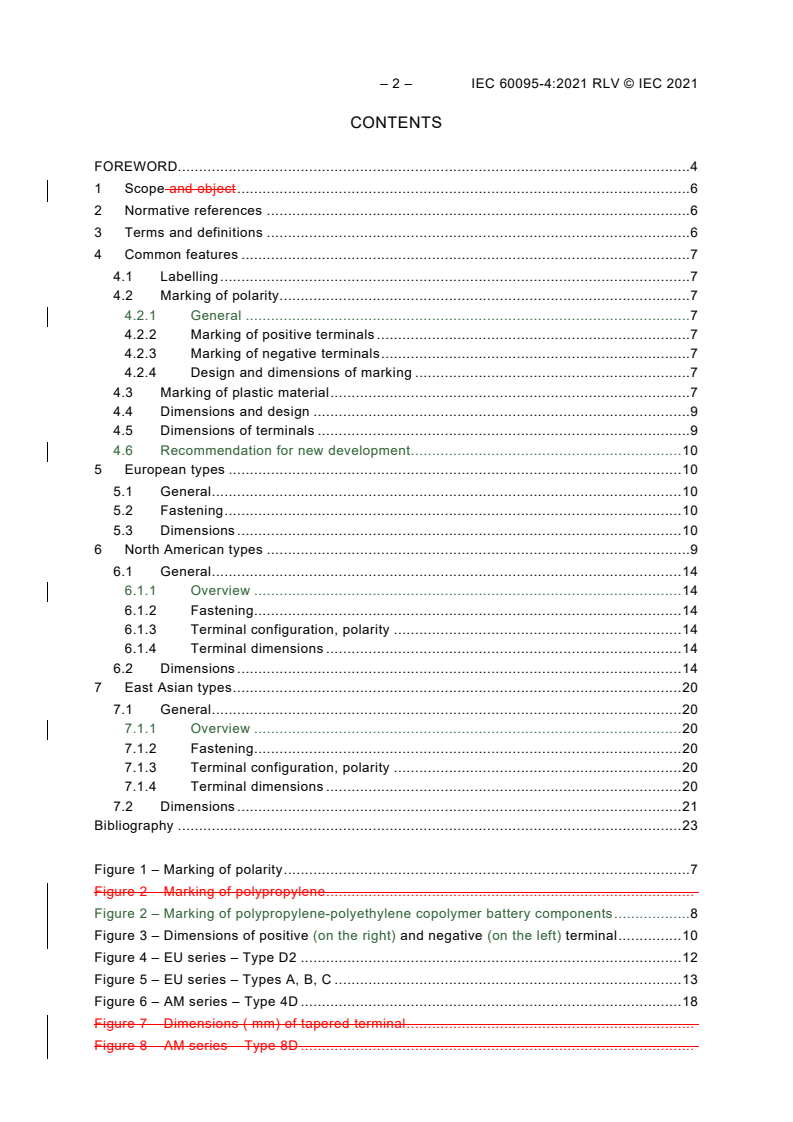
– 2 – IEC 60095-4:2021 © IEC 2021
CONTENTS
FOREWORD. 4
1 Scope . 6
2 Normative references . 6
3 Terms and definitions . 6
4 Common features . 7
4.1 Labelling . 7
4.2 Marking of polarity . 7
4.2.1 General . 7
4.2.2 Marking of positive terminals . 7
4.2.3 Marking of negative terminals . 7
4.2.4 Design and dimensions of marking . 7
4.3 Marking of plastic material . 7
4.4 Dimensions and design . 8
4.5 Dimensions of terminals . 8
4.6 Recommendation for new development . 9
5 European types . 9
5.1 General . 9
5.2 Fastening . 9
5.3 Dimensions . 9
6 North American types . 11
6.1 General . 11
6.1.1 Overview . 11
6.1.2 Fastening . 11
6.1.3 Terminal configuration, polarity . 11
6.1.4 Terminal dimensions . 11
6.2 Dimensions . 12
7 East Asian types . 15
7.1 General . 15
7.1.1 Overview . 15
7.1.2 Fastening . 15
7.1.3 Terminal configuration, polarity . 15
7.1.4 Terminal dimensions . 15
7.2 Dimensions . 15
Bibliography . 17
Figure 1 – Marking of polarity . 7
Figure 2 – Marking of polypropylene-polyethylene copolymer battery components . 8
Figure 3 – Dimensions of positive (on the right) and negative (on the left) terminal . 9
Figure 4 – EU series – Type D2 . 10
Figure 5 – EU series – Types A, B, C . 11
Figure 6 – AM series – Type 4D . 12
Figure 7 – AM series – Type 8D . 13
Figure 8 – AM series – Type 31T. 13
Figure 9 – Dimensions of stud terminal . 14
Figure 10 – AM series – Type 31A . 14
Figure 11 – AS series – Type E 41 . 16
Figure 12 – AS series – Types F51, G51 and H52 . 16
Table 1 – EU series – Dimensions of batteries . 10
Table 2 – AM series – Dimensions of batteries . 12
Table 3 – AS series – Dimensions of batteries . 15
– 4 – IEC 60095-4:2021 © IEC 2021
INTERNATIONAL ELECTROTECHNICAL COMMISSION
____________
LEAD-ACID STARTER BATTERIES –
Part 4: Dimensions of batteries for heavy vehicles
FOREWORD
1) The International Electrotechnical Commission (IEC) is a worldwide organization for standardization comprising
all national electrotechnical committees (IEC National Committees). The object of IEC is to promote
international co-operation on all questions concerning standardization in the electrical and electronic fields. To
this end and in addition to other activities, IEC publishes International Standards, Technical Specifications,
Technical Reports, Publicly Available Specifications (PAS) and Guides (hereafter referred to as "IEC
Publication(s)"). Their preparation is entrusted to technical committees; any IEC National Committee interested
in the subject dealt with may participate in this preparatory work. International, governmental and non-
governmental organizations liaising with the IEC also participate in this preparation. IEC collaborates closely
with the International Organization for Standardization (ISO) in accordance with conditions determined by
agreement between the two organizations.
2) The formal decisions or agreements of IEC on technical matters express, as nearly as possible, an international
consensus of opinion on the relevant subjects since each technical committee has representation from all
interested IEC National Committees.
3) IEC Publications have the form of recommendations for international use and are accepted by IEC National
Committees in that sense. While all reasonable efforts are made to ensure that the technical content of IEC
Publications is accurate, IEC cannot be held responsible for the way in which they are used or for any
misinterpretation by any end user.
4) In order to promote international uniformity, IEC National Committees undertake to apply IEC Publications
transparently to the maximum extent possible in their national and regional publications. Any divergence
between any IEC Publication and the corresponding national or regional publication shall be clearly indicated in
the latter.
5) IEC itself does not provide any attestation of conformity. Independent certification bodies provide conformity
assessment services and, in some areas, access to IEC marks of conformity. IEC is not responsible for any
services carried out by independent certification bodies.
6) All users should ensure that they have the latest edition of this publication.
7) No liability shall attach to IEC or its directors, employees, servants or agents including individual experts and
members of its technical committees and IEC National Committees for any personal injury, property damage or
other damage of any nature whatsoever, whether direct or indirect, or for costs (including legal fees) and
expenses arising out of the publication, use of, or reliance upon, this IEC Publication or any other IEC
Publications.
8) Attention is drawn to the Normative references cited in this publication. Use of the referenced publications is
indispensable for the correct application of this publication.
9) Attention is drawn to the possibility that some of the elements of this IEC Publication may be the subject of
patent rights. IEC shall not be held responsible for identifying any or all such patent rights.
International Standard IEC 60095-4 has been prepared by IEC technical committee 21:
Secondary cells and batteries.
This third edition
...
IEC 60095-4 ®
Edition 3.0 2021-07
REDLINE VERSION
INTERNATIONAL
STANDARD
colour
inside
Lead-acid starter batteries –
Part 4: Dimensions of batteries for heavy vehicles
All rights reserved. Unless otherwise specified, no part of this publication may be reproduced or utilized in any form
or by any means, electronic or mechanical, including photocopying and microfilm, without permission in writing from
either IEC or IEC's member National Committee in the country of the requester. If you have any questions about IEC
copyright or have an enquiry about obtaining additional rights to this publication, please contact the address below or
your local IEC member National Committee for further information.
IEC Central Office Tel.: +41 22 919 02 11
3, rue de Varembé info@iec.ch
CH-1211 Geneva 20 www.iec.ch
Switzerland
About the IEC
The International Electrotechnical Commission (IEC) is the leading global organization that prepares and publishes
International Standards for all electrical, electronic and related technologies.
About IEC publications
The technical content of IEC publications is kept under constant review by the IEC. Please make sure that you have the
latest edition, a corrigendum or an amendment might have been published.
IEC publications search - webstore.iec.ch/advsearchform IEC online collection - oc.iec.ch
The advanced search enables to find IEC publications by a Discover our powerful search engine and read freely all the
variety of criteria (reference number, text, technical publications previews. With a subscription you will always
committee, …). It also gives information on projects, replaced have access to up to date content tailored to your needs.
and withdrawn publications.
Electropedia - www.electropedia.org
IEC Just Published - webstore.iec.ch/justpublished
The world's leading online dictionary on electrotechnology,
Stay up to date on all new IEC publications. Just Published
containing more than 22 000 terminological entries in English
details all new publications released. Available online and
and French, with equivalent terms in 18 additional languages.
once a month by email.
Also known as the International Electrotechnical Vocabulary
(IEV) online.
IEC Customer Service Centre - webstore.iec.ch/csc
If you wish to give us your feedback on this publication or
need further assistance, please contact the Customer Service
Centre: sales@iec.ch.
IEC 60095-4 ®
Edition 3.0 2021-07
REDLINE VERSION
INTERNATIONAL
STANDARD
colour
inside
Lead-acid starter batteries –
Part 4: Dimensions of batteries for heavy vehicles
INTERNATIONAL
ELECTROTECHNICAL
COMMISSION
ICS 29.220.20; 43.040.10 ISBN 978-2-8322-4034-2
– 2 – IEC 60095-4:2021 RLV © IEC 2021
CONTENTS
FOREWORD. 4
1 Scope and object . 6
2 Normative references . 6
3 Terms and definitions . 6
4 Common features . 7
4.1 Labelling . 7
4.2 Marking of polarity . 7
4.2.1 General . 7
4.2.2 Marking of positive terminals . 7
4.2.3 Marking of negative terminals . 7
4.2.4 Design and dimensions of marking . 7
4.3 Marking of plastic material . 7
4.4 Dimensions and design . 9
4.5 Dimensions of terminals . 9
4.6 Recommendation for new development . 10
5 European types . 10
5.1 General . 10
5.2 Fastening . 10
5.3 Dimensions . 10
6 North American types . 9
6.1 General . 14
6.1.1 Overview . 14
6.1.2 Fastening . 14
6.1.3 Terminal configuration, polarity . 14
6.1.4 Terminal dimensions . 14
6.2 Dimensions . 14
7 East Asian types . 20
7.1 General . 20
7.1.1 Overview . 20
7.1.2 Fastening . 20
7.1.3 Terminal configuration, polarity . 20
7.1.4 Terminal dimensions . 20
7.2 Dimensions . 21
Bibliography . 23
Figure 1 – Marking of polarity . 7
Figure 2 – Marking of polypropylene .
Figure 2 – Marking of polypropylene-polyethylene copolymer battery components . 8
Figure 3 – Dimensions of positive (on the right) and negative (on the left) terminal . 10
Figure 4 – EU series – Type D2 . 12
Figure 5 – EU series – Types A, B, C . 13
Figure 6 – AM series – Type 4D . 18
Figure 7 – Dimensions ( mm) of tapered terminal .
Figure 8 – AM series – Type 8D .
Figure 9 – AM series – Type 31T.
Figure 10 – Dimensions of stud terminal .
Figure 11 – AM series – Type 31A .
Figure 12 – Dimensions (mm) of tapered terminal .
Figure 7 – AM series – Type 8D . 18
Figure 8 – AM series – Type 31T. 19
Figure 9 – Dimensions of stud terminal . 19
Figure 10 – AM series – Type 31A . 20
Figure 11 – AS series – Type E 41 . 22
Figure 12 – AS series – Types F51, G51 and H52 . 22
Table 1 – EU series – Dimensions of batteries . 11
Table 2 – AM series – Dimensions of batteries . 14
Table 3 – Dimensions of tapered terminal .
Table 3 – AS series – Dimensions of batteries . 21
– 4 – IEC 60095-4:2021 RLV © IEC 2021
INTERNATIONAL ELECTROTECHNICAL COMMISSION
____________
LEAD-ACID STARTER BATTERIES –
Part 4: Dimensions of batteries for heavy vehicles
FOREWORD
1) The International Electrotechnical Commission (IEC) is a worldwide organization for standardization comprising
all national electrotechnical committees (IEC National Committees). The object of IEC is to promote
international co-operation on all questions concerning standardization in the electrical and electronic fields. To
this end and in addition to other activities, IEC publishes International Standards, Technical Specifications,
Technical Reports, Publicly Available Specifications (PAS) and Guides (hereafter referred to as "IEC
Publication(s)"). Their preparation is entrusted to technical committees; any IEC National Committee interested
in the subject dealt with may participate in this preparatory work. International, governmental and non-
governmental organizations liaising with the IEC also participate in this preparation. IEC collaborates closely
with the International Organization for Standardization (ISO) in accordance with conditions determined by
agreement between the two organizations.
2) The formal decisions or agreements of IEC on technical matters express, as nearly as possible, an international
consensus of opinion on the relevant subjects since each technical committee has representation from all
interested IEC National Committees.
3) IEC Publications have the form of recommendations for international use and are accepted by IEC National
Committees in that sense. While all reasonable efforts are made to ensure that the technical content of IEC
Publications is accurate, IEC cannot be held responsible for the way in which they are used or for any
misinterpretation by any end user.
4) In order to promote international uniformity, IEC National Committees undertake to apply IEC Publications
transparently to the maximum extent possible in their national and regional publications. Any divergence
between any IEC Publication and the corresponding national or regional publication shall be clearly indicated in
the latter.
5) IEC itself does not provide any attestation of conformity. Independent certification bodies provide conformity
assessment services and, in some areas, access to IEC marks of conformity. IEC is not responsible for any
services carried out by independent certification bodies.
6) All users should ensure that they have the latest edition of this publication.
7) No liability shall attach to IEC or its directors, employees, servants or agents including individual experts and
members of its technical committees and IEC National Committees for any personal injury, property damage or
other damage of any nature whatsoever, whether direct or indirect, or for costs (including legal fees) and
expenses arising out of the publication, use of, or reliance upon, this IEC Publication or any other IEC
Publications.
8) Attention is drawn to the Normative references cited in this publication. Use of the referenced publications is
indispensable for the correct application of this publication.
9) Attention is drawn to the possibility that some of the elements of this IEC Publication may be the subject of
patent rights. IEC shall not be held responsible for identifying any or all such patent rights.
This redline version of the official IEC Standard allows the user to identify the changes made to
the previous edition IEC 60095-4:2008. A vertical bar appears in the margin wherever a change
has been made. Additions are in green text, deletions are in strikethrough red text.
International Standard IEC 60095-4 has been prepared by IEC technical committee 21:
Secondary cells and batteries.
This third edition cancels and replaces the second edition published in 2008. This edition
constitutes a technical revision.
This edition includes the following significant technical changes with respect to the previous
edition:
a) values of "tolerance", in particular for European batteries;
b) update of figures for USA and Asian batteries.
The text of this International Standard is based on the following documents:
FDIS Report on voting
21/1087/FDIS 21/1091/RVD
Full information on the voting for its approval can be found in the report on voting indicated in
the above table.
The language used for the development of this International Standard is English.
This document was drafted in accordance with ISO/IEC Directives, Part 2, and developed in
accordance with ISO/IEC Directives, Part 1 and ISO/IEC Directives, IEC Supplement,
available at www.iec.ch/members_experts/refdocs. The main document types developed by
IEC are described in greater detail at www.iec.ch/standardsdev/publications.
A list of all parts in the IEC 60095 series, published under the general title Lead-acid starter
batteries, can be found on the IEC website.
The committee has decided that the contents of this document will remain unchanged until the
stability date indicated on the IEC website under webstore.iec.ch in the data related to the
specific document. At this date, the document will be
• reconfirmed,
• withdrawn,
• replaced by a revised edition, or
• amended.
IMPORTANT – The 'colour inside' logo on the cover page of this publication indicates that it
contains colours which are considered to be useful for the correct understanding of its
contents. Users should therefore print this document using a colour printer.
– 6 – IEC 60095-4:2021 RLV © IEC 2021
LEAD-ACID STARTER BATTERIES –
Part 4: Dimensions of batteries for heavy vehicles
1 Scope and object
This part of IEC 60095 is applicable to lead-acid batteries used for starting, lighting and
ignition of heavy trucks, commercial vehicles, busses and agricultural trucks.
The object of this document is to specify global requirements of the main dimensions of
starter batteries for Europe, North America and East Asia.
This document comprises 12 types of "preferred types" of batteries.
This document specifies dimensions of 4 types of batteries each for Europe (types A, B, C
and D2), North America (types 4D, 8D, 31T, 31A) and East Asia (types E41, F51, G51, H52).
2 Normative references
The following documents are referred to in the text in such a way that some or all of their
content constitutes requirements of this document. For dated references, only the edition
cited applies. For undated references, the latest edition of the referenced document (including
any amendments) applies.
IEC 60050-482:2004, International Electrotechnical Vocabulary – Part 482: Primary and
secondary cells and batteries
IEC 60095-1, Lead-acid starter batteries – Part 1: General requirements and methods of test
IEC 60417:2002, Graphical symbols for use on equipment
ISO/IEC 10646, Information technology – Universal coded character set (UCS)
ISO 1043-1, Plastics – Symbols and abbreviated terms – Part 1: Basic polymers and their
special characteristics
ISO 7000, Graphical symbols for use on equipment – Index and synopsis
ISO 11469, Plastics – Generic identification and marking of plastics products
3 Terms and definitions
For the purposes of this document, the terms and definitions given in IEC 60050-482 apply.
ISO and IEC maintain terminological databases for use in standardization at the following
addresses:
• IEC Electropedia: available at http://www.electropedia.org/
• ISO Online browsing platform: available at http://www.iso.org/obp
4 Common features
4.1 Labelling
The batteries shall be marked in accordance with IEC 60095-1.
4.2 Marking of polarity
4.2.1 General
The batteries shall carry the marking of polarity, at least of the positive terminal.
4.2.2 Marking of positive terminals
This marking shall take the form of the symbol ‘+’ either on the upper surface of the positive
terminal or on the lid adjacent to the positive terminal.
4.2.3 Marking of negative terminals
If the negative polarity is also marked, the marking shall take the form of the symbol ‘–’, either
on the upper surface of the negative terminal or on the lid adjacent to the negative terminal.
NOTE As an alternative, the wording "POS" and "NEG" is permitted for the North American
market only.
4.2.4 Design and dimensions of marking
The symbols used for marking the terminals shall be in accordance with
IEC 60417-5005:2012-10 for the positive polarity and IEC 60417-5006:2012-10 for the
negative polarity. Suggested dimensions are shown in Figure 1.
10 10
2 2
IEC 221/08
Permissible are 0,3 mm – 0,5 mm, indented or relief.
The dimensions of the marking shall be according to Figure 1.
The polarity symbols may be either indented or embossed by 0,4 mm ± 0,1 mm.
Dimensions in millimetres
Figure 1 – Marking of polarity
– 8 – IEC 60095-4:2021 RLV © IEC 2021
4.3 Marking of plastic material
Batteries are universally marked to identify the plastic material. Various marking schemes
exist around the world in line with local regulations. However all schemes identify the plastic
material by embossing or indenting it into the battery housing. The material content shall be in
accordance with ISO 1043-1.
”PP/PE“ or ”PP“ is used as the marking for types of plastic materials.
Some materials also include the recycling symbol (ISO 7000-1135) as shown in Figure 2.
Figure 2 – Marking of polypropylene
Injection moulded battery components need to be marked according to ISO 11469 and
ISO 1043‑1. The marking shall be placed on the bottom of the battery container or on one
short side near the ledge.
According to ISO 11469 and ISO 1043-1 the minimum marking for polypropylene-polyethylene
copolymer is >PP< or >PP/PE<.
In addition, it is possible to show the recycling symbol with number 7 (Unicode character
'RECYCLING SYMBOL FOR TYPE-7 PLASTICS' (U+2679) according to ISO/IEC 10646) and
the term "Other".
The recommended thickness is (0,3 ± 0,1) mm. The height of the marking characters shall be
between 5 mm and 7 mm.
An example for this marking is shown in Figure 2.
Figure 2 – Marking of polypropylene-polyethylene copolymer battery components
Producers are encouraged to consult the regulations of the target market.
It is permissible to use the number coding 7 or 07 for PP/PE and the addition of "other" to
cover additives to the plastic material.
4.4 Dimensions and design
All dimensions are in millimetres and sometime also in inches when mentioned in brackets.
Details of the design that are not indicated in the generic drawings have to be chosen
appropriately. The illustrations in this document, especially those of the design of the lids,
handles, ribs, ledges, vent caps and their locations are not mandatory.
4.5 Dimensions of terminals
The dimensions of the tapered positive and negative terminal shall be according to Figure 3.
Dimensions in millimetres
Convex or concave design
+1
permitted within height dimension of 18
−2
Edge with radius Edge with radius
R ≥2,5 R ≥2,5
0 0
∅19,5 ∅17,9
−0,3
−0,3
∅28 ± 1 ∅28 ± 1
IEC 222/08
The dimensions describing the base of the terminal are given as a recommendation and are
not mandatory.
(1:9) ± 0,01
+0,5
3,5 18 ± 1
−1
(1:9) ± 0,01
+0,5
3,5
18 ± 1
−1
– 10 – IEC 60095-4:2021 RLV © IEC 2021
Key
1 Edge with radius
+1
2 Convex or concave surface design permitted within height dimensions of (18 ) mm related to the centre of
-2
the terminal
Figure 3 – Dimensions of positive (on the right) and negative (on the left) terminal
4.6 Recommendation for new development
For future new developments of heavy vehicles, it is strongly recommended to use only
batteries from this document.
Several other types of batteries exist under the standards of national or regional
organisations. They are not included in this International Standard.
5 European types
5.1 General
This applies to the series of lead-acid starter batteries for heavy trucks, widely and
predominantly used in Europe. In the following, the series is designated as "EU". The EU
series comprises four types.
5.2 Fastening
All types are intended for fastening by the upper part of the battery only.
This fastening shall be realized at a level defined by the dimension "h " in the figures. The
configuration shall permit the fitting of an angle-iron frame, both legs of which are 20 mm
wide, for the major part of the lid’s four sides.
5.1.2 Terminal configurations, polarity
The terminal configuration and polarity shall be as shown in Figures 4 and 5.
5.3 Dimensions
The main dimensions are represented by symbols, as indicated in Figure 4 and Figure 5. The
dimensions according to the symbols shall be in accordance with Table 1.
Table 1 – EU series – Dimensions of batteries
Dimensions in millimetres
Type Length Width Height
l l l b b h
l b h
1 2 3 1 2 1
+4
+0 +0 +0 +0 +0
D2 -- -- 162 --
349 344 175 235 213
−4
−5 -8 −4 −4 −4
+4
+0 +0 +2 +2 +0 +1 +0
A 200 223 max
513 475 482 188 178 86 195
−4
−4 −3 −2 −2 −2 −1 −3
+4
+0 +0 +2 +2 +0 +1 +0
B 513 475 482 222 210 102 223 max 195
−4 −3 −2 −4 −2 −2 −1 −3
+4
+0 +0 +4 +2 +0 +1 +0
C 200 242 max
518 475 482 274 265 130 216
−8 −3 −2 −4 −2 −2 −1 −3
NOTE The length, width and height symbols refer to Figure 4 and Figure 5.
– 12 – IEC 60095-4:2021 RLV © IEC 2021
I b
I b
1 1
IEC 223/08
Figure 4 – EU series – Type D2
h
h
b
I b
I b
1 1
I
I
IEC 224/08
Figure 5 – EU series – Types A, B, C
h
h
– 14 – IEC 60095-4:2021 RLV © IEC 2021
6 North American types
6.1 General
6.1.1 Overview
This applies to the series of lead-acid starter batteries for heavy trucks, widely and
predominantly used in North America. In the following, the series is designated as "AM". The
AM series comprises four types.
6.1.2 Fastening
All of these batteries are intended for fastening to the vehicles by means of a hold-down
device engaging with the upper part of the battery (for example a metal frame), connected to
the support platform.
6.1.3 Terminal configuration, polarity
The types of the AM series have terminal configurations as shown in the battery drawings
(Figures 6, 8, 9 and 11) in Figure 6, Figure 7, Figure 8 and Figure 10. The polarity shall be as
shown in the figures.
6.1.4 Terminal dimensions
The dimensions are shown in Figures 7 and 10 Figure 3 and Figure 9.
6.2 Dimensions
The main dimensions are represented by symbols as indicated in Figures 6,8, 9 and 11
Figure 6, Figure 7, Figure 8 and Figure 10. The dimensions according to the symbols shall be
typically are in accordance with Table 2.
Table 2 – AM series – Dimensions of batteries
Dimensions in millimetres
Type Length (overall) Width Height
l b h h
+0 +0 +0 +0
4D 222
527 230 250
−4 −4 −4 −4
+0 +0 +0 +0
8D
527 283 230 250
−4 −4 −4 −4
+0 +0 +0 +0
31T
330 173 219 240
−4 −4 −4 −4
+0 +0 +0 +0
31A
330 173 219 240
−4 −4 −4 −4
I b
IEC 225/08
Figure 6 – AM series – Type 4D
Dimensions in millimetres
∅17,50 ± 0,20 (+)
R perm.
∅15,90 ± 0,20 (−)
∅19,10 ± 0,20 (+)
∅17,50 ± 0,20 (−)
Terminal post dimensions 1:9 taper ref.
IEC 226/08
Figure 7 – Dimensions (mm) of tapered terminal
h
h
1,52 ± 0,10 1
15,90 ± 0,10
18,60 ± 1,40
– 16 – IEC 60095-4:2021 RLV © IEC 2
...