


IEC TS 62850:2013
(Main)Safety requirements for electrical equipment for measurement, control, and laboratory use - General requirements for equipment intended to be used in educational establishments by children
General Information
- Abstract
IEC/TS 62850:2013 specifies general safety requirements for the following types of equipment and their accessories intended to be used in educational establishments by persons between the age of 3 years and the age of 16 years under the supervision of the RESPONSIBLE BODY. If all or part of the equipment falls within the scope of one or more part 2 standards of IEC 61010 as well as within the scope of this technical specification, it will also need to meet the requirements of those other part 2 standards.
- Status
- Replaced
- Publication Date
- 21-Feb-2013
- Technical Committee
- TC 66 - Safety of measuring, control and laboratory equipment
- Drafting Committee
- WG 1 - TC 66/WG 1
- Current Stage
- DELPUB - Deleted Publication
- Start Date
- 23-Mar-2021
- Completion Date
- 30-Nov-2018
Buy Documents
IEC TS 62850:2013 - Safety requirements for electrical equipment for measurement, control, and laboratory use - General requirements for equipment intended to be used in educational establishments by children
IEC TS 62850:2013 - Safety requirements for electrical equipment for measurement, control, and laboratory use - General requirements for equipment intended to be used in educational establishments by children Released:2/22/2013
Relations
- Effective Date
- 05-Sep-2023
Buy Documents
IEC TS 62850:2013 - Safety requirements for electrical equipment for measurement, control, and laboratory use - General requirements for equipment intended to be used in educational establishments by children
IEC TS 62850:2013 - Safety requirements for electrical equipment for measurement, control, and laboratory use - General requirements for equipment intended to be used in educational establishments by children Released:2/22/2013
Get Certified
Connect with accredited certification bodies for this standard

IMP NDT d.o.o.
Non-destructive testing services. Radiography, ultrasonic, magnetic particle, penetrant, visual inspection.
Inštitut za kovinske materiale in tehnologije
Institute of Metals and Technology. Materials testing, metallurgical analysis, NDT.
Q Techna d.o.o.
NDT and quality assurance specialist. 30+ years experience. NDT personnel certification per ISO 9712, nuclear and thermal power plant inspections, QA/
Sponsored listings
Frequently Asked Questions
IEC TS 62850:2013 is a technical specification published by the International Electrotechnical Commission (IEC). Its full title is "Safety requirements for electrical equipment for measurement, control, and laboratory use - General requirements for equipment intended to be used in educational establishments by children". This standard covers: IEC/TS 62850:2013 specifies general safety requirements for the following types of equipment and their accessories intended to be used in educational establishments by persons between the age of 3 years and the age of 16 years under the supervision of the RESPONSIBLE BODY. If all or part of the equipment falls within the scope of one or more part 2 standards of IEC 61010 as well as within the scope of this technical specification, it will also need to meet the requirements of those other part 2 standards.
IEC/TS 62850:2013 specifies general safety requirements for the following types of equipment and their accessories intended to be used in educational establishments by persons between the age of 3 years and the age of 16 years under the supervision of the RESPONSIBLE BODY. If all or part of the equipment falls within the scope of one or more part 2 standards of IEC 61010 as well as within the scope of this technical specification, it will also need to meet the requirements of those other part 2 standards.
IEC TS 62850:2013 is classified under the following ICS (International Classification for Standards) categories: 19.080 - Electrical and electronic testing. The ICS classification helps identify the subject area and facilitates finding related standards.
IEC TS 62850:2013 has the following relationships with other standards: It is inter standard links to IEC 61010-2-130:2021. Understanding these relationships helps ensure you are using the most current and applicable version of the standard.
IEC TS 62850:2013 is available in PDF format for immediate download after purchase. The document can be added to your cart and obtained through the secure checkout process. Digital delivery ensures instant access to the complete standard document.
Standards Content (Sample)
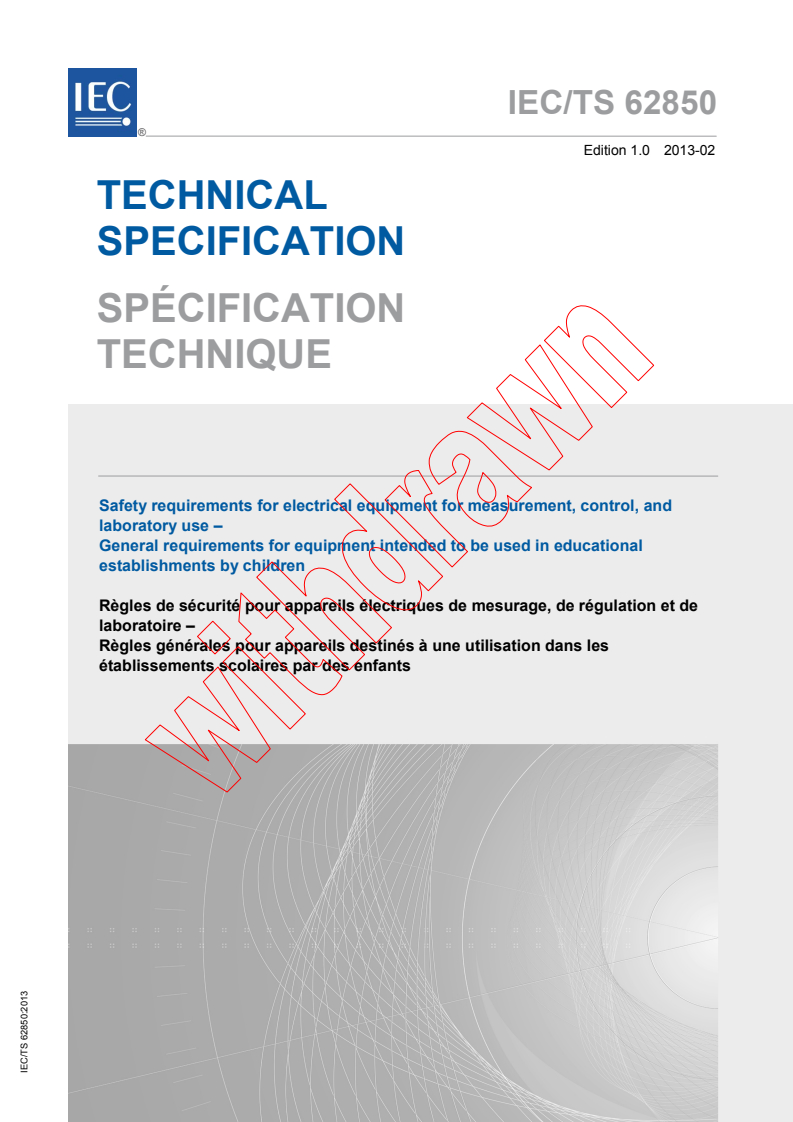
IEC/TS 62850 ®
Edition 1.0 2013-02
TECHNICAL
SPECIFICATION
SPÉCIFICATION
TECHNIQUE
Safety requirements for electrical equipment for measurement, control, and
laboratory use –
General requirements for equipment intended to be used in educational
establishments by children
Règles de sécurité pour appareils électriques de mesurage, de régulation et de
laboratoire –
Règles générales pour appareils destinés à une utilisation dans les
établissements scolaires par des enfants
IEC/TS 62850:2013
All rights reserved. Unless otherwise specified, no part of this publication may be reproduced or utilized in any form
or by any means, electronic or mechanical, including photocopying and microfilm, without permission in writing from
either IEC or IEC's member National Committee in the country of the requester.
If you have any questions about IEC copyright or have an enquiry about obtaining additional rights to this publication,
please contact the address below or your local IEC member National Committee for further information.
Droits de reproduction réservés. Sauf indication contraire, aucune partie de cette publication ne peut être reproduite ni
utilisée sous quelque forme que ce soit et par aucun procédé, électronique ou mécanique, y compris la photocopie et les
microfilms, sans l'accord écrit de la CEI ou du Comité national de la CEI du pays du demandeur.
Si vous avez des questions sur le copyright de la CEI ou si vous désirez obtenir des droits supplémentaires sur cette
publication, utilisez les coordonnées ci-après ou contactez le Comité national de la CEI de votre pays de résidence.
IEC Central Office Tel.: +41 22 919 02 11
3, rue de Varembé Fax: +41 22 919 03 00
CH-1211 Geneva 20 info@iec.ch
Switzerland www.iec.ch
About the IEC
The International Electrotechnical Commission (IEC) is the leading global organization that prepares and publishes
International Standards for all electrical, electronic and related technologies.
About IEC publications
The technical content of IEC publications is kept under constant review by the IEC. Please make sure that you have the
latest edition, a corrigenda or an amendment might have been published.
Useful links:
IEC publications search - www.iec.ch/searchpub Electropedia - www.electropedia.org
The advanced search enables you to find IEC publications The world's leading online dictionary of electronic and
by a variety of criteria (reference number, text, technical electrical terms containing more than 30 000 terms and
committee,…). definitions in English and French, with equivalent terms in
It also gives information on projects, replaced and additional languages. Also known as the International
withdrawn publications. Electrotechnical Vocabulary (IEV) on-line.
IEC Just Published - webstore.iec.ch/justpublished Customer Service Centre - webstore.iec.ch/csc
Stay up to date on all new IEC publications. Just Published If you wish to give us your feedback on this publication
details all new publications released. Available on-line and or need further assistance, please contact the
also once a month by email. Customer Service Centre: csc@iec.ch.
A propos de la CEI
La Commission Electrotechnique Internationale (CEI) est la première organisation mondiale qui élabore et publie des
Normes internationales pour tout ce qui a trait à l'électricité, à l'électronique et aux technologies apparentées.
A propos des publications CEI
Le contenu technique des publications de la CEI est constamment revu. Veuillez vous assurer que vous possédez
l’édition la plus récente, un corrigendum ou amendement peut avoir été publié.
Liens utiles:
Recherche de publications CEI - www.iec.ch/searchpub Electropedia - www.electropedia.org
La recherche avancée vous permet de trouver des Le premier dictionnaire en ligne au monde de termes
publications CEI en utilisant différents critères (numéro de électroniques et électriques. Il contient plus de 30 000
référence, texte, comité d’études,…). termes et définitions en anglais et en français, ainsi que
Elle donne aussi des informations sur les projets et les les termes équivalents dans les langues additionnelles.
publications remplacées ou retirées. Egalement appelé Vocabulaire Electrotechnique
International (VEI) en ligne.
Just Published CEI - webstore.iec.ch/justpublished
Service Clients - webstore.iec.ch/csc
Restez informé sur les nouvelles publications de la CEI.
Just Published détaille les nouvelles publications parues. Si vous désirez nous donner des commentaires sur
Disponible en ligne et aussi une fois par mois par email. cette publication ou si vous avez des questions
contactez-nous: csc@iec.ch.
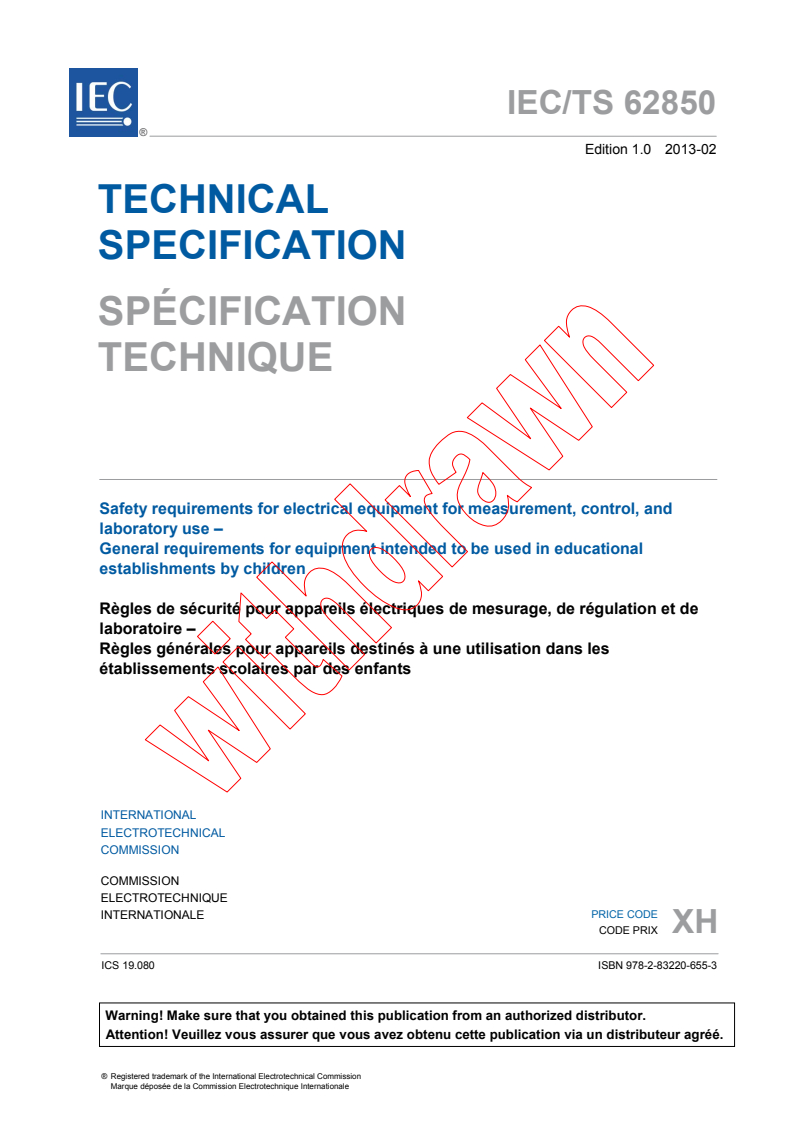
IEC/TS 62850 ®
Edition 1.0 2013-02
TECHNICAL
SPECIFICATION
SPÉCIFICATION
TECHNIQUE
Safety requirements for electrical equipment for measurement, control, and
laboratory use –
General requirements for equipment intended to be used in educational
establishments by children
Règles de sécurité pour appareils électriques de mesurage, de régulation et de
laboratoire –
Règles générales pour appareils destinés à une utilisation dans les
établissements scolaires par des enfants
INTERNATIONAL
ELECTROTECHNICAL
COMMISSION
COMMISSION
ELECTROTECHNIQUE
PRICE CODE
INTERNATIONALE
CODE PRIX XH
ICS 19.080 ISBN 978-2-83220-655-3
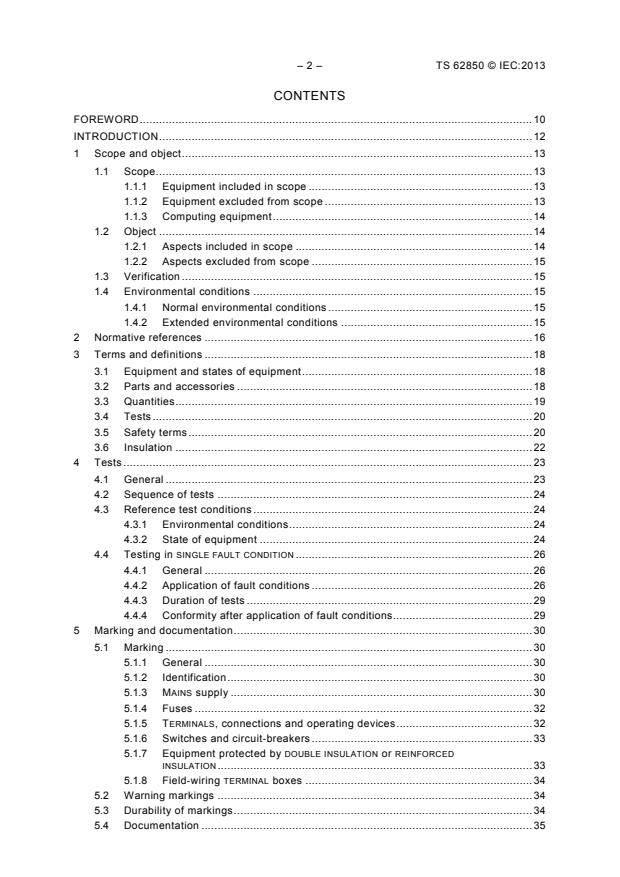
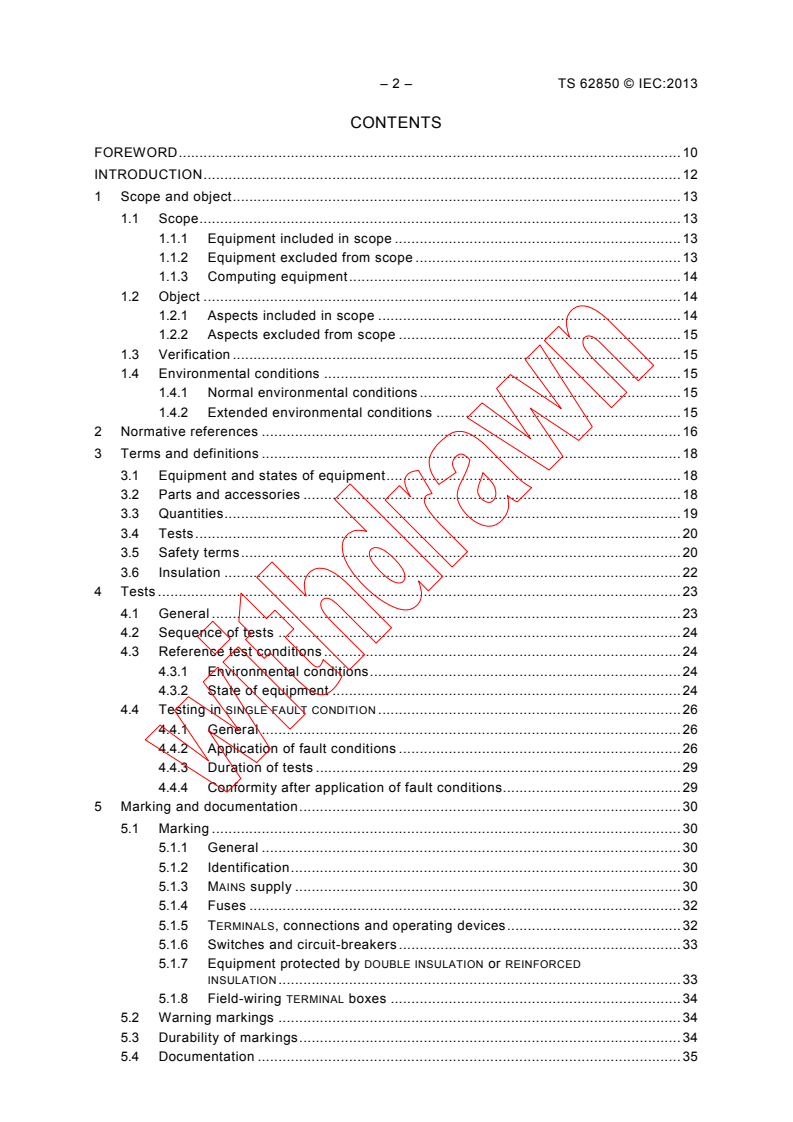
– 2 – TS 62850 © IEC:2013
CONTENTS
FOREWORD . 10
INTRODUCTION . 12
1 Scope and object . 13
1.1 Scope . 13
1.1.1 Equipment included in scope . 13
1.1.2 Equipment excluded from scope . 13
1.1.3 Computing equipment . 14
1.2 Object . 14
1.2.1 Aspects included in scope . 14
1.2.2 Aspects excluded from scope . 15
1.3 Verification . 15
1.4 Environmental conditions . 15
1.4.1 Normal environmental conditions . 15
1.4.2 Extended environmental conditions . 15
2 Normative references . 16
3 Terms and definitions . 18
3.1 Equipment and states of equipment . 18
3.2 Parts and accessories . 18
3.3 Quantities . 19
3.4 Tests . 20
3.5 Safety terms . 20
3.6 Insulation . 22
4 Tests . 23
4.1 General . 23
4.2 Sequence of tests . 24
4.3 Reference test conditions . 24
4.3.1 Environmental conditions . 24
4.3.2 State of equipment . 24
4.4 Testing in SINGLE FAULT CONDITION . 26
4.4.1 General . 26
4.4.2 Application of fault conditions . 26
4.4.3 Duration of tests . 29
4.4.4 Conformity after application of fault conditions. 29
5 Marking and documentation . 30
5.1 Marking . 30
5.1.1 General . 30
5.1.2 Identification . 30
5.1.3 MAINS supply . 30
5.1.4 Fuses . 32
5.1.5 TERMINALS, connections and operating devices . 32
5.1.6 Switches and circuit-breakers . 33
5.1.7 Equipment protected by DOUBLE INSULATION or REINFORCED
INSULATION . 33
5.1.8 Field-wiring TERMINAL boxes . 34
5.2 Warning markings . 34
5.3 Durability of markings . 34
5.4 Documentation . 35
TS 62850 © IEC:2013 – 3 –
5.4.1 General . 35
5.4.2 Equipment RATINGS . 35
5.4.3 Equipment installation . 36
5.4.4 Equipment operation. 36
5.4.5 Equipment maintenance and service . 37
5.4.6 Integration into systems or effects resulting from special conditions . 37
6 Protection against electric shock . 38
6.1 General . 38
6.1.1 Requirements . 38
6.1.2 Exceptions . 38
6.2 Determination of ACCESSIBLE parts . 38
6.2.1 General . 38
6.2.2 Examination . 39
6.2.3 Not used Openings above parts that are HAZARDOUS LIVE . 39
6.2.4 Not used Openings for pre-set controls . 39
6.2.5 Additional determination for all openings except TERMINALS . 40
6.3 Limit values for ACCESSIBLE parts. 40
6.3.1 Levels in NORMAL CONDITION . 40
6.3.2 Levels in SINGLE FAULT CONDITION. 40
6.4 Primary means of protection . 43
6.4.1 General . 43
6.4.2 ENCLOSURES and PROTECTIVE BARRIERS. 43
6.4.3 BASIC INSULATION . 43
6.4.4 Impedance. 43
6.5 Additional means of protection in case of SINGLE FAULT CONDITIONS . 43
6.5.1 General . 43
6.5.2 PROTECTIVE BONDING . 44
6.5.3 SUPPLEMENTARY INSULATION and REINFORCED INSULATION . 47
6.5.4 PROTECTIVE IMPEDANCE . 47
6.5.5 Automatic disconnection of the supply . 48
6.5.6 Current- or voltage-limiting device . 48
6.6 Connections to external circuits . 48
6.6.1 General . 48
6.6.2 TERMINALS for external circuits . 49
6.6.3 Circuits with TERMINALS which are HAZARDOUS LIVE . 49
6.6.4 TERMINALS for stranded conductors . 49
6.7 Insulation requirements . 50
6.7.1 The nature of insulation . 50
6.7.2 Insulation for MAINS CIRCUITS of OVERVOLTAGE CATEGORY II with a
nominal supply voltage up to 300 V . 52
6.7.3 Insulation for secondary circuits derived from MAINS CIRCUITS of
OVERVOLTAGE CATEGORY II up to 300 V . 56
6.8 Procedure for voltage tests . 61
6.8.1 General . 61
6.8.2 Humidity preconditioning . 62
6.8.3 Test procedures . 63
6.9 Constructional requirements for protection against electric shock . 63
6.9.1 General . 63
6.9.2 Insulating materials . 64
– 4 – TS 62850 © IEC:2013
6.9.3 Colour coding . 64
6.10 Connection to the MAINS supply source and connections between parts of
equipment . 64
6.10.1 MAINS supply cords . 64
6.10.2 Fitting of non-detachable MAINS supply cords . 65
6.10.3 Plugs and connectors . 67
6.11 Disconnection from supply source . 67
6.11.1 General . 67
6.11.2 Exceptions . 67
6.11.3 Requirements according to type of equipment . 67
6.11.4 Disconnecting devices . 68
7 Protection against mechanical HAZARDS . 69
7.1 General . 69
7.2 Sharp edges . 69
7.3 Moving parts . 69
7.3.1 General . 69
7.3.2 Exceptions . 69
7.3.3 RISK assessment for mechanical HAZARDS to body parts . 70
7.3.4 Limitation of force and pressure. 71
7.3.5 Gap limitations between moving parts . 71
7.4 Stability . 73
7.5 Provisions for lifting and carrying. 74
7.5.1 General . 74
7.5.2 Handles and grips. 74
7.5.3 Lifting devices and supporting parts . 74
7.6 Wall mounting . 75
7.7 Expelled parts . 75
8 Resistance to mechanical stresses . 75
8.1 General . 75
8.2 ENCLOSURE rigidity tests . 76
8.2.1 Static test . 76
8.2.2 Impact test . 77
8.3 Drop test . 78
8.3.1 Equipment other than HAND-HELD EQUIPMENT and DIRECT PLUG-IN
EQUIPMENT . 78
8.3.2 HAND-HELD EQUIPMENT and DIRECT PLUG-IN EQUIPMENT . 78
9 Protection against the spread of fire . 78
9.1 General . 78
9.2 Eliminating or reducing the sources of ignition within the equipment . 80
9.3 Containment of fire within the equipment, should it occur . 80
9.3.1 General . 80
9.3.2 Constructional requirements . 80
9.4 Limited-energy circuit . 83
9.5 Requirements for equipment containing or using flammable liquids . 84
9.6 Overcurrent protection . 84
9.6.1 General . 84
9.6.2 PERMANENTLY CONNECTED EQUIPMENT . 85
9.6.3 Other equipment . 85
10 Equipment temperature limits and resistance to heat . 85
TS 62850 © IEC:2013 – 5 –
10.1 Surface temperature limits for protection against burns . 85
10.2 Temperatures of windings . 86
10.3 Other temperature measurements . 87
10.4 Conduct of temperature tests . 87
10.4.1 General . 87
10.4.2 Temperature measurement of heating equipment . 87
10.4.3 Equipment intended for installation in a cabinet or a wall . 88
10.5 Resistance to heat . 88
10.5.1 Integrity of CLEARANCES and CREEPAGE DISTANCES . 88
10.5.2 Non-metallic ENCLOSURES . 88
10.5.3 Insulating material . 88
11 Protection against HAZARDS from fluids . 89
11.1 General . 89
11.2 Cleaning . 90
11.3 Spillage . 90
11.4 Overflow . 90
11.5 Battery electrolyte . 90
11.6 Specially protected equipment . 91
11.7 Fluid pressure and leakage . 91
11.7.1 Maximum pressure . 91
11.7.2 Leakage and rupture at high pressure . 91
11.7.3 Leakage from low-pressure parts . 92
11.7.4 Overpressure safety device . 92
12 Protection against radiation, including laser sources, and against sonic and
ultrasonic pressure . 92
12.1 General . 92
12.2 Equipment producing ionizing radiation . 92
12.2.1 Ionizing radiation . 92
12.2.2 Accelerated electrons . 94
12.3 Ultraviolet (UV) Optical radiation . 94
12.4 Microwave radiation . 95
12.5 Sonic and ultrasonic pressure . 95
12.5.1 Sound level . 95
12.5.2 Ultrasonic pressure . 95
12.6 Laser sources. 96
13 Protection against liberated gases and substances, explosion and implosion . 96
13.1 Poisonous and injurious gases and substances . 96
13.2 Explosion and implosion . 97
13.2.1 Components . 97
13.2.2 Batteries and battery charging . 97
13.2.3 Implosion of cathode ray tubes . 97
14 Components and subassemblies . 98
14.1 General . 98
14.2 Motors . 99
14.2.1 Motor temperatures . 99
14.2.2 Series excitation motors . 99
14.3 Overtemperature protection devices . 100
14.4 Fuse holders . 100
14.5 MAINS voltage selection devices . 100
– 6 – TS 62850 © IEC:2013
14.6 MAINS transformers tested outside equipment . 100
14.7 Printed wiring boards. 101
14.8 Circuits or components used as TRANSIENT OVERVOLTAGE limiting devices . 101
14.9 Small components . 102
15 Protection by interlocks . 102
15.1 General . 102
15.2 Prevention of reactivating . 102
15.3 Reliability . 102
16 HAZARDS resulting from application . 103
16.1 REASONABLY FORESEEABLE MISUSE . 103
16.2 Ergonomic aspects . 103
17 RISK assessment . 103
Annex A (normative) Measuring circuits for touch current (see 6.3). 105
Annex B (normative) Standard test fingers (see 6.2) . 109
Annex C (normative) Measurement of CLEARANCES and CREEPAGE DISTANCES . 112
Annex D (normative) Parts between which insulation requirements are specified (see
6.4 and 6.5.3) . 116
Annex E (informative) Guideline for reduction of POLLUTION DEGREES . 119
Annex F (normative) ROUTINE TESTS. 120
Annex G (informative) Leakage and rupture from fluids under pressure . 122
Annex H (normative) Qualification of conformal coatings for protection against
POLLUTION . 127
Annex I (informative) Line-to-neutral voltages for common MAINS supply systems . 130
Annex J (informative) RISK assessment . 131
Annex K (normative) Insulation requirements not covered by 6.7 . 134
Annex L (informative) Index of defined terms . 156
Bibliography . 158
Figure 1 – Measurements through openings in ENCLOSURES . 39
Figure 2 – Maximum duration of short-term ACCESSIBLE voltages in SINGLE FAULT
CONDITION (see 6.3.2 a)) . 41
Figure 3 – Capacitance level versus voltage in NORMAL CONDITION and SINGLE FAULT
CONDITION (see 6.3.1 c) and 6.3.2 c)) . 42
Figure 4 – Acceptable arrangement of protective means against electric shock . 44
Figure 5 – Examples of binding screw assemblies . 46
Figure 6 – Distance between conductors on an interface between two layers . 54
Figure 7 – Distance between adjacent conductors along an interface of two inner
layers . 54
Figure 8 – Distance between adjacent conductors located between the same two
layers . 55
Figure 9 – Detachable MAINS supply cords and connections . 65
Figure 10 – Impact test using a sphere . 77
Figure 11 – Flow chart to explain the requirements for protection against the spread of
fire . 79
Figure 12 – Baffle . 82
Figure 13 – Area of the bottom of an ENCLOSURE to be constructed as specified in
9.3.2 c) 1) . 82
TS 62850 © IEC:2013 – 7 –
Figure 14 – Ball-pressure test apparatus . 89
Figure 15 – Flow chart for conformity options 14.1 a), b), c) and d) . 99
Figure 16 – Cylinder for checking the size of small components . 102
Figure A.1 – Measuring circuit for a.c. with frequencies up to 1 MHz and for d.c. . 105
Figure A.2 – Measuring circuits for sinusoidal a.c. with frequencies up to 100 Hz and
for d.c. . 106
Figure A.3 – Current measuring circuit for electrical burns . 107
Figure A.4 – Current measuring circuit for wet contact . 108
Figure B.1 – Rigid test finger . 109
Figure B.2 – Jointed test finger . 110
Figure B.3 – Jointed test probe for equipment intended to be used by CHILDREN . 111
Figure C.1 – Examples of methods of measuring CLEARANCES and CREEPAGE
DISTANCES . 115
Figures D.1 a) to d) – Protection between HAZARDOUS LIVE circuits and ACCESSIBLE
parts . 117
Figures D.1 e) to h) – Protection between HAZARDOUS LIVE circuits and circuits which
ACCESSIBLE external TERMINALS . 117
Figures D.2 a) and b) – Protection between a HAZARDOUS LIVE internal circuit and an
ACCESSIBLE part which is not bonded to other ACCESSIBLE parts . 118
Figures D.2 c) and d) – Protection between a HAZARDOUS LIVE primary circuit and
circuits which have ACCESSIBLE external TERMINALS . 118
Figure D.3 – Protection of external ACCESSIBLE TERMINALS of two HAZARDOUS LIVE
circuits . 118
Figure G.1 – Conformity verification process (see G.2) . 123
Figure H.1 – Test sequence and conformity . 129
Figure J.1 – Iterative process of RISK assessment and RISK reduction . 131
Figure J.2 – RISK reduction . 132
Figure K.1 – Distance between conductors on an interface between two layers . 139
Figure K.2 – Distance between adjacent conductors along an interface of an inner
layer . 139
Figure K.3 – Distance between adjacent conductors located between the same two
layers . 140
Figure K.4 – Example of recurring peak voltage . 153
Table 1 – Symbols . 31
Table 2 – Tightening torque for binding screw assemblies . 46
Table 3 – Multiplication factors for CLEARANCES of equipment RATED for operation at
altitudes up to 5 000 m . 51
Table 4 – CLEARANCES and CREEPAGE DISTANCES for MAINS CIRCUITS of OVERVOLTAGE
CATEGORY II up to 300 V . 53
Table 5 – Test voltages for solid insulation in MAINS CIRCUITS of OVERVOLTAGE
CATEGORY II up to 300 V . 53
Table 6 – CLEARANCES and test voltages for secondary circuits derived from MAINS
CIRCUITS of OVERVOLTAGE CATEGORY II up to 300 V . 57
Table 7 – CREEPAGE DISTANCES for secondary circuits . 58
Table 8 – Minimum values for distance or thickness (see 6.7.3.4.2 to 6.7.3.4.4) . 60
Table 9 – Distances between TERMINALS and foil . 61
– 8 – TS 62850 © IEC:2013
Table 10 – Correction factors according to test site altitude for test voltages for
CLEARANCES . 62
Table 11 – Values for physical tests on cord anchorages . 66
Table 12 – Protective measures against mechanical HAZARDS to body parts. 70
Table 13 – Minimum maintained gaps to prevent crushing for different body parts . 72
Table 14 – Maximum gaps to prevent access for different body parts . 73
Table 15 – Impact energy levels, test height and corresponding IK codes . 78
Table 16 – Acceptable perforation of the bottom of an ENCLOSURE . 81
Table 17 – Limits of maximum available current . 83
Table 18 – Values for overcurrent protection devices . 84
Table 19 – Surface temperature limits in NORMAL CONDITION . 86
Table 20 – Maximum temperatures for insulation material of windings . 87
Table 21 – Lamp or lamp systems considered photobiologically safe . 94
Table 22 – Lamp or lamp systems considered photobiologically conditionally safe . 94
Table 23 Table 21 – Impulse withstand voltages for OVERVOLTAGE CATEGORY II . 101
Table C.1 – Dimensions of X. 112
Table E.1 – Environmental situations . 119
Table E.2 – Reduction of POLLUTION DEGREES . 119
Table F.1 – Test voltages for ROUTINE TESTS of MAINS CIRCUITS . 121
Table G.1 – Test pressures for equipment with pressures above 14 MPa . 125
Table H.1 – Test parameters, test conditions and test procedures . 128
Table I.1 – Line-to-neutral voltages for common MAINS supply systems . 130
Table J.1 – Severity of harm . 133
Table J.2 – Probability of harm . 133
Table J.3 – RISK category . 133
Table K.1 – Multiplication factors for CLEARANCES for equipment RATED for operation at
altitudes up to 5 000 m . 135
Table K.2 – CLEARANCES and CREEPAGE DISTANCES for MAINS CIRCUITS of OVERVOLTAGE
CATEGORY II above 300 V . 135
Table K.3 – CLEARANCES and CREEPAGE DISTANCES for MAINS CIRCUITS of OVERVOLTAGE
CATEGORY III . 136
Table K.4 – CLEARANCES and CREEPAGE DISTANCES for MAINS CIRCUITS of OVERVOLTAGE
CATEGORY IV . 136
Table K.5 – Test voltages for solid insulation in MAINS CIRCUITS of OVERVOLTAGE
CATEGORY II above 300 V . 137
Table K.6 – Test voltages for solid insulation in MAINS CIRCUITS of OVERVOLTAGE
CATEGORY III . 137
Table K.7 – Test voltages for solid insulation in MAINS CIRCUITS of OVERVOLTAGE
CATEGORY IV . 138
Table K.8 – Test voltages for testing long-term stress of solid insulation in MAINS
CIRCUITS . 138
Table K.9 – Minimum values for distance or thickness of solid insulation . 139
Table K.10 – CLEARANCES and test voltages for secondary circuits derived from MAINS
CIRCUITS of OVERVOLTAGE CATEGORY II above 300 V . 142
Table K.11 – CLEARANCES and test voltages for secondary circuits derived from MAINS
CIRCUITS of OVERVOLTAGE CATEGORY III . 143
TS 62850 © IEC:2013 – 9 –
Table K.12 – CLEARANCES and test voltages for secondary circuits derived from MAINS
CIRCUITS of OVERVOLTAGE CATEGORY IV . 144
Table K.13 – CREEPAGE DISTANCES for secondary circuits . 145
Table K.14 – Minimum values for distance or thickness (see K.2.4.2 to K.2.4.4) . 147
Table K.15 – CLEARANCE values for the calculation of K.3.2 .
...
IEC/TS 62850 ®
Edition 1.0 2013-02
TECHNICAL
SPECIFICATION
SPÉCIFICATION
TECHNIQUE
Safety requirements for electrical equipment for measurement, control, and
laboratory use –
General requirements for equipment intended to be used in educational
establishments by children
Règles de sécurité pour appareils électriques de mesurage, de régulation et de
laboratoire –
Règles générales pour appareils destinés à une utilisation dans les
établissements scolaires par des enfants
IEC/TS 62850:2013
All rights reserved. Unless otherwise specified, no part of this publication may be reproduced or utilized in any form
or by any means, electronic or mechanical, including photocopying and microfilm, without permission in writing from
either IEC or IEC's member National Committee in the country of the requester.
If you have any questions about IEC copyright or have an enquiry about obtaining additional rights to this publication,
please contact the address below or your local IEC member National Committee for further information.
Droits de reproduction réservés. Sauf indication contraire, aucune partie de cette publication ne peut être reproduite ni
utilisée sous quelque forme que ce soit et par aucun procédé, électronique ou mécanique, y compris la photocopie et les
microfilms, sans l'accord écrit de la CEI ou du Comité national de la CEI du pays du demandeur.
Si vous avez des questions sur le copyright de la CEI ou si vous désirez obtenir des droits supplémentaires sur cette
publication, utilisez les coordonnées ci-après ou contactez le Comité national de la CEI de votre pays de résidence.
IEC Central Office Tel.: +41 22 919 02 11
3, rue de Varembé Fax: +41 22 919 03 00
CH-1211 Geneva 20 info@iec.ch
Switzerland www.iec.ch
About the IEC
The International Electrotechnical Commission (IEC) is the leading global organization that prepares and publishes
International Standards for all electrical, electronic and related technologies.
About IEC publications
The technical content of IEC publications is kept under constant review by the IEC. Please make sure that you have the
latest edition, a corrigenda or an amendment might have been published.
Useful links:
IEC publications search - www.iec.ch/searchpub Electropedia - www.electropedia.org
The advanced search enables you to find IEC publications The world's leading online dictionary of electronic and
by a variety of criteria (reference number, text, technical electrical terms containing more than 30 000 terms and
committee,…). definitions in English and French, with equivalent terms in
It also gives information on projects, replaced and additional languages. Also known as the International
withdrawn publications. Electrotechnical Vocabulary (IEV) on-line.
IEC Just Published - webstore.iec.ch/justpublished Customer Service Centre - webstore.iec.ch/csc
Stay up to date on all new IEC publications. Just Published If you wish to give us your feedback on this publication
details all new publications released. Available on-line and or need further assistance, please contact the
also once a month by email. Customer Service Centre: csc@iec.ch.
A propos de la CEI
La Commission Electrotechnique Internationale (CEI) est la première organisation mondiale qui élabore et publie des
Normes internationales pour tout ce qui a trait à l'électricité, à l'électronique et aux technologies apparentées.
A propos des publications CEI
Le contenu technique des publications de la CEI est constamment revu. Veuillez vous assurer que vous possédez
l’édition la plus récente, un corrigendum ou amendement peut avoir été publié.
Liens utiles:
Recherche de publications CEI - www.iec.ch/searchpub Electropedia - www.electropedia.org
La recherche avancée vous permet de trouver des Le premier dictionnaire en ligne au monde de termes
publications CEI en utilisant différents critères (numéro de électroniques et électriques. Il contient plus de 30 000
référence, texte, comité d’études,…). termes et définitions en anglais et en français, ainsi que
Elle donne aussi des informations sur les projets et les les termes équivalents dans les langues additionnelles.
publications remplacées ou retirées. Egalement appelé Vocabulaire Electrotechnique
International (VEI) en ligne.
Just Published CEI - webstore.iec.ch/justpublished
Service Clients - webstore.iec.ch/csc
Restez informé sur les nouvelles publications de la CEI.
Just Published détaille les nouvelles publications parues. Si vous désirez nous donner des commentaires sur
Disponible en ligne et aussi une fois par mois par email. cette publication ou si vous avez des questions
contactez-nous: csc@iec.ch.
IEC/TS 62850 ®
Edition 1.0 2013-02
TECHNICAL
SPECIFICATION
SPÉCIFICATION
TECHNIQUE
Safety requirements for electrical equipment for measurement, control, and
laboratory use –
General requirements for equipment intended to be used in educational
establishments by children
Règles de sécurité pour appareils électriques de mesurage, de régulation et de
laboratoire –
Règles générales pour appareils destinés à une utilisation dans les
établissements scolaires par des enfants
INTERNATIONAL
ELECTROTECHNICAL
COMMISSION
COMMISSION
ELECTROTECHNIQUE
PRICE CODE
INTERNATIONALE
CODE PRIX XH
ICS 19.080 ISBN 978-2-83220-655-3
– 2 – TS 62850 © IEC:2013
CONTENTS
FOREWORD . 10
INTRODUCTION . 12
1 Scope and object . 13
1.1 Scope . 13
1.1.1 Equipment included in scope . 13
1.1.2 Equipment excluded from scope . 13
1.1.3 Computing equipment . 14
1.2 Object . 14
1.2.1 Aspects included in scope . 14
1.2.2 Aspects excluded from scope . 15
1.3 Verification . 15
1.4 Environmental conditions . 15
1.4.1 Normal environmental conditions . 15
1.4.2 Extended environmental conditions . 15
2 Normative references . 16
3 Terms and definitions . 18
3.1 Equipment and states of equipment . 18
3.2 Parts and accessories . 18
3.3 Quantities . 19
3.4 Tests . 20
3.5 Safety terms . 20
3.6 Insulation . 22
4 Tests . 23
4.1 General . 23
4.2 Sequence of tests . 24
4.3 Reference test conditions . 24
4.3.1 Environmental conditions . 24
4.3.2 State of equipment . 24
4.4 Testing in SINGLE FAULT CONDITION . 26
4.4.1 General . 26
4.4.2 Application of fault conditions . 26
4.4.3 Duration of tests . 29
4.4.4 Conformity after application of fault conditions. 29
5 Marking and documentation . 30
5.1 Marking . 30
5.1.1 General . 30
5.1.2 Identification . 30
5.1.3 MAINS supply . 30
5.1.4 Fuses . 32
5.1.5 TERMINALS, connections and operating devices . 32
5.1.6 Switches and circuit-breakers . 33
5.1.7 Equipment protected by DOUBLE INSULATION or REINFORCED
INSULATION . 33
5.1.8 Field-wiring TERMINAL boxes . 34
5.2 Warning markings . 34
5.3 Durability of markings . 34
5.4 Documentation . 35
TS 62850 © IEC:2013 – 3 –
5.4.1 General . 35
5.4.2 Equipment RATINGS . 35
5.4.3 Equipment installation . 36
5.4.4 Equipment operation. 36
5.4.5 Equipment maintenance and service . 37
5.4.6 Integration into systems or effects resulting from special conditions . 37
6 Protection against electric shock . 38
6.1 General . 38
6.1.1 Requirements . 38
6.1.2 Exceptions . 38
6.2 Determination of ACCESSIBLE parts . 38
6.2.1 General . 38
6.2.2 Examination . 39
6.2.3 Not used Openings above parts that are HAZARDOUS LIVE . 39
6.2.4 Not used Openings for pre-set controls . 39
6.2.5 Additional determination for all openings except TERMINALS . 40
6.3 Limit values for ACCESSIBLE parts. 40
6.3.1 Levels in NORMAL CONDITION . 40
6.3.2 Levels in SINGLE FAULT CONDITION. 40
6.4 Primary means of protection . 43
6.4.1 General . 43
6.4.2 ENCLOSURES and PROTECTIVE BARRIERS. 43
6.4.3 BASIC INSULATION . 43
6.4.4 Impedance. 43
6.5 Additional means of protection in case of SINGLE FAULT CONDITIONS . 43
6.5.1 General . 43
6.5.2 PROTECTIVE BONDING . 44
6.5.3 SUPPLEMENTARY INSULATION and REINFORCED INSULATION . 47
6.5.4 PROTECTIVE IMPEDANCE . 47
6.5.5 Automatic disconnection of the supply . 48
6.5.6 Current- or voltage-limiting device . 48
6.6 Connections to external circuits . 48
6.6.1 General . 48
6.6.2 TERMINALS for external circuits . 49
6.6.3 Circuits with TERMINALS which are HAZARDOUS LIVE . 49
6.6.4 TERMINALS for stranded conductors . 49
6.7 Insulation requirements . 50
6.7.1 The nature of insulation . 50
6.7.2 Insulation for MAINS CIRCUITS of OVERVOLTAGE CATEGORY II with a
nominal supply voltage up to 300 V . 52
6.7.3 Insulation for secondary circuits derived from MAINS CIRCUITS of
OVERVOLTAGE CATEGORY II up to 300 V . 56
6.8 Procedure for voltage tests . 61
6.8.1 General . 61
6.8.2 Humidity preconditioning . 62
6.8.3 Test procedures . 63
6.9 Constructional requirements for protection against electric shock . 63
6.9.1 General . 63
6.9.2 Insulating materials . 64
– 4 – TS 62850 © IEC:2013
6.9.3 Colour coding . 64
6.10 Connection to the MAINS supply source and connections between parts of
equipment . 64
6.10.1 MAINS supply cords . 64
6.10.2 Fitting of non-detachable MAINS supply cords . 65
6.10.3 Plugs and connectors . 67
6.11 Disconnection from supply source . 67
6.11.1 General . 67
6.11.2 Exceptions . 67
6.11.3 Requirements according to type of equipment . 67
6.11.4 Disconnecting devices . 68
7 Protection against mechanical HAZARDS . 69
7.1 General . 69
7.2 Sharp edges . 69
7.3 Moving parts . 69
7.3.1 General . 69
7.3.2 Exceptions . 69
7.3.3 RISK assessment for mechanical HAZARDS to body parts . 70
7.3.4 Limitation of force and pressure. 71
7.3.5 Gap limitations between moving parts . 71
7.4 Stability . 73
7.5 Provisions for lifting and carrying. 74
7.5.1 General . 74
7.5.2 Handles and grips. 74
7.5.3 Lifting devices and supporting parts . 74
7.6 Wall mounting . 75
7.7 Expelled parts . 75
8 Resistance to mechanical stresses . 75
8.1 General . 75
8.2 ENCLOSURE rigidity tests . 76
8.2.1 Static test . 76
8.2.2 Impact test . 77
8.3 Drop test . 78
8.3.1 Equipment other than HAND-HELD EQUIPMENT and DIRECT PLUG-IN
EQUIPMENT . 78
8.3.2 HAND-HELD EQUIPMENT and DIRECT PLUG-IN EQUIPMENT . 78
9 Protection against the spread of fire . 78
9.1 General . 78
9.2 Eliminating or reducing the sources of ignition within the equipment . 80
9.3 Containment of fire within the equipment, should it occur . 80
9.3.1 General . 80
9.3.2 Constructional requirements . 80
9.4 Limited-energy circuit . 83
9.5 Requirements for equipment containing or using flammable liquids . 84
9.6 Overcurrent protection . 84
9.6.1 General . 84
9.6.2 PERMANENTLY CONNECTED EQUIPMENT . 85
9.6.3 Other equipment . 85
10 Equipment temperature limits and resistance to heat . 85
TS 62850 © IEC:2013 – 5 –
10.1 Surface temperature limits for protection against burns . 85
10.2 Temperatures of windings . 86
10.3 Other temperature measurements . 87
10.4 Conduct of temperature tests . 87
10.4.1 General . 87
10.4.2 Temperature measurement of heating equipment . 87
10.4.3 Equipment intended for installation in a cabinet or a wall . 88
10.5 Resistance to heat . 88
10.5.1 Integrity of CLEARANCES and CREEPAGE DISTANCES . 88
10.5.2 Non-metallic ENCLOSURES . 88
10.5.3 Insulating material . 88
11 Protection against HAZARDS from fluids . 89
11.1 General . 89
11.2 Cleaning . 90
11.3 Spillage . 90
11.4 Overflow . 90
11.5 Battery electrolyte . 90
11.6 Specially protected equipment . 91
11.7 Fluid pressure and leakage . 91
11.7.1 Maximum pressure . 91
11.7.2 Leakage and rupture at high pressure . 91
11.7.3 Leakage from low-pressure parts . 92
11.7.4 Overpressure safety device . 92
12 Protection against radiation, including laser sources, and against sonic and
ultrasonic pressure . 92
12.1 General . 92
12.2 Equipment producing ionizing radiation . 92
12.2.1 Ionizing radiation . 92
12.2.2 Accelerated electrons . 94
12.3 Ultraviolet (UV) Optical radiation . 94
12.4 Microwave radiation . 95
12.5 Sonic and ultrasonic pressure . 95
12.5.1 Sound level . 95
12.5.2 Ultrasonic pressure . 95
12.6 Laser sources. 96
13 Protection against liberated gases and substances, explosion and implosion . 96
13.1 Poisonous and injurious gases and substances . 96
13.2 Explosion and implosion . 97
13.2.1 Components . 97
13.2.2 Batteries and battery charging . 97
13.2.3 Implosion of cathode ray tubes . 97
14 Components and subassemblies . 98
14.1 General . 98
14.2 Motors . 99
14.2.1 Motor temperatures . 99
14.2.2 Series excitation motors . 99
14.3 Overtemperature protection devices . 100
14.4 Fuse holders . 100
14.5 MAINS voltage selection devices . 100
– 6 – TS 62850 © IEC:2013
14.6 MAINS transformers tested outside equipment . 100
14.7 Printed wiring boards. 101
14.8 Circuits or components used as TRANSIENT OVERVOLTAGE limiting devices . 101
14.9 Small components . 102
15 Protection by interlocks . 102
15.1 General . 102
15.2 Prevention of reactivating . 102
15.3 Reliability . 102
16 HAZARDS resulting from application . 103
16.1 REASONABLY FORESEEABLE MISUSE . 103
16.2 Ergonomic aspects . 103
17 RISK assessment . 103
Annex A (normative) Measuring circuits for touch current (see 6.3). 105
Annex B (normative) Standard test fingers (see 6.2) . 109
Annex C (normative) Measurement of CLEARANCES and CREEPAGE DISTANCES . 112
Annex D (normative) Parts between which insulation requirements are specified (see
6.4 and 6.5.3) . 116
Annex E (informative) Guideline for reduction of POLLUTION DEGREES . 119
Annex F (normative) ROUTINE TESTS. 120
Annex G (informative) Leakage and rupture from fluids under pressure . 122
Annex H (normative) Qualification of conformal coatings for protection against
POLLUTION . 127
Annex I (informative) Line-to-neutral voltages for common MAINS supply systems . 130
Annex J (informative) RISK assessment . 131
Annex K (normative) Insulation requirements not covered by 6.7 . 134
Annex L (informative) Index of defined terms . 156
Bibliography . 158
Figure 1 – Measurements through openings in ENCLOSURES . 39
Figure 2 – Maximum duration of short-term ACCESSIBLE voltages in SINGLE FAULT
CONDITION (see 6.3.2 a)) . 41
Figure 3 – Capacitance level versus voltage in NORMAL CONDITION and SINGLE FAULT
CONDITION (see 6.3.1 c) and 6.3.2 c)) . 42
Figure 4 – Acceptable arrangement of protective means against electric shock . 44
Figure 5 – Examples of binding screw assemblies . 46
Figure 6 – Distance between conductors on an interface between two layers . 54
Figure 7 – Distance between adjacent conductors along an interface of two inner
layers . 54
Figure 8 – Distance between adjacent conductors located between the same two
layers . 55
Figure 9 – Detachable MAINS supply cords and connections . 65
Figure 10 – Impact test using a sphere . 77
Figure 11 – Flow chart to explain the requirements for protection against the spread of
fire . 79
Figure 12 – Baffle . 82
Figure 13 – Area of the bottom of an ENCLOSURE to be constructed as specified in
9.3.2 c) 1) . 82
TS 62850 © IEC:2013 – 7 –
Figure 14 – Ball-pressure test apparatus . 89
Figure 15 – Flow chart for conformity options 14.1 a), b), c) and d) . 99
Figure 16 – Cylinder for checking the size of small components . 102
Figure A.1 – Measuring circuit for a.c. with frequencies up to 1 MHz and for d.c. . 105
Figure A.2 – Measuring circuits for sinusoidal a.c. with frequencies up to 100 Hz and
for d.c. . 106
Figure A.3 – Current measuring circuit for electrical burns . 107
Figure A.4 – Current measuring circuit for wet contact . 108
Figure B.1 – Rigid test finger . 109
Figure B.2 – Jointed test finger . 110
Figure B.3 – Jointed test probe for equipment intended to be used by CHILDREN . 111
Figure C.1 – Examples of methods of measuring CLEARANCES and CREEPAGE
DISTANCES . 115
Figures D.1 a) to d) – Protection between HAZARDOUS LIVE circuits and ACCESSIBLE
parts . 117
Figures D.1 e) to h) – Protection between HAZARDOUS LIVE circuits and circuits which
ACCESSIBLE external TERMINALS . 117
Figures D.2 a) and b) – Protection between a HAZARDOUS LIVE internal circuit and an
ACCESSIBLE part which is not bonded to other ACCESSIBLE parts . 118
Figures D.2 c) and d) – Protection between a HAZARDOUS LIVE primary circuit and
circuits which have ACCESSIBLE external TERMINALS . 118
Figure D.3 – Protection of external ACCESSIBLE TERMINALS of two HAZARDOUS LIVE
circuits . 118
Figure G.1 – Conformity verification process (see G.2) . 123
Figure H.1 – Test sequence and conformity . 129
Figure J.1 – Iterative process of RISK assessment and RISK reduction . 131
Figure J.2 – RISK reduction . 132
Figure K.1 – Distance between conductors on an interface between two layers . 139
Figure K.2 – Distance between adjacent conductors along an interface of an inner
layer . 139
Figure K.3 – Distance between adjacent conductors located between the same two
layers . 140
Figure K.4 – Example of recurring peak voltage . 153
Table 1 – Symbols . 31
Table 2 – Tightening torque for binding screw assemblies . 46
Table 3 – Multiplication factors for CLEARANCES of equipment RATED for operation at
altitudes up to 5 000 m . 51
Table 4 – CLEARANCES and CREEPAGE DISTANCES for MAINS CIRCUITS of OVERVOLTAGE
CATEGORY II up to 300 V . 53
Table 5 – Test voltages for solid insulation in MAINS CIRCUITS of OVERVOLTAGE
CATEGORY II up to 300 V . 53
Table 6 – CLEARANCES and test voltages for secondary circuits derived from MAINS
CIRCUITS of OVERVOLTAGE CATEGORY II up to 300 V . 57
Table 7 – CREEPAGE DISTANCES for secondary circuits . 58
Table 8 – Minimum values for distance or thickness (see 6.7.3.4.2 to 6.7.3.4.4) . 60
Table 9 – Distances between TERMINALS and foil . 61
– 8 – TS 62850 © IEC:2013
Table 10 – Correction factors according to test site altitude for test voltages for
CLEARANCES . 62
Table 11 – Values for physical tests on cord anchorages . 66
Table 12 – Protective measures against mechanical HAZARDS to body parts. 70
Table 13 – Minimum maintained gaps to prevent crushing for different body parts . 72
Table 14 – Maximum gaps to prevent access for different body parts . 73
Table 15 – Impact energy levels, test height and corresponding IK codes . 78
Table 16 – Acceptable perforation of the bottom of an ENCLOSURE . 81
Table 17 – Limits of maximum available current . 83
Table 18 – Values for overcurrent protection devices . 84
Table 19 – Surface temperature limits in NORMAL CONDITION . 86
Table 20 – Maximum temperatures for insulation material of windings . 87
Table 21 – Lamp or lamp systems considered photobiologically safe . 94
Table 22 – Lamp or lamp systems considered photobiologically conditionally safe . 94
Table 23 Table 21 – Impulse withstand voltages for OVERVOLTAGE CATEGORY II . 101
Table C.1 – Dimensions of X. 112
Table E.1 – Environmental situations . 119
Table E.2 – Reduction of POLLUTION DEGREES . 119
Table F.1 – Test voltages for ROUTINE TESTS of MAINS CIRCUITS . 121
Table G.1 – Test pressures for equipment with pressures above 14 MPa . 125
Table H.1 – Test parameters, test conditions and test procedures . 128
Table I.1 – Line-to-neutral voltages for common MAINS supply systems . 130
Table J.1 – Severity of harm . 133
Table J.2 – Probability of harm . 133
Table J.3 – RISK category . 133
Table K.1 – Multiplication factors for CLEARANCES for equipment RATED for operation at
altitudes up to 5 000 m . 135
Table K.2 – CLEARANCES and CREEPAGE DISTANCES for MAINS CIRCUITS of OVERVOLTAGE
CATEGORY II above 300 V . 135
Table K.3 – CLEARANCES and CREEPAGE DISTANCES for MAINS CIRCUITS of OVERVOLTAGE
CATEGORY III . 136
Table K.4 – CLEARANCES and CREEPAGE DISTANCES for MAINS CIRCUITS of OVERVOLTAGE
CATEGORY IV . 136
Table K.5 – Test voltages for solid insulation in MAINS CIRCUITS of OVERVOLTAGE
CATEGORY II above 300 V . 137
Table K.6 – Test voltages for solid insulation in MAINS CIRCUITS of OVERVOLTAGE
CATEGORY III . 137
Table K.7 – Test voltages for solid insulation in MAINS CIRCUITS of OVERVOLTAGE
CATEGORY IV . 138
Table K.8 – Test voltages for testing long-term stress of solid insulation in MAINS
CIRCUITS . 138
Table K.9 – Minimum values for distance or thickness of solid insulation . 139
Table K.10 – CLEARANCES and test voltages for secondary circuits derived from MAINS
CIRCUITS of OVERVOLTAGE CATEGORY II above 300 V . 142
Table K.11 – CLEARANCES and test voltages for secondary circuits derived from MAINS
CIRCUITS of OVERVOLTAGE CATEGORY III . 143
TS 62850 © IEC:2013 – 9 –
Table K.12 – CLEARANCES and test voltages for secondary circuits derived from MAINS
CIRCUITS of OVERVOLTAGE CATEGORY IV . 144
Table K.13 – CREEPAGE DISTANCES for
...