


IEC 62067:2022
(Main)Power cables with extruded insulation and their accessories for rated voltages above 150 kV (Um = 170 kV) up to 500 kV (Um = 550 kV) - Test methods and requirements
Power cables with extruded insulation and their accessories for rated voltages above 150 kV (<em>U</em><sub>m</sub> = 170 kV) up to 500 kV (<em>U</em><sub>m</sub> = 550 kV) - Test methods and requirements
IEC 62067:2022 specifies test methods and requirements for power cable systems, cables with extruded insulation and their accessories for fixed installations, for rated voltages above 150 kV (Um = 170 kV) up to and including 500 kV (Um = 550 kV). The requirements apply to single-core cables and to their accessories for usual conditions of installation and operation, but not to special cables and their accessories, such as submarine cables, for which modifications to the standard tests can be necessary or special test conditions that may need to be devised. This document does not cover transition joints between cables with extruded insulation and paper insulated cables.
Câbles d'énergie à isolation extrudée et leurs accessoires pour des tensions assignées supérieures à 150 kV (<em>U</em><sub>m</sub> = 170 kV) et jusqu'à 500 kV (<em>U</em><sub>m</sub> = 550 kV) - Méthodes et exigences d'essai
L'IEC 62067:2022 spécifie les méthodes et exigences d'essai relatives aux systèmes de câbles d'énergie, aux câbles à isolation extrudée et à leurs accessoires destinés aux installations fixes, pour des tensions assignées supérieures à 150 kV (Um = 170 kV) et jusqu'à 500 kV (Um = 550 kV) compris. Les exigences sont applicables aux câbles unipolaires et à leurs accessoires dans des conditions d'installation et de fonctionnement courantes, mais ne sont pas applicables aux câbles spéciaux et à leurs accessoires, tels que les câbles sous-marins, pour lesquels il peut être nécessaire de modifier les essais normalisés ou d'établir des conditions d'essai particulières. Les jonctions qui assurent le raccordement des câbles à isolant extrudé aux câbles isolés au papier ne sont pas couvertes par le présent document.
General Information
- Status
- Published
- Publication Date
- 20-Apr-2022
- Technical Committee
- TC 20 - Electric cables
- Drafting Committee
- WG 16 - TC 20/WG 16
- Current Stage
- PPUB - Publication issued
- Start Date
- 21-Apr-2022
- Completion Date
- 22-Apr-2022
Relations
- Effective Date
- 05-Sep-2023
Overview
IEC 62067:2022 defines test methods and requirements for power cables with extruded insulation and their accessories for fixed installations at rated voltages above 150 kV (Um = 170 kV) up to and including 500 kV (Um = 550 kV). The standard covers single-core cables and associated accessories under usual installation and operational conditions. It excludes special cable types (for example, submarine cables) where modified or special test conditions may be necessary, and it does not cover transition joints between extruded-insulation and paper-insulated cables.
Key topics and technical requirements
- Scope and definitions: voltage designations, insulating materials, metal screens/sheaths and oversheathing materials.
- Test categories: routine tests, sample tests, type tests, prequalification tests and on-site electrical tests for complete cable systems and accessories.
- Electrical tests: partial discharge testing, power-frequency and impulse voltage tests, heating-cycle voltage tests, tan δ measurements and impulse (lightning/switching) tests.
- Mechanical and material tests: ageing, mechanical properties before/after ageing, hot-set tests for XLPE/EPR, density measurements (HDPE), pressure and low-temperature tests for oversheaths, ozone resistance and fire-performance tests.
- Special tests and measurements: resistivity of semi-conducting screens, water-penetration tests, measurement of insulation/oversheath thickness, conductor temperature determination methods for heating-cycle tests.
- Accessories: test requirements and characteristics for terminations (including gas-immersed), outdoor insulators and prefabricated accessories; tests on components and complete assemblies.
- Quality and compatibility checks: material compatibility testing, repeatability/frequency of sample tests and examination procedures.
Practical applications and users
IEC 62067 is essential for:
- Cable manufacturers and accessory suppliers - for product development, type approval and factory quality control.
- Utilities and transmission system operators - for procurement specifications, acceptance testing and prequalification of cable systems.
- Testing laboratories and certification bodies - to perform standardized electrical, mechanical and environmental tests.
- Design and installation engineers - to ensure selected cable systems meet operational and safety requirements for high-voltage transmission projects.
Typical applications include validation of high-voltage transmission cables, acceptance testing after manufacture or installation, material compatibility checks in system design, and prequalification of new cable systems for grid projects.
Related standards
For comprehensive specification and application, consult the IEC publications catalogue for related standards covering cable installation practices, lower-voltage extruded cables, paper‑insulated systems and complementary test methods. The IEC webstore provides the latest editions and amendments.
Buy Documents
IEC 62067:2022 RLV - Power cables with extruded insulation and their accessories for rated voltages above 150 kV (<em>U</em><sub>m</sub> = 170 kV) up to 500 kV (<em>U</em><sub>m</sub> = 550 kV) - Test methods and requirements Released:4/21/2022 Isbn:9782832251768


IEC 62067:2022 - Power cables with extruded insulation and their accessories for rated voltages above 150 kV (<em>U</em><sub>m</sub> = 170 kV) up to 500 kV (<em>U</em><sub>m</sub> = 550 kV) - Test methods and requirements Released:4/21/2022 Isbn:9782832251751
Get Certified
Connect with accredited certification bodies for this standard

Intertek Testing Services NA Inc.
Intertek certification services in North America.

UL Solutions
Global safety science company with testing, inspection and certification.

ANCE
Mexican certification and testing association.
Sponsored listings
Frequently Asked Questions
IEC 62067:2022 is a standard published by the International Electrotechnical Commission (IEC). Its full title is "Power cables with extruded insulation and their accessories for rated voltages above 150 kV (<em>U</em><sub>m</sub> = 170 kV) up to 500 kV (<em>U</em><sub>m</sub> = 550 kV) - Test methods and requirements". This standard covers: IEC 62067:2022 specifies test methods and requirements for power cable systems, cables with extruded insulation and their accessories for fixed installations, for rated voltages above 150 kV (Um = 170 kV) up to and including 500 kV (Um = 550 kV). The requirements apply to single-core cables and to their accessories for usual conditions of installation and operation, but not to special cables and their accessories, such as submarine cables, for which modifications to the standard tests can be necessary or special test conditions that may need to be devised. This document does not cover transition joints between cables with extruded insulation and paper insulated cables.
IEC 62067:2022 specifies test methods and requirements for power cable systems, cables with extruded insulation and their accessories for fixed installations, for rated voltages above 150 kV (Um = 170 kV) up to and including 500 kV (Um = 550 kV). The requirements apply to single-core cables and to their accessories for usual conditions of installation and operation, but not to special cables and their accessories, such as submarine cables, for which modifications to the standard tests can be necessary or special test conditions that may need to be devised. This document does not cover transition joints between cables with extruded insulation and paper insulated cables.
IEC 62067:2022 is classified under the following ICS (International Classification for Standards) categories: 29.060.20 - Cables. The ICS classification helps identify the subject area and facilitates finding related standards.
IEC 62067:2022 has the following relationships with other standards: It is inter standard links to IEC 62067:2011. Understanding these relationships helps ensure you are using the most current and applicable version of the standard.
IEC 62067:2022 is available in PDF format for immediate download after purchase. The document can be added to your cart and obtained through the secure checkout process. Digital delivery ensures instant access to the complete standard document.
Standards Content (Sample)
IEC 62067 ®
Edition 3.0 2022-04
REDLINE VERSION
INTERNATIONAL
STANDARD
colour
inside
Power cables with extruded insulation and their accessories for rated voltages
above 150 kV (Um = 170 kV) up to 500 kV (Um = 550 kV) – Test methods and
requirements
All rights reserved. Unless otherwise specified, no part of this publication may be reproduced or utilized in any form
or by any means, electronic or mechanical, including photocopying and microfilm, without permission in writing from
either IEC or IEC's member National Committee in the country of the requester. If you have any questions about IEC
copyright or have an enquiry about obtaining additional rights to this publication, please contact the address below or
your local IEC member National Committee for further information.
IEC Secretariat Tel.: +41 22 919 02 11
3, rue de Varembé info@iec.ch
CH-1211 Geneva 20 www.iec.ch
Switzerland
About the IEC
The International Electrotechnical Commission (IEC) is the leading global organization that prepares and publishes
International Standards for all electrical, electronic and related technologies.
About IEC publications
The technical content of IEC publications is kept under constant review by the IEC. Please make sure that you have the
latest edition, a corrigendum or an amendment might have been published.
IEC publications search - webstore.iec.ch/advsearchform IEC Products & Services Portal - products.iec.ch
The advanced search enables to find IEC publications by a Discover our powerful search engine and read freely all the
variety of criteria (reference number, text, technical publications previews. With a subscription you will always
committee, …). It also gives information on projects, replaced have access to up to date content tailored to your needs.
and withdrawn publications.
Electropedia - www.electropedia.org
IEC Just Published - webstore.iec.ch/justpublished
The world's leading online dictionary on electrotechnology,
Stay up to date on all new IEC publications. Just Published
containing more than 22 300 terminological entries in English
details all new publications released. Available online and
and French, with equivalent terms in 19 additional languages.
once a month by email.
Also known as the International Electrotechnical Vocabulary
(IEV) online.
IEC Customer Service Centre - webstore.iec.ch/csc
If you wish to give us your feedback on this publication or
need further assistance, please contact the Customer Service
Centre: sales@iec.ch.
IEC 62067 ®
Edition 3.0 2022-04
REDLINE VERSION
INTERNATIONAL
STANDARD
colour
inside
Power cables with extruded insulation and their accessories for rated voltages
above 150 kV (U = 170 kV) up to 500 kV (U = 550 kV) – Test methods and
m m
requirements
INTERNATIONAL
ELECTROTECHNICAL
COMMISSION
ICS 29.060.20 ISBN 978-2-8322-5176-8
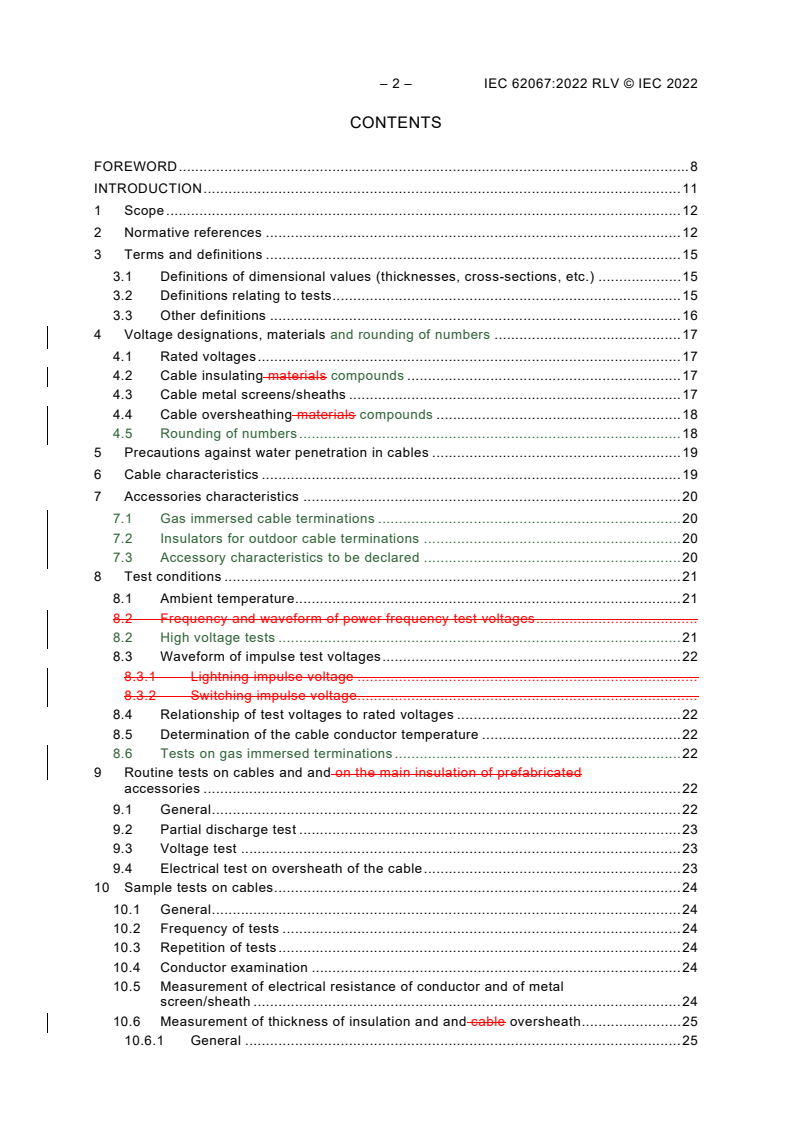
– 2 – IEC 62067:2022 RLV © IEC 2022
CONTENTS
FOREWORD . 8
INTRODUCTION . 11
1 Scope . 12
2 Normative references . 12
3 Terms and definitions . 15
3.1 Definitions of dimensional values (thicknesses, cross-sections, etc.) . 15
3.2 Definitions relating to tests . 15
3.3 Other definitions . 16
4 Voltage designations, materials and rounding of numbers . 17
4.1 Rated voltages . 17
4.2 Cable insulating materials compounds . 17
4.3 Cable metal screens/sheaths . 17
4.4 Cable oversheathing materials compounds . 18
4.5 Rounding of numbers . 18
5 Precautions against water penetration in cables . 19
6 Cable characteristics . 19
7 Accessories characteristics . 20
7.1 Gas immersed cable terminations . 20
7.2 Insulators for outdoor cable terminations . 20
7.3 Accessory characteristics to be declared . 20
8 Test conditions . 21
8.1 Ambient temperature. 21
8.2 Frequency and waveform of power frequency test voltages .
8.2 High voltage tests . 21
8.3 Waveform of impulse test voltages . 22
8.3.1 Lightning impulse voltage .
8.3.2 Switching impulse voltage.
8.4 Relationship of test voltages to rated voltages . 22
8.5 Determination of the cable conductor temperature . 22
8.6 Tests on gas immersed terminations . 22
9 Routine tests on cables and and on the main insulation of prefabricated
accessories . 22
9.1 General . 22
9.2 Partial discharge test . 23
9.3 Voltage test . 23
9.4 Electrical test on oversheath of the cable . 23
10 Sample tests on cables . 24
10.1 General . 24
10.2 Frequency of tests . 24
10.3 Repetition of tests . 24
10.4 Conductor examination . 24
10.5 Measurement of electrical resistance of conductor and of metal
screen/sheath . 24
10.6 Measurement of thickness of insulation and and cable oversheath . 25
10.6.1 General . 25
10.6.2 Requirements for the insulation . 25
10.6.3 Requirements for the cable oversheath . 26
10.7 Measurement of thickness of metal sheath . 26
10.7.1 General . 26
10.7.2 Lead or lead alloy sheath . 26
10.7.3 Plain or corrugated Copper or aluminium sheath . 27
10.7.4 Metal tape for CD design . 27
10.8 Measurement of diameters . 27
10.9 Hot set test for XLPE and EPR insulations . 28
10.9.1 Procedure . 28
10.9.2 Requirements . 28
10.10 Measurement of capacitance . 28
10.11 Measurement of density of HDPE insulation . 28
10.11.1 Procedure . 28
10.11.2 Requirements . 28
10.12 Lightning impulse voltage test . 28
10.13 Water penetration test . 29
10.14 Tests on components of cables with a longitudinally applied metal tape or
foil bonded to the oversheath . 29
11 Sample tests on accessories . 29
11.1 Tests on components of accessory . 29
11.2 Tests on complete accessory . 29
12 Type tests on cable systems . 29
12.1 General . 29
12.2 Range of type approval . 30
12.3 Summary of type tests . 31
12.4 Electrical type tests on complete cable systems . 32
12.4.1 Test voltage values . 32
12.4.2 Tests and sequence of tests . 32
12.4.3 Bending test . 33
12.4.4 Partial discharge tests . 34
12.4.5 Tan δ measurement . 34
12.4.6 Heating cycle voltage test . 34
12.4.7 Impulse voltage tests . 35
12.4.8 Examination . 36
12.4.9 Resistivity of semi-conducting screens . 36
12.5 Non-electrical type tests on cable and on cable components and on
complete cable . 37
12.5.1 General . 37
12.5.2 Check of cable construction . 37
12.5.3 Tests for determining the mechanical properties of insulation before and
after ageing . 37
12.5.4 Tests for determining the mechanical properties of oversheaths before
and after ageing . 38
12.5.5 Ageing tests on for pieces of complete cable to check compatibility of
materials . 38
12.5.6 Loss of mass test on PVC oversheaths of type ST . 39
12.5.7 Pressure test at high temperature on oversheaths . 39
– 4 – IEC 62067:2022 RLV © IEC 2022
12.5.8 Test on for PVC oversheaths (ST and ST ) and LSHF oversheaths
1 2
(ST ) at low temperature . 40
12.5.9 Heat shock test for PVC oversheaths (ST and ST ) . 40
1 2
12.5.10 Ozone resistance test for EPR insulation . 40
12.5.11 Hot set test for EPR and XLPE insulations . 40
12.5.12 Measurement of density of for HDPE insulation . 40
12.5.13 Measurement of carbon black content for black PE oversheaths (ST
and ST ) . 40
12.5.14 Test under fire conditions . 41
12.5.15 Water penetration test . 42
12.5.16 Tests on for components of cables with a longitudinally applied metal
tape or foil, bonded to the oversheath . 43
13 Prequalification test of the cable system . 43
13.1 General and range of prequalification test approval . 43
13.2 Prequalification test on complete cable system . 44
13.2.1 Summary of prequalification tests . 44
13.2.2 Test voltage values . 44
13.2.3 Test arrangement . 44
13.2.4 Heating cycle voltage test . 45
13.2.5 Lightning impulse voltage test . 45
13.2.6 Examination . 46
13.3 Tests for the extension of the prequalification of a cable system . 46
13.3.1 Summary of the extension of prequalification test . 46
13.3.2 Electrical part of the extension of prequalification tests on complete
cable system . 46
14 Type test on cables . 48
15 Type test on accessories . 48
16 Electrical test after installation (on-site tests) . 49
16.1 General . 49
16.2 DC voltage test of the oversheath . 49
16.3 Tests using AC voltage . 49
16.3.1 AC voltage test of the insulation . 49
16.3.2 Partial discharge test . 49
Annex A (informative) Determination of the cable conductor temperature . 59
A.1 Purpose . 59
A.2 Calibration of the temperature of the main test loop . 59
A.2.1 General . 59
A.2.2 Installation of cable and temperature sensors . 59
A.2.3 Calibration method . 62
A.3 Heating for the test . 62
A.3.1 Method 1 – Test using a reference cable . 62
A.3.2 Method 2 – Test using conductor temperature calculations and
measurement of the surface temperature . 63
Annex B (normative) Rounding of numbers . 64
Annex C (informative) List of type, prequalification and extension of prequalification
tests of for cable systems . 65
Annex D (normative) Measurement method for resistivity of semi-conducting screens . 67
Annex E (normative) Water penetration test . 71
E.1 Test piece . 71
E.2 Test . 71
E.3 Requirements . 72
Annex F (normative) Test for water penetration in the conductor . 74
F.1 Test piece . 74
F.2 Test . 74
F.3 Requirements . 74
Annex G (normative) Tests on components of cables with a longitudinally applied
metal tape or foil, bonded to the oversheath . 76
G.1 Visual inspection examination . 76
G.2 Adhesion and peel strength of metal foil . 76
G.2.1 General . 76
G.2.2 Procedure Test: Adhesion strength . 76
G.2.3 Test: Peel strength of overlapped metal foil . 77
G.2.4 Requirements . 78
Annex G (normative) Tests of outer protection for joints .
Annex H (normative) Additional tests for accessories . 84
H.1 General . 84
H.2 Range of approval. 85
H.2.1 Range of approval for joints without screen or metal sheath interruption . 85
H.2.2 Range of approval for joints with screen or metal sheath interruption . 86
H.2.3 Range of approval for accessories for cable screen interruption and/or
earth connection . 86
H.2.4 Range of approval for terminations with an insulated screen . 86
H.3 Tests of joints with or without screen or metal sheath interruption and
accessories for cable screen interruption and/or earth connection . 86
H.3.1 Conditioning of sample for test . 86
H.3.2 Water immersion test . 86
H.3.3 Electrical tests . 87
H.3.4 Examination . 88
H.4 Tests of terminations with an insulated screen . 89
H.4.1 Conditioning of sample for test . 89
H.4.2 DC voltage withstand test between screen and earth . 89
H.4.3 Lightning impulse voltage withstand test between screen and earth . 89
H.4.4 Examination . 89
H.5 Tests for insulators for outdoor terminations . 89
H.5.1 Tests for ceramic insulators . 89
H.5.2 Tests for composite insulators . 90
H.6 Tests for gas-immersed terminations in case of changing insulating gas . 90
H.6.1 General . 90
H.6.2 Electrical tests . 90
H.6.3 Leak rate test . 91
Annex I (informative) Guidance on examination of cable and accessories . 92
Annex J (informative) Guidance for type test on heating-cycle-voltage-test interruption
and cycle validity . 93
J.1 Interruption of cycles during a heating cycle voltage test. 93
J.1.1 Scheduled interruption of test . 93
J.1.2 Non-scheduled interruption of test . 93
J.2 Valid heating cycles . 93
– 6 – IEC 62067:2022 RLV © IEC 2022
Annex K (normative) Methods for determining the weighted value of halogen content
of the non-metallic materials in the cable . 94
K.1 Calculating the weighted value for the cable when the halogen content of
individual non-metallic material is tested . 94
K.2 Preparation of the test sample for measurement of halogen content on a
sample representative of the non-metallic materials in the cable . 94
Bibliography . 95
Figure 1 – Example of EQ test arrangement for the prequalification of a system with
another joint, designed for rigid as well as for flexible installation . 47
Figure A.1 – Typical Schematic diagram of test set-up for the reference loop and the main test
loop . 60
Figure A.2 – Example of an arrangement of the temperature sensors on the conductor
of the reference loop . 61
Figure D.1 – Preparation of samples for measurement of resistivity of conductor and
insulation screens .
Figure D.1 – Dimensions for preparation of samples for measurement of resistivity of
conductor screen . 68
Figure D.2 – Dimensions for preparation of samples for measurement of resistivity of
insulation screen . 69
Figure E.1 – Schematic diagram of apparatus for water penetration test . 73
Figure F.1 – Schematic diagram of apparatus for water penetration test in the
conductor . 75
Figure G.1 – Adhesion of metal tape or foil . 77
Figure G.2 – Example of overlapped metal foil . 78
Figure G.3 – Peel strength of overlapped metal foil . 78
Figure G.4 – Typical strength versus grip spacing curve (1) . 79
Figure G.5 – Typical strength versus grip spacing curve (2) . 79
Table 1 – Insulating compounds for cables . 50
Table 2 – Oversheathing compounds for cables . 50
Table 3 – Tan δ requirements for insulating compounds for cables . 50
Table 4 – Test voltages . 51
Table 5 – Non-electrical type tests for insulating and oversheathing compounds for cables . 52
Table 6 – Test requirements for mechanical characteristics of insulating compounds
for cables (before and after ageing) . 53
Table 7 – Test requirements for mechanical characteristics of oversheathing
compounds for cables (before and after ageing) . 54
Table 8 – Test requirements for particular characteristics of insulating compounds for
cables . 55
Table 9 – Test requirements for particular characteristics of PVC and LSHF
oversheathing for cables . 56
Table 10 – Test requirements for fire performance characteristics of cables with PVC
and LSHF oversheaths . 57
Table 11 – Cantilever operating load for insulators for outdoor terminations . 58
Table 12 – Test voltages for AC voltage test after installation . 58
Table C.1 – Type tests on for cable systems . 65
Table C.2 – PQ tests on cable systems . 66
Table C.3 – EQ tests on cable systems . 66
Table G.1 – Minimum acceptable adhesion or peel strength forces . 80
Table G.1 – Impulse voltage tests .
Table H.1 – Test sequence . 85
Table H.2 – Lightning impulse voltage withstand test between screen and earth of
joints with or without screen or metal sheath interruption and accessories for cable
screen interruption and/or earth connection . 88
Table H.3 – Lightning impulse voltage withstand test between screen and screen of
joints with screen or metal sheath interruption and accessories for cable screen
interruption and/or earth connection . 88
Table H.4 – Lightning impulse voltage withstand tests between screen and earth of
terminations with an insulated screen . 89
– 8 – IEC 62067:2022 RLV © IEC 2022
INTERNATIONAL ELECTROTECHNICAL COMMISSION
____________
POWER CABLES WITH EXTRUDED INSULATION AND
THEIR ACCESSORIES FOR RATED VOLTAGES
ABOVE 150 kV (U = 170 kV) UP TO 500 kV (U = 550 kV) –
m m
TEST METHODS AND REQUIREMENTS
FOREWORD
1) The International Electrotechnical Commission (IEC) is a worldwide organization for standardization comprising
all national electrotechnical committees (IEC National Committees). The object of IEC is to promote international
co-operation on all questions concerning standardization in the electrical and electronic fields. To this end and
in addition to other activities, IEC publishes International Standards, Technical Specifications, Technical Reports,
Publicly Available Specifications (PAS) and Guides (hereafter referred to as "IEC Publication(s)"). Their
preparation is entrusted to technical committees; any IEC National Committee interested in the subject dealt with
may participate in this preparatory work. International, governmental and non-governmental organizations liaising
with the IEC also participate in this preparation. IEC collaborates closely with the International Organization for
Standardization (ISO) in accordance with conditions determined by agreement between the two organizations.
2) The formal decisions or agreements of IEC on technical matters express, as nearly as possible, an international
consensus of opinion on the relevant subjects since each technical committee has representation from all
interested IEC National Committees.
3) IEC Publications have the form of recommendations for international use and are accepted by IEC National
Committees in that sense. While all reasonable efforts are made to ensure that the technical content of IEC
Publications is accurate, IEC cannot be held responsible for the way in which they are used or for any
misinterpretation by any end user.
4) In order to promote international uniformity, IEC National Committees undertake to apply IEC Publications
transparently to the maximum extent possible in their national and regional publications. Any divergence between
any IEC Publication and the corresponding national or regional publication shall be clearly indicated in the latter.
5) IEC itself does not provide any attestation of conformity. Independent certification bodies provide conformity
assessment services and, in some areas, access to IEC marks of conformity. IEC is not responsible for any
services carried out by independent certification bodies.
6) All users should ensure that they have the latest edition of this publication.
7) No liability shall attach to IEC or its directors, employees, servants or agents including individual experts and
members of its technical committees and IEC National Committees for any personal injury, property damage or
other damage of any nature whatsoever, whether direct or indirect, or for costs (including legal fees) and
expenses arising out of the publication, use of, or reliance upon, this IEC Publication or any other IEC
Publications.
8) Attention is drawn to the Normative references cited in this publication. Use of the referenced publications is
indispensable for the correct application of this publication.
9) Attention is drawn to the possibility that some of the elements of this IEC Publication may be the subject of patent
rights. IEC shall not be held responsible for identifying any or all such patent rights.
This redline version of the official IEC Standard allows the user to identify the changes made to
the previous edition IEC 62067:2011. A vertical bar appears in the margin wherever a change has
been made. Additions are in green text, deletions are in strikethrough red text.
IEC 62067 has been prepared by IEC technical committee 20: Electric cables. It is an
International Standard.
This third edition cancels and replaces the second edition published in 2011. This edition
constitutes a technical revision.
This edition includes the following significant technical changes with respect to the previous
edition:
a) A new material class (ST ) is introduced which has fire performance requirements.
b) A full range of fire performance tests is available which can be selected on the basis of
claimed cable performance characteristics.
c) The range of cable metal screen designs and the bending test has been revised in line with
IEC TR 61901 [1] .
d) Requirements are introduced for outdoor termination insulators.
e) Design and testing requirements for gas immersed terminations (and their separating
insulating barriers) are coordinated with IEC 62271-209. An additional type test is required
where the separating insulating barrier is installed by the switchgear manufacturer.
f) A separate water penetration test for the cable conductor is required.
g) AC voltage testing of the insulation after installation has been revised in line with recently
published CIGRE recommendations.
h) Tests have been added for a change in the type of insulating gas used in the cable
connection enclosure of a gas immersed termination.
The text of this International Standard is based on the following documents:
Draft Report on voting
20/2017/FDIS 20/2020/RVD
Full information on the voting for its approval can be found in the report on voting indicated in
the above table.
The language used for the development of this International Standard is English.
This document was drafted in accordance with ISO/IEC Directives, Part 2, and developed in
accordance with ISO/IEC Directives, Part 1 and ISO/IEC Directives, IEC Supplement, available
at www.iec.ch/members_experts/refdocs. The main document types developed by IEC are
described in greater detail at www.iec.ch/standardsdev/publications.
___________
Numbers in square brackets refer to the bibliography.
– 10 – IEC 62067:2022 RLV © IEC 2022
The committee has decided that the contents of this document will remain unchanged until the
stability date indicated on the IEC website under webstore.iec.ch in the data related to the
specific document. At this date, the document will be
• reconfirmed,
• withdrawn,
• replaced by a revised edition, or
• amended.
IMPORTANT – The 'colour inside' logo on the cover page of this publication indicates that it
contains colours which are considered to be useful for the correct understanding of its
contents. Users should therefore print this document using a colour printer.
INTRODUCTION
As a result of major developments in cable systems with extruded insulation for voltages above
150 kV, CIGRE Study Committee (SC) 21 set up Working Group (WG) 21.03 in 1990. The terms
of reference of WG 21.03 were "to prepare recommendations for electrical type tests, sample
and routine tests, based on extending IEC 60840:1988 up to 400 kV and to make proposals for
prequalification/development tests which, as a minimum, should be performed".
WG 21.03 reported that the extension of IEC 60840 [2] to voltages above 150 kV needed extra
consideration because of the following factors:
1) such cables form part of the backbone of the transmission system and, therefore, reliability
considerations are of the highest priority;
2) these cables and their accessories operate with higher electrical stresses than cables up to
150 kV and, as a result, have a smaller safety margin with respect to the intrinsic
performance boundaries of the cable system;
3) such cables and accessories have a thicker insulation wall than those up to 150 kV and, as
a result, are subjected to greater thermo-mechanical effects;
4) the design and coordination of the cables and accessories become more difficult with
increasing system voltage levels.
The recommendations of the WG 21.03 were published in Electra No. 151 [3] [4] in December
1993 and taken into account by IEC in 1995 in the preparation of this standard for cable systems
with extruded insulation for voltages above 150 kV. IEC considered that the new standard
should also cover the 500 kV level. Thus, at its meeting in September 1996, CIGRE SC 21 set
up a task force 21.18 to study the extension of the initial recommendations to the 500 kV level.
The resulting updated recommendations were cited in Electra No. 193 in December 2000 and
thus were also taken into account by IEC Technical Committee (TC) 20 in the preparation of
the first edition of this standard.
On the advice of CIGRE, a long term accelerated ageing test was introduced in the first edition,
in order to gain some indication of the long term reliability of a cable system. This test, known
as the "prequalification test", was to be performed on the complete system comprising the cable,
joints and terminations in order to demonstrate the performance of the system.
In addition, CIGRE WG 21.09, published recommendations for "tests after installation on high-
voltage extruded insulation cable systems" in Electra No. 173 [5] in August 1997. These
recommendations (which state, amongst other things, that DC tests should be avoided on the
main insulation, as they are both ineffective and potentially damaging) were also taken into
account in the first edition of this standard.
At its meeting in November 2004, TC 20 concluded that the next revision of IEC 62067 should
include the recommendation for testing of HV and EHV extruded cables that was under
preparation by the CIGRE SC B1 (previously SC 21) WG B1.06. This was made available as a
CIGRE Technical Brochure 303 [6] before the meeting of TC 20 in October 2006, which
confirmed this view. Therefore, Technical Brochure 303 has been considered by TC 20 and
major parts have been implemented in this standard. This has resulted in some modifications
to the prequalification test requirements, a major change being the addition of the extension of
the prequalification test. The latter test requires approximately one quarter of the time to
complete when compared with the full prequalification test.
This third edition of IEC 62067 has been produced as part of the normal periodic review and
updating procedures of IEC taking into account progress and developments within the energy
industry.
A list of relevant CIGRE references is given in the bibliography.
– 12 – IEC 62067:2022 RLV © IEC 2022
POWER CABLES WITH EXTRUDED INSULATION AND
THEIR ACCESSORIES FOR RATED VOLTAGES
ABOVE 150 kV (U = 170 kV) UP TO 500 kV (U = 550 kV) –
m m
TEST METHODS AND REQUIREMENTS
1 Scope
This document specifies test methods and requirements for power cable systems, cables with
extruded insulation and their accessories for fixed installations, for rated voltages above 150 kV
(U = 170 kV) up to and including 500 kV (U = 550 kV).
m m
The requirements apply to single-core cables and to their accessories for usual conditions of
installation and operation, but not to special cables and their accessories, such as submarine
cables, for which modifications to the standard tests may can be necessary or special test
conditions that may need to be devised.
This document does not cover transition joints between cables with extruded insulation and
paper insulated cables.
2 Normative references
The following documents are referred to in the text in such a way that some or all of their content
constitutes requirements of this document. For dated references, only the edition cited applies.
For undated references, the latest edition of the referenced document (including any
amendments) applies.
NOTE The IEC 60811 series is currently undergoing a revision, which will lead to a restructuring of its parts. A
description of this, as well as a cross-reference table between the current and planned parts will be given in
IEC 60811-100.
IEC 60060-1, High-voltage test techniques – Part 1: General definitions and test requirements
IEC 60060-3, High-voltage test techniques – Part 3: Definitions and requirements for on-site
testing
IEC 60137, Insulated bushings for alternating voltages above 1000 V
IEC 60183, Guide to the selection of high-voltage cables
IEC 60228, Conductors of insulated cables
IEC 60229:2007, Electric cables – Tests on extruded oversheaths with a special protective
function
IEC 60230, Impulse tests on cables and their accessories
IEC 60287-1-1:2006, Electric cables – Calculation of the current rating – Part 1-1: Current rating
equations (100 % load factor) and calculation of losses – General
IEC 60332-1-2, Tests on electric and optical fibre cables under fire conditions – Part 1-2: Test
for vertical flame propagation for a single insulated wire or cable – Procedure for 1 kW pre-
mixed flame
IEC 6033
...
IEC 62067 ®
Edition 3.0 2022-04
INTERNATIONAL
STANDARD
NORME
INTERNATIONALE
Power cables with extruded insulation and their accessories for rated voltages
above 150 kV (Um = 170 kV) up to 500 kV (Um = 550 kV) – Test methods and
requirements
Câbles d'énergie à isolation extrudée et leurs accessoires pour des tensions
assignées supérieures à 150 kV (Um = 170 kV) et jusqu'à 500 kV (Um = 550 kV) –
Méthodes et exigences d'essai
All rights reserved. Unless otherwise specified, no part of this publication may be reproduced or utilized in any form
or by any means, electronic or mechanical, including photocopying and microfilm, without permission in writing from
either IEC or IEC's member National Committee in the country of the requester. If you have any questions about IEC
copyright or have an enquiry about obtaining additional rights to this publication, please contact the address below or
your local IEC member National Committee for further information.
Droits de reproduction réservés. Sauf indication contraire, aucune partie de cette publication ne peut être reproduite ni
utilisée sous quelque forme que ce soit et par aucun procédé, électronique ou mécanique, y compris la photocopie et
les microfilms, sans l'accord écrit de l'IEC ou du Comité national de l'IEC du pays du demandeur. Si vous avez des
questions sur le copyright de l'IEC ou si vous désirez obtenir des droits supplémentaires sur cette publication, utilisez
les coordonnées ci-après ou contactez le Comité national de l'IEC de votre pays de résidence.
IEC Secretariat Tel.: +41 22 919 02 11
3, rue de Varembé info@iec.ch
CH-1211 Geneva 20 www.iec.ch
Switzerland
About the IEC
The International Electrotechnical Commission (IEC) is the leading global organization that prepares and publishes
International Standards for all electrical, electronic and related technologies.
About IEC publications
The technical content of IEC publications is kept under constant review by the IEC. Please make sure that you have the
latest edition, a corrigendum or an amendment might have been published.
IEC publications search - webstore.iec.ch/advsearchform IEC Products & Services Portal - products.iec.ch
The advanced search enables to find IEC publications by a Discover our powerful search engine and read freely all the
variety of criteria (reference number, text, technical publications previews. With a subscription you will always have
committee, …). It also gives information on projects, replaced access to up to date content tailored to your needs.
and withdrawn publications.
Electropedia - www.electropedia.org
IEC Just Published - webstore.iec.ch/justpublished
The world's leading online dictionary on electrotechnology,
Stay up to date on all new IEC publications. Just Published
containing more than 22 300 terminological entries in English
details all new publications released. Available online and once
and French, with equivalent terms in 19 additional languages.
a month by email.
Also known as the International Electrotechnical Vocabulary
(IEV) online.
IEC Customer Service Centre - webstore.iec.ch/csc
If you wish to give us your feedback on this publication or need
further assistance, please contact the Customer Service
Centre: sales@iec.ch.
A propos de l'IEC
La Commission Electrotechnique Internationale (IEC) est la première organisation mondiale qui élabore et publie des
Normes internationales pour tout ce qui a trait à l'électricité, à l'électronique et aux technologies apparentées.
A propos des publications IEC
Le contenu technique des publications IEC est constamment revu. Veuillez vous assurer que vous possédez l’édition la
plus récente, un corrigendum ou amendement peut avoir été publié.
Recherche de publications IEC - Découvrez notre puissant moteur de recherche et consultez
webstore.iec.ch/advsearchform gratuitement tous les aperçus des publications. Avec un
La recherche avancée permet de trouver des publications IEC abonnement, vous aurez toujours accès à un contenu à jour
en utilisant différents critères (numéro de référence, texte, adapté à vos besoins.
comité d’études, …). Elle donne aussi des informations sur les
projets et les publications remplacées ou retirées. Electropedia - www.electropedia.org
Le premier dictionnaire d'électrotechnologie en ligne au monde,
IEC Just Published - webstore.iec.ch/justpublished
avec plus de 22 300 articles terminologiques en anglais et en
Restez informé sur les nouvelles publications IEC. Just
français, ainsi que les termes équivalents dans 19 langues
Published détaille les nouvelles publications parues.
additionnelles. Egalement appelé Vocabulaire
Disponible en ligne et une fois par mois par email.
Electrotechnique International (IEV) en ligne.
Service Clients - webstore.iec.ch/csc
Si vous désirez nous donner des commentaires sur cette
publication ou si vous avez des questions contactez-nous:
sales@iec.ch.
IEC Products & Services Portal - products.iec.ch
IEC 62067 ®
Edition 3.0 2022-04
INTERNATIONAL
STANDARD
NORME
INTERNATIONALE
Power cables with extruded insulation and their accessories for rated voltages
above 150 kV (Um = 170 kV) up to 500 kV (Um = 550 kV) – Test methods and
requirements
Câbles d'énergie à isolation extrudée et leurs accessoires pour des tensions
assignées supérieures à 150 kV (Um = 170 kV) et jusqu'à 500 kV (Um = 550 kV) –
Méthodes et exigences d'essai
INTERNATIONAL
ELECTROTECHNICAL
COMMISSION
COMMISSION
ELECTROTECHNIQUE
INTERNATIONALE
ICS 29.060.20 ISBN 978-2-8322-1092-8
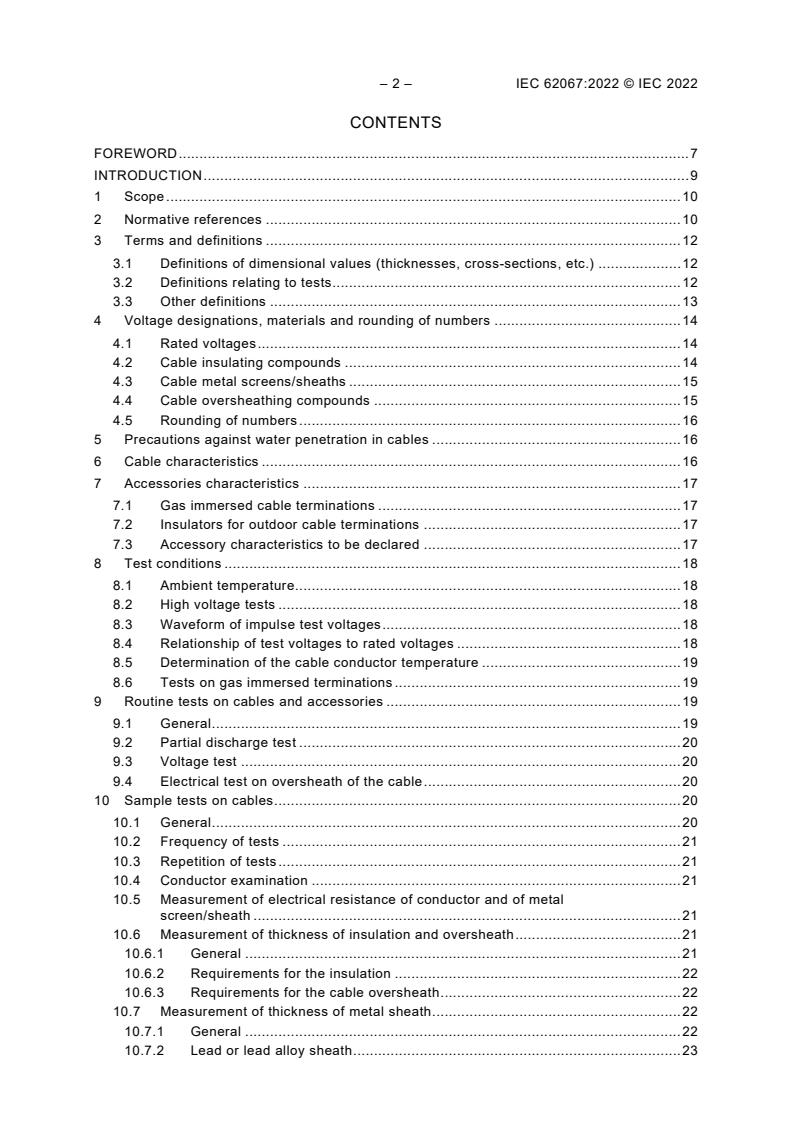
– 2 – IEC 62067:2022 © IEC 2022
CONTENTS
FOREWORD . 7
INTRODUCTION . 9
1 Scope . 10
2 Normative references . 10
3 Terms and definitions . 12
3.1 Definitions of dimensional values (thicknesses, cross-sections, etc.) . 12
3.2 Definitions relating to tests . 12
3.3 Other definitions . 13
4 Voltage designations, materials and rounding of numbers . 14
4.1 Rated voltages . 14
4.2 Cable insulating compounds . 14
4.3 Cable metal screens/sheaths . 15
4.4 Cable oversheathing compounds . 15
4.5 Rounding of numbers . 16
5 Precautions against water penetration in cables . 16
6 Cable characteristics . 16
7 Accessories characteristics . 17
7.1 Gas immersed cable terminations . 17
7.2 Insulators for outdoor cable terminations . 17
7.3 Accessory characteristics to be declared . 17
8 Test conditions . 18
8.1 Ambient temperature. 18
8.2 High voltage tests . 18
8.3 Waveform of impulse test voltages . 18
8.4 Relationship of test voltages to rated voltages . 18
8.5 Determination of the cable conductor temperature . 19
8.6 Tests on gas immersed terminations . 19
9 Routine tests on cables and accessories . 19
9.1 General . 19
9.2 Partial discharge test . 20
9.3 Voltage test . 20
9.4 Electrical test on oversheath of the cable . 20
10 Sample tests on cables . 20
10.1 General . 20
10.2 Frequency of tests . 21
10.3 Repetition of tests . 21
10.4 Conductor examination . 21
10.5 Measurement of electrical resistance of conductor and of metal
screen/sheath . 21
10.6 Measurement of thickness of insulation and oversheath . 21
10.6.1 General . 21
10.6.2 Requirements for the insulation . 22
10.6.3 Requirements for the cable oversheath . 22
10.7 Measurement of thickness of metal sheath . 22
10.7.1 General . 22
10.7.2 Lead or lead alloy sheath . 23
10.7.3 Copper or aluminium sheath . 23
10.7.4 Metal tape for CD design . 24
10.8 Measurement of diameters . 24
10.9 Hot set test for XLPE and EPR insulations . 24
10.9.1 Procedure . 24
10.9.2 Requirements . 24
10.10 Measurement of capacitance . 24
10.11 Measurement of density of HDPE insulation . 24
10.11.1 Procedure . 24
10.11.2 Requirements . 24
10.12 Lightning impulse voltage test . 24
10.13 Water penetration test . 25
10.14 Tests on components of cables with a longitudinally applied metal tape or
foil bonded to the oversheath . 25
11 Sample tests on accessories . 25
11.1 Tests on components of accessory . 25
11.2 Tests on complete accessory . 25
12 Type tests on cable systems . 26
12.1 General . 26
12.2 Range of type approval . 26
12.3 Summary of type tests . 27
12.4 Electrical type tests on complete cable systems . 28
12.4.1 Test voltage values . 28
12.4.2 Tests and sequence of tests . 28
12.4.3 Bending test . 29
12.4.4 Partial discharge tests . 29
12.4.5 Tan δ measurement . 30
12.4.6 Heating cycle voltage test . 30
12.4.7 Impulse voltage tests . 31
12.4.8 Examination . 32
12.4.9 Resistivity of semi-conducting screens . 32
12.5 Non-electrical type tests on cable and on cable components . 32
12.5.1 General . 32
12.5.2 Check of cable construction . 33
12.5.3 Tests for determining the mechanical properties of insulation before and
after ageing . 33
12.5.4 Tests for determining the mechanical properties of oversheaths before
and after ageing . 33
12.5.5 Ageing tests for pieces of cable to check compatibility of materials . 34
12.5.6 Loss of mass test on PVC oversheaths of type ST . 34
12.5.7 Pressure test at high temperature on oversheaths . 35
12.5.8 Test for PVC oversheaths (ST and ST ) and LSHF oversheaths
1 2
(ST ) at low temperature . 35
12.5.9 Heat shock test for PVC oversheaths (ST and ST ) . 35
1 2
12.5.10 Ozone resistance test for EPR insulation . 35
12.5.11 Hot set test for EPR and XLPE insulations . 35
12.5.12 Measurement of density for HDPE insulation . 36
– 4 – IEC 62067:2022 © IEC 2022
12.5.13 Measurement of carbon black content for black PE oversheaths (ST
and ST ) . 36
12.5.14 Test under fire conditions . 36
12.5.15 Water penetration test . 38
12.5.16 Tests for components of cables with a longitudinally applied metal tape
or foil, bonded to the oversheath . 38
13 Prequalification test of the cable system . 38
13.1 General and range of prequalification test approval . 38
13.2 Prequalification test on complete cable system . 39
13.2.1 Summary of prequalification tests . 39
13.2.2 Test voltage values . 39
13.2.3 Test arrangement . 40
13.2.4 Heating cycle voltage test . 40
13.2.5 Lightning impulse voltage test . 41
13.2.6 Examination . 41
13.3 Tests for the extension of the prequalification of a cable system . 41
13.3.1 Summary of the extension of prequalification test . 41
13.3.2 Electrical part of the extension of prequalification tests on complete
cable system . 41
14 Type test on cables . 43
15 Type test on accessories . 43
16 Electrical test after installation (on-site tests) . 43
16.1 General . 43
16.2 DC voltage test of the oversheath . 43
16.3 Tests using AC voltage . 44
16.3.1 AC voltage test of the insulation . 44
16.3.2 Partial discharge test . 44
Annex A (informative) Determination of the cable conductor temperature . 52
A.1 Purpose . 52
A.2 Calibration of the temperature of the main test loop . 52
A.2.1 General . 52
A.2.2 Installation of cable and temperature sensors . 52
A.2.3 Calibration method . 54
A.3 Heating for the test . 54
A.3.1 Method 1 – Test using a reference cable . 54
A.3.2 Method 2 – Test using conductor temperature calculations and
measurement of the surface temperature . 55
Annex B (normative) Rounding of numbers . 56
Annex C (informative) List of type, prequalification and extension of prequalification
tests for cable systems . 57
Annex D (normative) Measurement method for resistivity of semi-conducting screens . 59
Annex E (normative) Water penetration test . 62
E.1 Test piece . 62
E.2 Test . 62
E.3 Requirements . 63
Annex F (normative) Test for water penetration in the conductor . 64
F.1 Test piece . 64
F.2 Test . 64
F.3 Requirements . 64
Annex G (normative) Tests on components of cables with a longitudinally applied
metal tape or foil, bonded to the oversheath . 66
G.1 Visual examination . 66
G.2 Adhesion and peel strength. 66
G.2.1 General . 66
G.2.2 Test: Adhesion strength . 66
G.2.3 Test: Peel strength of overlapped metal foil . 67
G.2.4 Requirements . 68
Annex H (normative) Additional tests for accessories . 70
H.1 General . 70
H.2 Range of approval. 71
H.2.1 Range of approval for joints without screen or metal sheath interruption . 71
H.2.2 Range of approval for joints with screen or metal sheath interruption . 72
H.2.3 Range of approval for accessories for cable screen interruption and/or
earth connection . 72
H.2.4 Range of approval for terminations with an insulated screen . 72
H.3 Tests of joints with or without screen or metal sheath interruption and
accessories for cable screen interruption and/or earth connection . 72
H.3.1 Conditioning of sample for test . 72
H.3.2 Water immersion test . 72
H.3.3 Electrical tests . 73
H.3.4 Examination . 74
H.4 Tests of terminations with an insulated screen . 75
H.4.1 Conditioning of sample for test . 75
H.4.2 DC voltage withstand test between screen and earth . 75
H.4.3 Lightning impulse voltage withstand test between screen and earth . 75
H.4.4 Examination . 75
H.5 Tests for insulators for outdoor terminations . 75
H.5.1 Tests for ceramic insulators . 75
H.5.2 Tests for composite insulators . 76
H.6 Tests for gas-immersed terminations in case of changing insulating gas . 76
H.6.1 General . 76
H.6.2 Electrical tests . 76
H.6.3 Leak rate test . 77
Annex I (informative) Guidance on examination of cable and accessories . 78
Annex J (informative) Guidance for type test on heating-cycle-voltage-test interruption
and cycle validity . 79
J.1 Interruption of cycles during a heating cycle voltage test. 79
J.1.1 Scheduled interruption of test . 79
J.1.2 Non-scheduled interruption of test . 79
J.2 Valid heating cycles . 79
Annex K (normative) Methods for determining the weighted value of halogen content
of the non-metallic materials in the cable . 80
K.1 Calculating the weighted value for the cable when the halogen content of
individual non-metallic material is tested . 80
K.2 Preparation of the test sample for measurement of halogen content on a
sample representative of the non-metallic materials in the cable . 80
Bibliography . 81
– 6 – IEC 62067:2022 © IEC 2022
Figure 1 – Example of EQ test arrangement for the prequalification of a system with
another joint, designed for rigid as well as for flexible installation . 42
Figure A.1 – Schematic diagram of test set-up for the reference loop and the main test loop . 53
Figure A.2 – Example of an arrangement of the temperature sensors on the conductor
of the reference loop . 54
Figure D.1 – Dimensions for preparation of samples for measurement of resistivity of
conductor screen . 60
Figure D.2 – Dimensions for preparation of samples for measurement of resistivity of
insulation screen . 61
Figure E.1 – Schematic diagram of apparatus for water penetration test . 63
Figure F.1 – Schematic diagram of apparatus for water penetration test in the
conductor . 65
Figure G.1 – Adhesion of metal tape or foil . 67
Figure G.2 – Example of overlapped metal foil . 68
Figure G.3 – Peel strength of overlapped metal foil . 68
Figure G.4 – Typical strength versus grip spacing curve (1) . 69
Figure G.5 – Typical strength versus grip spacing curve (2) . 69
Table 1 – Insulating compounds for cables . 44
Table 2 – Oversheathing compounds for cables . 45
Table 3 – Tan δ requirements for insulating compounds for cables . 45
Table 4 – Test voltages . 45
Table 5 – Non-electrical type tests for insulating and oversheathing compounds for cables . 46
Table 6 – Test requirements for mechanical characteristics of insulating compounds
for cables (before and after ageing) . 47
Table 7 – Test requirements for mechanical characteristics of oversheathing
compounds for cables (before and after ageing) . 48
Table 8 – Test requirements for particular characteristics of insulating compounds for
cables . 48
Table 9 – Test requirements for particular characteristics of PVC and LSHF
oversheathing for cables . 49
Table 10 – Test requirements for fire performance characteristics of cables with PVC
and LSHF oversheaths . 50
Table 11 – Cantilever operating load for insulators for outdoor terminations . 51
Table 12 – Test voltages for AC voltage test after installation . 51
Table C.1 – Type tests for cable systems . 57
Table C.2 – PQ tests on cable systems . 58
Table C.3 – EQ tests on cable systems . 58
Table G.1 – Minimum acceptable adhesion or peel strength forces . 69
Table H.1 – Test sequence . 71
Table H.2 – Lightning impulse voltage withstand test between screen and earth of
joints with or without screen or metal sheath interruption and accessories for cable
screen interruption and/or earth connection . 74
Table H.3 – Lightning impulse voltage withstand test between screen and screen of
joints with screen or metal sheath interruption and accessories for cable screen
interruption and/or earth connection . 74
Table H.4 – Lightning impulse voltage withstand tests between screen and earth of
terminations with an insulated screen . 75
INTERNATIONAL ELECTROTECHNICAL COMMISSION
____________
POWER CABLES WITH EXTRUDED INSULATION AND
THEIR ACCESSORIES FOR RATED VOLTAGES
ABOVE 150 kV (U = 170 kV) UP TO 500 kV (U = 550 kV) –
m m
TEST METHODS AND REQUIREMENTS
FOREWORD
1) The International Electrotechnical Commission (IEC) is a worldwide organization for standardization comprising
all national electrotechnical committees (IEC National Committees). The object of IEC is to promote international
co-operation on all questions concerning standardization in the electrical and electronic fields. To this end and
in addition to other activities, IEC publishes International Standards, Technical Specifications, Technical Reports,
Publicly Available Specifications (PAS) and Guides (hereafter referred to as "IEC Publication(s)"). Their
preparation is entrusted to technical committees; any IEC National Committee interested in the subject dealt with
may participate in this preparatory work. International, governmental and non-governmental organizations liaising
with the IEC also participate in this preparation. IEC collaborates closely with the International Organization for
Standardization (ISO) in accordance with conditions determined by agreement between the two organizations.
2) The formal decisions or agreements of IEC on technical matters express, as nearly as possible, an international
consensus of opinion on the relevant subjects since each technical committee has representation from all
interested IEC National Committees.
3) IEC Publications have the form of recommendations for international use and are accepted by IEC National
Committees in that sense. While all reasonable efforts are made to ensure that the technical content of IEC
Publications is accurate, IEC cannot be held responsible for the way in which they are used or for any
misinterpretation by any end user.
4) In order to promote international uniformity, IEC National Committees undertake to apply IEC Publications
transparently to the maximum extent possible in their national and regional publications. Any divergence between
any IEC Publication and the corresponding national or regional publication shall be clearly indicated in the latter.
5) IEC itself does not provide any attestation of conformity. Independent certification bodies provide conformity
assessment services and, in some areas, access to IEC marks of conformity. IEC is not responsible for any
services carried out by independent certification bodies.
6) All users should ensure that they have the latest edition of this publication.
7) No liability shall attach to IEC or its directors, employees, servants or agents including individual experts and
members of its technical committees and IEC National Committees for any personal injury, property damage or
other damage of any nature whatsoever, whether direct or indirect, or for costs (including legal fees) and
expenses arising out of the publication, use of, or reliance upon, this IEC Publication or any other IEC
Publications.
8) Attention is drawn to the Normative references cited in this publication. Use of the referenced publications is
indispensable for the correct application of this publication.
9) Attention is drawn to the possibility that some of the elements of this IEC Publication may be the subject of patent
rights. IEC shall not be held responsible for identifying any or all such patent rights.
IEC 62067 has been prepared by IEC technical committee 20: Electric cables. It is an
International Standard.
This third edition cancels and replaces the second edition published in 2011. This edition
constitutes a technical revision.
This edition includes the following significant technical changes with respect to the previous
edition:
a) A new material class (ST ) is introduced which has fire performance requirements.
b) A full range of fire performance tests is available which can be selected on the basis of
claimed cable performance characteristics.
– 8 – IEC 62067:2022 © IEC 2022
c) The range of cable metal screen designs and the bending test has been revised in line with
IEC TR 61901 [1] .
d) Requirements are introduced for outdoor termination insulators.
e) Design and testing requirements for gas immersed terminations (and their separating
insulating barriers) are coordinated with IEC 62271-209. An additional type test is required
where the separating insulating barrier is installed by the switchgear manufacturer.
f) A separate water penetration test for the cable conductor is required.
g) AC voltage testing of the insulation after installation has been revised in line with recently
published CIGRE recommendations.
h) Tests have been added for a change in the type of insulating gas used in the cable
connection enclosure of a gas immersed termination.
The text of this International Standard is based on the following documents:
Draft Report on voting
20/2017/FDIS 20/2020/RVD
Full information on the voting for its approval can be found in the report on voting indicated in
the above table.
The language used for the development of this International Standard is English.
This document was drafted in accordance with ISO/IEC Directives, Part 2, and developed in
accordance with ISO/IEC Directives, Part 1 and ISO/IEC Directives, IEC Supplement, available
at www.iec.ch/members_experts/refdocs. The main document types developed by IEC are
described in greater detail at www.iec.ch/standardsdev/publications.
The committee has decided that the contents of this document will remain unchanged until the
stability date indicated on the IEC website under webstore.iec.ch in the data related to the
specific document. At this date, the document will be
• reconfirmed,
• withdrawn,
• replaced by a revised edition, or
• amended.
___________
Numbers in square brackets refer to the bibliography.
INTRODUCTION
As a result of major developments in cable systems with extruded insulation for voltages above
150 kV, CIGRE Study Committee (SC) 21 set up Working Group (WG) 21.03 in 1990. The terms
of reference of WG 21.03 were "to prepare recommendations for electrical type tests, sample
and routine tests, based on extending IEC 60840:1988 up to 400 kV and to make proposals for
prequalification/development tests which, as a minimum, should be performed".
WG 21.03 reported that the extension of IEC 60840 [2] to voltages above 150 kV needed extra
consideration because of the following factors:
1) such cables form part of the backbone of the transmission system and, therefore, reliability
considerations are of the highest priority;
2) these cables and their accessories operate with higher electrical stresses than cables up to
150 kV and, as a result, have a smaller safety margin with respect to the intrinsic
performance boundaries of the cable system;
3) such cables and accessories have a thicker insulation wall than those up to 150 kV and, as
a result, are subjected to greater thermo-mechanical effects;
4) the design and coordination of the cables and accessories become more difficult with
increasing system voltage levels.
The recommendations of the WG 21.03 were published in Electra No. 151 [3] [4] in December
1993 and taken into account by IEC in 1995 in the preparation of this standard for cable systems
with extruded insulation for voltages above 150 kV. IEC considered that the new standard
should also cover the 500 kV level. Thus, at its meeting in September 1996, CIGRE SC 21 set
up a task force 21.18 to study the extension of the initial recommendations to the 500 kV level.
The resulting updated recommendations were taken into account by IEC Technical Committee
(TC) 20 in the preparation of the first edition of this standard.
On the advice of CIGRE, a long term accelerated ageing test was introduced in the first edition,
in order to gain some indication of the long term reliability of a cable system. This test, known
as the "prequalification test", was to be performed on the complete system comprising the cable,
joints and terminations in order to demonstrate the performance of the system.
In addition, CIGRE WG 21.09, published recommendations for "tests after installation on high-
voltage extruded insulation cable systems" in Electra No. 173 [5] in August 1997. These
recommendations (which state, amongst other things, that DC tests should be avoided on the
main insulation, as they are both ineffective and potentially damaging) were also taken into
account in the first edition of this standard.
At its meeting in November 2004, TC 20 concluded that the next revision of IEC 62067 should
include the recommendation for testing of HV and EHV extruded cables that was under
preparation by the CIGRE SC B1 (previously SC 21) WG B1.06. This was made available as a
CIGRE Technical Brochure 303 [6] before the meeting of TC 20 in October 2006, which
confirmed this view. Therefore, Technical Brochure 303 has been considered by TC 20 and
major parts have been implemented in this standard. This has resulted in some modifications
to the prequalification test requirements, a major change being the addition of the extension of
the prequalification test. The latter test requires approximately one quarter of the time to
complete when compared with the full prequalification test.
This third edition of IEC 62067 has been produced as part of the normal periodic review and
updating procedures of IEC taking into account progress and developments within the energy
industry.
A list of relevant CIGRE references is given in the bibliography.
– 10 – IEC 62067:2022 © IEC 2022
POWER CABLES WITH EXTRUDED INSULATION AND
THEIR ACCESSORIES FOR RATED VOLTAGES
ABOVE 150 kV (U = 170 kV) UP TO 500 kV (U = 550 kV) –
m m
TEST METHODS AND REQUIREMENTS
1 Scope
This document specifies test methods and requirements for power cable systems, cables with
extruded insulation and their accessories for fixed installations, for rated voltages above 150 kV
(U = 170 kV) up to and including 500 kV (U = 550 kV).
m m
The requirements apply to single-core cables and to their accessories for usual conditions of
installation and operation, but not to special cables and their accessories, such as submarine
cables, for which modifications to the standard tests can be necessary or special test conditions
that may need to be devised.
This document does not cover transition joints between cables with extruded insulation and
paper insulated cables.
2 Normative references
The following documents are referred to in the text in such a way that some or all of their content
constitutes requirements of this document. For dated references, only the edition cited applies.
For undated references, the latest edition of the referenced document (including any
amendments) applies.
IEC 60060-1, High-voltage test techniques – Part 1: General definitions and test requirements
IEC 60060-3, High-voltage test techniques – Part 3: Definitions and requirements for on-site
testing
IEC 60137, Insulated bushings for alternating volt
...
Questions, Comments and Discussion
Ask us and Technical Secretary will try to provide an answer. You can facilitate discussion about the standard in here.
Loading comments...