

IEC TR 63164-2:2020
(Main)Reliability of industrial automation devices and systems - Part 2: System reliability
General Information
- Abstract
IEC TR 63164-2:2020 provides guidance on the calculation of reliability data of automation systems which can be simplified as series, parallel or mixed structure based on reliability data of single devices and/or sub-systems, and on the form to present the data.
NOTE This procedure is only targeted to the reliability of automation systems, but not systems that embed automation systems, e.g. process plant.
Reliability is included in dependability, and this document is mainly focused on random hardware failures that affect reliability. Dependability is used as a collective term for the time-related quality characteristics of an item and additionally includes availability, recoverability, maintainability, maintenance support performance, and, in some cases, other characteristics such as durability, safety and security, which are all not in the scope of this Technical Report.
- Status
- Published
- Publication Date
- 21-Jul-2020
- Technical Committee
- TC 65 - Industrial-process measurement, control and automation
- Drafting Committee
- WG 22 - TC 65/WG 22
- Current Stage
- PPUB - Publication issued
- Start Date
- 22-Jul-2020
- Completion Date
- 20-Aug-2020
Overview
IEC TR 63164-2:2020 - "Reliability of industrial automation devices and systems - Part 2: System reliability" - is a Technical Report by the IEC that gives guidance for calculating and presenting the reliability of automation systems. It focuses on deriving system-level reliability (failure rates, reliability values) from the reliability data of individual devices and sub‑systems, where system architectures can be simplified into series, parallel or mixed (series–parallel/redundant) structures. The guidance targets random hardware failures in automation systems and is intended for automation systems themselves (not larger process plants that embed automation).
Key technical topics and requirements
- Calculation methods for system reliability based on component or sub‑system failure rates or reliability values.
- Structure-based approaches: treatment of series, parallel and mixed (redundancy) configurations and reduction techniques to simplify mixed structures.
- Presentation of reliability data: recommended form and reporting conventions so system results are traceable to component data.
- Terminology and metrics: use and definitions of terms such as failure rate (λ), MTTF/MTBF, MTTR, and mission time concepts.
- Practical improvement methods (informative annex): approaches for raising system reliability, including
- fault‑tolerant design,
- error‑avoidance design,
- system derating,
- and measures to reduce or control systematic failures.
- Informative examples (Annex A) that illustrate typical automation system block diagrams and how to apply the calculations.
Practical applications and who uses this standard
Who benefits:
- System integrators and automation designers calculating the reliability of control systems (DCS, PLC, fieldbus-based) from component data.
- Reliability engineers performing quantitative reliability assessments and redundancy analyses.
- Maintenance planners and asset managers using reliability figures for spare‑parts stocking and maintenance scheduling.
- Procurement and QA groups that require standardized presentation of reliability data when specifying or verifying automation systems.
Common applications:
- Estimating system failure probability and expected uptime for production lines.
- Designing redundancy (parallel subsystems) to meet reliability targets.
- Feeding reliability inputs into maintenance planning (MTBF/MTTR assumptions).
- Documenting and communicating system reliability during design reviews and supplier evaluations.
Related standards and references
- IEC TS 63164-1 - Assurance of automation devices reliability data (companion part)
- IEC 60050-192, IEC 61703, IEC 62381 - referenced terminology and mathematical expressions used in reliability engineering
Keywords: IEC TR 63164-2:2020, system reliability, industrial automation, reliability calculation, series-parallel structures, failure rate, MTBF, redundancy, fault-tolerant design, maintenance planning.
Get Certified
Connect with accredited certification bodies for this standard

DVS-ZERT GmbH
German welding certification society.
CARES (UK Certification Authority for Reinforcing Steels)
UK certification for reinforcing steels and construction.
EWF/IIW (European/International Welding Federation)
International welding personnel certification.
Sponsored listings
Frequently Asked Questions
IEC TR 63164-2:2020 is a technical report published by the International Electrotechnical Commission (IEC). Its full title is "Reliability of industrial automation devices and systems - Part 2: System reliability". This standard covers: IEC TR 63164-2:2020 provides guidance on the calculation of reliability data of automation systems which can be simplified as series, parallel or mixed structure based on reliability data of single devices and/or sub-systems, and on the form to present the data. NOTE This procedure is only targeted to the reliability of automation systems, but not systems that embed automation systems, e.g. process plant. Reliability is included in dependability, and this document is mainly focused on random hardware failures that affect reliability. Dependability is used as a collective term for the time-related quality characteristics of an item and additionally includes availability, recoverability, maintainability, maintenance support performance, and, in some cases, other characteristics such as durability, safety and security, which are all not in the scope of this Technical Report.
IEC TR 63164-2:2020 provides guidance on the calculation of reliability data of automation systems which can be simplified as series, parallel or mixed structure based on reliability data of single devices and/or sub-systems, and on the form to present the data. NOTE This procedure is only targeted to the reliability of automation systems, but not systems that embed automation systems, e.g. process plant. Reliability is included in dependability, and this document is mainly focused on random hardware failures that affect reliability. Dependability is used as a collective term for the time-related quality characteristics of an item and additionally includes availability, recoverability, maintainability, maintenance support performance, and, in some cases, other characteristics such as durability, safety and security, which are all not in the scope of this Technical Report.
IEC TR 63164-2:2020 is classified under the following ICS (International Classification for Standards) categories: 25.040 - Industrial automation systems. The ICS classification helps identify the subject area and facilitates finding related standards.
IEC TR 63164-2:2020 is available in PDF format for immediate download after purchase. The document can be added to your cart and obtained through the secure checkout process. Digital delivery ensures instant access to the complete standard document.
Standards Content (Sample)
IEC TR 63164-2 ®
Edition 1.0 2020-07
TECHNICAL
REPORT
Reliability of industrial automation devices and systems –
Part 2: System reliability
All rights reserved. Unless otherwise specified, no part of this publication may be reproduced or utilized in any form
or by any means, electronic or mechanical, including photocopying and microfilm, without permission in writing from
either IEC or IEC's member National Committee in the country of the requester. If you have any questions about IEC
copyright or have an enquiry about obtaining additional rights to this publication, please contact the address below or
your local IEC member National Committee for further information.
IEC Central Office Tel.: +41 22 919 02 11
3, rue de Varembé info@iec.ch
CH-1211 Geneva 20 www.iec.ch
Switzerland
About the IEC
The International Electrotechnical Commission (IEC) is the leading global organization that prepares and publishes
International Standards for all electrical, electronic and related technologies.
About IEC publications
The technical content of IEC publications is kept under constant review by the IEC. Please make sure that you have the
latest edition, a corrigendum or an amendment might have been published.
IEC publications search - webstore.iec.ch/advsearchform Electropedia - www.electropedia.org
The advanced search enables to find IEC publications by a The world's leading online dictionary on electrotechnology,
variety of criteria (reference number, text, technical containing more than 22 000 terminological entries in English
committee,…). It also gives information on projects, replaced and French, with equivalent terms in 16 additional languages.
and withdrawn publications. Also known as the International Electrotechnical Vocabulary
(IEV) online.
IEC Just Published - webstore.iec.ch/justpublished
Stay up to date on all new IEC publications. Just Published IEC Glossary - std.iec.ch/glossary
details all new publications released. Available online and 67 000 electrotechnical terminology entries in English and
once a month by email. French extracted from the Terms and Definitions clause of
IEC publications issued since 2002. Some entries have been
IEC Customer Service Centre - webstore.iec.ch/csc collected from earlier publications of IEC TC 37, 77, 86 and
If you wish to give us your feedback on this publication or CISPR.
need further assistance, please contact the Customer Service
Centre: sales@iec.ch.
IEC TR 63164-2 ®
Edition 1.0 2020-07
TECHNICAL
REPORT
Reliability of industrial automation devices and systems –
Part 2: System reliability
INTERNATIONAL
ELECTROTECHNICAL
COMMISSION
ICS 25.040 ISBN 978-2-8322-8663-0
– 2 – IEC TR 63164-2:2020 © IEC 2020
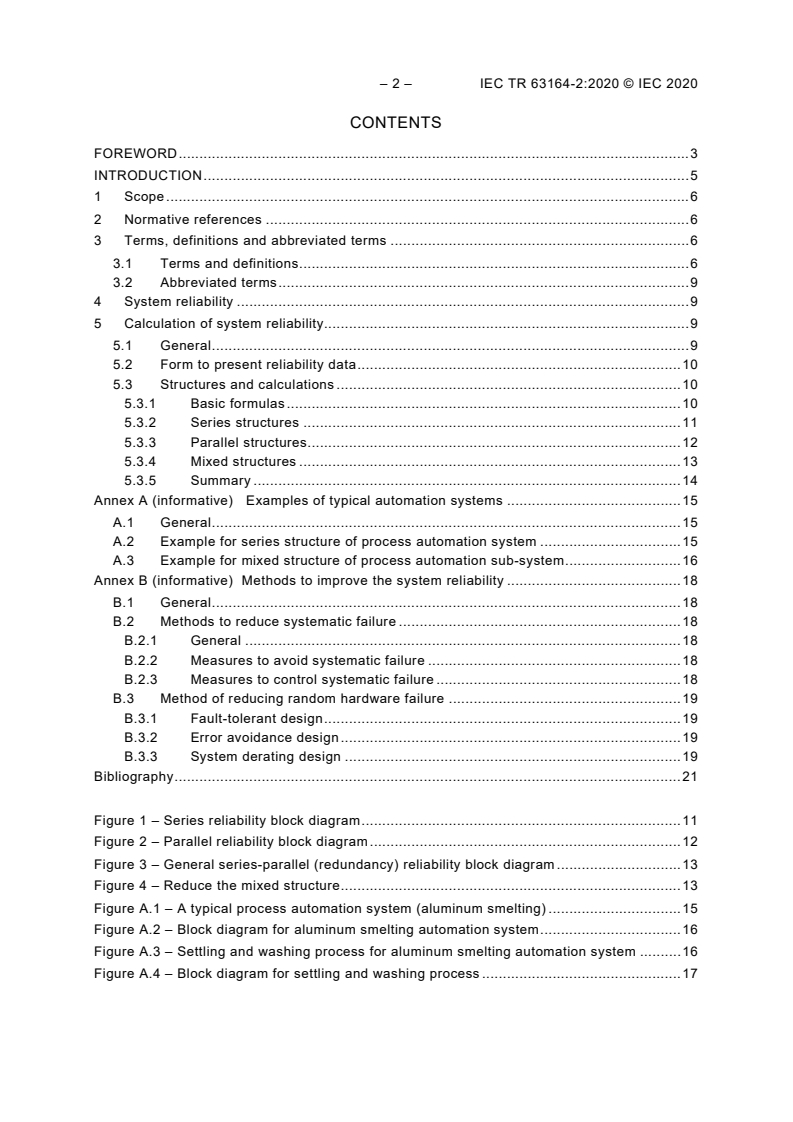
CONTENTS
FOREWORD . 3
INTRODUCTION . 5
1 Scope . 6
2 Normative references . 6
3 Terms, definitions and abbreviated terms . 6
3.1 Terms and definitions . 6
3.2 Abbreviated terms . 9
4 System reliability . 9
5 Calculation of system reliability. 9
5.1 General . 9
5.2 Form to present reliability data . 10
5.3 Structures and calculations . 10
5.3.1 Basic formulas . 10
5.3.2 Series structures . 11
5.3.3 Parallel structures . 12
5.3.4 Mixed structures . 13
5.3.5 Summary . 14
Annex A (informative) Examples of typical automation systems . 15
A.1 General . 15
A.2 Example for series structure of process automation system . 15
A.3 Example for mixed structure of process automation sub-system . 16
Annex B (informative) Methods to improve the system reliability . 18
B.1 General . 18
B.2 Methods to reduce systematic failure . 18
B.2.1 General . 18
B.2.2 Measures to avoid systematic failure . 18
B.2.3 Measures to control systematic failure . 18
B.3 Method of reducing random hardware failure . 19
B.3.1 Fault-tolerant design . 19
B.3.2 Error avoidance design . 19
B.3.3 System derating design . 19
Bibliography . 21
Figure 1 – Series reliability block diagram . 11
Figure 2 – Parallel reliability block diagram . 12
Figure 3 – General series-parallel (redundancy) reliability block diagram . 13
Figure 4 – Reduce the mixed structure . 13
Figure A.1 – A typical process automation system (aluminum smelting) . 15
Figure A.2 – Block diagram for aluminum smelting automation system . 16
Figure A.3 – Settling and washing process for aluminum smelting automation system . 16
Figure A.4 – Block diagram for settling and washing process . 17
INTERNATIONAL ELECTROTECHNICAL COMMISSION
____________
RELIABILITY OF INDUSTRIAL AUTOMATION DEVICES AND SYSTEMS –
Part 2: System reliability
FOREWORD
1) The International Electrotechnical Commission (IEC) is a worldwide organization for standardization comprising
all national electrotechnical committees (IEC National Committees). The object of IEC is to promote international
co-operation on all questions concerning standardization in the electrical and electronic fields. To this end and
in addition to other activities, IEC publishes International Standards, Technical Specifications, Technical Reports,
Publicly Available Specifications (PAS) and Guides (hereafter referred to as “IEC Publication(s)”). Their
preparation is entrusted to technical committees; any IEC National Committee interested in the subject dealt with
may participate in this preparatory work. International, governmental and non-governmental organizations liaising
with the IEC also participate in this preparation. IEC collaborates closely with the International Organization for
Standardization (ISO) in accordance with conditions determined by agreement between the two organizations.
2) The formal decisions or agreements of IEC on technical matters express, as nearly as possible, an international
consensus of opinion on the relevant subjects since each technical committee has representation from all
interested IEC National Committees.
3) IEC Publications have the form of recommendations for international use and are accepted by IEC National
Committees in that sense. While all reasonable efforts are made to ensure that the technical content of IEC
Publications is accurate, IEC cannot be held responsible for the way in which they are used or for any
misinterpretation by any end user.
4) In order to promote international uniformity, IEC National Committees undertake to apply IEC Publications
transparently to the maximum extent possible in their national and regional publications. Any divergence between
any IEC Publication and the corresponding national or regional publication shall be clearly indicated in the latter.
5) IEC itself does not provide any attestation of conformity. Independent certification bodies provide conformity
assessment services and, in some areas, access to IEC marks of conformity. IEC is not responsible for any
services carried out by independent certification bodies.
6) All users should ensure that they have the latest edition of this publication.
7) No liability shall attach to IEC or its directors, employees, servants or agents including individual experts and
members of its technical committees and IEC National Committees for any personal injury, property damage or
other damage of any nature whatsoever, whether direct or indirect, or for costs (including legal fees) and
expenses arising out of the publication, use of, or reliance upon, this IEC Publication or any other IEC Publications.
8) Attention is drawn to the Normative references cited in this publication. Use of the referenced publications is
indispensable for the correct application of this publication.
9) Attention is drawn to the possibility that some of the elements of this IEC Publication may be the subject of patent
rights. IEC shall not be held responsible for identifying any or all such patent rights.
The main task of IEC technical committees is to prepare International Standards. However, a
technical committee may propose the publication of a technical report when it has collected
data of a different kind from that which is normally published as an International Standard, for
example "state of the art".
IEC TR 63164-2 has been prepared by IEC technical committee 65: Industrial-process
measurement, control and automation.
The text of this Technical Report is based on the following documents:
Enquiry draft Report on voting
65/771/DTR 65/796/RVDTR
Full information on the voting for the approval of this technical report can be found in the report
on voting indicated in the above table.
This document has been drafted in accordance with the ISO/IEC Directives, Part 2.
– 4 – IEC TR 63164-2:2020 © IEC 2020
A list of all parts in the IEC 63164 series, published under the general title Reliability of industrial
automation devices and systems, can be found on the IEC website.
The committee has decided that the contents of this document will remain unchanged until the
stability date indicated on the IEC website under "http://webstore.iec.ch" in the data related to
the specific document. At this date, the document will be
• reconfirmed,
• withdrawn,
• replaced by a revised edition, or
• amended.
A bilingual version of this publication may be issued at a later date.
INTRODUCTION
Under the background of Smart Manufacturing, new production modes such as mass
customization based on interconnected factories require real-time interconnection, frequent
switching and integration across different levels. Therefore, reliability is an important
requirement for automation systems in factories. Reliability data of automation systems is the
basis for maintenance planning e.g. stock-keeping of spare parts of a production line. An
automation system usually consists of several different devices or machines that are used in
series, parallel or mixed. This technical report gives guidance for system integrator on how to
evaluate the reliability of such entire systems.
This report is the second part of the series. This part concentrates on calculation of failure rates
or reliability values for systems based on failure rates or reliability values of single devices
depending on the structure of the system. This is necessary for system integrators or designers
to be able to calculate the reliability of an entire system from the reliability values of individual
devices (see IEC TS 63164-1).
Parts within IEC 63164 series are:
Part 1: Assurance of automation devices reliability data and specification of their source
Part 2: System reliability
Future parts may include following subjects:
– collecting reliability data for automation devices in the field;
– user guide.
– 6 – IEC TR 63164-2:2020 © IEC 2020
RELIABILITY OF INDUSTRIAL AUTOMATION DEVICES AND SYSTEMS –
Part 2: System reliability
1 Scope
This part of IEC 63164 provides guidance on the calculation of reliability data of automation
systems which can be simplified as series, parallel or mixed structure based on reliability data
of single devices and/or sub-systems, and on the form to present the data.
NOTE This procedure is only targeted to the reliability of automation systems, but not systems that embed
automation systems, e.g. process plant.
Reliability is included in dependability, and this document is mainly focused on random
hardware failures that affect reliability. Dependability is used as a collective term for the time-
related quality characteristics of an item and additionally includes availability, recoverability,
maintainability, maintenance support performance, and, in some cases, other characteristics
such as durability, safety and security, which are all not in the scope of this Technical Report.
2 Normative references
The following documents are referred to in the text in such a way that some or all of their content
constitutes requirements of this document. For dated references, only the edition cited applies.
For undated references, the latest edition of the referenced document (including any
amendments) applies.
There are no normative references in this document.
3 Terms, definitions and abbreviated terms
3.1 Terms and definitions
For the purposes of this document, the following terms and definitions apply.
ISO and IEC maintain terminological databases for use in standardization at the following
addresses:
• IEC Electropedia: available at http://www.electropedia.org/
• ISO Online browsing platform: available at http://www.iso.org/obp
3.1.1
automation system
DCS- or PLC-based system for the monitoring and controlling of production facilities in the
process industry, including control systems based on fieldbus technologies
Note 1 to entry: Whenever “system” is mentioned in this document, it means “automation system”.
[SOURCE: IEC 62381:2012, 3.1.1, modified – Note 1 to entry has been added.]
3.1.2
B threshold
time until 10 % of the components fail
Note 1 to entry: The applicable time interval is dependent on the nature and application of the asset and can be
elapsed time, operating hours, number of cycles, etc.
Note 2 to entry: For this document, an average failure rate is calculated from the B threshold by dividing 10 %
with the B threshold in hours. The influence of infant mortality is neglected and increasing failure rate is assumed
only significant after B .
Note 3 to entry: Once the B threshold is reached, the failure rate is assumed unacceptable for pneumatic and
electromechanical components.
3.1.3
dependability
ability to perform as and when required
Note 1 to entry: Dependability includes availability (192-01-23), reliability (192-01-24), recoverability (192-01-25),
maintainability (192-01-27), and maintenance support performance (192-01-29), and, in some cases, other
characteristics such as durability (192-01-21), safety and security.
Note 2 to entry: Dependability is used as a collective term for the time-related quality characteristics of an item.
[SOURCE: IEC 60050-192:2015, 192-01-22]
3.1.4
failure rate
λ
limit, if it exists, of the quotient of the conditional probability that the failure of a non-repairable
item occurs within time interval (t, t + Δt) by Δt, when Δt tends to zero, given that failure has
not occurred within time interval (0, t)
Note 1 to entry: See IEC 61703, Mathematical expressions for reliability, availability, maintainability and
maintenance support terms, for more detail.
[SOURCE: IEC 60050-192:2015, 192-05-06, modified – The first preferred term "instantaneous
failure rate", formula and Note 2 to entry have been deleted]
3.1.5
mean operating time between failures
MTBF
expectation of the duration of the operating time between failures
Note 1 to entry: Mean operating time between failures should only be applied to repairable items. For non-repairable
items, see mean operating time to failure (192-05-11).
[SOURCE: IEC 60050-192:2015, 192-05-13, modified – The last preferred term "MOTBF" has
been deleted]
3.1.6
mean operating time to failure
MTTF
expectation of the operating time to failure
Note 1 to entry: In the case of non-repairable items with an exponential distribution of operating times to failure (i.e.
a constant failure rate) the MTTF is numerically equal to the reciprocal of the failure rate. This is also true for
repairable items if after restoration they can be considered to be "as-good-as-new".
[SOURCE: IEC 60050-192:2015, 192-05-11, modified – Note 2 has been deleted]
– 8 – IEC TR 63164-2:2020 © IEC 2020
3.1.7
mean time to restoration
MTTR
expectation of the time to restoration
Note 1 to entry: IEC 60050-191:1990 (now withdrawn; replaced by IEC 60050-192:2015) defined the term ”mean
time to recovery” as a synonym, but restoration and recovery are not synonyms.
[SOURCE: IEC 60050-192:2015, 192-07-23]
3.1.8
mission time
T
M
period of time covering the intended use
Note 1 to entry: For complex system with maintenance of components, the mission time of system can be longer
than the mission time of individual components of the system.
[SOURCE: ISO 13849-1:2015, 3.1.28, modified – "of an SRP/CS" has been deleted and the
note to entry has been added]
3.1.9
random hardware failure
failure, occurring at a random time, which results from one or more of the possible degradation
mechanisms in the hardware
[SOURCE: IEC 61508-4:2010, 3.6.5, modified – The notes have been deleted]
3.1.10
reliability
ability to perform as required, without failure, for a given time interval, under given conditions
Note 1 to entry: The time interval duration may be expressed in units appropriate to the item concerned, e.g.
calendar time, operating cycles, distance run, etc., and the units should always be clearly stated.
Note 2 to entry: Given conditions include aspects that affect reliability, such as: mode of operation, stress levels,
environmental conditions, and maintenance.
[SOURCE: IEC 60050-192:2015, 192-01-24, modified – Note 3 to entry has been deleted]
3.1.11
systematic failure
failure, related in a deterministic way to a certain cause, which can only be eliminated by a
modification of the design or of the manufacturing process, operational procedures,
documentation or other relevant factors
Note 1 to entry: Corrective maintenance without modification will usually not eliminate the failure cause.
Note 2 to entry: A systematic failure can be induced by simulating the failure cause.
Note 3 to entry: Examples of causes of systematic failures include human error in
– the safety requirements specification;
– the design, manufacture, installation, operation of the hardware;
– the design, implementation, etc. of the software.
Note 4 to entry: In this document, failures in a safety-related system are categorized as random hardware failures
(see 3.1.9) or systematic failures.
[SOURCE: IEC 61508-4:2010, 3.6.6]
3.1.12
useful life
time interval, from first use until user requirements are no longer met, due to economics of
operation and maintenance, or obsolescence
Note 1 to entry: In this context, “first use” excludes testing activities prior to hand-over of the item to the end-user.
[SOURCE: IEC 60050-192:2015, 192-02-27]
3.2 Abbreviated terms
FIT Failures in time
METBF Mean (elapsed) time between failures
MTBF Mean operating time between failures
MTTF Mean operating time to failure
MTTR Mean time to restoration
TM Mission time
FMEA Fault modes and effects analysis
FTA Fault tree analysis
RBD Reliability block diagram
PoF Physics of failure
4 System reliability
Typically, an automation system consists of several different types of sub-systems, automation
devices and accessories, and requires consistency in the reliability data of the automation
system as well as automation devices.
The reliability of the system needs to consider the reliability of hardware, including interface,
communication, etc. In addition to hardware reliability, other factors such as software, human
factor, security, may also be considered (see Annex A).
NOTE Communication in this document means the hardware used for communication, such as cable, router.
5 Calculation of system reliability
5.1 General
This document provides guidance for calculation of system reliability for simple system
structures with constant failure rates for its elements, based on reliability block diagrams. For
these and other type of system structures, e.g. k-out-of-n structures, see e.g. IEC 61078. For
more information about other calculation methods for systems, see e.g. IEC 60300-3-1.
Reliability data from observation of devices in the field and laboratory test are not addressed in
this document, but it is referred to IEC TS 63164-1.
Every single element of the system needs to have reliability data, like MTTF, MTBF, 𝜆𝜆 or B .
To calculate the whole system all single elements ne
...