IEC 60895:2002/COR1:2003
(Corrigendum)Corrigendum 1 - Live working - Conductive clothing for use at nominal voltage up to 800 kV a.c. and +/- 600 kV d.c.
Corrigendum 1 - Live working - Conductive clothing for use at nominal voltage up to 800 kV a.c. and +/- 600 kV d.c.
Corrigendum 1 - Travaux sous tension - Vêtements conducteurs pour usage jusqu'à 800 kV de tension nominale en courant alternatif et +/- 600 kV en courant continu
General Information
Relations
Standards Content (Sample)
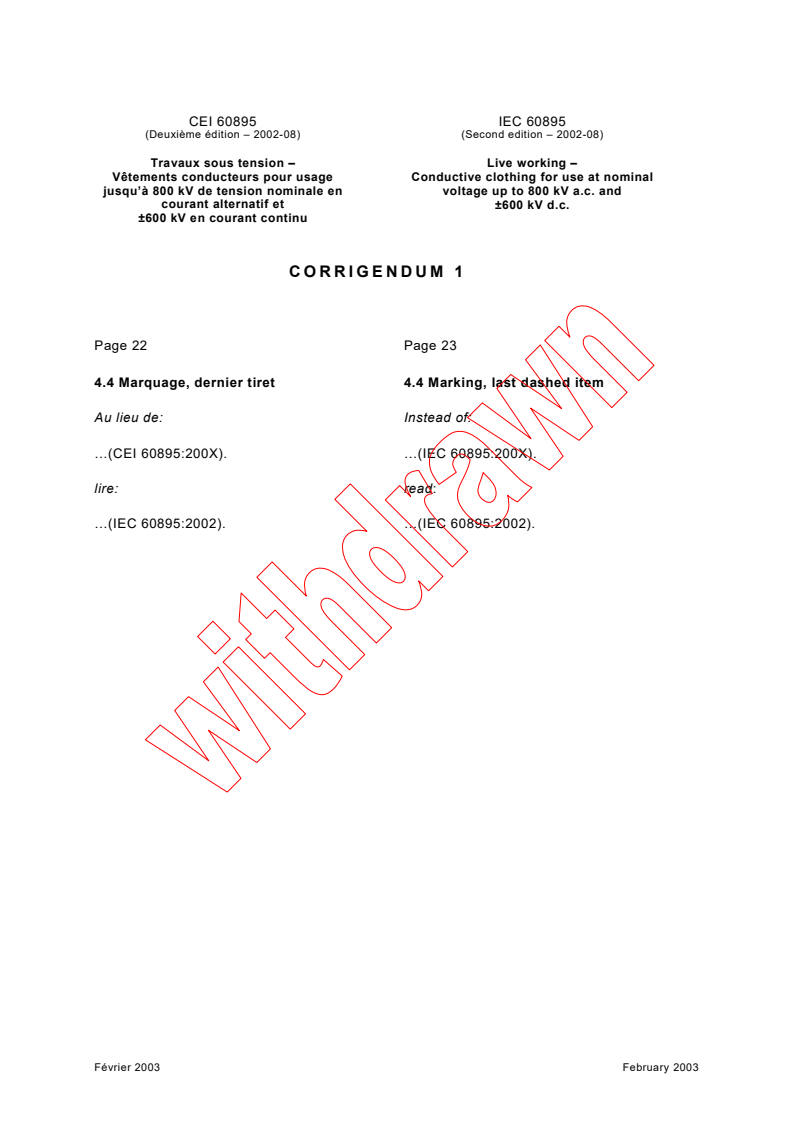
CEI 60895 IEC 60895
(Deuxième édition – 2002-08) (Second edition – 2002-08)
Travaux sous tension – Live working –
Vêtements conducteurs pour usage Conductive clothing for use at nominal
jusqu’à 800 kV de tension nominale en voltage up to 800 kV a.c. and
courant alternatif et ±600 kV d.c.
±600 kV en
...
This May Also Interest You
IEC 60895:2020 is applicable to conductive clothing, worn during live working (especially bare-hand working) on AC and DC electrical installations, to provide electrical continuity between all parts of the clothing and a reduction of electric field inside the clothing.
This document is applicable to conductive clothing assembled from a conductive garment (jackets and trousers or coveralls forming a one-piece garment) and from conductive component parts (gloves, hoods or helmets, shoes or boots, overshoe socks and socks) in electrical systems with nominal voltage up to 1 000 kV AC and up to ±800 kV DC.
This document does not indicate values of protection from the effects of the electric arc, because any value indicated would not guarantee the necessary protection from the effects of electric arcs, or the operator would need to wear very heavy and rigid conductive clothing, which would not allow the execution of the work in safety.
The products designed and manufactured according to this document contribute to the safety of the users provided they are used by persons trained for the work, in accordance with the live working methods and the instructions for use.
This third edition cancels and replaces the second edition, published in 2002. This edition constitutes a technical revision.
This edition includes the following significant technical changes with respect to the previous edition:
a) increase of the use up to 1 000 kV AC and ±800 kV DC;
b) introduction of two classes of conductive clothing with different electrical requirements;
c) revision of the electrical requirements of conductive clothing;
d) definition of specific resistance values for each component part of the conductive clothing;
e) introduction of conductive helmet and conductive scarf as component parts of conductive clothing;
f) introduction of mechanical requirements and new tests for fabrics;
g) update of the cleaning test procedures;
h) revision of the efficiency test of the conductive clothing to improve the feasibility and repeatability;
i) preparation of the elements of classification of defects, and general application of IEC 61318:2007;
j) the normative Annex B for the classification of tests has been replaced by normative Annex C for the general type tests procedure, the normative Annex D for the classification of defects and the informative Annex E providing the justification for the classification of defects;
k) the normative Annex C on sampling procedure has been deleted (not applicable according to IEC 61318:2007);
l) modification of the recommended frequency of the periodic tests.
- Standard139 pagesEnglish and French languagesale 15% off
IEC 60855-1:2016 is applicable to insulating foam-filled tubes and solid rods, of a circular cross-section, made of synthetic materials with reinforced fibreglass and intended to be used in the manufacture and construction of tools, devices and equipment for carrying out live working on electrical systems operating at voltages above 1 kV. This second edition cancels and replaces the first edition published in 2009. This edition constitutes a technical revision.
- Standard65 pagesEnglish and French languagesale 15% off
IEC 60855-1:2009 is applicable to insulating foam-filled tubes and solid rods, of a circular cross-section, made of synthetic materials and intended to be used for the manufacture and construction of tools and equipment for carrying out live work on electrical systems operating at voltages above 1 kV. Tubes and rods of cross-section other than circular are not covered by this part of IEC 60855. This first edition of IEC 60855-1 cancels and replaces the first edition of IEC 60855 published in 1985; and constitutes a technical revision. Technical committee 78 is considering the preparation of IEC 60855-2, which would cover tubes and rods of cross-section other than circular.
- Standard62 pagesEnglish and French languagesale 15% off
Applicable to conductive clothing, either assembled from component parts or forming a single complete clothing, worn by (electrically) skilled persons during live working (especially bare-hand working) at a nominal power system voltage up to 800 kV a.c. and ±600 kV d.c. It is applicable to conductive jackets, trousers, coveralls (one-piece clothing), gloves or mitts, hoods, shoes, overshoe socks and socks. The main changes with respect to the previous edition are listed below: - the scope has been extended to cover the use of conductive clothing to ±600 kV d.c.; - revision of the electrical resistance requirements of the fabrics used in conductive clothing; - revision of the testing procedures for complete clothing. The contents of the corrigendum of February 2003 habe been included in this copy.
- Standard79 pagesEnglish and French languagesale 15% off
- Standard3 pagesEnglish and French languagesale 15% off
IEC TR 61169-1-8:2025 provides a test method for voltage standing wave ratio (VSWR, hereinafter) of single RF connector by double-connector method. This document is applicable to single RF cable connectors and single microstrip RF connectors as well as single adapters if an estimation of the VSWR of a single completely installed RF-connector is used and a time domain feature is not available on the vector network analyzer.
- Technical report18 pagesEnglish languagesale 15% off
IEC 62541-100:2025 defines the information model associated with Devices. This document describes three models which build upon each other as follows:
• The (base) Device Model is intended to provide a unified view of devices and their hardware and software parts irrespective of the underlying device protocols.
• The Device Communication Model adds Network and Connection information elements so that communication topologies can be created.
• The Device Integration Host Model finally adds additional elements and rules required for host systems to manage integration for a complete system. It enables reflecting the topology of the automation system with the devices as well as the connecting communication networks.
This document also defines AddIns that can be used for the models in this document but also for models in other information models. They are:
• Locking model – a generic AddIn to control concurrent access,
• Software update model – an AddIn to manage software in a Device.
This second edition cancels and replaces the first edition published in 2015. This edition constitutes a technical revision.
This edition includes the following significant technical changes with respect to the previous edition:
a a ComponentType that can be used to model any HW or SW element of a device has been defined and a SoftwareType has been added as subtype of ComponentType;
b the new OPC UA interface concept and defined interfaces for Nameplate, DeviceHealth, and SupportInfo has been added.
c) a new model for Software Update (Firmware Update) has been added;
d) a new entry point for documents where each document is represented by a FileType instance has been specified;
e) a model that provides information about the lifetime, related limits and semantic of the lifetime of things like tools, material or machines has been added.
- Standard152 pagesEnglish languagesale 15% off
- Standard158 pagesFrench languagesale 15% off
- Standard310 pagesEnglish and French languagesale 15% off
IEC TS 62876-3-4:2025, which is a Technical Specification, establishes a standardized guideline to assess
• reliability of metallic interfaces
of Ohmic-contacted field-effect transistors (FETs) using 2D nano-materials by quantifying
• linearity of current-voltage (I-V) output curves
for devices with various materials combinations of van der Waals (vdW) interfaces.
For metallic interfaces with 2D materials (eg. graphene, MoS2, MoTe2, WS2, WSe2, etc) and metals (eg. Ti, Cr, Au, Pd, In, Sb, etc), the reliability of Ohmic contact is quantified.
For FETs consisting of 2D materials-based channels (eg. MoS2, MoTe2, WS2, WSe2, etc), the reliability of Ohmic contact when varying contacting metal, channel length, channel thickness, applied voltage, and surface treatment condition is quantified.
The reliability of the metallic contacts is quantified from the linearity of I-V characteristics measured over extended time periods.
- Technical specification24 pagesEnglish languagesale 15% off
IEC 63522-4:2025 is used for testing along with the appropriate severities and conditions for measurements and tests designed to assess the ability of DUTs to perform under expected conditions of transportation, storage and all aspects of operational use.
The object of this test is to define a standard test method for the dielectric strength test.
- Standard10 pagesEnglish languagesale 15% off
- Standard10 pagesFrench languagesale 15% off
- Standard20 pagesEnglish and French languagesale 15% off
IEC TS 63414:2025 is applicable for the determination of the AC and DC pollution flashover and withstand voltage characteristics of insulators with polymeric housing, to be used outdoors in HV applications and exposed to polluted environments. This is also applicable for insulators with hydrophobic coatings. This document refers to AC systems with a rated voltage greater than 1 000 V and DC systems with a rated voltage greater than 1 500 V.
The object of this technical specification is to prescribe standardized test methods, requirements and procedures for artificial pollution tests applicable to polymeric insulators for overhead lines including traction lines, station post and hollow insulators of equipment. Available test experience with polymeric station post and hollow insulators, especially for DC applications, is limited.
The proposed tests are not applicable to ceramic and glass insulators without polymeric housing, to greased insulators or to special types of insulators (e.g., insulators with semiconducting glaze).
Differently to ceramic and glass insulators without polymeric housing:
- The pollution performance of insulators with polymeric housing varies with the hydrophobicity condition of the surface. The specific conditions simulated by standardized tests might not represent the actual dynamic field conditions.
- The determination of the flashover and/or withstand voltage under pollution conditions is not enough for dimensioning. Additional constraints related to possible ageing are also to be considered.
- If the Hydrophobicity Transfer Material (HTM) test according to IEC TR 62039 confirms that an insulator is non-HTM, it can be tested according to IEC 60507 or IEC TS 61245.
- Technical specification39 pagesEnglish languagesale 15% off


Questions, Comments and Discussion
Ask us and Technical Secretary will try to provide an answer. You can facilitate discussion about the standard in here.
Loading comments...