

IEC 61643-332:2024
(Main)Components for low-voltage surge protection - Part 332: Selection and application principles for metal oxide varistors (MOV)
General Information
- Abstract
IEC 61643-332:2024 describes the theory of operation, principles for the selection and application of MOVs to be connected to power lines or telecommunication or signalling circuits, up to 1 000 V AC or 1 500 V DC. These SPCs are designed to protect apparatus or personnel, or both, from high transient voltages. This document applies to MOVs having two electrodes and voltage dependents elements with or without disconnectors. It does not apply to assemblies that include MOVs and their influence on the MOV's characteristics. This standard specifically discusses the zinc-oxide type of MOVs.
- Status
- Published
- Publication Date
- 16-Apr-2024
- Technical Committee
- SC 37B - Components for low-voltage surge protection
- Drafting Committee
- WG 1 - TC 37/SC 37B/WG 1
- Current Stage
- PPUB - Publication issued
- Start Date
- 17-Apr-2024
- Completion Date
- 19-Apr-2024
Overview
IEC 61643-332:2024 is an international standard published by the International Electrotechnical Commission (IEC) that focuses on components for low-voltage surge protection, specifically metal oxide varistors (MOVs). This standard provides comprehensive guidance on the selection and application principles of MOVs designed to protect electrical equipment and personnel from transient overvoltages on power lines, telecommunication, or signalling circuits with voltage ratings up to 1,000 V AC or 1,500 V DC.
The standard describes the operational theory of MOVs, including their thermal protection, failure modes, and application considerations. It applies primarily to zinc-oxide type MOVs with two electrodes and voltage-dependent elements, covering devices with or without disconnectors. The document does not address assemblies incorporating MOVs or their influence on MOV behavior, emphasizing component-level knowledge.
Key Topics
Theory and Construction
IEC 61643-332:2024 outlines the fundamental theory of MOV operation, showing how these devices limit transient voltages by changing resistance with voltage stress. It covers:
- MOV voltage-current (V-I) characteristics
- Thermal protection mechanisms to avoid damage under fault conditions
- Different failure modes such as short-circuit, degradation, and open-circuit types
Selection Guidelines
The standard provides detailed principles to help engineers select suitable MOVs based on:
- Maximum continuous operating voltage (MCOV)
- Energy absorption capabilities considering pulse shapes and widths
- Compatibility with specific circuit requirements, including power supply types and earthing methods
- Application-specific factors such as parallel or series connection of MOVs and requirements for thermally protected MOVs
Application Considerations
IEC 61643-332:2024 discusses practical aspects of MOV application:
- Recommended circuit topologies for surge protection devices (SPDs)
- Methods to mitigate consequences of MOV failure, including fuse protection and thermal disconnection
- Proper location and bonding practices to optimize surge protection effectiveness
- Use in various environments, including telecommunication and signalling lines
- Special applications such as electrostatic discharge (ESD) protection and transient overvoltage (TOV) considerations
Safety and Hazard Information
The standard emphasizes safety, providing guidance to minimize:
- Fire risks associated with MOV failure
- Electrical shock hazards
- Mechanical risks such as shattering under fault conditions
- Precautionary statements related to MOV degradation and possible equipment damage
Practical Applications
IEC 61643-332:2024 serves as a critical reference for professionals designing and deploying surge protective components in:
- Low-voltage power distribution systems requiring transient overvoltage protection
- Telecommunication and signalling circuits exposed to electrical surges and ESD events
- Protection of equipment in industrial, commercial, and residential infrastructures
- Specialty fields like wind turbine systems and 5G power supply networks, ensuring reliable surge protection compatible with modern technologies
- Design and evaluation of thermally protected MOVs to enhance safety and longevity under fault conditions
By following this standard, electrical engineers and system designers can improve the resilience of electrical and electronic installations, reducing downtime and equipment damage caused by transient surges.
Related Standards
IEC 61643-332:2024 complements other standards in the IEC 61643 series on surge protective devices (SPDs), including:
- IEC 61643-11 - Low-voltage surge protective devices connected to low-voltage power systems: performance requirements and testing methods
- IEC 61643-21 - Surge protective devices connected to telecommunications and signalling networks
- Other IEC standards covering broader surge and lightning protection systems
Using IEC 61643-332 in conjunction with these standards ensures a harmonized approach to surge protection design, from component selection to system-level integration.
Keywords: IEC 61643-332:2024, metal oxide varistors, MOV selection, low-voltage surge protection, transient voltage protection, surge protective devices, thermal protection, surge suppression, zinc oxide MOV, electrical safety, overvoltage mitigation, MOV failure modes, surge protective component standards.
Frequently Asked Questions
IEC 61643-332:2024 is a standard published by the International Electrotechnical Commission (IEC). Its full title is "Components for low-voltage surge protection - Part 332: Selection and application principles for metal oxide varistors (MOV)". This standard covers: IEC 61643-332:2024 describes the theory of operation, principles for the selection and application of MOVs to be connected to power lines or telecommunication or signalling circuits, up to 1 000 V AC or 1 500 V DC. These SPCs are designed to protect apparatus or personnel, or both, from high transient voltages. This document applies to MOVs having two electrodes and voltage dependents elements with or without disconnectors. It does not apply to assemblies that include MOVs and their influence on the MOV's characteristics. This standard specifically discusses the zinc-oxide type of MOVs.
IEC 61643-332:2024 describes the theory of operation, principles for the selection and application of MOVs to be connected to power lines or telecommunication or signalling circuits, up to 1 000 V AC or 1 500 V DC. These SPCs are designed to protect apparatus or personnel, or both, from high transient voltages. This document applies to MOVs having two electrodes and voltage dependents elements with or without disconnectors. It does not apply to assemblies that include MOVs and their influence on the MOV's characteristics. This standard specifically discusses the zinc-oxide type of MOVs.
IEC 61643-332:2024 is classified under the following ICS (International Classification for Standards) categories: 31.040.20 - Potentiometers, variable resistors. The ICS classification helps identify the subject area and facilitates finding related standards.
IEC 61643-332:2024 is available in PDF format for immediate download after purchase. The document can be added to your cart and obtained through the secure checkout process. Digital delivery ensures instant access to the complete standard document.
Standards Content (Sample)
IEC 61643-332 ®
Edition 1.0 2024-04
INTERNATIONAL
STANDARD
NORME
INTERNATIONALE
Components for low-voltage surge protection –
Part 332: Selection and application principles for metal oxide varistors (MOV)
Composants pour parafoudres basse tension –
Partie 332: Choix et principes d'application des varistances à oxyde métallique
(MOV)
All rights reserved. Unless otherwise specified, no part of this publication may be reproduced or utilized in any form
or by any means, electronic or mechanical, including photocopying and microfilm, without permission in writing from
either IEC or IEC's member National Committee in the country of the requester. If you have any questions about IEC
copyright or have an enquiry about obtaining additional rights to this publication, please contact the address below or
your local IEC member National Committee for further information.
Droits de reproduction réservés. Sauf indication contraire, aucune partie de cette publication ne peut être reproduite ni
utilisée sous quelque forme que ce soit et par aucun procédé, électronique ou mécanique, y compris la photocopie et
les microfilms, sans l'accord écrit de l'IEC ou du Comité national de l'IEC du pays du demandeur. Si vous avez des
questions sur le copyright de l'IEC ou si vous désirez obtenir des droits supplémentaires sur cette publication, utilisez
les coordonnées ci-après ou contactez le Comité national de l'IEC de votre pays de résidence.
IEC Secretariat Tel.: +41 22 919 02 11
3, rue de Varembé info@iec.ch
CH-1211 Geneva 20 www.iec.ch
Switzerland
About the IEC
The International Electrotechnical Commission (IEC) is the leading global organization that prepares and publishes
International Standards for all electrical, electronic and related technologies.
About IEC publications
The technical content of IEC publications is kept under constant review by the IEC. Please make sure that you have the
latest edition, a corrigendum or an amendment might have been published.
IEC publications search - webstore.iec.ch/advsearchform IEC Products & Services Portal - products.iec.ch
The advanced search enables to find IEC publications by a Discover our powerful search engine and read freely all the
variety of criteria (reference number, text, technical publications previews, graphical symbols and the glossary.
committee, …). It also gives information on projects, replaced With a subscription you will always have access to up to date
and withdrawn publications. content tailored to your needs.
IEC Just Published - webstore.iec.ch/justpublished
Electropedia - www.electropedia.org
Stay up to date on all new IEC publications. Just Published
The world's leading online dictionary on electrotechnology,
details all new publications released. Available online and once
containing more than 22 500 terminological entries in English
a month by email.
and French, with equivalent terms in 25 additional languages.
Also known as the International Electrotechnical Vocabulary
IEC Customer Service Centre - webstore.iec.ch/csc
(IEV) online.
If you wish to give us your feedback on this publication or need
further assistance, please contact the Customer Service
Centre: sales@iec.ch.
A propos de l'IEC
La Commission Electrotechnique Internationale (IEC) est la première organisation mondiale qui élabore et publie des
Normes internationales pour tout ce qui a trait à l'électricité, à l'électronique et aux technologies apparentées.
A propos des publications IEC
Le contenu technique des publications IEC est constamment revu. Veuillez vous assurer que vous possédez l’édition la
plus récente, un corrigendum ou amendement peut avoir été publié.
Recherche de publications IEC - IEC Products & Services Portal - products.iec.ch
webstore.iec.ch/advsearchform Découvrez notre puissant moteur de recherche et consultez
La recherche avancée permet de trouver des publications IEC gratuitement tous les aperçus des publications, symboles
en utilisant différents critères (numéro de référence, texte, graphiques et le glossaire. Avec un abonnement, vous aurez
comité d’études, …). Elle donne aussi des informations sur les toujours accès à un contenu à jour adapté à vos besoins.
projets et les publications remplacées ou retirées.
Electropedia - www.electropedia.org
IEC Just Published - webstore.iec.ch/justpublished
Le premier dictionnaire d'électrotechnologie en ligne au monde,
Restez informé sur les nouvelles publications IEC. Just
avec plus de 22 500 articles terminologiques en anglais et en
Published détaille les nouvelles publications parues.
français, ainsi que les termes équivalents dans 25 langues
Disponible en ligne et une fois par mois par email.
additionnelles. Egalement appelé Vocabulaire
Electrotechnique International (IEV) en ligne.
Service Clients - webstore.iec.ch/csc
Si vous désirez nous donner des commentaires sur cette
publication ou si vous avez des questions contactez-nous:
sales@iec.ch.
IEC 61643-332 ®
Edition 1.0 2024-04
INTERNATIONAL
STANDARD
NORME
INTERNATIONALE
Components for low-voltage surge protection –
Part 332: Selection and application principles for metal oxide varistors (MOV)
Composants pour parafoudres basse tension –
Partie 332: Choix et principes d'application des varistances à oxyde métallique
(MOV)
INTERNATIONAL
ELECTROTECHNICAL
COMMISSION
COMMISSION
ELECTROTECHNIQUE
INTERNATIONALE
ICS 31.040.20 ISBN 978-2-8322-8594-7
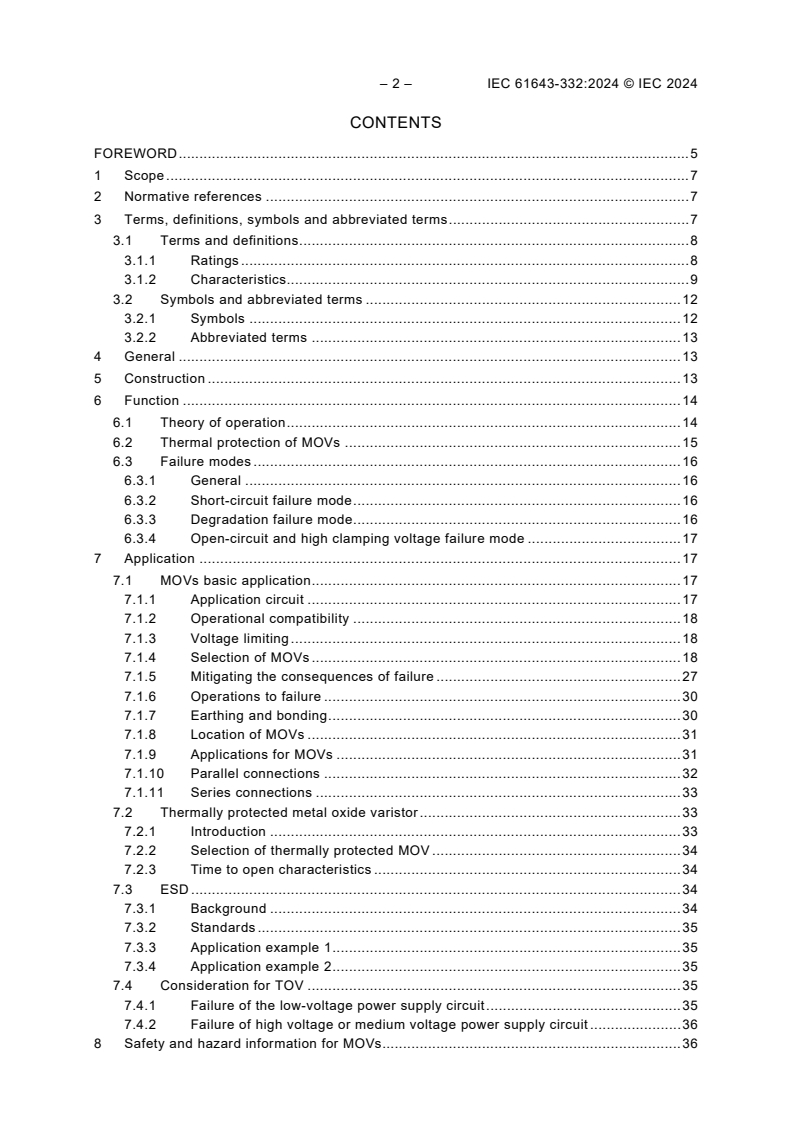
– 2 – IEC 61643-332:2024 © IEC 2024
CONTENTS
FOREWORD . 5
1 Scope . 7
2 Normative references . 7
3 Terms, definitions, symbols and abbreviated terms . 7
3.1 Terms and definitions . 8
3.1.1 Ratings . 8
3.1.2 Characteristics. 9
3.2 Symbols and abbreviated terms . 12
3.2.1 Symbols . 12
3.2.2 Abbreviated terms . 13
4 General . 13
5 Construction . 13
6 Function . 14
6.1 Theory of operation . 14
6.2 Thermal protection of MOVs . 15
6.3 Failure modes . 16
6.3.1 General . 16
6.3.2 Short-circuit failure mode . 16
6.3.3 Degradation failure mode . 16
6.3.4 Open-circuit and high clamping voltage failure mode . 17
7 Application . 17
7.1 MOVs basic application . 17
7.1.1 Application circuit . 17
7.1.2 Operational compatibility . 18
7.1.3 Voltage limiting . 18
7.1.4 Selection of MOVs . 18
7.1.5 Mitigating the consequences of failure . 27
7.1.6 Operations to failure . 30
7.1.7 Earthing and bonding . 30
7.1.8 Location of MOVs . 31
7.1.9 Applications for MOVs . 31
7.1.10 Parallel connections . 32
7.1.11 Series connections . 33
7.2 Thermally protected metal oxide varistor . 33
7.2.1 Introduction . 33
7.2.2 Selection of thermally protected MOV . 34
7.2.3 Time to open characteristics . 34
7.3 ESD . 34
7.3.1 Background . 34
7.3.2 Standards . 35
7.3.3 Application example 1 . 35
7.3.4 Application example 2 . 35
7.4 Consideration for TOV . 35
7.4.1 Failure of the low-voltage power supply circuit . 35
7.4.2 Failure of high voltage or medium voltage power supply circuit . 36
8 Safety and hazard information for MOVs. 36
8.1 Overview. 36
8.1.1 General . 36
8.1.2 Confirmation of rated performance . 36
8.2 Fire risks . 36
8.2.1 General . 36
8.2.2 Use between lines . 36
8.2.3 Use between line and earth . 37
8.2.4 Shatter-proof . 37
8.2.5 Prevention of burning . 37
8.2.6 Environmental condition . 37
8.3 Electrical shock risks . 37
8.4 Typical precaution statement for the use of MOVs . 37
8.4.1 Information related to degradation and failures of MOVs . 37
8.4.2 Information related to scattering of MOVs . 38
8.4.3 Information related to equipment damage or malfunction . 38
8.4.4 Information related to accidents caused by unexpected phenomena . 38
Annex A (informative) Terms and explanations . 39
A.1 Single-impulse peak current I . 39
TM
A.2 Maximum continuous voltage V . 39
M
A.3 Standby current I . 39
D
A.3.1 AC Standby current . 39
A.3.2 DC Standby current I . 40
DC
A.4 varistor voltage V . 42
V
A.5 Clamping voltage V . 42
C
A.6 Capacitance C . 44
V
Annex B (informative) MOV durability evaluation under DC bias condition . 45
B.1 Introduction . 45
B.2 Durability test . 45
B.3 Typical performances in MOV durability evaluation . 46
B.3.1 Ambient temperature: 85 °C . 46
B.3.2 Ambient temperature: 105 °C . 47
B.4 Conclusion . 47
Annex C (informative) Typical application circuits of thermally protected MOVs . 48
Annex D (informative) MOV application for wind turbine systems . 50
Annex E (informative) 5G powering surge protection . 51
E.1 AC power protection . 51
E.2 DC power protection . 51
Annex F (informative) Comparison of MOV terms with other standards . 53
Annex G (informative) How to select MOV/thermally protected MOV for equipment . 55
Annex H (informative) How to select an MOV/thermally protected MOV for an SPD . 57
Bibliography . 59
Figure 1 – V-I characteristic of an MOV . 10
Figure 2 – Symbol for an MOV . 12
Figure 3 – Symbol for a thermally protected MOV . 12
Figure 4 – Schematic depiction of microstructure of MOV . 13
– 4 – IEC 61643-332:2024 © IEC 2024
Figure 5 – Typical varistor V-I curve plotted log-log scale . 14
Figure 6 – MOV equivalent circuit model . 15
Figure 7 – Possible connection of MOVs (simplified) . 17
Figure 8 – Overvoltage categories . 20
Figure 9 – Test data example of impulse current vs repetitions for 14 mm MOVs . 21
Figure 10 – Example of 10 mm, 14 mm and 20 mm MOV voltage current characteristics . 22
Figure 11 – K value for various waveforms . 24
Figure 12 – 5/50 exponential waveform as an example . 25
Figure 13 – MOV pulse energy versus pulse width for various pulse repetitions . 25
Figure 14 – Options for MOV fuse connection . 28
Figure 15 – Time-current characteristic of fast acting and time delay fuse . 29
Figure 16 – Parallel connection of MOVs . 32
Figure 17 – Example of V-I characteristics for two parallel MOVs . 32
Figure 18 – Operating Time . 34
Figure 19 – Example of MOV application for ESD . 35
Figure 20 – Example of 4 ports application using MOVs for ESD. 35
Figure 21 – Combination an MOV with a GDT . 36
Figure A.1 – Short term effect of temperature, frequency, and voltage on standby
power of a typical 20 mm MOV . 40
Figure A.2 – Typical temperature coefficient of voltage versus current, 14 mm size,
−55 °C to 125 °C . 41
Figure A.3 – Typical clamping voltage response to 8/20 test current impulse . 42
Figure A.4 – Illustration of static (DC) I–V characteristics on linear scale . 43
Figure B.1 – Durability test result at 85 °C . 46
Figure B.2 – Durability test result at 105 °C . 47
Figure C.1 – AC Application Circuit . 48
Figure C.2 – DC Photovoltaic Application circuit . 49
Figure E.1 – AC power feed protection according to ITU-T K.120 . 51
Figure E.2 – DC power feed protection according to ITU-T K.97 and Diode steering . 52
Figure G.1 – Flow chart of MOV/thermally protected MOV selection for equipment . 56
Figure H.1 – Flow chart of MOV/thermally protected MOV selection for an SPD . 58
Table D.1 – Example of characteristics of the generator alternator excitation circuit and
selected SPD . 50
Table F.1 – Comparison of MOV terms/symbols with other standards for MOV voltages . 53
Table F.2 – Comparison of MOV terms/symbols with other standards for impulse
current ratings . 53
Table F.3 – Comparison of MOV terms/symbols with other standards for TOV and
abnormal voltage testing . 54
INTERNATIONAL ELECTROTECHNICAL COMMISSION
____________
COMPONENTS FOR LOW-VOLTAGE SURGE PROTECTION –
Part 332: Selection and application principles
for metal oxide varistors (MOV)
FOREWORD
1) The International Electrotechnical Commission (IEC) is a worldwide organization for standardization comprising
all national electrotechnical committees (IEC National Committees). The object of IEC is to promote international
co-operation on all questions concerning standardization in the electrical and electronic fields. To this end and
in addition to other activities, IEC publishes International Standards, Technical Specifications, Technical Reports,
Publicly Available Specifications (PAS) and Guides (hereafter referred to as "IEC Publication(s)"). Their
preparation is entrusted to technical committees; any IEC National Committee interested in the subject dealt with
may participate in this preparatory work. International, governmental and non-governmental organizations liaising
with the IEC also participate in this preparation. IEC collaborates closely with the International Organization for
Standardization (ISO) in accordance with conditions determined by agreement between the two organizations.
2) The formal decisions or agreements of IEC on technical matters express, as nearly as possible, an international
consensus of opinion on the relevant subjects since each technical committee has representation from all
interested IEC National Committees.
3) IEC Publications have the form of recommendations for international use and are accepted by IEC National
Committees in that sense. While all reasonable efforts are made to ensure that the technical content of IEC
Publications is accurate, IEC cannot be held responsible for the way in which they are used or for any
misinterpretation by any end user.
4) In order to promote international uniformity, IEC National Committees undertake to apply IEC Publications
transparently to the maximum extent possible in their national and regional publications. Any divergence between
any IEC Publication and the corresponding national or regional publication shall be clearly indicated in the latter.
5) IEC itself does not provide any attestation of conformity. Independent certification bodies provide conformity
assessment services and, in some areas, access to IEC marks of conformity. IEC is not responsible for any
services carried out by independent certification bodies.
6) All users should ensure that they have the latest edition of this publication.
7) No liability shall attach to IEC or its directors, employees, servants or agents including individual experts and
members of its technical committees and IEC National Committees for any personal injury, property damage or
other damage of any nature whatsoever, whether direct or indirect, or for costs (including legal fees) and
expenses arising out of the publication, use of, or reliance upon, this IEC Publication or any other IEC
Publications.
8) Attention is drawn to the Normative references cited in this publication. Use of the referenced publications is
indispensable for the correct application of this publication.
9) IEC draws attention to the possibility that the implementation of this document may involve the use of (a)
patent(s). IEC takes no position concerning the evidence, validity or applicability of any claimed patent rights in
respect thereof. As of the date of publication of this document, IEC had not received notice of (a) patent(s), which
may be required to implement this document. However, implementers are cautioned that this may not represent
the latest information, which may be obtained from the patent database available at https://patents.iec.ch. IEC
shall not be held responsible for identifying any or all such patent rights.
IEC 61643 has been prepared by subcommittee 37B: Components for low voltage surge
protection, of IEC technical committee 37: Surge arresters. It is an International Standard.
The text of this International Standard is based on the following documents:
Draft Report on voting
37B/243/FDIS 37B/245/RVD
Full information on the voting for its approval can be found in the report on voting indicated in
the above table.
The language used for the development of this International Standard is English.
– 6 – IEC 61643-332:2024 © IEC 2024
This document was drafted in accordance with ISO/IEC Directives, Part 2, and developed in
accordance with ISO/IEC Directives, Part 1 and ISO/IEC Directives, IEC Supplement, available
at www.iec.ch/members_experts/refdocs. The main document types developed by IEC are
described in greater detail at www.iec.ch/publications.
A list of all parts in the IEC 61643 series, published under the general title Components for
low-voltage surge protection, can be found on the IEC website.
The committee has decided that the contents of this document will remain unchanged until the
stability date indicated on the IEC website under webstore.iec.ch in the data related to the
specific document. At this date, the document will be
• reconfirmed,
• withdrawn, or
• revised.
IMPORTANT – The "colour inside" logo on the cover page of this document indicates
that it contains colours which are considered to be useful for the correct understanding
of its contents. Users should therefore print this document using a colour printer.
COMPONENTS FOR LOW-VOLTAGE SURGE PROTECTION –
Part 332: Selection and application principles
for metal oxide varistors (MOV)
1 Scope
This part of IEC 61643 describes the theory of operation, principles for the selection and
application of MOVs to be connected to power lines or telecommunication or signalling circuits,
up to 1 000 V AC or 1 500 V DC. These SPCs are designed to protect apparatus or personnel,
or both, from high transient voltages.
This document applies to MOVs having two electrodes and voltage dependent elements with or
without disconnectors. It does not apply to assemblies that include MOVs and their influence
on the MOV's characteristics.
This standard specifically discusses the zinc-oxide type of MOVs.
2 Normative references
The following documents are referred to in the text in such a way that some or all of their content
constitutes requirements of this document. For dated references, only the edition cited applies.
For undated references, the latest edition of the referenced document (including any
amendments) applies.
IEC 60664-1:2020, Insulation coordination for equipment within low-voltage supply systems –
Part 1: Principles, requirements and tests
IEC 61051-1:2018, Varistors for use in electronic equipment – Part 1: Generic specification
IEC 61051-2:2021, Varistors for use in electronic equipment – Part 2: Sectional specification
for surge suppression varistors
IEC 61643-11:2011, Low-voltage surge protective devices – Part 11: Surge protective devices
connected to low-voltage power systems – Requirements and test methods
IEC 61643-331:2020, Components for low-voltage surge protection – Part 331: Performance
requirements and test methods for metal oxide varistors (MOV)
IEC 62368-1:2023, Audio/video, information and communication technology equipment – Part 1:
Safety requirements
3 Terms, definitions, symbols and abbreviated terms
For the purposes of this document, the following terms and definitions apply.
ISO and IEC maintain terminology databases for use in standardization at the following
addresses:
• IEC Electropedia: available at https://www.electropedia.org/
• ISO Online browsing platform: available at https://www.iso.org/obp
– 8 – IEC 61643-332:2024 © IEC 2024
3.1 Terms and definitions
3.1.1 Ratings
3.1.1.1
rating
limiting capability or limiting condition beyond which damage to the MOV may occur
Note 1 to entry: A limiting condition may be either a maximum or a minimum.
3.1.1.2
single-impulse [transient] maximum current
I
TM
rated maximum value of current which may be applied for a single impulse of specified
waveform
Note 1 to entry: For power distribution SPDs, IEC 61643-11, Maximum Discharge Current I is used.
max
[SOURCE: IEC 61643-331:2020, 3.1.1.2]
3.1.1.3
nominal discharge current
I
n
crest value of the current through the MOV having a current waveshape of 8/20
[SOURCE: IEC 61643-331:2020, 3.1.1.3]
3.1.1.4
maximum continuous voltage
V
M
maximum voltage that may be applied continuously at a specified temperature
Note 1 to entry: May also be called U or MCOV (Maximum continuous operating voltage).
C
Note 2 to entry: See Figure 1.
[SOURCE: IEC 61643-331:2020, 3.1.1.7, modified (addition of "Maximum continuous operating
voltage" to Note 1 to entry)]
3.1.1.5
maximum continuous AC voltage
V
M(AC)
maximum value of RMS power frequency voltage (less than 5 % total harmonic distortion) that
may be applied continuously at a specified temperature
[SOURCE: IEC 61643-331:2020, 3.1.1.8]
3.1.1.6
maximum continuous DC voltage
V
M(DC)
maximum value of DC voltage that may be applied continuously at a specified temperature
[SOURCE: IEC 61643-331:2020, 3.1.1.9]
3.1.1.7
maximum discharge current
I
max
crest value of a current through the SPD having an 8/20 waveshape and magnitude according
to the manufacturer's specification.
Note 1 to entry: I is equal to or greater than I .
max n
[SOURCE: IEC 61643-11:2011, 3.1.48]
3.1.1.8
impulse discharge current for class I test
I
imp
crest value of a discharge current through the SPD with specified charge transfer Q and
specified energy W/R in the specified time
[SOURCE: IEC 61643-11:2011, 3.1.10]
3.1.1.9
rated average dissipation power
P
M
maximum average dissipation power of repetitive pulses allowed to be applied to the varistors
at ambient temperature of 25 °C
[SOURCE: IEC 61051-1:2018, 3.23]
3.1.2 Characteristics
3.1.2.1
characteristics
inherent and measurable properties of an MOV
[SOURCE: IEC 61643-331:2020, 3.1.2.1]
3.1.2.2
standby current
I
D
current passing through MOV at maximum continuous voltage V
M
Note 1 to entry: The current passing through the MOV at less than V is called leakage current.
M
[SOURCE: IEC 61643-331:2020, 3.1.2.2]
3.1.2.3
varistor voltage
V
V
voltage across the MOV measured at a specified current (typically 1 mA) for a specific duration
Note 1 to entry: The MOV manufacturer specifies the current. Otherwise, 1 mA DC for a duration of 20 to 100 ms
is normally used.
Note 2 to entry: See Figure 1.
[SOURCE: IEC 61643-331:2020, 3.1.2.3]
– 10 – IEC 61643-332:2024 © IEC 2024
Figure 1 – V-I characteristic of an MOV
3.1.2.4
Clamping voltage
V
C
peak voltage across the MOV measured under conditions of a class current (I ) and specified
CLS
waveform
3.1.2.5
class current
I
CLS
peak value of current, which is 1/10 of the maximum peak current for 100 pulses for the 8/20
current pulse with a time interval of 30 s
[SOURCE: IEC 61051-1:2018, 3.21]
3.1.2.6
Capacitance
C
V
capacitance across the MOV measured at a specified frequency, voltage and time
[SOURCE: IEC 61643-331:2020, 3.1.2.6]
3.1.2.7
SPD
device that contains at least one nonlinear component that is intended to limit surge voltages
and divert surge currents
[SOURCE: IEC 61643-11 Clause 3.1.1]
3.1.2.8
SPC
discrete component whose primary function is to divert or limit excessive voltage and current
surges to protect sensitive equipment and circuits from potential damage. Examples of SPCs
are MOVs, GDTs, SITs, ABDs, and thyristors.
3.1.2.9
metal oxide varistor (MOV)
non-linear resistor made of a sintered mixture of metal oxides whose conductance, at a given
temperature, increases rapidly with voltage
Note 1 to entry: This is also known as a voltage dependant resistor (VDR).
[SOURCE: IEC 61643-331:2020, 3.1.2.7]
3.1.2.10
thermally protected metal oxide varistor
varistor which includes a series non-resettable element that will disconnect the MOV when it is
overheated due to excessive dissipation
[SOURCE: IEC 61643-331:2020, 3.1.2.8]
3.1.2.11
nonlinearity current index
β
starting from Formula (1) of 3.3, it is defined by the formula
IUd
β × (1)
UId
Note 1 to entry: For the convenience of calculation, the following formula may be used:
log (UU )
10 1 2
β =
(2)
log (I I )
10 1 2
β is always less than 1.
[SOURCE: IEC 61051-1:2018, 3.4]
=
– 12 – IEC 61643-332:2024 © IEC 2024
3.1.2.12
non-linearity voltage index
γ
reciprocal of non-linearity current index β
Note 1 to entry: γ is always greater than 1.
Note 2 to entry: In varistor industry and literature, the non-linearity voltage index is usually denoted by α rather
γ.
than
[SOURCE: IEC 61051-1:2018, 3.5]
3.1.2.13
AC standby current
I
AC
current passing through MOV at maximum continuous voltage AC V
M(AC)
3.1.2.14
DC standby current
I
DC
current passing through MOV at maximum continuous voltage DC V
M(DC)
[SOURCE: IEC 61643-331:2020, 3.1.2.9]
3.2 Symbols and abbreviated terms
3.2.1 Symbols
Figure 2 and Figure 3 show the symbols for an MOV and a thermally protected MOV,
respectively.
Figure 2 – Symbol for an MOV
Figure 3 – Symbol for a thermally protected MOV
NOTE IEC 60027 recommends the letters V and v only as reserve symbols for voltage; however, in the field of MOV
components, these are so widely used that in this publication they are preferred to U and u.
3.2.2 Abbreviated terms
ESD Electrostatic Discharge
GDT Gas Discharge Tube
IC Integrated Circuit
IT Information Technology
IT Isole-Terre (French for Isolated-Earth)
MCOV Maximum Continuous Operating Voltage
MOV Metal Oxide Varistor
SMD Surface Mount Device
SPC Surge Protective Component
SPD Surge Protective Device
TCO Thermal Cut off
TOV Temporary Overvoltage
TN Terre-Neutre (French for Earth-Neutral)
TT Terre-Terre (French for Earth-Earth)
4 General
Due to the high complexity of the ceramics on which the functioning of the MOV is based, the
performance of the MOV depends on the technology and processes used. Thus, the electrical
properties and characteristics (tolerances, impulse withstand capability, etc.) may vary among
manufacturers. The explanations of terms related to electrical properties and characteristics
are described in Annex A.
5 Construction
Typically, MOVs consist of a round disc-shaped body of sintered zinc-oxide with suitable
additives. Other types in use include rectangular and tubular shapes and multilayer structures.
MOVs have metal particle electrodes consisting of a silver alloy or other metal. The electrodes
may have been applied to the body by screen printing and firing or by other processes
depending on the metal used. MOVs also often have wire leads or some other type of
termination that may have been soldered to the electrode.
The basic conduction mechanism of MOVs results from semiconductor barriers at the boundary
of the zinc-oxide grains formed during a sintering process. The MOV may be considered a multi-
barrier component with many grains acting in series-parallel combination between the terminals.
A schematic cross-sectional view of a typical MOV is shown in Figure 4.
Figure 4 – Schematic depiction of microstructure of MOV
– 14 – IEC 61643-332:2024 © IEC 2024
6 Function
6.1 Theory of operation
MOVs have the property of maintaining a relatively small voltage change across their terminals
while the surge current flowing through them varies over several decades. This non-linear action
allows them to divert the current of a surge when connected in shunt across the line, and hold
the voltage across the line to values that protect the equipment connected to that line. Since
the voltage across the MOV is held at some level higher than the normal circuit voltage (but still
protecting) while surge current flows, there will be energy dissipated in the MOV during its surge
diversion function.
The MOV material consists of zinc-oxide grains separated by a thin intergranular material.
Bismuth oxide and other metal oxides comprise the boundary between grains, and these form
semiconducting barriers with the grains. A fundamental property of the material is that the
voltage drop across a single interface between the grains is nearly constant, and is independent
of the grain size. Figure 5 shows a typical V-I characteristic of an MOV in one direction of
conduction, and the opposite direction would be similar.
The voltage and current values of the curve in Figure 5 were measured by using DC current
-2
when the current being less than 10 A, or by using 8/20 current when the current being greater
than 100 A.
Figure 5 – Typical varistor V-I curve plotted log-log scale
The electrical behaviour of an MOV can be understood by reference to the V-I characteristic of
Figure 5 and the equivalent circuit components of Figure 6 as follows:
1) Leakage Region: When the voltage across the MOV is below its varistor voltage (V ), the
V
non-linear resistance R approaches a high ohmic state and can be disregarded, hence the
x
parallel resistance R , is the prevailing component. In the example of Figure 6, R is such
off off
a high value that the MOV is essentially in a nearly open-circuit state.
2) Normal Varistor Operation Region: The non-linear resistance R becomes so small that it
x
is much lower than the linear leakage resistance R , so that the R is ignored but R
off off x
remains larger than R . The variable resistance R takes on continuously decreasing
on x
values, according to the power law relating current and voltage. In this region, current
increases in several orders of magnitude as V remains rather constant.
V
3) Upturn Region: At large currents, the series resistance R becomes a significant part of the
on
total device resistance, causing an upturn with the value of R as an asymptote. The MOV
on
is essentially in a short-circuit state during this region.
The parametric values given in Figure 5 and Figure 6 are shown for illustration purposes only.
Figure 6 – MOV equivalent circuit model
Under AC or signal operating conditions as well as under surge conditions the reactive
components (L and C) of Figure 6 may significantly affect the behaviour of the MOV. The parallel
capacitance C can pass a current that may be larger than the DC standby current. The series
inductance L, resulting from the leads can increase the voltage appearing across the component
terminals when it passes surge currents with steep wave fronts. This inductive voltage drop
may appear as an overshoot on the voltage waveform and appear to be a delay in MOV
response.
Ambient temperature, and/or the temperature rise caused in the MOV by operating conditions
or by a surge, produces little effect on the clamping voltage. However, the standby current will
increase with increasing temperature. Therefore, if conditions result in temperatures that may
exceed the component rating, consideration will have to be given to thermal design in the
application.
6.2 Thermal protection of MOVs
Thermal protection can be effective in cases where current through an MOV might be so low as
to not result in the operation of the overcurrent protection, and where currents could be high
enough to cause an MOV to reach extremely high temperatures sufficient to result in extreme
overheating. The following examples describe how thermal protection means could be applied
to disconnect the MOV:
1) If a power frequency overvoltage occurs, AC standby power dissipation will rise. This
could result in heating of an MOV.
2) If an MOV is exposed to stresses beyond its rating, it could be subject to a degradation
failure mode. With severe degradation of an MOV, standby power dissipation could rise
enough to cause heating.
3) If the power source impedance is relatively high, and the fault current available is too
low to operate an overcurrent means, an MOV failed in the short-circuit mode could
cause heating.
– 16 – IEC 61643-332:2024 © IEC 2024
Further work also needs to be done to evaluate the effect of surge transients on their operating
characteristics of thermal protections.
6.3 Failure modes
6.3.1 General
The case shall be considered in which power frequency overvoltages or extreme surge values
could occur, exceeding the predictions of limited-base statistics, and in which excess energy
might be dissipated in the MOV. Like any other component over stressed in this manner, an
MOV is subject to failure. The mode of failure will depend on the kind and degree of stress. The
failure modes discussed in this subclause are short-circuit, degradation, and open-circuit and
high clamping voltage.
The use of "safe failure mode" to describe a failure mode of an MOV is discouraged, since the
consequences of failure, if not mitigated, may present a hazard to equipment or personnel.
Some users may consider that the most desirable condition of a failed MOV is a low resistance,
where the protective function is maintained. Others may prefer failure into a high resistance
condition, so that the failed MOV does not induce a short circuit. Because "safe failure mode"
means opposite things to different users, the recommended practice is to describe MOV failure
only by the terms given in 6.3.2, 6.3.3 and 6.3.4.
High current flowing in a failed MOV can melt soldered connections or shatter the component.
Since these ultimate failure modes are not generally desirable, the common practice is to
provide a thermal or overcurrent protective means, or both, in order to disconnect the MOV and
clear the fault from the circuit.
6.3.2 Short-circuit failure mode
In this failure mode an MOV may exhibit mechanical damage due to overheating by electrical
current. The MOV element may have a punch- through hole between the electrodes, and some
of the zinc-oxide material may have been reduced to metallic form. Outside of the damaged
region, the MOV may have normal V-I characteristics. Hence, in terms of the equivalent
electrical circuit of Figure 6 the parallel resistance component R has a much lower value in
off
failed MOVs. When the failed MOV is measured out of its circuit and at room temperature, the
non-linear exponent will be between 1 and 2. Typical values may be on the order of 10 Ω or
more. The value could be lower at higher temperature at the time of failure.
6.3.3 Degradation failure mode
Overvoltage stresses that do not result in functional failure may nonetheless cause an
observab
...