

IEC 61000-3-11:2017
(Main)Electromagnetic compatibility (EMC) - Part 3-11: Limits - Limitation of voltage changes, voltage fluctuations and flicker in public low-voltage supply systems - Equipment with rated current ≤ 75 A and subject to conditional connection
General Information
- Abstract
IEC 61000-3-11:2017 is concerned with the emission of voltage changes, voltage fluctuations and flicker produced by equipment and impressed on the public low-voltage supply system. It specifies the limits of voltage changes produced by equipment tested under specified conditions.
This edition includes the following significant technical changes with respect to the previous edition:
a) addition of a new Annex A which explains the limitations and effectiveness of IEC 61000-3-11 regarding the connection of multiple items of similar equipment at the same location in the supply network.
- Status
- Published
- Publication Date
- 20-Apr-2017
- Technical Committee
- SC 77A - EMC - Low frequency phenomena
- Drafting Committee
- WG 2 - TC 77/SC 77A/WG 2
- Current Stage
- PPUB - Publication issued
- Start Date
- 21-Apr-2017
- Completion Date
- 01-May-2017
Buy Documents
IEC 61000-3-11:2017 RLV - Electromagnetic compatibility (EMC) - Part 3-11: Limits - Limitation of voltage changes, voltage fluctuations and flicker in public low-voltage supply systems - Equipment with rated current ? 75 A and subject to conditional connection Released:4/21/2017
IEC 61000-3-11:2017 - Electromagnetic compatibility (EMC) - Part 3-11: Limits - Limitation of voltage changes, voltage fluctuations and flicker in public low-voltage supply systems - Equipment with rated current ? 75 A and subject to conditional connection Released:4/21/2017
Overview - IEC 61000-3-11:2017 (EMC, voltage changes & flicker)
IEC 61000-3-11:2017 is the International Electrotechnical Commission standard that defines limits and test procedures for voltage changes, voltage fluctuations and flicker caused by equipment connected to public low‑voltage supply systems. Edition 2.0 (2017) covers equipment with rated input current greater than 16 A up to and including 75 A per phase and equipment that is subject to conditional connection. The standard applies to nominal public low‑voltage systems (typically 220–250 V line‑to‑neutral at 50 Hz) and specifies type‑test methods, evaluation criteria and manufacturer declaration requirements.
Key technical topics and requirements
- Scope and application: Targets equipment with rated current ≤ 75 A that may cause voltage disturbance on public low‑voltage networks and that do not comply with IEC 61000‑3‑3 (≤16 A) under the reference impedance.
- Limits: Specifies limits for voltage changes, voltage fluctuations and flicker (the flicker limits are aligned with IEC 61000‑3‑3).
- Reference impedance (Zref): Uses a conventional reference impedance for measurement, calculation of relative voltage change, and assessment of compliance.
- Conditional connection: Defines the concept where equipment may be connected only if the supply at the interface point has impedance lower than the declared maximum permissible impedance.
- Test and measurement procedures: Includes procedures for type testing, measurement against test impedance, evaluation methods and declaration of compliance.
- Manufacturer declarations: Requires manufacturers to evaluate and declare the maximum permissible system impedance and/or minimum permissible service current capacity for safe connection without exceeding limits.
- Annex A (new in 2017): Explains limitations and effectiveness of the standard when multiple similar items are connected at the same location (penetration and aggregation effects).
Practical applications - who uses this standard
- Manufacturers of industrial drives, motors, heating and power conversion equipment (16–75 A) - to design products that meet public supply compatibility requirements and to prepare compliance documentation.
- EMC test laboratories - to perform type tests, measurements and conformity assessments per the specified procedures.
- Utilities and distribution network operators - to evaluate conditional connections and local connection conditions (impedance, service capacity).
- Certification and compliance bodies - to assess equipment declarations and connection permissions.
- System integrators and facility engineers - to understand connection limits and to avoid supply disturbances in shared low‑voltage networks.
Related standards and references
- IEC 61000-3-3 - limits for equipment ≤16 A (equipment meeting this is excluded from 3‑11).
- IEC TR 60725 - guidance on reference and public supply network impedances for equipment up to 75 A.
- IEC 60050‑161 - EMC vocabulary used by this standard.
Keywords: IEC 61000-3-11, EMC, voltage fluctuations, flicker, low‑voltage supply, conditional connection, reference impedance, rated current ≤75 A, test procedures, manufacturer declaration.
Relations
- Effective Date
- 25-Aug-2026
- Effective Date
- 13-May-2026
- Effective Date
- 05-Sep-2023
Buy Documents
IEC 61000-3-11:2017 RLV - Electromagnetic compatibility (EMC) - Part 3-11: Limits - Limitation of voltage changes, voltage fluctuations and flicker in public low-voltage supply systems - Equipment with rated current ? 75 A and subject to conditional connection Released:4/21/2017
IEC 61000-3-11:2017 - Electromagnetic compatibility (EMC) - Part 3-11: Limits - Limitation of voltage changes, voltage fluctuations and flicker in public low-voltage supply systems - Equipment with rated current ? 75 A and subject to conditional connection Released:4/21/2017
Get Certified
Connect with accredited certification bodies for this standard

ANCE
Mexican certification and testing association.

Intertek Slovenia
Intertek testing, inspection, and certification services in Slovenia.

LNE (Laboratoire National de Métrologie et d'Essais)
French national laboratory for metrology and testing.
Sponsored listings
Frequently Asked Questions
IEC 61000-3-11:2017 is a standard published by the International Electrotechnical Commission (IEC). Its full title is "Electromagnetic compatibility (EMC) - Part 3-11: Limits - Limitation of voltage changes, voltage fluctuations and flicker in public low-voltage supply systems - Equipment with rated current ≤ 75 A and subject to conditional connection". This standard covers: IEC 61000-3-11:2017 is concerned with the emission of voltage changes, voltage fluctuations and flicker produced by equipment and impressed on the public low-voltage supply system. It specifies the limits of voltage changes produced by equipment tested under specified conditions. This edition includes the following significant technical changes with respect to the previous edition: a) addition of a new Annex A which explains the limitations and effectiveness of IEC 61000-3-11 regarding the connection of multiple items of similar equipment at the same location in the supply network.
IEC 61000-3-11:2017 is concerned with the emission of voltage changes, voltage fluctuations and flicker produced by equipment and impressed on the public low-voltage supply system. It specifies the limits of voltage changes produced by equipment tested under specified conditions. This edition includes the following significant technical changes with respect to the previous edition: a) addition of a new Annex A which explains the limitations and effectiveness of IEC 61000-3-11 regarding the connection of multiple items of similar equipment at the same location in the supply network.
IEC 61000-3-11:2017 is classified under the following ICS (International Classification for Standards) categories: 33.100.10 - Emission. The ICS classification helps identify the subject area and facilitates finding related standards.
IEC 61000-3-11:2017 has the following relationships with other standards: It is inter standard links to EN 12015:2020, EN ISO 17409:2020, IEC 61000-3-11:2000. Understanding these relationships helps ensure you are using the most current and applicable version of the standard.
IEC 61000-3-11:2017 is available in PDF format for immediate download after purchase. The document can be added to your cart and obtained through the secure checkout process. Digital delivery ensures instant access to the complete standard document.
Standards Content (Sample)
IEC 61000-3-11 ®
Edition 2.0 2017-04
REDLINE VERSION
INTERNATIONAL
STANDARD
colour
inside
Electromagnetic compatibility (EMC) –
Part 3-11: Limits – Limitation of voltage changes, voltage fluctuations and flicker
in public low-voltage supply systems – Equipment with rated current ≤75 A and
subject to conditional connection
All rights reserved. Unless otherwise specified, no part of this publication may be reproduced or utilized in any form
or by any means, electronic or mechanical, including photocopying and microfilm, without permission in writing from
either IEC or IEC's member National Committee in the country of the requester. If you have any questions about IEC
copyright or have an enquiry about obtaining additional rights to this publication, please contact the address below or
your local IEC member National Committee for further information.
IEC Central Office Tel.: +41 22 919 02 11
3, rue de Varembé Fax: +41 22 919 03 00
CH-1211 Geneva 20 info@iec.ch
Switzerland www.iec.ch
About the IEC
The International Electrotechnical Commission (IEC) is the leading global organization that prepares and publishes
International Standards for all electrical, electronic and related technologies.
About IEC publications
The technical content of IEC publications is kept under constant review by the IEC. Please make sure that you have the
latest edition, a corrigenda or an amendment might have been published.
IEC Catalogue - webstore.iec.ch/catalogue Electropedia - www.electropedia.org
The stand-alone application for consulting the entire The world's leading online dictionary of electronic and
bibliographical information on IEC International Standards, electrical terms containing 20 000 terms and definitions in
Technical Specifications, Technical Reports and other English and French, with equivalent terms in 16 additional
documents. Available for PC, Mac OS, Android Tablets and languages. Also known as the International Electrotechnical
iPad. Vocabulary (IEV) online.
IEC publications search - www.iec.ch/searchpub IEC Glossary - std.iec.ch/glossary
The advanced search enables to find IEC publications by a 65 000 electrotechnical terminology entries in English and
variety of criteria (reference number, text, technical French extracted from the Terms and Definitions clause of
committee,…). It also gives information on projects, replaced IEC publications issued since 2002. Some entries have been
and withdrawn publications. collected from earlier publications of IEC TC 37, 77, 86 and
CISPR.
IEC Just Published - webstore.iec.ch/justpublished
Stay up to date on all new IEC publications. Just Published IEC Customer Service Centre - webstore.iec.ch/csc
details all new publications released. Available online and If you wish to give us your feedback on this publication or
also once a month by email. need further assistance, please contact the Customer Service
Centre: csc@iec.ch.
IEC 61000-3-11 ®
Edition 2.0 2017-04
REDLINE VERSION
INTERNATIONAL
STANDARD
colour
inside
Electromagnetic compatibility (EMC) –
Part 3-11: Limits – Limitation of voltage changes, voltage fluctuations and flicker
in public low-voltage supply systems – Equipment with rated current ≤75 A and
subject to conditional connection
INTERNATIONAL
ELECTROTECHNICAL
COMMISSION
ICS 33.100.10 ISBN 978-2-8322-4252-0
– 2 – IEC 61000-3-11:2017 RLV © IEC 2017
CONTENTS
FOREWORD . 3
INTRODUCTION . 5
1 Scope and object . 6
2 Normative references . 6
3 Terms and definitions . 7
4 Requirements . 7
5 Limits . 8
6 Test, measurement and evaluation procedures . 9
6.1 Overview. 9
6.2 Test and measurement procedures . 10
6.2.1 Test impedance Z . 10
test
6.2.2 Test of equipment against Z . 10
test
6.2.3 Evaluation against Z . 10
ref
6.3 Evaluation and declaration by the manufacturer of the maximum permissible
system impedance . 10
6.3.1 Comparison of calculated and measured emission values with Clause 5
limits to enable a declaration of compliance with IEC 61000-3-3 . 11
6.3.2 Calculation of the maximum permissible system impedance . 11
6.4 Evaluation and declaration by the manufacturer of the minimum permissible
service current capacity . 11
Annex A (informative) Explanation of flicker exponents . 13
A.1 Overview. 13
A.2 Explanation of 6.2.2 Clause 6 . 13
Annex B (informative) Flow chart showing the evaluation and test procedures leading
to the connection of equipment . 20
Bibliography . 22
Figure A.1 – Typical motor starting RMS voltage variation plot . 15
Figure A.2 – Visualization of the relationship between items of equipment “n” and P . 18
st
Figure A.3 – Impedance requirements as a function of individual P values and
st@Zref
penetration level n . 19
Figure B.1 – Flow chart showing the evaluation and test procedures leading to the
connection of equipment . 20
Figure B.2 – Reference network for single- and three-phase supplies derived from a
three-phase, four-wire supply . 21
Table 1 – Suffixes and their applications . 9
INTERNATIONAL ELECTROTECHNICAL COMMISSION
____________
ELECTROMAGNETIC COMPATIBILITY (EMC) –
Part 3-11: Limits – Limitation of voltage changes, voltage fluctuations and
flicker in public low-voltage supply systems – Equipment with rated
current 75 A and subject to conditional connection
FOREWORD
1) The International Electrotechnical Commission (IEC) is a worldwide organization for standardization comprising
all national electrotechnical committees (IEC National Committees). The object of IEC is to promote
international co-operation on all questions concerning standardization in the electrical and electronic fields. To
this end and in addition to other activities, IEC publishes International Standards, Technical Specifications,
Technical Reports, Publicly Available Specifications (PAS) and Guides (hereafter referred to as “IEC
Publication(s)”). Their preparation is entrusted to technical committees; any IEC National Committee interested
in the subject dealt with may participate in this preparatory work. International, governmental and non-
governmental organizations liaising with the IEC also participate in this preparation. IEC collaborates closely
with the International Organization for Standardization (ISO) in accordance with conditions determined by
agreement between the two organizations.
2) The formal decisions or agreements of IEC on technical matters express, as nearly as possible, an international
consensus of opinion on the relevant subjects since each technical committee has representation from all
interested IEC National Committees.
3) IEC Publications have the form of recommendations for international use and are accepted by IEC National
Committees in that sense. While all reasonable efforts are made to ensure that the technical content of IEC
Publications is accurate, IEC cannot be held responsible for the way in which they are used or for any
misinterpretation by any end user.
4) In order to promote international uniformity, IEC National Committees undertake to apply IEC Publications
transparently to the maximum extent possible in their national and regional publications. Any divergence
between any IEC Publication and the corresponding national or regional publication shall be clearly indicated in
the latter.
5) IEC itself does not provide any attestation of conformity. Independent certification bodies provide conformity
assessment services and, in some areas, access to IEC marks of conformity. IEC is not responsible for any
services carried out by independent certification bodies.
6) All users should ensure that they have the latest edition of this publication.
7) No liability shall attach to IEC or its directors, employees, servants or agents including individual experts and
members of its technical committees and IEC National Committees for any personal injury, property damage or
other damage of any nature whatsoever, whether direct or indirect, or for costs (including legal fees) and
expenses arising out of the publication, use of, or reliance upon, this IEC Publication or any other IEC
Publications.
8) Attention is drawn to the Normative references cited in this publication. Use of the referenced publications is
indispensable for the correct application of this publication.
9) Attention is drawn to the possibility that some of the elements of this IEC Publication may be the subject of
patent rights. IEC shall not be held responsible for identifying any or all such patent rights.
This redline version of the official IEC Standard allows the user to identify the changes
made to the previous edition. A vertical bar appears in the margin wherever a change
has been made. Additions are in green text, deletions are in strikethrough red text.
– 4 – IEC 61000-3-11:2017 RLV © IEC 2017
International Standard IEC 61000-3-11 has been prepared by sub-committee 77A: EMC –
Low-frequency phenomena, of IEC technical committee 77: Electromagnetic compatibility.
This second edition cancels and replaces the first edition published in 2000. This edition
constitutes a technical revision.
This edition includes the following significant technical changes with respect to the previous
edition:
a) addition of a new Annex A which explains the limitations and effectiveness of
IEC 61000-3-11 regarding the connection of multiple items of similar equipment at the
same location in the supply network.
The text of this International Standard is based on the following documents:
CDV Report on voting
77A/929/CDV 77A/947/RVC
Full information on the voting for the approval of this International Standard can be found in
the report on voting indicated in the above table.
This document has been drafted in accordance with the ISO/IEC Directives, Part 2.
A list of all parts in the IEC 61000, published under the general title Electromagnetic
compatibility (EMC), can be found on the IEC website.
The committee has decided that the contents of this document will remain unchanged until the
stability date indicated on the IEC website under "http://webstore.iec.ch" in the data related to
the specific document. At this date, the document will be
• reconfirmed,
• withdrawn,
• replaced by a revised edition, or
• amended.
IMPORTANT – The 'colour inside' logo on the cover page of this publication indicates
that it contains colours which are considered to be useful for the correct
understanding of its contents. Users should therefore print this document using a
colour printer.
INTRODUCTION
IEC 61000 is published in separate parts according to the following structure:
Part 1: General
General considerations (introduction, fundamental principles)
Definitions, terminology
Part 2: Environment
Description of the environment
Classification of the environment
Compatibility levels
Part 3: Limits
Emission limits
Immunity limits (in so far as they do not fall under the responsibility of product
committees)
Part 4: Testing and measurement techniques
Measurement techniques
Testing techniques
Part 5: Installation and mitigation guidelines
Installation guidelines
Mitigation methods and devices
Part 9: Miscellaneous
Each part is further subdivided into several parts published either as International Standards
or technical reports, some of which have already been published as sections. Others will be
published with the part number followed by a dash and a second number identifying the
subdivision (example: 61000-3-11).
The scope of this part overlaps with that of IEC 61000-3-3 in that it is also applicable to
equipment with a rated input current ≤16 A. However, it should be noted that equipment
having a rated input current ≤16 A should first be tested for conformity with IEC 61000-3-3
before applying the evaluation techniques and measurement procedures specified in this part
of IEC 61000.
Equipment which meets the requirements of IEC 61000-3-3 is not subject to conditional
connection and therefore it is not subject to this part of IEC 61000.
– 6 – IEC 61000-3-11:2017 RLV © IEC 2017
ELECTROMAGNETIC COMPATIBILITY (EMC) –
Part 3-11: Limits – Limitation of voltage changes, voltage fluctuations and
flicker in public low-voltage supply systems – Equipment with rated
current ≤75 A and subject to conditional connection
1 Scope and object
This part of IEC 61000 is concerned with the emission of voltage changes, voltage
fluctuations and flicker produced by equipment and impressed on the public low-voltage
supply system.
It specifies the limits of voltage changes produced by equipment tested under specified
conditions.
This document is primarily applicable to electrical and electronic equipment having a rated
input current from 16 A up to and including 75 A, which is intended to be connected to public
low-voltage distribution systems having nominal system voltages of between 220 V and
250 V, line-to-neutral at 50 Hz, and which is subject to conditional connection.
This document is also applicable to equipment within the scope of IEC 61000-3-3 that does
not meet the limits when tested or evaluated with reference impedance Z and is therefore
ref
subject to conditional connection. Equipment which meets the requirements of IEC 61000-3-3
is excluded from this part of IEC 61000.
Equipment tests made in accordance with this document are type tests.
NOTE 1 The flicker limits specified in this document, being the same as those in IEC 61000-3-3, are based on the
subjective severity of the flicker imposed on the light from 230 V/60 W coiled-coil filament lamps when subjected to
fluctuations of the supply voltage. For systems with nominal voltages less than 220 V, line-to-neutral and/or
frequency of 60 Hz, the limits and reference circuit values are under consideration.
NOTE 2 The limits in this document relate to the voltage changes experienced by consumers connected at the
interface between the public supply low-voltage network and the equipment user’s installation. Therefore, it cannot
be guaranteed that the users of equipment compliant with this standard will not experience supply disturbance
within their own installation due to the operation of this equipment alone, as the impedance at the point of
connection of the equipment to the supply within the installation may can have an impedance greater than the test
maximum permissible impedance as determined by the procedures in this document.
2 Normative references
The following documents are referred to in the text in such a way that some or all of their
content constitutes requirements of this document. For dated references, only the edition
cited applies. For undated references, the latest edition of the referenced document (including
any amendments) applies.
IEC 60050-161, International Electrotechnical Vocabulary (IEV) – Chapter 161: Electro-
magnetic compatibility (available at www.electropedia.org)
IEC TR 60725, Consideration of reference impedances and public supply network impedances
for use in determining the disturbance characteristics of household appliances and similar
electrical equipment having a rated current ≤75 A per phase
IEC 61000-3-3:2013, Electromagnetic compatibility (EMC) – Part 3-3: Limits – Limitation of
voltage changes, voltage fluctuations and flicker in public low-voltage supply systems, for
equipment with rated current ≤ 16 A per phase and not subject to conditional connection
3 Terms and definitions
For the purposes of this document, the terms and definitions given in IEC 60050-161,
IEC 61000-3-3 and the following apply.
ISO and IEC maintain terminological databases for use in standardization at the following
addresses:
• IEC Electropedia: available at http://www.electropedia.org/
• ISO Online browsing platform: available at http://www.iso.org/obp
3.1
reference impedance
Z
ref
conventional impedance specified in IEC 61000-3-3, with a value in accordance with
IEC TR 60725, and used in the calculation and measurement of relative voltage change d,
and of P and P values
st lt
Note 1 to entry: The resistive and reactive components of Z are given in Figure B.2.
ref
3.2
interface point
interface between a public supply network and a user’s installation
3.3
conditional connection
connection of equipment which requires the user’s supply at the interface point to have an
impedance lower than the reference impedance Z in order that the equipment emissions
ref
comply with the limits in this document
Note 1 to entry: Meeting the voltage change limits is not the only condition for connection; emission limits for
other phenomena such as harmonics, may also have to be satisfied.
3.4
service current capacity
current per phase which can be taken continuously by the user at the interface point without
exceeding the plant ratings used by the supply authority in the design of its system
Note 1 to entry: In practice the service current capacity is the rating of the main service fuse or overcurrent
protection setting of the circuit breaker at the interface point. In cases where supply authorities declare supply
capacities in volt-amperes (VA), the current per phase may be deduced for single-phase supplies by dividing the
volt-amperes by the declared phase voltage, and for three-phase supplies by dividing it by √3 times the declared
line voltage.
4 Requirements
The assessment of voltage changes and flicker shall be conducted in accordance with the
methods specified in IEC 61000-3-3.
If equipment with a rated current above 16 A complies with the requirements of IEC 61000-3-3
and therefore is not subject to conditional connection, it may be declared so by the
manufacturer in documentation made available to users before purchase.
Equipment which does not meet the limits of IEC 61000-3-3, when tested or evaluated with
reference impedance Z , is subject to conditional connection, and the manufacturer shall
ref
either:
a) determine the maximum permissible system impedance Z at the interface point of the
max
user’s supply in accordance with 6.3, declare Z in the equipment instruction manual
max
– 8 – IEC 61000-3-11:2017 RLV © IEC 2017
and instruct the user to determine in consultation with the supply authority, if necessary,
that the equipment is connected only to a supply of that impedance or less, or
b) test the equipment in accordance with 6.4 and declare in the equipment instruction
manual that the equipment is intended for use only in premises having a service current
capacity ≥ 100 A per phase, supplied from a distribution network having a nominal voltage
of 400/230 V, and instruct the user to determine in consultation with the supply authority,
if necessary, that the service current capacity at the interface point is sufficient for the
equipment.
The equipment shall be clearly marked as being suitable for use only in premises having a
service current capacity equal to or greater than 100 A per phase.
NOTE 1 In the case of option a), restrictions to connection may can be imposed by the supply authority on the
use of equipment if the actual system impedance at the interface point on the user’s premises, Z , exceeds Z .
act max
NOTE 2 In the case of option b), a new symbol (IEC 60417-5855) is under consideration available for the purpose
of marking equipment.
NOTE 3 For options a) and b), if the supply capacity and/or the actual system impedance Z have been declared
act
to, or measured by, the user, this information may can be used to assess the suitability of equipment without
reference to the supply authority.
5 Limits
The limits shall be applicable to voltage fluctuations and flicker at the supply terminals of the
equipment under test, measured or calculated according to Clause 4 under test conditions
described in Clause 6. Tests made to prove compliance with the limits are considered to be
type tests.
The following limits apply:
a) the value of the short-term flicker indicator, P shall not be greater than 1,0;
st
b) the value of the long-term flicker indicator, P shall not be greater than 0,65;
lt
c) T , the value accumulated time of d(t) with a deviation exceeding 3,3 % during a voltage
max
change, shall not exceed 3,3 % for more than 500 ms;
d) the maximum relative steady-state voltage change, d , shall not exceed 3,3 %;
c
e) the maximum relative voltage change, d , shall not exceed:
max
1) 4 % without additional conditions;
2) 6 % for equipment which is
− switched manually, or
− switched automatically more frequently than twice per day and having a delayed restart
(the delay being not less than a few tens of seconds) or manual restart after a power
supply interruption,
NOTE The cycling frequency will be further limited by the P and P limit. For example: a d of 6 %
max
st lt
producing a rectangular voltage change characteristic twice per hour will give a P of about 0,65.
lt
3) 7 % for equipment which is
– attended whilst in use (for example, hair dryers, vacuum cleaners, kitchen equip-
ment such as mixers, garden equipment such as lawnmowers, portable tools such
as electric drills industrial machinery such as milling equipment and lathes); or
– switched on automatically, or is intended to be switched on manually, no more than
twice per day and has a delayed restart (the delay being not less than a few tens of
seconds) or manual restart after a power supply interruption.
In the case of equipment incorporating multiple loads subsystems, limits 2) and 3) shall only
apply if there is delayed or manual restart after a power supply interruption; for all equipment
with automatic switching which is energised immediately on restoration of supply after a
power supply interruption, limits 1) shall apply; for all equipment with manual switching, limits
2) or 3) shall apply, depending on the rate of switching.
P and P requirements shall not be applicable to voltage changes caused by manual
st lt
switching.
The limits shall not be applicable to emergency switching or emergency operations
interruptions.
6 Test, measurement and evaluation procedures
6.1 Overview
Except where specified otherwise in this document, the general test conditions, measurement
and evaluation procedures specified in IEC 61000-3-3 shall apply. For equipment that meets
the conditions specified in 6.2.1 the test impedance in 6.2.1 shall be used.
An overview in the form of a flow chart showing the evaluation and test procedures used in
the assessment of equipment and leading to connection is given in Annex B (see Figure B.1).
In the calculations described in the following subclauses 6.2 to 6.4 the modulus values of
complex impedances shall be used.
In order to evaluate equipment and determine the maximum permissible system impedance
from a type test, some auxiliary quantities are necessary. These auxiliary quantities have
been given suffixes to facilitate their application in formulae and calculations; see Table 1.
The test conditions specified in IEC 61000-3-3:2013, Annex A, shall be applicable to
equipment rated ≤ 16 A. For equipment rated > 16 A the general test conditions specified in
IEC 61000-3-3 shall apply.
Table 1 – Suffixes and their applications
Suffix Representing Application
Z is the modulus of the impedance of the system to which the equipment may
sys System
sys
be connected in order to meet a particular limit. A number after the subscript
identifies a particular calculation.
ref Reference Z is the reference impedance.
ref
act Actual Z is the modulus of the actual impedance of the supply existing at the interface
act
point.
max Maximum Z is the modulus of the maximum value of the supply impedance at which
max
equipment meets all the limits of this document.
test Test or measurement Z is the modulus of the test circuit impedance at which the emission test is
test
performed and d , d , P and P are measured values.
ctest max test st test lt test
– 10 – IEC 61000-3-11:2017 RLV © IEC 2017
6.2 Test and measurement procedures
6.2.1 Test impedance Z
test
The test impedance Z may be lower than Z , particularly for equipment having a rated
test ref
input current > 16 A. To find the optimal test impedance, two conditions shall be met:
1) the steady-state voltage drop ∆U (d ) caused by the equipment shall be within the range
c
3 % to 5 % 2 % to 9 % of the test supply voltage;
2) the ratio of inductive to resistive components of Z given by X /R shall be within the
test test test
range 0,5 to 0,75 (i.e. similar to the ratio of the components of Z ).
ref
NOTE The 3 % to 5 % 2 % to 9 % condition ensures that the relative current changes of the equipment in the real
network situation will be nearly the same as those during the test.
6.2.2 Test of equipment against Z
test
The test shall be made with the test circuit specified in Figure B.2, except that the impedance
Z is replaced with Z . Four values d , d , P and P shall be measured.
ref test c test max test st test lt test
The definitions of d , d , P , and P are given in IEC 61000-3-3.
c max st lt
6.2.3 Evaluation against Z
ref
If Z is not equal to Z , the measured values shall be recalculated using the following
test ref
formulae:
Z
ref
d = d ⋅
c c test
Z
test
Z
ref
d = d ⋅
max max test
Z
test
Z
ref
P = P ⋅
st st test
Z
test
Z
ref
P = P ⋅
lt lt test
Z
test
The values d , d , P , P are similar to those which would be obtained by measurements
c max st lt
using Z because the conditions placed on Z in 6.2.1 ensure that the modulus values of Z
ref test
and Z are have approximately "in phase" the same X/R ratio and that the measured
test ref
voltage, P and P values can be converted to equivalent values with reasonable accuracy by
st lt
Z
ref
multiplying them by the ratio .
Z
test
Provided that the conditions for d and d are met with Z , d(t) T shall be deemed to
c max test max
be satisfied.
6.3 Evaluation and declaration by the manufacturer of the maximum permissible
system impedance
In the calculations described in the following sub-clauses, the modulus values of complex
impedances shall be used.
6.3.1 Comparison of calculated and measured emission values with Clause 5 limits
to enable a declaration of compliance with IEC 61000-3-3
If all values calculated according to 6.2.3, or measured in accordance with IEC 61000-3-3, are
less than or equal to the limits in Clause 5, the manufacturer may declare that "the product
meets the technical requirements of IEC 61000-3-3".
6.3.2 Calculation of the maximum permissible system impedance
The following evaluation procedure shall be applied if the equipment emissions cannot meet
the technical requirements of IEC 61000-3-3 and therefore the equipment cannot be declared
compliant by the manufacturer in accordance with 6.3.1. In such a case the equipment shall
only be connected to a supply having a system impedance lower than Z .
ref
To calculate the lower system impedance, Z , the values of d , d , P and P calculated
sys c max st lt
according to 6.2.3 shall be used in the following formulae.
For manual switching:
(the d limit given in Clause 5 appropriate to the EUT)
max
Z = Z ⋅
sys1 ref
d
max
3,3 %
Z = Z ⋅
sys2 ref
d
c
2
Z = Z ⋅
sys3 ref
P
st
2
0,65
Z = Z ⋅
sys4 ref
P
lt
The minimum of the four calculated values of Z is the maximum permissible system
sys
impedance, Z which the manufacturer shall declare in accordance with Clause 4.
max,
In consideration of voltage changes caused by manual switching, it is only required to
calculate Z and Z ; Z is the minimum of the two values.
sys1 sys2 max
See annex A for further information.
Provided that the conditions for d and d are met with Z , d(t) shall be deemed to be
c max test
satisfied.
If the evaluation in accordance with 6.2.3 results in a d value which exceeds 3,3 % and a
max
recording of d(t) is not available, additional tests will be required to properly evaluate T .
max
The measurement d(t) shall be multiplied by the ratio Z / Z prior to evaluating the
max test
requirements for T . Alternatively, the threshold definitions may be multiplied by the ratio
max
Z / Z for the T determination.
test max max
6.4 Evaluation and declaration by the manufacturer of the minimum permissible
service current capacity
For single-phase equipment intended to be connected to public low-voltage distribution
systems having a nominal voltage of 230 V line to neutral by means of a single or three-phase
– 12 – IEC 61000-3-11:2017 RLV © IEC 2017
,
service having a service current supply capacity ≥100 A per phase, the test impedance, Z
test
shall be set in complex terms at 0,25 + j 0,25 Ω; see Figure B.2.
For three-phase equipment intended to be connected to public low-voltage distribution
systems having a nominal voltage of 400 V line to line by means of a three-phase service
having a service current capacity ≥100 A per phase, the test impedance, Z , shall be set in
test
complex terms at 0,15 + j 0,15 Ω for each line, and 0,1 + j 0,1 Ω for the neutral; see Figure
B.2.
Equipment tested against the test impedances specified in the previous paragraphs of 6.4
shall meet the limits given in Clause 5.
The manufacturer shall declare the minimum service current capacity in accordance with
Clause 4, item b).
Annex A
(informative)
Explanation of flicker exponents
A.1 Overview
The following additional information is intended to assist the user of this document in
calculating the maximum permissible system impedance in order that the equipment
emissions comply with the limits of this document. The information in Annex A is mainly
applicable to equipment which is switched on/off abruptly. Modern energy-saving equipment
with properly-performing controlled start/stop speed or power control (e.g., variable speed
drives (VSDs)) will typically not exhibit this abrupt type of behaviour.
A.2 Explanation of 6.2.2 Clause 6
For harmonics or flicker, the permitted perturbation of the system voltage is decreased as the
system impedance is reduced, because the number of consumers influenced by the
disturbances is increased and there is less diversity.
However, coincidence of voltage change disturbances is very unlikely, since two changes
having only 1 s time difference can be regarded as separate events. It is unlikely that, for
example, two uncombined motors will start exactly in the same second, and that the voltage
drops will be cumulative. For this reason, the permitted voltage change is independent of the
network impedance and, therefore, the voltage drop during operation at the system
impedance may reach, but should not exceed, the limit values according to clause 5.
Where the probability of two, or more, exactly simultaneous switching processes is quite small
and a reduction of the permitted relative voltage drops is not necessary, the P and P values
st lt
should be smaller than the limit values valid for the reference impedance, Z , since
ref
equipment with a rated current greater than 16 A needs a smaller system impedance Z . For
sys
example, large equipment, which is connected near to the supply transformer, affects an area
greater than that of a 16 A device.
The greater area increases the probability of coincidence with voltage fluctuations caused by
other equipment. The admissible values of P and P should therefore decrease with the
st lt
decrease in the system impedance, Z .
sys
The "total disturbing effect" of equipment corresponds to the integral of all P values - caused
st
by this equipment – over the "affected area". Under the philosophy of "equal rights", the "total
disturbing effect" should be the same for all equipment.
Extensive calculations, based on the superposition cube law of flicker, show that this
condition is met if the admissible flicker value decreases according to the following
relationship.
1/3.2/3
Z
sys
∼
P
st ( )
Z
ref
In order to give as much as possible allowance to equipment with higher power, the exponent
in this relation is set at 1/3. This leads to, but must not be compared with, the equations
concerning P and P in 6.2.2.
st lt
Example: It is assumed that the recalculated P value of equipment which is related to the
st
reference impedance is P = 4.
st
– 14 – IEC 61000-3-11:2017 RLV © IEC 2017
According to 6.2.2, the relevant system impedance is calculated by
Z ref
3/2
= =
Zsys Z ref( )
The actual flicker produced by the equipment at the system impedance is then reduced by the
ratio Z /Z against the flicker value at the reference impedance:
sys ref
Zsys
1 1
= ⋅4 = ⋅4 =
Pst
8 2
Z
ref
Comparison with the aforementioned relationship between system impedance and admissible
flicker confirms the given exponent 1/3:
1/3
1 1
= =
Pst
( )
8 2
Multiple formulae are provided in Clause 6 to determine the required Z as a function of Z .
sys ref
The formula suggested to address multiple items of equipment is shown in Formula (A.1)
Z = Z (A.1)
sys ref
P
st@Zref
where Z is the impedance required to meet P requirements at the point of evaluation.
sys st
The P produced by a single piece of equipment at the reference impedance (Z ) is denoted
st ref
by P . The 3/2 exponent is suggested to manage the combined flicker effects of multiple
st@Zref
items. However, there are some limitations in the use of this formula which could lead to over-
or under-conservative results depending on the specifics of the situation.
For demonstration purposes, a typical induction motor will be considered as the single piece
of equipment to be analyzed. It is assumed large enough to produce an appreciable voltage
change contributing to a larger P value than allowed by IEC 61000-3-3, so the requirements
st
of IEC 61000-3-11 can be considered. The voltage change of a motor-start characteristic is
shown below in Figure A.1. The P is derived using the shape factor curve
st
(IEC 61000-3-3:2013, Figure 5), and the P = 1 curve (IEC 61000-3-3:2013, Figure 2), which
st
is an accepted method described in 61000-3-3 to assess P .
st
0 4 8 12 16 20 24 28 32 36 40 44 48 52 56 60
Time in cycles @ 50 Hz
IEC
Figure A.1 – Typical motor starting RMS voltage
variation plot
The front time and tail time for the motor-start characteristic in Figure A.1 are, T = 20 ms
f
and T = 200 ms. From the shape factor curve, the derived F is approximately, F = 0,93. The
t
P = 1 curve can then be used to predict the actual P value that will be produced for various
st st
numbers of changes per 10-min interval.
Using the motor start as one example of equipment which is characterized by a relatively
large d and very little other fluctuating behaviour, it can be concluded that the P value will
max st
be largely controlled by the value of d and the associated fluctuation waveshape which
max
yields a shape factor coefficient F = 0,93. Considering the limits in Clause 5, the maximum
value of d is fixed at 6 %. Assuming the system impedance Z is specified based on a
max sys
limiting value of d = 6 %, the associated P is determined based on the shape factor
max st
application as shown in Formula (A.2) where the value d = 7,4 is taken from the P = 1 curve
st
for a single change (t = 1) in one 10-min period.
(A.2)
Fd
6
max
P = = 0,93 = 0,754
st@Zsys
d(t) 7,4
For the case of multiple fluctuations produced by n identical items of equipment, it is
necessary to consider the flickermeter response. The value of the instantaneous flicker
sensation P , which is sampled and statistically evaluated over a 10-min period to produce a
inst
P value, will exponentially decay from some maximum value to near zero in 30 s or less.
st
This means that single-change events, such as a step change or motor start, can be
considered as independent events over the course of the 10-min P evaluation and, for
st
analysis simplicity, the interval between n identical fluctuations can be taken as 10/n min (as
long as 10/n is greater than 0,5 min). This assumption allows two independent events to be
evaluated using shape factor analysis and the P = 1 curve with a fluctuation rate of n
st
changes/10 min. The use of the single-change result of Formula (A.2) and the assumption
that two pieces of equipment produce such a change (n = 2 changes/10 min), results in a
predicted P =1,213 based on a P = 1 value of 4,6 for 2 changes/10 min in Formula (A.2) in
st st
place of 7,4. It is clear that multiple pieces of equipment (POE) (n = 2 or more), each
individually complying with Clause 5 limits, starting in the same 10-min period will violate the
P = 1 limit.
st
An alternative to using n = 2, 3, or more changes/10 min to combine flicker effects using
shape factors and the P = 1 curve is to use the summation law. The summation law can be
st
used to combine the individual effects of multiple fluctuations into a single P value for the
st
“equipment group.” A summation law exponent of 3 is accepted for general use and is also
recognized in IEC 61000-3-11. Assuming that n items of equipment in a group produce equal
values of P at a determined system impedance Z (P ), the summated total P
st sys st@Zsys st
RMS Voltage (%)
– 16 – IEC 61000-3-11:2017 RLV © IEC 2017
produced by the n items is given generally by Formula (A.3) which can be simplified to
Formula (A.4).
n
P = (P ) (A.3)
st,total@Zsys ∑ st@Zsys,i
i=1
P = n × P (A.4)
st,total@Zsys st@Zsys
Using the value P =0,754 obtained from the shape factor analysis for n = 1, Formula
st@Zsys
(A.4) can be solved to show that for n = 3 items, the total flicker produced is
P = 1,088 which is a limit violation. Using the summation law approach in Formula
st,total@Zsys
(A.4), it is clear that 3 or more items of equipment, each individually meeting Clause 5 limits,
will lead to a total P > 1 condition.
st
Assuming that Z is adjusted to obtain d = 6 % (at the specified Z ) according to the
sys max sys
specifications in Clause 6, operation of multiple items of equipment will definitely lead to total
P > 1 conditions. This conclusion is true if either the shape factor and P = 1 curve approach
st st
is used or if the cubic summation law is used.
Using the summation law, which combines the total flicker effects, a new system impedance
value Z can be determined so that P = 1 results from the combined operation of
sys,total st,total
multiple items of equipment. Considering the well-known relation between system impedance,
voltage change, and P , Formula (A.5) can be written to establish the required value of
st
system impedance Z .
sys,total
P
Z
st,total@Z
sys,total sys,total
= (A.5)
P Z
st,total@Z sys
sys
Inserting the results of the cubic summation law in Formula (A.4), and further returning to the
level of the reference impedance if helpful, Formula (A.6) can be derived to specify the value
of Z necessary to insure that the combined effects of multiple identical pieces of
sys,total
equipment are taken into account resulting in P = 1,0. It shall be recognized
st,total@Zsys,total
that the result is dependent on both the number of pieces of equipment, n, and the P that
st
one piece of this equipment produces when supplied through the system impedance, Z ,
sys
determined according to the procedures of Clause 5 (or the initial reference impedance, Z ).
ref
1 1
Z = Z = Z (A.6)
sys,total sys ref
3 3
n (P ) n (P )
st@Zsys st@Zref
The third formula in 6.3.2, shown again here in Formula (A.7) is provided in order to take into
account multiple items of (identical) equipment based on the cubic summation law.
(A.7)
Z = Z
sys ref
P
st@Zref
For the existing Clause 6 requirements, the system impedance is only dependent on the P
st
value of one of the multiple POE, and the 3/2 exponent supposedly manages the combined
flicker effects of multiple items. The results in Formulae (A.6) and (A.7) are intended to
manage the same situation, but the resultant required impedances are clearly different. It is
possible to determine the relationship between them by equating Z in Formula (A.6)
sys,total
with Z in Formula (A.7) and reducing as shown in Formulae (A.8) and (A.9).
sys
1 1
Z = Z (A.8)
ref ref
P
n (P )
st@Z
st@Z ref
ref
n = (P ) (A.9)
st@Z
ref
The conclusion of Formula (A.9) is that the two results (in Formulae (A.6) and (A.7)) are
equal only for a specific number of pieces of equipment, n, and this value of n is a nonlinear
function of the P value produced by one item of equipment at the reference impeda
...
IEC 61000-3-11 ®
Edition 2.0 2017-04
INTERNATIONAL
STANDARD
NORME
INTERNATIONALE
colour
inside
Electromagnetic compatibility (EMC) –
Part 3-11: Limits – Limitation of voltage changes, voltage fluctuations and flicker
in public low-voltage supply systems – Equipment with rated current ≤75 A and
subject to conditional connection
Compatibilité électromagnétique (CEM) –
Partie 3-11: Limites – Limitation des variations de tension, des fluctuations de
tension et du papillotement dans les réseaux publics d’alimentation basse
tension – Équipements ayant un courant assigné ≤75 A et soumis à un
raccordement conditionnel
All rights reserved. Unless otherwise specified, no part of this publication may be reproduced or utilized in any form
or by any means, electronic or mechanical, including photocopying and microfilm, without permission in writing from
either IEC or IEC's member National Committee in the country of the requester. If you have any questions about IEC
copyright or have an enquiry about obtaining additional rights to this publication, please contact the address below or
your local IEC member National Committee for further information.
Droits de reproduction réservés. Sauf indication contraire, aucune partie de cette publication ne peut être reproduite
ni utilisée sous quelque forme que ce soit et par aucun procédé, électronique ou mécanique, y compris la photocopie
et les microfilms, sans l'accord écrit de l'IEC ou du Comité national de l'IEC du pays du demandeur. Si vous avez des
questions sur le copyright de l'IEC ou si vous désirez obtenir des droits supplémentaires sur cette publication, utilisez
les coordonnées ci-après ou contactez le Comité national de l'IEC de votre pays de résidence.
IEC Central Office Tel.: +41 22 919 02 11
3, rue de Varembé Fax: +41 22 919 03 00
CH-1211 Geneva 20 info@iec.ch
Switzerland www.iec.ch
About the IEC
The International Electrotechnical Commission (IEC) is the leading global organization that prepares and publishes
International Standards for all electrical, electronic and related technologies.
About IEC publications
The technical content of IEC publications is kept under constant review by the IEC. Please make sure that you have the
latest edition, a corrigenda or an amendment might have been published.
IEC Catalogue - webstore.iec.ch/catalogue Electropedia - www.electropedia.org
The stand-alone application for consulting the entire The world's leading online dictionary of electronic and
bibliographical information on IEC International Standards, electrical terms containing 20 000 terms and definitions in
Technical Specifications, Technical Reports and other English and French, with equivalent terms in 16 additional
documents. Available for PC, Mac OS, Android Tablets and languages. Also known as the International Electrotechnical
iPad. Vocabulary (IEV) online.
IEC publications search - www.iec.ch/searchpub IEC Glossary - std.iec.ch/glossary
The advanced search enables to find IEC publications by a 65 000 electrotechnical terminology entries in English and
variety of criteria (reference number, text, technical French extracted from the Terms and Definitions clause of
committee,…). It also gives information on projects, replaced IEC publications issued since 2002. Some entries have been
and withdrawn publications. collected from earlier publications of IEC TC 37, 77, 86 and
CISPR.
IEC Just Published - webstore.iec.ch/justpublished
Stay up to date on all new IEC publications. Just Published IEC Customer Service Centre - webstore.iec.ch/csc
details all new publications released. Available online and If you wish to give us your feedback on this publication or
also once a month by email. need further assistance, please contact the Customer Service
Centre: csc@iec.ch.
A propos de l'IEC
La Commission Electrotechnique Internationale (IEC) est la première organisation mondiale qui élabore et publie des
Normes internationales pour tout ce qui a trait à l'électricité, à l'électronique et aux technologies apparentées.
A propos des publications IEC
Le contenu technique des publications IEC est constamment revu. Veuillez vous assurer que vous possédez l’édition la
plus récente, un corrigendum ou amendement peut avoir été publié.
Catalogue IEC - webstore.iec.ch/catalogue Electropedia - www.electropedia.org
Application autonome pour consulter tous les renseignements
Le premier dictionnaire en ligne de termes électroniques et
bibliographiques sur les Normes internationales,
électriques. Il contient 20 000 termes et définitions en anglais
Spécifications techniques, Rapports techniques et autres
et en français, ainsi que les termes équivalents dans 16
documents de l'IEC. Disponible pour PC, Mac OS, tablettes
langues additionnelles. Egalement appelé Vocabulaire
Android et iPad.
Electrotechnique International (IEV) en ligne.
Recherche de publications IEC - www.iec.ch/searchpub
Glossaire IEC - std.iec.ch/glossary
65 000 entrées terminologiques électrotechniques, en anglais
La recherche avancée permet de trouver des publications IEC
en utilisant différents critères (numéro de référence, texte, et en français, extraites des articles Termes et Définitions des
comité d’études,…). Elle donne aussi des informations sur les publications IEC parues depuis 2002. Plus certaines entrées
projets et les publications remplacées ou retirées. antérieures extraites des publications des CE 37, 77, 86 et
CISPR de l'IEC.
IEC Just Published - webstore.iec.ch/justpublished
Service Clients - webstore.iec.ch/csc
Restez informé sur les nouvelles publications IEC. Just
Published détaille les nouvelles publications parues. Si vous désirez nous donner des commentaires sur cette
Disponible en ligne et aussi une fois par mois par email. publication ou si vous avez des questions contactez-nous:
csc@iec.ch.
IEC 61000-3-11 ®
Edition 2.0 2017-04
INTERNATIONAL
STANDARD
NORME
INTERNATIONALE
colour
inside
Electromagnetic compatibility (EMC) –
Part 3-11: Limits – Limitation of voltage changes, voltage fluctuations and flicker
in public low-voltage supply systems – Equipment with rated current ≤75 A and
subject to conditional connection
Compatibilité électromagnétique (CEM) –
Partie 3-11: Limites – Limitation des variations de tension, des fluctuations de
tension et du papillotement dans les réseaux publics d’alimentation basse
tension – Équipements ayant un courant assigné ≤75 A et soumis à un
raccordement conditionnel
INTERNATIONAL
ELECTROTECHNICAL
COMMISSION
COMMISSION
ELECTROTECHNIQUE
INTERNATIONALE
ICS 33.100.10 ISBN 978-2-8322-4163-9
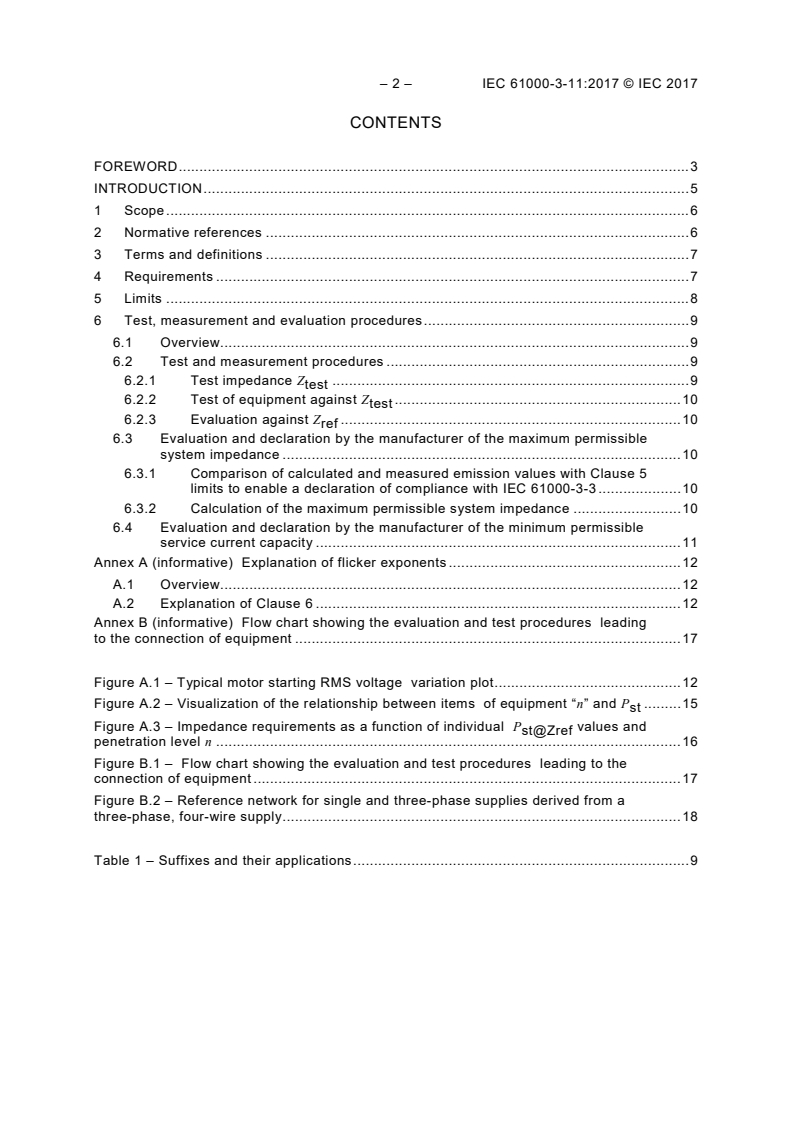
– 2 – IEC 61000-3-11:2017 © IEC 2017
CONTENTS
FOREWORD . 3
INTRODUCTION . 5
1 Scope . 6
2 Normative references . 6
3 Terms and definitions . 7
4 Requirements . 7
5 Limits . 8
6 Test, measurement and evaluation procedures . 9
6.1 Overview. 9
6.2 Test and measurement procedures . 9
6.2.1 Test impedance Z . 9
test
6.2.2 Test of equipment against Z . 10
test
6.2.3 Evaluation against Z . 10
ref
6.3 Evaluation and declaration by the manufacturer of the maximum permissible
system impedance . 10
6.3.1 Comparison of calculated and measured emission values with Clause 5
limits to enable a declaration of compliance with IEC 61000-3-3 . 10
6.3.2 Calculation of the maximum permissible system impedance . 10
6.4 Evaluation and declaration by the manufacturer of the minimum permissible
service current capacity . 11
Annex A (informative) Explanation of flicker exponents . 12
A.1 Overview. 12
A.2 Explanation of Clause 6 . 12
Annex B (informative) Flow chart showing the evaluation and test procedures leading
to the connection of equipment . 17
Figure A.1 – Typical motor starting RMS voltage variation plot . 12
Figure A.2 – Visualization of the relationship between items of equipment “n” and P . 15
st
Figure A.3 – Impedance requirements as a function of individual P values and
st@Zref
penetration level n . 16
Figure B.1 – Flow chart showing the evaluation and test procedures leading to the
connection of equipment . 17
Figure B.2 – Reference network for single and three-phase supplies derived from a
three-phase, four-wire supply . 18
Table 1 – Suffixes and their applications . 9
INTERNATIONAL ELECTROTECHNICAL COMMISSION
____________
ELECTROMAGNETIC COMPATIBILITY (EMC) –
Part 3-11: Limits – Limitation of voltage changes, voltage fluctuations and
flicker in public low-voltage supply systems – Equipment with rated
current ≤75 A and subject to conditional connection
FOREWORD
1) The International Electrotechnical Commission (IEC) is a worldwide organization for standardization comprising
all national electrotechnical committees (IEC National Committees). The object of IEC is to promote
international co-operation on all questions concerning standardization in the electrical and electronic fields. To
this end and in addition to other activities, IEC publishes International Standards, Technical Specifications,
Technical Reports, Publicly Available Specifications (PAS) and Guides (hereafter referred to as “IEC
Publication(s)”). Their preparation is entrusted to technical committees; any IEC National Committee interested
in the subject dealt with may participate in this preparatory work. International, governmental and non-
governmental organizations liaising with the IEC also participate in this preparation. IEC collaborates closely
with the International Organization for Standardization (ISO) in accordance with conditions determined by
agreement between the two organizations.
2) The formal decisions or agreements of IEC on technical matters express, as nearly as possible, an international
consensus of opinion on the relevant subjects since each technical committee has representation from all
interested IEC National Committees.
3) IEC Publications have the form of recommendations for international use and are accepted by IEC National
Committees in that sense. While all reasonable efforts are made to ensure that the technical content of IEC
Publications is accurate, IEC cannot be held responsible for the way in which they are used or for any
misinterpretation by any end user.
4) In order to promote international uniformity, IEC National Committees undertake to apply IEC Publications
transparently to the maximum extent possible in their national and regional publications. Any divergence
between any IEC Publication and the corresponding national or regional publication shall be clearly indicated in
the latter.
5) IEC itself does not provide any attestation of conformity. Independent certification bodies provide conformity
assessment services and, in some areas, access to IEC marks of conformity. IEC is not responsible for any
services carried out by independent certification bodies.
6) All users should ensure that they have the latest edition of this publication.
7) No liability shall attach to IEC or its directors, employees, servants or agents including individual experts and
members of its technical committees and IEC National Committees for any personal injury, property damage or
other damage of any nature whatsoever, whether direct or indirect, or for costs (including legal fees) and
expenses arising out of the publication, use of, or reliance upon, this IEC Publication or any other IEC
Publications.
8) Attention is drawn to the Normative references cited in this publication. Use of the referenced publications is
indispensable for the correct application of this publication.
9) Attention is drawn to the possibility that some of the elements of this IEC Publication may be the subject of
patent rights. IEC shall not be held responsible for identifying any or all such patent rights.
International Standard IEC 61000-3-11 has been prepared by sub-committee 77A: EMC –
Low-frequency phenomena, of IEC technical committee 77: Electromagnetic compatibility.
This second edition cancels and replaces the first edition published in 2000. This edition
constitutes a technical revision.
This edition includes the following significant technical changes with respect to the previous
edition:
a) addition of a new Annex A which explains the limitations and effectiveness of
IEC 61000-3-11 regarding the connection of multiple items of similar equipment at the
same location in the supply network.
– 4 – IEC 61000-3-11:2017 © IEC 2017
The text of this International Standard is based on the following documents:
CDV Report on voting
77A/929/CDV 77A/947/RVC
Full information on the voting for the approval of this International Standard can be found in
the report on voting indicated in the above table.
This document has been drafted in accordance with the ISO/IEC Directives, Part 2.
A list of all parts in the IEC 61000, published under the general title Electromagnetic
compatibility (EMC), can be found on the IEC website.
The committee has decided that the contents of this document will remain unchanged until the
stability date indicated on the IEC website under "http://webstore.iec.ch" in the data related to
the specific document. At this date, the document will be
• reconfirmed,
• withdrawn,
• replaced by a revised edition, or
• amended.
IMPORTANT – The 'colour inside' logo on the cover page of this publication indicates
that it contains colours which are considered to be useful for the correct
understanding of its contents. Users should therefore print this document using a
colour printer.
INTRODUCTION
IEC 61000 is published in separate parts according to the following structure:
Part 1: General
General considerations (introduction, fundamental principles)
Definitions, terminology
Part 2: Environment
Description of the environment
Classification of the environment
Compatibility levels
Part 3: Limits
Emission limits
Immunity limits (in so far as they do not fall under the responsibility of product
committees)
Part 4: Testing and measurement techniques
Measurement techniques
Testing techniques
Part 5: Installation and mitigation guidelines
Installation guidelines
Mitigation methods and devices
Part 9: Miscellaneous
Each part is further subdivided into several parts published either as International Standards
or technical reports, some of which have already been published as sections. Others will be
published with the part number followed by a dash and a second number identifying the
subdivision (example: 61000-3-11).
– 6 – IEC 61000-3-11:2017 © IEC 2017
ELECTROMAGNETIC COMPATIBILITY (EMC) –
Part 3-11: Limits – Limitation of voltage changes, voltage fluctuations and
flicker in public low-voltage supply systems – Equipment with rated
current ≤75 A and subject to conditional connection
1 Scope
This part of IEC 61000 is concerned with the emission of voltage changes, voltage
fluctuations and flicker produced by equipment and impressed on the public low-voltage
supply system.
It specifies the limits of voltage changes produced by equipment tested under specified
conditions.
This document is primarily applicable to electrical and electronic equipment having a rated
input current from 16 A up to and including 75 A, which is intended to be connected to public
low-voltage distribution systems having nominal system voltages of between 220 V and
250 V, line-to-neutral at 50 Hz, and which is subject to conditional connection.
This document is also applicable to equipment within the scope of IEC 61000-3-3 that does
not meet the limits when tested or evaluated with reference impedance Z and is therefore
ref
subject to conditional connection. Equipment which meets the requirements of IEC 61000-3-3
is excluded from this part of IEC 61000.
Equipment tests made in accordance with this document are type tests.
NOTE 1 The flicker limits specified in this document, being the same as those in IEC 61000-3-3, are based on the
subjective severity of the flicker imposed on the light from 230 V/60 W coiled-coil filament lamps when subjected to
fluctuations of the supply voltage. For systems with nominal voltages less than 220 V, line-to-neutral and/or
frequency of 60 Hz, the limits and reference circuit values are under consideration.
NOTE 2 The limits in this document relate to the voltage changes experienced by consumers connected at the
interface between the public supply low-voltage network and the equipment user’s installation. Therefore, it cannot
be guaranteed that the users of equipment compliant with this standard will not experience supply disturbance
within their own installation due to the operation of this equipment alone, as the impedance at the point of
connection of the equipment to the supply within the installation can have an impedance greater than the maximum
permissible impedance as determined by the procedures in this document.
2 Normative references
The following documents are referred to in the text in such a way that some or all of their
content constitutes requirements of this document. For dated references, only the edition
cited applies. For undated references, the latest edition of the referenced document (including
any amendments) applies.
IEC 60050-161, International Electrotechnical Vocabulary (IEV) – Chapter 161: Electro-
magnetic compatibility (available at www.electropedia.org)
IEC TR 60725, Consideration of reference impedances and public supply network impedances
for use in determining the disturbance characteristics of electrical equipment having a rated
current ≤75 A per phase
IEC 61000-3-3:2013, Electromagnetic compatibility (EMC) – Part 3-3: Limits – Limitation of
voltage changes, voltage fluctuations and flicker in public low-voltage supply systems, for
equipment with rated current ≤ 16 A per phase and not subject to conditional connection
3 Terms and definitions
For the purposes of this document, the terms and definitions given in IEC 60050-161,
IEC 61000-3-3 and the following apply.
ISO and IEC maintain terminological databases for use in standardization at the following
addresses:
• IEC Electropedia: available at http://www.electropedia.org/
• ISO Online browsing platform: available at http://www.iso.org/obp
3.1
reference impedance
Z
ref
conventional impedance specified in IEC 61000-3-3, with a value in accordance with
IEC TR 60725, and used in the calculation and measurement of relative voltage change d,
and of P and P values
st lt
Note 1 to entry: The resistive and reactive components of Z are given in Figure B.2.
ref
3.2
interface point
interface between a public supply network and a user’s installation
3.3
conditional connection
connection of equipment which requires the user’s supply at the interface point to have an
impedance lower than the reference impedance Z in order that the equipment emissions
ref
comply with the limits in this document
Note 1 to entry: Meeting the voltage change limits is not the only condition for connection; emission limits for
other phenomena such as harmonics, may also have to be satisfied.
3.4
service current capacity
current per phase which can be taken continuously by the user at the interface point without
exceeding the plant ratings used by the supply authority in the design of its system
Note 1 to entry: In practice the service current capacity is the rating of the main service fuse or overcurrent
protection setting of the circuit breaker at the interface point. In cases where supply authorities declare supply
capacities in volt-amperes (VA), the current per phase may be deduced for single-phase supplies by dividing the
volt-amperes by the declared phase voltage, and for three-phase supplies by dividing it by √3 times the declared
line voltage.
4 Requirements
The assessment of voltage changes and flicker shall be conducted in accordance with the
methods specified in IEC 61000-3-3.
If equipment with a rated current above 16 A complies with the requirements of IEC 61000-3-3
and therefore is not subject to conditional connection, it may be declared so by the
manufacturer in documentation made available to users before purchase.
Equipment which does not meet the limits of IEC 61000-3-3, when tested or evaluated with
reference impedance Z , is subject to conditional connection, and the manufacturer shall
ref
either:
a) determine the maximum permissible system impedance Z at the interface point of the
max
user’s supply in accordance with 6.3, declare Z in the equipment instruction manual
max
– 8 – IEC 61000-3-11:2017 © IEC 2017
and instruct the user to determine in consultation with the supply authority, if necessary,
that the equipment is connected only to a supply of that impedance or less, or
b) test the equipment in accordance with 6.4 and declare in the equipment instruction
manual that the equipment is intended for use only in premises having a service current
capacity ≥ 100 A per phase, supplied from a distribution network having a nominal voltage
of 400/230 V, and instruct the user to determine in consultation with the supply authority,
if necessary, that the service current capacity at the interface point is sufficient for the
equipment.
The equipment shall be clearly marked as being suitable for use only in premises having a
service current capacity equal to or greater than 100 A per phase.
NOTE 1 In the case of option a), restrictions to connection can be imposed by the supply authority on the use of
equipment if the actual system impedance at the interface point on the user’s premises, Z , exceeds Z .
act max
NOTE 2 In the case of option b), a new symbol (IEC 60417-5855) is available for the purpose of marking
equipment.
NOTE 3 For options a) and b), if the supply capacity and/or the actual system impedance Z have been declared
act
to, or measured by, the user, this information can be used to assess the suitability of equipment without reference
to the supply authority.
5 Limits
The limits shall be applicable to voltage fluctuations and flicker at the supply terminals of the
equipment under test, measured or calculated according to Clause 4 under test conditions
described in Clause 6. Tests made to prove compliance with the limits are considered to be
type tests.
The following limits apply:
a) the value of the short-term flicker indicator, P shall not be greater than 1,0;
st
b) the value of the long-term flicker indicator, P shall not be greater than 0,65;
lt
c) T , the accumulated time of d(t) with a deviation exceeding 3,3 % during a voltage
max
change, shall not exceed 500 ms;
d) the maximum relative steady-state voltage change, d , shall not exceed 3,3 %;
c
e) the maximum relative voltage change, d , shall not exceed:
max
1) 4 % without additional conditions;
2) 6 % for equipment which is
− switched manually, or
− switched automatically more than twice per day and having a delayed restart (the delay
being not less than a few tens of seconds), or manual restart after a power supply
interruption;
NOTE The cycling frequency will be further limited by the P and P limit. For example: a d of 6 %
max
st lt
producing a rectangular voltage change characteristic twice per hour will give a P of about 0,65.
lt
3) 7 % for equipment which is
– attended whilst in use (for example, industrial machinery such as milling equipment
and lathes); or
– switched on automatically, or is intended to be switched on manually, no more than
twice per day and has a delayed restart (the delay being not less than a few tens of
seconds) or manual restart after a power supply interruption.
In the case of equipment incorporating multiple subsystems, limits 2) and 3) shall only apply if
there is delayed or manual restart after a power supply interruption; for all equipment with
automatic switching which is energised immediately on restoration of supply after a power
supply interruption, limits 1) shall apply; for all equipment with manual switching, limits 2) or
3) shall apply, depending on the rate of switching.
P and P requirements shall not be applicable to voltage changes caused by manual
st lt
switching.
The limits shall not be applicable to emergency switching or emergency interruptions.
6 Test, measurement and evaluation procedures
6.1 Overview
Except where specified otherwise in this document, the general test conditions, measurement
and evaluation procedures specified in IEC 61000-3-3 shall apply. For equipment that meets
the conditions specified in 6.2.1 the test impedance in 6.2.1 shall be used.
An overview in the form of a flow chart showing the evaluation and test procedures used in
the assessment of equipment and leading to connection is given in Annex B (see Figure B.1).
In the calculations described in the following subclauses 6.2 to 6.4 the modulus values of
complex impedances shall be used.
In order to evaluate equipment and determine the maximum permissible system impedance
from a type test, some auxiliary quantities are necessary. These auxiliary quantities have
been given suffixes to facilitate their application in formulae and calculations; see Table 1.
The test conditions specified in IEC 61000-3-3:2013, Annex A, shall be applicable to
equipment rated ≤ 16 A. For equipment rated > 16 A the general test conditions specified in
IEC 61000-3-3 shall apply.
Table 1 – Suffixes and their applications
Suffix Representing Application
sys System Z is the modulus of the impedance of the system to which the equipment may
sys
be connected in order to meet a particular limit. A number after the subscript
identifies a particular calculation.
ref Reference Z is the reference impedance.
ref
act Actual Z is the modulus of the actual impedance of the supply existing at the interface
act
point.
max Maximum Z is the modulus of the maximum value of the supply impedance at which
max
equipment meets all the limits of this document.
test Test or measurement Z is the modulus of the test circuit impedance at which the emission test is
test
performed and d , d , P and P are measured values.
ctest max test st test lt test
6.2 Test and measurement procedures
6.2.1 Test impedance Z
test
The test impedance Z may be lower than Z , particularly for equipment having a rated
test ref
input current > 16 A. To find the optimal test impedance, two conditions shall be met:
1) the steady-state voltage drop (d ) caused by the equipment shall be within the range 2 %
c
to 9 % of the test supply voltage;
2) the ratio of inductive to resistive components of Z given by X /R shall be within the
test test test
range 0,5 to 0,75 (i.e. similar to the ratio of the components of Z ).
ref
NOTE The 2 % to 9 % condition ensures that the relative current changes of the equipment in the real network
situation will be nearly the same as those during the test.
– 10 – IEC 61000-3-11:2017 © IEC 2017
6.2.2 Test of equipment against Z
test
The test shall be made with the test circuit specified in Figure B.2, except that the impedance
Z is replaced with Z . Four values d , d , P and P shall be measured.
ref test c test max test st test lt test
The definitions of d , d , P , and P are given in IEC 61000-3-3.
c max st lt
6.2.3 Evaluation against Z
ref
If Z is not equal to Z , the measured values shall be recalculated using the following
test ref
formulae:
Z
ref
d = d ⋅
c c test
Z
test
Z
ref
d = d ⋅
max max test
Z
test
Z
ref
P = P ⋅
st st test
Z
test
Z
ref
P = P ⋅
lt lt test
Z
test
The values d , d , P , P are similar to those which would be obtained by measurements
c max st lt
using Z because the conditions placed on Z in 6.2.1 ensure that Z and Z have
ref test test ref
and P values can be
approximately the same X/R ratio and that the measured voltage, P
st lt
converted to equivalent values with reasonable accuracy by multiplying them by the ratio
Z
ref
.
Z
test
Provided that the conditions for d and d are met with Z , T shall be deemed to be
c max test max
satisfied.
6.3 Evaluation and declaration by the manufacturer of the maximum permissible
system impedance
6.3.1 Comparison of calculated and measured emission values with Clause 5 limits
to enable a declaration of compliance with IEC 61000-3-3
If all values calculated according to 6.2.3, or measured in accordance with IEC 61000-3-3, are
less than or equal to the limits in Clause 5, the manufacturer may declare that "the product
meets the technical requirements of IEC 61000-3-3".
6.3.2 Calculation of the maximum permissible system impedance
The following evaluation procedure shall be applied if the equipment emissions cannot meet
the technical requirements of IEC 61000-3-3 and therefore the equipment cannot be declared
compliant by the manufacturer in accordance with 6.3.1. In such a case the equipment shall
only be connected to a supply having a system impedance lower than Z .
ref
To calculate the lower system impedance, Z , the values of d , d , P and P calculated
sys c max st lt
according to 6.2.3 shall be used in the following formulae.
(the d limit given in Clause 5 appropriate to the EUT)
max
Z = Z ⋅
sys1 ref
d
max
3,3 %
Z = Z ⋅
sys2 ref
d
c
1 2
Z = Z ⋅
sys3 ref
P
st
2
0,65
Z = Z ⋅
sys4 ref
P
lt
The minimum of the four calculated values of Z is the maximum permissible system
sys
impedance, Z which the manufacturer shall declare in accordance with Clause 4.
max,
In consideration of voltage changes caused by manual switching, it is only required to
calculate Z and Z ; Z is the minimum of the two values.
sys1 sys2 max
See annex A for further information.
If the evaluation in accordance with 6.2.3 results in a d value which exceeds 3,3 % and a
max
recording of d(t) is not available, additional tests will be required to properly evaluate T .
max
The measurement d(t) shall be multiplied by the ratio Z / Z prior to evaluating the
max test
. Alternatively, the threshold definitions may be multiplied by the ratio
requirements for T
max
Z / Z for the T determination.
test max max
6.4 Evaluation and declaration by the manufacturer of the minimum permissible
service current capacity
For single-phase equipment intended to be connected to public low-voltage distribution
systems having a nominal voltage of 230 V line to neutral by means of a single or three-phase
service having a service current supply capacity ≥100 A per phase, the test impedance, Z ,
test
shall be set in complex terms at 0,25 + j 0,25 Ω; see Figure B.2.
For three-phase equipment intended to be connected to public low-voltage distribution
systems having a nominal voltage of 400 V line to line by means of a three-phase service
having a service current capacity ≥100 A per phase, the test impedance, Z , shall be set in
test
complex terms at 0,15 + j 0,15 Ω for each line, and 0,1 + j 0,1 Ω for the neutral; see Figure
B.2.
Equipment tested against the test impedances specified in the previous paragraphs of 6.4
shall meet the limits given in Clause 5.
The manufacturer shall declare the minimum service current capacity in accordance with
Clause 4, item b).
– 12 – IEC 61000-3-11:2017 © IEC 2017
Annex A
(informative)
Explanation of flicker exponents
A.1 Overview
The following additional information is intended to assist the user of this document in
calculating the maximum permissible system impedance in order that the equipment
emissions comply with the limits of this document. The information in Annex A is mainly
applicable to equipment which is switched on/off abruptly. Modern energy-saving equipment
with properly-performing controlled start/stop speed or power control (e.g., variable speed
drives (VSDs)) will typically not exhibit this abrupt type of behaviour.
A.2 Explanation of Clause 6
Multiple formulae are provided in Clause 6 to determine the required Z as a function of Z .
sys ref
The formula suggested to address multiple items of equipment is shown in Formula (A.1)
Z = Z (A.1)
sys ref
P
st@Zref
is the impedance required to meet P requirements at the point of evaluation.
where Z
sys st
The P produced by a single piece of equipment at the reference impedance (Z ) is denoted
st ref
by P . The 3/2 exponent is suggested to manage the combined flicker effects of multiple
st@Zref
items. However, there are some limitations in the use of this formula which could lead to over-
or under-conservative results depending on the specifics of the situation.
For demonstration purposes, a typical induction motor will be considered as the single piece
of equipment to be analyzed. It is assumed large enough to produce an appreciable voltage
change contributing to a larger P value than allowed by IEC 61000-3-3, so the requirements
st
of IEC 61000-3-11 can be considered. The voltage change of a motor-start characteristic is
shown below in Figure A.1. The P is derived using the shape factor curve
st
(IEC 61000-3-3:2013, Figure 5), and the P = 1 curve (IEC 61000-3-3:2013, Figure 2), which
st
is an accepted method described in 61000-3-3 to assess P .
st
0 4 8 12 16 20 24 28 32 36 40 44 48 52 56 60
Time in cycles @ 50 Hz
IEC
Figure A.1 – Typical motor starting RMS voltage
variation plot
RMS Voltage (%)
The front time and tail time for the motor-start characteristic in Figure A.1 are, T = 20 ms
f
and T = 200 ms. From the shape factor curve, the derived F is approximately, F = 0,93. The
t
P = 1 curve can then be used to predict the actual P value that will be produced for various
st st
numbers of changes per 10-min interval.
Using the motor start as one example of equipment which is characterized by a relatively
large d and very little other fluctuating behaviour, it can be concluded that the P value will
max st
be largely controlled by the value of d and the associated fluctuation waveshape which
max
yields a shape factor coefficient F = 0,93. Considering the limits in Clause 5, the maximum
value of d is fixed at 6 %. Assuming the system impedance Z is specified based on a
max sys
limiting value of d = 6 %, the associated P is determined based on the shape factor
max st
application as shown in Formula (A.2) where the value d = 7,4 is taken from the P = 1 curve
st
for a single change (t = 1) in one 10-min period.
(A.2)
Fd 6
max
P = = 0,93 = 0,754
st@Zsys
d(t) 7,4
For the case of multiple fluctuations produced by n identical items of equipment, it is
necessary to consider the flickermeter response. The value of the instantaneous flicker
sensation P , which is sampled and statistically evaluated over a 10-min period to produce a
inst
P value, will exponentially decay from some maximum value to near zero in 30 s or less.
st
This means that single-change events, such as a step change or motor start, can be
considered as independent events over the course of the 10-min P evaluation and, for
st
analysis simplicity, the interval between n identical fluctuations can be taken as 10/n min (as
long as 10/n is greater than 0,5 min). This assumption allows two independent events to be
evaluated using shape factor analysis and the P = 1 curve with a fluctuation rate of n
st
changes/10 min. The use of the single-change result of Formula (A.2) and the assumption
that two pieces of equipment produce such a change (n = 2 changes/10 min), results in a
predicted P =1,213 based on a P = 1 value of 4,6 for 2 changes/10 min in Formula (A.2) in
st st
place of 7,4. It is clear that multiple pieces of equipment (POE) (n = 2 or more), each
individually complying with Clause 5 limits, starting in the same 10-min period will violate the
P = 1 limit.
st
An alternative to using n = 2, 3, or more changes/10 min to combine flicker effects using
shape factors and the P = 1 curve is to use the summation law. The summation law can be
st
used to combine the individual effects of multiple fluctuations into a single P value for the
st
“equipment group.” A summation law exponent of 3 is accepted for general use and is also
recognized in IEC 61000-3-11. Assuming that n items of equipment in a group produce equal
values of P at a determined system impedance Z (P ), the summated total P
st sys st@Zsys st
produced by the n items is given generally by Formula (A.3) which can be simplified to
Formula (A.4).
n
P = (P ) (A.3)
st,total@Zsys st@Zsys,i
∑
i=1
P = n× P (A.4)
st,total@Zsys st@Zsys
Using the value P =0,754 obtained from the shape factor analysis for n = 1, Formula
st@Zsys
(A.4) can be solved to show that for n = 3 items, the total flicker produced is
= 1,088 which is a limit violation. Using the summation law approach in Formula
P
st,total@Zsys
(A.4), it is clear that 3 or more items of equipment, each individually meeting Clause 5 limits,
will lead to a total P > 1 condition.
st
Assuming that Z is adjusted to obtain d = 6 % (at the specified Z ) according to the
sys max sys
specifications in Clause 6, operation of multiple items of equipment will definitely lead to total
– 14 – IEC 61000-3-11:2017 © IEC 2017
P > 1 conditions. This conclusion is true if either the shape factor and P = 1 curve approach
st st
is used or if the cubic summation law is used.
Using the summation law, which combines the total flicker effects, a new system impedance
value Z can be determined so that P = 1 results from the combined operation of
sys,total st,total
multiple items of equipment. Considering the well-known relation between system impedance,
voltage change, and P , Formula (A.5) can be written to establish the required value of
st
system impedance Z .
sys,total
P
Z
st,total@Z
sys,total sys,total
(A.5)
=
P Z
st,total@Z sys
sys
Inserting the results of the cubic summation law in Formula (A.4), and further returning to the
level of the reference impedance if helpful, Formula (A.6) can be derived to specify the value
of Z necessary to insure that the combined effects of multiple identical pieces of
sys,total
equipment are taken into account resulting in P = 1,0. It shall be recognized
st,total@Zsys,total
that the result is dependent on both the number of pieces of equipment, n, and the P that
st
one piece of this equipment produces when supplied through the system impedance, Z ,
sys
determined according to the procedures of Clause 5 (or the initial reference impedance, Z ).
ref
1 1
Z = Z = Z
(A.6)
sys,total sys ref
3 3
n(P ) n(P )
st@Zsys st@Zref
The third formula in 6.3.2, shown again here in Formula (A.7) is provided in order to take into
account multiple items of (identical) equipment based on the cubic summation law.
Z = Z (A.7)
sys ref
P
st@Zref
For the existing Clause 6 requirements, the system impedance is only dependent on the P
st
value of one of the multiple POE, and the 3/2 exponent supposedly manages the combined
flicker effects of multiple items. The results in Formulae (A.6) and (A.7) are intended to
manage the same situation, but the resultant required impedances are clearly different. It is
possible to determine the relationship between them by equating Z in Formula (A.6)
sys,total
with Z in Formula (A.7) and reducing as shown in Formulae (A.8) and (A.9).
sys
1 1
Z = Z (A.8)
ref ref
3
P
n(P ) st@Z
st@Z ref
ref
n=(P ) (A.9)
st@Z
ref
The conclusion of Formula (A.9) is that the two results (in Formulae (A.6) and (A.7)) are
equal only for a specific number of pieces of equipment, n, and this value of n is a nonlinear
function of the P value produced by one item of equipment at the reference impedance. For
st
equipment which produces a P value only slightly greater than 1,0 at the reference
st
impedance, the resultant value of n will be small. For equipment which produces a P value
st
significantly greater than 1,0 at the reference impedance, the resultant value of n will be
larger. Recalling that n represents the number of pieces of equipment which can be supplied
before the total P value exceeds 1,0 and that the value of n is calculated from the widely-
st
accepted summation law, the following conclusions can be drawn:
1) For a single piece of equipment producing a P slightly greater than 1,0 at the reference
st
impedance, the resultant application of the recommended option 3 formula in 6.3.2 will be
under-conservative in that the resultant system impedance determined could be too large.
Applying the cubic summation law in this case would predict that only a very small number
of identical pieces of equipment can be connected before the total P exceeds 1,0. In this
st
case, the network owner/operator is faced with increased risk of flicker-related problems if
the actual number of supplied pieces of equipment is larg
...