

IEC 62282-4-102:2022
(Main)Fuel cell technologies - Part 4-102: Fuel cell power systems for electrically powered industrial trucks - Performance test methods
General Information
- Abstract
IEC 62282-4-102:2022 specifies the performance test methods of fuel cell power systems for propulsion and auxiliary power units (APU). This document covers fuel cell power systems for propulsion other than those for road vehicles. This document applies to gaseous hydrogen-fuelled fuel cell power systems and direct methanol fuel cell power systems for electrically powered industrial trucks. The following fuels are considered within the scope of this document:
- gaseous hydrogen, and
- methanol.
This document covers the fuel cell power system as defined in 3.7 and Figure 1. This document applies to DC type fuel cell power systems, with a rated output voltage not exceeding DC 150 V for indoor and outdoor use. This document covers fuel cell power systems whose fuel source container is permanently attached to either the industrial truck or the fuel cell power system.
This second edition cancels and replaces the first edition published in 2017. This edition includes the following significant technical changes with respect to the previous edition:
a. alignment of the Scope with the second edition of IEC 62282-4-101:2022;
b. deletion of terms and definitions (previous entries 3.5, 3.10, and 3.15);
c. addition of new terms in Clause 3: "delivered power" (3.13) and "regenerated power" (3.14);
d. revision of symbols and their meanings in alignment with those of IEC 62282-3-201;
e. replacement of "reference conditions" with "standard conditions" as seen in Clause 5;
f. revision of the test method for the accessory load voltage spike test (13.3.2);
g. addition of clarifications in Clause 14 (Power stability under operation);
h. addition of a checklist for performance criteria dealt with in this document (Annex C).
- Status
- Published
- Publication Date
- 19-Dec-2022
- Technical Committee
- TC 105 - Fuel cell technologies
- Drafting Committee
- MT 302 - TC 105/MT 302
- Current Stage
- PPUB - Publication issued
- Start Date
- 20-Dec-2022
- Completion Date
- 06-Jan-2023
Buy Documents
IEC 62282-4-102:2022 RLV - Fuel cell technologies - Part 4-102: Fuel cell power systems for electrically powered industrial trucks - Performance test methods Released:12/20/2022
IEC 62282-4-102:2022 - Fuel cell technologies - Part 4-102: Fuel cell power systems for electrically powered industrial trucks - Performance test methods Released:12/20/2022
Overview
IEC 62282-4-102:2022 - "Fuel cell technologies - Part 4-102: Fuel cell power systems for electrically powered industrial trucks - Performance test methods" specifies standardized test methods for evaluating performance of fuel cell power systems used for propulsion and auxiliary power units (APU) in electrically powered industrial trucks. The standard applies to gaseous hydrogen-fuelled and direct methanol fuel cell (DMFC) systems, for DC-type power units with rated output voltage up to DC 150 V, and covers systems whose fuel container is permanently attached to the truck or power system. Edition 2.0 (2022) replaces the 2017 edition and introduces updates such as new terms (“delivered power”, “regenerated power”), alignment with IEC 62282-4-101:2022 and IEC 62282-3-201, and a performance checklist (Annex C).
Key topics and technical requirements
- Scope and definitions for fuel cell power systems intended for industrial electric trucks (propulsion and APU).
- Test preparation and set-up: data acquisition planning, measurement points and instrumentation requirements for hydrogen and methanol systems.
- Fuel consumption tests: methods for hydrogen and methanol fuel measurement and result calculations.
- Electrical power output and efficiency tests: protocols to measure average electrical output and compute electrical efficiency.
- Operational performance type tests: cold-start maximum power, power-cycling electrical load, accessory load voltage spike testing, and clarifications on power stability under operation (including delivered and regenerated power measurements).
- Environmental performance tests: noise measurement, exhaust gas components, and discharge water testing.
- Reporting requirements: content for summary, detailed and full test reports and a checklist for performance criteria (Annex C).
- Standard conditions & measurement uncertainty: adoption of “standard conditions” and minimum measurement systematic uncertainty thresholds.
Practical applications
- Develop and validate type tests for fuel cell power systems used in material handling and warehouse trucks.
- Provide objective performance benchmarking for hydrogen and methanol fuel cell units (fuel consumption, power output, efficiency).
- Support design verification, acceptance testing, and vendor selection for fleet operators and OEMs.
- Aid certification bodies and test laboratories in producing standardized test reports suitable for procurement and compliance documentation.
- Inform R&D teams on repeatable test methods for optimizing APU and propulsion system control and energy recovery (regenerated power).
Who should use this standard
- Fuel cell system manufacturers and OEMs for industrial trucks
- Test laboratories and certification bodies performing type or acceptance testing
- Fleet operators and procurement agencies specifying performance criteria
- R&D and systems engineers working on hydrogen and methanol fuel cell integration
Related standards
- IEC 62282-4-101:2022 (alignment of scope)
- IEC 62282-3-201 (symbols and meanings alignment)
Keywords: IEC 62282-4-102:2022, fuel cell power systems, industrial trucks, performance test methods, hydrogen fuel cell, direct methanol fuel cell, DC 150 V, power stability, environmental tests, test report checklist.
Relations
- Effective Date
- 05-Sep-2023
Buy Documents
IEC 62282-4-102:2022 RLV - Fuel cell technologies - Part 4-102: Fuel cell power systems for electrically powered industrial trucks - Performance test methods Released:12/20/2022
IEC 62282-4-102:2022 - Fuel cell technologies - Part 4-102: Fuel cell power systems for electrically powered industrial trucks - Performance test methods Released:12/20/2022
Get Certified
Connect with accredited certification bodies for this standard

DNV
DNV is an independent assurance and risk management provider.

Lloyd's Register
Lloyd's Register is a global professional services organisation specialising in engineering and technology.
DNV Energy Systems
Energy and renewable energy certification.
Sponsored listings
Frequently Asked Questions
IEC 62282-4-102:2022 is a standard published by the International Electrotechnical Commission (IEC). Its full title is "Fuel cell technologies - Part 4-102: Fuel cell power systems for electrically powered industrial trucks - Performance test methods". This standard covers: IEC 62282-4-102:2022 specifies the performance test methods of fuel cell power systems for propulsion and auxiliary power units (APU). This document covers fuel cell power systems for propulsion other than those for road vehicles. This document applies to gaseous hydrogen-fuelled fuel cell power systems and direct methanol fuel cell power systems for electrically powered industrial trucks. The following fuels are considered within the scope of this document: - gaseous hydrogen, and - methanol. This document covers the fuel cell power system as defined in 3.7 and Figure 1. This document applies to DC type fuel cell power systems, with a rated output voltage not exceeding DC 150 V for indoor and outdoor use. This document covers fuel cell power systems whose fuel source container is permanently attached to either the industrial truck or the fuel cell power system. This second edition cancels and replaces the first edition published in 2017. This edition includes the following significant technical changes with respect to the previous edition: a. alignment of the Scope with the second edition of IEC 62282-4-101:2022; b. deletion of terms and definitions (previous entries 3.5, 3.10, and 3.15); c. addition of new terms in Clause 3: "delivered power" (3.13) and "regenerated power" (3.14); d. revision of symbols and their meanings in alignment with those of IEC 62282-3-201; e. replacement of "reference conditions" with "standard conditions" as seen in Clause 5; f. revision of the test method for the accessory load voltage spike test (13.3.2); g. addition of clarifications in Clause 14 (Power stability under operation); h. addition of a checklist for performance criteria dealt with in this document (Annex C).
IEC 62282-4-102:2022 specifies the performance test methods of fuel cell power systems for propulsion and auxiliary power units (APU). This document covers fuel cell power systems for propulsion other than those for road vehicles. This document applies to gaseous hydrogen-fuelled fuel cell power systems and direct methanol fuel cell power systems for electrically powered industrial trucks. The following fuels are considered within the scope of this document: - gaseous hydrogen, and - methanol. This document covers the fuel cell power system as defined in 3.7 and Figure 1. This document applies to DC type fuel cell power systems, with a rated output voltage not exceeding DC 150 V for indoor and outdoor use. This document covers fuel cell power systems whose fuel source container is permanently attached to either the industrial truck or the fuel cell power system. This second edition cancels and replaces the first edition published in 2017. This edition includes the following significant technical changes with respect to the previous edition: a. alignment of the Scope with the second edition of IEC 62282-4-101:2022; b. deletion of terms and definitions (previous entries 3.5, 3.10, and 3.15); c. addition of new terms in Clause 3: "delivered power" (3.13) and "regenerated power" (3.14); d. revision of symbols and their meanings in alignment with those of IEC 62282-3-201; e. replacement of "reference conditions" with "standard conditions" as seen in Clause 5; f. revision of the test method for the accessory load voltage spike test (13.3.2); g. addition of clarifications in Clause 14 (Power stability under operation); h. addition of a checklist for performance criteria dealt with in this document (Annex C).
IEC 62282-4-102:2022 is classified under the following ICS (International Classification for Standards) categories: 27.070 - Fuel cells. The ICS classification helps identify the subject area and facilitates finding related standards.
IEC 62282-4-102:2022 has the following relationships with other standards: It is inter standard links to IEC 62282-4-102:2017. Understanding these relationships helps ensure you are using the most current and applicable version of the standard.
IEC 62282-4-102:2022 is available in PDF format for immediate download after purchase. The document can be added to your cart and obtained through the secure checkout process. Digital delivery ensures instant access to the complete standard document.
Standards Content (Sample)
IEC 62282-4-102 ®
Edition 2.0 2022-12
REDLINE VERSION
INTERNATIONAL
STANDARD
colour
inside
Fuel cell technologies –
Part 4-102: Fuel cell power systems for industrial electric trucks electrically
powered industrial trucks – Performance test methods
All rights reserved. Unless otherwise specified, no part of this publication may be reproduced or utilized in any form
or by any means, electronic or mechanical, including photocopying and microfilm, without permission in writing from
either IEC or IEC's member National Committee in the country of the requester. If you have any questions about IEC
copyright or have an enquiry about obtaining additional rights to this publication, please contact the address below or
your local IEC member National Committee for further information.
IEC Secretariat Tel.: +41 22 919 02 11
3, rue de Varembé info@iec.ch
CH-1211 Geneva 20 www.iec.ch
Switzerland
About the IEC
The International Electrotechnical Commission (IEC) is the leading global organization that prepares and publishes
International Standards for all electrical, electronic and related technologies.
About IEC publications
The technical content of IEC publications is kept under constant review by the IEC. Please make sure that you have the
latest edition, a corrigendum or an amendment might have been published.
IEC publications search - webstore.iec.ch/advsearchform IEC Products & Services Portal - products.iec.ch
The advanced search enables to find IEC publications by a Discover our powerful search engine and read freely all the
variety of criteria (reference number, text, technical publications previews. With a subscription you will always
committee, …). It also gives information on projects, replaced have access to up to date content tailored to your needs.
and withdrawn publications.
Electropedia - www.electropedia.org
IEC Just Published - webstore.iec.ch/justpublished
The world's leading online dictionary on electrotechnology,
Stay up to date on all new IEC publications. Just Published
containing more than 22 300 terminological entries in English
details all new publications released. Available online and
and French, with equivalent terms in 19 additional languages.
once a month by email.
Also known as the International Electrotechnical Vocabulary
(IEV) online.
IEC Customer Service Centre - webstore.iec.ch/csc
If you wish to give us your feedback on this publication or
need further assistance, please contact the Customer Service
Centre: sales@iec.ch.
IEC 62282-4-102 ®
Edition 2.0 2022-12
REDLINE VERSION
INTERNATIONAL
STANDARD
colour
inside
Fuel cell technologies –
Part 4-102: Fuel cell power systems for industrial electric trucks electrically
powered industrial trucks – Performance test methods
INTERNATIONAL
ELECTROTECHNICAL
COMMISSION
ICS 27.070 ISBN 978-2-8322-6314-3
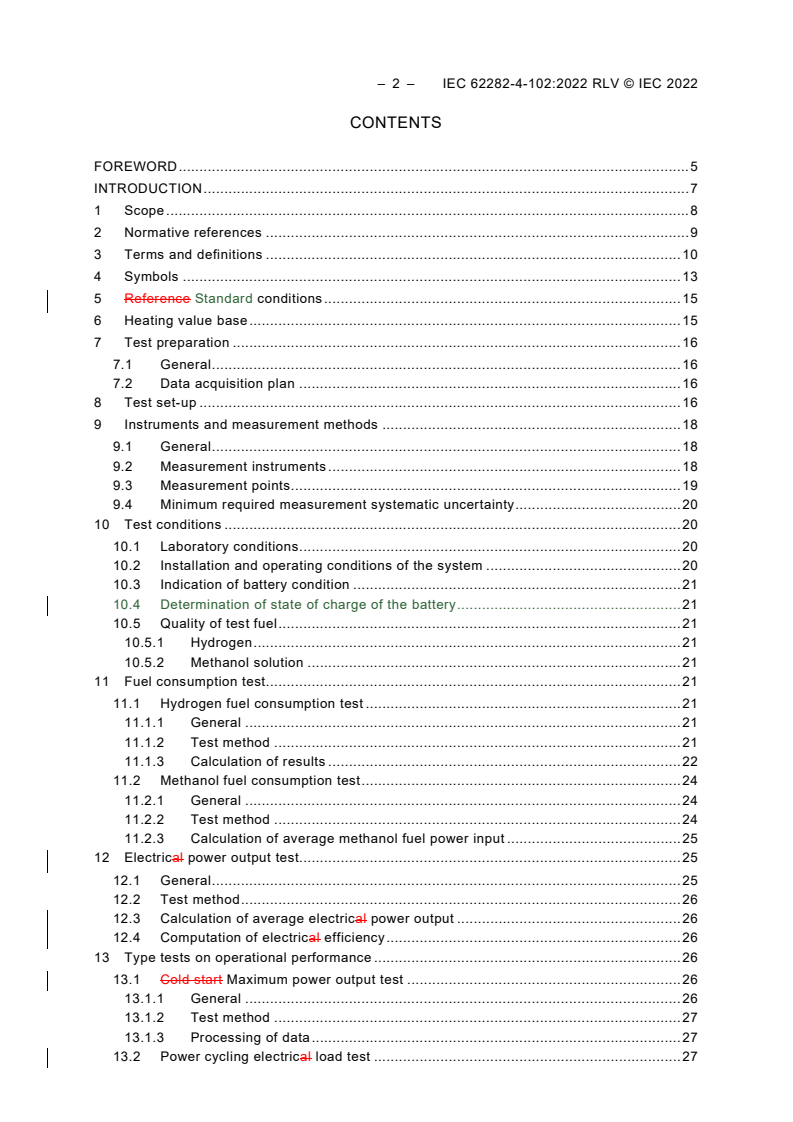
– 2 – IEC 62282-4-102:2022 RLV © IEC 2022
CONTENTS
FOREWORD . 5
INTRODUCTION . 7
1 Scope . 8
2 Normative references . 9
3 Terms and definitions . 10
4 Symbols . 13
5 Reference Standard conditions . 15
6 Heating value base . 15
7 Test preparation . 16
7.1 General . 16
7.2 Data acquisition plan . 16
8 Test set-up . 16
9 Instruments and measurement methods . 18
9.1 General . 18
9.2 Measurement instruments . 18
9.3 Measurement points . 19
9.4 Minimum required measurement systematic uncertainty . 20
10 Test conditions . 20
10.1 Laboratory conditions . 20
10.2 Installation and operating conditions of the system . 20
10.3 Indication of battery condition . 21
10.4 Determination of state of charge of the battery . 21
10.5 Quality of test fuel . 21
10.5.1 Hydrogen . 21
10.5.2 Methanol solution . 21
11 Fuel consumption test. 21
11.1 Hydrogen fuel consumption test . 21
11.1.1 General . 21
11.1.2 Test method . 21
11.1.3 Calculation of results . 22
11.2 Methanol fuel consumption test . 24
11.2.1 General . 24
11.2.2 Test method . 24
11.2.3 Calculation of average methanol fuel power input . 25
12 Electrical power output test. 25
12.1 General . 25
12.2 Test method . 26
12.3 Calculation of average electrical power output . 26
12.4 Computation of electrical efficiency . 26
13 Type tests on operational performance . 26
13.1 Cold start Maximum power output test . 26
13.1.1 General . 26
13.1.2 Test method . 27
13.1.3 Processing of data . 27
13.2 Power cycling electrical load test . 27
13.2.1 General . 27
13.2.2 Test method . 27
13.2.3 Processing of data . 27
13.3 Accessory load voltage spike test . 27
13.3.1 General . 27
13.3.2 Test method . 27
13.3.3 Processing of data . 28
14 Power stability under operation . 28
14.1 General . 28
14.2 Delivered power . 28
14.3 Power absorbed Regenerated power . 29
15 Type tests on environmental performance . 30
15.1 General . 30
15.2 Noise test . 30
15.2.1 General . 30
15.2.2 Test conditions . 30
15.2.3 Test method . 31
15.2.4 Processing of data . 32
15.3 Exhaust gas test . 32
15.3.1 General . 32
15.3.2 Components to be measured . 32
15.3.3 Test method . 32
15.3.4 Processing of data . 33
15.4 Discharge water test . 35
15.4.1 General . 35
15.4.2 Test method . 35
16 Test reports . 36
16.1 General . 36
16.2 Title page . 36
16.3 Table of contents . 36
16.4 Summary report . 36
16.5 Checklist for performance parameters . 36
Annex A (informative) Heating values for hydrogen and methanol at reference
standard conditions . 37
Annex B (informative) Guidelines for the contents of detailed and full reports . 38
B.1 General . 38
B.2 Detailed report . 38
B.3 Full report . 38
Annex C (informative) Checklist for performance criteria dealt with in this document . 39
Bibliography . 42
Figure 1 – Fuel cell power systems for industrial electric trucks .
Figure 1 – Fuel cell power systems for electrically powered industrial trucks . 9
Figure 2 – Example of a test set-up for hydrogen fuel . 17
Figure 3 – Example of a test set-up for methanol fuel . 18
Figure 4 – Energy flow for regenerated power and delivered power . 28
Figure 5 – Noise measurement points for fuel cell power systems . 31
– 4 – IEC 62282-4-102:2022 RLV © IEC 2022
Table 1 – Symbols and their meanings for electric and thermal performance . 14
Table 2 – Symbols and their meanings for environmental performance . 15
Table 3 – Delivered power measurements . 29
Table 4 – Power absorbed Regenerated power measurements . 30
Table 5 – Compensation of readings against Correction values corresponding to the
effect of background noise . 31
Table A.1 – Heating values for hydrogen and methanol at reference standard
conditions . 37
INTERNATIONAL ELECTROTECHNICAL COMMISSION
____________
FUEL CELL TECHNOLOGIES –
Part 4-102: Fuel cell power systems for industrial electric trucks
electrically powered industrial trucks – Performance test methods
FOREWORD
1) The International Electrotechnical Commission (IEC) is a worldwide organization for standardization comprising
all national electrotechnical committees (IEC National Committees). The object of IEC is to promote international
co-operation on all questions concerning standardization in the electrical and electronic fields. To this end and
in addition to other activities, IEC publishes International Standards, Technical Specifications, Technical Reports,
Publicly Available Specifications (PAS) and Guides (hereafter referred to as "IEC Publication(s)"). Their
preparation is entrusted to technical committees; any IEC National Committee interested in the subject dealt with
may participate in this preparatory work. International, governmental and non-governmental organizations liaising
with the IEC also participate in this preparation. IEC collaborates closely with the International Organization for
Standardization (ISO) in accordance with conditions determined by agreement between the two organizations.
2) The formal decisions or agreements of IEC on technical matters express, as nearly as possible, an international
consensus of opinion on the relevant subjects since each technical committee has representation from all
interested IEC National Committees.
3) IEC Publications have the form of recommendations for international use and are accepted by IEC National
Committees in that sense. While all reasonable efforts are made to ensure that the technical content of IEC
Publications is accurate, IEC cannot be held responsible for the way in which they are used or for any
misinterpretation by any end user.
4) In order to promote international uniformity, IEC National Committees undertake to apply IEC Publications
transparently to the maximum extent possible in their national and regional publications. Any divergence between
any IEC Publication and the corresponding national or regional publication shall be clearly indicated in the latter.
5) IEC itself does not provide any attestation of conformity. Independent certification bodies provide conformity
assessment services and, in some areas, access to IEC marks of conformity. IEC is not responsible for any
services carried out by independent certification bodies.
6) All users should ensure that they have the latest edition of this publication.
7) No liability shall attach to IEC or its directors, employees, servants or agents including individual experts and
members of its technical committees and IEC National Committees for any personal injury, property damage or
other damage of any nature whatsoever, whether direct or indirect, or for costs (including legal fees) and
expenses arising out of the publication, use of, or reliance upon, this IEC Publication or any other IEC
Publications.
8) Attention is drawn to the Normative references cited in this publication. Use of the referenced publications is
indispensable for the correct application of this publication.
9) Attention is drawn to the possibility that some of the elements of this IEC Publication may be the subject of patent
rights. IEC shall not be held responsible for identifying any or all such patent rights.
This redline version of the official IEC Standard allows the user to identify the changes
made to the previous edition IEC 62282-4-102:2017. A vertical bar appears in the margin
wherever a change has been made. Additions are in green text, deletions are in
strikethrough red text.
– 6 – IEC 62282-4-102:2022 RLV © IEC 2022
IEC 62282-4-102 has been prepared by IEC technical committee 105: Fuel cell technologies.
It is an International Standard.
This second edition cancels and replaces the first edition published in 2017. This edition
constitutes a technical revision.
This edition includes the following significant technical changes with respect to the previous
edition:
a) alignment of the Scope with the second edition of IEC 62282-4-101:2022;
b) deletion of terms and definitions (previous entries 3.5, 3.10, and 3.15);
c) addition of new terms in Clause 3: "delivered power" (3.13) and "regenerated power" (3.14);
d) revision of symbols and their meanings in alignment with those of IEC 62282-3-201;
e) replacement of "reference conditions" with "standard conditions" as seen in Clause 5;
f) revision of the test method for the accessory load voltage spike test (13.3.2);
g) addition of clarifications in Clause 14 (Power stability under operation);
h) addition of a checklist for performance criteria dealt with in this document (Annex C).
The text of this International Standard is based on the following documents:
Draft Report on voting
105/947/FDIS 105/954/RVD
Full information on the voting for its approval can be found in the report on voting indicated in
the above table.
The language used for the development of this International Standard is English.
This document was drafted in accordance with ISO/IEC Directives, Part 2, and developed in
accordance with ISO/IEC Directives, Part 1 and ISO/IEC Directives, IEC Supplement, available
at www.iec.ch/members_experts/refdocs. The main document types developed by IEC are
described in greater detail at www.iec.ch/publications.
A list of all parts in the IEC 62282 series, published under the general title Fuel cell technologies,
can be found on the IEC website.
The committee has decided that the contents of this document will remain unchanged until the
stability date indicated on the IEC website under webstore.iec.ch in the data related to the
specific document. At this date, the document will be
• reconfirmed,
• withdrawn,
• replaced by a revised edition, or
• amended.
IMPORTANT – The "colour inside" logo on the cover page of this document indicates that it
contains colours which are considered to be useful for the correct understanding of its
contents. Users should therefore print this document using a colour printer.
INTRODUCTION
This part of IEC 62282-4 provides consistent and repeatable test methods for the electric,
thermal and environmental performance of fuel cell power systems for industrial electric trucks
electrically powered industrial trucks.
The IEC 62282-4 series deals with categories such as safety, performance, and
interchangeability of fuel cell power systems for propulsion other than road vehicles and
auxiliary power units (APUs). This document (IEC 62282-4-102) focuses on performance test
methods for fuel cell power systems for used to drive industrial electric trucks, which are being
manufactured and used increasingly worldwide. This is because such applications are urgently
demanded needed in the world.
This part of IEC 62282-4 describes type tests and their test methods only. No routine tests are
required or identified, and no performance targets are set in this document.
Fuel cell systems used in industrial electric trucks electrically powered industrial trucks, such
as forklift trucks, are hybrids use both batteries and fuel cells, and so operate in several different
modes. Similarly, forklift trucks operate in different modes. The purpose of this document is to
evaluate the fuel cell system in the various combinations of fuel cell modes and forklift truck
modes. This document breaks down these different modes and provides a framework for
designing and evaluating a fuel cell system for use specifically in a forklift truck.
This part of IEC 62282-4 is intended to be used by either manufacturers of fuel cell power
systems used for industrial electric trucks and/ electrically powered industrial trucks or those
who evaluate the performance of the systems used in them for certification purposes or both.
Users of this document selectively execute test items that are suitable for their purposes from
those described in this document can select and perform the tests they need from those
described. This document is not intended to exclude any other methods tests.
– 8 – IEC 62282-4-102:2022 RLV © IEC 2022
FUEL CELL TECHNOLOGIES –
Part 4-102: Fuel cell power systems for industrial electric trucks
electrically powered industrial trucks – Performance test methods
1 Scope
This part of IEC 62282 specifies the performance test methods of fuel cell power systems for
propulsion and auxiliary power units (APU). This document covers fuel cell power systems for
propulsion other than those for road vehicles.
The scope of this document is limited to electrically powered industrial trucks. Hybrid trucks
that include an internal combustion engine are not included in the scope. The scope of this
standard will be applicable to material-handling equipment, e.g. forklifts.
This document covers the performance test methods of fuel cell power systems intended to be
used for electrically powered industrial trucks as defined in ISO 5053-1, except for:
– rough-terrain trucks;
– non-stacking low-lift straddle carrier;
– stacking high-lift straddle carrier;
– rough-terrain variable-reach truck;
– slewing rough-terrain variable-reach truck;
– variable-reach container handler;
– pedestrian propelled trucks.
This document applies to gaseous hydrogen-fuelled fuel cell power systems and direct methanol
fuel cell power systems for electrically powered industrial trucks. The following fuels are
considered within the scope of this document:
– gaseous hydrogen, and
– methanol.
This document does not apply to reformer-equipped fuel cell power systems.
This document covers the fuel cell power system as defined in 3.7 and Figure 1.
This document applies to DC type fuel cell power systems, with a rated output voltage not
exceeding DC 150 V for indoor and outdoor use.
This document covers fuel cell power systems whose fuel source container is permanently
attached to either the industrial truck or the fuel cell power system. A fuel source container of
the detachable type is not permitted.
Fuel cell power systems intended for operation in potentially explosive atmospheres are
excluded from the scope of this document.
This document does not cover the fuel storage systems using liquid hydrogen.
All systems with integrated energy storage systems are covered by this document. This includes
systems such as batteries for internal recharges or recharged from an external source.
The following are not included in the scope of this document:
– detachable type fuel source containers;
– hybrid trucks that include an internal combustion engine;
– reformer-equipped fuel cell power systems;
– fuel cell power systems intended for operation in potentially explosive atmospheres;
– fuel storage systems using liquid hydrogen.
Key
EMD electromagnetic disturbance
EMI electromagnetic interference
NOTE A fuel cell power system can contain all or some of the above components.
Figure 1 – Fuel cell power systems for electrically powered industrial trucks
2 Normative references
The following documents are referred to in the text in such a way that some or all of their content
constitutes requirements of this document. For dated references, only the edition cited applies.
For undated references, the latest edition of the referenced document (including any
amendments) applies.
IEC 61672-1, Electroacoustics – Sound level meters – Part 1: Specifications
IEC 62282-3-201, Fuel cell technologies – Part 3-201: Small stationary fuel cell power systems
– Performance test methods for small fuel cell power systems
IEC 62282-6-300:2012, Fuel cell technologies – Part 6-300: Micro fuel cell power systems –
Fuel cartridge interchangeability
ISO 9000, Quality management series of standards
ISO 6798-1, Reciprocating internal combustion engines – Measurement of sound power level
using sound pressure – Part 1: Engineering method
– 10 – IEC 62282-4-102:2022 RLV © IEC 2022
ISO 6798-2, Reciprocating internal combustion engines – Measurement of sound power level
using sound pressure – Part 2: Survey method
ISO 14687, Hydrogen fuel quality – Product specification
ISO 14687-2, Hydrogen fuel – Product specification – Part 2: Proton exchange membrane (PEM)
fuel cell applications for road vehicles
3 Terms and definitions
For the purposes of this document, the following terms and definitions apply.
ISO and IEC maintain terminology databases for use in standardization at the following
addresses:
• IEC Electropedia: available at https://www.electropedia.org/
• ISO Online browsing platform: available at https://www.iso.org/obp
3.1
noise level
sound pressure level produced by the fuel cell power system measured at a specified distance
in all operation modes
Note 1 to entry: Noise level is expressed in decibels (dB) and measured as described in 15.2.
3.2
background noise level
sound pressure level of ambient noise at the measurement point
Note 1 to entry: This measurement is taken as described in 15.2 with the fuel cell power system in the cold state.
3.3
battery
electrochemical energy storage device that either provides energy input to support parasitic
loads and/or provides electrical energy output or both
Note 1 to entry: Back-up batteries for control software memory and similar applications are not included.
3.4
cold state
state of a fuel cell power system at ambient temperature with no power input or output
[SOURCE: IEC/TS 62282-1:2013, 3.110.1 IEC 60050-485:2020, 485-21-01]
3.5
discharge rate
mass of discharged exhaust gas component per unit of time
3.5
discharge water
water discharged from the fuel cell power system including waste water and condensate
Note 1 to entry: Discharge water does not constitute part of a thermal recovery system.
[SOURCE: IEC/TS 62282-1:2013, 2.2, modified – Note 1 to entry added.]
3.6
fuel cell system electrical efficiency
ratio of the average electric power output of a fuel cell power system at for a given duration to
the average fuel power fed to the same fuel cell power system at for the same duration
3.7
fuel cell power system
generator system that uses one or more fuel cell modules to generate electric power and heat
Note 1 to entry: See Figure 1 for a block diagram of a fuel cell power system.
Note 2 to entry: A fuel cell power system may contain all or some of the components shown in Figure 1. The fuel
cell power system for use with industrial trucks will be in one of the forms as outlined in 3.9 and 3.10 of IEC 62282-
4-101.
[SOURCE: IEC/TS 62282-1:2013, 3.49, modified – New Note 1 to entry has been added, and
existing Note 1 to entry has become Note 2 to entry with the addition of the second sentence.]
Note 1 to entry: The fuel cell power system for use with industrial trucks will be in one of the forms as outlined in
IEC 62282-4-101:2022, 3.9 and 3.10.
[SOURCE: IEC 60050-485:2020, 485-09-01, modified – Note 1 to entry has been added.]
– 12 – IEC 62282-4-102:2022 RLV © IEC 2022
Coolant
Fuel (Hydrogen, Methanol)
System boundary
Excess/released fuel
Fuel storage
Thermal
(Hydrogen, Waste heat
Methanol)
Internal power needs
Fuel regulating
Power
Fuel cell
Electrical power output
and piping
conditioning
system
Oxidant (air) module
Energy
t
Ventilation Exhaust gases
Ventilation air
system
Water
Waste water
Water
treatment and
Control
ti t
EMD
EMI
Vibration,
Noise,
IEC
id i
Key
Fuel cell power system including subsystems. The interface is defined as a conceptual or functional
one instead of hardware such as a power package.
Subsystems; fuel cell module, fuel processor, etc. These subsystem configurations depend on the
kind of fuel, type of fuel cell or system.
The interface points in the boundary to be measured for calculation data.
EMD electromagnetic disturbance
EMI electromagnetic interference
Figure 1 – Fuel cell power systems for industrial electric trucks
3.8
fuel input
amount of hydrogen or methanol supplied to the fuel cell power system
3.9
fuel consumption
volume or mass of fuel consumed by the fuel cell power system under specified operating
conditions
3.10
fuel power consumption
amount of energy per time unit contained in the fuel consumed by the fuel cell power system
3.10
minimum electric power output
minimum power output, at which a fuel cell power system is able to operate continuously at a
steady state
3.11
rated power
maximum continuous electric power output power that a fuel cell power system is designed to
achieve under normal operating conditions specified by the manufacturer
[SOURCE: IEC/TS 62282-1:2013, 3.85.4, modified – Note 1 to entry deleted IEC 60050-
485:2020, 485-14-04, modified – Note 1 to entry has been deleted.]
3.14
auxiliary load
power consumed by auxiliary machines and equipment such as balance of plant (BOP)
necessary to operate a fuel cell power system
3.15
storage state
condition of a fuel cell power system that is non-operational and possibly requiring, under
conditions specified by the manufacturer, the input of thermal or electric energy in order to
prevent deterioration of the components and/or energize the control systems and other
components, and is ready for start-up
[SOURCE: IEC/TS 62282-1:2013, 3.110.6, modified – Reference to an inert atmosphere has
been deleted, "and/or energize control systems and other components, and is ready for start-
up" has been added.]
3.12
test duration
time interval in which data points required for the computation of test results are recorded
3.13
delivered power
current and voltage delivery requirements of the industrial truck at various intervals as
necessary in order to maintain acceptable truck performance
3.14
regenerated power
electro-dynamic power in which the energy produced by the motors is fed into the contact line
or into energy storage on-board devices
Note 1 to entry: Examples of storage devices: batteries, flywheels.
[SOURCE: IEC 60050-811:2017, 811-06-25, modified – The term "regenerative braking" has
been replaced with "regenerated power" and in the definition "braking" has been replaced with
"power".]
4 Symbols
The symbols and their meanings used in this document are given in Table 1 for electric and
thermal performance and in Table 2 for environmental performance, with the appropriate units.
– 14 – IEC 62282-4-102:2022 RLV © IEC 2022
Table 1 – Symbols and their meanings for electric and thermal performance
Symbol Definition Unit
M, m Molar mass, mass
M M
Molar mass of fuel kg/mol
mf f
m
Fuel mass measured over the test duration kg
f
p Pressure
p p Reference Standard pressure (101,325 kPa (abs))
kPa (abs)
0 s
p Average fuel pressure
kPa (abs)
f
P, dP Power, power change rate
P Average net electric power output
kW
n
P P Average fuel power input
kJ/s
inf fin
E Input energy
E Input energy of fuel per mass
kJ/kg
mf
E E Input energy of fuel (mass and volume) per volume
kJ/kgl
fm vf
E E
Total fuel input energy
kJ
inf fin
q
Mass flow rate
m
q Average mass flow rate of fuel under the test conditions
kg/s
mf
q
Volumetric flow rate
V
q
Average volumetric flow rate of fuel under the test conditions l/min
Vf
q q Average volumetric flow rate of fuel under reference standard conditions l/min
Vf0 Vfs
H Heating value
H H
Heating value of fuel on a molar basis under reference standard conditions kJ/mol
f0 fs
H
Heating value of liquid mass kJ/kg
fl
t Time
Δt Test duration s, min
T Temperature
T T Reference Standard temperature (273,15 K)
K
0 s
T
Average fuel temperature
K
f
ΔT Temperature difference between heat recovery fluid output and input K
V, V
Volume, molar volume
m
V
Total fuel volume measured over the test duration l
f
Reference Standard molar volume of ideal gas (22,414 l/mol) (at reference standard
V V
m l/mol
m0 ms
temperature T = 273,15 K and pressure p = 101,325 kPa)
0 0
W Electric energy
W
Electric energy output kW · h
out
η Efficiency
η η Electric efficiency %
e el
η Heat recovery efficiency %
th
η Overall energy efficiency %
total
Table 2 – Symbols and their meanings for environmental performance
Symbol Definition Unit
φ Volume fraction
vol % or
φ
measured volume fraction of each the component B
B,meas
ml/m
vol % or
φ
corrected volume fraction of each the component B
B,corr
ml/m
φ (O ) measured O (oxygen) volume fraction in atmosphere at air inlet in dry state
vol %
at 2 2
φ (O ) measured O volume fraction in dry exhaust gas
vol %
ex 2 2
φ (CO)
ex corr
corrected CO volume fraction in dry exhaust gas
ml/m
φ (CO)
ex,corr
ml/m
φ (THC)
corrected total hydrocarbon (THC) volume fraction in dry exhaust gas (carbon
ex corr
C
φ (THC) equivalent)
ex,corr
equivalent
γ Mass concentration
γ (CO)
CO mass concentration in dry exhaust gas
mg/m
ex
γ (THC)
THC mass concentration in dry exhaust gas mg/m
ex
ε Emission
ε(CO) mass of CO emission per unit energy of input fuel mg/kW · h
ε(THC) mass of THC emission per unit energy of fuel input mg/kW · h
α Atom ratio
hydrogen to carbon atom ratio of the THC in the exhaust gas
α(THC)
H Heating value
ω Mass fraction
ω
mass fraction of methanol
B
5 Reference Standard conditions
The reference standard conditions are specified as follows:
– reference standard temperature: T T = 273,15 K (0 °C);
0 s
– reference standard pressure: p p = 101,325 kPa (abs).
0 s
6 Heating value base
Except if otherwise specified, the given heating value of fuel shall be the low heating value
(LHV) or similar.
NOTE The heating values of hydrogen and methanol (LHV and HHV) are given in Annex A.
In cases where the LHV is applied for the calculation of energy efficiency, it is not necessary to
add the initialism LHV, as shown below:
η η , η , or η = XX %
e el th total
If the higher heating value (HHV) is applied, the initialism HHV shall be added to the value of
energy efficiency as follows:
– 16 – IEC 62282-4-102:2022 RLV © IEC 2022
η η , η , or η = XX % (HHV)
e el th total
7 Test preparation
7.1 General
Clause 7 describes typical items that shall be considered prior to the implementation of a test.
For each test, an effort shall be made to minimize uncertainty by selecting high-precision
instruments and planning the tests with attention to detail. Detailed test plans shall be prepared
by the parties to the test using this document as their basis. A written test plan shall be prepared.
The following items shall be considered for the test plan:
1) objective;
2) test specifications;
3) test personnel qualifications;
4) quality assurance management standards (ISO 9000, ISO 9001 and ISO 9004, collectively
known as the ISO 9000 family, or other equivalent standards);
5) target uncertainty;
6) identification of measurement instruments (refer to Clause 9);
7) estimated range of test parameters;
8) data acquisition plan.
7.2 Data acquisition plan
In order to meet the target uncertainty, proper duration and frequency of readings shall be
defined and data recording equipment shall be prepared before the performance test.
Automatic data acquisition using a personal computer or similar is preferable.
8 Test set-up
Figure 2 and Figure 3 illustrate examples of test set-ups that are required to conduct fuel cell
power system testing with hydrogen fuel and methanol fuel, respectively, which are described
in this document. An electric load is connected to a fuel cell power system.
Key
AA
ammeter
VV
voltmeter
T
thermometer
pp
pressure gauge
qq
flowmeter
FF
integrating flowmeter
PP
electric power meter
WW
integrating electric power meter (electric energy meter)
a
To collecting device to measure volume (or weight), pH, biochemical oxygen demand (BOD), chemical oxygen
demand (COD).
b
To collecting device to analyse components.
Figure 2 – Example of a test set-up for hydrogen fuel
– 18 – IEC 62282-4-102:2022 RLV © IEC 2022
NOTE See explanations of the symbols in Figure 2.
a
To collecting device to measure volume (or weight), pH, biochemical oxygen demand (BOD), chemical oxygen
demand (COD).
b
To collecting device to analyse components.
Figure 3 – Example of a test set-up for methanol fuel
9 Instruments and measurement methods
9.1 General
Measurement instruments and measurement methods shall conform to the relevant
international standards. They shall be selected to meet the measurement range specified by
the manufacturer and the required accuracy of measurements.
9.2 Measurement instruments
Measurement instruments are listed according to their intended use:
a) apparatus for measuring voltage spikes: oscilloscope, high-frequency analysers;
b) apparatus for measuring the electric power input and output, and electric energy input and
output:
– electric power meters, electric energy meters, voltmeters, ammeters;
c) apparatus for measuring fuel input:
– flowmeters, integrating flowmeters, weight meters, pressure sensors, temperature
sensors;
d) apparatus for measuring ambient conditions:
– barometers, hygrometers, and temperature sensors;
e) apparatus for measuring the noise level:
– sound level meters as specified in IEC 61672-1 or other measuring instruments of
equivalent or better accuracy;
f) apparatus for measuring concentrations of the exhaust gas components:
– oxygen analyser (e.g. based on paramagnetic, electrochemical or zirconium oxide
sensors);
– carbon dioxide analyser (e.g. GC-MS or based on infrared absorption sensor);
– carbon monoxide analyser (e.g. based on nondispersive infrared or electrochemical
sensor);
g) apparatus for determining the discharge water:
– graduated cylinder (for volume measurement), temperature sensor, pH meters, BOD
probes.
NOTE 1 BOD means Biochemical Oxygen Demand, COD stands for Chemical Oxygen Demand, and THC is Total
Hydrocarbon.
9.3 Measurement points
Measurement points for the different parameters are described below.
a) Hydrogen fuel flow rate:
Place a flowmeter for fuel on the fuel supply line to the fuel cell power system to measure
the fuel flow rate.
b) Hydrogen integrated fuel input:
Place an integrating flowmeter for fuel on the fuel supply line to the fuel cell power system
to measure the fuel input. The integrating flowmeter shall combine a flowmeter that
measures the fuel flow rate.
c) Methanol fuel input weight:
Place a weight meter under the fuel tank to measure the weight of fuel and tank together.
Methanol fuel input weight is measured by subtracting the weight after the test from that
before the test.
d) Fuel temperature:
Connect a thermometer or a thermocouple immediately downstream of the fuel flowmeter.
e) Fuel pressure:
Place a pressure meter immediately downstream of the fuel flowmeter to measure the gauge
pressure of fuel.
f) Electric power output:
Connect an electrical power meter to the electrical power output terminal of the fuel cell
power system and close to the system boundary.
g) Electric energy output:
Connect an electrical energy meter to the electrical power output terminal of the fuel cell
power system and close to the system boundary. The electrical energy meter shall
incorporate an electrical power meter that indicates electrical power output.
h) Fuel composition:
The fuel used for the tests shall be sampled and analysed for its composition for each test
run.
i) Atmospheric pressure:
Place an absolute pressure meter adjacent to the fuel cell power system where it will not be
affected by ventilation, air intake or exhaust of the fuel cell power system.
j) Atmospheric temperature:
Place a thermometer adjacent to the fuel cell power system where the thermometer will not
be affected by ventilation, air intake or exhaust of the fuel cell power system.
k) Atmospheric humidity:
Place a hygrometer adjacent to the fuel cell power system where the hygrometer will not be
affected by v
...
IEC 62282-4-102 ®
Edition 2.0 2022-12
INTERNATIONAL
STANDARD
NORME
INTERNATIONALE
Fuel cell technologies –
Part 4-102: Fuel cell power systems for electrically powered industrial trucks –
Performance test methods
Technologies des piles à combustible –
Partie 4-102: Systèmes à piles à combustible pour chariots de manutention
électriques – Méthodes d’essai des performances
All rights reserved. Unless otherwise specified, no part of this publication may be reproduced or utilized in any form
or by any means, electronic or mechanical, including photocopying and microfilm, without permission in writing from
either IEC or IEC's member National Committee in the country of the requester. If you have any questions about IEC
copyright or have an enquiry about obtaining additional rights to this publication, please contact the address below or
your local IEC member National Committee for further information.
Droits de reproduction réservés. Sauf indication contraire, aucune partie de cette publication ne peut être reproduite
ni utilisée sous quelque forme que ce soit et par aucun procédé, électronique ou mécanique, y compris la photocopie
et les microfilms, sans l'accord écrit de l'IEC ou du Comité national de l'IEC du pays du demandeur. Si vous avez des
questions sur le copyright de l'IEC ou si vous désirez obtenir des droits supplémentaires sur cette publication, utilisez
les coordonnées ci-après ou contactez le Comité national de l'IEC de votre pays de résidence.
IEC Secretariat Tel.: +41 22 919 02 11
3, rue de Varembé info@iec.ch
CH-1211 Geneva 20 www.iec.ch
Switzerland
About the IEC
The International Electrotechnical Commission (IEC) is the leading global organization that prepares and publishes
International Standards for all electrical, electronic and related technologies.
About IEC publications
The technical content of IEC publications is kept under constant review by the IEC. Please make sure that you have the
latest edition, a corrigendum or an amendment might have been published.
IEC publications search - webstore.iec.ch/advsearchform IEC Products & Services Portal - products.iec.ch
The advanced search enables to find IEC publications by a Discover our powerful search engine and read freely all the
variety of criteria (reference number, text, technical publications previews. With a subscription you will always
committee, …). It also gives information on projects, replaced have access to up to date content tailored to your needs.
and withdrawn publications.
Electropedia - www.electropedia.org
IEC Just Published - webstore.iec.ch/justpublished
The world's leading online dictionary on electrotechnology,
Stay up to date on all new IEC publications. Just Published
containing more than 22 300 terminological entries in English
details all new publications released. Available online and
and French, with equivalent terms in 19 additional languages.
once a month by email.
Also known as the International Electrotechnical Vocabulary
(IEV) online.
IEC Customer Service Centre - webstore.iec.ch/csc
If you wish to give us your feedback on this publication or
need further assistance, please contact the Customer Service
Centre: sales@iec.ch.
A propos de l'IEC
La Commission Electrotechnique Internationale (IEC) est la première organisation mondiale qui élabore et publie des
Normes internationales pour tout ce qui a trait à l'électricité, à l'électronique et aux technologies apparentées.
A propos des publications IEC
Le contenu technique des publications IEC est constamment revu. Veuillez vous assurer que vous possédez l’édition la
plus récente, un corrigendum ou amendement peut avoir été publié.
Recherche de publications IEC - IEC Products & Services Portal - products.iec.ch
webstore.iec.ch/advsearchform Découvrez notre puissant moteur de recherche et consultez
La recherche avancée permet de trouver des publications IEC gratuitement tous les aperçus des publications. Avec un
en utilisant différents critères (numéro de référence, texte, abonnement, vous aurez toujours accès à un contenu à jour
comité d’études, …). Elle donne aussi des informations sur adapté à vos besoins.
les projets et les publications remplacées ou retirées.
Electropedia - www.electropedia.org
IEC Just Published - webstore.iec.ch/justpublished
Le premier dictionnaire d'électrotechnologie en ligne au
Restez informé sur les nouvelles publications IEC. Just
monde, avec plus de 22 300 articles terminologiques en
Published détaille les nouvelles publications parues.
anglais et en français, ainsi que les termes équivalents dans
Disponible en ligne et une fois par mois par email.
19 langues additionnelles. Egalement appelé Vocabulaire
Electrotechnique International (IEV) en ligne.
Service Clients - webstore.iec.ch/csc
Si vous désirez nous donner des commentaires sur cette
publication ou si vous avez des questions contactez-nous:
sales@iec.ch.
IEC 62282-4-102 ®
Edition 2.0 2022-12
INTERNATIONAL
STANDARD
NORME
INTERNATIONALE
Fuel cell technologies –
Part 4-102: Fuel cell power systems for electrically powered industrial trucks –
Performance test methods
Technologies des piles à combustible –
Partie 4-102: Systèmes à piles à combustible pour chariots de manutention
électriques – Méthodes d’essai des performances
INTERNATIONAL
ELECTROTECHNICAL
COMMISSION
COMMISSION
ELECTROTECHNIQUE
INTERNATIONALE
ICS 27.070 ISBN 978-2-8322-6175-0
– 2 – IEC 62282-4-102:2022 © IEC 2022
CONTENTS
FOREWORD . 5
INTRODUCTION . 7
1 Scope . 8
2 Normative references . 9
3 Terms and definitions . 9
4 Symbols . 11
5 Standard conditions . 13
6 Heating value base . 13
7 Test preparation . 13
7.1 General . 13
7.2 Data acquisition plan . 14
8 Test set-up . 14
9 Instruments and measurement methods . 15
9.1 General . 15
9.2 Measurement instruments . 15
9.3 Measurement points . 16
9.4 Minimum required measurement systematic uncertainty . 17
10 Test conditions . 17
10.1 Laboratory conditions . 17
10.2 Installation and operating conditions of the system . 17
10.3 Indication of battery condition . 17
10.4 Determination of state of charge of the battery . 18
10.5 Quality of test fuel . 18
10.5.1 Hydrogen . 18
10.5.2 Methanol solution . 18
11 Fuel consumption test. 18
11.1 Hydrogen fuel consumption test . 18
11.1.1 General . 18
11.1.2 Test method . 18
11.1.3 Calculation of results . 19
11.2 Methanol fuel consumption test . 21
11.2.1 General . 21
11.2.2 Test method . 21
11.2.3 Calculation of average methanol fuel power input . 21
12 Electric power output test . 22
12.1 General . 22
12.2 Test method . 22
12.3 Calculation of average electric power output . 22
12.4 Computation of electric efficiency. 22
13 Type tests on operational performance . 23
13.1 Maximum power output test . 23
13.1.1 General . 23
13.1.2 Test method . 23
13.1.3 Processing of data . 23
13.2 Power cycling electric load test . 23
13.2.1 General . 23
13.2.2 Test method . 23
13.2.3 Processing of data . 23
13.3 Accessory load voltage spike test . 24
13.3.1 General . 24
13.3.2 Test method . 24
13.3.3 Processing of data . 24
14 Power stability under operation . 24
14.1 General . 24
14.2 Delivered power . 24
14.3 Regenerated power . 25
15 Type tests on environmental performance . 25
15.1 General . 25
15.2 Noise test . 25
15.2.1 General . 25
15.2.2 Test conditions . 26
15.2.3 Test method . 27
15.2.4 Processing of data . 27
15.3 Exhaust gas test . 27
15.3.1 General . 27
15.3.2 Components to be measured . 27
15.3.3 Test method . 28
15.3.4 Processing of data . 28
15.4 Discharge water test . 30
15.4.1 General . 30
15.4.2 Test method . 30
16 Test reports . 31
16.1 General . 31
16.2 Title page . 31
16.3 Table of contents . 31
16.4 Summary report . 31
16.5 Checklist for performance parameters . 31
Annex A (informative) Heating values for hydrogen and methanol at standard
conditions . 32
Annex B (informative) Guidelines for the contents of detailed and full reports . 33
B.1 General . 33
B.2 Detailed report . 33
B.3 Full report . 33
Annex C (informative) Checklist for performance criteria dealt with in this document . 34
Bibliography . 37
Figure 1 – Fuel cell power systems for electrically powered industrial trucks . 9
Figure 2 – Example of a test set-up for hydrogen fuel . 14
Figure 3 – Example of a test set-up for methanol fuel . 15
Figure 4 – Energy flow for regenerated power and delivered power . 24
Figure 5 – Noise measurement points for fuel cell power systems . 26
– 4 – IEC 62282-4-102:2022 © IEC 2022
Table 1 – Symbols and their meanings for electric and thermal performance . 11
Table 2 – Symbols and their meanings for environmental performance . 12
Table 3 – Delivered power measurements . 25
Table 4 – Regenerated power measurements . 25
Table 5 – Correction values corresponding to the effect of background noise . 27
Table A.1 – Heating values for hydrogen and methanol at standard conditions . 32
INTERNATIONAL ELECTROTECHNICAL COMMISSION
____________
FUEL CELL TECHNOLOGIES –
Part 4-102: Fuel cell power systems for electrically
powered industrial trucks – Performance test methods
FOREWORD
1) The International Electrotechnical Commission (IEC) is a worldwide organization for standardization comprising
all national electrotechnical committees (IEC National Committees). The object of IEC is to promote international
co-operation on all questions concerning standardization in the electrical and electronic fields. To this end and
in addition to other activities, IEC publishes International Standards, Technical Specifications, Technical Reports,
Publicly Available Specifications (PAS) and Guides (hereafter referred to as "IEC Publication(s)"). Their
preparation is entrusted to technical committees; any IEC National Committee interested in the subject dealt with
may participate in this preparatory work. International, governmental and non-governmental organizations liaising
with the IEC also participate in this preparation. IEC collaborates closely with the International Organization for
Standardization (ISO) in accordance with conditions determined by agreement between the two organizations.
2) The formal decisions or agreements of IEC on technical matters express, as nearly as possible, an international
consensus of opinion on the relevant subjects since each technical committee has representation from all
interested IEC National Committees.
3) IEC Publications have the form of recommendations for international use and are accepted by IEC National
Committees in that sense. While all reasonable efforts are made to ensure that the technical content of IEC
Publications is accurate, IEC cannot be held responsible for the way in which they are used or for any
misinterpretation by any end user.
4) In order to promote international uniformity, IEC National Committees undertake to apply IEC Publications
transparently to the maximum extent possible in their national and regional publications. Any divergence between
any IEC Publication and the corresponding national or regional publication shall be clearly indicated in the latter.
5) IEC itself does not provide any attestation of conformity. Independent certification bodies provide conformity
assessment services and, in some areas, access to IEC marks of conformity. IEC is not responsible for any
services carried out by independent certification bodies.
6) All users should ensure that they have the latest edition of this publication.
7) No liability shall attach to IEC or its directors, employees, servants or agents including individual experts and
members of its technical committees and IEC National Committees for any personal injury, property damage or
other damage of any nature whatsoever, whether direct or indirect, or for costs (including legal fees) and
expenses arising out of the publication, use of, or reliance upon, this IEC Publication or any other IEC
Publications.
8) Attention is drawn to the Normative references cited in this publication. Use of the referenced publications is
indispensable for the correct application of this publication.
9) Attention is drawn to the possibility that some of the elements of this IEC Publication may be the subject of patent
rights. IEC shall not be held responsible for identifying any or all such patent rights.
IEC 62282-4-102 has been prepared by IEC technical committee 105: Fuel cell technologies.
It is an International Standard.
This second edition cancels and replaces the first edition published in 2017. This edition
constitutes a technical revision.
This edition includes the following significant technical changes with respect to the previous
edition:
a) alignment of the Scope with the second edition of IEC 62282-4-101:2022;
b) deletion of terms and definitions (previous entries 3.5, 3.10, and 3.15);
c) addition of new terms in Clause 3: "delivered power" (3.13) and "regenerated power" (3.14);
d) revision of symbols and their meanings in alignment with those of IEC 62282-3-201;
e) replacement of "reference conditions" with "standard conditions" as seen in Clause 5;
f) revision of the test method for the accessory load voltage spike test (13.3.2);
– 6 – IEC 62282-4-102:2022 © IEC 2022
g) addition of clarifications in Clause 14 (Power stability under operation);
h) addition of a checklist for performance criteria dealt with in this document (Annex C).
The text of this International Standard is based on the following documents:
Draft Report on voting
105/947/FDIS 105/954/RVD
Full information on the voting for its approval can be found in the report on voting indicated in
the above table.
The language used for the development of this International Standard is English.
This document was drafted in accordance with ISO/IEC Directives, Part 2, and developed in
accordance with ISO/IEC Directives, Part 1 and ISO/IEC Directives, IEC Supplement, available
at www.iec.ch/members_experts/refdocs. The main document types developed by IEC are
described in greater detail at www.iec.ch/publications.
A list of all parts in the IEC 62282 series, published under the general title Fuel cell technologies,
can be found on the IEC website.
The committee has decided that the contents of this document will remain unchanged until the
stability date indicated on the IEC website under webstore.iec.ch in the data related to the
specific document. At this date, the document will be
• reconfirmed,
• withdrawn,
• replaced by a revised edition, or
• amended.
INTRODUCTION
This part of IEC 62282-4 provides consistent and repeatable test methods for the electric,
thermal and environmental performance of fuel cell power systems for electrically powered
industrial trucks.
The IEC 62282-4 series deals with categories such as safety, performance, and
interchangeability of fuel cell power systems for propulsion other than road vehicles and
auxiliary power units (APUs). This document (IEC 62282-4-102) focuses on performance test
methods for fuel cell power systems used to drive industrial electric trucks, which are being
manufactured and used increasingly worldwide. This is because such applications are urgently
needed in the world.
This part of IEC 62282-4 describes type tests and their test methods only. No routine tests are
required or identified, and no performance targets are set in this document.
Fuel cell systems used in electrically powered industrial trucks, such as forklift trucks, use both
batteries and fuel cells, and so operate in several different modes. Similarly, forklift trucks
operate in different modes. The purpose of this document is to evaluate the fuel cell system in
the various combinations of fuel cell modes and forklift truck modes. This document breaks
down these different modes and provides a framework for designing and evaluating a fuel cell
system for use specifically in a forklift truck.
This part of IEC 62282-4 is intended to be used by either manufacturers of fuel cell power
systems used for electrically powered industrial trucks or those who evaluate the performance
of the systems used in them for certification purposes or both.
Users of this document can select and perform the tests they need from those described. This
document is not intended to exclude any other tests.
– 8 – IEC 62282-4-102:2022 © IEC 2022
FUEL CELL TECHNOLOGIES –
Part 4-102: Fuel cell power systems for electrically
powered industrial trucks – Performance test methods
1 Scope
This part of IEC 62282 specifies the performance test methods of fuel cell power systems for
propulsion and auxiliary power units (APU). This document covers fuel cell power systems for
propulsion other than those for road vehicles.
This document covers the performance test methods of fuel cell power systems intended to be
used for electrically powered industrial trucks as defined in ISO 5053-1, except for:
– rough-terrain trucks;
– non-stacking low-lift straddle carrier;
– stacking high-lift straddle carrier;
– rough-terrain variable-reach truck;
– slewing rough-terrain variable-reach truck;
– variable-reach container handler;
– pedestrian propelled trucks.
This document applies to gaseous hydrogen-fuelled fuel cell power systems and direct methanol
fuel cell power systems for electrically powered industrial trucks. The following fuels are
considered within the scope of this document:
– gaseous hydrogen, and
– methanol.
This document covers the fuel cell power system as defined in 3.7 and Figure 1.
This document applies to DC type fuel cell power systems, with a rated output voltage not
exceeding DC 150 V for indoor and outdoor use.
This document covers fuel cell power systems whose fuel source container is permanently
attached to either the industrial truck or the fuel cell power system.
All systems with integrated energy storage systems are covered by this document. This includes
systems such as batteries for internal recharges or recharged from an external source.
The following are not included in the scope of this document:
– detachable type fuel source containers;
– hybrid trucks that include an internal combustion engine;
– reformer-equipped fuel cell power systems;
– fuel cell power systems intended for operation in potentially explosive atmospheres;
– fuel storage systems using liquid hydrogen.
Key
EMD electromagnetic disturbance
EMI electromagnetic interference
NOTE A fuel cell power system can contain all or some of the above components.
Figure 1 – Fuel cell power systems for electrically powered industrial trucks
2 Normative references
The following documents are referred to in the text in such a way that some or all of their content
constitutes requirements of this document. For dated references, only the edition cited applies.
For undated references, the latest edition of the referenced document (including any
amendments) applies.
IEC 62282-6-300:2012, Fuel cell technologies – Part 6-300: Micro fuel cell power systems –
Fuel cartridge interchangeability
ISO 6798-1, Reciprocating internal combustion engines – Measurement of sound power level
using sound pressure – Part 1: Engineering method
ISO 6798-2, Reciprocating internal combustion engines – Measurement of sound power level
using sound pressure – Part 2: Survey method
ISO 14687, Hydrogen fuel quality – Product specification
3 Terms and definitions
For the purposes of this document, the following terms and definitions apply.
ISO and IEC maintain terminology databases for use in standardization at the following
addresses:
• IEC Electropedia: available at https://www.electropedia.org/
• ISO Online browsing platform: available at https://www.iso.org/obp
– 10 – IEC 62282-4-102:2022 © IEC 2022
3.1
noise level
sound pressure level produced by the fuel cell power system measured at a specified distance
in all operation modes
Note 1 to entry: Noise level is expressed in decibels (dB) and measured as described in 15.2.
3.2
background noise level
sound pressure level of ambient noise at the measurement point
3.3
battery
electrochemical energy storage device that either provides energy input to support parasitic
loads or provides electric energy output or both
Note 1 to entry: Back-up batteries for control software memory and similar applications are not included.
3.4
cold state
state of a fuel cell power system at ambient temperature with no power input or output
[SOURCE: IEC 60050-485:2020, 485-21-01]
3.5
discharge water
water discharged from the fuel cell power system including waste water and condensate
Note 1 to entry: Discharge water does not constitute part of a thermal recovery system.
3.6
fuel cell system electric efficiency
ratio of the average electric power output of a fuel cell power system for a given duration to the
average fuel power fed to the same fuel cell power system for the same duration
3.7
fuel cell power system
generator system that uses one or more fuel cell modules to generate electric power and heat
Note 1 to entry: The fuel cell power system for use with industrial trucks will be in one of the forms as outlined in
IEC 62282-4-101:2022, 3.9 and 3.10.
[SOURCE: IEC 60050-485:2020, 485-09-01, modified – Note 1 to entry has been added.]
3.8
fuel input
amount of hydrogen or methanol supplied to the fuel cell power system
3.9
fuel consumption
volume or mass of fuel consumed by the fuel cell power system under specified operating
conditions
3.10
minimum electric power output
minimum power output, at which a fuel cell power system is able to operate continuously at a
steady state
3.11
rated power
maximum continuous electric power output that a fuel cell power system is designed to achieve
under normal operating conditions specified by the manufacturer
[SOURCE: IEC 60050-485:2020, 485-14-04, modified – Note 1 to entry has been deleted.]
3.12
test duration
time interval in which data points required for the computation of test results are recorded
3.13
delivered power
current and voltage delivery requirements of the industrial truck at various intervals as
necessary in order to maintain acceptable truck performance
3.14
regenerated power
electro-dynamic power in which the energy produced by the motors is fed into the contact line
or into energy storage on-board devices
Note 1 to entry: Examples of storage devices: batteries, flywheels.
[SOURCE: IEC 60050-811:2017, 811-06-25, modified – The term "regenerative braking" has
been replaced with "regenerated power" and in the definition "braking" has been replaced with
"power".]
4 Symbols
The symbols and their meanings used in this document are given in Table 1 for electric and
thermal performance and in Table 2 for environmental performance, with the appropriate units.
Table 1 – Symbols and their meanings for electric and thermal performance
Symbol Definition Unit
M, m Molar mass, mass
M
Molar mass of fuel kg/mol
f
m
Fuel mass measured over the test duration kg
f
p Pressure
p Standard pressure (101,325 kPa (abs))
kPa (abs)
s
p Average fuel pressure
kPa (abs)
f
P Power
P Average net electric power output
kW
n
P
Average fuel power input
kJ/s
fin
E Input energy
E
Input energy of fuel per mass
kJ/kg
mf
E Input energy of fuel per volume
kJ/l
vf
E Total fuel input energy
kJ
fin
q
Mass flow rate
m
q Average mass flow rate of fuel under the test conditions
kg/s
mf
– 12 – IEC 62282-4-102:2022 © IEC 2022
Symbol Definition Unit
q
Volumetric flow rate
V
q Average volumetric flow rate of fuel under the test conditions l/min
Vf
q Average volumetric flow rate of fuel under standard conditions l/min
Vfs
H Heating value
H
Heating value of fuel on a molar basis under standard conditions kJ/mol
fs
H
Heating value of liquid mass kJ/kg
fl
t Time
Δt Test duration s, min
T Temperature
T Standard temperature (273,15 K)
K
s
T
Average fuel temperature
K
f
V, V
Volume, molar volume
m
V Total fuel volume measured over the test duration l
f
Standard molar volume of ideal gas (22,414 l/mol) (at standard temperature T = l/mol
V
ms
273,15 K and pressure p = 101,325 kPa)
W Electric energy
W
Electric energy output kW · h
out
η Efficiency
η Electric efficiency %
el
η Heat recovery efficiency %
th
η
Overall energy efficiency %
total
Table 2 – Symbols and their meanings for environmental performance
Symbol Definition Unit
φ Volume fraction
vol % or
φ
measured volume fraction of the component B
B,meas
ml/m
vol % or
φ
corrected volume fraction of the component B
B,corr
ml/m
φ (O ) measured O (oxygen) volume fraction in atmosphere at air inlet in dry state
vol %
at 2 2
φ (O ) measured O volume fraction in dry exhaust gas
vol %
ex 2 2
φ (CO)
corrected CO volume fraction in dry exhaust gas
ml/m
ex,corr
corrected total hydrocarbon (THC) volume fraction in dry exhaust gas (carbon
φ (THC)
ml/m
ex,corr
equivalent)
γ Mass concentration
γ (CO)
CO mass concentration in dry exhaust gas
mg/m
ex
γ (THC)
THC mass concentration in dry exhaust gas
mg/m
ex
ε Emission
ε(CO) mass of CO emission per energy of input fuel mg/kW · h
ε(THC) mass of THC emission per energy of fuel input mg/kW · h
α Atom ratio
Symbol Definition Unit
α(THC) hydrogen to carbon atom ratio of the THC in the exhaust gas
ω Mass fraction
ω
mass fraction of methanol
B
5 Standard conditions
The standard conditions are specified as follows:
– standard temperature: T = 273,15 K (0 °C);
s
– standard pressure: p = 101,325 kPa (abs).
s
6 Heating value base
Except if otherwise specified, the given heating value of fuel shall be the low heating value
(LHV) or similar.
NOTE The heating values of hydrogen and methanol (LHV and HHV) are given in Annex A.
In cases where the LHV is applied for the calculation of energy efficiency, it is not necessary to
add the LHV, as shown below:
η , η , or η = XX %
el th total
If the higher heating value (HHV) is applied, the HHV shall be added to the value of energy
efficiency as follows:
η , η , or η = XX % (HHV)
el th total
7 Test preparation
7.1 General
Clause 7 describes typical items that shall be considered prior to the implementation of a test.
For each test, an effort shall be made to minimize uncertainty by selecting high-precision
instruments and planning the tests with attention to detail. Detailed test plans shall be prepared
by the parties to the test using this document as their basis. A written test plan shall be prepared.
The following items shall be considered for the test plan:
1) objective;
2) test specifications;
3) test personnel qualifications;
4) quality management standards (ISO 9000, ISO 9001 and ISO 9004, collectively known as
the ISO 9000 family, or other equivalent standards);
5) target uncertainty;
6) identification of measurement instruments (refer to Clause 9);
7) estimated range of test parameters;
8) data acquisition plan.
– 14 – IEC 62282-4-102:2022 © IEC 2022
7.2 Data acquisition plan
In order to meet the target uncertainty, proper duration and frequency of readings shall be
defined and data recording equipment shall be prepared before the performance test.
Automatic data acquisition using a personal computer or similar is preferable.
8 Test set-up
Figure 2 and Figure 3 illustrate examples of test set-ups that are required to conduct fuel cell
power system testing with hydrogen fuel and methanol fuel, respectively, which are described
in this document. An electric load is connected to a fuel cell power system.
Key
AA
ammeter
VV
voltmeter
T
thermometer
pp
pressure gauge
qq
flowmeter
FF
integrating flowmeter
PP
electric power meter
WW
integrating electric power meter (electric energy meter)
a
To collecting device to measure volume (or weight), pH, biochemical oxygen demand (BOD), chemical oxygen
demand (COD).
b
To collecting device to analyse components.
Figure 2 – Example of a test set-up for hydrogen fuel
NOTE See explanations of the symbols in Figure 2.
a
To collecting device to measure volume (or weight), pH, biochemical oxygen demand (BOD), chemical oxygen
demand (COD).
b
To collecting device to analyse components.
Figure 3 – Example of a test set-up for methanol fuel
9 Instruments and measurement methods
9.1 General
Measurement instruments and measurement methods shall conform to the relevant
international standards. They shall be selected to meet the measurement range specified by
the manufacturer and the required accuracy of measurements.
9.2 Measurement instruments
Measurement instruments are listed according to their intended use:
a) apparatus for measuring voltage spikes: oscilloscope, high-frequency analysers;
b) apparatus for measuring the electric power input and output, and electric energy input and
output:
– electric power meters, electric energy meters, voltmeters, ammeters;
c) apparatus for measuring fuel input:
– flowmeters, integrating flowmeters, weight meters, pressure sensors, temperature
sensors;
d) apparatus for measuring ambient conditions:
– barometers, hygrometers, and temperature sensors;
e) apparatus for measuring the noise level:
– sound level meters as specified in IEC 61672-1 or other measuring instruments of
equivalent or better accuracy;
f) apparatus for measuring concentrations of the exhaust gas components:
– oxygen analyser (e.g. based on paramagnetic, electrochemical or zirconium oxide
sensors);
– carbon dioxide analyser (e.g. GC-MS or based on infrared absorption sensor);
– 16 – IEC 62282-4-102:2022 © IEC 2022
– carbon monoxide analyser (e.g. based on nondispersive infrared or electrochemical
sensor);
g) apparatus for determining the discharge water:
– graduated cylinder (for volume measurement), temperature sensor, pH meters, BOD
probes.
9.3 Measurement points
Measurement points for the different parameters are described below.
a) Hydrogen fuel flow rate:
Place a flowmeter for fuel on the fuel supply line to the fuel cell power system to measure
the fuel flow rate.
b) Hydrogen integrated fuel input:
Place an integrating flowmeter for fuel on the fuel supply line to the fuel cell power system
to measure the fuel input. The integrating flowmeter shall combine a flowmeter that
measures the fuel flow rate.
c) Methanol fuel input weight:
Place a weight meter under the fuel tank to measure the weight of fuel and tank together.
Methanol fuel input weight is measured by subtracting the weight after the test from that
before the test.
d) Fuel temperature:
Connect a thermometer or a thermocouple immediately downstream of the fuel flowmeter.
e) Fuel pressure:
Place a pressure meter immediately downstream of the fuel flowmeter to measure the gauge
pressure of fuel.
f) Electric power output:
Connect an electric power meter to the electric power output terminal of the fuel cell power
system and close to the system boundary.
g) Electric energy output:
Connect an electric energy meter to the electric power output terminal of the fuel cell power
system and close to the system boundary. The electric energy meter shall incorporate an
electric power meter that indicates electric power output.
h) Fuel composition:
The fuel used for the tests shall be sampled and analysed for its composition for each test
run.
i) Atmospheric pressure:
Place an absolute pressure meter adjacent to the fuel cell power system where it will not be
affected by ventilation, air intake or exhaust of the fuel cell power system.
j) Atmospheric temperature:
Place a thermometer adjacent to the fuel cell power system where the thermometer will not
be affected by ventilation, air intake or exhaust of the fuel cell power system.
k) Atmospheric humidity:
Place a hygrometer adjacent to the fuel cell power system where the hygrometer will not be
affected by ventilation, air intake or exhaust of the fuel cell power system.
l) Noise level:
Refer to 15.2.
m) Exhaust gas:
Place one or more exhaust gas collecting probes combined with a temperature sensor in
the exhaust stream at the exhaust gas outlet (refer to Figure 2 and Figure 3).
n) Discharge water:
Place a discharge water reservoir combined with a temperature sensor at the discharge
water outlet.
9.4 Minimum required measurement systematic uncertainty
The test equipment should be chosen in a way that the systematic uncertainty of measurement
is below 3 % for overall and thermal efficiencies, and below 2 % for electrical efficiency. In order
to reach the desired efficiency uncertainties, the following systematic measurement
uncertainties of the equipment are recommended. They are given in percentage of measured
or calculated values or both, or as absolute values:
– electric power: ±1 %;
– electric energy: ±1 %;
– fuel gas flow rate: ±1 %;
– integrated gas flow: ±1 %;
– time: ±0,5 %;
– liquid fuel mass: ±1 % of the mass to be determined (not including the tare weight) as in
IEC 62282-3-201;
– relative humidity: ±5 %;
– absolute pressure: ±1 %;
– fuel gas and discharge water temperature: ±1 K;
– exhaust gas temperature: ±4 K.
10 Test conditions
10.1 Laboratory conditions
Unless otherwise specified, performance shall be tested in the environment specified below:
– temperature: 20 °C ± 5 °C;
– humidity: 65 % ± 20 % relative humidity;
– pressure: between 91 kPa (abs) and 106 kPa (abs).
The laboratory conditions shall be measured and set for each test run. As air quality will affect
fuel cell system performance, laboratory air composition including foreign substances and
gases shall be reported with the test result.
10.2 Installation and operating conditions of the system
The fuel cell power system shall be assembled and operated in accordance with the
manufacturer’s installation instructions prior to the start of the tests.
10.3 Indication of battery condition
Systems with batteries may be equipped with a means (for example, a display method or an
output signal) to identify that the battery has reached a known nominal state of charge (including
full charge state) that is determined by the manufacturer.
– 18 – IEC 62282-4-102:2022 © IEC 2022
10.4 Determination of state of charge of the battery
The time when the battery is recharged to the known nominal state of charge can be determined
by either one of the following two methods:
a) for a system equipped with a means (for example, a display method or an output signal) to
identify that the ba
...