

IEC 62629-62-11:2022
(Main)3D display devices - Part 62-11: Measurement methods for virtual-image type - Optical
General Information
- Abstract
IEC 62629-62-11:2022 specifies the standard measuring conditions and measurement methods for determining the optical properties of the image created by 3D display devices and virtual-image optics such as head-up displays. The virtual image refers to an image in which the 3D visual information is superimposed with the outside world. Eye-wear type displays are however beyond the scope of this document.
NOTE The meaning of a virtual image in optics is in general an image formed when the outgoing rays from a point on an object always diverge. With regard to display application, a virtual image can be interpreted according to a real viewing case. When an image is viewed, even though there is no physical display (monitor, TV, screen), in front of a person's eyes, it is called virtual image.
- Status
- Published
- Publication Date
- 03-Nov-2022
- Technical Committee
- TC 110 - Electronic displays
- Drafting Committee
- WG 6 - TC 110/WG 6
- Current Stage
- PPUB - Publication issued
- Start Date
- 04-Nov-2022
- Completion Date
- 02-Dec-2022



Overview
IEC 62629-62-11:2022 - 3D display devices, Part 62-11: Measurement methods for virtual-image type – Optical specifies standard measuring conditions and measurement procedures to determine the optical properties of virtual-image 3D displays (for example, head‑up displays). The standard covers how to characterize the virtual image that is optically superimposed on the outside world (the virtual-image plane) and defines measurement concepts such as the eye-box, virtual image distance, field of view and optical uniformity. Eye‑wear type displays are explicitly out of scope.
Key topics and technical requirements
The standard defines measurement systems, setups and reporting practices for optical evaluation of virtual‑image 3D displays, including:
- Measurement systems and setup
- Requirements for measuring devices and imaging light-measuring detectors (imaging LMDs)
- Definition of the eye‑box and how to determine its geometry
- Geometric properties
- Procedures for measuring virtual image distance, look‑down / look‑over angles, and field of view (FOV)
- Methods to estimate measuring point positions and measure geometric distortion
- Optical performance
- Luminance and chromaticity measurement procedures across the eye‑box and on the virtual‑image plane
- Measurement and reporting of luminance drop, contrast, and color coordinates
- 3D-specific characteristics
- Methods for measuring distance between a user and a 3D virtual object
- Test methods for static crosstalk and multi‑perspective luminance profiles
- Calibration and reporting
- Guidance on calibration of imaging LMDs and standardized reporting templates for results
Practical applications - who uses IEC 62629-62-11
This standard is intended for organizations involved in the design, verification and certification of virtual-image 3D display systems:
- Automotive and aerospace OEMs and suppliers developing head‑up displays (HUDs)
- Display manufacturers and optical subsystem integrators
- Test laboratories and conformity assessment bodies performing optical characterization
- R&D teams working on augmented reality (AR) optics that use virtual-image superposition (excluding wearable eyewear)
- Systems engineers validating FOV, luminance uniformity, geometric distortion and 3D object placement
Using IEC 62629-62-11 helps ensure reproducible, comparable optical measurements for virtual‑image devices and supports product specifications, supplier contracts and safety requirements.
Related standards
- ISO 9241‑305 (display measurement concepts) and SAE J1757‑2 are referenced for comparison of measurement approaches and concepts.
- IEC 62629 series (other parts) covers additional aspects of 3D display device measurement.
Keywords: IEC 62629-62-11, 3D display devices, virtual-image, measurement methods, optical properties, head-up display, virtual image plane, eye-box, luminance, chromaticity, field of view, geometric distortion, imaging LMD.
Frequently Asked Questions
IEC 62629-62-11:2022 is a standard published by the International Electrotechnical Commission (IEC). Its full title is "3D display devices - Part 62-11: Measurement methods for virtual-image type - Optical". This standard covers: IEC 62629-62-11:2022 specifies the standard measuring conditions and measurement methods for determining the optical properties of the image created by 3D display devices and virtual-image optics such as head-up displays. The virtual image refers to an image in which the 3D visual information is superimposed with the outside world. Eye-wear type displays are however beyond the scope of this document. NOTE The meaning of a virtual image in optics is in general an image formed when the outgoing rays from a point on an object always diverge. With regard to display application, a virtual image can be interpreted according to a real viewing case. When an image is viewed, even though there is no physical display (monitor, TV, screen), in front of a person's eyes, it is called virtual image.
IEC 62629-62-11:2022 specifies the standard measuring conditions and measurement methods for determining the optical properties of the image created by 3D display devices and virtual-image optics such as head-up displays. The virtual image refers to an image in which the 3D visual information is superimposed with the outside world. Eye-wear type displays are however beyond the scope of this document. NOTE The meaning of a virtual image in optics is in general an image formed when the outgoing rays from a point on an object always diverge. With regard to display application, a virtual image can be interpreted according to a real viewing case. When an image is viewed, even though there is no physical display (monitor, TV, screen), in front of a person's eyes, it is called virtual image.
IEC 62629-62-11:2022 is classified under the following ICS (International Classification for Standards) categories: 31.120 - Electronic display devices; 31.260 - Optoelectronics. Laser equipment. The ICS classification helps identify the subject area and facilitates finding related standards.
IEC 62629-62-11:2022 is available in PDF format for immediate download after purchase. The document can be added to your cart and obtained through the secure checkout process. Digital delivery ensures instant access to the complete standard document.
Standards Content (Sample)
IEC 62629-62-11 ®
Edition 1.0 2022-11
INTERNATIONAL
STANDARD
colour
inside
3D display devices –
Part 62-11: Measurement methods for virtual-image type – Optical
All rights reserved. Unless otherwise specified, no part of this publication may be reproduced or utilized in any form
or by any means, electronic or mechanical, including photocopying and microfilm, without permission in writing from
either IEC or IEC's member National Committee in the country of the requester. If you have any questions about IEC
copyright or have an enquiry about obtaining additional rights to this publication, please contact the address below or
your local IEC member National Committee for further information.
IEC Secretariat Tel.: +41 22 919 02 11
3, rue de Varembé info@iec.ch
CH-1211 Geneva 20 www.iec.ch
Switzerland
About the IEC
The International Electrotechnical Commission (IEC) is the leading global organization that prepares and publishes
International Standards for all electrical, electronic and related technologies.
About IEC publications
The technical content of IEC publications is kept under constant review by the IEC. Please make sure that you have the
latest edition, a corrigendum or an amendment might have been published.
IEC publications search - webstore.iec.ch/advsearchform IEC Products & Services Portal - products.iec.ch
The advanced search enables to find IEC publications by a Discover our powerful search engine and read freely all the
variety of criteria (reference number, text, technical publications previews. With a subscription you will always
committee, …). It also gives information on projects, replaced have access to up to date content tailored to your needs.
and withdrawn publications.
Electropedia - www.electropedia.org
IEC Just Published - webstore.iec.ch/justpublished
The world's leading online dictionary on electrotechnology,
Stay up to date on all new IEC publications. Just Published
containing more than 22 300 terminological entries in English
details all new publications released. Available online and
and French, with equivalent terms in 19 additional languages.
once a month by email.
Also known as the International Electrotechnical Vocabulary
(IEV) online.
IEC Customer Service Centre - webstore.iec.ch/csc
If you wish to give us your feedback on this publication or
need further assistance, please contact the Customer Service
Centre: sales@iec.ch.
IEC 62629-62-11 ®
Edition 1.0 2022-11
INTERNATIONAL
STANDARD
colour
inside
3D display devices –
Part 62-11: Measurement methods for virtual-image type – Optical
INTERNATIONAL
ELECTROTECHNICAL
COMMISSION
ICS 31.120; 31.260 ISBN 978-2-8322-6006-7
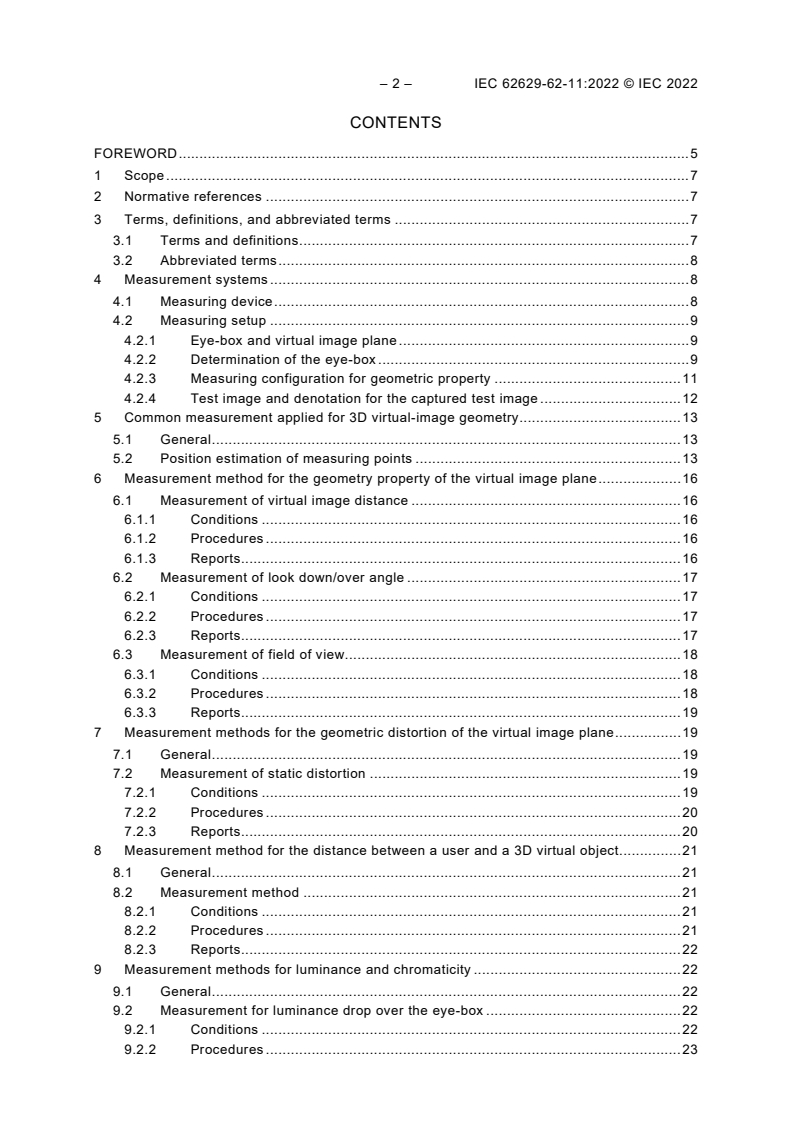
– 2 – IEC 62629-62-11:2022 © IEC 2022
CONTENTS
FOREWORD . 5
1 Scope . 7
2 Normative references . 7
3 Terms, definitions, and abbreviated terms . 7
3.1 Terms and definitions . 7
3.2 Abbreviated terms . 8
4 Measurement systems . 8
4.1 Measuring device . 8
4.2 Measuring setup . 9
4.2.1 Eye-box and virtual image plane . 9
4.2.2 Determination of the eye-box . 9
4.2.3 Measuring configuration for geometric property . 11
4.2.4 Test image and denotation for the captured test image . 12
5 Common measurement applied for 3D virtual-image geometry . 13
5.1 General . 13
5.2 Position estimation of measuring points . 13
6 Measurement method for the geometry property of the virtual image plane . 16
6.1 Measurement of virtual image distance . 16
6.1.1 Conditions . 16
6.1.2 Procedures . 16
6.1.3 Reports. 16
6.2 Measurement of look down/over angle . 17
6.2.1 Conditions . 17
6.2.2 Procedures . 17
6.2.3 Reports. 17
6.3 Measurement of field of view. 18
6.3.1 Conditions . 18
6.3.2 Procedures . 18
6.3.3 Reports. 19
7 Measurement methods for the geometric distortion of the virtual image plane . 19
7.1 General . 19
7.2 Measurement of static distortion . 19
7.2.1 Conditions . 19
7.2.2 Procedures . 20
7.2.3 Reports. 20
8 Measurement method for the distance between a user and a 3D virtual object. 21
8.1 General . 21
8.2 Measurement method . 21
8.2.1 Conditions . 21
8.2.2 Procedures . 21
8.2.3 Reports. 22
9 Measurement methods for luminance and chromaticity . 22
9.1 General . 22
9.2 Measurement for luminance drop over the eye-box . 22
9.2.1 Conditions . 22
9.2.2 Procedures . 23
9.2.3 Reports. 25
9.3 Measurement of the luminance and chromaticity for the virtual-image plane . 25
9.3.1 Conditions . 25
9.3.2 Procedures . 26
9.3.3 Reports. 28
Annex A (informative) Comparison of measurement items between the conventional
3D display and the virtual-image type 3D display . 29
Annex B (informative) Comparison of the optical-property measurement methods for
virtual images . 31
Annex C (informative) Additional information for geometric property measurement of
3D virtual images using imaging LMDs. 34
C.1 General . 34
C.2 Reasons for the necessity of using three imaging LMDs . 34
C.3 Geometric calibration process for the imaging LMDs . 35
Annex D (informative) Measurement for static crosstalk . 38
D.1 General . 38
D.2 Preparations . 38
D.3 Procedures . 39
D.4 Reports . 42
Bibliography . 43
Figure 1 – Geometric relationship between an eye-box and a virtual-image plane . 9
Figure 2 – Configuration for determination of the eye-box . 10
Figure 3 – Measuring setup for geometric property . 11
Figure 4 – Test image with nine measuring points (top) and the three corresponding
images captured by three imaging LMDs (bottom) . 12
Figure 5 – Denotation for each of the three corresponding images captured by three
imaging LMDs . 13
Figure 6 – Geometric relationship of the black circle of P in the test image, two
L R
imaging LMDs, and the captured P (indicated by and ) by the two imaging
m m
11 11
LMDs of LMD and LMD . 15
L R
Figure 7 – Denotation for the black circle indicated by P (i and j = 1) in the three
corresponding images captured by three imaging LMDs. 15
Figure 8 – Measuring condition for the virtual image distance . 16
Figure 9 – Measuring conditions for look down and look over angles . 17
Figure 10 – Measuring conditions for field of view (FOV) . 19
Figure 11 – Measuring conditions for evaluating static distortion . 20
Figure 12 – Measuring conditions for the distance of the 3D virtual object . 21
Figure 13 – Three images captured by three imaging LMDs for the 3D virtual object
located at the back of the virtual plane . 22
Figure 14 – Measuring location representation in the eye-box . 23
Figure 15 – Measuring condition for luminance and chromaticity from the centre point
in the eye-box . 25
Figure A.1 – Example of 3D displays. 29
Figure B.1 – Illustration of the measurement concept applied for this documenta . 32
Figure B.2 – Illustration of the measurement concept applied for ISO 9241-305:2008,
6.11.1 [5] . 33
– 4 – IEC 62629-62-11:2022 © IEC 2022
Figure B.3 – Illustration of the measurement concept applied for SAE J 1757-2 [3] . 33
Figure C.1 – Limit in the determination of the location of a 3D virtual object using two
imaging LMDs . 34
Figure C.2 – Determination of the location of a 3D virtual object using three imaging
LMDs . 35
Figure C.3 – World, imaging LMD and 2D image (pixel) coordinates for calibration . 37
Figure D.1 – Example of luminance profile created by four perspective images . 38
Figure D.2 – Measuring layout for the 3D crosstalk of a 3D HUD . 39
Figure D.3 – Example of luminance angular profile for 21 perspective images . 41
Table 1 – Example of reported specification of an imaging LMD . 8
Table 2 – Example of measurement results for the average of luminance drop for white
colour over the eye-box shown in Figure 14 . 25
Table 3 – Example of measurement results for white (black) luminance, contrast,
uniformity of white (black) luminance, and chromaticity coordinates in the
measurement configuration of Figure 15 . 28
Table A.1 – Comparison of measurement items . 30
Table B.1 – Comparison of the optical-property measurement methods for virtual
images . 32
Table D.1 – Example of measurement results for 3D crosstalk value . 42
INTERNATIONAL ELECTROTECHNICAL COMMISSION
____________
3D DISPLAY DEVICES –
Part 62-11: Measurement methods for virtual-image type – Optical
FOREWORD
1) The International Electrotechnical Commission (IEC) is a worldwide organization for standardization comprising
all national electrotechnical committees (IEC National Committees). The object of IEC is to promote international
co-operation on all questions concerning standardization in the electrical and electronic fields. To this end and
in addition to other activities, IEC publishes International Standards, Technical Specifications, Technical Reports,
Publicly Available Specifications (PAS) and Guides (hereafter referred to as “IEC Publication(s)”). Their
preparation is entrusted to technical committees; any IEC National Committee interested in the subject dealt with
may participate in this preparatory work. International, governmental and non-governmental organizations liaising
with the IEC also participate in this preparation. IEC collaborates closely with the International Organization for
Standardization (ISO) in accordance with conditions determined by agreement between the two organizations.
2) The formal decisions or agreements of IEC on technical matters express, as nearly as possible, an international
consensus of opinion on the relevant subjects since each technical committee has representation from all
interested IEC National Committees.
3) IEC Publications have the form of recommendations for international use and are accepted by IEC National
Committees in that sense. While all reasonable efforts are made to ensure that the technical content of IEC
Publications is accurate, IEC cannot be held responsible for the way in which they are used or for any
misinterpretation by any end user.
4) In order to promote international uniformity, IEC National Committees undertake to apply IEC Publications
transparently to the maximum extent possible in their national and regional publications. Any divergence between
any IEC Publication and the corresponding national or regional publication shall be clearly indicated in the latter.
5) IEC itself does not provide any attestation of conformity. Independent certification bodies provide conformity
assessment services and, in some areas, access to IEC marks of conformity. IEC is not responsible for any
services carried out by independent certification bodies.
6) All users should ensure that they have the latest edition of this publication.
7) No liability shall attach to IEC or its directors, employees, servants or agents including individual experts and
members of its technical committees and IEC National Committees for any personal injury, property damage or
other damage of any nature whatsoever, whether direct or indirect, or for costs (including legal fees) and
expenses arising out of the publication, use of, or reliance upon, this IEC Publication or any other IEC
Publications.
8) Attention is drawn to the Normative references cited in this publication. Use of the referenced publications is
indispensable for the correct application of this publication.
9) Attention is drawn to the possibility that some of the elements of this IEC Publication may be the subject of patent
rights. IEC shall not be held responsible for identifying any or all such patent rights.
IEC 62629-62-11 has been prepared by IEC technical committee 110: Electronic displays. It is
an International Standard.
The text of this International Standard is based on the following documents:
Draft Report on voting
110/1459/FDIS 110/1473/RVD
Full information on the voting for its approval can be found in the report on voting indicated in
the above table.
The language used for the development of this International Standard is English.
This document was drafted in accordance with ISO/IEC Directives, Part 2, and developed in
accordance with ISO/IEC Directives, Part 1 and ISO/IEC Directives, IEC Supplement, available
at www.iec.ch/members_experts/refdocs. The main document types developed by IEC are
described in greater detail at www.iec.ch/standardsdev/publications.
– 6 – IEC 62629-62-11:2022 © IEC 2022
A list of all parts in the IEC 62629 series, published under the general title: 3D display devices,
can be found on the IEC website.
The committee has decided that the contents of this document will remain unchanged until the
stability date indicated on the IEC website under webstore.iec.ch in the data related to the
specific document. At this date, the document will be
• reconfirmed,
• withdrawn,
• replaced by a revised edition, or
• amended.
IMPORTANT – The "colour inside" logo on the cover page of this document indicates
that it contains colours which are considered to be useful for the correct understanding
of its contents. Users should therefore print this document using a colour printer.
3D DISPLAY DEVICES –
Part 62-11: Measurement methods for virtual-image type – Optical
1 Scope
This part of IEC 62629 specifies the standard measuring conditions and measurement methods
for determining the optical properties of the image created by 3D display devices and virtual-
image optics such as head-up displays. The virtual image refers to an image in which the 3D
visual information is superimposed with the outside world. Eye-wear type displays are however
beyond the scope of this document.
NOTE The meaning of a virtual image in optics is in general an image formed when the outgoing rays from a point
on an object always diverge. With regard to display application, a virtual image can be interpreted according to a
real viewing case. When an image is viewed, even though there is no physical display (monitor, TV, screen), in front
of a person's eyes, it is called virtual image.
2 Normative references
The following documents are referred to in the text in such a way that some or all of their content
constitutes requirements of this document. For dated references, only the edition cited applies.
For undated references, the latest edition of the referenced document (including any
amendment-s) applies.
IEC 62629-1-2, 3D display devices – Part 1-2: Generic – Terminology and letter symbols
3 Terms, definitions, and abbreviated terms
3.1 Terms and definitions
For the purposes of this document, the terms and definitions given in IEC 62629-1-2 and the
following apply.
ISO and IEC maintain terminological databases for use in standardization at the following
addresses:
• IEC Electropedia: available at http://www.electropedia.org/
• ISO Online browsing platform: available at http://www.iso.org/obp
3.1.1
virtual image distance
distance from the centre between both eyes to the centre of a virtual image
Note 1 to entry: The eye-centre corresponds to the point where the half of the binocular spacing is located.
3.1.2
field of view
angle subtending the area of the virtual image as observed from the centre between both eyes
3.1.3
eye-box
<3D display devices – virtual-image type> three-dimensional space within which the users place
both their eyes and properly see the entire virtual image
– 8 – IEC 62629-62-11:2022 © IEC 2022
3.1.4
look down angle
angle in a downward direction between the normal line and viewing direction from which the
virtual image is viewed at the centre between both eyes
Note 1 to entry: The normal line represents a line forming a vertical angle of 90° from the centre of the eye to the
virtual image plane.
3.1.5
look over angle
angle in a sideway direction between the normal line and viewing direction from which the virtual
image is viewed at the centre between both eyes
3.2 Abbreviated terms
CCD charge-coupled device
CMOS complementary metal-oxide semiconductor
FOV field of view
HUD head-up display
IPD inter pupil distance
LMD light measuring device
4 Measurement systems
4.1 Measuring device
A spot LMD or an imaging LMD such as a 2D imaging colorimeter should be applied for
measuring light and colour properties, for example luminance value, chromaticity coordinates,
etc. The specification of the LMD applied should be described in the report as in the example
given in Table 1.
NOTE If a 3D display has the characteristics of multi-view, which is explained in IEC 62629-22-1 [1] , the aperture
size of 2 mm to 5 mm is suggested and is not larger than 6 mm.
Table 1 – Example of reported specification of an imaging LMD
Image sensor type CCD, CMOS
Resolution 1 380 × 1 030, 2 448 × 2 050,
2 2
Luminance range
0,05 cd/m to 100 000 cd/m
Repeatability ∆L (luminance) < 0,1 %
∆x, y (chromaticity coordinate) < 0,001
Measuring accuracy
∆L < 3 % (for Standard Illuminant A)
∆x, y < 0,002 (for Standard Illuminant A)
The geometric property of the 3D virtual image can be estimated using the imaging LMD
(multiple imaging LMDs or one imaging LMD with movement). Annex A shows a comparison of
measurement items between the conventional 3D display and the virtual-image type 3D display.
___________
Numbers in square brackets refer to the Bibliography.
4.2 Measuring setup
4.2.1 Eye-box and virtual image plane
The geometric relationship between an eye-box and a virtual image plane is shown in Figure 1.
Figure 1 – Geometric relationship between an eye-box and a virtual-image plane
If users’ eyes are placed in the eye-box, it is assumed that the users can view the entire virtual
image without moving their head or making any other adjustment. The eye-box position can be
specified by a supplier since this is varied by the application. The designed viewing distance
shown in Figure 1 is the distance between the centre of the eye-box and the position on the
half mirror, which should be suggested by the supplier. For the measurement, the designed
viewing distance should be applied as the measuring distance.
If the eye-box location information is not provided by the supplier, this can be determined
according to the method presented in 4.2.2. The measuring devices of the imaging LMD should
be set up within the eye-box position. When the same left and right images without parallax are
input, the plane on which the image is displayed is referred to as the virtual image plane. A 3D
virtual object can be presented in the front or the back of the virtual image plane. A 3D
coordinate system of xyz indicated in Figure 1 is defined in order to figure out the positions of
the 3D virtual object and the virtual image plane from the eye-box of the users. The centre of
the eye-box is defined as the zero position (xyz = 0).
NOTE If the supplier does not provide the eye-box position, this can be estimated by checking the geometric location
where observers can view the entire virtual image plane. In general, the eye-box location is defined by the
manufacturer according to the application. For example, it is determined by considering the distance from the
windshield or combiner to the driver for automotive application, and the distance from the user to the half mirror for
the exhibition application.
4.2.2 Determination of the eye-box
If the eye-box position is not provided by the supplier, the following method can be applied to
determine the eye-box:
NOTE H1 to H9 and V1 to V7 in Figure 2 indicate examples of the position of the imaging LMD to determine the
eye-box.
– 10 – IEC 62629-62-11:2022 © IEC 2022
Figure 2 – Configuration for determination of the eye-box
a) a full grey input image (e.g. RGB = 50) with a white outline and a centre grey square (1 / 5
input image size in the horizontal and vertical position, e.g. RGB = 200) can be used as
shown in Figure 2;
b) an imaging LMD is located at the designed viewing distance (z = 0) and should be directed
to the centre point of the input image;
c) the virtual image of full grey input is captured, and the luminance of the centre grey square
is measured by moving the imaging LMD in an increment of 5 mm from left to right;
NOTE 1 When the experimenter visually observes the virtual image (in Figure 2) at the designed viewing distance,
the left border of the target virtual image starts to be viewed. The LMD is placed at position H1.
d) find the maximum luminance value from those measured while moving the imaging LMD,
and calculate the percentage of the maximum luminance value at all imaging LMD locations;
e) the leftmost and rightmost positions, at which the full grey image with the white outline is
acquired and the percentage of the maximum luminance value is greater than 50 %, are
determined in the x-axis (for instance, almost half of the virtual image plane and 40 % of the
percentage of the maximum luminance value are only acquired by the imaging LMD at the
H1 position);
NOTE 2 The percentage of the maximum luminance value applied to find the eye-box boundary can be selected as
50 % or something else, but the value will be recorded in the report.
f) for example, the leftmost and rightmost horizontal positions to be determined are H3 and
H8 in Figure 2;
NOTE 3 The left eye and right eye are located at the leftmost and rightmost positions determined through the
procedures (a) to (e). Both eyes are free to be located inside the leftmost and rightmost positions.
g) the horizontal centre (x = 0) is found from the middle position of H3 and H8;
h) the virtual image of full grey input is captured and the luminance of the centre grey square
is measured by moving the imaging LMD in an increment of 5 mm from the bottom through
the horizontal centre (x = 0) to the top;
i) find the maximum luminance value from those measured while moving the imaging LMD,
and calculate the percentage of the maximum luminance value at all imaging LMD locations;
j) the bottommost and topmost positions, at which the full grey image with the white outline is
acquired and the percentage of the maximum luminance value is greater than 50 %, are
determined in the y-axis;
k) for example, the bottommost and topmost vertical positions to be determined are V2 and V6
in Figure 2;
l) the vertical centre (y = 0) is found from the middle position of V2 and V6; and
m) the zero position (xyz = 0) is finally determined.
4.2.3 Measuring configuration for geometric property
Figure 3 illustrates the configuration of three imaging LMDs and the test pattern displayed on
the virtual-image plane in the three-dimensional xyz-coordinate system for evaluating geometric
characteristics of the virtual projected image.
Figure 3 – Measuring setup for geometric property
The measurement items for assessing the virtual image geometry relative to a user’s eyes are
the look down/over angle, virtual image distance, and field of view. To ensure that projections
are properly aligned, geometric distortion is also measured. The centre of the eye-box is defined
to be the origin (x = 0, y = 0 and z = 0) at which the centre imaging LMD (LMD ) is placed. The
C
gap between the left (LMD ) and right (LMD ) imaging LMDs is assumed to be the same as the
L R
inter pupil distance (IPD) of a user. The average IPD of 60 mm or 65 mm can be used for this
gap. The IPDs are selected to reflect mean values among both male and female examinees
found in previous research [2]. The distance between the LMD and LMD is the half of the
L(R) C
distance between the LMD and LMD . If one imaging LMD instead of three imaging LMDs is
L R
applied, the measurement can be conducted by moving the imaging LMD. The measuring point
for each of the nine black circles in the test pattern is named P (i and j = 1, 2, 3). P can be
ij ij
expressed as (x , y , z ) in the xyz-coordinate system.
ij ij ij
The 3D virtual image/object to be evaluated can be located on the virtual image plane or in the
front/rear of the virtual image plane (Figure 1). If the 3D virtual image/object is placed on the
virtual image plane, there is no parallax. On the other hand, if the 3D virtual image/object to be
evaluated is located in the front or rear of the virtual image plane, there is negative or positive
parallax.
Annex B describes the principle of the geometric-property measurement method applied for this
document and comparisons with other measurement methods. Annex C provides the geometric
calibration process for the imaging LMD. The required calibration level should satisfy the
following condition.
The rotation matrix R in the calibration result of three imaging LMDs (LMD , LMD and LMD )
L C R
in Figure 3 should be R = R = R in theory. For the practical case, if R ≠ R ≠ R , there is
L C R L C R
LR
nn−
then nonzero for the difference in the vertical pixel index of between the captured
ij ij
images by LMD and LMD where the n is vertical pixel index of the captured image of the test
L R
LR
pattern ij. To obtain reliable results, the value of nn− should be less than 1 %, that is, the
ij ij
difference in the vertical pixel index between the captured images by LMD and LMD should
L R
– 12 – IEC 62629-62-11:2022 © IEC 2022
be less than the number of vertical pixels in the captured image/100. Details related to imaging
LMD calibration are described in Annex C.
4.2.4 Test image and denotation for the captured test image
Figure 4 shows the test image composed of nine black circles and the three corresponding
captured images by three imaging LMDs (LMD , LMD and LMD ) placed in the left, centre and
L C R
right positions of the eye-box. Every black circle includes a white cross in the centre. The
distance between LMD and LMD is indicated by a. The measuring point(s) can be selected
L R
from the nine points of P to P as necessary.
11 33
Figure 4 – Test image with nine measuring points (top right) and the three
corresponding images (bottom) captured by three imaging LMDs (top left)
captured image by LMD captured image by LMD captured image by LMD
L C R
L LL C CC
R RR
P = (mn,) P = (mn,)
ij ij ij ij ij ij P = (mn,)
ij ij ij
NOTE m,n: pixel index of the captured image, which is an integer.
Figure 5 – Denotation for each of the three corresponding
images captured by three imaging LMDs
LC R
P , P , and P for the test patterns in the three
Figure 5 shows the denotation in terms of
ij ij ij
corresponding captured images by three imaging LMDs, that is LMD , LMD and LMD . Since
L C R
LC R L,C,R
P , P , and P are the two-dimensional coordinates on the captured images, P is
ij ij ij ij
L,C,R L,C,R
m n
represented by ( , ) where m and n are pixel indexes of the captured image of the
ij ij
test pattern.
5 Common measurement applied for 3D virtual-image geometry
5.1 General
The 3D virtual images should be properly aligned relative to a user’s eyes. The geometric
property therefore shall be evaluated for the projected virtual-image plane and the 3D virtual
objects (see Figure 1) that can be located in front or in back of the virtual image plane. Clause
5 introduces the common measurement method applied for the geometric property evaluation.
Clause 6 and Clause 7 describe the specific procedures for evaluating the degree to which a
virtual image is aligned from a user's location by focusing on four aspects: look down/over angle,
field of view, distance between the user, and virtual image plane, and the distortion. Clause 8
describes the detailed procedures for determining the distance between the user and the 3D
virtual object.
There is no parallax for the 3D virtual object placed on the virtual image plane, whereas there
is negative or positive parallax for the 3D virtual object located in front or in back of the virtual
image plane. The geometric properties for the virtual image plane (Figure 8 to Figure 11) and
the 3D virtual object (Figure 12) are obtained based on the triangulation methodology. The input
factors in the application of triangulation are the binocular disparity information acquired by the
multiple imaging LMDs and the field of view of the imaging LMD.
If the geometric property measurement is made using other methods than that proposed by this
document, these other methods shall be mentioned in the report.
5.2 Position estimation of measuring points
If the positions (P = x , y , z ) for the nine points P to P on the captured image are
ij ij ij ij 11 33
determined in the xyz-coordinate system of Figure 3, the geometric information for the virtual
– 14 – IEC 62629-62-11:2022 © IEC 2022
image plane and the 3D virtual object can be deduced. In order to determine the accurate
location of the 3D virtual object, Annex C introduces the reason for using three imaging LMDs
(LMD , LMD and LMD ) in Figure 3. The position z for P in the test image of Figure 3 is
L C R 11 11
obtained first using LMD and LMD . The LMD is then used to determine the position (x ,
L R C 11
y ). The detailed calculation process is described as follows.
The position z for P in the test image of Figure 3 is calculated first using a triangular
11 11
relationship made of the distance (between the centre of the user’s eyes and P ) in the z-axis,
LR
the binocular disparity information of ( ), and the LMD’s field of view of θ in Figure 6. For
mm−
11 11
the black circle indicated by P , the denotation in the captured images is given in Figure 7.
Formula (1) and Formula (2) describe this relationship well. The binocular disparity information
LR
of ( ) is obtained from the corresponding 2D image points of the two captured images by
mm−
11 11
L R
m m
LMD and LMD . The horizontal disparity between of the LMD image and of the
11 11
L R L
LR
LMD image is the same as the value of a. Thus, the ratio of ( ) to M can be expressed
mm−
R
11 11
θ
in the same way as the ratio of α to using the following formulae.
2 ⋅⋅z tan
11
θ
LR
m− mM: =α : 2⋅⋅z tan
(1)
11 11 11
LR
mm−
α
11 11
=
(2)
θ
M
2 ⋅⋅z tan
11
where
M is the number of horizontal pixels in the captured image;
LR
are the horizontal pixel indexes of the captured image by LMD and LMD ;
mm,
11 11 L R
θ is the horizontal field of view of the imaging LMD;
z is the distance between the centre (0, 0, 0 in Figure 3) of LMD and LMD , and P ;
11 L R 11
and
α is the gap between LMD and LMD .
L R
α: gap between LMD and LMD ;
L R
θ: horizontal field of view of the imaging LMD;
z : distance between the centre position (0, 0, 0 in Figure 3) of LMD and LMD ; and
11 L R
P : one of the black circles in the test image in Figure 4;
LR
: horizontal pixel indexes of the captured image by LMD and LMD .
mm,
11 11 L R
Figure 6 – Geometric relationship of the black circle of P in the test image,
L R
two imaging LMDs, and the captured P (indicated by and )
m m
11 11
by the two imaging LMDs of LMD and LMD
L R
LL RR CC
(,mn ) (,mn ) (,mn )
11 11 11 11 11 11
Figure 7 – Denotation for the black circle indicated by P (i and j = 1) in the three
corresponding images captured by three imaging LMDs
LL
mm,
The black circle in the top left corner (P ) in Figure 7 is indicated by ( ) in the captured
11 11
RR CC
mm, mm,
image by LMD or by ( ) in the captured image by LMD or by ( ) in the captured
11 11 11 11
L R
image by LMD . From Formula (1) and Formula (2), the value of z can be obtained. The
C 11
position (x , y , z ) of P can then be calculated using Formula (3).
11 11 11 11
CC
mn′
θ θ αM
11 11
xz= ⋅ tan 2⋅ −1, y = z ⋅ tan 2⋅ −1, z = ⋅
(3)
11 11 11 11 11
θ LR
22MN
2 ⋅ tan
()mm−
11 11
where
M, N are the number of horizontal and vertical pixels in the captured image;
– 16 – IEC 62629-62-11:2022 © IEC 2022
L RC
are the horizontal pixel indices of the captured images by LMD , LMD , and LMD ;
mmm,,
11 11 11 L R C
C
is the vertical pixel index of the captured image by LMD ;
n
C
θ is the horizontal field of view of the imaging LMD;
θ′ is the vertical field of view of the imaging LMD; and
a is the gap between LMD and LMD .
L R
6 Measurement method for the geometry property of the virtual image plane
6.1 Measurement of virtual image distance
6.1.1 Conditions
The following detailed conditions should be applied (see Figure 8):
a) test pattern: the test image with nine circles (P to P ) in Figure 3; and
11 33
b) acquisition of the test image: the three imaging LMDs located in the eye-box are used to
capture three sets of the 2D image.
Figure 8 – Measuring condition for the virtual image distance
6.1.2 Procedures
The following measuring procedures should be carried out:
a) three test images are acquired by the three imaging LMDs: LMD , LMD and LMD ;
L C R
b) the position (x , y , z ) for P in the test image is determined according to the
22 22 22 22
computation method described in 5.2; and
c) the virtual image distance between (0, 0, 0) in the eye-box and (x , y , z ) in the centre
22 22 22
of the virtual plane is calculated as follows:
2 22
(4)
D x++yz
VI 22 22 22
6.1.3 Reports
The measurement results shall be reported with the gap (a in Figure 3 and Figure 4) that is
the same as the IPD value applied to evaluate the virtual image distance as follows.
– , in m
D
VI
– a, in mm
=
6.2 Measurement of look down/over angle
6.2.1 Conditions
The following detailed conditions should be applied (see Figure 9):
a) test pattern: the test image with nine circles (P to P ) in Figure 3; and
11 33
b) acquisition of the test image: the three imaging LMDs located in the eye-box are used to
capture three sets of the 2D image.
(a) for the look down angle of θ
down
(b) for the look over angle of θ
over
Figure 9 – Measuring conditions for look down and look over angles
6.2.2 Procedures
The following measuring procedure should be carried out:
a) three test-pattern images are acquired by three imaging LMDs: LMD , LMD and LMD ;
L C R
b) test pattern: the position (x , y , z ) for P in the test image is determined according to
22 22 22 22
the computation method described in 5.2; and
c) the look down/over angles of θ and θ are calculated using the position information
down over
(x , y , z ) for P in the test image as follows:
22 22 22 22
2 2 22
x + y xz+
−−1122 22 22 22
θθcos , cos
(5)
down over
2 22 2 22
x ++yz x ++yz
22 22 22 22 22 22
6.2.3 Reports
The measurement results shall be reported with the gap (a in Figure 3 and Figure 4) that is
the same as the IPD value applied to evaluate the look down and look over angles as follows.
==
– 18 – IEC 62629-62-11:2022 © IEC 2022
– θ and θ
down over
– a, in mm
6.3 Measurement of field of view
6.3.1 Conditions
The following detailed conditions should be applied (see Figure 10):
a) test pattern: the test image with nine circles (P to P ) in Figure 3; and
11 33
b) acquisition of the test image: the three imaging LMDs located in the eye-box are used to
capture three sets of the 2D image.
6.3.2 Procedures
The following measuring procedure should be carried out:
a) three test images are acquired by three imaging LMDs: LMD , LMD and LMD ;
L C R
b) for the horizontal FOV, the positions (x , y , z ) and (x , y , z ) for P and P in the
21 21 21 23 23 23 21 23
test image (see Figure 10 (a)) are determined according to the computation method
described in 5.2;
H
θ
c) the horizontal FOV of is calculated as follows:
FOV
22 2
()PO +−P O P P
21 23 21 23
H1−
(6)
θ = cos
FOV
2 PO P O
21 23
where
O is the (0, 0, 0) position, that is, the centre of the eye-box;
PP
is the distance between P and P ;
21 23
21 23
PO
is the distance between P and O;
PO is the distance between P and O;
23 23
d) for the vertical FOV, the positions (x , y , z ) and (x , y ,
...