

IEC PAS 62840-3:2021
(Main)Electric vehicle battery swap system - Part 3: Particular safety and interoperability requirements for battery swap systems operating with removable RESS/battery systems
General Information
- Abstract
IEC PAS 62840-3:2021 applies to battery swap systems for removable RESS of electric road vehicle when connected to the supply network, with a rated supply voltage up to 480 V AC or up to 400 V DC, for battery systems with a rated voltage up to 120 V DC.
This document applies to battery swap systems for removable RESS/EV where the removable RESS/EV is stored for the purpose of transfer power between the battery swap station and removable RESS/EV.
Requirements for bidirectional energy transfer DC to AC are under consideration and are not part of this document.
This document applies to:
– battery swap systems supplied from on-site storage systems (for example buffer batteries etc;
– manual, mechanically assisted and automatic systems);
– battery swap systems intended to supply removable battery systems having communication allowing to identify the battery system characteristics;
– battery swap systems intended to be installed at an altitude of up to 2 000 m.
The aspects covered in this document include:
– requirements for power transfer between the battery systems;
– additional requirements for communication;
– the connection to supply network.
Additional requirements may apply to special locations.
This document does not apply to:
– safety requirements for mechanical equipment covered by ISO 10218 (all parts);
– locking compartments systems providing AC socket-outlets for the use of manufacturer specific voltage converter units and manufacturer specific battery systems;
– safety aspects related to maintenance;
– electrical devices and components which are covered by their specific product standards;
– trolley buses, rail vehicles;
– any on-board equipment which is covered by ISO;
– EMC requirements for on-board equipment while connected to the supply, which are covered by IEC 61851-21-1.
Requirements for battery swap systems using protective measures as covered by 410 of IEC 60364-4-41:2005 other than double or reinforced insulation are under consideration.
- Status
- Published
- Publication Date
- 26-Sep-2021
- Technical Committee
- TC 69 - Electrical power/energy transfer systems for electrically propelled road vehicles and industrial trucks
- Drafting Committee
- WG 13 - TC 69/WG 13
- Current Stage
- PPUB - Publication issued
- Start Date
- 27-Sep-2021
- Completion Date
- 26-Oct-2021
Buy Documents
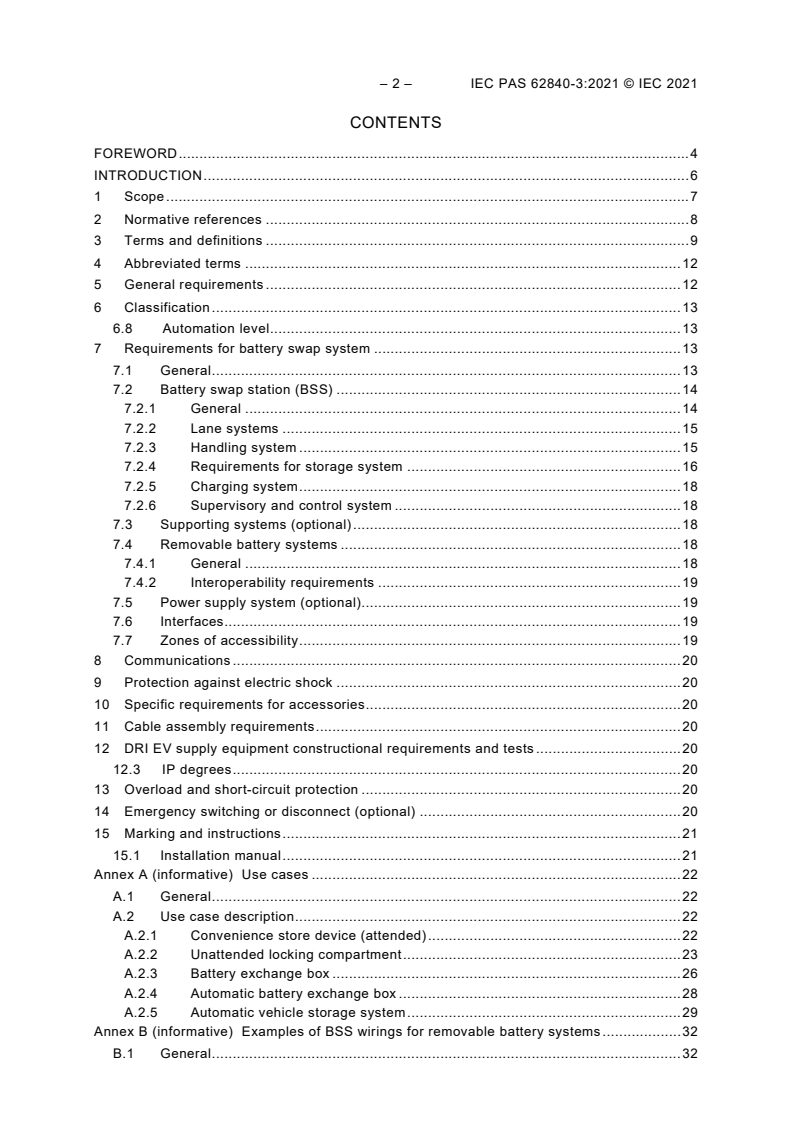
IEC PAS 62840-3:2021 - Electric vehicle battery swap system - Part 3: Particular safety and interoperability requirements for battery swap systems operating with removable RESS/battery systems Released:9/27/2021
Overview
IEC PAS 62840-3:2021 - Electric vehicle battery swap system - Part 3 - specifies particular safety and interoperability requirements for battery swap systems that operate with removable RESS (Rechargeable Energy Storage Systems) / removable EV batteries. This PAS (Publicly Available Specification, edition 1.0, 2021-09) applies to battery swap stations (BSS) connected to the supply network up to 480 V AC or 400 V DC, and to removable battery systems with rated voltage up to 120 V DC. It covers manual, mechanically assisted and automatic systems, including on-site storage (buffer batteries), and is intended for installations up to 2 000 m altitude. Bidirectional DC→AC energy transfer is under consideration and is not included.
Key topics and requirements
The document defines technical and safety requirements focused on interoperability and safe power transfer between battery systems:
- Power transfer requirements between the battery swap station and removable RESS/battery systems.
- Communication requirements so BSS can identify battery characteristics (interoperability and control).
- Connection to the supply network including on-site storage integration.
- Subsystem requirements for BSS components: lane/handling systems, storage, charging, supervisory and control systems.
- Zones of accessibility, protection against electric shock, overload and short-circuit protection, emergency disconnect options.
- Construction and testing aspects (e.g., IP degrees, cable assembly, accessories).
- Marking and instructions including installation manuals and user information.
- Informative annexes with use cases, wiring examples and stackable removable battery system examples.
Excluded items are clearly listed (no mechanical safety covered by ISO 10218, no on-board equipment covered by ISO standards, no EMC for on-board equipment covered by IEC 61851-21-1, maintenance safety, and product-specific standards for individual components).
Practical applications
This PAS is practical for:
- Designing and certifying battery swap stations (BSS) for electric road vehicles using removable batteries.
- Developing interoperable removable battery systems (RESS) that can be identified and handled safely by BSS.
- Integrating on-site energy storage or buffer battery solutions for swap operations.
- Preparing installation, testing and safety documentation for commercial and unattended swap facilities.
Who should use this standard
- EV infrastructure designers and system integrators
- Battery and RESS manufacturers developing removable packs
- Charging and BSS equipment manufacturers
- Safety engineers, test laboratories and certification bodies
- Fleet operators and site planners deploying swap stations
Related standards
- IEC 61851-3 (EV supply equipment) - IEC PAS 62840-3 is to be used in conjunction with IEC 61851-3.
- IEC 62840 series (general guidance and safety parts)
- IEC 60364-4-41 (protective measures) - related topics under consideration
Keywords: IEC PAS 62840-3:2021, battery swap system, removable RESS, battery swap station, EV battery swap, interoperability, safety requirements.
Buy Documents
IEC PAS 62840-3:2021 - Electric vehicle battery swap system - Part 3: Particular safety and interoperability requirements for battery swap systems operating with removable RESS/battery systems Released:9/27/2021
Get Certified
Connect with accredited certification bodies for this standard

TÜV Rheinland
TÜV Rheinland is a leading international provider of technical services.

TÜV SÜD
TÜV SÜD is a trusted partner of choice for safety, security and sustainability solutions.

DEKRA Certification Inc.
DEKRA US certification services.
Sponsored listings
Frequently Asked Questions
IEC PAS 62840-3:2021 is a technical specification published by the International Electrotechnical Commission (IEC). Its full title is "Electric vehicle battery swap system - Part 3: Particular safety and interoperability requirements for battery swap systems operating with removable RESS/battery systems". This standard covers: IEC PAS 62840-3:2021 applies to battery swap systems for removable RESS of electric road vehicle when connected to the supply network, with a rated supply voltage up to 480 V AC or up to 400 V DC, for battery systems with a rated voltage up to 120 V DC. This document applies to battery swap systems for removable RESS/EV where the removable RESS/EV is stored for the purpose of transfer power between the battery swap station and removable RESS/EV. Requirements for bidirectional energy transfer DC to AC are under consideration and are not part of this document. This document applies to: – battery swap systems supplied from on-site storage systems (for example buffer batteries etc; – manual, mechanically assisted and automatic systems); – battery swap systems intended to supply removable battery systems having communication allowing to identify the battery system characteristics; – battery swap systems intended to be installed at an altitude of up to 2 000 m. The aspects covered in this document include: – requirements for power transfer between the battery systems; – additional requirements for communication; – the connection to supply network. Additional requirements may apply to special locations. This document does not apply to: – safety requirements for mechanical equipment covered by ISO 10218 (all parts); – locking compartments systems providing AC socket-outlets for the use of manufacturer specific voltage converter units and manufacturer specific battery systems; – safety aspects related to maintenance; – electrical devices and components which are covered by their specific product standards; – trolley buses, rail vehicles; – any on-board equipment which is covered by ISO; – EMC requirements for on-board equipment while connected to the supply, which are covered by IEC 61851-21-1. Requirements for battery swap systems using protective measures as covered by 410 of IEC 60364-4-41:2005 other than double or reinforced insulation are under consideration.
IEC PAS 62840-3:2021 applies to battery swap systems for removable RESS of electric road vehicle when connected to the supply network, with a rated supply voltage up to 480 V AC or up to 400 V DC, for battery systems with a rated voltage up to 120 V DC. This document applies to battery swap systems for removable RESS/EV where the removable RESS/EV is stored for the purpose of transfer power between the battery swap station and removable RESS/EV. Requirements for bidirectional energy transfer DC to AC are under consideration and are not part of this document. This document applies to: – battery swap systems supplied from on-site storage systems (for example buffer batteries etc; – manual, mechanically assisted and automatic systems); – battery swap systems intended to supply removable battery systems having communication allowing to identify the battery system characteristics; – battery swap systems intended to be installed at an altitude of up to 2 000 m. The aspects covered in this document include: – requirements for power transfer between the battery systems; – additional requirements for communication; – the connection to supply network. Additional requirements may apply to special locations. This document does not apply to: – safety requirements for mechanical equipment covered by ISO 10218 (all parts); – locking compartments systems providing AC socket-outlets for the use of manufacturer specific voltage converter units and manufacturer specific battery systems; – safety aspects related to maintenance; – electrical devices and components which are covered by their specific product standards; – trolley buses, rail vehicles; – any on-board equipment which is covered by ISO; – EMC requirements for on-board equipment while connected to the supply, which are covered by IEC 61851-21-1. Requirements for battery swap systems using protective measures as covered by 410 of IEC 60364-4-41:2005 other than double or reinforced insulation are under consideration.
IEC PAS 62840-3:2021 is classified under the following ICS (International Classification for Standards) categories: 43.120 - Electric road vehicles. The ICS classification helps identify the subject area and facilitates finding related standards.
IEC PAS 62840-3:2021 is available in PDF format for immediate download after purchase. The document can be added to your cart and obtained through the secure checkout process. Digital delivery ensures instant access to the complete standard document.
Standards Content (Sample)
IEC PAS 62840-3 ®
Edition 1.0 2021-09
PUBLICLY AVAILABLE
SPECIFICATION
PRE-STANDARD
Electric vehicle battery swap system –
Part 3: Particular safety and interoperability requirements for battery swap
systems operating with removable RESS/battery systems
All rights reserved. Unless otherwise specified, no part of this publication may be reproduced or utilized in any form
or by any means, electronic or mechanical, including photocopying and microfilm, without permission in writing from
either IEC or IEC's member National Committee in the country of the requester. If you have any questions about IEC
copyright or have an enquiry about obtaining additional rights to this publication, please contact the address below or
your local IEC member National Committee for further information.
IEC Central Office Tel.: +41 22 919 02 11
3, rue de Varembé info@iec.ch
CH-1211 Geneva 20 www.iec.ch
Switzerland
About the IEC
The International Electrotechnical Commission (IEC) is the leading global organization that prepares and publishes
International Standards for all electrical, electronic and related technologies.
About IEC publications
The technical content of IEC publications is kept under constant review by the IEC. Please make sure that you have the
latest edition, a corrigendum or an amendment might have been published.
IEC publications search - webstore.iec.ch/advsearchform IEC online collection - oc.iec.ch
The advanced search enables to find IEC publications by a Discover our powerful search engine and read freely all the
variety of criteria (reference number, text, technical publications previews. With a subscription you will always have
committee, …). It also gives information on projects, replaced access to up to date content tailored to your needs.
and withdrawn publications.
Electropedia - www.electropedia.org
IEC Just Published - webstore.iec.ch/justpublished
The world's leading online dictionary on electrotechnology,
Stay up to date on all new IEC publications. Just Published
containing more than 22 000 terminological entries in English
details all new publications released. Available online and once
and French, with equivalent terms in 18 additional languages.
a month by email.
Also known as the International Electrotechnical Vocabulary
(IEV) online.
IEC Customer Service Centre - webstore.iec.ch/csc
If you wish to give us your feedback on this publication or need
further assistance, please contact the Customer Service
Centre: sales@iec.ch.
IEC PAS 62840-3 ®
Edition 1.0 2021-09
PUBLICLY AVAILABLE
SPECIFICATION
PRE-STANDARD
Electric vehicle battery swap system –
Part 3: Particular safety and interoperability requirements for battery swap
systems operating with removable RESS/battery systems
INTERNATIONAL
ELECTROTECHNICAL
COMMISSION
ICS 43.120 ISBN 978-2-8322-1031-6
– 2 – IEC PAS 62840-3:2021 © IEC 2021
CONTENTS
FOREWORD . 4
INTRODUCTION . 6
1 Scope . 7
2 Normative references . 8
3 Terms and definitions . 9
4 Abbreviated terms . 12
5 General requirements . 12
6 Classification . 13
6.8 Automation level . 13
7 Requirements for battery swap system . 13
7.1 General . 13
7.2 Battery swap station (BSS) . 14
7.2.1 General . 14
7.2.2 Lane systems . 15
7.2.3 Handling system . 15
7.2.4 Requirements for storage system . 16
7.2.5 Charging system . 18
7.2.6 Supervisory and control system . 18
7.3 Supporting systems (optional) . 18
7.4 Removable battery systems . 18
7.4.1 General . 18
7.4.2 Interoperability requirements . 19
7.5 Power supply system (optional). 19
7.6 Interfaces . 19
7.7 Zones of accessibility . 19
8 Communications . 20
9 Protection against electric shock . 20
10 Specific requirements for accessories . 20
11 Cable assembly requirements . 20
12 DRI EV supply equipment constructional requirements and tests . 20
12.3 IP degrees . 20
13 Overload and short-circuit protection . 20
14 Emergency switching or disconnect (optional) . 20
15 Marking and instructions . 21
15.1 Installation manual . 21
Annex A (informative) Use cases . 22
A.1 General . 22
A.2 Use case description . 22
A.2.1 Convenience store device (attended) . 22
A.2.2 Unattended locking compartment . 23
A.2.3 Battery exchange box . 26
A.2.4 Automatic battery exchange box . 28
A.2.5 Automatic vehicle storage system . 29
Annex B (informative) Examples of BSS wirings for removable battery systems . 32
B.1 General . 32
B.2 Example of a BSS wiring providing independent VCU for each battery
system . 32
B.3 Example of a BSS wiring providing common VCU for all battery systems . 34
Annex C (informative) Examples of BSS for stackable removable battery systems . 35
C.1 General . 35
C.2 Connection of battery systems connected together . 35
Bibliography . 38
Figure 1 – Composition of the battery swap system . 14
Figure B.1 – Example of a removable battery system wiring (for information) . 32
Figure B.2 – Example of a BSS wiring providing independent VCU for each battery
system . 33
Figure B.3 – Example of a BSS wiring providing common VCU for all battery systems . 34
Figure C.1 – Example of a stackable removable battery system wiring . 35
Figure C.2 – Example of a BSS for stackable removable battery systems . 36
Figure C.3 – Connection of battery systems connected together . 37
Table 1 – Sub-systems mandatory for use-cases . 14
Table 2 – Interoperability requirements . 19
Table A.1 – UC convenience store device (attended) . 22
Table A.2 – UC unattended locking compartment DC . 24
Table A.3 – UC unattended locking compartment AC . 25
Table A.4 – UC battery exchange box . 27
Table A.5 – UC automatic battery exchange box . 29
Table A.6 – UC automatic vehicle storage system . 30
– 4 – IEC PAS 62840-3:2021 © IEC 2021
INTERNATIONAL ELECTROTECHNICAL COMMISSION
____________
ELECTRIC VEHICLE BATTERY SWAP SYSTEM –
Part 3: Particular safety and interoperability requirements for battery
swap systems operating with removable RESS/battery systems
FOREWORD
1) The International Electrotechnical Commission (IEC) is a worldwide organization for standardization comprising
all national electrotechnical committees (IEC National Committees). The object of IEC is to promote international
co-operation on all questions concerning standardization in the electrical and electronic fields. To this end and
in addition to other activities, IEC publishes International Standards, Technical Specifications, Technical Reports,
Publicly Available Specifications (PAS) and Guides (hereafter referred to as “IEC Publication(s)”). Their
preparation is entrusted to technical committees; any IEC National Committee interested in the subject dealt with
may participate in this preparatory work. International, governmental and non-governmental organizations liaising
with the IEC also participate in this preparation. IEC collaborates closely with the International Organization for
Standardization (ISO) in accordance with conditions determined by agreement between the two organizations.
2) The formal decisions or agreements of IEC on technical matters express, as nearly as possible, an international
consensus of opinion on the relevant subjects since each technical committee has representation from all
interested IEC National Committees.
3) IEC Publications have the form of recommendations for international use and are accepted by IEC National
Committees in that sense. While all reasonable efforts are made to ensure that the technical content of IEC
Publications is accurate, IEC cannot be held responsible for the way in which they are used or for any
misinterpretation by any end user.
4) In order to promote international uniformity, IEC National Committees undertake to apply IEC Publications
transparently to the maximum extent possible in their national and regional publications. Any divergence between
any IEC Publication and the corresponding national or regional publication shall be clearly indicated in the latter.
5) IEC itself does not provide any attestation of conformity. Independent certification bodies provide conformity
assessment services and, in some areas, access to IEC marks of conformity. IEC is not responsible for any
services carried out by independent certification bodies.
6) All users should ensure that they have the latest edition of this publication.
7) No liability shall attach to IEC or its directors, employees, servants or agents including individual experts and
members of its technical committees and IEC National Committees for any personal injury, property damage or
other damage of any nature whatsoever, whether direct or indirect, or for costs (including legal fees) and
expenses arising out of the publication, use of, or reliance upon, this IEC Publication or any other IEC
Publications.
8) Attention is drawn to the Normative references cited in this publication. Use of the referenced publications is
indispensable for the correct application of this publication.
9) Attention is drawn to the possibility that some of the elements of this IEC Publication may be the subject of patent
rights. IEC shall not be held responsible for identifying any or all such patent rights.
A PAS is an intermediate specification made available to the public and needing a lower level
of consensus than an International Standard to be approved by vote (simple majority).
IEC PAS 62840-3 has been processed by IEC technical committee 69: Electrical power/energy
transfer systems for electrically propelled road vehicles industrial trucks.
The text of this PAS is based on the This PAS was approved for
following document: publication by the P-members of the
committee concerned as indicated in
the following document
Draft PAS Report on voting
69/749/DPAS 69/772/RVDPAS
Following publication of this PAS, which is a pre-standard publication, the technical committee
or subcommittee concerned may transform it into an International Standard.
This PAS shall remain valid for an initial maximum period of 2 years starting from the publication
date. The validity may be extended for a single period up to a maximum of 2 years, at the end
of which it shall be published as another type of normative document, or shall be withdrawn.
In this document, the following print types are used:
– requirements: in roman type;
– test specifications: in italic type;
– notes: in small roman type.
A list of all parts in the IEC 62840 series, published under the general title Electric vehicle
battery swap system, can be found on the IEC website.
– 6 – IEC PAS 62840-3:2021 © IEC 2021
INTRODUCTION
The IEC 62840 series is published in separate parts according to the following structure:
IEC TS 62840-1: Electric vehicle battery swap system – Part 1: General and guidance
IEC 62840-2: Electric vehicle battery swap system – Part 2: Safety requirements
IEC PAS 62840-3: Electric vehicle battery swap system – Part 3: Particular safety and
interoperability requirements for battery swap systems operating with removable RESS/battery
systems
This document derives from IEC 61851-3 (all parts) and was established by IEC TC 69 WG10
as a referencing document to IEC TS 61851-3-1.
NOTE In this document, EV supply equipment configuration type F according to IEC TS 61851-3-1 for removable
battery systems is named "battery swap station".
After moving of the document to IEC TC 69 WG13, IEC TC 69 decided to publish the document
as PAS based on IEC TS 61851-3-3 as an intermediate specification, which responds to
particular market needs according to 2.4.8 of ISO/IEC Directives, Part 1:2020, published prior
to the development of a full International Standard.
For this reason, this document is to be used in conjunction with IEC 61851-3 (all parts).
By the upcoming revision of IEC 62840 (all parts), this document will be fully integrated into the
IEC 62840 series.
ELECTRIC VEHICLE BATTERY SWAP SYSTEM –
Part 3: Particular safety and interoperability requirements for battery
swap systems operating with removable RESS/battery systems
1 Scope
This document applies to battery swap systems for removable RESS of electric road vehicle
when connected to the supply network, with a rated supply voltage up to 480 V AC or up to 400
V DC, for battery systems with a rated voltage up to 120 V DC.
NOTE 1 In the following countries, the acceptable nominal supply voltage is up to 600 V AC: CA, US.
This document applies to battery swap systems for removable RESS/EV where the removable
RESS/EV is stored for the purpose of transfer power between the battery swap station and
removable RESS/EV.
Requirements for bidirectional energy transfer DC to AC are under consideration and are not
part of this document.
This document applies to:
– battery swap systems supplied from on-site storage systems (for example buffer batteries
etc);
– manual, mechanically assisted and automatic systems;
– battery swap systems intended to supply removable battery systems having communication
allowing to identify the battery system characteristics;
– battery swap systems intended to be installed at an altitude of up to 2 000 m.
The aspects covered in this document include:
– requirements for power transfer between the battery systems;
– additional requirements for communication;
– the connection to supply network.
Additional requirements may apply to special locations.
This document does not apply to:
– safety requirements for mechanical equipment covered by ISO 10218 (all parts);
– locking compartments systems providing AC socket-outlets for the use of manufacturer
specific voltage converter units and manufacturer specific battery systems;
– safety aspects related to maintenance;
– electrical devices and components which are covered by their specific product standards;
– trolley buses, rail vehicles;
– any on-board equipment which is covered by ISO;
– EMC requirements for on-board equipment while connected to the supply, which are covered
by IEC 61851-21-1.
Requirements for battery swap systems using protective measures as covered by 410 of
IEC 60364-4-41:2005 other than double or reinforced insulation are under consideration.
– 8 – IEC PAS 62840-3:2021 © IEC 2021
2 Normative references
The following documents are referred to in the text in such a way that some or all of their content
constitutes requirements of this document. For dated references, only the edition cited applies.
For undated references, the latest edition of the referenced document (including any
amendments) applies.
IEC 60038, IEC standard voltages
IEC 60529:1989, Degrees of protection provided by enclosures (IP Code)
IEC 60529:1989/AMD1:1999
IEC 60529:1989/AMD2:2013
IEC TS 61851-3-1:—, Electric vehicles conductive power supply system – Part 3-1: Particular
requirements for EV supply equipment where protection relies on double or reinforced insulation
– AC and DC conductive power supply systems
IEC TS 61851-3-2: —, Electric vehicles conductive power supply system – Part 3-2 Particular
requirements for EV supply equipment where protection relies on double or reinforced insulation
– Portable and mobile DRI EV supply equipment
IEC TS 61851-3-4: —, Electric vehicles conductive power supply system – Part 3-4 Particular
requirements for EV supply equipment where protection relies on double or reinforced insulation
– General definitions and requirements for CANopen communication
IEC TS 61851-3-5: —, Electric vehicles conductive power supply system – Part 3-5 Particular
requirements for EV supply equipment where protection relies on double or reinforced insulation
– Pre-defined communication parameters and general application objects
IEC TS 61851-3-6: —, Electric vehicles conductive power supply system – Part 3-6: Particular
requirements for EV supply equipment where protection relies on double or reinforced insulation
– Voltage converter unit communication
IEC TS 61851-3-7: —, Electric vehicles conductive power supply system – Part 3-7: Particular
requirements for EV supply equipment where protection relies on double or reinforced insulation
– Battery system communication
IEC TS 62196-4:—, Plugs, socket-outlets, vehicle connectors and vehicles inlet – Conductive
charging of electric vehicles – Part 4: Dimensional compatibility and interchangeability
requirements for DC pin and contact-tube accessories for class II or class III applications
IEC TS 62840-1:2016, Electric vehicle battery swap system – Part 1: General and guidance
IEC 62840-2:2016, Electric vehicle battery swap system – Part 2: Safety requirements
Under preparation. Stage at the time of publication: IEC ADTS 61851-3-1:2021.
Under preparation. Stage at the time of publication: IEC ADTS 61851-3-2:2021.
Under preparation. Stage at the time of publication: IEC RPUB 61851-3-4:2021.
Under preparation. Stage at the time of publication: IEC RPUB 61851-3-5:2021.
Under preparation. Stage at the time of publication: IEC RPUB 61851-3-6:2021.
Under preparation. Stage at the time of publication: IEC RPUB 61851-3-7:2021.
Under preparation. Stage at the time of publication: IEC BPUB TS 62196-4:2021.
IEC TS 63066:2017, Low-voltage docking connectors for removable energy storage units
ISO 10218-1:2011, Robots and robotic devices – Safety requirements for industrial robots –
Part 1: Robots
ISO 10218-2:2011, Robots and robotic devices – Safety requirements for industrial robots –
Part 2: Robot systems and integration
ISO 19353:2019, Safety of machinery – Fire prevention and fire protection
EN 14470 (all parts), Fire safety storage cabinets
EN 50604-1:2016, Secondary lithium batteries for light EV (electric vehicle) applications – Part
1: General safety requirements and test methods
EN 50604-1:2016/AMD1:2021
3 Terms and definitions
ISO and IEC maintain terminological databases for use in standardization at the following
addresses:
• IEC Electropedia: available at http://www.electropedia.org/
• ISO Online browsing platform: available at http://www.iso.org/obp
3.1
battery swap system
battery swap station and supporting systems
[SOURCE: IEC TS 62840-1:2016, 3.2]
3.2
battery swap station
BSS
facility that provides a removable battery swap service for EVs and client
Note 1 to entry: In the context of this document, BSS is representing the DRI EV supply equipment type F according
to IEC TS 61851-3-1.
[SOURCE: IEC TS 62840-1:2016, 3.4 modified – Addition of Note 1]
3.3
supporting system
system which serves the battery swap station
[SOURCE: IEC TS 62840-1:2016, 3.3]
3.4
battery pack
energy storage device that includes cells or cell assemblies normally connected with cell
electronics, power supply circuits and overcurrent shut-off device, including electrical
interconnections, interfaces for external systems
Note 1 to entry: See Clause A.2 of ISO 12405-4:2018 for further explanations.
Note 2 to entry: Examples of external systems are cooling, voltage class B, auxiliary voltage class A and
communication
[SOURCE: ISO 12405-4:2018, 3.2]
– 10 – IEC PAS 62840-3:2021 © IEC 2021
3.5
battery swap equipment
swap equipment
equipment used for mounting/unmounting removable battery system to/from EVs
Note 1 to entry: The battery transferring function may be integrated in the battery swap equipment
[SOURCE: IEC TS 62840-1:2016, 3.13, modified – SBS is replaced by removable battery
system.]
3.6
handling system
equipment that provides the function of moving, positioning or otherwise manipulating
removable battery systems
Note 1 to entry: Handling system could be a part of BSS or external to the BSS.
3.7
battery control unit
BCU
electronic device that controls, manages, detects or calculates electric and thermal functions of
the battery system and that provides communication between the battery system and other
vehicle controllers
Note 1 to entry: See also Annex A for further explanation.
[SOURCE: ISO 12405-4:2018, 3.1]
3.8
battery management system
BMS
local energy management system (EMS unit) for the battery system, protecting the battery
system from damage, monitoring and increasing the lifetime, and maintaining the functional
state
Note 1 to entry: BMS and BCU (according to ISO 12405 all parts) do not have the same functions.
[SOURCE: IEC TS 61851-3-4, 3.7]
3.9
removable battery system
removable RESS
RBS
battery system/RESS that can be moved/removed from an EV by hand (portable RESS) or with
the assistance of an installation/device (mobile RESS)
3.10
RESS coupler
means enabling the connection of RESS to an EV or a DRI EV supply equipment
3.11
double or reinforced insulated EV supply equipment
DRI EV supply equipment
EV supply equipment in which protection against electric shock relies on double insulation or
reinforced insulation, there being no provision for protective earthing or reliance upon
installation conditions
[SOURCE: IEC TS 61851-3-1:—, 3.1.1]
3.12
EV supply system
complete system including the DRI EV supply equipment and the EV/RESS functions that are
required to transfer power between the fixed installation or supply network and the EV/RESS
[SOURCE: IEC TS 61851-3-1:—, 3.1.2]
3.13
charging
all functions necessary to condition voltage and/or current provided by the AC or DC supply
network to assure the supply of electric energy to the RESS
[SOURCE: IEC 61851-1:2017, 3.1.8]
3.14
voltage converter
set of equipment to convert one type of electric current to another type different in nature,
voltage and/or frequency
[SOURCE: IEC 60050-811:2017, 811-19-01, modified – The word "voltage" has been added to
the term, and the words "static or rotating" has been deleted from the definition.]
3.15
voltage converter unit
VCU
voltage converter with local EMS and communication interface
[SOURCE: IEC TS 61851-3-1:—, 3.1.8]
3.16
DC power circuit
circuit for DC conductive power transfer
[SOURCE: IEC TS 61851-3-1:—, 3.1.11]
3.17
gateway
functional unit that connects two networks with different network architectures and protocols
[SOURCE: IEC 60050-732:1998, 732-01-17, modified – The words "computer networks" has
been replaced by "networks" in the definition, and Note 1 and 2 have been deleted.]
3.18
energy management system
EMS
system consisting of active and passive devices for controlling the power transfer
[SOURCE: IEC TS 61851-3-1:—, 3.3.3]
3.19
active device
device connected to DC power circuit, AUX circuit and CAN circuit
[SOURCE: IEC TS 61851-3-1:—, 3.3.4]
– 12 – IEC PAS 62840-3:2021 © IEC 2021
3.20
passive device
device connected to AUX circuit and CAN circuit
[SOURCE: IEC TS 61851-3-1:—, 3.3.5]
3.21
energy management system controller
EMSC
device or virtual device that manages the communication as well as the energy exchange
[SOURCE: IEC TS 61851-3-4:—, 3.9]
4 Abbreviated terms
BCU battery control unit
BMS battery management system
BSS battery swap station
EMSC energy management system controller
EMS energy management system
HMI human machine interface
SOC state of charge
SOH state of health
VCU voltage converter unit
5 General requirements
The battery swap system for removable battery systems described in this document allows
simultaneous connection of removable battery systems to the BSS independent of their state
of charge (SOC), state of health (SOH), chemistry and performance.
EV supply system configuration type F according to 6.7 of IEC TS 61851-3-1:— is considered
to be stationary equipment according to a) of 6.6 of IEC TS 61851-3-1:— (see also 7.2.1).
The BSS shall be rated for one or a range of standard nominal voltages as given in IEC 60038.
NOTE 1 In the following countries, standard nominal voltages are given in CAN3-C235-83: CA.
For extreme environment or other special service conditions, see IEC 61439-7:2018.
Unless otherwise specified, the tests shall be carried out in a draught-free location and at an
ambient temperature of 20°C ± 5°C.
For robots and robotic devices and their integration into the BSS, a hazard identification and
risk assessment shall be provided according to Clause 4 of ISO 10218-1:2011 or
ISO 10218-2:2011 and under consideration of Annex A and Annex F of ISO 10218-1:2011 or
Annex A and Annex G of ISO 10218-2:2011 depending on the application.
NOTE 2 For BSS with more than one robot systems implemented in the same application, ISO 10218-2 is applicable.
Additional attention regarding hazards of fire shall be given by the risk assessment considering
ISO 19353:2019.
All tests indicated in this document are type tests unless otherwise mentioned.
Unless otherwise specified, all tests shall be carried out in the order of the clauses and
subclauses in this document.
6 Classification
Clause 6 of IEC TS 61851-3-1:— is applicable except as follows.
Additional paragraph:
6.8 Automation level
Automation levels of the BSS are classified as follows:
– full automatic;
– semi-automatic;
– manual.
7 Requirements for battery swap system
7.1 General
A battery swap system as covered by IEC 62840 (all parts) consists of:
– battery swap station (BSS), 7.2;
– supporting systems (optional), 7.3;
– removable battery systems, 7.4;
– power supply system (optional), 7.5.
Figure 1 shows the composition of the battery swap system as defined in this document and
the relationships between the various systems.
NOTE Figure 1 in this document is different from Figure 1 of IEC TS 62840-1:2016.
Key
1 battery swap system
2 removable battery system (7.4)
3 battery swap station (7.2)
4 storage system (7.2.4)
4a charging system included in storage system (7.2.5)
– 14 – IEC PAS 62840-3:2021 © IEC 2021
5 handling system (7.2.3)
6 lane system (7.2.2)
7 EMSC
8 supply network
9 electric vehicle
20 mechanical connection
21 electrical connection
22 communication
* optional
Figure 1 – Composition of the battery swap system
A battery swap system according to the use-case description of Annex A may provide the
following functions (see also Table 1):
– battery system mounting and unmounting from/to the vehicle;
– transfer of the removable battery system within the BSS;
– storage of the removable battery system in the BSS;
– power transfer between removable battery system and supply network; and
– other functions.
Examples of use cases for battery swapping are indicated in Annex A. Battery swap systems
that correspond to the identified use cases will be composed of different components with
different levels of automation, storage and handling systems. For details, see also Table 1.
Table 1 – Sub-systems mandatory for use-cases
Sub-system Storage system Handling system Lane system
Function Storage Power Mounting/ Transfer -
transfer unmounting
Use case - - - - -
Convenience store device M M n.a. n.a. n.a.
(attended)
Unattended locking M M n.a. n.a. n.a.
compartment DC
Battery exchange box M M n.a. n.a. O
Automatic battery exchange
M M M M M
box
Automatic vehicle storage M M M M M
system
M: mandatory
O: optional
n.a.: not applicable
NOTE Unattended locking compartment only concerns DC power transfer.
7.2 Battery swap station (BSS)
7.2.1 General
EV supply equipment configuration Type F according to IEC TS 61851-3-1 for removable battery
systems is named in this document "battery swap station".
A battery swaps station as covered by IEC 62840 (all parts) consists of:
– lane system, 7.2.2;
– battery handling system, 7.2.3;
– storage system, 7.2.4;
– charging system, 7.2.5;
– supervisory and control system, 7.2.6.
A BSS shall be in accordance with 7.1.1, 7.2 and 7.3 of IEC TS 61851-3-1:—, if applicable.
NOTE 1 Exceptions regarding latching of the accessories according to 7.3.1 of IEC TS 61851-3-1:— are given in
7.2.4.
NOTE 2 For compatibility check, see 7.3.1 of IEC TS 61851-3-1:—.
Compliance shall be tested by measurement according to 7.1.1, 7.2 and of 7.3 of IEC TS 61851-
3-1:—.
Annex B shows examples of BSS wiring for removable battery systems.
Annex C shows examples of BSS for stackable removable battery systems.
7.2.2 Lane systems
Lane systems (if any) are used to transfer and/or position the EV to the designated location to
get ready for removable battery system handling. Lane systems are described in IEC 62840 (all
parts).
The lane system (if any) shall comply with 5.2 of IEC 62840-2:2016.
Compliance is checked according to 5.2 of IEC 62840-2:2016.
7.2.3 Handling system
The handling system (if any) is generally composed of a number of mechanical, electro-
mechanical and electric subassemblies that provide the transportation, mounting, unmounting
and swapping of removable battery system. Such handling system may be internal to the
enclosure of the BSS external to the enclosure or both.
Semi-automatic or automatic BSS use handling systems to move or position removable battery
systems within or to the BSS. For further information, see also IEC TS 62840-1:2016.
The handling system consists of:
– swap equipment; and
– transferring equipment.
The swapping shall only be initiated when confirmation is obtained that the removable battery
system (and the EV, if applicable) is ready for swapping.
NOTE 1 Object 6002h (status word) according to IEC TS 61851-3-7:— can be used to provide the status of the
removable battery system to the EV and the BSS.
Compliance is tested by inspection of communication protocol.
The handling system shall ensure that the removable battery system is correctly placed and
latched or unlatched, if applicable, at each phase of the transport or movement. This includes
placement in the EV or in the storage system.
– 16 – IEC PAS 62840-3:2021 © IEC 2021
NOTE 2 Object 6002h (status word) according to IEC TS 61851-3-7:— can be used to provide the status of the
removable battery system to the EV and the BSS.
Compliance is tested by inspection of communication protocol.
A handling system shall have, according to 5.3 of IEC 62840-2:2016, the function of detecting
presence of objects on the passage of the movement of the removable battery system that will
hinder the operation (e.g., another removable battery system). In addition, 5.10 of
ISO 10218-2:2011 shall be taken into consideration by establishing the risk assessment as
mentioned in Clause 5.
NOTE 3 This function avoids that a battery system will be loaded into a compartment, which is already occupied by
another removable battery system.
Compliance is checked by inspection.
Handling systems shall have an emergency procedure according to 5.3 of IEC 62840-2:2016
when the removable battery system to be removed from EV or storage rack is suffering from a
malfunction (for example, a contact welding malfunction, contact deformation, etc.)
Compliance is tested by applying the maximum withdrawal force as described in the relevant
document of the used accessory to the parts of the accessory located on the removable battery
system.
The operator may control the handling system remotely through the human machine interface
(HMI) (see also 7.2.6).
NOTE 4 HMI is specified in Part 9 of CiA 454-9.
Handling system can be subject to national standards or regulations.
7.2.4 Requirements for storage system
The storage system is used to store the removable battery system safely and supports the
control of the status (monitoring) of the removable battery system (see PDO mapping entries
given in Table B.1 of IEC TS 61851-3-5:—) during:
– power transfer between removable battery system and BSS according to IEC TS 61851-3
(all parts);
– storage (without power transfer).
The storage system consists of at least of the following elements:
– storage compartments or locking compartments following EN 14470 (all parts) consisting of:
• RESS connector connected to a power supply/VCU (for additional information, see
Annex B);
• communication provided by virtual EMSC according to Annex B of IEC TS 61851-3-4:—
;
• communication provided by VCU according to Clause 5 of IEC TS 61851-3-6:—;
• sensors (if required);
• thermal management system (optional).
The storage system may provide storage compartments, which do not provide power transfer
between removable battery system and BSS.
Each removable battery system shall be connected to the EMS according to
IEC TS 61851-3-4:— as long it is stored in the storage system to control the status of the
removable battery system.
Compliance is tested by inspection.
Each storage compartment shall be provided with an independent temperature sensor.
If temperature inside of the storage compartment is above 60 °C, power transfer from/to the
battery system shall be interrupted. An alarm (optical alarm up to reset and acoustical alarm for
120 s) shall be initiated. Automatic reset of the system shall be prohibited.
Compliance is tested by inspection and the following test.
– Charging of a load from the RESS connector. The load may be inside or outside the
compartment.
– The compartment temperature is increased by an artificial heat source.
– Current flow to the RESS connector shall be interrupted (independently of the battery
electronics) and the alarm activated when the temperature exceeds 60°C.
– The compartment temperature shall be decreased below 40 °C.
– The current shall not be automatically reconnected within 2 h after the transition below
40 °C.
The maximum fire load of each storage compartment shall be limited up to maximum capacity
(at 1 °C) of 6 kWh of the removable battery system or the combination of removable battery
systems by compatibility check.
Compliance is tested by performing compatibility check according to 8.2.3.4 of
IEC TS 61851-3-4:— by simulation of the connection of a non-conform removable battery
system. See also 7.4.1.
Protection against fire shall be provided by at least T15 according to EN 14470 (all parts)
between storage compartments.
Compliance is checked by inspection.
Protection against fire can be subject to national standards or regulations.
Ventilation shall be provided by construction or thermal management system according to
manufacturer’s description.
Ventilation can be subject to national standards or regulations.
Latching of the accessories as mandatory function for power transfer according to 7.3.1 of
IEC TS 61851-3-1:— can also be provided by locking of the storage compartment (for example
door, lid) before start of the power transfer and unlocking storage compartment after stop of the
power transfer.
Power contacts of accessories (for example RESS coupler) of storage compartment shall only
be live if:
– door of storage compartment is locked;
– compatibility check according to 8.2.3.4 of IEC TS 61851-3-4:— is successfully completed.
Immediately after the following events, all active devices shall be disconnected from the DC
power circuit within 100 ms:
– door of storage compartment is unlocked;
– communication is lost (detected by a missing heartbeat according to 5.1.7 and 5.1.8 of
IEC TS 61851-3-5:—)
– 18 – IEC PAS 62840-3:2021 © IEC 2021
– request to power off the device (according to 9.2.2 of IEC TS 61851-3-4:—).
Compliance is checked by inspection and, if necessary, by a test on the sample wired as in
normal use and an externally generated test sequence that simulates the fault conditions.
7.2.5 Charging system
In this document, the requirements for charging system are integrated into the requirements for
storage system completely. Subclause 4.2.5 of IEC TS 62840-1:2016 and Subclause 5.5 of
IEC 62840-2:2016 are not applicable.
7.2.6 Supervisory and control system
Supervisory and control system shall be implemented according to the operating principles as
covered by Clause 8 of IEC TS 61851-3-4:— and Clause 5 of IEC TS 61851-3-6:—.
NOTE For communication, see Clause 8.
A number of battery system objects are defined in IEC TS 61851-3-5:— and IEC TS 61851-3-
7:—. In addition to the mandatory objects indicated in these documents, the following objects
are also generally required for the operation of a battery swap system:
– 6.2 of IEC TS 61851-3-5:—:
• device actual external voltage (Object 6039h, 6.2.22);
– 6.5 of IEC TS 61851-3-7: —:
• battery system status (Object 6101h, 6.5.2);
• battery system rated Ah capacity (Object 6103h, 6.5.3);
• battery system manufacturer (Object 6109h, 6.5.8);
• battery system maximum charge start temperature (Object 6120h, 6.5.11);
• battery system minimum charge start temperature (Object 6121h, 6.5.12);
• battery system maximum discharge temperature (Object 6122h, 6.5.13);
• battery system minimum discharge temperature (Object 6123h, 6.5.14);
• battery system maximum temperature for storage (Object 6124h, 6.5.15);
• battery system minimum temperature for storage (Object 6125h, 6.5.16).
The operator may require further objects defined in IEC TS 61851-3-5:— and
IEC TS 61851-3-7:—.
Application objects relevant for fleet management are defined in Clause 7 of
IEC TS 61851-3-5:—.
7.3 Supporting systems (optional)
Supporting systems as described in 5.8 of IEC 62840-2:2016 are not used in this document.
7.4 Removable battery systems
7.4.1 General
Battery systems which are not conform with EN 50604-1:2016 and EN 50604-
1:2016/AMD1:2021 shall not pass compatibility check.
Compliance is tested by performing compatibility check according to 8.2.3.4 of IEC TS 61851-
3-4:— by simulation of the connection of a non-conform removable battery system.
Battery systems with a maximum capacity not in accordance with 7.2.4 shall not pass
compatibility check.
Compliance is tested by performing compatibility check accord
...