

IEC 60746-1:2003
(Main)Expression of performance of electrochemical analyzers - Part 1: General
General Information
- Abstract
IEC 60746-1:2003 specifies the terminology and definitions of terms related to the performance characteristics of electrochemical analyzers used for the continuous determination of certain aspects of (generally aqueous) solutions; the uniform methods to be used in making statements on the performance characteristics of such analyzers; the general test procedures to determine and verify the performance characteristics of electrochemical analyzers, taking into account the differences of approach in IEC documents specifying test methods (IEC 60359, IEC 60770, IEC 61298). It provides basic documents to support the application of standards of quality assurance: ISO 9001, ISO 9002 and ISO 9003. This second edition cancels and replaces the first edition published in 1982 and constitutes a technical revision.
- Status
- Published
- Publication Date
- 21-Jan-2003
- Technical Committee
- SC 65B - Measurement and control devices
- Drafting Committee
- WG 14 - TC 65/SC 65B/WG 14
- Current Stage
- PPUB - Publication issued
- Start Date
- 22-Jan-2003
- Completion Date
- 31-Jan-2003
Buy Documents
IEC 60746-1:2003 - Expression of performance of electrochemical analyzers - Part 1: General Released:1/22/2003
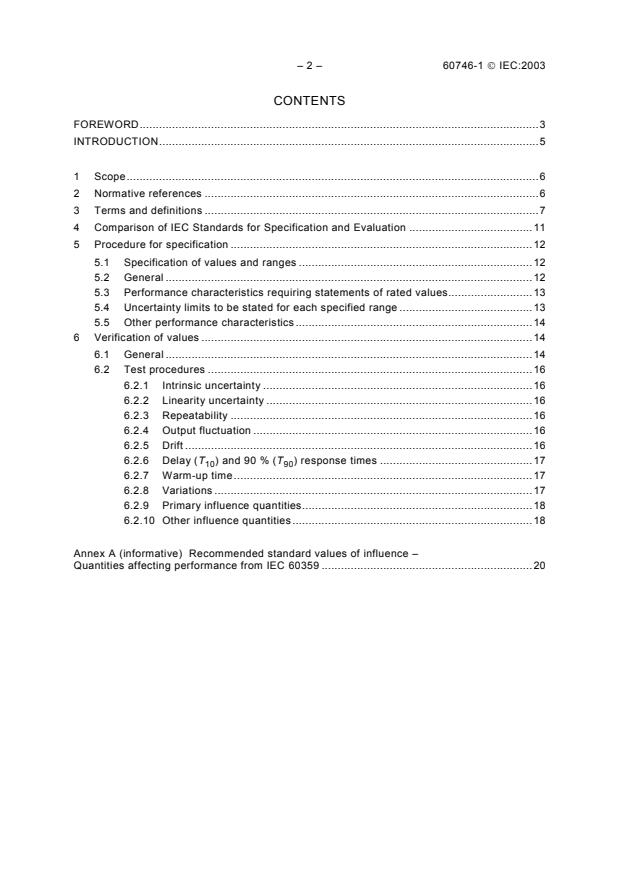
IEC 60746-1:2003 - Expression of performance of electrochemical analyzers - Part 1: General Released:1/22/2003
Overview - IEC 60746-1:2003 (Expression of performance of electrochemical analyzers - Part 1: General)
IEC 60746-1:2003 defines how to express and verify the performance of electrochemical analyzers. It establishes uniform terminology, definitions and general test procedures for analyzers used in the continuous determination of properties of (generally aqueous) solutions - for example pH, electrical conductivity, dissolved oxygen, ion concentration and redox potential. This second edition (2003) replaced the 1982 edition and is intended to support consistent specification, testing and quality assurance across manufacturers and users.
Key topics and technical requirements
- Terminology & definitions: Standardized terms for analyzers, sensors, electronic units, calibration/test solutions, conventional true value, influence quantities, rated values, ranges and span.
- Specification principles: Rules for stating rated values, ranges and uncertainty limits; how to present performance characteristics so users can compare analyzers objectively.
- General test procedures: Methods to determine and verify performance characteristics, referencing tests such as intrinsic uncertainty, linearity uncertainty, repeatability, output fluctuation, drift, warm-up time, response times (T10, T90) and variations under changing influence quantities.
- Reference & influence conditions: Definition of reference conditions, reference ranges and specified operating/measuring ranges; how influence quantities (e.g., temperature, pressure, ionic strength) are treated in performance statements.
- Scope of application: Applies to complete analyzers, individual sensor units or electronic units (including flow-through and immersible sensors). Excludes non-integral accessories (chart recorders, data acquisition) and safety requirements (see IEC 61010).
- Quality assurance linkage: Provides base documents to support ISO 9001 / ISO 9002 / ISO 9003 quality-system applications.
Practical applications and users
Who should use IEC 60746-1:
- Instrument manufacturers - for writing clear, comparable performance specifications and data sheets.
- Test laboratories & calibration labs - to design verification procedures and report uncertainties.
- Procurement & QA teams - to evaluate bids, specify acceptance criteria and ensure traceability to conventional true values.
- Process engineers and environmental analysts - when selecting analyzers for water treatment, chemical processing, environmental monitoring and industrial process control.
- Regulatory bodies and contract test houses - to harmonize test reports and contractual requirements.
Related standards
Relevant cross-references include: IEC 60359, IEC 60770-1, IEC 61298, IEC 60068-1, IEC 60654-1, IEC 61187, IEC 60381-1, IEC 60382, and quality-system standards ISO 9001 / ISO 9002 / ISO 9003. For safety see IEC 61010.
Use IEC 60746-1 when you need consistent, auditable statements of analyzer performance and verified test procedures for electrochemical measurement equipment.
Buy Documents
IEC 60746-1:2003 - Expression of performance of electrochemical analyzers - Part 1: General Released:1/22/2003
IEC 60746-1:2003 - Expression of performance of electrochemical analyzers - Part 1: General Released:1/22/2003
Get Certified
Connect with accredited certification bodies for this standard

ECOCERT
Organic and sustainability certification.

Eurofins Food Testing Global
Global leader in food, environment, and pharmaceutical product testing.

IMP NDT d.o.o.
Non-destructive testing services. Radiography, ultrasonic, magnetic particle, penetrant, visual inspection.
Sponsored listings
Frequently Asked Questions
IEC 60746-1:2003 is a standard published by the International Electrotechnical Commission (IEC). Its full title is "Expression of performance of electrochemical analyzers - Part 1: General". This standard covers: IEC 60746-1:2003 specifies the terminology and definitions of terms related to the performance characteristics of electrochemical analyzers used for the continuous determination of certain aspects of (generally aqueous) solutions; the uniform methods to be used in making statements on the performance characteristics of such analyzers; the general test procedures to determine and verify the performance characteristics of electrochemical analyzers, taking into account the differences of approach in IEC documents specifying test methods (IEC 60359, IEC 60770, IEC 61298). It provides basic documents to support the application of standards of quality assurance: ISO 9001, ISO 9002 and ISO 9003. This second edition cancels and replaces the first edition published in 1982 and constitutes a technical revision.
IEC 60746-1:2003 specifies the terminology and definitions of terms related to the performance characteristics of electrochemical analyzers used for the continuous determination of certain aspects of (generally aqueous) solutions; the uniform methods to be used in making statements on the performance characteristics of such analyzers; the general test procedures to determine and verify the performance characteristics of electrochemical analyzers, taking into account the differences of approach in IEC documents specifying test methods (IEC 60359, IEC 60770, IEC 61298). It provides basic documents to support the application of standards of quality assurance: ISO 9001, ISO 9002 and ISO 9003. This second edition cancels and replaces the first edition published in 1982 and constitutes a technical revision.
IEC 60746-1:2003 is classified under the following ICS (International Classification for Standards) categories: 19.040 - Environmental testing; 71.040.40 - Chemical analysis. The ICS classification helps identify the subject area and facilitates finding related standards.
IEC 60746-1:2003 is available in PDF format for immediate download after purchase. The document can be added to your cart and obtained through the secure checkout process. Digital delivery ensures instant access to the complete standard document.
Standards Content (Sample)
INTERNATIONAL IEC
STANDARD
60746-1
Second edition
2003-01
Expression of performance of
electrochemical analyzers –
Part 1:
General
Expression des qualités de fonctionnement
des analyseurs électrochimiques –
Partie 1:
Généralités
Reference number
Publication numbering
As from 1 January 1997 all IEC publications are issued with a designation in the
60000 series. For example, IEC 34-1 is now referred to as IEC 60034-1.
Consolidated editions
The IEC is now publishing consolidated versions of its publications. For example,
edition numbers 1.0, 1.1 and 1.2 refer, respectively, to the base publication, the
base publication incorporating amendment 1 and the base publication incorporating
amendments 1 and 2.
Further information on IEC publications
The technical content of IEC publications is kept under constant review by the IEC,
thus ensuring that the content reflects current technology. Information relating to
this publication, including its validity, is available in the IEC Catalogue of
publications (see below) in addition to new editions, amendments and corrigenda.
Information on the subjects under consideration and work in progress undertaken
by the technical committee which has prepared this publication, as well as the list
of publications issued, is also available from the following:
• IEC Web Site (www.iec.ch)
• Catalogue of IEC publications
The on-line catalogue on the IEC web site (http://www.iec.ch/searchpub/cur_fut.htm)
enables you to search by a variety of criteria including text searches, technical
committees and date of publication. On-line information is also available on
recently issued publications, withdrawn and replaced publications, as well as
corrigenda.
• IEC Just Published
This summary of recently issued publications (http://www.iec.ch/online_news/
justpub/jp_entry.htm) is also available by email. Please contact the Customer
Service Centre (see below) for further information.
• Customer Service Centre
If you have any questions regarding this publication or need further assistance,
please contact the Customer Service Centre:
Email: custserv@iec.ch
Tel: +41 22 919 02 11
Fax: +41 22 919 03 00
INTERNATIONAL IEC
STANDARD
60746-1
Second edition
2003-01
Expression of performance of
electrochemical analyzers –
Part 1:
General
Expression des qualités de fonctionnement
des analyseurs électrochimiques –
Partie 1:
Généralités
IEC 2003 Copyright - all rights reserved
No part of this publication may be reproduced or utilized in any form or by any means, electronic or
mechanical, including photocopying and microfilm, without permission in writing from the publisher.
International Electrotechnical Commission, 3, rue de Varembé, PO Box 131, CH-1211 Geneva 20, Switzerland
Telephone: +41 22 919 02 11 Telefax: +41 22 919 03 00 E-mail: inmail@iec.ch Web: www.iec.ch
PRICE CODE
Commission Electrotechnique Internationale
T
International Electrotechnical Commission
Международная Электротехническая Комиссия
For price, see current catalogue
– 2 – 60746-1 IEC:2003(E)
CONTENTS
FOREWORD . 3
INTRODUCTION .4
1 Scope . 5
2 Normative references. 5
3 Terms and definitions . 6
4 Comparison of IEC Standards for Specification and Evaluation.10
5 Procedure for specification .11
5.1 Specification of values and ranges .11
5.2 General .11
5.3 Performance characteristics requiring statements of rated values .12
5.4 Uncertainty limits to be stated for each specified range .12
5.5 Other performance characteristics .13
6 Verification of values .13
6.1 General .13
6.2 Test procedures.15
6.2.1 Intrinsic uncertainty.15
6.2.2 Linearity uncertainty.15
6.2.3 Repeatability.15
6.2.4 Output fluctuation .15
6.2.5 Drift .15
6.2.6 Delay (T ) and 90 % (T ) response times .16
10 90
6.2.7 Warm-up time .16
6.2.8 Variations .16
6.2.9 Primary influence quantities.17
6.2.10 Other influence quantities .17
Annex A (informative) Recommended standard values of influence –
Quantities affecting performance from IEC 60359 .19
60746-1 IEC:2003(E) – 3 –
INTERNATIONAL ELECTROTECHNICAL COMMISSION
___________
EXPRESSION OF PERFORMANCE OF
ELECTROCHEMICAL ANALYZERS –
Part 1: General
FOREWORD
1) The IEC (International Electrotechnical Commission) is a worldwide organization for standardization comprising
all national electrotechnical committees (IEC National Committees). The object of the IEC is to promote
international co-operation on all questions concerning standardization in the electrical and electronic fields. To
this end and in addition to other activities, the IEC publishes International Standards. Their preparation is
entrusted to technical committees; any IEC National Committee interested in the subject dealt with may
participate in this preparatory work. International, governmental and non-governmental organizations liaising
with the IEC also participate in this preparation. The IEC collaborates closely with the International
Organization for Standardization (ISO) in accordance with conditions determined by agreement between the
two organizations.
2) The formal decisions or agreements of the IEC on technical matters express, as nearly as possible, an
international consensus of opinion on the relevant subjects since each technical committee has representation
from all interested National Committees.
3) The documents produced have the form of recommendations for international use and are published in the form
of standards, technical specifications, technical reports or guides and they are accepted by the National
Committees in that sense.
4) In order to promote international unification, IEC National Committees undertake to apply IEC International
Standards transparently to the maximum extent possible in their national and regional standards. Any
divergence between the IEC Standard and the corresponding national or regional standard shall be clearly
indicated in the latter.
5) The IEC provides no marking procedure to indicate its approval and cannot be rendered responsible for any
equipment declared to be in conformity with one of its standards.
6) Attention is drawn to the possibility that some of the elements of this International Standard may be the subject
of patent rights. The IEC shall not be held responsible for identifying any or all such patent rights.
International Standard IEC 60746-1 has been prepared by subcommittee 65D: Analysing
equipment, of IEC technical committee 65: Industrial-process measurement and control.
This second edition cancels and replaces the first edition published in 1982 and constitutes
a technical revision.
The text of this standard is based on the following documents:
FDIS Report on voting
65D/89A/FDIS 65D/93/RVD
Full information on the voting for the approval of this standard can be found in the report on
voting indicated in the above table.
For this second edition, the text has been changed to reflect revision and introduction of Inter-
national Standards since 1982. An Informative Annex A has been introduced.
This publication has been drafted in accordance with the ISO/IEC Directives, Part 2.
The committee has decided that the contents of this publication will remain unchanged until
2007. At this date, the publication will be
• reconfirmed;
• withdrawn;
• replaced by a revised edition, or
• amended.
– 4 – 60746-1 IEC:2003(E)
INTRODUCTION
This standard specifies the statements which manufacturers should make to describe
analyzers so that users may compare the performance characteristics of any analyzer to their
requirements. It includes the terminology and definitions of the terms to be used in such
statements. It describes the tests that are applicable to all types of electrochemical analyzers,
which may be used to determine these performance characteristics by either the manufacturer
or the user.
This standard is applicable to electrochemical analyzers used for the determination of certain
properties of (generally aqueous) solutions such as pH value, electrical conductivity, dissolved
oxygen content, the concentration of specified ions and redox potential. Other standards in this
series describe those aspects that are particular to specific types of analyzer, for example
IEC 60746-2. It is in accordance with the general principles set out in IEC 60359 and takes into
account documents specifying methods for evaluating performance, IEC 60770 and IEC 61298.
This standard is applicable to analyzers specified for installation in any location and to
analyzers having either flow-through or immersible type sensors. It is applicable to the
complete analyzer when supplied by one manufacturer as an integral unit comprised of all
mechanical, electrical and electronic portions. It also applies to sensor units alone and
electronic units alone when supplied separately or by different manufacturers. For the
purposes of this standard, any regulator for mains-supplied power or any non-mains power
supply, provided with the analyzer or specified by the manufacturer, is considered part of the
analyzer whether it is integral with the analyzer or housed separately.
It does not apply to accessories used in conjunction with the analyzers, such as chart
recorders or data acquisition systems. However, when multiple analyzers are combined and
sold with a single electronic unit for measurements of several properties in parallel,
that read-out unit is considered to be part of the analyzer. Similarly, e.m.f.-to-current or
e.m.f.-to-pressure converters that are not an integral part of the analyzer are not included.
Safety requirements are dealt with in IEC 61010.
Standard ranges of analogue d.c. current and pneumatic signals used in process control
systems are dealt within IEC 60381-1, and IEC 60382.
Specifications for values of influence quantities for the testing of performance characteristics
can be found in IEC 60654-1 and methods of testing in IEC 60068.
Requirements for documentation to be supplied with instruments are dealt with in some
National Standards and also IEC 61187.
General principles concerning quantities, units and symbols are dealt with in ISO 1000.
See also ISO 31, Parts 0 to 13.
60746-1 IEC:2003(E) – 5 –
EXPRESSION OF PERFORMANCE OF
ELECTROCHEMICAL ANALYZERS –
Part 1: General
1 Scope
This standard is intended:
– to specify the terminology and definitions of terms related to the performance charac-
teristics of electrochemical analyzers used for the continuous determination of certain
aspects of (generally aqueous) solutions;
– to specify uniform methods to be used in making statements on the performance
characteristics of such analyzers;
– to specify general test procedures to determine and verify the performance characteristics
of electrochemical analyzers, taking into account the differences of approach in IEC
documents specifying test methods (IEC 60359, IEC 60770, IEC 61298);
– to provide basic documents to support the application of standards of quality assurance:
ISO 9001, ISO 9002 and ISO 9003.
2 Normative references
The following referenced documents are indispensable for the application of this document.
For dated references, only the edition cited applies. For undated references, the latest edition
of the referenced document (including any amendments) applies.
IEC 60068-1, Environmental testing – Part 1: General and guidance
IEC 60359:2001, Electrical and electronic measurement equipment – Expression of
performance
IEC 60381-1, Analogue signals for process control systems – Part 1: Direct current signals
IEC 60382, Analogue pneumatic signal for process control systems
IEC 60654-1, Industrial-process measurement and control equipment – Operating conditions –
Part 1: Climatic conditions
IEC 60770-1, Transmitters for use in industrial-process control systems – Part 1: Methods for
performance evaluation
IEC 61298, (all parts): Process measurement and control devices – General methods and
procedures for evaluating performance
ISO 9001, Quality management systems – Requirements
ISO 9002, Quality systems – Model for quality assurance in production, installation and
servicing
ISO 9003, Quality systems – Model for quality assurance in final inspection and test
– 6 – 60746-1 IEC:2003(E)
3 Terms and definitions
For the purposes of this standard, the following definitions apply. These definitions are based
on those in IEC 60359. Additional definitions from IEC 60770 are included for performance
characteristics appropriate to electrochemical analyzers. The definitions have, in some cases,
been clarified and directed towards relevance to electrochemical analyzers. The reconciliation
of the quantities used to define performance characteristics in this document with those
referred to in IEC 60359, IEC 60770 and IEC 61298 is discussed in clause 4.
3.1
electrochemical analyzer
measuring instrument that provides an indication of a specific property of a medium by use of
a sensor which responds to ions from electrolytes (or ions generated from reactions with
non-electrolytes) in that medium
NOTE The analyzer may comprise of separate parts, see below.
3.2
sensor
that part of the electrochemical analyzer (which may be a separate unit) which is in contact
with the medium in which the property is to be measured
NOTE In general an electrical output related to that property of the sample which is to be measured is derived
from this part of the analyzer. Examples of electrochemical sensors are: pH, ion-sensitive and redox potentiometric
cells, dissolved oxygen cells, conductance cells.
3.3
electronic unit
device converting the electrical signal from the sensor to a defined, scaled, output signal
3.4
simulator
device which provides well-defined electrical properties similar to a specific type of sensor
NOTE It may therefore be used to determine the performance characteristics of the electronic unit alone. It must
exhibit uncertainties that are negligible in comparison with the specifications of performance characteristics to be
determined.
3.5
calibration solution
solution of known value of the property being measured, used for periodic calibration and for
various performance tests.
NOTE 1 The value should be expressed in SI units compatible with ISO 31.
NOTE 2 For the purposes of this Standard, the value of this solution represents the conventional true value
(see 3.8) against which the indicated value is compared.
NOTE 3 The values of calibration solutions should be traceable to reference material according to international or
national standards, or agreed upon by the manufacturer and the user, and the uncertainty of the conventional true
values shall be stated.
3.6
test solution
solution of approximately known value of the property being measured, which is stable in
value over an extended period of time
3.7
true value
value of a quantity which is defined with no uncertainty.
NOTE The true value of a quantity is an ideal concept and, in general, cannot be known exactly.
60746-1 IEC:2003(E) – 7 –
3.8
conventional true value
value approximating to the true value of a quantity such that, for the purpose for which that
value is used, the difference between the two will be regarded as negligible
NOTE 1 Since the “true value” cannot be known exactly, for the sake of simplicity and where no ambiguity exists,
the term “true value” may be used where the term “conventional true value” is meant.
NOTE 2 See 3.1.13 of IEC 60359.
3.9
performance characteristic
one of the quantities assigned to an apparatus in order to define its performance by values,
tolerances, ranges, etc.
3.10
influence quantity
any quantity, which is not the subject of the measurement but which influences the indication
of the measuring equipment
NOTE Influence quantities may interact in their effect on the measuring equipment.
3.11
variation
difference between the values indicated by an analyzer for the same value of the property
being measured when a single influence quantity assumes successively two different values
3.12
rated value
value assigned to a performance characteristic of the analyzer by the manufacturer
NOTE See 3.3.8 of IEC 60359.
3.13
range
domain between the upper and lower limits of the quantity under consideration
NOTE 1 The term “range” is usually used with a modifier. It may apply to a performance characteristic or an
influence quantity, etc. For example, the Rated Measuring Range is the set of values of the property to be
measured, corresponding to the Output Signal Range of the analyzer (for example 4 mA - 20 mA, etc).
NOTE 2 See 3.3.2 of IE 60359.
3.14
span
difference between the upper and lower limits of the rated measuring range
3.15
performance
quality with which the intended functions of the equipment are accomplished
3.16
reference conditions
appropriate set of influence quantities, with reference values with their tolerances and
reference ranges, with respect to which intrinsic uncertainty is specified
3.17
reference value
specified value of one of a set of reference conditions
NOTE A tolerance may be specified for a reference value.
3.18
reference range
specified range of values of one of a set of reference conditions
– 8 – 60746-1 IEC:2003(E)
3.19
specified operating range
range of values of a single influence quantity which forms part of the rated operating
conditions
3.20
specified measuring range
set of values of the property to be measured for which the uncertainty of the analyzer is
intended to lie within specified limits
NOTE 1 An instrument can have several specified measuring ranges.
NOTE 2 The specified measuring range can be smaller than the range of values which can be indicated, for
example, on the scale.
NOTE 3 This term used to be known as “effective range”.
3.21
rated operating conditions
set of operating ranges for influence quantities and associated ranges of performance
characteristics within which the variations of an analyzer are specified by the manufacturer
3.22
limit conditions of operation
extreme conditions which an operating instrument can withstand without resulting in damage
or degradation of performance when it is afterwards operated under rated operating conditions
3.23
storage and transport conditions
extreme conditions which an non-operating instrument can withstand without resulting in
damage or degradation of performance when it is afterwards operated under rated operating
conditions
3.24
uncertainty (of measurement)
dispersion of values that may be attributed to the measured quantity
NOTE See 3.1.4 of IEC 60359.
3.25
intrinsic uncertainty
uncertainty when used under reference conditions (see 3.16)
NOTE See 3.1.10, 3.1.11, 3.1.12 of IEC 60359.
3.26
operating uncertainty
uncertainty when used under rated operating conditions (see 3.21)
NOTE See also 3.2.11 of IEC 60359.
3.27
relative uncertainty
ratio of the uncertainty to the conventional true value (when expressed in the same units)
NOTE See 3.3.4 of IEC 60359.
3.28
interference uncertainty
uncertainty caused by substances other than those affecting the measured property being
present in the sample
60746-1 IEC:2003(E) – 9 –
3.29
linearity uncertainty
maximum deviation between indicated values and a linear function of indicated value versus
the true value of the property being measured, which includes indicated values near the upper
and lower limits of the rated range
NOTE Linearity is a property of the electronic unit and may be verified with a simulator (see 3.4).
3.30
limits of uncertainty
maximum values of uncertainty assigned by the manufacturer to the indicated values of an
analyzer operating under specified conditions
NOTE See 3.3.6 of IEC 60359.
3.31
repeatability
spread of the results of successive measurements at short intervals of time of identical test
material, carried out by the same method, with the same measuring instruments, by the same
observer, in the same laboratory, in unchanged environmental conditions and with no adjust-
ments made by external means to the analyzer under test
NOTE 1 The spread of results should be included in the intrinsic uncertainty (see 3.25).
NOTE 2 A time interval equal to about ten times the 90 % response time of the analyzer may be considered
a short interval between successive measurements.
3.32
hysteresis
difference in indicated values when the same value of the property being measured is applied
but preceded by a lower then a higher value
NOTE If repeatability is specified or measured using approaches from both upscale and downscale direction,
it may include an amount due to hysteresis, i.e., which is not a truly random event. However, the contribution may
be considered to be random when the analyzer is to be applied to applications where the indicated value may
be approached from either direction with equal probability.
3.33
drift
change of indication of an analyzer, for a given value of the property being measured, over a
stated period of time, under reference conditions which remain constant and without any
adjustment to the analyzer by external means
NOTE The rate of change of uncertainty with time should be derived by linear regression.
3.34
output fluctuation
peak-to-peak deviations of the output measured with constant input and constant influence
quantities
3.35
minimum detectable change
change in value of the property to be measured equivalent to twice the output fluctuation
3.36
delay time, T
time interval from the instant a step change in the value of the property being measured
occurs to the instant when the change in the indicated value passes (and remains beyond)
10 % of its steady-state amplitude difference. For cases where the rising delay time and
falling delay time differ, the different delay times should be specified.
3.37
rise (fall) time, T , T
r f
difference between the 90 % response time and delay time
– 10 – 60746-1 IEC:2003(E)
3.38
90 % response time, T
time interval from the instant a step change occurs in the value of the property being
measured to the instant when the change in the indicated value passes (and remains beyond)
90 % of its steady-state amplitude difference, i.e., T = T + T (or T ). For cases where the
90 10 r f
rising and falling response times differ, the different response times should be specified.
T
T T
10 f
100 %
10 %
90 %
Step
Step
change
change
10 % 90 %
100 %
T
T
10 r
T
IEC 3026/02
Figure 1 – Relationship between T T (T ) and T
10, r, f 90
3.39
warm-up time
time interval after switching on the power, under reference conditions, necessary for a unit or
analyzer to comply with and remain within specified limits of uncertainty
NOTE The limits of uncertainty may appropriately be specified equal to the rated intrinsic uncertainty.
4 Comparison of IEC Standards for Specification and Evaluation
The methods for specification of analyzer performance characteristics used by manufacturers
should be compatible with methods for specification of performance requirements by users.
For accurate comparison of manufacturers’ specifications and users' requirements, the para-
meters used to define the performance characteristics of the equipment must be selected
and defined identically.
An electrochemical sensor has particular characteristics primarily determined by chemical
properties, and these can only be slightly modified by constructional techniques. Moreover,
the sensor is directly exposed to a working fluid which can exert a range of influence factors
on the sensor system. This is in contrast to the operation of the purely electrical measuring
devices considered in many other related standards, where the signal is injected electrically
into the instrument's circuits and the sensing of that signal is entirely internal. The approach
to the determination and statement of performance characteristics used in 6.4.2 of IEC 60359
entitled Limits of intrinsic instrumental uncertainty with variations for a single influence
quantity was selected as the best basis for defining the performance of electrochemical type
analyzers. Therefore, requirements for statements in this document are generally given in
60746-1 IEC:2003(E) – 11 –
accordance with that document, with some performance parameters and test methods based
on IEC 60770.
Alternative approaches adopted in other IEC documents are summarized below, for
comparison:
IEC 61298, Subclause 3.9: Maximum measured uncertainty
A non-statistical test of instrument conformity, where the maximum and minimum
uncertainties are reported from a series of tests. This is particularly appropriate to batch tests
where a limited series of tests should yield individual results within the limits of uncertainty
specified for the rated operating conditions.
IEC 60770, Evaluating the performance of transmitters for use in industrial-process control
systems
Procedures defined in this standard are closely aligned with those in IEC 60359. Both
IEC 60359 and IEC 60770 are primarily directed to the evaluation of purely electrical (or
pneumatic) systems. Procedures defined in the following clauses are from these two
documents but take into account the chemical nature of the sensor. Definitions of terms have
all been based on these documents.
5 Procedure for specification
5.1 Specification of values and ranges
Manufacturers specifying the performance of complete analyzers, sensor units or electronic
units, shall give statements covering all quantities considered to be applicable performance
characteristics.
These statements shall cover the aspects which will be described in the following subclauses.
5.2 General
5.2.1 The reference value (or range) and rated range of use for all influence quantities shall
be stated. These should be selected from only one of the usage groups I, II or III in IEC 60359
(see Annex A) or may be from usage groups in IEC 60654-1. Any exceptions to the values
given there shall be explicitly and clearly stated by the manufacturer with an indication that
they are exceptions.
NOTE 1 The analyzers or electronic units may correspond to one group of rated ranges of use for environmental
conditions and to another group for mains supply conditions, but this should be clearly stated by the manufacturer.
NOTE 2 When the sensor and electronic units are separate, the rated range for climatic conditions for the
individual units may be different.
NOTE 3 Electrochemical an
...
IEC 60746-1 ®
Edition 2.0 2003-01
INTERNATIONAL
STANDARD
NORME
INTERNATIONALE
Expression of performance of electrochemical analyzers –
Part 1: General
Expression des qualités de fonctionnement des analyseurs électrochimiques –
Partie 1: Généralités
All rights reserved. Unless otherwise specified, no part of this publication may be reproduced or utilized in any form
or by any means, electronic or mechanical, including photocopying and microfilm, without permission in writing from
either IEC or IEC's member National Committee in the country of the requester.
If you have any questions about IEC copyright or have an enquiry about obtaining additional rights to this publication,
please contact the address below or your local IEC member National Committee for further information.
Droits de reproduction réservés. Sauf indication contraire, aucune partie de cette publication ne peut être reproduite ni
utilisée sous quelque forme que ce soit et par aucun procédé, électronique ou mécanique, y compris la photocopie et les
microfilms, sans l'accord écrit de la CEI ou du Comité national de la CEI du pays du demandeur.
Si vous avez des questions sur le copyright de la CEI ou si vous désirez obtenir des droits supplémentaires sur cette
publication, utilisez les coordonnées ci-après ou contactez le Comité national de la CEI de votre pays de résidence.
IEC Central Office Tel.: +41 22 919 02 11
3, rue de Varembé Fax: +41 22 919 03 00
CH-1211 Geneva 20 info@iec.ch
Switzerland www.iec.ch
About the IEC
The International Electrotechnical Commission (IEC) is the leading global organization that prepares and publishes
International Standards for all electrical, electronic and related technologies.
About IEC publications
The technical content of IEC publications is kept under constant review by the IEC. Please make sure that you have the
latest edition, a corrigenda or an amendment might have been published.
Useful links:
IEC publications search - www.iec.ch/searchpub Electropedia - www.electropedia.org
The advanced search enables you to find IEC publications The world's leading online dictionary of electronic and
by a variety of criteria (reference number, text, technical electrical terms containing more than 30 000 terms and
committee,…). definitions in English and French, with equivalent terms in
It also gives information on projects, replaced and additional languages. Also known as the International
withdrawn publications. Electrotechnical Vocabulary (IEV) on-line.
IEC Just Published - webstore.iec.ch/justpublished Customer Service Centre - webstore.iec.ch/csc
Stay up to date on all new IEC publications. Just Published If you wish to give us your feedback on this publication
details all new publications released. Available on-line and or need further assistance, please contact the
also once a month by email. Customer Service Centre: csc@iec.ch.
A propos de la CEI
La Commission Electrotechnique Internationale (CEI) est la première organisation mondiale qui élabore et publie des
Normes internationales pour tout ce qui a trait à l'électricité, à l'électronique et aux technologies apparentées.
A propos des publications CEI
Le contenu technique des publications de la CEI est constamment revu. Veuillez vous assurer que vous possédez
l’édition la plus récente, un corrigendum ou amendement peut avoir été publié.
Liens utiles:
Recherche de publications CEI - www.iec.ch/searchpub Electropedia - www.electropedia.org
La recherche avancée vous permet de trouver des Le premier dictionnaire en ligne au monde de termes
publications CEI en utilisant différents critères (numéro de électroniques et électriques. Il contient plus de 30 000
référence, texte, comité d’études,…). termes et définitions en anglais et en français, ainsi que
Elle donne aussi des informations sur les projets et les les termes équivalents dans les langues additionnelles.
publications remplacées ou retirées. Egalement appelé Vocabulaire Electrotechnique
International (VEI) en ligne.
Just Published CEI - webstore.iec.ch/justpublished
Service Clients - webstore.iec.ch/csc
Restez informé sur les nouvelles publications de la CEI.
Just Published détaille les nouvelles publications parues. Si vous désirez nous donner des commentaires sur
Disponible en ligne et aussi une fois par mois par email. cette publication ou si vous avez des questions
contactez-nous: csc@iec.ch.
IEC 60746-1 ®
Edition 2.0 2003-01
INTERNATIONAL
STANDARD
NORME
INTERNATIONALE
Expression of performance of electrochemical analyzers –
Part 1: General
Expression des qualités de fonctionnement des analyseurs électrochimiques –
Partie 1: Généralités
INTERNATIONAL
ELECTROTECHNICAL
COMMISSION
COMMISSION
ELECTROTECHNIQUE
PRICE CODE
INTERNATIONALE
CODE PRIX T
ICS 19.040; 71.040 ISBN 978-2-83220-373-6
– 2 – 60746-1 IEC:2003
CONTENTS
FOREWORD . 3
INTRODUCTION . 5
1 Scope . 6
2 Normative references . 6
3 Terms and definitions . 7
4 Comparison of IEC Standards for Specification and Evaluation . 11
5 Procedure for specification . 12
5.1 Specification of values and ranges . 12
5.2 General . 12
5.3 Performance characteristics requiring statements of rated values. 13
5.4 Uncertainty limits to be stated for each specified range . 13
5.5 Other performance characteristics . 14
6 Verification of values . 14
6.1 General . 14
6.2 Test procedures . 16
6.2.1 Intrinsic uncertainty . 16
6.2.2 Linearity uncertainty . 16
6.2.3 Repeatability . 16
6.2.4 Output fluctuation . 16
6.2.5 Drift . 16
6.2.6 Delay (T ) and 90 % (T ) response times . 17
10 90
6.2.7 Warm-up time . 17
6.2.8 Variations . 17
6.2.9 Primary influence quantities . 18
6.2.10 Other influence quantities . 18
Annex A (informative) Recommended standard values of influence –
Quantities affecting performance from IEC 60359 . 20
60746-1 IEC:2003 – 3 –
INTERNATIONAL ELECTROTECHNICAL COMMISSION
___________
EXPRESSION OF PERFORMANCE OF
ELECTROCHEMICAL ANALYZERS –
Part 1: General
FOREWORD
1) The IEC (International Electrotechnical Commission) is a worldwide organization for standardization comprising
all national electrotechnical committees (IEC National Committees). The object of the IEC is to promote
international co-operation on all questions concerning standardization in the electrical and electronic fields. To
this end and in addition to other activities, the IEC publishes International Standards. Their preparation is
entrusted to technical committees; any IEC National Committee interested in the subject dealt with may
participate in this preparatory work. International, governmental and non-governmental organizations liaising
with the IEC also participate in this preparation. The IEC collaborates closely with the International
Organization for Standardization (ISO) in accordance with conditions determined by agreement between the
two organizations.
2) The formal decisions or agreements of the IEC on technical matters express, as nearly as possible, an
international consensus of opinion on the relevant subjects since each technical committee has representation
from all interested National Committees.
3) The documents produced have the form of recommendations for international use and are published in the form
of standards, technical specifications, technical reports or guides and they are accepted by the National
Committees in that sense.
4) In order to promote international unification, IEC National Committees undertake to apply IEC International
Standards transparently to the maximum extent possible in their national and regional standards. Any
divergence between the IEC Standard and the corresponding national or regional standard shall be clearly
indicated in the latter.
5) The IEC provides no marking procedure to indicate its approval and cannot be rendered responsible for any
equipment declared to be in conformity with one of its standards.
6) Attention is drawn to the possibility that some of the elements of this International Standard may be the subject
of patent rights. The IEC shall not be held responsible for identifying any or all such patent rights.
International Standard IEC 60746-1 has been prepared by subcommittee 65D: Analysing
equipment, of IEC technical committee 65: Industrial-process measurement and control.
This second edition cancels and replaces the first edition published in 1982 and constitutes
a technical revision.
This bilingual version (2012-12) corresponds to the monolingual English version, published in
2003-01.
The text of this standard is based on the following documents:
FDIS Report on voting
65D/89A/FDIS 65D/93/RVD
Full information on the voting for the approval of this standard can be found in the report on
voting indicated in the above table.
The French version of this standard has not been voted upon.
For this second edition, the text has been changed to reflect revision and introduction of Inter-
national Standards since 1982. An Informative Annex A has been introduced.
This publication has been drafted in accordance with the ISO/IEC Directives, Part 2.
– 4 – 60746-1 IEC:2003
The committee has decided that the contents of this publication will remain unchanged until
2007. At this date, the publication will be
• reconfirmed;
• withdrawn;
• replaced by a revised edition, or
• amended.
60746-1 IEC:2003 – 5 –
INTRODUCTION
This standard specifies the statements which manufacturers should make to describe
analyzers so that users may compare the performance characteristics of any analyzer to their
requirements. It includes the terminology and definitions of the terms to be used in such
statements. It describes the tests that are applicable to all types of electrochemical analyzers,
which may be used to determine these performance characteristics by either the manufacturer
or the user.
This standard is applicable to electrochemical analyzers used for the determination of certain
properties of (generally aqueous) solutions such as pH value, electrical conductivity,
dissolved oxygen content, the concentration of specified ions and redox potential. Other
standards in this series describe those aspects that are particular to specific types of
analyzer, for example IEC 60746-2. It is in accordance with the general principles set out
in IEC 60359 and takes into account documents specifying methods for evaluating
performance, IEC 60770 and IEC 61298.
This standard is applicable to analyzers specified for installation in any location and to
analyzers having either flow-through or immersible type sensors. It is applicable to the
complete analyzer when supplied by one manufacturer as an integral unit comprised of all
mechanical, electrical and electronic portions. It also applies to sensor units alone and
electronic units alone when supplied separately or by different manufacturers. For the
purposes of this standard, any regulator for mains-supplied power or any non-mains power
supply, provided with the analyzer or specified by the manufacturer, is considered part of the
analyzer whether it is integral with the analyzer or housed separately.
It does not apply to accessories used in conjunction with the analyzers, such as chart
recorders or data acquisition systems. However, when multiple analyzers are combined and
sold with a single electronic unit for measurements of several properties in parallel,
that read-out unit is considered to be part of the analyzer. Similarly, e.m.f.-to-current or
e.m.f.-to-pressure converters that are not an integral part of the analyzer are not included.
Safety requirements are dealt with in IEC 61010.
Standard ranges of analogue d.c. current and pneumatic signals used in process control
systems are dealt within IEC 60381-1, and IEC 60382.
Specifications for values of influence quantities for the testing of performance characteristics
can be found in IEC 60654-1 and methods of testing in IEC 60068.
Requirements for documentation to be supplied with instruments are dealt with in some
National Standards and also IEC 61187.
General principles concerning quantities, units and symbols are dealt with in ISO 1000.
See also ISO 31, Parts 0 to 13.
– 6 – 60746-1 IEC:2003
EXPRESSION OF PERFORMANCE OF
ELECTROCHEMICAL ANALYZERS –
Part 1: General
1 Scope
This standard is intended:
– to specify the terminology and definitions of terms related to the performance charac-
teristics of electrochemical analyzers used for the continuous determination of certain
aspects of (generally aqueous) solutions;
– to specify uniform methods to be used in making statements on the performance
characteristics of such analyzers;
– to specify general test procedures to determine and verify the performance characteristics
of electrochemical analyzers, taking into account the differences of approach in IEC
documents specifying test methods (IEC 60359, IEC 60770, IEC 61298);
– to provide basic documents to support the application of standards of quality assurance:
ISO 9001, ISO 9002 and ISO 9003.
2 Normative references
The following referenced documents are indispensable for the application of this document.
For dated references, only the edition cited applies. For undated references, the latest edition
of the referenced document (including any amendments) applies.
IEC 60068-1, Environmental testing – Part 1: General and guidance
IEC 60359:2001, Electrical and electronic measurement equipment – Expression of
performance
IEC 60381-1, Analogue signals for process control systems – Part 1: Direct current signals
IEC 60382, Analogue pneumatic signal for process control systems
IEC 60654-1, Industrial-process measurement and control equipment – Operating conditions –
Part 1: Climatic conditions
IEC 60770-1, Transmitters for use in industrial-process control systems – Part 1: Methods for
performance evaluation
IEC 61298, (all parts): Process measurement and control devices – General methods and
procedures for evaluating performance
ISO 9001, Quality management systems – Requirements
ISO 9002, Quality systems – Model for quality assurance in production, installation and
servicing
ISO 9003, Quality systems – Model for quality assurance in final inspection and test
60746-1 IEC:2003 – 7 –
3 Terms and definitions
For the purposes of this standard, the following definitions apply. These definitions are based
on those in IEC 60359. Additional definitions from IEC 60770 are included for performance
characteristics appropriate to electrochemical analyzers. The definitions have, in some cases,
been clarified and directed towards relevance to electrochemical analyzers. The reconciliation
of the quantities used to define performance characteristics in this document with those
referred to in IEC 60359, IEC 60770 and IEC 61298 is discussed in clause 4.
3.1
electrochemical analyzer
measuring instrument that provides an indication of a specific property of a medium by use of
a sensor which responds to ions from electrolytes (or ions generated from reactions with
non-electrolytes) in that medium
NOTE The analyzer may comprise of separate parts, see below.
3.2
sensor
that part of the electrochemical analyzer (which may be a separate unit) which is in contact
with the medium in which the property is to be measured
NOTE In general an electrical output related to that property of the sample which is to be measured is derived
from this part of the analyzer. Examples of electrochemical sensors are: pH, ion-sensitive and redox potentiometric
cells, dissolved oxygen cells, conductance cells.
3.3
electronic unit
device converting the electrical signal from the sensor to a defined, scaled, output signal
3.4
simulator
device which provides well-defined electrical properties similar to a specific type of sensor
NOTE It may therefore be used to determine the performance characteristics of the electronic unit alone. It must
exhibit uncertainties that are negligible in comparison with the specifications of performance characteristics to be
determined.
3.5
calibration solution
solution of known value of the property being measured, used for periodic calibration and for
various performance tests.
NOTE 1 The value should be expressed in SI units compatible with ISO 31.
NOTE 2 For the purposes of this Standard, the value of this solution represents the conventional true value
(see 3.8) against which the indicated value is compared.
NOTE 3 The values of calibration solutions should be traceable to reference material according to international or
national standards, or agreed upon by the manufacturer and the user, and the uncertainty of the conventional true
values shall be stated.
3.6
test solution
solution of approximately known value of the property being measured, which is stable in
value over an extended period of time
3.7
true value
value of a quantity which is defined with no uncertainty.
NOTE The true value of a quantity is an ideal concept and, in general, cannot be known exactly.
– 8 – 60746-1 IEC:2003
3.8
conventional true value
value approximating to the true value of a quantity such that, for the purpose for which that
value is used, the difference between the two will be regarded as negligible
NOTE 1 Since the “true value” cannot be known exactly, for the sake of simplicity and where no ambiguity exists,
the term “true value” may be used where the term “conventional true value” is meant.
NOTE 2 See 3.1.13 of IEC 60359.
3.9
performance characteristic
one of the quantities assigned to an apparatus in order to define its performance by values,
tolerances, ranges, etc.
3.10
influence quantity
any quantity, which is not the subject of the measurement but which influences the indication
of the measuring equipment
NOTE Influence quantities may interact in their effect on the measuring equipment.
3.11
variation
difference between the values indicated by an analyzer for the same value of the property
being measured when a single influence quantity assumes successively two different values
3.12
rated value
value assigned to a performance characteristic of the analyzer by the manufacturer
NOTE See 3.3.8 of IEC 60359.
3.13
range
domain between the upper and lower limits of the quantity under consideration
NOTE 1 The term “range” is usually used with a modifier. It may apply to a performance characteristic or an
influence quantity, etc. For example, the Rated Measuring Range is the set of values of the property to be
measured, corresponding to the Output Signal Range of the analyzer (for example 4 mA - 20 mA, etc).
NOTE 2 See 3.3.2 of IE 60359.
3.14
span
difference between the upper and lower limits of the rated measuring range
3.15
performance
quality with which the intended functions of the equipment are accomplished
3.16
reference conditions
appropriate set of influence quantities, with reference values with their tolerances and
reference ranges, with respect to which intrinsic uncertainty is specified
3.17
reference value
specified value of one of a set of reference conditions
NOTE A tolerance may be specified for a reference value.
3.18
reference range
specified range of values of one of a set of reference conditions
60746-1 IEC:2003 – 9 –
3.19
specified operating range
range of values of a single influence quantity which forms part of the rated operating
conditions
3.20
specified measuring range
set of values of the property to be measured for which the uncertainty of the analyzer is
intended to lie within specified limits
NOTE 1 An instrument can have several specified measuring ranges.
NOTE 2 The specified measuring range can be smaller than the range of values which can be indicated, for
example, on the scale.
NOTE 3 This term used to be known as “effective range”.
3.21
rated operating conditions
set of operating ranges for influence quantities and associated ranges of performance
characteristics within which the variations of an analyzer are specified by the manufacturer
3.22
limit conditions of operation
extreme conditions which an operating instrument can withstand without resulting in damage
or degradation of performance when it is afterwards operated under rated operating conditions
3.23
storage and transport conditions
extreme conditions which an non-operating instrument can withstand without resulting in
damage or degradation of performance when it is afterwards operated under rated operating
conditions
3.24
uncertainty (of measurement)
dispersion of values that may be attributed to the measured quantity
NOTE See 3.1.4 of IEC 60359.
3.25
intrinsic uncertainty
uncertainty when used under reference conditions (see 3.16)
NOTE See 3.1.10, 3.1.11, 3.1.12 of IEC 60359.
3.26
operating uncertainty
uncertainty when used under rated operating conditions (see 3.21)
NOTE See also 3.2.11 of IEC 60359.
3.27
relative uncertainty
ratio of the uncertainty to the conventional true value (when expressed in the same units)
NOTE See 3.3.4 of IEC 60359.
3.28
interference uncertainty
uncertainty caused by substances other than those affecting the measured property being
present in the sample
– 10 – 60746-1 IEC:2003
3.29
linearity uncertainty
maximum deviation between indicated values and a linear function of indicated value versus
the true value of the property being measured, which includes indicated values near the upper
and lower limits of the rated range
NOTE Linearity is a property of the electronic unit and may be verified with a simulator (see 3.4).
3.30
limits of uncertainty
maximum values of uncertainty assigned by the manufacturer to the indicated values of an
analyzer operating under specified conditions
NOTE See 3.3.6 of IEC 60359.
3.31
repeatability
spread of the results of successive measurements at short intervals of time of identical test
material, carried out by the same method, with the same measuring instruments, by the same
observer, in the same laboratory, in unchanged environmental conditions and with no adjust-
ments made by external means to the analyzer under test
NOTE 1 The spread of results should be included in the intrinsic uncertainty (see 3.25).
NOTE 2 A time interval equal to about ten times the 90 % response time of the analyzer may be considered
a short interval between successive measurements.
3.32
hysteresis
difference in indicated values when the same value of the property being measured is applied
but preceded by a lower then a higher value
NOTE If repeatability is specified or measured using approaches from both upscale and downscale direction,
it may include an amount due to hysteresis, i.e., which is not a truly random event. However, the contribution may
be considered to be random when the analyzer is to be applied to applications where the indicated value may
be approached from either direction with equal probability.
3.33
drift
change of indication of an analyzer, for a given value of the property being measured, over a
stated period of time, under reference conditions which remain constant and without any
adjustment to the analyzer by external means
NOTE The rate of change of uncertainty with time should be derived by linear regression.
3.34
output fluctuation
peak-to-peak deviations of the output measured with constant input and constant influence
quantities
3.35
minimum detectable change
change in value of the property to be measured equivalent to twice the output fluctuation
3.36
delay time, T
time interval from the instant a step change in the value of the property being measured
occurs to the instant when the change in the indicated value passes (and remains beyond)
10 % of its steady-state amplitude difference. For cases where the rising delay time and
falling delay time differ, the different delay times should be specified.
3.37
rise (fall) time , T , T
r f
difference between the 90 % response time and delay time
60746-1 IEC:2003 – 11 –
3.38
90 % response time, T
time interval from the instant a step change occurs in the value of the property being
measured to the instant when the change in the indicated value passes (and remains beyond)
90 % of its steady-state amplitude difference, i.e., T = T + T (or T ). For cases where the
90 10 r f
rising and falling response times differ, the different response times should be specified.
T
T T
10 f
100 %
90 % 10 %
Step
Step
change
change
10 % 90 %
100 %
T
T
r
T
IEC 3026/02
Figure 1 – Relationship between T T (T ) and T
10, r, f 90
3.39
warm-up time
time interval after switching on the power, under reference conditions, necessary for a unit or
analyzer to comply with and remain within specified limits of uncertainty
NOTE The limits of uncertainty may appropriately be specified equal to the rated intrinsic uncertainty.
4 Comparison of IEC Standards for Specification and Evaluation
The methods for specification of analyzer performance characteristics used by manufacturers
should be compatible with methods for specification of performance requirements by users.
For accurate comparison of manufacturers’ specifications and users' requirements, the para-
meters used to define the performance characteristics of the equipment must be selected
and defined identically.
An electrochemical sensor has particular characteristics primarily determined by chemical
properties, and these can only be slightly modified by constructional techniques. Moreover,
the sensor is directly exposed to a working fluid which can exert a range of influence factors
on the sensor system. This is in contrast to the operation of the purely electrical measuring
devices considered in many other related standards, where the signal is injected electrically
into the instrument's circuits and the sensing of that signal is entirely internal. The approach
to the determination and statement of performance characteristics used in 6.4.2 of IEC 60359
entitled Limits of intrinsic instrumental uncertainty with variations for a single influence
quantity was selected as the best basis for defining the performance of electrochemical type
analyzers. Therefore, requirements for statements in this document are generally given in
– 12 – 60746-1 IEC:2003
accordance with that document, with some performance parameters and test methods based
on IEC 60770.
Alternative approaches adopted in other IEC documents are summarized below, for
comparison:
IEC 61298, Subclause 3.9: Maximum measured uncertainty
A non-statistical test of instrument conformity, where the maximum and minimum
uncertainties are reported from a series of tests. This is particularly appropriate to batch tests
where a limited series of tests should yield individual results within the limits of uncertainty
specified for the rated operating conditions.
IEC 60770, Evaluating the performance of transmitters for use in industrial-process control
systems
Procedures defined in this standard are closely aligned with those in IEC 60359. Both
IEC 60359 and IEC 60770 are primarily directed to the evaluation of purely electrical (or
pneumatic) systems. Procedures defined in the following clauses are from these two
documents but take into account the chemical nature of the sensor. Definitions of terms have
all been based on these documents.
5 Procedure for specification
5.1 Specification of values and ranges
Manufacturers specifying the performance of complete analyzers, sensor units or electronic
units, shall give statements covering all quantities considered to be applicable performance
characteristics.
These statements shall cover the aspects which will be described in the following subclauses.
5.2 General
5.2.1 The reference value (or range) and rated range of use for all influence quantities shall
be stated. These should be selected from only one of the usage groups I, II or III in IEC 60359
(see Annex A) or may be from usage groups in IEC 60654-1. Any exceptions to the values
given there shall be explicitly and clearly stated by the manufacturer with an indication that
they are exceptions.
NOTE 1 The analyzers or electronic units may correspond to one group of rated ranges of use for environmental
conditions and to another group for mains supply conditions, but this should be clearly stated by the manufacturer.
NOTE 2 When the sensor and electronic units are separate, the rated range for climatic conditions for the
individual units may be different.
NOTE 3 Electrochemical analyzers frequently employ sensors containing or used to measure aqueous solutions,
in which case the ambient temperature class I of IEC 60359 will be appropriate to prevent freezing in the sensor
and sample lines.
5.2.2 Rated ranges of use shall be stated for sample conditions at the analyzer inlet for an
on-line analyzer, or at the sensor unit for an insertion sensor type analyzer. These shall
include flow rate (if appropriate), pressure and temperature, as well as the rated maximum
rate of change for sample temperature.
5.2.3 The limit conditions of operation shall be stated such that the analyzer, while function-
ing, will show no damage or degradation of performance when any number of performance
characteristics and/or influence quantities assume any value within the limit conditions of
operation during a specified time, or, if not specified, for an unlimited time.
NOTE Absence of degradation of performance means that, after re-establishing reference conditions or rated
operating conditions, the analyzer again satisfies the requirements concerning its performance.
60746-1 IEC:2003 – 13 –
5.2.4 The limit conditions for storage or transport shall be stated such that the analyzer,
while inoperative, will show no permanent damage or degradation of performance, when it has
been subjected to conditions where any number of influence quantities assume any value
within their storage or transport conditions during a specified time, or, if not specified, for an
unlimited time.
NOTE Absence of degradation of performance means that, after re-establishing reference conditions or rated
operating conditions, the analyzer again satisfies the requirements concerning its performance.
5.2.5 Constructional materials in contact with the sample shall be stated.
5.2.6 Unless the analyzer system is specified as a complete unit, the manufacturer shall
state the values of parameters which are required to make any type of sensor unit(s)
compatible with the electronic unit and type of electronics unit(s) compatible with the sensor
unit . The steps required to restore accurate operation within the original performance
specification when replacing either the sensor unit or electronic unit shall be stated .
5.3 Performance characteristics requiring statements of rated values
5.3.1 The manufacturer shall state minimum and maximum rated values for the property to
be measured (range or ranges).
5.3.2 Minimum and maximum rated values for output signals corresponding to the rated
values as given in 5.3.1.
These signals shall be stated in units of voltage, current or pressure. If stated in units of
voltage, the minimum allowable load, in ohms, shall be stated. If stated in units of current, the
maximum allowable load, in ohms, shall be stated. If a capacitive or inductive load will
influence the output signal, this shall be specified.
Where the analyzer or electronic unit has multiple outputs, the statements above should be
made for all outputs.
If the output signal is an electrical current, see also IEC 60381-1; if it is pneumatic, see also
IEC 60382.
5.4 Uncertainty limits to be stated for each specified range
These should be in accordance with 6.4.2 in IEC 60359. Wherever appropriate, statements
shall be made of the uncertainty limits near the lower and upper ends of each analyzer range.
5.4.1 Limits of intrinsic uncertainty shall be stated for use under reference conditions in
a manner which allows them to be inferred over the rated range.
For example:
“±x % of span”
“±0,1pH units”
“The greatest of ±x % of range or ±y % of true value”
“±1 display digit ±y % of true value”
5.4.2 For an analyzer or electronic unit, the linearity uncertainty shall be stated separately.
Where a non-linear output is provided, the manufacturer shall accurately state the relationship
between the output value and the measured parameter.
NOTE Deviation from linearity is strictly considered as an uncertainty only if a linear output is claimed. For
analyzers having non-linear outputs, the term “conformity” may be used.
___________
For example: "sensor model XXX for use with electronics unit YYY".
For example: "when replacing the sensor unit, recalibrate the analyzer using calibration solutions.", or "when
replacing the electronics unit, enter the following parameters as data …".
– 14 – 60746-1 IEC:2003
5.4.3 The manufacturer shall state which possible sample components are known to have
interference effects in the application under consideration, whether the interference is positive
or negative and its magnitude. The choice of interfering components, their concentration
levels and test methods may, where appropriate, be made by agreement between the
manufacturer and the user except where other Parts of the IEC 60746 series state specific
requirements.
5.4.4 The manufacturer shall state the repeatability and the basis on which it was calculated.
5.4.5 The drift shall be stated by the manufacturer for at least one time interval chosen from
the list in 6.2.5. The time interval(s) chosen should be relevant to the intended application
(see note of 6.2.5). The warm-up time is always excluded from the time interval.
5.5 Other performance characteristics
Although no statements of uncertainty limits are required for the performance characteristics
listed below, the manufacturer shall state their values or ranges for each specified measuring
range.
5.5.1 Output fluctuation.
5.5.2 Minimum detectable change.
5.5.3 Delay and 90 % response times for both upscale and downscale changes.
5.5.4 Warm-up time.
5.5.5 The quantitative effect on indicated value of the property to be measured produced by
variation of the sample temperature.
NOTE This may be given as part of the statement of the rated operating conditions, in that at the limits of sample
temperature, the specified maximum variation for this influence quantity has been reached.
5.5.6 The quantitative effects on indicated value of the property to be measured produced
by changes in other influence quantities may not be known, but where there are reasons to
believe simple coefficients exist, these should be stated for sample flow-rate, sample
pressure and ambient temperature.
NOTE These may be given as part of the statement of the rated operating conditions, in that at the limits of the
influence quantities, the specified maximum variations have been reached.
6 Verification of values
In order to determine or verify the rated values stated by the manufacturer, uniform test
procedures are necessary. These will enable the statements made with respect to different
analyzers for similar applications to be strictly comparable. It will also enable the user to
demonstrate compliance of an analyzer with his performance requirements fairly and by
similar means to those which the manufacturer used to determine its rated performance. This
clause gives general test procedures to determine the values of the various performance
characteristics defined. Later parts of the IEC 60746 series will give more specific procedures
appropriate to particular types of analyzer. In the case of special circumstances, where these
tests are not appropriate, additional test procedures may be agreed upon between
manufacturer and user.
6.1 General
6.1.1 Tests shall be performed with the analyzer (including accessories) ready for use after
warm-up time and after performing all necessary adjustments according to the manufacturer’s
instructions.
60746-1 IEC:2003 – 15 –
6.1.2 Unless otherwise specified, the influence quantities shall be at reference conditions
during the tests concerned and during the tests, the analyzer shall be supplied with its rated
voltage and frequency.
6.1.3 The sensor shall be in optimal condition as specified by the manufacturer. The flow
conditions and other relevant influence factors (sample flow-rate, pressure, temperature, etc.)
at the sensor shall be according to the manufacturer's instructions.
6.1.4 When measuring the intrinsic uncertainty, the combination of values and/or ranges of
influence quantities shall remain within the reference conditions which include relevant
tolerances on reference values.
6.1.5 When measuring variation of a performance characteristic due to an influence quantity,
all other quantities shall remain within reference conditions. The value of the property to be
measured in the test solution applied and the range of the influence quantity may assume any
value within their rated operating ranges.
6.1.6 During tests, adjustments by external means may be repeated at the intervals
prescribed by the manufacturer or at any suitable interval, if such adjustment does not
interfere with the uncertainty to be checked.
Adjustments shall also be performed when uncertainty values have expressly been quoted to
be valid only after such adjustment. Measurements shall be made immediately after such
adjustment so that any drift will not influence them.
6.1.7 In principle, the uncertainties in measurements made with test instruments should be
negligible in comparison with the uncertainties to be determined. Refer to local standards
defining quality assurance procedures and also 6.1.8.
6.1.8 When the uncertainty of any test instrument is not negligible, the following rule
should apply:
If an analyzer is tested against a reference instrument which has a known uncertainty n and
the uncertainty determined is n the actual uncertainty e of the analyzer shall be stated as
e = n – n. If the performance of the analyzer is subsequently checked by another party using
a test instrument with a known uncertainty m and the uncertainty determined is m , it may
only legitimately be claimed that this indicates that the analyzer is not exhibiting its stated
performance if m – m > e.
NOTE The above represents a very simplistic treatment of uncertainty based on consideration of instrument
systematic uncertainty only. In order to be completely rigorous in the treatment of claimed uncertainties and
deviations from stated performance, strict statistical examination of the results would be necessary. This would
probably require calculation of t or f test parameters and the use of statistical tables to demonstrate the
significance of the claims.
6.1.9 Test equipment shall include all of the necessary test solutions (see 3.5, 3.6)
6.1.10 Test equipment shall also include appropriate simulators for testing electronic units in
those cases where such units are supplied separately from sensor units. In these cases, 6.1.7
and 6.1.8 apply to the simulators. Specifications for appropriate simulators vary from one type
of analyzer to another and are located in the other Parts of the IEC 60746 series dealing with
specific analyzers
NOTE Sensor units supplied separately are tested with suitable calibration or test solutions (see 3.5, 3.6), using an
appropriate electronic unit, which may be that of the considered analyzer, provided it has been previously tested.
– 16 – 60746-1 IEC:2003
6.2 Test procedures
Tests of the complete analyzer or sensor unit alone will normally be carried out. In this case,
intrinsic uncertainty shall be determined by use of a series of applications of calibration or test
solutions with a reference method. Variations shall be determined while applying stable test
solution(s). Tests may also be of the electronics unit alone, in which case a simulator of
known performance characteristics would be used to apply signals equivalent to the particular
sensor. Tests should be repeated for each specified measuring range.
6.2.1 Intrinsic uncertainty
With all influence quantities at their reference values, the output reading of the unit shall be
recorded in the units of the property to be measured. Values shall be applied giving
indications near the upper and lower limits of the measuring range and at least one other
point within the range. This procedure shall be performed at least six times to calculate the
mean value of intrinsic uncertainty at the three chosen points.
6.2.2 Linearity uncertainty
At least five measurements shall be taken, approximately uniformly distributed across the
range and with two near the limits of the measuring range. A straight line shall be fitted to
the readings using the least squares method.
The maximum deviation between the recorded values and this straight line is the linearity
uncertainty. It is ex
...