


IEC 62453-315:2009
(Main)Field device tool (FDT) Interface specification - Part 315: Communication profile integration - IEC 61784 CPF 15
Field device tool (FDT) Interface specification - Part 315: Communication profile integration - IEC 61784 CPF 15
IEC 62453-315:2009 provides information for integrating Modbus TCP® and Modbus Serial Line® protocol support into FDT based systems.This bilingual version (2015-06) corresponds to the English version, published in 2009-07. This part, in conjunction with the other parts of the first edition of the IEC 62453 series cancels and replaces IEC/PAS 62453-1, IEC/PAS 62453-2, IEC/PAS 62453-3, IEC/PAS 62453-4 and IEC/PAS 62453-5 published in 2006, and constitutes a technical revision.
Spécification des interfaces des outils des dispositifs de terrain (FDT) - Partie 315: Intégration des profils de communication - CEI 61784 CPF 15
L'IEC 62453-315:2009 fournit des informations pour intégrer le protocole Modbus TCP® et Modbus Serial Line® dans des systèmes basés sur FDT. La présente version bilingue (2015-06) correspond à la version anglaise monolingue publiée en 2009-07. Cette partie, conjointement avec les autres parties de la première édition de la série CEI 62453 annule et remplace les CEI/PAS 62453-1, CEI/PAS 62453-2, CEI/PAS 62453-3, CEI/PAS 62453-4 et la CEI/PAS 62453-5 publiées en 2006, et constitue une révision technique.
General Information
- Status
- Published
- Publication Date
- 07-Jul-2009
- Technical Committee
- SC 65E - Devices and integration in enterprise systems
- Current Stage
- PPUB - Publication issued
- Start Date
- 08-Jul-2009
- Completion Date
- 15-Jul-2009
Relations
- Replaces
IEC PAS 62453-4:2006 - Field Device Tool (FDT) interface specification - Part 4: HART communication - Effective Date
- 05-Sep-2023
- Effective Date
- 05-Sep-2023
- Effective Date
- 05-Sep-2023
- Effective Date
- 05-Sep-2023
- Effective Date
- 05-Sep-2023
- Effective Date
- 05-Sep-2023
Overview
IEC 62453-315:2009 - Field device tool (FDT) Interface specification, Part 315: Communication profile integration - IEC 61784 CPF 15 - defines how Modbus TCP and Modbus Serial Line protocol support is integrated into FDT-based systems. This part of the IEC 62453 series standardizes mapping of Modbus services and network behavior to FDT/DTM (Device Type Manager) data types and services to ensure consistent device integration, interoperability and device identification in automation systems. This bilingual edition (2015-06) corresponds to the original English 2009-07 release and supersedes earlier IEC/PAS 62453 parts.
Key topics and requirements
- Protocol coverage: Integration rules for Modbus TCP® and Modbus Serial Line® into FDT architecture (IEC 61784 CPF 15).
- DTM services and data access: Definitions of Process Channel objects and DTM services for accessing instance and device data.
- Transaction mapping: Standardized data types and structures for Modbus transaction services such as Read Coils, Read/Write Registers, Write Multiple, Diagnostics, Read Device Identification, Read/Write File Record, Mask Write Register, Encapsulated Interface Transport, private and unconfirmed Modbus transactions, and Modbus exception responses.
- Network and connection management: Structured connection management data types, channel parameters and network management elements for Modbus communication in FDT.
- Broadcast and unconfirmed behavior: Rules and sequences for broadcast transactions and unconfirmed Modbus requests for both serial and TCP transport.
- Device identification & topology: Data types and mapping rules for device type identification, topology scans and scan identification objects to support inventory and auto-discovery in FDT environments.
- Interoperability focus: Consistent mapping of protocol-specific device objects to general FDT data types to enable portable DTMs and predictable tool behavior.
Practical applications and who uses it
- Device manufacturers: Implement DTMs that expose Modbus device functions in FDT frames according to the standard, easing integration into host tools.
- System integrators & automation engineers: Use consistent Modbus-to-FDT mappings for reliable commissioning, diagnostics and lifecycle management of Modbus devices.
- Control system vendors & DCS/SCADA architects: Ensure Modbus devices integrate uniformly into FDT-enabled asset management and engineering environments.
- Tool developers: Build FDT frame applications and communication DTMs that follow CPF 15 profiles for Modbus TCP/Serial compatibility.
Related standards
- IEC 62453 series (FDT interface specification)
- IEC 61784 (communication profile families) - CPF 15 mapping
- Modbus protocol specifications (Modbus TCP / Modbus Serial Line)
This standard is essential for anyone implementing or integrating Modbus devices within FDT ecosystems who needs standardized transaction mapping, device identification and predictable communication behavior.
IEC 62453-315:2009 - Field device tool (FDT) Interface specification - Part 315: Communication profile integration - IEC 61784 CPF 15 Released:7/8/2009 Isbn:9782889107254

IEC 62453-315:2009+AMD1:2016 CSV - Field device tool (FDT) Interface specification - Part 315:Communication profile integration - IEC 61784 CPF 15 Released:6/17/2016 Isbn:9782832234860
IEC 62453-315:2009 - Field device tool (FDT) Interface specification - Part 315: Communication profile integration - IEC 61784 CPF 15
Frequently Asked Questions
IEC 62453-315:2009 is a standard published by the International Electrotechnical Commission (IEC). Its full title is "Field device tool (FDT) Interface specification - Part 315: Communication profile integration - IEC 61784 CPF 15". This standard covers: IEC 62453-315:2009 provides information for integrating Modbus TCP® and Modbus Serial Line® protocol support into FDT based systems.This bilingual version (2015-06) corresponds to the English version, published in 2009-07. This part, in conjunction with the other parts of the first edition of the IEC 62453 series cancels and replaces IEC/PAS 62453-1, IEC/PAS 62453-2, IEC/PAS 62453-3, IEC/PAS 62453-4 and IEC/PAS 62453-5 published in 2006, and constitutes a technical revision.
IEC 62453-315:2009 provides information for integrating Modbus TCP® and Modbus Serial Line® protocol support into FDT based systems.This bilingual version (2015-06) corresponds to the English version, published in 2009-07. This part, in conjunction with the other parts of the first edition of the IEC 62453 series cancels and replaces IEC/PAS 62453-1, IEC/PAS 62453-2, IEC/PAS 62453-3, IEC/PAS 62453-4 and IEC/PAS 62453-5 published in 2006, and constitutes a technical revision.
IEC 62453-315:2009 is classified under the following ICS (International Classification for Standards) categories: 25.040.40 - Industrial process measurement and control; 35.100.05 - Multilayer applications; 35.110 - Networking. The ICS classification helps identify the subject area and facilitates finding related standards.
IEC 62453-315:2009 has the following relationships with other standards: It is inter standard links to IEC PAS 62453-4:2006, IEC PAS 62453-5:2006, IEC PAS 62453-2:2006, IEC PAS 62453-3:2006, IEC PAS 62453-1:2006, IEC 62453-315:2009/AMD1:2016. Understanding these relationships helps ensure you are using the most current and applicable version of the standard.
IEC 62453-315:2009 is available in PDF format for immediate download after purchase. The document can be added to your cart and obtained through the secure checkout process. Digital delivery ensures instant access to the complete standard document.
Standards Content (Sample)
IEC 62453-315 ®
Edition 1.0 2009-07
INTERNATIONAL
STANDARD
Field device tool (FDT) interface specification –
Part 315: Communication profile integration – IEC 61784 CPF 15
All rights reserved. Unless otherwise specified, no part of this publication may be reproduced or utilized in any form
or by any means, electronic or mechanical, including photocopying and microfilm, without permission in writing from
either IEC or IEC's member National Committee in the country of the requester.
If you have any questions about IEC copyright or have an enquiry about obtaining additional rights to this publication,
please contact the address below or your local IEC member National Committee for further information.
IEC Central Office
3, rue de Varembé
CH-1211 Geneva 20
Switzerland
Email: inmail@iec.ch
Web: www.iec.ch
About the IEC
The International Electrotechnical Commission (IEC) is the leading global organization that prepares and publishes
International Standards for all electrical, electronic and related technologies.
About IEC publications
The technical content of IEC publications is kept under constant review by the IEC. Please make sure that you have the
latest edition, a corrigenda or an amendment might have been published.
ƒ Catalogue of IEC publications: www.iec.ch/searchpub
The IEC on-line Catalogue enables you to search by a variety of criteria (reference number, text, technical committee,…).
It also gives information on projects, withdrawn and replaced publications.
ƒ IEC Just Published: www.iec.ch/online_news/justpub
Stay up to date on all new IEC publications. Just Published details twice a month all new publications released. Available
on-line and also by email.
ƒ Electropedia: www.electropedia.org
The world's leading online dictionary of electronic and electrical terms containing more than 20 000 terms and definitions
in English and French, with equivalent terms in additional languages. Also known as the International Electrotechnical
Vocabulary online.
ƒ Customer Service Centre: www.iec.ch/webstore/custserv
If you wish to give us your feedback on this publication or need further assistance, please visit the Customer Service
Centre FAQ or contact us:
Email: csc@iec.ch
Tel.: +41 22 919 02 11
Fax: +41 22 919 03 00
IEC 62453-315 ®
Edition 1.0 2009-07
INTERNATIONAL
STANDARD
Field device tool (FDT) interface specification –
Part 315: Communication profile integration – IEC 61784 CPF 15
INTERNATIONAL
ELECTROTECHNICAL
COMMISSION
PRICE CODE
XA
ICS 25.040.40; 35.100.05; 35.110 ISBN 978-2-88910-725-4
– 2 – 62453-315 © IEC:2009(E)
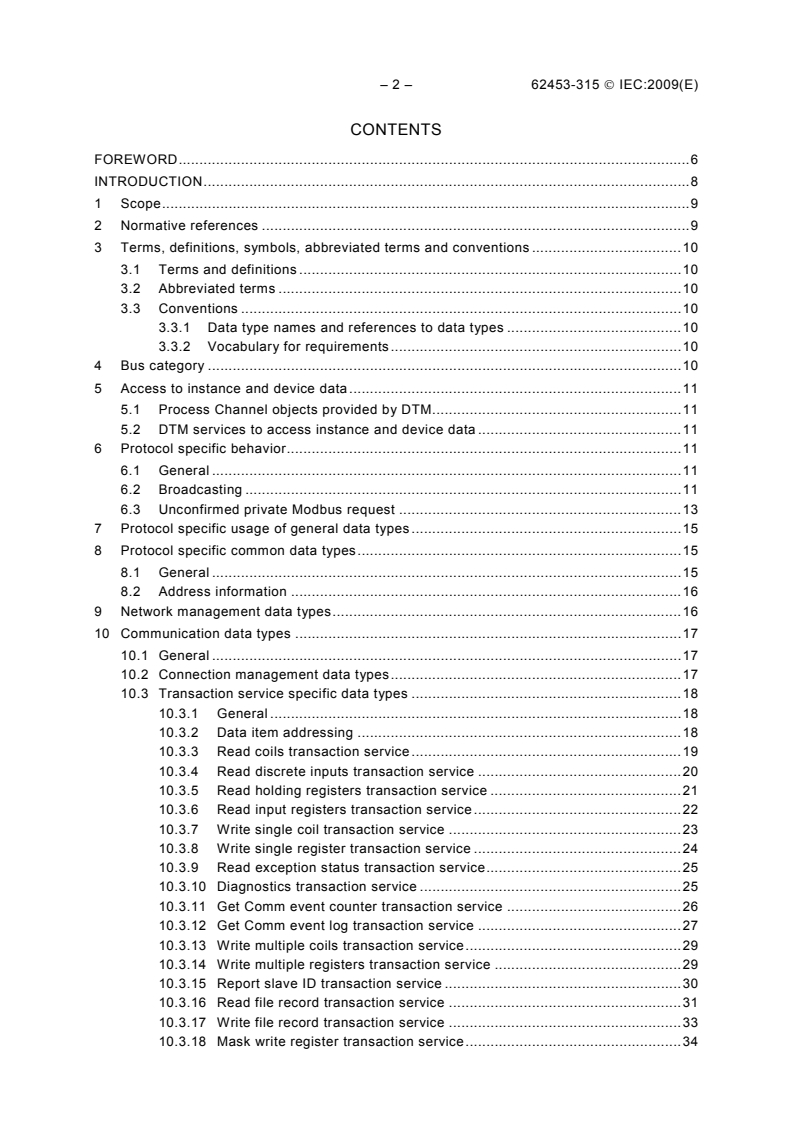
CONTENTS
FOREWORD.6
INTRODUCTION.8
1 Scope.9
2 Normative references .9
3 Terms, definitions, symbols, abbreviated terms and conventions .10
3.1 Terms and definitions .10
3.2 Abbreviated terms .10
3.3 Conventions .10
3.3.1 Data type names and references to data types .10
3.3.2 Vocabulary for requirements.10
4 Bus category .10
5 Access to instance and device data.11
5.1 Process Channel objects provided by DTM.11
5.2 DTM services to access instance and device data .11
6 Protocol specific behavior.11
6.1 General .11
6.2 Broadcasting .11
6.3 Unconfirmed private Modbus request .13
7 Protocol specific usage of general data types .15
8 Protocol specific common data types.15
8.1 General .15
8.2 Address information .16
9 Network management data types.16
10 Communication data types .17
10.1 General .17
10.2 Connection management data types.17
10.3 Transaction service specific data types .18
10.3.1 General .18
10.3.2 Data item addressing .18
10.3.3 Read coils transaction service.19
10.3.4 Read discrete inputs transaction service .20
10.3.5 Read holding registers transaction service .21
10.3.6 Read input registers transaction service.22
10.3.7 Write single coil transaction service .23
10.3.8 Write single register transaction service .24
10.3.9 Read exception status transaction service.25
10.3.10 Diagnostics transaction service .25
10.3.11 Get Comm event counter transaction service .26
10.3.12 Get Comm event log transaction service .27
10.3.13 Write multiple coils transaction service.29
10.3.14 Write multiple registers transaction service .29
10.3.15 Report slave ID transaction service .30
10.3.16 Read file record transaction service .31
10.3.17 Write file record transaction service .33
10.3.18 Mask write register transaction service.34
62453-315 © IEC:2009(E) – 3 –
10.3.19 Read/write holding registers transaction service.35
10.3.20 Read FIFO queue transaction service.37
10.3.21 Encapsulated interface transport transaction service.37
10.3.22 Read device identification transaction service .38
10.3.23 Private Modbus transaction service .41
10.3.24 Unconfirmed private Modbus transaction service.42
10.3.25 Modbus exception response .43
11 Channel parameter data types.44
12 Device Identification .46
12.1 Common device type identification data types .46
12.2 Topology scan data types.47
12.3 Scan identification data types.48
12.4 Device type identification data types – provided by DTM .50
12.5 Mapping of protocol specific device identification objects to FDT data types.51
Bibliography.53
Figure 1 – Part 315 of the IEC 62453 series .8
Figure 2 – Broadcast sequence with Modbus Serial Line Communication DTM .12
Figure 3 – Broadcast sequence with Modbus TCP Communication DTM .13
Figure 4 – Broadcast sequence without Modbus Communication DTM .13
Figure 5 – Unconfirmed request with Modbus Serial Line Communication DTM.14
Figure 6 – Unconfirmed request with Modbus TCP Communication DTM .14
Figure 7 – Unconfirmed request without Modbus Communication DTM .15
Figure 8 – Data item addressing .19
Table 1 – Protocol identifiers .10
Table 2 – Address information for broadcast mode .11
Table 3 – Broadcast transaction requests .12
Table 4 – Protocol specific usage of general FDT data types .15
Table 5 – Simple address information data types .16
Table 6 – Structured address information data types .16
Table 7 – Structured network management data types .17
Table 8 – Simple common communication data types .17
Table 9 – Structured connection management service data types .18
Table 10 – Simple ReadCoilsReq data types .19
Table 11 – Structured ReadCoilsReq data types .19
Table 12 – Simple ReadCoilsRsp data types.20
Table 13 – Structured ReadCoilsRsp data types .20
Table 14 – Simple ReadDiscreteInputsReq data types .20
Table 15 – Structured ReadDiscreteInputsReq data types .20
Table 16 – Simple ReadDiscreteInputsRsp data types .21
Table 17 – Structured ReadDiscreteInputsRsp data types.21
Table 18 – Simple ReadHoldingRegistersReq data types.21
Table 19 – Structured ReadHoldingRegistersReq data types .21
Table 20 – Simple ReadHoldingRegistersRsp data types .22
– 4 – 62453-315 © IEC:2009(E)
Table 21 – Structured ReadHoldingRegistersRsp data types .22
Table 22 – Simple ReadInputRegistersReq data types.22
Table 23 – Structured ReadInputRegistersReq data types .22
Table 24 – Simple ReadInputRegistersRsp data types .23
Table 25 – Structured ReadInputRegistersRsp data types .23
Table 26 – Simple WriteSingleCoilReq data types.23
Table 27 – Structured WriteSingleCoilReq data types .23
Table 28 – Structured WriteSingleCoilRsp data types .24
Table 29 – Simple WriteSingleRegisterReq data types.24
Table 30 – Structured WriteSingleRegisterReq data types .24
Table 31 – Structured WriteSingleRegisterRsp data types .24
Table 32 – Structured ReadExceptionStatusReq data types.25
Table 33 – Simple ReadExceptionStatusRsp data types .25
Table 34 – Structured ReadExceptionStatusRsp data types.25
Table 35 – Simple diagnostics data types .26
Table 36 – Structured DiagnosticsReq data types .26
Table 37 – Structured DiagnosticsRsp data types .26
Table 38 – Structured GetCommEventCounterReq data types .27
Table 39 – Simple GetCommEventCounterRsp data types .27
Table 40 – Structured GetCommEventCounterRsp data types .27
Table 41 – Structured GetCommEventLogReq data types.28
Table 42 – Simple GetCommEventLogRsp data types.28
Table 43 – Structured GetCommEventLogRsp data types .28
Table 44 – Simple WriteMultipleCoilsReq data types .29
Table 45 – Structured WriteMultipleCoilsReq data types .29
Table 46 – Structured WriteMultipleCoilsRsp data types .29
Table 47 – Simple WriteMultipleRegistersReq data types.30
Table 48 – Structured WriteMultipleRegistersReq data types .30
Table 49 – Structured WriteMultipleRegistersRsp data types .30
Table 50 – Structured ReportSlaveIDReq data types .31
Table 51 – Simple ReportSlaveIDRsp data types .31
Table 52 – Structured ReportSlaveIDRsp data types.31
Table 53 – Simple ReadFileSubRequest data types.32
Table 54 – Structured ReadFileSubRequest data types .32
Table 55 – Structured ReadFileRecordReq data types .32
Table 56 – Simple ReadFileSubResponse data types .32
Table 57 – Structured ReadFileSubResponse data types.33
Table 58 – Structured ReadFileRecordRsp data types .33
Table 59 – Simple WriteFileSubRequest data types .33
Table 60 – Structured WriteFileSubRequest data types .34
Table 61 – Structured WriteFileRecordReq data types .34
Table 62 – Structured WriteFileRecordRsp data types .34
Table 63 – Simple MaskWriteRegisterReq data types .35
62453-315 © IEC:2009(E) – 5 –
Table 64 – Structured MaskWriteRegisterReq data types.35
Table 65 – Structured MaskWriteRegisterRsp data types.35
Table 66 – Simple ReadWriteRegistersReq data types .36
Table 67 – Structured ReadWriteRegistersReq data types .36
Table 68 – Simple ReadWriteRegistersRsp data types.36
Table 69 – Structured ReadWriteRegistersRsp data types .36
Table 70 – Simple ReadFifoQueueReq data types .37
Table 71 – Structured ReadFifoQueueReq data types.37
Table 72 – Simple ReadFifoQueueRsp data types .37
Table 73 – Structured ReadFifoQueueRsp data types.37
Table 74 – Simple EncapsulatedInterfaceTransportReq data types .38
Table 75 – Structured EncapsulatedInterfaceTransportReq data types .38
Table 76 – Simple EncapsulatedInterfaceTransportRsp data types .38
Table 77 – Structured EncapsulatedInterfaceTransportRsp data types.38
Table 78 – Simple ReadDeviceIdentificationReq data types .39
Table 79 – Structured ReadDeviceIdentificationReq data types .39
Table 80 – Simple IdentificationObject data types .39
Table 81 – Structured IdentificationObject data types .39
Table 82 – Simple ReadDeviceIdentificationRsp data types .40
Table 83 – Structured ReadDeviceIdentificationRsp data types.41
Table 84 – Simple PrivateModbusReq data types .41
Table 85 – Structured PrivateModbusReq data types.41
Table 86 – Simple PrivateModbusRsp data types.41
Table 87 – Structured PrivateModbusRsp data types .42
Table 88 – Simple UnconfirmedPrivateModbusReq data types.42
Table 89 – Structured UnconfirmedPrivateModbusReq data types .42
Table 90 – Structured UnconfirmedPrivateModbusRsp data types .42
Table 91 – Simple ModbusExceptionRsp data types .43
Table 92 – Structured ModbusExceptionRsp data types.43
Table 93 – Simple channel parameter data types.44
Table 94 – Structured channel parameter data types .45
Table 95 – Simple common identification data types .46
Table 96 – Simple device information data types .47
Table 97 – Structured device information data types.48
Table 98 – Simple scan identification data types.49
Table 99 – Structured scan identification data types .49
Table 100 – Structured device type identification data types .50
Table 101 – Mapping of protocol specific identification objects in FDT .52
Table 102 – Additional information for optional identification objects.52
– 6 – 62453-315 © IEC:2009(E)
INTERNATIONAL ELECTROTECHNICAL COMMISSION
____________
FIELD DEVICE TOOL (FDT) INTERFACE SPECIFICATION –
Part 315: Communication profile integration –
IEC 61784 CPF 15
FOREWORD
1) The International Electrotechnical Commission (IEC) is a worldwide organization for standardization comprising
all national electrotechnical committees (IEC National Committees). The object of IEC is to promote
international co-operation on all questions concerning standardization in the electrical and electronic fields. To
this end and in addition to other activities, IEC publishes International Standards, Technical Specifications,
Technical Reports, Publicly Available Specifications (PAS) and Guides (hereafter referred to as “IEC
Publication(s)”). Their preparation is entrusted to technical committees; any IEC National Committee interested
in the subject dealt with may participate in this preparatory work. International, governmental and non-
governmental organizations liaising with the IEC also participate in this preparation. IEC collaborates closely
with the International Organization for Standardization (ISO) in accordance with conditions determined by
agreement between the two organizations.
2) The formal decisions or agreements of IEC on technical matters express, as nearly as possible, an international
consensus of opinion on the relevant subjects since each technical committee has representation from all
interested IEC National Committees.
3) IEC Publications have the form of recommendations for international use and are accepted by IEC National
Committees in that sense. While all reasonable efforts are made to ensure that the technical content of IEC
Publications is accurate, IEC cannot be held responsible for the way in which they are used or for any
misinterpretation by any end user.
4) In order to promote international uniformity, IEC National Committees undertake to apply IEC Publications
transparently to the maximum extent possible in their national and regional publications. Any divergence
between any IEC Publication and the corresponding national or regional publication shall be clearly indicated in
the latter.
5) IEC provides no marking procedure to indicate its approval and cannot be rendered responsible for any
equipment declared to be in conformity with an IEC Publication.
6) All users should ensure that they have the latest edition of this publication.
7) No liability shall attach to IEC or its directors, employees, servants or agents including individual experts and
members of its technical committees and IEC National Committees for any personal injury, property damage or
other damage of any nature whatsoever, whether direct or indirect, or for costs (including legal fees) and
expenses arising out of the publication, use of, or reliance upon, this IEC Publication or any other IEC
Publications.
8) Attention is drawn to the Normative references cited in this publication. Use of the referenced publications is
indispensable for the correct application of this publication.
9) Attention is drawn to the possibility that some of the elements of this IEC Publication may be the subject of
patent rights. IEC shall not be held responsible for identifying any or all such patent rights.
International Standard IEC 62453-315 has been prepared by subcommittee 65E: Devices and
integration in enterprise systems, of IEC technical committee 65: Industrial-process
measurement, control and automation.
This part, in conjunction with the other parts of the first edition of the IEC 62453 series
cancels and replaces IEC/PAS 62453-1, IEC/PAS 62453-2, IEC/PAS 62453-3, IEC/PAS
62453-4 and IEC/PAS 62453-5 published in 2006, and constitutes a technical revision.
Each part of the IEC 62453-3xy series is intended to be read in conjunction with IEC 62453-2.
62453-315 © IEC:2009(E) – 7 –
The text of this standard is based on the following documents:
FDIS Report on voting
65E/131/FDIS 65E/144/RVD
Full information on the voting for the approval of this standard can be found in the report on
voting indicated in the above table.
This publication has been drafted in accordance with the ISO/IEC Directives, Part 2.
A list of all parts of the IEC 62453 series, under the general title Field Device Tool (FDT)
interface specification, can be found on the IEC website.
The committee has decided that the contents of this publication will remain unchanged until
the maintenance result date indicated on the IEC web site under "http://webstore.iec.ch" in
the data related to the specific publication. At this date, the publication will be
• reconfirmed,
• withdrawn,
• replaced by a revised edition, or
• amended.
A bilingual version of this publication may be issued at a later date.
– 8 – 62453-315 © IEC:2009(E)
INTRODUCTION
This part of IEC 62453 is an interface specification for developers of FDT (Field Device Tool)
components for function control and data access within a client/server architecture. The
specification is a result of an analysis and design process to develop standard interfaces to
facilitate the development of servers and clients by multiple vendors that need to interoperate
seamlessly.
With the integration of fieldbusses into control systems, there are a few other tasks which
need to be performed. In addition to fieldbus- and device-specific tools, there is a need to
integrate these tools into higher-level system-wide planning- or engineering tools. In
particular, for use in extensive and heterogeneous control systems, typically in the area of the
process industry, the unambiguous definition of engineering interfaces that are easy to use for
all those involved is of great importance.
A device-specific software component, called DTM (Device Type Manager), is supplied by the
field device manufacturer with its device. The DTM is integrated into engineering tools via the
FDT interfaces defined in this specification. The approach to integration is in general open for
all kinds of fieldbusses and thus meets the requirements for integrating different kinds of
devices into heterogeneous control systems.
Figure 1 shows how IEC 62453-315 is aligned in the structure of the IEC 62453 series.
Part 315
Communication
profile integration –
IEC 61784 CPF 15
IEC 1136/09
Figure 1 – Part 315 of the IEC 62453 series
62453-315 © IEC:2009(E) – 9 –
FIELD DEVICE TOOL (FDT) INTERFACE SPECIFICATION –
Part 315: Communication profile integration –
IEC 61784 CPF 15
1 Scope
Communication Profile Family 15 (commonly known as Modbus ) defines communication
profiles based on IEC 61158-5-15 and IEC 61158-6-15. The basic profile CP 15/1 (Modbus
TCP) is defined in IEC 61784-1. An additional communication profile (Modbus Serial Line) is
defined in [2].
This part of the IEC 62453 provides information for integrating Modbus TCP® and Modbus
Serial Line® protocol support into FDT based systems.
NOTE This part of IEC 62453 only specifies the mapping of Modbus parameters to FDT data types. For
restrictions of protocol specific parameters concerning allowed values and concerning limitations of arrays used in
the definition of FDT data types, refer to IEC 61158-5-15 and the MODBUS Application Protocol Specification.
2 Normative references
The following referenced documents are indispensable for the application of this document.
For dated references, only the edition cited applies. For undated references, the latest edition
of the referenced document (including any amendments) applies.
IEC 61131-3, Programmable controllers – Part 3: Programming languages
IEC 61158-5-15, Industrial communication networks – Fieldbus specifications – Part 5-15:
Application layer service definition – Type 15 elements
IEC 61158-6-15, Industrial communication networks – Fieldbus specifications – Part 6-20:
Application layer protocol specification – Type 15 elements
IEC 61784-1, Industrial communication networks – Profiles – Part 1: Fieldbus profiles
IEC 61784-2, Industrial communication networks – Profiles – Part 2: Additional fieldbus
profiles for real-time networks based on ISO/IEC 8802-3
IEC 62453-1:2009, Field Device Tool (FDT) interface specification – Part 1: Overview and
guidance
IEC 62453-2:2009, Field Device Tool (FDT) interface specification – Part 2: Concepts and
detailed description
RFC 791, Internet Protocol (available at
—————————
)
1 Modbus is the trademark of Schneider Automation Inc. It is registered in the United States of America. This
information is given for the convenience of users of this International Standard and does not constitute an
endorsement by IEC of the trademark holder or any of its products. Compliance to this profile does not require
use of the trademark Modbus. Use of the trademark Modbus requires permission from Schneider Automation
Inc.
– 10 – 62453-315 © IEC:2009(E)
3 Terms, definitions, symbols, abbreviated terms and conventions
3.1 Terms and definitions
For the purposes of this document, the terms and definitions given in IEC 62453-1,
IEC 62453-2 and the following apply.
3.2 Abbreviated terms
For the purposes of this document, the abbreviations given in IEC 62453-1, IEC 62453-2 and
the following apply.
ASCII American Standard Code for Information Interchange
DTM Device Type Manager
FA Frame Application
IP Internet Protocol
RFC Request For comment
TCP Transmission Control Protocol
3.3 Conventions
3.3.1 Data type names and references to data types
The conventions for naming and referencing of data types are explained in IEC 62453-2
Clause A.1
3.3.2 Vocabulary for requirements
The following expressions are used when specifying requirements.
– Usage of “shall” or “mandatory” – No exceptions allowed.
– Usage of “should” or “recommended” – Strong recommendation. It may make sense in
special exceptional cases to differ from the
described behaviour.
– Usage of “can’ or “optional’ – Function or behaviour may be provided, depending
on defined conditions.
4 Bus category
The Modbus protocol is identified in the protocolId element of the structured data type
'fdt:BusCategory' by the following unique identifiers (see Table 1).
Table 1 – Protocol identifiers
Identifier value ProtocolId name Description
59629a40-285f-11db-a98b-0800200c9a66 ‘Modbus over Serial Line’ Modbus over Serial Line
59629a41-285f-11db-a98b-0800200c9a66 ‘Modbus over TCP’ Modbus over TCP
62453-315 © IEC:2009(E) – 11 –
5 Access to instance and device data
5.1 Process Channel objects provided by DTM
For Modbus no minimum set of parameters is defined which must be provided by a DTM. If a
DTM provides process values, the process variables should be modeled as Process
Channels.
5.2 DTM services to access instance and device data
Not applicable.
6 Protocol specific behavior
6.1 General
This clause specifies how unconfirmed Modbus requests shall be handled in FDT. Two types
of unconfirmed Modbus requests are supported in FDT:
• broadcasts;
• unconfirmed private Modbus requests.
6.2 Broadcasting
In broadcast mode, a DTM can send a Modbus request to all devices connected to the bus.
This mode is only supported for devices, which are connected via Modbus Serial Line. The
connection can either be a direct connection or a connection via a gateway. The broadcast
mode must be initiated by a fdtmodbus:ConnectRequest with the slave address of the target
device set to 0 (slaveAddress=0). For more detailed information about the address
information which has to be provided for broadcast mode, see Table 2.
Table 2 – Address information for broadcast mode
Data type Definition Description
Elementary data types U Multiplicity
s
a
g
e
ModbusSerial STRUCT Address information for Modbus Serial Line
slaveAddress M [1.1] Shall be 0 for broadcast mode
ModbusTCP STRUCT Address information for Modbus TCP:
slaveAddress M [1.1] Shall be 0 for broadcast mode
tcpAddress M [1.1] IP address of the Modbus TCP/ Modbus
Serial Line gateway
tcpPort O [0.1] Port for Modbus TCP connection (if no port
information is provided, the default port
502 shall be used)
Because in broadcast mode no response will be returned by the device, the broadcast mode
shall be used only with the transaction requests shown in Table 3:
– 12 – 62453-315 © IEC:2009(E)
Table 3 – Broadcast transaction requests
Broadcast transaction requests Restrictions
WriteSingleCoilReq None
WriteSingleRegisterReq None
DiagnosticsReq This transaction request shall be used in broadcast mode only with
the following sub-functions:
- 0x01: Restart Communication Option
- 0x03: Change ASCII Input Delimiter
- 0x04: Force Listen Only Mode
- 0x0A: Clear Counters and Diagnostic Register
- 0x14: Clear Overrun Counter and Flag
WriteMultipleCoilsReq None
WriteMultipleRegistersReq None
WriteFileRecordReq None
MaskWriteRegisterReq None
PrivateModbusReq Shall be used only with private services where no response is
required from the device
Although in broadcast mode no response will be returned by the target devices a transaction
response, which corresponds to the transaction request shall be generated. This transaction
response shall be generated in order to inform the DTM that the broadcast request was sent
on the bus. If a Modbus Communication DTM is used to establish the communication, it has to
provide this generated transaction response (see Figure 2 and Figure 3).
IEC 1137/09
Figure 2 – Broadcast sequence with Modbus Serial Line Communication DTM
62453-315 © IEC:2009(E) – 13 –
IEC 1138/09
Figure 3 – Broadcast sequence with Modbus TCP Communication DTM
If no Modbus Communication DTM is used to establish the communication, the Modbus
Gateway DTM, which provides the link to the higher communication level different from
Modbus, has to provide this transaction response (see Figure 4).
IEC 1139/09
Figure 4 – Broadcast sequence without Modbus Communication DTM
6.3 Unconfirmed private Modbus request
This transaction request can be used to send any unconfirmed private Modbus request.
Although no response will be returned by the target device, a transaction response, which
corresponds to the transaction request, shall be generated. This transaction response shall be
– 14 – 62453-315 © IEC:2009(E)
generated in order to inform the DTM that the unconfirmed request was sent on the bus. If a
Modbus Communication DTM is used to establish the communication, it has to provide this
generated transaction response (see Figure 5 and Figure 6).
IEC 1140/09
Figure 5 – Unconfirmed request with Modbus Serial Line Communication DTM
IEC 1141/09
Figure 6 – Unconfirmed request with Modbus TCP Communication DTM
If no Modbus Communication DTM is used to establish the communication, the Modbus
Gateway DTM, which provides the link to the higher communication level different from
Modbus, has to provide this transaction response (see Figure 7).
62453-315 © IEC:2009(E) – 15 –
IEC 1142/09
Figure 7 – Unconfirmed request without Modbus Communication DTM
7 Protocol specific usage of general data types
The following table (Table 4) shows how general data types, defined in IEC 62453-2 within
the namespace ‘fdt’, are used with IEC 61784 CPF 15 devices.
Table 4 – Protocol specific usage of general FDT data types
Data type Description for use
fdt:dataType Identifier for the FDT data type of the channel object
fdt:busCategory See Clause 4
deviceTypeInformation Modbus device description in form of human readable string, which can be
provided with a DTM
deviceTypeInformationPat Path to file which contains the Modbus device description if available
h
fdt:readAccess Specifies whether the value can be read from the device:
• “0”, if reading access is not allowed
• “1”, if reading access is allowed
fdt:systemTag Unique identifier of a device instance within a project of a Frame Application
fdt:writeAccess Specifies whether the value can be written to the device:
• “0”, if writing access is not allowed
• “1”, if writing access is allowed
8 Protocol specific common data types
8.1 General
This clause specifies protocol specific common data types which are used in the definition of
other data types.
– 16 – 62453-315 © IEC:2009(E)
8.2 Address information
This subclause specifies the structure and the semantics of the protocol specific address
information in FDT, which is used on the different underlying communication layers for
Modbus TCP and Modbus Serial Line.
For a detailed description of how the address information is mapped to data types, see
Table 5 and Table 6.
The data types described in this subclause are defined for the following namespace.
Namespace: mb
Table 5 – Simple address information data types
Data type Definition Description
slaveAddress USINT Slave address of a Modbus device
tcpAddress STRING String representation of the IP address as described in
RFC 791 Internet Protocol (IP)
tcpPort UINT Port for Modbus TCP connection (if no port information is
provided the default port 502 shall be used)
Table 6 – Structured address information data types
Data type Definition Description
Elementary data types U Multiplicity
s
a
g
e
ModbusSerial STRUCT Address information for Modbus Serial Line
slaveAddress M [1.1]
ModbusTCP STRUCT Address information for Modbus TCP:
IP address of the target Modbus TCP
server
Slave address of the target device if the
Modbus TCP server provides routing
services over Modbus Serial Line
slaveAddress O [0.1]
tcpAddress M [1.1]
tcpPort O [0.1]
9 Network management data types
The data types described in this clause are used in the following services:
• NetworkManagementInfoRead service;
• NetworkManagementInfoWrite service.
This clause describes the information, which has to be provided for Modbus devices, in the
UserDefinedBus data type (see Table 7).
62453-315 © IEC:2009(E) – 17 –
Table 7 – Structured network management data types
Data type Definition Description
Elementary data types U Multiplicity
s
a
g
e
UserDefinedBus STRUCT The UserDefinedBus data type contains the
address information of the device.
It is required that the UserDefinedBus data
type contains at least one address
information data type of the target device
mb:ModbusSerial O[0.*]
mb:ModbusTCP O[0.*]
Some devices and their modules require more than one address on the bus. It is possible that
the UserDefinedBus data type may contain several address-elements. In this case, the first
address element shall contain the information about the principal address of the device.
10 Communication data types
10.1 General
The data types described in this clause are used in the following services:
• connect service;
• disconnect service;
• transaction service.
This clause describes the structure and the semantics of the protocol specific communication
related data, which is exchanged between a DTM and its parent component.
For a detailed description of the common communication data types used in these services,
see Table 8.
The data types described in this clause are defined for the following namespace.
Namespace: fdtmodbus
Table 8 – Simple common communication data types
Data type Definition Description
communicationReference UUID Mandatory identifier for a communication link to a device
This identifier is allocated by the communication component
during the connect. The address information has to be used
for all following communication calls
10.2 Connection management data types
For a detailed description of the information used in the connect service and in the disconnect
service see Table 9.
– 18 – 62453-315 © IEC:2009(E)
Table 9 – Structured connection management service data types
Data type Definition Description
Elementary data types U Multiplicity
s
a
g
e
Abort STRUCT If the Abort command is sent to the next
communication component or to the
connected device, it terminates all
pending requests and returns without
waiting for a result. The termination of the
connection will not be confirmed
communicationReference O [0.1]
ConnectRequest STRUCT Describes the communication request:
− to establish a communication link
to a Modbus TCP server device;
− to establish a communication link
to a Modbus Serial Line slave
device.
The request contains the address
information of the target device
fdt:systemTag M[1.1]
choice of M [1.1]
mb:ModbusSerial S [1.1]
mb:ModbusTCP S [1.1]
ConnectResponse STRUCT Describes the communication response to
the connect request
communicationReference M [1.1]
DisconnectRequest STRUCT Describes the communication request to
release a communication link
communicationReference M [1.1]
DisconnectResponse STRUCT Describes the communication response to
a disconnect request
communicationReference M [1.1]
10.3 Transaction service specific data types
10.3.1 General
This subclause describes the information which is used in the transaction services.
10.3.2 Data item addressing
This document specifies the mapping of Modbus parameters to FDT data types. For this
reason, all address information provided as parameters and concerning the Modbus data
items
• coils,
• discrete inputs,
• holding registers and
• input registers,
shall be the same information as will be later sent on the bus (see Figure 8).
62453-315 © IEC:2009(E) – 19 –
IEC 1143/09
Figure 8 – Data item addressing
10.3.3 Read coils transaction service
The parameters of the transaction service, which is equivalent to the Rea
...
IEC 62453-315 ®
Edition 1.1 2016-06
CONSOLIDATED VERSION
INTERNATIONAL
STANDARD
NORME
INTERNATIONALE
colour
inside
Field device tool (FDT) Interface specification –
Part 315: Communication profile integration – IEC 61784 CPF 15
Spécification des interfaces des outils des dispositifs de terrain (FDT) –
Partie 315: Intégration des profils de communication – IEC 61784 CPF 15
All rights reserved. Unless otherwise specified, no part of this publication may be reproduced or utilized in any form
or by any means, electronic or mechanical, including photocopying and microfilm, without permission in writing from
either IEC or IEC's member National Committee in the country of the requester. If you have any questions about IEC
copyright or have an enquiry about obtaining additional rights to this publication, please contact the address below or
your local IEC member National Committee for further information.
Droits de reproduction réservés. Sauf indication contraire, aucune partie de cette publication ne peut être reproduite
ni utilisée sous quelque forme que ce soit et par aucun procédé, électronique ou mécanique, y compris la photocopie
et les microfilms, sans l'accord écrit de l'IEC ou du Comité national de l'IEC du pays du demandeur. Si vous avez des
questions sur le copyright de l'IEC ou si vous désirez obtenir des droits supplémentaires sur cette publication, utilisez
les coordonnées ci-après ou contactez le Comité national de l'IEC de votre pays de résidence.
IEC Central Office Tel.: +41 22 919 02 11
3, rue de Varembé Fax: +41 22 919 03 00
CH-1211 Geneva 20 info@iec.ch
Switzerland www.iec.ch
About the IEC
The International Electrotechnical Commission (IEC) is the leading global organization that prepares and publishes
International Standards for all electrical, electronic and related technologies.
About IEC publications
The technical content of IEC publications is kept under constant review by the IEC. Please make sure that you have the
latest edition, a corrigenda or an amendment might have been published.
IEC Catalogue - webstore.iec.ch/catalogue Electropedia - www.electropedia.org
The stand-alone application for consulting the entire The world's leading online dictionary of electronic and
bibliographical information on IEC International Standards, electrical terms containing 20 000 terms and definitions in
Technical Specifications, Technical Reports and other English and French, with equivalent terms in 15 additional
documents. Available for PC, Mac OS, Android Tablets and languages. Also known as the International Electrotechnical
iPad. Vocabulary (IEV) online.
IEC publications search - www.iec.ch/searchpub IEC Glossary - std.iec.ch/glossary
The advanced search enables to find IEC publications by a 65 000 electrotechnical terminology entries in English and
variety of criteria (reference number, text, technical French extracted from the Terms and Definitions clause of
committee,…). It also gives information on projects, replaced IEC publications issued since 2002. Some entries have been
and withdrawn publications. collected from earlier publications of IEC TC 37, 77, 86 and
CISPR.
IEC Just Published - webstore.iec.ch/justpublished
Stay up to date on all new IEC publications. Just Published IEC Customer Service Centre - webstore.iec.ch/csc
details all new publications released. Available online and If you wish to give us your feedback on this publication or
also once a month by email. need further assistance, please contact the Customer Service
Centre: csc@iec.ch.
A propos de l'IEC
La Commission Electrotechnique Internationale (IEC) est la première organisation mondiale qui élabore et publie des
Normes internationales pour tout ce qui a trait à l'électricité, à l'électronique et aux technologies apparentées.
A propos des publications IEC
Le contenu technique des publications IEC est constamment revu. Veuillez vous assurer que vous possédez l’édition la
plus récente, un corrigendum ou amendement peut avoir été publié.
Catalogue IEC - webstore.iec.ch/catalogue Electropedia - www.electropedia.org
Application autonome pour consulter tous les renseignements
Le premier dictionnaire en ligne de termes électroniques et
bibliographiques sur les Normes internationales,
électriques. Il contient 20 000 termes et définitions en anglais
Spécifications techniques, Rapports techniques et autres
et en français, ainsi que les termes équivalents dans 15
documents de l'IEC. Disponible pour PC, Mac OS, tablettes
langues additionnelles. Egalement appelé Vocabulaire
Android et iPad.
Electrotechnique International (IEV) en ligne.
Recherche de publications IEC - www.iec.ch/searchpub
Glossaire IEC - std.iec.ch/glossary
La recherche avancée permet de trouver des publications IEC
65 000 entrées terminologiques électrotechniques, en anglais
en utilisant différents critères (numéro de référence, texte,
et en français, extraites des articles Termes et Définitions des
comité d’études,…). Elle donne aussi des informations sur les
publications IEC parues depuis 2002. Plus certaines entrées
projets et les publications remplacées ou retirées.
antérieures extraites des publications des CE 37, 77, 86 et
CISPR de l'IEC.
IEC Just Published - webstore.iec.ch/justpublished
Restez informé sur les nouvelles publications IEC. Just Service Clients - webstore.iec.ch/csc
Published détaille les nouvelles publications parues. Si vous désirez nous donner des commentaires sur cette
Disponible en ligne et aussi une fois par mois par email. publication ou si vous avez des questions contactez-nous:
csc@iec.ch.
IEC 62453-315 ®
Edition 1.1 2016-06
CONSOLIDATED VERSION
INTERNATIONAL
STANDARD
NORME
INTERNATIONALE
colour
inside
Field device tool (FDT) Interface specification –
Part 315: Communication profile integration – IEC 61784 CPF 15
Spécification des interfaces des outils des dispositifs de terrain (FDT) –
Partie 315: Intégration des profils de communication – IEC 61784 CPF 15
INTERNATIONAL
ELECTROTECHNICAL
COMMISSION
COMMISSION
ELECTROTECHNIQUE
INTERNATIONALE
ICS 25.040.40; 35.100.05; 35.110 ISBN 978-2-8322-3486-0
IEC 62453-315 ®
Edition 1.1 2016-06
CONSOLIDATED VERSION
REDLINE VERSION
VERSION REDLINE
colour
inside
Field device tool (FDT) Interface specification –
Part 315: Communication profile integration – IEC 61784 CPF 15
Spécification des interfaces des outils des dispositifs de terrain (FDT) –
Partie 315: Intégration des profils de communication – IEC 61784 CPF 15
– 2 – IEC 62453-315:2009+AMD1:2016 CSV
© IEC 2016
CONTENTS
FOREWORD. 6
INTRODUCTION . 8
1 Scope . 9
2 Normative references . 9
3 Terms, definitions, symbols, abbreviated terms and conventions . 10
3.1 Terms and definitions . 10
3.2 Abbreviated terms . 10
3.3 Conventions . 10
3.3.1 Data type names and references to data types . 10
3.3.2 Vocabulary for requirements . 10
4 Bus category . 10
5 Access to instance and device data . 12
5.1 Process Channel objects provided by DTM . 12
5.2 DTM services to access instance and device data . 12
6 Protocol specific behavior . 12
6.1 General . 12
6.2 Broadcasting . 13
6.3 Unconfirmed private Modbus request . 15
8 Protocol specific common data types . 17
8.1 General . 17
8.2 Address information . 18
7 Protocol specific usage of general data types . 17
9 Network management data types . 18
10 Communication data types . 19
10.1 General . 19
10.2 Connection management data types. 19
10.3 Transaction service specific data types . 20
10.3.1 General . 20
10.3.2 Data item addressing . 20
10.3.3 Read coils transaction service . 21
10.3.4 Read discrete inputs transaction service . 22
10.3.5 Read holding registers transaction service . 23
10.3.6 Read input registers transaction service . 24
10.3.7 Write single coil transaction service . 25
10.3.8 Write single register transaction service . 26
10.3.9 Read exception status transaction service . 27
10.3.10 Diagnostics transaction service . 27
10.3.11 Get Comm event counter transaction service . 28
10.3.12 Get Comm event log transaction service . 29
10.3.13 Write multiple coils transaction service . 31
10.3.14 Write multiple registers transaction service . 31
10.3.15 Report slave ID transaction service . 32
10.3.16 Read file record transaction service . 33
10.3.17 Write file record transaction service . 35
10.3.18 Mask write register transaction service . 36
© IEC 2016
10.3.19 Read/write holding registers transaction service . 37
10.3.20 Read FIFO queue transaction service . 38
10.3.21 Encapsulated interface transport transaction service . 39
10.3.22 Read device identification transaction service . 40
10.3.23 Private Modbus transaction service . 43
10.3.24 Unconfirmed private Modbus transaction service . 44
10.3.25 Modbus exception response . 45
11 Channel parameter data types . 46
12 Device Identification . 48
12.1 Common device type identification data types . 48
12.2 Topology scan data types . 49
12.3 Scan identification data types . 50
12.4 Device type identification data types – provided by DTM . 52
12.5 Mapping of protocol specific device identification objects to FDT data types. 53
Bibliography . 55
Figure 1 – Part 315 of the IEC 62453 series . 8
Figure 2 – Broadcast sequence with Modbus Serial Line Communication DTM . 14
Figure 3 – Broadcast sequence with Modbus TCP Communication DTM . 14
Figure 4 – Broadcast sequence without Modbus Communication DTM . 15
Figure 5 – Unconfirmed request with Modbus Serial Line Communication DTM . 16
Figure 6 – Unconfirmed request with Modbus TCP Communication DTM . 16
Figure 7 – Unconfirmed request without Modbus Communication DTM . 17
Figure 8 – Data item addressing . 21
Table 1 – Protocol identifiers . 10
Table 2 – Address information for broadcast mode . 13
Table 3 – Broadcast transaction requests . 13
Table 4 – Protocol specific usage of general FDT data types . 17
Table 5 – Simple address information data types . 18
Table 6 – Structured address information data types . 18
Table 7 – Structured network management data types . 19
Table 8 – Simple common communication data types . 19
Table 9 – Structured connection management service data types . 20
Table 10 – Simple ReadCoilsReq data types . 21
Table 11 – Structured ReadCoilsReq data types . 21
Table 12 – Simple ReadCoilsRsp data types . 22
Table 13 – Structured ReadCoilsRsp data types . 22
Table 14 – Simple ReadDiscreteInputsReq data types . 22
Table 15 – Structured ReadDiscreteInputsReq data types . 22
Table 16 – Simple ReadDiscreteInputsRsp data types . 23
Table 17 – Structured ReadDiscreteInputsRsp data types . 23
Table 18 – Simple ReadHoldingRegistersReq data types . 23
Table 19 – Structured ReadHoldingRegistersReq data types . 23
Table 20 – Simple ReadHoldingRegistersRsp data types . 24
– 4 – IEC 62453-315:2009+AMD1:2016 CSV
© IEC 2016
Table 21 – Structured ReadHoldingRegistersRsp data types . 24
Table 22 – Simple ReadInputRegistersReq data types . 24
Table 23 – Structured ReadInputRegistersReq data types . 24
Table 24 – Simple ReadInputRegistersRsp data types . 25
Table 25 – Structured ReadInputRegistersRsp data types . 25
Table 26 – Simple WriteSingleCoilReq data types . 25
Table 27 – Structured WriteSingleCoilReq data types . 25
Table 28 – Structured WriteSingleCoilRsp data types . 26
Table 29 – Simple WriteSingleRegisterReq data types . 26
Table 30 – Structured WriteSingleRegisterReq data types . 26
Table 31 – Structured WriteSingleRegisterRsp data types . 26
Table 32 – Structured ReadExceptionStatusReq data types . 27
Table 33 – Simple ReadExceptionStatusRsp data types . 27
Table 34 – Structured ReadExceptionStatusRsp data types . 27
Table 35 – Simple diagnostics data types . 28
Table 36 – Structured DiagnosticsReq data types . 28
Table 37 – Structured DiagnosticsRsp data types . 28
Table 38 – Structured GetCommEventCounterReq data types . 29
Table 39 – Simple GetCommEventCounterRsp data types . 29
Table 40 – Structured GetCommEventCounterRsp data types . 29
Table 41 – Structured GetCommEventLogReq data types . 30
Table 42 – Simple GetCommEventLogRsp data types . 30
Table 43 – Structured GetCommEventLogRsp data types . 30
Table 44 – Simple WriteMultipleCoilsReq data types . 31
Table 45 – Structured WriteMultipleCoilsReq data types . 31
Table 46 – Structured WriteMultipleCoilsRsp data types . 31
Table 47 – Simple WriteMultipleRegistersReq data types . 32
Table 48 – Structured WriteMultipleRegistersReq data types . 32
Table 49 – Structured WriteMultipleRegistersRsp data types . 32
Table 50 – Structured ReportSlaveIDReq data types . 32
Table 51 – Simple ReportSlaveIDRsp data types . 33
Table 52 – Structured ReportSlaveIDRsp data types . 33
Table 53 – Simple ReadFileSubRequest data types . 33
Table 54 – Structured ReadFileSubRequest data types . 34
Table 55 – Structured ReadFileRecordReq data types . 34
Table 56 – Simple ReadFileSubResponse data types . 34
Table 57 – Structured ReadFileSubResponse data types . 34
Table 58 – Structured ReadFileRecordRsp data types . 35
Table 59 – Simple WriteFileSubRequest data types . 35
Table 60 – Structured WriteFileSubRequest data types . 35
Table 61 – Structured WriteFileRecordReq data types . 36
Table 62 – Structured WriteFileRecordRsp data types . 36
Table 63 – Simple MaskWriteRegisterReq data types . 36
© IEC 2016
Table 64 – Structured MaskWriteRegisterReq data types . 37
Table 65 – Structured MaskWriteRegisterRsp data types . 37
Table 66 – Simple ReadWriteRegistersReq data types . 37
Table 67 – Structured ReadWriteRegistersReq data types . 38
Table 68 – Simple ReadWriteRegistersRsp data types . 38
Table 69 – Structured ReadWriteRegistersRsp data types . 38
Table 70 – Simple ReadFifoQueueReq data types . 38
Table 71 – Structured ReadFifoQueueReq data types . 38
Table 72 – Simple ReadFifoQueueRsp data types . 39
Table 73 – Structured ReadFifoQueueRsp data types . 39
Table 74 – Simple EncapsulatedInterfaceTransportReq data types . 39
Table 75 – Structured EncapsulatedInterfaceTransportReq data types . 40
Table 76 – Simple EncapsulatedInterfaceTransportRsp data types . 40
Table 77 – Structured EncapsulatedInterfaceTransportRsp data types . 40
Table 78 – Simple ReadDeviceIdentificationReq data types . 41
Table 79 – Structured ReadDeviceIdentificationReq data types . 41
Table 80 – Simple IdentificationObject data types . 41
Table 81 – Structured IdentificationObject data types . 41
Table 82 – Simple ReadDeviceIdentificationRsp data types . 42
Table 83 – Structured ReadDeviceIdentificationRsp data types . 43
Table 84 – Simple PrivateModbusReq data types . 43
Table 85 – Structured PrivateModbusReq data types . 43
Table 86 – Simple PrivateModbusRsp data types . 43
Table 87 – Structured PrivateModbusRsp data types . 44
Table 88 – Simple UnconfirmedPrivateModbusReq data types . 44
Table 89 – Structured UnconfirmedPrivateModbusReq data types . 44
Table 90 – Structured UnconfirmedPrivateModbusRsp data types . 44
Table 91 – Simple ModbusExceptionRsp data types . 45
Table 92 – Structured ModbusExceptionRsp data types . 45
Table 93 – Simple channel parameter data types . 46
Table 94 – Structured channel parameter data types . 47
Table 95 – Simple common identification data types . 48
Table 96 – Simple device information data types . 49
Table 97 – Structured device information data types . 50
Table 98 – Simple scan identification data types . 51
Table 99 – Structured scan identification data types . 51
Table 100 – Structured device type identification data types . 52
Table 101 – Mapping of protocol specific identification objects in FDT . 54
Table 102 – Additional information for optional identification objects . 54
Table 103 – Physical layer identifiers for Modbus TCP . 11
Table 104 – Physical layer identifiers for Modbus Serial . 12
– 6 – IEC 62453-315:2009+AMD1:2016 CSV
© IEC 2016
INTERNATIONAL ELECTROTECHNICAL COMMISSION
____________
FIELD DEVICE TOOL (FDT) INTERFACE SPECIFICATION –
Part 315: Communication profile integration –
IEC 61784 CPF 15
FOREWORD
1) The International Electrotechnical Commission (IEC) is a worldwide organization for standardization comprising
all national electrotechnical committees (IEC National Committees). The object of IEC is to promote
international co-operation on all questions concerning standardization in the electrical and electronic fields. To
this end and in addition to other activities, IEC publishes International Standards, Technical Specifications,
Technical Reports, Publicly Available Specifications (PAS) and Guides (hereafter referred to as “IEC
Publication(s)”). Their preparation is entrusted to technical committees; any IEC National Committee interested
in the subject dealt with may participate in this preparatory work. International, governmental and non-
governmental organizations liaising with the IEC also participate in this preparation. IEC collaborates closely
with the International Organization for Standardization (ISO) in accordance with conditions determined by
agreement between the two organizations.
2) The formal decisions or agreements of IEC on technical matters express, as nearly as possible, an international
consensus of opinion on the relevant subjects since each technical committee has representation from all
interested IEC National Committees.
3) IEC Publications have the form of recommendations for international use and are accepted by IEC National
Committees in that sense. While all reasonable efforts are made to ensure that the technical content of IEC
Publications is accurate, IEC cannot be held responsible for the way in which they are used or for any
misinterpretation by any end user.
4) In order to promote international uniformity, IEC National Committees undertake to apply IEC Publications
transparently to the maximum extent possible in their national and regional publications. Any divergence
between any IEC Publication and the corresponding national or regional publication shall be clearly indicated in
the latter.
5) IEC itself does not provide any attestation of conformity. Independent certification bodies provide conformity
assessment services and, in some areas, access to IEC marks of conformity. IEC is not responsible for any
services carried out by independent certification bodies.
6) All users should ensure that they have the latest edition of this publication.
7) No liability shall attach to IEC or its directors, employees, servants or agents including individual experts and
members of its technical committees and IEC National Committees for any personal injury, property damage or
other damage of any nature whatsoever, whether direct or indirect, or for costs (including legal fees) and
expenses arising out of the publication, use of, or reliance upon, this IEC Publication or any other IEC
Publications.
8) Attention is drawn to the Normative references cited in this publication. Use of the referenced publications is
indispensable for the correct application of this publication.
9) Attention is drawn to the possibility that some of the elements of this IEC Publication may be the subject of
patent rights. IEC shall not be held responsible for identifying any or all such patent rights.
This consolidated version of the official IEC Standard and its amendment has been prepared
for user convenience.
IEC 62453-315 edition 1.1 contains the first edition (2009-07) [documents 65E/131/FDIS and
65E/144/RVD] and its amendment 1 (2016-06) [documents 65E/336/CDV and 65E/395A/RVC].
In this Redline version, a vertical line in the margin shows where the technical content is
modified by amendment 1. Additions are in green text, deletions are in strikethrough red text.
A separate Final version with all changes accepted is available in this publication.
© IEC 2016
International Standard IEC 62453-315 has been prepared by subcommittee 65E: Devices and
integration in enterprise systems, of IEC technical committee 65: Industrial-process
measurement, control and automation.
Each part of the IEC 62453-3xy series is intended to be read in conjunction with IEC 62453-2.
The French version of this standard has not been voted upon.
This publication has been drafted in accordance with the ISO/IEC Directives, Part 2.
A list of all parts of the IEC 62453 series, under the general title Field Device Tool (FDT)
interface specification, can be found on the IEC website.
The committee has decided that the contents of the base publication and its amendment will
remain unchanged until the stability date indicated on the IEC web site under
"http://webstore.iec.ch" in the data related to the specific publication. At this date, the
publication will be
• reconfirmed,
• withdrawn,
• replaced by a revised edition, or
• amended.
IMPORTANT – The 'colour inside' logo on the cover page of this publication indicates
that it contains colours which are considered to be useful for the correct
understanding of its contents. Users should therefore print this document using a
colour printer.
– 8 – IEC 62453-315:2009+AMD1:2016 CSV
© IEC 2016
INTRODUCTION
This part of IEC 62453 is an interface specification for developers of FDT (Field Device Tool)
components for function control and data access within a client/server architecture. The
specification is a result of an analysis and design process to develop standard interfaces to
facilitate the development of servers and clients by multiple vendors that need to interoperate
seamlessly.
With the integration of fieldbusses into control systems, there are a few other tasks which
need to be performed. In addition to fieldbus- and device-specific tools, there is a need to
integrate these tools into higher-level system-wide planning- or engineering tools. In
particular, for use in extensive and heterogeneous control systems, typically in the area of the
process industry, the unambiguous definition of engineering interfaces that are easy to use for
all those involved is of great importance.
A device-specific software component, called DTM (Device Type Manager), is supplied by the
field device manufacturer with its device. The DTM is integrated into engineering tools via the
FDT interfaces defined in this specification. The approach to integration is in general open for
all kinds of fieldbusses and thus meets the requirements for integrating different kinds of
devices into heterogeneous control systems.
Figure 1 shows how IEC 62453-315 is aligned in the structure of the IEC 62453 series.
IEC 1136/09
Figure 1 – Part 315 of the IEC 62453 series
© IEC 2016
FIELD DEVICE TOOL (FDT) INTERFACE SPECIFICATION –
Part 315: Communication profile integration –
IEC 61784 CPF 15
1 Scope
Communication Profile Family 15 (commonly known as Modbus ) defines communication
profiles based on IEC 61158-5-15 and IEC 61158-6-15. The basic profile CP 15/1 (Modbus
TCP) is defined in IEC 61784-1. An additional communication profile (Modbus Serial Line) is
defined in [2].
This part of the IEC 62453 provides information for integrating Modbus TCP® and Modbus
Serial Line® protocol support into FDT based systems.
NOTE This part of IEC 62453 only specifies the mapping of Modbus parameters to FDT data types. For
restrictions of protocol specific parameters concerning allowed values and concerning limitations of arrays used in
the definition of FDT data types, refer to IEC 61158-5-15 and the MODBUS Application Protocol Specification.
2 Normative references
The following referenced documents are indispensable for the application of this document.
For dated references, only the edition cited applies. For undated references, the latest edition
of the referenced document (including any amendments) applies.
IEC 61131-3, Programmable controllers – Part 3: Programming languages
IEC 61158-5-15, Industrial communication networks – Fieldbus specifications – Part 5-15:
Application layer service definition – Type 15 elements
IEC 61158-6-15, Industrial communication networks – Fieldbus specifications – Part 6-20:
Application layer protocol specification – Type 15 elements
IEC 61784-1, Industrial communication networks – Profiles – Part 1: Fieldbus profiles
IEC 61784-2, Industrial communication networks – Profiles – Part 2: Additional fieldbus
profiles for real-time networks based on ISO/IEC 8802-3
IEC 62453-1:2009, Field Device Tool (FDT) interface specification – Part 1: Overview and
guidance
IEC 62453-2:2009, Field Device Tool (FDT) interface specification – Part 2: Concepts and
detailed description
RFC 791, Internet Protocol (available at
—————————
)
1 Modbus is the trademark of Schneider Automation Inc. It is registered in the United States of America. This
information is given for the convenience of users of this International Standard and does not constitute an
endorsement by IEC of the trademark holder or any of its products. Compliance to this profile does not require
use of the trademark Modbus. Use of the trademark Modbus requires permission from Schneider Automation
Inc.
– 10 – IEC 62453-315:2009+AMD1:2016 CSV
© IEC 2016
3 Terms, definitions, symbols, abbreviated terms and conventions
3.1 Terms and definitions
For the purposes of this document, the terms and definitions given in IEC 62453-1,
IEC 62453-2 and the following apply.
3.2 Abbreviated terms
For the purposes of this document, the abbreviations given in IEC 62453-1, IEC 62453-2 and
the following apply.
ASCII American Standard Code for Information Interchange
DTM Device Type Manager
FA Frame Application
IP Internet Protocol
RFC Request For comment
TCP Transmission Control Protocol
3.3 Conventions
3.3.1 Data type names and references to data types
The conventions for naming and referencing of data types are explained in IEC 62453-2
Clause A.1.
3.3.2 Vocabulary for requirements
The following expressions are used when specifying requirements.
– Usage of “shall” or “mandatory” – No exceptions allowed.
– Usage of “should” or “recommended” – Strong recommendation. It may make sense in
special exceptional cases to differ from the
described behaviour.
– Usage of “can’ or “optional’ – Function or behaviour may be provided, depending
on defined conditions.
4 Bus category
The Modbus protocol is identified in the protocolId element of the structured data type
'fdt:BusCategory' by the following unique identifiers (see Table 1).
Table 1 – Protocol identifiers
Identifier value ProtocolId name Description
59629a40-285f-11db-a98b-0800200c9a66 ‘Modbus over Serial Line’ Modbus over Serial Line
59629a41-285f-11db-a98b-0800200c9a66 ‘Modbus over TCP’ Modbus over TCP
Modbus TCP is using the following unique identifiers in physicalLayer members within
PhysicalLayer data type (see Table 103):
© IEC 2016
Table 103 – Physical layer identifiers for Modbus TCP
Identifier value Description
307DD810-C010-11DB-90E7-0002B3ECDCBE 100BaseTXFD (default for Media Type Copper)
307DD812-C010-11DB-90E7-0002B3ECDCBE 100BaseFXFD (default for Media Type Fiber Optic)
307DD813-C010-11DB-90E7-0002B3ECDCBE 100BaseLX10
307DD816-C010-11DB-90E7-0002B3ECDCBE 1000BaseXFD
307DD818-C010-11DB-90E7-0002B3ECDCBE 1000BaseLXFD
307DD81A-C010-11DB-90E7-0002B3ECDCBE 1000BaseSXFD
307DD81C-C010-11DB-90E7-0002B3ECDCBE 1000BaseTFD
307DD81D-C010-11DB-90E7-0002B3ECDCBE 10GbaseFX
307DD81E-C010-11DB-90E7-0002B3ECDCBE 10GbaseLX4
307DD81F-C010-11DB-90E7-0002B3ECDCBE 10GBaseR
307DD820-C010-11DB-90E7-0002B3ECDCBE 10GbaseER
307DD821-C010-11DB-90E7-0002B3ECDCBE 10GbaseLR
307DD822-C010-11DB-90E7-0002B3ECDCBE 10GbaseSR
307DD823-C010-11DB-90E7-0002B3ECDCBE 10GbaseW
307DD824-C010-11DB-90E7-0002B3ECDCBE 10GbaseEW
307DD824-C010-11DB-90E7-0002B3ECDCBE 10GbaseLW
307DD825-C010-11DB-90E7-0002B3ECDCBE 10GbaseSW
307DD826-C010-11DB-90E7-0002B3ECDCBE 10GbaseCX4
307DD827-C010-11DB-90E7-0002B3ECDCBE 2BaseTL
307DD828-C010-11DB-90E7-0002B3ECDCBE 10PassTS
307DD829-C010-11DB-90E7-0002B3ECDCBE 100BaseBX10D
307DD82A-C010-11DB-90E7-0002B3ECDCBE 100BaseBX10U
307DD82B-C010-11DB-90E7-0002B3ECDCBE 100BaseLX10
307DD82C-C010-11DB-90E7-0002B3ECDCBE 1000BaseBX10D
307DD82D-C010-11DB-90E7-0002B3ECDCBE 1000BaseBX10U
307DD82F-C010-11DB-90E7-0002B3ECDCBE 1000BaseLX10
307DD830-C010-11DB-90E7-0002B3ECDCBE 1000BasePX10D
307DD831-C010-11DB-90E7-0002B3ECDCBE 1000BasePX10U
307DD832-C010-11DB-90E7-0002B3ECDCBE 1000BasePX20D
307DD833-C010-11DB-90E7-0002B3ECDCBE 1000BasePX20U
307DD834-C010-11DB-90E7-0002B3ECDCBE 10GBaseT or 100BasePXFD
307DD835-C010-11DB-90E7-0002B3ECDCBE 10GBaseLRM
307DD836-C010-11DB-90E7-0002B3ECDCBE 1000BaseKX
307DD837-C010-11DB-90E7-0002B3ECDCBE 1000BaseKX4
307DD838-C010-11DB-90E7-0002B3ECDCBE 1000BaseKR
307DD839-C010-11DB-90E7-0002B3ECDCBE 10G1GBasePRXD1
307DD83A-C010-11DB-90E7-0002B3ECDCBE 10G1GBasePXRD2
307DD83B-C010-11DB-90E7-0002B3ECDCBE 10G1GBasePXRD3
307DD83C-C010-11DB-90E7-0002B3ECDCBE 10G1GBasePRXU1
307DD83D-C010-11DB-90E7-0002B3ECDCBE 10G1GBasePXRU2
307DD83E-C010-11DB-90E7-0002B3ECDCBE 10G1GBasePXRU3
307DD83F-C010-11DB-90E7-0002B3ECDCBE 10GBasePRD1
307DD840-C010-11DB-90E7-0002B3ECDCBE 10GBasePRD2
– 12 – IEC 62453-315:2009+AMD1:2016 CSV
© IEC 2016
Identifier value Description
307DD841-C010-11DB-90E7-0002B3ECDCBE 10GBasePRD3
307DD842-C010-11DB-90E7-0002B3ECDCBE 10GBasePRU1
307DD843-C010-11DB-90E7-0002B3ECDCBE 10GBasePRU3
307DD844-C010-11DB-90E7-0002B3ECDCBE 40GbaseKR4
307DD845-C010-11DB-90E7-0002B3ECDCBE 40GbaseCR4
307DD845-C010-11DB-90E7-0002B3ECDCBE 40GbaseSR4
307DD846-C010-11DB-90E7-0002B3ECDCBE 40GbaseFR
307DD847-C010-11DB-90E7-0002B3ECDCBE 40GbaseLR4
307DD848-C010-11DB-90E7-0002B3ECDCBE 100GbaseCR10
307DD849-C010-11DB-90E7-0002B3ECDCBE 100GbaseSR10
307DD84A-C010-11DB-90E7-0002B3ECDCBE 100GbaseLR4
307DD84B-C010-11DB-90E7-0002B3ECDCBE 100GbaseER4
307DD84C-C010-11DB-90E7-0002B3ECDCBE 100BasePXFD
307DD84D-C010-11DB-90E7-0002B3ECDCBE Radio Communication
307DD84E-C010-11DB-90E7-0002B3ECDCBE Speed of 100 Mbit/s (and more) and full duplexity
Modbus Serial is using the following unique identifiers in physicalLayer members within
PhysicalLayer data type (see Table 104):
Table 104 – Physical layer identifiers for Modbus Serial
Identifier value Description
C0458028-F240-45A5-8664-70DC84FDC6FE RS-232
3BF008DC-5A44-4220-8C3E-3C46A589A0B4 RS-422
036D1591-387B-11D4-86E1-00E0987270B9 RS-485
The DataLinkLayer property is not applicable for Modbus and has to be set to null.
5 Access to instance and device data
5.1 Process Channel objects provided by DTM
For Modbus no minimum set of parameters is defined which must be provided by a DTM. If a
DTM provides process values, the process variables should be modeled as Process
Channels.
5.2 DTM services to access instance and device data
Not applicable.
6 Protocol specific behavior
6.1 General
This clause specifies how unconfirmed Modbus requests shall be handled in FDT. Two types
of unconfirmed Modbus requests are supported in FDT:
• broadcasts;
• unconfirmed private Modbus requests.
© IEC 2016
6.2 Broadcasting
In broadcast mode, a DTM can send a Modbus request to all devices connected to the bus.
This mode is only supported for devices, which are connected via Modbus Serial Line. The
connection can either be a direct connection or a connection via a gateway. The broadcast
mode must be initiated by a fdtmodbus:ConnectRequest with the slave address of the target
device set to 0 (slaveAddress=0). For more detailed information about the address
information which has to be provided for broadcast mode, see Table 2.
Table 2 – Address information for broadcast mode
Data type Definition Description
Elementary data types U Multiplicity
s
a
g
e
ModbusSerial STRUCT Address information for Modbus Serial Line
slaveAddress M [1.1] Shall be 0 for broadcast mode
ModbusTCP STRUCT Address information for Modbus TCP:
slaveAddress M [1.1] Shall be 0 for broadcast mode
tcpAddress M [1.1] IP address of the Modbus TCP/ Modbus
Serial Line gateway
tcpPort O [0.1] Port for Modbus TCP connection (if no port
information is provided, the default port
502 shall be used)
Because in broadcast mode no response will be returned by the device, the broadcast mode
shall be used only with the transaction requests shown in Table 3:
Table 3 – Broadcast transaction requests
Broadcast transaction requests Restrictions
WriteSingleCoilReq None
WriteSingleRegisterReq None
DiagnosticsReq This transaction request shall be used in broadcast mode only with
the following sub-functions:
- 0x01: Restart Communication Option
- 0x03: Change ASCII Input Delimiter
- 0x04: Force Listen Only Mode
- 0x0A: Clear Counters and Diagnostic Register
- 0x14: Clear Overrun Counter and Flag
WriteMultipleCoilsReq None
WriteMultipleRegistersReq None
...
IEC 62453-315 ®
Edition 1.0 2009-07
INTERNATIONAL
STANDARD
NORME
INTERNATIONALE
colour
inside
Field device tool (FDT) Interface specification –
Part 315: Communication profile integration – IEC 61784 CPF 15
Spécification des interfaces des outils des dispositifs de terrain (FDT) –
Partie 315: Intégration des profils de communication – CEI 61784 CPF 15
All rights reserved. Unless otherwise specified, no part of this publication may be reproduced or utilized in any form
or by any means, electronic or mechanical, including photocopying and microfilm, without permission in writing from
either IEC or IEC's member National Committee in the country of the requester. If you have any questions about IEC
copyright or have an enquiry about obtaining additional rights to this publication, please contact the address below or
your local IEC member National Committee for further information.
Droits de reproduction réservés. Sauf indication contraire, aucune partie de cette publication ne peut être reproduite
ni utilisée sous quelque forme que ce soit et par aucun procédé, électronique ou mécanique, y compris la photocopie
et les microfilms, sans l'accord écrit de l'IEC ou du Comité national de l'IEC du pays du demandeur. Si vous avez des
questions sur le copyright de l'IEC ou si vous désirez obtenir des droits supplémentaires sur cette publication, utilisez
les coordonnées ci-après ou contactez le Comité national de l'IEC de votre pays de résidence.
IEC Central Office Tel.: +41 22 919 02 11
3, rue de Varembé Fax: +41 22 919 03 00
CH-1211 Geneva 20 info@iec.ch
Switzerland www.iec.ch
About the IEC
The International Electrotechnical Commission (IEC) is the leading global organization that prepares and publishes
International Standards for all electrical, electronic and related technologies.
About IEC publications
The technical content of IEC publications is kept under constant review by the IEC. Please make sure that you have the
latest edition, a corrigenda or an amendment might have been published.
IEC Catalogue - webstore.iec.ch/catalogue Electropedia - www.electropedia.org
The stand-alone application for consulting the entire The world's leading online dictionary of electronic and
bibliographical information on IEC International Standards, electrical terms containing more than 30 000 terms and
Technical Specifications, Technical Reports and other definitions in English and French, with equivalent terms in 15
documents. Available for PC, Mac OS, Android Tablets and additional languages. Also known as the International
iPad. Electrotechnical Vocabulary (IEV) online.
IEC publications search - www.iec.ch/searchpub IEC Glossary - std.iec.ch/glossary
The advanced search enables to find IEC publications by a More than 60 000 electrotechnical terminology entries in
variety of criteria (reference number, text, technical English and French extracted from the Terms and Definitions
committee,…). It also gives information on projects, replaced clause of IEC publications issued since 2002. Some entries
and withdrawn publications. have been collected from earlier publications of IEC TC 37,
77, 86 and CISPR.
IEC Just Published - webstore.iec.ch/justpublished
Stay up to date on all new IEC publications. Just Published IEC Customer Service Centre - webstore.iec.ch/csc
details all new publications released. Available online and If you wish to give us your feedback on this publication or
also once a month by email. need further assistance, please contact the Customer Service
Centre: csc@iec.ch.
A propos de l'IEC
La Commission Electrotechnique Internationale (IEC) est la première organisation mondiale qui élabore et publie des
Normes internationales pour tout ce qui a trait à l'électricité, à l'électronique et aux technologies apparentées.
A propos des publications IEC
Le contenu technique des publications IEC est constamment revu. Veuillez vous assurer que vous possédez l’édition la
plus récente, un corrigendum ou amendement peut avoir été publié.
Catalogue IEC - webstore.iec.ch/catalogue Electropedia - www.electropedia.org
Application autonome pour consulter tous les renseignements
Le premier dictionnaire en ligne de termes électroniques et
bibliographiques sur les Normes internationales,
électriques. Il contient plus de 30 000 termes et définitions en
Spécifications techniques, Rapports techniques et autres
anglais et en français, ainsi que les termes équivalents dans
documents de l'IEC. Disponible pour PC, Mac OS, tablettes
15 langues additionnelles. Egalement appelé Vocabulaire
Android et iPad.
Electrotechnique International (IEV) en ligne.
Recherche de publications IEC - www.iec.ch/searchpub
Glossaire IEC - std.iec.ch/glossary
La recherche avancée permet de trouver des publications IEC Plus de 60 000 entrées terminologiques électrotechniques, en
en utilisant différents critères (numéro de référence, texte, anglais et en français, extraites des articles Termes et
comité d’études,…). Elle donne aussi des informations sur les Définitions des publications IEC parues depuis 2002. Plus
projets et les publications remplacées ou retirées. certaines entrées antérieures extraites des publications des
CE 37, 77, 86 et CISPR de l'IEC.
IEC Just Published - webstore.iec.ch/justpublished
Service Clients - webstore.iec.ch/csc
Restez informé sur les nouvelles publications IEC. Just
Published détaille les nouvelles publications parues. Si vous désirez nous donner des commentaires sur cette
Disponible en ligne et aussi une fois par mois par email. publication ou si vous avez des questions contactez-nous:
csc@iec.ch.
IEC 62453-315 ®
Edition 1.0 2009-07
INTERNATIONAL
STANDARD
NORME
INTERNATIONALE
colour
inside
Field device tool (FDT) Interface specification –
Part 315: Communication profile integration – IEC 61784 CPF 15
Spécification des interfaces des outils des dispositifs de terrain (FDT) –
Partie 315: Intégration des profils de communication – CEI 61784 CPF 15
INTERNATIONAL
ELECTROTECHNICAL
COMMISSION
COMMISSION
ELECTROTECHNIQUE
INTERNATIONALE
ICS 25.040.40; 35.100.05; 35.110 ISBN 978-2-8322-2646-9
– 2 – IEC 62453-315:2009 © IEC 2009
CONTENTS
FOREWORD. 6
INTRODUCTION . 8
1 Scope . 9
2 Normative references . 9
3 Terms, definitions, symbols, abbreviated terms and conventions . 10
3.1 Terms and definitions . 10
3.2 Abbreviated terms . 10
3.3 Conventions . 10
3.3.1 Data type names and references to data types . 10
3.3.2 Vocabulary for requirements . 10
4 Bus category . 10
5 Access to instance and device data . 11
5.1 Process Channel objects provided by DTM . 11
5.2 DTM services to access instance and device data . 11
6 Protocol specific behavior . 11
6.1 General . 11
6.2 Broadcasting . 11
6.3 Unconfirmed private Modbus request . 13
7 Protocol specific usage of general data types . 15
8 Protocol specific common data types . 15
8.1 General . 15
8.2 Address information . 16
9 Network management data types . 16
10 Communication data types . 17
10.1 General . 17
10.2 Connection management data types. 17
10.3 Transaction service specific data types . 18
10.3.1 General . 18
10.3.2 Data item addressing . 18
10.3.3 Read coils transaction service . 19
10.3.4 Read discrete inputs transaction service . 20
10.3.5 Read holding registers transaction service . 21
10.3.6 Read input registers transaction service . 22
10.3.7 Write single coil transaction service . 23
10.3.8 Write single register transaction service . 24
10.3.9 Read exception status transaction service . 25
10.3.10 Diagnostics transaction service . 25
10.3.11 Get Comm event counter transaction service . 26
10.3.12 Get Comm event log transaction service . 27
10.3.13 Write multiple coils transaction service . 29
10.3.14 Write multiple registers transaction service . 29
10.3.15 Report slave ID transaction service . 30
10.3.16 Read file record transaction service . 31
10.3.17 Write file record transaction service . 33
10.3.18 Mask write register transaction service . 34
10.3.19 Read/write holding registers transaction service . 35
10.3.20 Read FIFO queue transaction service . 36
10.3.21 Encapsulated interface transport transaction service . 37
10.3.22 Read device identification transaction service. 38
10.3.23 Private Modbus transaction service . 41
10.3.24 Unconfirmed private Modbus transaction service . 42
10.3.25 Modbus exception response . 43
11 Channel parameter data types . 44
12 Device Identification . 46
12.1 Common device type identification data types . 46
12.2 Topology scan data types . 47
12.3 Scan identification data types . 48
12.4 Device type identification data types – provided by DTM . 50
12.5 Mapping of protocol specific device identification objects to FDT data types. 51
Bibliography . 53
Figure 1 – Part 315 of the IEC 62453 series . 8
Figure 2 – Broadcast sequence with Modbus Serial Line Communication DTM . 12
Figure 3 – Broadcast sequence with Modbus TCP Communication DTM . 13
Figure 4 – Broadcast sequence without Modbus Communication DTM . 13
Figure 5 – Unconfirmed request with Modbus Serial Line Communication DTM . 14
Figure 6 – Unconfirmed request with Modbus TCP Communication DTM . 14
Figure 7 – Unconfirmed request without Modbus Communication DTM . 15
Figure 8 – Data item addressing . 19
Table 1 – Protocol identifiers . 10
Table 2 – Address information for broadcast mode . 11
Table 3 – Broadcast transaction requests . 12
Table 4 – Protocol specific usage of general FDT data types . 15
Table 5 – Simple address information data types . 16
Table 6 – Structured address information data types . 16
Table 7 – Structured network management data types . 17
Table 8 – Simple common communication data types . 17
Table 9 – Structured connection management service data types . 18
Table 10 – Simple ReadCoilsReq data types . 19
Table 11 – Structured ReadCoilsReq data types . 19
Table 12 – Simple ReadCoilsRsp data types . 20
Table 13 – Structured ReadCoilsRsp data types . 20
Table 14 – Simple ReadDiscreteInputsReq data types . 20
Table 15 – Structured ReadDiscreteInputsReq data types . 20
Table 16 – Simple ReadDiscreteInputsRsp data types . 21
Table 17 – Structured ReadDiscreteInputsRsp data types . 21
Table 18 – Simple ReadHoldingRegistersReq data types . 21
Table 19 – Structured ReadHoldingRegistersReq data types . 21
Table 20 – Simple ReadHoldingRegistersRsp data types . 22
– 4 – IEC 62453-315:2009 © IEC 2009
Table 21 – Structured ReadHoldingRegistersRsp data types . 22
Table 22 – Simple ReadInputRegistersReq data types . 22
Table 23 – Structured ReadInputRegistersReq data types . 22
Table 24 – Simple ReadInputRegistersRsp data types . 23
Table 25 – Structured ReadInputRegistersRsp data types . 23
Table 26 – Simple WriteSingleCoilReq data types . 23
Table 27 – Structured WriteSingleCoilReq data types . 23
Table 28 – Structured WriteSingleCoilRsp data types . 24
Table 29 – Simple WriteSingleRegisterReq data types . 24
Table 30 – Structured WriteSingleRegisterReq data types . 24
Table 31 – Structured WriteSingleRegisterRsp data types . 24
Table 32 – Structured ReadExceptionStatusReq data types . 25
Table 33 – Simple ReadExceptionStatusRsp data types . 25
Table 34 – Structured ReadExceptionStatusRsp data types . 25
Table 35 – Simple diagnostics data types . 26
Table 36 – Structured DiagnosticsReq data types . 26
Table 37 – Structured DiagnosticsRsp data types . 26
Table 38 – Structured GetCommEventCounterReq data types . 27
Table 39 – Simple GetCommEventCounterRsp data types . 27
Table 40 – Structured GetCommEventCounterRsp data types . 27
Table 41 – Structured GetCommEventLogReq data types . 28
Table 42 – Simple GetCommEventLogRsp data types . 28
Table 43 – Structured GetCommEventLogRsp data types . 28
Table 44 – Simple WriteMultipleCoilsReq data types . 29
Table 45 – Structured WriteMultipleCoilsReq data types . 29
Table 46 – Structured WriteMultipleCoilsRsp data types . 29
Table 47 – Simple WriteMultipleRegistersReq data types . 30
Table 48 – Structured WriteMultipleRegistersReq data types . 30
Table 49 – Structured WriteMultipleRegistersRsp data types . 30
Table 50 – Structured ReportSlaveIDReq data types . 31
Table 51 – Simple ReportSlaveIDRsp data types . 31
Table 52 – Structured ReportSlaveIDRsp data types . 31
Table 53 – Simple ReadFileSubRequest data types . 32
Table 54 – Structured ReadFileSubRequest data types . 32
Table 55 – Structured ReadFileRecordReq data types . 32
Table 56 – Simple ReadFileSubResponse data types . 32
Table 57 – Structured ReadFileSubResponse data types . 33
Table 58 – Structured ReadFileRecordRsp data types . 33
Table 59 – Simple WriteFileSubRequest data types . 33
Table 60 – Structured WriteFileSubRequest data types . 34
Table 61 – Structured WriteFileRecordReq data types . 34
Table 62 – Structured WriteFileRecordRsp data types . 34
Table 63 – Simple MaskWriteRegisterReq data types . 35
Table 64 – Structured MaskWriteRegisterReq data types . 35
Table 65 – Structured MaskWriteRegisterRsp data types . 35
Table 66 – Simple ReadWriteRegistersReq data types . 36
Table 67 – Structured ReadWriteRegistersReq data types . 36
Table 68 – Simple ReadWriteRegistersRsp data types . 36
Table 69 – Structured ReadWriteRegistersRsp data types . 36
Table 70 – Simple ReadFifoQueueReq data types . 37
Table 71 – Structured ReadFifoQueueReq data types . 37
Table 72 – Simple ReadFifoQueueRsp data types . 37
Table 73 – Structured ReadFifoQueueRsp data types . 37
Table 74 – Simple EncapsulatedInterfaceTransportReq data types . 38
Table 75 – Structured EncapsulatedInterfaceTransportReq data types . 38
Table 76 – Simple EncapsulatedInterfaceTransportRsp data types . 38
Table 77 – Structured EncapsulatedInterfaceTransportRsp data types . 38
Table 78 – Simple ReadDeviceIdentificationReq data types . 39
Table 79 – Structured ReadDeviceIdentificationReq data types . 39
Table 80 – Simple IdentificationObject data types . 39
Table 81 – Structured IdentificationObject data types . 39
Table 82 – Simple ReadDeviceIdentificationRsp data types . 40
Table 83 – Structured ReadDeviceIdentificationRsp data types . 41
Table 84 – Simple PrivateModbusReq data types . 41
Table 85 – Structured PrivateModbusReq data types . 41
Table 86 – Simple PrivateModbusRsp data types . 41
Table 87 – Structured PrivateModbusRsp data types . 42
Table 88 – Simple UnconfirmedPrivateModbusReq data types . 42
Table 89 – Structured UnconfirmedPrivateModbusReq data types . 42
Table 90 – Structured UnconfirmedPrivateModbusRsp data types . 42
Table 91 – Simple ModbusExceptionRsp data types . 43
Table 92 – Structured ModbusExceptionRsp data types . 43
Table 93 – Simple channel parameter data types . 44
Table 94 – Structured channel parameter data types . 45
Table 95 – Simple common identification data types . 46
Table 96 – Simple device information data types . 47
Table 97 – Structured device information data types . 48
Table 98 – Simple scan identification data types . 49
Table 99 – Structured scan identification data types . 49
Table 100 – Structured device type identification data types . 50
Table 101 – Mapping of protocol specific identification objects in FDT . 52
Table 102 – Additional information for optional identification objects . 52
– 6 – IEC 62453-315:2009 © IEC 2009
INTERNATIONAL ELECTROTECHNICAL COMMISSION
____________
FIELD DEVICE TOOL (FDT) INTERFACE SPECIFICATION –
Part 315: Communication profile integration –
IEC 61784 CPF 15
FOREWORD
1) The International Electrotechnical Commission (IEC) is a worldwide organization for standardization comprising
all national electrotechnical committees (IEC National Committees). The object of IEC is to promote
international co-operation on all questions concerning standardization in the electrical and electronic fields. To
this end and in addition to other activities, IEC publishes International Standards, Technical Specifications,
Technical Reports, Publicly Available Specifications (PAS) and Guides (hereafter referred to as “IEC
Publication(s)”). Their preparation is entrusted to technical committees; any IEC National Committee interested
in the subject dealt with may participate in this preparatory work. International, governmental and non-
governmental organizations liaising with the IEC also participate in this preparation. IEC collaborates closely
with the International Organization for Standardization (ISO) in accordance with conditions determined by
agreement between the two organizations.
2) The formal decisions or agreements of IEC on technical matters express, as nearly as possible, an international
consensus of opinion on the relevant subjects since each technical committee has representation from all
interested IEC National Committees.
3) IEC Publications have the form of recommendations for international use and are accepted by IEC National
Committees in that sense. While all reasonable efforts are made to ensure that the technical content of IEC
Publications is accurate, IEC cannot be held responsible for the way in which they are used or for any
misinterpretation by any end user.
4) In order to promote international uniformity, IEC National Committees undertake to apply IEC Publications
transparently to the maximum extent possible in their national and regional publications. Any divergence
between any IEC Publication and the corresponding national or regional publication shall be clearly indicated in
the latter.
5) IEC provides no marking procedure to indicate its approval and cannot be rendered responsible for any
equipment declared to be in conformity with an IEC Publication.
6) All users should ensure that they have the latest edition of this publication.
7) No liability shall attach to IEC or its directors, employees, servants or agents including individual experts and
members of its technical committees and IEC National Committees for any personal injury, property damage or
other damage of any nature whatsoever, whether direct or indirect, or for costs (including legal fees) and
expenses arising out of the publication, use of, or reliance upon, this IEC Publication or any other IEC
Publications.
8) Attention is drawn to the Normative references cited in this publication. Use of the referenced publications is
indispensable for the correct application of this publication.
9) Attention is drawn to the possibility that some of the elements of this IEC Publication may be the subject of
patent rights. IEC shall not be held responsible for identifying any or all such patent rights.
International Standard IEC 62453-315 has been prepared by subcommittee 65E: Devices and
integration in enterprise systems, of IEC technical committee 65: Industrial-process
measurement, control and automation.
This bilingual version (2015-06) corresponds to the English version, published in 2009-07.
This part, in conjunction with the other parts of the first edition of the IEC 62453 series
cancels and replaces IEC/PAS 62453-1, IEC/PAS 62453-2, IEC/PAS 62453-3, IEC/PAS
62453-4 and IEC/PAS 62453-5 published in 2006, and constitutes a technical revision.
Each part of the IEC 62453-3xy series is intended to be read in conjunction with IEC 62453-2.
The text of this standard is based on the following documents:
FDIS Report on voting
65E/131/FDIS 65E/144/RVD
Full information on the voting for the approval of this standard can be found in the report on
voting indicated in the above table.
The French version of this standard has not been voted upon.
This publication has been drafted in accordance with the ISO/IEC Directives, Part 2.
A list of all parts of the IEC 62453 series, under the general title Field Device Tool (FDT)
interface specification, can be found on the IEC website.
The committee has decided that the contents of this publication will remain unchanged until
the maintenance result date indicated on the IEC web site under "http://webstore.iec.ch" in
the data related to the specific publication. At this date, the publication will be
• reconfirmed,
• withdrawn,
• replaced by a revised edition, or
• amended.
IMPORTANT – The 'colour inside' logo on the cover page of this publication indicates
that it contains colours which are considered to be useful for the correct
understanding of its contents. Users should therefore print this document using a
colour printer.
– 8 – IEC 62453-315:2009 © IEC 2009
INTRODUCTION
This part of IEC 62453 is an interface specification for developers of FDT (Field Device Tool)
components for function control and data access within a client/server architecture. The
specification is a result of an analysis and design process to develop standard interfaces to
facilitate the development of servers and clients by multiple vendors that need to interoperate
seamlessly.
With the integration of fieldbusses into control systems, there are a few other tasks which
need to be performed. In addition to fieldbus- and device-specific tools, there is a need to
integrate these tools into higher-level system-wide planning- or engineering tools. In
particular, for use in extensive and heterogeneous control systems, typically in the area of the
process industry, the unambiguous definition of engineering interfaces that are easy to use for
all those involved is of great importance.
A device-specific software component, called DTM (Device Type Manager), is supplied by the
field device manufacturer with its device. The DTM is integrated into engineering tools via the
FDT interfaces defined in this specification. The approach to integration is in general open for
all kinds of fieldbusses and thus meets the requirements for integrating different kinds of
devices into heterogeneous control systems.
Figure 1 shows how IEC 62453-315 is aligned in the structure of the IEC 62453 series.
IEC 1136/09
Figure 1 – Part 315 of the IEC 62453 series
FIELD DEVICE TOOL (FDT) INTERFACE SPECIFICATION –
Part 315: Communication profile integration –
IEC 61784 CPF 15
1 Scope
Communication Profile Family 15 (commonly known as Modbus ) defines communication
profiles based on IEC 61158-5-15 and IEC 61158-6-15. The basic profile CP 15/1 (Modbus
TCP) is defined in IEC 61784-1. An additional communication profile (Modbus Serial Line) is
defined in [2].
This part of the IEC 62453 provides information for integrating Modbus TCP® and Modbus
Serial Line® protocol support into FDT based systems.
NOTE This part of IEC 62453 only specifies the mapping of Modbus parameters to FDT data types. For
restrictions of protocol specific parameters concerning allowed values and concerning limitations of arrays used in
the definition of FDT data types, refer to IEC 61158-5-15 and the MODBUS Application Protocol Specification.
2 Normative references
The following referenced documents are indispensable for the application of this document.
For dated references, only the edition cited applies. For undated references, the latest edition
of the referenced document (including any amendments) applies.
IEC 61131-3, Programmable controllers – Part 3: Programming languages
IEC 61158-5-15, Industrial communication networks – Fieldbus specifications – Part 5-15:
Application layer service definition – Type 15 elements
IEC 61158-6-15, Industrial communication networks – Fieldbus specifications – Part 6-20:
Application layer protocol specification – Type 15 elements
IEC 61784-1, Industrial communication networks – Profiles – Part 1: Fieldbus profiles
IEC 61784-2, Industrial communication networks – Profiles – Part 2: Additional fieldbus
profiles for real-time networks based on ISO/IEC 8802-3
IEC 62453-1:2009, Field Device Tool (FDT) interface specification – Part 1: Overview and
guidance
IEC 62453-2:2009, Field Device Tool (FDT) interface specification – Part 2: Concepts and
detailed description
RFC 791, Internet Protocol (available at
—————————
)
1 Modbus is the trademark of Schneider Automation Inc. It is registered in the United States of America. This
information is given for the convenience of users of this International Standard and does not constitute an
endorsement by IEC of the trademark holder or any of its products. Compliance to this profile does not require
use of the trademark Modbus. Use of the trademark Modbus requires permission from Schneider Automation
Inc.
– 10 – IEC 62453-315:2009 © IEC 2009
3 Terms, definitions, symbols, abbreviated terms and conventions
3.1 Terms and definitions
For the purposes of this document, the terms and definitions given in IEC 62453-1,
IEC 62453-2 and the following apply.
3.2 Abbreviated terms
For the purposes of this document, the abbreviations given in IEC 62453-1, IEC 62453-2 and
the following apply.
ASCII American Standard Code for Information Interchange
DTM Device Type Manager
FA Frame Application
IP Internet Protocol
RFC Request For comment
TCP Transmission Control Protocol
3.3 Conventions
3.3.1 Data type names and references to data types
The conventions for naming and referencing of data types are explained in IEC 62453-2
Clause A.1.
3.3.2 Vocabulary for requirements
The following expressions are used when specifying requirements.
– Usage of “shall” or “mandatory” – No exceptions allowed.
– Usage of “should” or “recommended” – Strong recommendation. It may make sense in
special exceptional cases to differ from the
described behaviour.
– Usage of “can’ or “optional’ – Function or behaviour may be provided, depending
on defined conditions.
4 Bus category
The Modbus protocol is identified in the protocolId element of the structured data type
'fdt:BusCategory' by the following unique identifiers (see Table 1).
Table 1 – Protocol identifiers
Identifier value ProtocolId name Description
59629a40-285f-11db-a98b-0800200c9a66 ‘Modbus over Serial Line’ Modbus over Serial Line
59629a41-285f-11db-a98b-0800200c9a66 ‘Modbus over TCP’ Modbus over TCP
5 Access to instance and device data
5.1 Process Channel objects provided by DTM
For Modbus no minimum set of parameters is defined which must be provided by a DTM. If a
DTM provides process values, the process variables should be modeled as Process
Channels.
5.2 DTM services to access instance and device data
Not applicable.
6 Protocol specific behavior
6.1 General
This clause specifies how unconfirmed Modbus requests shall be handled in FDT. Two types
of unconfirmed Modbus requests are supported in FDT:
• broadcasts;
• unconfirmed private Modbus requests.
6.2 Broadcasting
In broadcast mode, a DTM can send a Modbus request to all devices connected to the bus.
This mode is only supported for devices, which are connected via Modbus Serial Line. The
connection can either be a direct connection or a connection via a gateway. The broadcast
mode must be initiated by a fdtmodbus:ConnectRequest with the slave address of the target
device set to 0 (slaveAddress=0). For more detailed information about the address
information which has to be provided for broadcast mode, see Table 2.
Table 2 – Address information for broadcast mode
Data type Definition Description
Elementary data types U Multiplicity
s
a
g
e
ModbusSerial STRUCT Address information for Modbus Serial Line
slaveAddress M [1.1] Shall be 0 for broadcast mode
ModbusTCP STRUCT Address information for Modbus TCP:
slaveAddress M [1.1] Shall be 0 for broadcast mode
tcpAddress M [1.1] IP address of the Modbus TCP/ Modbus
Serial Line gateway
tcpPort O [0.1] Port for Modbus TCP connection (if no port
information is provided, the default port
502 shall be used)
Because in broadcast mode no response will be returned by the device, the broadcast mode
shall be used only with the transaction requests shown in Table 3:
– 12 – IEC 62453-315:2009 © IEC 2009
Table 3 – Broadcast transaction requests
Broadcast transaction requests Restrictions
WriteSingleCoilReq None
WriteSingleRegisterReq None
DiagnosticsReq This transaction request shall be used in broadcast mode only with
the following sub-functions:
- 0x01: Restart Communication Option
- 0x03: Change ASCII Input Delimiter
- 0x04: Force Listen Only Mode
- 0x0A: Clear Counters and Diagnostic Register
- 0x14: Clear Overrun Counter and Flag
WriteMultipleCoilsReq None
WriteMultipleRegistersReq None
WriteFileRecordReq None
MaskWriteRegisterReq None
PrivateModbusReq Shall be used only with private services where no response is
required from the device
Although in broadcast mode no response will be returned by the target devices a transaction
response, which corresponds to the transaction request shall be generated. This transaction
response shall be generated in order to inform the DTM that the broadcast request was sent
on the bus. If a Modbus Communication DTM is used to establish the communication, it has to
provide this generated transaction response (see Figure 2 and Figure 3).
IEC 1137/09
Figure 2 – Broadcast sequence with Modbus Serial Line Communication DTM
IEC 1138/09
Figure 3 – Broadcast sequence with Modbus TCP Communication DTM
If no Modbus Communication DTM is used to establish the communication, the Modbus
Gateway DTM, which provides the link to the higher communication level different from
Modbus, has to provide this transaction response (see Figure 4).
IEC 1139/09
Figure 4 – Broadcast sequence without Modbus Communication DTM
6.3 Unconfirmed private Modbus request
This transaction request can be used to send any unconfirmed private Modbus request.
Although no response will be returned by the target device, a transaction response, which
corresponds to the transaction request, shall be generated. This transaction response shall be
– 14 – IEC 62453-315:2009 © IEC 2009
generated in order to inform the DTM that the unconfirmed request was sent on the bus. If a
Modbus Communication DTM is used to establish the communication, it has to provide this
generated transaction response (see Figure 5 and Figure 6).
IEC 1140/09
Figure 5 – Unconfirmed request with Modbus Serial Line Communication DTM
IEC 1141/09
Figure 6 – Unconfirmed request with Modbus TCP Communication DTM
If no Modbus Communication DTM is used to establish the communication, the Modbus
Gateway DTM, which provides the link to the higher communication level different from
Modbus, has to provide this transaction response (see Figure 7).
IEC 1142/09
Figure 7 – Unconfirmed request without Modbus Communication DTM
7 Protocol specific usage of general data types
The following table (Table 4) shows how general data types, defined in IEC 62453-2 within
the namespace ‘fdt’, are used with IEC 61784 CPF 15 devices.
Table 4 – Protocol specific usage of general FDT data types
Data type Description for use
fdt:dataType Identifier for the FDT data type of the channel object
fdt:busCategory See Clause 4
deviceTypeInformation Modbus device description in form of human readable string, which can be
provided with a DTM
deviceTypeInformationPat Path to file which contains the Modbus device description if available
h
fdt:readAccess Specifies whether the value can be read from the device:
• “0”, if reading access is not allowed
• “1”, if reading access is allowed
fdt:systemTag Unique identifier of a device instance within a project of a Frame Application
fdt:writeAccess Specifies whether the value can be written to the device:
• “0”, if writing access is not allowed
• “1”, if writing access is allowed
8 Protocol specific common data types
8.1 General
This clause specifies protocol specific common data types which are used in the definition of
other data types.
– 16 – IEC 62453-315:2009 © IEC 2009
8.2 Address information
This subclause specifies the structure and the semantics of the protocol specific address
information in FDT, which is used on the different underlying communication layers for
Modbus TCP and Modbus Serial Line.
For a detailed description of how the address information is mapped to data types, see
Table 5 and Table 6.
The data types described in this subclause are defined for the following namespace.
Namespace: mb
Table 5 – Simple address information data types
Data type Definition Description
slaveAddress USINT Slave address of a Modbus device
tcpAddress STRING String representation of the IP address as described in
RFC 791 Internet Protocol (IP)
tcpPort UINT Port for Modbus TCP connection (if no port information is
provided the default port 502 shall be used)
Table 6 – Structured address information data types
Data type Definition Description
Elementary data types U Multiplicity
s
a
g
e
ModbusSerial STRUCT Address information for Modbus Serial Line
slaveAddress M [1.1]
ModbusTCP STRUCT Address information for Modbus TCP:
IP address of the target Modbus TCP
ser
...
Questions, Comments and Discussion
Ask us and Technical Secretary will try to provide an answer. You can facilitate discussion about the standard in here.
Loading comments...