

IEC 60079-6:2015
(Main)Explosive atmospheres - Part 6: Equipment protection by liquid immersion "o"
General Information
- Abstract
IEC 60079-6:2015 specifies the requirements for the design, construction, testing and marking of Ex Equipment and Ex Components with type of protection liquid immersion "o" intended for use in explosive gas atmospheres. Ex Equipment and Ex Components of type of protection liquid immersion "o" are either:
- Level of Protection "ob" (EPL "Mb" or "Gb") or
- Level of Protection "oc" (EPL "Gc"). For Level of Protection "ob", this standard applies where the rated voltage does not exceed 11 kV r.m.s. a.c. or d.c. For Level of Protection "oc", this standard applies where the rated voltage does not exceed 15 kV r.m.s. a.c. or d.c. This standard supplements and modifies the general requirements of IEC 60079-0. Where a requirement of this standard conflicts with a requirement of IEC 60079-0, the requirement of this standard takes precedence. This fourth edition cancels and replaces the third edition, published in 2007. This edition constitutes a technical revision. The significant changes with respect to the previous edition are:
- Edition 4 represents a major technical revision of the requirements for oil immersion "o" and should be considered as introducing all new requirements. The normal "Table of Significant Changes" has not been included for this reason. In particular:
- The requirements for oil immersion "o" have been redefined into liquid immersion, levels of protection "ob" and "oc" as recommended by the responses to 31/715/DC;
- The ability to protect sparking contacts has been added to both "ob" and "oc". Additional requirements have been introduced for the protective liquid. Keywords: Ex Equipment and Ex Components with type of protection liquid immersion "o"
- Status
- Published
- Publication Date
- 23-Feb-2020
- Technical Committee
- TC 31 - Equipment for explosive atmospheres
- Drafting Committee
- WG 22 - TC 31/WG 22
- Current Stage
- PPUB - Publication issued
- Start Date
- 20-Feb-2015
- Completion Date
- 15-Feb-2015
Buy Documents
IEC 60079-6:2015 - Explosive atmospheres - Part 6: Equipment protection by liquid immersion "o" Released:2/20/2015

IEC 60079-6:2015+AMD1:2020 CSV - Explosive atmospheres - Part 6: Equipment protection by liquid immersion "o" Released:2/24/2020
Overview
IEC 60079-6:2015 is an international standard developed by the International Electrotechnical Commission (IEC) that specifies the requirements for equipment protection by liquid immersion ("o") in explosive gas atmospheres. This standard addresses the design, construction, testing, and marking of explosive atmosphere (Ex) equipment and components using the liquid immersion method, ensuring optimal safety in hazardous environments. It introduces key protection levels-"ob" and "oc"-and revised specifications to enhance reliability and safety.
The fourth edition of IEC 60079-6 constitutes a major technical revision, expanding the scope from oil immersion specifically to liquid immersion, updating requirements, and incorporating protections for sparking contacts. It supersedes previous editions, modifies general IEC 60079-0 provisions where conflicting, and adds new testing and marking protocols to ensure conformity.
Keywords: IEC 60079-6, liquid immersion "o", Ex equipment, explosive atmospheres, equipment protection, hazardous areas, EPL Mb, EPL Gb, electrical safety, protective liquid, sparking contacts.
Key Topics
Scope and Applicability:
IEC 60079-6 applies to Ex equipment and components designed for use in explosive gas atmospheres, protected by immersion in a liquid barrier. It covers two protection levels:- Level "ob" (Equipment Protection Level EPL "Mb" or "Gb"), for rated voltages up to 11 kV r.m.s.
- Level "oc" (EPL "Gc"), for rated voltages up to 15 kV r.m.s.
For equipment rated beyond 15 kV and up to 245 kV, supplementary requirements are detailed.
Design and Construction Requirements:
The standard mandates careful consideration of enclosure design to contain liquid, provisions for sealing or controlled ventilation, electrical clearances, creepage distances, and immersion depth. It also covers devices for liquid level indication and safety systems for maintaining protective liquid integrity during operation.Protective Liquid Specifications:
Detailed requirements concern the type, volume, and quality of the protective liquid, including flashpoint limits and contamination management. The liquid must reliably prevent ignition sources from contacting explosive atmospheres while maintaining electrical insulation.Switching Device Protection:
IEC 60079-6 specifies how switching devices must be adequately protected via immersion, emphasizing the capability to safeguard sparking contacts under both "ob" and "oc" levels of protection.Testing and Verification:
Rigorous type and routine tests are prescribed, including overpressure, reduced pressure, switching operations, and maximum temperature withstand tests to verify compliance with safety objectives.Marking and Documentation:
The standard requires clear and durable markings on equipment to indicate protection type and level, rated voltage, and other essential safety information, along with comprehensive operating instructions and maintenance guidelines.
Applications
Industrial Process Plants:
Use of equipment compliant with IEC 60079-6 is especially critical in chemical plants, oil refineries, and gas processing facilities where explosive gas atmospheres may be present. Liquid immersion protection offers a reliable barrier against ignition sources in such hazardous zones.Electrical Equipment in Hazardous Locations:
Motors, connectors, switches, and control devices designed with liquid immersion "o" protection ensure operational safety and reduce risk of explosions due to electrical arcs or sparks.High Voltage Equipment:
Equipment operating up to 15 kV (and provisions for up to 245 kV) benefits from this standard, enabling safe operation of power distribution and control apparatus using liquid immersion as protective means.Maintenance and Inspection:
The standard provides requirements for maintenance and overhaul, facilitating extended equipment lifecycle and operational safety through regular inspection of liquid quality and containment integrity.
Related Standards
IEC 60079-0: General requirements for electrical equipment in explosive atmospheres. IEC 60079-6 supplements and, where conflicting, takes precedence over IEC 60079-0.
IEC 60079 Series: Includes other parts covering various protection techniques such as flameproof enclosures (d), intrinsic safety (i), and increased safety (e).
ISO/IEC Directives, Part 2: Guidelines on drafting International Standards ensure consistent structuring and technical clarity in IEC 60079 series publications.
By adhering to IEC 60079-6:2015, manufacturers and users of Ex equipment can ensure enhanced safety, performance, and compliance when deploying liquid immersion protection methods in explosive gas atmospheres. This standard is vital for minimizing ignition risks and maintaining operational integrity in hazardous industrial environments.
Relations
- Effective Date
- 25-Aug-2026
- Effective Date
- 25-Aug-2026
- Effective Date
- 25-Aug-2026
- Effective Date
- 08-Jul-2026
- Effective Date
- 10-Feb-2026
- Effective Date
- 05-Sep-2023
- Effective Date
- 05-Sep-2023
Buy Documents
IEC 60079-6:2015 - Explosive atmospheres - Part 6: Equipment protection by liquid immersion "o" Released:2/20/2015
IEC 60079-6:2015+AMD1:2020 CSV - Explosive atmospheres - Part 6: Equipment protection by liquid immersion "o" Released:2/24/2020
Get Certified
Connect with accredited certification bodies for this standard

IMQ S.p.A. (Certification)
Italian electrical product certification.

SLG Prüf- und Zertifizierungs GmbH
German testing and certification body.

UL Solutions
Global safety science company with testing, inspection and certification.
Sponsored listings
Frequently Asked Questions
IEC 60079-6:2015 is a standard published by the International Electrotechnical Commission (IEC). Its full title is "Explosive atmospheres - Part 6: Equipment protection by liquid immersion "o"". This standard covers: IEC 60079-6:2015 specifies the requirements for the design, construction, testing and marking of Ex Equipment and Ex Components with type of protection liquid immersion "o" intended for use in explosive gas atmospheres. Ex Equipment and Ex Components of type of protection liquid immersion "o" are either: - Level of Protection "ob" (EPL "Mb" or "Gb") or - Level of Protection "oc" (EPL "Gc"). For Level of Protection "ob", this standard applies where the rated voltage does not exceed 11 kV r.m.s. a.c. or d.c. For Level of Protection "oc", this standard applies where the rated voltage does not exceed 15 kV r.m.s. a.c. or d.c. This standard supplements and modifies the general requirements of IEC 60079-0. Where a requirement of this standard conflicts with a requirement of IEC 60079-0, the requirement of this standard takes precedence. This fourth edition cancels and replaces the third edition, published in 2007. This edition constitutes a technical revision. The significant changes with respect to the previous edition are: - Edition 4 represents a major technical revision of the requirements for oil immersion "o" and should be considered as introducing all new requirements. The normal "Table of Significant Changes" has not been included for this reason. In particular: - The requirements for oil immersion "o" have been redefined into liquid immersion, levels of protection "ob" and "oc" as recommended by the responses to 31/715/DC; - The ability to protect sparking contacts has been added to both "ob" and "oc". Additional requirements have been introduced for the protective liquid. Keywords: Ex Equipment and Ex Components with type of protection liquid immersion "o"
IEC 60079-6:2015 specifies the requirements for the design, construction, testing and marking of Ex Equipment and Ex Components with type of protection liquid immersion "o" intended for use in explosive gas atmospheres. Ex Equipment and Ex Components of type of protection liquid immersion "o" are either: - Level of Protection "ob" (EPL "Mb" or "Gb") or - Level of Protection "oc" (EPL "Gc"). For Level of Protection "ob", this standard applies where the rated voltage does not exceed 11 kV r.m.s. a.c. or d.c. For Level of Protection "oc", this standard applies where the rated voltage does not exceed 15 kV r.m.s. a.c. or d.c. This standard supplements and modifies the general requirements of IEC 60079-0. Where a requirement of this standard conflicts with a requirement of IEC 60079-0, the requirement of this standard takes precedence. This fourth edition cancels and replaces the third edition, published in 2007. This edition constitutes a technical revision. The significant changes with respect to the previous edition are: - Edition 4 represents a major technical revision of the requirements for oil immersion "o" and should be considered as introducing all new requirements. The normal "Table of Significant Changes" has not been included for this reason. In particular: - The requirements for oil immersion "o" have been redefined into liquid immersion, levels of protection "ob" and "oc" as recommended by the responses to 31/715/DC; - The ability to protect sparking contacts has been added to both "ob" and "oc". Additional requirements have been introduced for the protective liquid. Keywords: Ex Equipment and Ex Components with type of protection liquid immersion "o"
IEC 60079-6:2015 is classified under the following ICS (International Classification for Standards) categories: 29.260.20 - Electrical apparatus for explosive atmospheres. The ICS classification helps identify the subject area and facilitates finding related standards.
IEC 60079-6:2015 has the following relationships with other standards: It is inter standard links to EN ISO 20257-1:2020, EN ISO 16904:2016, EN ISO 12643-1:2023, EN ISO 16315:2016, EN 61800-2:2015, IEC 60079-6:2015/AMD1:2020, IEC 60079-6:2007. Understanding these relationships helps ensure you are using the most current and applicable version of the standard.
IEC 60079-6:2015 is available in PDF format for immediate download after purchase. The document can be added to your cart and obtained through the secure checkout process. Digital delivery ensures instant access to the complete standard document.
Standards Content (Sample)
IEC 60079-6 ®
Edition 4.0 2015-02
INTERNATIONAL
STANDARD
NORME
INTERNATIONALE
Explosive atmospheres –
Part 6: Equipment protection by liquid immersion "o"
Atmosphères explosives –
Partie 6: Protection du matériel par immersion dans le liquide "o"
All rights reserved. Unless otherwise specified, no part of this publication may be reproduced or utilized in any form
or by any means, electronic or mechanical, including photocopying and microfilm, without permission in writing from
either IEC or IEC's member National Committee in the country of the requester. If you have any questions about IEC
copyright or have an enquiry about obtaining additional rights to this publication, please contact the address below or
your local IEC member National Committee for further information.
Droits de reproduction réservés. Sauf indication contraire, aucune partie de cette publication ne peut être reproduite
ni utilisée sous quelque forme que ce soit et par aucun procédé, électronique ou mécanique, y compris la photocopie
et les microfilms, sans l'accord écrit de l'IEC ou du Comité national de l'IEC du pays du demandeur. Si vous avez des
questions sur le copyright de l'IEC ou si vous désirez obtenir des droits supplémentaires sur cette publication, utilisez
les coordonnées ci-après ou contactez le Comité national de l'IEC de votre pays de résidence.
IEC Central Office Tel.: +41 22 919 02 11
3, rue de Varembé Fax: +41 22 919 03 00
CH-1211 Geneva 20 info@iec.ch
Switzerland www.iec.ch
About the IEC
The International Electrotechnical Commission (IEC) is the leading global organization that prepares and publishes
International Standards for all electrical, electronic and related technologies.
About IEC publications
The technical content of IEC publications is kept under constant review by the IEC. Please make sure that you have the
latest edition, a corrigenda or an amendment might have been published.
IEC Catalogue - webstore.iec.ch/catalogue Electropedia - www.electropedia.org
The stand-alone application for consulting the entire The world's leading online dictionary of electronic and
bibliographical information on IEC International Standards, electrical terms containing more than 30 000 terms and
Technical Specifications, Technical Reports and other definitions in English and French, with equivalent terms in 15
documents. Available for PC, Mac OS, Android Tablets and additional languages. Also known as the International
iPad. Electrotechnical Vocabulary (IEV) online.
IEC publications search - www.iec.ch/searchpub IEC Glossary - std.iec.ch/glossary
The advanced search enables to find IEC publications by a More than 60 000 electrotechnical terminology entries in
variety of criteria (reference number, text, technical English and French extracted from the Terms and Definitions
committee,…). It also gives information on projects, replaced clause of IEC publications issued since 2002. Some entries
and withdrawn publications. have been collected from earlier publications of IEC TC 37,
77, 86 and CISPR.
IEC Just Published - webstore.iec.ch/justpublished
Stay up to date on all new IEC publications. Just Published IEC Customer Service Centre - webstore.iec.ch/csc
details all new publications released. Available online and If you wish to give us your feedback on this publication or
also once a month by email. need further assistance, please contact the Customer Service
Centre: csc@iec.ch.
A propos de l'IEC
La Commission Electrotechnique Internationale (IEC) est la première organisation mondiale qui élabore et publie des
Normes internationales pour tout ce qui a trait à l'électricité, à l'électronique et aux technologies apparentées.
A propos des publications IEC
Le contenu technique des publications IEC est constamment revu. Veuillez vous assurer que vous possédez l’édition la
plus récente, un corrigendum ou amendement peut avoir été publié.
Catalogue IEC - webstore.iec.ch/catalogue Electropedia - www.electropedia.org
Application autonome pour consulter tous les renseignements
Le premier dictionnaire en ligne de termes électroniques et
bibliographiques sur les Normes internationales,
électriques. Il contient plus de 30 000 termes et définitions en
Spécifications techniques, Rapports techniques et autres
anglais et en français, ainsi que les termes équivalents dans
documents de l'IEC. Disponible pour PC, Mac OS, tablettes
15 langues additionnelles. Egalement appelé Vocabulaire
Android et iPad.
Electrotechnique International (IEV) en ligne.
Recherche de publications IEC - www.iec.ch/searchpub
Glossaire IEC - std.iec.ch/glossary
La recherche avancée permet de trouver des publications IEC Plus de 60 000 entrées terminologiques électrotechniques, en
en utilisant différents critères (numéro de référence, texte, anglais et en français, extraites des articles Termes et
comité d’études,…). Elle donne aussi des informations sur les Définitions des publications IEC parues depuis 2002. Plus
projets et les publications remplacées ou retirées. certaines entrées antérieures extraites des publications des
CE 37, 77, 86 et CISPR de l'IEC.
IEC Just Published - webstore.iec.ch/justpublished
Service Clients - webstore.iec.ch/csc
Restez informé sur les nouvelles publications IEC. Just
Published détaille les nouvelles publications parues. Si vous désirez nous donner des commentaires sur cette
Disponible en ligne et aussi une fois par mois par email. publication ou si vous avez des questions contactez-nous:
csc@iec.ch.
IEC 60079-6 ®
Edition 4.0 2015-02
INTERNATIONAL
STANDARD
NORME
INTERNATIONALE
Explosive atmospheres –
Part 6: Equipment protection by liquid immersion "o"
Atmosphères explosives –
Partie 6: Protection du matériel par immersion dans le liquide "o"
INTERNATIONAL
ELECTROTECHNICAL
COMMISSION
COMMISSION
ELECTROTECHNIQUE
INTERNATIONALE
ICS 29.260.20 ISBN 978-2-8322-2251-5
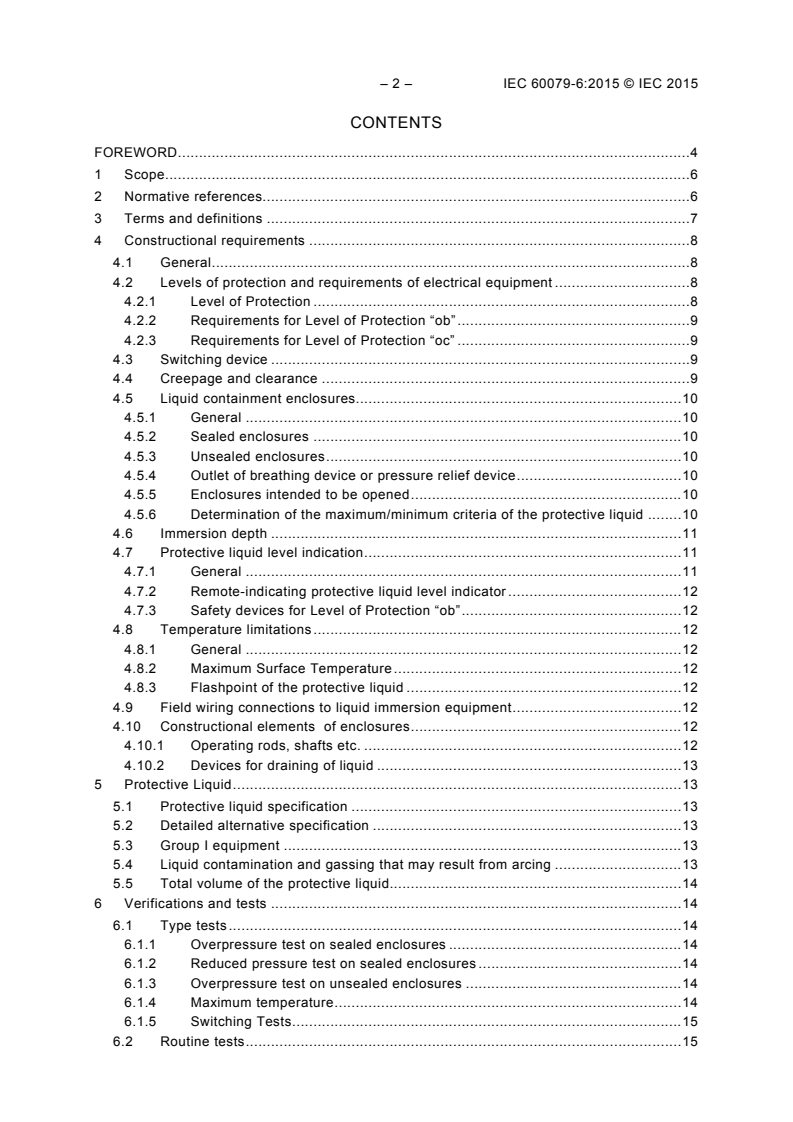
– 2 – IEC 60079-6:2015 © IEC 2015
CONTENTS
FOREWORD . 4
1 Scope . 6
2 Normative references. 6
3 Terms and definitions . 7
4 Constructional requirements . 8
4.1 General . 8
4.2 Levels of protection and requirements of electrical equipment . 8
4.2.1 Level of Protection . 8
4.2.2 Requirements for Level of Protection “ob” . 9
4.2.3 Requirements for Level of Protection “oc” . 9
4.3 Switching device . 9
4.4 Creepage and clearance . 9
4.5 Liquid containment enclosures. 10
4.5.1 General . 10
4.5.2 Sealed enclosures . 10
4.5.3 Unsealed enclosures . 10
4.5.4 Outlet of breathing device or pressure relief device . 10
4.5.5 Enclosures intended to be opened . 10
4.5.6 Determination of the maximum/minimum criteria of the protective liquid . 10
4.6 Immersion depth . 11
4.7 Protective liquid level indication . 11
4.7.1 General . 11
4.7.2 Remote-indicating protective liquid level indicator . 12
4.7.3 Safety devices for Level of Protection “ob” . 12
4.8 Temperature limitations . 12
4.8.1 General . 12
4.8.2 Maximum Surface Temperature . 12
4.8.3 Flashpoint of the protective liquid . 12
4.9 Field wiring connections to liquid immersion equipment . 12
4.10 Constructional elements of enclosures . 12
4.10.1 Operating rods, shafts etc. . 12
4.10.2 Devices for draining of liquid . 13
5 Protective Liquid . 13
5.1 Protective liquid specification . 13
5.2 Detailed alternative specification . 13
5.3 Group I equipment . 13
5.4 Liquid contamination and gassing that may result from arcing . 13
5.5 Total volume of the protective liquid. 14
6 Verifications and tests . 14
6.1 Type tests . 14
6.1.1 Overpressure test on sealed enclosures . 14
6.1.2 Reduced pressure test on sealed enclosures . 14
6.1.3 Overpressure test on unsealed enclosures . 14
6.1.4 Maximum temperature . 14
6.1.5 Switching Tests . 15
6.2 Routine tests . 15
6.2.1 Sealed enclosures . 15
6.2.2 Unsealed enclosures . 15
7 Marking . 15
8 Instructions. 16
Annex A (normative) Selection and erection requirements . 17
Annex B (normative) Maintenance requirements . 18
Annex C (normative) Repair and Overhaul requirements . 19
Bibliography . 20
Table 1 – Working voltage . 9
Table 2 – Depth of immersion . 11
Table B.1 – Inspection requirements . 18
– 4 – IEC 60079-6:2015 © IEC 2015
INTERNATIONAL ELECTROTECHNICAL COMMISSION
____________
EXPLOSIVE ATMOSPHERES –
Part 6: Equipment protection by liquid immersion "o"
FOREWORD
1) The International Electrotechnical Commission (IEC) is a worldwide organization for standardization comprising
all national electrotechnical committees (IEC National Committees). The object of IEC is to promote
international co-operation on all questions concerning standardization in the electrical and electronic fields. To
this end and in addition to other activities, IEC publishes International Standards, Technical Specifications,
Technical Reports, Publicly Available Specifications (PAS) and Guides (hereafter referred to as “IEC
Publication(s)”). Their preparation is entrusted to technical committees; any IEC National Committee interested
in the subject dealt with may participate in this preparatory work. International, governmental and non-
governmental organizations liaising with the IEC also participate in this preparation. IEC collaborates closely
with the International Organization for Standardization (ISO) in accordance with conditions determined by
agreement between the two organizations.
2) The formal decisions or agreements of IEC on technical matters express, as nearly as possible, an international
consensus of opinion on the relevant subjects since each technical committee has representation from all
interested IEC National Committees.
3) IEC Publications have the form of recommendations for international use and are accepted by IEC National
Committees in that sense. While all reasonable efforts are made to ensure that the technical content of IEC
Publications is accurate, IEC cannot be held responsible for the way in which they are used or for any
misinterpretation by any end user.
4) In order to promote international uniformity, IEC National Committees undertake to apply IEC Publications
transparently to the maximum extent possible in their national and regional publications. Any divergence
between any IEC Publication and the corresponding national or regional publication shall be clearly indicated in
the latter.
5) IEC itself does not provide any attestation of conformity. Independent certification bodies provide conformity
assessment services and, in some areas, access to IEC marks of conformity. IEC is not responsible for any
services carried out by independent certification bodies.
6) All users should ensure that they have the latest edition of this publication.
7) No liability shall attach to IEC or its directors, employees, servants or agents including individual experts and
members of its technical committees and IEC National Committees for any personal injury, property damage or
other damage of any nature whatsoever, whether direct or indirect, or for costs (including legal fees) and
expenses arising out of the publication, use of, or reliance upon, this IEC Publication or any other IEC
Publications.
8) Attention is drawn to the Normative references cited in this publication. Use of the referenced publications is
indispensable for the correct application of this publication.
9) Attention is drawn to the possibility that some of the elements of this IEC Publication may be the subject of
patent rights. IEC shall not be held responsible for identifying any or all such patent rights.
International Standard IEC 60079-6 has been prepared by IEC technical committee 31:
Equipment for explosive atmospheres.
This fourth edition cancels and replaces the third edition, published in 2007. This edition
constitutes a technical revision.
The significant changes with respect to the previous edition are listed below:
– Edition 4 represents a major technical revision of the requirements for oil immersion “o”
and should be considered as introducing all new requirements. The normal “Table of
Significant Changes” has not been included for this reason. In particular:
• The requirements for oil immersion “o” have been redefined into liquid immersion ,
levels of protection “ob” and “oc” as recommended by the responses to 31/715/DC
• The ability to protect sparking contacts has been added to both “ob” and “oc”
– Additional requirements have been introduced for the protective liquid.
This part of IEC 60079 is to be used in conjunction with IEC 60079-0, Explosive atmospheres
– Part 0: Equipment – General requirements.
The text of this standard is based on the following documents:
FDIS Report on voting
31/1157/FDIS 31/1172/RVD
Full information on the voting for the approval of this standard can be found in the report on
voting indicated in the above table.
This publication has been drafted in accordance with the ISO/IEC Directives, Part 2.
A list of all parts in the IEC 60079 series, under the general title Explosive atmospheres, can
be found on the IEC website.
The committee has decided that the contents of this publication will remain unchanged until
the stability date indicated on the IEC website under "http://webstore.iec.ch" in the data
related to the specific publication. At this date, the publication will be
• reconfirmed,
• withdrawn,
• replaced by a revised edition, or
• amended.
– 6 – IEC 60079-6:2015 © IEC 2015
EXPLOSIVE ATMOSPHERES –
Part 6: Equipment protection by liquid immersion "o"
1 Scope
This part of IEC 60079 specifies the requirements for the design, construction, testing and
marking of Ex Equipment and Ex Components with type of protection liquid immersion “o”
intended for use in explosive gas atmospheres.
Ex Equipment and Ex Components of type of protection liquid immersion “o” are either:
• Level of Protection “ob” (EPL “Mb” or “Gb”)
• Level of Protection “oc” (EPL “Gc”)
For Level of Protection “ob”, this standard applies where the rated voltage does not exceed
11 kV r.m.s. a.c. or d.c.
For Level of Protection “oc”, this standard applies where the rated voltage does not exceed
15 kV r.m.s. a.c. or d.c.
NOTE Requirements for higher voltages are under consideration.
This standard supplements and modifies the general requirements of IEC 60079-0. Where a
requirement of this standard conflicts with a requirement of IEC 60079-0, the requirement of
this standard takes precedence.
2 Normative references
The following documents, in whole or in part, are normatively referenced in this document and
are indispensable for its application. For dated references, only the edition cited applies. For
undated references, the latest edition of the referenced document (including any
amendments) applies.
IEC 60079-0, Explosive Atmospheres – Part 0: Equipment – General requirements
IEC 60156, Insulating liquids – Determination of the breakdown voltage at power frequency –
Test method
IEC 60247, Insulating liquids – Measurement of relative permittivity, dielectric dissipation
factor (tan δ) and d.c. resistivity
IEC 60296, Fluids for electrotechnical applications – Unused mineral insulating oils for
transformers and switchgear
IEC 60529, Degrees of protection provided by enclosures (IP Code)
IEC 60814, Insulating liquids – Oil impregnated paper and pressboard – Determination of
water by automatic coulometric Karl Fischer titration
IEC 60836, Specifications for unused silicone insulating liquids for electrotechnical purposes
IEC 61099, Insulating liquids – Specifications for unused synthetic organic esters for electrical
purposes
IEC 61125, Unused hydrocarbon based insulating liquids – Test methods for evaluating the
oxidation stability
IEC 62021-1, Insulating liquids – Determination of acidity – Part 1: Automatic potentiometric
titration
IEC 62535, Insulating liquids – Test method for detection of potentially corrosive sulphur in
used and unused insulating oil
ISO 2592, Determination of flash and fire points – Cleveland open cup method
ISO 2719, Determination of flash point – Pensky-Martens closed cup method
ISO 3016, Petroleum oils – Determination of pour point
ISO 3104, Petroleum products – Transparent and opaque liquids – Determination of kinematic
viscosity and calculation of dynamic viscosity
3 Terms and definitions
For the purposes of this document, the terms and definitions given in IEC 60079-0 and the
following apply.
3.1
liquid immersion "o"
type of protection in which the electrical equipment or parts of the electrical equipment are
immersed in a protective liquid in such a way that an explosive gas atmosphere which may be
above the liquid or outside the enclosure cannot be ignited
3.2
protective liquid
liquid which prevents the explosive atmosphere from making direct contact with potential
ignition sources
3.3
sealed equipment
equipment designed and constructed in such a manner as to prevent ingress of an external
atmosphere during the expansion and contraction of the internally contained liquid during
normal operation, for example, by means of an expansion vessel
3.4
non-sealed equipment
equipment designed and constructed in such a manner as to allow the ingress and egress of
an external atmosphere during the expansion and contraction of the internally contained fluid
during normal operation
3.5
maximum permissible protective liquid level
maximum level that the protective liquid can attain in normal service, taking into account the
effects of expansion from the worst-case filling condition specified by the manufacturer to the
condition of full load at maximum ambient temperature for which the equipment is designed
– 8 – IEC 60079-6:2015 © IEC 2015
3.6
minimum permissible protective liquid level
minimum level that the protective liquid can attain in normal service taking into account the
effects of contraction from the worst-case filling condition to the condition of de-energization
at minimum ambient temperature
3.7
disconnector
mechanical switching device which provides, in the open position, an isolating distance in
accordance with specified requirements
Note 1 to entry: A disconnector is capable of opening and closing a circuit when either negligible current is
broken or made, or when no significant change in the voltage across the terminals of each of the poles of the
disconnector occurs. It is also capable of carrying currents under normal circuit conditions and carrying for a
specified time currents under abnormal conditions such as those of short circuit.
[SOURCE: IEC 60050-441:1984, 441-14-05]
3.8
switching device
device designed to make or break the current in one or more electric circuits
[SOURCE: IEC 60050-441:1984, 441-14-01]
3.9
safety device
device intended for use inside or outside explosive atmospheres but required for or
contributing to the safe functioning of equipment and protective systems with respect to the
risks of explosion
3.10
tap selector
device designed to carry, but not to make or break current, used in conjunction with a diverter
switch to select tapping connections
[SOURCE: IEC 60050-421:1990, 421-11-02]
4 Constructional requirements
4.1 General
For Type of Protection “liquid immersion “o”, the Ex Equipment or parts of the Ex Equipment
are immersed in a protective liquid in such a way that an explosive gas atmosphere, which
may be above the liquid or outside the enclosure, cannot be ignited.
The Ex Equipment is constructed to ensure that the necessary amount of protective liquid is
present. Dependent on the intended Equipment Protection Level, this is achieved by
monitoring device(s), indicator(s) or a level control safety device with automatic switch off.
NOTE In accordance with the requirements for all electrical equipment given in IEC 60079-0, it is assumed that
the relevant industrial requirements have been applied. The requirements of the IEC 60079 series of standards
supplement those industrial requirements.
4.2 Levels of protection and requirements of electrical equipment
4.2.1 Level of Protection
Electrical equipment with liquid immersion “o” shall be either:
a) Level of Protection “ob” (EPL Gb or Mb); or
b) Level of Protection “oc” (EPL Gc).
The requirements of this standard shall apply to all levels of protection unless otherwise
stated.
4.2.2 Requirements for Level of Protection “ob”
Electrical circuits and components, when liquid immersed in accordance with this standard,
are considered to be not ignition capable in normal operation and during expected
malfunctions, and shall be assigned a Level of Protection “ob” (EPL Gb or Mb).
A liquid level indication according to 4.7 is required.
Switching devices protected by liquid immersion level of protection “ob” shall comply with the
following additional requirements:
a) When a sealed enclosure is employed, the enclosure shall comply with the overpressure
test in 6.1.1 using four times the prescribed pressure.
b) Electrical equipment containing switching devices operated in the protective liquid, rated
at 2 kVA per contact or less, are permitted without further test. Where the switching
device is rated above 2 kVA per contact, neither pressure increases nor excessive
decomposition products shall invalidate the type of protection as demonstrated by tests in
accordance with 6.1.5.
c) The equipment shall be suitable for a prospective short circuit current of 32 kA unless
marked with a lower value.
Disconnectors and manual tap selectors, above 1 000 V, shall be lockable and provided with
a warning according to 7 i). In addition, information on their use shall be included in the
instructions.
4.2.3 Requirements for Level of Protection “oc”
Electrical circuits and components, when liquid immersed in accordance with this standard,
are considered to be not ignition capable in normal operation or in the case of regular
expected occurrences, and shall be assigned a Level of Protection “oc” (EPL Gc).
Ex Equipment containing switching devices operated in the protective liquid, rated at 10 kVA
per contact or less, are permitted without further test. For switching devices rated above
10 kVA per contact, neither pressure increases nor excessive decomposition products shall
invalidate the type of protection as demonstrated by tests in accordance with 6.1.5.
4.3 Switching device
Switching devices are only permitted for a.c. circuits where the working voltage of the switch
does not exceed the values given in Table 1. Switching devices for d.c. circuits are not
permitted.
Table 1 – Working voltage
Level of Protection “ob” “oc”
Working voltage of switching device 1 000 V r.m.s. a.c. 6,6 kV r.m.s. a.c.
4.4 Creepage and clearance
Electrical circuits and components intended to be immersed in the protective liquid shall meet
the relevant industrial requirements for creepage and clearance distances in air before being
immersed in the protective liquid. If the relevant industrial standard gives options for pollution
degree, pollution degree 2 shall be assumed.
– 10 – IEC 60079-6:2015 © IEC 2015
4.5 Liquid containment enclosures
4.5.1 General
The chemical resistance against the protective liquid shall be documented by the
manufacturer.
NOTE It is not a requirement of this standard that conformity to the chemical resistance against the protective
liquid be verified.
The enclosures shall be subjected to the type tests as specified in Clause 6 for sealed and
unsealed enclosures respectively.
Connection bushings provided for termination of the electrical conductors shall be considered
as part of the enclosure and subject to the requirements of this clause.
4.5.2 Sealed enclosures
Covers of sealed enclosures may be continuously welded to the enclosure, or sealed by
means of a gasket, in which case, the cover shall be provided with special fasteners
according to IEC 60079-0.
Equipment with a sealed enclosure shall be provided with a pressure-relief device. This
device shall be permanently set by the manufacturer of the liquid-filled equipment to operate
at a pressure of at least 10 kPa. Enclosures permanently sealed at the time of manufacture
shall not be capable of being opened without leaving visible evidence that the enclosure has
been opened. The enclosure shall be marked in accordance with 7 c).
NOTE Suitable techniques that can provide visible evidence of being opened are, for example, welding, soldering,
cemented joints, rivets, cementing of screws, or lead-seal safety-wiring of screws.
4.5.3 Unsealed enclosures
An enclosure, which is not sealed, shall be constructed so that gas or vapour that may evolve
from the protective liquid in normal service can escape through a breathing device which
includes a suitable drying agent. The manufacturer shall specify the maintenance
requirements for the drying agent.
4.5.4 Outlet of breathing device or pressure relief device
The outlet of the breathing device for unsealed equipment and the outlet of the pressure relief
device for sealed equipment shall face down and have a degree of protection of at least IP66
as given in IEC 60529.
4.5.5 Enclosures intended to be opened
Enclosure that are designed to be opened shall incorporate sealing methods that are capable
of being renewed without damage to the enclosure when the equipment is repaired, refilled
and resealed. The enclosure shall be marked in accordance with 7 d).
4.5.6 Determination of the maximum/minimum criteria of the protective liquid
The following criteria shall be specified:
a) the maximum and minimum level of the protective liquid;
b) the maximum working angle, from the horizontal, of the equipment;
4.6 Immersion depth
Live parts of the electrical equipment shall be immersed to a depth according to Table 2
within the protective liquid, at the minimum possible liquid level no matter the orientation of
the internal equipment.
Table 2 – Depth of immersion
Voltage Distance
a
(See )
No switching device With a switching device
U a.c. or d.c.
.
r.m.s
(a.c. only)
V
3 mm 10 mm
≤ 50 V
≤ 250 V 5 mm 15 mm
10 mm 20 mm
≤ 1 000 V
25 mm 50 mm
≤ 6 000 V
≤ 10 000 V 25 mm –
≤ 13 640 V 50 mm –
a
When determining the required values for depth of immersion, the working voltage may be higher than the
voltage in the table by a factor of 1,1 (see Note).
NOTE The factor of 1,1 recognizes that at many places in a circuit, the working voltage equals the rated
voltage and that there are a number of rated voltages in common use that can be accommodated by the 1,1
factor.
4.7 Protective liquid level indication
4.7.1 General
Protective liquid level indicating device(s) complying with the following requirements shall be
provided so that the liquid level of each separate liquid-filled compartment can be easily
checked in service.
The maximum and the minimum protective liquid levels permissible in normal service shall be
marked in accordance with 7 e), taking into account the effects of expansion and contraction
resulting from operational temperature changes over the full ambient temperature range
specified by the manufacturer.
The protective liquid level indicating device shall be marked in accordance with 7 f) to indicate
the levels to which the electrical equipment shall be filled under the filling temperature
conditions specified by the manufacturer. Alternatively, an adjacent label shall be provided
which fully specifies the filling conditions.
The location of the protective liquid level indicating device shall be such that the minimum
possible indicated level of the protective liquid cannot be beneath the level necessary to
comply with 4.6, taking into account the effects of expansion and contraction resulting from
operational temperature changes over the full ambient temperature range specified by the
manufacturer.
The manufacturer shall prepare documentation to show that transparent parts will retain their
mechanical and optical properties when in contact with the protective liquid.
For non-sealed equipment, a dipstick may be used provided that, in normal operation, the
dipstick is secured in its measurement position and that the requirements of 4.5.1 with regard
to ingress protection are maintained. An adjacent warning marking shall be provided in
accordance with 7 g).
– 12 – IEC 60079-6:2015 © IEC 2015
4.7.2 Remote-indicating protective liquid level indicator
If a remote-indicating protective liquid level indicator is provided, the switching element shall
be lower than the sensing element by at least the dimension shown in Table 2, or it shall be
protected by one of the types of protection suitable for the application. If the manufacturer
does not provide the remote-indicating liquid level indicator, the certificate number shall
include the "X" suffix in accordance with IEC 60079-0 and the Specific Condition of Use shall
specify all necessary information required by the user to ensure conformity with the
requirements of this standard.
4.7.3 Safety devices for Level of Protection “ob”
For Level of Protection “ob” with switching devices, a protective liquid level safety device shall
monitor the level of the protective liquid and provide for automatic disconnection of power
upon reduction of oil below the permitted minimum. The switching element of the safety
device shall be lower than the sensing element of the safety device by at least the dimension
shown in Table 2, or shall be protected by one of the types of protection suitable for the
application If the manufacturer does not provide the safety devices, the certificate number
shall include the "X" suffix in accordance with IEC 60079-0 and the Specific Condition of Use
shall specify all necessary information required by the user to ensure conformity with the
requirements of this standard.
NOTE Safety devices for these applications normally have a fault tolerance of 0 and a safety integrity level SIL 1.
Requirements for such safety devices are currently given in EN 50495. A project has been initiated to consider the
development of an IEC standard based on EN 50495 which would provide requirements for these safety devices.
4.8 Temperature limitations
4.8.1 General
The maximum permissible temperature for equipment or parts of equipment shall be equal to
the lower of the two temperatures determined by 4.8.2 or 4.8.3
4.8.2 Maximum Surface Temperature
The temperature at the free surface of the protective liquid or at any point on the surface of
the electrical equipment to which an explosive gas atmosphere has access shall not exceed
the limit for the assigned temperature class or assigned maximum surface temperature. In no
case shall the limit exceed 200 °C.
4.8.3 Flashpoint of the protective liquid
The stated minimum flash-point (closed cup) for the protective liquid used shall be at least
25 K greater than the temperature at the free surface of the protective liquid and the
temperature of the internal components immersed in the liquid.
4.9 Field wiring connections to liquid immersion equipment
Liquid immersion is not an accepted type of protection for field wiring connections. Bushings
shall be used for connections through the wall of the equipment. Direct entry is not permitted.
The field wiring connections shall be protected with a type of protection suitable for the
application.
4.10 Constructional elements of enclosures
4.10.1 Operating rods, shafts etc.
If the enclosure contains operating rods, shafts etc. it shall comply with the tests of 6.1.1 and
6.1.2 if a sealed enclosure and 6.1.3 if an unsealed enclosure. The tests shall be carried out
with such elements in place. Operating rods or shafts used in a sealed enclosure shall be
subject to a conditioning of 500 operations prior to the tests of 6.1.1 and 6.1.2
4.10.2 Devices for draining of liquid
Devices for draining the liquid shall be secured against inadvertent removal.
5 Protective Liquid
5.1 Protective liquid specification
The protective liquid shall be a mineral oil conforming to IEC 60296, a silicone liquid
conforming to IEC 60836, a synthetic organic ester liquid (Type T1) conforming to IEC 61099,
or shall be a liquid conforming to the requirements of 5.2.
NOTE The future use of natural ester liquids per IEC 62770 is under consideration.
5.2 Detailed alternative specification
The specification for the alternative protective liquid shall include the following:
a) the protective liquid shall have a fire point of not less than 300 °C determined by the test
method indicated in ISO 2592;
b) the protective liquid flash-point (closed cup) determined in accordance with ISO 2719 shall
be not less than 25 K above the free surface temperature of the protective liquid (See
4.8.3);
c) the protective liquid shall have a kinematic viscosity of not more than 100 cSt at 25 °C
determined in accordance with ISO 3104;
d) the protective liquid shall have an electrical breakdown strength of not less than 30 kV
determined in accordance with IEC 60156;
e) the protective liquid shall have a volume resistivity at 25 °C of not less than
1 × 10 Ω × m determined in accordance with IEC 60247;
f) the pour point, determined in accordance with ISO 3016, shall be no higher than the lower
of -30 °C or 10 K less than the minimum ambient temperature of the equipment;
g) the acidity (neutralization value) shall be not more than 0,03 mg KOH/g determined in
accordance with IEC 62021-1;
h) the protective liquid shall have no adverse effect on the properties of materials with which
it is in contact;
i) the oxidation stability shall not exceed 0,15 % sludge according to IEC 61125;
j) the sulphur content shall be confirmed as non-corrosive according to IEC 62535; and
k) the water content shall not exceed 35 ppm according to IEC 60814.
NOTE It is not a requirement of this standard that conformity to the specification of the protective liquid be
verified.
5.3 Group I equipment
For Group I equipment, mineral oils are not acceptable.
5.4 Liquid contamination and gassing that may result from arcing
Where switching devices are incorporated in the electrical equipment and may give rise to
contamination of the protective liquid, suitable maintenance instructions shall be prepared. As
a minimum these will include instructions for the cleaning/filtering/replacement of the
protective liquid following a given number of normal switching operations and following
interruption of fault currents.
– 14 – IEC 60079-6:2015 © IEC 2015
5.5 Total volume of the protective liquid
The documentation prepared in accordance with IEC 60079-0 shall specify the total volume of
the protective liquid, including the maximum and minimum volumes to maintain the levels
required as given in 4.6.
6 Verifications and tests
6.1 Type tests
6.1.1 Overpressure test on sealed enclosures
For Level of Protection “ob” with a switching device switching more than 2 kVA per contact, a
pressure equal to 4 times the pressure relief device setting, and for all other enclosures, a
pressure equal to 1,5 times the pressure relief device setting shall be applied internally. In no
case shall the test pressure be less than 150 kPa. The period of application of the pressure
shall be at least 60 s. The pressure relief device entry shall be sealed for the duration of the
test.
The test shall be considered satisfactory if, at the end of the test, the enclosure has suffered
neither damage nor permanent distortion which adversely affects its ability to comply with 4.6.
NOTE A non-compressible hydraulic media is normally used for these tests. If a compressible media such as air
or inert gas is used, failure of the enclosure can result in personal injury or property damage.
6.1.2 Reduced pressure test on sealed enclosures
The internal pressure of the enclosure without protective liquid shall be reduced by an amount
equivalent to not less than the pressure that would result from a change in the protective
liquid level from the maximum permissible level to the minimum permissible level when
appropriately corrected for any ambient temperature variations specified in the
documentation.
At the end of 24 h, any increase in pressure shall not exceed 5 %.
6.1.3 Overpressure test on unsealed enclosures
A pressure equal to 150 kPa, with the breather sealed, shall be applied internally. The period
of application shall be at least 60 s.
The test shall be considered satisfactory if, at the end of the test, the enclosure has suffered
neither damage nor permanent distortion that adversely affects its ability to comply with 4.5.3
and 4.5.5.
NOTE A non-compressible hydraulic media is normally used for these tests. If a compressible media such as air
or inert gas is used, failure of the enclosure can result in personal injury or property damage.
6.1.4 Maximum temperature
A sample of “o” equipment shall be subjected to a type test to ensure that the temperature
limits specified in 4.8 are not exceeded.
For “o” equipment without an external load, the test shall be carried out in accordance with
the temperature measurements of IEC 60079-0.
For “o” equipment with an external load, the test shall be carried out for Level of Protection
“ob” by adjusting the current to 110 % of the rated current and for Level of Protection “oc” at
100 % of the rated current in normal operation and at the maximum rated duty cycle.
NOTE Equipment with characteristics such as non-linear external loads, input power control or difficult to define
failure modes introduces challenges into the determination of maximum temperatures under malfunction conditions.
6.1.5 Switching Tests
The electrical switching tests given in the relevant IEC industrial standards shall be carried
out with the equipment in its design configuration. The protective liquid shall be at minimum
level. At the conclusion of the tests:
a) there shall be no release of the protective liquid nor shall the required creepage and
clearance distances be compromised; and
b) the protective liquid shall have an electrical breakdown strength of not less than 30 kV
determined in accordance with IEC 60156.
6.2 Routine tests
6.2.1 Sealed enclosures
Each sealed enclosure shall be subjected to both the following tests in sequence:
a) the overpressure test described in 6.1.1. This routine test may be omitted for other than
welded enclosures, if during type testing, the equipment complies with the acceptance
criteria in 6.1.1 using four times the pressure relief device setting;
NOTE A non-compressible hydraulic media is normal
...
IEC 60079-6 ®
Edition 4.1 2020-02
CONSOLIDATED VERSION
INTERNATIONAL
STANDARD
NORME
INTERNATIONALE
colour
inside
Explosive atmospheres –
Part 6: Equipment protection by liquid immersion "o"
Atmosphères explosives –
Partie 6: Protection du matériel par immersion dans le liquide "o"
All rights reserved. Unless otherwise specified, no part of this publication may be reproduced or utilized in any form
or by any means, electronic or mechanical, including photocopying and microfilm, without permission in writing from
either IEC or IEC's member National Committee in the country of the requester. If you have any questions about IEC
copyright or have an enquiry about obtaining additional rights to this publication, please contact the address below or
your local IEC member National Committee for further information.
Droits de reproduction réservés. Sauf indication contraire, aucune partie de cette publication ne peut être reproduite
ni utilisée sous quelque forme que ce soit et par aucun procédé, électronique ou mécanique, y compris la photocopie
et les microfilms, sans l'accord écrit de l'IEC ou du Comité national de l'IEC du pays du demandeur. Si vous avez des
questions sur le copyright de l'IEC ou si vous désirez obtenir des droits supplémentaires sur cette publication, utilisez
les coordonnées ci-après ou contactez le Comité national de l'IEC de votre pays de résidence.
IEC Central Office Tel.: +41 22 919 02 11
3, rue de Varembé info@iec.ch
CH-1211 Geneva 20 www.iec.ch
Switzerland
About the IEC
The International Electrotechnical Commission (IEC) is the leading global organization that prepares and publishes
International Standards for all electrical, electronic and related technologies.
About IEC publications
The technical content of IEC publications is kept under constant review by the IEC. Please make sure that you have the
latest edition, a corrigendum or an amendment might have been published.
IEC publications search - webstore.iec.ch/advsearchform Electropedia - www.electropedia.org
The advanced search enables to find IEC publications by a The world's leading online dictionary on electrotechnology,
variety of criteria (reference number, text, technical containing more than 22 000 terminological entries in English
committee,…). It also gives information on projects, replaced and French, with equivalent terms in 16 additional languages.
and withdrawn publications. Also known as the International Electrotechnical Vocabulary
(IEV) online.
IEC Just Published - webstore.iec.ch/justpublished
Stay up to date on all new IEC publications. Just Published IEC Glossary - std.iec.ch/glossary
details all new publications released. Available online and 67 000 electrotechnical terminology entries in English and
once a month by email. French extracted from the Terms and definitions clause of
IEC publications issued between 2002 and 2015. Some
IEC Customer Service Centre - webstore.iec.ch/csc entries have been collected from earlier publications of IEC
If you wish to give us your feedback on this publication or TC 37, 77, 86 and CISPR.
need further assistance, please contact the Customer Service
Centre: sales@iec.ch.
A propos de l'IEC
La Commission Electrotechnique Internationale (IEC) est la première organisation mondiale qui élabore et publie des
Normes internationales pour tout ce qui a trait à l'électricité, à l'électronique et aux technologies apparentées.
A propos des publications IEC
Le contenu technique des publications IEC est constamment revu. Veuillez vous assurer que vous possédez l’édition la
plus récente, un corrigendum ou amendement peut avoir été publié.
Recherche de publications IEC - Electropedia - www.electropedia.org
webstore.iec.ch/advsearchform Le premier dictionnaire d'électrotechnologie en ligne au
La recherche avancée permet de trouver des publications IEC monde, avec plus de 22 000 articles terminologiques en
en utilisant différents critères (numéro de référence, texte, anglais et en français, ainsi que les termes équivalents dans
comité d’études,…). Elle donne aussi des informations sur les 16 langues additionnelles. Egalement appelé Vocabulaire
projets et les publications remplacées ou retirées. Electrotechnique International (IEV) en ligne.
IEC Just Published - webstore.iec.ch/justpublished Glossaire IEC - std.iec.ch/glossary
Restez informé sur les nouvelles publications IEC. Just 67 000 entrées terminologiques électrotechniques, en anglais
Published détaille les nouvelles publications parues. et en français, extraites des articles Termes et définitions des
Disponible en ligne et une fois par mois par email. publications IEC parues entre 2002 et 2015. Plus certaines
entrées antérieures extraites des publications des CE 37, 77,
Service Clients - webstore.iec.ch/csc 86 et CISPR de l'IEC.
Si vous désirez nous donner des commentaires sur cette
publication ou si vous avez des questions contactez-nous:
sales@iec.ch.
IEC 60079-6 ®
Edition 4.1 2020-02
CONSOLIDATED VERSION
INTERNATIONAL
STANDARD
NORME
INTERNATIONALE
colour
inside
Explosive atmospheres –
Part 6: Equipment protection by liquid immersion "o"
Atmosphères explosives –
Partie 6: Protection du matériel par immersion dans le liquide "o"
INTERNATIONAL
ELECTROTECHNICAL
COMMISSION
COMMISSION
ELECTROTECHNIQUE
INTERNATIONALE
ICS 29.260.20 ISBN 978-2-8322-7920-5
IEC 60079-6 ®
Edition 4.1 2020-02
CONSOLIDATED VERSION
REDLINE VERSION
VERSION REDLINE
colour
inside
Explosive atmospheres –
Part 6: Equipment protection by liquid immersion "o"
Atmosphères explosives –
Partie 6: Protection du matériel par immersion dans le liquide "o"
– 2 – IEC 60079-6:2015+AMD1:2020 CSV
© IEC 2020
CONTENTS
FOREWORD . 4
1 Scope . 6
2 Normative references . 6
3 Terms and definitions . 7
4 Constructional requirements . 9
4.1 General . 9
4.2 Levels of protection and requirements of electrical equipment. 9
4.2.1 Level of Protection . 9
4.2.2 Requirements for Level of Protection “ob” . 9
4.2.3 Requirements for Level of Protection “oc” . 10
4.3 Switching device . 10
4.4 Creepage and clearance . 10
4.5 Liquid containment enclosures . 10
4.5.1 General . 10
4.5.2 Sealed enclosures . 10
4.5.3 Unsealed enclosures . 11
4.5.4 Outlet of breathing device or pressure relief device . 11
4.5.5 Enclosures intended to be opened . 11
4.5.6 Determination of the maximum/minimum criteria of the protective liquid. 11
4.6 Immersion depth . 11
4.7 Protective liquid level indication . 12
4.7.1 General . 12
4.7.2 Remote-indicating protective liquid level indicator . 12
4.7.3 Safety devices for Level of Protection “ob” . 13
4.8 Temperature limitations . 13
4.8.1 General . 13
4.8.2 Maximum Surface Temperature . 13
4.8.3 Flashpoint of the protective liquid . 13
4.9 Field wiring connections to liquid immersion equipment . 13
4.10 Constructional elements of enclosures . 13
4.10.1 Operating rods, shafts etc. . 13
4.10.2 Devices for draining of liquid. 13
5 Protective Liquid . 14
5.1 Protective liquid specification . 14
5.2 Detailed alternative specification . 14
5.3 Group I equipment . 14
5.4 Liquid contamination and gassing that may result from arcing . 14
5.5 Total volume of the protective liquid . 14
6 Verifications and tests . 15
6.1 Type tests . 15
6.1.1 Overpressure test on sealed enclosures . 15
6.1.2 Reduced pressure test on sealed enclosures . 15
6.1.3 Overpressure test on unsealed enclosures . 15
6.1.4 Maximum temperature . 15
6.1.5 Switching Tests . 15
6.2 Routine tests. 16
© IEC 2020
6.2.1 Sealed enclosures . 16
6.2.2 Unsealed enclosures . 16
7 Marking . 16
8 Instructions . 17
Annex A (normative) Selection and erection requirements . 18
Annex B (normative) Maintenance requirements . 19
Annex C (normative) Repair and Overhaul requirements . 20
Annex D (normative) Supplementary requirements for electrical equipment with Level
of Protection "oc" for voltages greater than 15 kV and up to and including 245 kV . 21
Bibliography . 24
Table 1 – Working voltage . 10
Table 2 – Depth of immersion . 12
Table B.1 – Inspection requirements . 19
– 4 – IEC 60079-6:2015+AMD1:2020 CSV
© IEC 2020
INTERNATIONAL ELECTROTECHNICAL COMMISSION
____________
EXPLOSIVE ATMOSPHERES –
Part 6: Equipment protection by liquid immersion "o"
FOREWORD
1) The International Electrotechnical Commission (IEC) is a worldwide organization for standardization comprising
all national electrotechnical committees (IEC National Committees). The object of IEC is to promote
international co-operation on all questions concerning standardization in the electrical and electronic fields. To
this end and in addition to other activities, IEC publishes International Standards, Technical Specifications,
Technical Reports, Publicly Available Specifications (PAS) and Guides (hereafter referred to as “IEC
Publication(s)”). Their preparation is entrusted to technical committees; any IEC National Committee interested
in the subject dealt with may participate in this preparatory work. International, governmental and non-
governmental organizations liaising with the IEC also participate in this preparation. IEC collaborates closely
with the International Organization for Standardization (ISO) in accordance with conditions determined by
agreement between the two organizations.
2) The formal decisions or agreements of IEC on technical matters express, as nearly as possible, an international
consensus of opinion on the relevant subjects since each technical committee has representation from all
interested IEC National Committees.
3) IEC Publications have the form of recommendations for international use and are accepted by IEC National
Committees in that sense. While all reasonable efforts are made to ensure that the technical content of IEC
Publications is accurate, IEC cannot be held responsible for the way in which they are used or for any
misinterpretation by any end user.
4) In order to promote international uniformity, IEC National Committees undertake to apply IEC Publications
transparently to the maximum extent possible in their national and regional publications. Any divergence
between any IEC Publication and the corresponding national or regional publication shall be clearly indicated in
the latter.
5) IEC itself does not provide any attestation of conformity. Independent certification bodies provide conformity
assessment services and, in some areas, access to IEC marks of conformity. IEC is not responsible for any
services carried out by independent certification bodies.
6) All users should ensure that they have the latest edition of this publication.
7) No liability shall attach to IEC or its directors, employees, servants or agents including individual experts and
members of its technical committees and IEC National Committees for any personal injury, property damage or
other damage of any nature whatsoever, whether direct or indirect, or for costs (including legal fees) and
expenses arising out of the publication, use of, or reliance upon, this IEC Publication or any other IEC
Publications.
8) Attention is drawn to the Normative references cited in this publication. Use of the referenced publications is
indispensable for the correct application of this publication.
9) Attention is drawn to the possibility that some of the elements of this IEC Publication may be the subject of
patent rights. IEC shall not be held responsible for identifying any or all such patent rights.
This consolidated version of the official IEC Standard and its amendment(s) has been
prepared for user convenience.
IEC 60079-6 edition 4.1 contains the fourth edition (2015-02) [documents 31/1157/FDIS
and 31/1172/RVD] and its amendment 1 (2020-02) [documents 31/1517/FDIS and
31/1526/RVD].
In this Redline version, a vertical line in the margin shows where the technical content
is modified by amendment 1. Additions are in green text, deletions are in strikethrough
red text. A separate Final version with all changes accepted is available in
this publication.
© IEC 2020
International Standard IEC 60079-6 has been prepared by IEC technical committee 31:
Equipment for explosive atmospheres.
This fourth edition constitutes a technical revision.
The significant changes with respect to the previous edition are listed below:
– Edition 4 represents a major technical revision of the requirements for oil immersion “o”
and should be considered as introducing all new requirements. The normal “Table of
Significant Changes” has not been included for this reason. In particular:
• The requirements for oil immersion “o” have been redefined into liquid immersion ,
levels of protection “ob” and “oc” as recommended by the responses to 31/715/DC
• The ability to protect sparking contacts has been added to both “ob” and “oc”
– Additional requirements have been introduced for the protective liquid.
This part of IEC 60079 is to be used in conjunction with IEC 60079-0, Explosive atmospheres
– Part 0: Equipment – General requirements.
This publication has been drafted in accordance with the ISO/IEC Directives, Part 2.
A list of all parts in the IEC 60079 series, under the general title Explosive atmospheres, can
be found on the IEC website.
The committee has decided that the contents of the base publication and its amendment will
remain unchanged until the stability date indicated on the IEC web site under
"http://webstore.iec.ch" in the data related to the specific publication. At this date, the
publication will be
• reconfirmed,
• withdrawn,
• replaced by a revised edition, or
• amended.
IMPORTANT – The 'colour inside' logo on the cover page of this publication indicates
that it contains colours which are considered to be useful for the correct
understanding of its contents. Users should therefore print this document using a
colour printer.
– 6 – IEC 60079-6:2015+AMD1:2020 CSV
© IEC 2020
EXPLOSIVE ATMOSPHERES –
Part 6: Equipment protection by liquid immersion "o"
1 Scope
This part of IEC 60079 specifies the requirements for the design, construction, testing and
marking of Ex Equipment and Ex Components with type of protection liquid immersion “o”
intended for use in explosive gas atmospheres.
Ex Equipment and Ex Components of type of protection liquid immersion “o” are either:
• Level of Protection “ob” (EPL “Mb” or “Gb”)
• Level of Protection “oc” (EPL “Gc”)
For Level of Protection “ob”, this standard applies where the rated voltage does not exceed
11 kV r.m.s. a.c. or d.c.
For Level of Protection “oc”, this standard applies where the rated voltage does not exceed
15 kV r.m.s. a.c. or d.c.
Additionally, for Level of Protection "oc", Annex D applies where the rated voltage exceeds
15 kV AC RMS or DC and up to 245 kV AC RMS or DC.
Annex D applies specifically to liquid immersed transformers and reactors, and other liquid
immersed equipment such as swivels for off-shore platforms, power regulators, tap changers
and earthing/switching resistors.
NOTE Requirements for higher voltages are under consideration.
This standard supplements and modifies the general requirements of IEC 60079-0. Where a
requirement of this standard conflicts with a requirement of IEC 60079-0, the requirement of
this standard takes precedence.
2 Normative references
The following documents, in whole or in part, are normatively referenced in this document and
are indispensable for its application. For dated references, only the edition cited applies. For
undated references, the latest edition of the referenced document (including any
amendments) applies.
IEC 60071 (all parts), Insulation co-ordination
IEC 60076-3, Power transformers – Part 3: Insulation levels, dielectric tests and external
clearances in air
IEC 60079-0, Explosive Atmospheres – Part 0: Equipment – General requirements
IEC 60079-1, Explosive atmospheres – Part 1: Equipment protection by flameproof enclosures
"d"
IEC 60079-2, Explosive atmospheres – Part 2: Equipment protection by pressurized enclosure
"p"
© IEC 2020
IEC 60079-33, Explosive atmospheres – Part 33: Equipment protection by special protection
's'
IEC 60137, Insulated bushings for alternating voltages above 1000 V
IEC 60156, Insulating liquids – Determination of the breakdown voltage at power frequency –
Test method
IEC 60247, Insulating liquids – Measurement of relative permittivity, dielectric dissipation
factor (tan δ) and d.c. resistivity
IEC 60296, Fluids for electrotechnical applications – Unused mineral insulating oils for
transformers and switchgear
IEC 60529, Degrees of protection provided by enclosures (IP Code)
IEC 60814, Insulating liquids – Oil impregnated paper and pressboard – Determination of
water by automatic coulometric Karl Fischer titration
IEC 60836, Specifications for unused silicone insulating liquids for electrotechnical purposes
IEC 61099, Insulating liquids – Specifications for unused synthetic organic esters for electrical
purposes
IEC 61125, Unused hydrocarbon based insulating liquids – Test methods for evaluating the
oxidation stability
IEC 62021-1, Insulating liquids – Determination of acidity – Part 1: Automatic potentiometric
titration
IEC 62535, Insulating liquids – Test method for detection of potentially corrosive sulphur in
used and unused insulating oil
IEC 62770, Fluids for electrotechnical applications – Unused natural esters for transformers
and similar electrical equipment
ISO 2592, Determination of flash and fire points – Cleveland open cup method
ISO 2719, Determination of flash point – Pensky-Martens closed cup method
ISO 3016, Petroleum oils – Determination of pour point
ISO 3104, Petroleum products – Transparent and opaque liquids – Determination of kinematic
viscosity and calculation of dynamic viscosity
3 Terms and definitions
For the purposes of this document, the terms and definitions given in IEC 60079-0 and the
following apply.
3.1
liquid immersion "o"
type of protection in which the electrical equipment or parts of the electrical equipment are
immersed in a protective liquid in such a way that an explosive gas atmosphere which may be
above the liquid or outside the enclosure cannot be ignited
– 8 – IEC 60079-6:2015+AMD1:2020 CSV
© IEC 2020
3.2
protective liquid
liquid which prevents the explosive atmosphere from making direct contact with potential
ignition sources
3.3
sealed equipment
equipment designed and constructed in such a manner as to prevent ingress of an external
atmosphere during the expansion and contraction of the internally contained liquid during
normal operation, for example, by means of an expansion vessel
3.4
non-sealed equipment
equipment designed and constructed in such a manner as to allow the ingress and egress of
an external atmosphere during the expansion and contraction of the internally contained fluid
during normal operation
3.5
maximum permissible protective liquid level
maximum level that the protective liquid can attain in normal service, taking into account the
effects of expansion from the worst-case filling condition specified by the manufacturer to the
condition of full load at maximum ambient temperature for which the equipment is designed
3.6
minimum permissible protective liquid level
minimum level that the protective liquid can attain in normal service taking into account the
effects of contraction from the worst-case filling condition to the condition of de-energization
at minimum ambient temperature
3.7
disconnector
mechanical switching device which provides, in the open position, an isolating distance in
accordance with specified requirements
Note 1 to entry: A disconnector is capable of opening and closing a circuit when either negligible current is
broken or made, or when no significant change in the voltage across the terminals of each of the poles of the
disconnector occurs. It is also capable of carrying currents under normal circuit conditions and carrying for a
specified time currents under abnormal conditions such as those of short circuit.
[SOURCE: IEC 60050-441:1984, 441-14-05]
3.8
switching device
device designed to make or break the current in one or more electric circuits
[SOURCE: IEC 60050-441:1984, 441-14-01]
3.9
safety device
device intended for use inside or outside explosive atmospheres but required for or
contributing to the safe functioning of equipment and protective systems with respect to the
risks of explosion
3.10
tap selector
device designed to carry, but not to make or break current, used in conjunction with a diverter
switch to select tapping connections
[SOURCE: IEC 60050-421:1990, 421-11-02]
© IEC 2020
3.11
oil-immersed swivel for HV connections
oil filled equipment to transfer power with coupling between two parts enabling one to revolve
and the other to remain stationary (fixed)
3.12
oil-immersed earthing resistor
equipment intended for system neutral earthing
3.13
oil-immersed switching resistor
equipment intended for inrush current limitation
4 Constructional requirements
4.1 General
For Type of Protection “liquid immersion “o”, the Ex Equipment or parts of the Ex Equipment
are immersed in a protective liquid in such a way that an explosive gas atmosphere, which
may be above the liquid or outside the enclosure, cannot be ignited.
The Ex Equipment is constructed to ensure that the necessary amount of protective liquid is
present. Dependent on the intended Equipment Protection Level, this is achieved by
monitoring device(s), indicator(s) or a level control safety device with automatic switch off.
NOTE In accordance with the requirements for all electrical equipment given in IEC 60079-0, it is assumed that
the relevant industrial requirements have been applied. The requirements of the IEC 60079 series of standards
supplement those industrial requirements.
4.2 Levels of protection and requirements of electrical equipment
4.2.1 Level of Protection
Electrical equipment with liquid immersion “o” shall be either:
a) Level of Protection “ob” (EPL Gb or Mb); or
b) Level of Protection “oc” (EPL Gc).
The requirements of this standard shall apply to all levels of protection unless otherwise
stated.
4.2.2 Requirements for Level of Protection “ob”
Electrical circuits and components, when liquid immersed in accordance with this standard,
are considered to be not ignition capable in normal operation and during expected
malfunctions, and shall be assigned a Level of Protection “ob” (EPL Gb or Mb).
A liquid level indication according to 4.7 is required.
Switching devices protected by liquid immersion level of protection “ob” shall comply with the
following additional requirements:
a) When a sealed enclosure is employed, the enclosure shall comply with the overpressure
test in 6.1.1 using four times the prescribed pressure.
b) Electrical equipment containing switching devices operated in the protective liquid, rated
at 2 kVA per contact or less, are permitted without further test. Where the switching
device is rated above 2 kVA per contact, neither pressure increases nor excessive
decomposition products shall invalidate the type of protection as demonstrated by tests in
accordance with 6.1.5.
– 10 – IEC 60079-6:2015+AMD1:2020 CSV
© IEC 2020
c) The equipment shall be suitable for a prospective short circuit current of 32 kA unless
marked with a lower value.
Disconnectors and manual tap selectors, above 1 000 V, shall be lockable and provided with
a warning according to 7 i). In addition, information on their use shall be included in the
instructions.
4.2.3 Requirements for Level of Protection “oc”
Electrical circuits and components, when liquid immersed in accordance with this standard,
are considered to be not ignition capable in normal operation or in the case of regular
expected occurrences, and shall be assigned a Level of Protection “oc” (EPL Gc).
Ex Equipment containing switching devices operated in the protective liquid, rated at 10 kVA
per contact or less, are permitted without further test. For switching devices rated above
10 kVA per contact, neither pressure increases nor excessive decomposition products shall
invalidate the type of protection as demonstrated by tests in accordance with 6.1.5.
4.3 Switching device
Switching devices are only permitted for a.c. circuits where the working voltage of the switch
does not exceed the values given in Table 1. Switching devices for d.c. circuits are not
permitted.
Table 1 – Working voltage
Level of Protection “ob” “oc”
Working voltage of switching device 1 000 V r.m.s. a.c. 6,6 kV r.m.s. a.c.
4.4 Creepage and clearance
Electrical circuits and components intended to be immersed in the protective liquid shall meet
the relevant industrial requirements for creepage and clearance distances in air before being
immersed in the protective liquid. If the relevant industrial standard gives options for pollution
degree, pollution degree 2 shall be assumed.
4.5 Liquid containment enclosures
4.5.1 General
The chemical resistance against the protective liquid shall be documented by the
manufacturer.
NOTE It is not a requirement of this standard that conformity to the chemical resistance against the protective
liquid be verified.
The enclosures shall be subjected to the type tests as specified in Clause 6 for sealed and
unsealed enclosures respectively.
Connection bushings provided for termination of the electrical conductors shall be considered
as part of the enclosure and subject to the requirements of this clause.
4.5.2 Sealed enclosures
Covers of sealed enclosures may be continuously welded to the enclosure, or sealed by
means of a gasket, in which case, the cover shall be provided with special fasteners
according to IEC 60079-0.
© IEC 2020
Equipment with a sealed enclosure shall be provided with a pressure-relief device. This
device shall be permanently set by the manufacturer of the liquid-filled equipment to operate
at a pressure of at least 10 kPa. Enclosures permanently sealed at the time of manufacture
shall not be capable of being opened without leaving visible evidence that the enclosure has
been opened. The enclosure shall be marked in accordance with 7 c).
NOTE Suitable techniques that can provide visible evidence of being opened are, for example, welding, soldering,
cemented joints, rivets, cementing of screws, or lead-seal safety-wiring of screws.
4.5.3 Unsealed enclosures
An enclosure, which is not sealed, shall be constructed so that gas or vapour that may evolve
from the protective liquid in normal service can escape through a breathing device which
includes a suitable drying agent. The manufacturer shall specify the maintenance
requirements for the drying agent.
4.5.4 Outlet of breathing device or pressure relief device
The outlet of the breathing device for unsealed equipment and the outlet of the pressure relief
device for sealed equipment shall face down and have a degree of protection of at least IP66
as given in IEC 60529.
4.5.5 Enclosures intended to be opened
Enclosure that are designed to be opened shall incorporate sealing methods that are capable
of being renewed without damage to the enclosure when the equipment is repaired, refilled
and resealed. The enclosure shall be marked in accordance with 7 d).
4.5.6 Determination of the maximum/minimum criteria of the protective liquid
The following criteria shall be specified:
a) the maximum and minimum level of the protective liquid;
b) the maximum working angle, from the horizontal, of the equipment;
4.6 Immersion depth
Live parts of the electrical equipment shall be immersed to a depth according to Table 2
within the protective liquid, at the minimum possible liquid level no matter the orientation of
the internal equipment.
– 12 – IEC 60079-6:2015+AMD1:2020 CSV
© IEC 2020
Table 2 – Depth of immersion
Voltage Distance
a
(See )
No switching device With a switching device
U . a.c. or d.c.
r.m.s
(a.c. only)
V
3 mm 10 mm
≤ 50 V
≤ 250 V 5 mm 15 mm
10 mm 20 mm
≤ 1 000 V
25 mm 50 mm
≤ 6 000 V
≤ 10 000 V 25 mm –
≤ 13 640 V 50 mm –
a
When determining the required values for depth of immersion, the working voltage may be higher than the
voltage in the table by a factor of 1,1 (see Note).
NOTE The factor of 1,1 recognizes that at many places in a circuit, the working voltage equals the rated
voltage and that there are a number of rated voltages in common use that can be accommodated by the 1,1
factor.
4.7 Protective liquid level indication
4.7.1 General
Protective liquid level indicating device(s) complying with the following requirements shall be
provided so that the liquid level of each separate liquid-filled compartment can be easily
checked in service.
The maximum and the minimum protective liquid levels permissible in normal service shall be
marked in accordance with 7 e), taking into account the effects of expansion and contraction
resulting from operational temperature changes over the full ambient temperature range
specified by the manufacturer.
The protective liquid level indicating device shall be marked in accordance with 7 f) to indicate
the levels to which the electrical equipment shall be filled under the filling temperature
conditions specified by the manufacturer. Alternatively, an adjacent label shall be provided
which fully specifies the filling conditions.
The location of the protective liquid level indicating device shall be such that the minimum
possible indicated level of the protective liquid cannot be beneath the level necessary to
comply with 4.6, taking into account the effects of expansion and contraction resulting from
operational temperature changes over the full ambient temperature range specified by the
manufacturer.
The manufacturer shall prepare documentation to show that transparent parts will retain their
mechanical and optical properties when in contact with the protective liquid.
For non-sealed equipment, a dipstick may be used provided that, in normal operation, the
dipstick is secured in its measurement position and that the requirements of 4.5.1 with regard
to ingress protection are maintained. An adjacent warning marking shall be provided in
accordance with 7 g).
4.7.2 Remote-indicating protective liquid level indicator
If a remote-indicating protective liquid level indicator is provided, the switching element shall
be lower than the sensing element by at least the dimension shown in Table 2, or it shall be
protected by one of the types of protection suitable for the application. If the manufacturer
does not provide the remote-indicating liquid level indicator, the certificate number shall
© IEC 2020
include the "X" suffix in accordance with IEC 60079-0 and the Specific Condition of Use shall
specify all necessary information required by the user to ensure conformity with the
requirements of this standard.
4.7.3 Safety devices for Level of Protection “ob”
For Level of Protection “ob” with switching devices, a protective liquid level safety device shall
monitor the level of the protective liquid and provide for automatic disconnection of power
upon reduction of oil below the permitted minimum. The switching element of the safety
device shall be lower than the sensing element of the safety device by at least the dimension
shown in Table 2, or shall be protected by one of the types of protection suitable for the
application If the manufacturer does not provide the safety devices, the certificate number
shall include the "X" suffix in accordance with IEC 60079-0 and the Specific Condition of Use
shall specify all necessary information required by the user to ensure conformity with the
requirements of this standard.
NOTE Safety devices for these applications normally have a fault tolerance of 0 and a safety integrity level SIL 1.
Requirements for such safety devices are currently given in EN 50495. A project has been initiated to consider the
development of an IEC standard based on EN 50495 which would provide requirements for these safety devices.
4.8 Temperature limitations
4.8.1 General
The maximum permissible temperature for equipment or parts of equipment shall be equal to
the lower of the two temperatures determined by 4.8.2 or 4.8.3
4.8.2 Maximum Surface Temperature
The temperature at the free surface of the protective liquid or at any point on the surface of
the electrical equipment to which an explosive gas atmosphere has access shall not exceed
the limit for the assigned temperature class or assigned maximum surface temperature. In no
case shall the limit exceed 200 °C.
4.8.3 Flashpoint of the protective liquid
The stated minimum flash-point (closed cup) for the protective liquid used shall be at least
25 K greater than the temperature at the free surface of the protective liquid and the
temperature of the internal components immersed in the liquid.
4.9 Field wiring connections to liquid immersion equipment
Liquid immersion is not an accepted type of protection for field wiring connections. Bushings
shall be used for connections through the wall of the equipment. Direct entry is not permitted.
The field wiring connections shall be protected with a type of protection suitable for the
application.
4.10 Constructional elements of enclosures
4.10.1 Operating rods, shafts etc.
If the enclosure contains operating rods, shafts etc. it shall comply with the tests of 6.1.1 and
6.1.2 if a sealed enclosure and 6.1.3 if an unsealed enclosure. The tests shall be carried out
with such elements in place. Operating rods or shafts used in a sealed enclosure shall be
subject to a conditioning of 500 operations prior to the tests of 6.1.1 and 6.1.2
4.10.2 Devices for draining of liquid
Devices for draining the liquid shall be secured against inadvertent removal.
– 14 – IEC 60079-6:2015+AMD1:2020 CSV
© IEC 2020
5 Protective Liquid
5.1 Protective liquid specification
The protective liquid shall be a mineral oil conforming to IEC 60296, a silicone liquid
conforming to IEC 60836, a synthetic organic ester liquid (Type T1) conforming to IEC 61099,
or shall be a liquid conforming to the requirements of 5.2.
NOTE The future use of natural ester liquids per IEC 62770 is under consideration.
5.2 Detailed alternative specification
The specification for the alternative protective liquid shall include the following:
a) the protective liquid shall have a fire point of not less than 300 °C determined by the test
method indicated in ISO 2592;
b) the protective liquid flash-point (closed cup) determined in accordance with ISO 2719 shall
be not less than 25 K above the free surface temperature of the protective liquid (See
4.8.3);
c) the protective liquid shall have a kinematic viscosity of not more than 100 cSt at 25 °C
determined in accordance with ISO 3104;
d) the protective liquid shall have an electrical breakdown strength of not less than 30 kV
determined in accordance with IEC 60156;
e) the protective liquid shall have a volume resistivity at 25 °C of not less than
1 × 10 Ω × m determined in accordance with IEC 60247;
f) the pour point, determined in accordance with ISO 3016, shall be no higher than the lower
of -30 °C or 10 K less than the minimum ambient temperature of the equipment;
g) the acidity (neutralization value) shall be not more than 0,03 mg KOH/g determined in
accordance with IEC 62021-1;
h) the protective liquid shall have no adverse effect on the properties of materials with which
it is in contact;
i) the oxidation stability shall not exceed 0,15 % sludge according to IEC 61125;
j) the sulphur content shall be confirmed as non-corrosive according to IEC 62535; and
k) the water content shall not exceed 35 ppm according to IEC 60814.
NOTE It is not a requirement of this standard that conformity to the specification of the protective liquid be
verified.
5.3 Group I equipment
For Group I equipment, mineral oils are not acceptable.
5.4 Liquid contamination and gassing that may result from arcing
Where switching devices are incorporated in the electrical equipment and may give rise to
contamination of the protective liquid, suitable maintenance instructions shall be prepared. As
a minimum these will include instructions for the cleaning/filtering/replacement of the
protective liquid following a given number of normal switching operations and following
interruption of fault currents.
5.5 Total volume of the protective liquid
The documentation prepared in accordance with IEC 60079-0 shall specify the total volume of
the protective liquid, including the maximum and minimum volumes to maintain the levels
required as given in 4.6.
© IEC 2020
6 Verifications and tests
6.1 Type tests
6.1.1 Overpressure test on sealed enclosures
For Level of Protection “ob” with a switching device switching more than 2 kVA per contact, a
pressure equal to 4 times the pressure relief device setting, and for all other enclosures, a
pressure equal to 1,5 times the pressure relief device setting shall be applied internally. In no
case shall the test pressure be less than 150 kPa. The period of application of the pressure
shall be at least 60 s. The pressure relief device entry shall be sealed for the duration of the
test.
The test shall be considered satisfactory if, at the end of the test, the enclosure has suffered
neither damage nor permanent distortion which adversely affects its ability to comply with 4.6.
NOTE A non-compressible hydraulic media is normally used for these tests. If a compressible media such as air
or inert gas is used, failure of the enclosure can result in personal injury or property damage.
6.1.2 Reduced pressure test on sealed enclosures
The internal pressure of the enclosure without protective liquid shall be reduced by an amount
equivalent to not less than the pressure that would result from a change in the protective
liquid level from the maximum permissible level to the minimum permissible level when
appropriately corrected for any ambient temperature variations specified in the
documentation.
At the end of 24 h, any increase in pressure shall not exceed 5 %.
6.1.3 Overpressure test on unsealed enclosures
A pressure equal to 150 kPa, with the breather sealed, shall be applied internally. The period
of application shall be at least 60 s.
The test sha
...