

IEC 60695-9-2:2014
(Main)Fire hazard testing - Part 9-2: Surface spread of flame - Summary and relevance of test methods
General Information
- Abstract
IEC 60695-9-2:2014 presents a summary of published test methods that are used to determine the surface spread of flame of electrotechnical products or materials from which they are formed. It represents the current state of the art of the test methods and, where available, includes special observations on their relevance and use. The list of test methods is not to be considered exhaustive, and test methods that were not developed by IEC TC89 are not to be considered as endorsed by IEC TC89 unless this is specifically stated. This summary cannot be used in place of published standards which are the only valid reference documents.
Key words: Fire hazard, Surface spread, Flame
This publication is to be read in conjunction with IEC 60695-9-1:2013.
- Status
- Published
- Publication Date
- 05-Mar-2014
- Technical Committee
- TC 89 - Fire hazard testing
- Drafting Committee
- WG 11 - TC 89/WG 11
- Current Stage
- DELPUB - Deleted Publication
- Start Date
- 25-Aug-2021
- Completion Date
- 31-Jul-2018
IEC 60695-9-2:2014 - Fire Hazard Testing: Surface Spread of Flame Test Methods
Overview
IEC 60695-9-2:2014, published by the International Electrotechnical Commission (IEC), offers a comprehensive summary and evaluation of test methods designed to assess the surface spread of flame in electrotechnical products and materials. This standard forms a pivotal part of fire hazard testing by outlining current state-of-the-art methods that gauge how flames propagate over surfaces, which is critical to improving fire safety in electrical and electronic equipment. It complements IEC 60695-9-1:2013, which provides general guidance on the surface spread of flame.
This document does not replace the individual test standards but serves as a reference to help technical committees incorporate relevant flame spread tests into product standards effectively. It includes key observations on the applicability and limitations of various test methods, enhancing the understanding of their relevance to fire hazard assessment.
Key Topics
Scope of Surface Flame Spread Testing
IEC 60695-9-2 outlines test methods that quantify the extent and rate at which flames spread across product surfaces. The focus is on electrotechnical products or components made from different materials where fire propagation poses significant safety risks.Summary of Published Test Methods
This standard reviews both small-scale and large-scale burning tests including:- Horizontal and vertical flame tests (IEC 60695-11 series)
- Vertical burning tests for cables (IEC 60332 series)
- Lateral flame spread tests for building and transport materials (ISO 5658 series)
- Fire propagation apparatus tests (ISO 12136)
- Specialized tests for aviation and road vehicle materials (FAR 25, ISO 3795)
- Ladder tests and flame spread tests for cables (UL 1666, NF C 32-070, NFPA 262)
Terminology and Definitions
The standard aligns with ISO 13943 and IEC 60695-4 for key terms such as burned length, char length, combustion, and combustibility, ensuring consistent understanding in fire hazard testing.Relevance and Application Insights
IEC 60695-9-2 discusses the practical value of each test method, highlighting their repeatability, reproducibility, and suitability for different product categories. It emphasizes that not all test methods are IEC-endorsed, providing guidance about usage in standards development.
Applications
Fire Safety in Electrotechnical Design
The standard supports product designers and manufacturers by providing a framework to assess flame spread risks associated with materials and components, helping to minimize fire propagation in electrical products.Standards Development
Technical committees leverage this summary to select and incorporate appropriate surface spread of flame test methods when developing or updating safety standards for electrotechnical equipment.Material Selection and Evaluation
Material scientists and fire safety engineers use the test method summaries to evaluate and compare the fire performance of polymers, cables, and surface finishes, facilitating safer material choices.Compliance and Regulatory Adherence
IEC 60695-9-2 informs regulatory compliance by providing clarity on accepted test methods, supporting conformity assessment in national and international markets.
Related Standards
IEC 60695 Series
- IEC 60695-9-1:2013: Provides general guidance on surface spread of flame
- IEC 60695-11 Series: Flame test methods including 50 W and 500 W horizontal and vertical flame tests
Cable Flame Tests
- IEC 60332-1 and IEC 60332-2: Vertical burning tests for cables
- UL 1666: Vertical flame test for riser cables
- NF C 32-070: Cable flame propagation testing
International Fire Testing Standards
- ISO 5658-2 and ISO 5658-4: Lateral flame spread tests on construction products
- ISO 12136: Fire propagation apparatus
- FAR 25: Vertical burning test for aircraft materials
- ISO 3795: Horizontal burning rate for road vehicle materials
- NFPA 262: Horizontal flame spread test for cables
Conclusion
IEC 60695-9-2:2014 is an essential resource for understanding the myriad of surface spread of flame test methods relevant to electrotechnical products. By summarizing and comparing these methods, the standard aids industry professionals in selecting effective fire hazard tests tailored to their specific products and regulatory requirements. This contributes significantly to safer electrical product design and fire risk mitigation worldwide.
Keywords: fire hazard, surface spread of flame, flame propagation, electrotechnical products, fire safety testing, flame spread test methods, IEC standards, cable flame tests
Relations
- Effective Date
- 05-Sep-2023
- Effective Date
- 05-Sep-2023
Get Certified
Connect with accredited certification bodies for this standard

IMQ S.p.A. (Certification)
Italian electrical product certification.

SLG Prüf- und Zertifizierungs GmbH
German testing and certification body.

UL Solutions
Global safety science company with testing, inspection and certification.
Sponsored listings
Frequently Asked Questions
IEC 60695-9-2:2014 is a standard published by the International Electrotechnical Commission (IEC). Its full title is "Fire hazard testing - Part 9-2: Surface spread of flame - Summary and relevance of test methods". This standard covers: IEC 60695-9-2:2014 presents a summary of published test methods that are used to determine the surface spread of flame of electrotechnical products or materials from which they are formed. It represents the current state of the art of the test methods and, where available, includes special observations on their relevance and use. The list of test methods is not to be considered exhaustive, and test methods that were not developed by IEC TC89 are not to be considered as endorsed by IEC TC89 unless this is specifically stated. This summary cannot be used in place of published standards which are the only valid reference documents. Key words: Fire hazard, Surface spread, Flame This publication is to be read in conjunction with IEC 60695-9-1:2013.
IEC 60695-9-2:2014 presents a summary of published test methods that are used to determine the surface spread of flame of electrotechnical products or materials from which they are formed. It represents the current state of the art of the test methods and, where available, includes special observations on their relevance and use. The list of test methods is not to be considered exhaustive, and test methods that were not developed by IEC TC89 are not to be considered as endorsed by IEC TC89 unless this is specifically stated. This summary cannot be used in place of published standards which are the only valid reference documents. Key words: Fire hazard, Surface spread, Flame This publication is to be read in conjunction with IEC 60695-9-1:2013.
IEC 60695-9-2:2014 is classified under the following ICS (International Classification for Standards) categories: 13.220.40 - Ignitability and burning behaviour of materials and products; 29.020 - Electrical engineering in general. The ICS classification helps identify the subject area and facilitates finding related standards.
IEC 60695-9-2:2014 has the following relationships with other standards: It is inter standard links to IEC TS 60695-9-2:2005, IEC 60695-9-2:2021. Understanding these relationships helps ensure you are using the most current and applicable version of the standard.
IEC 60695-9-2:2014 is available in PDF format for immediate download after purchase. The document can be added to your cart and obtained through the secure checkout process. Digital delivery ensures instant access to the complete standard document.
Standards Content (Sample)
IEC 60695-9-2 ®
Edition 1.0 2014-03
INTERNATIONAL
STANDARD
NORME
INTERNATIONALE
BASIC SAFETY PUBLICATION
PUBLICATION FONDAMENTALE DE SÉCURITÉ
Fire hazard testing –
Part 9-2: Surface spread of flame – Summary and relevance of test methods
Essais relatifs aux risques du feu –
Partie 9-2: Propagation des flammes en surface – Résumé et pertinence des
méthodes d'essai
All rights reserved. Unless otherwise specified, no part of this publication may be reproduced or utilized in any form
or by any means, electronic or mechanical, including photocopying and microfilm, without permission in writing from
either IEC or IEC's member National Committee in the country of the requester. If you have any questions about IEC
copyright or have an enquiry about obtaining additional rights to this publication, please contact the address below or
your local IEC member National Committee for further information.
Droits de reproduction réservés. Sauf indication contraire, aucune partie de cette publication ne peut être reproduite
ni utilisée sous quelque forme que ce soit et par aucun procédé, électronique ou mécanique, y compris la photocopie
et les microfilms, sans l'accord écrit de l'IEC ou du Comité national de l'IEC du pays du demandeur. Si vous avez des
questions sur le copyright de l'IEC ou si vous désirez obtenir des droits supplémentaires sur cette publication, utilisez
les coordonnées ci-après ou contactez le Comité national de l'IEC de votre pays de résidence.
IEC Central Office Tel.: +41 22 919 02 11
3, rue de Varembé Fax: +41 22 919 03 00
CH-1211 Geneva 20 info@iec.ch
Switzerland www.iec.ch
About the IEC
The International Electrotechnical Commission (IEC) is the leading global organization that prepares and publishes
International Standards for all electrical, electronic and related technologies.
About IEC publications
The technical content of IEC publications is kept under constant review by the IEC. Please make sure that you have the
latest edition, a corrigenda or an amendment might have been published.
IEC Catalogue - webstore.iec.ch/catalogue Electropedia - www.electropedia.org
The stand-alone application for consulting the entire The world's leading online dictionary of electronic and
bibliographical information on IEC International Standards, electrical terms containing more than 30 000 terms and
Technical Specifications, Technical Reports and other definitions in English and French, with equivalent terms in 14
documents. Available for PC, Mac OS, Android Tablets and additional languages. Also known as the International
iPad. Electrotechnical Vocabulary (IEV) online.
IEC publications search - www.iec.ch/searchpub IEC Glossary - std.iec.ch/glossary
The advanced search enables to find IEC publications by a More than 55 000 electrotechnical terminology entries in
variety of criteria (reference number, text, technical English and French extracted from the Terms and Definitions
committee,…). It also gives information on projects, replaced clause of IEC publications issued since 2002. Some entries
and withdrawn publications. have been collected from earlier publications of IEC TC 37,
77, 86 and CISPR.
IEC Just Published - webstore.iec.ch/justpublished
Stay up to date on all new IEC publications. Just Published IEC Customer Service Centre - webstore.iec.ch/csc
details all new publications released. Available online and If you wish to give us your feedback on this publication or
also once a month by email. need further assistance, please contact the Customer Service
Centre: csc@iec.ch.
A propos de l'IEC
La Commission Electrotechnique Internationale (IEC) est la première organisation mondiale qui élabore et publie des
Normes internationales pour tout ce qui a trait à l'électricité, à l'électronique et aux technologies apparentées.
A propos des publications IEC
Le contenu technique des publications IEC est constamment revu. Veuillez vous assurer que vous possédez l’édition la
plus récente, un corrigendum ou amendement peut avoir été publié.
Catalogue IEC - webstore.iec.ch/catalogue Electropedia - www.electropedia.org
Application autonome pour consulter tous les renseignements
Le premier dictionnaire en ligne de termes électroniques et
bibliographiques sur les Normes internationales,
électriques. Il contient plus de 30 000 termes et définitions en
Spécifications techniques, Rapports techniques et autres
anglais et en français, ainsi que les termes équivalents dans
documents de l'IEC. Disponible pour PC, Mac OS, tablettes
14 langues additionnelles. Egalement appelé Vocabulaire
Android et iPad.
Electrotechnique International (IEV) en ligne.
Recherche de publications IEC - www.iec.ch/searchpub
Glossaire IEC - std.iec.ch/glossary
Plus de 55 000 entrées terminologiques électrotechniques, en
La recherche avancée permet de trouver des publications IEC
en utilisant différents critères (numéro de référence, texte, anglais et en français, extraites des articles Termes et
comité d’études,…). Elle donne aussi des informations sur les Définitions des publications IEC parues depuis 2002. Plus
projets et les publications remplacées ou retirées. certaines entrées antérieures extraites des publications des
CE 37, 77, 86 et CISPR de l'IEC.
IEC Just Published - webstore.iec.ch/justpublished
Service Clients - webstore.iec.ch/csc
Restez informé sur les nouvelles publications IEC. Just
Published détaille les nouvelles publications parues. Si vous désirez nous donner des commentaires sur cette
Disponible en ligne et aussi une fois par mois par email. publication ou si vous avez des questions contactez-nous:
csc@iec.ch.
IEC 60695-9-2 ®
Edition 1.0 2014-03
INTERNATIONAL
STANDARD
NORME
INTERNATIONALE
BASIC SAFETY PUBLICATION
PUBLICATION FONDAMENTALE DE SÉCURITÉ
Fire hazard testing –
Part 9-2: Surface spread of flame – Summary and relevance of test methods
Essais relatifs aux risques du feu –
Partie 9-2: Propagation des flammes en surface – Résumé et pertinence des
méthodes d'essai
INTERNATIONAL
ELECTROTECHNICAL
COMMISSION
COMMISSION
ELECTROTECHNIQUE
PRICE CODE
INTERNATIONALE
CODE PRIX U
ICS 13.220.40, 29.020 ISBN 978-2-8322-1386-5
– 2 – IEC 60695-9-2:2014 © IEC:2014
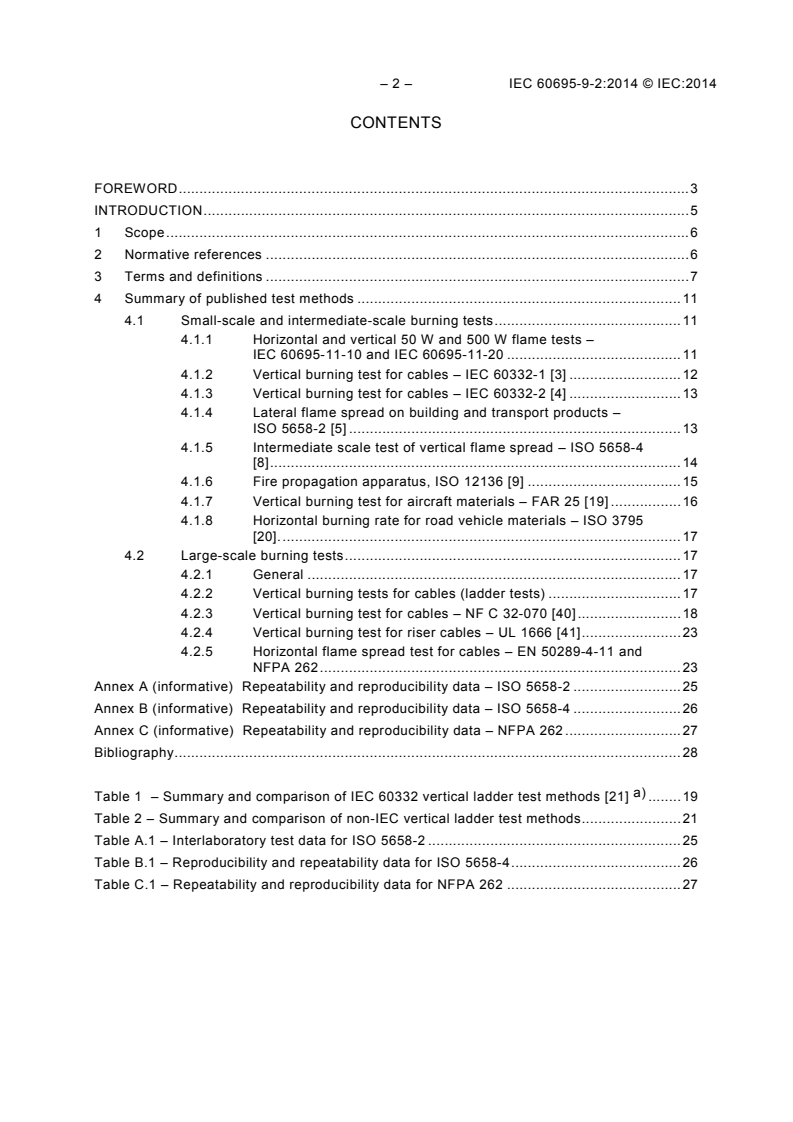
CONTENTS
FOREWORD . 3
INTRODUCTION . 5
1 Scope . 6
2 Normative references . 6
3 Terms and definitions . 7
4 Summary of published test methods . 11
4.1 Small-scale and intermediate-scale burning tests . 11
4.1.1 Horizontal and vertical 50 W and 500 W flame tests –
IEC 60695-11-10 and IEC 60695-11-20 . 11
4.1.2 Vertical burning test for cables – IEC 60332-1 [3] . 12
4.1.3 Vertical burning test for cables – IEC 60332-2 [4] . 13
4.1.4 Lateral flame spread on building and transport products –
ISO 5658-2 [5] . 13
4.1.5 Intermediate scale test of vertical flame spread – ISO 5658-4
[8] . 14
4.1.6 Fire propagation apparatus, ISO 12136 [9] . 15
4.1.7 Vertical burning test for aircraft materials – FAR 25 [19] . 16
4.1.8 Horizontal burning rate for road vehicle materials – ISO 3795
[20]. . 17
4.2 Large-scale burning tests . 17
4.2.1 General . 17
4.2.2 Vertical burning tests for cables (ladder tests) . 17
4.2.3 Vertical burning test for cables – NF C 32-070 [40] . 18
4.2.4 Vertical burning test for riser cables – UL 1666 [41] . 23
4.2.5 Horizontal flame spread test for cables – EN 50289-4-11 and
NFPA 262 . 23
Annex A (informative) Repeatability and reproducibility data – ISO 5658-2 . 25
Annex B (informative) Repeatability and reproducibility data – ISO 5658-4 . 26
Annex C (informative) Repeatability and reproducibility data – NFPA 262 . 27
Bibliography . 28
a)
Table 1 – Summary and comparison of IEC 60332 vertical ladder test methods [21] . 19
Table 2 – Summary and comparison of non-IEC vertical ladder test methods . 21
Table A.1 – Interlaboratory test data for ISO 5658-2 . 25
Table B.1 – Reproducibility and repeatability data for ISO 5658-4 . 26
Table C.1 – Repeatability and reproducibility data for NFPA 262 . 27
INTERNATIONAL ELECTROTECHNICAL COMMISSION
____________
FIRE HAZARD TESTING –
Part 9-2: Surface spread of flame –
Summary and relevance of test methods
FOREWORD
1) The International Electrotechnical Commission (IEC) is a worldwide organization for standardization comprising
all national electrotechnical committees (IEC National Committees). The object of IEC is to promote
international co-operation on all questions concerning standardization in the electrical and electronic fields. To
this end and in addition to other activities, IEC publishes International Standards, Technical Specifications,
Technical Reports, Publicly Available Specifications (PAS) and Guides (hereafter referred to as “IEC
Publication(s)”). Their preparation is entrusted to technical committees; any IEC National Committee interested
in the subject dealt with may participate in this preparatory work. International, governmental and non-
governmental organizations liaising with the IEC also participate in this preparation. IEC collaborates closely
with the International Organization for Standardization (ISO) in accordance with conditions determined by
agreement between the two organizations.
2) The formal decisions or agreements of IEC on technical matters express, as nearly as possible, an international
consensus of opinion on the relevant subjects since each technical committee has representation from all
interested IEC National Committees.
3) IEC Publications have the form of recommendations for international use and are accepted by IEC National
Committees in that sense. While all reasonable efforts are made to ensure that the technical content of IEC
Publications is accurate, IEC cannot be held responsible for the way in which they are used or for any
misinterpretation by any end user.
4) In order to promote international uniformity, IEC National Committees undertake to apply IEC Publications
transparently to the maximum extent possible in their national and regional publications. Any divergence
between any IEC Publication and the corresponding national or regional publication shall be clearly indicated in
the latter.
5) IEC itself does not provide any attestation of conformity. Independent certification bodies provide conformity
assessment services and, in some areas, access to IEC marks of conformity. IEC is not responsible for any
services carried out by independent certification bodies.
6) All users should ensure that they have the latest edition of this publication.
7) No liability shall attach to IEC or its directors, employees, servants or agents including individual experts and
members of its technical committees and IEC National Committees for any personal injury, property damage or
other damage of any nature whatsoever, whether direct or indirect, or for costs (including legal fees) and
expenses arising out of the publication, use of, or reliance upon, this IEC Publication or any other IEC
Publications.
8) Attention is drawn to the Normative references cited in this publication. Use of the referenced publications is
indispensable for the correct application of this publication.
9) Attention is drawn to the possibility that some of the elements of this IEC Publication may be the subject of
patent rights. IEC shall not be held responsible for identifying any or all such patent rights.
International Standard IEC 60695-9-2 has been prepared by IEC technical committee 89: Fire
hazard testing.
It has the status of a basic safety publication in accordance with IEC Guide 104 and
ISO/IEC Guide 51.
This first edition cancels and replaces the second edition of IEC TS 60695-9-2 published in
2005. This edition constitutes a technical revision.
The text of this standard is based on the following documents:
FDIS Report on voting
89/1202/FDIS 89/1209/RVD
Full information on the voting for the approval of this standard can be found in the report on
voting indicated in the above table.
– 4 – IEC 60695-9-2:2014 © IEC:2014
This publication has been drafted in accordance with the ISO/IEC Directives, Part 2.
A list of all the parts in the 60695 series, under the general title Fire hazard testing, can be
found on the IEC web site.
This International standard is to be used in conjunction with IEC 60695-9-1.
The committee has decided that the contents of this publication will remain unchanged until
the stability date indicated on the IEC web site under "http://webstore.iec.ch" in the data
related to the specific publication. At this date, the publication will be
• reconfirmed,
• withdrawn,
• replaced by a revised edition, or
• amended.
INTRODUCTION
The risk of fire needs to be considered in any electrical circuit. The objective of component,
circuit and equipment design, as well as the choice of materials, is to reduce the likelihood of
fire, even in the event of foreseeable abnormal use, malfunction or failure.
Electrotechnical products, primarily as victims of fire, may nevertheless contribute to the fire.
Fire hazard increases as the burning area increases, leading in some cases to flashover and
a fully developed fire. This is a typical fire scenario in buildings. It is therefore useful to
measure the rate and extent of the surface spread of flame.
This part of IEC 60695-9 describes surface spread of flame test methods in common use to
assess electrotechnical products or materials used in electrotechnical products. It forms part
of the IEC 60695-9 series which gives guidance to product committees wishing to incorporate
test methods for surface spread of flame in product standards.
IEC 60695-9 consists of the following parts:
– Part 9-1: Surface spread of flame – General guidance
– Part 9-2: Surface spread of flame – Summary and relevance of test methods.
– 6 – IEC 60695-9-2:2014 © IEC:2014
FIRE HAZARD TESTING –
Part 9-2: Surface spread of flame –
Summary and relevance of test methods
1 Scope
This part of IEC 60695 presents a summary of published test methods that are used to
determine the surface spread of flame of electrotechnical products or materials from which
they are formed.
It represents the current state of the art of the test methods and, where available, includes
special observations on their relevance and use.
The list of test methods is not to be considered exhaustive, and test methods that were not
developed by IEC TC89 are not to be considered as endorsed by IEC TC89 unless this is
specifically stated.
This summary cannot be used in place of published standards which are the only valid
reference documents.
This basic safety publication is intended for use by technical committees in the preparation of
standards in accordance with the principles laid down in IEC Guide 104 and
ISO/IEC Guide 51.
One of the responsibilities of a technical committee is, wherever applicable, to make use of
basic safety publications in the preparation of its publications. The requirements, test
methods or test conditions of this basic safety publication will not apply unless specifically
referred to or included in the relevant publications.
2 Normative references
The following documents, in whole or in part, are normatively referenced in this document and
are indispensable for its application. For dated references, only the edition cited applies. For
undated references, the latest edition of the referenced document (including any
amendments) applies.
IEC 60695-4, Fire hazard testing – Part 4: Terminology concerning fire tests for
electrotechnical products
IEC 60695-9-1, Fire hazard testing – Part 9-1: Surface spread of flame – General guidance
IEC Guide 104, The preparation of safety publications and the use of basic safety publications
and group safety publications
ISO/IEC Guide 51, Safety aspects – Guidelines for their inclusion in standards
ISO 13943:2008, Fire Safety – Vocabulary
3 Terms and definitions
For the purposes of this document, terms and definitions given in ISO 13943 and
IEC 60695-4, some of which are reproduced below for the user’s convenience, as well as the
following additional definitions, apply:
3.1
burned length
maximum extent in a specified direction of the burned area
Note 1 to entry: The typical units are metres (m).
cf. damaged length (3.6)
[SOURCE: ISO 13943: 2008, definition 4.31]
3.2
char, noun
carbonaceous residue resulting from pyrolysis (3.26) or incomplete combustion (3.5)
[SOURCE: ISO 13943: 2008, definition 4.38]
3.3
char length
length of charred area
cf. burned length (3.1) and damaged length (3.6)
Note 1 to entry: In some standards, char length is defined by a specific test method.
[SOURCE: ISO 13943: 2008, definition 4.40]
3.4
combustible, noun
item capable of combustion (3.5)
[SOURCE: ISO 13943: 2008, definition 4.44]
3.5
combustion
exothermic reaction of a substance with an oxidizing agent
Note 1 to entry: Combustion generally emits fire effluent accompanied by flames (3.14) and/or glowing.
[SOURCE: ISO 13943: 2008, definition 4.46]
3.6
damaged length
maximum extent in a specified direction of the damaged area
cf. char length (3.3) and burned length (3.1)
[SOURCE: ISO 13943: 2008, definition 4.60]
3.7
extent of combustion
〈electrotechnical〉 maximum length of a test specimen that has been destroyed by
combustion (3.5) or pyrolysis (3.26), under specified test conditions, excluding any region
damaged only by deformation
– 8 – IEC 60695-9-2:2014 © IEC:2014
[SOURCE: ISO 13943: 2008, definition 4.91]
3.8
fire
〈general〉 process of combustion (3.5) characterized by the emission of heat and fire effluent
and usually accompanied by smoke, flame (3.14), glowing or a combination thereof
Note 1 to entry: In the English language the term “fire” is used to designate three concepts, two of which, fire
(3.9) and fire (3.10), relate to specific types of self-supporting combustion with different meanings and two of them
are designated using two different terms in both French and German.
[SOURCE: ISO 13943: 2008, definition 4.96]
3.9
fire
〈controlled〉 self-supporting combustion (3.5) that has been deliberately arranged to provide
useful effects and is limited in its extent in time and space
[SOURCE: ISO 13943: 2008, definition 4.97]
3.10
fire
〈uncontrolled〉 self-supporting combustion (3.5) that has not been deliberately arranged to
provide useful effects and is not limited in its extent in time and space
[SOURCE: ISO 13943: 2008, definition 4.98]
3.11
fire hazard
physical object or condition with a potential for an undesirable consequence from fire (3.10)
[SOURCE: ISO 13943: 2008, definition 4.112]
3.12
fire retardant, noun
substance added, or a treatment applied, to a material in order to delay ignition (3.22) or to
reduce the rate of combustion (3.5)
[SOURCE: ISO 13943: 2008, definition 4.123, modified by deletion of “cf. flame retardant”]
3.13
fire scenario
qualitative description of the course of a fire (3.10) with respect to time, identifying key events
that characterise the studied fire and differentiate it from other possible fires
Note 1 to entry: It typically defines the ignition (3.22) and fire growth processes, the fully developed fire (3.20)
stage, the fire decay stage, and the environment and systems that impact on the course of the fire.
[SOURCE: ISO 13943: 2008, definition 4.129]
3.14
flame, noun
zone in which there is rapid, self-sustaining, sub-sonic propagation of combustion (3.5) in a
gaseous medium, usually with emission of light
[SOURCE: ISO 13943: 2008, definition 4.133 – modified by the addition of “zone in which
there is”]
3.15
flame front
boundary of flaming combustion (3.5) at the surface of a material or propagating through a
gaseous mixture
[SOURCE: ISO 13943: 2008, definition 4,136]
3.16
flame retardant, noun
substance added, or a treatment applied, to a material in order to suppress or delay the
appearance of a flame (3.14) and/or reduce the flame-spread rate (3.18)
Note 1 to entry: The use of (a) flame retardant(s) does not necessarily suppress fire (3.8) or terminate
combustion (3.5).
[SOURCE: ISO 13943: 2008, definition 4.139]
3.17
flame spread
propagation of a flame front (3.15)
[SOURCE: ISO 13943: 2008, definition 4.142]
3.18
flame-spread rate
burning rate (deprecated)
rate of burning (deprecated)
distance travelled by a flame front (3.15) during its propagation, divided by the time of travel,
under specified conditions
[SOURCE: ISO 13943: 2008, definition 4.143]
3.19
flashover
〈stage of fire〉 transition to a state of total surface involvement in a fire (3.10) of combustible
materials within an enclosure
[SOURCE: ISO 13943: 2008, definition 4.156]
3.20
fully developed fire
state of total involvement of combustible materials in a fire (3.8)
[SOURCE: ISO 13943: 2008, definition 4.164]
3.21
heat release rate
burning rate (deprecated)
rate of burning (deprecated)
rate of thermal energy production generated by combustion ()
Note 1 to entry: The typical units are watts (W).
[SOURCE: ISO 13943: 2008, definition 4.177]
– 10 – IEC 60695-9-2:2014 © IEC:2014
3.22
ignition
sustained ignition (deprecated)
〈general〉 initiation of combustion (3.5)
[SOURCE: ISO 13943: 2008, definition 4.188]
3.23
ignition source
source of energy that initiates combustion (3.5)
[SOURCE: ISO 13943: 2008, definition 4.189]
3.24
large-scale fire test
fire test that cannot be carried out in a typical laboratory chamber, performed on a test
specimen of large dimensions
Note 1 to entry: A fire test performed on a test specimen of which the maximum dimension is greater than 3 m is
usually called a large-scale fire test.
[SOURCE: ISO 13943: 2008, definition 4.205]
3.25
minimum ignition temperature
ignition point
minimum temperature at which sustained combustion (3.5) can be initiated under specified
test conditions
Note 1 to entry: The minimum ignition temperature implies the application of a thermal stress for an infinite length
of time.
Note 2 to entry: The typical units are degrees Celsius (°C).
[SOURCE: ISO 13943: 2008, definition 4.231]
3.26
pyrolysis
chemical decomposition of a substance by the action of heat
Note 1 to entry: Pyrolysis is often used to refer to a stage of fire (3.8) before flaming combustion (3.5) has
begun.
Note 2 to entry: In fire science, no assumption is made about the presence or absence of oxygen.
[SOURCE: ISO 13943: 2008, definition 4.266]
3.27
pyrolysis front
boundary between the region of pyrolysis (3.26) and the region of unaffected material at the
surface of the material
[SOURCE: ISO 13943: 2008, definition 4.267]
3.28
real-scale fire test
fire test that simulates a given application, taking into account the real scale, the real way the
item is installed and used, and the environment
Note 1 to entry: Such a fire test normally assumes that the products are used in accordance with the conditions
laid down by the specifier and/or in accordance with normal practice.
[SOURCE: ISO 13943: 2008, definition 4.273]
3.29
riser cable
cable that runs vertically between floors in a building
Note 1 to entry: This is a term used predominantly in North America
3.30
riser shaft
shaft provided to run services between floors in a building
Note 1 to entry: This is a term used predominantly in North America
3.31
small-scale fire test
fire test performed on a test specimen of small dimensions
Note 1 to entry: A fire test performed on a test specimen of which the maximum dimension is less than 1 m is
usually called a small-scale fire test.
[SOURCE: ISO 13943: 2008, definition 4.292]
3.32
surface spread of flame
flame spread (3.17) away from the source of ignition (3.22) across the surface of a liquid or
a solid
[SOURCE: ISO 13943: 2008, definition 4.317]
4 Summary of published test methods
4.1 Small-scale and intermediate-scale burning tests
4.1.1 Horizontal and vertical 50 W and 500 W flame tests – IEC 60695-11-10 and
IEC 60695-11-20
4.1.1.1 General
IEC 60695-11-10 [1] is a test using a 50 W flame. IEC 60695-11-20 [2] is a test using a
500 W flame.
4.1.1.2 Purpose and principle
These tests refer to solid electrical insulating materials and are intended to serve as a
preliminary indication of their behaviour when exposed to an ignition source. The results make
it possible to check the constancy of the characteristics of a material and provide an
indication of the progress in the development of the flame retardancy of insulating materials.
The results also provide a relative comparison and classification of insulating materials.
4.1.1.3 Test specimen
The relatively small test specimen is 125 mm long, 13 mm wide, and up to 13 mm thick.
___________
Numbers in square brackets refer to the bibliography.
– 12 – IEC 60695-9-2:2014 © IEC:2014
4.1.1.4 Test method
These tests involve the application of an ignition source to a horizontal or vertical test
specimen and the evaluation of the linear burning rate (HB classification) and the vertical
spread of flame (V classification).
4.1.1.5 Repeatability and reproducibility
Data are available in IEC 60695-11-10 [1] Annexes A and B, and IEC 60695-11-20 [2],
Annex A.
4.1.1.6 Relevance of test data
These test methods are used to evaluate materials. The test methods provide classifications
that may be used for quality assurance, the preselection of component materials of products,
or to verify the required minimum flammability classification of materials used in end products.
The tests are not valid for determining the fire behaviour and fire hazard of complete items of
equipment, since the dimensions of the insulating systems, the design and heat transfer to
adjacent metallic parts, greatly influence the flammability of the electrical insulating materials
being used.
4.1.2 Vertical burning test for cables – IEC 60332-1 [3]
4.1.2.1 Purpose and principle
This test method specifies a method of testing a single vertical wire or cable or optical cable
under fire conditions. Part 1-1 defines the apparatus. Part 1-2 defines the procedure. The
char length of a vertical test specimen, exposed to a 1 kW pre-mixed flame in a suitable
chamber, is measured. The standard includes, in an informative annex, recommended
requirements for compliance for use where these are not given in the cable product standard.
Part 1-3 is a procedure for determination of flaming droplets/particles.
The method specified is not suitable for the testing of small single insulated conductors or
cables of less than 0,5 mm total cross-section, because the conductor melts before the test
is completed, or for the testing of small optical fibre cables because the cable is broken
before the test is completed – see Clause 4.1.3.
NOTE The corresponding EN standards are EN 60332-1-1, EN 60332-1-2 and EN 60332-1-3.
4.1.2.2 Test specimen
The test specimen consists of a piece of finished wire or cable 600 mm ± 25 mm long.
4.1.2.3 Test method
The test specimen is held in a vertical position by means of two support arms within a three-
sided metallic screen. A calibrated burner is used to ignite the test specimen. Its flame is
continuously applied for a period of time which is related to the overall diameter of the test
specimen. The damaged length of the test specimen is then noted.
4.1.2.4 Repeatability and reproducibility
No data are known to be available.
4.1.2.5 Relevance of test data
This method is used to determine the extent of vertical burning of a single finished wire or
cable by measuring the char length.
The use of insulated wire or cable, which retards flame propagation and complies with the
requirements of this standard, cannot be assumed by itself to prevent propagation of fire
under all conditions of installation. Two examples of such conditions are:
a) vertical runs of bunched or bundled cables
b) potential ignition sources that would impose a more intense thermal environment than that
provided by the test method.
It is recommended that wherever the risk of propagation is high, special installation
precautions should be taken.
4.1.3 Vertical burning test for cables – IEC 60332-2 [4]
4.1.3.1 Purpose and principle
This test method specifies a method of testing a small insulated wire under fire conditions
when the method specified in vertical burning test IEC 60332-1 is not suitable – see Clause
4.1.2.1. Part 2-1 defines the apparatus. Part 2-2 defines the procedure. The char length of a
vertical test specimen, exposed to a diffusion flame of length 125 mm ± 25 mm in a draught-
free chamber, is measured. The standard includes, in an informative annex, recommended
requirements for compliance for use where these are not given in the cable product standard.
NOTE The corresponding EN standards are EN 60332-2-1 and EN 60332-2-2.
4.1.3.2 Test specimen
The test specimen consists of a piece of finished copper wire or cable or optical cable,
600 mm ± 25 mm long.
4.1.3.3 Test method
The test specimen is held in a vertical position by means of two support arms within a three-
sided metallic screen. A load of 5 N for each mm of conductor area is attached to the lower
part of the test specimen. A calibrated burner is used to ignite the test specimen. Its flame is
continuously applied for a maximum period of 20 s. The damaged length of the test specimen
is then noted.
4.1.3.4 Repeatability and reproducibility
No data are known to be available.
4.1.3.5 Relevance of test data
This method is used to determine the extent of burning by measuring the char length.
Since the use of insulated wire or cable or optical cable, which retards flame propagation and
complies with the requirements of this standard, is not sufficient by itself to prevent
propagation of fire under all conditions of installation, it is recommended that wherever the
risk of propagation is high, for example in long vertical runs of bunched cables, special
installation precautions should also be taken. It cannot be assumed that, because the cable
test specimen complies with the performance required in this standard, bunched cables will
behave in a similar manner.
4.1.4 Lateral flame spread on building and transport products – ISO 5658-2 [5]
4.1.4.1 Purpose and principle
This test provides a simple method by which lateral spread of flame on a vertical test
specimen can be determined for comparative purposes. The test provides data suitable for
comparing the performance of essentially flat materials, composites or assemblies, which are
– 14 – IEC 60695-9-2:2014 © IEC:2014
used primarily as the exposed surfaces of walls in buildings and transport vehicles, such as
ships and trains. Some profiled products (such as pipes) can also be tested under specified
mounting and fixing conditions.
NOTE The test was developed from the method of the International Maritime Organization (IMO) published as
IMO Resolution A.653 [6].
4.1.4.2 Test specimen
Test specimens are 800 mm long by 155 mm wide. Products of thickness 70 mm or less are
tested using their full thickness. For products of thickness greater than 70 mm the unexposed
face is cut away to reduce the thickness to 70 mm.
4.1.4.3 Test method
The test method consists of exposing conditioned test specimens to a well-defined field of
radiant heat flux and measuring the time to ignition, the lateral spread of flame, and its final
extinguishment. A test specimen is placed in a vertical position adjacent to a gas-fired radiant
panel. A pilot flame is sited close to the hot end of the test specimen to ignite volatile gases.
Following ignition, any flame front which develops is noted, and a record is made of the
progression of the flame front horizontally along the length of the test specimen. The results
are expressed as the critical heat flux at extinguishment and the average heat for sustained
burning.
4.1.4.4 Repeatability and reproducibility
Data obtained in an interlaboratory trial are given in Annex A.
4.1.4.5 Relevance of test data
The test is applicable to the measurement and description of the properties of materials,
products or assemblies in response to radiative heat in the presence of a pilot flame under
controlled laboratory conditions. The test deals only with a simple representation of a
particular aspect of the potential fire situation typified by a radiant heat source and flame; it
cannot alone provide any direct guidance on behaviour or safety in fire. The test is particularly
useful for research, development and quality control purposes. Profiled test specimens such
as cables and pipes can be tested using this test method.
NOTE The same test apparatus is used for the procedures described in ASTM E-1321 [7] which provides a more
scientifically detailed method by which the ignitability and spread of flame parameters of materials can be
determined. Data derived from this test are suitable for use as input in fire safety engineering calculations.
4.1.5 Intermediate scale test of vertical flame spread – ISO 5658-4 [8]
4.1.5.1 Purpose and principle
This test method consists of exposing the lower part of a conditioned vertically-oriented test
-2
specimen to a single well-defined field of radiant heat flux (maximum 40 kW⋅m ) and
measuring the time to ignition, vertical and horizontal spread of flame and, where appropriate,
observing other fire spread effects such as flaming drips or debris and lateral spread. A non-
impinging line pilot burner is positioned above the radiated area of the test specimen to ignite
volatile gases.
4.1.5.2 Test specimen
Test specimens are representative of the product and are 1 525 mm long by 1 025 mm wide.
The specimen is mounted in a holder on a support trolley with the long edge vertical and the
short edge horizontal.
4.1.5.3 Test method
The test specimen is marked with reference lines (vertical and horizontal). When the radiant
panel has attained thermal equilibrium, the pilot burner is lit and the trolley is moved into the
test position. The ignition time is recorded together with any other flaming effects. Times of
arrival of any sustained flame at the reference lines on the test specimen and at the edges of
the test specimen are recorded. The test time is a maximum of 30 min. The burned area and
the type of damage are recorded.
4.1.5.4 Repeatability and reproducibility
Data from an interlaboratory trial are given in Annex B.
4.1.5.5 Relevance of test data
This test specifies an intermediate-scale method for measuring the vertical spread (upward
and downward) of flame over a test specimen of a product oriented in the vertical position. A
measure of lateral spread can also be obtained. The test provides data suitable for comparing
the performance of materials, composites or assemblies, which are used as the exposed
surfaces of walls or other vertically oriented products in construction applications. The heat
source may be considered to represent a single burning item such as a wastepaper bin or an
upholstered chair within an enclosure, and this scenario would generally be considered to
apply during the early developing stage of a fire.
4.1.6 Fire propagation apparatus, ISO 12136 [9]
4.1.6.1 Purpose and principle
ISO 12136 provides test methods for determining and quantifying the flammability
characteristics of materials, in relation to their propensity to support fire propagation, by
means of a fire propagation apparatus (FPA). Material flammability characteristics that are
quantified in this international standard include time to ignition, chemical and convective heat
release rates, mass loss rate, effective heat of combustion, heat of gasification and smoke
yield. These properties can be used for fire safety engineering and for fire modelling.
4.1.6.2 Test apparatus
See ISO 12136 [9] and ASTM E2058 [10].
4.1.6.3 Test specimens
Square test specimens are 102 mm x 102 mm and are mounted in a square holder. Circular
test specimens are 96,5 mm in diameter and are mounted in a circular holder. The test
specimen thickness is not less than 3 mm and not greater than 25.4 mm. For the vertical fire
propagation test, the test specimen is 102 mm in width and 305 mm in length and is mounted
in a vertical test specimen holder.
4.1.6.4 Test methods and results
The four test methods given in this international standard are based on measurements of time
to observed ignition, mass loss rate, heat release rate and smoke generation rate. The tests
are performed using a laboratory calorimeter known as fire propagation apparatus whereby
the heat source is isolated from the test specimen. The test methods are intended to produce
flammability property measurements that will characterize fire behaviour during reference-
scale fire tests.
The ignition, combustion or fire propagation test methods, or a combination thereof, have
been performed with materials and products containing a wide range of polymer compositions
and structures, including electrotechnical products, materials for electrotechnical products
and electric cables [11] to [18].
– 16 – IEC 60695-9-2:2014 © IEC:2014
The unique feature of the fire propagation test method is that it produces laboratory
measurements of the chemical heat release rate during upward fire propagation and burning
(from a material's own flame after initiation by an external radiant flux) on a vertical test
specimen in normal air, oxygen enriched air, or in oxygen-vitiated air.
These test methods are intended for evaluation of specific flammability characteristics of
materials. Materials to be analysed consist of specimens from an end-use product or the
various components used in the end-use product. Results from the test methods provide input
to flame spread and fire growth models, risk analysis studies, building and product designs
and materials research and development.
This international standard can be used to measure and describe the response of materials,
products, or assemblies to heat and flame under controlled conditions, but does not by itself
incorporate all factors required for fire hazard or fire risk assessment of the materials,
products or assemblies under actual fire conditions.
4.1.7 Vertical burning test for aircraft materials – FAR 25 [19]
4.1.7.1 Purpose and principle
The requirements for electrical system components are given in FAR 25.869 (a). Insulation on
electrical wires and electric cable installed in any area of an airplane fuselage shall be self-
°
extinguishing when tested in accordance with a 60 Bunsen burner test described in Part I,
(b), (7) in Appendix F of FAR 25 (1965).
The requirements for materials and parts used in the crew and passenger compartments are
given in FAR 25.853. Electrical conduit shall be self-extinguishing when tested in accordance
with a vertical Bunsen burner test described in Part I, (b), (4) in Appendix F of FAR 25 (1965).
4.1.7.2 Test specimen
The test specimen for the vertical Bunsen burner test is at least 50 mm wide and 30,5 mm
long, unless the actual size used in the airplane is smaller. The test specimen thickness is no
thicker than the minimum thickness qualified for use in an airplane.
The test specimen for the 60 ° Bunsen burner test is a length of wire or cable. The gauge is
the same as that used in the airplane.
4.1.7.3 Test method
These tests involve applying an ignition source to a 60° or vertical test specimen. The flame
time, burned length, and flaming time of drippings, if any, are then measured or noted.
Electrical conduits are submitted to a 12 s application of flame. Wire and cable are submitted
to a 30 s application of flame.
4.1.7.4 Repeatability and reproducibility
No data are known to be available.
4.1.7.5 Relevance of test data
These test methods are used for the preselection of materials, quality control and product
evaluation in the aviation industry in the USA.
4.1.8 Horizontal burning rate for road vehicle materials – ISO 3795 [20].
4.1.8.1 Purpose and principle
This test method determines the horizontal burning rate of materials used in the occupant
compartment of road vehicles, after exposure to a small flame. It is used to determine if the
flame extinguishes, and the time required for the flame to travel a measured distance.
The standard includes the requirement for compliance.
4.1.8.2 Test specimen
The test specimen size is 356 mm × 100 mm × d mm. The thickness d corresponds to the
thickness of the product to be tested but shall be not more than 13 mm.
4.1.8.3 Test method
During the test, at least five test specimens are tested horizontally in a special combustion
chamber, mounted in a defined test specimen holder. The gas burner is a 9,5 mm Bunsen
burner. The flame height is 38 mm and the burner top is 19 mm below the bottom edge of the
test specimen. The burning rate, B, in mm/min, is measured.
A test specimen is held in a U-shaped holder and is exposed to the action of a defined low-
energy flame for 15 s in a combustion chamber, with the flame acting on the free end of the
test s
...