

IEC 60721-3-7:1995
(Main)Classification of environmental conditions - Part 3: Classification of groups of environmental parameters and their severities - Section 7: Portable and non-stationary use
General Information
- Abstract
Classifies groups of environmental parameters and their severities to which products are subjected during portable and non-stationary use.
- Status
- Published
- Publication Date
- 23-Oct-2002
- Technical Committee
- TC 104 - Environmental conditions, classification and methods of test
- Drafting Committee
- MT 19 - TC 104/MT 19
- Current Stage
- DELPUB - Deleted Publication
- Start Date
- 06-Feb-2026
- Completion Date
- 21-Jul-2023
Buy Documents
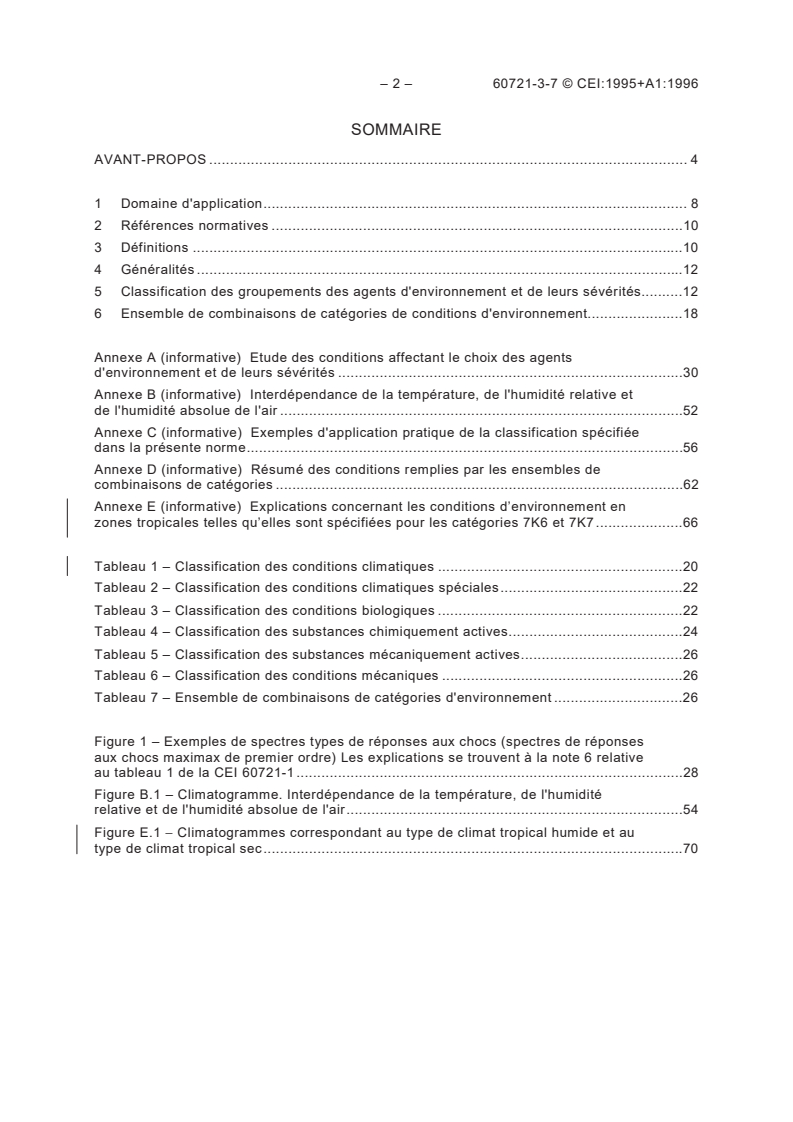
IEC 60721-3-7:1995+AMD1:1996 CSV - Classification of environmental conditions - Part 3-7: Classification of groups of environmental parameters and their severities - Portable and non-stationary use Released:10/24/2002
Overview
IEC 60721-3-7:1995 is an international standard developed by the International Electrotechnical Commission (IEC). This standard is part of the IEC 60721 series, which provides a systematic approach to the classification of environmental conditions. Specifically, IEC 60721-3-7 classifies groups of environmental parameters and their severities for products used in portable and non-stationary applications. It covers conditions encountered during use, including periods of transfer, downtime, maintenance, and repair in both protected and unprotected environments, on land or offshore.
The purpose of this standard is to ensure that products intended for portable or non-stationary use are designed, tested, and qualified to function reliably under diverse environmental conditions they may encounter throughout their lifecycle.
Key Topics
- Classification of Environmental Parameters and Severities:
Defines a set of environmental factors (climatic, biological, chemical, mechanical) and classifies their severities for portable and non-stationary usage scenarios. - Scope of Application:
Applies to products that are frequently moved or temporarily used in different locations, both indoors (weatherprotected) and outdoors (non-weatherprotected), including periods of transport and downtime. - Environmental Condition Groups Covered:
- Climatic conditions (e.g., temperature, humidity)
- Special climatic conditions (e.g., extreme environments, tropical climates)
- Biological conditions (e.g., mold, insects)
- Chemically active substances (e.g., corrosive atmospheres)
- Mechanically active substances (e.g., dust, sand)
- Mechanical conditions (e.g., vibration, shock)
- Guidance on Severity Levels:
The standard provides classes that reflect the maximum expected severity of each environmental parameter, recognizing that various combinations of factors may occur and that extreme or special environments may require individual assessment.
Applications
IEC 60721-3-7 is applicable to a wide range of electrical and electronic equipment, tools, measuring instruments, and other products designed for portable use. Practical applications include:
- Product Design and Testing:
Manufacturers use this standard to select suitable environmental class combinations to specify design requirements and testing criteria, ensuring products maintain performance throughout mobile operations. - Risk Assessment and Qualification:
Helps in evaluating potential risks related to environmental exposure, enhancing reliability during handling, maintenance, or field repair. - Specification in Procurement:
Procurement teams use the classifications to draft clear environmental requirements for products expected to be frequently moved or temporarily stationed in challenging settings. - Lifecycle Assurance:
Ensures that products are not only robust during stationary operation but also during transport, handling, or any temporary deployment, reducing unexpected failures in non-stationary scenarios.
Related Standards
IEC 60721-3-7 forms part of the broader IEC 60721 series, which addresses environmental classification across various use cases:
- IEC 60721-1: Environmental parameters and their severities
- IEC 60721-2-1: Conditions in nature - Temperature and humidity
- IEC 60721-3-0: Introduction to the classification of environmental groups and their severities
- IEC 60721-3-2: Environmental classifications for transportation
- IEC 60721-3-3: Classification for stationary use at weatherprotected locations
- IEC 60721-3-4: Classification for stationary use at non-weatherprotected locations
These related standards offer complementary guidance for fixed installations, transport, storage, and other specific situations.
Conclusion
IEC 60721-3-7 provides a structured methodology for understanding and classifying environmental stresses relevant to portable and non-stationary products. By referencing this standard, organizations ensure their products meet global reliability expectations across diverse environments and usage scenarios. Compliance helps reduce lifecycle risks, improves product longevity, and supports international harmonization of product requirements for non-stationary and portable use.
Relations
- Effective Date
- 25-Aug-2026
- Effective Date
- 25-Aug-2026
- Effective Date
- 25-Aug-2026
- Effective Date
- 25-Aug-2026
- Effective Date
- 25-Aug-2026
- Effective Date
- 05-Sep-2023
- Effective Date
- 05-Sep-2023
Buy Documents
IEC 60721-3-7:1995+AMD1:1996 CSV - Classification of environmental conditions - Part 3-7: Classification of groups of environmental parameters and their severities - Portable and non-stationary use Released:10/24/2002
Get Certified
Connect with accredited certification bodies for this standard

IMP NDT d.o.o.
Non-destructive testing services. Radiography, ultrasonic, magnetic particle, penetrant, visual inspection.
Inštitut za kovinske materiale in tehnologije
Institute of Metals and Technology. Materials testing, metallurgical analysis, NDT.
Q Techna d.o.o.
NDT and quality assurance specialist. 30+ years experience. NDT personnel certification per ISO 9712, nuclear and thermal power plant inspections, QA/
Sponsored listings
Frequently Asked Questions
IEC 60721-3-7:1995 is a standard published by the International Electrotechnical Commission (IEC). Its full title is "Classification of environmental conditions - Part 3: Classification of groups of environmental parameters and their severities - Section 7: Portable and non-stationary use". This standard covers: Classifies groups of environmental parameters and their severities to which products are subjected during portable and non-stationary use.
Classifies groups of environmental parameters and their severities to which products are subjected during portable and non-stationary use.
IEC 60721-3-7:1995 is classified under the following ICS (International Classification for Standards) categories: 19.040 - Environmental testing. The ICS classification helps identify the subject area and facilitates finding related standards.
IEC 60721-3-7:1995 has the following relationships with other standards: It is inter standard links to EN ISO 11608-4:2007, EN ISO 11608-4:2022, EN ISO 20072:2013, EN ISO 21649:2023, EN ISO 20072:2010, IEC 60721-3-7:1995/AMD1:1996, IEC 60721-3-7:2026. Understanding these relationships helps ensure you are using the most current and applicable version of the standard.
IEC 60721-3-7:1995 is available in PDF format for immediate download after purchase. The document can be added to your cart and obtained through the secure checkout process. Digital delivery ensures instant access to the complete standard document.
Standards Content (Sample)
IEC 60721-3-7 ®
Edition 2.1 2002-10
CONSOLIDATED VERSION
INTERNATIONAL
STANDARD
NORME
INTERNATIONALE
Classification of environmental conditions –
Part 3-7: Classification of groups of environmental parameters and their
severities – Portable and non-stationary use
Classification des conditions d'environnement –
Partie 3-7: Classification des groupements des agents d'environnement et de
leurs sévérités – Utilisation en déplacement
All rights reserved. Unless otherwise specified, no part of this publication may be reproduced or utilized in any form
or by any means, electronic or mechanical, including photocopying and microfilm, without permission in writing from
either IEC or IEC's member National Committee in the country of the requester. If you have any questions about IEC
copyright or have an enquiry about obtaining additional rights to this publication, please contact the address below or
your local IEC member National Committee for further information.
Droits de reproduction réservés. Sauf indication contraire, aucune partie de cette publication ne peut être reproduite
ni utilisée sous quelque forme que ce soit et par aucun procédé, électronique ou mécanique, y compris la photocopie
et les microfilms, sans l'accord écrit de l'IEC ou du Comité national de l'IEC du pays du demandeur. Si vous avez des
questions sur le copyright de l'IEC ou si vous désirez obtenir des droits supplémentaires sur cette publication, utilisez
les coordonnées ci-après ou contactez le Comité national de l'IEC de votre pays de résidence.
IEC Central Office Tel.: +41 22 919 02 11
3, rue de Varembé Fax: +41 22 919 03 00
CH-1211 Geneva 20 info@iec.ch
Switzerland www.iec.ch
About the IEC
The International Electrotechnical Commission (IEC) is the leading global organization that prepares and publishes
International Standards for all electrical, electronic and related technologies.
About IEC publications
The technical content of IEC publications is kept under constant review by the IEC. Please make sure that you have the
latest edition, a corrigenda or an amendment might have been published.
IEC Catalogue - webstore.iec.ch/catalogue Electropedia - www.electropedia.org
The stand-alone application for consulting the entire The world's leading online dictionary of electronic and
bibliographical information on IEC International Standards, electrical terms containing 20 000 terms and definitions in
Technical Specifications, Technical Reports and other English and French, with equivalent terms in 15 additional
documents. Available for PC, Mac OS, Android Tablets and languages. Also known as the International Electrotechnical
iPad. Vocabulary (IEV) online.
IEC publications search - www.iec.ch/searchpub IEC Glossary - std.iec.ch/glossary
The advanced search enables to find IEC publications by a 65 000 electrotechnical terminology entries in English and
variety of criteria (reference number, text, technical French extracted from the Terms and Definitions clause of
committee,…). It also gives information on projects, replaced IEC publications issued since 2002. Some entries have been
and withdrawn publications. collected from earlier publications of IEC TC 37, 77, 86 and
CISPR.
IEC Just Published - webstore.iec.ch/justpublished
Stay up to date on all new IEC publications. Just Published IEC Customer Service Centre - webstore.iec.ch/csc
details all new publications released. Available online and If you wish to give us your feedback on this publication or
also once a month by email. need further assistance, please contact the Customer Service
Centre: csc@iec.ch.
A propos de l'IEC
La Commission Electrotechnique Internationale (IEC) est la première organisation mondiale qui élabore et publie des
Normes internationales pour tout ce qui a trait à l'électricité, à l'électronique et aux technologies apparentées.
A propos des publications IEC
Le contenu technique des publications IEC est constamment revu. Veuillez vous assurer que vous possédez l’édition la
plus récente, un corrigendum ou amendement peut avoir été publié.
Catalogue IEC - webstore.iec.ch/catalogue Electropedia - www.electropedia.org
Application autonome pour consulter tous les renseignements
Le premier dictionnaire en ligne de termes électroniques et
bibliographiques sur les Normes internationales,
électriques. Il contient 20 000 termes et définitions en anglais
Spécifications techniques, Rapports techniques et autres
et en français, ainsi que les termes équivalents dans 15
documents de l'IEC. Disponible pour PC, Mac OS, tablettes
langues additionnelles. Egalement appelé Vocabulaire
Android et iPad.
Electrotechnique International (IEV) en ligne.
Recherche de publications IEC - www.iec.ch/searchpub
Glossaire IEC - std.iec.ch/glossary
La recherche avancée permet de trouver des publications IEC
65 000 entrées terminologiques électrotechniques, en anglais
en utilisant différents critères (numéro de référence, texte,
et en français, extraites des articles Termes et Définitions des
comité d’études,…). Elle donne aussi des informations sur les
publications IEC parues depuis 2002. Plus certaines entrées
projets et les publications remplacées ou retirées.
antérieures extraites des publications des CE 37, 77, 86 et
CISPR de l'IEC.
IEC Just Published - webstore.iec.ch/justpublished
Restez informé sur les nouvelles publications IEC. Just Service Clients - webstore.iec.ch/csc
Published détaille les nouvelles publications parues. Si vous désirez nous donner des commentaires sur cette
Disponible en ligne et aussi une fois par mois par email. publication ou si vous avez des questions contactez-nous:
csc@iec.ch.
IEC 60721-3-7 ®
Edition 2.1 2002-10
CONSOLIDATED VERSION
INTERNATIONAL
STANDARD
NORME
INTERNATIONALE
Classification of environmental conditions –
Part 3-7: Classification of groups of environmental parameters and their
severities – Portable and non-stationary use
Classification des conditions d'environnement –
Partie 3-7: Classification des groupements des agents d'environnement et de
leurs sévérités – Utilisation en déplacement
INTERNATIONAL
ELECTROTECHNICAL
COMMISSION
COMMISSION
ELECTROTECHNIQUE
INTERNATIONALE
ICS 19.040 ISBN 2-8318-6576-X
– 2 – 60721-3-7 © CEI:1995+A1:1996
SOMMAIRE
AVANT-PROPOS . 4
1 Domaine d'application. 8
2 Références normatives .10
3 Définitions .10
4 Généralités .12
5 Classification des groupements des agents d'environnement et de leurs sévérités.12
6 Ensemble de combinaisons de catégories de conditions d'environnement.18
Annexe A (informative) Etude des conditions affectant le choix des agents
d'environnement et de leurs sévérités .30
Annexe B (informative) Interdépendance de la température, de l'humidité relative et
de l'humidité absolue de l'air .52
Annexe C (informative) Exemples d'application pratique de la classification spécifiée
dans la présente norme.56
Annexe D (informative) Résumé des conditions remplies par les ensembles de
combinaisons de catégories .62
Annexe E (informative) Explications concernant les conditions d’environnement en
zones tropicales telles qu’elles sont spécifiées pour les catégories 7K6 et 7K7.66
Tableau 1 – Classification des conditions climatiques .20
Tableau 2 – Classification des conditions climatiques spéciales.22
Tableau 3 – Classification des conditions biologiques .22
Tableau 4 – Classification des substances chimiquement actives.24
Tableau 5 – Classification des substances mécaniquement actives.26
Tableau 6 – Classification des conditions mécaniques .26
Tableau 7 – Ensemble de combinaisons de catégories d'environnement .26
Figure 1 – Exemples de spectres types de réponses aux chocs (spectres de réponses
aux chocs maximax de premier ordre) Les explications se trouvent à la note 6 relative
au tableau 1 de la CEI 60721-1 .28
Figure B.1 – Climatogramme. Interdépendance de la température, de l'humidité
relative et de l'humidité absolue de l'air.54
Figure E.1 − Climatogrammes correspondant au type de climat tropical humide et au
type de climat tropical sec.70
60721-3-7 © IEC:1995+A1:1996 – 3 –
CONTENTS
FOREWORD . 5
1 Scope . 9
2 Normative references.11
3 Definitions .11
4 General .13
5 Classification of groups of environmental parameters and their severities.13
6 Sets of environmental condition class combinations.19
Annex A (informative) Survey of conditions affecting the choice of environmental
parameters and their severities .31
Annex B (informative) Interdependence of air temperature, relative humidity and
absolute humidity .53
Annex C (informative) Examples for practical application of the classification specified
in this standard .57
Annex D (informative) Summary of conditions covered by sets of class combinations .63
Annex E (informative) Explanation of the environmental conditions in tropical areas as
specified in classes 7K6 and 7K7 .67
Table 1 – Classification of climatic conditions.21
Table 2 – Classification of special climatic conditions.23
Table 3 – Classification of biological conditions.23
Table 4 – Classification of chemically active substances .25
Table 5 – Classification of mechanically active substances .27
Table 6 – Classification of mechanical conditions.27
Table 7 – Sets of environmental class combinations .27
Figure 1 – Model shock response spectra (first order maximax shock response
spectra) For explanation see note 6 relating to table 1 of IEC 60721-1.29
Figure B.1 – Climatogram. Interdependence of air temperature, relative air humidity
and absolute air humidity .55
Figure E.1 – Climatograms for tropical damp type of climate and tropical dry type of
climate .71
– 4 – 60721-3-7 © CEI:1995+A1:1996
COMMISSION ÉLECTROTECHNIQUE INTERNATIONALE
____________
CLASSIFICATION DES CONDITIONS D’ENVIRONNEMENT –
Partie 3-7: Classification des groupements des agents d’environnement
et de leurs sévérités – Utilisation en déplacement
AVANT-PROPOS
1) La CEI (Commission Electrotechnique Internationale) est une organisation mondiale de normalisation composée
de l'ensemble des comités électrotechniques nationaux (Comités nationaux de la CEI). La CEI a pour objet de
favoriser la coopération internationale pour toutes les questions de normalisation dans les domaines de
l'électricité et de l'électronique. A cet effet, la CEI, entre autres activités, publie des Normes internationales. Leur
élaboration est confiée à des comités d'études, aux travaux desquels tout Comité national intéressé par le sujet
traité peut participer. Les organisations internationales, gouvernementales et non gouvernementales, en liaison
avec la CEI, participent également aux travaux. La CEI collabore étroitement avec l'Organisation Internationale de
Normalisation (ISO), selon des conditions fixées par accord entre les deux organisations.
2) Les décisions ou accords officiels de la CEI concernant les questions techniques représentent, dans la mesure du
possible, un accord international sur les sujets étudiés, étant donné que les Comités nationaux intéressés sont
représentés dans chaque comité d’études.
3) Les documents produits se présentent sous la forme de recommandations internationales. Ils sont publiés comme
normes, spécifications techniques, rapports techniques ou guides et agréés comme tels par les Comités
nationaux.
4) Dans le but d'encourager l'unification internationale, les Comités nationaux de la CEI s'engagent à appliquer de
façon transparente, dans toute la mesure possible, les Normes internationales de la CEI dans leurs normes
nationales et régionales. Toute divergence entre la norme de la CEI et la norme nationale ou régionale
correspondante doit être indiquée en termes clairs dans cette dernière.
5) La CEI n’a fixé aucune procédure concernant le marquage comme indication d’approbation et sa responsabilité
n’est pas engagée quand un matériel est déclaré conforme à l’une de ses normes.
6) L’attention est attirée sur le fait que certains des éléments de la présente Norme internationale peuvent faire
l’objet de droits de propriété intellectuelle ou de droits analogues. La CEI ne saurait être tenue pour responsable
de ne pas avoir identifié de tels droits de propriété et de ne pas avoir signalé leur existence.
Cette version consolidée de la Norme IEC officielle et de son amendement a été préparée
pour la commodité de l'utilisateur.
La CEI 60721-3-7 édition 1.1 contient la deuxième édition (1995) [documents 75(BC)105 et
75(BC)113A] et son amendement 1 (1996) [documents 75/283/FDIS et 75/292/RVD].
Une ligne verticale dans la marge indique où la publication de base a été modifiée par
l’amendement 1.
La Norme internationale CEI 60721-3-7 a été établie par le comité d'études 104 de la CEI:
Classification des conditions d’environnement.*
La CEI 60721 comprend les parties suivantes, présentées sous le titre général
Classification des conditions d'environnement:
– Partie 1: 1990, Agents d'environnement et leurs sévérités
– Partie 2, Conditions d'environnement présentes dans la nature
– Partie 3, Classification des groupements des agents d'environnement et de leurs sévérités
Les annexes A, B, C, D et E sont données uniquement à titre d'information.
–––––––––––
*
Le comité d’études 75 de la CEI: «Classification des conditions d’environnement» a été transformé en comité
d’études 104.
60721-3-7 © IEC:1995+A1:1996 – 5 –
INTERNATIONAL ELECTROTECHNICAL COMMISSION
____________
CLASSIFICATION OF ENVIRONMENTAL CONDITIONS –
Part 3-7: Classification of groups of environmental parameters
and their severities –
Portable and non-stationary use
FOREWORD
1) The IEC (International Electrotechnical Commission) is a worldwide organization for standardization comprising
all national electrotechnical committees (IEC National Committees). The object of the IEC is to promote
international co-operation on all questions concerning standardization in the electrical and electronic fields. To
this end and in addition to other activities, the IEC publishes International Standards. Their preparation is
entrusted to technical committees; any IEC National Committee interested in the subject dealt with may
participate in this preparatory work. International, governmental and non-governmental organizations liaising
with the IEC also participate in this preparation. The IEC collaborates closely with the International
Organization for Standardization (ISO) in accordance with conditions determined by agreement between the
two organizations.
2) The formal decisions or agreements of the IEC on technical matters express, as nearly as possible, an
international consensus of opinion on the relevant subjects since each technical committee has representation
from all interested National Committees.
3) The documents produced have the form of recommendations for international use and are published in the form
of standards, technical specifications, technical reports or guides and they are accepted by the National
Committees in that sense.
4) In order to promote international unification, IEC National Committees undertake to apply IEC International
Standards transparently to the maximum extent possible in their national and regional standards. Any
divergence between the IEC Standard and the corresponding national or regional standard shall be clearly
indicated in the latter.
5) The IEC provides no marking procedure to indicate its approval and cannot be rendered responsible for any
equipment declared to be in conformity with one of its standards.
6) Attention is drawn to the possibility that some of the elements of this International Standard may be the subject
of patent rights. The IEC shall not be held responsible for identifying any or all such patent rights.
This consolidated version of the official IEC Standard and its amendment has been
prepared for user convenience.
IEC 60721-3-7 edition 2.1 contains the second edition (1995) [documents 75(CO)105 and
75(CO)113A] and its amendment 1 (1996) [documents 75/283/FDIS and 75/292/RVD].
A vertical line in the margin shows where the base publication has been modified by
amendment 1.
International Standard IEC 60721-3-7 has been prepared by IEC technical committee 75:
Classification of environmental conditions.*
IEC 60721 consists of the following parts, under the general title Classification of environ-
mental conditions:
– Part 1: 1990, Environmental parameters and their severities
– Part 2, Environmental conditions appearing in nature
– Part 3, Classification of groups of environmental parameters and their severities
Annexes A, B, C, D and E are for information only.
———————
*
IEC technical committee 75: “Classification of environmental conditions” has been transformed into technical
committee 104.
– 6 – 60721-3-7 © CEI:1995+A1:1996
Le comité a décidé que le contenu de cette publication ne sera pas modifié avant 2007. A
cette date, la publication sera
• reconduite;
• supprimée;
• remplacée par une édition révisée, ou
• amendée.
60721-3-7 © IEC:1995+A1:1996 – 7 –
The committee has decided that the contents of this publication will remain unchanged until
2007. At this date, the publication will be
• reconfirmed;
• withdrawn;
• replaced by a revised edition, or
• amended.
– 8 – 60721-3-7 © CEI:1995+A1:1996
CLASSIFICATION DES CONDITIONS D’ENVIRONNEMENT –
Partie 3-7: Classification des groupements des agents d’environnement
et de leurs sévérités – Utilisation en déplacement
1 Domaine d'application
La présente norme classifie les groupements des agents d'environnement et leurs sévérités,
auxquels sont soumis les produits utilisés en déplacement, y compris les périodes de
transfert, d'immobilisation, de maintenance et de réparation.
Les conditions d'environnement couvertes par ces groupements comprennent:
– les conditions d'environnement aux endroits où le produit peut être placé ou utilisé
temporairement;
– le changement des agents d'environnement causé par un changement d'emplacement;
– les conditions d'environnement liées au transfert du produit entre différents
emplacements.
Les conditions d'environnement classifiées ne prennent pas en compte le profil d'utilisation du
produit, c'est-à-dire si le produit est utilisé seulement pendant une phase temporairement fixe,
pendant la phase de transfert ou arbitrairement.
Les conditions d'utilisation en déplacement auxquelles les produits peuvent être exposés
comprennent les emplacements à terre et en mer protégés ou non contre les intempéries.
Elles comprennent en outre le transfert qui est une partie d'utilisation en déplacement.
Les conditions d'environnement spécifiées dans la présente norme se limitent à celles qui
peuvent influencer directement le comportement des produits. Seules de telles conditions
sont prises en considération, aucune description particulière de leurs effets sur les produits
n'étant donnée.
Les conditions d'environnement qui sont directement liées aux risques d'incendie ou
d'explosion et celles qui sont liées au rayonnement ionisant sont exclues. Sont également
exclus tous les autres incidents imprévisibles. Il convient de prendre en considération la
possibilité qu'ils surviennent dans certains cas particuliers.
Le microclimat à l'intérieur d'un produit n'est pas compris dans le domaine d'application.
Les conditions pour une utilisation à poste fixe, à bord de véhicules et de navires et les conditions
de stockage et de transport sont données dans d'autres sections de la CEI 60721-3.
Un nombre limité de catégories de conditions d'environnement, qui couvre un large champ
d'application est donné. L'utilisateur de la présente norme devra choisir les catégories les
plus basses exigées pour couvrir les conditions de l'utilisation prévue.
60721-3-7 © IEC:1995+A1:1996 – 9 –
CLASSIFICATION OF ENVIRONMENTAL CONDITIONS –
Part 3-7: Classification of groups of environmental parameters
and their severities –
Portable and non-stationary use
1 Scope
This standard classifies groups of environmental parameters and their severities to which
products are subjected during portable and non-stationary use, including periods of transfer,
down time, maintenance and repair.
The environmental conditions covered by these groups include:
– the environmental conditions at locations where the product may be placed or used
temporarily;
– the change of environmental parameters due to change of location;
– the environmental conditions related to transfer of the product between different locations.
The environmental conditions classified do not take into account the use profile of the
product, i.e. whether the product is used only during a temporary stationary state, during the
state of transfer or arbitrarily.
The conditions of portable and non-stationary use to which products may be exposed include
land-based and offshore, weatherprotected and non-weatherprotected locations. The
conditions further include transfer which is a part of the portable and non-stationary use.
The environmental conditions specified in this standard are limited to those which may directly
affect the performance of products. Only environmental conditions as such are considered. No
special description of the effects of these conditions on the product is given.
Environmental conditions directly related to fire or explosion hazards and conditions related to
ionizing radiation are excluded. Any other unforeseen incidents are also excluded. The
possibility of their occurence should be taken into account in special cases.
Microclimate within a product is not included.
Conditions of stationary use, use in vehicles, and ships, and conditions of storage and
transportation are given in other sections of IEC 60721-3.
A limited number of classes of environmental conditions is given, covering a broad field of
application. The user of this standard should select the lowest classification necessary for
covering the conditions of the intended use.
– 10 – 60721-3-7 © CEI:1995+A1:1996
2 Références normatives
Les documents de référence suivants sont indispensables pour l'application du présent
document. Pour les références datées, seule l'édition citée s'applique. Pour les références
non datées, la dernière édition du document de référence s'applique (y compris les éventuels
amendements).
CEI 60721-1:1990, Classification des conditions d'environnement – Partie 1: Agents
d'environnement et leurs sévérités
Amendement 1 (1992)
CEI 60721-2-1:1982, Classification des conditions d'environnement – Partie 2: Conditions
d'environnement présentes dans la nature – Section 1: Température et humidité
Modification 1 (1987)
CEI 60721-3-0:1984, Classification des conditions d'environnement – Partie 3: Classification
des groupements des agents d'environnement et de leurs sévérités – Section 0: Introduction
Modification 1 (1987)
CEI 60721-3-2:1985, Classification des conditions d'environnement – Partie 3: Classification
des groupements des agents d'environnement et de leurs sévérités – Section 2: Transport
Amendement 1 (1991)
Amendement 2 (1993)
CEI 60721-3-3:1994, Classification des conditions d'environnement – Partie 3: Classification
des groupements des agents d'environnement et de leurs sévérités – Section 3: Utilisation à
poste fixe, protégé contre les intempéries
CEI 60721-3-4:1995, Classification des conditions d'environnement – Partie 3: Classification
des groupements des agents d'environnement et de leurs sévérités – Section 4: Utilisation à
poste fixe, non protégé contre les intempéries
3 Définitions
En plus des définitions figurant à l'article 3 de la CEI 60721-1, les définitions suivantes sont
applicables dans la présente norme:
3.1
utilisation en déplacement
produit est fréquemment transféré d'un endroit à un autre. Pendant le transfert, il n'est pas
spécialement emballé. La durée totale du transfert peut être une partie significative de la
durée de vie du produit. Le produit n'est pas monté en permanence sur une structure fixe ou
placé dans une situation fixe. Le produit peut fonctionner soit en station ou en transfert
3.2
endroit protégé contre les intempéries
endroit où le produit est protégé contre les influences météorologiques
– endroit totalement protégé (endroit fermé): les influences directes des conditions
météorologiques sont totalement exclues;
– endroit partiellement protégé (endroit abrité): les influences directes des conditions
météorologiques ne sont pas totalement exclues.
3.3
endroit non protégé contre les intempéries
endroit où le produit n'est pas protégé contre les influences météorologiques directes
60721-3-7 © IEC:1995+A1:1996 – 11 –
2 Normative references
The following referenced documents are indispensable for the application of this document.
For dated references, only the edition cited applies. For undated references, the latest edition
of the referenced document (including any amendments) applies.
IEC 60721-1:1990, Classification of environmental conditions – Part 1: Environmental
parameters and their severities
Amendment 1 (1992)
IEC 60721-2-1:1982, Classification of environmental conditions – Part 2: Environmental
conditions appearing in nature – Section 1: Temperature and humidity
Amendment 1 (1987)
IEC 60721-3-0:1984, Classification of environmental conditions – Part 3: Classification of
groups of environmental parameters and their severities – Section 0: Introduction
Amendment 1 (1987)
IEC 60721-3-2:1985, Classification of environmental conditions – Part 3: Classification of
groups of environmental parameters and their severities – Section 2: Transportation
Amendment 1 (1991),
Amendment 2 (1993)
IEC 60721-3-3:1994, Classification of environmental conditions – Part 3: Classification of
groups of environmental parameters and their severities – Section 3: Stationary use at
weatherprotected locations
IEC 60721-3-4:1995, Classification of environmental conditions – Part 3: Classification of
groups of environmental parameters and their severities – Section 4: Stationary use at non-
weatherprotected locations
3 Definitions
In addition to the definitions in clause 3 of IEC 60721-1, the following definitions apply to this
standard:
3.1
portable and non-stationary use
product is frequently moved from place to place. During transfer there is no special packaging
for the product. The total transfer time may amount to a significant portion of the product's
lifetime. The product is not permanently mounted on any structure or placed at a fixed site.
The product may be operated while being either in a stationary or in a transfer state
3.2
weatherprotected location
location at which the product is protected from weather influences:
– totally weatherprotected location (enclosed location): direct weather influences are totally
excluded;
– partially weatherprotected location (sheltered location): direct weather influences are not
completely excluded.
3.3
non-weatherprotected location
location at which the product is not protected from direct weather influences
– 12 – 60721-3-7 © CEI:1995+A1:1996
4 Généralités
Pour une information générale complémentaire, voir la CEI 60721-3-0.
Les produits utilisables en déplacement en cours d'utilisation sont quelquefois transférés d'un
endroit à un autre sans être alimentés. Pendant un tel transfert, les conditions
d'environnement influant sur le produit peuvent l'affecter de façon différente qu'en cours de
fonctionnement. Si les conditions d'environnement en cours de fonctionnement sont
considérées séparément des conditions en cours de transfert, une catégorie inférieure peut
être choisie, par exemple, pour cette phase de l'utilisation.
Les sévérités spécifiées sont celles qui ont une faible probabilité d'être dépassées. Toutes les
sévérités spécifiées sont des valeurs maximales ou limites. Ces sévérités peuvent être
atteintes, mais ne se maintiennent pas de façon permanente. En fonction de la situation
locale, il peut y avoir différentes fréquences d'événements en liaison avec certaines périodes.
De telles fréquences d'événements seront prises en considération pour tout agent
d'environnement. Elles seront spécifiées en complément si cela est possible. Des indications
sur la durée et la fréquence des événements sont données dans la CEI 60721-3-0 en tant
qu'article 6.
L'attention est attirée sur le fait que des combinaisons d'agents d'environnement peuvent
accroître les effets de ces agents sur un produit. Cela s'applique en particulier à la présence
d'une forte humidité relative à laquelle s'ajoutent les conditions biologiques ou la présence
des substances chimiquement ou mécaniquement actives.
Les conditions d'environnement d'un endroit peuvent subir d'autres influences telles que des
sources de dissipation de chaleur, des conditions spéciales de processus, etc.
Il convient que les mesurages des conditions d'environnement d'un endroit soient effectués
en un point représentatif, à proximité du produit.
Il est reconnu que des conditions d'environnement extrêmes ou spéciales peuvent exister.
Les spécifications relatives aux produits à utiliser dans ces conditions spéciales feront l'objet
de négociations entre le fournisseur et l'utilisateur.
5 Classification des groupements des agents d'environnement et de
leurs sévérités
Les tableaux 1 à 6 spécifient un certain nombre de catégories pour les conditions climatiques
(K), climatiques spéciales (Z), et biologiques (B), les substances chimiquement actives (C) et
mécaniquement actives (S) et les conditions mécaniques (M).
Cette classification permet un certain nombre de combinaisons possibles de conditions
d'environnement qui influent sur les produits quel que soit l'endroit où ils sont utilisés. Elle
représente la situation réelle pour des conditions d'utilisation universelles dues aux influences
locales du climat extérieur, de la construction des bâtiments, du montage, des conditions de
processus. etc. (Voir aussi l'article 6.)
Toute catégorie comprend normalement les catégories dont l'indice de sévérité est inférieur.
Il n'a pas encore été possible de quantifier les sévérités de certains agents d'environnement.
60721-3-7 © IEC:1995+A1:1996 – 13 –
4 General
For further general guidance, see IEC 60721-3-0.
Products in portable and non-stationary use are sometimes transferred from one location to
another without being switched on. During this transfer the environmental conditions bearing
on the product may affect the product in a different way than during operation. If
environmental conditions during operation are considered separately from those during
transfer, another class, e.g. a lower one, may be selected for this part of the use.
The severities specified are those which will have a low probability of being exceeded.
All specified values are maximum or limit values. These values may be reached, but do not
occur permanently. Depending on the local situation there may be different frequencies of
occurrence related to a certain period of time. Such frequencies of occurrence should be
considered for any environmental parameter. They should additionally be specified if
applicable. Information on duration and frequency of occurence is given in IEC 60721-3-0 as
clause 6.
Attention is drawn to the fact that combinations of the environmental parameters given may
increase the effect on a product. This applies especially to the presence of high relative
humidity in addition to biological conditions, or to conditions of chemically or mechanically
active substances.
The environmental conditions present at a location may be affected by other influences, e.g.
heat dissipation sources, special process conditions, etc.
Measurements of the environmental conditions present at a location should be made at a
representative point in the vicinity of the product.
It is recognized that extreme or special environmental conditions may exist. Specifications for
products to operate under such special conditions are a matter of negotiation between
supplier and user.
5 Classification of groups of environmental parameters and their severities
A number of classes for climatic conditions (K), special climatic conditions (Z), biological
conditions (B), chemically active substances (C), mechanically active substances (S) and
mechanical conditions (M) are specified in tables 1 to 6.
This classification allows a number of possible combinations of environmental conditions,
which bear upon products wherever used. It represents the real situation in respect of
worldwide conditions of use, due to local influences of open-air climate, construction
of buildings, mounting, process conditions, etc. (See also clause 6.)
A class of conditions normally includes all classes with lower severity digits.
For certain parameters it has not yet been possible to specify quantitative severities.
– 14 – 60721-3-7 © CEI:1995+A1:1996
Pour un produit donné ou une utilisation donnée, il convient de se référer à la série complète
des catégories, par exemple:
7K2/7Z1/7Z4/7B1/7C2/7S1/7M4
L'annexe A explique les bases sur lesquelles sont fondées les catégories. Elle résume les
conditions couvertes par chaque catégorie et présente une étude des conditions affectant le
choix des agents d'environnement et de leurs sévérités.
L'annexe B contient un climatogrammes montrant l'interdépendance de la température de
l'air, de l'humidité relative et de l'humidité absolue.
L'annexe C donne trois exemples d'application pratique de cette classification.
5.1 Conditions climatiques
Les conditions climatiques spécifiées pour les catégories 7K1 à 7K5 représentent les
conditions d'utilisation en déplacement des produits. Elles ont été éprouvées universellement
sur une longue période, compte tenu de tous les agents pouvant les influencer, par exemple
les conditions climatiques extérieures (à l'air libre), le type de construction du bâtiment, les
systèmes de régulation de la température et de l'humidité et les conditions à l'intérieur, par
exemple la dissipation de chaleur fournie par d'autres équipements, la présence humaine,
etc. Les conditions couvrent tous les cas normaux, mais pas les événements exceptionnels.
Les conditions climatiques en zones tropicales, telles qu’elles sont spécifiées dans les
catégories 7K6 et 7K7, son expliquées à l’annexe E.
Lors du choix des catégories appropriées, il faut être attentif au fait que les conditions
climatiques à l'intérieur des bâtiments dépendent des conditions extérieures (à l'air libre), en
particulier de la température de l'air et du rayonnement solaire, ainsi que du type de
construction du bâtiment. Des murs fournissant une bonne isolation thermique ou ayant une
bonne capacité thermique peuvent atténuer de manière appréciable les variations de la
température entre le jour et la nuit, ou celles se produisant exceptionnellement sur des
périodes de plus longue durée. Des murs de faible isolation thermique ou de faible capacité
thermique ne peuvent pas avoir cet effet, et les différences peuvent être accrues par le
rayonnement solaire pendant le jour et par le rayonnement du bâtiment la nuit. L'action du
rayonnement solaire peut être accrue par l'effet de pièce à chaleur ou de serre.
Aux emplacements non protégés contre les intempéries, l'influence de conditions climatiques
spéciales constitue une part plus significative des effets que subit un produit et ses éléments
fonctionnels qu'aux endroits protégés. En particulier, les effets de variation de température,
rayonnement solaire, précipitations, vitesse de l'air et refroidissement dû au vent doivent être
pris en considération à ce propos.
Les sévérités de ces effets peuvent être influencées, par exemple, par des détails constructifs
(composition et épaisseur du matériau, couleur de la surface, emballages scellés ou
perméables, réchauffage du produit, etc.) et par des détails de mise en oeuvre (choix du site,
prise en considération de la direction du temps et du vent dominant à l'endroit en question,
etc.).
5.2 Conditions climatiques spéciales
Comme, dans la pratique, les agents tels que rayonnement de chaleur, mouvement de l'air
environnant, de l'eau, d'autre origine que la pluie haute température de l'air et basse pression
atmosphérique, peuvent survenir avec n'importe quelle sévérité en combinaison avec
n'importe quelle autre condition climatique, des conditions spéciales sont spécifiées dans le
tableau 2. Dans ce cas, une hypothèse sur la coïncidence d'événements de sévérités
croissantes conduirait à un surdimensionnement inutile.
60721-3-7 © IEC:1995+A1:1996 – 15 –
For a given use or product, reference should be made to the total set of classes, e.g.
7K2/7Z1/7Z4/7B1/7C2/7S1/7M4
Annex A explains the basis of the classes. It contains a summary of the conditions covered by
each class and gives a survey of conditions affecting the choice of environmental parameters
and their severities.
Annex B contains a climatogram showing the interdependence of air temperature, relative
humidity and absolute humidity.
Annex C gives three examples for practical application of this classification.
5.1 Climatic conditions
The climatic conditions specified for classes 7K1 to 7K5 represent the conditions of portable
and non-stationary use of products. They have been experienced worldwide over a long
period of time taking into account all the parameters that can influence them, e.g. external
(open-air) climatic conditions, type of building construction, temperature/humidity controlling
systems, means of transfer and internal conditions, e.g. heat dissipation from other
equipment, presence of humans, etc. The conditions should cover all normal cases, but not
exceptional events.
Climatic conditions in tropical areas as specified in classes 7K6 and 7K7 are explained in
annex E.
When selecting appropriate classes attention should be paid to the fact that the climatic
conditions inside buildings depend on the outside (open-air) conditions, especially air
temperature and solar radiation, and the type of building construction. Walls with good
thermal insulation or high thermal capacity can consistently smooth the peaks of outside air
temperature variation between day and night, or exceptionally for a longer period. Walls with
poor thermal insulation or low thermal capacity cannot have that effect, and peaks can be
magnified due to the effect of solar radiation during the day and to the effect of building
radiation at night. The effect of solar radiation can be increased by either heat-trap or
greenhouse effects.
At non-weatherprotected locations the influence from special climatic conditions constitutes a
more significant share of the effects bearing upon a product and its functional parts than at
weatherprotected locations. Particularly the effects from temperature change, solar radiation,
precipitation, air velocity, and wind-chill should be considered in this respect.
The severity of these effects may be influenced e.g. by constructional details (sort and
thickness of material, colour of surface, sealing or breathing of casings, product heating, etc.),
and by operating details (selection of mounting site, consideration of degree of exposure to
prevailing wind and weather, etc.).
5.2 Special climatic conditions
As in practice parameters such as heat radiation, movement of surrounding air, water from
sources other than rain, high air temperature and low air pressure may occur with any of their
severities in combination with any of the other climatic conditions, these special conditions
are specified in table 2. In this case an assumption of the coincidence of events of increasing
severity would lead to unnecessary overdesign.
– 16 – 60721-3-7 © CEI:1995+A1:1996
5.3 Conditions biologiques
Des valeurs quantitatives n'ont pas été spécifiées pour ces conditions. Les agents spécifiés
dans le tableau 3 sont typiques, mais peuvent être incomplets.
5.4 Substances chimiquement actives
La contamination de l'atmosphère naturelles est causée principalement par les influents
chimiques des activités industrielles, les véhicules à moteur et les systèmes de chauffage.
Les aérosols salins constituent une autre influence chimique. La contamination peut affecter
la fonction et les matériaux des prod
...